Housing Authority of the City of Camden
Welcome to an “un-official” web-site about the Housing Authority of the City of Camden. This site is devoted to people, events, and activities that make up the history of public housing in Camden NJ, from its inception in the 1930s up until about 1990.
Click here to visit the OFFICIAL Housing Authority of the City of Camden Website
The Housing Authority
From “Housing in Camden” —
The seed of the modern, low-rent public housing system now taken for granted as part of the social structure of the city of Camden was planted back in the dark days of the depression, in the interim between the first election and inauguration of President Roosevelt, by the Unemployed Union of Camden County. This was an association formed to present the problems of the unemployed collectively and intelligently to those public officials who were responsible for the administration of relief in Camden County.
Believing that the relief problem would be a permanent one, the executive board of the union established contact with civic and social organizations in Camden to initiate a Statewide movement for planning lasting civic improvements which simultaneously would provide employment and meet a pressing need for decent housing for the under-privileged.
In the furtherance of this policy, a resolution was adopted by the union and presented to the city commissioners on December 22, 1932 proposing that the city seek a loan from the Reconstruction Finance Corporation with which to finance construction of homes to be owned and rented by the city. Since public housing was something entirely new for Camden and little understood, an educational program was undertaken by the union. Frank J. Manning, president of the union, and Clarence E. Moulette appeared before various organizations in Camden seeking support for the housing plan.
Mayor Roy R. Stewart on August 3, 1933 convened a meeting of representatives of real estate, insurance, title and mortgage companies, labor and the unemployed to discuss problems arising from vacant properties in the city. Mr. Manning was present and, although the conference originally had been planned to consider a housing project, consideration of that subject was deferred because of the absence of Rabbi Nachman S. Arnoff, who was to have opened a discussion on slum clearance and municipal housing.
A few days later the Mayor held another conference with representatives of the same interests at which architects were present. The conferees discussed the possible condemnation or repair of hundreds of vacant houses which had been reported in a survey by the Police and Fire Departments early in March. Of 2,800 houses found unoccupied, 838 were declared to be absolutely unfit for human habitation owing to lack of repair and deficient sanitation facilities. The representatives of labor and the unemployed and the architects strongly advocated a municipal housing plan for Camden which would be financed in the main by the government under the national recovery program. On August 10, the Camden Board of City Commissioners and the Camden County Board of Freeholders appointed a joint City-County Public Works Survey Committee, the purpose of which was to pass upon all proposed projects for federal aid under the national recovery program. The committee consisted of 17 men prominent in business, labor, and political life appointed by Mayor Stewart and Dr. Leslie H. Ewing, Director of the Board of Freeholders. The members were Mayor Stewart, Dr. Ewing, David Baird Jr., Representative Charles A. Wolverton, J. David Stern, Norman Parker, Edward J. Borden, Harry L. Maloney, Ernest Bartelt, Ernest R. Lewis, Dr. Thomas B. Lee, former State Senator William T. Read, Albert S. Woodruff, Wilfred W. Fry, J. William Markham, Grover C. Richman and William H. Dobbins.
Before the committee had organized, 16 projects for federal aid were proposed. At the organization meeting the Camden Society of Architects offered to make a slum-elimination survey without cost to the city, and the offer was accepted on September 5 by a committee which was an outgrowth of the Mayor’s conferences. This committee was headed by William S. Abbott, president of the Camden County Real Estate Board. On the same day Representative Wolverton, head of a sub-committee of the City-County Committee, outlined to the Mayor’s committee steps that had been taken for better housing and told of visits he had made to the slum areas and of the evil conditions there. The Mayor’s committee then went on record as favoring slum elimination, but opposed any new housing projects, according to Carl R. Evered, a member of the committee and chairman of the housing projects committee of the County Real Estate Board. A preliminary report by the architects recommended that the city request federal loans for new housing to accommodate poor families.
The City-County Committee on September 20, 1933 asked the City Commissioners to apply immediately for $2,000,000 of federal funds for slum-elimination and housing.
After the compilation of the ERA’s State-wide Real Property Inventory in 1934 disclosed how people in Camden lived, there was formed in 1935 a committee composed of labor and consumer’s organizations which sought better housing for the city. From this group was chosen a committee of five consisting of Charles Hollopeter, president; Horace R. Dixon, vice-president; Joseph Reed, Francis Hunter, and Joseph Mitten. This was known as the Action Committee and was sent to Washington to convince the PWA of the need for housing projects in Camden.
The Action Committee, following the earmarking by PWA of $3,500,000 to finance a housing project, was disbanded in 1936.
With the passage of the U.S. Housing act of 1937, the Municipal Low Cost Housing Committee sponsored legislation providing for the creation of housing authorities in New Jersey. After many conferences with other agencies and representatives of the United States Housing Authority, bills were introduced in the New Jersey Assembly.
To the Camden Municipal Low Cost Housing Committee should go a large share of the credit for arranging the conferences and the work in the legislature that resulted in the passage of these bills.
The Housing Authority of the City of Camden was established by an ordinance adopted by the Board of City Commissioners on April 20, 1938. To its non-salaried membership were appointed the members of the Municipal Low Cost Housing Committee, which had been in existence since October of 1937. They were Charles F. Hollopeter, William H. White, John Green, Dr. M.F. Wheatland, and Horace R. Dixon, who were appointed for terms of one, two, three, four, and five years, respectively.
The Authority held its first meeting on April 27, 1938 and on May 11 of that year, discussed with the USHA plans for earmarking $2,500,000 for a Camden project which would furnish a decent domicile for the South Camden Negroes and for the leasing of Westfield Acres, the PWA project.
Mr. Dixon was elected chairman and Mr. Hollopeter secretary. Joseph N. Hettel was appointed to serve as technical adviser, a post he had held on the Municipal Low Cost Housing Committee. In June 1939, the city commissioners appointed Mr. Dixon executive secretary and treasurer of the Authority and named Charles Anderson to take his place as a member. At that time the Authority moved into the permanent and commodious quarters assigned to it on the ninth floor of the City Hall.
Upon resignation of the commissioners, late in 1940, a new Authority was appointed. Former Commissioners Dobbins and Primas were reappointed to their un-expired terms, and the new Authority was completed with the designations of Samuel D. Shields, Frank J. Suttill, and Bartholomew A. Sheehan. Mr. Sheehan was elected chairman.
For further reading, see How People in Camden Live — Housing Conditions in the 1930s.
Von Nieda Opposes New City School
Camden Courier-Post —
Objection to the city burdening itself with any more school expenses, was voiced yesterday by Mayor Frederick von Nieda at a meeting of the Mayor’s Housing Committee.
The mayor’s viewpoint was made clear to members of the committee who met in his office to map out a plan to be submitted to Washington which would make possible a 100 percent grant by the government for the proposed school to be erected at the $3,000,000 “Westfield Acres” housing project.
The mayor declared his objection to any additional school burden after it was brought out that the office of W.P.A. Administrator Harold L. Ickes had notified the committee the city’s proposal for a 30-room school has been held up because there are no available government funds.
“I am opposed to any additional school expense on the city because of this project,” Mayor von Nieda said. “If the housing project is to come here, the government must meet its share.
“We want another school and not a shack. There is already a temporary school on Thirty-second street between Hayes and River avenues, and we don’t want any more of that. I am against any more spending so far as the city is concerned. The board of education has all it can stand. There will be no more spending, only over my dead body.”
Following the mayor’s statement, James W. Burnison, chairman of the committee, named a subcommittee to confer with the board of education and other local educational officials in an effort to map out some plan acceptable to Washington. The sub-committee consists of A. J. Rosenfeld, Charles F. Hollopeter and Joseph N. Hettel.
Mayor von Nieda told the group that a 30-room school would cost at least $250,000, and that approximately 400 families would be housed at the development, with at least one child to every family.
Burnison urged passage of federal legislation which would give the city definite assurance that it would be paid all service charges, such as sewer and water, in lieu of taxes.
A dedication committee was named to arrange for exercises at such time as the project gets under way. The committee includes George V. Walsh, project manager, Hollopeter and Burnison. Other members of the housing committee are James V. Moran, Joseph Mitton and Rosenfeld.
Architects Show Mode of Westfield Acres
Camden Courier-Post —
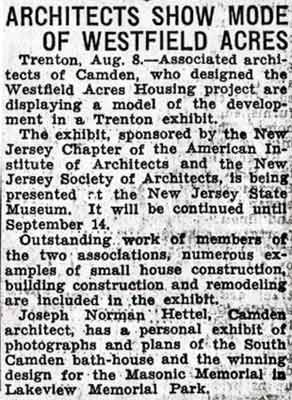
Trenton, Aug. 8.—Associated architects of Camden, who designed the Westfield Acres Housing project are displaying a model of the development in a Trenton exhibit.
The exhibit, sponsored by the New Jersey Chapter of the American Institute of Architects and the New Jersey Society of Architects, is being presented at the New Jersey State Museum. It will be continued until September 14.
Outstanding work of members of the two associations, numerous examples of small house construction, building construction and remodeling are included in the exhibit. Joseph Norman Hettel, Camden architect, has a personal exhibit of photographs and plans of the South Camden bath-house and the winning design for the Masonic Memorial in Lakeview Memorial Park.
$2,489,000 Low Bid on Westfield Acres
Camden Courier-Post —
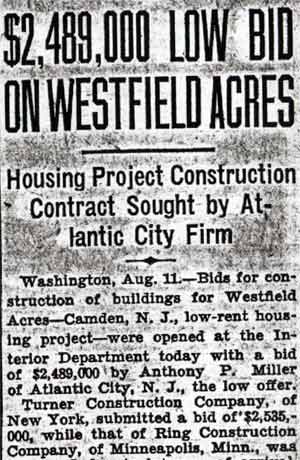
Housing Project Construction Contract Sought by Atlantic City Firm
Washington, Aug. 11.—Bids for construction of buildings for Westfield Acres—Camden, N.J., low-rent housing project—were opened at the Interior Department today with a bid of $2,489,000 by Anthony P. Miller of Atlantic City, N.J., the low offer.
Turner Construction Company, of New York, submitted a bid of $2,535,000, while that of Ring Construction Company, of Minneapolis, Minn. was unopened due to lateness of arrival. It will be opened tomorrow.
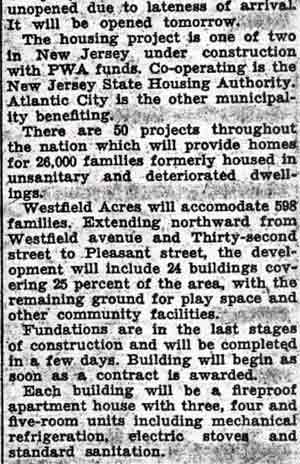
The housing project is one of two in New Jersey under construction with PWA funds. Co-operating is the New Jersey State Housing Authority. Atlantic City is the other municipality benefiting.
There are 50 projects throughout the nation which will provide homes for 26,000 families formerly housed in unsanitary and deteriorated dwellings.
Westfield Acres will accomodate [sic] 598 families. Extending northward from Westfield avenue and Thirty-second street to Pleasant street, the development will include 24 buildings covering 25 percent of the area, with the remaining ground for play space and other community facilities.
Fundations [sic] are in the last stages of construction and will be completed in a few days. Building will begin as soon as a contract is awarded.
Each building will be a fireproof apartment house with three, four and five-room units including mechanical refrigeration, electric stoves and standard sanitation.
Elimination of 20 City Blocks Urged by Housing Committee
Camden Courier-Post —
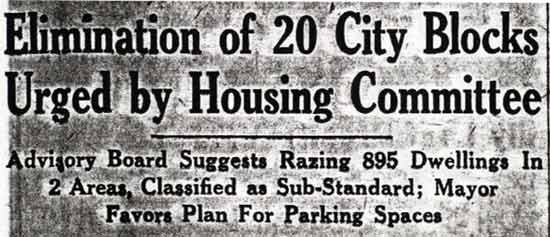
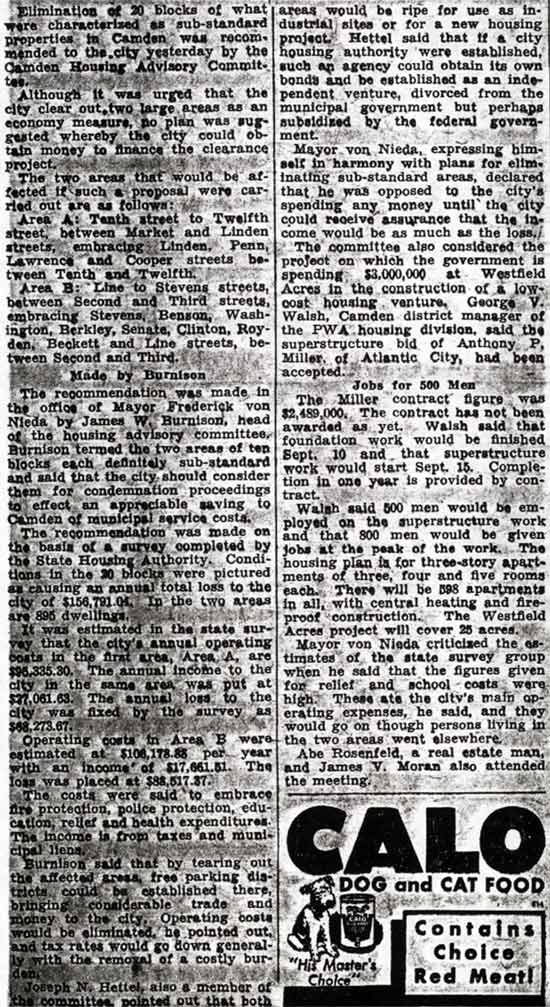
Advisory Board Suggests Razing 895 Dwellings In 2 Areas, Classified as Sub-Standard; Mayor Favors Plan For Parking Spaces
Elimination of 20 blocks of what were characterized as sub-standard properties in Camden was recommended to the city yesterday by the Camden Housing Advisory Committee.
Although it was urged that the city clear out two large areas as an economy measure, no plan was suggested whereby the city could obtain money to finance the clearance project.
The two areas that would be affected if such a proposal were carried out are as follows:
Area A: Tenth street to Twelfth street, between Market and Linden streets, embracing Linden, Penn, Lawrence and Cooper streets between Tenth and Twelfth.
Area B: Line to Stevens streets, between Second and Third streets, embracing Stevens, Benson, Washington, Berkley, Senate, Clinton, Royden, Beckett and Line streets, between Second and Third.
Made by Burnison
The recommendation was made in the office of Mayor Frederick von Nieda, by James W. Burnison, head of the housing advisory committee. Burnison termed the two areas of ten blocks each definitely sub-standard and said that the city should consider them for condemnation proceedings to effect an appreciable saving to Camden of municipal service costs.
The recommendation was made on the basis of a survey completed by the State Housing Authority. Conditions in the 20 blocks were pictured as causing an annual total loss to the city of $156,791.04. In the two areas are 895 dwellings.
It was estimated in the state survey that the city’s annual operating costs in the first area, Area A, are $95,335.30. The annual income to the city in the same area was put at $27,061.63. The annual loss to the city was fixed by the survey as $68,273.67.
Operating costs in Area B were estimated at $106,178.88 per year with an income of $17,661.51. The loss was placed at $88,517.37.
The costs were said to embrace fire protection, police protection, education, relief and health expenditures. The income is from taxes and municipal liens.
Burnison said that by tearing out the affected areas, free parking districts could be established there, bringing considerable trade and money to the city. Operating costs would be eliminated, he pointed out, and tax rates would go down generally with the removal of a costly burden.
Joseph N. Hettel, also a member of the committee, pointed out that both areas would be ripe for use as industrial sites or for a new housing project. Hettel said that if a city housing authority were established, such an agency could obtain its own bonds and be established as an independent venture, divorced from the municipal government but perhaps subsidized by the federal government.
Mayor von Nieda, expressing himself in harmony with plans for eliminating sub-standard areas, declared that he was opposed to the city’s spending any money until the city could receive assurance that the income would be as much as the loss.
The committee also considered the project on which the government is spending $3,000,000 at Westfield Acres in the construction of a low-cost housing venture. George V. Walsh, Camden district manager of the PWA housing division, said the superstructure bid of Anthony P. Miller, of Atlantic City, had been accepted.
Jobs for 500 Men
The Miller contract figure was $2,489,000. The contract has not been awarded as yet. Walsh said that foundation work would be finished Sept. 10 and that superstructure work would start Sept. 15. Completion in one year is provided by contract.
Walsh said 500 men would be employed on the superstructure work and that 800 men would be given jobs at the peak of the work. The housing plan is for three-story apartments of three, four and five rooms each. There will be 598 apartments in all, with central heating and fireproof construction. The Westfield Acres project will cover 25 acres.
Mayor von Nieda criticized the estimates of the state survey group when he said that the figures given for relief and school costs were high. These are the city’s main operating expenses, he said, and they would go on though persons living in the two areas went elsewhere.
Abe Rosenfeld, a real estate man, and James V. Moran also attended the meeting.
Von Nieda Opposes ‘Parking Lot’ Plan
Camden Courier-Post —
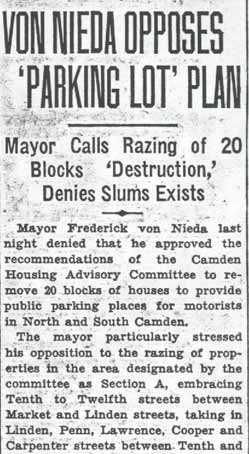
Mayor Calls Razing of 20 Blocks ‘Destruction,’ Denies Slums Exists [sic]
Mayor Frederick von Nieda last night denied that he approved the recommendations of the Camden Housing Advisory Committee to remove 20 blocks of houses to provide public parking places for motorists in North and South Camden.
The mayor particularly stressed his opposition to the razing of properties in the area designated by the committee as Section A, embracing Tenth to Twelfth streets between Market and Linden streets, taking in Linden, Penn, Lawrence, Cooper and Carpenter streets between Tenth and Twelfth strets [sic].
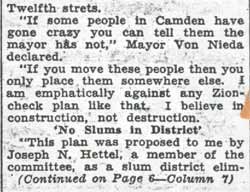
“If some people in Camden have gone crazy you can tell them the mayor has not,” Mayor Von Nieda declared.
“If you move these people then you only place them somewhere else. I am emphatically against any Zioncheck plan like that. I believe in construction, not destruction.”
‘No Slums in District’
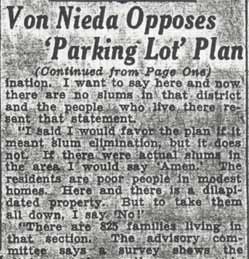
“This plan was proposed to me by Joseph N. Hettel, a member of the committee, as a slum district elimination. I want to say here and now there are no slums in that district and the people who live there resent that statement.
“I said I would favor the plan if it meant slum elimination, but it does not. If there were actual slums in the area I would say ‘Amen.’ The residents are poor people in modest homes. Here and there is a dilapidated property. But to take them all down, I say ‘No!’
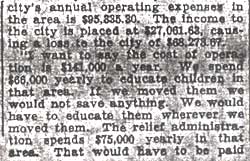
“There are 825 families living in that section. The advisory committee says a survey shows the city’s annual operating expenses in the area is $95,335.30. The income to the city is placed at $27,061.63, causing a loss to the city of $68,273.67.
“I want to say the cost of operation is $141,000 a year. We spend $66,000 yearly to educate children in that area. If we moved them we would not save anything. We would have to educate them wherever we moved them. The relief administration spends $75,000 yearly in that area. That would have to be paid wherever we move them. If the costs of operation were $180,000 that sum would be insignificant.
Wants to Help City Grow
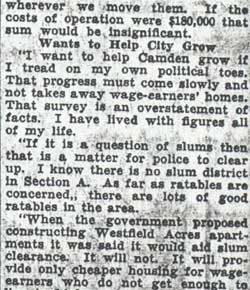
“I want to help Camden grow if I tread on my own political toes. That progress must come slowly and not takes [sic] away wage-earners’ homes. That survey is an overstatement of facts. I have lived with figures all of my life.
“If it is a question of slums then that is a matter for police to clear up. I know there is no slum district in Section A. As far as ratables are concerned, there are lots of good ratables in the area.
“When the government proposed constructing Westfield Acres apartments it was said it would aid slum clearance. It will not. It will provide only cheaper housing for wage-earners who do not get enough to live in higher-priced houses.
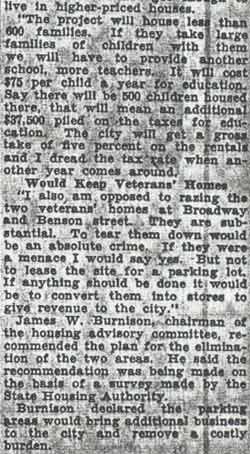
“The project will house less than 600 families. If they take large families of children with them we will have to provide another school, more teachers. It will cost $75 per child a year for education. Say there will be 500 children housed there, that will mean an additional $37,500 piled on the taxes for education. The city will get a gross take of five percent on the rentals and I dread the tax rate when another year comes around.
Would Keep Veterans’ Homes
“I also am opposed to razing the two veterans’ homes at Broadway and Benson street. They are substantial. To tear them down would be an absolute crime. If they were a menace I would say yes. But not to lease the site for a parking lot. If anything should be done it would be to convert them into stores to give revenue to the city.”
James W. Burnison, chairman of the housing advisory committee, recommended the plan for the elimination of the two areas. He said the recommendation was being made on the basis of a survey made by the State Housing Authority.
Burnison declared the parking areas would bring additional business to the city and remove a costly burden.
Camden Group Wins Housing Bills Goal
Camden Courier-Post —
A long and hard-fought campaign to obtain housing bills which will enable New Jersey municipalities to secure Federal funds for slum clearance and low-cost housing resulted in a moral victory for members of the Camden Municipal Low-Cost Housing Committee yesterday.
The local group, which several weeks ago inaugurated a statewide movement to obtain the legislation and to eliminate political chicanery in the legislation, returned last night from Newark after attending a stormy session that lasted more than four hours.
S. Raymond Dobbs, executive secretary of the Camden committee and acting secretary of the state conference of low cost housing committees, said the members of the local and state groups are satisfied with several amendments to be made to the present bills.
Four Housing bills will be presented in the Assembly next Monday night, Dobbs said. They will be introduced by Assemblyman Jennie A. Pilch, of Morris County, chairman of the Assembly housing committee.
Dobbs said Wilensky agreed to limit the authority of the state director of housing, set up in two of the bills, to municipalities under 50,000. Another bill was amended requiring the state director to forward to the U.S. Housing Authority within 20 days all applications for Federal money for slum clearance and low cost housing.
Those representing Camden at the conference besides Dobbs were Charles F. Hollopeter, local committee chairman, and acting chairman of the state group; Commissioner Harold W. Bennett, counsel, and Joseph N. Hettel, technical adviser to the Camden committee, and Horace R. Dixon, committee secretary.
$8,000,000 Fund Sought for Housing
Camden Courier-Post —
A Federal grant of $8,000,000 for slum clearance and two municipal low-cost housing units will be sought by the city of Camden when the State Legislature approves pending bills providing enabling legislation.
This was made known yesterday by Commissioner Frank J. Hartmann, director of public works, who also announced he will present an ordinance at Thursday’s meeting of the City Commission setting up a Camden Municipal Housing Authority.
Present members of the Camden Municipal Low-cost Housing Committee are Charles F. Hollopeter, chairman; Dr. M. F. Wheatland, William H. White, Horace R. Dixon, secretary, and John Green, president of the United Marine and Shipbuilders’ Union of America.
“Camden needs two more low-cost housing units to provide modern, sanitary and adequate housing for its working people,” Hartmann said. “Unless present plans are changed the proposed housing authority will seek a grant of $8,000,000 from the U.S. Housing Authority.”
“This committee has studied housing needs from all angles. Neither politics, race or creed will enter into negotiations in connection with the projects.”
Rentals at Westfield Acres for Those Who Need It
Camden Courier-Post —
Rentals at Westfield Acres, Camden’s $3,000,000 Federal housing project, are within the means of those most in need of decent, low-cost housing and every effort should be made to see that those are the ones who receive the benefit.
As announced in Washington, the rates will be from $23.60 per month for three-room apartments to $32.80 for five rooms. Since these prices include heat, hot water and electricity for lighting, cooking and refrigeration, it is obvious that the three-room tenant will be paying no more than he paid for sub-standard quarters at $15 a month.
Nathan Straus, Federal housing administrator, has laid down the requirements for eligibility of tenants, providing that first consideration be given families of lowest income. His schedule of “conditions of occupancy” makes clear that the entire idea of low-cost housing will be submerged if every precaution is not taken to keep the “chiselers” out.
At Westfield Acres are modern, up-to-date homes for low-salaried workers. Here is a fulfillment of the New Deal’s ambition to improve the living standards of those now “surrounded by dilapidation, primitive conveniences or otherwise unwholesome environment.”
To them Westfield Acres belongs. The family of higher income which well can afford commensurate conveniences at regular private rental has no right to live in Westfield Acres and should not be allowed to deprive a needy, deserving family of its right to these advantage.
Dixon Says Building Program Here Delayed by Legislature
Camden Courier-Post —
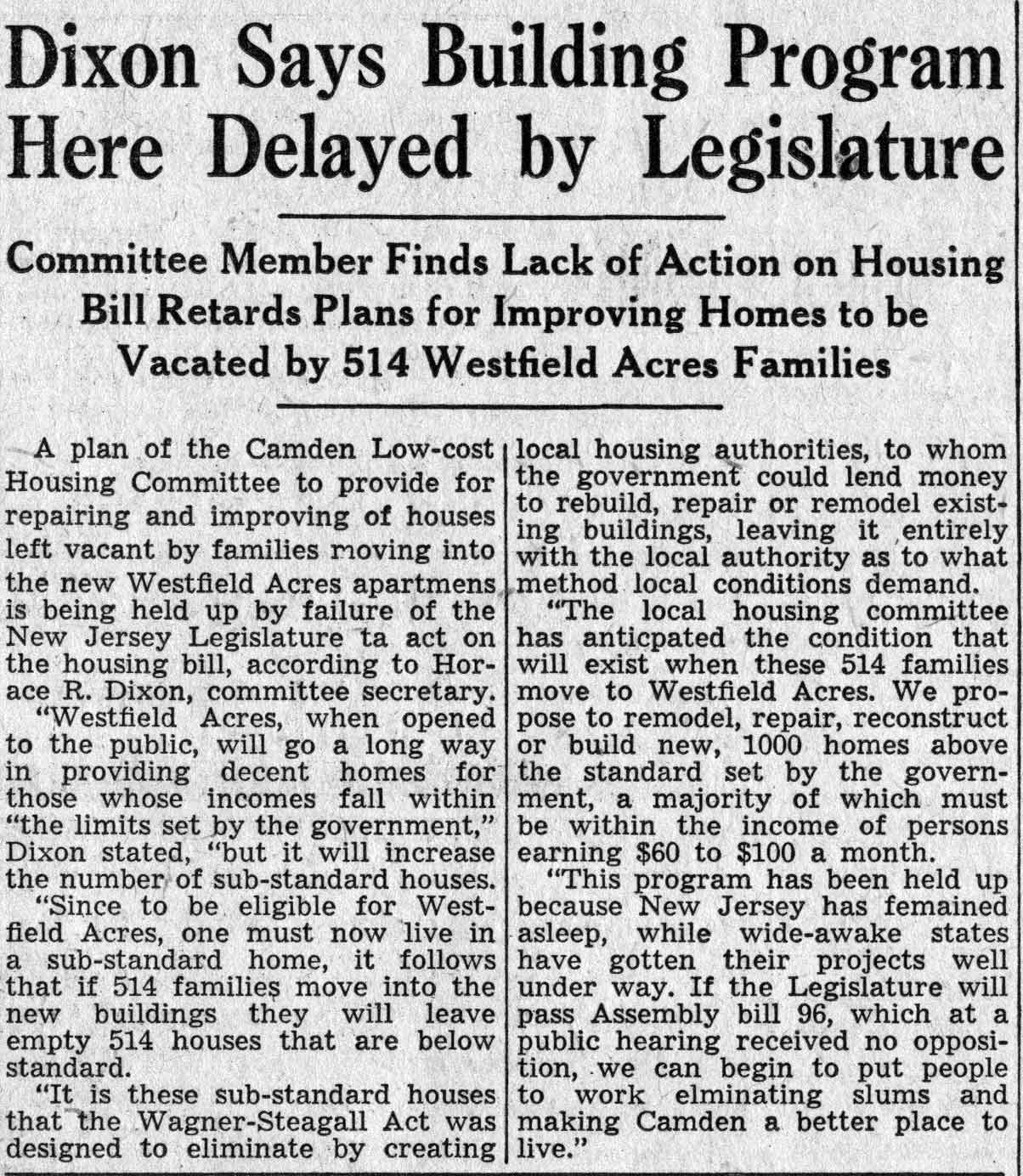
Committee Member Finds Lack of Action on Housing Bill Retards Plans for Improving Homes to be Vacated by 514 Westfield Acres Families
A plan of the Camden Low-cost Housing Committee to provide for repairing and improving of houses left vacant by families moving into the new Westfield Acres apartments is being held up by failure of the New Jersey Legislature to act on the housing bill, according to Horace R. Dixon, committee secretary.
“Westfield Acres, when opened to the public, will go a long way in providing decent homes for those whose incomes fall within “the limits set by the government,” Dixon stated, “but it will increase the number of sub-standard houses.”
“Since to be eligible for Westfield Acres, one must now live in a sub-standard home, it follows that if 514 families move into the new buildings they will leave empty 514 houses that are below standard. It is these sub-standard houses that the Wagner-Steagall Act was designed to eliminate by creating local housing authorities, to whom the government could lend money to rebuild, repair or remodel existing buildings, leaving it entirely with the local authority as to what method local conditions demand.”
“The local housing committee has anticipated the condition that will exist when these 514 families move to Westfield Acres. We propose to remodel, repair, reconstruct or build new, 1000 homes above the standard set by the government, a majority of which must be within the income of persons earning $60 to $100 a month. This program has been held up because New Jersey has remained asleep, while wide-awake states have gotten their projects well under way. If the Legislature will pass Assembly bill 96, which at a public hearing received no opposition, we can begin to put people to work eliminating slums and making Camden a better place to live.”
Dixon Says Need for Housing Grows
Camden Courier-Post —
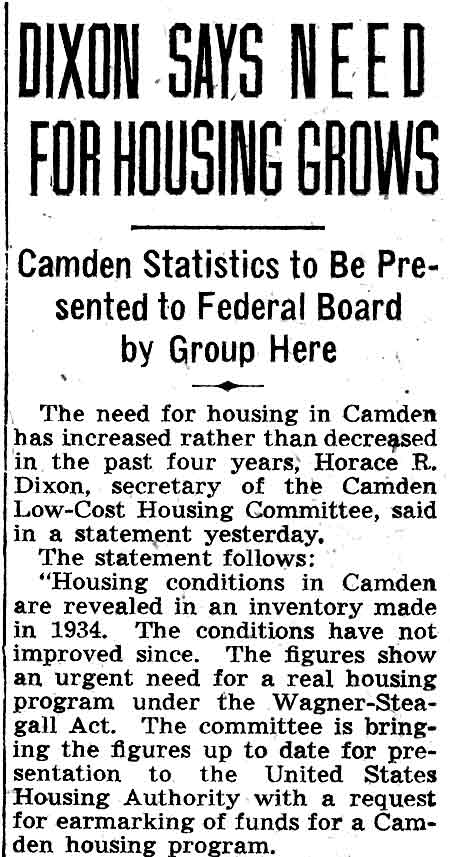
Camden Statistics to Be Presented to Federal Board by Group Here
The need for housing in Camden has increased rather than decreased in the past four years, Horace R. Dixon, secretary of the Camden Low-Cost Housing Committee, said in a statement yesterday.
The statement follows:
“Housing conditions in Camden are revealed in an inventory made in 1934. The conditions have not improved since. The figures show an urgent need for a real housing program under the Wagner-Steagall Act. The committee is bringing the figures up to date for presentation to the United States Housing Authority with a request for earmarking of funds for a Camden housing program.
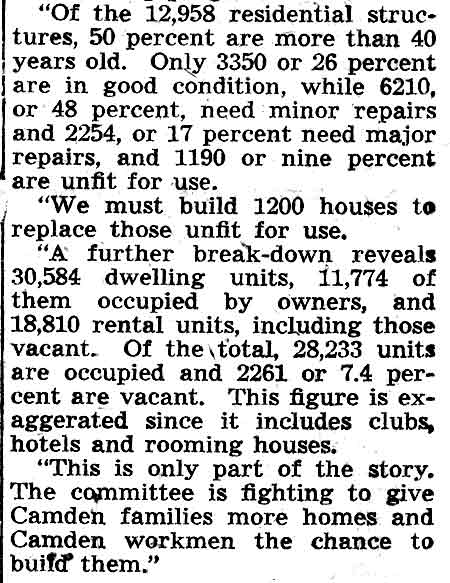
“Of the 12,958 residential structures, 50 percent are more than 40 years old. Only 3350 or 26 percent are in good condition, while 6210, or 48 percent, need minor repairs and 2254, or 17 percent need major repairs, and 1190 or nine percent are unfit for use.
“We must build 1200 houses to replace those unfit for use.
“A further break-down reveals 30,584 dwelling units, 11,774 of them occupied by owners, and 18,810 rental units, including those vacant. Of the total, 28,233 units are occupied and 2261 or 7.4 percent are vacant. This figure is exaggerated since it includes clubs, hotels and rooming houses.
“This is only part of the story. The committee is fighting to give Camden families more homes and Camden workmen the chance to build them.”
Dixon Will Ask U. S. to Advance $73,000 for Housing Board
Camden Courier-Post —
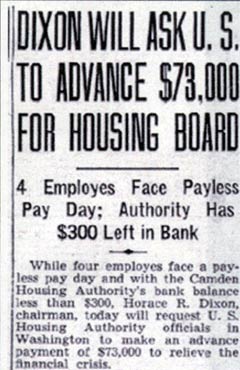
4 Employees Face Payless Pay Day; Authority Has $300 Left in Bank
While four employees face a payless pay day and with the Camden Housing Authority’s bank balance less than $300, Horace R. Dixon, chairman, today will request U. S. Housing Authority officials in Washington to make an advance payment of $73,000 to relieve the financial crisis.
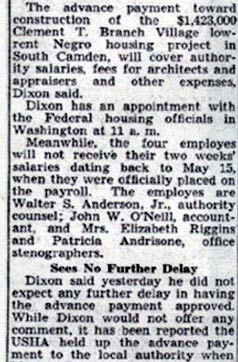
The advance payment toward construction of the $1,423,000 Clement T. Branch Village low-rent Negro housing project in South Camden, will cover authority salaries, fees for architects and appraisers and other expenses, Dixon said.
Dixon has an appointment with the Federal housing officials in Washington at 11 a. m.
Meanwhile, the four employees will not receive their two weeks’ salaries dating back to May 15, when they were officially placed on the payroll. The employees are Walter S. Anderson, Jr., authority counsel; John W. O’Neill, accountant, and Mrs. Elizabeth Riggins and Patricia Andrisone, office stenographers.
Sees No Further Delay
Dixon said yesterday he did not expect any further delay in having the advance payment approved. While Dixon would not offer any comment, it has been reported the USHA held up the advance payment to the local authority when [cut off between the crops]
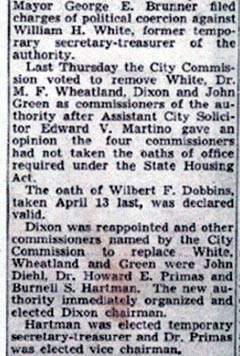
Mayor George E. Brunner filed charges of political coercion against William H. White, former temporary secretary-treasurer of the authority.
Last Thursday the City Commission voted to remove White, Dr. M. F. Wheatland, Dixon and John Green as commissioners of the authority after Assistant City Solicitor Edward V. Martino gave an opinion the four commissioners had not taken the oaths of office required under the State Housing Act.
The oath of Wilbert F. Dobbins, taken April 13 last, was declared valid.
Dixon was reappointed and other commissioners named by the City Commission to replace White, Wheatland and Green were John Diehl, Dr. Howard E. Primas and Burnell S. Hartman. The new authority immediately organized and elected Dixon chairman.
Hartman was elected temporary secretary-treasurer and Dr. Primas was elected vice chairman.
Hearing Delayed
Charges filed by the Mayor against White were to have been heard last Thursday, but due to a legal technicality the hearing was postponed until 2 p. m., June 8.
White was charged with threatening tenants of Westfield Acres with eviction when they were said to have refused to vote for former Commissioner Frank J. Hartmann who was defeated for re-election May 9. White categorically denied the charges.
The local authority manages Westfield Acres under a contract with the USHA. However, funds of the East Camden project are set up in a separate account and can be used only for its management.
At a recent meeting Anderson gave an opinion the authority commissioners can borrow from the Westfield Acres account to meet payroll demands. The money borrowed, he said, could be returned when the authority receives the first payment on the South Camden housing project.
The next regular meeting of the authority is scheduled for June 14. Dixon said a special meeting will be called before then.
Housing Unit Reorganizes to Get Funds
Camden Courier-Post —

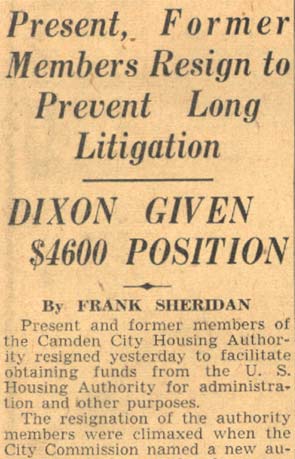
Present, Former Members Resign to Prevent Long Litigation
Dixon Given $4600 Position
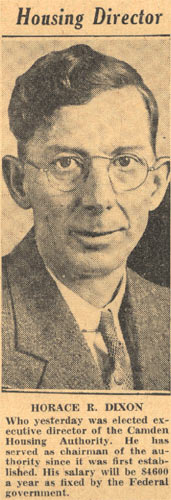
Housing Director
HORACE R. DIXON Who yesterday was elected executive director of the Camden Housing Authority. He has served as chairman of the authority since it was first established. His salary will be $4600 a year as fixed by the Federal government.
Present and former members of the Camden City Housing Authority resigned yesterday to facilitate obtaining funds from the U. S. Housing Authority for administration and other purposes.
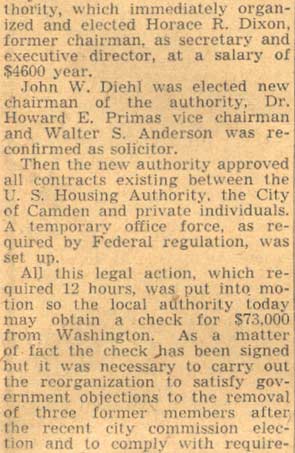
The resignation of the authority members were climaxed when the City Commission named a new authority, which immediately organized and elected Horace R. Dixon, former chairman, as secretary and executive director, at a salary of $4600 year.
John W. Diehl was elected new chairman of the authority, Dr. Howard E. Primas vice chairman and Walter S. Anderson was reconfirmed as solicitor.
Then the new authority approved all contracts existing between the U. S. Housing Authority, the City of Camden and private individuals. A temporary office force, as required by Federal regulation, was set up.
All this legal action, which required 12 hours, was put into motion so the local authority today may obtain a check for $73,000 from Washington. As a matter of fact the check has been signed but it was necessary to carry out the reorganization to satisfy government objections to the removal of three former members after the recent city commission election and to comply with requirements of the Federal housing setup.
New Job Created
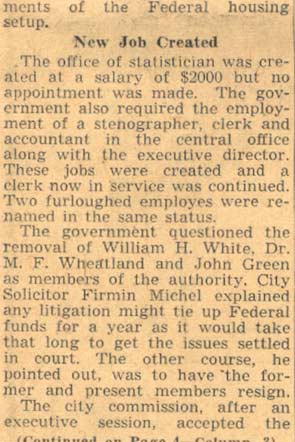
The office of statistician was created at a salary of $2000 but no appointment was made. The government also required the employment of a stenographer, clerk and accountant in the central office along with the executive director. These jobs were created and a clerk now in service was continued. Two furloughed employes were renamed in the same status.
The government questioned the removal of William H. White, Dr. M. F. Wheatland and John Green as members of the authority. City Solicitor Firmin Michel explained any litigation might tie up Federal funds for a year as it would take that long to get the issues settled in court. The other course, he pointed out, was to have the former and present members resign. The city commission, after an executive session, accepted the
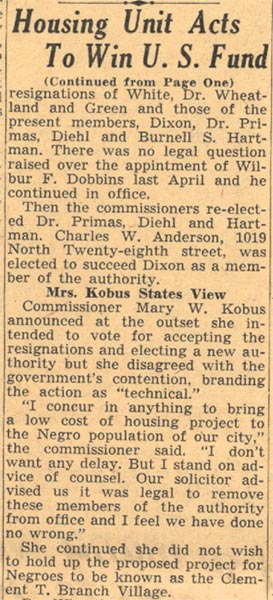
resignations of White, Dr. Wheatland and Green and those of the present members, Dixon, Dr. Primas, Diehl and Burnell S. Hartman. There was no legal question raised over the appintment [sic] of Wilbur F. Dobbins last April and he continued in office.
Then the commissioners re-elected Dr. Primas, Diehl and Hartman. Charles W. Anderson, 1019 North Twenty-eighth street, was elected to succeed Dixon as a member of the authority.
Mrs. Kobus States View
Commissioner Mary W. Kobus announced at the outset she intended to vote for accepting the resignations and electing a new authority but she disagreed with the government’s contention, branding the action as “technical.”
“I concur in anything to bring a low cost of housing project to the Negro population of our city,” the commissioner said. “I don’t want any delay. But I stand on advice of counsel. Our solicitor advised us it was legal to remove these members of the authority from office and I feel we have done no wrong.”
She continued she did not wish to hold up the proposed project for Negroes to be known as the Clement T. Branch Village.
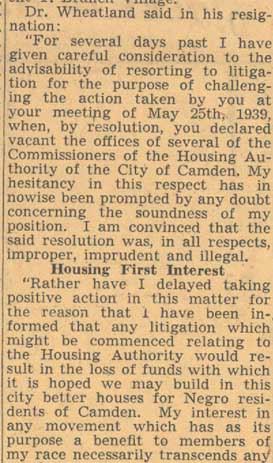
Dr. Wheatland said in his resignation:
“For several days past I have given careful consideration to the advisability of resorting to litigation for the purpose of challenging the action taken by you at your meeting of May 25th, 1939, when, by resolution, you declared vacant the offices of several of the Commissioners of the Housing Authority of the City of Camden. My hesitancy in this respect has in nowise been prompted by any doubt concerning the soundness of my position. I am convinced that the said resolution was, in all respects, improper, imprudent and illegal.
Housing First Interest
“Rather have I delayed taking positive action in this matter for the reason that I have been informed that any litigation which might be commenced relating to the Housing Authority would result in the loss of funds with which it is hoped we may build in this city better houses for Negro residents of Camden. My interest in any movement which has as its purpose a benefit to members of my race necessarily transcends any purely personal consideration I may have.
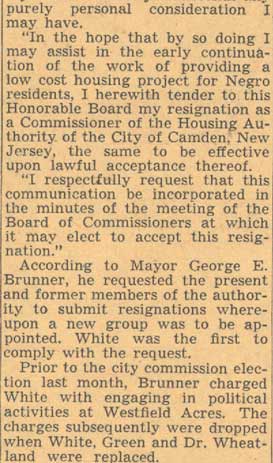
“In the hope that by so doing I may assist in the early continuation of the work of providing a low cost housing project for Negro residents, I herewith tender to this Honorable Board my resignation as a Commissioner of the Housing Authority of the City of Camden, New Jersey, the same to be effective upon lawful acceptance thereof.
“I respectfully request that this communication be incorporated in the minutes of the meeting of the Board of Commissioners at which it may elect to accept this resignation.”
According to Mayor George E. Brunner, he requested the present and former members of the authority to submit resignations whereupon a new group was to be appointed. White was the first to comply with the request.
Prior to the city commission election last month, Brunner charged White with engaging in political activities at Westfield Acres. The charges subsequently were dropped when White, Green and Dr. Wheatland were replaced.
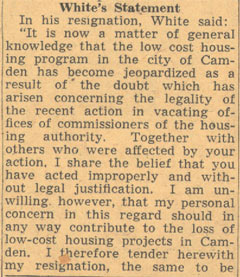
White’s Statement
In his resignation, White said:
“It is now a matter of general knowledge that the low cost housing program in the city of Camden has become jeopardized as a result of the doubt which has arisen concerning the legality of the recent action in vacating offices of commissioners of the housing authority. Together with others who were affected by your action, I share the belief that you have acted improperly and without legal justification. I am unwilling, however, that my personal concern in this regard should in any way contribute to the loss of low-cost housing projects in Camden. I therefore tender herewith my resignation, the same to be [cut off at the crop edge]
Housing Board Acts to Get First Loan for New Project
Camden Courier-Post —
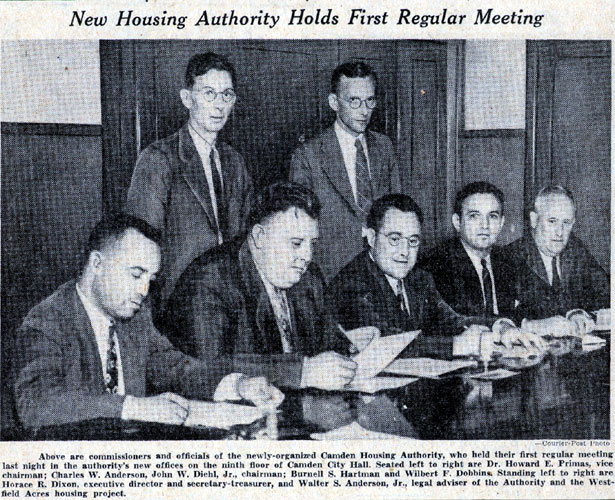

Housing Authority commissioners, June 30, 1939.
Housing Board Acts to Get First Loan for New Project
Camden Courier-Post —
$65,000 Accepted to Cover Expenses Incurred for Salaries and Fees
Holding its first regular meeting since its re-organization, the Camden Housing Authority acted last night to obtain the initial advance loan payment from the U. S. Housing Authority to construct the Clement T. Branch Village low-rent housing project for South Camden Negroes.
A resolution was adopted authorizing John W. Diehl, Jr., authority chairman, and Horace R. Dixon, executive director and secretary-treasurer, to accept a check for $65,000, covering the initial loan payment at the Federal Reserve Bank, in Philadelphia and deposit it with the First Camden National Bank and Trust Company.
The payment is the first of $1,000,000 in advance loan notes authorized by the USHA for use of the Camden authority. The amount will cover expenses already incurred for architect, engineers, legal and survey fees, in addition to salaries of employees other than the authority commissioners, and for other expenditures.
Payment Reduced
Originally the initial payment was $73,000, but the amount was reduced and the difference will be made up with the payment of the second allotment to the authority, Walter S. Anderson, Jr., legal adviser, explained.
In compliance with regulations of the State Housing Authority, Dixon was named secretary-treasurer at no additional salary. Dixon will receive $4600 annually as executive director. Commissioner Burnell S. Hartman had been acting as temporary secretary-treasurer.
Another resolution was adopted authorizing Diehl and Dixon to sign all checks and vouchers.
The commissioners also voted to place all employees of Westfield Acres, a housing project managed by the board, and other employees of the authority, on a work week of 40 hours. Adjusted hourly wage scales also were approved. Both will be effective beginning July 16.
Drop Temporary Titles
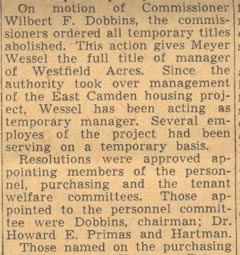
On motion of Commissioner Wilbert F. Dobbins, the commissioners ordered all temporary titles abolished. This action gives Meyer Wessel the full title of manager of Westfield Acres. Since the authority took over management of the East Camden housing project, Wessel has been acting as temporary manager. Several employes of the project had been serving on a temporary basis.
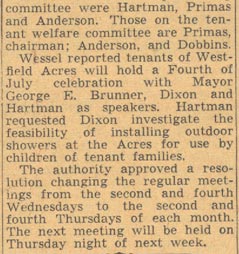
Resolutions were approved appointing members of the personnel, purchasing and the tenant welfare committees. Those appointed to the personnel committee were Dobbins, chairman; Dr. Howard E. Primas and Hartman. Those named on the purchasing committee were Hartman, Primas and Anderson. Those on the tenant welfare committee are Primas, chairman; Anderson, and Dobbins.
Wessel reported tenants of Westfield Acres will hold a Fourth of July celebration with Mayor George E. Brunner, Dixon and Hartman as speakers. Hartman requested Dixon investigate the feasibility of installing outdoor showers at the Acres for use by children of tenant families.
The authority approved a resolution changing the regular meetings from the second and fourth Wednesdays to the second and fourth Thursdays of each month. The next meeting will be held on Thursday night of next week.
The Housing Authority Board, 1940s

Named: From left: Unknown, Wilbert F. Dobbins, Horace Dixon, Bartholomew Sheehan, Dr. Howard E. Primas Sr., and Unknown..
The Housing Authority successfully completed the new project, known as Clement T. Branch Village. The demand for wartime housing for defense workers gave impetus to the Housing Authority building two more projects, William Stanley Ablett Village and Chelton Terrace.
Up until 1943 Horace R. Dixon was the Executive Director at the Housing Authority of the City of Camden. In 1943 Edward J. Kelleher was named Executive Director, a post he would hold until his resignation in March of 1945. It was during his tenure that Chelton Terrace was completed and dedicated.
Housing Plans in East Camden Okayed by U.S.
Camden Courier-Post —
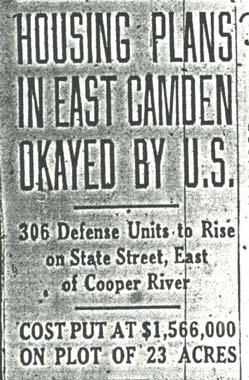
306 Defense Units to Rise on State Street, East of Cooper River — Cost Put at $1,566,000 on Plot of 23 Acres
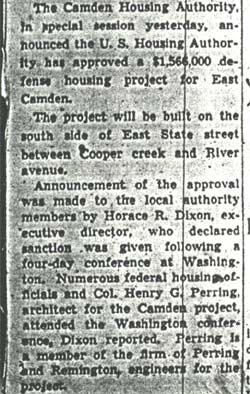
The Camden Housing Authority, in special session yesterday, announced the U.S. Housing Authority has approved a $1,566,000 defense housing project for East Camden.
The project will be built on the south side of East State street between Cooper creek and River avenue.
Announcement of the approval was made to the local authority members by Horace R. Dixon, executive director, who declared sanction was given following a four-day conference at Washington. Numerous federal housing officials and Col. Henry G. Perring, architect for the Camden project, attended the Washington conference, Dixon reported. Perring is a member of the firm of Perring and Remington, engineers for the project.
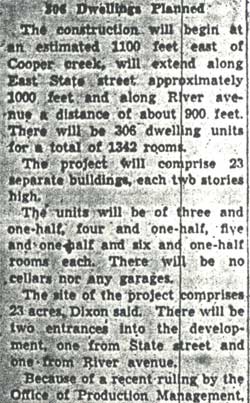
306 Dwellings Planned
The construction will begin at an estimated 1100 feet east of Cooper creek, will extend along East State street approximately 1000 feet and along River avenue a distance of about 900 feet. There will be 306 dwelling units for a total of 1342 rooms.
The project will comprise 23 separate buildings, each two stories high.
The units will be of three and one-half, four and one-half, five and one-half and six and one-half rooms each. There will be no cellars nor any garages.
The site of the project comprises 23 acres, Dixon said. There will be two entrances into the development, one from State street and one from River avenue.
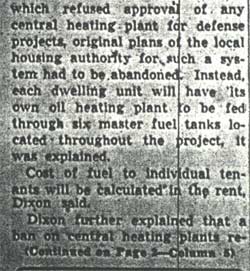
Because of a recent ruling by the Office of Production Management which refused approval of any central heating plant for defense projects, original plans of the local housing authority for such a system had to be abandoned. Instead, each dwelling unit will have its own oil heating plant to be fed through six master fuel tanks located throughout the project, it was explained.
Cost of fuel to individual tenants will be calculated in the rent, Dixon said.
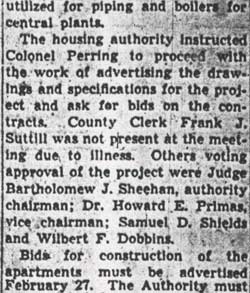
Dixon further explained that a ban on central heating plants resulted from a shortage of cast iron, steel and wrought iron which is utilized for piping and boilers for central plants.
The housing authority instructed Colonel Perring to proceed with the work of advertising the drawings and specifications for the project and ask for bids on the contracts. County Clerk Frank J. Suttill was not present at the meeting due to illness. Others voting approval of the project were Judge Bartholomew J. Sheehan, authority chairman; Dr. Howard E. Primas, vice chairman; Samuel D. Shields and Wilbert F. Dobbins.
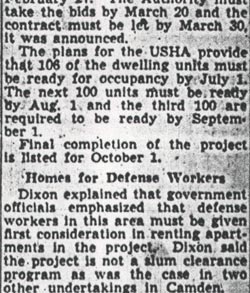
Bids for construction of the apartments must be advertised February 27. The Authority must take the bids by March 20 and the contract must be let by March 30, it was announced.
The plans for the USHA provide that 106 of the dwelling units must be ready for occupancy by July 1. The next 100 units must be ready by Aug. 1, and the third 100 are required to be ready by September 1. Final completion of the project is listed for October 1.
Homes for Defense Workers
Dixon explained that government officials emphasized that defense workers in this area must be given first consideration in renting apartments in the project. Dixon said the project is not a slum clearance program as was the case in two other undertakings in Camden.
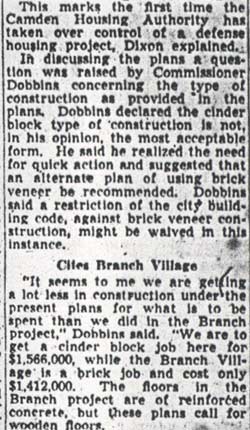
This marks the first time the Camden Housing Authority has taken over control of a defense housing project, Dixon explained.
In discussing the plans a question was raised by Commissioner Dobbins concerning the type of construction as provided in the plans. Dobbins declared the cinder block type of construction is not, in his opinion, the most acceptable form. He said he realized the need for quick action and suggested that an alternate plan of using brick veneer be recommended. Dobbins said a restriction of the city building code, against brick veneer construction, might be waived in this instance.
Cites Branch Village
“It seems to me we are getting a lot less in construction under the present plans for what is to be spent than we did in the Branch project,” Dobbins said. “We are to get a cinder block job here for $1,566,000, while the Branch Village is a brick job and cost only $1,412,000. The floors in the Branch project are of reinforced concrete, but these plans call for wooden floors.
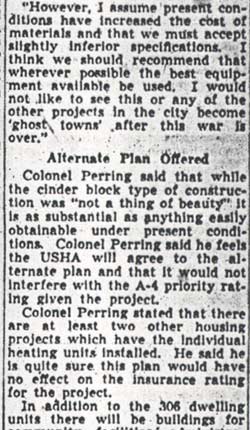
“However, I assume present conditions have increased the cost of materials and that we must accept slightly inferior specifications. I think we should recommend that wherever possible the best equipment available be used. I would not like to see this or any of the other projects in the city become ‘ghost towns’ after this war is over.”
Alternate Plan Offered
Colonel Perring said that while the cinder block type of construction was “not a thing of beauty” it is as substantial as anything easily obtainable under present conditions. Colonel Perring said he feels the USHA will agree to the alternate plan and that it would not interfere with the A-4 priority rating given the project.
Colonel Perring stated that there are at least two other projects which have the individual heating units installed. He said he is quite sure this plan would have no effect on the insurance rating for the project.
In addition to the 306 dwelling units there will be buildings for community facilities, administration, project service and storage, Col. Perring said.
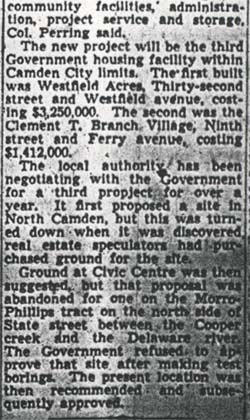
The new project will be the third Government housing facility within Camden City limits. The first built was Westfield Acres, Thirty-second street and Westfield avenue, costing $3,250,000. The second was the Clement T. Branch Village, Ninth street and Ferry avenue, costing $1,412,000.
The local authority has been negotiating with the Government for a third project for over a year. It first proposed a site in North Camden, but this was turned down when it was discovered real estate speculators had purchased ground for the site.
Ground at Civic Centre was then suggested, but that proposal was abandoned for one on the Morro-Phillips tract on the north side of State street between the Cooper creek and the Delaware river. The Government refused to approve that site after making test borings. The present location was then recommended and subsequently approved.
Dedication of Chelton Terrace
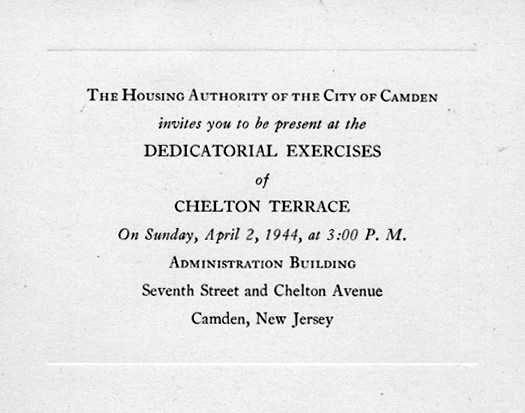
Invitation to the dedication of Chelton Terrace, April 2, 1944.
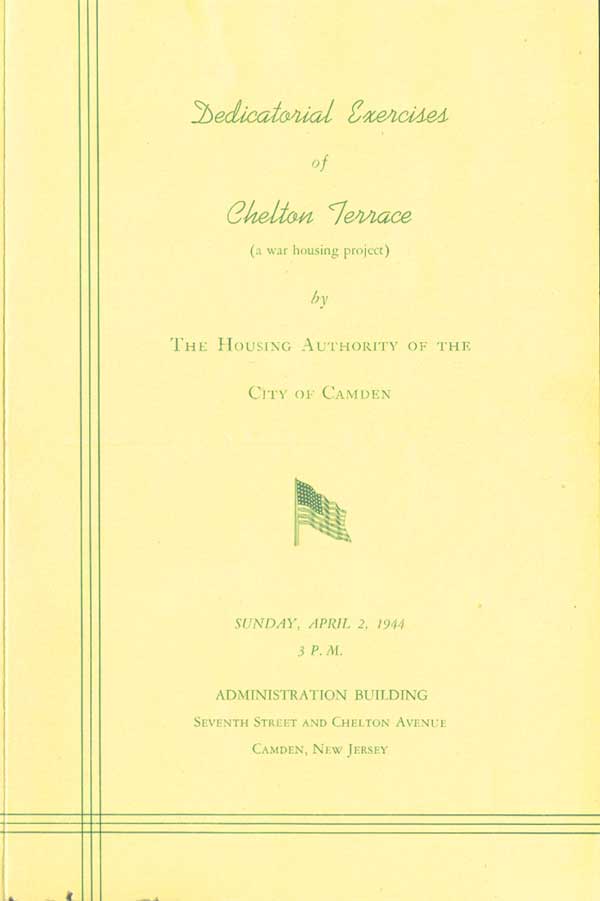
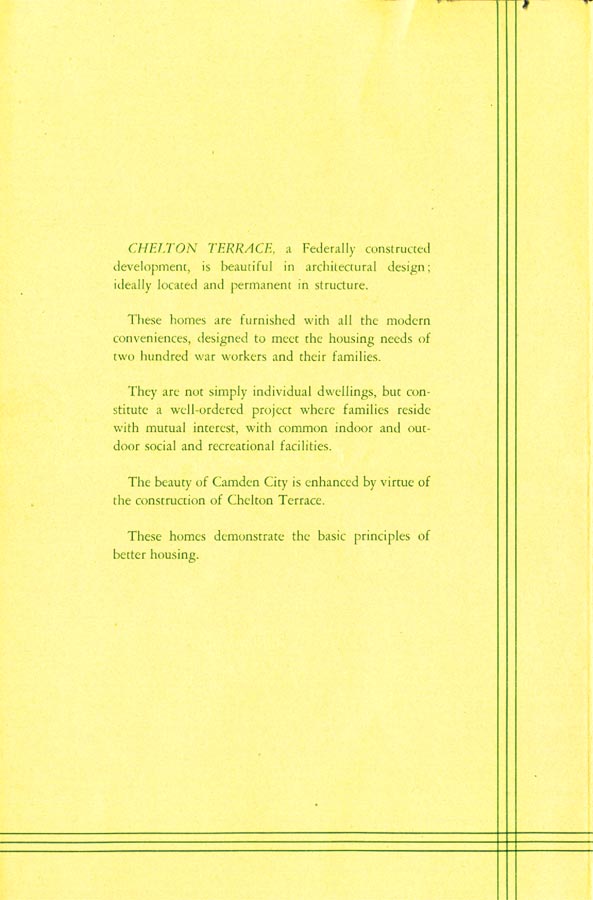
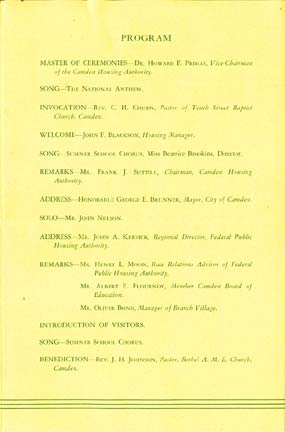
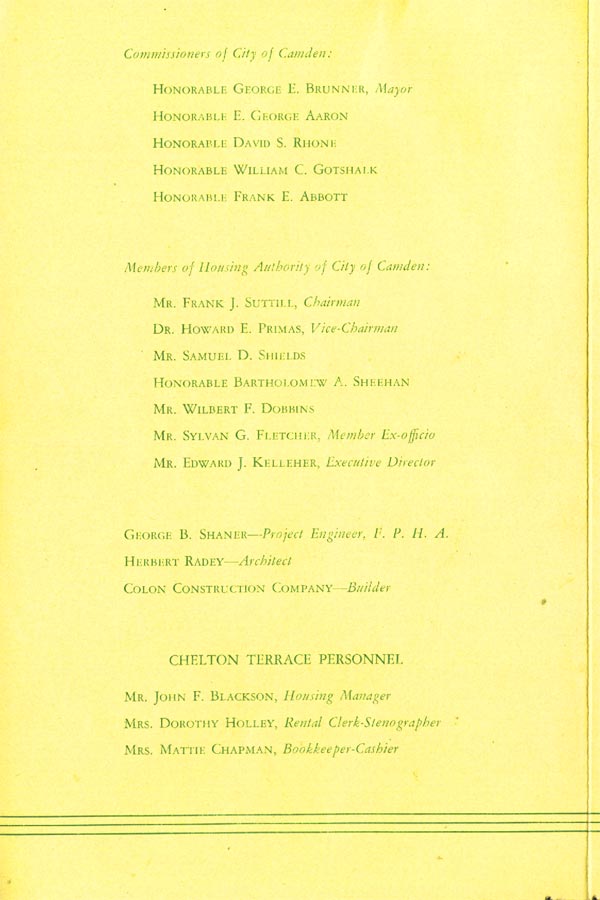
Four-page dedication program for Chelton Terrace, April 2, 1944.
Housing Authority Will Be Asked to Aid Big Families
Camden Courier-Post —
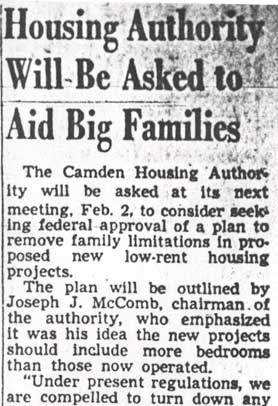
The Camden Housing Authority will be asked at its next meeting, Feb. 2, to consider seeking federal approval of a plan to remove family limitations in proposed new low-rent housing projects.
The plan will be outlined by Joseph J. McComb, chairman of the authority, who emphasized it was his idea the new projects should include more bedrooms than those now operated.
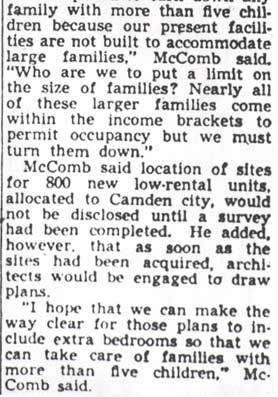
“Under present regulations, we are compelled to turn down any family with more than five children because our present facilities are not built to accommodate large families,” McComb said. “Who are we to put a limit on the size of families? Nearly all of these larger families come within the income brackets to permit occupancy but we must turn them down.”
McComb said location of sites for 800 new low-rental units, allocated to Camden city, would not be disclosed until a survey had been completed. He added, however, that as soon as the sites had been acquired, architects would be engaged to draw plans.
“I hope that we can make the way clear for those plans to include extra bedrooms so that we can take care of families with more than five children,” McComb said.
Harker Appointed To Conduct Survey For Housing Unit
Camden Courier-Post —
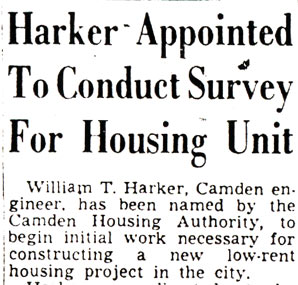
William T. Harker, Camden engineer, has been named by the Camden Housing Authority, to begin initial work necessary for constructing a new low-rent housing project in the city.
Harker was directed at the authority’s meeting Thursday night to make surveys, test borings, soundings and topographical maps of the housing site. Location where the homes will be constructed cannot be revealed at this time, Joseph J. McComb, chairman, announced.
The initial work will be financed with federal funds for which the housing authority applied several months ago. First payments for the surveys have been received from the government, William F. Barnett, authority executive director, said.
The plans call for construction of 800 homes which are to replace slums.
Approval of erection of a newspaper vending stand at Ablett Village was authorized by the authority on motion of Wilbur F. Dobbins.
The stand will be used by Miss Cora Gideon, 50, of 588 Berkley street, who is blind, Dobbins explained. She will pay $1 a month as rent for the stand.
Materials and labor will be supplied by AFL unions without additional cost to the housing authority, Dobbins said.
400 Housing Units To Be Added Near Present Projects
Camden Courier-Post —
Four hundred low-rent dwellings, half the number allocated to the city by the U. S. Public Housing Administration, will be constructed this year on land near the four presently owned projects, Joseph J. McComb, chairman of the Camden Housing Authority, announced Sunday night.
Several factors entered into the decision of housing authority to construct the homes on available land, McComb said. First, he declared, the city will receive revenue in lieu of taxes from unimproved ground yielding little or no taxes, based on 10 percent of shelter rentals, less utilities.
The four projects now operated by the authority are: Westfield Acres, Thirty-first street and Westfield avenue, 514 units, cost $3,250,000, opened 1938; Clement T. Branch Village, Ninth street and Ferry avenue, 279 units, cost $1,416,000, opened 1941; William Stanley Ablett Village, River road and State street, 306 units, cost $1,722,000, open in 1943, and Chelton Terrace, Bulson and Phillips streets, 200 units, cost $800,000, open 1944.
No Added Utilities Needed
McComb also explained that at present, the city receives only three and one-half percent in lieu of taxes from Westfield Acres, Branch Village and Ablett Village. The return from Chelton Terrace is equivalent to full taxes. Only the new projects, allocated under the Housing Act of 1949, will yield the 10 percent return, McComb pointed out.
No new schools will be needed and no new police, fire, health, electricity or gas utilities will be required to service the homes for low-income families, McComb declared.
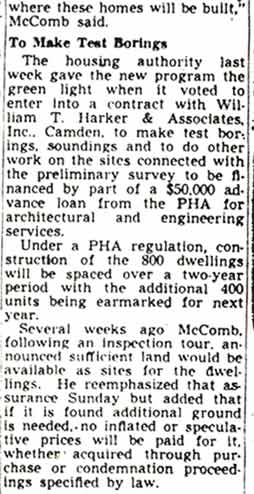
“The city of Camden will not be compelled or obligated to spend money for additional municipal utilities because they are already provided in the respective four sections of the city where these homes will be built,” McComb said.
To Make Test Borings
The housing authority last week gave the new program the green light when it voted to enter into a contract with William T. Harker & Associates, Inc., Camden, to make test borings, soundings and to do other work on the sites connected with the preliminary survey to be financed by part of a $50,000 advance loan from the PHA for architectural and engineering services.
Under a PHA regulation, construction of the 800 dwellings will be spaced over a two-year period with the additional 400 units being earmarked for next year.
Several weeks ago McComb, following an inspection tour, announced sufficient land would be available as sites for the dwellings. He reemphasized that assurance Sunday but added that if it is found additional ground is needed, no inflated or speculative prices will be paid for it, whether acquired through purchase or condemnation proceedings specified by law.
City Will Get $210,000 For Housing
Camden Courier-Post —
Original Request Of $50,000 From U. S. Was Too Low
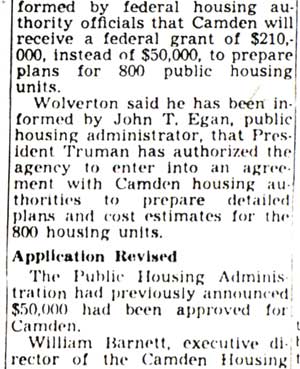
Congressman Wolverton announced today he has been informed by federal housing authority officials that Camden will receive a federal grant of $210,000, instead of $50,000, to prepare plans for 800 public housing units.
Wolverton said he has been informed by John T. Egan, public housing administrator, that President Truman has authorized the agency to enter into an agreement with Camden housing authorities to prepare detailed plans and cost estimates for the 800 housing units.
Application Revised
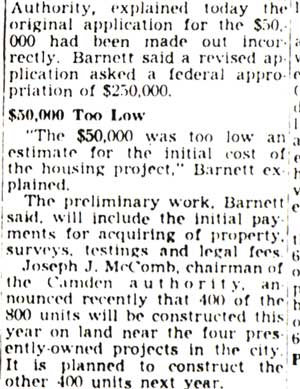
The Public Housing Administration had previously announced $50,000 had been approved for Camden. William Barnett, executive director of the Camden Housing Authority, explained today the original application for the $50,000 had been made out incorrectly. Barnett said a revised application asked a federal appropriation of $250,000.
$50,000 Too Low
“The $50,000 was too low an estimate for the initial cost of the housing project,” Barnett explained. The preliminary work, Barnett said, will include the initial payments for acquiring of property, surveys, testings and legal fees.
Joseph J. McComb, chairman of the Camden authority, announced recently that 400 of the 800 units will be constructed this year on land near the four presently-owned projects in the city. It is planned to construct the other 400 units next year.
City Will Get $7,000 More On Housing
Camden Courier-Post —
By Eugene L. Horan Jr.
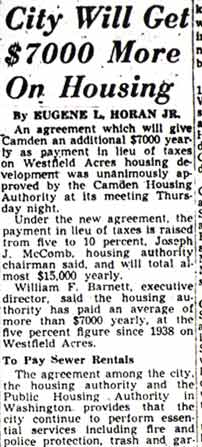
An agreement which will give Camden an additional $7000 yearly as payment in lieu of taxes on Westfield Acres housing development was unanimously approved by the Camden Housing Authority at its meeting Thursday night.
Under the new agreement, the payment in lieu of taxes is raised from five to 10 percent, Joseph J. McComb, housing authority chairman said, and will total almost $15,000 yearly.
William F. Barnett, executive director, said the housing authority has paid an average of more than $7000 yearly, at the five percent figure since 1938 on Westfield Acres.
To Pay Sewer Rentals
The agreement among the city, the housing authority and the Public Housing Authority in Washington provides that the city continue to perform essential services including fire and police protection, trash and garbage collections and school facilities.
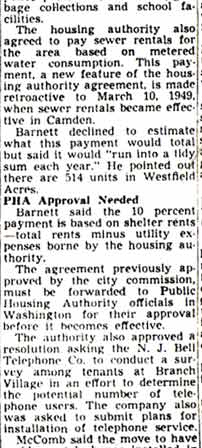
The housing authority also agreed to pay sewer rentals for the area based on metered water consumption. This payment, a new feature of the housing authority agreement, is made retroactive to March 10, 1949, when sewer rentals became effective in Camden.
Barnett declined to estimate what this payment would total but said it would “run into a tidy sum each year.” He pointed out there are 514 units in Westfield Acres.
PHA Approval Needed
Barnett said the 10 percent payment is based on shelter rents—total rents minus utility expenses borne by the housing authority.
The agreement previously approved by the city commission, must be forwarded to Public Housing Authority officials in Washington for their approval before it becomes effective.
The authority also approved a resolution asking the N. J. Bell Telephone Co. to conduct a survey among tenants at Branch Village in an effort to determine the potential number of telephone users. The company also was asked to submit plans for installation of telephone service.
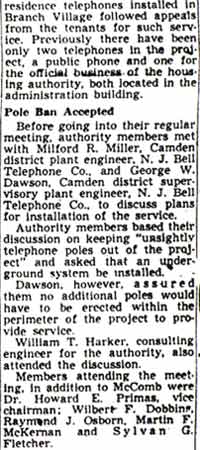
McComb said the move to have residence telephones installed in Branch Village followed appeals from the tenants for such service. Previously there have been only two telephones in the project, a public phone and one for the official business of the housing authority, both located in the administration building.
Pole Ban Accepted
Before going into their regular meeting, authority members met with Milford R. Miller, Camden district plant engineer, N. J. Bell Telephone Co., and George W. Dawson, Camden district supervisory plant engineer, N. J. Bell Telephone Co., to discuss plans for installation of the service.
Authority members based their discussion on keeping “unsightly telephone poles out of the project” and asked that an underground system be installed.
Dawson, however, assured them no additional poles would have to be erected within the perimeter of the project to provide service.
William T. Harker, consulting engineer for the authority, also attended the discussion.
Members attending the meeting, in addition to McComb were Dr. Howard E. Primas, vice chairman; Wilbert F. Dobbins, Raymond J. Osborn, Martin F. McKernan and Sylvan G. Fletcher.
Troiano Appointed As New Member of Housing Authority
Camden Courier-Post —
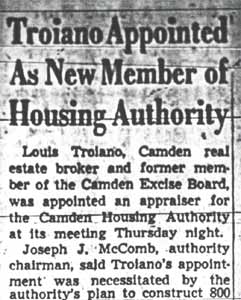
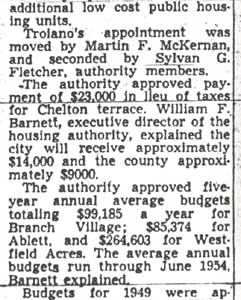
Louis Troiano, Camden real estate broker and former member of the Camden Excise Board, was appointed an appraiser for the Camden Housing Authority at its meeting Thursday night.
Joseph J. McComb, authority chairman, said Troiano’s appointment was necessitated by the authority’s plan to construct 800 additional low cost public housing units.
Troiano’s appointment was moved by Martin F. McKernan, and seconded by Sylvan G. Fletcher, authority members.
The authority approved payment of $23,000 in lieu of taxes for Chelton terrace. William F. Barnett, executive director of the housing authority, explained the city will receive approximately $14,000 and the county approximately $9000.
The authority approved five-year annual average budgets totaling $99,185 a year for Branch Village; $85,374 for Ablett, and $264,603 for Westfield Acres. The average annual budgets run through June 1954, Barnett explained.
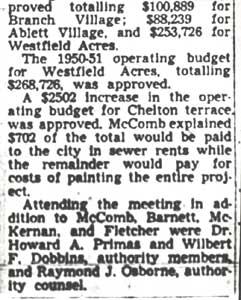
Budgets for 1949 were approved totalling $100,889 for Branch Village; $88,239 for Ablett Village, and $253,726 for Westfield Acres.
The 1950-51 operating budget for Westfield Acres, totalling $268,726, was approved.
A $2502 increase in the operating budget for Chelton terrace was approved. McComb explained $702 of the total would be paid to the city in sewer rents while the remainder would pay for costs of painting the entire project.
Attending the meeting in addition to McComb, Barnett, McKernan, and Fletcher were Dr. Howard A. Primas and Wilbert F. Dobbins, authority members, and Raymond J. Osborne, authority counsel.
When the war ended…
When the war ended, the Housing Authority administered the Civic Center homes, built as temporary housing, which were demolished a few years after the war to make way for the “Camden Connection”, the Federal Street overpass to Mickle Boulevard and Haddon Avenue. The Housing Authority also administered emergency housing throughout the city into the 1950s when the program ended.
In 1949, the Housing Authority applied for funds to build another low-rent housing project. In the end, two more sites were built, McGuire Gardens in East Camden and Roosevelt Manor in the Centerville section of South Camden, both completed by the mid-1950s.
During this time there were bumps in the road at the Authority. The managers at both Chelton Terrace and Clement T. Branch Village were let go for actions inconsistent with their positions. There were heating problems at Westfield Acres, which eventually were solved. Starting in the a conversion from coal to oil and eventually to gas heat took place at the Authority.
Resolution Appointing Joseph J. McComb as Commissioner of the Housing Authority
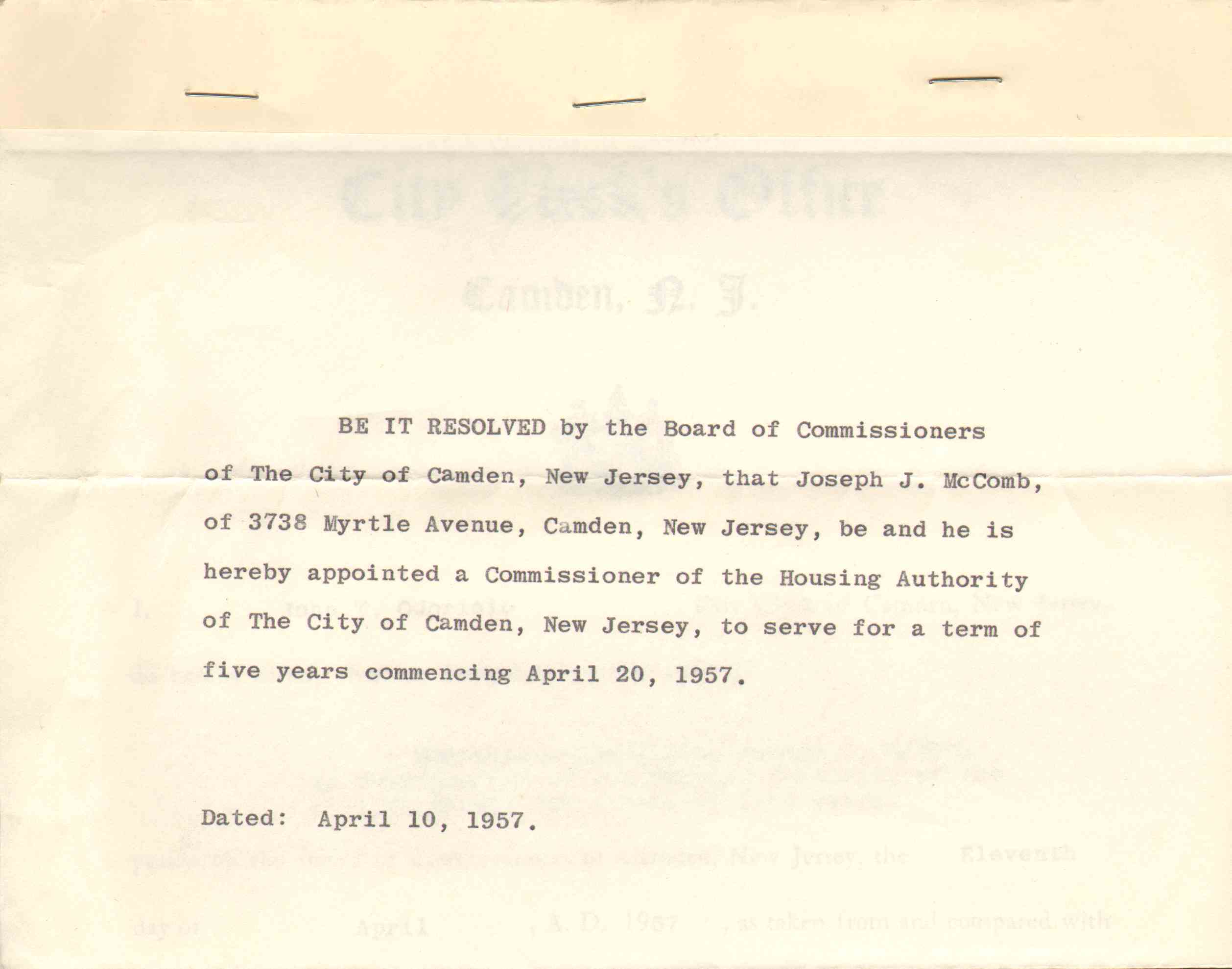
BE IT RESOLVED by the Board of Commissioners of The City of Camden, New Jersey, that Joseph J. McComb, of 3738 Myrtle Avenue, Camden, New Jersey, be and he is hereby appointed a Commissioner of the Housing Authority of The City of Camden, New Jersey, to serve for a term of five years commencing April 20, 1957.
Dated: April 10, 1957.
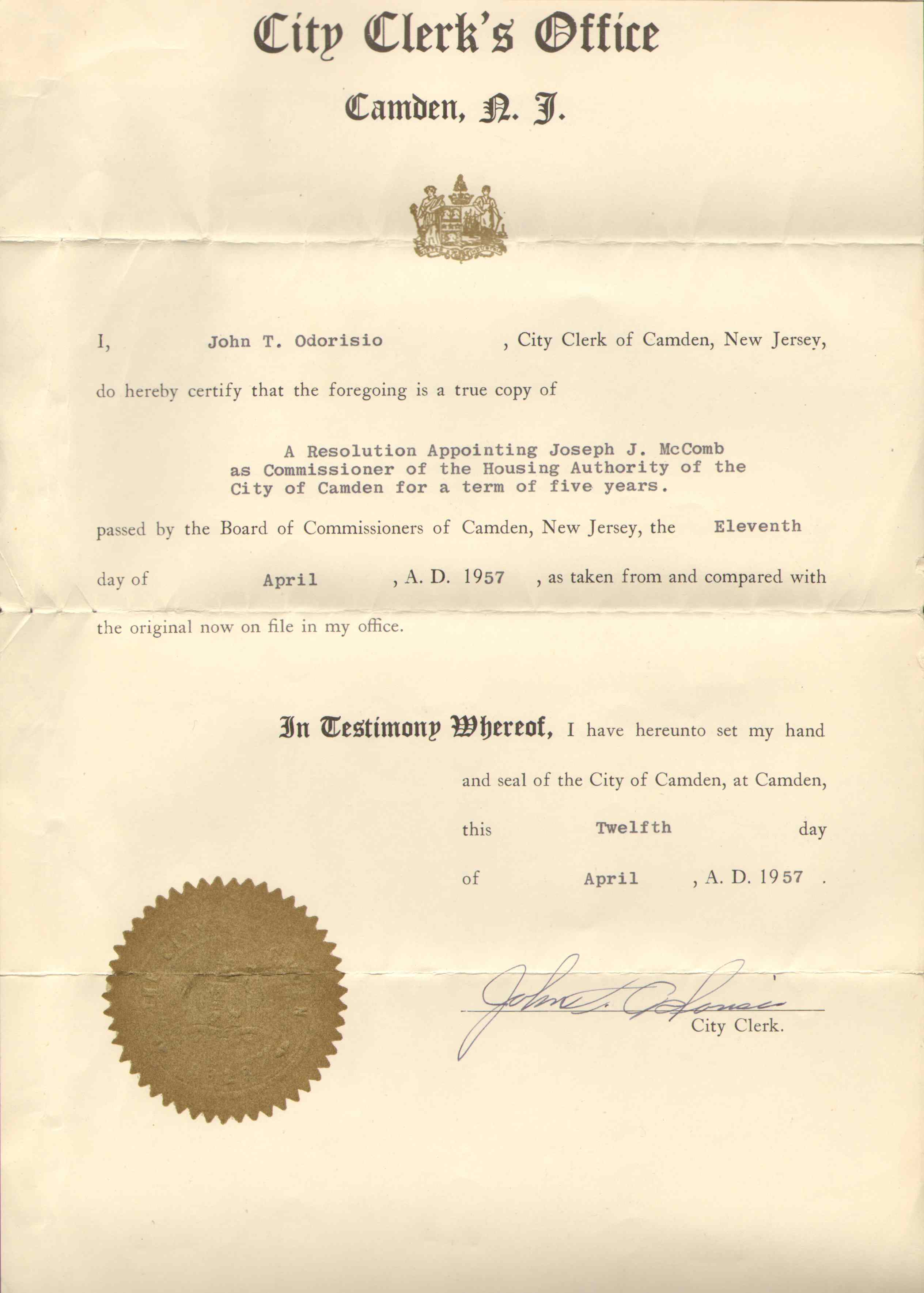
City Clerk’s Office
Camden, N. J.
I, John T. Odorisio, City Clerk of Camden, New Jersey, do hereby certify that the foregoing is a true copy of
A Resolution Appointing Joseph J. McComb as Commissioner of the Housing Authority of the City of Camden for a term of five years.
passed by the Board of Commissioners of Camden, New Jersey, the Eleventh day of April, A. D. 1957, as taken from and compared with the original now on file in my office.
In Testimony Whereof, I have hereunto set my hand and seal of the City of Camden, at Camden, this Twelfth day of April, A. D. 1957.
[Signature] City Clerk.
Oath of Allegiance
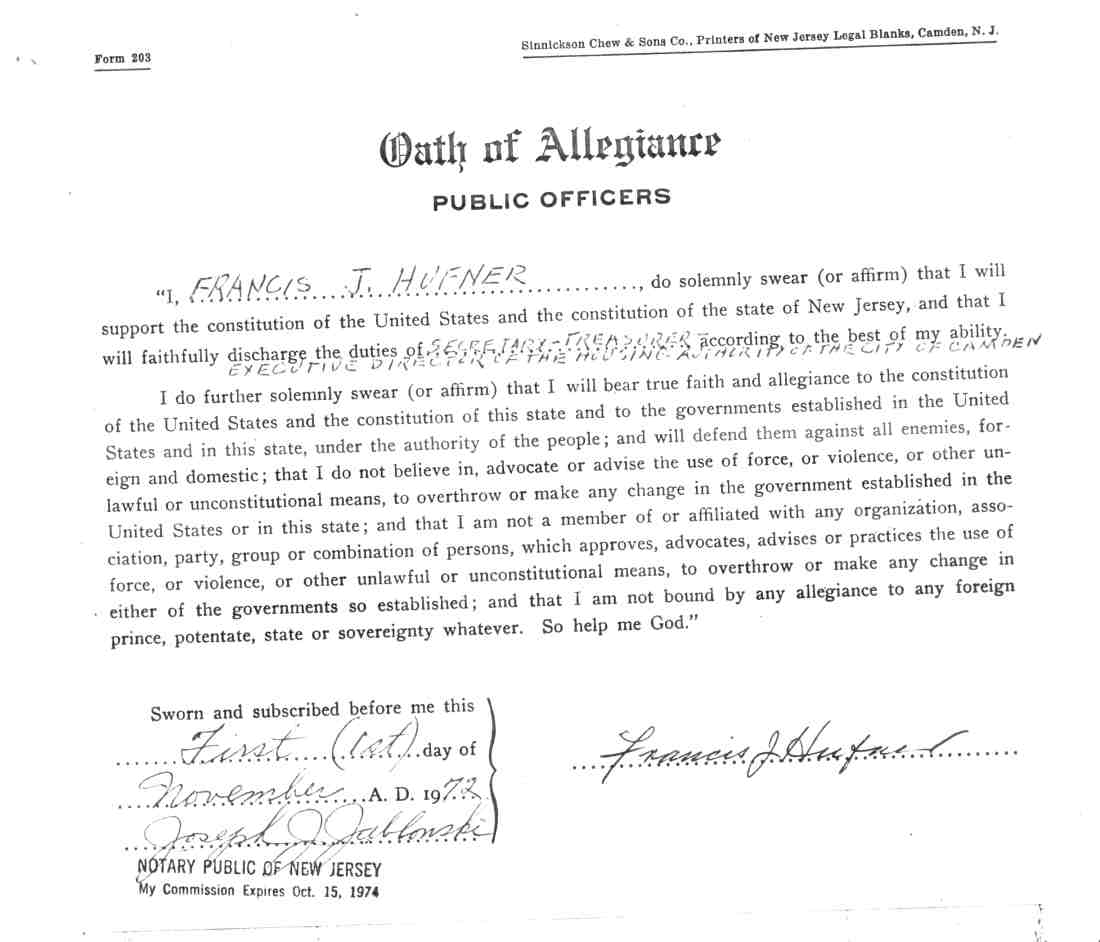
Oath of Allegiance, November 1, 1972. Francis J. Hufner, Executive Director — Joseph Jablonski, notary public.
The Housing Authority Projects
- Westfield Acres
- Clement T. Branch Village
- William Stanley Ablett Village
- Chelton Terrace
- Veterans Emergency Housing
- Peter J. McGuire Gardens
- Franklin D. Roosevelt Manor
- Westfield Towers
- Kennedy Towers
- Mickle Towers
- Royal Court
- Baldwin’s Run