Book of Facts for Shipyard Workers
Industrial Union of Marine and Shipbuilding Workers of America —
[Stamped:] James L. Daugherty, Box 349, Wallace, Idaho
STORY OF THE RISE OF THE INDUSTRIAL UNION OF MARINE & SHIPBUILDING WORKERS OF AMERICA
Price: 10 Cents
Free to Shipyard Workers
Introduction
Camden, New Jersey’s New York Shipbuilding Corporation was the birthplace of many famous naval vessels, and a host of commercial ships as well. Just as notable, the workers who built those ships also built the Industrial Union of Marine and Shipbuilding Workers of America, which was founded late in 1933.
The following booklet was published in October of 1935. Much can be learned from it, much that one may generally NOT find in newspaper accounts of the time. Certain elements of the press then were as biased against organized labor almost as much as certain elements of today’s press are biased against our own government.
It is generally forgotten that the struggle by workers for decent wages, working conditions, and a 40 hour week took far longer and cost far more lives than the struggle for civil rights. From the first attempts to organize after the Civil War right up until modern times, union organizers and union members were often met with persecution, prosecution, and in many, many cases, execution. Attempts by Soviet-trained and funded agents to infiltrate the unions in the thirties and forties did not help the situation.
Camden saw its share of labor strife during the 1930s. Besides the two strikes mentioned below, RCA-Victor experienced labor trouble, as did several other large companies in the city.
In the latter part of the 20th century, for a variety of reasons including the takeover of several unions by organized crime, the labor movement in great measure lost the respect of a large segment of the American people, who in past decades would have been predisposed to supporting its measures.
That being said, we should not forget the bravery and steadfastness of those who fought and in many cases died for the working conditions that we take for granted in America today. Any comments, corrections, or additions that you the reader would like to see made are very much welcomed.
— Phil Cohen
Book of Facts for Shipyard Workers
This little book was written by shipyard workers for shipyard workers. We ask you to keep it in your pocket and read it carefully, because it is full of meat; and it affects your welfare and your wages as well as ours.
In here you will find the truth about conditions in the shipbuilding and ship repairing industry. You will learn what amount and what kind of unions there are in the shipyards, what wages are being paid, how much work there is, and what the general working conditions are.
We also tell in here the story of the two great strikes in the Camden shipyard in 1934 and 1935; the story of the growth of the Industrial Union of Marine and Shipbuilding Workers of America, and our plans for the future. These plans include YOU.
When you finish reading this book, don’t throw it away. The time may come very soon when you will want to check up on something you are not sure of. Then you can look into this book and find it. You can be sure of anything you read in here, because all the statements in this book are FACTS.
We are confident that after you learn this story you will join with us in our fight for more work, higher wages, and better conditions in the shipyards.
Industrial Union of Marine and Shipbuilding Workers of America, October, 1935
Contents: History of Conditions in the Shipyards — 3 • Present Conditions in the Industry — 4 • Rise of the Industrial Union — 6 • Story of First Camden Strike — 7 • Organization of Other Yards by Industrial Union — 7 • Story of Second Camden Strike — 9 • Outlook for the Future — 12
Appendix: Profits on the Naval Work — 15 • Wage Scales and Comparisons — 16 • Industrial Union’s Program — 19 • Answers to Questions — 19 • The Red Scare Spiked — 21 • Recognized by the President — 22 • List of Unions That Donated to Camden Strike — 25 • Relations with American Federation of Labor — 28 • Treachery of the Metal Trades Department, A.F. of L. — 29 • List of Ships Under Construction in Major Yards — 32
Conditions in the Shipyards, and how they got that way.
In nineteen hundred and twenty-one
The shipbuilding business went on the bum.
Many of us can remember well enough what happened in the early 1920’s. Thousands of men were thrown on the street, wages were slashed, the A.F. of L. unions were practically wiped out. Business was bad, and the bosses used the opportunity to get rid of the unions and cut the rates. There were a great many strikes, and most of them were lost, and the workers found themselves worse off than before.
In many cases, in those days, one union would come out, and all the rest would go on working; with the result that the craft unions were licked one at a time. The machinists, boilermakers, sheet metal workers, and other unions were in a bad way. They lost money on strikes, and members were thrown out of work so they couldn’t pay dues. Some of the union officials and business agents ran away with the treasuries, and some grafted, and some got good jobs for themselves at the expense of the rank and file membership.
At about the same time shipping and commerce started to go bad, which meant less work for the repair yards. This put more shipyard workers on the street.
By 1924 the shipbuilding industry was open shop for all practical purposes. The A.F. of L. craft unions were finished in the shipyards.
The records show that between 1920 and 1924 the membership of the International Association of Machinists declined from 331,000 to 78,000, and the Boilermakers from 103,000 to 17,500. These were the leading A.F. of L. unions in the shipyards, and they became so weak that the big corporations no longer took them seriously. That is still the case today.
The weakness of the old A.F. of L. craft unions was that they divided the workers instead of uniting them. With a dozen different unions in the shipyard the boss could play off one against the other. There was jealousy and rivalry between the crafts. We have learned now from bitter experience that all shipyard workers must stand together in one union and use their united strength if we are going to get anywhere.
Once the real unions were cleaned out of the industry, the big corporations proceeded to build up company unions. Bethlehem started off and was followed by New York Ship, Newport News, New London, and others. These company unions kept the workers fooled for a long time, and meanwhile wages stayed low and working conditions got worse and worse. Speed-up systems were introduced, with piecework, incentive, and bonus systems for every kind of a job. The shape-up system was invented, and shipyard workers were forced to stand in line day after day for the privilege of being told there was no work for them.
The shipbuilding corporations had everything their own way. Whenever they felt like it they called in the company union stools and said, “Boys, business is bad. For the good of all concerned we will have to have a wage cut.” The company stools, as always, answered “Yes, boss,” and the wage cut went into effect.
The company union leaders held their jobs in good times and bad, keeping the rank and file of workers under their thumb by spying and lying, graft and favoritism. Work was so scarce for all these years right up to 1933, that most men were afraid to kick for fear they would lose their jobs. They took it on the chin and kept their mouths shut.
In nineteen hundred and thirty-three
The Navy Department went on a spree.
The Navy Department in 1933, hooked Congress for over 200 million dollars to build up the Navy and put men to work (they promised to put 60,000 men to work in two years, but the time is up and they haven’t put more than 40,000 to work.) This money was parcelled out to the navy yards and the private yards — most of it going to the private yards. The big corporations got their heads together (see the Nye Committee investigation) and divided up the loot: 40 million for you, 40 million for me, and 40 million for Charlie Schwab over there. There was a lot of profit in these contracts, and still is. In 1934 they got a little more. In 1935 they got another slice. In 1936, with a war scare in Europe, the melon will be bigger and juicier.
When the NRA was set up, the government forced the corporations to raise the wage rates. But hours were reduced at the same time, leaving us just about where we were before, except that we had more leisure time to worry about the rent bill and the installment on the Ford, if any.
The shorter week put more men to work, but the speed-up of production put them on the street again. Efficiency systems and incentive systems have been developed to such an extent in the big yards, that two men now do the work that three or four used to do. We produce as much now in 36 hours as we used to do in 40 or 44.
Craft lines are being broken down. The old style mechanic who could do about everything in the shop isn’t wanted any more. Every man is a specialist nowadays, and because it doesn’t take as much skill or experience to be a specialist, he gets a lower rate. We have helpers and handymen doing mechanics’ work, and mechanics getting helpers’ wages.
As a result, the mechanic who comes into a shipyard from outside, finds himself getting 20 or 30 cents an hour less inside the yard.
Today the mechanic in the shipyard gets 20 or 30 cents less per hour than the mechanic in building construction, and 20 or 30 cents less per hour than the mechanic in the Navy Yards, where the wages are fixed by Congress (see Appendix in back of book).
Shipbuilding is one of the most skilled industries in the country; it ought to be the highest paid, but it isn’t.
Today there is no shipbuilding in the country to speak of outside of naval shipbuilding. This is divided amongst the following shipyards (exclusive of the navy yards): Bath Iron Works, Bath, Maine; Bethlehem’s Fore River Plant, Quincy, Mass.; Electric Boat Co., New London, Conn.; United Drydocks, Staten Island, N.Y.; Federal Shipbuilding, Kearny, N.J.; New York Ship, Camden, N.J.; Newport News Shipbuilding, Newport News, Va.; and Bethlehem’s Union Iron Works, San Francisco. These yards are now employing 18 to 19 thousand men. There are 8 navy yards doing government building, employing 25,000 men.
Repair yard work is still slack, besides being very uncertain and irregular.
The vicious shape-up system is in general use, and in most ports the wage levels are very low.
Now that the NRA is dead, there is no restriction on hours whatsoever.
This is especially true of the repair yards, where men are working as many as fifty and sixty hours a week. The big shipbuilding plants are still on the 36-hour-week, but there is absolutely no law that can force them to maintain it. Meanwhile, 40 to 50 per cent of the shipyard workers of this country are unemployed.
There are a few crafts that are in demand, and in these crafts there is a shortage of men; but the corporations are operating schools to teach men these crafts so that there will soon be an oversupply there too, and the army of unemployed will increase.
Some of the worst abuses now common in the industry are the following:
- No classifications of work or wage standards. Unskilled men, helpers and apprentices are made to do mechanics’ work at low rates of pay. Often a group of unskilled men are put to work on a particular job under the supervision of one or two mechanics, and expected to do skilled work. As they become more proficient and experienced they gradually displace the skilled men altogether, although their pay remains the same. Skilled men are kicked out in the street, and perhaps hired back later as second or third class mechanics at reduced rates. The result is that in many shops and departments only a small minority of the men are getting the first class rate. Also it is the practice to have six or eight different rates for exactly the same type of work. Differentials of from ½c to 5c an hour are maintained in each classification in each department. The great number of different rates set up in this way enables the management to chisel and discriminate.
- Night work, without extra pay.
- Dangerous and dirty work, without extra pay.
- Welding on galvanized metal, without rest periods or respirators.
- North-South differential. Wages in the South are 10 to 20 per cent lower, for no reason except that the bosses can get away with it.
- The Shape-up. Report for work every day, and stand around for hours waiting to be told there is no work for you, but only for some company stool.
- The Speed-up. Bonus system, piecework. The faster you work, the sooner the piece rates or bonus contract will be cut. You do twice as much work and get maybe 10 per cent more money. Chiseling, graft, favoritism are common under these incentive systems.
- Furloughs and lay-offs. Very few men in the shipbuilding or repairing industry work as much as 9 full months a year. The average annual income of workers in this industry is only about $1000. Who can maintain a family decently on that income? Especially with food prices up 15 to 20 percent more than they were a year and a half ago.
These conditions can be changed. They must be changed. The Industrial Union needs your help to change them; because it can’t be done in one yard. It has to be done throughout the whole industry. (See Union program in Appendix.)
Rise of the Industrial Union of Marine and Shipbuilding Workers of America
In the summer of 1933 wages and conditions were so bad in Camden that the men began to get really sore about it. We had all heard about the NRA and the promised New Deal, but our earnings were lower than ever. At the same time food prices and the cost of living were going up.
There was a company union in the Camden yard, but it was worse than useless, and its leaders didn’t even try to get more money for the men. So Johnnie Green, a tinsmith in the yard, together with a handful of other men, got together and decided to start a real union of their own. The American Federation of Labor would give us no help. They wanted the machinists to go into one union, the chippers into another, the coppersmiths into another, etc. We knew that unless we were all united in the same organization we would be licked before we started, because we were up against a rich and powerful Corporation. We called secret meetings and talked it up in the yard. Then we printed some application cards and started passing them around.
The idea caught on quick, and within a couple of months we had a majority of the yard signed up. By this time, of course, the company had heard about it, and the company union officials were up in the air. It was decided to conduct a secret ballot to see which union the men wanted. The vote was taken in December, and the Industrial Union won by a majority of 20 to 1. That settled that.
We sent committees down to Washington to see the Labor Board and other NRA officials about getting us a wage increase; but all we got was delays and red tape. The company agreed to meet with us, but all they did was talk — they wouldn’t come across.
First Camden Strike
Finally, a set of demands was drawn up. These were presented to the company early in March, 1934. We told them we wanted more money, or else.
The Company, in the person of Clinton L. Bardo, said No; so on March 24th, 1934, a strike vote was taken of the Industrial Union membership. It carried, and the company was given three more days in which to make up its mind. Bardo still refused to give in, so a mass meeting was held Monday night where the strike vote was reaffirmed. The following morning, Tuesday, March 27th, the whole yard walked out on strike, even to the leaders. The plant was shut down 100 per cent.
As soon as the men saw the Union meant to fight, they rushed in to pay up their back dues. But even with all this money coming in there was only a few thousand dollars in the treasury — not much to spread amongst 3,000 men. However, the other unions, local merchants, and friends of the workingmen came to our support. We ran the strike economically, borrowed and chiseled, and made every dollar do the work of two or three, so that when the strike ended we were better off financially than before.
The strike lasted seven weeks. Every week or so the company would offer us a little more. First it was 6 per cent; then it was 10 per cent; then it was 13 per cent. But the men continued to stick and the picket line held fast. Nobody wanted to go through it and nobody tried to.
Finally the strike was settled on May 11th for 14.8 per cent increase and other concessions, including a week’s notice of layoff, a reduction in the number of rates, preference for former employees in hiring, and most important — recognition of the Industrial Union of Marine and Shipbuilding Workers of America.
Mr. Bardo signed the agreement, and we went back to work on May 14th with the first union contract signed by any big shipbuilding company for 15 years.
Within 3 months, the men at Fore River, Bath, New London, and Newport News were given general wage increases!
Organizing the Other Yards
We realized that Camden could not reform the whole industry by itself.
It was necessary to bring other shipyards into the same organization. Within the next year the men of Camden put up over $8,000 to send organizers to the other yards, and help them build up Locals of the Industrial Union. By the spring of 1935 we had Locals in the following places:
Local No. 1 — N.Y. Ship, Camden, N.J.
Local No. 2 — Sun Ship, Chester, Pa.
Local No. 3 — Dravo, and Pusey & Jones, Wilmington, Del.
Local No. 4 — Bath Iron Works, Bath, Maine.
Local No. 5 — Fore River Plant (Bethlehem), Quincy, Mass.
Local No. 6 — Electric Boat, New London, Conn.
Local No. 7 — Union Iron Works, San Francisco, Calif.
Local No. 8 — Newport News Shipyard, Newport News, Va.
Local No. 9 — Repair Yards, San Pedro, Calif.
Local No. 10 — Repair Yards, Seattle, Wash.
Local No. 11 — Repair Yards, Oakland, California
The struggle to get these yards organized is a long story and we will not tell all the details here. It is enough to mention Newport News, which we tackled in the winter of 1935. In two months’ time we signed up close to a thousand men, mostly welders and shipfitters. Then the company got worried about it and decided to kill the Union before it could grow strong.
Early in April the Newport News management picked out 30 leaders of the Union and fired them out of the yard. They knew they could get away with it because the old Labor Board was dead, and the new Wagner Labor Board not born yet. We were forced to call a strike; and for three long weeks, the town of Newport News saw the first real picket line in its history. As there were close to 6,000 men working there at the time, our picket line was not big enough to hold them out. The whole town, the bankers, merchants, lawyers, and businessmen were against us, and the company had most of its employees so terrorized that they were afraid to come out in our support. We could not get county relief for our men, and the grocers shut off their credit. Camden, with some help from the other Locals, carried the burden of paying the Newport News strikers’ benefits to keep them going. But Camden was facing another strike of its own, and we were finally forced to call off the Newport News strike on May 8th — but with the determination to come back and organize the yard right.
This is a sample of what we are up against in fighting the big shipbuilding corporations. They will use every possible method to keep their employees from organizing a real union that will fight for the men’s rights and decent wages.
After we left Newport News the Metal Trades Department of the A.F. of L. came sneaking into town and tried to make a deal with the company on the strength of the company’s fear of the Industrial Union. (See Calvin’s letter in Appendix.) They made the deal with the company all right, but they couldn’t organize the men, so it did them no good.
Second Camden Strike
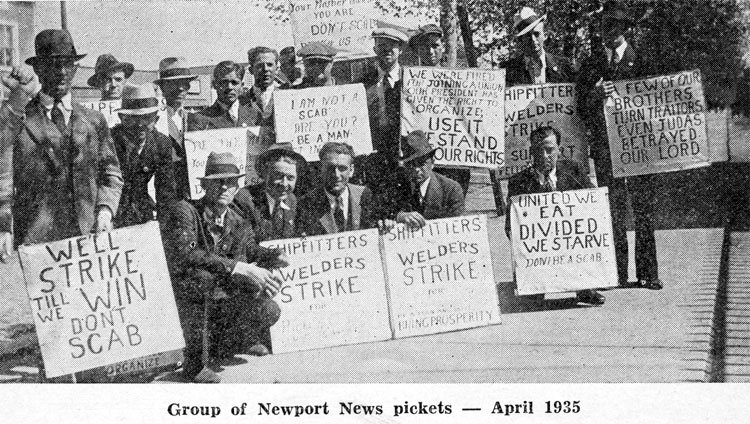
Group of Newport News pickets — April 1935
The Union’s agreement with New York Ship was to run out May 11th, 1935. For six weeks before this date we tried to reach an agreement with the company for a new agreement, or renewal of the old one with a few changes, including an increase in wages. The company not only refused to negotiate a new agreement, but even refused to extend the old one. There was nothing for the Union to do but call a strike to enforce its demands, and protect its members.
The company was insisting on a company union type of set-up which would have meant the quick death of the Industrial Union if it had been adopted.
The yard came out as before, 100 per cent — 4,000 strong. The picket line extended along Broadway for fully half a mile, four men abreast.
The management had a few conferences with our committee, but would not concede a single point. Instead they tried to foist their company union agreement on the men over the heads of the Union officers. They sent letters to all the men and tried to get them to vote to go back to work. But the Union held meetings every day, and decided that the men would back up their committee to the limit.
A strike kitchen was set up, which fed about 3,000 pickets every day.
Food and other donations were contributed by local merchants and sympathetic farmers. Raffles and tag days were run to raise money, and donations started to come in from the other Locals of the Industrial Union and from many other labor organizations (see list of unions in Appendix). Hundreds of strikers went on relief and so did the officers of the Union.
The Union sent committees and delegations to Washington to enlist the aid of the Labor and Navy Departments, and also the Nye Committee and various Congressmen and Senators. We got a great many promises, but practically no help at all. The Navy Department had a deaf ear for us. The Labor Department sent in a conciliator, but he didn’t have any power to force the company to settle. Although $50,000,000 worth of naval construction was tied up, the government wasn’t interested enough to force the Company to come to terms with the strikers.
Meanwhile the management was trying other tricks to get the men back. They ran big advertisements in the newspapers calling the leaders radicals and Communists, and telling the men to come back on the company’s terms. When this failed, they got a big advertising company, N.W. Ayer & Son, to conduct a “survey” of the strikers. They got a New York lawyer by the name of Major Henry L. Holthusen, and he hired a bunch of college boys to canvass the strikers at their homes, to see if they could be persuaded to break ranks and return to work.
The Union got wind of it the night before the great “survey” started. We had cars waiting at the entrance to Camden and followed the college boys around the city. We rounded them up, gave them a lecture on the evils of strike-breaking, and sent them back home. The survey was a flop.
The major then got hold of some local American Legion officials, and had them agree to cooperate in holding a vote amongst the strikers on the question of returning to work on the company’s terms. As soon as we heard of this, we put on a couple of demonstrations at Legion headquarters, and the rank and file legionnaires raised such a protest that the officials quickly backed down. So the vote wasn’t held.
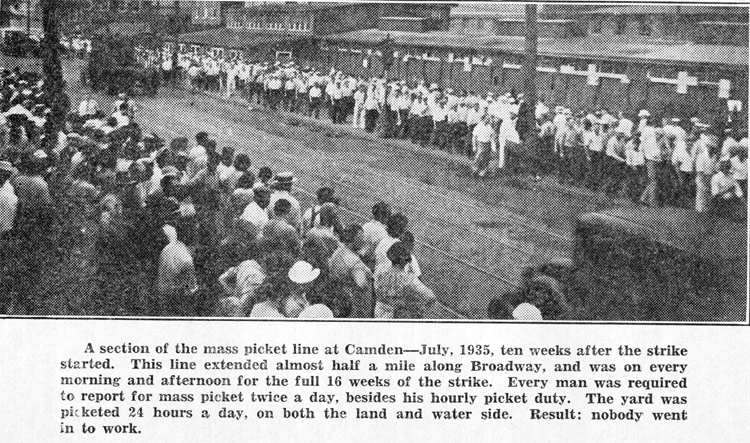
A section of the mass picket line at Camden — July, 1935, ten weeks after the strike started. This line extended almost half a mile along Broadway, and was on every morning and afternoon for the full 16 weeks of the strike. Every man was required to report for mass picket twice a day, besides his hourly picket duty. The yard was picketed 24 hours a day, on both the land and water side. Result: nobody went in to work.
The company then put on a great drive to reopen the yard on July 23rd. They wrote to every man that the yard was going to resume work, and sent foremen around to the men’s homes to tell them to come in on that day.
When the morning of July 23rd arrived, however, over 3,000 men reported for picket duty instead of work. With the aid of the police, a few scabs were rushed through the gates. But two days of running the gauntlet was all these scabs could stand, and on July 24th the company again abandoned its attempt to operate.
Instead they went into court and tried to get an injunction against us. While this injunction was hanging fire, Secretary of Labor Perkins proposed that the men should return under the old Union contract and arbitrate the new demands. The Union accepted the offer but the company refused. They didn’t succeed in getting their injunction, however, so they went to work on the Navy Department, and got it to make a different proposal for settlement. This proposal didn’t provide for recognition of the Union, so the men turned it down.
Back into court, the Federal Court this time, went the company in another effort to get an injunction against us that would break up our picket line.
Meanwhile, Congressman Marcantonio, of New York, and the House Labor Subcommittee began to open up on the company for its anti-labor tactics, and on the Navy Department for supporting the New York Ship as against the strikers. The Committee called all parties concerned down to Washington, and investigated the causes and condition of the strike. In his statements to the press, Marcantonio made it clear that he thought the blame fell entirely on the company, and that it was using the red scare to try to dodge its obligations to the men and the government. Protests began pouring into Washington against the government’s delay in taking strong action to force a settlement. But the company still refused to arbitrate or to recognize the Union.
Finally, on August 22nd, President Roosevelt issued an executive order creating the Camden Board of Arbitration, which was instructed to attempt to settle the strike on the following terms: recognition of the Union, all men to return to work under the old contract; and the board to arbitrate all the Union’s demands and to embody its awards in a Union agreement to be signed by both parties. The company was licked, and had to accept. The President’s settlement was signed on August 27th, and the men returned to work August 29th the same way they had come out — all together. The strike had lasted about 16 weeks.
The Camden Board of Arbitration, consisting of Admiral Henry A. Wiley, Robert Bruere, and Colonel Frank Douglas, conducted hearings in Washington for a month and a half after the strike was settled, considering the Union’s demands and the company’s answers.
On October 12th the final decision was handed down in the form of a contract to be signed by the Corporation and the Union which is to run for about two and one-half years. It provides for a 5 per cent general wage increase, 5 per cent increase in piece rates and bonus contracts, week’s notice of layoffs, maintenance of the 36-hour week, machinery for handling grievances by the Union Shop Stewards, and an Arbitration Board to settle all disputes that can’t be settled by negotiation between the Company and the Union. There is also a provision that bad days cannot be averaged up with good days on piece work; and the piece rates and bonus contracts must be shown to the men before they start work on any job.
This Union agreement is now in effect in Camden. It gives us the highest average wage rates on the east coast, and conditions that no other big shipyard has. We have some protection against unfair discharges, cutting rates, transferring men, setting piece rates, etc. Prominent labor leaders throughout the country have hailed ours as one of the outstanding strikes of the year, and, with the single exception of the coal miners’ strike, the most important victory for organized labor that was won in 1935.
Where We Are and Where We Are Going
As things stand today, the Industrial Union of Marine and Shipbuilding Workers of America is the only important union in the shipbuilding industry. It is the biggest, and the strongest, and is growing all the time. It is recognized by the corporations and by the government.
This Union has raised wages in Camden by 20 per cent in the past year and a half. It has forced the other big yards to raise their wages 10 to 15 per cent. We have ten locals on the Atlantic and Pacific coasts. We have the sympathy and support of some of the biggest labor unions in the country.
There is still much work to be done. If we are going to win good wages and conditions (see Union program in Appendix) we have got to build strong Locals in all the major shipyards throughout the country. Navy yard rates are still 25 per cent above Camden, which is the highest paid private yard on the east coast. We can carry out this program only by solidarity and united action.
Your place is in the Industrial Union with your fellow shipyard workers.
Join the ranks of those who are marching forward.
Shipyard workers of America, Unite!!
ON TO VICTORY!!!
Industrial Union of Marine and Shipbuilding Workers of America
General Office, 572 Fairview St., Camden, N.J.
Appendix
For additional information of any kind, or for help in organizing, write to the Industrial Union — 572 Fairview Street — Camden, N.J.
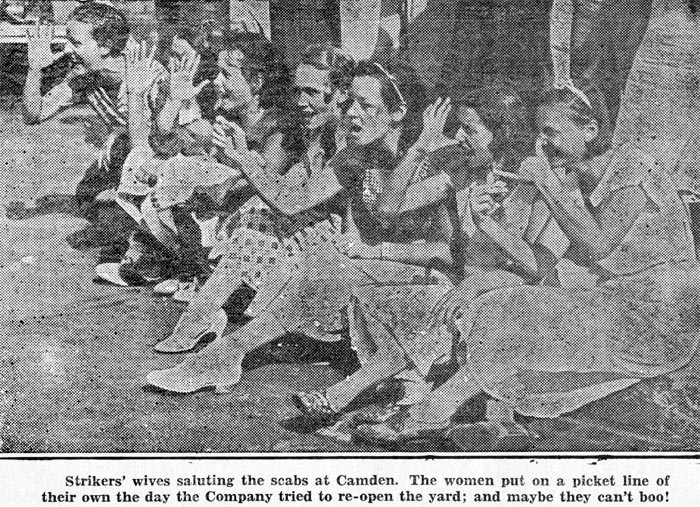
Strikers’ wives saluting the scabs at Camden. The women put on a picket line of their own the day the Company tried to re-open the yard; and maybe they can’t boo!
Profits on the Naval Work
Industrial Union of Marine and Shipbuilding Workers of America —
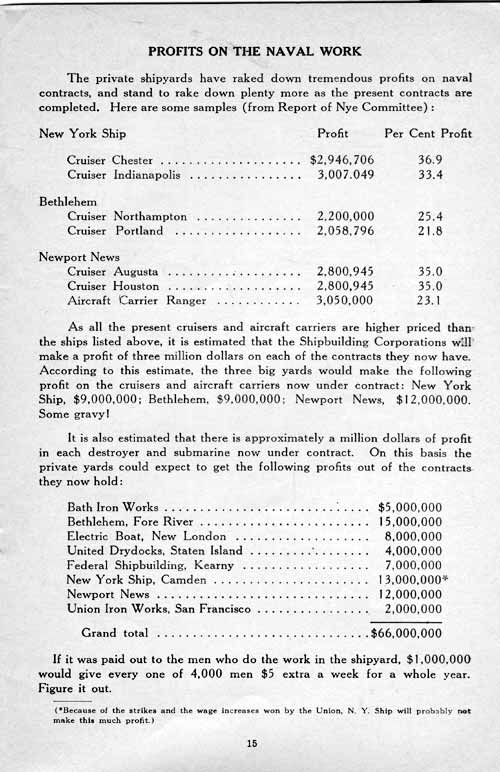
The private shipyards have raked down tremendous profits on naval contracts, and stand to rake down plenty more as the present contracts are completed. Here are some samples (from Report of Nye Committee):
| Profit | Per Cent Profit | |
|---|---|---|
| New York Ship | ||
| Cruiser Chester | $2,946,706 | 36.9 |
| Cruiser Indianapolis | 3,007.049 [sic] | 33.4 |
| Bethlehem | ||
| Cruiser Northampton | 2,200,000 | 25.4 |
| Cruiser Portland | 2,058,796 | 21.8 |
| Newport News | ||
| Cruiser Augusta | 2,800,945 | 35.0 |
| Cruiser Houston | 2,800,945 | 35.0 |
| Aircraft Carrier Ranger | 3,050,000 | 23.1 |
As all the present cruisers and aircraft carriers are higher priced than the ships listed above, it is estimated that the Shipbuilding Corporations will make a profit of three million dollars on each of the contracts they now have. According to this estimate, the three big yards would make the following profit on the cruisers and aircraft carriers now under contract: New York Ship, $9,000,000; Bethlehem, $9,000,000; Newport News, $12,000,000. Some gravy!
It is also estimated that there is approximately a million dollars of profit in each destroyer and submarine now under contract. On this basis the private yards could expect to get the following profits out of the contracts they now hold:
| Bath Iron Works | $5,000,000 |
| Bethlehem, Fore River | 15,000,000 |
| Electric Boat, New London | 8,000,000 |
| United Drydocks, Staten Island | 4,000,000 |
| Federal Shipbuilding, Kearny | 7,000,000 |
| New York Ship, Camden | 13,000,000* |
| Newport News | 12,000,000 |
| Union Iron Works, San Francisco | 2,000,000 |
| Grand total | $66,000,000 |
If it was paid out to the men who do the work in the shipyard, $1,000,000 would give every one of 4,000 men $5 extra a week for a whole year. Figure it out.
(*Because of the strikes and the wage increases won by the Union, N. Y. Ship will probably not make this much profit.)
Wage Scales
Industrial Union of Marine and Shipbuilding Workers of America —
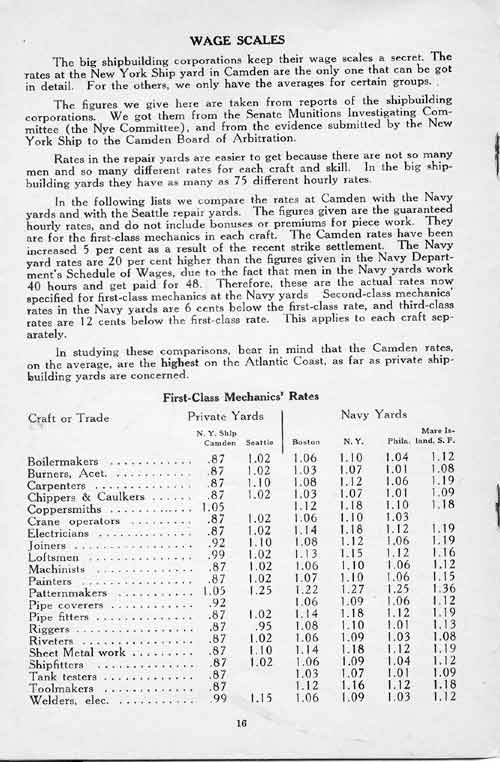
The big shipbuilding corporations keep their wage scales a secret. The rates at the New York Ship yard in Camden are the only one that can be got in detail. For the others, we only have the averages for certain groups.
The figures we give here are taken from reports of the shipbuilding corporations. We got them from the Senate Munitions Investigating Committee (the Nye Committee), and from the evidence submitted by the New York Ship to the Camden Board of Arbitration.
Rates in the repair yards are easier to get because there are not so many men and so many different rates for each craft and skill. In the big shipbuilding yards they have as many as 75 different hourly rates.
In the following lists we compare the rates at Camden with the Navy yards and with the Seattle repair yards. The figures given are the guaranteed hourly rates, and do not include bonuses or premiums for piece work. They are for the first-class mechanics in each craft. The Camden rates have been increased 5 per cent as a result of the recent strike settlement. The Navy yard rates are 20 per cent higher than the figures given in the Navy Department’s Schedule of Wages, due to the fact that men in the Navy yards work 40 hours and get paid for 48. Therefore, these are the actual rates now specified for first-class mechanics at the Navy yards Second-class mechanics’ rates in the Navy yards are 6 cents below the first-class rate, and third-class rates are 12 cents below the first-class rate. This applies to each craft separately.
In studying these comparisons, bear in mind that the Camden rates, on the average, are the highest on the Atlantic Coast, as far as private shipbuilding yards are concerned.
First-Class Mechanics’ Rates
| Craft or Trade | Private Yards | Navy Yards | ||||
|---|---|---|---|---|---|---|
| N. Y. Ship Camden | Seattle | Boston | N. Y. | Phila. | Mare Island, S. F. | |
| Boilermakers | .87 | 1.02 | 1.06 | 1.10 | 1.04 | 1.12 |
| Burners, Acet. | .87 | 1.02 | 1.03 | 1.07 | 1.01 | 1.08 |
| Carpenters | .87 | 1.10 | 1.08 | 1.12 | 1.06 | 1.19 |
| Chippers & Caulkers | .87 | 1.02 | 1.03 | 1.07 | 1.01 | 1.09 |
| Coppersmiths | 1.05 | 1.12 | 1.18 | 1.10 | 1.18 | |
| Crane operators | .87 | 1.02 | 1.06 | 1.10 | 1.03 | |
| Electricians | .87 | 1.02 | 1.14 | 1.18 | 1.12 | 1.19 |
| Joiners | .92 | 1.10 | 1.08 | 1.12 | 1.06 | 1.19 |
| Loftsmen | .99 | 1.02 | 1.13 | 1.15 | 1.12 | 1.16 |
| Machinists | .87 | 1.02 | 1.06 | 1.10 | 1.06 | 1.12 |
| Painters | .87 | 1.02 | 1.07 | 1.10 | 1.06 | 1.15 |
| Patternmakers | 1.05 | 1.25 | 1.22 | 1.27 | 1.25 | 1.36 |
| Pipe coverers | .92 | 1.06 | 1.09 | 1.06 | 1.12 | |
| Pipe fitters | .87 | 1.02 | 1.14 | 1.18 | 1.12 | 1.19 |
| Riggers | .87 | .95 | 1.08 | 1.10 | 1.01 | 1.13 |
| Riveters | .87 | 1.02 | 1.06 | 1.09 | 1.03 | 1.08 |
| Sheet Metal work | .87 | 1.10 | 1.14 | 1.18 | 1.12 | 1.19 |
| Shipfitters | .87 | 1.02 | 1.06 | 1.09 | 1.04 | 1.12 |
| Tank testers | .87 | 1.03 | 1.07 | 1.01 | 1.09 | |
| Toolmakers | .87 | 1.12 | 1.16 | 1.12 | 1.18 | |
| Welders, elec. | .99 | 1.15 | 1.06 | 1.09 | 1.03 | 1.12 |
Top Rates for Semi- and Unskilled Men
Industrial Union of Marine and Shipbuilding Workers of America —
| N. Y. Ship Camden | Seattle | Boston | N. Y. | Phila. | Mare Island, S. F. | |
|---|---|---|---|---|---|---|
| Drillers, Reamers & Bolters | .70 | .85 | .88 | .91 | .84 | .94 |
| Heaters, rivet | .54 | .75 | .70 | .72 | .67 | .72 |
| Holders-on | .65 | .85 | .80 | .79 | .78 | .82 |
| Helpers, general | .58 | .75 | .73 | .73 | .68 | .76 |
| Handymen and Machine Operators | .70 | .82 | .85 | .80 | .91 | |
| Laborers | .54 | .67 | .67 | .67 | .64 | .67 |
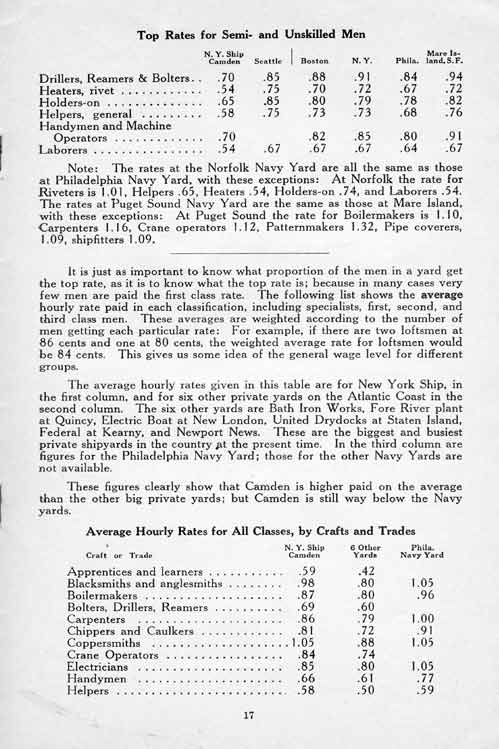
Note: The rates at the Norfolk Navy Yard are all the same as those at Philadelphia Navy Yard, with these exceptions: At Norfolk the rate for Riveters is 1.01, Helpers .65, Heaters .54, Holders-on .74, and Laborers .54. The rates at Puget Sound Navy Yard are the same as those at Mare Island, with these exceptions: At Puget Sound the rate for Boilermakers is 1.10, Carpenters 1.16, Crane operators 1.12, Patternmakers 1.32, Pipe coverers, 1.09, shipfitters 1.09.
It is just as important to know what proportion of the men in a yard get the top rate, as it is to know what the top rate is; because in many cases very few men are paid the first class rate. The following list shows the average hourly rate paid in each classification, including specialists, first, second, and third class men. These averages are weighted according to the number of men getting each particular rate: For example, if there are two loftsmen at 86 cents and one at 80 cents, the weighted average rate for loftsmen would be 84 cents. This gives us some idea of the general wage level for different groups.
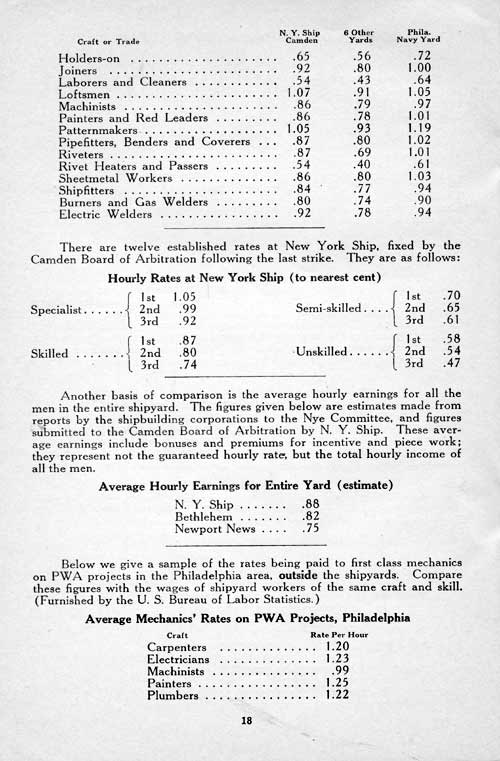
The average hourly rates given in this table are for New York Ship, in the first column, and for six other private yards on the Atlantic Coast in the second column. The six other yards are Bath Iron Works, Fore River plant at Quincy, Electric Boat at New London, United Drydocks at Staten Island, Federal at Kearny, and Newport News. These are the biggest and busiest private shipyards in the country at the present time. In the third column are figures for the Philadelphia Navy Yard; those for the other Navy Yards are not available.
These figures clearly show that Camden is higher paid on the average than the other big private yards; but Camden is still way below the Navy yards.
Average Hourly Rates for All Classes, by Crafts and Trades
| Craft or Trade | N. Y. Ship Camden | 6 Other Yards | Phila. Navy Yard |
|---|---|---|---|
| Apprentices and learners | .59 | .42 | |
| Blacksmiths and anglesmiths | .98 | .80 | 1.05 |
| Boilermakers | .87 | .80 | .96 |
| Bolters, Drillers, Reamers | .69 | .60 | |
| Carpenters | .86 | .79 | 1.00 |
| Chippers and Caulkers | .81 | .72 | .91 |
| Coppersmiths | 1.05 | .88 | 1.05 |
| Crane Operators | .84 | .74 | |
| Electricians | .85 | .80 | 1.05 |
| Handymen | .66 | .61 | .77 |
| Helpers | .58 | .50 | .59 |
Wage Scales (continued)
Industrial Union of Marine and Shipbuilding Workers of America —
| Craft or Trade | N. Y. Ship Camden | 6 Other Yards | Phila. Navy Yard |
|---|---|---|---|
| Holders-on | .65 | .56 | .72 |
| Joiners | .92 | .80 | 1.00 |
| Laborers and Cleaners | .54 | .43 | .64 |
| Loftsmen | 1.07 | .91 | 1.05 |
| Machinists | .86 | .79 | .97 |
| Painters and Red Leaders | .86 | .78 | 1.01 |
| Patternmakers | 1.05 | .93 | 1.19 |
| Pipefitters, Benders and Coverers | .87 | .80 | 1.02 |
| Riveters | .87 | .69 | 1.01 |
| Rivet Heaters and Passers | .54 | .40 | .61 |
| Sheetmetal Workers | .86 | .80 | 1.03 |
| Shipfitters | .84 | .77 | .94 |
| Burners and Gas Welders | .80 | .74 | .90 |
| Electric Welders | .92 | .78 | .94 |
There are twelve established rates at New York Ship, fixed by the Camden Board of Arbitration following the last strike. They are as follows:
Hourly Rates at New York Ship (to nearest cent)
| 1st | 2nd | 3rd | |
|---|---|---|---|
| Specialist | 1.05 | .99 | .92 |
| Semi-skilled | .70 | .65 | .61 |
| Skilled | .87 | .80 | .74 |
| Unskilled | .58 | .54 | .47 |
Another basis of comparison is the average hourly earnings for all the men in the entire shipyard. The figures given below are estimates made from reports by the shipbuilding corporations to the Nye Committee, and figures submitted to the Camden Board of Arbitration by N. Y. Ship. These average earnings include bonuses and premiums for incentive and piece work; they represent not the guaranteed hourly rate, but the total hourly income of all the men.
Average Hourly Earnings for Entire Yard (estimate)
| N. Y. Ship | .88 |
| Bethlehem | .82 |
| Newport News | .75 |
Below we give a sample of the rates being paid to first class mechanics on PWA projects in the Philadelphia area, outside the shipyards. Compare these figures with the wages of shipyard workers of the same craft and skill. (Furnished by the U. S. Bureau of Labor Statistics.)
Average Mechanics’ Rates on PWA Projects, Philadelphia
| Craft | Rate Per Hour |
|---|---|
| Carpenters | 1.20 |
| Electricians | 1.23 |
| Machinists | .99 |
| Painters | 1.25 |
| Plumbers | 1.22 |
Industrial Union’s Program for the Industry
Industrial Union of Marine and Shipbuilding Workers of America —
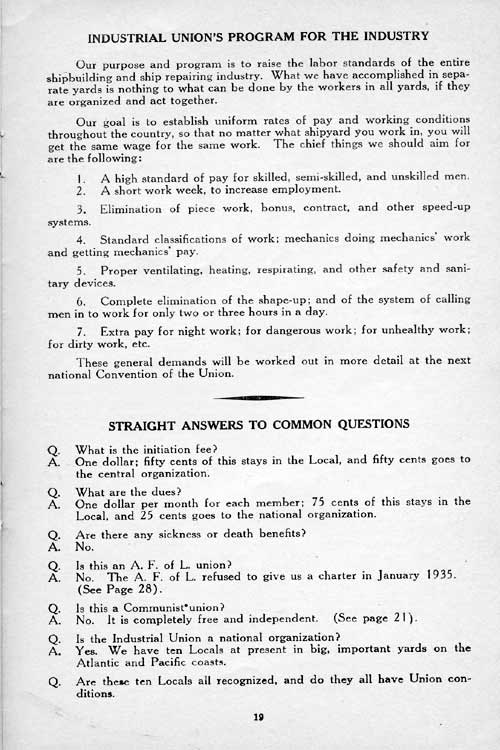
Our purpose and program is to raise the labor standards of the entire shipbuilding and ship repairing industry. What we have accomplished in separate yards is nothing to what can be done by the workers in all yards, if they are organized and act together.
Our goal is to establish uniform rates of pay and working conditions throughout the country, so that no matter what shipyard you work in, you will get the same wage for the same work. The chief things we should aim for are the following:
1. A high standard of pay for skilled, semi-skilled, and unskilled men.
2. A short work week, to increase employment.
3. Elimination of piece work, bonus, contract, and other speed-up systems.
4. Standard classifications of work; mechanics doing mechanics’ work and getting mechanics’ pay.
5. Proper ventilating, heating, respirating, and other safety and sanitary devices.
6. Complete elimination of the shape-up; and of the system of calling men in to work for only two or three hours in a day.
7. Extra pay for night work; for dangerous work; for unhealthy work; for dirty work, etc.
These general demands will be worked out in more detail at the next national Convention of the Union.
Straight Answers to Common Questions
Q. What is the initiation fee?
A. One dollar; fifty cents of this stays in the Local, and fifty cents goes to the central organization.
Q. What are the dues?
A. One dollar per month for each member; 75 cents of this stays in the Local, and 25 cents goes to the national organization.
Q. Are there any sickness or death benefits?
A. No.
Q. Is this an A. F. of L. union?
A. No. The A. F. of L. refused to give us a charter in January 1935. (See Page 28).
Q. Is this a Communist union?
A. No. It is completely free and independent. (See page 21).
Q. Is the Industrial Union a national organization?
A. Yes. We have ten Locals at present in big, important yards on the Atlantic and Pacific coasts.
Q. Are these ten Locals all recognized, and do they all have Union conditions.
Straight Answers to Common Questions (continued)
Industrial Union of Marine and Shipbuilding Workers of America —
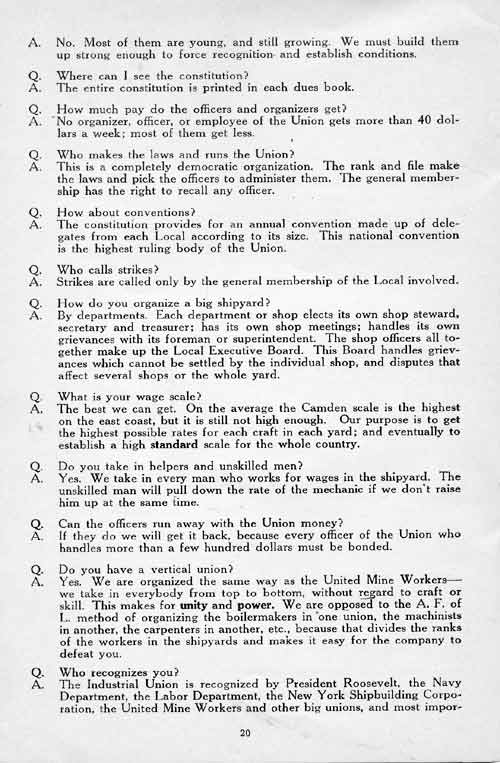
A. No. Most of them are young, and still growing. We must build them up strong enough to force recognition and establish conditions.
Q. Where can I see the constitution?
A. The entire constitution is printed in each dues book.
Q. How much pay do the officers and organizers get?
A. No organizer, officer, or employee of the Union gets more than 40 dollars a week; most of them get less.
Q. Who makes the laws and runs the Union?
A. This is a completely democratic organization. The rank and file make the laws and pick the officers to administer them. The general membership has the right to recall any officer.
Q. How about conventions?
A. The constitution provides for an annual convention made up of delegates from each Local according to its size. This national convention is the highest ruling body of the Union.
Q. Who calls strikes?
A. Strikes are called only by the general membership of the Local involved.
Q. How do you organize a big shipyard?
A. By departments. Each department or shop elects its own shop steward, secretary and treasurer; has its own shop meetings; handles its own grievances with its foreman or superintendent. The shop officers all together make up the Local Executive Board. This Board handles grievances which cannot be settled by the individual shop, and disputes that affect several shops or the whole yard.
Q. What is your wage scale?
A. The best we can get. On the average the Camden scale is the highest on the east coast, but it is still not high enough. Our purpose is to get the highest possible rates for each craft in each yard; and eventually to establish a high standard scale for the whole country.
Q. Do you take in helpers and unskilled men?
A. Yes. We take in every man who works for wages in the shipyard. The unskilled man will pull down the rate of the mechanic if we don’t raise him up at the same time.
Q. Can the officers run away with the Union money?
A. If they do we will get it back, because every officer of the Union who handles more than a few hundred dollars must be bonded.
Q. Do you have a vertical union?
A. Yes. We are organized the same way as the United Mine Workers— we take in everybody from top to bottom, without regard to craft or skill. This makes for unity and power. We are opposed to the A. F. of L. method of organizing the boilermakers in one union, the machinists in another, the carpenters in another, etc., because that divides the ranks of the workers in the shipyards and makes it easy for the company to defeat you.
Q. Who recognizes you?
A. The Industrial Union is recognized by President Roosevelt, the Navy Department, the Labor Department, the New York Shipbuilding Corporation, the United Mine Workers and other big unions, and most impor-
The Red Scare Spiked
Industrial Union of Marine and Shipbuilding Workers of America —
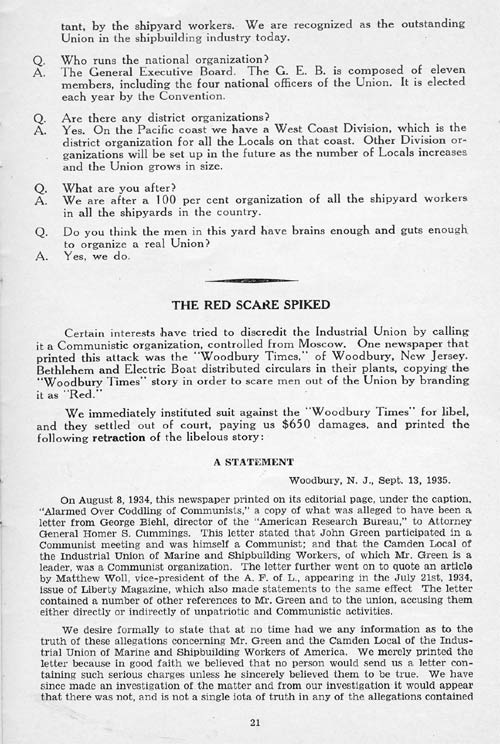
tant, by the shipyard workers. We are recognized as the outstanding Union in the shipbuilding industry today.
Q. Who runs the national organization?
A. The General Executive Board. The G. E. B. is composed of eleven members, including the four national officers of the Union. It is elected each year by the Convention.
Q. Are there any district organizations?
A. Yes. On the Pacific coast we have a West Coast Division, which is the district organization for all the Locals on that coast. Other Division organizations will be set up in the future as the number of Locals increases and the Union grows in size.
Q. What are you after?
A. We are after a 100 per cent organization of all the shipyard workers in all the shipyards in the country.
Q. Do you think the men in this yard have brains enough and guts enough to organize a real Union?
A. Yes, we do.
The Red Scare Spiked
Certain interests have tried to discredit the Industrial Union by calling it a Communistic organization, controlled from Moscow. One newspaper that printed this attack was the “Woodbury Times,” of Woodbury, New Jersey. Bethlehem and Electric Boat distributed circulars in their plants, copying the “Woodbury Times” story in order to scare men out of the Union by branding it as “Red.”
We immediately instituted suit against the “Woodbury Times” for libel, and they settled out of court, paying us $650 damages, and printed the following retraction of the libelous story:
A STATEMENT
Woodbury, N. J., Sept. 13, 1935.
On August 8, 1934, this newspaper printed on its editorial page, under the caption, “Alarmed Over Coddling of Communists,” a copy of what was alleged to have been a letter from George Biehl, director of the “American Research Bureau,” to Attorney General Homer S. Cummings. This letter stated that John Green participated in a Communist meeting and was himself a Communist; and that the Camden Local of the Industrial Union of Marine and Shipbuilding Workers, of which Mr. Green is a leader, was a Communist organization. The letter further went on to quote an article by Matthew Woll, vice-president of the A. F. of L., appearing in the July 21st, 1934, issue of Liberty Magazine, which also made statements to the same effect The letter contained a number of other references to Mr. Green and to the union, accusing them either directly or indirectly of unpatriotic and Communistic activities.
We desire formally to state that at no time had we any information as to the truth of these allegations concerning Mr. Green and the Camden Local of the Industrial Union of Marine and Shipbuilding Workers of America. We merely printed the letter because in good faith we believed that no person would send us a letter containing such serious charges unless he sincerely believed them to be true. We have since made an investigation of the matter and from our investigation it would appear that there was not, and is not a single iota of truth in any of the allegations contained
Recognized by the President !!
Industrial Union of Marine and Shipbuilding Workers of America —
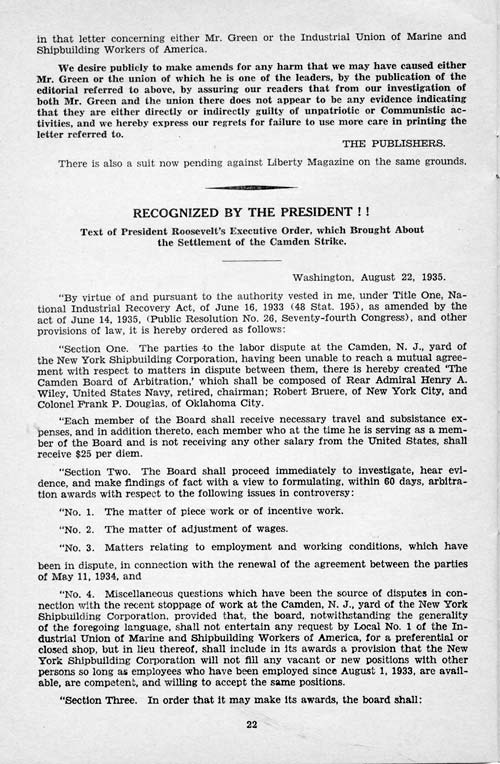
in that letter concerning either Mr. Green or the Industrial Union of Marine and Shipbuilding Workers of America.
We desire publicly to make amends for any harm that we may have caused either Mr. Green or the union of which he is one of the leaders, by the publication of the editorial referred to above, by assuring our readers that from our investigation of both Mr. Green and the union there does not appear to be any evidence indicating that they are either directly or indirectly guilty of unpatriotic or Communistic activities, and we hereby express our regrets for failure to use more care in printing the letter referred to.
THE PUBLISHERS.
There is also a suit now pending against Liberty Magazine on the same grounds.
RECOGNIZED BY THE PRESIDENT !!
Text of President Roosevelt’s Executive Order, which Brought About the Settlement of the Camden Strike.
Washington, August 22, 1935.
“By virtue of and pursuant to the authority vested in me, under Title One, National Industrial Recovery Act, of June 16, 1933 (48 Stat. 195), as amended by the act of June 14, 1935, (Public Resolution No. 26, Seventy-fourth Congress), and other provisions of law, it is hereby ordered as follows:
“Section One. The parties to the labor dispute at the Camden, N. J., yard of the New York Shipbuilding Corporation, having been unable to reach a mutual agreement with respect to matters in dispute between them, there is hereby created ‘The Camden Board of Arbitration,’ which shall be composed of Rear Admiral Henry A. Wiley, United States Navy, retired, chairman; Robert Bruere, of New York City, and Colonel Frank P. Douglas, of Oklahoma City.
“Each member of the Board shall receive necessary travel and subsistence expenses, and in addition thereto, each member who at the time he is serving as a member of the Board and is not receiving any other salary from the United States, shall receive $25 per diem.
“Section Two. The Board shall proceed immediately to investigate, hear evidence, and make findings of fact with a view to formulating, within 60 days, arbitration awards with respect to the following issues in controversy:
“No. 1. The matter of piece work or of incentive work.
“No. 2. The matter of adjustment of wages.
“No. 3. Matters relating to employment and working conditions, which have been in dispute, in connection with the renewal of the agreement between the parties of May 11, 1934, and
“No. 4. Miscellaneous questions which have been the source of disputes in connection with the recent stoppage of work at the Camden, N. J., yard of the New York Shipbuilding Corporation, provided that, the board, notwithstanding the generality of the foregoing language, shall not entertain any request by Local No. 1 of the Industrial Union of Marine and Shipbuilding Workers of America, for a preferential or closed shop, but in lieu thereof, shall include in its awards a provision that the New York Shipbuilding Corporation will not fill any vacant or new positions with other persons so long as employees who have been employed since August 1, 1933, are available, are competent, and willing to accept the same positions.
“Section Three. In order that it may make its awards, the board shall:
5 P. C. Pay Rise Awarded to Shipyard Workers, Retroactive to Aug. 29
Philadelphia Record —
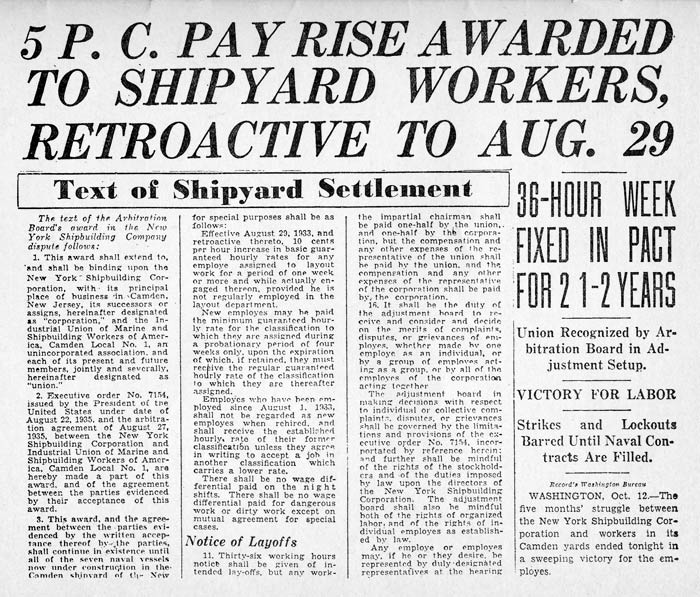
Text of Shipyard Settlement
The text of the Arbitration Board’s award in the New York Shipbuilding Company dispute follows:
1. This award shall extend to, and shall be binding upon the New York Shipbuilding Corporation, with its principal place of business in Camden, New Jersey, its successors or assigns, hereinafter designated as “corporation,” and the Industrial Union of Marine and Shipbuilding Workers of America, Camden Local No. 1, an unincorporated association, and each of its present and future members, jointly and severally, hereinafter designated as “union.”
2. Executive order No. 7154, issued by the President of the United States under date of August 22, 1935, and the arbitration agreement of August 27, 1935, between the New York Shipbuilding Corporation and Industrial Union of Marine and Shipbuilding Workers of America, Camden Local No. 1, are hereby made a part of this award, and of the agreement between the parties evidenced by their acceptance of this award.
3. This award, and the agreement between the parties evidenced by the written acceptance thereof by the parties, shall continue in existence until all of the seven naval vessels now under construction in the Camden shipyard of the New [words missing between the columns]
for special purposes shall be as follows:
Effective August 29, 1933, and retroactive thereto, 10 cents per hour increase in basic guaranteed hourly rates for any employe assigned to layout work for a period of one week or more and while actually engaged thereon, provided he is not regularly employed in the layout department.
New employes may be paid the minimum guaranteed hourly rate for the classification to which they are assigned during a probationary period of four weeks only, upon the expiration of which, if retained, they must receive the regular guaranteed hourly rate of the classification to which they are thereafter assigned.
Employes who have been employed since August 1, 1933, shall not be regarded as new employes when rehired, and shall receive the established hourly rate of their former classification unless they agree in writing to accept a job in another classification which carries a lower rate.
There shall be no wage differential paid on the night shifts. There shall be no wage differential paid for dangerous work or dirty work except on mutual agreement for special cases.
Notice of Layoffs
11. Thirty-six working hours notice shall be given of intended lay-offs, but any work- [words missing between the columns]
the impartial chairman shall be paid one-half by the union, and one-half by the corporation, but the compensation and any other expenses of the representative of the union shall be paid by the union, and the compensation and any other expenses of the representative of the corporation shall be paid by the corporation.
16. It shall be the duty of the adjustment board to receive and consider and decide on the merits of complaints, disputes, or grievances of employes, whether made by one employe as an individual, or by a group of employes acting as a group, or by all of the employes of the corporation acting together
The adjustment board in making decisions with respect to individual or collective complaints, disputes, or grievances shall be governed by the limitations and provisions of the executive order No. 7154, incorporated by reference herein; and further shall be mindful of the rights of the stockholders and of the duties imposed by law upon the directors of the New York Shipbuilding Corporation. The adjustment board shall also be mindful both of the rights of organized labor, and of the rights of individual employes as established by law.
Any employe or employes may, if he or they desire, be represented by duly designated representatives at the hearing [words missing between the columns]
36-HOUR WEEK FIXED IN PACT FOR 2 1-2 YEARS
Union Recognized by Arbitration Board in Adjustment Setup.
VICTORY FOR LABOR
Strikes and Lockouts Barred Until Naval Contracts Are Filled.
Record’s Washington Bureau
WASHINGTON, Oct. 12.—The five months’ struggle between the New York Shipbuilding Corporation and workers in its Camden yards ended tonight in a sweeping victory for the employes.
Text of President Roosevelt’s Executive Order (continued)
Industrial Union of Marine and Shipbuilding Workers of America —
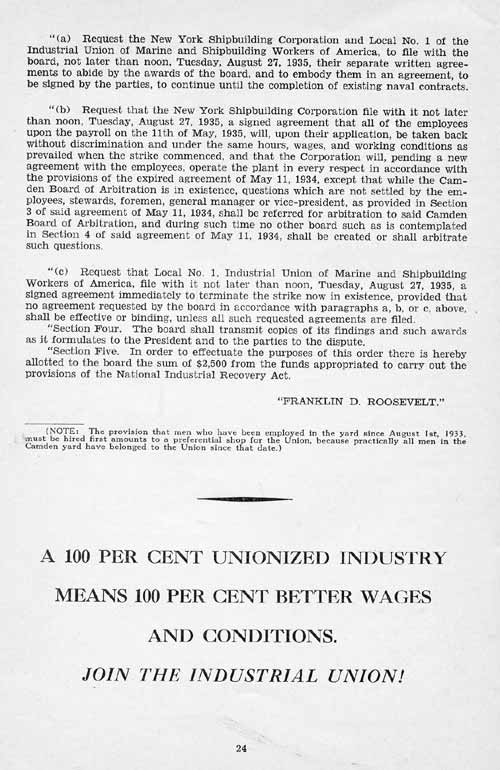
“(a) Request the New York Shipbuilding Corporation and Local No. 1 of the Industrial Union of Marine and Shipbuilding Workers of America, to file with the board, not later than noon, Tuesday, August 27, 1935, their separate written agreements to abide by the awards of the board, and to embody them in an agreement, to be signed by the parties, to continue until the completion of existing naval contracts.
“(b) Request that the New York Shipbuilding Corporation file with it not later than noon, Tuesday, August 27, 1935, a signed agreement that all of the employees upon the payroll on the 11th of May, 1935, will, upon their application, be taken back without discrimination and under the same hours, wages, and working conditions as prevailed when the strike commenced, and that the Corporation will, pending a new agreement with the employees, operate the plant in every respect in accordance with the provisions of the expired agreement of May 11, 1934, except that while the Camden Board of Arbitration is in existence, questions which are not settled by the employees, stewards, foremen, general manager or vice-president, as provided in Section 3 of said agreement of May 11, 1934, shall be referred for arbitration to said Camden Board of Arbitration, and during such time no other board such as is contemplated in Section 4 of said agreement of May 11, 1934, shall be created or shall arbitrate such questions.
“(c) Request that Local No. 1, Industrial Union of Marine and Shipbuilding Workers of America, file with it not later than noon, Tuesday, August 27, 1935, a signed agreement immediately to terminate the strike now in existence, provided that no agreement requested by the board in accordance with paragraphs a, b, or c, above, shall be effective or binding, unless all such requested agreements are filed.
“Section Four. The board shall transmit copies of its findings and such awards as it formulates to the President and to the parties to the dispute.
“Section Five. In order to effectuate the purposes of this order there is hereby allotted to the board the sum of $2,500 from the funds appropriated to carry out the provisions of the National Industrial Recovery Act.
FRANKLIN D. ROOSEVELT.”
(NOTE: The provision that men who have been employed in the yard since August 1st, 1933, must be hired first amounts to a preferential shop for the Union, because practically all men in the Camden yard have belonged to the Union since that date.)
A 100 PER CENT UNIONIZED INDUSTRY MEANS 100 PER CENT BETTER WAGES AND CONDITIONS.
JOIN THE INDUSTRIAL UNION!
List of Unions That Donated to Camden Strike of 1935
Radio and Metal Workers Industrial Union, Camden, N.J.
United Mine Workers of America, Washington, D.C.
Amalgamated Clothing Workers of America, General Executive Board, N.Y.C.
Amalgamated Clothing Workers of America, Philadelphia Joint Board.
Amalgamated Clothing Workers of America, New York Joint Board.
Amalgamated Clothing Workers of America, Local No. 75.
Amalgamated Clothing Workers of America, Local No. 143.
Amalgamated Clothing Workers of America, Local No. 156.
Amalgamated Clothing Workers of America, Local No. 110.
International Ladies Garment Workers, Dressmakers Joint Board, New York.
International Ladies Garment Workers, Camden Joint Board.
International Ladies Garment Workers, Local No. 128.
American Federation of Hosiery Workers, Branch 1, Philadelphia, Pa.
American Federation of Hosiery Workers, Branch 70, Camden, N.J.
American Federation of Hosiery Workers, Branch 10, Reading, Pa.
American Federation of Hosiery Workers, Branch 706.
American Federation of Hosiery Workers, Branch 10, Ladies Auxiliary.
Paperhangers Union, Local No. 306, Philadelphia.
Suit Case, Bag and Portfolio Makers Union, Philadelphia.
Taxicab Drivers Union, Local No. 156, of I.B. of T.C., and S.H. of A.
International Oil Field Workers, Local No. 253.
American Federation of Teachers, Local No. 192, Philadelphia.
National Federation of Post Office Clerks, Local No. 89, Philadelphia.
Allied Printing Trades Council, Philadelphia.
Painters Local No. 997, Philadelphia.
United Garment Workers of America, Local No. 149, Gloucester, N.J.
Pressmans Union, Philadelphia Local No. 4.
Wool Pullers Union, Local No. 3.
Bakery and Confectionery Workers Union, Local No. 201.
Axminster Carpet Workers, Local No. 2053 of United Textile Workers.
Brewery Workers Union, Local No. 5.
Stereotypers Union, Local No. 7, Philadelphia.
Upholstery Weavers Union, Local No. 25.
Electrotypers and Finishers Union, Local No. 72, Philadelphia.
Amalgamated Lace Operatives of America, Branch No. 1, Philadelphia.
Stone Masons Union, Local No. 3.
Amalgamated Association of Street and Electric Railway Employees.
United Brotherhood of Carpenters and Joiners of A., Local No. 1050, Phila.
United Brotherhood of Carpenters and Joiners of A., Local No. 393.
Westinghouse Employes Union, Federal Local No. 18872.
Brewery Drivers Union, Local No. 132, Philadelphia.
Typographical Workers, Local No. 86, Reading, Pa.
United Brewery and S.D. Workers of A., Joint Local Exec. Board of Philadelphia.
Battery Workers Federal Labor Union, No. 18551, Philadelphia.
Hod Carriers, B. and C.L., Council, No. 471, Reading, Pa.
Millinery Workers Union, Local No. 24, New York.
Upholsterers and Frame Workers Union, Local No. 77, Philadelphia.
National Leather Workers Union, Local No. 21, Peabody, Mass.
Federated Trades Council, Reading, Pa.
Central Labor Union, Camden, N.J.
I.A.T.S.E., Local No. 97, Reading, Pa.
Bricklayers, M. & P.I.U., Local No. 21, Reading, Pa.
Plumbers and Fitters, Local 42, Reading, Pa.
Journeymen Barbers, Local Union 203, Reading, Pa.
United Textile Workers of America, Local No. 1733, Paterson, N.J. (Dyers).
Motion Picture Operators Union, Camden, N.J.
Printing Pressmen and Assistants, Local No. 160, Reading, Pa.
Moving Picture Machine Operators, Local No. 306, New York City.
Brotherhood of Shoe and Allied Craftsmen, Brockton, Mass.
International Longshoremen’s Association, Philadelphia Local.
Federation of Art Workers, Philadelphia.
I.A.T.S.E., Collingswood, N.J.
Tool and Die Makers Local, Radio and Metal Workers Ind. Union, Philadelphia.
International Association of Machinists, Newport, R.I.
Milk Drivers Union, Local No. 70, Philadelphia.
Metal Workers Industrial Union, Newark, N.J.
Metal Workers Industrial Union, Local No. 301, Brooklyn, N.Y.
National Biscuit Workers Federal Labor Union, Philadelphia.
Painters and Decorators Union, Local No. 11, Boston, Mass.
Brotherhood of Railway Trainmen, Camden, N.J.
Storage House Employees Union, Federal Local No. 18571, Philadelphia.
Southwark Baldwin Local No. 9, Metal Workers Industrial Union.
United Meat Cutters and Poultry Workers, Philadelphia.
Total: 73 unions. Also the following Locals of the Industrial Union of Marine and Shipbuilding Workers: Quincy, Chester, San Pedro, Bath, San Francisco, Seattle.
Mine Workers’ Check for the Camden Strike
Industrial Union of Marine and Shipbuilding Workers of America —
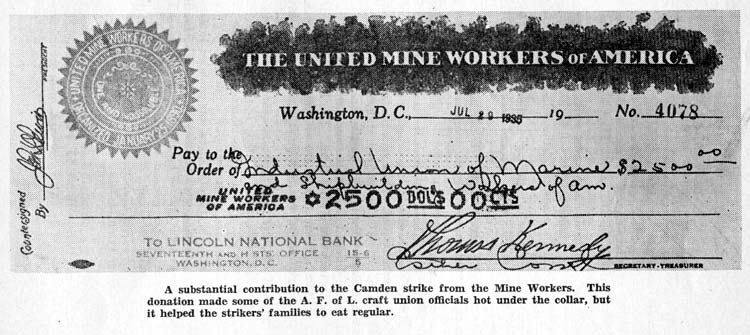
The United Mine Workers of America
Washington, D.C., Jul [?] 1935. No. 4078.
Pay to the Order of Industrial Union of Marine and Shipbuilding Workers of Am. $2500.00. United Mine Workers of America 2500 Dols. 00 Cts. To Lincoln National Bank, Seventeenth and H Sts. Office, Washington, D.C. 15-6. Thomas Kennedy, Secretary-Treasurer. Countersigned by [signature], President.
A substantial contribution to the Camden strike from the Mine Workers. This donation made some of the A. F. of L. craft union officials hot under the collar, but it helped the strikers’ families to eat regular.
The Industrial Union and the American Federation of Labor
Industrial Union of Marine and Shipbuilding Workers of America —
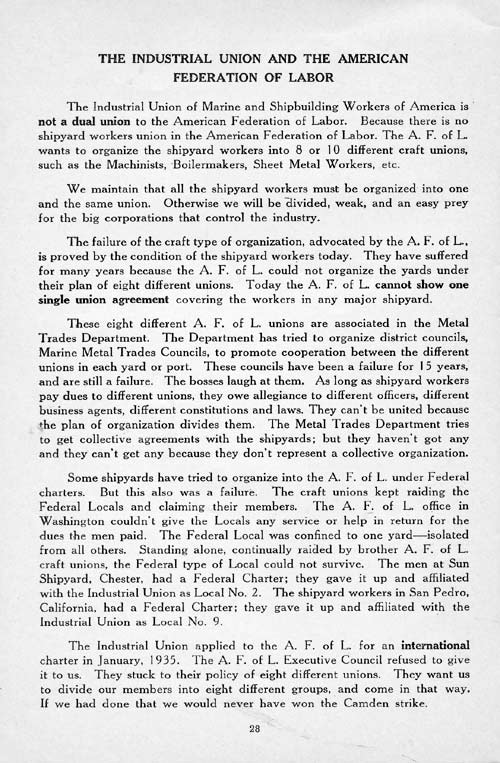
The Industrial Union of Marine and Shipbuilding Workers of America is not a dual union to the American Federation of Labor. Because there is no shipyard workers union in the American Federation of Labor. The A. F. of L. wants to organize the shipyard workers into 8 or 10 different craft unions, such as the Machinists, Boilermakers, Sheet Metal Workers, etc.
We maintain that all the shipyard workers must be organized into one and the same union. Otherwise we will be divided, weak, and an easy prey for the big corporations that control the industry.
The failure of the craft type of organization, advocated by the A. F. of L., is proved by the condition of the shipyard workers today. They have suffered for many years because the A. F. of L. could not organize the yards under their plan of eight different unions. Today the A. F. of L. cannot show one single union agreement covering the workers in any major shipyard.
These eight different A. F. of L. unions are associated in the Metal Trades Department. The Department has tried to organize district councils, Marine Metal Trades Councils, to promote cooperation between the different unions in each yard or port. These councils have been a failure for 15 years, and are still a failure. The bosses laugh at them. As long as shipyard workers pay dues to different unions, they owe allegiance to different officers, different business agents, different constitutions and laws. They can’t be united because the plan of organization divides them. The Metal Trades Department tries to get collective agreements with the shipyards; but they haven’t got any and they can’t get any because they don’t represent a collective organization.
Some shipyards have tried to organize into the A. F. of L. under Federal charters. But this also was a failure. The craft unions kept raiding the Federal Locals and claiming their members. The A. F. of L. office in Washington couldn’t give the Locals any service or help in return for the dues the men paid. The Federal Local was confined to one yard—isolated from all others. Standing alone, continually raided by brother A. F. of L. craft unions, the Federal type of Local could not survive. The men at Sun Shipyard, Chester, had a Federal Charter; they gave it up and affiliated with the Industrial Union as Local No. 2. The shipyard workers in San Pedro, California, had a Federal Charter; they gave it up and affiliated with the Industrial Union as Local No. 9.
The Industrial Union applied to the A. F. of L. for an international charter in January, 1935. The A. F. of L. Executive Council refused to give it to us. They stuck to their policy of eight different unions. They want us to divide our members into eight different groups, and come in that way. If we had done that we would never have won the Camden strike.
Treachery of the Metal Trades Department, A. F. of L.
Industrial Union of Marine and Shipbuilding Workers of America —
We would like to be affiliated with the other unions; but we are determined to maintain our industrial form of organization. United we stand, divided we would fall.
The big, progressive unions in the A. F. of L. are sympathetic to us. They know we have the right kind of organization for the shipyards. Many of them contributed to our support during the Camden strike (see complete list in this book). We know they will continue to cooperate with us, and we will continue to cooperate with them. We believe in the solidarity of all labor.
The Industrial Union of Marine and Shipbuilding Workers of America has proved it is right; it has accomplished something. And we intend to maintain our form of organization, with or without the blessings of the A. F. of L.
Treachery of the Metal Trades Department, A. F. of L.
After our strike at Newport News, and while the Camden strike was going on, representatives of the A. F. of L. Metal Trades Department had a conference with the Vice-President of the Newport News Shipbuilding and Drydock Corporation. The management of that yard, which has been non-union for years, said they had no objection to the A. F. of L. craft unions organizing their men!! What they are afraid of is the Industrial Union, because they know we will force them to pay higher wages and establish better working conditions for the men.
In the following letter, Mr. Calvin, of the Metal Trades Department, writes the “good news” to the presidents of the various international unions affiliated with his Department. This letter (we have a photostatic copy of the original) reveals the co-operation between the Metal Trades Department and the shipyard owners to keep the shipyard workers out of a live union and force them into a lot of half dead craft unions. It shows that these particular high officials of the A. F. of L. will even stoop so low as to make deals with the boss to get members into their unions at high dues. And it also proves that only the Industrial Union can organize honestly and openly, and throw a scare into the big corporations.
Metal Trades Department Letter, August 6, 1935
Metal Trades Department, American Federation of Labor —
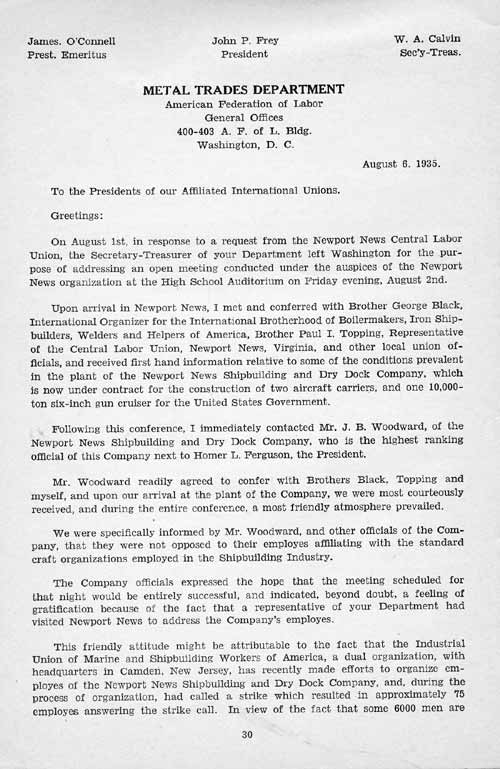
James. O’Connell, Prest. Emeritus. John P. Frey, President. W. A. Calvin, Sec’y-Treas.
Metal Trades Department
American Federation of Labor. General Offices. 400-403 A. F. of L. Bldg. Washington, D. C.
August 6. 1935.
To the Presidents of our Affiliated International Unions.
Greetings:
On August 1st, in response to a request from the Newport News Central Labor Union, the Secretary-Treasurer of your Department left Washington for the purpose of addressing an open meeting conducted under the auspices of the Newport News organization at the High School Auditorium on Friday evening, August 2nd.
Upon arrival in Newport News, I met and conferred with Brother George Black, International Organizer for the International Brotherhood of Boilermakers, Iron Shipbuilders, Welders and Helpers of America, Brother Paul I. Topping, Representative of the Central Labor Union, Newport News, Virginia, and other local union officials, and received first hand information relative to some of the conditions prevalent in the plant of the Newport News Shipbuilding and Dry Dock Company, which is now under contract for the construction of two aircraft carriers, and one 10,000-ton six-inch gun cruiser for the United States Government.
Following this conference, I immediately contacted Mr. J. B. Woodward, of the Newport News Shipbuilding and Dry Dock Company, who is the highest ranking official of this Company next to Homer L. Ferguson, the President.
Mr. Woodward readily agreed to confer with Brothers Black, Topping and myself, and upon our arrival at the plant of the Company, we were most courteously received, and during the entire conference, a most friendly atmosphere prevailed.
We were specifically informed by Mr. Woodward, and other officials of the Company, that they were not opposed to their employes affiliating with the standard craft organizations employed in the Shipbuilding Industry.
The Company officials expressed the hope that the meeting scheduled for that night would be entirely successful, and indicated, beyond doubt, a feeling of gratification because of the fact that a representative of your Department had visited Newport News to address the Company’s employes.
This friendly attitude might be attributable to the fact that the Industrial Union of Marine and Shipbuilding Workers of America, a dual organization, with headquarters in Camden, New Jersey, has recently made efforts to organize employes of the Newport News Shipbuilding and Dry Dock Company, and, during the process of organization, had called a strike which resulted in approximately 75 employes answering the strike call. In view of the fact that some 6000 men are
Metal Trades Department Letter, August 6, 1935 (continued)
Metal Trades Department, American Federation of Labor —
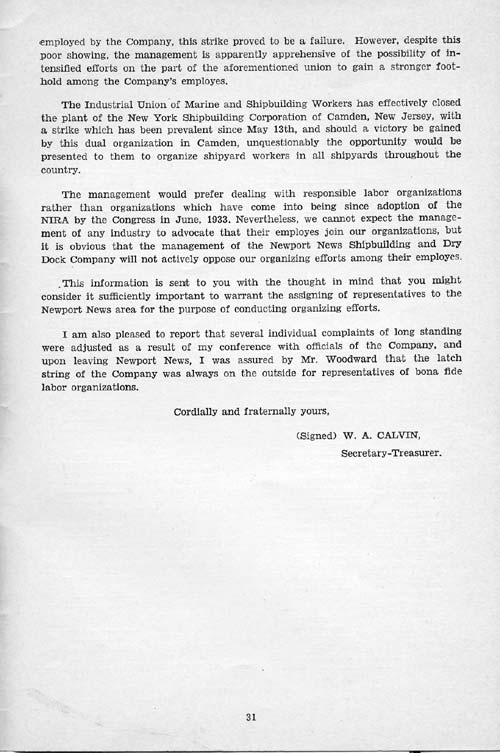
employed by the Company, this strike proved to be a failure. However, despite this poor showing, the management is apparently apprehensive of the possibility of intensified efforts on the part of the aforementioned union to gain a stronger foothold among the Company’s employes.
The Industrial Union of Marine and Shipbuilding Workers has effectively closed the plant of the New York Shipbuilding Corporation of Camden, New Jersey, with a strike which has been prevalent since May 13th, and should a victory be gained by this dual organization in Camden, unquestionably the opportunity would be presented to them to organize shipyard workers in all shipyards throughout the country.
The management would prefer dealing with responsible labor organizations rather than organizations which have come into being since adoption of the NIRA by the Congress in June, 1933. Nevertheless, we cannot expect the management of any industry to advocate that their employes join our organizations, but it is obvious that the management of the Newport News Shipbuilding and Dry Dock Company will not actively oppose our organizing efforts among their employes.
This information is sent to you with the thought in mind that you might consider it sufficiently important to warrant the assigning of representatives to the Newport News area for the purpose of conducting organizing efforts.
I am also pleased to report that several individual complaints of long standing were adjusted as a result of my conference with officials of the Company, and upon leaving Newport News, I was assured by Mr. Woodward that the latch string of the Company was always on the outside for representatives of bona fide labor organizations.
Cordially and fraternally yours,
(Signed) W. A. CALVIN, Secretary-Treasurer.
Ships Under Construction in Major Yards
Industrial Union of Marine and Shipbuilding Workers of America —
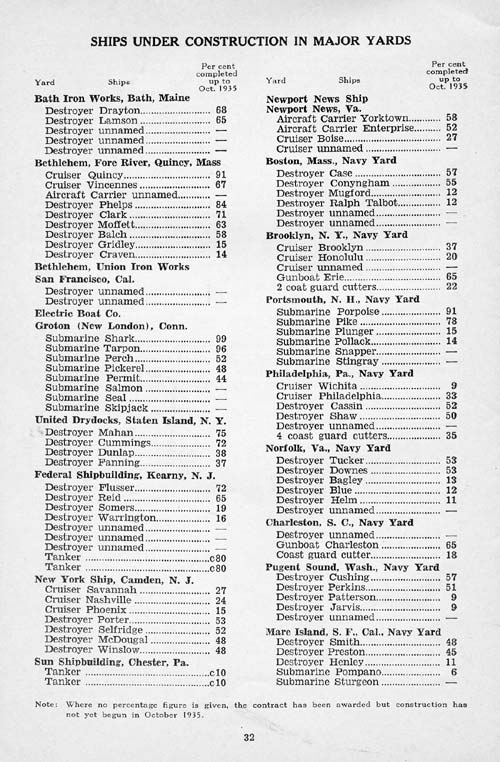
| Yard and ships | Per cent completed up to Oct. 1935 | |
|---|---|---|
| Bath Iron Works, Bath, Maine | ||
| Destroyer Drayton | 68 | |
| Destroyer Lamson | 65 | |
| Destroyer unnamed | — | |
| Destroyer unnamed | — | |
| Destroyer unnamed | — | |
| Bethlehem, Fore River, Quincy, Mass | ||
| Cruiser Quincy | 91 | |
| Cruiser Vincennes | 67 | |
| Aircraft Carrier unnamed | — | |
| Destroyer Phelps | 84 | |
| Destroyer Clark | 71 | |
| Destroyer Moffett | 63 | |
| Destroyer Balch | 58 | |
| Destroyer Gridley | 15 | |
| Destroyer Craven | 14 | |
| Bethlehem, Union Iron Works, San Francisco, Cal. | ||
| Destroyer unnamed | — | |
| Destroyer unnamed | — | |
| Electric Boat Co., Groton (New London), Conn. | ||
| Submarine Shark | 99 | |
| Submarine Tarpon | 96 | |
| Submarine Perch | 52 | |
| Submarine Pickerel | 48 | |
| Submarine Permit | 44 | |
| Submarine Salmon | — | |
| Submarine Seal | — | |
| Submarine Skipjack | — | |
| United Drydocks, Staten Island, N. Y. | ||
| Destroyer Mahan | 75 | |
| Destroyer Cummings | 72 | |
| Destroyer Dunlap | 38 | |
| Destroyer Fanning | 37 | |
| Federal Shipbuilding, Kearny, N. J. | ||
| Destroyer Flusser | 72 | |
| Destroyer Reid | 65 | |
| Destroyer Somers | 19 | |
| Destroyer Warrington | 16 | |
| Destroyer unnamed | — | |
| Destroyer unnamed | — | |
| Destroyer unnamed | — | |
| Tanker | c80 | |
| Tanker | c80 | |
| New York Ship, Camden, N. J. | ||
| Cruiser Savannah | 27 | |
| Cruiser Nashville | 24 | |
| Cruiser Phoenix | 15 | |
| Destroyer Porter | 53 | |
| Destroyer Selfridge | 52 | |
| Destroyer McDougal | 48 | |
| Destroyer Winslow | 48 | |
| Sun Shipbuilding, Chester, Pa. | ||
| Tanker | c10 | |
| Tanker | c10 |
| Yard and ships | Per cent completed up to Oct. 1935 | |
|---|---|---|
| Newport News Ship, Newport News, Va. | ||
| Aircraft Carrier Yorktown | 58 | |
| Aircraft Carrier Enterprise | 52 | |
| Cruiser Boise | 27 | |
| Cruiser unnamed | — | |
| Boston, Mass., Navy Yard | ||
| Destroyer Case | 57 | |
| Destroyer Conyngham | 55 | |
| Destroyer Mugford | 12 | |
| Destroyer Ralph Talbot | 12 | |
| Destroyer unnamed | — | |
| Destroyer unnamed | — | |
| Brooklyn, N. Y., Navy Yard | ||
| Cruiser Brooklyn | 37 | |
| Cruiser Honolulu | 20 | |
| Cruiser unnamed | — | |
| Gunboat Erie | 65 | |
| 2 coast guard cutters | 22 | |
| Portsmouth, N. H., Navy Yard | ||
| Submarine Porpoise | 91 | |
| Submarine Pike | 78 | |
| Submarine Plunger | 15 | |
| Submarine Pollack | 14 | |
| Submarine Snapper | — | |
| Submarine Stingray | — | |
| Philadelphia, Pa., Navy Yard | ||
| Cruiser Wichita | 9 | |
| Cruiser Philadelphia | 33 | |
| Destroyer Cassin | 52 | |
| Destroyer Shaw | 50 | |
| Destroyer unnamed | — | |
| 4 coast guard cutters | 35 | |
| Norfolk, Va., Navy Yard | ||
| Destroyer Tucker | 53 | |
| Destroyer Downes | 53 | |
| Destroyer Bagley | 13 | |
| Destroyer Blue | 12 | |
| Destroyer Helm | 11 | |
| Destroyer unnamed | — | |
| Charleston, S. C., Navy Yard | ||
| Destroyer unnamed | — | |
| Gunboat Charleston | 65 | |
| Coast guard cutter | 18 | |
| Pugent [sic] Sound, Wash., Navy Yard | ||
| Destroyer Cushing | 57 | |
| Destroyer Perkins | 51 | |
| Destroyer Patterson | 9 | |
| Destroyer Jarvis | 9 | |
| Destroyer unnamed | — | |
| Mare Island, S. F., Cal., Navy Yard | ||
| Destroyer Smith | 48 | |
| Destroyer Preston | 45 | |
| Destroyer Henley | 11 | |
| Submarine Pompano | 6 | |
| Submarine Sturgeon | — |
Note: Where no percentage figure is given, the contract has been awarded but construction has not yet begun in October 1935.
Back Cover
Industrial Union of Marine and Shipbuilding Workers of America —
SHIPYARD WORKERS OF AMERICA UNITE