History of the Courier-Post
By Stephen M. O’Keefe
Stephen M. O’Keefe capped off a 57-year long career, all of it with the newspaper that in time became the Courier-Post, with writing the article below, a seven-part history of the newspaper, which published its first edition on October 7, 1875 as the Camden Daily Post on October 2, 1875.
On the whole it is a very good recounting of the history of the Courier in particular with some insights into the times and the people who played a role in Camden’s newspapers and political world. One thing worth noting, is that O’Keefe, who apparently never let go of some hostility towards David Baird Jr., chose to refer to him as a “Night Rider” in his business dealings with J. David Stern, with “Night Rider” implying that Baird was in some how affiliated with the Ku Klux Klan. That Baird referred to Stern as a “carpetbagger” is indisputable, as is his accuracy in using that term, especially given the actions of Stern, who had no local connections, involving himself in local politics. A good case can be made that the “reforms” Stern backed, especially the abandonment of the ward-based City Council in favor of five at-large commissioners was a terrible idea and did not serve the city well at all, placing politicians in charge of departments where they had no expertise whatsoever. Two wrongs do not make a right, however, and there was no need to imply that the long-dead Baird Jr. was in anyway associated with the KKK.
NOTE: In the interest of speeding up the process of getting the seven-part history on the website, I have not followed usual practice and reformatted long columns. The source material, microfilm images, was not optimal for use with OCR software, and I do not have the time to manually transcribe the images. For now at least, the reader will have to do some scrolling. Also in the interest of time, I have not provided hyperlinks to pages about people mentioned below. These will be forthcoming at a later date.
A hopeful beginning in the wake of war
Camden Courier-Post —

By STEPHEN M. O’KEEFE
Former Courier-Post City Editor
One hundred years ago the first edition of the Courier-Post Newspapers was published. It was dedicated to informing the people of Camden abouts [sic] news events and contained a vow to promote the best interest of the city.
A glimpse into the bygones in that century offers a vista of change — in the community, the people and the newspaper. The long span from Oct. 2, 1875, has been packed with pathos and pleasures which attend the daily panorama of news — an abundance far beyond the dreams of Camden’s early journalists.
Birth and death are neighbors in newspaper columns. Right and wrong rest there with all the sins and virtues. The disasters of man and nature mingle with the defeats, the triumphs, the tragedies of life, and each day’s paper bears testimony that rich and poor, high and low, all stand within range of the pressman’s ink.
THE LAST HALF of the Courier-Post centennial has brought astonishing change. Modern tools and techniques have banished into oblivion methods that were regarded as wonders 100 years ago. Printers who retired only a few years ago cannot believe it possible to produce newspaper without type and the onetime marvels that were typesetting machines.
The home of the Courier-Post, sandwiched by Cuthbert Boulevard and Hampton Road in Cherry Hill entombs the spirits of many who labored to make it possible. While countless numbers have made anonymous contributions others left legacies that have enriched the hostory [sic] of Camden — even beyond its borders in the once-dense wilderness.
Journalists a century ago were a hardy and optimistic breed. They consigned to the past the horrors of the Civil War and a national panic in 1873.
Camden at that time was a town of ferries, a source of prosperity. Then and for years afterward, the city’s culture reflected on the river. There in season boats by the hundreds were gliding or riding at anchor in a steam that was adequate for commerce and unspoiled.
THAT WAS the way it was when Henry L. Bonsall, at the age of 12, went to work in the printing shop of the West Jersey Mail, at Front and Federal Streets. A biographer of later years wrote that Bonsall was educated in that printing shop. He was destined to become superintent [sic] of Camden schools, to serve four years in the New Jersey Legislature, become a whiskey-drinking companion of poet Walt Whitman, and founder of the Courier-Post.
Whitman was the foremost writer in Courier-Post annals. The penciled manuscripts he brought to the Camden Daily Post shop probably were discarded after they were set in type. Those scribblings would command huge sums today.
Bonsall departed from the West Jersey Mail a short time after completing his apprenticeship and left Camden in 1858. He worked in Philadelphia, Harrisburg, New York, served as a war correspondent and was a clerk in the House of Representatives before returning to Camden in 1867.
A CLUE AS to why he left and returned to Camden may rest in a fragmentary record in the Camden County Historical Society library. Typed on a card there is the notation that Lydia C. Bonsall, his wife, died in Washington, on Oct. 8, 1866, in her 24th year. Other records list Bonsall as 32 then.
Bonsall launched a weekly, the New Republic, on Nov. 30, 1867, at the southeast corner of 2nd and Plum (now Arch) Streets. Eight years later after an interlude in politics, he launched the Camden Daily Post.
Camden was on the move as a city. It was called a beautiful and prosperous town by visitors. New industries were springing up and Pennsylvanians were impressed by the increasing number of fine homes being built here. The city’s churches, its schools, hotels, clubs and stores were augmented by the Camden Opera House at West and Mickle Streets.
From a village of 1,143 souls in 1828, when it was incorporated, the population rose to almost 30,000 in 1875.
BONSALL PRODUCED the first issue of the Camden Daily Post on Oct. 2, 1875. Soon afterward his son, Bartram L., then about 20, was listed as his partner, and the firm was identified as H.L. Bonsall & Son, located at 205 Market St. Type for the paper was set at that address but the paper was printed by its rival, the Camden Democrat, in a frame building at Front and Federal Streets. This seemingly strange situation was part of newspaper tradition.
Soon after the first issue of the Post, things began to happen. Business throughout the city was lively, and popular reaction to the new paper pleased both Bonsall and the advertisers. The first edition set forth Bonsall’s vow:
“REALIZING the necessity for a departure from the traditional policy of partisan journalism, THE DAILY POST will be entirely independent and untrammeled. Having no other ‘backing’ than the clear heads and strong hands of its projectors, it will be under the domination of no party, clique or corporation and be influenced by no considerations save those which conduce to the best interests of a community from which alone it will endeavor to deserve and derive support. Alive to the advanced thought of the day, it will strive to keep abreast with it, ever lending a generous support to liberal and humanizing efforts, and avoiding the miserable, if not mercenary, personal detraction which blurs the pages of many journals.
“Camden is rapidly growing and destined to become a great city. It will be the effort of the POST to present the evidence of this fact and assist in its further development.
“A newspaper is the best reflex of a community, conveying to the casual observer an idea of its business enterprise and intelligence. Philadelphia dailies, which have met with a liberal support in the absence of a home medium, constantly detract from our merits instead of doing justice to a city which already contributes far too much to the material interests of a neighbor it may, at no distant day, rival in production, if not population, should our immense and unrivaled advantages be properly availed of by a liberal policy of encouraging home industry.
“To achieve this end will be the aim of the POST and to enable to do its work thoroughly and acceptably, it confidently claims the support and cooperation of citizens, irrespective of party or other preferences, pledging itself in return to furnish a paper that will meet the just expectations and reasonable demands of an intelligent reading public.”
THE RESPONSE indicated Bonsall’s move was timely and profit was apparent in the flow of advertising.
In short order about a dozen names were listed in the paper as authorized to accent [sic] subscriptions, at 10 cents per week, for a minimum of six months.
Advertising rates were quite low and not rigidly set. The payroll was augmented in kind. One editor-writer, Dickinson of the Democrat, reputedly was paid $7 a week, with washing thrown in. Sinnickson Chew, of the West Jersey Press, is said to have been receiving $8.25 per week. Bartram Bonsall augmented his 50 cents per week by selling newspapers from other cities mailed to the Post. He also was given a pass to the Opera House.
Most papers of that period were dull, compared to today’s papers, packed with space-filling junk and items copied from other journals, some of which were two to three months old.
The Post managed to print more local news, particularly court cases. Readers today would be astonished at the number of drunks and wife-beaters that appeared in mayor’s court in those good old days. Also surprising was the number of women tipplers arrested, some hauled to jail in pushcarts or wheelbarrows. All were identified in court and in the newspapers.
DURING THE winter of 1875-76, the Post circulation exceeded 1,000 and in about a year the figure topped 3,000, then hailed as the largest in South Jersey.
Before joining his father on the Post, young Bonsall was publisher of The Spy, which he called “a paper run by a boy.” He was 17 when The Spy first appeared. It sold for 25 cents a year. In its first two years, The Spy took over four other journals put out by amateur editors. At one time there were seven such publications in Camden, all in the 1870s. Several professional developed [sic] from these journals.
The Post continued to play up politics, and it was evident that Bonsall was straining to give both parties coverage. His columns of commentary, however, generally espoused the Republican Party.
IN THE FIRST half of the 1870s, Camden was showing signs of progress but it still was contained in a compact area, mainly from the Market Street ferry to about 6th Street or Broadway, the old turnpike to Woodbury. The north-south sideses [sic] of the sector were Cooper and Federal Streets. Present-day North 7th Street, where the Friends’ Meeting House faced Cooper Street, was looked upon as the outskirts.
It took about four years for city officials to accept 4.5 acres of land donated as a site for a new municipal building on Haddon Avenue, between Washington and Benson Streets. They felt the location was too far out.
It was accepted formally in 1974 [sic], and the second City Hall was built at a cost of $125,000. Its recorded opening date has been listed as Jan. 1, 1876, but an old newspaper file reported the City Council first met there in December, 1875.
That building, with a large clock in a high steeple, was to remain a landmark for more than a half century.
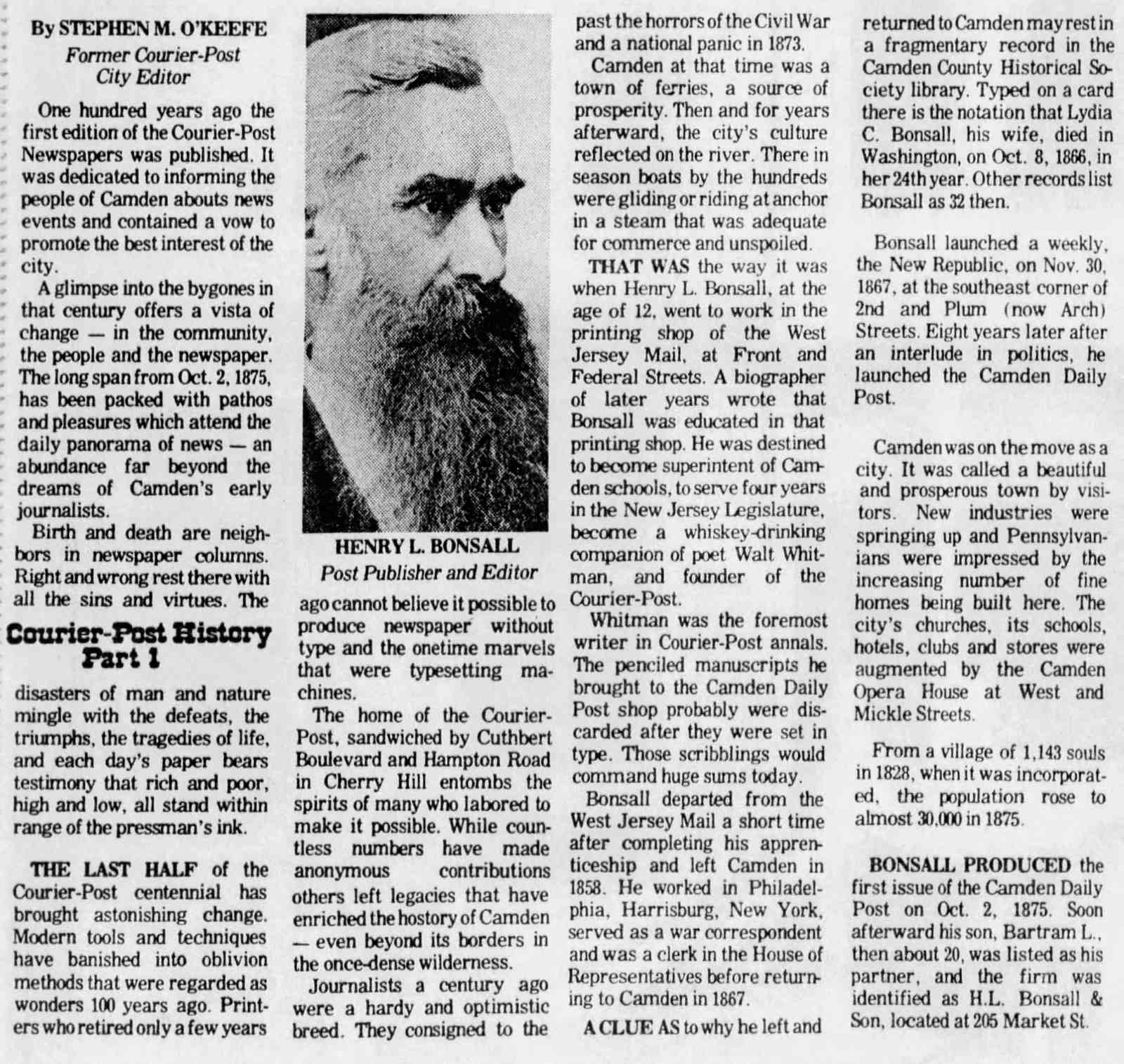
HENRY L. BONSALL Post Publisher and Editor
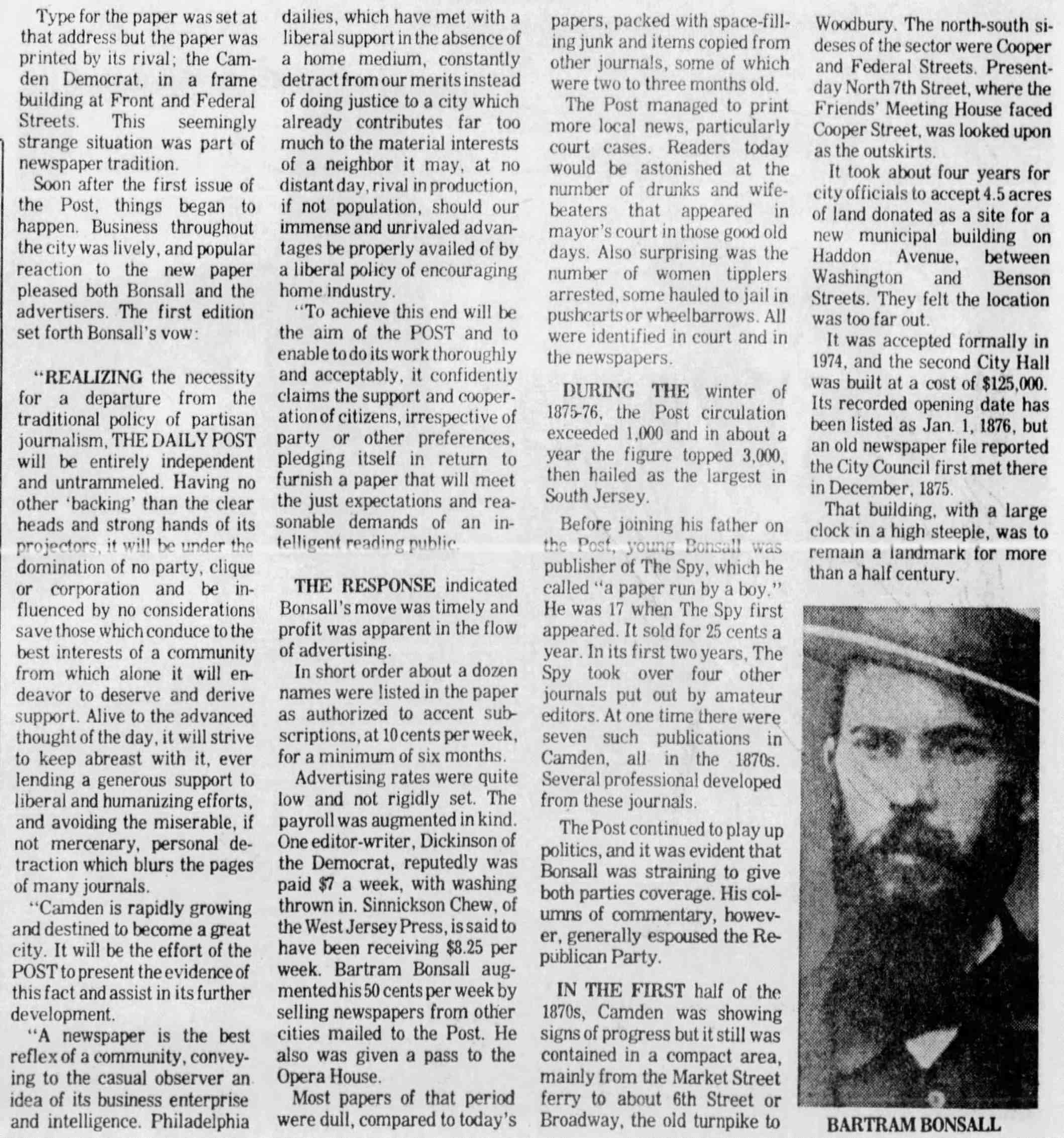
BARTRAM BONSALL
Post and Courier parallel
Camden Courier-Post —


Mergers, shifting management mark early years
By STEPHEN M. O’KEEFE
Former Courier-Post Editor
As partners in establishing the Daily Post, Henry L. Bonsall and his son, Bartram L., also were witnesses to the founding of the Courier, first as a weekly in Haddonfield (April, 1878) then its transfer to Camden (July, 1879) and the beginning of the Courier as a daily on June 2, 1882.
The man who started the Courier was also a printer, Charles H. Whitecar, who had been employed by the elder Bonsall on the New Republic.
The son of a Methodist minister, Whitecar called his paper the Haddonfield Courier, then changed it to the Camden County Courier when he moved it to Camden in the summer of 1879. He had been publishing in the city only about three months when he was run over by a train at Haddonfield on Oct. 9. He died five days later at age 24.
WHITECAR HAD financial difficulties and occasionally the Post would speculate about whether he would fail. After his death, the paper was acquired by Sheriff William Cahoun and former Sheriff Jacob C. Daubman. They retained the name of Camden County Courier. The address listed as 132 Federal St., in May, 1880.
The paper was purchased by F. F. Patterson Sr. in September, 1880, and through that transaction it became identified with a family that figured prominently in New Jersey’s history for 78 years, from 1848 to 1926. Patterson made a daily of the Courier.
Frank Ford Patterson Sr. was a seasoned newspaperman when he acquired the County Courier. He continued issuing it on Saturdays with nine columns on each of four pages, compared to the six columns on each of the Post’s four pages. But the Post earned more revenue by printing each afternoon, except Sunday.
ON JUNE 2, 1882, Patterson started the daily. The Camden Daily Courier was circulated in the city while the County Courier was distributed in the outlying areas. The weekly was discontinued in 1884.
Patterson’s eldest son, Theodore N., was first associated in the Courier venture as business manager. The father was editor and top hand in the printing shop. Ownership of the paper was vested in the Courier Publishing Company, and Patterson shared control of the firm with John H. McMurray and Thomas C. Hamilton, as of Feb. 1, 1883.
Patterson, with the Courier, and Bonsall, with the Post, plodded along parallel lines during the next five years.
THE NEXT major event was in 1888, when George A. Frey came from Philadelphia to purchase the Courier. Associated with Frey were V.L. Cavanna and at least one other. Little is recorded about them, and Frey soon after appeared as the sole owner. In that role, he was credited with prudent management of the paper for more than 30 years.
Frey had worked on a newspaper in Pittsburgh and published a grocery business sheet in Philadelphia. In Camden, he became progressively identified with organizations dedicated to thrift, property acquisitions and banking. He served as Camden city treasurer for about 17 years and became president of a leading bank.
According to the talk around Camden, more than $18 million in municipal funds passed through Frey’s hands. Yet his accounts were always correct to the penny. Frey also had a reputation for punctuality. People used to say that when he was sighted strolling briskly to the old City Hall on Haddon Avenue a watch could be set at 8:58 a.m. and that he would take a seat at his desk at the stroke of 9.
IN HIS DRESS, Frey favored Prince Albert attire. The princely appearance was complete with his white mane, pointed mustache and neatly trimmed goatee. He owned a variety of canes. He was a firm believer in the value of walking and his trim figure relfected [sic] the benefits of that pastime.
Frey was a member of the state Board of Education and showed a steady interest in Bordentown Industrial Institute.
At the start of the Frey saga, Post and Bonsall had both experienced some troubles. One incident concerned the sale of a half-interest in the paper from father to son Aug. 1, 1883.
It is likely that expenses involved in equipping the plant at 116 Federal St. had drained the resources of Henry Bonsall and that Bartram drew upon his own savings to meet the costs. In any event, The Post Printing and Publishing Company was organized in 1886 with Bartram as secretary, Henry Bonsall, president, and Joseph M. Engrad, treasurer.
BONSALL HAD contracted for a new building, with a stone front, on the northeast corner of Front and Federal Streets. This was built and occupied in October 1887. Within two years a new press was purchased.
The Post continued to issue from the Front and Federal Street plant until June 12, 1899, when it was consolidated with the Camden Daily Telegram. The conbination [sic] was the Camden Post-Telegram. A major feature of the deal was the city’s first telegraphic news service.
James M. Fitzgerald, a stormy figure in the news field and politics, and Alvah M. Smith, a pipe-smoking writer, started the Telegram Feb. 24, 1886, at 95 Federal St. They were Democrats and offered some competition to the Republican Courier and Post.
They arranged for installation of a Morse apparatus with a wire connected to the Baltimore & Ohio Railroad Company cable.
IN LAUNCHING their enterprise, Fitzgerald and Smith decided to have news items sent as telegrams from correspondents in several key cities. In line with their plan, they selected Telegram as the name for the paper.
Fitzgerald has been described as a vigorous, intelligent and free-swinging journalist who delighted in aiming at a political target and walloping away with worlds [sic].
Smith, more careful and patient than Fitzgerald, spent about seven months with the Telegram and in September sold his one-third interest to his partner.
FRANCIS F. PATTERSON JR.
GEORGE A. FREY Courier Publisher until 1919
YEARS LATER, around 1916, Smith was hired by Frey and occupied a desk in the Camden Daily Courier newsroom alongside Ben Courter, an editorial writer. Ben was the second of four generations of Courters in the Courier-Post annals. His father, John D., started the strain in the 1870s, while his son, John D. and grandson, Robert, are included in the centennial roster of the Courier-Post.
After Smith’s separation from the Telegram the paper declined. Control shifted to John H. Fort the same month Smith quit. Fort was a newspaperman, lawyer, orator, historian and politician. With the Telegram, he added publisher to his titles.
Fort had his law office at his home, 311 Market St., and he moved the paper there, too. He changed the name to Daily Telegram and in 1888 formed the Telegram Publishing Company.
He enlisted Upton S. Jefferys, as secretary-treasurer, and Thomas C. Hamilton, as business manager. The latter two severed connections in 1890 and purchased the Saturday Evening Express, with an office at 211 Market St. but which was printed in Philadelphia.
AFTER THE 1888 sale of the Courier by his father, F.F. Patterson Jr. became a reporter on the Baltimore Herald. He was advancing to a desk position but accepted the city editorship of the Daily Telegram instead.
He was successively identified with the brief excitement that attended the Morning News and General Advertiser, another inovation [sic] of James M. Fitzgerald, and the Sunday Review, which was established by his brother, Theodore N. Patterson, in 1889.
In the fall of 1891, F.F. Patterson Jr. became New Jersey editor of the Philadelphia Record. He resigned in September, 1894, to take over the Camden Daily Telegram.
THAT CHANGE helped save the Telegram from complete failure. It had been subjected to several mutations and was handicapped by poor equipment. Worse, it was described as financially weak.
The paper was purchased by a group of Republican Party leaders who elected F.F. Patterson Jr. as president of the Camden Daily Telegram Company. He quickly discarded old type and badly-worm [sic] mechanical equipment and installed the first linotype machines ever used on a Camden newspaper.
Patterson’s father and brothers assisted in restoring the Telegram to a position of profit and influence in about two years. Theodore N. Patterson had disposed of the Sunday Review in 1892 to a syndicate financed by William J. Thompson, racetrack chieftain famed as the “Duke of Gloucester.”
AFTER THOMPSON put up the money to acquire the Sunday Review, it was changed from an independent Republican journal to a Democratic daily paper on Sept. 6, 1892. Harry B. Paul became publisher. The first editor was George M. Todd, perviously [sic] of the Elizabeth Herald. He was succeeded by Charles Bowman, who sprayed excitement over the political scene both in New Jersey and Pennsylvania.
Expenses and debts plagued the paper. On Feb. 13, 1894, it was subject to levy by Sheriff George Barrett and sold to William J. Paul. The Review was one of four daily newspapers in Camden, until it ceased publication Dec. 11, 1902. The others, the Post, Courier and Telegram, all were Republican sheets.
The Post and Telegram were consolidated June 12, 1899.
The Telegram was a livlier [sic] paper with the energy of the Pattersons devoted to it daily. The Post was noticeably slower, and the merger was considered to be in the best interest of Bonsall’s journal. It had been going along for nearly nine years without one of its mainsprings, since the death on Nov. 11, 1890, of Bartram Bonsall.
THE COMBINED papers appeared under the masthead of the Camden Post-Telegram, with Bonsall and his partner, Engard, teamed with F.F. Patterson Jr. and his brother, Theodore, as principals. Bonsall became the editor but died in 1900, at 66. He was replaced by Upton Jefferys, who resigned as New Jersey editor of the Philadelphia Inquirer.
Engard also died with a short time. The stock of both Bonsall and Engard was acquired by W. L. Patterson, then secretary-treasurer of the Post-Telegram Company. When the latter retired he was succeeded by Frank F. Patterson 3rd, who a quarter century was destined to be the last Patterson in a position of eminence in journalism.
The Courier and Post-Telegram continued an untroubled rivalry, each publishing 10, 12 and 16 pages, up to the end of 1919. The Post-Telgram [sic] occupied the row of buildings west of 2nd Street, at 139 Federal, while the Courier enjoyed more space since the transfer from 132
Stern the maverick publisher cuts in
Camden Courier-Post —

By STEPHEN M. O’KEEFE
Former Courier-Post City Editor
George A. Frey sold the Courier Dec. 15, 1919. It was just a business deal. That is the way it was generally received in Camden’s business and political community.
But Frey’s departure and the purchase by a stranger stirred fears among Courier employes who had grown to feel that they were part of an institution.
It was soon apparent that the transaction was to be a turning point in the city’s history as well as the newspaper’s. The impact was to extend throughout South Jersey. Even Philadelphia would feel it.
THE NEW owner was J. David Stern, who sold his newspaper interests in Springfield, Ill., to buy the Courier. Within a few years of his arrival, Camden’s economy perked up, the face of the city changed and a political dynasty that had maintained rigid control for more than 25 years toppled.
Stern’s purchase of the Courier was shrouded in secrecy. One man, however was privy to the sale. He was Walter L. Tushingham, the business manager. “Tush” had a reputation as a trusted repository for secrets and private business matters.
It was not until many years had passed that Stern revealed that he had paid Frey $144,000 for 80 per cent of the Courier stock. The other 20 per cent was owned by Tushingham, who persuaded Stern to buy and remained in the setup.
Tushingham, long the main cog at the Courier, had experienced a series of frustrations in arranging for necessary improvements and expansion of the plant. Adjoining properties had been purchased and $75,000 had been appropriated for a new press. Frey was a stickler for economy and he put restraint upon such expenditures which delayed the expansion.
TUSHINGHAM was shackled. They [sic] way business was moving, he knew more revenue was obtainable but the Courier plant was operating at capacity. This was the situation early in 1919 when “Tush” and Stern were brought together by F. Morse Archer, then president of the First National Bank in Camden. Stern had consulted Archer about the possibility of making a purchase, at the suggestion of a mutual friend.
Archer had told Stern that there was hardly any hope of purchasing either the Courier or Post-Telegram. He said both papers were owned by men beholden to former U.S. Sen. David Baird, who dictated Republican Party matters and had a grip upon much of the city’s business affairs. Baird, he counselled, controlled the newspapers and he had no wish to see an outsider distrub [sic] matters.
According to Stern, in his memoirs printed in 1962, the $200,000 price tag Tushingham quoted was too high. He told “Tush” he was not interested.
In his book Stern later gave Tushingham’s account of the situation in Camden. According to the book, Tushingham admitted, the price is high. If it were less, someone in Baird’s organization would take it over.
“FREY IS SURE to consult the Senator, who won’t relish the deal. In the present setup, the Senator has it all to himself. When he wants something in or out of the paper he doesn’t bother to ask Frey or me. He calls the city editor direct. The boys are all on his payroll.
“If Baird lets Frey sell, it will only be because Baird doesn’t want to match the offer or keep his old friend (Frey) from getting the high dollar.”
After stating that he had lost interest, Stern came back to “Tush” and agreed to make an offer for Frey’s stock. His friends and relatives advised against the investment, but a staunch advocate was his wife Jill (born Juliet E. Lit).
Arguing against the purchase were her uncles, Samuel and Jacob, who ran Lit Brothers department store. Both, however subsequently helped with substantial advertising accounts and influenced other Philadelphia merchants in that direction.
STERN CITED $20,000 as the Courier’s earnings in one year prior to the purchase. He said in five years the paper grossed $1 million and that figured climbed to $3 million in 1947, when he retired.
When the Courier-Post joined the Gannett group Sept. 1, 1957; the purchase price of $5 million was, according to Stern’s reckoning, “28 times the high price I paid in 1919.”
The maverick publisher (his own term) neglected to compare the dingy, rundown property he bought with the vastly larger and more modern facility that replaced it under the management of his successors, the late Harold A. Stretch and his family.
Stern regarded Walter L. Tushingham as one of the best assets he acquired in the deal with Frey.
“TUSH” VIRTUALLY dedicated his life to the Courier, from the time he started in 1894 as a $5-a-week bookkeeper. As a boy of 15, he had earned pennies peddling garden produce from the wagon of his father, who later became pastor of Calvary Methodist Protestant Church in East Camden. His son put his savings into Banks Business College to obtain the training he required for the job at the Courier.
“Tush” had a brief fling at publishing, in 1893, when he set up “The Stockton News,” a weekly. It was discontinued after a few issues, but the experience gave him an insight into the complexities he would face at the Courier.
AN EXHIBITION of poor judgment in the handling of some news stories — with the Courier suffering in comparison with Philadelphia papers — triggered changes in the editorial department.
Harry T. Saylor was brought in as managing editor. Gifted writer, keen analyst and master of tact are but a few of Saylor’s attributes. He adjusted to the crude circumstances he saw when he arrived at the Courier. He was a big portly man with a fine sense of humor and he openly displayed pleasure in his work, an enthusiam [sic] which infected many of his associates. In the years that followed he capably filled the editor’s chair in all Stern newspapers.
OTHER KEY imports were Elmer C. Pratt, master printer and mechanic; Fred Wilhite, advertising executive, and Alfred Neef, accountant and investor.
In later years, Stern recounted that he brought 20 former Springfield employes to Camden to enliven the Courier. They did that, in good measure, but there was an abundance of local talent in every department.
Frank H. Ryan was a standout. William B. Wells was another. They were survivors of the low-pay, hard-times era. Each served more than 50 years.
Wells, as foreman, and Ryan, his assistant and top makeup man, were laboring in the shop when Stern directed the first big political triumph in the early 1920s. Tushingham was closer to the situation, having engineered the transaction which made Stern the publisher.
AMONG Tushingham’s legion of friends was Newton B. T. Roney, whose father had worked in the Courier pressroom. Roney had studied law, but shifted to real estate developments with a measure of success. He harbored a dream of building an elaborate theater at Broadway and Pine Streets, then the heart of Camden’s commercial district.
The theater foundation was laid and part of the structure raised when Roney experienced financial difficulties.
Roney went to see Baird. He asked, but was turned down. Appealing to other sources, he learned that word had been spread about Baird’s rejection. He could not get financing from any bank, he related a few years afterward. Roney’s dream faded and he soon left for Florida.
IN TIME, title to Roney’s dream changed to other hands. The project eventually was completed and opened as the Towers Theater.
Within a few years after he departed, reports came back about Newt Roney’s making big money in land along the ocean side of Miami Beach.
Roney planned well, worked diligently and met with astounding success. His beachfront paradise, named Roney Plaza, was the first of many hotels that transformed Miami’s oceanside to a vacation wonderland. This project was underway when Roney returned to Camden.
THE STERNS and the Roneys met and in 1922, on a visit, Roney asked Stern to lunch. His companion on that bright June day was Edward J. Kelleher, then a struggling Democrat with ideals and ideas.
The three launched into a discussion of Boss Baird. Roney had expressed his aversion to Baird in a previous chat with Stern, who on this occasion was being drawn into a Roney plot to avenge the Towers theater setback. For the record, Stern offered no resistence [sic].
Stern was more than casually acquainted with Baird. He accompanied Baird to the Republican National Convention in 1920 at Chicago. The big deal there, the nomination of Warren G. Harding for President, disgusted Stern but Baird regarded it as part of the game.
In the discussion with Roney and Kelleher, Stern said he was open to suggestions. Roney cited as a key figure the Democratic City chairman, Patrick J. Harding, a personable attorney who enjoyed reminiscing about his days at the Courier before becoming a lawyer.
HARDING WAS regarded as a good lawyer, had a lot of such friends, served as municipal solicitor and engaged in such profitable corporation work, as that of Public Service. He also was counsel for the Republican-controlled Camen [sic] County Board of Freeholders. His appointment was convincing evidence that Baird “took care” of Democrats, too. Roney put the point directly to Stern:
“Will the Courier back Ed Kelleher against Harding?”
The answer was just as direct in the affirmative. Roney put up a few thousand dollars initially and told Kelleher to start the ball rolling. Stern promised ample publicity. Roney knew — Stern was only then to learn — that Kelleher was a clever strategist and a natural politician. Hardin [sic] was ousted from the party chair.
AT THE NEXT session, Roney and Kelleher dealt with building up the Democratic organization. Stern matched Roney with $2,500 and Kelleher said he could pick up small donations to round out the $10,000 he estimated would be needed to form new clubs and to reorganize some of the old units.
Part of Kelleher’s night-and-day labors was to bring to Stern some long-concealed property tax data which would provide interesting political stories in the Courier.
Baird was upset. The Post-Telegram lashed Stern as a carpetbagger whose aim was to ruin the city.
Harry Saylor showed mastery in the treatment of every issue. He sprinkled humor, sound philosophy and plainly-worded common sense through the Courier columns. His occasional shaft at the Post-Telegram proved sharp and subtle. The people loved it. The circulation climbed.
THE VOICE OF the Post was its publisher, a long-time faithful ally of Baird and a congressman, Francis F. Patterson Jr. As a principal, Patterson had been rewarded with a share of appointments handed to those favored in the Baird system.
Patterson was a rugged printer in the late 1800s, part of whose duty was to deliver papers as a post-rider. His many years of ease came after the turn of the century. He and Frey were just nice neighborley [sic] rivals. Both were secure and affluent.
That smooth way of life vanished with Frey and Stern’s arrival. The long period in his comfortable groove had lulled Patterson into a passive outlook. He did not seem to have the vim that propelled him into a saddle and over miles of Gloucester county backroads.
THE POST-TELEGRAM could not agree with some of Stern’s ideas of progress. Patterson tried to fight Stern and his ideas. Camden readers were receptive to change. Political disclosures, in language that was new to them excited their interest. They bought it in increasingly daily doses. The Post-Telegram suffered decline.
Roney occupied a grandstand seat and kept counsel with the other members of the trinity. He and Kelleher introduced Victor King to Stern as a potential candidate for mayor. The tall and lanky King, a caricature of the comic-strip character Andy Gump, was the opposite of Fran [sic] S. Van Hart, then acting mayor. Van Hart was the Old Guard replacement for Charles H. Ellis, mayor from 1905 to 1922, where he became postmaster.
In the fever of the imes [sic], fanned by the slanted columns of the Courier, King won at the polls. Even Stern confessed amazement. The margin of victory was only 800 votes.
CAMDEN IN THE 1920s was far different from today. Horse troughs stood at many corners — drinking fountains for pedestrians, too. Horses and wagons were common, also carriages. Automobiles and light trucks had noticeably increased, but every motor vehicle in the city at a given time would not cause a traffic jam.
The city then still had a number of dirt streets and quite a few surfaced with cobblestones. Hundreds of sidewalks were bricked — but without mortar.
Stern and the the [sic] Courier moved to a higher plateau of influence, and advertising revenue was climbing. So were expenses, particularly expanding the plant for a new press and a far greater amount of equipment than longtime Courier craftsmen had ever seen.
EVERY department had more space. Elmer Pratt directed the installation, working around the clock through many weekends. He was mechanical superintendent but did regular chores as a printer.
Expanding the plant at 3rd and Arch was not easy. Construction workmen spent weeks weaving around Courier mechanics.
Trouble soon cropped up with the new press, a giant marvel compared to its steam-powered predecessor. The old press had been converted to electric power in 1927 before it was sold to a South American publisher. The conversion was made by William Morton, who helped Eldridge R. Johnson develop the Victor Talking Machine and ran a nearby machine shop.
NOR WAS everything hunkydory in Camden’s political environment. Ed Kelleher had managed to knit the long-repressed Democrats in the wards into a coalition with independent, non partisan citizenry and quite a number of unhappy or uncontrolled Republicans. Most were identified with the Non-Partisan League and they were feeling their oats. The practical Roney and Kelleher, however, knew they had merely reached first base.
The two men huddled with Stern and came up with an idea — campaign for a new form of government for the city. The plan was worked out expertly, emphasizing the advantages of a compact, five-man governing group, each member accountable to voters all over the city.
The new plan was kept secret for a while. It was embodied in an exhaustive survey for the council by Mayor King. The new mayor startled the Old Guard and the city at large by calling for a referendum on a City Commission form of government. The speech prompted an abundance of favorable copy in the Courier; not so favorable comment in the Post-Telegram.
IN MARCH, 1923, the change was approved. In May, the voters elected the entire Non-Partisan League ticket. This put Baird and his organization out of business for the first time in 25 years.
Stern and the Courier were the chief beneficiaries of the change. The publisher — and now politician — was to know the stress of carrying water on both shoulders.
Patterson and the Post-Telegram were to feel the worst effect. With the downward turn of fortune, a frustrating decline in advertising and circulation revenues, the P-T was a loser each day.
STERN CALCULATED the advantages in buy [sic] the Post-Telegram, but Patterson wouldn’t consider a deal with Stern. He approached Baird and asked for a loan needed to fight Stern. Baird said he wanted Patterson to keep the competition and suggested a smaller loan. The Post publisher wouldn’t agree.
“The full amount or nothing,” Patterson declared.
Baird matched his stubbornness. Back in the office Patterson shared his misery with Upton S. Jefferys, the editor, and Frank S. Albright, city editor. Upton owned five shares of P-T stock. He and Albright had given their best efforts for many years, but the outlook was bleak.
THIS WAS the situation when Patterson saw Ed Kelleher enter the office. The two were not strangers, but Patterson had little reason to regard him warmly.
Kelleher came right out with an offer to buy the Post-Telegram. Patterson replied with equal candor:
“You know that I know, Ed, that you don’t have anough [sic] money to buy this paper.”
Kelleher put a hand in a coat pocket and was about to inform Patterson that he had come prepared to negotiate.
“I’m sure I know who you represent,” Patterson stated. “My answer is no.”
KELLEHER DREW a check from his pocket and placed it before Patterson. The publisher took a quick glance at the amount. It was $75,000. He then summoned his son, Frank F. Patterson 3d.
“Here, Frank, you’re the treasurer here; this is your department.”
Kelleher thought he was hearing a change of attitude by Patterson. The younger Patterson stared at both men. He glanced at both sides of the check as would an accountant, then turned to his parent.
“What am I supposed to do with this, Father?” he asked.
THE REPLY was intended for Kelleher:
“You are supposed to tear it up and throw the pieces in the waste basket, Son.”
Young Patterson obeyed.
Keleher [sic] accepted the gestured [sic] as finale. One minute later he was walking along Federal Street to the Courier building to report to Stern.
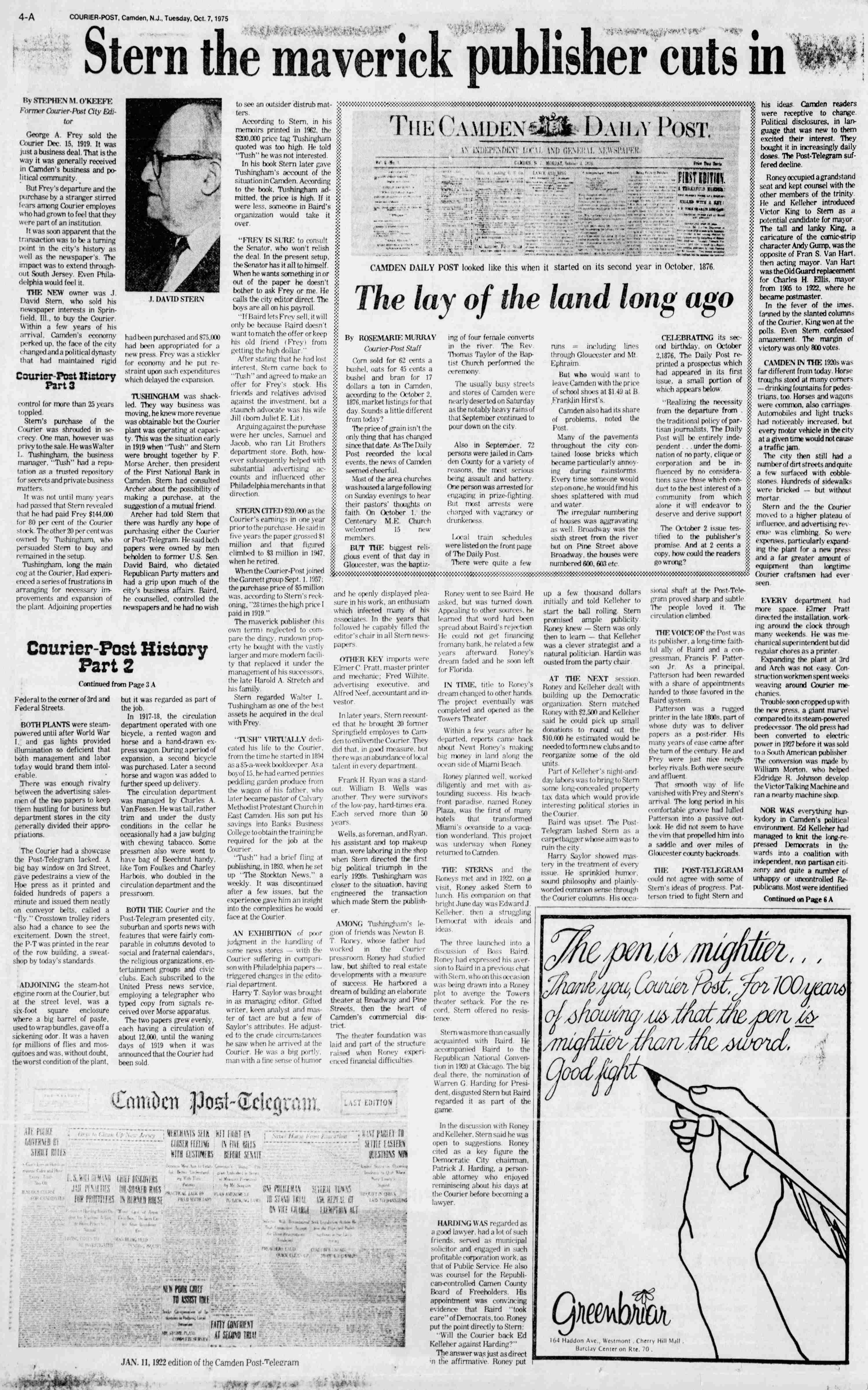
J. DAVID STERN
JAN. 11, 1922 edition of the Camden Post-Telegram
The lay of the land long ago
By ROSEMARIE MURRAY
Courier-Post Staff
Corn sold for 62 cents a bushel, oats for 45 cents a bushel and bran for 17 dollars a ton in Camden, according to the October 2, 1876, market listings for that day. Sounds a little different from today?
The price of grain isn’t the only thing that has changed since that date. As The Daily Post recorded the local events, the news of Camden seemed cheerful.
Most of the area churches was [sic] housed a large following on Sunday evenings to hear their pastors’ thoughts on faith. On October 1, the Centenary M.E. Church welcomed 15 new members.
BUT THE biggest religious event of that day in Gloucester, was the baptizing of four female converts in the river. The Rev. Thomas Taylor of the Baptist Church performed the ceremony.
The usually busy streets and stores of Camden were nearly deserted on Saturday as the notably heavy rains of that September continued to pour down on the city.
Also in September, 72 persons were jailed in Camden County for a variety of reasons, the most serious being assault and battery. One person was arrested for engaging in prize-fighting. But most arrests were charged with vagrancy or drunkeness [sic].
Local train schedules were listed on the front page of The Daily Post.
There were quite a few runs — including lines through Gloucester and Mt. Ephraim.
But who would want to leave Camden with the price of school shoes at $1.49 at B. Franklin Hirst’s.
Camden also had its share of problems, noted the Post.
Many of the pavements throughout the city contained loose bricks which became particularly annoying during rainstorms. Every time someone would step on one, he would find his shoes splattered with mud and water.
The irregular numbering of houses was aggravating as well. Broadway was the sixth street from the river but on Pine Street above Broadway, the houses were numbered 600, 603 etc.
CELEBRATING its second birthday, on October 2, 1876, The Daily Post reprinted a prospectus which had appeared in its first issue, a small portion of which appears below:
“Realizing the necessity from the departure from the traditional policy of partisan journalists, The Daily Post will be entirely independent . . . under the domination of no party, clique or corporation and be influenced by no considerations save those which conduct to the best interest of a community from which alone it will endeavor to deserve and derive support.”
The October 2 issue testified to the publisher’s promise. And at 2 cents a copy, how could the readers go wrong?
CAMDEN DAILY POST looked like this when it started on its second year in October, 1876.
Courier-Post History Part 2
Federal to the corner of 3rd and Federal Streets.
BOTH PLANTS were steam-powered until after World War I, and gas lights provided illumination so deficient that both management and labor today would brand them intolerable.
There was enough rivalry between the advertising salesmen of the two papers to keep them hustling for business but department stores in the city generally divided their appropriations.
The Courier had a showcase the Post-Telegram lacked. A big bay window on 3rd Street, gave pedestrains [sic] a view of the Hoe press as it printed and folded hundreds of papers a minute and issued them neatly on conveyor belts, called a “fly.” Crosstown trolley riders also had a chance to see the excitement. Down the street, the P-T was printed in the rear of the row building, a sweatshop by today’s standards.
ADJOINING the steam-hot engine room at the Courier, but at the street level, was a six-foot square enclosure where a big barrel of paste, used to wrap bundles, gave off a sickening odor. It was a haven for millions of flies and mosquitoes and was, without doubt, the worst condition of the plant, but it was regarded as part of the job.
In 1917-18, the circulation department operated with one bicycle, a rented wagon and horse and a hand-drawn express wagon. During a period of expansion, a second bicycle was purchased. Later a second horse and wagon was added to further speed up delivery.
The circulation department was managed by Charles A. Van Fossen. He was tall, rather trim and under the dusty conditions in the cellar he occasionally had a jaw bulging with chewing tabacco [sic]. Some pressmen also were wont to have bag of Beechnut handy, like Tom Foulkes and Charley Harbois, who doubled in the circulation department and the pressroom.
BOTH THE Courier and the Post-Telegram presented city, suburban and sports news with features that were fairly comparable in columns devoted to social and fraternal calendars, the religious organizations, entertainment groups and civic clubs. Each subscribed to the United Press news service, employing a telegrapher who typed copy from signals received over Morse apparatus.
The two papers grew evenly, each having a circulation of about 12,000, until the waning days of 1919 when it was announced that the Courier had been sold.
Night rider takes on carpetbagger
Camden Courier-Post —
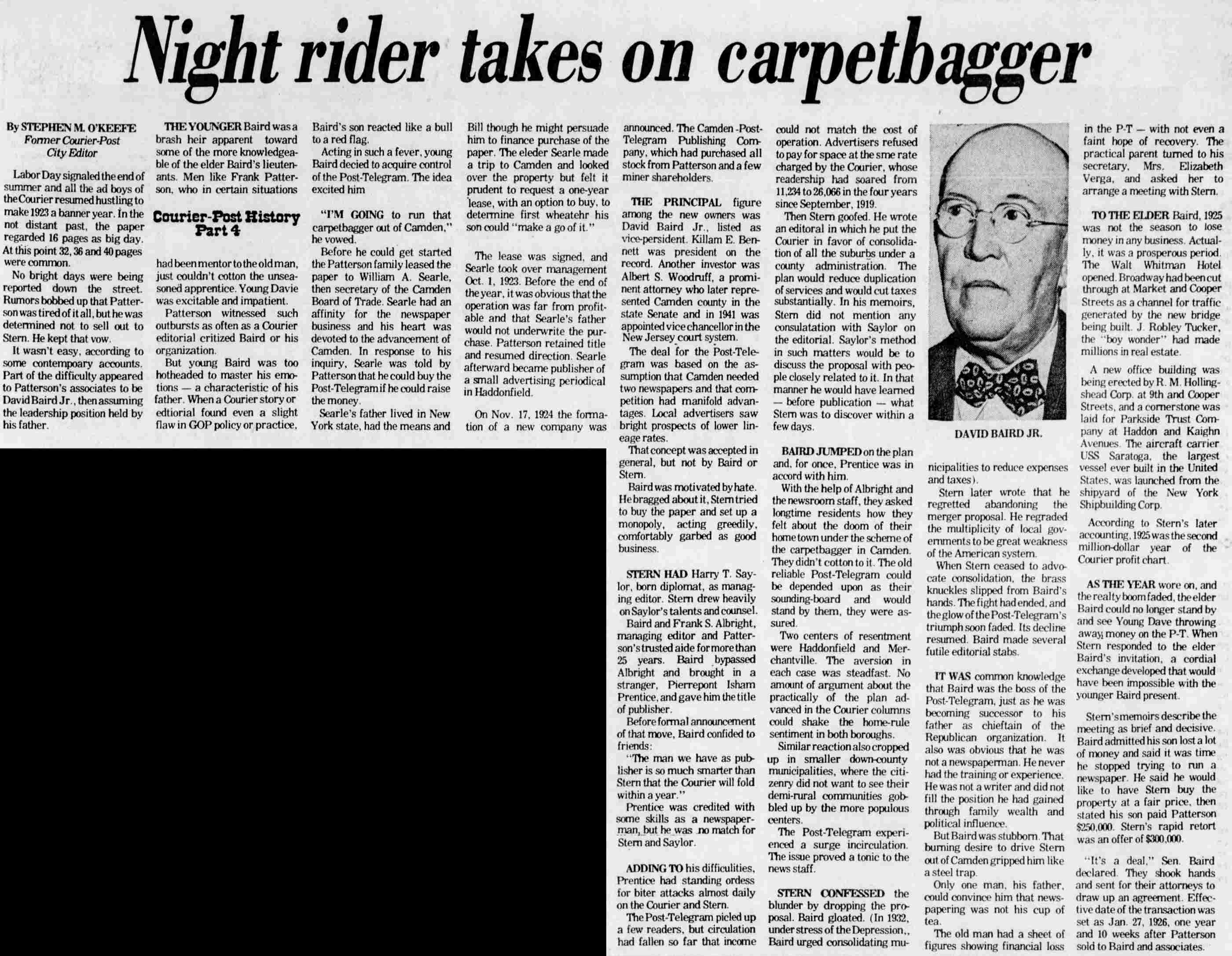
By STEPHEN M. O’KEEFE
Former Courier-Post City Editor
Labor Day signaled the end of summer and all the ad boys of the Courier resumed hustling to make 1923 a banner year. In the not distant past, the paper regarded 16 pages as big day. At this point 32, 36 and 40 pages were common.
No bright days were being reported down the street. Rumors bobbed up that Patterson was tired of it all, but he was determined not to sell out to Stern. He kept that vow.
It wasn’t easy, according to some contempoary [sic] accounts. Part of the difficulty appeared to Patterson’s associates to be David Baird Jr., then assuming the leadership position held by his father.
THE YOUNGER Baird was a brash heir apparent toward some of the more knowledgeable of the elder Baird’s lieutenants. Men like Frank Patterson, who in certain situations had been mentor to the old man, just couldn’t cotton the unseasoned apprentice. Young Davie was excitable and impatient.
Patterson witnessed such outbursts as often as a Courier editorial critized [sic] Baird or his organization.
But young Baird was too hotheaded to master his emotions — a characteristic of his father. When a Courier story or edtiorial [sic] found even a slight flaw in GOP policy or practice, Baird’s son reacted like a bull to a red flag.
Acting in such a fever, young Baird decied [sic] to acquire control of the Post-Telegram. The idea excited him
“I’M GOING to run that carpetbagger out of Camden,” he vowed.
Before he could get started the Patterson family leased the paper to William A. Searle, then secretary of the Camden Board of Trade. Searle had an affinity for the newspaper business and his heart was devoted to the advancement of Camden. In response to his inquiry, Searle was told by Patterson that he could buy the Post-Telegram if he could raise the money.
Searle’s father lived in New York state, had the means and Bill though he might persuade him to finance purchase of the paper. The eleder [sic] Searle made a trip to Camden and looked over the property but felt it prudent to request a one-year lease, with an option to buy, to determine first wheatehr [sic] his son could “make a go of it.”
The lease was signed, and Searle took over management Oct. 1, 1923. Before the end of the year, it was obvious that the operation was far from profitable and that Searle’s father would not underwrite the purchase. Patterson retained title and resumed direction. Searle afterward became publisher of a small advertising periodical in Haddonfield.
On Nov. 17, 1924 the formation of a new company was announced. The Camden-Post-Telegram Publishing Company, which had purchased all stock from Patterson and a few miner [sic] shareholders.
THE PRINCIPAL figure among the new owners was David Baird Jr., listed as vice-persident [sic]. Killam E. Bennett was president on the record. Another investor was Albert S. Woodruff, a prominent attorney who later represented Camden county in the state Senate and in 1941 was appointed vice chancellor in the New Jersey court system.
The deal for the Post-Telegram was based on the assumption that Camden needed two newspapers and that competition had manifold advantages. Local advertisers saw bright prospects of lower lineage rates.
That concept was accepted in general, but not by Baird or Stern.
Baird was motivated by hate. He bragged about it, Stern tried to buy the paper and set up a monopoly, acting greedily, comfortably garbed as good business.
STERN HAD Harry T. Saylor, born diplomat, as managing editor. Stern drew heavily on Saylor’s talents and counsel.
Baird and Frank S. Albright, managing editor and Patterson’s trusted aide for more than 25 years. Baird bypassed Albright and brought in a stranger, Pierrepont Isham Prentice, and gave him the title of publisher.
Before formal announcement of that move, Baird confided to friends:
“The man we have as publisher is so much smarter than Stern that the Courier will fold within a year.”
Prentice was credited with some skills as a newspaperman, but he was no match for Stern and Saylor.
ADDING TO his difficulties, Prentice had standing ordess [sic] for biter [sic] attacks almost daily on the Courier and Stern.
The Post-Telegram picled [sic] up a few readers, but circulation had fallen so far that income could not match the cost of operation. Advertisers refused to pay for space at the sme [sic] rate charged by the Courier, whose readership had soared from 11,234 to 26,066 in the four years since September, 1919.
Then Stern goofed. He wrote an editoral [sic] in which he put the Courier in favor of consolidation of all the suburbs under a county administration. The plan would reduce duplication of services and would cut taxes substantially. In his memoirs, Stern did not mention any consulatation [sic] with Saylor on the editorial. Saylor’s method in such matters would be to discuss the proposal with people closely related to it. In that manner he would have learned — before publication — what Stern was to discover within a few days.
BAIRD JUMPED on the plan and, for once, Prentice was in accord with him.
With the help of Albright and the newsroom staff, they asked longtime residents how they felt about the doom of their home town under the scheme of the carpetbagger in Camden. They didn’t cotton to it. The old reliable Post-Telegram could be depended upon as their sounding-board and would stand by them, they were assured.
Two centers of resentment were Haddonfield and Merchantville. The aversion in each case was steadfast. No amount of argument about the practically of the plan advanced in the Courier columns could shake the home-rule sentiment in both boroughs.
Similar reaction also cropped up in smaller down-county municipalities, where the citizenry did not want to see their demi-rural communities gobbled up by the more populous centers.
The Post-Telegram experienced a surge inciruclation [sic]. The issue proved a tonic to the news staff.
STERN CONFESSED the blunder by dropping the proposal. Baird gloated. (In 1932, under stress of the Depression, Baird urged consolidating municipalities to reduce expenses and taxes).
Stern later wrote that he regretted abandoning the merger proposal. He regraded [sic] the multiplicity of local governments to be great weakness of the American system.
When Stern ceased to advocate consolidation, the brass knuckles slipped from Baird’s hands. The fight had ended, and the glow of the Post-Telegram’s triumph soon faded. Its decline resumed. Baird made several futile editorial stabs.
IT WAS common knowledge that Baird was the boss of the Post-Telegram, just as he was becoming successor to his father as chieftain of the Republican organization. It also was obvious that he was not a newspaperman. He never had the training or experience. He was not a writer and did not fill the position he had gained through family wealth and political influence.
But Baird was stubborn. That burning desire to drive Stern out of Camden gripped him like a steel trap.
Only one man, his father, could convince him that newspapering was not his cup of tea.
The old man had a sheet of figures showing financial loss in the P-T — with not even a faint hope of recovery. The practical parent turned to his secretary, Mrs. Elizabeth Verga, and asked her to arrange a meeting with Stern.
TO THE ELDER Baird, 1925 was not the season to lose money in any business. Actually, it was a prosperous period. The Walt Whitman Hotel opened. Broadway had been cut through at Market and Cooper Streets as a channel for traffic generated by the new bridge being built. J. Robley Tucker, the “boy wonder” had made millions in real estate.
A new office building was being erected by R. M. Hollingshead Corp. at 9th and Cooper Streets, and a cornerstone was laid for Parkside Trust Company at Haddon and Kaighn Avenues. The aircraft carrier USS Saratoga, the largest vessel ever built in the United States, was launched from the shipyard of the New York Shipbuilding Corp.
According to Stern’s later accounting, 1925 was the second million-dollar year of the Courier profit chart.
AS THE YEAR wore on, and the realty boom faded, the elder Baird could no longer stand by and see Young Dave throwing away money on the P-T. When Stern responded to the elder Baird’s invitation, a cordial exchange developed that would have been impossible with the younger Baird present.
Stern’s memoirs describe the meeting as brief and decisive. Baird admitted his son lost a lot of money and said it was time he stopped trying to run a newspaper. He said he would like to have Stern buy the property at a fair price, then stated his son paid Patterson $250,000. Stern’s rapid retort was an offer of $300,000.
“It’s a deal,” Sen. Baird declared. They shook hands and sent for their attorneys to draw up an agreement. Effective date of the transaction was set as Jan. 27, 1926, one year and 10 weeks after Patterson sold to Baird and associates.
DAVID BAIRD JR.
News monopolist: into politics and out again
Camden Courier-Post —
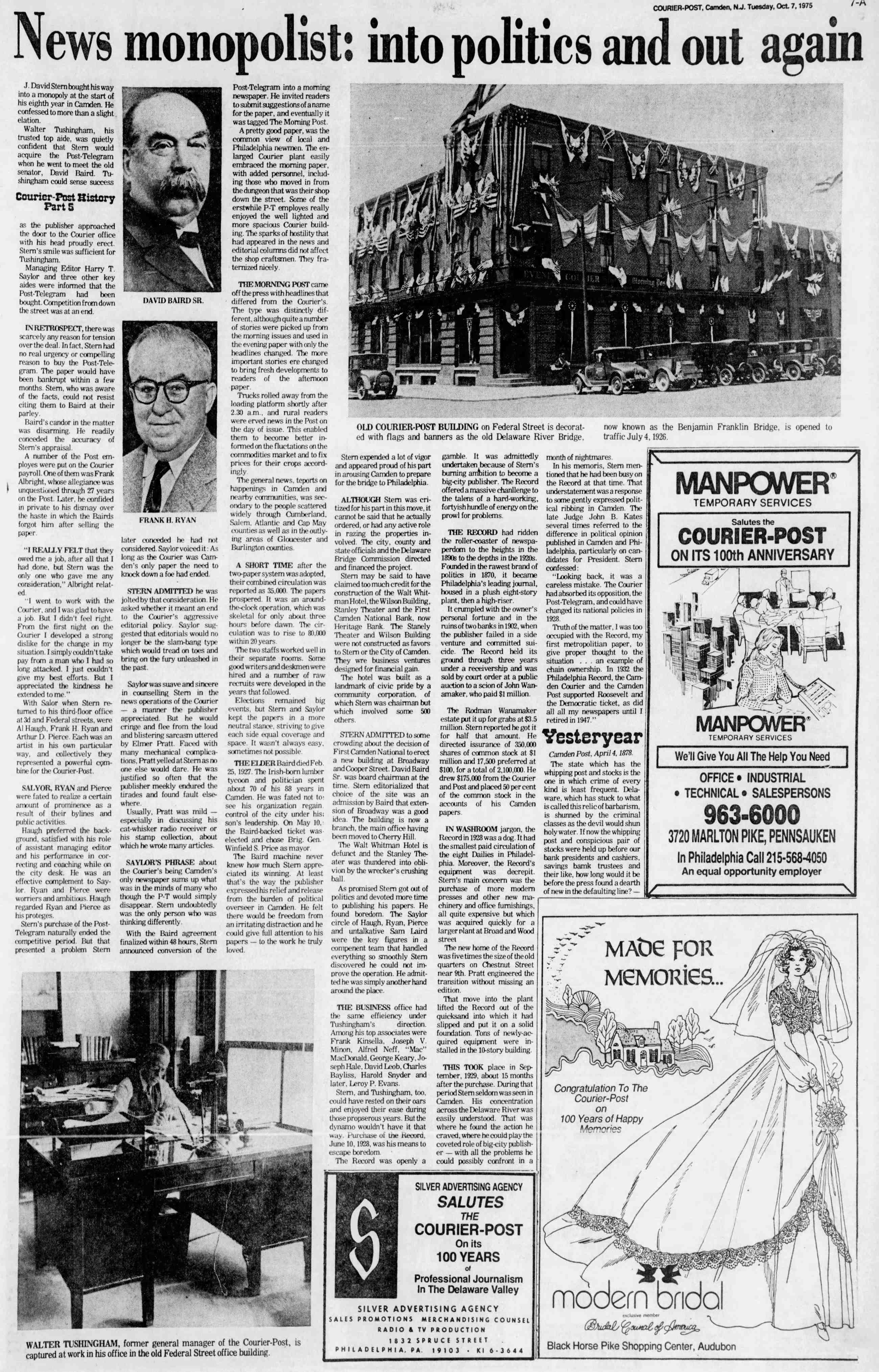
J. David Stern bought his way into a monopoly at the start of his eighth year in Camden. He confessed to more than a slight elation.
Walter Tushingham, his trusted top aide, was quietly confident that Stern would acquire the Post-Telegram when he went to meet the old senator, David Baird. Tushingham could sense success as the publisher approached the door to the Courier office with his head proudly erect. Stern’s smile was sufficient for Tushingham.
Managing Editor Harry T. Saylor and three other key aides were informed that the Post-Telegram had been bought. Competition from down the street was at an end.
IN RETROSPECT, there was scarcely any reason for tension over the deal. In fact, Stern had no real urgency or compelling reason to buy the Post-Telegram. The paper would have been bankrupt within a few months. Stern, who was aware of the facts, could not resist citing them to Baird at their parley.
Baird’s candor in the matter was disarming. He readily conceded the accuracy of Stern’s appraisal.
A number of the Post employes were put on the Courier payroll. One of them was Frank Albright, whose allegiance was unquestioned through 27 years on the Post. Later, he confided in private to his dismay over the haste in which the Bairds forgot him after selling the paper.
“I REALLY FELT that they owed me a job, after all that I had done, but Stern was the only one who gave me any consideration,” Albright related.
“I went to work with the Courier, and I was glad to have a job. But I didn’t feel right. From the first night on the Courier I developed a strong dislike for the change in my situation. I simply couldn’t take pay from a man who I had so long attacked. I just couldn’t give my best efforts. But I appreciated the kindness he extended to me.”
With Salor [sic] when Stern returned to his third-floor office at 3d and Federal streets, were Al Haugh, Frank H. Ryan and Arthur D. Pierce. Each was an artist in his own particular way, and collectively they represented a powerful combine for the Courier-Post.
SALYOR, RYAN and Pierce were fated to realize a certain amount of prominence as a result of their bylines and public activities.
Haugh preferred the background, satisfied with his role of assistant managing editor and his performance in correcting and coaching while on the city desk. He was an effective complement to Saylor. Ryan and Pierce were worriers and ambitious. Haugh regarded Ryan and Pierce as his proteges.
Stern’s purchase of the Post-Telegram naturally ended the competitive period. But that presented a problem Stern later conceded he had not considered. Saylor voiced it: As long as the Courier was Camden’s only paper the need to knock down a foe had ended.
STERN ADMITTED he was jolted by that consideration. He asked whether it meant an end to the Courier’s aggressive editorial policy. Saylor suggested that editorials would no longer be the slam-bang type which would tread on toes and bring on the fury unleashed in the past.
Saylor was suave and sincere in counselling Stern in the news operations of the Courier — a manner the publisher appreciated. But he would cringe and flee from the loud and blistering sarcasm uttered by Elmer Pratt. Faced with many mechanical complications, Pratt yelled at Stern as no one else would dare. He was justified so often that the publisher meekly endured the tirades and found fault elsewhere.
Usually, Pratt was mild — especially in discussing his cat-whisker radio receiver or his stamp collection, about which he wrote many articles.
SAYLOR’S PHRASE about the Courier’s being Camden’s only newspaper sums up what was in the minds of many who though [sic] the P-T would simply disappear. Stern undoubtedly was the only person who was thinking differently.
With the Baird agreement finalized within 48 hours, Stern announced conversion of the Post-Telegram into a morning newspaper. He invited readers to submit suggestions of a name for the paper, and eventually it was tagged The Morning Post.
A pretty good paper, was the common view of local and Philadelphia newmen. The enlarged Courier plant easily embraced the morning paper, with added personnel, including those who moved in from the dungeon that was their shop down the street. Some of the erstwhile P-T employes really enjoyed the well lighted and more spacious Courier building. The sparks of hostility that had appeared in the news and editorial columns did not affect the shop craftsmen. They fraternized nicely.
THE MORNING POST came off the press with headlines that differed from the Courier’s. The type was distinctly different, although quite a number of stories were picked up from the morning issues and used in the evening paper with only the headlines changed. The more important stories ere [sic] changed to bring fresh developments to readers of the afternoon paper.
Trucks rolled away from the loading platform shortly after 2.30 a.m., and rural readers were erved [sic] news in the Post on the day of issue. This enabled them to become better informed on the fluctations [sic] on the commodities market and to fix prices for their crops accordingly.
The general news, teports [sic] on happenings in Camden and nearby communities, was secondary to the people scattered widely through Cumberland, Salem, Atlantic and Cap May [sic] counties as well as in the outlying areas of Gloucester and Burlington counties.
A SHORT TIME after the two-paper system was adopted, their combined circulation was reported as 35,000. The papers prospered. It was an around-the-clock operation, which was skeletal for only about three hours before dawn. The circulation was to rise to 80,000 within 20 years.
The two staffs worked well in their separate rooms. Some good writers and deskmen were hired and a number of raw recruits were developed in the years that followed.
Elections remained big events, but Stern and Saylor kept the papers in a more neutral stance, striving to give each side equal coverage and space. It wasn’t always easy, sometimes not possible.
THE ELDER Baird died Feb. 25, 1927. The Irish-born lumber tycoon and politician spent about 70 of his 88 years in Camden. He was fated not to see his organization regain control of the city under his son’s leadership. On May 10, the Baird-backed ticket was elected and chose Brig. Gen. Winfield S. Price as mayor.
The Baird machine never knew how much Stern appreciated its winning. At least that’s the way the publisher expressed his relief and release from the burden of political overseer in Camden. He felt there would be freedom from an irritating distraction and he could give full attention to his papers — to the work he truly loved.
Stern expended a lot of vigor and appeared proud of his part in arousing Camden to prepare for the bridge to Philadelphia.
ALTHOUGH Stern was critized [sic] for his part in this move, it cannot be said that he actually ordered, or had any active role in razing the properties involved. The city, county and state officials and the Delaware Bridge Commission directed and financed the project.
Stern may be said to have claimed too much credit for the construction of the Walt Whitman Hotel, the Wilson Building, Stanley Theater and the First Camden National Bank, now Heritage Bank. The Stanely [sic] Theater and Wilson Building were not constructed as favors to Stern or the City of Camden. They wre [sic] business ventures designed for financial gain.
The hotel was built as a landmark of civic pride by a community corporation, of which Stern was chairman but which involved some 500 others.
STERN ADMITTED to some crowding about the decision of First Camden National to erect a new building at Broadway and Cooper Street. David Baird Sr. was board chairman at the time. Stern editorialized that choice of the site was an admission by Baird that extension of Broadway was a good idea. The building is now a branch, the main office having been moved to Cherry Hill.
The Walt Whitman Hotel is defunct and the Stanley Theater was thundered into oblivion by the wrecker’s crushing ball.
As promised Stern got out of politics and devoted more time to publishing his papers. He found boredom. The Saylor circle of Haugh, Ryan, Pierce and untalkative Sam Laird were the key figures in a compenent [sic] team that handled everything so smoothly Stern discovered he could not improve the operation. He admitted he was simply another hand around the place.
THE BUSINESS office had the same effieiency [sic] under Tushingham’s direction. Among his top associates were Frank Kinsella, Joseph V. Minon, Alfred Neff, “Mac” MacDonald, George Keary, Joseph Hale, David Leob, Charles Bayliss, Harold Snyder and later, Leroy P. Evans.
Stern, and Tushingham, too, could have rested on their oars and enjoyed their ease during those propserous [sic] years. But the dynamo wouldn’t have it that way. Purchase of the Record, June 10, 1928, was his means to escape boredom.
The Record was openly a gamble. It was admittedly undertaken because of Stern’s burning ambition to become a big-city publisher. The Record offered a massive chanllenge [sic] to the talens [sic] of a hard-working, fortyish hundle [sic] of energy on the prowl for problems.
THE RECORD had ridden the roller-coaster of newspaperdom to the heights in the 1890s to the depths in the 1920s. Founded in the rawest brand of politics in 1870, it became Philadelphia’s leading journal, housed in a plush eight-story plant, then a high-riser.
It crumpled with the owner’s personal fortune and in the ruins of two banks in 1902, when the publisher failed in a side venture and committed suicide. The Record held its ground through three years under a receivership and was sold by court order at a public auction to a scion of John Wanamaker, who paid $1 million.
The Rodman Wanamaker estate put it up for grabs at $3.5 million. Stern reported he got it for half that amount. He directed issurance [sic] of 350,000 shares of common stock at $1 million and 17,500 preferred at $100, for a total of 2,100,000. He drew $175,000 from the Courier and Post and placed 50 per cent of the common stock in the accounts of his Camden papers.
IN WASHROOM jargon, the Record in 1928 was a dog. It had the smallest paid circulation of the eight Dailies in Philadelphia. Moreover, the Record’s equipment was decrepit. Stern’s main concern was the purchase of more modern presses and other new machinery and office furnishings, all quite expensive but which was acquired quickly for a larger plant at Broad and Wood street.
The new home of the Record was five times the size of the old quarters on Chestnut Street near 9th. Pratt engineered the transition without missing an edition.
That move into the plant lifted the Record out of the quicksand into which it had slipped and put it on a solid foundation. Tons of newly-acquired equipment were installed in the 10-story building.
THIS TOOK place in September, 1929, about 15 months after the purchase. During that period Stern seldom was seen in Camden. His concentration across the Delaware River was easily understood. That was where he found the action he craved, where he could play the coveted role of big-city publisher — with all the problems he could possibly confront in a month of nightmares.
In his memoris [sic], Stern mentioned that he had been busy on the Record at that time. That understatement was a response to some gently expressed political ribbing in Camden. The late Judge John B. Kates several times referred to the difference in political opinion published in Camden and Philadelphia, particularly on candidates for President. Stern confessed:
“Looking back, it was a careless mistake. The Courier had absorbed its opposition, the Post-Telegram, and could have changed its national policies in 1928.
Truth of the matter, I was too occupied with the Record, my first metropolitan paper, to give proper thought to the situation . . . an example of chain ownership. In 1932 the Philadelphia Record, the Camden Courier and the Camden Post supported Roosevelt and the Democratic ticket, as did all all [sic] my newspapers until I retired in 1947.”
DAVID BAIRD SR.
FRANK H. RYAN
OLD COURIER-POST BUILDING on Federal Street is decorated with flags and banners as the old Delaware River Bridge, now known as the Benjamin Franklin Bridge, is opened to traffic July 4, 1926.
WALTER TUSHINGHAM, former general manager of the Courier-Post, is captured at work in his office in the old Federal Street office building.
Yesteryear
Camden Post, April 4, 1878.
The state which has the whipping post and stocks is the one in which crime of every kind is least frequent. Delaware, which has stuck to what is called this relic of barbarism, is shunned by the criminal classes as the devil would shun holy water. If now the whipping post and conspicuous pair of stocks were held up before our bank presidents and cashiers, savings bamk [sic] trustees and their like, how long would it be before the press found a dearth of new [sic] in the defaulting line? —
Camden: springboard into Philadelphia, N.Y. newspaper markets
Camden Courier-Post —
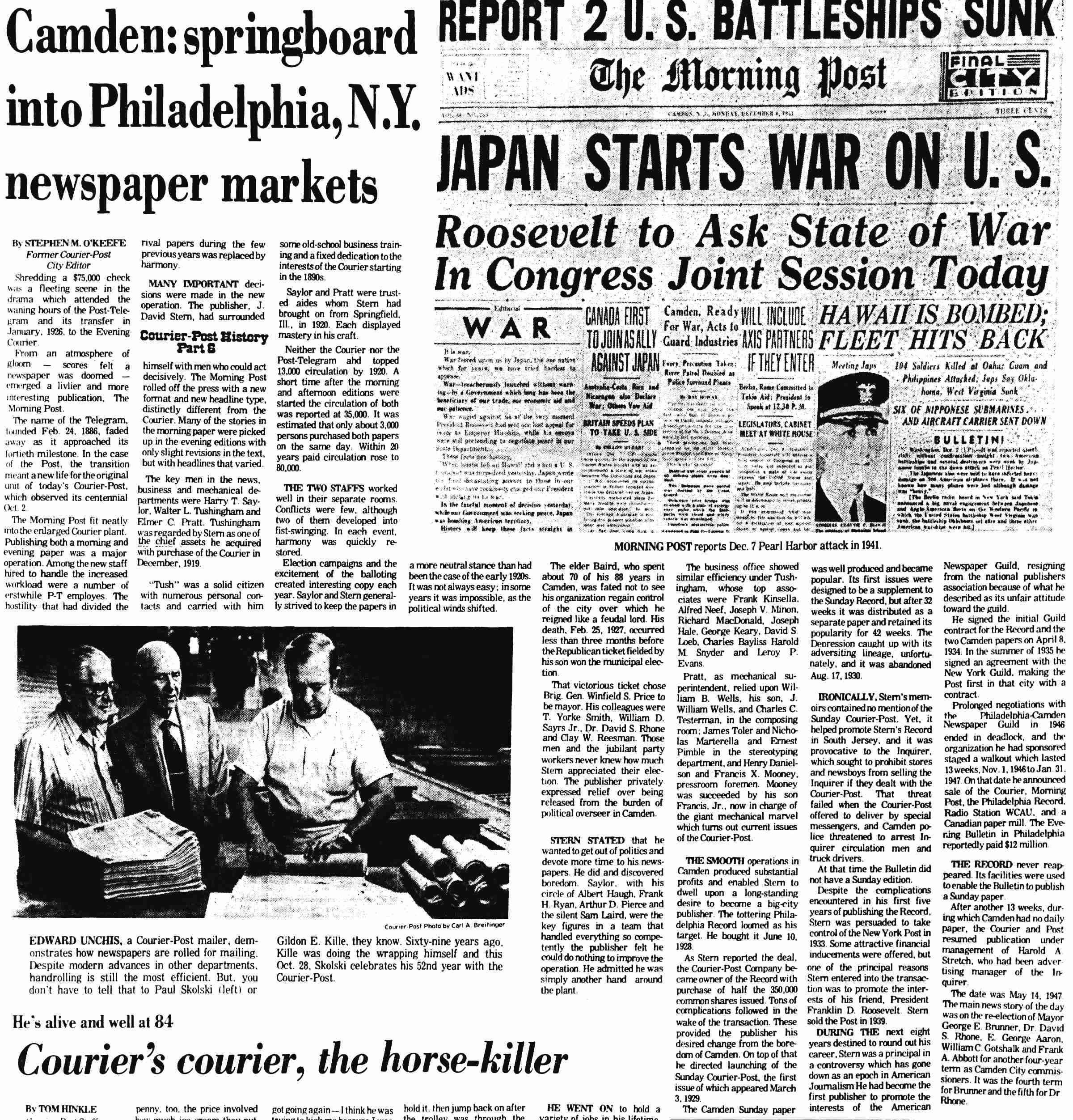
By STEPHEN M. O’KEEFE
Former Courier-Post City Editor
Shredding a $75,000 check was a fleeting scene in the drama which attended the waning hours of the Post-Telegram and its transfer in January, 1926, to the Evening Courier.
From an atmosphere of gloom — scores felt a newspaper was doomed — emerged a livlier and more interesting publication, The Morning Post.
The name of the Telegram, founded Feb. 24, 1886, faded away as it approached its fortieth milestone. In the case of the Post, the transition meant a new life for the original unit of today’s Courier-Post, which observed its centennial Oct. 2.
The Morning Post fit neatly into the enlarged Courier plant. Publishing both a morning and evening paper was a major operation. Among the new staff hired to handle the increased workload were a number of erstwhile P-T employes. The hostility that had divided the rival papers during the few previous years was replaced by harmony.
MANY IMPORTANT decisions were made in the new operation. The publisher, J. David Stern, had surrounded himself with men who could act decisively. The Morning Post rolled off the press with a new format and new headline type, distinctly different from the Courier. Many of the stories in the morning paper were picked up in the evening editions with only slight revisions in the text, but with headlines that varied.
The key men in the news, business and mechanical departments were Harry T. Saylor, Walter L. Tushingham and Elmer C. Pratt. Tushingham was regarded by Stern as one of the chief assets he acquired with purchase of the Courier in December, 1919.
“Tush” was a solid citizen with numerous personal contacts and carried with him some old-school business training and a fixed dedication to the interests of the Courier starting in the 1890s.
Saylor and Pratt were trusted aides whom Stern had brought on from Springfield, Ill., in 1920. Each displayed mastery in his craft.
Neither the Courier nor the Post-Telegram ahd [sic] topped 13,000 circulation by 1920. A short time after the morning and afternoon editions were started the circulation of both was reported at 35,000. It was estimated that only about 3,000 persons purchased both papers on the same day. Within 20 years paid circulation rose to 80,000.
THE TWO STAFFS worked well in their separate rooms. Conflicts were few, although two of them developed into fist-swinging. In each event, harmony was quickly restored.
Election campaigns and the excitement of the balloting created interesting copy each year. Saylor and Stern generally strived to keep the papers in a more neutral stance than had been the case of the early 1920s. It was not always easy; in some years it was impossible, as the political winds shifted.
The elder Baird, who spent about 70 of his 88 years in Camden, was fated not to see his organization regain control of the city over which he reigned like a feudal lord. His death, Feb. 25, 1927, occurred less than three months before the Republican ticket fielded by his son won the municipal election.
That victorious ticket chose Brig. Gen. Winfield S. Price to be mayor. His colleagues were T. Yorke Smith, William D. Sayrs Jr., Dr. David S. Rhone and Clay W. Reesman. Those men and the jubilant party workers never knew how much Stern appreciated their election. The publisher privately expressed relief over being released from the burden of political overseer in Camden.
STERN STATED that he wanted to get out of politics and devote more time to his newspapers. He did and discovered boredom. Saylor, with his circle of Albert Haugh, Frank H. Ryan, Arthur D. Pierce and the silent Sam Laird, were the key figures in a team that handled everything so competently the publisher felt he could do nothing to improve the operation. He admitted he was simply another hand around the plant.
The business office showed similar efficiency under Tushingham, whose top associates were Frank Kinsella, Alfred Neef, Joseph V. Minon, Richard MacDonald, Joseph Hale, George Keary, David S. Loeb, Charles Bayliss Harold M. Snyder and Leroy P. Evans.
Pratt, as mechanical superintendent, relied upon William B. Wells, his son, J. William Wells, and Charles C. Testerman, in the composing room; James Toler and Nicholas Marterella and Ernest Pimble in the stereotyping department, and Henry Danielson and Francis X. Mooney, pressroom foremen. Mooney was succeeded by his son Francis, Jr., now in charge of the giant mechanical marvel which turns out current issues of the Courier-Post.
THE SMOOTH operations in Camden produced substantial profits and enabled Stern to dwell upon a long-standing desire to become a big-city publisher. The tottering Philadelphia Record loomed as his target. He bought it June 10, 1928.
As Stern reported the deal, the Courier-Post Company became owner of the Record with purchase of half the 350,000 common shares issued. Tons of complications followed in the wake of the transaction. These provided the publisher his desired change from the boredom of Camden. On top of that he directed launching of the Sunday Courier-Post, the first issue of which appeared March 3, 1929.
The Camden Sunday paper was well produced and became popular. Its first issues were designed to be a supplement to the Sunday Record, but after 32 weeks it was distributed as a separate paper and retained its popularity for 42 weeks. The Depression caught up with its adversiting [sic] lineage, unfortunately, and it was abandoned Aug. 17, 1930.
IRONICALLY, Stern’s memoirs contained no mention of the Sunday Courier-Post. Yet, it helped promote Stern’s Record in South Jersey, and it was provocative to the Inquirer, which sought to prohibit stores and newsboys from selling the Inquirer if they dealt with the Courier-Post. That threat failed when the Courier-Post offered to deliver by special messengers, and Camden police threatened to arrest Inquirer circulation men and truck drivers.
At that time the Bulletin did not have a Sunday edition.
Despite the complications encountered in his first five years of publishing the Record, Stern was persuaded to take control of the New York Post in 1933. Some attractive financial inducements were offered, but one of the principal reasons Stern entered into the transaction was to promote the interests of his friend, President Franklin D. Roosevelt. Stern sold the Post in 1939.
DURING THE next eight years destined to round out his career, Stern was a principal in a controversy which has gone down as an epoch in American Journalism He had become the first publisher to promote the interests of the American Newspaper Guild, resigning from the national publishers association because of what he described as its unfair attitude toward the guild.
He signed the initial Guild contract for the Record and the two Camden papers on April 8, 1934. In the summer of 1935 he signed an agreement with the New York Guild, making the Post first in that city with a contract.
Prolonged negotiations with the Philadelphia-Camden Newspaper Guild in 1946 ended in deadlock, and the organization he had sponsored staged a walkout which lasted 13 weeks, Nov. 1, 1946 to Jan. 31, 1947. On that date he announced sale of the Courier, Morning Post, the Philadelphia Record, Radio Station WCAU, and a Canadian paper mill. The Evening Bulletin in Philadelphia reportedly paid $12 million.
THE RECORD never reappeared. Its facilities were used to enable the Bulletin to publish a Sunday paper.
After another 13 weeks, during which Camden had no daily paper, the Courier and Post resumed publication under management of Harold A. Stretch, who had been advertising manager of the Inquirer.
The date was May 14, 1947. The main news story of the day was on the re-election of Mayor George E. Brunner, Dr. David S. Rhone, E. George Aaron, William C. Gotshalk and Frank A. Abbott for another four-year term as Camden City commissioners. It was the fourth term for Brunner and the fifth for Dr Rhone.
MORNING POST reports Dec. 7 Pearl Harbor attack in 1941.
Courier-Post Photo by Carl A. Breitinger
EDWARD UNCHIS, a Courier-Post mailer, demonstrates how newspapers are rolled for mailing. Despite modern advances in other departments, handrolling is still the most efficient. But, you don’t have to tell that to Paul Skolski (left) or Gildon E. Kille, they know. Sixty-nine years ago, Kille was doing the wrapping himself and this Oct. 28, Skolski celebrates his 52nd year with the Courier-Post.
The Sunday C-P responds to a low blow from the competition
Camden Courier-Post —
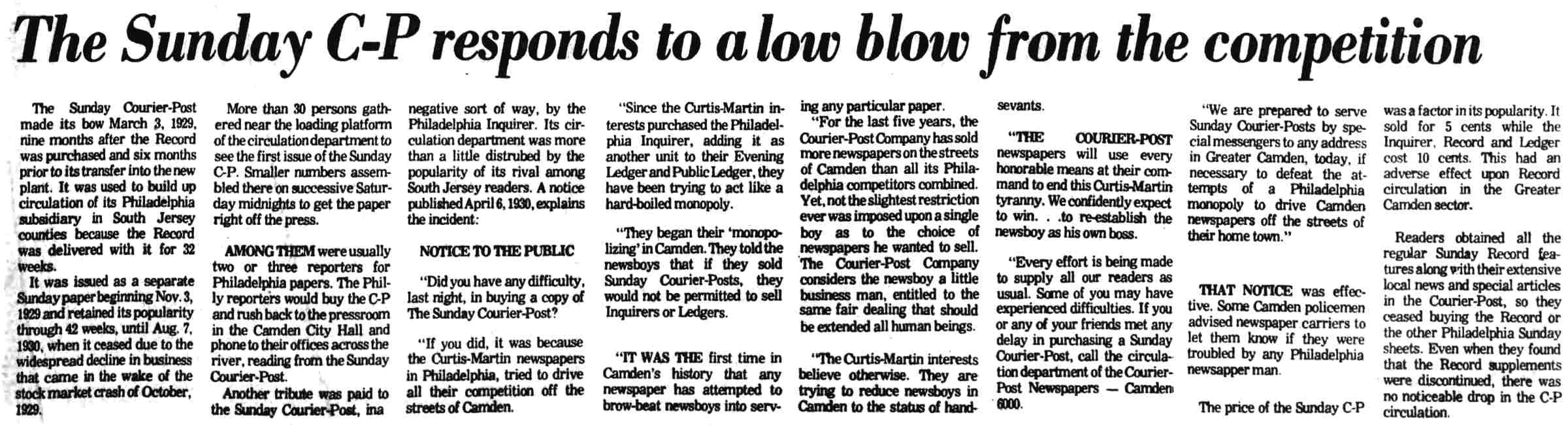
The Sunday Courier-Post made its bow March 3, 1929, nine months after the Record was purchased and six months prior to its transfer into the new plant. It was used to build up circulation of its Philadelphia subsidiary in South Jersey counties because the Record was delivered with it for 32 weeks.
It was issued as a separate Sunday paper beginning Nov. 3, 1929 and retained its popularity through 42 weeks, until Aug. 7, 1930, when it ceased due to the widespread decline in business that came in the wake of the stock market crash of October, 1929.
More than 30 persons gathered near the loading platform of the circulation department to see the first issue of the Sunday C-P. Smaller numbers assembled there on successive Saturday midnights to get the paper right off the press.
AMONG THEM were usually two or three reporters for Philadelphia papers. The Philly reporters would buy the C-P and rush back to the pressroom in the Camden City Hall and phone to their offices across the river, reading from the Sunday Courier-Post.
Another tribute was paid to the Sunday Courier-Post, ina [sic] negative sort of way, by the Philadelphia Inquirer. Its circulation department was more than a little distrubed [sic] by the popularity of its rival among South Jersey readers. A notice published April 6, 1930, explains the incident:
NOTICE TO THE PUBLIC
“Did you have any difficulty, last night, in buying a copy of The Sunday Courier-Post?
“If you did, it was because the Curtis-Martin newspapers in Philadelphia, tried to drive all their competition off the streets of Camden.
“Since the Curtis-Martin interests purchased the Philadelphia Inquirer, adding it as another unit to their Evening Ledger and Public Ledger, they have been trying to act like a hard-boiled monopoly.
“They began their ‘monopolizing’ in Camden. They told the newsboys that if they sold Sunday Courier-Posts, they would not be permitted to sell Inquirers or Ledgers.
“IT WAS THE first time in Camden’s history that any newspaper has attempted to brow-beat newsboys into serving any particular paper.
“For the last five years, the Courier-Post Company has sold more newspapers on the streets of Camden than all its Philadelphia competitors combined. Yet, not the slightest restriction ever was imposed upon a single boy as to the choice of newspapers he wanted to sell. The Courier-Post Company considers the newsboy a little business man, entitled to the same fair dealing that should be extended all human beings.
“The Curtis-Martin interests believe otherwise. They are trying to reduce newsboys in Camden to the status of handsevants [sic].
“THE COURIER-POST newspapers will use every honorable means at their command to end this Curtis-Martin tyranny. We confidently expect to win. . .to re-establish the newsboy as his own boss.
“Every effort is being made to supply all our readers as usual. Some of you may have experienced difficulties. If you or any of your friends met any delay in purchasing a Sunday Courier-Post, call the circulation department of the Courier-Post Newspapers — Camden 6000.
“We are prepared to serve Sunday Courier-Posts by special messengers to any address in Greater Camden, today, if necessary to defeat the attempts of a Philadelphia monopoly to drive Camden newspapers off the streets of their home town.”
THAT NOTICE was effective. Some Camden policemen advised newspaper carriers to let them know if they were troubled by any Philadelphia newspapper man.
The price of the Sunday C-P was a factor in its popularity. It sold for 5 cents while the Inquirer, Record and Ledger cost 10 cents. This had an adverse effect upon Record circulation in the Greater Camden sector.
Readers obtained all the regular Sunday Record features along with their extensive local news and special articles in the Courier-Post, so they ceased buying the Record or the other Philadelphia Sunday sheets. Even when they found that the Record supplements were discontinued, there was no noticeable drop in the C-P circulation.
The joyful roar as Stretches took over
Camden Courier-Post —

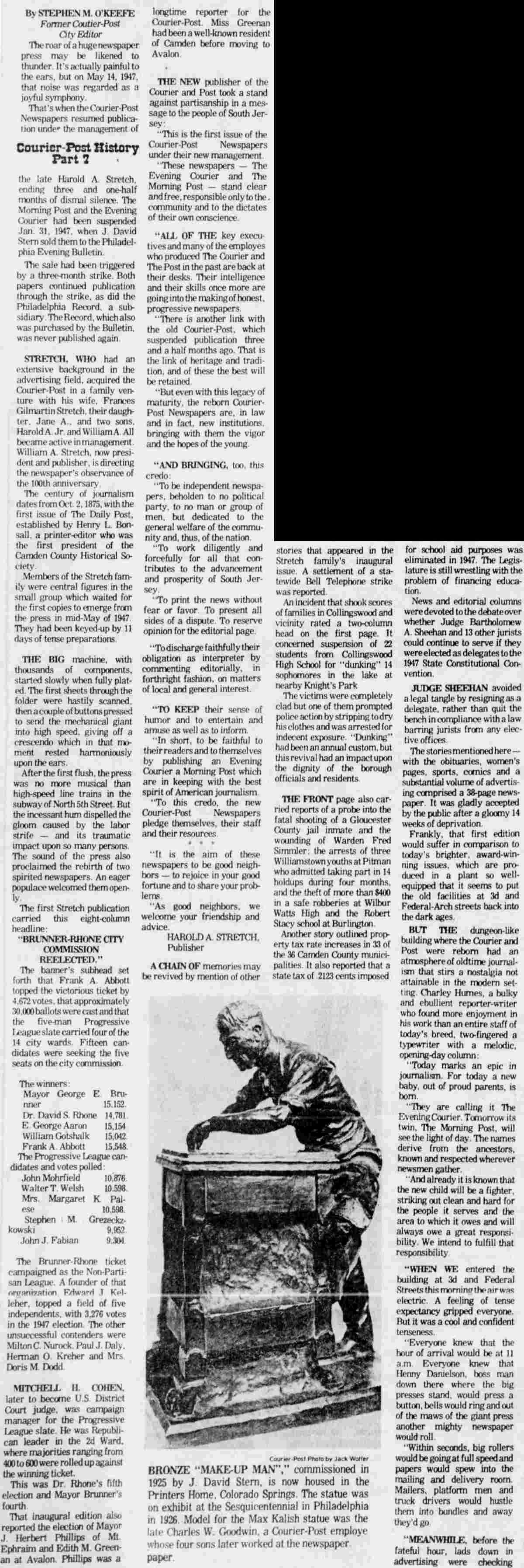
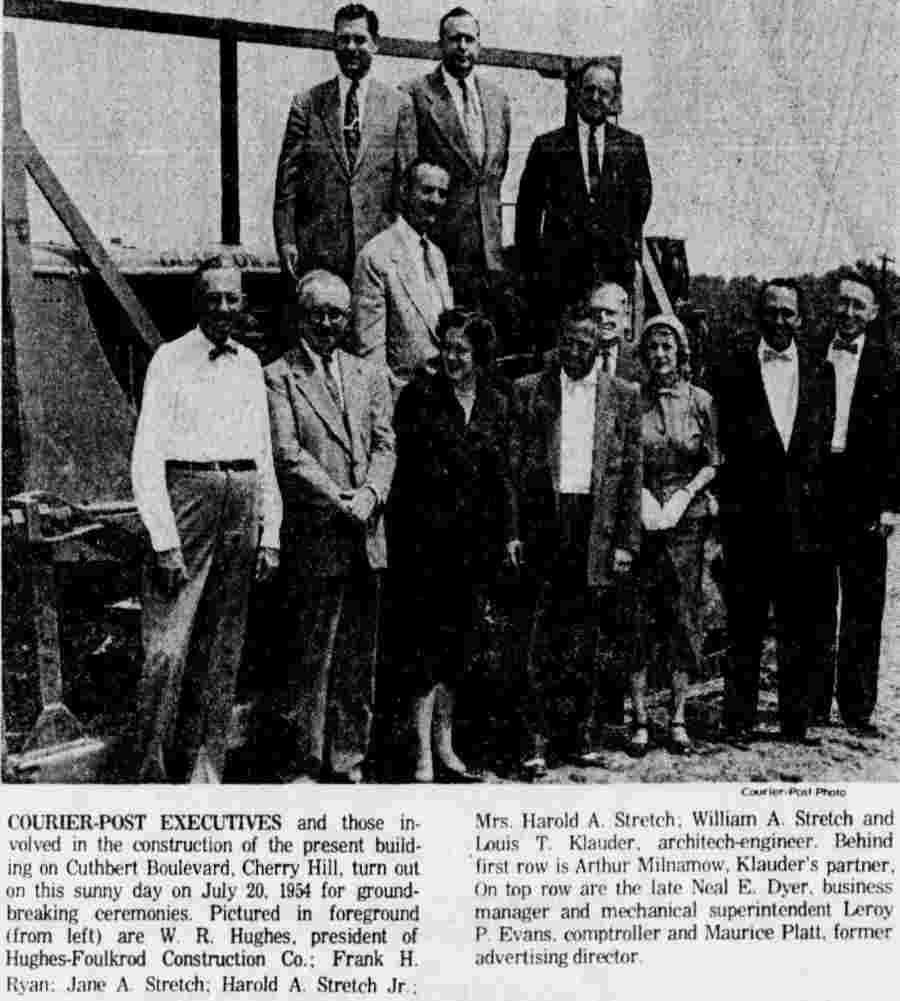
By STEPHEN M. O’KEEFE
Former Courier-Post City Editor
The roar of a huge newspaper press may be likened to thunder. It’s actually painful to the ears, but on May 14, 1947, that noise was regarded as a joyful symphony.
That’s when the Courier-Post Newspapers resumed publication under the management of the late Harold A. Stretch, ending three and one-half months of dismal silence. The Morning Post and the Evening Courier had been suspended Jan. 31, 1947, when J. David Stern sold them to the Philadelphia Evening Bulletin.
The sale had been triggered by a three-month strike. Both papers continued publication through the strike, as did the Philadelphia Record, a subsidiary. The Record, which also was purchased by the Bulletin, was never published again.
STRETCH, WHO had an extensive background in the advertising field, acquired the Courier-Post in a family venture with his wife, Frances Gilmartin Stretch, their daughter, Jane A., and two sons, Harold A. Jr. and William A. All became active in management. William A. Stretch, now president and publisher, is directing the newspaper’s observance of the 100th anniversary.
The century of journalism dates from Oct. 2, 1875, with the first issue of The Daily Post, established by Henry L. Bonsall, a printer-editor who was the first president of the Camden County Historical Society.
Members of the Stretch family were central figures in the small group which waited for the first copies to emerge from the press in mid-May of 1947. They had been keyed-up by 11 days of tense preparations.
THE BIG machine, with thousands of components, started slowly when fully plated. The first sheets through the folder were hastily scanned, then a couple of buttons pressed to send the mechanical giant into high speed, giving off a crescendo which in that moment rested harmoniously upon the ears.
After the first flush, the press was no more musical than high-speed line trains in the subway of North 5th Street. But the incessant hum dispelled the gloom caused by the labor strife — and its traumatic impact upon so many persons. The sound of the press also proclaimed the rebirth of two spirited newspapers. An eager populace welcomed them openly.
The first Stretch publication carried this eight-column headline:
“BRUNNER-RHONE CITY COMMISSION REELECTED.”
The banner’s subhead set forth that Frank A. Abbott topped the victorious ticket by 4,672 votes, that approximately 30,000 ballots were cast and that the five-man Progressive League slate carried four of the 14 city wards. Fifteen candidates were seeking the five seats on the city commission.
The winners:
Mayor George E. Brunner 15,152.
Dr. David S. Rhone 14,781.
E. George Aaron 15,154.
William Gotshalk 15,042.
Frank A. Abbott 15,548.
The Progressive League candidates and votes polled:
John Mohrfield 10,876.
Walter T. Welsh 10,598.
Mrs. Margaret K. Palese 10,598.
Stephen M. Grezeckzkowski 9,952.
John J. Fabian 9,304.
The Brunner-Rhone ticket campaigned as the Non-Partisan League. A founder of that organization, Edward J. Kelleher, topped a field of five independents, with 3,276 votes in the 1947 election. The other unsuccessful contenders were Milton C. Nurock, Paul J. Daly, Herman O. Kreher and Mrs. Doris M. Dodd.
MITCHELL H. COHEN, later to become U.S. District Court judge, was campaign manager for the Progressive League slate. He was Republican leader in the 2d Ward, where majorities ranging from 400 to 600 were rolled up against the winning ticket.
This was Dr. Rhone’s fifth election and Mayor Brunner’s fourth.
That inaugural edition also reported the election of Mayor J. Herbert Phillips of Mt. Ephraim and Edith M. Greenan at Avalon. Phillips was a longtime reporter for the Courier-Post. Miss Greenan had been a well-known resident of Camden before moving to Avalon.
THE NEW publisher of the Courier and Post took a stand against partisanship in a message to the people of South Jersey:
“This is the first issue of the Courier-Post Newspapers under their new management.
“These newspapers — The Evening Courier and The Morning Post — stand clear and free, responsible only to the community and to the dictates of their own conscience.
“ALL OF THE key executives and many of the employees who produced The Courier and The Post in the past are back at their desks. Their intelligence and their skills once more are going into the making of honest, progressive newspapers.
“There is another link with the old Courier-Post, which suspended publication three and a half months ago. That is the link of heritage and tradition, and of these the best will be retained.
“But even with this legacy of maturity, the reborn Courier-Post Newspapers are, in law and in fact, new institutions, bringing with them the vigor and the hopes of the young.
“AND BRINGING, too, this credo:
“To be independent newspapers, beholden to no political party, to no man or group of men, but dedicated to the general welfare of the community and, thus, of the nation.
“To work diligently and forcefully for all that contributes to the advancement and prosperity of South Jersey.
“To print the news without fear or favor. To present all sides of a dispute. To reserve opinion for the editorial page.
“To discharge faithfully their obligation as interpreter by commenting editorially, in forthright fashion, on matters of local and general interest.
“TO KEEP their sense of humor and to entertain and amuse as well as to inform.
“In short, to be faithful to their readers and to themselves by publishing an Evening Courier a Morning Post which are in keeping with the best spirit of American journalism.
“To this credo, the new Courier-Post Newspapers pledge themselves, their staff and their resources.
* * *
“It is the aim of these newspapers to be good neighbors — to rejoice in your good fortune and to share your problems.
“As good neighbors, we welcome your friendship and advice.
HAROLD A. STRETCH, Publisher
A CHAIN OF memories may be revived by mention of other stories that appeared in the Stretch family’s inaugural issue. A settlement of a statewide Bell Telephone strike was reported.
An incident that shook scores of families in Collingswood and vicinity rated a two-column head on the first page. It concerned suspension of 22 students from Collingswood High School for “dunking” 14 sophomores in the lake at nearby Knight’s Park.
The victims were completely clad but one of them prompted police action by stripping to dry his clothes and was arrested for indecent exposure. “Dunking” had been an annual custom, but this revival had an impact upon the dignity of the borough officials and residents.
THE FRONT page also carried reports of a probe into the fatal shooting of a Gloucester County jail inmate and the wounding of Warden Fred Simmler; the arrests of three Williamstown youths at Pitman who admitted taking part in 14 holdups during four months, and the theft of more than $400 in a safe robberies at Wilbur Watts High and the Robert Stacy school at Burlington.
Another story outlined property tax rate increases in 33 of the 36 Camden County municipalities. It also reported that a state tax of 2123 cents imposed for school aid purposes was eliminated in 1947. The Legislature is still wrestling with the problem of financing education.
News and editorial columns were devoted to the debate over whether Judge Bartholomew A. Sheehan and 13 other jurists could continue to serve if they were elected as delegates to the 1947 State Constitutional Convention.
JUDGE SHEEHAN avoided a legal tangle by resigning as a delegate, rather than quit the bench in compliance with a law barring jurists from any elective offices.
The stories mentioned here — with the obituaries, women’s pages, sports, comics and a substantial volume of advertising comprised a 38-page newspaper. It was gladly accepted by the public after a gloomy 14 weeks of deprivation.
Frankly, that first edition would suffer in comparison to today’s brighter, award-winning issues, which are produced in a plant so well-equipped that it seems to put the old facilities at 3d and Federal-Arch streets back into the dark ages.
BUT THE dungeon-like building where the Courier and Post were reborn had an atmosphere of oldtime journalism that stirs a nostalgia not attainable in the modern setting. Charley Humes, a bulky and ebullient reporter-writer who found more enjoyment in his work than an entire staff of today’s breed, two-fingered a typewriter with a melodic, opening-day column:
“Today marks an epic in journalism. For today a new baby, out of proud parents, is born.
“They are calling it The Evening Courier. Tomorrow its twin, The Morning Post, will see the light of day. The names derive from the ancestors, known and respected wherever newsmen gather.
“And already it is known that the new child will be a fighter, striking out clean and hard for the people it serves and the area to which it owes and will always owe a great responsibility. We intend to fulfill that responsibility.
“WHEN WE entered the building at 3d and Federal Streets this morning the air was electric. A feeling of tense expectancy gripped everyone. But it was a cool and confident tenseness.
“Everyone knew that the hour of arrival would be at 11 a.m. Everyone knew that Henny Danielson, boss man down there where the big presses stand, would press a button, bells would ring and out of the maws of the giant press another mighty newspaper would roll.
“Within seconds, big rollers would be going at full speed and papers would spew into the mailing and delivery room. Mailers, platform men and truck drivers would hustle them into bundles and away they’d go.
“MEANWHILE, before the fateful hour, lads down in advertising were checking last-minute proofs to make sure everything was OK. Up in the City Room the tempo was faster. We were going to press.
“Jack Ramsay, in the copy desk slot, was shouting “Copy!” Boys were running it to the composing room.
“Charley Klein was winding up police court news. Larry Wisely was rattling the keys with a yarn from Judge Sheehan’s court. Oscar Magnuson was explaining to a couple of vets that it would be impossible to get their picture in the first edition.
“Copy Reader ‘Buck’ Elliott was chuckling as he headed a newsy bit about girls which had just arrived from Burlington beatman Jake Weiner.
“FRANK RYAN and George Chaplin (editor and managing editor) rewriting and lugging copy, answering phones. The brass and the hoi polloi part of the teamwork.
“Earl Mazo fighting time with a piece on vets’ housing.
“Comments on the night staff which will come to do the job on the Post later today. Quips about City Editor Ralph Bull, Paul Webb, Frank Mulloy, Phil Buxton, Johnny Courter, Joe Garwood, Charley Schuck, Joe Wells, Adolph Stern and the others.
“Hilda Shivers, giving with the society stuff. Tom Ryan, Harry Rasmussen, Henry Quinton back in sports. Newsmen and women on the job.
“CITY EDITOR O’KEEFE wanted a new head on a No. 4. The old one did not tell the story, he said. Copyman Dan Boone obliged, with a grin.
“Telegraph wires buzzed with news of the world. Telegraph Editor Joe Forestal was slicing copy fast and efficiently. Heads were coming down the line, passing through O’Keefe to go out back. Jimmy O’Neill was directing makeup and barking orders here and there to the staff.
“Suddenly the pace slackened. It was deadline.
“Then the presses rolled. We were off.
“Everyone of us there in that City Room, and, we are sure, everyone in every department, had a feeling, a deep-rooted feeling that went away down into the pit of the stomach and sent chills of joy up the spine, that we would be a winner.
“WE KNEW WE were off to a good start and would not tire in the stretch.
“Some of us had been out to pasture during the past six months. Others were new faces. But everyone appeared freshened for the drive. Fit and ready, they call it at the races. That’s us. Fit and ready to give South Jersey the great newspaper it so badly needs and richly deserves. Fit and ready to run as long as time allows.
“Fit and ready to give the answer to the billion dollar question that has been on everyone’s lips for many months, from here to Oshkosh and back again: ‘When will the Courier come out again?’
“Here’s your answer, Bub, and thanks for buying us.”
THE CURTAIN came down wanted a new head on a No. 4. The old one did not tell the story, he said. Copyman Dan Boone obliged, with a grin.
“Telegraph wires buzzed with news of the world. Telegraph Editor Joe Forestal was slicing copy fast and efficiently. Heads were coming down the line, passing through O’Keefe to go out back. Jimmy O’Neill was directing makeup and barking orders here and there to the staff.
“Suddenly the pace slackened. It was deadline.
“Then the presses rolled. We were off.
“Everyone of us there in that City Room, and, we are sure, everyone in every department, had a feeling, a deep-rooted feeling that went away down into the pit of the stomach and sent chills of joy up the spine, that we would be a winner.
“WE KNEW WE were off to a good start and would not tire in the stretch.
“Some of us had been out to pasture during the past six months. Others were new faces. But everyone appeared freshened for the drive. Fit and ready, they call it at the races. That’s us. Fit and ready to give South Jersey the great newspaper it so badly needs and richly deserves. Fit and ready to run as long as time allows.
“Fit and ready to give the answer to the billion dollar question that has been on everyone’s lips for many months, from here to Oshkosh and back again: ‘When will the Courier come out again?’
“Here’s your answer, Bub, and thanks for buying us.”
THE CURTAIN came down on the opening-day drama when buttons were pressed to bring the press to a gradual halt. The day staff dwindled and nightside newsmen trickled in to prepare copy for the first Monring [sic] Post under the new publisher. Workers in the mechanical departments soon would be doing the same, and the plant that so long was idle would be humming again.
From then on it would be the old daily routine of writing, editing and printing the ever-changing panorama of life in South Jersey and throughout the world.
The Stretch family had staked its resources in this venture, and entwined with their destiny was the fate of several hundred workers and the numerous commercial enterprises in this area which depended upon the services of the two newspapers.
THE NEW publisher became the heart of an energetic organization. His daughter, Jane, and sons, Harold A. Jr. and William A., began here as sparkplugs in the advertising department and each manifested interest in the more fascinating news room and staff. All were actively identified with the numerous civic undertakings directed toward progress of the community.
The family soon moved from homes in Pennsylvania and Trenton to take part in the life of the city and suburbs throughout Camden, Burlington and Gloucester counties.
Frank H. Ryan directed the news and editorial units, while Walter L. Tushingham carried on as chief aide in the business end. Scores of new faces appeared among the personnel through the entire plant and there was a steady increase in new facilities.
ALL SEEMED to mesh ideally into the operation. Extensive advances in advertising lineage, local and national, gave a bright outlook to the publications. The Stretch family took on a heavy burden in the $500,000-a-year amortization schedule, but this was disbursed in half the alloted [sic] five-year span.
Prudent management dictated a merger of the two papers in September, 1949 — the morning paper became a part of the evening paper under the title of the Courier-Post.
The smooth course of events was jolted in November, 1950, when a heart attack hospitalized Stretch. A month later he went to his winter home in Delray Beach, Fla., for a rest. He died Feb. 1, 1951, in St. Mary’s Hospital, West Palm Beach. He was mourned in newspaperdom as a man of integrity, ability, enterprise, ambition and high principle.
With Bishop Bartholomew J. Eustace presiding, a solemn requiem Mass was celebrated by a close friend of the family, the late Rev. Francis J. Hegarty, in the cathedral of the Immaculate Conception. Burial was at Newtown, Pa.
MRS. STRETCH was elected president and publisher to succeed her husband and actively directed the family corporation with Harold A. Jr. as vice president, Jane A. as secretary, and William A. treasurer and general manager.
The death in November, 1954, of Frank Ryan was the next blow. This occurred during preparations for transfer of the company’s facilities to the present plant at Cuthbert Boulevard and Hampton Road in Cherry Hill, which occurred in July, 1955.
Ryan, long one of the most influential newsmen in New Jersey, had a hand in the design of the present building but its construction was not completed at the time of his death. Jane Stretch became editor in 1954 after being associated with Ryan up to that time. She retired June 1, 1963 and now resides with her mother in Carmel, Calif. Harold A. Jr. also is retired and lives in California.
WHEN WILLIAM A. STRETCH became publisher and president after his mother retired, Jane served as assistant publisher and secretary of the corporation. She became recognized as one of the most active women in American journalism.
Her series of articles under the heading “Random Thoughts,” proved popular in the early 1960s.
ONE OF THE major steps in the history of the Courier-Post took place in 1959 when negotiations led to its affiliation with the Gannett Group, based in Rochester, N.Y. William Stretch has continued to head the local organization and serves on the Gannett board of directors, as well as supervising the Suburban Newspaper Group, also a member of the Gannett system.
Courier-Post Photo by Jack Wolfer
BRONZE “MAKE-UP MAN,” commissioned in 1925 by J. David Stern, is now housed in the Printers Home, Colorado Springs. The statue was on exhibit at the Sesquicentennial in Philadelphia in 1926. Model for the Max Kalish statue was the late Charles W. Goodwin, a Courier-Post employe whose four sons later worked at the newspaper.
Courier-Post Photo
COURIER-POST EXECUTIVES and those involved in the construction of the present building on Cuthbert Boulevard, Cherry Hill, turn out on this sunny day on July 20, 1954 for groundbreaking ceremonies. Pictured in foreground (from left) are W. R. Hughes, president of Hughes-Foulkrod Construction Co.; Frank H. Ryan; Jane A. Stretch; Harold A. Stretch Jr.; Mrs. Harold A. Stretch; William A. Stretch and Louis T. Klauder, architech-engineer. Behind first row is Arthur Milnamow, Klauder’s partner. On top row are the late Neal E. Dyer, business manager and mechanical superintendent Leroy P. Evans, comptroller and Maurice Platt, former advertising director.