Introduction
Established in 1885, the Camden National Bank opened at 259 Kaighn Avenue on August 13, 1885. Zophar C. Howell was the first President. One of the founders, and an early vice-president was Henry B. Wilson, for whom the H.B. Wilson School at South 9th & Florence Street is named, and whose son was Admiral Henry Braid Wilson Jr., for whom the boulevard is named. Another of Wilson’s sons, Philip Wilson, worked for the bank for many years. Other founders included Howard M. Cooper and Isaac C. Toone.
The brick bank building at 2nd and Kaighn Avenue was opened in July of 1887. The bank removed to its new building at Broadway and Sycamore Street in 1906. During the 1910s and up to at least 1926, the bank’s President was Francis C. Howell. In that year its solicitor was Charles A. Wolverton, who would be elected to Congress the following year, and serve until 1959. Directors included Wolverton, Dr. John W. Donges, and William Leonard Hurley, the owner of Hurley’s Department Store. Edmund Stafford and Orlando Bowen had joined the bank as assistant cashiers by 1919.
The Camden National Bank merged with the First Camden National Bank and Trust Company, whose main office was at Broadway & Cooper Street, on July 1, 1927. The building at Broadway and Sycamore Street remained open as a branch for many years, and was added to the National Register of Historic Places in 1990.
History of Camden County, New Jersey
By George Reeser Prowell — 1886
The Camden National Bank.—A movement was made shortly after the passage of the National Bank Act toward establishing a bank in the southern part of Camden, but the project was abandoned. A few years later the Gloucester City Savings Institution opened a branch office on Kaighn Avenue, which it maintained till the time of its failure, 1884. In 1885 the subject of establishing a National Bank on Kaighn Avenue was again discussed. Isaac C. Martindale, who had many years’ experience in the banking business, became interested in the movement, and Zophar C. Howell, president of the Kaighn’s Point Ferry Company, and others gave the project encouraging support. Application was made on May 30, 1885, to the comptroller of the currency for authority to organize and establish “The Camden National Bank,” with a capital of one hundred thousand dollars, with the privilege of increasing it to two hundred thousand dollars. The necessary permission having been received, a call for a public meeting to promote the enterprise, signed by John Cooper, Henry B. Wilson, Howard M. Cooper, William B. Mulford, Zophar C. Howell and Isaac C. Martindale, was issued. The first meeting, held at the office of the Kaighn’s Point Ferry Company June 13, 1885, when more than one-fourth of the capital stock was subscribed. A committee then appointed to solicit further subscriptions reported, at a meeting held July 6th, that the full amount ($100,000), had been subscribed. The articles of association and the organization certificate were signed and executed, and a meeting of the stockholders held on July 20th, when the following-named persons were elected as the first Board of Directors: Zophar C. Howell, Henry B. Wilson, Charles B. Coles, James Davis, Isaac C. Toone, George W. Bailey, George T. Haines, Irvine C. Beatty, John Cooper, William B. Mulford, Philip H. Fowler, Charles E. Thomas, Harry B. Anthony, Howard M. Cooper, Zophar L. Howell, Herbert C. Felton, Rudolph W. Birdsell.
By subsequently electing Zophar C. Howell, president; John Cooper, vice-president; and Isaac C. Martindale, cashier, who still continue in office. Howard M. Cooper was chosen solicitor. No. 259 Kaighn Avenue was selected and fitted up for a temporary banking location, and authority to do business was granted by the comptroller of the currency on August 1st, and on August 13, 1885, the bank was opened for business.
The first statement, on October 1st, after the bank had been in operation six weeks, showed aggregate assets of $219,018.
On March 20, 1886, the bank opened a special line of accounts, on which interest is allowed, at the rate of three per cent. on all sums from one dollar to five hundred dollars, and two per cent. on all sums over five hundred dollars, such deposit to be drawn only after two weeks’ notice has been given, the interest being credited to the account every six months.
This bank has a branch office at the northwest corner of Second and Walnut Streets, Philadelphia, and arrangements have been perfected by which deposits will be received weekly by a clerk going to Gloucester City. The management of the Camden National Bank has been a success, and the institution has secured a good patronage.
Camden News
Philadelphia Inquirer —
Camden News. Notes of Interest from the City Across the Delaware.
The stockholders of the new Camden National Bank held another meeting yesterday and elected the following Board of Directors: Henry B. Anthony, Dr. George W. Bailey, Irvin C. Beatty, Howard M. Cooper, John Cooper, James Davis, Herbert C. Felton, Philip H. Fowler, George P. Haines, Zophar C. Howell, Zophar L. Howell, Rudolph W. Birdsall, William B. Mulford, Charles E. Thomas, Isaac C. Toone, Henry B. Wilson, Charles B. Coles. Zophar C. Howell was chosen president; John Cooper, vice president; Howard M. Cooper, solicitor, and Isaac C. Martindale, cashier. The committee, on procuring a suitable location, reported in favor of securing the store of Thomas Boyle, Kaighn’s avenue, above Locust street. They were instructed to procure the same and to make necessary alterations as speedily as possible. Fifty per cent. of the capital stock was paid in at the meeting.
Historical and Industrial Review of Camden, N.J.
1890
The Camden National Bank,
Second Street and Kaighn Avenue.
One of the chief elements in the material growth and progress of a community is the banking interest, and in this department of business, Camden boasts of several vigorous corporations, one of the most important being the Camden National Bank, located at Second street and Kaighn avenue. It was incorporated as a national bank in 1885, in order to provide for the needs of the merchants of South Camden, and though so young an institution, it is a remarkably successful one and from the date of its commencement, has enjoyed a large and liberal patronage including all the leading business houses of that enterprising and growing section of the city. It is a strong and reliable institution, holding a prominent place in, and exerting an active influence upon, the financial condition of the city. The capital is $100,000, and the surplus already reaches $25,000, and the dividends are six per cent. per annum. Since the organization of the bank, a handsome, modern new banking-house has been erected, into which the business was removed in 1888, and which is a prominent and elegant feature of Kaighn avenue. There are safe deposit boxes to rent in burglar proof vaults, while an element of saving fund banking is added by receiving small deposits from working people, subject to withdrawal on two weeks’ notice, and allowing interest thereon.
The main business is a general banking one, including loans, deposits, and discounts, collections being made on all chief cities of the United States through correspondents, and the volume of business has been from the start, and still is, a growing one, as is shown by the last statement, recently issued, which gives total resources amounting to more than $805,000. The officers are: President, Mr. Zophar C. Howell; vice-president, Mr. John Cooper; and cashier, Mr. J.C. Martindale. The directorate is composed of prominent gentlemen of substantial position. They are Messrs. H.B. Wilson, William B. Mulford, C. B. Coles, P. H. Fowler, James Davis, C. E. Thomas, Isaac C. Toone, H. B. Anthony, G. W. Bailey, Howard M. Cooper, G. T. Haines, Z.L. Howell, H. C. Felton, R. W. Birdsell and D.S. Risley. The bank also has an office at Second and Walnut streets, Philadelphia.
George Bacon vs. Camden National Bank
Philadelphia Inquirer —

Suit for $9000 damages was instituted by Lawyer George Bacon yesterday against the Camden National Bank for alleged false arrest of one of his clients.
In New Quarters
Camden Post —
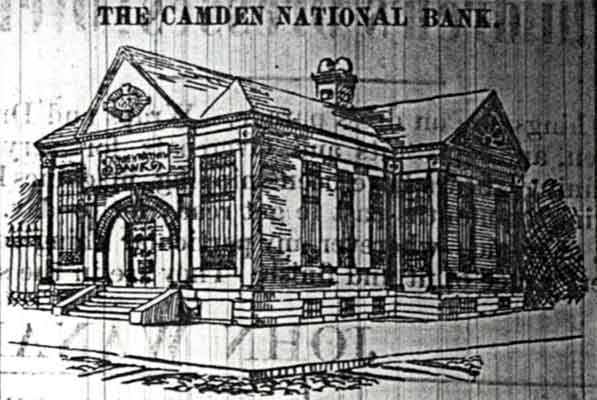
Sketch of the Building and Officers of the New Bank.
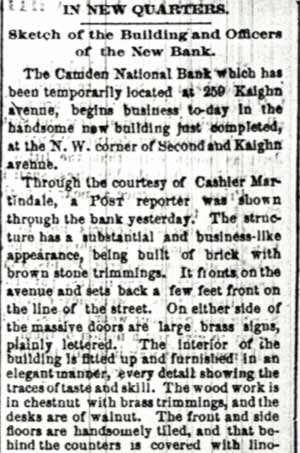
The Camden National Bank which has been temporarily located at 259 Kaighn avenue, begins business to-day in the handsome new building just completed, at the N.W. corner of Second and Kaighn avenue.
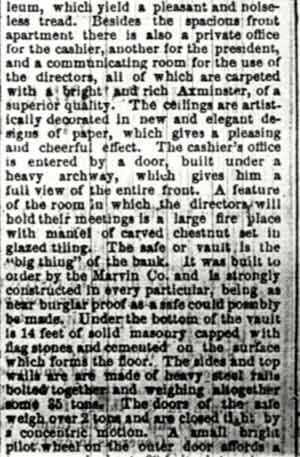
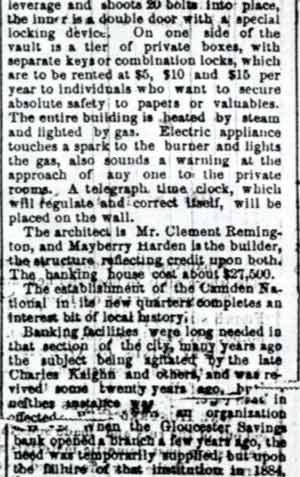
Through the courtesy of Cashier Martindale, a Post reporter was shown through the bank yesterday. The structure has a substantial and business-like appearance, being built of brick with brown stone trimmings. It fronts on the avenue and sets back a few feet from on the line of the street. On either side of the massive doors are large brass signs, plainly lettered. The interior of the building is fitted up and furnished in an elegant manner, every detail showing the traces of taste and skill. The wood work is in chestnut with brass trimmings, and the desks are of walnut. The front and side floors are handsomely tiled, and that behind the counters is covered with linoleum, which yield a pleasant and noiseless tread. Besides the spacious front apartment there is also a private office for the cashier, another for the president, and a communicating room for the use of the directors, all of which are carpeted with a bright and rich Axminster, of a superior quality. The ceilings are artistically decorated in new and elegant designs of paper, which gives a pleasing and cheerful effect. The cashier’s office is entered by a door, built under a heavy archway, which gives him a full view of the entire front. A feature of the room in which the directors will hold their meetings is a large fire place with mantel of carved chestnut set in glazed tiling. The safe or vault is the “big thing” of the bank. It was built to order by the Marvin Co. and is strongly constructed in every particular, being as near burglar proof as a safe could possibly be made. Under the bottom of the vault is 14 feet of solid masonry capped with flag stones and cemented on the surface which forms the floor. The sides and top walls are made of heavy steel rails bolted together and weighing altogether some 35 tons. The doors of the safe weigh over 2 tons and are closed tight by a concentric motion. A small bright pilot wheel on the outer door affords a leverage and shoots 20 bolts into place, the inner is a double door with a special locking device. On one side of the vault is a tier of private boxes, which are to be rented at $5, $10 and $15 per year to individuals who want to secure absolute safety to papers or valuables.
The entire building is heated by steam and lighted by gas. Electric appliance touches a spark to the burner and lights the gas, also sounds a warning at the approach of any one to the private rooms. A telegraph time clock, which will regulate and correct itself, will be placed on the wall.
The architect is Mr. Clement Remington, and Mayberry Harden is the builder, the structure reflecting credit upon both. The banking house cost about $27,500.
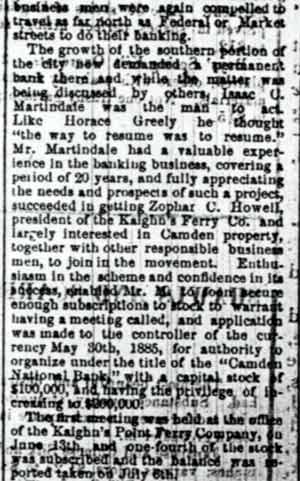
The establishment of the Camden National in its new quarters completes an interesting bit of local history. Banking facilities were long needed in that section of the city, many years ago the subject being agitated by the late Charles Kaighn and others, and was revived some twenty years ago, but affected an organization when the Gloucester Savings bank opened a branch a few years ago, the need was temporarily supplied; but upon the failure of that institution in 1884, business men were again compelled to travel as far north as Federal or Market streets to do their banking.
The growth of the southern portion of the city now demanded a permanent bank there and while the matter was being discussed by others, Isaac C. Martindale was the man to act. Like Horace Greeley he thought “the way to resume was to resume.” Mr. Martindale had a valuable experience in the banking business, covering a period of 20 years, and fully appreciating the needs and prospects of such a project, succeeded in getting Zophar C. Howell, president of the Kaighn’s Ferry Co. and largely interested in Camden property, together with other responsible businessmen, to join in the movement. Enthusiasm in the scheme and confidence in its offices, enabled Mr. Martindale to secure enough subscriptions to stock to warrant having a meeting called, and application was made to the controller of the currency May 30th, 1885, for authority to organize under the title of the “Camden National Bank” with a capital stock of $100,000, and having the privilege of increasing to $200,000. The first meeting was held at the office of the Kaighn’s Point Ferry Company, on June 13th, and one-fourth of the stock was subscribed and the balance was reported taken by July 8th.
The stockholders at meeting on July 20th, showed rare judgement in the selection of their officers. The board of directors is composed of men of high business qualifications. Henry B. Wilson, a prosperous coal merchant of over thirty years and big, a model postmaster, an efficient assemblyman and valuable councilman and president of council; John Cooper, a rare conservative, and always on the safe side of every business adventure; William B. Mulford, known to the people among whom he has lived for more than the average lifetime as stirlingly honest and unknown to make a mistake in business matters; Charles B. Coles, one of the best citizens, and successful business man; Harry B. Anthony, a prospering manufacturer; George W. Bailey, who makes a success of all he attempts; Isaac C. Toone, head of one of the largest commercial houses in Camden; R. W. Birdsell, the capable secretary of the Camden Insurance Company; Charles E. Thomas, of the glass manufacturing firm of Bodine, Thomas & Co.; William W. Price; Philip H. Fowler, the efficient manager of the Gloucester Gingham Mills, employing 900 persons; D. Somers Risley, a wise and reliable insurance man; Herbert C. Felton, the capable builder up of a dilapidated ferry property; Zophar L. Howell, a chip off the old block; Howard M. Cooper, a safe and competent lawyer with George T. Haines and James Davis, farmers of repute, whose industry with the plough, and skill in financial management, has made them wealthy, are the managers.
Zophar C. Howell was made president, John Cooper, vice president, Isaac C. Martindale, cashier and Howard M. Cooper, solicitor.
The bank opened for business on August 13th, at the building 259 Kaighn avenue, and the first report to the controller of the currency, six weeks later, showed aggregate assets of $219,018.50. Since then the business has rapidly and steadily increased in volume, as the following, taken from the report made two weeks ago shows: Capital stock, $100,000; profits, $23,764.67; circulation, $90,000; aggregate deposits, $419,278.25, making total assets of $623,042.92.
An excellent feature of the business is that the institution affords a place where working people and those of small means can place their savings and secure a reward for the use of it, as to meet this want the bank opened in March following its special line of accounts on which interest is allowed at the rate of 3 per cent., such accounts to be drawn only after two weeks’ notice, interest being credited every six months. For the convenience of the people of Gloucester City, a clerk goes down there every week to receive deposits.
The Camden National is a success. The portion of the city of which it occupies a central location is rapidly increasing in population; manufacturing establishments are going up in every direction, while the already extensive commerce carried on on Kaighn avenue will be quadrupled when the avenue is opened over Cooper’s creek, and will be the busiest thoroughfare in the city. Add to this the fortunate choice of officers, every one of unquestioned probity, and every one of them eminently successful in private business, a sure guarantee of fitness in the management of a public institution.
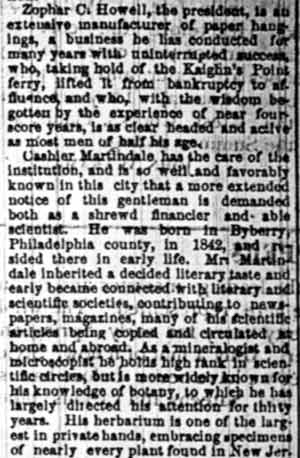
Zophar C. Howell, the president, is an extensive manufacturer of paper hangings, a business he has conducted for many years with uninterrupted success, who, taking hold of the Kaighn’s Point ferry, lifted it from bankruptcy to affluence, and who, with the wisdom begotten by the experience of near four score years, is as clear headed and active as most men of half his age.
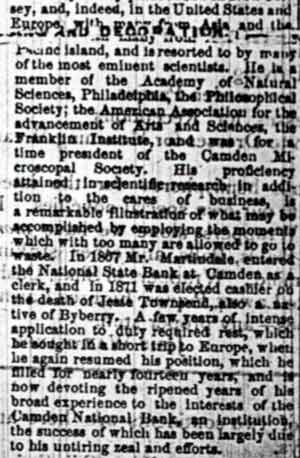
Cashier Martindale has the care of the institution, and is so well and favorably known in this city that a more extended notice of this gentleman is demanded both as a shrewd financier and able scientist. He was born in Byberry, Philadelphia county, in 1842, and resided there in early life. Mr. Martindale inherited a decided literary taste and early became connected with literary and scientific societies, contributing to newspapers, magazines, many of his scientific articles being copied and circulated at home and abroad. As a mineralogist and microscopist he holds high rank in scientific circles, but is more widely known for his knowledge of botany, to which he has largely directed his attention for thirty years. His herbarium is one of the largest in private hands, embracing specimens of nearly every plant found in New Jersey, and, indeed, in the United States and Europe, with many from Asia and the Pacific Island, and is resorted to by many of the most eminent scientists. He is a member of the Academy of Natural Sciences, Philadelphia; the Philosophical Society; the American Association for the Advancement of Arts and Sciences; the Franklin Institute; and was for a time president of the Camden Microscopical Society. His proficiency attained in scientific research, in addition to the cares of business, is a remarkable illustration of what may be accomplished by employing the moments which with too many are allowed to go to waste. In 1807 Mr. Martindale entered the National State Bank at Camden, as a clerk, and in 1871 was elected cashier at the death of Jesse Townsend, also a native of Byberry. A few years of intense application to duty required rest, which he sought in a short trip to Europe, when he again resumed his position, which he filled for nearly fourteen years, and is now devoting the ripened years of his broad experience to the interests of the Camden National Bank, an institution, the success of which has been largely due to his untiring zeal and efforts.
Camden National Bank — New Building
Philadelphia Inquirer —

The directors of the Camden National Bank will hold a meeting next Wednesday, when arrangements will be made for the erection of the new building at Broadway and Sycamore street.
To Build Camden's New Bank
Philadelphia Inquirer —
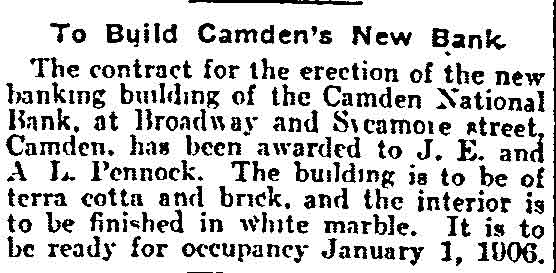
The contract for the erection of the new banking building of the Camden National Bank, at Broadway and Sycamore street, Camden, has been awarded to J. E. and A. L. Pennock. The building is to be of terra cotta and brick, and the interior is to be finished in white marble. It is to be ready for occupancy January 1, 1906.
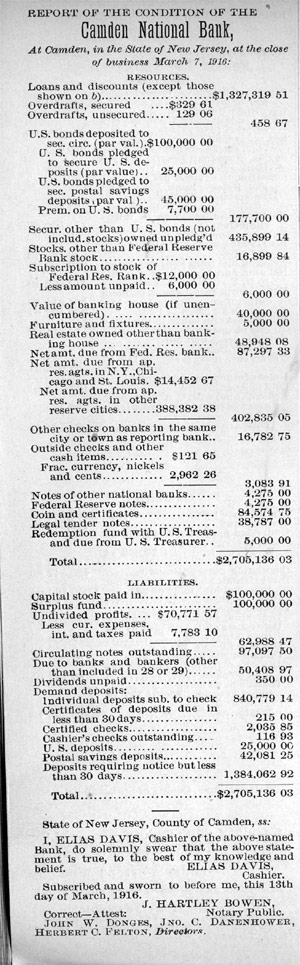
Bank Directory — March–December 1916
Camden National Bank, Camden, N.J.
Francis C. Howell, President — Herbert C. Felton, Vice President — Elias Davis, Cashier
Directors: Francis C. Howell — Herbert C. Felton — Rudolph W. Birdsell — Howard M. Cooper — Isaac Ferris — John D. Glover — James W. Halley — John C. Danenhower — Dr. John W. Donges — Elias Davis
Philadelphia Office, Southeast corner 2nd and Walnut Streets — Discount Day, Wednesday
Photos
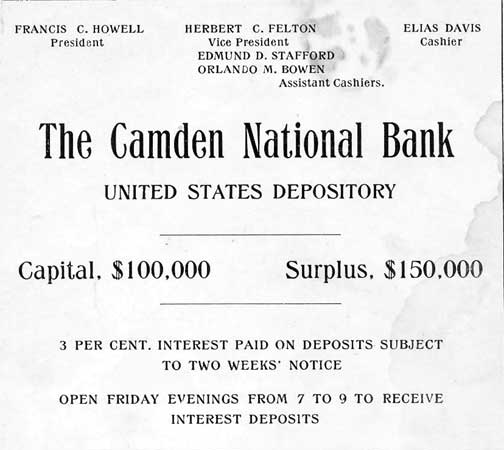
Camden National Bank — Camden High School Purple & Gold Yearbook Advertisement, 1919
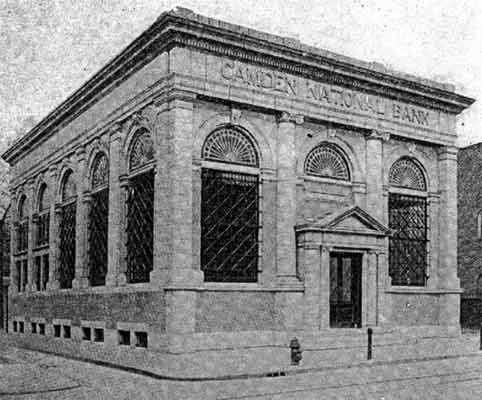
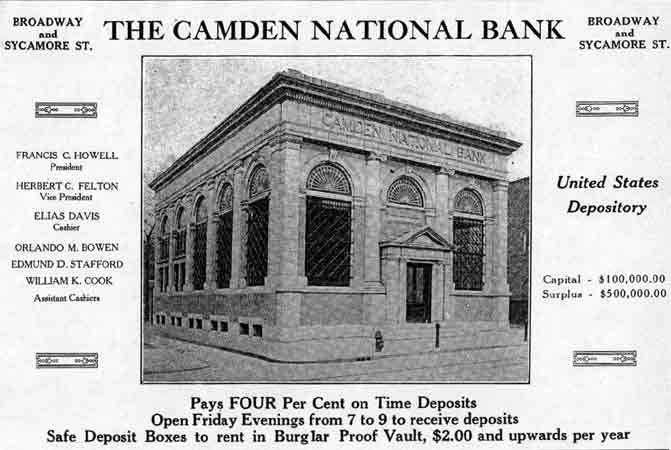
Camden National Bank — 1925
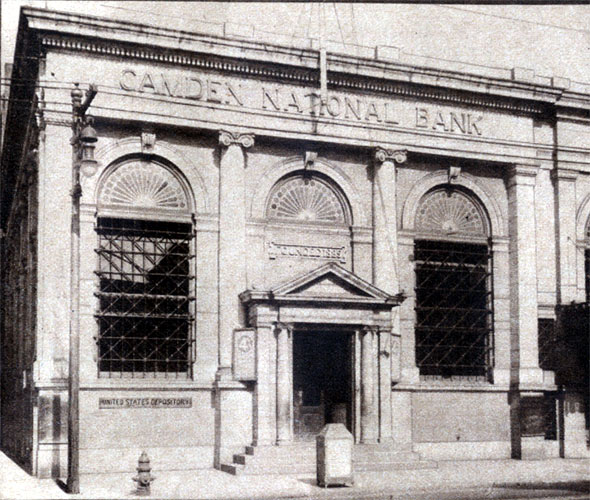
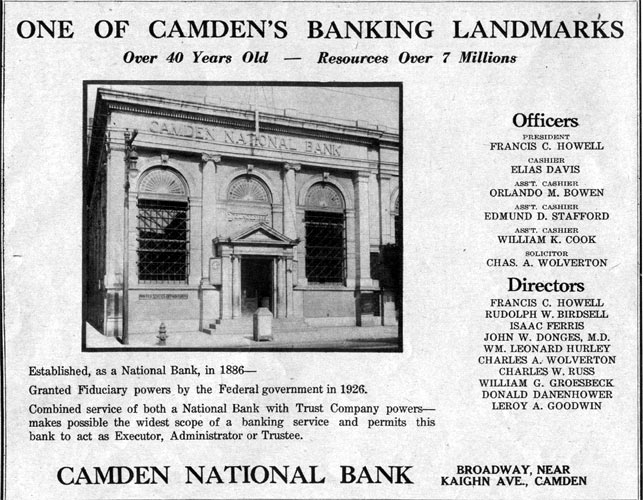
Camden National Bank — 1926
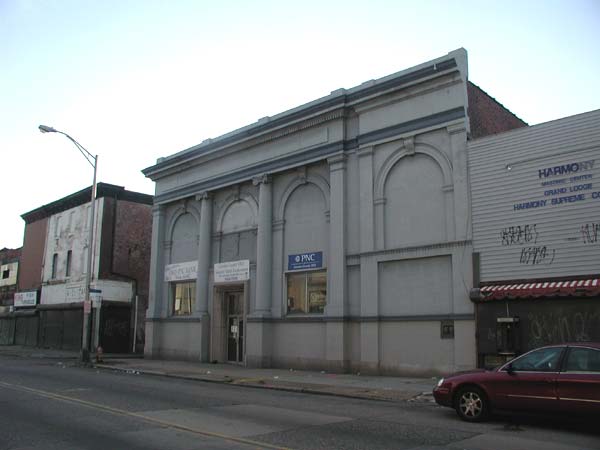
1123 Broadway — November 22, 2003