Little Ray Smith
RAYMOND F. “LITTLE RAY” SMITH was born in Chicago, Illinois on December 3, 1894. He enlisted in the 3rd Regiment of the New Jersey National Guard in Camden in 1912, and saw duty with General Pershing’s expedition to Mexico and in France during World War I. While in France began his professional boxing career. On January 1, 1926 former AEF champion lightweight boxer Little Ray Smith was assigned to Engine Company 8. He remained with Engine 8 until July of 1939, when he was promoted to Captain and assigned to lead the city’s Fire Training Academy. He was living at 111 North 6th Street in 1942, when he registered for the draft. He later re-enlisted and although already in his late 40s was accepted into the Coast Guard.
Local Legion Post to Put On Fight Show
Camden Courier-Post —
Sergeant Ray Smith Heads Committee In Charge of Arrangements for Jousts
Not to be outdone by any local organization, Corporal Raymond C. Thoirs Post, of the American Legion, passed a resolution last night in favor of staging a monster boxing show at Convention Hall sometime next month. Half the receipts will be donated to further the Boy Scout Movement.
Sergeant Ray Smith, former heavyweight boxer and now a licensed referee, was elected to head the committee on arrangements, which consists of ten members; Judge Frank F. Neutze, Dr. Irwin B. Deibert, Tom Taylor, J. Harry Ashton, Harry E. Bayne, George P. Rothermel, Albert Wehner, Fireman Ray Smith and Jack Weinberg will assist the sergeant in making the show a success.
A businessmen’s committee also will be appointed, but as yet has not been named by the legion committee members.
It is the intention of the committee to bring some of the best boxers in the country here for the show, which they will make an annual affair providing the initial one is a success. Chairman Smith stated today that he would apply for a boxing permit from Deputy Boxing Commissioner Edward A. Welsh at once.
Little Ray Smith Named Boxing Instructor at 'Y'
Camden Courier-Post —
Former Camden Scrapper to Teach Sport at Local Y.M.C.A.
Ray Smith, well-known in Camden boxing circles, has been appointed to the position of boxing Instructor at the Camden Y. M. C. A. That post has been vacant since Max W. Younger left to accept a berth at Temple University.
Smith, who is known as ‘Little Ray’ to distinguish himself from Sergeant Ray Smith, is going to get together a boxing team to represent the Y. M. C. A. in club competition.
Ray has had a number of ring bouts, including one with Willie Davis in Norristown; Tony Angelo and Tommy Sharkey, at Atlantic City; Joe Elliott and Frankie Nelson in Camden; Tommy Lyons in Gloucester; Joe O’Keefe in Clementon; Jimmy Magee in Philadelphia; and Willie Preston and Francis DeSilver, in France during the World War.
Sgt. Ray's Chatter
Camden Courier-Post —
A letter from “Sunny Miami” brings a note from Little Ray Smith, now a city fireman and one of the writer’s best friends. Little Ray, his wife Helen, and daughter Joan, are sojourning in the Southland during Ray’s vacation. Enclosed in a letter are two snap shots taken of Joan and George Bernard Shaw. Ray says he met an old friend of mine, Jimmy Maloney, who now is a policeman. And that brings to mind a story. Jim, a good Irishman, and a few years back one of the best heavy-weights ever turned out of Boston.
It was in 1927 when I last saw Jim Maloney, a fine husky lad who on the night of May 20 that year, was to meet an old rival, Jack Sharkey, from his home town in the ring at Madison Square Garden. These two had been bitter enemies and I feel that Jim resented the fact that Sharkey, a Lithuanian, had taken an Irish moniker when he took up fisticuffs. These two had met twice before in the squared circle in Boston. In 1924 Jim gained the decision in 10 rounds. In 1925 Jim again won, this time on a foul in the ninth round. And so on May 20, 1927, these two were to meet for the third time. To the winner was to go the distinction of being a runner-up for the heavyweight title.
After shaking hands with Maloney at the weighing-in ceremonies, I walked across the ring where Sharkey was addressing Jimmy Johnston, the matchmaker of the Garden, presented me to the garrulous gob.
I told Jack that I was a newspaper man and asked him how he felt about the encounter scheduled for that evening.
“I’ll knock that big Irishman right into your lap in about three rounds,” Sharkey told me.
Jack was the underdog in the fight, all the sports scribes around New York labeled the match as just a warming-up process for Maloney who they thought was a great prospect to annex the heavyweight championship of the world.
The night of the fight I was at the ringside with my nose literally in the resin box in Maloney’s corner. Jack got away to a fast start and was well out in front when near the middle of the fifth round, call it imagination if you please, but Jack looked down at me, winked and shot over a terrific right cross that sent Maloney sprawling to the canvas just a few inches from where I was sitting. That ended the fight and also the career of a great Irishman who always gave his best in the squared circle, and I’ll bet that there is no finer bluecoat in all Miami than Jim Maloney.
Incidentally that was the first fight that started Jack Sharkey on his climb to fame that resulted in his winning of the greatest of all fistic baubles—the heavyweight championship of the world.
Gloucester County Graduates Firemen
Camden Courier-Post —
Demonstration of Work Will Be Given at Woodbury High School
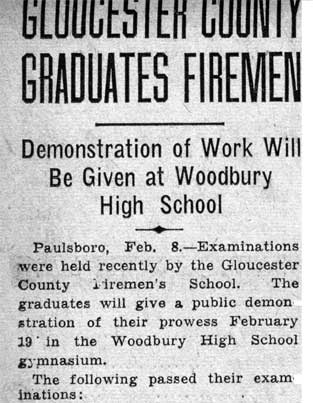
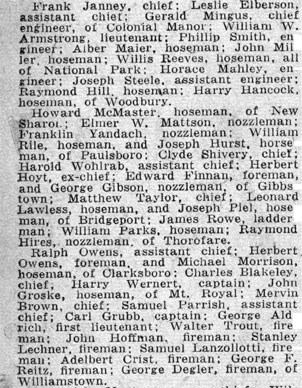
Paulsboro, Feb. 8.—Examinations were held recently by the Gloucester County Firemen’s School. The graduates will give a public demonstration of their prowess February 19 in the Woodbury High School gymnasium.
The following passed their examinations: Frank Janney, chief; Leslie Elberson, assistant chief; Gerald Mingus, chief engineer, of Colonial Manor; William Armstrong, lieutenant; Phillip Smith, engineer; Aiber Maier, hoseman; John Miller, hoseman; Willis Reeves, hoseman, all of National Park; Howard Cherk, engineer; Joseph Steele, assistant engineer; Raymond Hill, hoseman; Harry Hancock, hoseman, of Woodbury.
Howard McMaster, hoseman, of New Sharon; Eugene Mattson, nozzleman; Franklin Yandach, nozzleman; William Rile, hoseman, and Joseph Hurst, horseman, of Paulsboro; Clyde Shivery, foreman; Gerald Fletchman, hoseman; Herbert Hoyt, ex-chief; Edward Finnan, foreman, and George Gibson, nozzleman, of Gibbstown; Matthew Taylor, chief; Leonard Childress, horseman, and Joseph Piela, horseman, of Bridgeport; James Rowe, ladder man; William Parks, hoseman; Raymond Hires, nozzleman, of Thorofare.
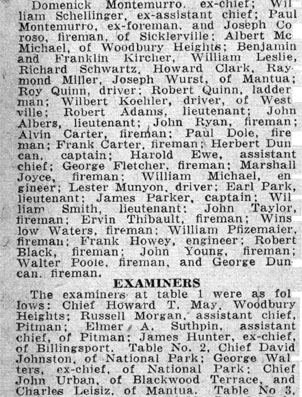
Ralph Owens, assistant chief; Herbert Owen, foreman, fireman, and Michael Morrison, hoseman, of Clarksboro; Charles Blakeley, chief; Harry Wernert, captain; John Groske, hoseman, of Mt. Royal; Mervin Brown, captain; Samuel Parks, assistant chief; Carl Grubb, captain; George Aldrich, first lieutenant; Walter Trout, fireman; John Hoffman, fireman; Stanley Billingslea, fireman; Samuel Crotchfield, fireman; Adelbert Crist, fireman; George F. Reitz, fireman; George Degler, fireman, of Williamstown.
Domenick Montemurro, ex-chief; William Schellinger, ex-assistant chief; Paul Montemurro, ex-foreman, and Joseph Coroso, fireman, of Sicklerville; Albert McMichael, of Woodbury Heights; Benjamin and Franklin Kircher, William Leslie, Richard Schwartz, Howard Clark, Raymond Miller, Joseph Wurst, of Mantua; Roy Quinn, driver; Robert Quinn, ladder man; Wilbert Koehler, driver, of Westville; Robert Adams, lieutenant; John Albers, lieutenant; John Ryan, fireman; Alvin Carter, fireman; Paul Dole, fireman; Frank Carter, fireman; Herbert Duncan, captain; Harold Ewe, assistant chief; George Fletcher, fireman; Marshall Joyce, fireman; William Michael, engineer; Lester Munyon, driver; Earl Park, lieutenant; James Parker, captain; William Smith, lieutenant; John Taylor, fireman; Ervin Thibault, fireman; Winslow Waters, fireman; William Pfizemaier, fireman; Frank Howey, engineer; Robert Black, fireman; John Young, fireman; Walter Poole, fireman, and George Duncan, fireman.
Examiners
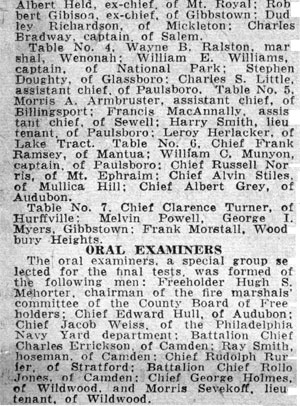
The examiners at table 1 were as follows: Chief Howard T. May, Woodbury Heights; Russell Morgan, assistant chief, Pitman; Elmer A. Suthpin, assistant chief, of Pitman; James Hunter, ex-chief, of Billingsport. Table No. 2, Chief David Johnston, of National Park; George Walters, ex-chief, of National Park; Chief John Urban, of Blackwood Terrace, and Charles Leisiz, of Mantua. Table No. 3, Albert Held, ex-chief, of Mt. Royal; Robert Gibison, ex-chief, of Gibbstown; Dudley Richardson, of Mickleton; Charles Bradway, captain, of Salem.
Table No. 4, Wayne B. Ralston, marshal, Wenonah; William E. Williams, captain, of National Park; Stephen Doughty, of Glassboro; Charles S. Little, assistant chief, of Paulsboro. Table No. 5, Morris A. Armbruster, assistant chief, of Billingsport; Francis MacAnnally, assistant chief, of Sewell; Harry Smith, lieutenant, of Paulsboro; Leroy Herlacker, of Lake Tract. Table No. 6. Chief Frank Ramsey, of Mantua; William C. Munyon, captain, of Paulsboro; Chief Russell Norris, of Mt. Ephraim; Chief Alvin Stiles, of Mullica Hill; Chief Albert Grey, of Audubon.
Table No. 7. Chief Clarence Turner, of Hurffville; Melvin Powell, George I. Myers, Gibbstown; Frank Morstall, Woodbury Heights.
Oral Examiners
The oral examiners, a special group selected for the final tests, was formed of the following men: Freeholder Hugh S. Mehorter, chairman of the fire marshals’ committee of the County Board of Freeholders; Chief Edward Hull, of Audubon; Chief Jacob Weiss, of the Philadelphia Navy Yard department; Battalion Chief Charles Errickson, of Camden; Ray Smith, hoseman, of Camden; Chief Rudolph Rurfer, of Stratford; Battalion Chief Rollo Jones, of Camden; Chief George Holmes, of Wildwood, and Morris Sevekoff, lieutenant, of Wildwood.
$100,000 Fire Sweeps Store of Antrim Co.
Camden Courier-Post —
Several Firemen Hurt; Oil Plant and Homes Are Menaced
Fire swept the wholesale store of Antrim Hardware Company, 1514 and 1516 Federal street last night, damaged the stock to the extent of $100,000, injured several firemen, menaced homes and the plant of the Standard Oil Company opposite. It was the first three-alarm fire in Camden since January, 1937.
One of the firemen, Ralph Bingaman, of Truck Company No. 1, was cut severely on the right hand and foot by falling glass and went to the Cooper Hospital. Another hoseman, Ray Smith, of headquarters, also was cut on the right hand but stuck to his fire fighting after his wounds were dressed.
Huge choking billows of smoke that rolled over the fighters balked them several times in their efforts to check the fire, but they remained at their posts and finally subdued the blaze after a battle of several hours.
Spread Rapidly
Chief John H. Lennox declared the fire started midway on the first floor from some unknown cause and spread so rapidly before its discovery efforts of the firemen were greatly hindered. Louis Gold, proprietor of the Federal Automobile Company, which adjoins the Antrim place, discovered the blaze and sent in an alarm at 7 p. m.
He then telephoned to Councilman E. Hulings Antrim, of Merchantville, treasurer of the concern, who raced to the fire, together with his mother, Mrs. Elwood Antrim, widow of the founder of the firm. Later B. Frank Antrim, president of the firm, arrived. The members of the family conferred and decided to reopen today their other store at Twenty-sixth and Federal streets, and to secure if possible an unoccupied floor of a chain store building to carry on the business. The stock, according to Antrim, was fully insured.
The firm was created on December 1, 1889, and had made arrangements to celebrate its golden anniversary. Mrs. Antrim, mother of the treasurer, stated she had half the anniversary number ready for publication “but the first fire we ever had has ruined all that now.”
Smashes Windows
When Gold, accompanied by his son, Marvin, discovered the fire, the latter smashed in two front windows on the first floor to permit the smoke to roll and and [sic] to prevent an explosion inside, he said. Meanwhile, Leroy Garrison, who lives at 50 South Twenty-fourth street, was driving past in his automobile.
He saw smoke rolling upward from the first floor and ran to the rear of the structure and threw open the door to permit the smoke to roll free at the rear.
Eight minutes after the first alarm was sounded Chief Lennox ordered a second, then a third at 7:33 p. m. Eight engines and two hook and ladder trucks responded and the fight began to keep the flames from spreading in the neighborhood. With the wind blowing north, the tanks of the oil company across the street seemed threatened, but the interior of the structure was bulked with two firewalls which held and gave the firemen a chance to get into action and beat down the flames.
Paint, chemicals and tar paper stored on the second floor made a dense, choking smoke that completely concealed the neighborhood and the hundreds of spectators that thronged the vicinity to watch the fire. Two tenants in nearby houses, Miss Agnes Mitchell and Mrs. Roy Dilks, 72, living in 1510 and 1508, respectively, were unaware of the fire right next door until the police sent them to safety.
Refused to Leave
Mrs. Dilks, alone in the house at the time, refused to leave. She told the police she didn’t want to go, because the family had lived there but a month and her relatives were away. Finally she was urged to depart and did, finding refuge with Mrs. Albert Bowne, whose husband runs a printing shop a few doors below.
When Councilman Antrim arrived on the scene he attempted to rescue records of the firm which he said could never be replaced. Five times he entered the smoking building and five times he was turned back by the firemen.
Finally two firemen, Andrew Ballantine, who drives Chief Lennox, and Ladderman John Strauss, of Truck Company No. 4, forged their way through the dense smoke and retrieved the records.
Antrim fixed his damages from smoke and water at $100,000 which he said was the amount of stock in the building. Mrs. Antrim, his mother, stood under an umbrella near the burning building, and refused to go back.
“We’ll open tomorrow,” said the energetic woman, “and not let this bother us. This firm was created in 1889 when Hulings, my son, was four, and B. Frank Antrim, now president, and myself ran the business and we’re not going to let this get us down, you bet.”
Antrim said he was the last person to leave the building at 5 p. m., and everything appeared to be all right then. The burglar alarm with which the building is equipped did not sound, so Antrim says no one could have entered the building after he departed.
Truck in Collision
After Engine Company No. 10 was sent home the apparatus was sideswiped by a traveling sandwich wagon, owned and driven by Emido Martelli, of 1315 Thurman street, at Eleventh street and Newton avenue.
Martelli’s wife and 25-months-old son were aboard the wagon at the time but none was injured. Police took Martelli to City Hall where he was asked for a statement as to the accident. According to the persons on the scene, Martelli was driving on Eleventh street when the engine came along Newton avenue, with its siren open.
The wagon driver did not seem to pay attention to the screams of the whistle and continued, the front of his car grazing the side of the apparatus.
When Engine Company No. 9, at Twenty-first and Federal streets, the first engine to respond to the alarm, reached the hydrant the firemen found an automobile parked there, and locked. They had to push the car out of the way, in order to get a hose to the hydrant.
Chief Lennox said the last time the department received a third alarm was when fire gutted the store of the McCrory Company at Broadway and Kaighn avenue.
Changes Announced in Fire Department
Camden Courier-Post —
Truck Disbanded, Engine Company Created; 13 Men Transferred
Commissioner Mary W. Kobus yesterday announced a number of changes in the fire department, including the disbanding of Truck Company No. 4; creation of a new engine company, No. 10, and the transfer of 18 officers and men, 12 of them captains.
Most of the new captains have been serving as acting captains and promotion to full rank will involve no pay increases, inasmuch as the men signed waivers foregoing the raises.
Commissioner Kobus explained most of the changes were made to conform with regulations of the National Board of Fire Underwriters. The board, Mrs. Kobus explained, made a survey of the department and advised appointments of acting captains to full rank.
The commissioner also announced she had appointed Junior Captain Raymond Smith as director of the school for firemen at Engine Company No. 10, Ninth and Morgan streets. Smith, one of the youngest at the recently appointed junior captains, will succeed the late Battalion Chief Rollo Jones.
Senior Captain Leonard Megee was appointed acting battalion chief to succeed Jones. He will continue at the Fifth and Arch streets fire headquarters.
Junior Captain William Spencer, of headquarters company, was named relief captain.
Engine Company No. 10 will use the headquarters of the old truck company, at Ninth and Morgan streets.
To the new company Mrs. Kobus assigned Senior Captain Mortica Clark and Firemen frank burt, Frank Esperance and Clifford Lane.
Junior Captain Frank Oberman was transferred from Engine Company No. 10 to Engine Company No. 1, at fire headquarters.
Other assignments are as follows:
Junior Captain robert wonsetler, Engine Company No. 11, to Engine Company No. 2.
Fireman harry kleinfelder, Engine Company No. 6, to Engine Company No. 2.
Junior Captain edgar ellender, Engine Company No. 2, to Engine Company No. 6.
Junior Captain ralph bingemann, Truck Company No. 2, to Engine Company No. 7.
Fireman david humphries, Truck Company No. 3, to Engine Company No. 11.
Junior Captain nelson andrews, Engine Company No. 2, to Truck Company No. 1.
Fireman albert dukes, jr., Truck Company No. 1, to Engine Company No. 2.
Junior Captain winfield levisuer, Truck Company No. 2, to Truck Company No. 3.
Junior Captain Edward McDowell retains assignment to Engine Company No. 3.
Junior Captain Maurice O’Brien assigned to Engine Company No. 10.
The changes were contained in notice to the Civil Service Commission, are effective as of June 1 and will appear on the June 15 payroll.
Two Ex-Convicts Seized in Gun Chase
Camden Courier-Post —
Figures and Scenes in Chase and Capture of Suspects


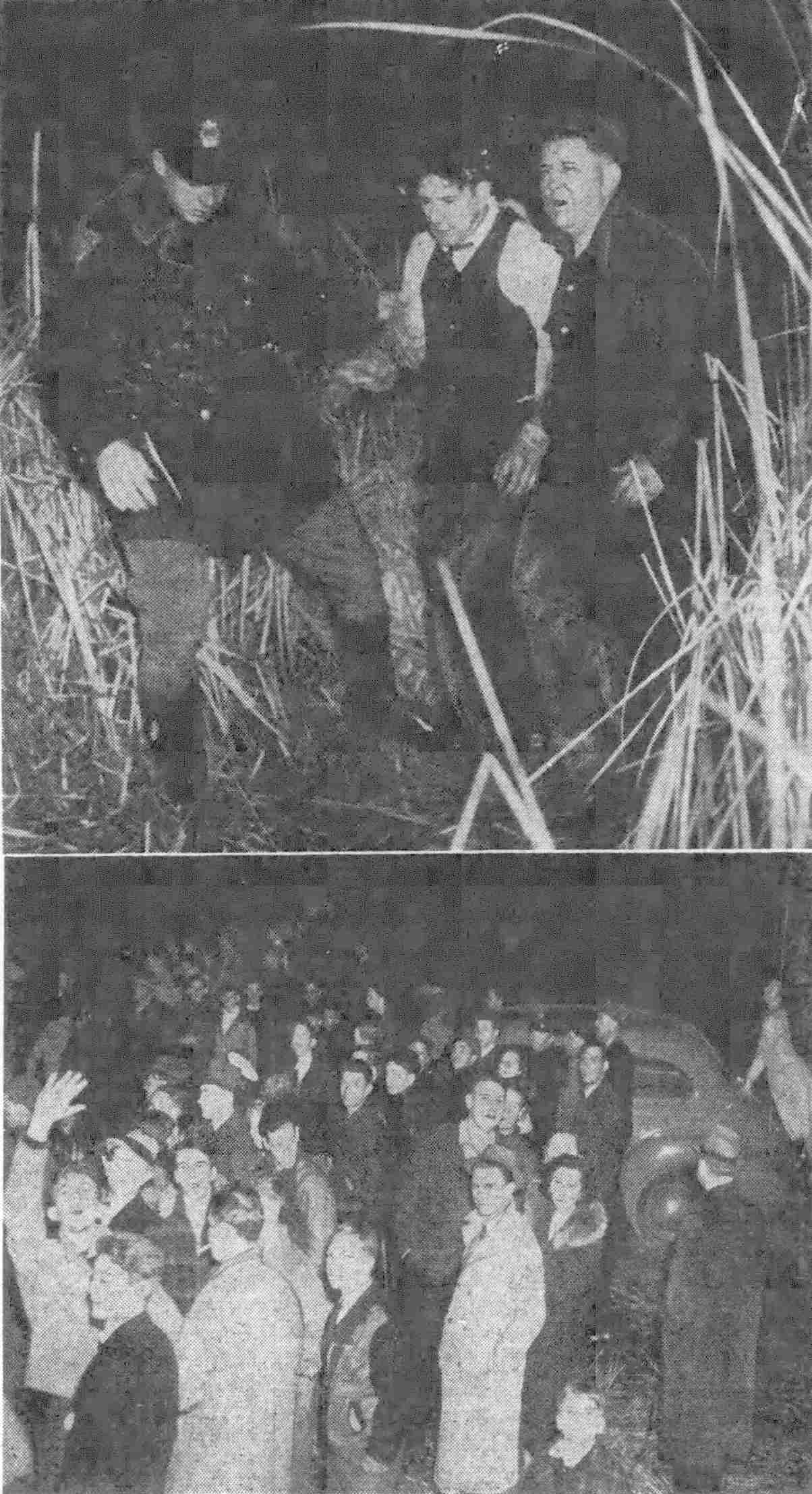

Top: Flight’s finish for fugitive Stanley Gasior (center), suspected would-be hijacker, brought out of the swamps along Newton Creek by Fire Captain Raymond Smith (right) and a patrolman. Bottom: Crowd of 300 Fairview residents watching the manhunt by the light of flood lights provided by the Camden fire department emergency squad.


As police deployed along the north bank of the marshland to prevent the fugitive from circling around and escaping, Junior Captain Raymond Smith, of the fire emergency squad, in hip boots and carrying a powerful hand flood light, worked his way into the mud of the swamp and beat the reeds to east and west while more powerful lights atop the roofs of the high emergency trucks pierced the blackness in wide sweeps.
Fire Training School Photos
Camden Courier-Post —
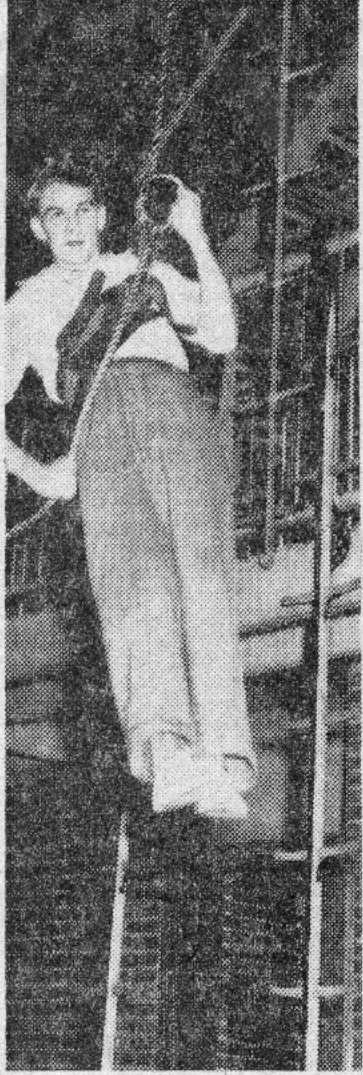
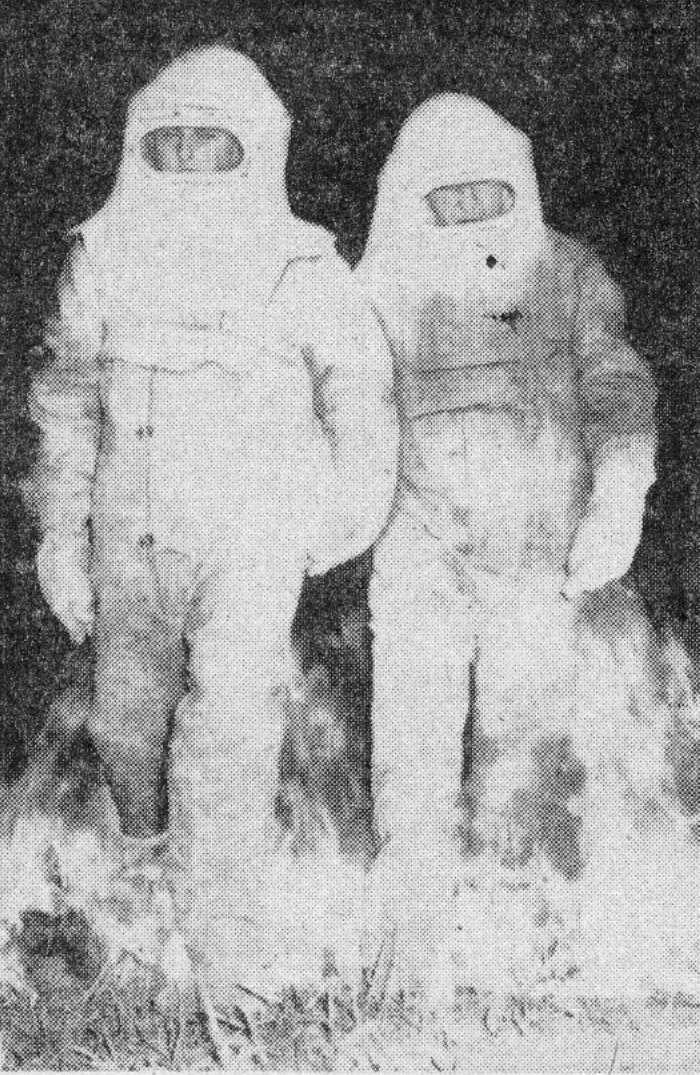
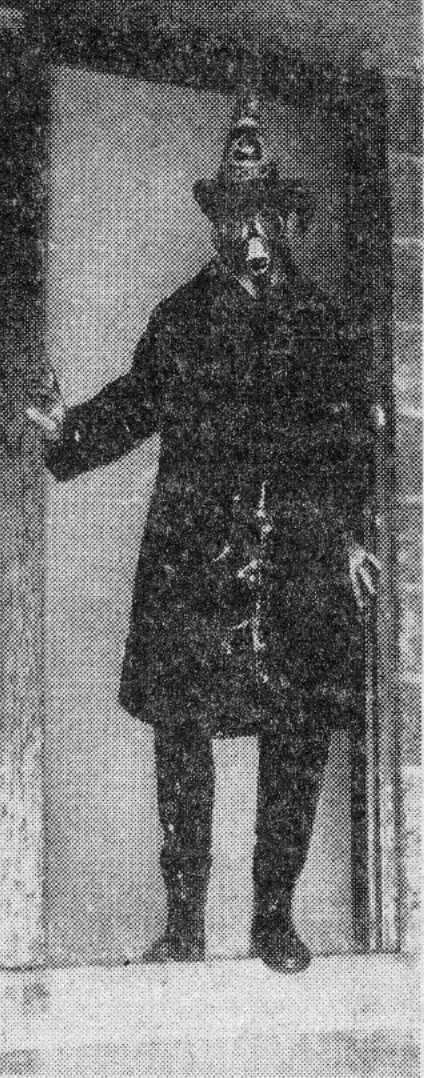
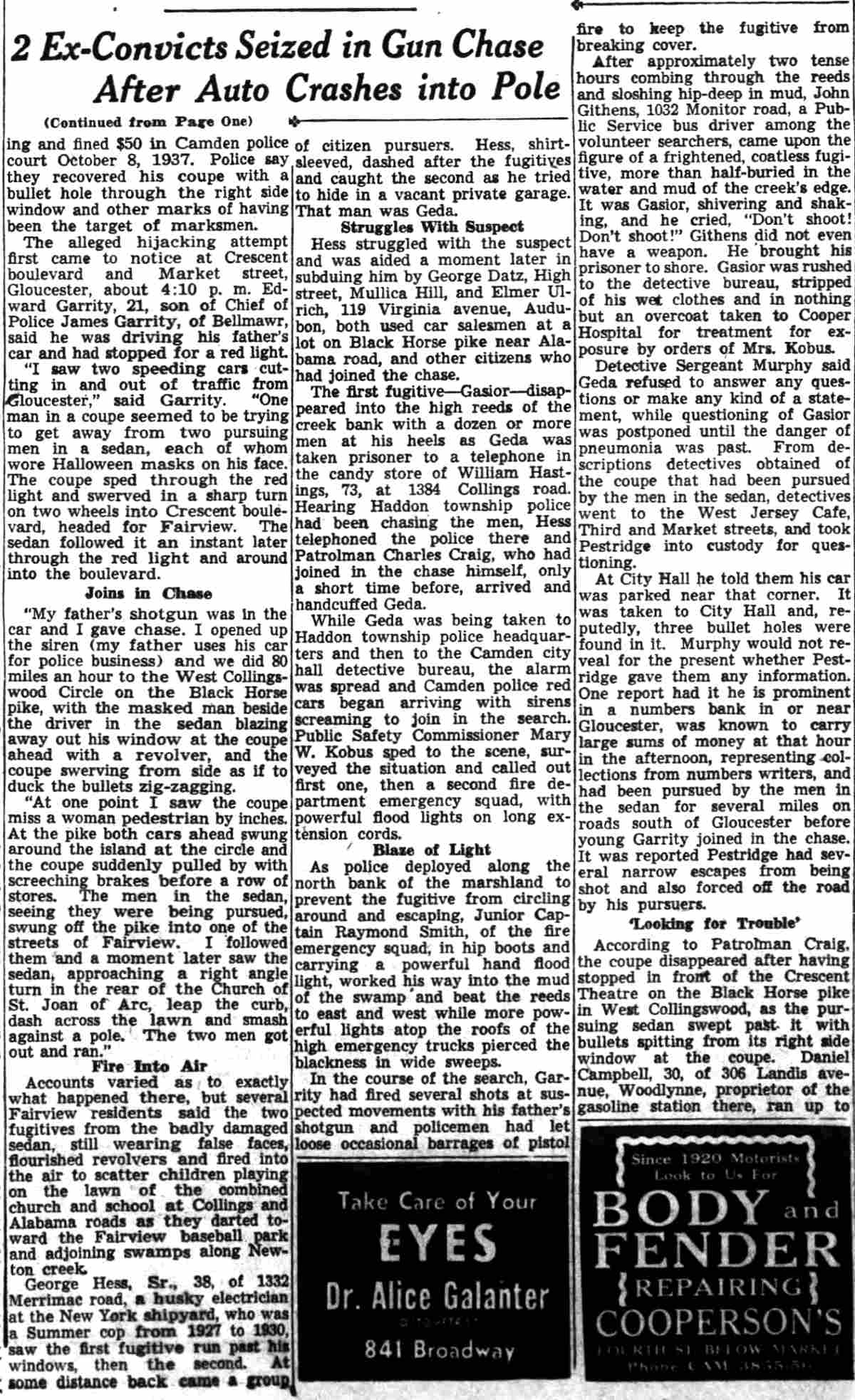
The photograph on the left shows Edward Friant, of 124 North Thirtieth Street, descending from a tall building on a rope by using a life belt. The center scene depicts Charles Geitz, of 465 Mechanic Street, left, and Nicholas Iacovelli, of 1303 Decatur street, using asbestos suits in the middle of roaring flames. The suits, according to Fire Captain Ray Smith, instructor at the school, are able to withstand 1,750 degrees of heat. Ernest Wilkinson, of 1304 Park boulevard, is the man behind the mask on the right shown emerging from a building filled with formaldehyde gas.
50 Volunteer Firemen Complete Training for Emergency Duties
Camden Courier-Post —
Graduates First of 500 to Be Trained by City for Huge Reserve Similar to that in London; Defense Officials Praise Work
Camden’s first group of war and emergency volunteer firemen received their “diplomas” last night on completion of their training at the fire school in no. 10 firehouse, Ninth street and Morgan boulevard.
They are the initial volunteers to be trained as a reserve for the city fire department in an emergency. The volunteers, 50 of them, will be on 24-hour call. Eventually more than 500 men are expected to receive the training course for a huge reserve similar to the corps of firemen now being used in London.
The men range in ages from 11 to 59 years with Charles Smith, son of Sgt. Ray Smith, being the youngest, and Harry L. Freidel, the oldest.
The training course started May 12 and the trainees have attended three sessions a week, Monday, Wednesday and Friday nights, for seven weeks under the direction of Fire Captain Raymond Smith, no relation to the sergeant, who is director of the training school. Smith is a graduate of Class 56, of the Philadelphia Fire Training School.
Each volunteer fireman will be issued an identification card which will hold his fingerprints.
Class Praised
Among those congratulating the graduates were Herbert E. Harper, chairman of the Camden Defense Council; William C. Schriver, council member; Fire Chief john lennox and Captain Smith. Howard Odrain, deputy chief of the Philadelphia Fire Department with 31 years of experience in fighting fires, attended as an observer.
“In behalf of the Camden City Defense Council, I want to thank you men for the hours and days you have put into taking this course,” Harper told the graduates.
“You have been prompt in attendance and have been attentive. We don’t anticipate any air raids or any acts of war-invasion, but we have an important problem in enabling national defense Industries in Camden city to make load in their Jobs.”
“The sabotage committee of the defense council has been visiting the local Industries encouraging the plants to set up their own fire fighting squads and many are doing so. You men will be needed in times of an emergency to aid these forces and to assist at industries where there is no fire fighting squads.”
Chief Lennox termed the volunteers “our second line of defense” and thanked them for their cooperation.
Training Complete
The course included training in all phases of fire-fighting from operating pumpers to climbing ladders and combating incendiaries. Rescue work also was included. The use of gas masks and asbestos suits in chemical fires, how to approach delayed bombs with snubbers and the proper methods of using extinguishers were taught.
A demonstration was held outside the firehouse by the volunteers. Their activities included scaling ladders, using gas masks to enter a smoke house, climbing and working on the top of the fire tower, using an aerial truck, tying tools for the lifting to tools, working on the end of water lines, working on pumpers, hooking up to stand pipes, jumping into life nets, tying life ropes and using asbestos suits through flaming gasoline and oil.
The Class
The graduates included: George D. Wilkinson, fire marshal of the RCA Manufacturing Company, and his two sons, Ernest and George; Garfield Watson, sergeant of police at New York Shipbuilding Corporation; Lieut. George Hamilton, Jr., of the 157th Field Artillery; Captain William Hare, of the Kaighn Avenue-South Street Ferry.
Harry B. Thompson, Earl Denby, Lester W. Giberson, Norman P. Maull, Joseph Leone, Samuel Schuele, George P. Smith, Joseph Marchese, Nicholas A. Messaro, Willam S. Martz, William E. Doan, Elwood P. Martz, Jr., Clyde Getzinger, George W. Grove, Stephen Kirby, James W. McCracken, William Watkin, Manuel Weiss, Riccardo DiGiacomo, Louis Cimini, William P. Walter, Sigmund Yakaski, Nicholas Iacovelli, Robert Holmes, Walter D. Lohrman.
Myer J. Mutter, Charles Geitz, Charles A. B. Smith, Howard Doerschner, Harry L. Freidel, Franklin L. Wright, Paul W. Kessler, Warren I. Carter, Creston Polland, Edward E. Friant, Frank F. Shropshire, Charles Gall, Albert E. Pine, Nicholas Cerasoli, George W. Williams, Joseph G. Foster, Joseph Elliott, George Hance and Irving L. Stiefel.
Little Ray Smith, Hero of 2 Wars, Off to Serve His Country in 3rd
Camden Courier-Post —
Head of Camden’s Fire School and Veteran of Mexican Border and France Enlists in Coast Guard
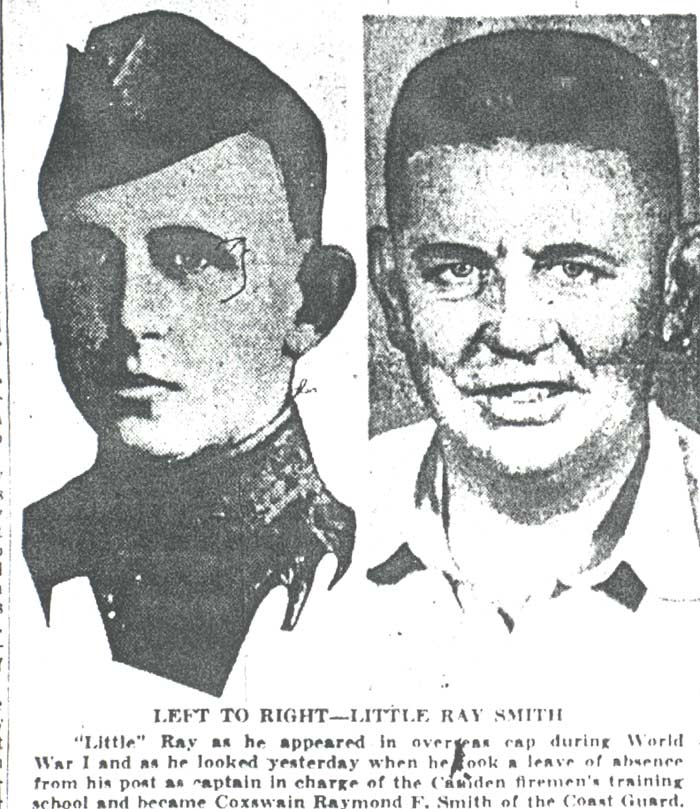
Left to right—Little Ray Smith: “Little” Ray as he appeared in overseas cap during World War I and as he looked when he took a leave of absence from his post as captain in charge of the Camden firemen’s training school and became Coxswain Raymond F. Smith of the Coast Guard.
By Ray Howay
“Little” Ray Smith is going to his third war.
Veteran of the Mexican border, battle-scarred hero of World War I, Captain Smith, head of Camden firemen’s training school, enlisted in the Coast Guard yesterday. He’s gone today.
At 48 he opens a new page in his book of memories.
Other pages chronicle following General Funston across the Rio Grande on the futile chase after Pancho Villa, through Cantigny, Soisson, St. Mihiel, the Argonne, the Watch on the Rhine; serving under General Summerall and Capt. Kermit Roosevelt.
Enough for most men, but not for the former 125-pound champion of the AEF; not enough for the living chronicle of six among whom a Hun plane dropped a bomb; not enough for a man who helped train a French 75 into the mouth of a cave in which 625 Boche were hiding and firing until they surrendered.
“Why are you going again, and why to sea this time?” we asked.
Expects Long War
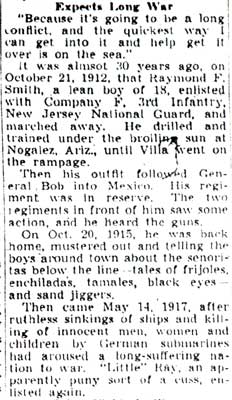
“Because it’s going to be a long conflict, and the quickest way I can get into it and help get it over is on the sea.”
It was almost 30 years ago, on October 21, 1912, that Raymond F. Smith, a lean boy of 18, enlisted with Company F, 3rd Infantry, New Jersey National Guard, and marched away. He drilled and actioned under the boiling sun at Nogalez, Ariz., until Villa went on the rampage.
Then his outfit followed General Bob into Mexico. His regiment was in reserve. The two regiments in front of him saw some action and had their casualties.
On Oct. 20, 1915, he was back home, mustered out and telling the boys around town about the señoritas below the line—tales of frijoles, enchiladas, tamales, black eyes and sand jiggers.
Then on May 14, 1917, after ruthless sinkings of ships and killing of innocent men, women and children by German submarines had aroused a long-suffering nation to war. “Little” Ray, an apparently puny sort of a cuss, enlisted again.
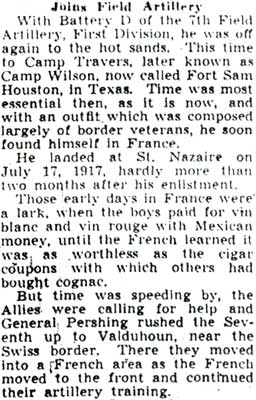
Joins Field Artillery
With Battery D of the 7th Field Artillery, First Division, he was off again to the hot sands. This time to Camp Travers, later known as Camp Wilson, now called Fort Sam Houston, in Texas. Time was most essential then, as it is now, and with an outfit which was composed largely of border veterans, he soon found himself in France.
He landed at St. Nazaire on July 17, 1917, hardly more than two months after his enlistment.
Those early days in France were a lark, when the boys paid for vin blanc and vin rouge with Mexican money, until the French learned it was as worthless as the cigar coupons with which others had bought cognac.
But time was speeding by, the Allies were calling for help and General Pershing rushed the Seventh up to Valduhoun, near the Swiss border. There they moved into a French area as the French moved to the front and continued their artillery training.
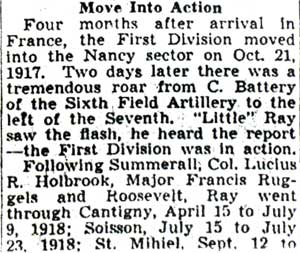
Move Into Action
Four months after arrival in France, the First Division moved into the Nancy sector on Oct. 21, 1917. Two days later there was a tremendous roar from C. Battery of the Sixth Field Artillery to the left of the Seventh. “Little” Ray saw the flash, he heard the report—the First Division was in action.
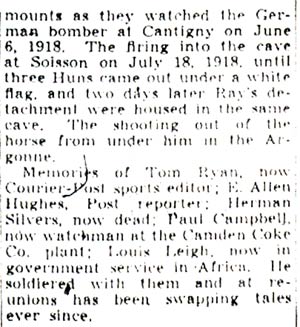
Following Summerall, Col. Lucius R. Holbrook, Major Francis Ruggels and Roosevelt, Ray went through Cantigny, April 15 to July 9, 1918; Soisson, July 15 to July 23, 1918; St. Mihiel, Sept. 12 to mounts as they watched the German bomber at Cantigny on June 6, 1918. The firing into the cave at Soisson on July 18, 1918, until three Huns came out under a white flag, and two days later Ray’s detachment were housed in the same cave. The shooting out of the horse from under him in the Argonne.
Memories of Tom Ryan, now Courier-Post sports editor; E. Allen Hughes, Post reporter; Herman Silvers, now dead; Paul Campbell, now watchman at the Camden Coke Co. plant; Louis Leigh, now in government service in Africa. He soldiered with them and at reunions has been swapping tales ever since.
Enters Department
Back home there was a variety of occupations, until July 1, 1923, when Ray went to work in the city repair shops, repairing busted fire equipment. On Jan. 1, 1926, he entered the fire department and was assigned to No. 8 fire house, Sixth street and Kaighn avenue.
In July, 1938, the city of Camden sent him to the Philadelphia firemen’s training school. A year later he had qualified for a captaincy under Civil Service examinations, was elevated by Commissioner Kobus and placed in charge of the Camden fire school.
In between soldiering and fire-fighting there was love and the marriage with Helen Appleton, YWCA swimmer and holder of the 10-mile championship for New Jersey and Pennsylvania. Later little Joan, now 10, arrived at the home on 111 North Sixth street.
Accident Hero
On Dec. 7, 1940, Ray found himself on the front pages of the newspapers. A car had skidded on the ice-covered pavement on the boulevard and plunged into Newton creek. An alarm was sounded and Ray was among those answering. He plunged into the icy water and saved the life of Ralph Gaudio, a commission merchant of 1291 South Merrimac road.
Came the second emergency. “Little” Ray, partly bald, no longer weighing 125 pounds, as he did when he took the AEF title from Francis de Silvers in Germany, felt he had better get prepared. He went to the State Council of Defense Fire Instruction School in Trenton last year and specialized in fighting incendiary, scatter and ground fire bombs.
After that he graduated from the FBI traffic school and then started to train volunteer firemen for war work. Three hundred auxiliary firemen now are prepared to fight Axis bombs, while thousands of civilians have witnessed bomb fire fighting demonstrations he has staged in all parts of South Jersey. He has done this on his own time; paid his own traveling expenses and received but $20 in 13 months from the Camden Defense Council for the materials with which he demonstrated home protection.
Gets War Itch
Two months ago “Little” Ray got the war itch. He could have gotten into the Army at Fort Dix. “But I would have had to stay there,” he said. “I wanted to get into service quick, so I accepted a coxswain’s berth in the Coast Guard. I’ll see plenty of action there, soon.”
“And your wife?” we asked the captain.
“We had a long talk,” he replied. “She wants me to go, because she knows I can do some good and will not be happy unless I do.”
“And where are you going?”
“Far away. I hope. I want action, nothing nearby, but out there where the home ties won’t pull too strongly. Away—”
The voice faded. There was a far away look in the eyes, a touch of sadness on the features as he may have been looking again upon Flanders fields. Then the smile returned.
“It’s got to be,” he said. “We must win the quickest way.”
And so today he’s Coxswain Raymond F. Smith, USCG.