Introduction
By Phil Cohen
This page evolved from a page about the Boudov Coal & Ice Company, a business that was located at 212 Mechanic Street for many years. Three of the website’s very good friends, John Ciafrani, Jim Bessing, and Earl Crim, were nice enough to write about what it was like to heat their homes with coal, a fuel that has become rarely used in Camden and suburban South Jersey. Prior to the advent of oil heat, and later the appearance of natural gas, coal was for many years the fuel of choice for heating homes, businesses, and other large buildings.
In October of 2006 I received a wonderful article about the George B. Newton Coal Company, which you can find on its own web page.
Coal & Ice
You may notice that in the pre-electric refrigerator days there were a lot of “Coal & Ice” businesses. Why were coal and ice paired like that? It was in great part due to where both items were shipped from.
Coal would be brought down by train to the Camden–Philadelphia port and shipped by boat to Boston and ports north, such as Portsmouth, New Hampshire and Portland, Maine. Once unloaded they would take on a load of block ice and bring it south to New York, Philadelphia, and ports south.
At both ends, the same merchants were buying and selling both products, the same ships taking on regular shipments, and thus, the Coal and Ice business was born, and let’s face it, as both businesses were sort of seasonal, selling coal and ice kept one working year-round.
Thanks to Paul W. Schopp for enlightening me as to how this trade arose.
Heating Your House With Coal
Do you remember the center grate or grille usually between the living and dining room? This was the only heat grille in the house; upstairs depended on gravity with the hot air rising for heat. Needless to say it didn’t work very well. We burned coal till I was almost a teen.
Hot water was a summer–winter hookup from the furnace. Cold weather didn’t always get you hot water — you got steam, and you had to be careful. In the summer there was no hot water from this system. We had a little “buck a day” separate hot water heater, which used a bucket of coal a day to make hot water in the summer. With coal costing $20 or more a ton there was only hot water on wash day and maybe Saturday. Don’t believe what they tell you, cold baths do not build character. Showers were something you saw in movies.
Ashes were the biggest pain in burning coal. They would get tracked all over the house in winter.
—John Ciafrani, January 2004
That center grate was also a good place to sneak a peek after you went to bed to see who was gathering in the dining room. I remember getting up in the morning and coming down to open the damper and shake down the ashes and stand there in your wool robe turning around 360 degrees to warm up as the coals got hotter, and I also remember going to bed with a hot brick or iron wrapped in a towel to warm your feet. Every time I went to visit my Grandmother I would take the ashes out to the curb and sift through them for any unburned coals.
—Jim Bessing, July 2004
I can still remember my parents saying at night when we lived in Ablett Village, “It’s time to bank the heater,” which meant adding enough coal to hold the fire over until the next morning. I remember the coal trucks and the coal bins and if a family was running out of coal they used to borrow some from the neighbors until they received their delivery. Jim Bessing has mentioned about sifting the ashes for unburnt coal. I used to do that as a chore as my father made a square box with wire mesh on the top and we used to dump the ashes on the form and moved them around. It was amazing how much good coal was found. Talking about finding coal, we used to walk the railroad tracks and pick up coal that fell off the rail cars. We also saved the ashes or cinders for the ice and snow for traction. Coal heat wasn’t the best heat and there were many nights my mother, my dad, myself and my sister would be in the vicinity of the grate, grill, or as we called it the register.
—Earl Crim, August 1, 2004
One thing I think I forgot about burning coal was that everyone kept old orange crates or scrap wood around. The wood was used as kindling but it had to be dry.
You would put some scrap paper and kindling in the firebox. Kindling went on top or under the coal as your preference. You light the paper, the paper lights the kindling, the kindling lights the coal. So much for auto ignition. Coal was a poor way to heat especially with gravity hot air. Steam and hot water was better.
It was a sign of pride that when ashes were sifted that only a few pieces of coal weren’t burnt. The ashes were a pain. In the winter everyone used them on icy sidewalks and to give cars traction. Guys would keep ashes in the trunk all winter, for snowy weather. Of course when you came indoors during winter you tracked the ashes everywhere. There was also a separate collection day for ashes separate from the garbage collection. As a kid I had a little route taking out ashes for some older neighbors. They would give you ten or 15 cents, which was movie money.
Banking the fire didn’t do much good on a day when temperature got unseasonably warm. You could tell people who burned coal on a day like that because they would have their front door or windows open.
—John Ciafrani, August 2004
In the late spring and early summer you would see quite a few coal deliveries. People were getting a head start on next winter and lower price for fuel. Even 35 years ago, the oil companies would solicit you to fill your tank during the summer and I believe I paid about 15 cents a gallon in August. McAllister had a coal yard from bridge plaza to Pearl Street, between 7th and 6th streets; where Northgate is now on 7th street was the entrance to the yard. They brought coal in on rail cars right up Main Street. They would run cars up a hump and dump the coal there, then took empty cars away… and there was coal dust over everything.
—John Ciafrani, August 2004
Now that weather is starting to change, thoughts turn to heating season. The Pavonia Ice & Coal ad reminded me when we talked about coal heat before, I had meant to tell you this. When ads spoke of clean fuel for coal they meant complete consumption of the coal with a minimum amount of ashes. Those old heaters were all natural draft, that is, they depended on temperature difference for combustion air, plus I don’t doubt old houses were so drafty that you had a good amount of fresh air leakage into the buildings.
Coal by nature burns dirty, giving off soot, and natural draft doesn’t help any. On the plus side you had heat even in a power failure. Soot and other products of combustion build up in stack pipe and chimney, and as it builds up your combustion draft drops off. The gas of combustion, carbon dioxide, carbon monoxide, and so on, have to go somewhere. With the old chimneys made of brick and mortar, the next thing you didn’t know is that you had a colorless and odorless gas filling the house.
Another problem was a fire in the stack or the chimney. That’s one reason that when they put a new heating system in today they usually put a chimney liner in, as it stops combustion gas leaks and keeps chimney fires down. A lot of people in “shoulder season” — that is, fall & spring — would build a wood fire in the coal furnace. If the wood wasn’t dried out, or was from a sap tree like pine, this added to the whole problem. It wasn’t unusual as a kid to read about a family overcome with flue gas and it was known on occasion to lead to a death.
Good old days? I wonder!
—John Ciafrani, October 2004
We had a coal bin in the front of our house at 152 Eutaw Avenue. We bought our coal from the Pavonia Coal Company. Depending on Dad’s budget, we would get one half ton or one ton delivered. Some time in the early ’50s we switched to gas heat.
—Tom Probst, October 2004
When we got oil heat, we cleaned out the coal bin. Of course the wooden chute to send coal under the front porch to the coal bin stayed. In the winter we kept 32 ounce Ballantine’s under there to keep cold. One winter we got a real bad cold snap in December and the whole case of beer froze. From then on only a few quart bottles went there at a time.
—John Ciafrani, October 2004
While poking around I found a paragraph on “Blue Coal.” According to this little note, Blue Coal was used as a selling point in as much as it was supposed to have superior burning qualities and as a theft deterrent. Some of the coal companies sprayed the coal with a blue coloring, so that if anyone tried to steal coal from a slow moving train they would get blue coloring all over their clothes and hands, making it easier for police to catch them. When the coal reached the coal yards its blue coloring was used as a selling point. Three cheers for truth in ads!
—John Ciafrani, November 2004
I can’t help smiling when I read such tales of woe as “Heating with Coal.” Did everyone but me have central heating back in the ’30s?
Although it must have been fun to be able to spy on those downstairs through the ceiling grates, it must have been wonderful to feel the warm air rising into your freezing bedroom on a cold winter’s night. Most houses with central heating, which you didn’t use in the summer, came equipped with a gas range for cooking and most houses with gas had a water heater. Central heat via a furnace also meant the ability to pay for coal by the ton, which few if any on little Cooper Street could even dream of.
Life on the other side of the tracks:
Coal was a luxury to be bought only when it was absolutely necessary, and then only in 50 lb bags. Blue coal or pea or nut or even coke, it didn’t matter on any particular day, except which happened to be cheapest.
I would take my little wagon up to the Pavonia Ice and Coal Co. at 23rd and Howell Streets when we had the money and struggle with a bag I could hardly lift, then haul it back home and try to carry it into the house. This was our secondary source of coal. At other times, which I hated, I would be ordered to take a bucket and walk the railroad tracks to find coal that had fallen off coal cars. This also meant playing hide and seek with the railroad police, who were not the friendliest people in the world. At that age it didn’t dawn on me that they were looking out for my safety as well as protecting railroad property.
My route for coal scavenging usually ranged from behind the Haddon Press down to behind Dimedio Lime, Du Bell Lumber and Concrete Steel Co. On a bad day I would have to continue all the way beyond Warren Webster’s to the Standard Oil place at Federal Street and River Road to fill my bucket, after which it was a heavy trip back to Cooper Street.
Our heating system at home consisted of a large wood/coal cooking range in the kitchen which was jet black and had shiny nickel plated parts hanging on it. I also had the job of polishing this stove which was done while it was very hot using a liquid consisting of an oil and carbon black dispersion. You rubbed this on with a cloth and it smoked like a volcano and you continued rubbing until it was dry and shiny black, and so were you.
This stove was used for cooking and heating water. There was only one faucet in the house and it was ice cold water. This is why in those days there was a Saturday bath; you didn’t shower a couple times a day even if you wanted to. There was no hot water and no shower. Bathing was done in the galvanized laundry tub. During the week you washed your face and hands.
Picture a woman’s life during this period:
Throughout the hottest time of the year she always needed a fire. To cook, to have water for the wash and to heat the iron for ironing. The wash was done on a wash board which most women today have seen only in museums. It was backbreaking labor… and let’s not forget my sister’s hair which also required a fire. With no electricity how else do you heat a curling iron?
There were two kinds of curling irons I remember my mother using. One was called a Marcelle Iron and this made waves. The other was a curling iron much like those used today, except that they weren’t heated with electricity. Then how were they heated?? Glad you asked.
The irons were held in the fire until they were hot. Then they were taken out and closed on a piece of paper, preferably a brown paper bag. This would smoke, turn black and sometimes erupt into flame. You would continue testing it until it no longer discolored the paper. At this point you would then proceed to put the hair in and roll it up as you do today. After a few minutes you would unroll it and hope the hair didn’t stay with the iron. Sound like fun? I have a curling iron for you to try, if you are so inclined.
Ironing clothes on a 100 degree day was not fun either. Or any other day for that matter.
During the summer months we used wood which meant you could allow the fire to go out when it wasn’t needed. The wood was usually scavenged by me from old shipping skids. These could be obtained from the Haddon Press and a few other businesses by hook or crook. Usually the latter. Many commodities in those days were shipped in wooden barrels. These were usually made of gum wood which was difficult to chop. The ax jumped back at you as if it had hit a block of rubber.
Women today say they are overworked because one day a week they may have to DRIVE Johnny to Little League.
That takes care of the kitchen.
There was a pot bellied stove in the parlor which was seldom used at all. Parlors were generally used for special visitors or which happened, it seems, all too often in those days, wakes.
Next comes the pot bellied stove in the dining room which was where we lived. This room served as living room, dining room and family room. This stove was our primary source of warmth throughout the winter months. This stove was not large but it kept the room comfortable.
What about the bedrooms? There was zero heat except what your body generated and the quilts managed to hold next to you. The kitchen stove didn’t help because the kitchen was a separate room attached to the rear of the house.
As mentioned before the parlor stove wasn’t used for general heating. Because of the size and limited utility of the dining room stove there was no ceiling grate to allow heat to rise to the upstairs… which would result in cooling the downstairs.
I remember one occasion where I didn’t think it was warm enough and being home alone I proceeded to remedy that situation. I filled the dining room stove with coke, which was all we had on hand that day. Then I opened the damper all the way which I had seen my father do. In a short period of time the pot belly was glowing red. Soon after the stove pipe started to get red and the red rose higher and higher and I became more and more scared not knowing what to do about it.
The red was within three feet of the ceiling when my father walked in the door. In a short time he had the stove under control. As the stove returned to its normal black my bottom became redder and redder. I had doubts I would ever sit again.
This is the way life went on in the good old days… and they really were the good old days. Ask anyone who grew up during that period. You may get a different answer if you ask those who were unemployed adults during this time. It’s all in your perspective.
Tom Agin
December 18, 2004
The natural hot air or gravity system in some ways was worse than a stove in the living room or kitchen. It was no more than a large vent that opened on the first floor. Some houses had a grille on the second floor, but often they depended on the stairway for any warm air. The drawback was that you lost the radiant heat off the furnace. At least with a stove you could huddle or sleep or sit around it. A lot of the heat from the furnace was wasted.
An even better system of natural draft hot air heat with ducts to the second floor were grossly inefficient. Steam heat was the warmest, but as the boiler aged rather than replace or do needed repair work, most people converted to gravity hot water. The problem here was that the radiators were sized for steam. The hot water didn’t circulate fast enough in very cold weather. Circulators for forcing the hot water to circulate through the system were expensive and pricey. The usual result of converting was that water would circulate as the temperature increased but the whole time the supply & return lines were giving up heat all over the house.
Add that to the fact that those brick row houses with a frame back had no insulation. By the time the water got to the second floor, the loss was high, plus there were always one or two rooms that if the weather was very cold didn’t get much heat. It was like trying to heat the outside.
In the ’40s and ’50s a lot of people had insulation blown in the frame back walls of their row houses. The problem was that the insulation, a product like cut wool paper, would settle after a few years. The lower floor would have all the insulation, while the upper floor where it was needed at night was still starved for heat. Add the fact that the radiators (many of which had been originally for steam) were quite often undersized left a lot of back bedrooms as cold as walk-in boxes.
Most hot water and steam heat systems had an extra coil to use the exhaust from the furnace to heat hot domestic water. Still, the bath was no treat in a cold bathroom. A bath and washing your face, hands, and other parts was, in winter, a wake up experience for a bath in winter.
I still remember people in the ’40s and ’50s collecting scrap wood. That pine used in pallets burned quick and was a dirty fire.
—John Ciafrani, December 2004
I had many opportunities to stay over in houses with central heating and although they were not perfect when compared to post-war standards I don’t remember a single one that could compare to an entire house heated with one little stove.
One point John made brought back fond memories. That being that you could cuddle up to a potbellied stove. I can remember running in the house half-frozen from playing in the snow and cuddling to the stove. This was truly ecstasy. It cannot be duplicated by entering a room warmed by central heating.
The concept of using the staircase as a convection channel to heat the upstairs only works with an open staircase. The houses on little Cooper Street’s stairs were totally enclosed clear to the bottom with a full wall both on the dining room side and the living room side. There was a door on one side or the other of the stairs to isolate the dining room, which you wanted to heat, from the living room which you did not.
John states that taking a bath in a cold bathroom was a horrible ordeal. We took our baths in a tin tub in a nice hot kitchen, so take your choice. But a BATHROOM? WOW! Now for the great equalizer. Although we bathed in the nice warm kitchen, think about when nature called.
Remember the old poem:
“Out of bed and unto the floor / and a fifty yard dash to the outhouse door”
Actually it was probably about twenty feet door-to-door. When the temperature was down toward freezing or a rain storm was in progress this was a real challenge, and since our lighting was kerosene lamps and nobody was going to light these in the middle of the night the trip would be made in total darkness.
John made a comment about pines and other such woods burning dirty and is probably right. I was too young to pay attention to such things but I remember that my father saved all his old flashlight batteries and on occasions put them in the fire. He said that the acids in the batteries helped keep the chimney clean. Whether it worked or not I don’t know.
Tom Agin
December 21, 2004
When times were hard, it was not an uncommon practice to go to the railroad tracks to pick up coal that had fallen from the trains… this is in the days before diesels. Coal-fired locomotives operated in Camden into the 1950s.
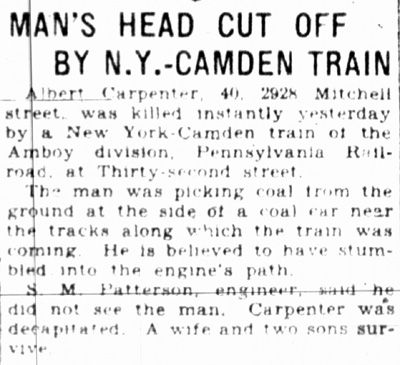
This of course could be a dangerous practice, and at least one person was killed while picking coal, hit by a train near North 32nd Street in April of 1928.
October 1, 2005
59 Ablett Village
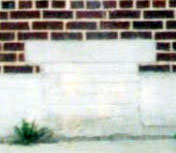
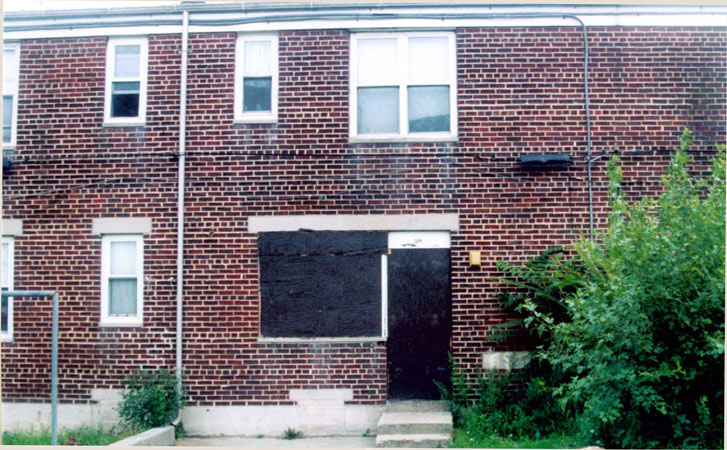
59 Ablett Village. I lived there when they had coal bins. The bin was located to the left of the steps in the rear of the dwelling. Take notice to the area that has been blocked and cemented over. This was an access hole to the outside coal bin. — Earl Crim, August 2004
1883–1884 Camden City Directory Advertisement
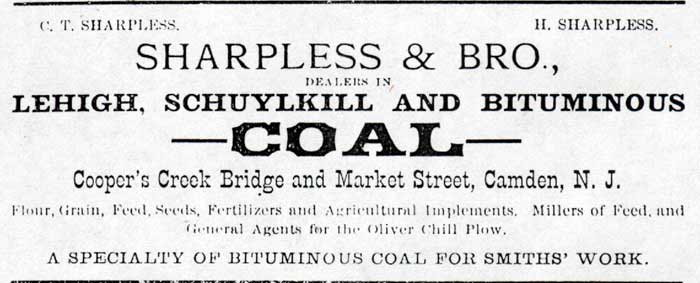
Casper T. Sharpless and his brother Harvey operated Sharpless & Bro., dealers in Lehigh, Schuylkill and Bituminous Coal, at Cooper’s Creek Bridge and Market Street, Camden, N.J.
1900 Camden City Directory
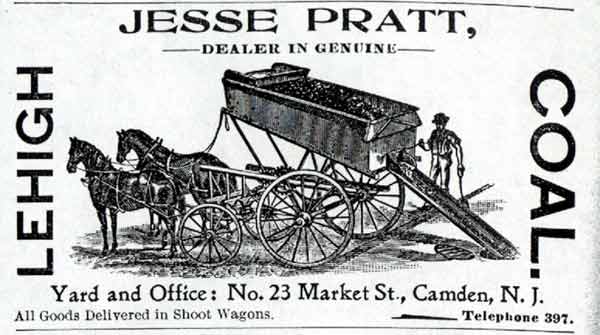
Jesse Pratt was Mayor of the City of Camden from 1886 to 1892. The city progressed greatly during his administration.
Camden News Notes
Philadelphia Inquirer —
Camden News Notes
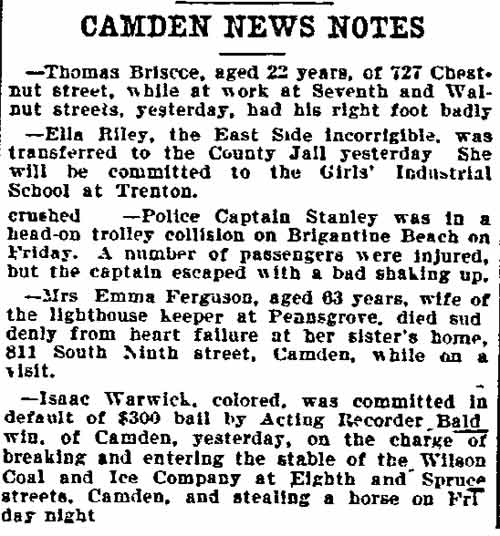
Isaac Warwick, colored, was committed in default of $300 bail by Acting Recorder Baldwin, of Camden, yesterday, on the charge of breaking and entering the stable of the Wilson Coal and Ice Company at Eighth and Spruce streets, Camden, and stealing a horse on Friday night.
Camden News Notes
Philadelphia Inquirer —
Camden News Notes
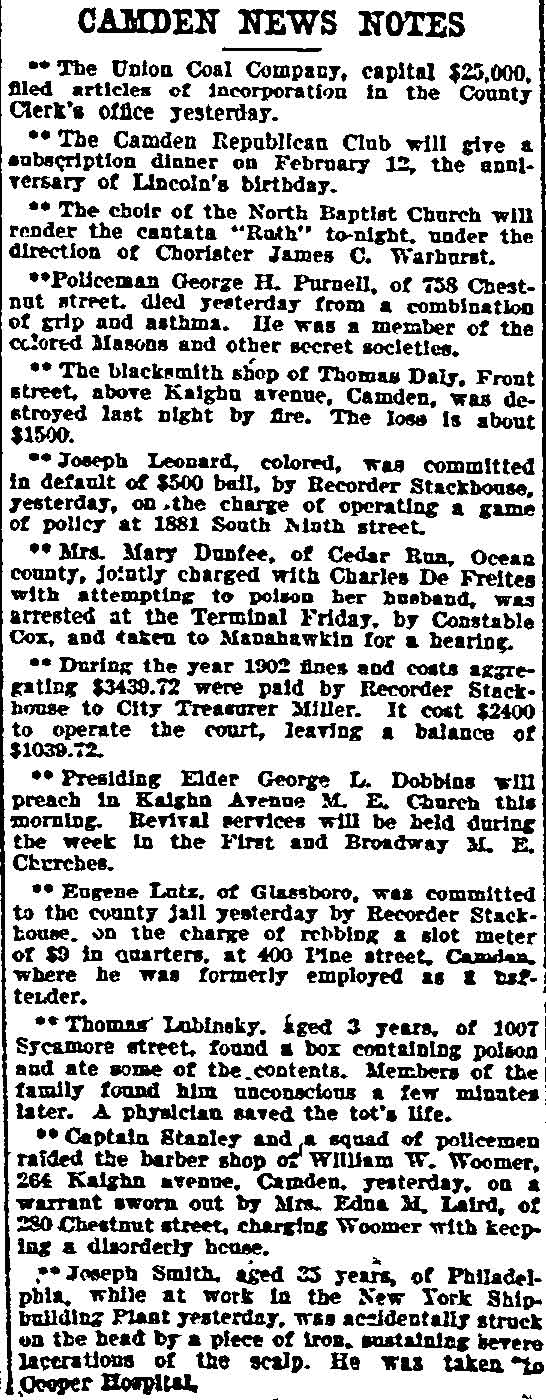
—Thomas Briscoe, aged 22 years, of 727 Chestnut street, while at work at Seventh and Walnut streets, yesterday, had his right foot badly crushed.
—Ella Riley, the East Side incorrigible, was transferred to the County Jail yesterday. She will be committed to the Girls' Industrial School at Trenton.
—Police Captain Stanley was in a head-on trolley collision on Brigantine Beach on Friday. A number of passengers were injured, but the captain escaped with a bad shaking up.
—Mrs Emma Ferguson, aged 63 years, wife of the lighthouse keeper at Pennsgrove, died suddenly from heart failure at her sister's home, 811 South Ninth street, Camden, while on a visit.
—Isaac Warwick, colored, was committed in default of $300 bail by Acting Recorder Baldwin, of Camden, yesterday, on the charge of breaking and entering the stable of the Wilson Coal and Ice Company at Eighth and Spruce streets, Camden, and stealing a horse on Friday night.
A New Coal Wagon
A new coal wagon built at the Theodore C. Tiedeken & Brother wagon works on Van Hook Street in South Camden, bearing the markings of Camden City Ice and Coal.
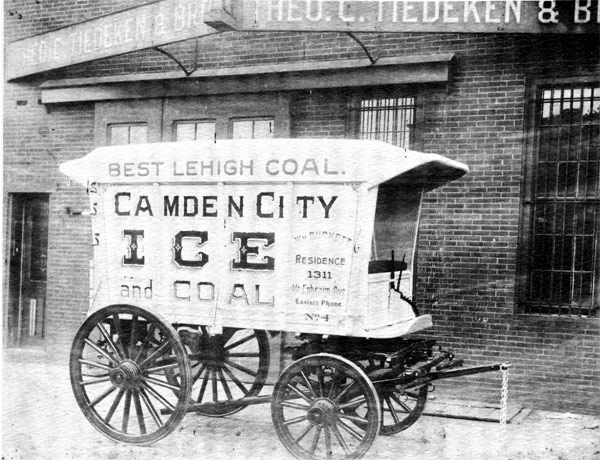
New coal wagon built at the Tiedeken & Brother wagon works, Van Hook Street, South Camden
1913 Camden City Directory Advertisements
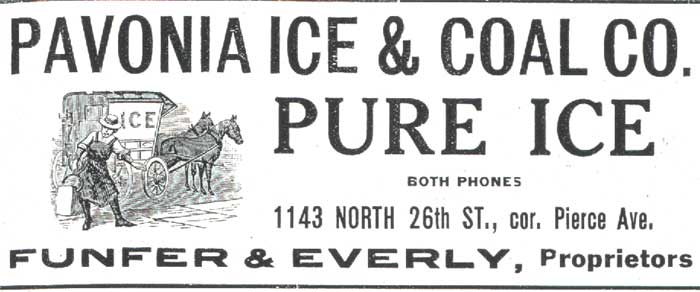
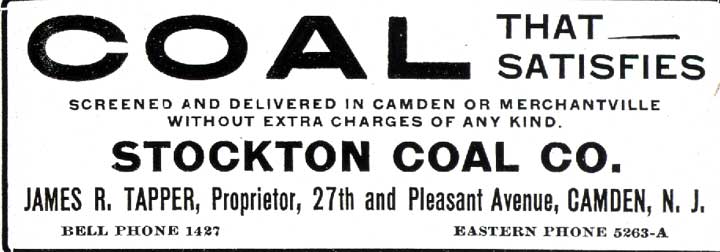
Pavonia Ice & Coal Co. (Funfer & Everly, Proprietors), 1143 North 26th St., cor. Pierce Ave.; and Stockton Coal Co. (James R. Tapper, Proprietor), 27th and Pleasant Avenue, Camden, N.J. — 1913 Camden City Directory
A.J. Vanzant Coal Yard
Van Hook Street & Ferry Avenue
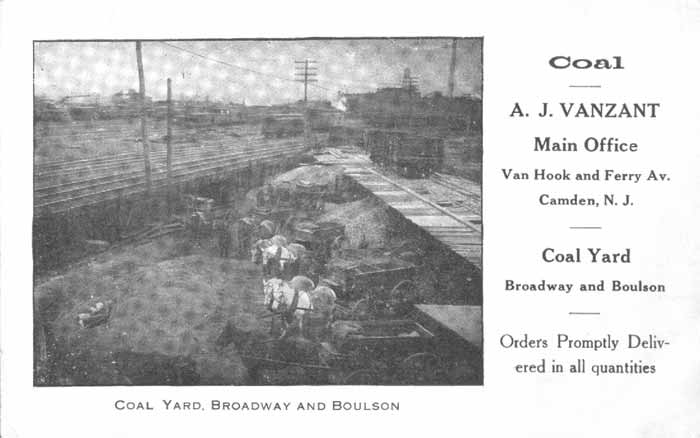
A.J. Vanzant Coal Yard — Van Hook Street & Ferry Avenue, Camden
1917 Camden City Directory Advertisement
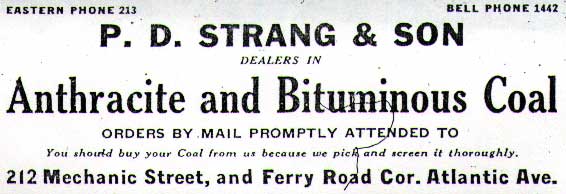
P. D. Strang & Son, dealers in Anthracite and Bituminous Coal, 212 Mechanic Street and Ferry Road Cor. Atlantic Ave. Within a few years, Isaac Boudov would acquire this business.
The Groff Coal Company
Camden Courier-Post —
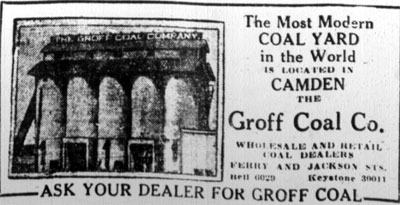
The Most Modern COAL YARD in the World IS LOCATED IN CAMDEN
THE Groff Coal Co.
WHOLESALE AND RETAIL COAL DEALERS
FERRY AND JACKSON STS.
Bell 6029 / Keystone 39011
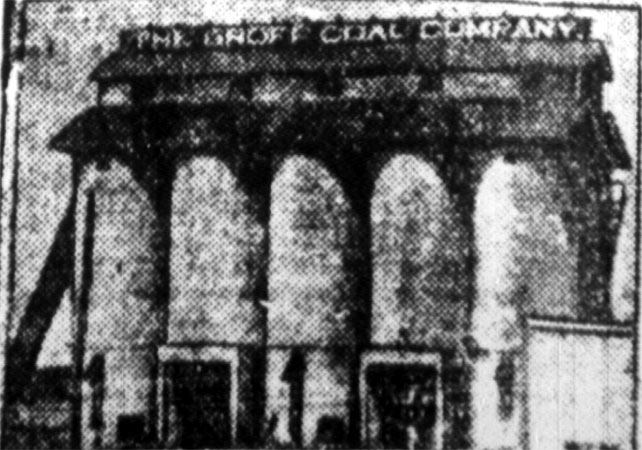
The Groff Coal Company building at Ferry and Jackson Streets, Camden — Camden Courier-Post, January 9, 1928
Man's Head Cut Off by N.Y.-Camden Train
Camden Courier-Post —
MAN’S HEAD CUT OFF BY N.Y.-CAMDEN TRAIN
Albert Carpenter, 40, 2928 Mitchell street, was killed instantly yesterday by a New York–Camden train of the Amboy division, Pennsylvania Railroad, at Thirty-second street. The man was picking coal from the ground at the side of a coal car near the tracks along which the train was coming. He is believed to have stumbled into the engine’s path. S. M. Patterson, engineer, said he did not see the man. Carpenter was decapitated. A wife and two sons survive.
Camden Coke Company
Camden Courier-Post —
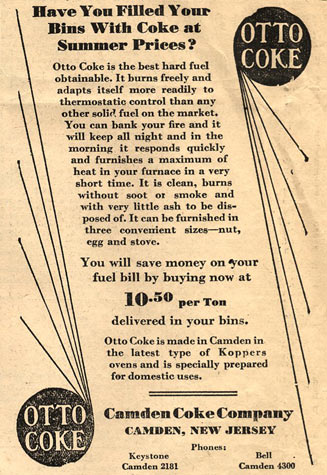
Have You Filled Your Bins With Coke at Summer Prices?
Otto Coke is the best hard fuel obtainable. It burns freely and adapts itself more readily to thermostatic control than any other solid fuel on the market. You can bank it and fire it and it will keep all night and in the morning it responds quickly and furnishes a maximum of heat in your furnace in a very short time. It is clean, burns without soot or smoke and with very little ash to be disposed of. It can be furnished in three convenient sizes — nut, egg and stove.
You will save money on your fuel bill by buying now at $10.50 per Ton delivered in your bins.
Otto Coke is made in Camden in the latest type of Koppers ovens and is specially prepared for domestic uses. — Camden Coke Company, Camden, New Jersey. Phones: Keystone Camden 2181 / Bell Camden 4300
Thermal System, Inc.
Camden Courier-Post —
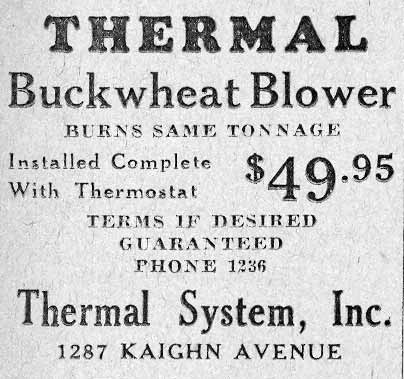
Named: THERMAL Buckwheat Blower, Burns Same Tonnage, Installed Complete With Thermostat $49.95, Terms If Desired, Guaranteed, and Thermal System, Inc., 1287 Kaighn Avenue.
Coal Advertisements
Camden Courier-Post —
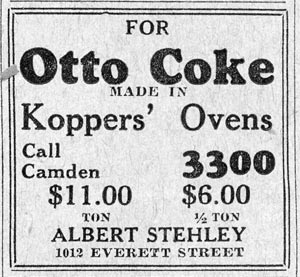
FOR Otto Coke MADE IN Koppers’ Ovens — Call Camden 3300 — $11.00 TON, $6.00 ½ TON — ALBERT STEHLEY, 1012 Everett Street
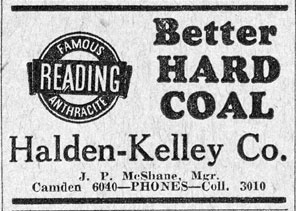
Better HARD COAL — Famous Reading Anthracite — Halden-Kelley Co. — J. P. McShane, Mgr. — Camden 6040
Oler Coal
Camden Courier-Post —
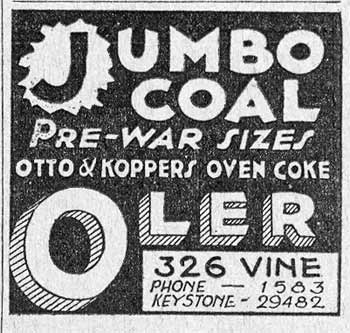
JUMBO COAL Pre-War Sizes Otto & Koppers Oven Coke OLER 326 VINE PHONE -- 1583 KEYSTONE -- 29482
Coal Advertisements
Camden Courier-Post —
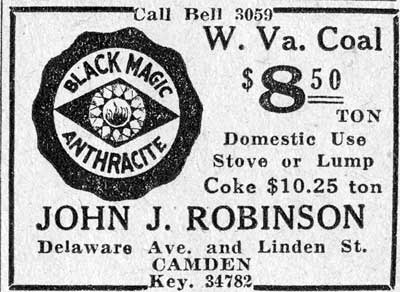
W. Va. Coal — Black Magic Anthracite — $8.50 TON — Domestic Use, Stove or Lump — Coke $10.25 ton — JOHN J. ROBINSON — Delaware Ave. and Linden St., Camden — Call Bell 3059
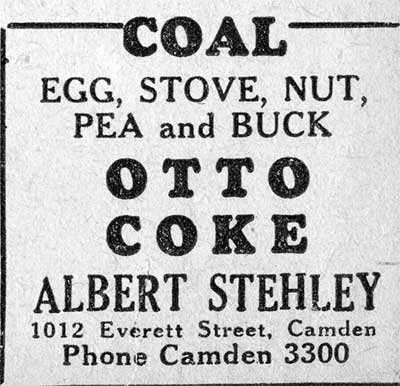
COAL — Egg, Stove, Nut, Pea and Buck — OTTO COKE — ALBERT STEHLEY — 1012 Everett Street, Camden — Phone Camden 3300
Coal Dealers Ask Lower Freight Rate
Camden Courier-Post —
South Jersey Men Appear Before I.C.C. to Demand 38-Cent Reduction
South Jersey retail coal dealers are awaiting a decision of the Interstate Commerce Commission on their plea for a reduction in the freight rates on anthracite coal from the Lehigh, Schuylkill and Wyoming regions to Camden.
Headed by John C. Hower, of Hower Bros., Merchantville, chairman of the freight rate committee of the South Jersey Retail Coal Dealers Association, and M. Marshal, secretary of the association, seven dealers testified before Commissioner B. O. Johnson at Washington on Thursday and Friday, when a preliminary hearing on their petition was held.
The dealers asked that the rates to Camden be made the same as the rates to Philadelphia, and sought a reduction of 28 cents a ton on the freight charges. They pointed out that Trenton has the same rate as Philadelphia, and quoted the general rate to Camden as $2.77 a ton as compared to $2.39 a ton to Philadelphia.
Representatives of 13 railroads were present to oppose the petition.
Commissioner Johnson will consider the evidence presented by the railroads and dealers and report to the other members of the commission, who will set a date for another hearing.
Attempt Made to Enter Offices of Coal Firm
Camden Courier-Post —
Called to the McAllister Coal Company, Seventh and Linden streets, by a neighbor who telephoned that someone was breaking into the place, a squad of motorcycle policemen searched the entire neighborhood early yesterday but found no one.
Detectives found that a rear window had been broken but nothing in the office was disturbed.
Mrs. Mercella Melnik, of 952 Central Avenue, reported to the police that an overcoat was stolen from her automobile while it was parked in front of her home.
Gloucester Fire Laid to Defective Flue
Camden Courier-Post —
A defective flue yesterday caused a fire at the home of William Fowler, 901 Ridgway Street, Gloucester.
The fire department confined the flames to the side of the building, although the living room was damaged. The fire started on the first floor and the family and neighbors carried out many of the household articles, but returned them after the flames were extinguished. The loss was $500. Fowler is the father of Policeman William Fowler.
Camden Coal Hauler Robbed of $50 in Pa.
Camden Courier-Post —
A Camden coal hauler and his helper were held up and robbed of $50 early yesterday by two bandits on Ridge pike near Butler pike, Barren Hill, near Conshohocken, Pa.
Clarence Franchetti, of 1231 Van Hook street, this city, and his helper, Alexander Cherry, whose address was not revealed, were forced by the bandits to drive their truck to the side of the road.
Alighting from a sedan, the bandits poked pistols in the faces of Franchetti and Cherry, then searched and robbed them. The holdup men returned to their automobile and speeded toward Philadelphia.
Franchetti was returning to the mines upstate for a truckload of coal when the holdup occurred, it was reported by police. He said the robbers were two young men.
Boudov Coal & Ice Co.
Camden Courier-Post —
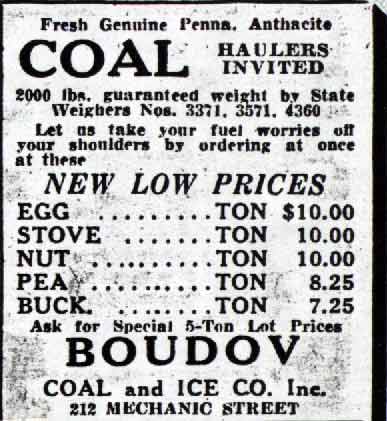
Fresh Genuine Penna. Anthracite — COAL — HAULERS INVITED — 2000 lbs. guaranteed weight by State Weighers
NEW LOW PRICES: Egg $10.00 ton — Stove $10.00 ton — Nut $10.00 ton — Pea $8.25 ton — Buck $7.25 ton
BOUDOV COAL and ICE CO. Inc. — 212 Mechanic Street
A Camden Coal Yard
204–212 Mechanic Street,
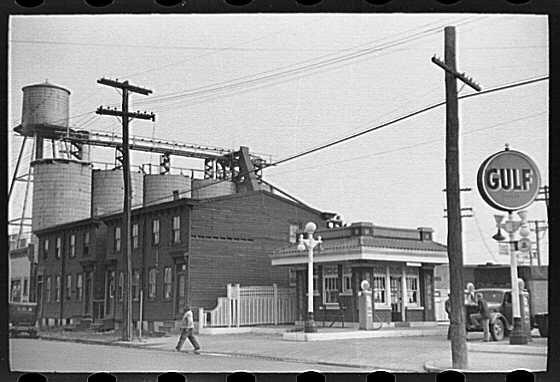
The Gulf Service Station had a Ferry Avenue street address. The building at the far left is 212 Mechanic Street, which was home to the Boudov Coal & Ice Co., Inc., in October of 1938, when this picture was taken.
Keystone Coal & Wood Co.
Camden Courier-Post —
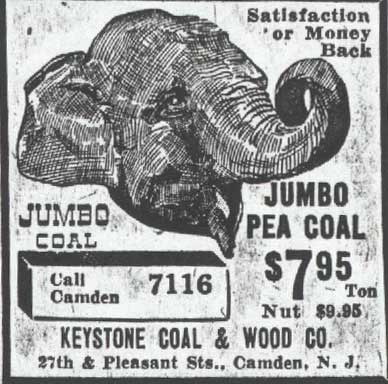
Named: JUMBO PEA COAL $7.95 Ton, Nut $9.95, Satisfaction or Money Back, Call Camden 7116, KEYSTONE COAL & WOOD CO., and 27th & Pleasant Sts., Camden, N. J..
Diamond Coal
Camden Courier-Post —
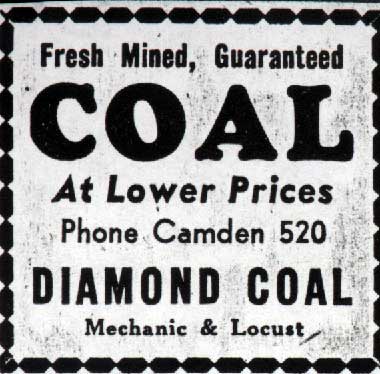
Named: Fresh Mined, Guaranteed COAL At Lower Prices, Phone Camden 520, DIAMOND COAL, and Mechanic & Locust.
Otto Coke / Camden Coke Plant
Camden Courier-Post —
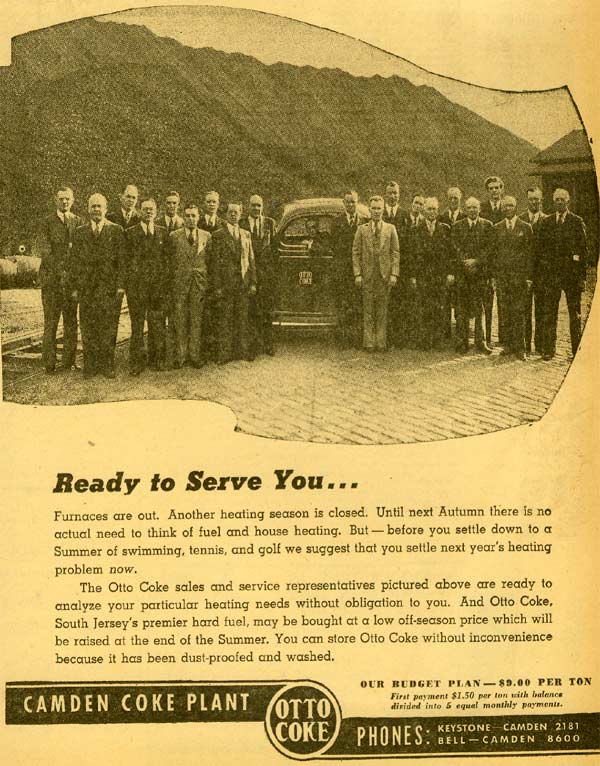
Ready to Serve You… Furnaces are out. Another heating season is closed. Until next Autumn there is no actual need to think of fuel and house heating. But — before you settle down to a Summer of swimming, tennis, and golf we suggest that you settle next year’s heating problem now.
The Otto Coke sales and service representatives pictured above are ready to analyze your particular heating needs without obligation to you. And Otto Coke, South Jersey’s premier hard fuel, may be bought at a low off-season price which will be raised at the end of the Summer. You can store Otto Coke without inconvenience because it has been dust-proofed and washed.
CAMDEN COKE PLANT — OTTO COKE — Our Budget Plan $9.69 Per Ton — Phones: Keystone Camden 2181 / Bell Camden 4600
Coke: The Real Thing?
Growing up in a house where natural gas was the fuel source for heat, I knew very little about heating with coal. In the course of building this site the mention of coke arose a few times, and when I posted the picture above, an advertisement for Otto Coke Co., which operated the Camden Coke Plant, I realized that I didn’t have a clue as to what exactly coke is! That being said, I called on a couple of the “Heating With Coal” friends for the answer to that question. As always, an answer came back quickly.
Fire may burn either with or without flames. A flame always indicates that heat has forced gas from a burning substance. The flames come from the combination of this gas with oxygen in the air. When a coal fire flames, it does so because gas is being forced from the coal, and the carbon and hydrogen in the gas combine with oxygen. If kept from burning, such gas can be stored. Manufactured gas is forced from coal in airtight kilns, or retorts. The product left after the gas is extracted from coal is called coke. Coke will burn without flame because no gas is driven off. In order to burn, the carbon in the coke combines directly with oxygen.
It is the gas given off by the heated wax in a candle that produces the bright flame. When a burning candle is blown out, for example, a thin ribbon of smoke will arise. If a lighted match is passed through this smoke an inch above the wick, a tiny flame will run down and relight the candle.
The brightest flames are not always the hottest. Hydrogen, which combines with oxygen when burning to form water, has an almost invisible flame even under ordinary circumstances. When it is absolutely pure and the air around it is completely free of dust, the hydrogen flame cannot be seen even in a dark room.
—Jim Bessing, November 2004
Soft coal has a lot of impurities in it and therefore doesn’t burn real complete or clean, so a hotter cleaner fuel was needed, not for residential use but mostly in the steel industry, at least in this country.
To manufacture coke, they take the soft coal or bituminous coal and heat from an external hot source and drive the moisture & various impurities off, as gas. The fuel left is heavier than soft coal and burns a great deal hotter and cleaner than soft coal would. This is because a lot of the crap was driven out, so the coke burns a lot cleaner and with less residue than soft coal. The coke burns at a steadier and hotter rate than soft coal — as I’ve said, very few ashes to remove.
The gas driven off when coke is made is saved and used for cooking, and was from about 1850 to the early 20th century for gas lighting. Even long after just about every home had electric cooking, coke gas was used for cooking and domestic hot water. Some parts of the country also used cooking gas for residential heating, but it does not have a real high BTU content.
For many years coke’s biggest usage was for industry, and also for its byproduct, cooking gas. If you were to burn coke in a home the grate in the furnace had to be a better grade of steel as coke burned so hot that the grates would melt. I had a foreman that I worked for years ago who burned coke at home. He had to go down to 3rd & Arch in Philadelphia to get a new grate for his furnace every few years if not sooner. A ton of coke cost more than a ton of soft coal.
I don’t know about Otto Coke, it sounds like a trade or type of process name for that coke. They still used cooking gas in Camden City till about 1957 or 1958. Then PSE&G sent guys around to change the orifices in all gas appliances so we could burn natural gas. Shortly afterwards Camden Coke closed at 2nd & Kaighn. Philadelphia until about the early 1970s had a coke plant on Richmond Street, and in real cold weather they would mix the cooking gas with natural gas so that they could make up any shortfall in pipeline. I think all coal dealers also sold coke too, I can’t remember any that didn’t.
—John Ciafrani, November 2004
Camden Coke Plant
Photos by Dick Chamberlin, circa 1956
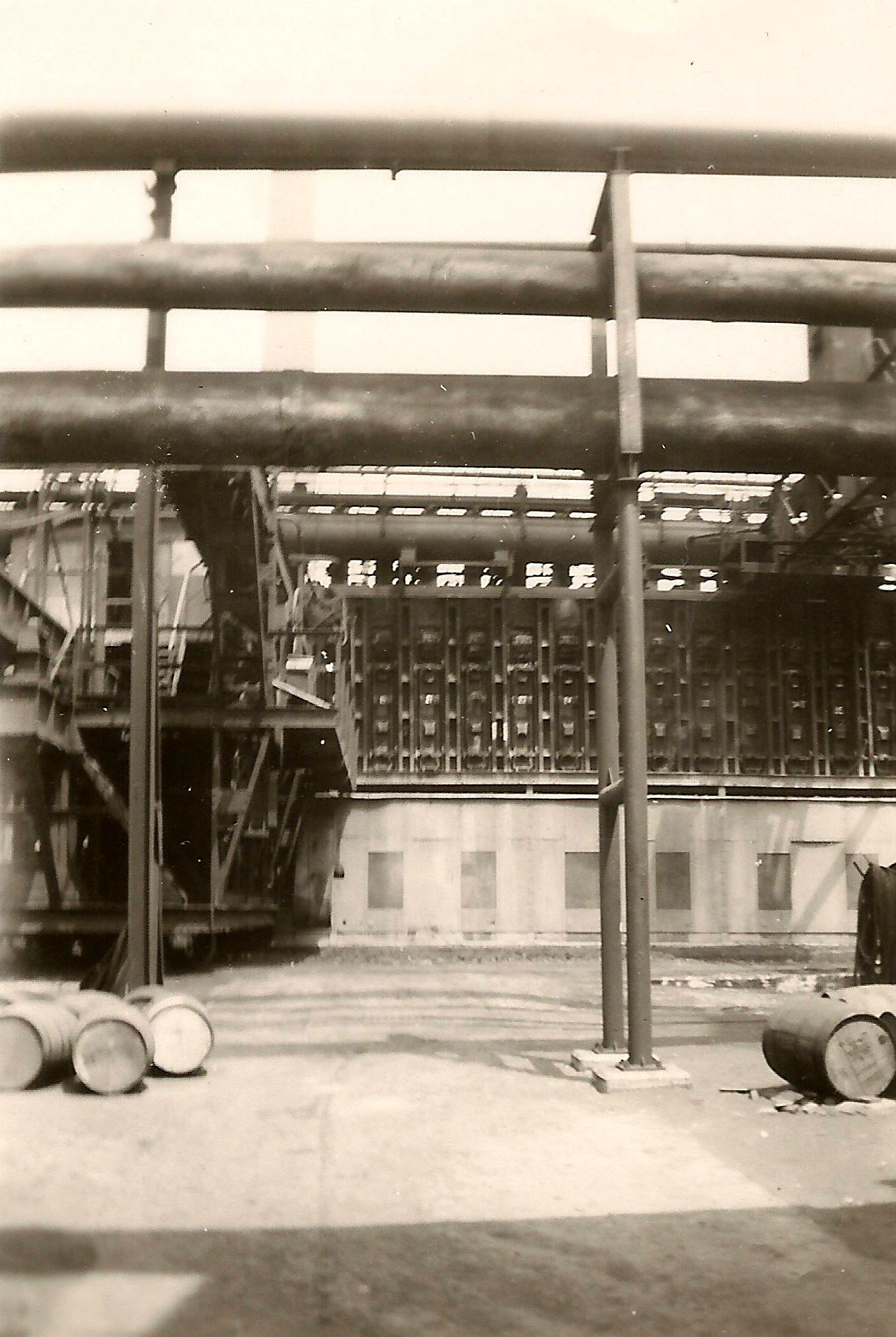
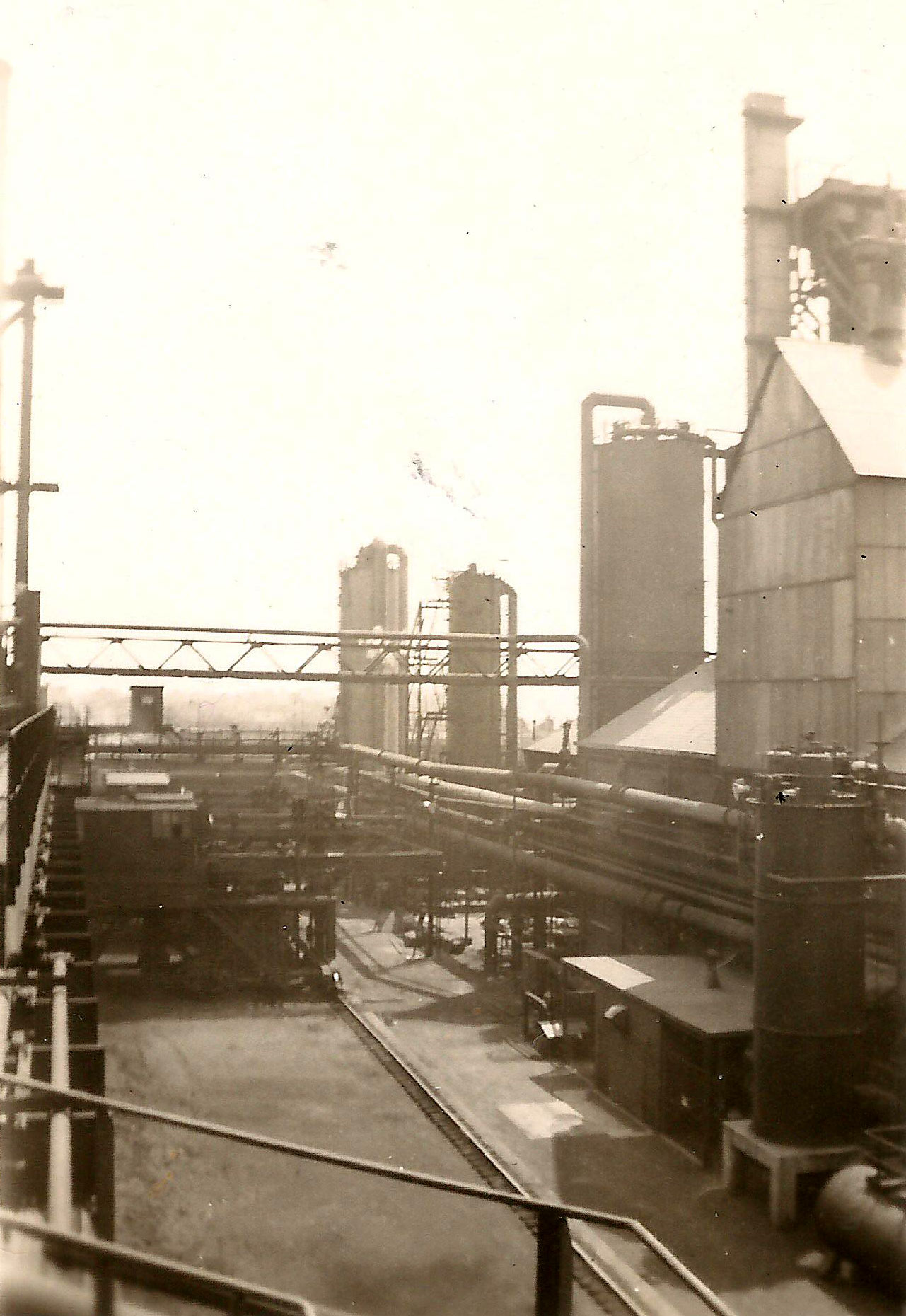
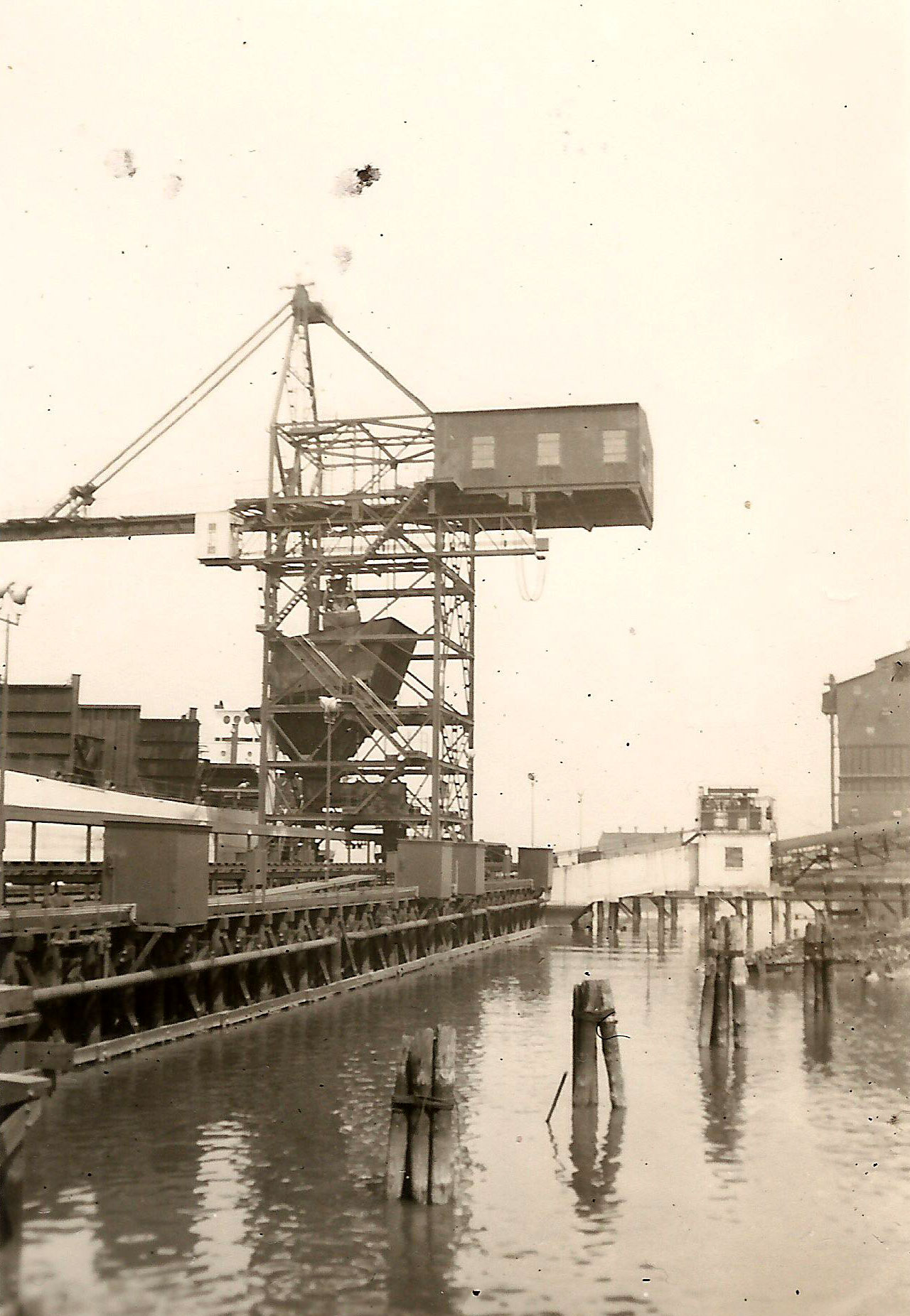
These were probably taken in 1956. Picture 1 shows the doors to the ovens from the pusher side. Picture 2 shows the exit side and the ovens being loaded from above. Picture 3 shows the pusher car control cab where the ram was activated to push the coke through the oven and out the back side to waiting rail cars.
One of the stories my Dad told me which even he believed was an urban legend said that because of the noisy environment everything was done by whistle or horn signal. It was said that one day after the doors to an oven were opened the worker who used a long pole to clean the area where the door sat was standing in front of the oven when a passing ship on the river blew its horn and he was pushed through the oven along with the coke.
Photos courtesy of Dick Chamberlin — June 2012
Boudov Coal & Ice Co.
Camden Courier-Post —
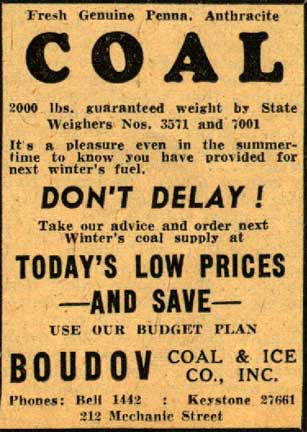
Fresh Genuine Penna. Anthracite — COAL — 2000 lbs. guaranteed weight by State Weighers Nos. 3571 and 7001
DON’T DELAY! Take our advice and order next Winter’s coal supply at TODAY’S LOW PRICES — AND SAVE — USE OUR BUDGET PLAN
BOUDOV COAL & ICE CO., INC. — 212 Mechanic Street — Phones: Bell 1442, Keystone 27661
1940s Advertising Blotter
Pavonia Ice & Coal
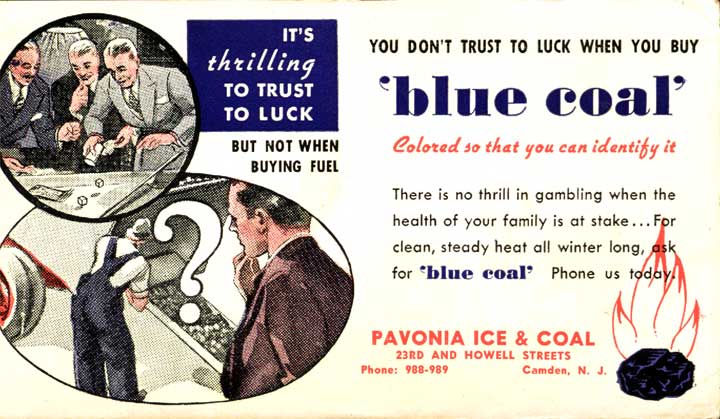
YOU DON’T TRUST TO LUCK WHEN YOU BUY ‘blue coal’ — Colored so that you can identify it
There is no thrill in gambling when the health of your family is at stake… For clean, steady heat all winter long, ask for ‘blue coal.’ Phone us today!
PAVONIA ICE & COAL — 23RD AND HOWELL STREETS — Phone: 988-989 — Camden, N. J.
Working at the Coal Yard
Many years ago I worked in a chemical plant power house. It was a good sized operation, 40-odd production buildings, and made enough electricity to power a small town. This was before the air pollution codes got so strict. The plant would burn upwards of 200-plus tons a day in winter. This was soft coal and the sizing requirements weren’t as stiff as for hard coal used for home heating. The price a ton was about $4.50–$5.00 and the rail shipping were about equal to the coal cost.
Now the excellent page on Newton Coal didn’t mention the so-called demurrage charges. You had about three days to have a coal car empty so that the railroad could take it back. The charges were pretty steep. So not only would the people not be able to get coal delivered but the coal company had to pay some extra steep charges.
In the winter it was a real dog to unload those cars. The cars would freeze that came from West Virginia, Tennessee and upstate Pennsylvania. Now you have to wonder how they froze so solid. Well at the mines they hosed the full cars down with a hose. It was said they did it to keep dust down. Well the water that wet the coal down had weight. You guessed it — a lot of the weight you paid for was water not coal.
Now the story on Newton said they climbed up on top of the car to break the coal loose. Well first you had to get the doors on the bottom of cars open and being frozen that was a joy to begin with. Next all the big coal companies had vibrators that would shake the car to help break the coal loose. Then you took a slice bar (a steel bar six to eight feet long, with a probe on end) and started to chip away on the hopper openings of the car. Hopefully as the coal on the bottom came out the weight of the coal on top would cause a collapse and more would run out. If you could get enough out on bottom then you used the slice bar on top and hoped that the weight would help to get the coal running out. Now if the cars were really iced up, you couldn’t just load straight in a truck or onto a coal pile. The chunks were just too big. So now you had to break up the chunks. This way the pieces could be run through a grinder that broke them up to a usable size. That was, as the Newton page said, a back breaking job.
Now the other feature of unloading those cars was the outside weather conditions — always cold as hell. When they got really far behind everybody had to help getting cars unloaded.
—John Ciafrani, November 2006
Fuel Advertisements
Camden Courier-Post —
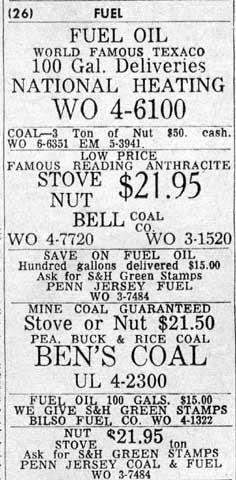
Fuel classified advertisements — Camden Courier-Post, November 30, 1965
FAMOUS READING ANTHRACITE — STOVE $21.95 — NUT — BELL COAL CO. — WO 4-7720
MINE COAL GUARANTEED — Stove or Nut $21.50 — Pea, Buck & Rice Coal — BEN’S COAL — UL 4-2300