Joseph McComb Sr.

Joseph McComb Sr., Camden Housing Authority
JOSEPH McCOMB SR. was born on August 2, 1912 in Pennsylvania. He lived and worked as a grocery clerk in Pennsylvania before coming to New Jersey.
Joseph McComb was active in the labor movement in Camden. By 1944 he was the vice-president of the Central Labor Union, which had its headquarters at the Labor Temple Building, 538 Broadway. In time he rose to the presidency of the organization.
In 1945 Joseph McComb was appointed chairman of the Board of Commissioners of the Housing Authority of the City of Camden. During his tenure two family developments, Roosevelt Manor and McGuire Gardens, were built. A senior-citizens high rise building, John F. Kennedy Tower, was also erected. Other projects such as the Royal Court townhouses and the Mickle Tower and Westfield Tower senior-citizens high-rises were “incubated” on his watch. Most people that this writer has heard from state that Camden’s public housing was well run and were good places to live under McComb’s administration.
Joseph McComb led the Central Labor Union and was also president of Retail Clerks Union Local 1060 for many years. He was a regular participant at Labor Day ceremonies in Pennsauken, New Jersey at the tomb of Peter McGuire, the “founder of Labor Day,” who lived for a time in Camden.
Joseph McComb Sr. became the center of much controversy during the late 1960s. After leaving the Housing Authority he was appointed to the Board of Commissioners of the Delaware River Port Authority, serving as late as 1977. He lived at 3837 Myrtle Avenue in East Camden. His neighbors included a number of labor and political leaders, including Joseph Nettleton, John L. Morrisey, and William “Pat” Corbett.
Joseph McComb Sr. passed away in April of 1980, survived by his wife, the former Margaret Keiffer, his son, Joseph McComb Jr., and a grandchild.
Joseph McComb Jr. served with the Camden Police Department before retiring in the 1970s due to a heart condition. Last a resident of Gloucester City, he died in November of 1980. Margaret Keiffer McComb joined her son and husband in October of 1985.
Joseph McComb was vilified in the 1960s for demolishing slums and for alleged non-integration of public housing facilities that the Housing Authority operated. Looking back in time more than 40 years afterwards, the “contributions” of those who assailed Mr. McComb are deserving of complete and unquestionable condemnation, while McComb’s pragmatic approach to conditions in the city merit an honest look. While the “social activists” with a few exceptions have for the most part a) left the city still patting themselves on the back for the damage they’ve done, b) gone to their last reward, or c) have been discredited through criminal activity, thousands of families who were driven out of Camden still mourn the city that was taken away from them. Has Camden gotten better or worse since the 1960s? Who did more lasting good for more people over a longer time, Joe McComb or his critics?
Charge of Housing Abuses Denied by Authority Here
Camden Courier-Post —
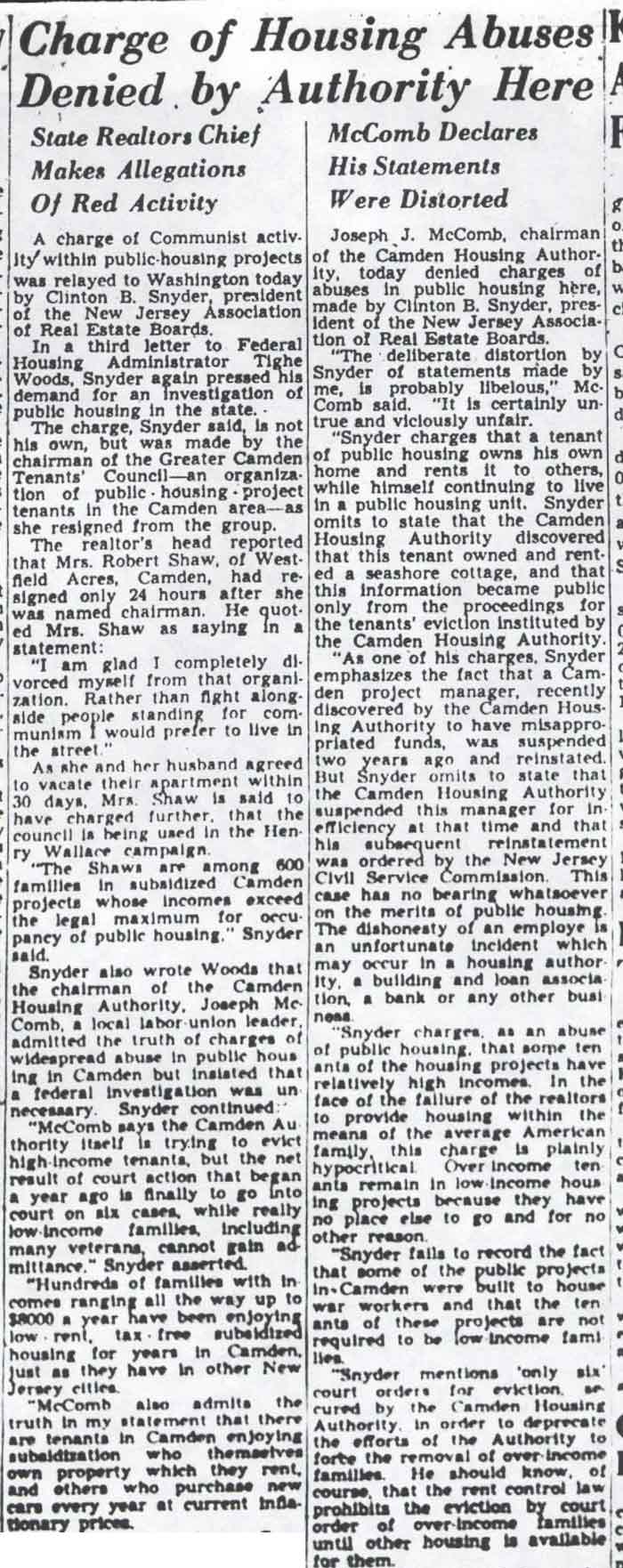
State Realtors Chief Makes Allegations Of Red Activity — McComb Declares His Statements Were Distorted
A charge of Communist activity within public-housing projects was relayed to Washington today by Clinton B. Snyder, president of the New Jersey Association of Real Estate Boards.
In a letter to Federal Housing Administrator Tighe Woods, Snyder again pressed his demand for an investigation of public housing in the state.
The charge, Snyder said, is not his own, but was made by the chairman of the Greater Camden Tenants’ Council—an organization that sought to protect tenants in the Camden area—as she resigned from the group.
The resignation, he said, stated that Mrs. Robert Shaw, of Westfield Acres, Camden, had resigned to devote hours to the council. He quoted Mrs. Shaw as saying in a statement:
“‘I am glad I completely divorced myself from that organization. Rather than fight side by side with them for communism I would prefer to live in the street.’
“Shaw and her husband agreed to vacate their apartment within 30 days, Mrs. Shaw is said to have declared. She said the council is being used in the Henry Wallace campaign.
“Snyder charges among 600 families in subsidized Camden projects whose incomes exceed legal maximum for occupancy of public housing,” Snyder said.
Snyder also wrote Woods that the chairman of the Camden Housing Authority, Joseph McComb, a local labor union leader, admitted the over-income families widespread abuse in public housing in Camden but insisted that court action to evict them was unnecessary, Snyder continued.
“McComb says the Camden Authority is trying to evict high-income tenants, but the net result of court action that began a year ago has actually gotten court in six cases, while really low-income families, including many veterans, cannot gain admission,” Snyder said.
“Hundreds of families with incomes ranging all the way up to $5000 a year are entrenched in low rent, tax-free subsidized housing for years in Camden, just as they have in other New Jersey cities.”
“McComb also admits the truth in my statement that those enjoying subsidization who themselves own property, which they rent to others, who purchase new cars every year at current inflationary prices.”
Joseph J. McComb, chairman of the Camden Housing Authority, denied the charges of abuses in public housing here, made by Clinton B. Snyder, president of the New Jersey Association of Real Estate Boards.
“The deliberate distortion by Snyder of statements made by me, is probably libelous,” McComb said. “It is certainly untruthful and unjustifiable.”
“Snyder charges that a tenant of public housing owns his own home and rents it to others, while himself continuing to live in a public housing unit. Snyder knows or should know, Camden Housing Authority discovered this tenant owned and rented a seashore cottage, and that such information became public only from the proceedings for the tenants’ eviction instigated by Camden Housing Authority.”
“As one of his charges, Snyder emphasizes the fact that a Camden project manager, recently discovered by the Camden Housing Authority to have misappropriated rent funds, was suspended two years ago and reinstated. But Snyder omits to state that the Camden Housing Authority suspended this manager for inefficiency at that time and that it was a proper reinstatement was ordered by the New Jersey Civil Service Commission. This case has no bearing whatsoever on the merits of public housing. The dishonesty of an employee is not unique to public housing; it may occur in a housing authority, a building and loan association, a bank or any other business.”
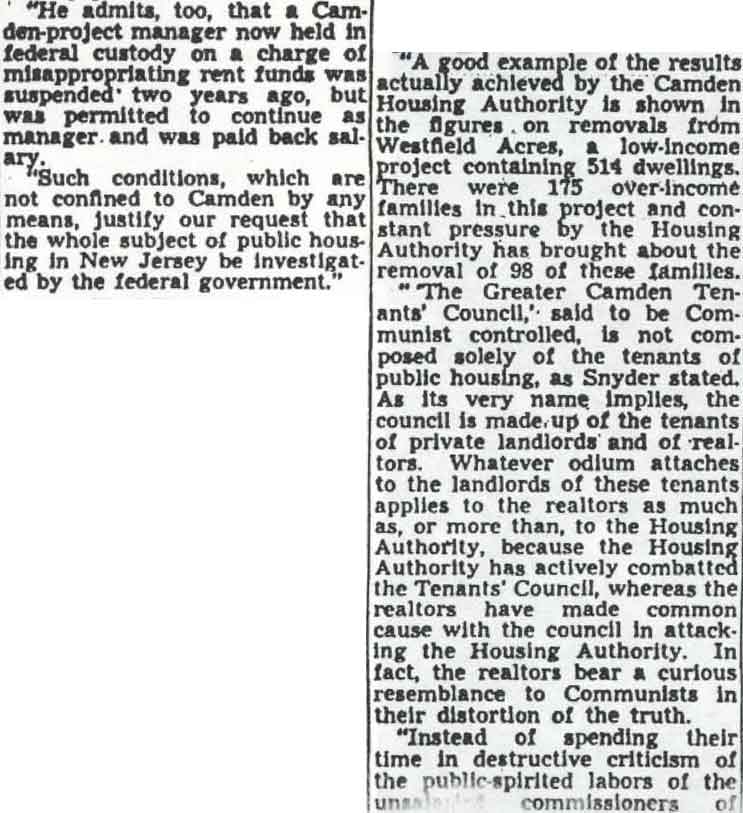
“He admits, too, that a Camden-project manager now held in federal custody on a charge of misappropriating rent funds was suspended two years ago, but was permitted to continue as manager and was paid back salary.
“Such conditions, which are not confined to Camden by any means, justify our request that the whole subject of public housing in New Jersey be investigated by the federal government.”
“A good example of the results actually achieved by the Camden Housing Authority is shown in the figures on removals from Westfield Acres, a low-income project containing 514 dwellings. There were 175 over-income families in this project and constant pressure by the Housing Authority has brought about the removal of 98 of these families.
“‘The Greater Camden Tenants’ Council,’ said to be Communist controlled, is not composed solely of the tenants of public housing, as Snyder stated. As its very name implies, the council is made up of the tenants of private landlords and of realtors. Whatever odium attaches to the landlords of these tenants applies to the realtors as much as, or more than, to the Housing Authority, because the Housing Authority has actively combatted the Tenants’ Council, whereas the realtors have made common cause with the council in attacking the Housing Authority. In fact, the realtors bear a curious resemblance to Communists in their distortion of the truth.
“Instead of spending their time in destructive criticism of the public-spirited labors of the unsalaried commissioners of…”
Housing Authority Will Be Asked to Aid Big Families
Camden Courier-Post —
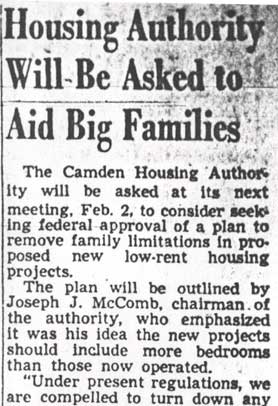
The Camden Housing Authority will be asked at its next meeting, Feb. 2, to consider seeking federal approval of a plan to remove family limitations in proposed new low-rent housing projects.
The plan will be outlined by Joseph J. McComb, chairman of the authority, who emphasized it was his idea the new projects should include more bedrooms than those now operated.
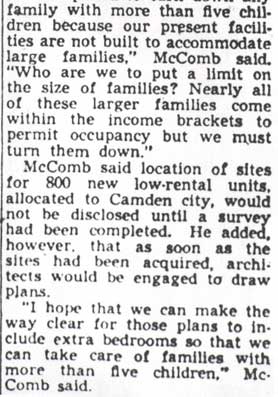
“Under present regulations, we are compelled to turn down any family with more than five children because our present facilities are not built to accommodate large families,” McComb said. “Who are we to put a limit on the size of families? Nearly all of these larger families come within the income brackets to permit occupancy but we must turn them down.”
McComb said location of sites for 800 new low-rental units, allocated to Camden city, would not be disclosed until a survey had been completed. He added, however, that as soon as the sites had been acquired, architects would be engaged to draw plans.
“I hope that we can make the way clear for those plans to include extra bedrooms so that we can take care of families with more than five children,” McComb said.
Harker Appointed To Conduct Survey For Housing Unit
Camden Courier-Post —
William T. Harker, Camden engineer, has been named by the Camden Housing Authority, to begin initial work necessary for constructing a new low-rent housing project in the city.
Harker was directed at the authority’s meeting Thursday night to make surveys, test borings, soundings and topographical maps of the housing site. Location where the homes will be constructed cannot be revealed at this time, Joseph J. McComb, chairman, announced.
The initial work will be financed with federal funds for which the housing authority applied several months ago. First payments for the surveys have been received from the government, William F. Barnett, authority executive director, said.
The plans call for construction of 800 homes which are to replace slums.
Approval of erection of a newspaper vending stand at Ablett Village was authorized by the authority on motion of Wilbur F. Dobbins. The stand will be used by Miss Cora Gideon, 50, of 588 Berkley street, who is blind, Dobbins explained. She will pay $1 a month as rent for the stand. Materials and labor will be supplied by AFL unions without additional cost to the housing authority, Dobbins said.
400 Housing Units To Be Added Near Present Projects
Camden Courier-Post —
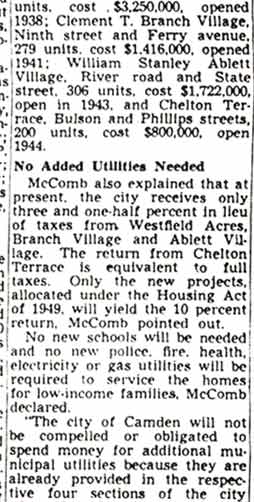
Four hundred low-rent dwellings, half the number allocated to the city by the U. S. Public Housing Administration, will be constructed this year on land near the four presently owned projects, Joseph J. McComb, chairman of the Camden Housing Authority, announced Sunday night.
Several factors entered into the decision of housing authority to construct the homes on available land, McComb said. First, he declared, the city will receive revenue in lieu of taxes from unimproved ground yielding little or no taxes, based on 10 percent of shelter rentals, less utilities.
The four projects now operated by the authority are: Westfield Acres, Thirty-first street and Westfield avenue, 514 units, cost $3,250,000, opened 1938; Clement T. Branch Village, Ninth street and Ferry avenue, 279 units, cost $1,416,000, opened 1941; William Stanley Ablett Village, River road and State street, 306 units, cost $1,722,000, open in 1943, and Chelton Terrace, Bulson and Phillips streets, 200 units, cost $800,000, open 1944.
No Added Utilities Needed
McComb also explained that at present, the city receives only three and one-half percent in lieu of taxes from Westfield Acres, Branch Village and Ablett Village. The return from Chelton Terrace is equivalent to full taxes. Only the new projects, allocated under the Housing Act of 1949, will yield the 10 percent return, McComb pointed out.
No new schools will be needed and no new police, fire, health, electricity or gas utilities will be required to service the homes for low-income families, McComb declared. “The city of Camden will not be compelled or obligated to spend money for additional municipal utilities because they are already provided in the respective four sections of the city where these homes will be built,” McComb said.
To Make Test Borings
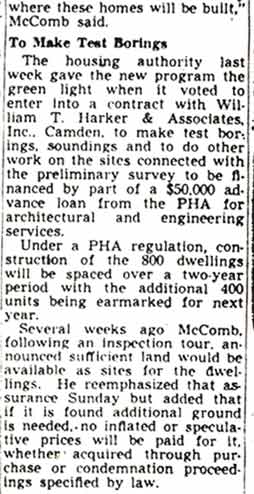
The housing authority last week gave the new program the green light when it voted to enter into a contract with William T. Harker & Associates, Inc., Camden, to make test borings, soundings and to do other work on the sites connected with the preliminary survey to be financed by part of a $50,000 advance loan from the PHA for architectural and engineering services.
Under a PHA regulation, construction of the 800 dwellings will be spaced over a two-year period with the additional 400 units being earmarked for next year.
Several weeks ago McComb, following an inspection tour, announced sufficient land would be available as sites for the dwellings. He reemphasized that assurance Sunday but added that if it is found additional ground is needed, no inflated or speculative prices will be paid for it, whether acquired through purchase or condemnation proceedings specified by law.
City Will Get $210,000 For Housing
Camden Courier-Post —
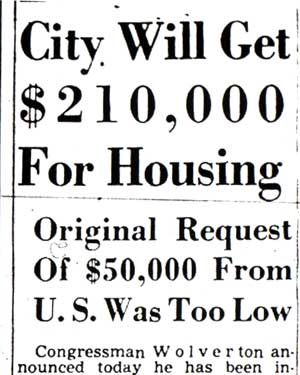
Original Request Of $50,000 From U.S. Was Too Low
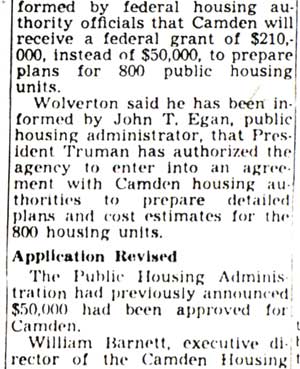
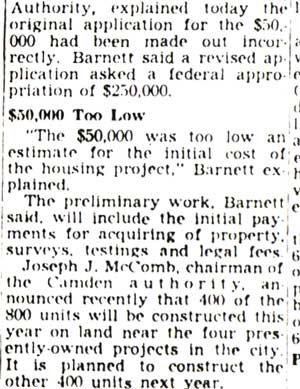
Congressman Wolverton announced today he has been informed by federal housing authority officials that Camden will receive a federal grant of $210,000, instead of $50,000, to prepare plans for 800 public housing units.
Wolverton said he has been informed by John T. Egan, public housing administrator, that President Truman has authorized the agency to enter into an agreement with Camden housing authorities to prepare detailed plans and cost estimates for the 800 housing units.
Application Revised
The Public Housing Administration had previously announced $50,000 had been approved for Camden. William Barnett, executive director of the Camden Housing Authority, explained today the original application for the $50,000 had been made out incorrectly. Barnett said a revised application asked a federal appropriation of $250,000.
$50,000 Too Low
“The $50,000 was too low an estimate for the initial cost of the housing project,” Barnett explained. The preliminary work, Barnett said, will include the initial payments for acquiring of property, surveys, testings and legal fees.
Joseph J. McComb, chairman of the Camden authority, announced recently that 400 of the 800 units will be constructed this year on land near the four presently-owned projects in the city. It is planned to construct the other 400 units next year.
City Will Get $7000 More On Housing
Camden Courier-Post —
By EUGENE L. HORAN JR.
Courier-Post Staff
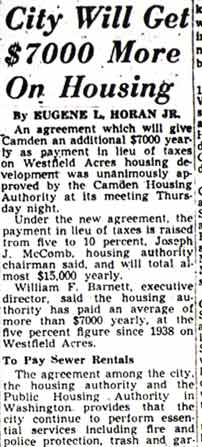
An agreement which will give Camden an additional $7000 yearly as payment in lieu of taxes on Westfield Acres housing development was unanimously approved by the Camden Housing Authority at its meeting Thursday night.
Under the new agreement, the payment in lieu of taxes is raised from five to 10 percent, Joseph J. McComb, housing authority chairman said, and will total almost $15,000 yearly.
William F. Barnett, executive director, said the housing authority has paid an average of less than $8000 yearly, at the five percent figure since 1938 on Westfield Acres.
To Pay Sewer Rentals
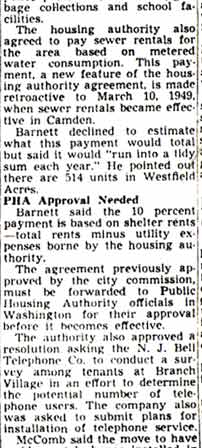
The agreement among the city, the housing authority and the Public Housing Authority in Washington provides that the city continue to perform essential services including fire and police protection, trash and garbage collections and school facilities.
The housing authority also agreed to pay sewer rentals for the area based on metered water consumption. This payment, a new feature of the housing authority agreement, is made retroactive to March 10, 1949, when sewer rentals became effective in Camden.
Barnett declined to estimate what this payment would total but said it would “run into a good many each year.” He pointed out there are 514 units in Westfield Acres.
PHA Approval Needed
Barnett said the 10 percent payment is on shelter rents—total rents minus utility expenses borne by the housing authority.
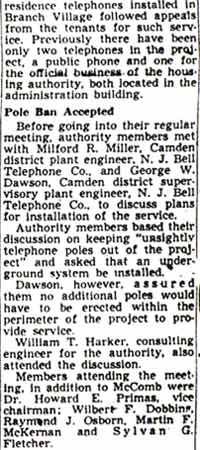
The authority also approved a resolution asking the N. J. Bell Telephone Co. to conduct a survey among tenants at Branch Village in an effort to determine the potential number of telephone users. The authority also voted to submit plans for installation of telephone service. McComb said the move to have residence telephones installed in Branch Village followed appeals from the tenants for such service. Previously there have been only two telephones in the project, a public phone and one for the official business of the housing authority, both located in the administration building.
Pole Ban Accepted
Before going into their regular meeting, authority members met with Milford R. Miller, Camden district plant engineer, N. J. Bell Telephone Co., and George W. Dawson, Camden district supervisor, plant engineer, N. J. Bell Telephone Co., to discuss plans for installation of the service. Authority members based their discussion on keeping “unsightly telephone poles out of the project” and asked that an underground system be installed. Dawson, however, assured them no additional poles would have to be erected on the perimeter of the project to provide service.
Members attending the meeting, in addition to McComb, Barnett, McKernan, and Fletcher were Dr. Howard E. Primas, vice chairman; Wilbert F. Dobbins, Raymond J. Osborn, Martin F. McKernan, and Sylvan G. Fletcher.
Troiano Appointed As New Member of Housing Authority
Camden Courier-Post —
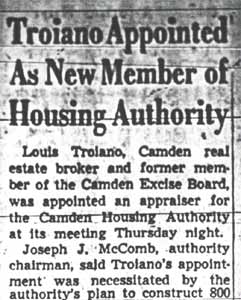
Louis Troiano, Camden real estate broker and former member of the Camden Excise Board, was appointed an appraiser for the Camden Housing Authority at its meeting Thursday night.
Joseph J. McComb, authority chairman, said Troiano’s appointment was necessitated by the authority’s plan to construct 800 additional low cost public housing units.
Troiano’s appointment was moved by Martin F. McKernan, and seconded by Sylvan G. Fletcher, authority members.
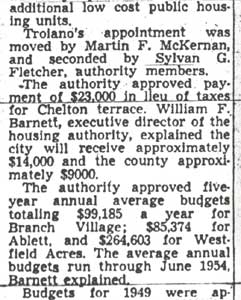
The authority approved payment of $23,000 in lieu of taxes for Chelton terrace. William F. Barnett, executive director of the housing authority, explained the city will receive approximately $14,000 and the county approximately $9000.
The authority approved five-year annual average budgets totaling $99,185 a year for Branch Village; $85,374 for Ablett, and $264,603 for Westfield Acres. The average annual budgets run through June 1954, Barnett explained.
Budgets for 1949 were approved totaling $100,889 for Branch Village; $88,239 for Ablett Village, and $253,726 for Westfield Acres.
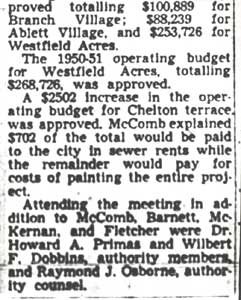
The 1950–51 operating budget for Westfield Acres, totaling $268,726, was approved.
A $2502 increase in the operating budget for Chelton terrace was approved. McComb explained $702 of the total would be paid to the city in sewer rents while the remainder would pay for costs of painting the entire project.
Attending the meeting in addition to McComb, Barnett, McKernan, and Fletcher were Dr. Howard A. Primas and Wilbert F. Dobbins, authority members, and Raymond J. Osborne, authority counsel.
Authority Acquires 1st Parcel Toward Housing Project
Camden Courier-Post —
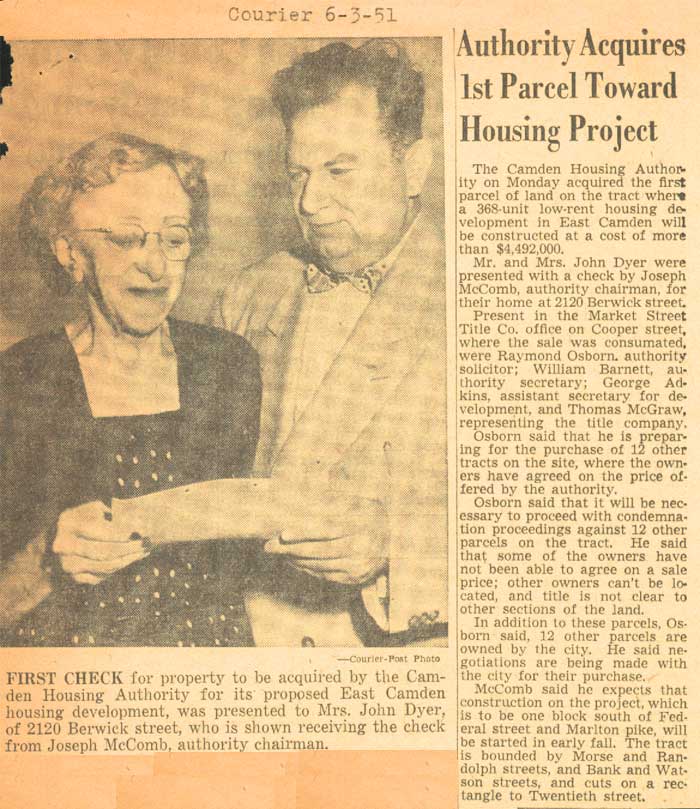
The Camden Housing Authority on Monday acquired the first parcel of land on the tract where a 368-unit low-rent housing development in East Camden will be constructed at a cost of more than $4,492,000.
Mr. and Mrs. John Dyer were presented with a check by Joseph McComb, authority chairman, for their home at 2120 Berwick street.
Present in the Market Street Title Co. office on Cooper street, where the sale was consumated, were Raymond Osborn, authority solicitor; William Barnett, authority secretary; George Adkins, assistant secretary for development, and Thomas McGraw, representing the title company.
Osborn said that he is preparing for the purchase of 12 other tracts on the site, where the owners have agreed on the price offered by the authority.
Osborn said that it will be necessary to proceed with condemnation proceedings against 12 other parcels on the tract. He said that some of the owners have not been able to agree on a sale price; other owners can’t be located, and title is not clear to other sections of the land.
In addition to these parcels, Osborn said, 12 other parcels are owned by the city. He said negotiations are being made with the city for their purchase.
McComb said he expects that construction on the project, which is to be one block south of Federal street and Marlton pike, will be started in early fall. The tract is bounded by Morse and Randolph streets, and Bank and Watson streets, and cuts on a rectangle to Twentieth street.
A Resolution Appointing Joseph J. McComb
City Clerk’s Office, Camden, N.J. —
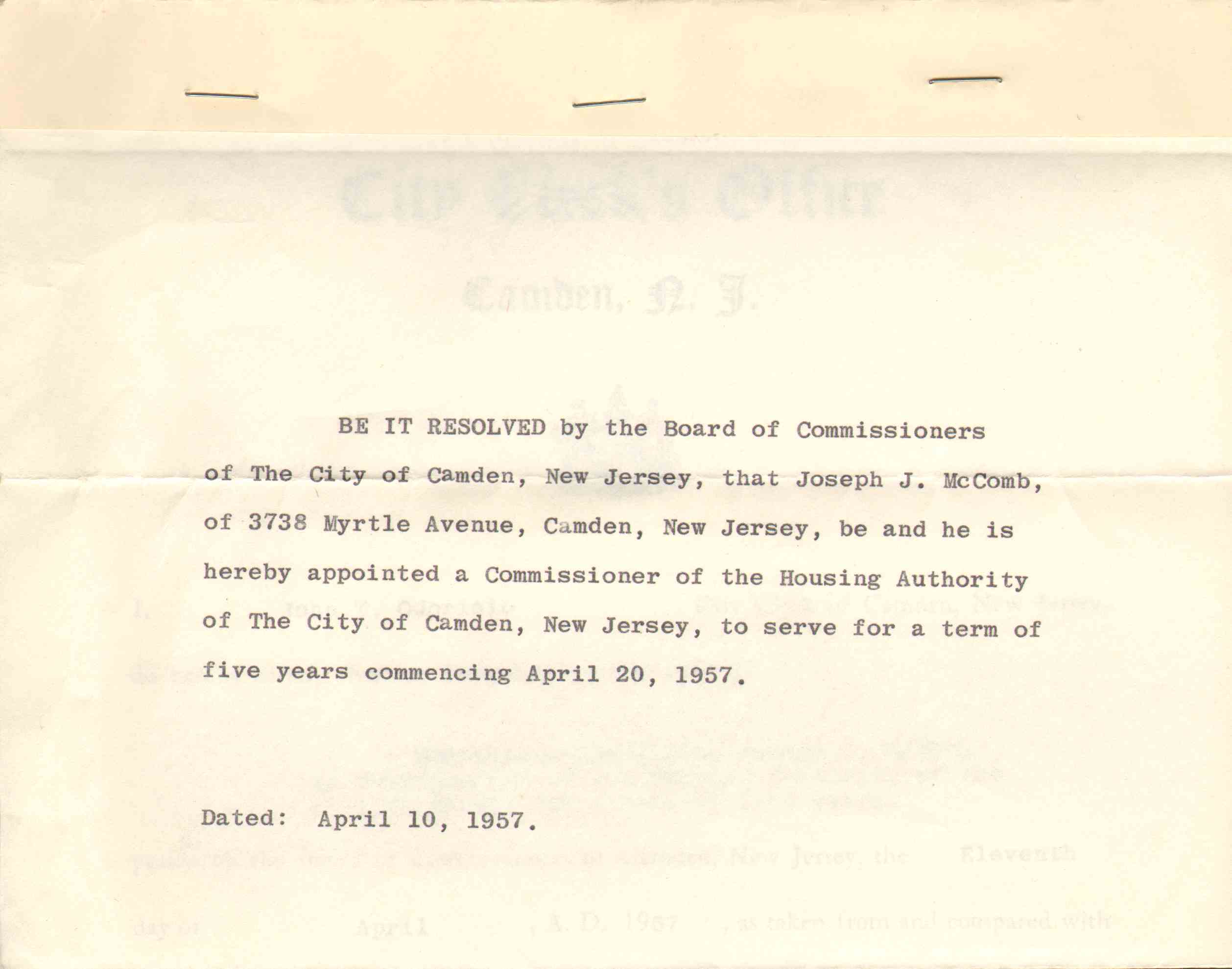
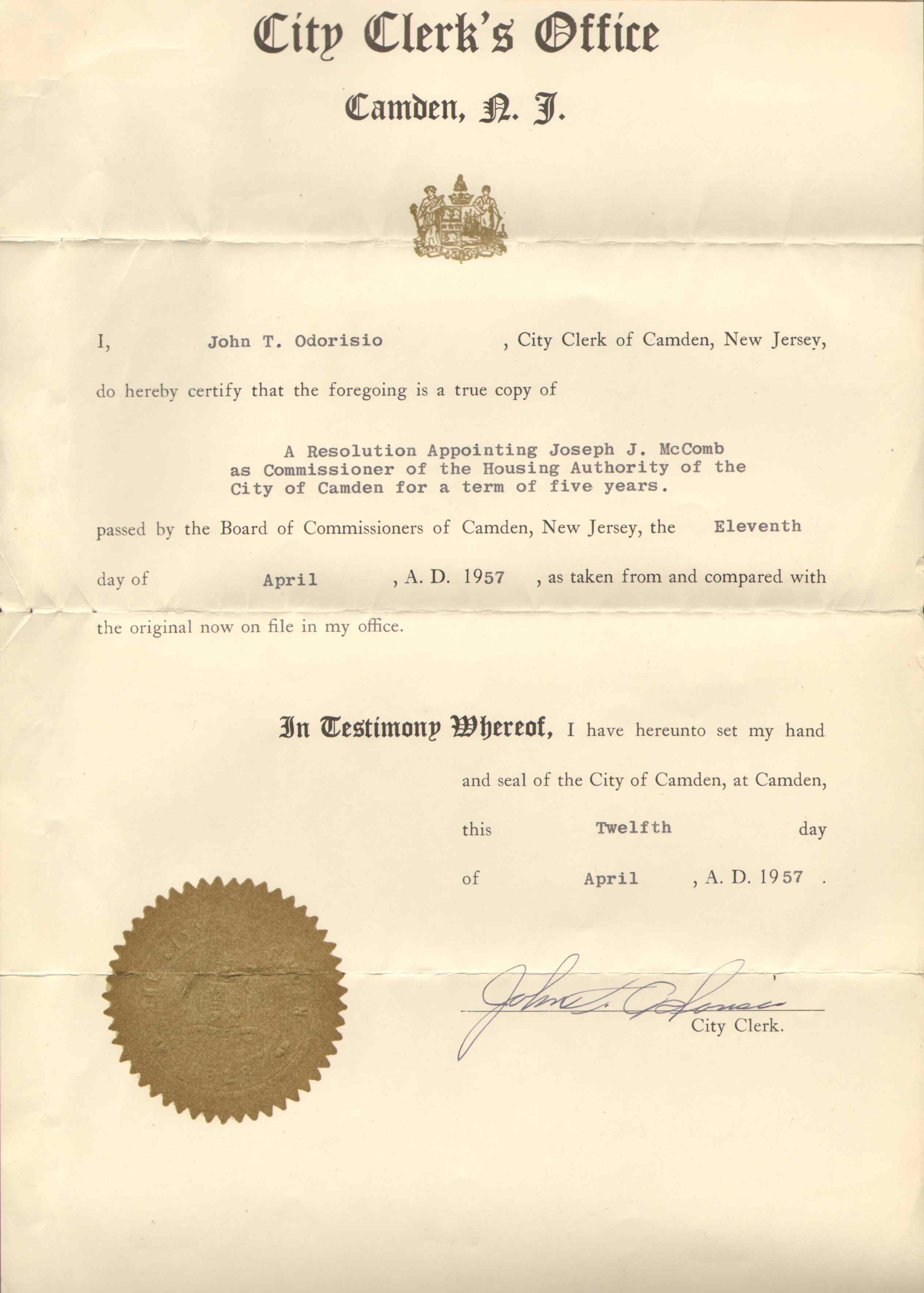
A Resolution Appointing Joseph J. McComb as Commissioner of the Housing Authority of the City of Camden — April 10, 1957. Certified by John T. Odorisio, City Clerk.
BE IT RESOLVED by the Board of Commissioners of The City of Camden, New Jersey, that Joseph J. McComb, of 3738 Myrtle Avenue, Camden, New Jersey, be and he is hereby appointed a Commissioner of the Housing Authority of The City of Camden, New Jersey, to serve for a term of five years commencing April 20, 1957.
Dated: April 10, 1957.
I, John T. Odorisio, City Clerk of Camden, New Jersey, do hereby certify that the foregoing is a true copy of A Resolution Appointing Joseph J. McComb as Commissioner of the Housing Authority of the City of Camden for a term of five years, passed by the Board of Commissioners of Camden, New Jersey, the Eleventh day of April, A.D. 1957, as taken from and compared with the original now on file in my office.
In Testimony Whereof, I have hereunto set my hand and seal of the City of Camden, at Camden, this Twelfth day of April, A.D. 1957.
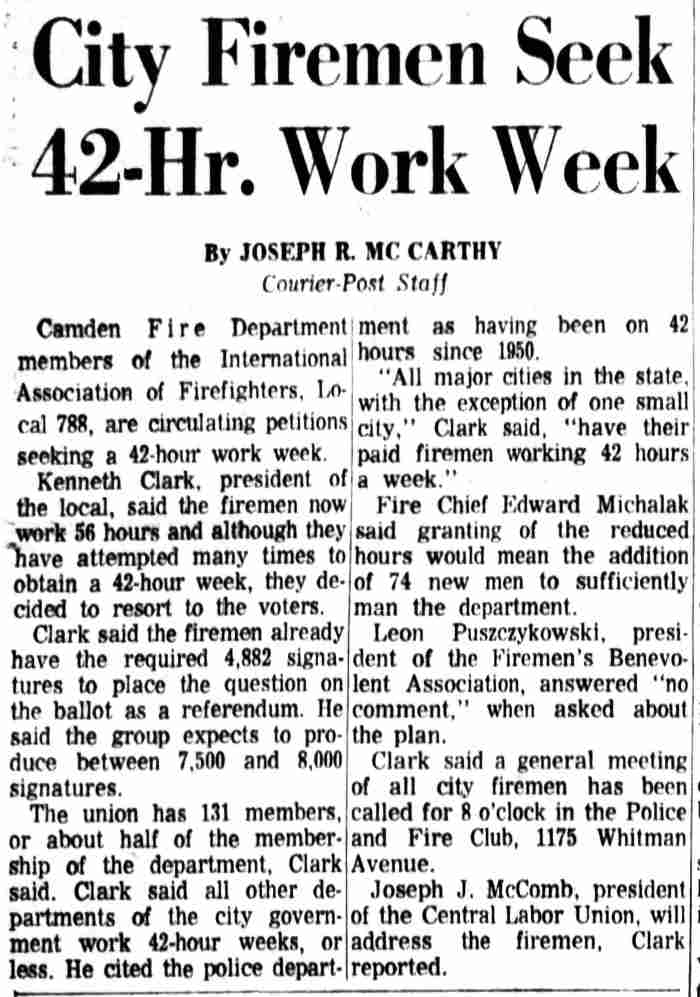
City Firemen Seek 42-Hr. Work Week
Camden Courier-Post —
By JOSEPH R. MC CARTHY
Courier-Post Staff
Camden Fire Department members of the International Association of Firefighters, Local 788, are circulating petitions seeking a 42-hour work week.
Kenneth Clark, president of the local, said the firemen now work 56 hours and although they have attempted many times to obtain a 42-hour week, they decided to resort to the voters.
Clark said the firemen already have the required 4,882 signatures to place the question on the ballot as a referendum. He said the group expects to produce between 7,500 and 8,000 signatures.
The union has 131 members, or about half of the membership of the department, Clark said. Clark said all other departments of the city government work 42-hour weeks, or less. He cited the police department as having been on 42 hours since 1950.
“All major cities in the state, with the exception of one small city,” Clark said, “have their paid firemen working 42 hours a week.”
Fire Chief Edward Michalak said granting of the reduced hours would mean the addition of 74 new men to sufficiently man the department.
Leon Puszczykowski, president of the Firemen’s Benevolent Association, answered “no comment,” when asked about the plan.
Clark said a general meeting of all city firemen has been called for 8 o’clock in the Police and Fire Club, 1175 Whitman Avenue.
Joseph J. McComb, president of the Central Labor Union, will address the firemen, Clark reported.