Introduction
E. Allen Ward.
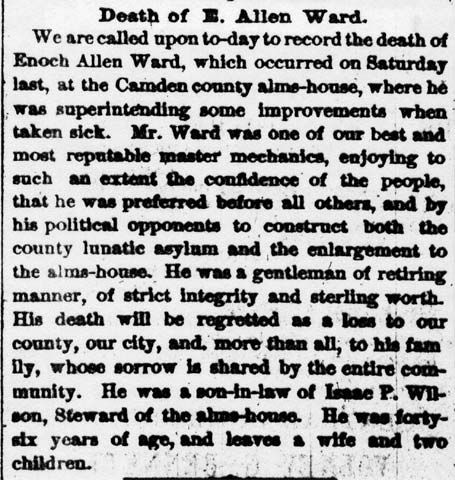
Enoch Allen Ward was born June 26, 1831 to Mason and Hannah Barton Ward in what was then Newton Township, Gloucester County NJ. This location is presently within the borders of the City of Camden. He was the youngest of eight children, and interestingly enough, born between two brothers both born to Mason and Hannah Ward named Aaron. The first Aaron had been born in 1829 but died before his third birthday, and the youngest child, born in 1834, was also named Aaron Ward. By the time of the 1860 Census he had moved to Camden’s North Ward, where he worked as a house carpenter. His widowed mother Hannah Ward then lived with him. She would move in with younger brother Aaron’s family after the Civil War.
Generally known as E. Allen Ward, he married Emma Wilson on March 20, 1861. The marriage produced three children, of which at least two reached adulthood.
In 1871 Jesse Starr donated 4½ acres of land along Haddon Avenue on which to construct a new city hall for Camden. Designed by Camden architect Stephen Decatur Button, the contract was given to E. Allen Ward for the sum of $125,000. The building was completed in December of 1875, and became the seat of government for Camden the following year.
During his lifetime, E. Allen Ward and family had made their home at 439 Berkeley Street. At the time of the 1880 Census they were living at 517 Clinton Street. Daughter Annie W., 17, and son Allie M. Ward, 14, were then living at home.
In 1880 E. Allen Ward was given another government contract, this time to make improvements at the Camden County complex at Lakeland, in Gloucester Township. He was to build the County’s first lunatic asylum, and enlarge the county almshouse. His father-in-law, Isaac Wilson, was then Steward of the almshouse. While working on this project, he contracted “typhus fever” and died in January of 1881. His wife and children lived at 513 North 4th Street in the late 1880s and early 1890s.
E. Allen Ward was buried at Colestown Cemetery in Delaware Township (present-day Cherry Hill) NJ.
Younger brother Aaron Ward was also well known in Camden for many years as a contractor. Concentrating on roads, bridges, and other public improvements, he built the first bridge across the Cooper River at Baird Avenue in 1903, and he also built another at Kaighn Avenue to cross the river, then known as Cooper’s Creek. Aaron Ward also built a concrete wharf at the foot of Cooper Street that was utilized for many decades, and in South Camden Aaron Ward’s firm built the Line Ditch sewer.
Niece Lettie Allen Ward, after teaching until her 30s, became a physician in 1897, gaining distinction as being one of Camden’s first female doctors. She lived and practiced general medicine at 704 Broadway, and later at 325 Cooper Street, also specializing in ailments of the ear, nose, and throat.
Camden City Hall
1876–1930
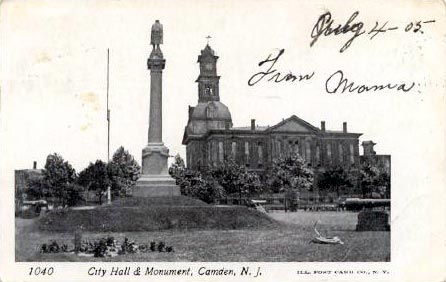
Many postcards were issued over the years with images of Camden City Hall. If you were standing on the southwest corner of Haddon Avenue and Mickle Street, looking south, this is what you would have seen. Mailed in 1905.
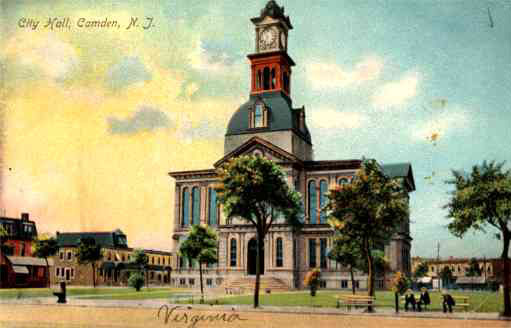
You have walked across Haddon Avenue, and have walked south to a point about 40 yards north of Benson Street. The red brick three-story building at left stood on the corner of South 7th and Benson Street. The rowhouses to the right of that building are still standing and for the most part in use as of 2004.
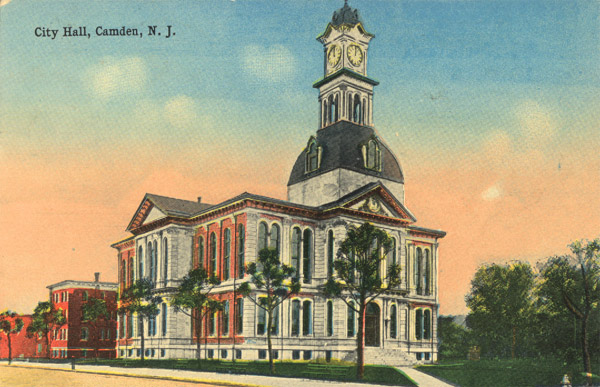
Now you have walked south on Haddon Avenue, and you are looking at the northwest corner of Haddon Avenue and Benson Street.
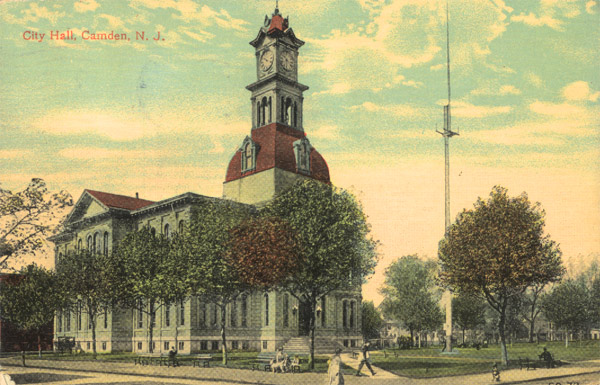
The same vantage point in a somewhat later year, as evidenced by the growth of the trees along Benson Street.
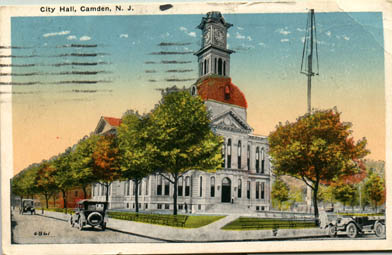
This is what you would have seen in the late 1910s or very early 1920s.
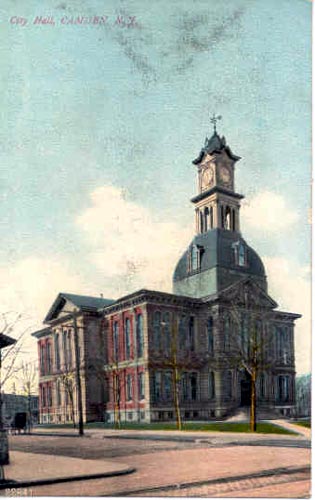
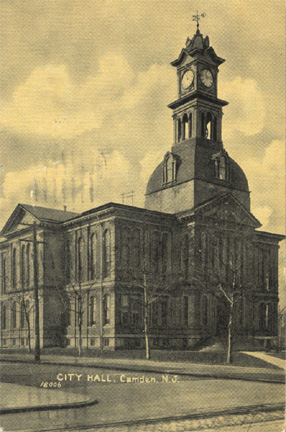
City Hall on Haddon Avenue.
Camden County Lunatic Asylum at Lakeland
1931
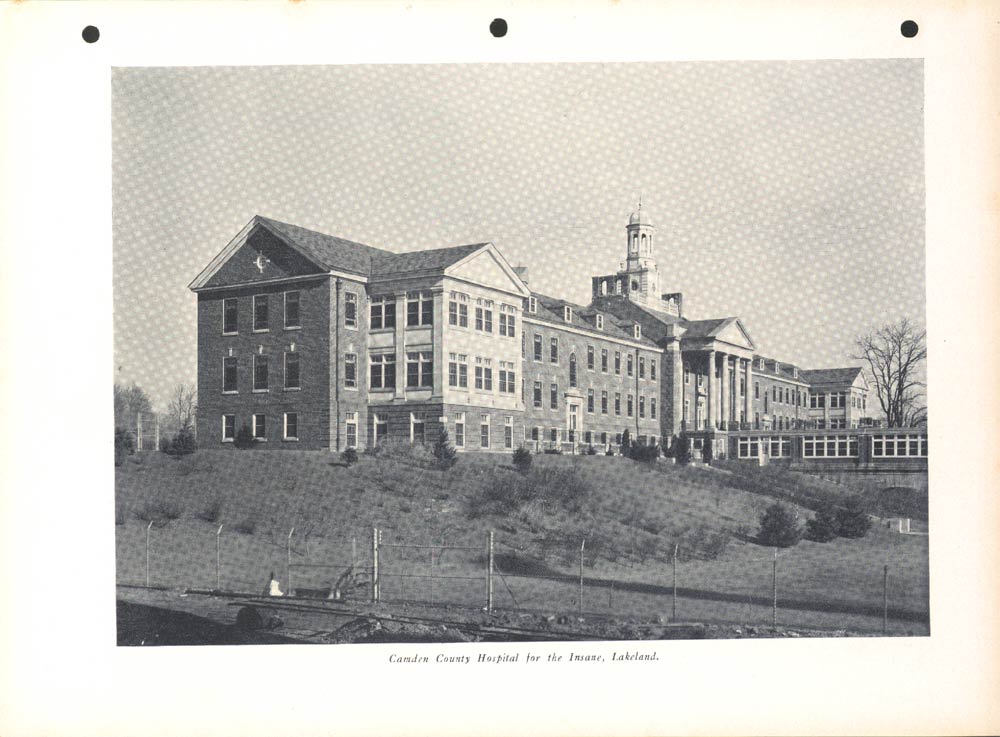
Camden County Lunatic Asylum at Lakeland, 1931. The main section in the center is the work of E. Allen Ward.