Camden Electrics Are Independent Champions of New Jersey
Camden Post-Telegram —
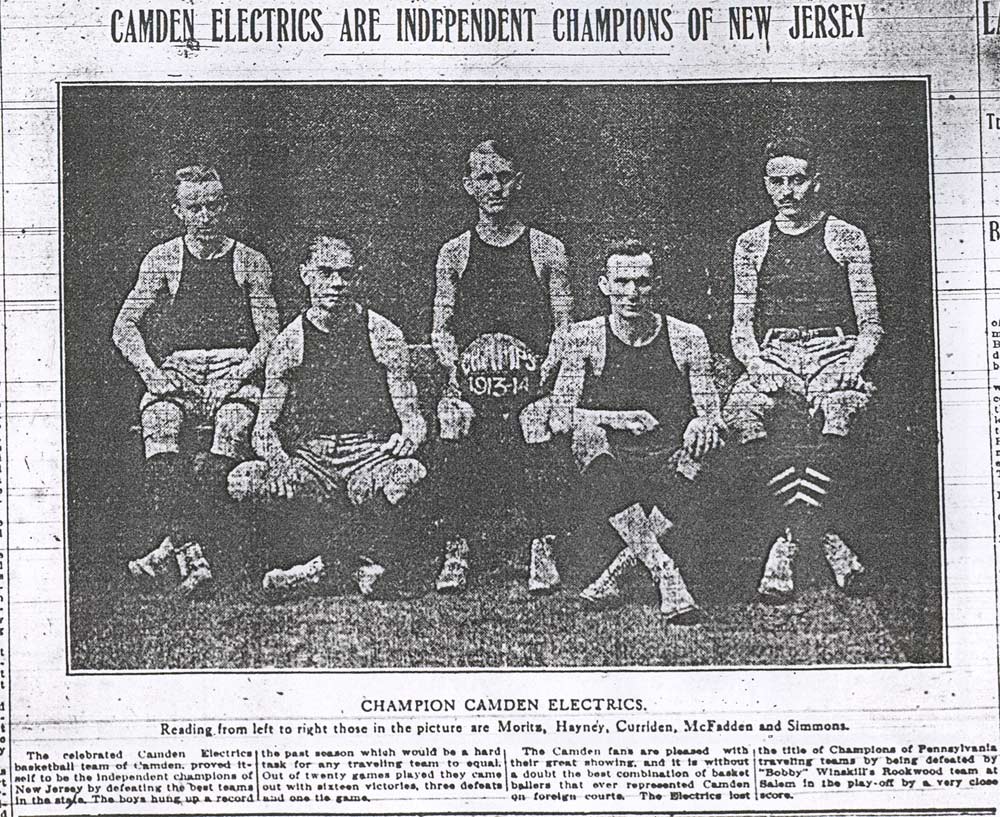

CHAMPION CAMDEN ELECTRICS.
Reading from left to right those in the picture are Moritz, Hayney, Curriden, McFadden and Simmons.
The celebrated Camden Electrics basketball team of Camden, proved itself to be the independent champions of New Jersey by defeating the best teams in the state. The boys hung up a record the past season which would be a hard task for any traveling team to equal. Out of twenty games played they came out with sixteen victories, three defeats and one tie game.
The Camden fans are pleased with their great showing, and it is without a doubt the best combination of basket ballers that ever represented Camden on foreign courts. The Electrics lost the title of Champions of Pennsylvania traveling teams by being defeated by “Bobby” Winakill's Rookwood team at Salem in the play-off by a very close score.
Professional Basketball in Camden NJ
When James Naismith, a physical education instructor, was asked to create an indoor game that would provide an “athletic distraction” for a rowdy class through the brutal New England winter, he never would have imagined the world-wide impact of the game he would invent. Under orders from Dr. Luther Gulick, head of physical education at the School for Christian Workers (now Springfield College), Naismith had 14 days to create a game for a rowdy group of 18 students. Naismith came up with the game we know as basketball.
Basketball became almost an immediate sensation, and within seven years of its invention, the first professional basketball league was organized, the National Basketball League. Camden NJ in the 1890s was a place that men with ideas for new and exciting things would come, a place where the latest inventions would not only be developed, but would be produced and gain world-wide fame. In many ways, Camden of these years could be compared to the Silicon Valley of the 1990s. Within a span of twenty years, new technologies such as the condensed soup made by the Campbell company and Eldridge Johnson’s Victrola, as well as less well remembered inventions at the Warren Webster Company, the Esterbrook and C. Howard Hunt Pen Companies, Acme Staple and others put the words “Made in Camden, New Jersey” probably in the mouths of more people who did not speak English than did!
It was only natural then, when the entrepreneurs who organized the National Basketball League looked for places for the new sport to be played, Camden was among the first chosen. The Camden Electrics, under owner and player-coach William E. “Billy” Morgenweck, had organized and were playing the game as early as 1895.
The Camden Electrics — 1895–1904
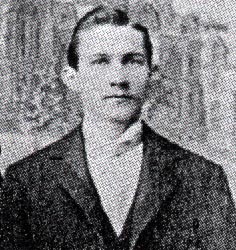
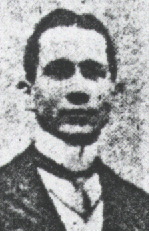
William “Billy” Morgenweck, owner and player-coach of the Camden Electrics.
The Electrics were one of the six original professional teams when the league began play in the 1898–1899 season. Of the six teams, besides Camden, three were in Philadelphia, one in Millville NJ, and the other in Trenton. Two of the Philadelphia teams folded prior to New Years Eve 1898, but the other four completed the season, with the Trenton Nationals winning the first championship with an 18-2-1 record. Camden finished 11 games back, with 7 wins against 13 defeats and a tie.
| 1898–99 NBL | |||
|---|---|---|---|
| Team | W | L | T |
| Trenton Nationals | 18 | 2 | 1 |
| Millville Glassblowers | 14 | 6 | 2 |
| Camden Electrics | 7 | 13 | 1 |
| Clover Wheelmen / Philadelphia Clover Wheelmen*** | 5 | 14 | 1 |
| Germantown Nationals* | 1 | 4 | 0 |
| Hancock Athletic Association** | 0 | 6 | 1 |
*Germantown played their last game on 29Dec98 and dropped out of the league shortly afterwards. **Hancock failed to show for a game in Camden on 31Dec98. Shortly afterwards a letter dated 28Dec98 was received by the League from Hancock who withdrew from the league. On 07Jan99 a league meeting was held in which the Hancock franchise was officially annulled. ***Since the loss of the Hancock franchise left the city of Philadelphia with just one team, the “Big Five of the Clover Wheelmen” were ordered to rename their team “the Big Five of Philadelphia” for the balance of the season.
Camden Electrics Team, Season 1895-96
(photograph) — 1896
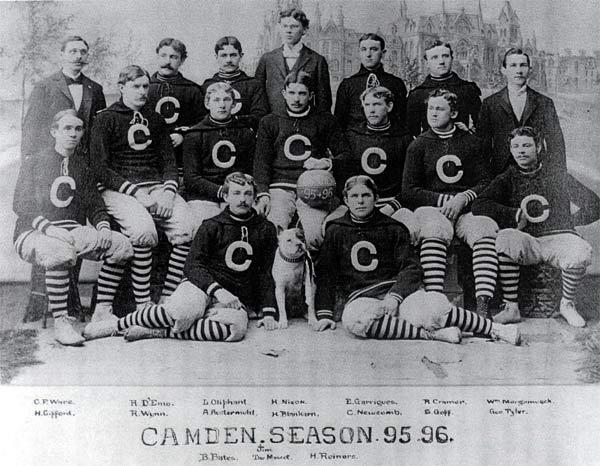
C. F. Ware. H. D’Emo. L. Oliphant. H. Nixon. E. Garriques. R. Cramer. Wm. Morgenweck.
H. Gifford. R. Wynn. A. Austermuhl. H. Blankorn. C. Newcomb. G. Goff. Geo. Tyler.
CAMDEN. SEASON. 95 96.
B. Bates. Jim The Mascot. H. Reiners.
1895–1896 Camden Electrics. Front: B. Bates, Jim the Mascot, H. Reiners. Middle: H. Gifford, Ray Wynn, A. Austermuhl, H. Blankorn, Charlie Newcomb, Leon Goff, George Tyler. Rear: C.F. Ware, H. D’Emo, L. Oliphant, H. Nixon, E. Garrigues, Randolph Cramer.
CAMDEN. B.B.T. 98.99.
1898–1899
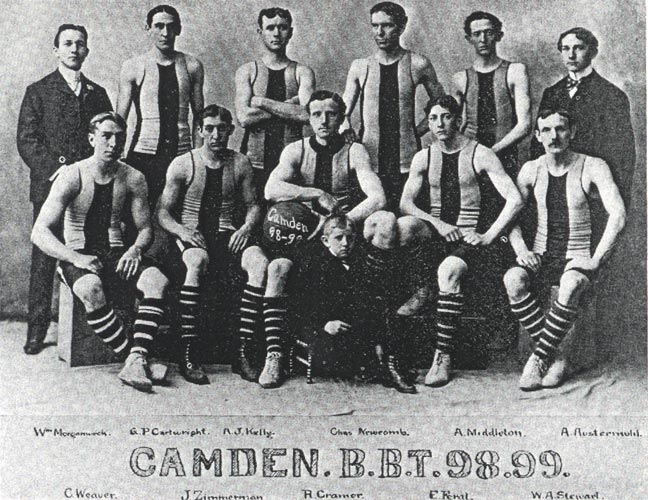
Wm. Morgenweck. G. P. Cartwright. A. J. Kelly. Chas. Newcomb. A. Middleton. A. Austermuhl.
C. Weaver. J. Zimmerman. R. Cramer. E. [?]. W. A. Steward.
Hot Basket Ball
Philadelphia Inquirer —
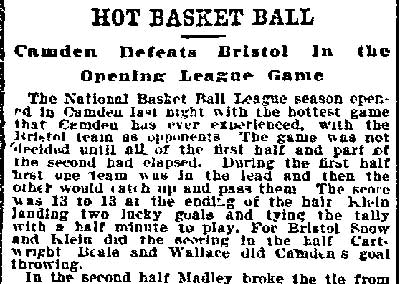
Camden Defeats Bristol In the Opening League Game
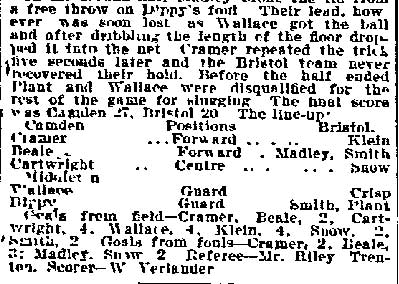
The National Basket Ball League season opened in Camden last night with the hottest game that Camden has ever experienced, with the Bristol team as opponents. The game was not decided until all of the first half and part of the second had elapsed. During the first half first one team was in the lead and then the other would catch up and pass them. The score was 13 to 13 at the ending of the half. Klein landing two lucky goals and tying the tally with a half minute to play. For Bristol Snow and Klein did the scoring in the half. Cartwright, Beale and Wallace did Camden's goal throwing.
In the second half Madley broke the tie from a free throw on Dippy's foul. Their lead, however, was soon lost as Wallace got the ball and after dribbling the length of the floor dropped it into the net. Cramer repeated the trick five seconds later and the Bristol team never recovered their hold. Before the half ended Plant and Wallace were disqualified for the rest of the game for slugging. The final score was Camden 27, Bristol 20. The line-up:
Camden — Positions — Bristol.
Cramer ... Forward ... Klein
Beale — Forward — Madley, Smith
Cartwright — Centre — Snow
Mid[?]let[?]n
Wallace — Guard — Crisp
Dippy — Guard — Smith, Plant
Goals from field—Cramer, Beale, 2, Cartwright, 4, Wallace, 4, Klein, 4, Snow, 2, Smith, 2. Goals from fouls—Cramer, 2, Beale, 3; Madley, Snow 2. Referee—Mr. Riley, Trenton. Scorer—W. Verlander.
The 1899–1900 National Basketball League
Philadelphia Inquirer, November 19, 1899 — full PDF
The following season was more stable for the new league. The New York Wanderers joined, and only one team, out of Chester PA dropped out, and they were immediately replaced by the Millville team, which had originally elected not to participate that season. Trenton and Millville proving again to be the best teams in the loop, with Trenton gaining a disputed championship. Camden opened the season at home with a win over Bristol, but they finished the season only 2 games over the .500 mark.
| 1899–1900 NBL | |||
|---|---|---|---|
| Team | W | L | T |
| First “Half” | |||
| Trenton Nationals | 8 | 0 | 0 |
| New York Wanderers | 3 | 2 | 0 |
| Camden Electrics | 4 | 4 | 0 |
| Pennsylvania Bicycle Club | 4 | 4 | 0 |
| Bristol Pile Drivers | 3 | 6 | 0 |
| Chester* | 0 | 6 | 0 |
| Second “Half” | |||
| Trenton Nationals | 14 | 4 | 1 |
| Millville Glassblowers** | 14 | 4 | 1 |
| New York Wanderers | 13 | 7 | 1 |
| Camden Electrics | 11 | 9 | 0 |
| Bristol Pile Drivers | 6 | 14 | 1 |
| Pennsylvania Bicycle Club | 0 | 20 | 0 |
*Chester dropped out during the first half. **Millville joined the league on 3Jan00. NBL PLAYOFF — 2nd half: 28Apr00 at Bristol — Millville 18, Trenton 13 (game protested by Trenton since Millville used Hilly Wallace who was ineligible to play for them — League President Fogel ruled that game was to be replayed). 05May00 at Camden — Trenton 4, Millville 0 forfeit (Millville refused to play game since they wanted to use Wallace). 08May00 at Camden — Trenton 22, Millville 19. NBL CHAMPIONSHIP: Trenton wins 2nd half playoff and thus wins both season halves, making championship series unnecessary.
1900–1901 National Basketball League
The National Basketball League began the 1900–1901 season with an expanded schedule of 32 games, and seven teams. Of the seven teams, six had participated in league play before; the only new entry, from Burlington NJ, failed to complete the season. With 5 of the seven teams finishing with records of .500 or better, NBL fans saw good competitive play from most teams throughout the season. In this season the Camden team also went by the handle of Camden Skeeters, apparently after what many call the New Jersey state bird, the mosquito! With the split season dropped, no playoffs were necessary, and the New York Wanderers captured the League title by three games.
| 1900–01 NBL | |||
|---|---|---|---|
| Team | W | L | Pct. |
| New York Wanderers | 23 | 9 | .719 |
| Trenton Nationals | 20 | 12 | .625 |
| Millville Glassblowers | 18 | 14 | .563 |
| Bristol Pile Drivers | 17 | 15 | .531 |
| Camden Skeeters | 16 | 16 | .500 |
| Pennsylvania Bicycle Club | 8 | 24 | .333 |
| Burlington* | 0 | 12 | .000 |
*Burlington dropped out during the season.
| 1900–01 Camden Skeeters | |||||
|---|---|---|---|---|---|
| Name | G | FG | FT | TP | PPG |
| Bishop | 1 | 0 | 0 | 0 | 0 |
| Charlie Bossert | 7 | 25 | 28 | 78 | 11.1 |
| Charlie Carr | 23 | 40 | 0 | 80 | 3.5 |
| George Cartwright | 8 | 12 | 1 | 25 | 3.1 |
| Ike Charlton* | 21 | 11 | 31 | 53 | 2.5 |
| Commons | 17 | 17 | 2 | 36 | 2.1 |
| Randolph “Red” Cramer | 24 | 41 | 30 | 112 | 4.7 |
| Dennison | 5 | 3 | 0 | 6 | 1.2 |
| Bob Dippy | 32 | 17 | 0 | 34 | 1.1 |
| Ed Ferat | 31 | 44 | 108 | 196 | 6.3 |
| Jud Hancock | 9 | 13 | 3 | 29 | 3.2 |
| A. “Budge” Middleton | 32 | 19 | 0 | 38 | 1.2 |
| Howard Randolph | 10 | 10 | 14 | 34 | 1.9 |
| Wick | 3 | 0 | 1 | 1 | 0.3 |
*Totals for Charlton reflect games played for Philadelphia.
1901–1902 National Basketball League
The 1901–1902 season may have been the most successful year of the National Basketball League in terms of stability. The schedule expanded once again to 40 games, every game save one was played as scheduled, no teams dropped out, and there was only one really weak team in the league. Camden finally became more than a .500 team, and lost the league crown to the Bristol Pile Drivers by only 3 games.
| 1901–02 NBL | |||
|---|---|---|---|
| Team | W | L | Pct. |
| Bristol Pile Drivers | 28 | 12 | .700 |
| Camden | 25 | 15 | .625 |
| Trenton Nationals | 23 | 17 | .575 |
| Millville Glassblowers | 21 | 19 | .525 |
| New York Wanderers | 18 | 21 | .461 |
| Philadelphia Phillies | 4 | 35 | .103 |
| 1901–02 Camden Skeeters | |||||
|---|---|---|---|---|---|
| Name | G | FG | FT | TP | PPG |
| Charlie Bossert | 41 | 102 | 7 | 211 | 5.1 |
| Charlie Carr | 6 | 0 | 0 | 0 | 0 |
| Randolph “Red” Cramer* | 24 | 33 | 59 | 125 | 5.2 |
| John “Snakes” Deal | 42 | 112 | 381 | 605 | 14.4 |
| Bob Dippy | 29 | 11 | 0 | 22 | 0.8 |
| Ed Ferat | 41 | 88 | 5 | 181 | 4.4 |
| Winnie Kincaid | 41 | 18 | 0 | 36 | −.9 |
| A. “Budge” Middleton | 37 | 28 | 1 | 57 | 1.5 |
| Bill Thomas | 4 | 4 | 5 | 13 | 3.3 |
*Cramer’s totals are for games with Camden and Philadelphia Phillies.
Some of the Old-timers Who Will Attend Fete
Camden Courier-Post —
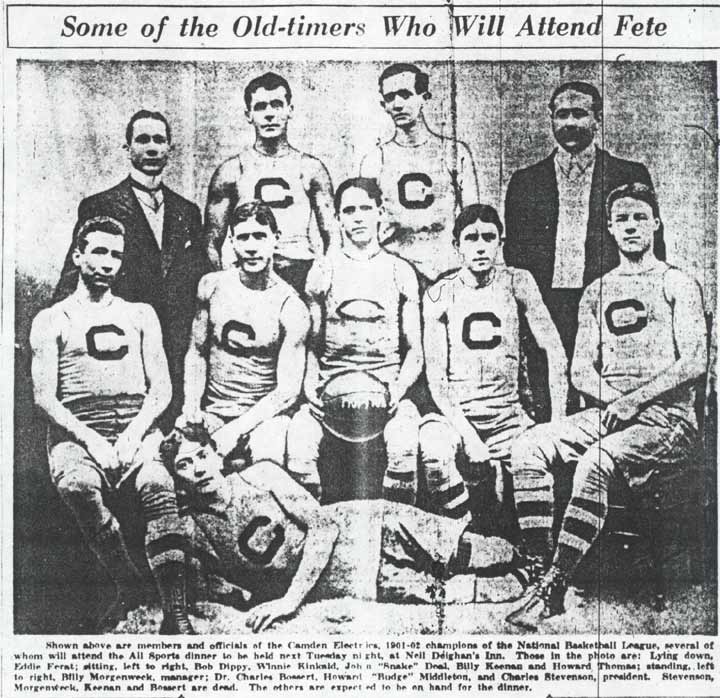

Shown above are members and officials of the Camden Electrics, 1901-02 champions of the National Basketball League, several of whom will attend the All Sports dinner to be held next Tuesday night, at Neil Deighan’s Inn. Those in the photo are: Lying down, Eddie Ferat; sitting, left to right, Bob Dippy, Winnie Kinkaid, John “Snake” Deal, Billy Keenan and Howard Thomas; standing, left to right, Billy Morgenweck, manager; Dr. Charles Bossert, Howard “Budge” Middleton and Charles Stevenson, president. Stevenson, Morgenweck, Keenan and Bossert are dead. The others are expected to be on hand for the dinner.
1903–1904 National Basketball League
Things did not go very well during the off season in 1903 in the National Basketball League. Only five teams elected to play that year; more importantly, New York, Burlington, and Wilmington, all with experienced owners and coaches, failed to return. The league began the season with only five teams. Trenton dropped out on December 26, 1903, and Camden left on December 31st. The National Basketball League disbanded on January 4, 1904, not without controversy, and at least one law suit followed its demise. Billy Morgenweck was subsequently sued by investors in the team, including local businessman Sig Schoenagle.
| 1903–04 NBL | |||
|---|---|---|---|
| Team | W | L | Pct. |
| Camden Electrics | 10 | 4 | .714 |
| Conshohocken | 8 | 4 | .667 |
| Trenton Potters | 8 | 5 | .615 |
| Millville Glass Blowers | 6 | 9 | .400 |
| St. Bridget’s Biddies | 2 | 12 | .143 |
*Trenton resigned from league on 26Dec03. **Camden resigned from league on 31Dec03. League disbanded Jan04.
Wm. Morgenweck Is Accused of Fraud in Basketball Sale
Trenton Times —
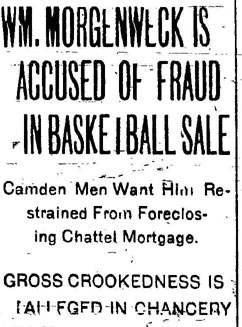
Camden Men Want Him Restrained From Foreclosing Chattel Mortgage.
GROSS CROOKEDNESS IS ALLEGED IN CHANCERY
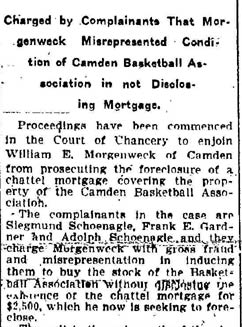
Charged by Complainants That Morgenweck Misrepresented Condition of Camden Basketball Association in not Disclosing Mortgage.
Proceedings have been commenced in the Court of Chancery to enjoin William E. Morgenweck of Camden from prosecuting the foreclosure of a chattel mortgage covering the property of the Camden Basketball Association.
The complainants in the case are Siegmund Schoenagle, Frank E. Gardner and Adolph Schoenagle, and they charge Morgenweck with gross fraud and misrepresentation in inducing them to buy the stock of the Basketball Association without disclosing the existence of the chattel mortgage for $2,500, which he now is seeking to foreclose.
The suit is the outgrowth of the rise and fall of the popularity of the game of basketball. Morgenweck was the promoter of the game in Camden and through his instrumentality the Camden Basketball Association was organized.
CHARGES OF BILL
The bill charges that in March, 1904, when the game had ceased to be popular, Morgenweck, John R. McCabe, Richard Miller, Harry C. Kramer and Adolph Schoenagle decided to abandon the association and form a new organization for the carrying on of bowling alleys in the old Sixth Regiment armory, West and Mickle streets, Camden, which had formerly been used by the basketball association.
The new organization retained the old name and it is charged that he induced the complainants to acquire the stock of the old concern by representing that its property was clear of incumbrance. The complainants state that they have spent about $5,000 in adapting the armory to its new use of bowling alleys and in getting the equipment.
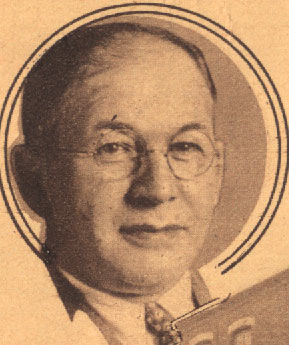
Sig Schoenagle
The Semi-Pro Era and the Return of Professional Basketball
After the dissolution of the Eastern League, the Camden Electrics carried on as a semi-pro team. Pro basketball would return to Camden in 1910 in a reborn Eastern Basket Ball League. The Camden Electrics, however, were not a part of the new league, the new team being the Camden Alphas. The Electrics were, however, active in semipro circles, and from the 1906–1907 season through the 1908–1909 season lost only one game, with a club featuring Horace Parker, Louis Urban, Frank Eames, Louis Ballinger, Earl Scott, and future major league baseball player and coach Russell “Lena” Blackburne. They were still active as late as 1914, when they went 16-3-1, won the New Jersey independent championship and came within a game of winning a Pennsylvania championship.
Although the Eastern League folded, basketball remained quite popular in the area and elsewhere. A professional league was organized in Philadelphia, but no Camden franchise ever joined this league. Besides the semi-pro Camden Electrics, a number of other teams were organized. One of the most successful and enduring of these were the Camden Alphas, sponsored by the Alpha Club, a social club headquartered on Broadway in South Camden. The Alphas and other teams such as the Third Regiment NJ National Guard team operated in a loose confederation of independent teams. The Alphas were Camden city champions during the 1909–1910 season, and joined the Eastern Basket Ball League the next year.
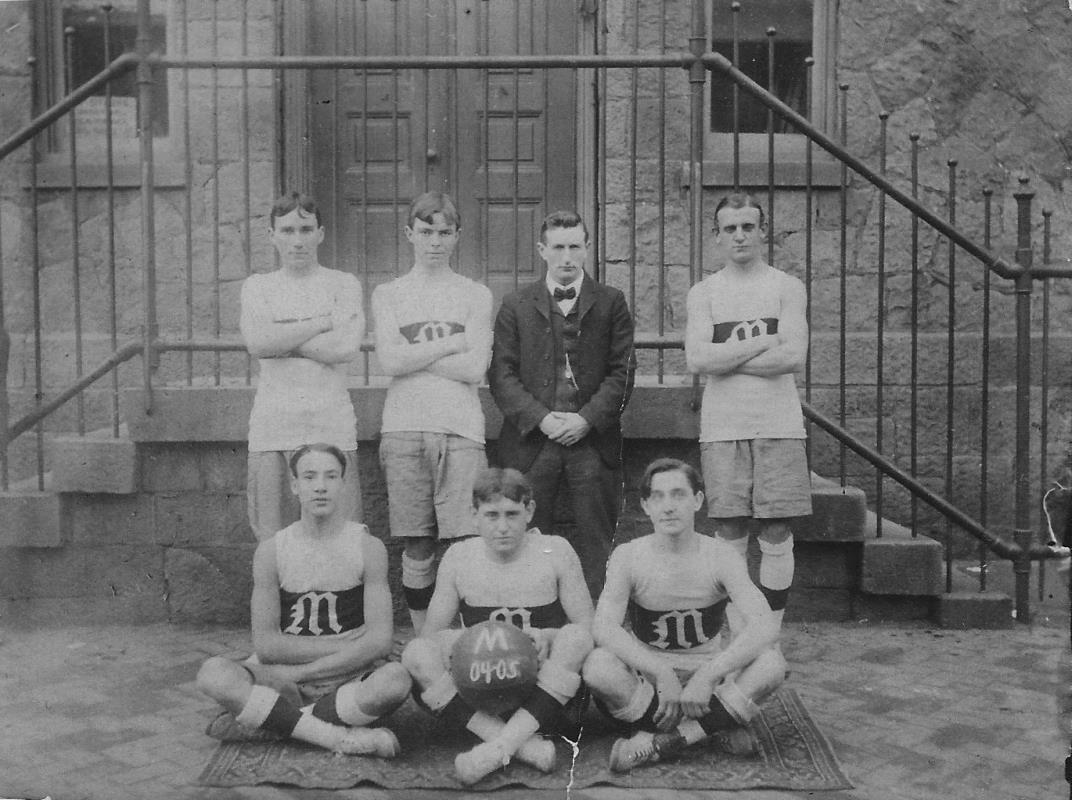
Monarch Athletic Club basketball team, 1904–1905. Seven men are pictured on a stoop, four standing (one in a jacket and bow tie) and three seated on a rug; the players wear “M” jerseys and the ball is lettered “M 04-05.” Horace B. Parker Jr. is identified as one of them; the picture prints no names, and his place in it is not recorded.
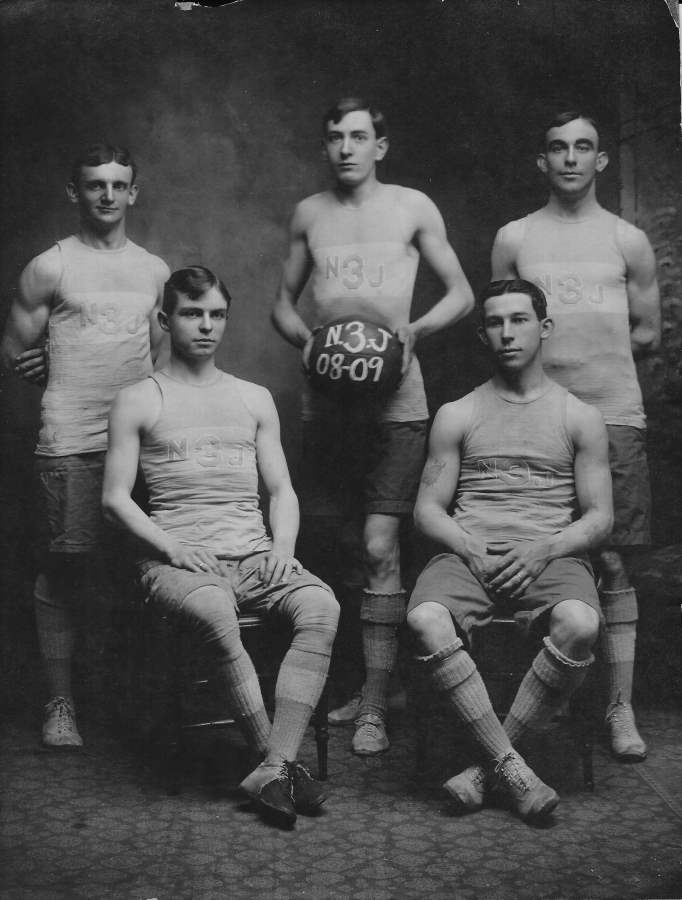
Third Regiment N.J. National Guard basketball team, 1908–1909. Five men are pictured in jerseys lettered “N.J.,” two standing, one standing holding the ball, and two seated; the ball is lettered “N.J. 08-09.” Horace B. Parker Jr. is identified as one of them; the picture prints no names, and his place in it is not recorded.
Camden Basketball Games
Philadelphia Inquirer —
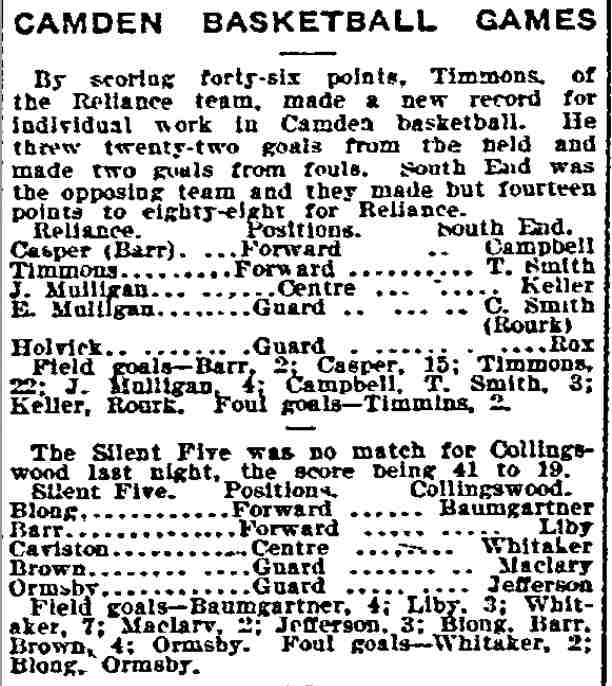
By scoring forty-six points, Timmons, of the Reliance team, made a new record for individual work in Camden basketball. He threw twenty-two goals from the field and made two goals from fouls. South End was the opposing team and they made but fourteen points to eighty-eight for Reliance.
| Reliance. | Positions. | South End. |
|---|---|---|
| Casper (Barr) | Forward | Campbell |
| Timmons | Forward | T. Smith |
| J. Mulligan | Centre | Keller |
| E. Mulligan | Guard | C. Smith (Rourk) |
| Holvick | Guard | Rox |
Field goals—Barr, 2; Casper, 15; Timmons, 22; J. Mulligan, 4; Campbell, T. Smith, 3; Keller, Rourk. Foul goals—Timmins, 2.
The Silent Five was no match for Collingswood last night, the score being 41 to 19.
| Silent Five. | Positions. | Collingswood. |
|---|---|---|
| Blong | Forward | Baumgartner |
| Barr | Forward | Liby |
| Caviston | Centre | Whitaker |
| Brown | Guard | Maclary |
| Ormsby | Guard | Jefferson |
Field goals—Baumgartner, 4; Liby, 3; Whitaker, 7; Maclary, 2; Jefferson, 3; Blong, Barr, Brown, 4; Ormsby. Foul goals—Whitaker, 2; Blong, Ormsby.
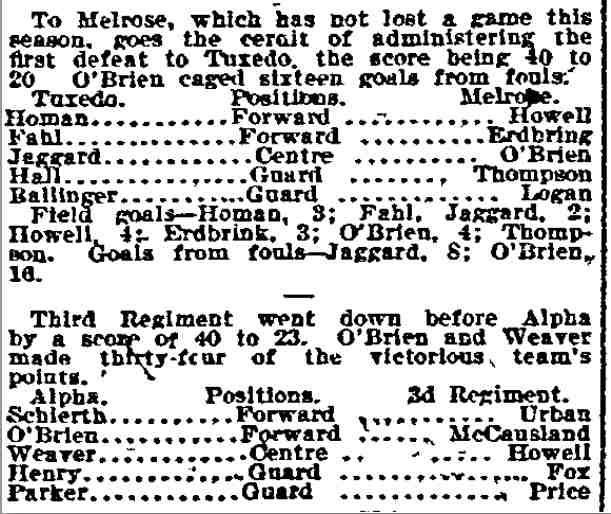
To Melrose, which has not lost a game this season, goes the credit of administering the first defeat to Tuxedo, the score being 40 to 20. O’Brien caged sixteen goals from fouls.
| Tuxedo. | Positions. | Melrose. |
|---|---|---|
| Homan | Forward | Howell |
| Fahl | Forward | Erdbring |
| Jeggard [sic] | Centre | O’Brien |
| Hall | Guard | Thompson |
| Ballinger | Guard | Logan |
Field goals—Homan, 3; Fahl, Jaggard, 2; Howell, 4; Erdbrink, 3; O’Brien, 4; Thompson. Goals from fouls—Jaggard, 8; O’Brien, 16.
Third Regiment went down before Alpha by a score of 40 to 23. O’Brien and Weaver made thirty-four of the victorious team’s points.
| Alpha. | Positions. | 3d Regiment. |
|---|---|---|
| Schierth | Forward | Urban |
| O’Brien | Forward | McCausland |
| Weaver | Centre | Howell |
| Henry | Guard | Fox |
| Parker | Guard | Price |
[cut off at the crop edge]
Local Teams Win
Woodbury Daily Times —
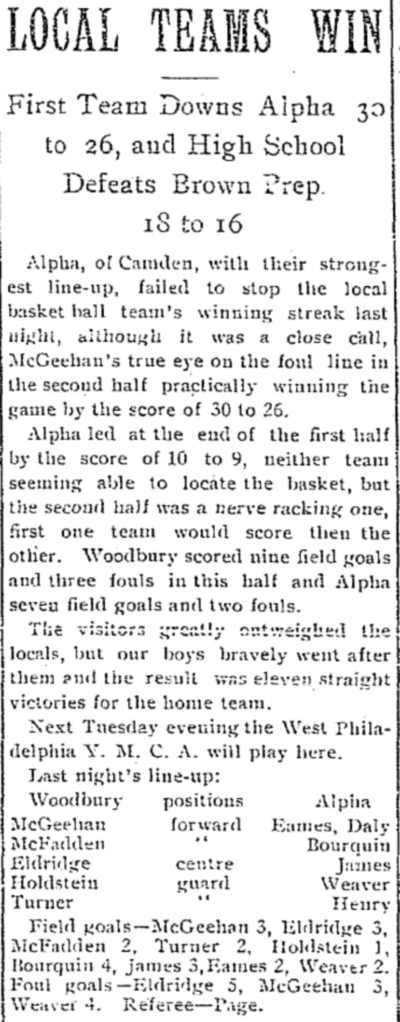
First Team Downs Alpha 30 to 26, and High School Defeats Brown Prep. 18 to 16
Alpha, of Camden, with their strongest line-up, failed to stop the local basket ball team's winning streak last night, although it was a close call, McGeehan's true eye on the foul line in the second half practically winning the game by the score of 30 to 26.
Alpha led at the end of the first half by the score of 10 to 9, neither team seeming able to locate the basket, but the second half was a nerve racking one, first one team would score then the other. Woodbury scored nine field goals and three fouls in this half and Alpha seven field goals and two fouls.
The visitors greatly outweighed the locals, but our boys bravely went after them and the result was eleven straight victories for the home team.
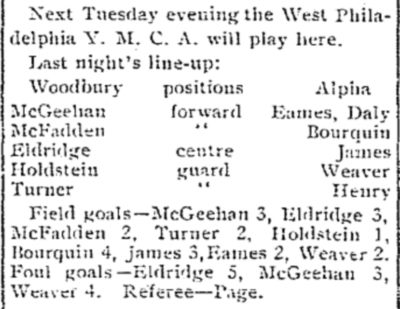
Next Tuesday evening the West Philadelphia Y. M. C. A. will play here.
Last night's line-up:
Woodbury — positions — Alpha
McGeehan — forward — Eames, Daly
McFadden — „ — Bourquin
Eldridge — centre — James
Holdstein — guard — Weaver
Turner — „ — Henry
Field goals—McGeehan 3, Eldridge 3, McFadden 2, Turner 2, Holdstein 1, Bourquin 4, James 3, Eames 2, Weaver 2. Foul goals—Eldridge 5, McGeehan 3, Weaver 4. Referee—Page.
Alpha Club — 1909–1910
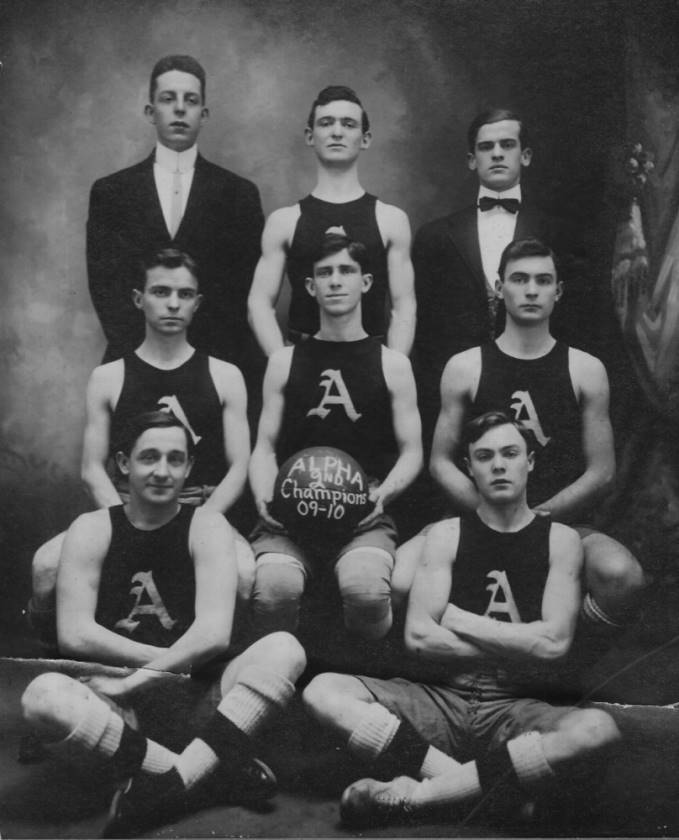
Alpha Club basketball team, 1909–1910, Camden city champions. Eight men are pictured in jerseys lettered “A” (two of the back row wear suits); the ball is lettered “Alpha Champions 09-10.” Horace B. Parker Jr. is identified as one of them; the picture prints no names, and his place in it is not recorded. The Alphas were not in a professional league that season, but were apparently in a loose confederation of independent teams. They joined the Eastern Basketball League the following season.
The Alpha Club retained ownership of the team until January of 1915, when they sold it to a group headed by Camden veterinarian Dr. Charles B. Helm. The Alphas finished in a three-way tie for first in 1913–1914, losing in the playoffs, and in a two-way tie the next season, where no playoff was held. They were pretty much a .500 team through the beginning of the 1917–1918 season, when play was suspended due to America’s involvement in World War I. During these years the Alphas’ star player was Jackie Adams. Other mainstays included Roy Steele, Jimmy Brown, Eddie Dolin, Eddie Ferat, and Neil Deighan.
The Eastern Basket Ball League resumed play in 1919, with Dolin, Steele, and Neil Deighan returning. New players included James “Soup” Campbell, Joe Hyde, Sam Lennox, Dave Kerr and Rich Deighan, Neil’s younger brother. Re-named, the Camden Crusaders totally dominated the league, winning both the first and second halves and eliminating a need for a playoff. Campbell led the league in scoring, with Dolin, Steele, and Kerr also being among the league’s top 10.
The Crusaders were good in 1920–1921, but not good enough, finishing one game out of first place in both half seasons. The team was again renamed for the 1921–1922 season, and as the Camden Skeeters, they again were good but not the best, finishing second in both halves once again. The 1922–1923 season looked to be more of the same, as the Skeeters were second in the first half. Sadly, with only three games played in the second half, the league suspended operations.
Interestingly enough, five of the 1919–1920 championship team became mainstays in the bar and restaurant business in Camden for many years after their sporting days were over. Neil Deighan built the establishment known since the 1950s as The PUB, which is still thriving on the Airport Circle in Pennsauken 85 years after that championship season. Roy Steele had a bar on Carman Street east of Broadway for years, built a floating nightclub on the Cooper River, and a bar and restaurant at the Jersey shore. Joe Hyde took over his father’s bar in the old Eighth Ward, Soup Campbell had a spot just off of Federal Street, and Sam Lennox was involved at the old Hudson Tavern.
After two seasons off, the Eastern Basketball League returned for the 1925–1926 season, but was by this time pretty much a semi-pro organization. The Camden team went 1-11 in the first half and did not play at all in the second. After another two-year hiatus, a reorganized EBL returned for the 1929–1930 season. The Camden team featured one of the Deighans, Joe Hyde, and Sam Lennox, all past their primes and was arguably the worst team in the league. They were somewhat better during the 1930–1931 season but were again awful in their final year, 1931–1932. Another Camden team played during the 1934–1935 season and were the second-half champions, losing in the playoffs to the Philadelphia Phillies, who were not affiliated with the baseball club. During these years players of note included Bart Sheehan, Ed Lobley, and Grover “Worm” Wearshing. The Eastern League folded after that. Pro basketball would not return to Camden for over 25 years, when the Camden Bullets arrived.
Basketball Fans to Follow Eastern League Team
Camden Post-Telegram —
Scores of downtown basketball bugs will accompany the local Eastern League team to Cooper Battalion Hall, Philadelphia, this evening, and root for Adams and his colleagues to atone for their recent defeat by walloping Greystock.
William 'Billy' Morgenweck
WILLIAM E. “BILLY” MORGENWECK was born September 9, 1869 in New York State. He was, with a relation, Frank “Pop” Morgenweck, one of the organizers of the first basketball league in the United States in the 1890s, the National Basketball League. Billy Morgenweck took to the then-new game as well, as an owner and player-coach of the Camden Electrics. The Electrics, paced by star guard Charles Bossert, were one of the top teams of the early 1900s, playing at the old Sixth Regiment Armory at West and Mickle Streets. The 1902-03 Electrics won 36 times against only 9 defeats. As Camden won both halves of the season they were awarded the NBL pennant and cup without the necessity of any playoff games. He also coached Charlie Newcomb, who went on to fame as a trap shooter. The league folded during the 1903-04 season. Billy Morgenweck was subsequently sued by investors in the team, including local businessman Sig Schoenagle.
After the breakup of the NBL, Billy Morgenweck left the sport, but returned as coach of the Camden Alphas in the Eastern Basketball League in the 1910s, tying for first in the league in 1913-14 and 1914-15. By 1920 he owned a property at 17 Broadway, near Federal Street, in Camden, where he lived and operated a tailor’s shop, with wife Margaret and son William P. Morgenweck.
Billy Morgenweck passed away on March 9, 1930. He was survived by his wife Margaret and son William P. Morgenweck, who owned a dyeing factory. Billy Morgenweck was buried at Harleigh Cemetery in Camden NJ.
Statistics of Camden Players in the Eastern Basket Ball League
1909-10 to 1917-18, 1919-20 to 1922-23. Contributed by John Grasso and Robert Bradley of the Association for Professional Basketball Research.
| 1910–11 EBL — Camden Alphas | |||||
|---|---|---|---|---|---|
| Name | G | FG | FT | TP | PPG |
| Howard “Kidder” Bourquin | 22 | 17 | 0 | 34 | 1.5 |
| Ormond “Army” Fitzgerald | 38 | 83 | 116 | 282 | 7.4 |
| Ford | 5 | 3 | 0 | 6 | 1.2 |
| Jimmy Kane | 1 | 2 | 0 | 4 | 4.0 |
| Gus Krueger | 29 | 20 | 0 | 40 | 1.4 |
| Loos | 29 | 36 | 0 | 72 | 2.5 |
| Bill Lukens | 22 | 20 | 28 | 68 | 3.1 |
| Walter McCallion | 37 | 71 | 33 | 175 | 4.7 |
| Paterson | 4 | 1 | 0 | 2 | 0.5 |
| Howard Thomas | 36 | 35 | 314 | 384 | 10.7 |
| Kirk Thomas | 38 | 41 | 0 | 82 | 2.2 |
| Weaver | 9 | 1 | 0 | 2 | 0.2 |
| 1911–12 EBL — Camden Alphas | |||||
|---|---|---|---|---|---|
| Name | G | FG | FT | TP | PPG |
| Howard “Kidder” Bourquin | 22 | 17 | 0 | 34 | 1.5 |
| Ormond “Army” Fitzgerald | 38 | 83 | 116 | 282 | 7.4 |
| Ford | 5 | 3 | 0 | 6 | 1.2 |
| Jimmy Kane | 1 | 2 | 0 | 4 | 4.0 |
| Gus Krueger | 29 | 20 | 0 | 40 | 1.4 |
| Loos | 29 | 36 | 0 | 72 | 2.5 |
| Bill Lukens | 22 | 20 | 28 | 68 | 3.1 |
| Walter McCallion | 37 | 71 | 33 | 175 | 4.7 |
| Paterson | 4 | 1 | 0 | 2 | 0.5 |
| Howard Thomas | 36 | 35 | 314 | 384 | 10.7 |
| Kirk Thomas | 38 | 41 | 0 | 82 | 2.2 |
| Weaver | 9 | 1 | 0 | 2 | 0.2 |
| 1912–13 EBL — Camden Alphas | |||||
|---|---|---|---|---|---|
| Name | G | FG | FT | TP | PPG |
| Jack Adams | 34 | 91 | 467 | 649 | 19.1 |
| Blackburne | 2 | 1 | 0 | 2 | 1.0 |
| Howard “Kidder” Bourquin | 10 | 10 | 0 | 20 | 2.0 |
| W. Brooks | 4 | 3 | 0 | 6 | 1.5 |
| Jimmy Brown | 34 | 72 | 15 | 159 | 4.7 |
| Eddie Dolin | 34 | 64 | 0 | 128 | 3.8 |
| John Featherstone | 10 | 5 | 0 | 10 | 1.0 |
| Eddie Ferat | 5 | 4 | 17 | 25 | 5.0 |
| Howard “Pud” Henry | 1 | 0 | 0 | 0 | 0.0 |
| Bill Herron | 29 | 26 | 0 | 52 | 1.8 |
| Gus Krueger | 2 | 0 | 0 | 0 | 0.0 |
| Loos | 2 | 0 | 0 | 0 | 0.0 |
| Allie McLaughlin | 36 | 20 | 0 | 40 | 1.1 |
| Jack Nugent | 2 | 0 | 0 | 0 | 0.0 |
| Roy Steele | 1 | 3 | 0 | 6 | 6.0 |
| Kirk Thomas | 5 | 2 | 0 | 4 | 0.8 |
| Thompson | 11 | 10 | 0 | 20 | 1.8 |
| Weaver | 2 | 0 | 0 | 0 | 0.0 |
| 1913–14 EBL — Camden Alphas | |||||
|---|---|---|---|---|---|
| Name | G | FG | FT | TP | PPG |
| Jack Adams | 39 | 76 | 507 | 659 | 16.9 |
| Jimmy Brown | 38 | 98 | 14 | 210 | 5.5 |
| Rube Cashman | 28 | 23 | 7 | 53 | 1.9 |
| Deighan | 3 | 4 | 0 | 8 | 2.7 |
| Eddie Dolin | 40 | 57 | 1 | 115 | 2.9 |
| Eddie Ferat | 2 | 2 | 0 | 4 | 2.0 |
| Bill Herron | 38 | 23 | 0 | 46 | 1.2 |
| Roy Steele | 11 | 18 | 0 | 36 | 3.3 |
| Walter Swenson | 12 | 12 | 0 | 24 | 2.0 |
| Thompson | 15 | 16 | 0 | 32 | 2.1 |
| White | 1 | 1 | 5 | 7 | 7.0 |
| 1914–15 EBL — Camden Alphas | |||||
|---|---|---|---|---|---|
| Name | G | FG | FT | TP | PPG |
| Jack Adams | 37 | 66 | 482 | 614 | 16.6 |
| Jimmy Brown | 34 | 117 | 30 | 264 | 7.8 |
| Neil Deighan | 28 | 32 | 0 | 64 | 2.3 |
| Eddie Dolin | 40 | 108 | 1 | 217 | 5.4 |
| Bill Herron | 22 | 5 | 0 | 10 | 0.5 |
| Roy Steele | 40 | 114 | 0 | 228 | 5.7 |
| 1915–16 EBL — Camden Alphas | |||||
|---|---|---|---|---|---|
| Name | G | FG | FT | TP | PPG |
| Jack Adams | 40 | 71 | 527 | 669 | 16.7 |
| Jimmy Brown | 39 | 132 | 2 | 266 | 6.8 |
| Deighan | 37 | 43 | 0 | 86 | 2.3 |
| Eddie Dolin | 40 | 94 | 0 | 188 | 4.7 |
| Eddie Ferat | 11 | 9 | 0 | 18 | 1.6 |
| Hayney | 9 | 2 | 0 | 4 | 0.4 |
| Roy Steele | 40 | 72 | 0 | 144 | 3.6 |
| 1916–17 EBL — Camden Alphas | |||||
|---|---|---|---|---|---|
| Name | G | FG | FT | TP | PPG |
| Jack Adams | 39 | 55 | 547 | 657 | 16.8 |
| Jimmy Brown | 40 | 125 | 13 | 263 | 6.6 |
| Creeley | 8 | 11 | 0 | 22 | 2.8 |
| Neil Deighan | 40 | 56 | 0 | 112 | 2.8 |
| Eddie Dolin | 39 | 84 | 0 | 168 | 4.3 |
| Brad Hall | 1 | 1 | 0 | 2 | 2.0 |
| Hayney | 7 | 2 | 0 | 4 | 0.6 |
| Roy Steele | 36 | 76 | 0 | 152 | 4.2 |
| 1917–18 EBL — Camden Alphas | |||||
|---|---|---|---|---|---|
| Name | G | FG | FT | TP | PPG |
| Jimmy Brown | 5 | 16 | 11 | 43 | 8.6 |
| Neil Deighan | 6 | 8 | 11 | 27 | 4.5 |
| Engle | 6 | 6 | 13 | 25 | 4.2 |
| Kelly | 4 | 5 | 4 | 14 | 3.5 |
| Kilpatrick | 2 | 1 | 2 | 4 | 2.0 |
| Miller | 1 | 1 | 2 | 4 | 4.0 |
| Roy Steele | 6 | 15 | 9 | 39 | 6.5 |
| 1919–20 EBL — Camden Crusaders | |||||
|---|---|---|---|---|---|
| Name | G | FG | FT | TP | PPG |
| James “Soup” Campbell | 37 | 91 | 93 | 275 | 7.4 |
| Neil Deighan | 38 | 57 | 65 | 179 | 4.7 |
| Rich Deighan | 3 | 5 | 4 | 14 | 4.7 |
| Eddie Dolin | 37 | 78 | 66 | 222 | 6.0 |
| Joe Hyde | 11 | 3 | 6 | 12 | 1.1 |
| Dave Kerr | 37 | 74 | 50 | 198 | 5.4 |
| Dick Leary | 1 | 2 | 2 | 6 | 6.0 |
| Sam Lennox | 16 | 9 | 7 | 25 | 1.6 |
| Roy Steele | 37 | 79 | 52 | 210 | 5.7 |
| 1920–21 EBL — Camden Crusaders | |||||
|---|---|---|---|---|---|
| Name | G | FG | FT | TP | PPG |
| James “Soup” Campbell | 26 | 57 | 63 | 177 | 6.8 |
| Neil Deighan | 35 | 59 | 45 | 163 | 4.7 |
| Sam Deines | 6 | 4 | 1 | 9 | 1.5 |
| Eddie Dolin | 38 | 99 | 73 | 271 | 7.1 |
| Dave Kerr | 38 | 75 | 54 | 204 | 5.4 |
| Ross Steele | 6 | 0 | 0 | 0 | 0.0 |
| Roy Steele | 39 | 77 | 71 | 225 | 5.8 |
| Lou Sugarman | 23 | 32 | 33 | 97 | 4.2 |
| 1921–22 EBL — Camden Skeeters | |||||
|---|---|---|---|---|---|
| Name | G | FG | FT | TP | PPG |
| James “Soup” Campbell | 45 | 136 | 136 | 408 | 9.1 |
| Costello | 8 | 16 | 8 | 40 | 5.0 |
| Neil Deighan | 40 | 46 | 47 | 139 | 3.5 |
| Sam Deines | 7 | 2 | 3 | 7 | 1.0 |
| Eddie Dolin | 47 | 101 | 94 | 296 | 6.3 |
| Oscar Grimstead | 12 | 9 | 7 | 25 | 2.1 |
| Dave Kerr | 44 | 96 | 68 | 260 | 5.9 |
| Roy Steele | 46 | 89 | 56 | 234 | 5.1 |
| 1922–23 EBL — Camden Skeeters | |||||
|---|---|---|---|---|---|
| Name | G | FG | FT | TP | PPG |
| James “Soup” Campbell | 23 | 59 | 79 | 197 | 8.6 |
| Neil Deighan | 22 | 26 | 22 | 74 | 3.4 |
| Eddie Dolin | 21 | 40 | 31 | 111 | 5.3 |
| Dave Kerr | 23 | 5 | 30 | 140 | 6.1 |
| Roy Steele | 22 | 57 | 31 | 145 | 6.6 |
| Charles “Skeets” Wright | 14 | 8 | 31 | 47 | 3.4 |
Standings of Camden in the Eastern Basket Ball League
1909-10 to 1917-18, 1919-20 to 1922-23. Contributed by John Grasso and Robert Bradley of the Association for Professional Basketball Research.
| 1909–10 EBL | |||
|---|---|---|---|
| Team | W | L | Pct. |
| Trenton Potters | 20 | 10 | .667 |
| Reading Bears | 20 | 10 | .667 |
| Jasper Jewels | 18 | 12 | .600 |
| DeNeri | 15 | 15 | .500 |
| Sixth Regiment/Germantown** | 11 | 19 | .367 |
| Elizabeth/Princeton Tigers* | 6 | 24 | .261 |
*Elizabeth was replaced by Princeton 18Dec08 who assumed their 0-7 record. **Sixth Regiment moved to Germantown 4Jan10. EBL PLAYOFF: 22Mar10 at Trenton — Trenton 34, Reading 18. 24Mar10 at Reading — Reading 29, Trenton 24. 25Mar10 at Trenton — Trenton 33, Reading 24.
| 1910–11 EBL | |||
|---|---|---|---|
| Team | W | L | Pct. |
| DeNeri | 28 | 12 | .700 |
| Jasper Jewels | 23 | 17 | .575 |
| Greystock Greys | 22 | 18 | .550 |
| Reading Bears | 21 | 19 | .525 |
| Camden Alphas | 14 | 26 | .350 |
| Trenton Potters | 12 | 28 | .300 |
WORLD SERIES OF BASKETBALL [DeNeri — EL, McKeesport — CBL]: 1Apr11 at DeNeri (Philadelphia) — McKeesport 33, DeNeri 22. 8Apr11 at DeNeri (Philadelphia) — McKeesport 35, DeNeri 21. 12Apr11 at Pittsburgh — McKeesport 42, DeNeri 22. 15Apr11 at Pittsburgh — McKeesport 57, DeNeri 20.
| 1911–12 EBL | |||
|---|---|---|---|
| Team | W | L | Pct. |
| Trenton Potters | 29 | 11 | .725 |
| Jasper Jewels | 29 | 11 | .725 |
| Greystock Greys | 20 | 20 | .500 |
| DeNeri | 18 | 22 | .450 |
| Camden Alphas | 13 | 27 | .350 |
| Reading Bears | 11 | 29 | .275 |
EBL CHAMPIONSHIP: 6Apr12 at Trenton — Trenton 30, Jasper 13. 11Apr12 at Jasper (Philadelphia) — Jasper 28, Trenton 22. 19Apr12 at Trenton — Trenton 19, Jasper 15.
| 1912–13 EBL | |||
|---|---|---|---|
| Team | W | L | Pct. |
| Reading Bears | 30 | 10 | .750 |
| DeNeri | 29 | 11 | .725 |
| Trenton Potters | 21 | 19 | .525 |
| Jasper Jewels | 20 | 20 | .500 |
| Camden Alphas | 11 | 29 | .275 |
| Greystock Greys | 9 | 31 | .225 |
PLAYOFF SERIES FOR EASTERN TITLE [Reading — EBL vs. Troy — NYSL]: 1Apr13 at Reading — Reading 38, Troy 24. 2Apr13 at Reading — Reading 33, Troy 16. 8Apr13 at Troy — Troy 28, Reading 14. 9Apr13 at Troy — Troy 47, Reading 13. 19Apr13 at Reading — Reading 31, Troy 29.
| 1913–14 EBL | |||
|---|---|---|---|
| Team | W | L | Pct. |
| Jasper Jewels | 23 | 17 | .575 |
| Camden Alphas | 23 | 17 | .575 |
| Trenton Potters | 23 | 17 | .575 |
| Reading Bears | 22 | 18 | .550 |
| DeNeri | 20 | 20 | .500 |
| Greystock Greys | 9 | 31 | .225 |
EBL PLAYOFF SERIES: 23Mar14 at Trenton — Trenton 30, Camden 24. 25Mar14 at Camden — Camden 34, Trenton 22. 26Mar14 at Jasper — Jasper 42, Camden 18. 27Mar14 at Trenton — Jasper 24, Trenton 20. 28Mar14 at Camden — Camden 33, Jasper 24. 30Mar14 at Jasper — Jasper 29, Trenton 20.
| 1914–15 EBL | |||
|---|---|---|---|
| Team | W | L | Pct. |
| Camden Alphas | 25 | 15 | .625 |
| Reading Bears | 25 | 15 | .625 |
| Trenton Potters | 20 | 20 | .500 |
| Greystock Greys | 18 | 22 | .450 |
| DeNeri | 17 | 23 | .425 |
| Jasper Jewels | 15 | 25 | .375 |
EBL PLAYOFF SERIES: 23Mar15 at Camden — Camden 45, Reading 35. 24Mar15 at Reading — Reading 52, Camden 29. Third game not played as teams couldn’t agree on site.
| 1915–16 EBL | |||
|---|---|---|---|
| Team | W | L | Pct. |
| Greystock Greys | 27 | 13 | .675 |
| Reading Bears | 23 | 17 | .575 |
| Camden Alphas | 21 | 19 | .525 |
| DeNeri | 20 | 20 | .500 |
| Jasper Jewels | 17 | 23 | .425 |
| Trenton Potters | 12 | 28 | .300 |
WORLD SERIES CHAMPIONSHIPS [Greystock — EBL, Paterson — IBL, Wilkes-Barre — PSL]: 7Apr16 at Greystock — Greystock 38, Paterson 16. 8Apr16 at Paterson — Paterson 30, Greystock 17. Third game scheduled at Greystock but Paterson declined to play and Greystock claimed forfeit victory. 12Apr16 at Wilkes-Barre — Wilkes-Barre 31, Paterson 22. 15Apr16 at Paterson — Wilkes-Barre 22, Paterson 17.
| 1916–17 EBL | ||||||
|---|---|---|---|---|---|---|
| Team | First Half | Second Half | ||||
| W | L | Pct. | W | L | Pct. | |
| Jasper Jewels | 14 | 6 | .700 | 10 | 10 | .500 |
| Greystock Greys | 12 | 8 | .600 | 14 | 6 | .700 |
| Reading Coal Barons | 12 | 8 | .600 | 10 | 10 | .500 |
| Camden Alphas | 11 | 9 | .550 | 10 | 10 | .500 |
| Trenton Potters | 10 | 10 | .500 | 10 | 10 | .500 |
| DeNeri | 1 | 19 | .050 | 6 | 14 | .300 |
EBL CHAMPIONSHIP: 21Mar17 at Camden — Jasper 30, Greystock 26. 26Mar17 at Camden — Greystock 35, Jasper 17. 30Mar17 at Camden — Greystock 23, Jasper 21.
| 1917–18 EBL | |||
|---|---|---|---|
| Team | W | L | Pct. |
| Jasper Jewels | 4 | 2 | .667 |
| DeNeri | 5 | 3 | .625 |
| Trenton Potters | 4 | 3 | .571 |
| Greystock Greys | 4 | 3 | .571 |
| Camden | 2 | 4 | .333 |
| Reading Bears | 2 | 6 | .250 |
The league suspended play on 03Dec17. 1918–19: No season due to World War I.
| 1919–20 EBL — Second Half | |||
|---|---|---|---|
| Team | W | L | Pct. |
| Camden Crusaders | 15 | 4 | .789 |
| Reading Bears | 10 | 8 | .556 |
| Trenton Potters | 11 | 9 | .550 |
| Germantown G’s | 10 | 10 | .500 |
| DeNeri | 7 | 11 | .389 |
| Bridgeport Blue Ribbons | 4 | 15 | .211 |
*North Philadelphia dropped out during the first half. No championship series necessary since Camden won both halves.
| 1920–21 EBL | ||||||
|---|---|---|---|---|---|---|
| Team | First Half | Second Half | ||||
| W | L | Pct. | W | L | Pct. | |
| Reading Bears | 15 | 5 | .750 | 11 | 9 | .550 |
| Trenton Tigers | 15 | 5 | .750 | 11 | 9 | .550 |
| Camden Crusaders | 14 | 6 | .700 | 15 | 5 | .750 |
| Philadelphia | 7 | 13 | .350 | 5 | 15 | .250 |
| Germantown | 5 | 15 | .250 | 16 | 4 | .800 |
| Newark/Coatesville* | 4 | 11 | .267 | 4 | 16 | .200 |
*Newark was dropped from the league 20Nov20 with a record of 0-5 and was replaced by Coatesville who assumed their record. EBL FIRST HALF PLAYOFF: Reading 27, Trenton 19. EBL CHAMPIONSHIP: At Germantown — Germantown 30, Reading 14. At Reading — Germantown 30, Reading 25.
| 1921–22 EBL | ||||||
|---|---|---|---|---|---|---|
| Team | First Half | Second Half | ||||
| W | L | Pct. | W | L | Pct. | |
| Trenton Tigers | 24 | 3 | .889 | 15 | 5 | .750 |
| Camden Skeeters | 20 | 7 | .741 | 15 | 5 | .750 |
| Scranton Miners*** | 11 | 11 | .500 | — | — | — |
| Wilkes-Barre | 10 | 13 | .435 | 3 | 13 | .188 |
| Reading Bears | 10 | 14 | .417 | 2 | 15 | .118 |
| Coatesville Coats | 8 | 14 | .364 | 5 | 14 | .263 |
| Philadelphia** | 5 | 15 | .250 | — | — | — |
| Harrisburg/New York* | 5 | 16 | .238 | — | — | — |
| New York Celtics | — | — | — | 16 | 4 | .800 |
***Scranton dropped out. **Philadelphia dropped out. *Harrisburg transferred to the New York Whirlwinds 16Nov21 who were dropped by the league on 19Dec21 and replaced by the New York Celtics during the first half. EBL CHAMPIONSHIP: 31Mar22 at Trenton — New York 24, Trenton 20. 1Apr22 at New York — Trenton 22, New York 17. Apr22 at Camden — New York 27, Trenton 22.
| 1922–23 EBL | ||||||
|---|---|---|---|---|---|---|
| Team | First Half | Second Half | ||||
| W | L | Pct. | W | L | Pct. | |
| Trenton Tigers | 16 | 3 | .842 | 2 | 1 | .667 |
| Camden Skeeters | 16 | 4 | .800 | 2 | 1 | .667 |
| Coatesville Coats | 9 | 11 | .450 | 2 | 2 | .500 |
| Atlantic City** | 7 | 10 | .412 | — | — | — |
| Philadelphia Jasper Jewels | 5 | 13 | .385 | 0 | 2 | .000 |
| Reading Bears* | 3 | 15 | .167 | — | — | — |
The league disbanded on 18Jan23. **The Atlantic City Sandpipers were replaced by the Atlantic City Celtics who dropped out during the first half. *Reading dropped out during the first half of the season.
Five Clubs Line Up in Eastern League
Camden Courier-Post —
York and Brooklyn Visitations Seen as Sixth Club Possibility
Either the Brooklyn Visitations or York (Pa.) clubs may be admitted into the Eastern Basketball League to round out a six-club circuit.
This was learned at the reorganization meeting of the league last night in Philadelphia after it became definitely known that Reading will not enter the race this season and that Trenton has been counted out of it as a possibility.
Curly Christian, manager of the Reading Bears last season, announced that the club is unable to secure a hall for the team, while it was learned that efforts to place a team in Trenton also failed. It was then brought out that both York and Brooklyn Visitations might look favorably on a chance to enter the circuit, and it is understood that the league will make overtures to the managers of both clubs.
The addition of the Brooklyn Visitations or York would be welcomed by the circuit, as it is understood that both clubs can play Sunday basketball and their ability to cope with the other teams in the league is well known.
Camden, Bridgeton, Sphas, Wilmington and the Philadelphia Moose posted franchise money at the meeting last night, after William Scheffer was re-elected president of the organization. Caddy Franklin was again named secretary, and Ben Emery was elected vice-president.
Playing nights at home for the various clubs also were set. Camden and Wilmington drew Wednesday nights, the Sphas, last year’s champions, are at home Thursday nights; Moose, formerly the Philadelphia Elks, have Saturday night and Bridgeton will be at home on Tuesday nights.
No definite date has as yet been set for the start of the first half, but another meeting will be held on Friday night when a schedule committee will be appointed.
Jasper Gets Franchise in Eastern Court Loop
Camden Courier-Post —
League to Open Season November 9; Bridgeton in Opener Here on 11th
Camden Strengthened
Howard Wood’s Jasper Club, of Kensington, was admitted to the Eastern Basketball League last night, to round out a six-club circuit.
Jasper, one of the standbys of the Eastern League a decade or more ago, was given the preference by the Eastern League moguls over several applicants for the vacant berth at the final meeting of the circuit in Philadelphia last night.
The team managed by Wood, former Hancock star of the old Philadelphia League, is expected to be one of the strongest in the circuit. While Wood gave no inkling to his possible roster, it is reported that several of last season’s Reading players, notably Teddy Kearns and George Glascoe, will be in the line-up as well as several other stars well known to local fandom.
The season will open on Monday, November 10, when Philadelphia Moose (formerly the Elks) invade Kensington to test the new Jasper team. The following night the champion Sphas travel to Bridgeton, while the Norman Cochrane–Jimmy Brown coached Camden “Skeeters” will open their season here on Wednesday night of the same week when Bridgeton is entertained.
The remainder of the first week’s schedule finds Jasper invading Wilmington on Wednesday night, the Sphas entertaining Jasper on Thursday night, and Camden stacking up against the Moose on Friday night at Broad and Thompson Streets, Philadelphia.
The remainder of the first half schedule will be released shortly by Caddy Franklin, league secretary.
With the brilliant Joey Sheehan and “Skin” Bollerman added to the already fine Camden team, the Skeeters appear due for a great campaign on the wooden way.
The local pilots announced last night that the opening lineup will probably have Eddie Lobley and “Sure Shot” Johnson as the forwards; Jacobs, center, with Joe Sheehan and Bill Bergen at the defensive positions. Bart Sheehan and Bollerman also are available and either may get the last minute call for starting duty.
Court Stars of Yesteryear Plan to Turn Out for Dinner
Camden Courier-Post —
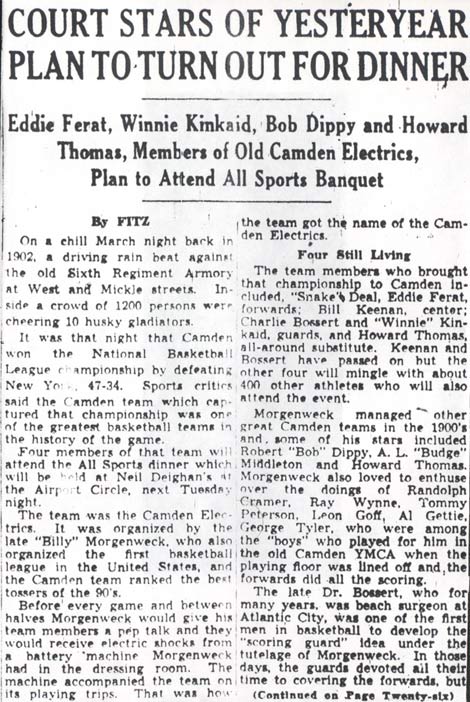
Eddie Ferat, Winnie Kinkaid, Bob Dippy and Howard Thomas, Members of Old Camden Electrics, Plan to Attend All Sports Banquet
By FITZ
On a chill March night back in 1902, a driving rain beat against the old Sixth Regiment Armory at West and Mickle streets. Inside a crowd of 1200 persons were cheering 10 husky gladiators.
It was that night that Camden won the National Basketball League championship by defeating New York, 47-34. Sports critics said the Camden team which captured that championship was one of the greatest basketball teams in the history of the game.
Four members of that team will attend the All Sports dinner which will be held at Neil Deighan’s at the Airport Circle, next Tuesday night.
The team was the Camden Electrics. It was organized by the late “Billy” Morgenweck, who also organized the first basketball league in the United States, and the Camden team ranked the best tossers of the 90’s.
Before every game and between halves Morgenweck would give his team members a pep talk and they would receive electric shocks from a battery machine Morgenweck had in the dressing room. The machine accompanied the team on its playing trips. That was how the team got the name of the Camden Electrics.
Four Still Living
The team members who brought that championship to Camden included, “Snake” Deal, Eddie Ferat, forwards; Bill Keenan, center; Charlie Bossert and “Winnie” Kinkaid, guards; and Howard Thomas, all-around substitute. Keenan and Bossert have passed on but the other four will mingle with about 400 other athletes who will also attend the event.
Morgenweck managed other great Camden teams in the 1900’s and some of his stars included Robert “Bob” Dippy, A. L. “Budge” Middleton and Howard Thomas. Morgenweck also loved to enthuse over the doings of Randolph Cramer, Ray Wynne, Tommy Peterson, Leon Goff, Al Gettie, George Tyler, who were among the “boys” who played for him in the old Camden YMCA when the playing floor was lined off and the forwards did all the scoring.
The late Dr. Bossert, who for many years was beach surgeon at Atlantic City, was one of the first men in basketball to develop the “scoring guard” idea under the tutelage of Morgenweck. In those days, the guards devoted all their time to covering the forwards, but when Morgenweck developed the “guards up” play, the idea revolutionized the game. Bossert was a wonder in going up the floor and scoring on center plays.
New York Also Had Stars
The old aggregation played in the Sixth Regiment Armory which figured in a tragic fire some years ago. Such popular figures as “Al” Wendelken and Bob Abadie played with the brilliant New York aggregation while “Sandy” Shields, “Reddy” Barber and John Penino were other stars in the circuit.
With the development of basketball in the New England states and in the old Central League in western Pennsylvania, Morgenweck retired from the basketball picture about 1904, but got back into harness again as coach of the Camden Alpha team in the Eastern League. Ormond “Army” Fitzgerald, Walter McCallion, Charles “Jesse” James, Frank Eames, Howard Thomas, Howard “Kidder” Bourquin and Howard “Bud” Henry were among the players on the team at that time. He gave up the game after several strenuous seasons and was succeeded by the late Ward Snyder, who was responsible for the introduction of Jackie Adams, Jimmy Brown and Eddie Dolin to Camden fans in Alpha uniforms.
Skeeters Brought Camden Only E.L. Court Crown
Camden Courier-Post —
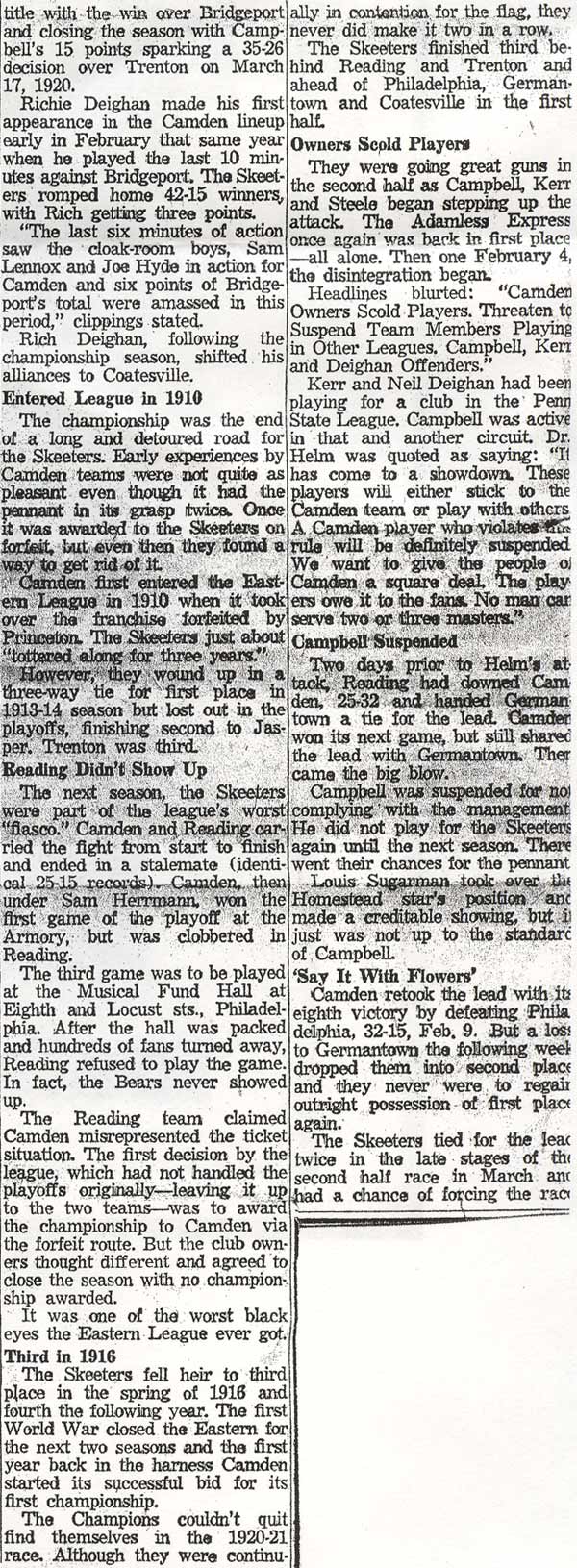
Dolin, N. Deighan, Campbell, Kerr, Steele 1919-20 Pro Champions
By JACK CARTY
There was an era when Camden was known for more than its production of ships, soups, radios and sundry other commercial items. That was when the Camden Skeeters were the scourge of the Eastern Professional Basketball League.
It was over 35 years ago when a banner line screamed across four columns of an old Daily Courier sports page proclaiming that “All Hail the Champions!”
The date was March 11, 1920. It was the day after the Camden team won its first and only championship of the old Eastern League.
Kennedy Was Manager
After 10 years of striving to bring home the coveted flag, Manager “Whispering Will” Kennedy’s Skeeters sewed up the title by defeating the Bridgeport, Conn., quintet, 45-34 at the Third Regiment Armory, now known as the Camden Armory at Haddon avenue and Mickle st.
The date is a memorable one for many, especially those who were around in the days when professional basketball was “the thing” in Camden. Days when such outstanding stars as Neil Deighan, Jimmy “Soup” Campbell, Rich Deighan, Dave Kerr, Roy Steele, Eddie Dolin and others were the masters of the cage game. They mastered it to the delight of two and three thousand fans every time they stepped on the floor at the Armory.
That season and that 1919-20 basketball team provide one of the proudest sports memories in the history of Camden. Although its short-lived glory lasted for less than two years, the mark the Skeeters left is indelible.
Corson, Helm Owners
The Skeeters, owned and financed by former Sheriff W. Penn Corson and Dr. Charles B. Helm, a veterinarian, had many near misses in the search for the pennant. But they never made the direct hit until Kennedy stepped into the picture.
It was the first season the Eastern League had resumed operation following World War I that the ex-Jasper coach took over the club.
He molded a winner with three veterans of former years—Steele, the captain, Dolin and Neil Deighan—with a couple of comparative unknowns, Kerr, and a youngster named Campbell.
With this aggregation as his nucleus, Kennedy won the pennant for Camden and it seemed that only he could have done it.
Frank H. Ryan, late editor of The Courier-Post, who then was sports editor of The Daily Courier, wrote of Kennedy following the team’s successful first half finish:
Describes Kennedy
“He has been connected with the cage game for a score of years, never bullyrags his men and can get results where others fail. Working hand and glove with Steele, who is captain and the king pin of the men on the floor, Kennedy has succeeded in giving Camden what others have failed to do, namely, the much coveted pennant. If the Skeeters can crown their achievement with the second half crown the natives from the city of ships, phonographs, soaps, furniture and fair zone activities can well afford to look our way and give us a silent sneer.”
And they did.
The Skeeters went right on to win 16 more games and the second half, which also included the “much coveted pennant.” They tied a league record of the Reading Bears with 30 wins per season, even though they had one more loss—10.
‘Reading Bear Pit’
Ryan had said of the Skeeters: “The desire to do the right thing at the right moment, a willingness for team play and a general pull together spirit made a combination which the other five teams found too formidable to surmount.” That was one description of the champions.
One of the biggest moments of that glorious season was marked when, for the first time in more than five seasons, Camden was able to beat Reading on the latter’s own court. The Skeeters prevailed 31-24 in the “Reading Bear Pit.”
Campbell, the import from Homestead, Pa., playing his first year in the “fast” ranks of professional basketball, fired the victory with an 11-point effort. That was Jan. 31, 1920—one of the opening games of the second half.
Wallop DeNeri
Prior to that, Campbell, Dolin and Neil Deighan were consistent leaders in point-making to spark the team to the first half championship.
During the season, Germantown, second place finisher in both halves, Trenton, Reading, DeNeri (Philadelphia) Bridgeport and North Philadelphia competed. Bridgeport took over the North Philadelphia franchise in the second half, after the North Phillies dropped out of the league.
In one game against DeNeri, Camden broke all existing records when it beat the Philadelphians, 53-28. Twenty-three field goals were registered by the “coming champs” that December night in 1919.
Campbell set the pace with seven double deckers, tieing the individual high score record for the season.
Only Two Regulars
DeNeri took the floor at the Armory with but two regulars in the lineup. That was blamed for the rout. The other regulars were playing with teams in other leagues—a situation which was to cost the Skeeters the pennant the following season.
The opening account of that particular Camden-DeNeri game read: “That the Eastern League is due to regret the rule which allows its men to play in other leagues was demonstrated by the misfit combination that Manager Myers, of De Neri, brought to this city last night to oppose the local league leaders at the Third Regiment Armory.”
The rule later was amended by league president William J. Scheffer. The amendment cost Adamless Express one of its brightest young stars and took away its championship in 1920-21 when the owners suspended Campbell.
‘Adamless Express’
The 1919-20 Skeeters often were called the “Adamless Express.” When Jackie tucked away his uniform after the league took time out for the first World War, Camden assumed the “Adamless Express” tag.
Brown was one of the mainstays of the North Philadelphia team during Camden’s Championship year, but missed much of the opening half campaign after he suffered a knee injury.
Meanwhile, the Adamless Express got up its head of steam and sailed merrily along its way.
A capacity crowd of nearly 3000 fans turned out at the Armory when the Skeeters opened the 1919-20 season by defeating De Neri, 26-18, on Nov. 5, 1919.
Trenton Causes Trouble
It was Steele, Campbell, Dolin, Neil Deighan and Kerr who played the entire game and Ryan’s account of the victory was very enthusiastic about their showing.
“It surely did seem strange to see the locals enter the cage minus the familiar and popular faces of Jackie Adams and Jimmy Brown as it was the advent of those two stars along with Eddie Dolin that took Camden out of the ‘also ran’ class in the Eastern and gave this city a permanent pennant contender. It can truthfully be said that more than one fan was indeed sorry to note the wrecking of the famous Adams Express, but at the same time no fault can be found with the aggregation Manager Bill Kennedy substituted in its place last night, as the new combination gave a dandy exhibition and looks strong enough to give any club in the circuit a battle for the pennant,” Ryan reported.
There were some squeakers in that first half. Four of them were with Trenton, a team which always had been a formidable foe of the Skeeters.
In the second game of the season Camden stacked up against the Royal Bengals and edged them, 20-18, in Trenton. Camden later won verdicts of 15-14, 24-23 and 20-18, the latter in overtime.
N. Deighan KO’s Schmeelk
However, in a game against Germantown, Kennedy’s cohorts dropped their second verdict of the race—their first at home that season—when the “Germs” prevailed, 21-18. Camden lost its next game and Germantown made it three straight reverses for the Adamless Express when it won, 35-27, Dec. 23, 1919.
The locals league lead was cut to a single game in the rip-snortin’ contest which featured the first fight of the season and banishment of two players. Kerr and Germantown’s Gary Schmeelk had come to blows, but it was Neil Deigham [sic], who entered the melee and “dropped Schmeelk to the floor.”
Referee Bill Kelley banished both men—Schmeelk and Deighan—from the game and both were fined $10.
However, two nights later on Christmas, Camden regained its winning ways by clobbering Reading, 36-15, when Deighan got back into action to score 11 points.
The overtime battle with Trenton clinched the first half diadem—before 2500 fans at the Armory.
Rich Deighan Plays
Camden breezed through the second half without too much trouble and wound up that part of the race with a 16-5 record, clinching the title with the win over Bridgeport and closing the season with Campbell’s 15 points sparking a 35-26 decision over Trenton on March 17, 1920.
Richie Deighan made his first appearance in the Camden lineup early in February that same year when he played the last 10 minutes against Bridgeport. The Skeeters romped home 42-15 winners, with Rich getting three points.
“The last six minutes of action saw the cloak-room boys, Sam Lennox and Joe Hyde in action for Camden and six points of Bridgeport’s total were amassed in this period,” clippings stated.
Rich Deighan, following the championship season, shifted his alliances to Coatesville.
Entered League in 1910
The championship was the end of a long and detoured road for the Skeeters. Early experiences by Camden teams were not quite as pleasant even though it had the pennant in its grasp twice. Once it was awarded to the Skeeters on forfeit, but even then they found a way to get rid of it.
Camden first entered the Eastern League in 1910 when it took over the franchise forfeited by Princeton. The Skeeters just about “tottered along for three years.”
However, they wound up in a three-way tie for first place in 1913-14 season but lost out in the playoffs, finishing second to Jasper. Trenton was third.
Reading Didn’t Show Up
The next season, the Skeeters were part of the league’s worst “fiasco.” Camden and Reading carried the fight from start to finish and ended in a stalemate (identical 25-15 records). Camden, then under Sam Herrmann, won the first game of the playoff at the Armory, but was clobbered in Reading.
The third game was to be played at the Musical Fund Hall at Eighth and Locust sts., Philadelphia. After the hall was packed and hundreds of fans turned away, Reading refused to play the game. In fact, the Bears never showed up.
The Reading team claimed Camden misrepresented the ticket situation. The first decision by the league, which had not handled the playoffs originally—leaving it up to the two teams—was to award the championship to Camden via the forfeit route. But the club owners thought different and agreed to close the season with no championship awarded.
It was one of the worst black eyes the Eastern League ever got.
Third in 1916
The Skeeters fell heir to third place in the spring of 1916 and fourth the following year. The first World War closed the Eastern for the next two seasons and the first year back in the harness Camden started its successful bid for its first championship.
The Champions couldn’t quit [sic] find themselves in the 1920-21 race. Although they were continually in contention for the flag, they never did make it two in a row.
The Skeeters finished third behind Reading and Trenton and ahead of Philadelphia, Germantown and Coatesville in the first half.
Owners Scold Players
They were going great guns in the second half as Campbell, Kerr and Steele began stepping up the attack. The Adamless Express once again was back in first place—all alone. Then one February 4, the disintegration began.
Headlines blurted: “Camden Owners Scold Players. Threaten to Suspend Team Members Playing in Other Leagues. Campbell, Kerr and Deighan Offenders.”
Kerr and Neil Deighan had been playing for a club in the Penn State League. Campbell was active in that and another circuit. Dr. Helm was quoted as saying: “It has come to a showdown. These players will either stick to the Camden team or play with others. A Camden player who violates the rule will be definitely suspended. We want to give the people of Camden a square deal. The players owe it to the fans. No man can serve two or three masters.”
Campbell Suspended
Two days prior to Helm’s attack, Reading had downed Camden, 25-32 and handed Germantown a tie for the lead. Camden won its next game, but still shared the lead with Germantown. Then came the big blow.
Campbell was suspended for not complying with the management. He did not play for the Skeeters again until the next season. There went their chances for the pennant.
Louis Sugarman took over the Homestead star’s position and made a creditable showing, but it just was not up to the standard of Campbell.
‘Say It With Flowers’
Camden retook the lead with its eighth victory by defeating Philadelphia, 32-15, Feb. 9. But a loss to Germantown the following week dropped them into second place and they never were to regain outright possession of first place again.
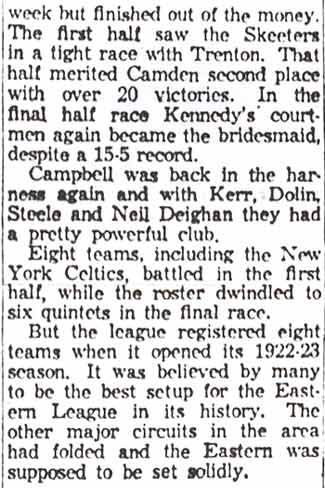
The Skeeters tied for the lead twice in the late stages of the second half race in March and had a chance of forcing the race [text missing between the crops] week but finished out of the money.
The first half saw the Skeeters in a tight race with Trenton. That half merited Camden second place with over 20 victories. In the final half race Kennedy’s courtmen again became the bridesmaid, despite a 15-5 record.
Campbell was back in the harness again and with Kerr, Dolin, Steele and Neil Deighan they had a pretty powerful club.
Eight teams, including the New York Celtics, battled in the first half, while the roster dwindled to six quintets in the final race.
But the league registered eight teams when it opened its 1922-23 season. It was believed by many to be the best setup for the Eastern League in its history. The other major circuits in the area had folded and the Eastern was supposed to be set solidly.
League Folds
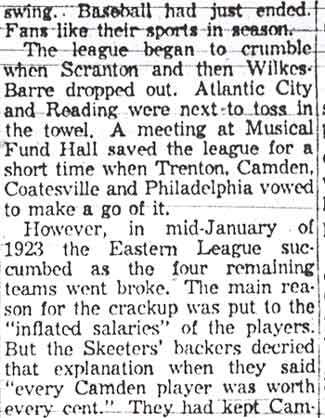
It started an early season (October) and that was the beginning of the end. Football was in full swing. Baseball had just ended. Fans like their sports in season.
The league began to crumble when Scranton and then Wilkes-Barre dropped out. Atlantic City and Reading were next to toss in the towel. A meeting at Musical Fund Hall saved the league for a short time when Trenton, Camden, Coatesville and Philadelphia vowed to make a go of it.
However, in mid-January of 1923 the Eastern League succumbed as the four remaining teams went broke. The main reason for the crackup was put to the “inflated salaries” of the players. But the Skeeters’ backers decried that explanation when they said “every Camden player was worth every cent.” They had kept Camden in first place until the league folded.
Fans Were Confused
Following one of the last games played in the league in Camden, Ryan wrote, “Wednesday night’s crowd would have been a disgrace to the East Side Church League.” That about summed it up.
Constant rearrangement of the league had jumbled the schedule. Fans never knew when or where their teams were playing. The gates were pitiful and the teams couldn’t operate without the money.
That was the end of the championship era of players like Steele, the Deighans, Campbell, Kerr, Dolin and the others. Some of them competed in the Philadelphia League the following season, but Camden dropped out of that league in 1924-25.
Old-timers who can recall the days of the championship Skeeters claim it was the “greatest basketball” team the East ever had.
Players Still Around
And some of the boys who played on that club are still around to verify that. Neil Deighan runs a restaurant in Gloucester and brother Rich manages the Sports Center here in Camden.
Eddie Dolin is a familiar figure as the bridge operator at 12th and Federal sts. Sam Lennox tends bar on Hudson st. and Davey Kerr deals in sporting goods in Ohio.
The rest — Steele, Campbell, Hyde, timekeeper Jim Kane, Helm, Corson and Kennedy—have passed away. But the memories of their court capabilities are very much alive.
Thank You
Many thanks to Robert Bradley, John Grasso, and the members of the Association for Professional Basketball Research, for help with this page — and for love of the game!
APBR.org — The Association for Professional Basketball Research

APBR.org
THE ASSOCIATION FOR PROFESSIONAL BASKETBALL RESEARCH
Camden in Eastern League
Camden Courier —
Camden will be again represented in the Eastern Basketball League during the coming season. A meeting of the Alpha Eastern League team and managers will be held at the Alpha Club, 708 Broadway, this evening. Brown, Adams, Bolin, Heron and McLaughlin are expected in the lineup and “Bill” Steele, one of the best basketball players in the East has been signed. Camden expects to land the bacon this fall with this formidable basket shooters.