Nathan F. Cowan
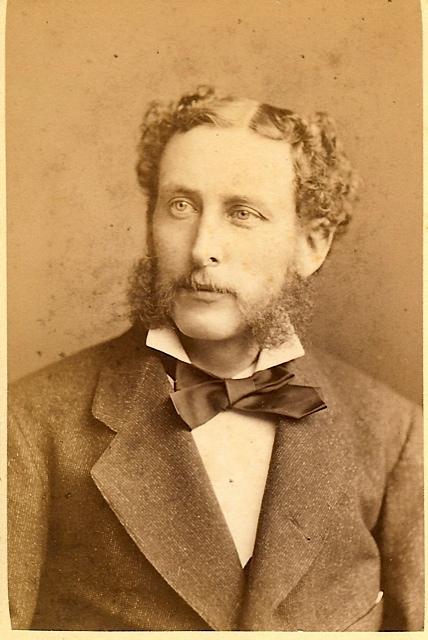
Nathan F. Cowan
Nathan Frame Cowan was born on November 27, 1840 in Sudbury, Pennsylvania to William and Cedney Cowan. The 1850 Census shows William working as a hatter. The children then at home were Edwin, age 23; Nathan, age 10; Susan, age 19; Deborah, age 12; and Sarah, age 8. Edwin Cowan was also working as a hatter. Four other brothers, Isaac, William, Henry, and Franklin, were not at home when the Census was taken. William Cowan was 47 in 1850 and did not survive the decade.
The family had established itself in Camden during the 1850s. When North Baptist Church was organized on November 15, 1859, older sisters Susan and Deborah Cowan were among the 37 original members. Nathan Cowan, however, remained affiliated with St. Paul’s Episcopal Church.
When the 1860 Census was taken, his widow and all the children save Henry and William were living in Camden’s Middle Ward. Isaac Cowan was then a practicing physician. Dr. Cowan moved to Cranford, New Jersey by the middle of 1880. All the family went with him, except for Nathan Cowan, who had married.
Nathan Cowan became well-known in Camden as a baseball player, playing centerfield for the Camden club beginning around 1861 and not leaving the game for twenty-seven years. He was a contemporary of Weston D. “Wes” Fisler, who, in 1865, crossed the river to play for the Philadelphia Athletics, a team that in 1870 joined the National Association, the professional baseball league that evolved into the National League. Fisler’s claim to baseball immortality occurred during his final season, 1876. On opening day, April 22, the first game of the National League’s first ever season, Wes Fisler of Camden NJ, scored the very first run in National League history. Nathan Cowan did not make the jump to the major leagues; his future lay in business. He began working as a clerk during these years, and eventually went into banking.
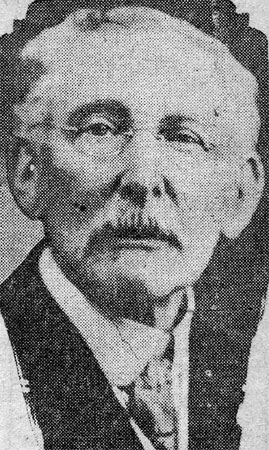
Nathan F. Cowan
Nathan Cowan was a Mason, originally a member of Camden Lodge No. 15. On February 2, 1871, members of Camden Lodge constituted a new lodge, Trimble Lodge No. 117, named for Joseph Trimble, three-term master of Camden Lodge and three years as grand master of the state. The organizers of the new lodge were George H. Fairfield, George F. Fort, Marmaduke E. Taylor, Dr. H. Genet Taylor, Dr. William S. Fort, Wilbur F. Rose, Nathan F. Cowan, Frederick A. Rex and J. Graham Milligan. The lodge was constituted in Morgan’s Hall, Fourth and Market Streets, then known as Masonic Hall. Fairfield was the first worshipful master; George F. Fort, senior warden; Marmaduke Taylor, junior warden; Dr. Taylor, treasurer; Milligan, secretary; Cowan, senior deacon; Rex, junior deacon; Rose, master of ceremonies, and Charles H. Gordon, tiler.
At the first meeting, Rev. Joseph F. Garrison, rector of St. Paul’s Episcopal Church, was presented for membership. He was the father of former Secretary of War Lindley M. Garrison and the late Supreme Court Justice Charles G. Garrison.
Nathan Cowan’s work as a clerk led in 1872 to a position with the First National Bank of Camden. About the same time another young man, Richard Coates Wilkins, began working there as well. When, on June 1, 1874, Richard Coates Wilkins married Laura Stokes, Nathan F. Cowan was a witness for the marriage license. The wedding was performed by Reverend Garrison of St. Paul’s Episcopal Church.
Richard Coates Wilkins’ sister Sallie Ann Wilkins had married a young physician, Dr. Henry Ackley, at some point during the Civil War. There was a child, Henry Wilkins Ackley, who sadly was born and died the same day, January 17, 1865. Sallie Ackley would be a widow before the year was out, her husband passing away in Philadelphia on 1865. On January 22, 1877, she married her brother’s friend, Nathan F. Cowan, and bore a son, William Genet Cowan on March 31, 1878. Twins Edgar Nathan Cowan and Herbert Richard Cowan arrived on April 27, 1880.
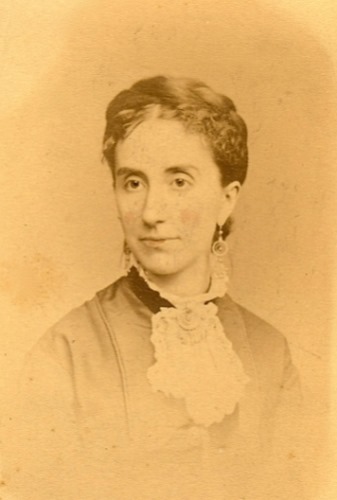
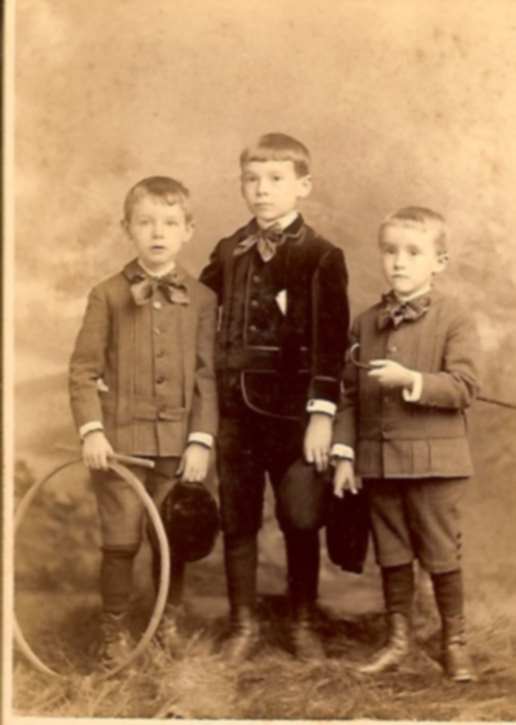
Sally Ackley Cowan — Herbert, William, & Edgar Cowan
Nathan Cowan was active in the affairs of St. Paul’s Episcopal Church, and between his activities there, in business, sports, and Masonry numbered many of Camden’s prominent citizens among his friends and acquaintances, as exhibited by St. Paul’s church officers in 1886. The officers of the church then were the following: Rector, Rev. Thomas A. Tidball, D.D.; Wardens, Abraham Browning, Esq., Marmaduke B. Taylor; Vestrymen, Maurice Browning, William E. Lafferty, Samuel H. Grey, Edward R. Shubrick, Joseph Fearon, William Joyce Sewell, Dr. Henry Genet Taylor, James H. Carpenter, Henry C. Alexander, Robert F.S. Heath, Wilson H. Jenkins, Nathan F. Cowan, Harry Humphreys, Edward H. King; Treasurer, William E. Lafferty; Secretary, James H. Carpenter.
Co-workers at the National State Bank in the 1880s and 1890s included Albert D. Ambruster, John T. Frazeee, Wilbur F. Rose, William Wolcott, Howard M. Heulings and Howard B. Lippincott.
Nathan Cowan was associated with the National State Bank for 50 years, retiring in 1922 when it merged with the First National Bank. The Cowans lived at 228 Cooper Street in Camden before moving to a mansion at 105 North Cove Road in Pennsauken (Merchantville is on the other side of Cove Road). William Cowan would own the home next door at 113 North Cove Road. Sallie Wilkins Cowan died in 1912 and was buried at Colestown Cemetery in Delaware Township (present-day Cherry Hill), New Jersey. Nathan Cowan died suddenly, at home, in 1927, and was interred next to his wife. Their three sons are also buried in the family plot at Colestown Cemetery.
Richard Coates Wilkins & Sallie Ann Wilkins
Richard Coates Wilkins at 18 with his sister, Sallie Ann Wilkins, age 22. Sallie Ann married Dr. Henry Ackley in 1861. She later married Nathan Cowan.
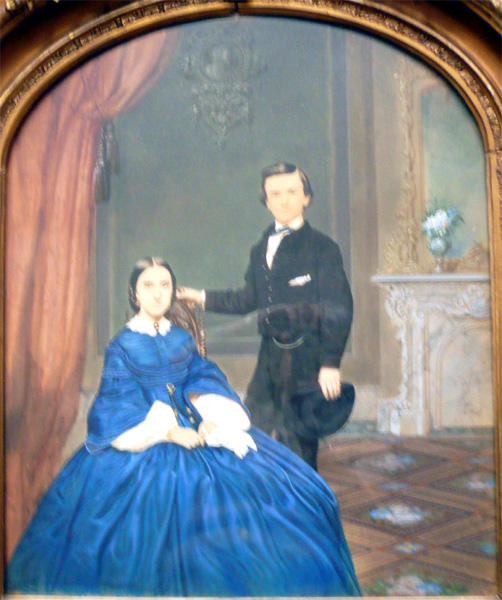
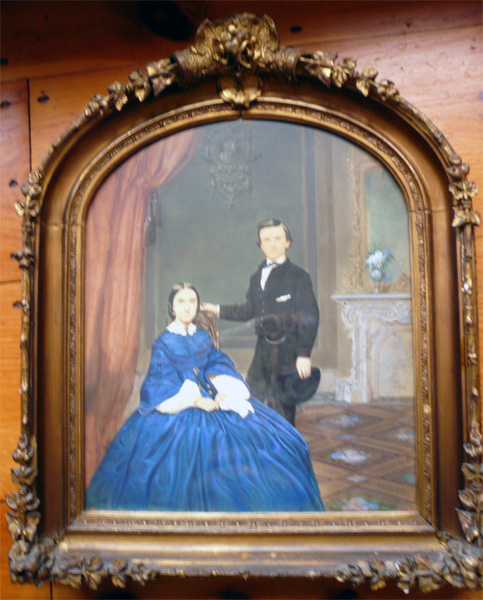
Richard Coates Wilkins — Sallie Ann Wilkins
Marriage License
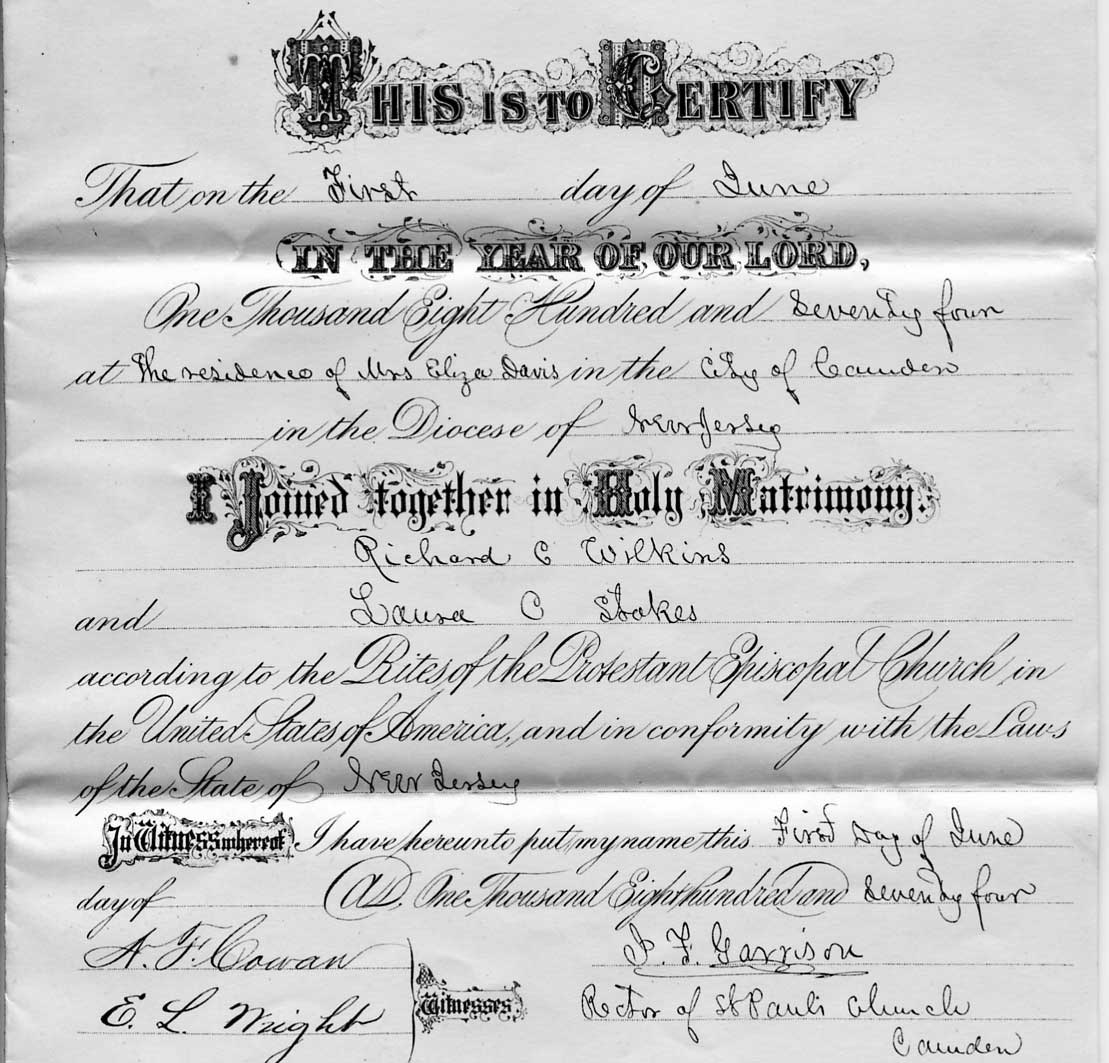
Marriage License — Richard Coates Wilkins & Laura Stokes, June 1, 1874, at the home of Mrs. Elizabeth Davis. Certified by Rev. Garrison, rector of St. Paul’s Episcopal Church. Witnessed by Nathan F. Cowan & E.L. Wright.
St. Paul's Episcopal Church Officers Elected
Philadelphia Inquirer —
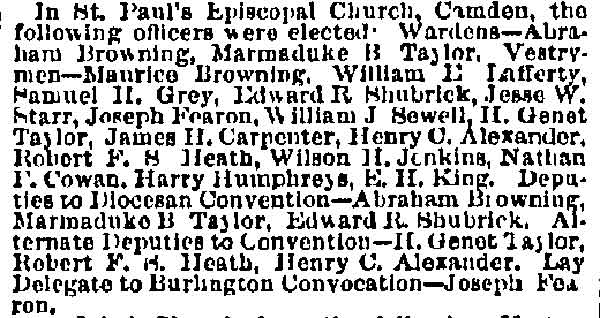
In St. Paul’s Episcopal Church, Camden, the following officers were elected: Wardens—Abraham Browning, Marmaduke B. Taylor. Vestrymen—Maurice Browning, William H. Lafferty, Samuel H. Grey, Edward R. Shubrick, Jesse W. Starr, Joseph Fearon, William J. Sewell, H. Genet Taylor, James H. Carpenter, Henry C. Alexander, Robert F. S. Heath, Wilson H. Jenkins, Nathan F. Cowan, Harry Humphreys, E. H. King. Deputies to Diocesan Convention—Abraham Browning, Marmaduke B. Taylor, Edward R. Shubrick. Alternate Deputies to Convention—H. Genet Taylor, Robert F. S. Heath, Henry C. Alexander. Lay Delegate to Burlington Convocation—Joseph Fearon.
228 Cooper Street
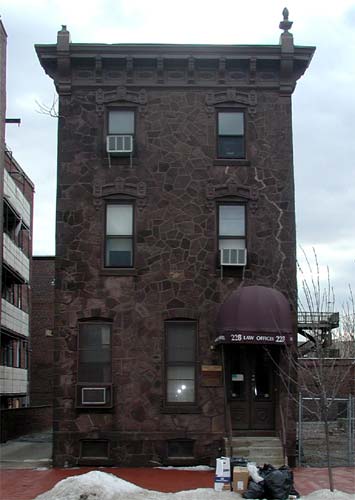
228 Cooper Street — From 1877 through 1888, the home of Nathan F. Cowan & family. Photo taken February 7, 2004.
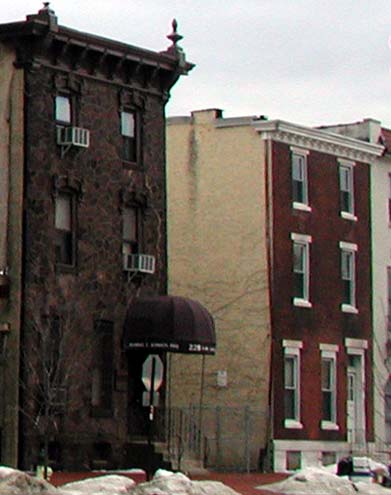
228 & 224 Cooper Street — February 7, 2004
Cowan Family in Pennsauken
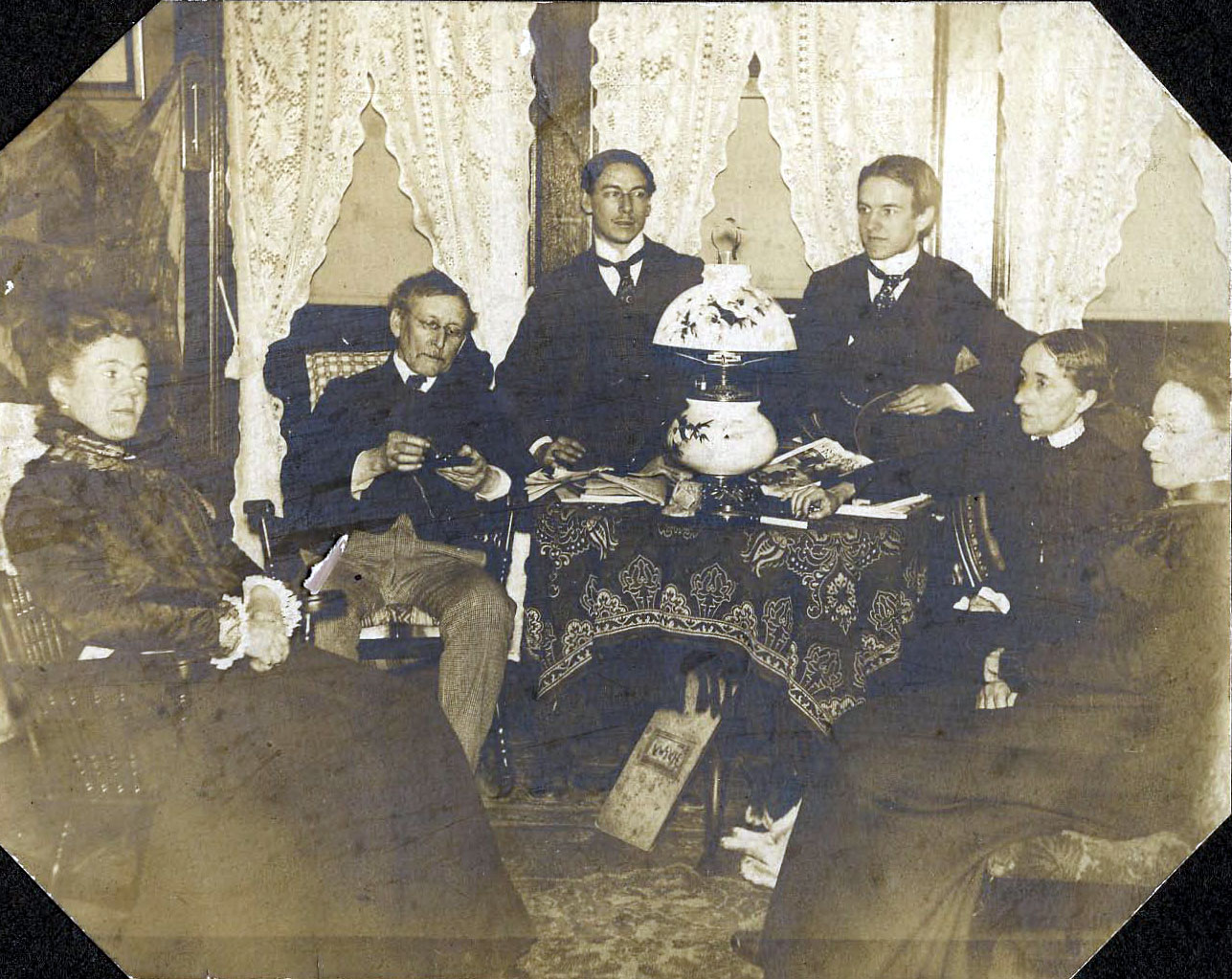
Nathan F. Cowan & Family — Pennsauken, New Jersey
Nathan F. Cowan on Baseball
Undated Philadelphia Newspaper — circa 1924

Like Secretary Denby of the Navy, “I was born a boy, grew up as a boy and will never get over it.” This is the frank autobiography of Nathan F. Cowan, an eighty-four-year-old youngster given to us at a baseball fanning bee yesterday afternoon at the Mission, Merchantville. We had made an engagement with the pink-cheeked veteran who had played national game actively for twenty-seven years from 1861 to 1889. We had been drawn to him by a recent discussion on the part of the Veteran Amateur Baseball Association relative to the claim to the birth of our national game. It read with considerable interest how that fifty-year-old youngster in Detroit claimed that the game was born in New York in 1845. I recall another case where another youngster of seventy claimed that Philadelphia was the parent of the game, it being born in 1833.
Scores the Youngsters
These youngsters simply have got townball and baseball confused. I played centerfield on the old Camden team in the early sixties. My mind is just as clear and fresh as to when our national game had its inception. I recall the game with the Athletics, our Camden team and the Stars of Albany, a real game with its incidental regulations. I recall vividly also making a match Atlantic Athletics arranged them the game of baseball.
Hit Freshened Memory
“Why is your memory so fresh on this one particular instance?” we interrogated. His eyes fairly flashed. All the memories seemed to come to the surface. “Well, I guess I should remember it. I was playing the outfield and the first ball pitched was batted over my head and went sailing over the fence. With all the speed of my youth, I scaled the fence, retrieved the ball, returned it in time to throw a man a few yards to spare. Those were the days of Dick McBride, Tom Pratt and their underhand method of throwing the ball from the box to the plate. Even Wes Fisler, who had fooled many batsmen. Coupled with this great duo of pitchers were men like Frank Burdsell and Lloyd Fisler, three Knight brothers—Tom, Frank and Harvey. Also Fisler. The real star of the diamond Frank Burdsell and Lloyd Fisler, all men whose names one is forced to conjure with in connection with our national game.”
Has Bad Right Wing
“My twenty-eight years of active baseball has not taught me to regard the physical man as all-important, but to husband my vitality by occupation of my mental powers. I occupied an official position in the State Bank for a number of years. Those happy days playing our national game was a complete relaxation from business cares, the financial worries incident to a banker’s life. I enjoyed the game wholeheartedly and without neglecting business. I have never forgotten it. Of course, I could still hurl a few from my accustomed centerfield hit and throw home without the feat being hard on me. I, rather, for my right wing is out of commission. I had a slight stroke two months ago, I cannot raise my arm above my shoulder. I could never throw underhand as any signal, so perhaps I am compelled to warm the bench.”
Liked to Talk to a Kid
“I am glad you came over. It warms the cockles of my heart to talk of the legends of the game, with a kid. It was not mechanical. We never thought it was a mere game. And those who survive are living monuments of its benefits.”
Colestown Cemetery
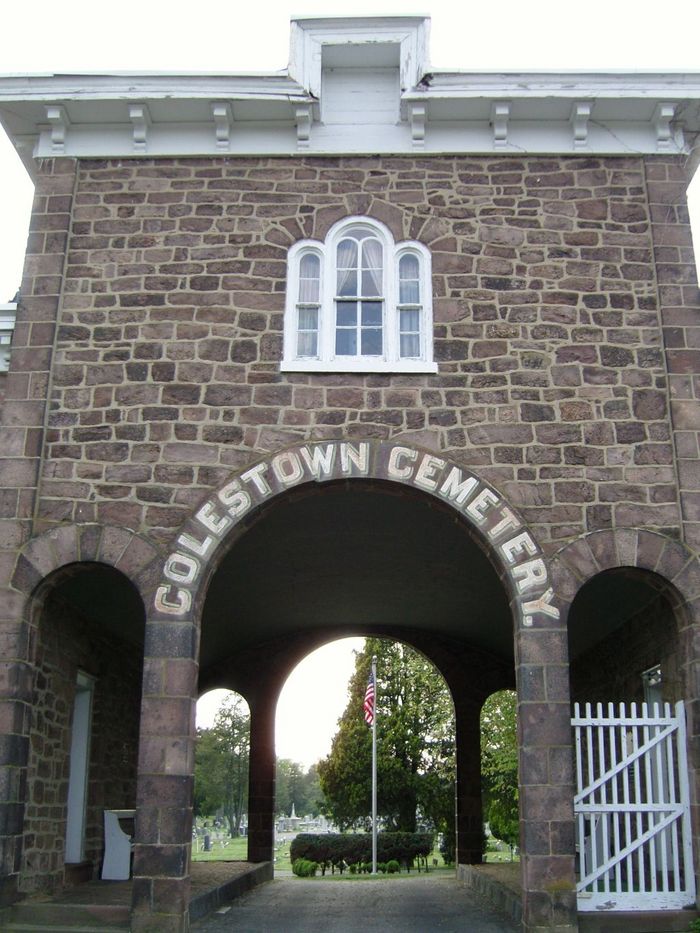
Colestown Cemetery, Cherry Hill, New Jersey
Grave Markers
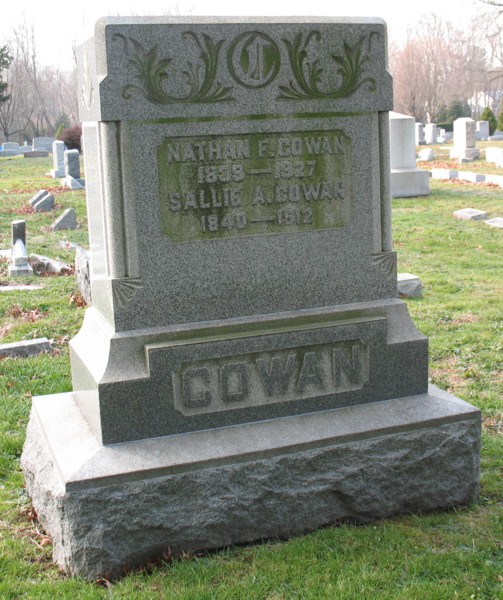
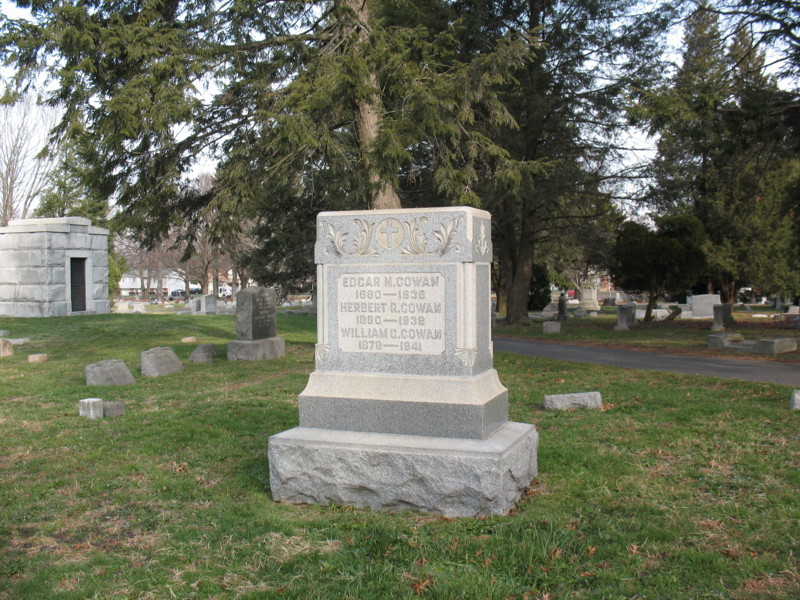
Cowan family plot, Colestown Cemetery