Wes Fisler
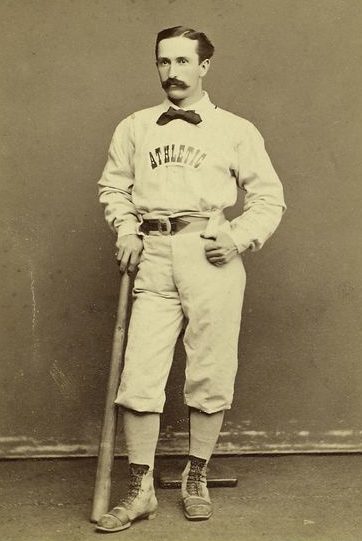
WES FISLER, nicknamed Icicle, was born July 5, 1841 in Camden, NJ. He came from a noted local family; his father, Dr. Lorenzo F. Fisler, served as mayor of the city of Camden at three different times.
In 1864 Wes Fisler batted cleanup and played catcher for a club simply known as “New Jersey,” with a boxscore published in the May 26, 1864 edition of the Philadelphia Daily Age. The following year Wes Fisler played left field and led off for the Camden Club, with a box score appearing in the August 4, 1865 edition of the Philadelphia Daily Age. The following season he joined the Philadelphia Athletic Club, for whom he would play the next 11 seasons.
Wes Fisler had already played five seasons for the Philadelphia Athletics when he made his major league debut at the age of 29 with the Philadelphia club of the National Association, the professional baseball league that evolved into the National League. Playing mostly first and second base, he was one of the better hitters in the league, although not one of the dominant players of his day. The event that staked Wes Fisler’s claim to baseball immortality occurred during his final season, on opening day.
On April 22, 1876, the opening game of the National League’s first ever season, the Boston Red Caps came out ahead of the Philadelphia Athletics by the score of 6 to 5. Athletics first baseman Wes Fisler of Camden NJ scored the very first run in National League history.
After he retired from baseball, Wes Fisler returned to Camden NJ. He appears in the 1887–1891 Camden city directories as living at 511 Federal Street, and working in “gents furnishings” in Philadelphia. He later moved to Philadelphia, where he appears in the 1910 census. His final years were spent in Philadelphia, where he lived in a rooming house at 2134 Park Avenue. Weston Dickson Fisler passed away December 25, 1922 in Philadelphia, PA.
Philadelphia Athletic Club
Photo Dated 1874
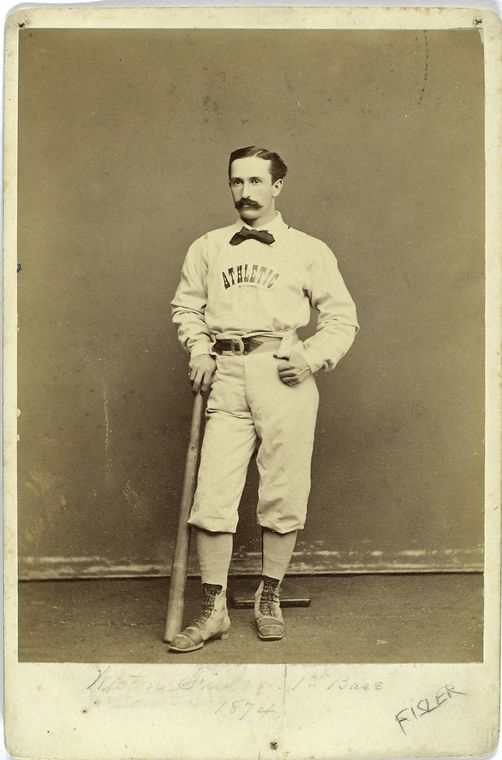
Named: Wes Fisler, Philadelphia Athletic Club (aka Philadelphia Athletics), and Photo Dated 1874.
Career Statistics
Batting — Glossary
| Year | Age | Tm | Lg | G | AB | R | H | 2B | 3B | HR | RBI | BB | SO | BA | OBP | SLG |
|---|---|---|---|---|---|---|---|---|---|---|---|---|---|---|---|---|
| 1871 | 29 | Ath | NA | 28 | 147 | 43 | 41 | 8 | 2 | 0 | 16 | 3 | 2 | .279 | .293 | .361 |
| 1872 | 30 | Ath | NA | 47 | 243 | 49 | 85 | 13 | 3 | 0 | 48 | 4 | 4 | .350 | .360 | .428 |
| 1873 | 31 | Ath | NA | 44 | 218 | 44 | 75 | 11 | 4 | 1 | 42 | 2 | 2 | .344 | .350 | .445 |
| 1874 | 32 | Ath | NA | 37 | 180 | 26 | 59 | 12 | 1 | 0 | 22 | 0 | 1 | .328 | .328 | .406 |
| 1875 | 33 | Ath | NA | 58 | 268 | 54 | 74 | 13 | 3 | 0 | 31 | 4 | 4 | .276 | .287 | .347 |
| 1876 | 34 | Ath | NL | 59 | 278 | 42 | 80 | 15 | 1 | 1 | 30 | 2 | 4 | .288 | .293 | .360 |
| 6 Seasons | 273 | 1334 | 258 | 414 | 72 | 14 | 2 | 189 | 15 | 17 | .310 | .318 | .390 | |||
Leaderboard Appearances — Awards are Year-League-Award, Stats are Year-Value-Rank
| Category | Appearances |
|---|---|
| Batting Average | 1872-.350-9 |
| On-base % | 1872-.360-8 |
| Slugging % | 1872-.428-10; 1873-.445-10 |
| OPS | 1872-.788-9 |
| Runs | 1871-43-10 |
| Hits | 1872-85-9 |
| Doubles | 1872-13-8; 1876-15-9 |
| RBI | 1872-48-4 |
| Adjusted OPS+ | 1872-141-9 |
| Times on Base | 1872-89-7 |
Undated Newspaper Article
Philadelphia Newspaper — circa 1924

Like Secretary Denby of the Navy, “I was born a boy, grew up as a boy and will never get over it.”
This is the frank autobiography of Nathan F. Cowan, an eighty-four-year-old youngster given to us at a baseball fanning bee yesterday afternoon at the Mission, Merchantville. We had made an engagement with the pink-cheeked veteran who had played national game actively for twenty-seven years from 1861 to 1889. We had been drawn to him by a recent discussion on the part of the Veteran Amateur Baseball Association relative to the claim to the birth of our national game. It read with considerable interest how that fifty-year-old youngster in Detroit claimed that the game was born in New York in 1845. I recall another case where another youngster of seventy claimed that Philadelphia was the parent of the game, it being born in 1833.
Scores the Youngsters
These youngsters simply have got townball and baseball confused. I played centerfield on the old Camden team in the early sixties. My mind is just as clear and fresh as to when our national game had its inception. I recall the game with the Athletics, our Camden team and the Stars of Albany, a real game with its incidental regulations. I recall vividly also making a match Atlantic Athletics arranged them the game of baseball.
Hit Freshened Memory
“Why is your memory so fresh on this one particular instance?” we interrogated. His eyes fairly flashed. All the memories seemed to come to the surface. “Well, I guess I should remember it. I was playing the outfield and the first ball pitched was batted over my head and went sailing over the fence. With all the speed of my youth, I scaled the fence, retrieved the ball, returned it in time to throw a man a few yards to spare. Those were the days of Dick McBride, Tom Pratt and their underhand method of throwing the ball from the box to the plate. Even Wes Fisler, who had fooled many batsmen. Coupled with this great duo of pitchers were men like Frank Burdsell and Lloyd Fisler, three Knight brothers—Tom, Frank and Harvey. Also Fisler. The real star of the diamond Frank Burdsell and Lloyd Fisler, all men whose names one is forced to conjure with in connection with our national game.”
Has Bad Right Wing
“My twenty-eight years of active baseball has not taught me to regard the physical man as all-important, but to husband my vitality by occupation of my mental powers. I occupied an official position in the State Bank for a number of years. Those happy days playing our national game was a complete relaxation from business cares, the financial worries incident to a banker’s life. I enjoyed the game wholeheartedly and without neglecting business. I have never forgotten it. Of course, I could still hurl a few from my accustomed centerfield hit and throw home without the feat being hard on me. I, rather, for my right wing is out of commission. I had a slight stroke two months ago, I cannot raise my arm above my shoulder. I could never throw underhand as any signal, so perhaps I am compelled to warm the bench.”
Liked to Talk to a Kid
“I am glad you came over. It warms the cockles of my heart to talk of the legends of the game, with a kid. It was not mechanical. We never thought it was a mere game. And those who survive are living monuments of its benefits.”