Camden, N.J. — World War II Merchant Marine Memorial
It must be a good idea if two people have it at the same time, and this is the case in relation to this page and the American Merchant Marine Memorial monument in Camden, New Jersey which was dedicated on June 11, 2005. I first put this page on the Internet in late 2002, while Charles Mardigian got the ball rolling on having a physical monument placed on the Camden Waterfront around the same time. Neither of us were aware of the others efforts, and we first met by phone, through Joe Balzano of the South Jersey Port Corporation, in July of 2005. Needless to say, a page will be built on this website about the new monument, which is adjacent to the battleship USS New Jersey, in Camden's Wiggins Park.
September 17, 2005
Camden Seamen Lost Due to Enemy Action
Click on each sailor's name to find out more about him, his ship, and what happened thereafter.
- Nicholas Hetz
- William Henry Merryfield
- Harry Jackson Mote
- Neil Jensen
- George Joseph Gleason
- Harvey Gardner Jr.
- Harry Holmes Bradway
- Norman David Louderback
- Clifton C. Stevenson
- Thomas Byrnes Jr.
- Abraham Price
- Carlton Harris Strang Jr.
Seamen from Other Camden County Towns
The following men from Camden County towns died while serving in the Merchant Marine during World War II. Click on each name to find out more.
- Edward Benfold
- Roy F. Brucks
- Thomas Byrnes Jr.
- Richard A. Cooper
- Hunter Crist
- Glenn Robert Curtis
- Raymond Farr
- Frank W. Fitzgerald Jr.
- Richard O. Kelleher
- Frank Mooney
- Francis J. Schwarz
- Charles A. Wilson
- Alfred Paul Woltjen
Camden Seamen Lost
Adam William Meade had served with the Camden Fire Department for at least 18 years before going to sea in his mid-40s to serve his country in time of war. He died overseas on July 7, 1945 and was buried at the Sicily-Rome American Cemetery in Nettuno, Italy.
Who Were the Mariners?
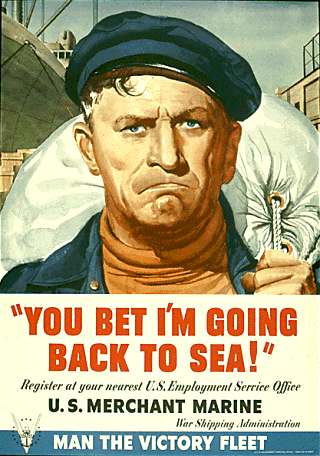
U.S. Merchant Marine — “You Bet I’m Going Back to Sea!” recruitment poster
The city of Camden, N.J. lost 12 of its sons to the sea during World War II, 10 to enemy action. Twelve others from Camden County died while serving as well. On two occasions, two of those men went down together while serving aboard the same ship. Merchant mariners were on the front lines the moment their ships left U.S. ports, and were subject to attack by bombers, kamikaze, battleships, submarines, mines, and land-based artillery, and 663 men and women Mariners became Prisoners of War. Approximately 8,000 U.S. Merchant Seamen were lost, in addition to countless foreign nationals serving aboard shipping serving the Allied cause.
“In 1940 the Merchant Marine numbered about 55,000. A massive recruiting effort brought in retired seafarers who were able to ship out immediately on the newly launched Liberty ships. Among them were 76 year-old James A. Logan who served as cook on the SS Joshua Hendy. Thomas Cavely, former master on the Brooklyn to Staten Island ferry, served as captain of a Liberty ship.
Young mariners trained at the U.S. Merchant Marine Academy, various state Maritime Academies, or the U.S. Maritime Service Training Stations. William Travers, 22, was captain of the SS James Ford Rhodes, while his 21 year old brother was first mate. The U.S. Maritime Service officially took youngsters who were 16 years-old. They took them with one eye, one leg, or heart problems. Many men who were too young or too old for the other services or who were physically unfit for the other services joined the Maritime Service and went in the Merchant Marine.
During World War II, some gossip columnists claimed that merchant mariners were getting rich on outrageous salaries. In a 1943 letter to the American Legion, Admiral Telfair Knight of the War Shipping Administration compared salaries for equivalent positions in Navy and Merchant Marine, and found salaries to be equivalent or even higher for Navy personnel. In addition, the Navy offered outstanding benefits, including paid leave, disability and death benefits, free medical care for personnel and dependents, free uniforms, and a generous retirement pension.
Mariners signed on for each voyage which lasted until they returned to a U.S. port, which could be one year or more. They had no paid leave, no vacation and no pension.”
Source: www.USMM.org
Merchant Mariners during WWII took casualties at a rate exceeded only by the U.S. Marine Corps.
Mariners’ Struggle for Veteran Status
During World War II President Franklin D. Roosevelt promised mariners of the U.S. Merchant Marine, and Army Transport Service veteran status and a Seaman’s Bill of Rights. His promises died with him.
“But once the war was won, what the bureaucrats [and politicians] in Washington did to the merchant mariners was reprehensible. They treated them like second-class citizens, and worse.” [American History Nov./Dec. 1993]
Mariners came home from Normandy, Anzio, Guadalcanal, or POW camps to face three main misconceptions about their service: high pay, draft dodging, and refusal to unload ships. Burned and wounded mariners paid for their own plastic surgery and, for those declared dead, had to return the insurance or the $1 per day received by their families. Mariners finally got limited veteran status in 1988 after a long court battle.
The bureaucrats and politicians are still at it in 2003!
Source: www.USMM.org
Nicholas Hetz
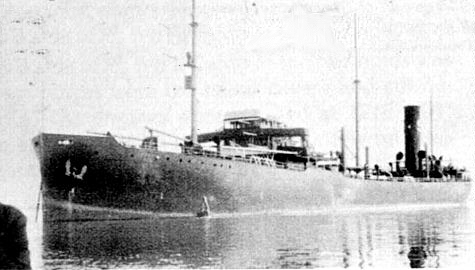
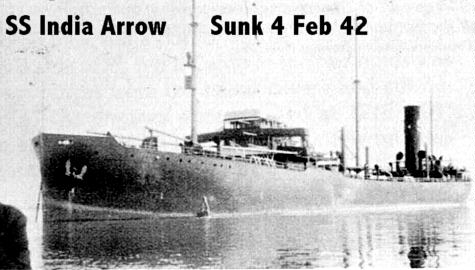
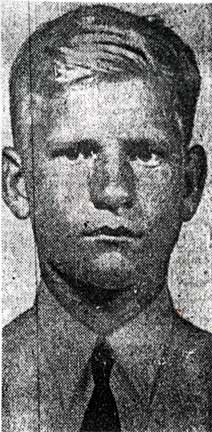
Left: The SS India Arrow. Center: A contemporary account of the sinking. Right: Nicholas Hetz.
Nicholas Hetz was serving as an Engine Utilityman on the tanker SS India Arrow out of New York, N.Y. when his ship was torpedoed and shelled on 2/4/42, 20 miles southeast of Cape May, N.J. by the German Submarine U-103 under Korvettenkapitän Werner Winter. The SS India Arrow carried a crew of 38; only 12 survived.
Nicholas Hetz resided at 690 Ferry Ave., Camden. He had joined the crew of the India Arrow only a week prior to its sinking.
Neil Jensen
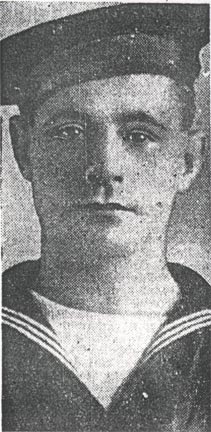
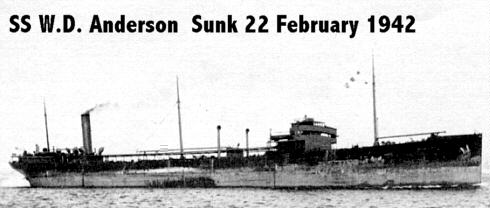
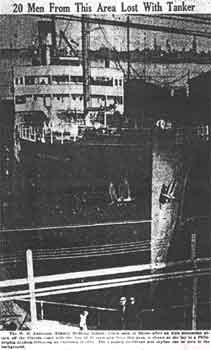
Left: Neil Jensen. Center and right: The SS W.D. Anderson.
Neil Jensen was employed as a Fireman/Watertender on the tanker SS W.D. Anderson under the command of Captain Albert B. Walters of Upper Darby, Pa., sailing from Texas to Philadelphia, Pa. when the ship was torpedoed and sunk on February 22, 1942, 12 miles northeast of Jupiter Inlet, Fla. by the German Submarine U-504 commanded by Korvettenkapitän Hans-Georg Friedrich Poske. The SS W.D. Anderson carried a crew of 35. Only 1 man survived, Frank L. Terry, a former lifeguard, by swimming to the shore.
Harry Holmes Bradway
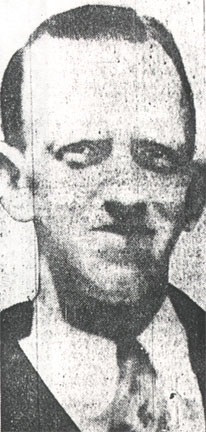
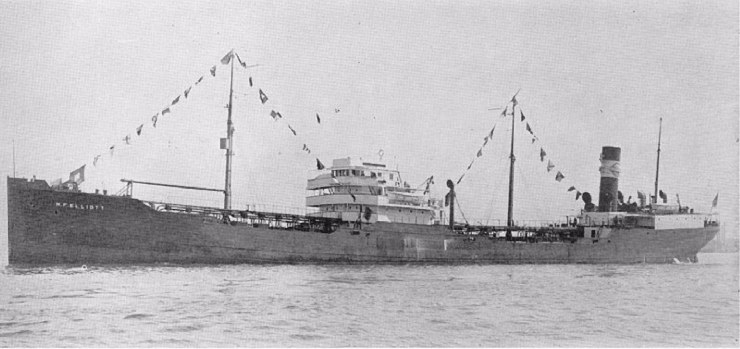
Left: Harry Holmes Bradway. Right: The SS M.F. Elliott.
Harry Holmes Bradway signed on as a Fireman/Watertender aboard the Esso tanker SS M.F. Elliott out of Wilmington, Del., and perished when the ship was torpedoed and sunk, 150 miles northwest of Trinidad on June 3rd, 1942. The M.F. Elliott had been built in 1921 by the Moore & Scott Iron Works, of Oakland, California. The ship was torpedoed by the German submarine U-502, captained by Oberleutnant zur See Jürgen von Rosenstiel. On June 4, the destroyer USS Tarbell DD-142 sighted 10 survivors of the sinking and brought them aboard. The U-502 was sunk in turn on July 5, 1942 in the Bay of Biscay west of La Rochelle, in position 46.10N, 06.40W, by depth charges from a British Wellington aircraft from Royal Air Force Squadron 172/H, with all 52 hands lost.
Harry H. Bradway was survived by his sister, Mrs. Mary Guenther who in 1944 resided at 709 Lawrence Street, Camden.
William Henry Merryfield
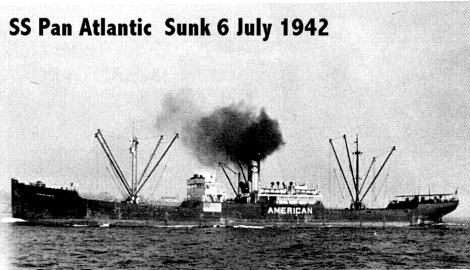
The SS Pan Atlantic.
William Henry Merryfield was an Oiler on the freighter SS Pan Atlantic. This ship was on its way to Russia on the Murmansk run when it was bombed and sunk by dive-bombers of the German Luftwaffe on July 6, 1942, 180 miles north of Cape Canin. Merryfield’s crewmates who survived this attack were picked up by the SS Bellingham, which was subsequently torpedoed herself; all hands fortunately survived. The Pan Atlantic carried a crew of 18, and an armed guard of 7.
William Henry Merryfield was born in Pennsylvania. By 1930 his father had passed on, and his mother had re-married, to a metal-stamper, William J. Smith, who owned a home at 221 Milton Street, in the Poet’s Row section of North Camden. At the time of the 1930 census, William Henry was 21, and living with his mother, step-father, brother John E. Merryfield, and step-sisters Margaret, Emma, and Ida at the Camden, N.J. address. He was working as a repairman in a typewriter shop. He was survived by his wife, mother, and siblings.
George Joseph Gleason and Norman David Louderback
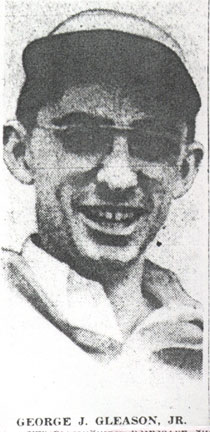
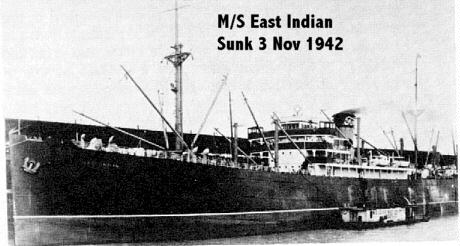
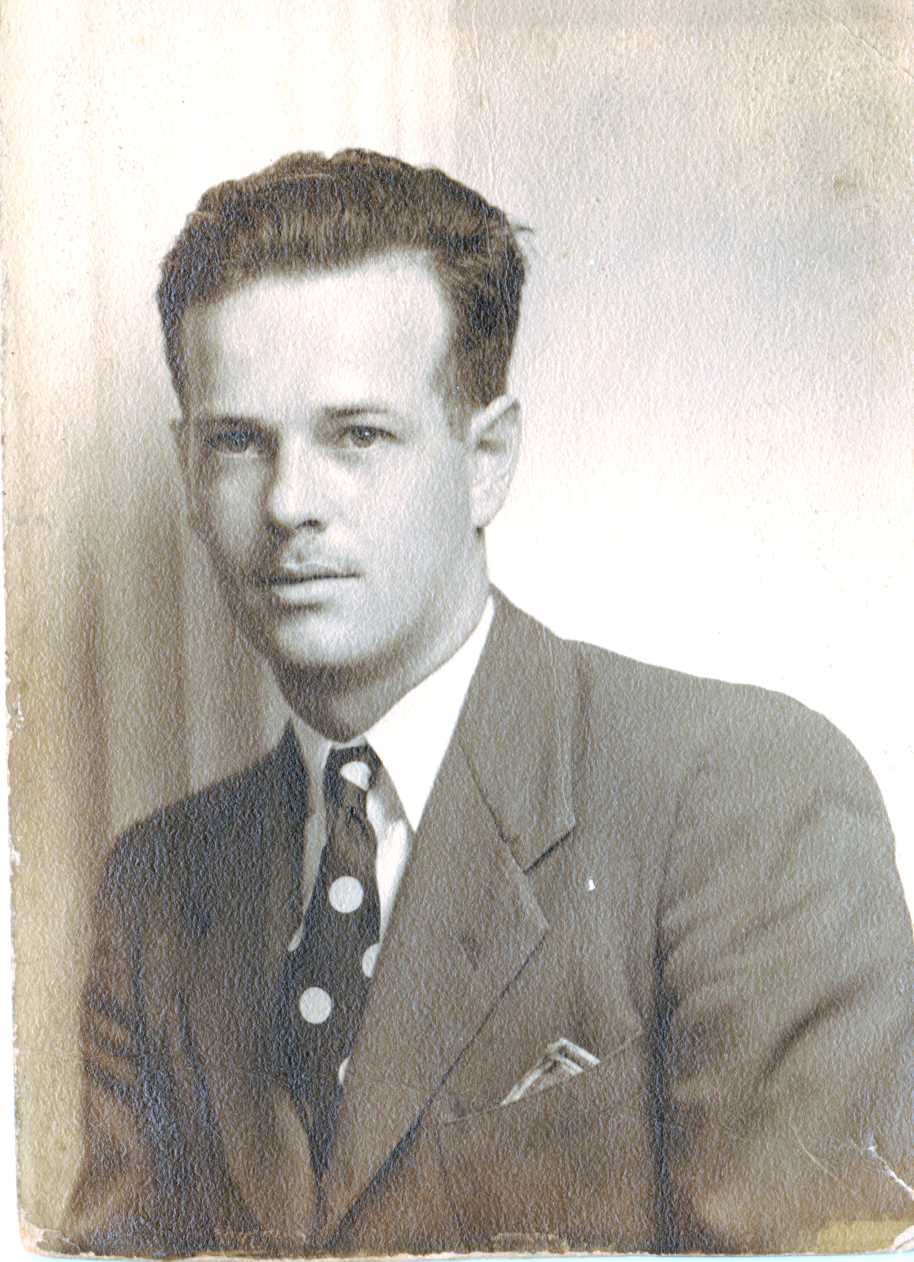
Left: George Joseph Gleason. Center: The SS East Indian. Right: Norman David Louderback.
George Joseph Gleason and Norman David Louderback, Jr. shipped out together as Wipers on the freighter SS East Indian from Camden, N.J. The East Indian, under Captain St. Marie, carried a crew of 33, an armed guard of 14, and 10 passengers. On November 3, 1942, she was torpedoed by the German submarine U-181, commanded by Kapitänleutnant Wolfgang Lüth, 275 miles southwest of Cape Town, South Africa. For an account of the sinking and the 13-day ordeal of the survivors before their rescue, click here.
The U-181 was destined for a strange end. While undergoing repairs at Singapore when Germany surrendered, U-181 was taken over by the Japanese Navy and became submarine I-501. She was surrendered to the British at Singapore August 15, 1945 and scuttled there February 16, 1946.
George Gleason was 24 when his ship went down. A June 1935 graduate of Camden High School, he had resided at 529 North 7th Street, with his parents Mr. & Mrs. James Gleason.
Norman Louderback, Jr. was 26. He was survived by his parents who lived at 1208 Mt. Ephraim Avenue, and his wife Frances G. Louderback, also of Camden. He also had ties to Waterford Township, N.J.
George Joseph Gleason and Norman David Louderback
Camden Courier-Post —
Five South Jersey Men Missing in Sinkings
2 Camden Youths Among Casualties Announced by Merchant Marine
Two Camden men and three from South Jersey are among 21 in the state reported missing and believed lost between November 22 and December 21, it was announced yesterday by the Merchant Marine.
The Camden men were George J. Gleason, Jr. 24, of 529 North 7th Street. He was a seaman aboard a ship that was torpedoed November 3 by a U-boat. News their son is missing was received by Mr. and Mrs. Gleason at their home; and Norman David Louderback, Jr., 26, a wiper, of 1208 Mt. Ephraim Avenue, son of Mr. and Mrs. Norman Louderback and husband of Frances Guaglano. He enlisted in January 1942 and was married soon afterward to his fiancée whom he met while working at the RCA-Victor Division of the Radio Corporation of America.
Gleason, a graduate of Camden High School and the Pierce School of Business Administration, sailed last may. Louderback and Gleason served on the same ship.
Gleason’s family received their last word from him in September from Calcutta. He wrote them then that he was convoying supplies to Russia.
Shipmates of Gleason who survived the sinking said the vessel went down in two minutes after the torpedo found its mark. Twenty-four members of the crew, who reached the lifeboats, started to row for Cape Town, 400 miles away, but were picked up by a British merchantman in the Indian Ocean. They were landed at Cape Town.
The lifeboat survivors told their rescuers that 34 other members of the crew escaped on three life rafts, which they lashed together. A search was made for the 34, but they were not found.
After sinking the American ship, members of the submarine crew took moving pictures of the foundering vessel. Then the undersea craft submerged, the survivors said.
Gleason formerly was employed by the sheet metal firm of William Strandwitz, whose son, Marine Corps Lt. John T. Strandwitz, was recently reported killed in action.
Harry Jackson Mote Jr.
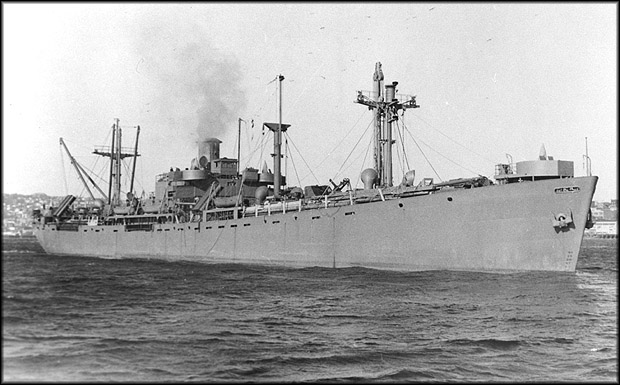
A WWII Liberty Ship.
2nd Engineer of the SS Meriwether Lewis, a Liberty Ship, was lost on March 2, 1943 in the North Atlantic at 62-10 N x 28-25 W when the ship was torpedoed and sunk by the German Submarine U-634 under the command of Oberleutnant zur See Eberhard Dahlhaus. The Lewis was part of a convoy headed for the United Kingdom. Her cargo was ammunition and tires. The Lewis was falling behind the convoy when she was torpedoed. The Coast Guard searched the area for two days, but the only trace of the SS Meriwether Lewis was a 30-mile-long line of tires. The SS Meriwether Lewis carried a crew of 44 with an armed guard of 28 men and was lost with all hands. Also serving on the SS Meriwether Lewis was Glenn Robert Curtis, of Delaware Township (Cherry Hill), N.J.
The SS Meriwether Lewis was the only ship sunk by U-634. The U-634 herself was sunk with all 47 hands lost on August 30, 1943 in the North Atlantic east of the Azores, in position 40.13N, 19.24W, by depth charges from the British sloop HMS Stork and the corvette HMS Stonecrop.
Harry J. Mote Jr. was born in Camden in 1911. He was the son of Harry J. and Mary A. Mote of 1102 Lois Avenue in the Cramer Hill section of Camden, N.J. His father was a machinist at the Cramp Shipyard in Camden. His father was also a well known baseball player in the Camden area, playing for the 11th Ward Republican Baseball Club, and later for the Westville team. The second of three children, he came between brother Augustus and sister Clara. By 1930 he had left school, and was working in a factory. Eventually he went to sea, and had achieved the rating of 2nd Engineer. By 1940 he had married, and had lived with his wife Lillian at 383 South 27th Street when he was lost at sea. He was 32 at the time of his death. His father passed away shortly thereafter, on August 13, 1943.
Glenn Robert Curtis was born in Pennsylvania in 1924 to James and Nellie Curtis. The family moved to Oaklyn, N.J., where by April of 1930, they were renting a home at 7 Valley Road. The elder Curtis was an electrician. Besides Glenn, there was an older sister, Dorothy, and a brother, Robert Curtis. The family later moved to the Woodcrest section of Delaware Township (Cherry Hill), N.J. Glenn Curtis shipped out as a messman in the Merchant Marine. He was aboard the Liberty Ship SS Meriwether Lewis when it was torpedoed in the North Atlantic.
Harvey Gardner Jr.
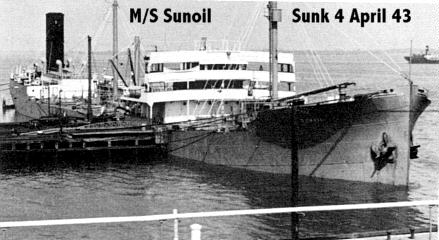
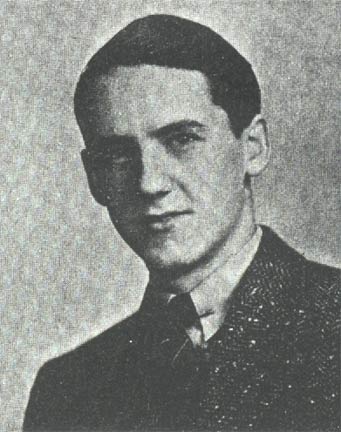
Left: The SS Sunoil. Right: Harvey Gardner Jr.
Harvey Gardner Jr., a Wiper on the tanker SS Sunoil, died on April 5, 1943 in the North Atlantic when his ship was torpedoed and sunk while en route from Halifax, Nova Scotia to the Clyde Estuary in Scotland. Carrying a crew of 43 and an armed guard of 16, she was lost with no survivors. The SS Sunoil was sunk by the German submarine U-563, under Oberleutnant Gustav Borchard. The U-563 in turn was sunk with all 49 hands on May 31, 1943 in the Bay of Biscay southwest of Brest, in position 46.35N, 10.40W, by depth charges from 2 British and 1 Australian Halifax and Sunderland aircraft from RAF Squadrons 58/R and 228/X, and RAAF Squadron 10/E.
Harvey Gardner was born in Smyrna, Del. in 1923, to Harvey & Grace Gardner. By 1930 his mother had remarried, to Norman Jones, a postman, and they lived at 1297 Sayers Street in Camden, N.J. He was a 1941 graduate of Camden High School, living at 1434 Princess Avenue in Camden, N.J. at graduation. Going to sea was his goal even while in school. He made his first voyage, on a tanker, after his graduation. He then found work on the railroad, before returning to sea in the fall of 1942. Harvey Gardner was survived by his mother, Grace M. Jones, and an older brother, George Gardner, then serving in the United States Navy. His death was reported in the April 28 edition of the Camden Courier-Post.
Thomas Byrnes Jr. and Clifton C. Stevenson
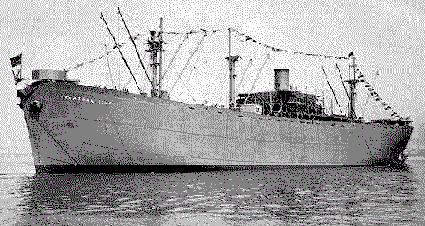
The SS John Morgan under construction at the Bethlehem Fairfield Shipyard. For years the John Morgan has been a popular site for scuba divers, and a monument has been placed on the wreck to the men and women who lost their lives in WWII.
Thomas Byrnes Jr., Ordinary Seaman, and Clifton C. Stevenson, Able Bodied Seaman, sailed aboard the Liberty Ship SS John Morgan, sailing from Philadelphia, Pa., en route to Bandar Shahpour, Iran loaded with P-39 airplanes, tanks, arms, and ammunition of all kinds. She was on her maiden voyage when on June 1, 1943 while approaching Newport News, Va., the SS John Morgan collided with an outbound ship, the SS Montana, off Cape Henry, Va. The John Morgan split in two, exploded, and her stern sank almost immediately, taking 42 crew members and 25 of its armed guard to their death.
Clifton C. Stevenson left a wife and daughter, Kathryn.
Abraham Price
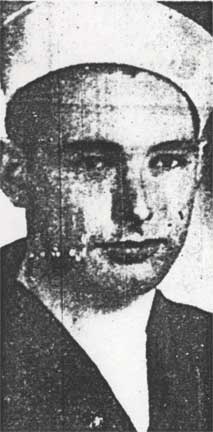
Abraham Price.
Abraham Price sailed as an Ordinary Seaman aboard the Liberty Ship SS John A. Poor, out of Portland, Me. This ship was damaged by a mine or torpedo on July 28, 1943. At that time there was no loss of life. On March 19, 1944, the SS John A. Poor was torpedoed and sunk by the German submarine U-510 captained by Oberleutnant zur See Alfred Eick at 13-58 N x 70-30 W in the area of the Indian Ocean and Red Sea. The John A. Poor lost 25 of its crew of 25, and 9 of the armed guard.
Abraham Price was survived by his parents, Mr. & Mrs. Max Price who then resided at 1255 Kaighn Avenue, and a brother Private First Class Samuel Price, who was with the Army Air Force in England. He had joined the Merchant Marine in November of 1942, and had been home on furlough in November of 1943. He was 22 when the John A. Poor went down.
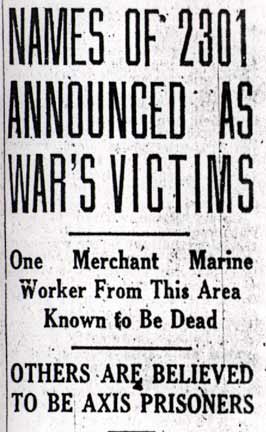
Names of 2301 Announced as War’s Victims
Camden Courier-Post —
One Merchant Marine Worker From This Area Known to Be Dead
Others Are Believed to Be Axis Prisoners
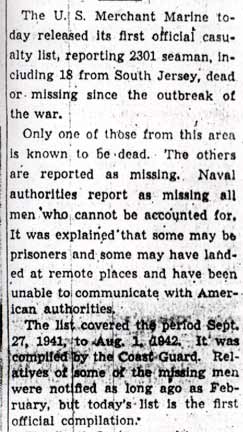
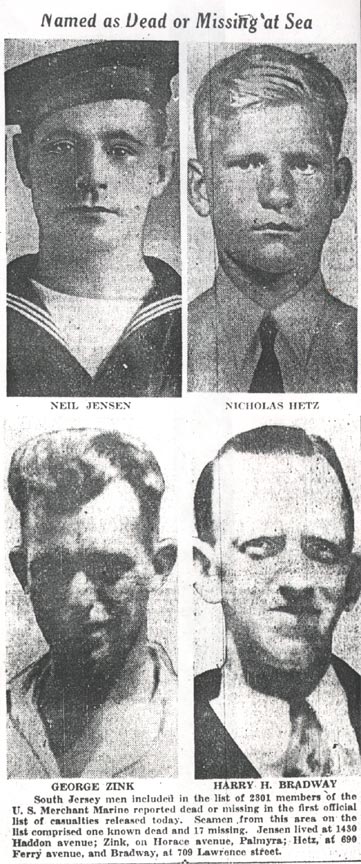
The U.S. Merchant Marine today released its first official casualty list, reporting 2301 seamen, including 18 from South Jersey, dead or missing since the outbreak of the war.
Only one of those from this area is known to be dead. The others are reported as missing. Naval authorities report as missing all men who cannot be accounted for. It was explained that some may be prisoners and some may have landed at remote places and have been unable to communicate with American authorities.
The list covered the period Sept. 27, 1941, to Aug. 1, 1942. It was compiled by the Coast Guard. Relatives of some of the missing men were notified as long ago as February, but today’s list is the first official compilation.
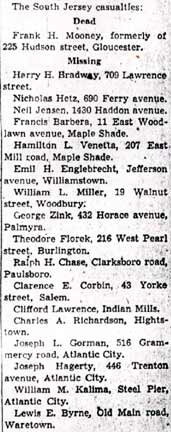
The South Jersey casualties:
Dead: Frank H. Mooney, formerly of 225 Hudson street, Gloucester.
Missing: Harry H. Bradway, 709 Lawrence street. Neil Jensen, 1430 Haddon avenue. Nicholas Hetz, 690 Ferry avenue. Francis Barbera, 11 East Woodlawn avenue, Maple Shade. Hamilton L. Venetta, 207 East Mill road, Maple Shade. Emil H. Englebrecht, Jefferson avenue, Williamstown. William L. Miller, 19 Walnut street, Woodbury. George Zink, 432 Horace avenue, Palmyra. Theodore Fioriek, 216 West Pearl street, Burlington. Ralph H. Chase, Clarksboro road, Paulsboro. Clarence E. Corbin, 43 Yorke street, Salem. Clifford Lawrence, Indian Mills. Charles A. Richardson, Hightstown. Joseph L. Gorman, 516 Grammercy road, Atlantic City. Joseph Hagerty, 446 Trenton avenue, Atlantic City. William M. Kalima, Steel Pier, Atlantic City. Lewis E. Byrne, Old Main road, Waretown.
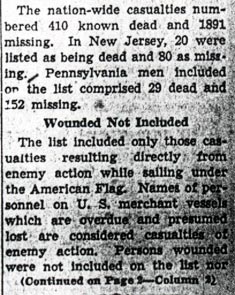
The nation-wide casualties numbered 410 known dead and 1891 missing. In New Jersey, 20 were listed as being dead and 80 as missing. Pennsylvania men included on the list comprised 29 dead and 152 missing.
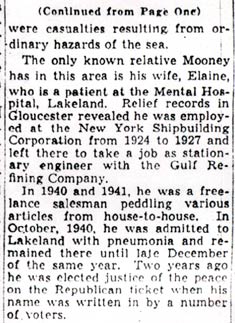
Wounded Not Included. The list included only those casualties resulting directly from enemy action while sailing under the American Flag. Names of personnel on U.S. merchant vessels which are overdue and presumed lost are considered casualties of enemy action. Persons wounded were not included on the list nor were casualties resulting from ordinary hazards of the sea.
The only known relative Mooney has in this area is his wife, Elaine, who is a patient at the Mental Hospital, Lakeland. Relief records in Gloucester revealed he was employed at the New York Shipbuilding Corporation from 1924 to 1927 and left there to take a job as stationary engineer with the Gulf Refining Company. In 1940 and 1941, he was a freelance salesman peddling various articles from house-to-house. In October, 1940, he was admitted to Lakeland with pneumonia and remained there until late December of the following year. Two years ago he was elected justice of the peace on the Republican ticket when his name was written in by a number of voters.
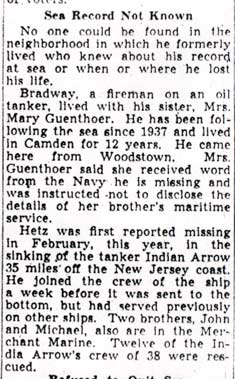
Sea Record Not Known. No one could be found in the neighborhood in which he formerly lived who knew about his record at sea or when or where he lost his life. Bradway, a fireman on an oil tanker, lived with his sister, Mrs. Mary Guenthoer. He has been following the sea since 1937 and lived in Camden for 12 years. He came here from Woodstown. Mrs. Guenthoer said she received word from the Navy he is missing and was instructed not to disclose the details of her brother’s maritime service. Hetz was first reported missing in February, this year, in the sinking of the tanker Indian Arrow 35 miles off the New Jersey coast. He joined the crew of the ship a week before it was sent to the bottom, but had served previously on other ships. Two brothers, John and Michael, also are in the Merchant Marine. Twelve of the India Arrow’s crew of 38 were rescued.
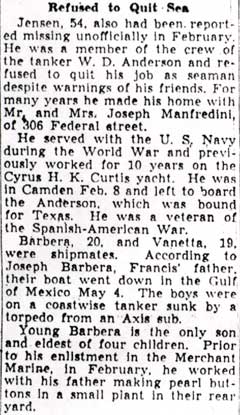
Refused to Quit Sea. Jensen, 54, also had been reported missing unofficially in February. He was a member of the crew of the tanker W.D. Anderson and refused to quit his job as seaman despite warnings of his friends. For many years he made his home with Mr. and Mrs. Joseph Manfredini, of 306 Federal street. He served with the U.S. Navy during the World War and previously worked for 10 years on the Cyrus H.K. Curtis yacht. He was in Camden Feb. 8 and left to board the Anderson, which was bound for Texas. He was a veteran of the Spanish-American War. Barbera, 20, and Vanetta, 19, were shipmates. According to Joseph Barbera, Francis’ father, their boat went down in the Gulf of Mexico when it was sunk by a torpedo from an Axis sub. Young Barbera is the only son and eldest of four children. Prior to his enlistment in the Merchant Marine, in February, he worked with his father making pearl buttons in a small plant in their rear yard.
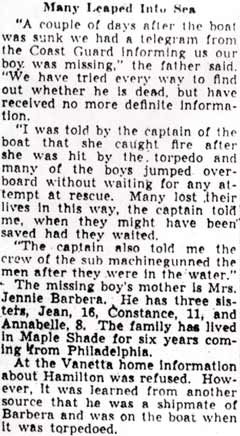
Many Leaped Into Sea. “A couple of days after the boat was sunk we had a telegram from the Coast Guard informing us our boy was missing,” the father said. “We have tried every way to find out whether he is dead, but have received no more definite information.” “I was told by the captain of the boat that she caught fire after she was hit by the torpedo and many of the boys jumped overboard without waiting for any attempt at rescue. Many lost their lives in this way, the captain told me, when they might have been saved had they waited.” “The captain also told me the crew of the sub machinegunned the men after they were in the water.” The missing boy’s mother is Mrs. Jennie Barbera. He has three sisters, Jean, 16, Constance, 11, and Annabelle, 8. The family has lived in Maple Shade for six years coming from Philadelphia. At the Vanetta home information about Hamilton was refused. However, it was learned from another source that he was a shipmate of Barbera and was on the boat when it was torpedoed.
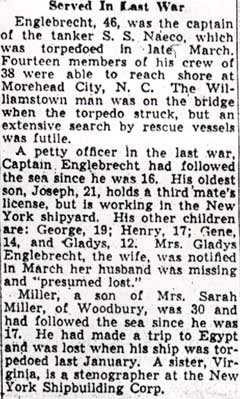
Served In Last War. Englebrecht, 46, was the captain of the tanker S.S. Naeco, which was torpedoed in late March. Fourteen members of his crew of 38 were able to reach shore at Morehead City, N.C. The Williamstown man was on the bridge when the torpedo struck, but an extensive search by rescue vessels was futile. A petty officer in the last war, Captain Englebrecht had followed the sea since he was 16. His oldest son, Joseph, 21, holds a third mate’s license, but is working in the New York shipyard. His other children are: George, 19; Henry, 17; Gene, 14, and Gladys, 12. Mrs. Gladys Englebrecht, the wife, was notified in March her husband was missing and “presumed lost.” Miller, a son of Mrs. Sarah Miller, of Woodbury, was 30 and had followed the sea since he was 17. He had made a trip to Egypt and was lost when his ship was torpedoed last January. A sister, Virginia, is a stenographer at the New York Shipbuilding Corp.
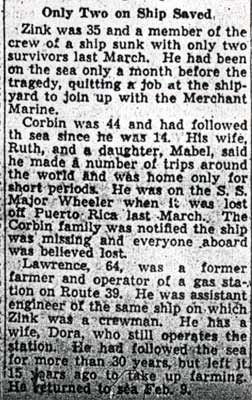
Only Two on Ship Saved. Zink was 35 and a member of the crew of a ship sunk with only two survivors last March. He had been on the sea only a month before the tragedy, quitting a job at the shipyard to join up with the Merchant Marine. Corbin was 44 and had followed the sea since he was 14. His wife, Ruth, and a daughter, Mabel, said he made a number of trips around the world and was home only for short periods. He was on the S.S. Major Wheeler when it was lost off Puerto Rica last March. The Corbin family was notified the ship was missing and everyone aboard was believed lost. Lawrence, 64, was a former farmer and operator of a gas station on Route 39. He was assistant engineer of the same ship on which Zink was a crewman. He has a wife, Dora, who still operates the station. He had followed the sea for more than 30 years but left 15 years ago to take up farming. He returned to sea Feb. 9.
South Jersey men included in the list of 2301 members of the U.S. Merchant Marine reported dead or missing in the first official list of casualties released today. Seamen from this area on the list comprised one known dead and 17 missing. Jensen lived at 1450 Haddon avenue; Zink, on Horace avenue, Palmyra; Hetz, at 690 Ferry avenue; and Bradway, at 709 Lawrence street.