Charles Louis Seerveld
Rank: Able Bodied Seaman, United States Merchant Marine
Ship: SS India Arrow
From: Center Moriches, New York
Biography
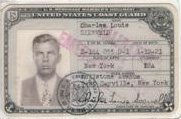

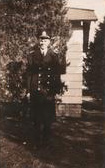
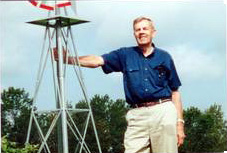
Charles Louis Seerveld
Charles Louis Seerveld grew up on New York’s Long Island. Many of his relatives had made their living as fishermen. He first went to sea in July of 1938, shortly after graduating high school. Charles Seerveld was serving aboard a tanker, the SS India Arrow, when the United States was attacked by Japan on December 7, 1941. Less than eight weeks later, the India Arrow was torpedoed off the New Jersey coast, with the loss of 26 men, Charles Seerveld being one of just 12 survivors. One of those lost was Nicholas Hetz, of Camden, NJ.
Charles Seerveld returned to service with the Merchant Marine, and by war’s end had earned a chief mate’s license. His travels took him literally around the world. Charles L. Seerveld retired from the Merchant Marine after the Japanese surrender in August of 1945, returning home to West Sayville, New York.
Charles Seerveld wrote of his experiences at sea, and this website is honored to share them.
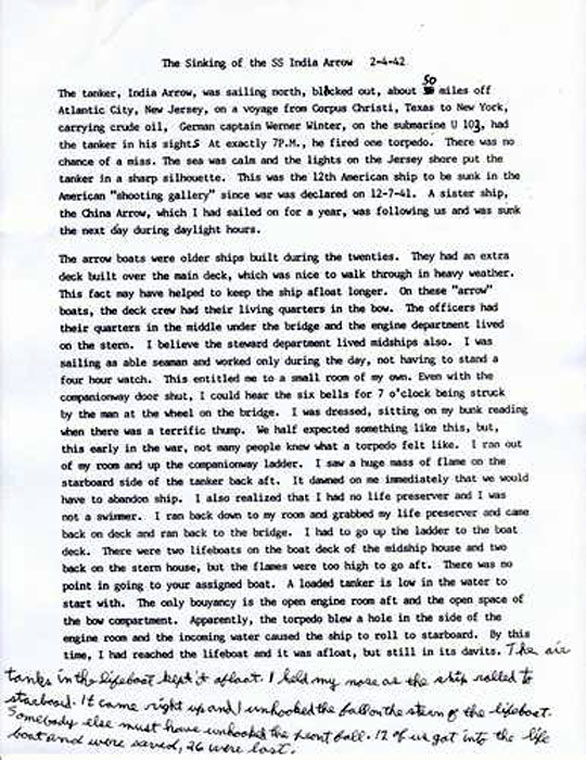
Seven Years With the U.S. Merchant Marine
Charles Louis Seerveld recalls his time at sea
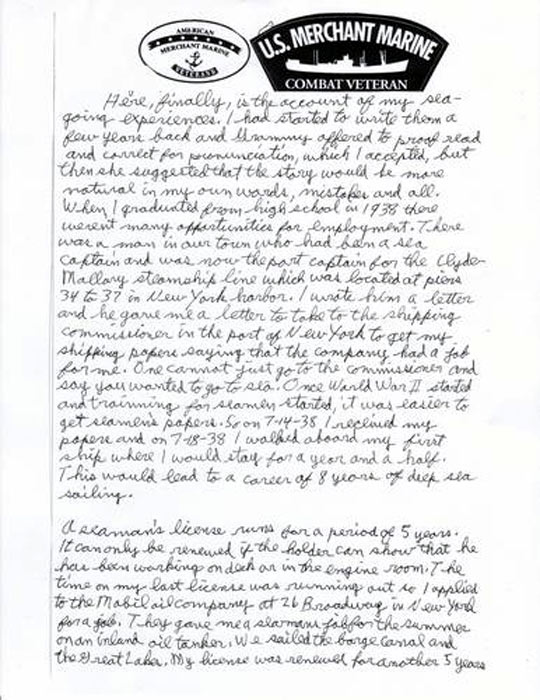
Here, finally, is the account of my sea-going experiences. I had started to write them a few years back and Grammy offered to proof read and correct for pronunciation, which I accepted, but then she suggested that the story would be more natural in my own words, mistakes and all.
When I graduated from high school in 1938 there weren’t many opportunities for employment. There was a man in our town who had been a sea captain and was now the port captain for the Clyde-Mallory Steamship Line which operated at piers 34 to 37 in New York harbor. I wrote him a letter and he gave me a letter to take to the shipping commissioner in the port of New York to get my shipping papers saying that the company had a job for me. One cannot just go to the commissioner and say you wanted to go to sea. Once World War II started and training for seamen started, it was easier to get seamen’s papers. So on 7-14-38 I received my papers and on 7-18-38 I walked aboard my first ship where I would stay for a year and a half. This would lead to a career of 8 years of deep sea sailing.
A seaman’s license runs for a period of 5 years. It can only be renewed if the holder can show that he has been working on deck or in the engine room. The time on my last license was running out so I applied to the Mobil oil company at 26 Broadway in New York for a job. They gave me a seaman’s job for the summer on an inland oil tanker. We sailed the barge canal and the Great Lakes. My license was renewed for another 5 years.
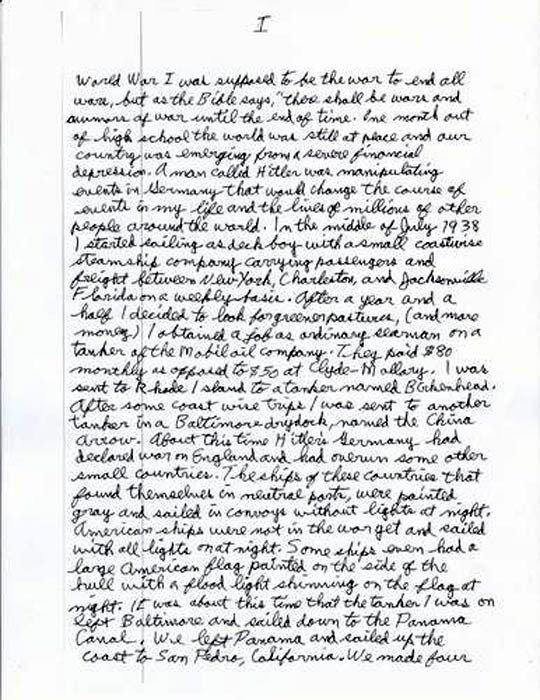
World War II was supposed to be the war to end all wars, but as the Bible says, “there shall be wars and rumors of wars until the end of time.” The moral rot of high school the world was still in place and our country was swinging from a deep financial depression. A man called Hitler was manipulating events in Germany that could change the course of events in my life and the lives of millions of other people around the world.
In the middle of July 1938 I started working on tankers for the Clyde-Mallory Steamship Company carrying passengers and freight between New York and Florida and Mexico. After a year and a half I decided to look for new pastures. I obtained a shore side job at the Mobil oil company. I was sent to Baltimore to join the crew of a tanker. After some coast wise trips I was sent to the India Arrow. Ships entering European ports were painted gray and sailed in convoy without lights at night. American ships were allowed to sail alone and with all lights at night. Some ships even had a large American flag painted on the side of the ship with a spotlight showing the flag at night.
It was about this time that the tanker I was on left Baltimore and sailed down to the Panama Canal. We would say we sailed from the east coast to San Pedro, California. We made four…
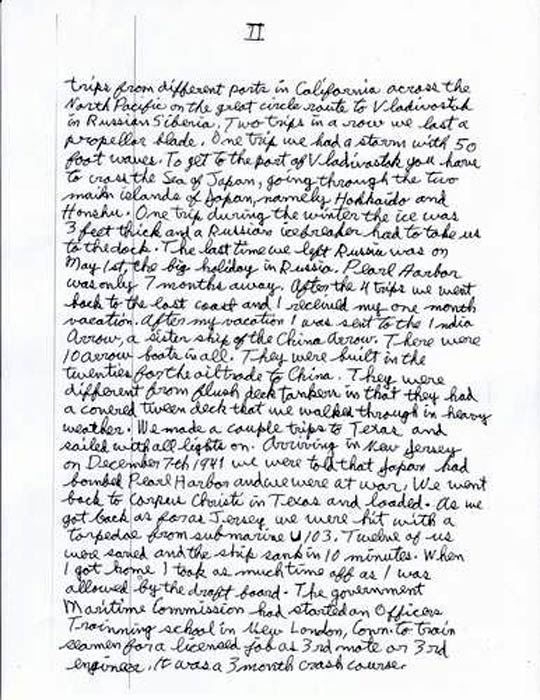
trips from different ports in California across the North Pacific on the West coast route to Vladivostok in Russia/Siberia. Two trips in a row we had a propeller blade problem. To get to Vladivostok you had to cross the Sea of Japan, going through the two main islands of Japan, namely Hokkaido and Honshu. Pearl Harbor was only 7 months away. After the 4 trips we went back to the East Coast and I picked up my earned vacation.
After my vacation I was sent to the India Arrow, a sister ship of the China Arrow. There were 9 arrow boats in all. They were different from any other tanker in that they had a divided tank deck. We made a couple trips to Texas and sailed along the Gulf Coast. So on December 7th, 1941 we were told that Japan had bombed Pearl Harbor and we were at war. We went back on board. Today we were hit with a torpedo from submarine U-103. Twenty of us survived out that night from a crew of 38.
So on I got home. I took as much time off as I was allowed by the ship board. The government sent a man to come interview me at our home. I became a job as 2nd mate on a 2nd ship — a 3-month crash course.
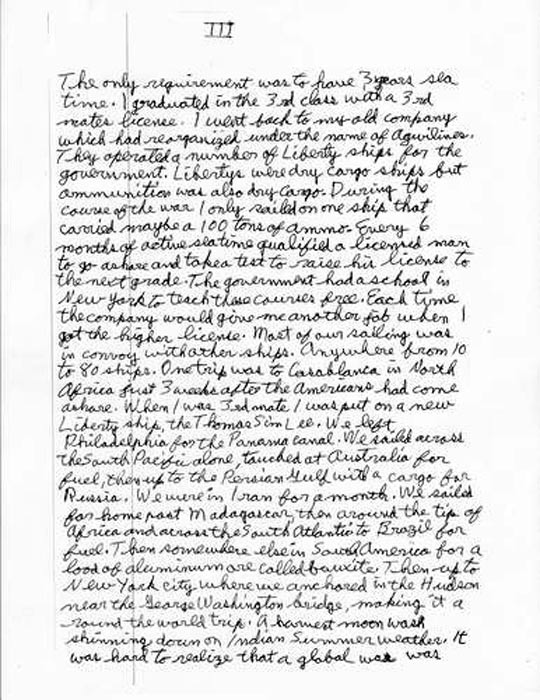
The only requirement was to have 3 years sea time. I graduated in the 3rd class with a 3rd mate’s license. I went back to my old company which had me go and work at some of their ships. They operated a number of Liberty ships for the government. Liberty ships were cargo ships but ammunition was also cargo. Every 6 months a ship had to return to go ashore and take its exam to raise his license to the next grade.
Most ships were sailing in convoy with other ships, organized from 10 to 50 ships. One trip was to the Caribbean. I also did a round to Murmansk and back. When I was inland I worked on a Liberty ship. We made a trip around the world across the British Pacific, along to Australia, all the way up to Russia. We then sailed for home past Madagascar, then around the tip of India and through the Gulf of Aden to the Red Sea. Then on to South America for a load of aluminum bauxite. Then up to New York Harbor, past Ambrose Lightship, past the George Washington Bridge — making it a true around the world trip.
It became more and more clear to our company and to all parties that a global war was…
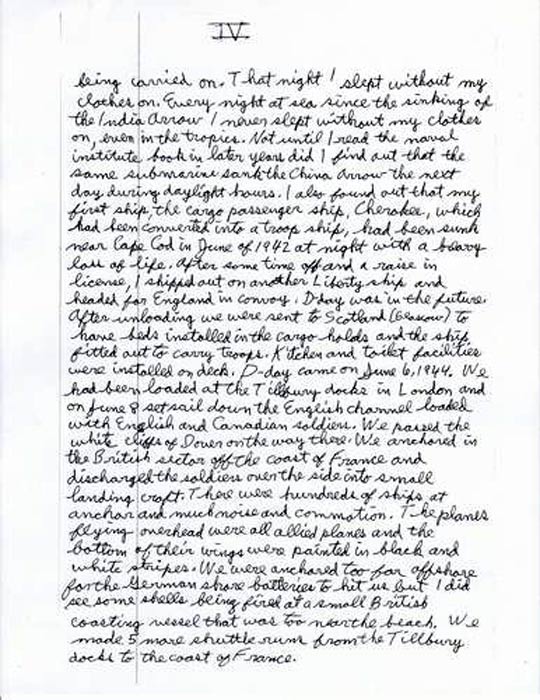
being carried on. That night I slept without my clothes on. Every night at sea since the sinking of the India Arrow I slept without my clothes on, over my trousers. But until I read a later naval institute book I found out that the same submarine that sunk the India Arrow also sunk the China Arrow the next day, having no survivors. I also found out that my first ship, the cargo passenger ship Cherokee, which had been converted into a troop ship, had been sunk in a head-on collision. Such is the tragic loss of life.
After some time ashore I raised my license and shipped out on another Liberty ship headed for England. After unloading we were sent to Scotland to have anti-submarine equipment fitted out in the engine room. Mark 7 depth charges and target facilities were installed on deck. D-Day came on June 6, 1944. We had been loaded at Point Comfort, Virginia. I sailed down the English channel loaded with English and Canadian soldiers. We passed the white cliffs of Dover on the way there.
We anchored in the British sector off the coast of France and discharged the soldiers with LCTs — large landing craft. This was not our only ship. Most were at anchor and moved on in convoy. The medium bombers had black and white stripes painted on their wings. It was nice to watch from far offshore. German shore guns did fire some shells at us, and small British coastline vessels had to move to shelter. We would come to a harbor along the coast of France.
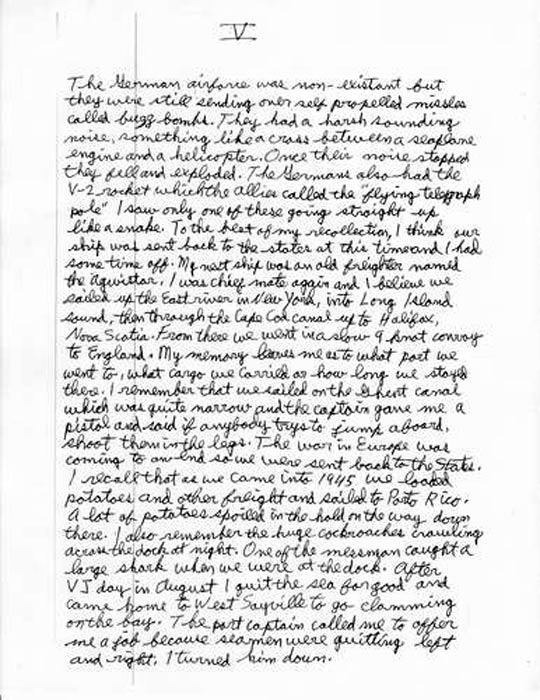
The German fighters were more reluctant but they were still sending out air-propelled missiles called buzz-bombs. They had a harsh pounding noise, something like a piston in an airplane engine. Once their motor stopped they fell and exploded. The Germans also had the V-2 rockets, which were called the “flying telegraph pole.” I saw only one of those going straight up like a snake.
My next ship was an old freighter. I was chief mate again and I believe we made up the East coast for some time, then through the Halifax area, then south via convoy. I got sent to England. The English Channel was quite narrow and the captain had to be very careful of anybody trying to jump aboard.
I recall that as we came into port we passed large stores of potatoes and onions stacked along the dock. I also remember the lifeboat crew checking each section of our ship and a young man caught a large shark while we were at the dock. After V-J Day in August 1945 I came ashore for good. When I came ashore I decided to go clamming on my boat. The first captain called me to report for a job because they were still short of crews. I turned him down.
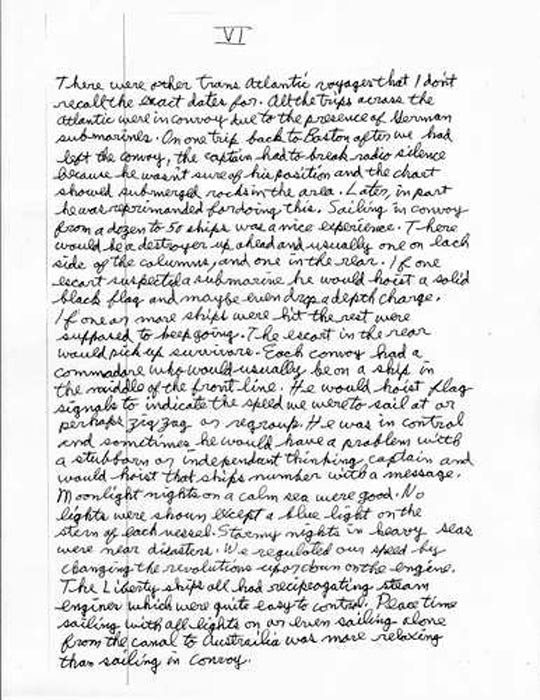
There was also Trans-Atlantic transport. Little trips across the Atlantic were in convoy due to the presence of German submarines. On one trip back to Baltimore, a ship had left the convoy and the captain had to break radio silence because he went off of his position and the chart showed icebergs. Under the rules the captain was reprimanded for doing this.
Sailing in convoy from about 30 to 50 ships was a nice experience. There would be destroyers or other escort vessels, one on each side of the column and one in the rear. If an enemy ship was spotted, signal was used to warn the convoy. Each convoy had a commodore who could usually be on a ship in the middle of the pack. They had a system of using signals to indicate the speed we should sail at.
Moonlight nights our sailing was more dangerous — no lights were allowed except a blue light on the stern. Radar was new at this point in time. Peace time sailing was all lights on, even sailing alone was great to see, which was more relaxing than sailing in convoy.
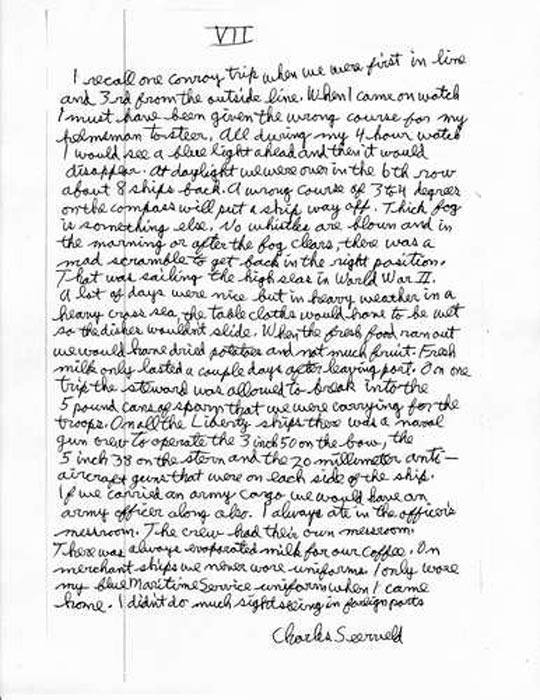
I recall one convoy trip when we were first in line and 3rd from the outside line. When I came on watch I must have been given the wrong course for my lighthouse to steer. After giving my 4-hour watch I saw a blue light ahead and then it would disappear. At daylight we were over about 8 ships back. During the course of a voyage, fog is something else. I was never unable to get back in the right positions.
A lot of things were nice but in heavy weather the table cloths would have to be wet so the dishes would not slide off the table. Fruit milk only lasted a couple days before being lost. The Liberty ships had a rapid gun across the front — a 3-inch 50 on the front, 5-inch 38 on the stern, and 20-millimeter anti-aircraft guns on each side of the ship. If we carried an armed guard we would have an army officer along also. I always ate in the officers’ mess hall. There was always good company and good coffee. In merchant ships our mess room uniforms were simple. I only wore my service uniform on the way home. I did not do much sightseeing in foreign ports.
— Charles Seerveld
The Sinking of the SS India Arrow — February 4, 1942
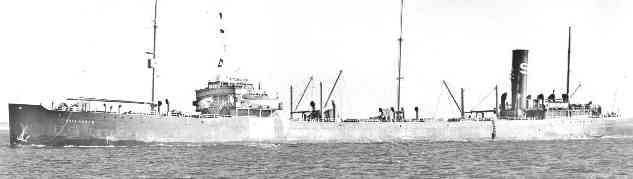
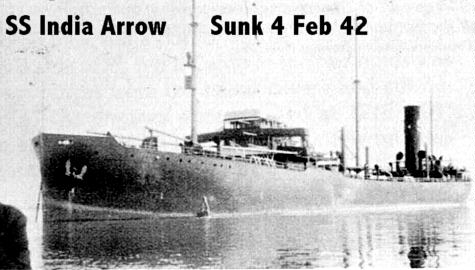
SS India Arrow
A 468-foot long tanker (sister ship to the Dixie Arrow and China Arrow — also lost during WWII), the India Arrow was built at the Fore River Shipyard at Quincy, MA in 1921. She was torpedoed by the U-103 and sunk on February 4, 1942 at position 38.48 N / 73.40 W. She was carrying a full load of 88,369 barrels of diesel oil to New York when the submarine ambushed the vessel late at night. While part of the Arrow immediately rested on the bottom, the ship refused to sink until the next day.
She now sits in 180 feet of water, intact and upside down, though canted to one side with a debris field strewn across the sand. Artifacts are abundant around the forward and stern superstructure areas. The India Arrow is an impressive wreck that has only been dived a few times in recent years.
The India Arrow was owned by the Socony-Vacuum Oil Company and operated out of New York. She was an 8,327-ton tanker with a draft of 38 feet 6 inches. Her master on that voyage was Captain Carl Samuel Johnson. She was not armed, and had no way of defending herself from attack.
The India Arrow sailed from Corpus Christi, Texas, en route to Carteret, New Jersey. About thirty-five miles due east of Five Fathom Bank, the U-103 (Winter) intercepted the tanker. The India Arrow was steering a non-evasive course when the torpedo struck the starboard quarter at about the No. 10 bunker. The ship caught fire and began to sink by the stem at a rapid rate. The radio operator sent a distress signal but not a position before the dynamo failed. Within three minutes the crew of nine officers and twenty-nine men began abandoning ship. Minutes later the U-103 started shelling the vessel from a distance of approximately 250 yards. The submarine fired seven shells at two-minute intervals, setting the after portion of the ship afire. The crew managed to launch successfully only one of the ship’s four lifeboats. In a sea of blazing oil two other boats swamped, and the rapidly sinking tanker pulled the No. 2 boat beneath the water. Only one officer and eleven men survived, rescued by the twenty-four foot fishing skiff Gitana twelve miles off Atlantic City. Two men died as a result of the shelling, and the remaining men apparently drowned when the two boats swamped.
Camden, NJ — Merchant Marine Memorial, SS India Arrow
SS India Arrow — U.S. Coast Guard index card
12 Saved in Torpedoing Off N.J.
The Morning Post — Camden, N.J. — Saturday,
Camden Sailor Among 26 Lost Aboard Tanker
Survivors Picked Up by 2 Fishermen and Taken to Atlantic City
Flaming Ocean Traps Crew After Attack
Atlantic City, Feb. 6 — After more than 24 hours in a lifeboat, 12 survivors of the India Arrow, 8,327-ton oil tanker that was torpedoed by an Axis submarine and sank 35 miles off the coast, were rescued and brought here today.
Twenty-six other members of the crew, including Nicholas Hetz, 23, of 690 Ferry Avenue, are reported missing and believed to have been lost when the ship sank within 5 minutes after the U-boat fired its lethal charge into the engine room.
So quickly did the India Arrow list and ship water that the radio operator had time only to flash one “SOS” before the dynamo went dead and the stern settled for the final plunge, as oil scattered by the explosion spread over the water and ignited, turning the scene into a veritable inferno.
Captain Carl S. Johnson, 48, of New Port, Staten Island, told Coast Guards on his arrival here the submarine fired 5 shells into the tanker after the torpedo struck. He said, however, that the lifeboat in which the 12 men escaped was not molested.
Ship Listed Quickly
The India Arrow, owned by the Socony-Vacuum Company, was struck on the starboard side and quickly listed. Captain Johnson said that he was on the bridge at the time and gave the order to abandon ship. The crew sought the lifeboats, but only one was successfully launched.
The tanker, northward bound, was the 17th ship to go down since the beginning of the war. The tanker Malay was attacked but managed to make port. Thus far the U-boats have claimed more than 400 lives.
The men in the lifeboats were sighted by Frank D. Marshall, of 501 Carson Avenue, who operates a produce stand in Stratford in the Summer, and John Shorn of 2219 Fairmount Avenue, who were on a cod-fishing trip in Marshall’s boat, the Gitana. Marshall took the survivors aboard and brought them to the Coast Guard station where, through the activities of Alexander Bolduc, chairman of the disaster committee, they were supplied with dry clothing.
The men in the lifeboat which Johnson commanded rigged a sail but they neither saw rescue craft nor were seen until just after dawn this morning — 24 hours after the striking — when Marshall’s boat was sighted 20 miles south-southwest of Atlantic City light.
Johnson said that the lifeboat was well-supplied with water and biscuits, and the survivors had not been alarmed at anytime over the possibility of not being found.
Philadelphia Man Lost
The Socony-Vacuum Company tonight listed the following members of the crew as missing:
| Joseph Davis Bronx, NY Chief Officer |
Arthur Lowe Brouillet Holyoke, MA Second Officer |
James Winn Brighton, MA Third Officer |
Erich Suderow Staten Island, NY Chief Engineer |
Thomas E. Brittingham Long Island, NY First Assistant Engineer |
| Walter White Staten Island, NY Second Asst. Engineer |
George Truitt New York City, NY Third Asst. Engineer |
Stanton E. Heater Cleveland, OH Jr. Third Asst. Engineer |
James S. Kerr Arkabutla, MS Seaman |
|
| Edward P. Simonson Philadelphia, PA Seaman |
Robert Tucker Riverside, RI Seaman |
Ernest D. Baldwin Huntingdon Station, NY Seaman |
Michael Schwartz Brooklyn, NY Seaman |
|
| Harris Elinekas New York City, NY Pumpman |
Anthony Simon Scranton, PA Oiler |
Henry J. Moody Beaumont, TX Oiler |
Joseph B. Anger Port Arthur, TX Fireman |
|
| Oliver LeJeaune Frisco, LA Wiper |
Ira H. Buhrman Baltimore, MD Wiper |
Karl F. Huhnergarth Hoboken, NJ Steward |
Thomas F. Harris Port Arthur, TX Chief Cook |
|
| Thomas Nielson Brooklyn, NY Second Cook |
Michael A. Finn New York City, NY Crewman |
Nicholas Hetz Camden, NJ Utility |
Rufus Alston Corpus Christi, TX Messman |
The list of survivors follows:
| Dale I. Montgomery Englewood, CA Boatswain |
N.J. Baugh Alpaus, NY Officer’s Steward |
Gordon Chambers Bronx, NY Wiper |
Edward Proehl Jersey City, NJ Officer’s Steward |
| Michael Kusy New York City, NY Able Bodied Seaman |
Fred Baker Johns Island, SC Machinist |
Sam Coulquitt Madisonville, TX Officer’s Messman |
A.C. Bradford, Jr. Pine Bluff, AR Fireman |
| Charles Seerveld Center Moriches, NY Able Bodied Seaman |
Edward J. Shear Hammonton, IN Radioman |
Bert Palmer Sayville, NY Fireman |
Carl S. Johnson Staten Island, NY Captain |
Ready to Resume Jobs
The 12 survivors, after receiving care at the Coast Guard station, returned to New York. Arrangements for the transfer were made by a representative of the Socony-Vacuum Company, who arrived here this afternoon.
Without exception, the men declared they were ready to return to sea on tankers as soon as new berths could be found for them.
“On Wednesday night we were struck by a torpedo at 7 o’clock off the Jersey coast,” said the captain. “I was on the bridge at the time. We launched a lifeboat and abandoned ship. The ship was struck on the starboard quarter and went down in five minutes. The torpedo hit in the No. 10 tank. I went off in the No. 1 lifeboat, and No. 2 may have been launched. There were four lifeboats on the ship, two of which did not get off.”
“Some men got out of the fire and the engine room. There were 12 men in my boat, including myself. I never saw anymore of the No. 2 lifeboat.”
Sub Shelled Ship
“The submarine shelled the ship, but gave us a chance to get off. I did not see the submarine. There was no moon and it was a dark night. There were 38 men in our crew.”
“We were covered in oil. It was the first mate’s watch when the torpedo struck. He went down to take charge of a lifeboat.”
“I think the engine room was flooded right away. Some of the men possibly could not get up the hatch.”
“The ship caught on fire before she went down. We sailed for shore, and 12 miles off Ocean City at 5:00 AM a fisherman brought us to the Coast Guard station at 8:55 this morning.”
“When we were in the lifeboat the sea was heavy and we had to fight the water and bail it out. On February 5th we set off flares but they were not noticed. A heavy fog hung across the ocean when we were rescued.”
Ship Sent Out SOS
“We transferred to the fishing boat. We had water and biscuits in the lifeboats. We got off an SOS before abandoning ship. Edward Shear was the radio operator. He is from Niagara Falls.”
“The ship went down stern first. I do not know if any of the crew was left on board. We could not see No. 2 lifeboat after the launching.”
“The ship caught fire immediately after the torpedo struck her from the starboard side. Oil spread out over the water and caught on fire for three or four hundred yards around when the ship sank. Fortunately we were clear of the fire on the water. I do not think No. 2 lifeboat got out at all. I saw four of the crew swimming in the water and then picked them up.”
“I have three children, two girls and a boy. One girl’s name is Josephine and she is 9. Charlotte is 4. The boy, Carl, is 8. My wife’s name is Charlotte.”
In Navy In Last War
“I have been with the Socony-Vacuum Oil Company since 1928. In the last war I was a lieutenant in the Navy and served overseas with the naval transport service.”
“I have been a master of the Socony tankers for the last eight years and on the India Arrow for three weeks.”
“As soon as I get another ship I am going right out to sea again. I have been at sea for 34 years. I lost a ship in a hurricane south of Cuba in 1917. She was the Admiral Clark. I was second mate. Six of us got away on a life raft and after sitting on it for seven days and nights were finally picked up by a Swedish sailing ship. We lost 26 men.”
“In 1926 I was second mate on another ship and rescued 23 men on a U.S. dredger that sank in New York harbor.”
Saw U-Boat Surface
Kusy, one of the survivors, gave a graphic description. “I was at the wheel when I first saw the outline or shadow of the submarine as the conning tower surfaced. Almost immediately the torpedo struck and I was knocked off my feet. I made my way to lifeboat No. 2 that had 20 men in it, but was not able to board it. I eluded the grasp of one of the mates and jumped overboard. Another fellow followed me. I barely left the ship when it heeled over to port and trapped all the men in that lifeboat.”
“I saw the bridge fall on the boat as the ship listed and took the men with it. I grabbed a floating hatch cover and was out of the way of the tanker when it sank. I saw my buddies go down.”
Montgomery declared the fog lifted for a short time while they were floating and they were able to see lights on the shore. He had been in the water 45 minutes before being picked up by the lifeboat.
Clung to Hatch Cover
Baker declared: “I was in my cabin when the torpedo hit. It knocked me out of my chair. I waded through oil and bilge water, knee deep. The ship already was sinking. I jumped overboard, right after Kusy and by that time the gunwales were within four feet of the water. I came up 300 feet from the ship and found a floating hatch cover to which I clung until Captain Johnson and the lifeboat found me.”
Shear, the radio operator, recounted his attempts to get a call for help on the air. “I was reading when I felt the blow of the torpedo. I dashed to the radio room and sent out a message ‘SOS-KDHP-Torpedo.’ KDHP were my call letters and that was all I could get on the air. The captain yelled the position of the ship to me, but I could not hear him and I tried to radio the last known position, but I guess the radio was dead.”
“By that time the ship was sinking astern and water hit the dynamo. The lights went out and I tried to use the emergency radio set but that would not work, either. I rushed to the deck and met Captain Johnson, who threw the ship’s papers to me. I dashed to lifeboat No. 1 where the Captain was trying to free one of the davits and I tossed the papers into the boat. Water was pouring into the lifeboat by that time due to the list of the ship. I jumped overboard and was picked up.”
Rescue Described
Marshall, who is 60 years old, and has two daughters, Helen, 25, and Maud, 22, said he has been fishing out of Atlantic City for five years. He served an enlistment in the Navy from 1910 to 1914.
“About 6:20 a.m. today while Jack Shore and I were fishing we saw what we thought was a flare through the fog,” he said. “We ported our helm for the position of the flash and 20 minutes later we found the lifeboat. Some of the men were barefooted, but when we took them on our boat, it was necessary to cut the shoes from two of them.”
“Three times this year I have had unusual experiences in fishing,” Marshall continued. “The first time I was at sea when the Naval Patrol called for my papers and I found I left them ashore. I had to return for them. The second time, it began to snow and drove me to shore. But on this trip, although I didn’t get any fish, I picked up the most valuable cargo my little boat has ever carried.”
Shore said when they managed to get the survivors aboard the Gitana, they gave them hot coffee and whiskey, but the sailors refused to eat, preferring to wait until they landed. They smoked five packs of cigarettes on the way to shore, he said.
Captain Johnson, Shore said, would not permit them to assist him until each of his men was given care.
The India Arrow’s home port was New York. She was 458 feet long with a beam of 63 feet and was built in 1921 at Quincy, Mass.
Survivors of the SS India Arrow
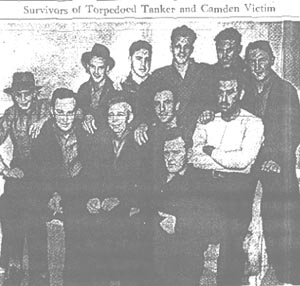
Survivors of the torpedoed tanker India Arrow, after they were given food and clothing at the Atlantic City Coast Guard station. In front is N.J. Baugh. Seated, left to right: A.C. Bradford Jr., D.I. Montgomery, Captain Carl S. Johnson, Michael Kusy, Bert Palmer. Standing, left to right: Edward Proehl, Fred H. Baker, Edward J. Shear, Sam Coulquitt, Gordon Chambers. The twelfth survivor, Charles Seerveld, is not in the picture.