Introduction
Clay Street, in Camden’s 5th Ward, ran west from the 900 block of South 2nd Street to South Front Street. The street does not appear in the 1891 Sanborn Map, and has no listings in the 1887–1888, 1888–1889, or 1890–1891 City Directories. Its origins appear tied to the construction of the Public Service Corporation of New Jersey’s gas plant on the east side of South 2nd Street between Cherry and Walnut Streets in the 1890s. A twin home of brick construction had been put up at 122 and 124 Clay Street by 1896. By 1906 Public Service had built a large storehouse and stables for its horses on the north side of Clay Street, and the S. Canning Childs grocery firm had a warehouse whose rear entrance was on the south side, at 116 Clay Street. Contractor William H. Doherty had a large building at the rear of his property at 133 Walnut Street that had access to Clay Street.
It is quite probable that the houses on Clay Street were built at the same time as 121, 123, 125 and 127 Walnut Street, and that it was William H. Doherty who had them erected. William H. Doherty owned land in the 100 block of Walnut Street as early as 1890, and made his home in that block of Walnut Street until he passed away in 1901.
Late in 1908 Clay Street became front page news when a resident was thought to have leprosy. No residences were recorded on Clay Street in City Directories after 1908, although newspaper articles indicate that there were residents there as late as 1912.
No homes or businesses had addresses on Clay Street in the 1923 or later Camden City Directories.
Clay Street was officially extinguished by the City of Camden in October of 1974. All physical traces of Clay Street are gone.
Clay Street — 1906 Sanborn Map
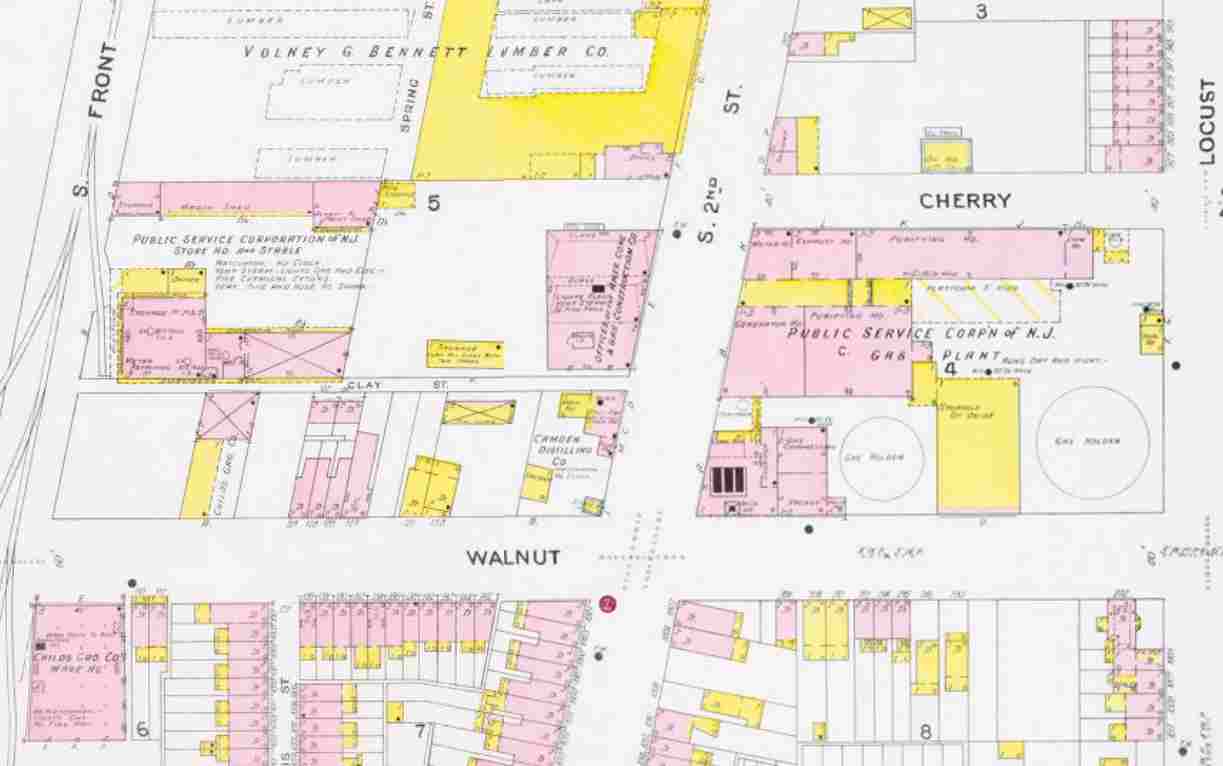
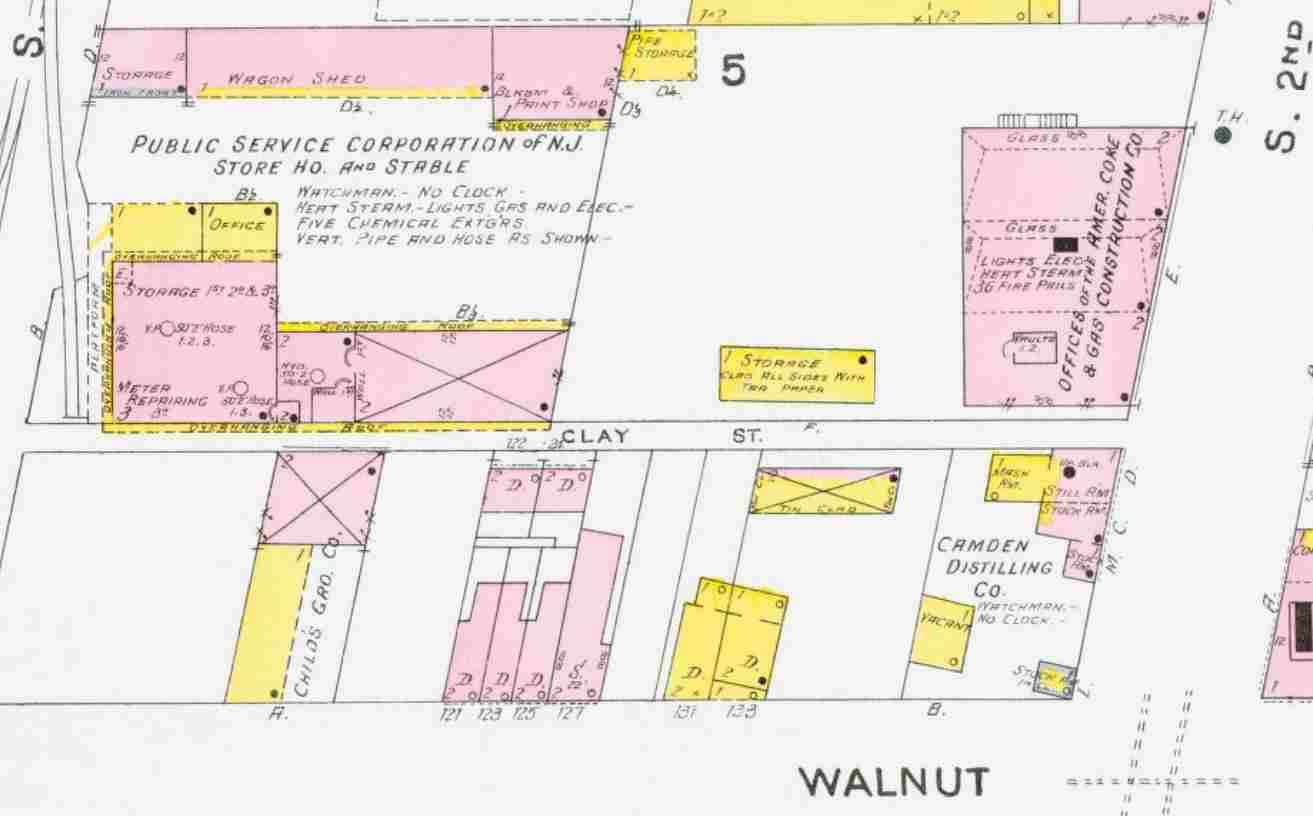
1906 Sanborn Map showing Clay Street running between South 2nd Street and South Front Street.
100 Block of Clay Street — Occupants
City directory records. Clay Street no longer exists; it was extinguished by the City of Camden in October 1974.
116 Clay Street
| Year ↕ | Name ↕ |
|---|---|
| 1906 | Public Service Corporation storehouse & stables (north side); S. Canning Childs grocery warehouse — rear entrance (south side) |
122 Clay Street
| Year ↕ | Name ↕ |
|---|---|
| 1895 | Real Estate Investment Co. (W. A. Davis, Harry W. Boureau, George Zollers) |
| 1898–1900 | George Brady & Family |
| 1898–1900 | George & Henrietta Brady |
| 1899 | Jacob Harris; Josephine Harris |
| 1899 | Jacob Harris |
| 1899 | Josephine Harris |
| 1900 | William Harding |
| 1900–1901 | George Rocker |
| 1902 | John Harris |
| 1903 | John E. Harris; Evelina Harris |
| 1903 | John E. Harris |
| 1903 | Evelina Harris |
| 1906 | Charles Johnson |
| 1907–1908 | Prince Clark & Family |
| 1907–1908 | Charles Clark |
124 Clay Street
| Year ↕ | Name ↕ |
|---|---|
| 1896–1897 | Real Estate Investment Co. (W. A. Davis, Harry W. Boureau, George Zollers) |
| 1896 | Allan Newman; Kate Newman |
| 1896 | Allan Newman |
| 1896 | Kate Newman |
| 1898 | Joseph Cornish; Sarah Cornish |
| 1898 | Joseph Cornish |
| 1898 | Sarah Cornish |
| 1900 | William Black & Family; William & Ella Black; Virginia R. Cannon (stepdaughter); Andrew Rawles (boarder) |
| 1901 | William Hatchett & Family; William & Daisy Hatchett; Marie, Leroy & Florence Hatchett |
| 1901 | William & Daisy Hatchett |
| 1901 | Marie Hatchett |
| 1901 | Leroy Hatchett |
| 1901 | Florence Hatchett |
| 1902 | William Chase; Peter Keets |
| 1902 | William Chase |
| 1902 | Peter Keets |
| 1904–1907 | James R. Daniels |
| 1909–1910 | Russell Davis & Family |
| 1909–1910 | Russell & Essie Davis |
| 1910 | Lewis Ford (bootblack) |
| 1910 | Lewis Ford |
| 1912 | Arminto Degrello |
Related: Prince Clark — 122 Clay Street, 1907–1908.
Clay Street — 1914 Map
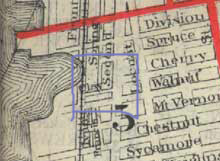
Clay Street — “inside the box.” Map published in 1914.
Clay Street — 1946 Map of Camden
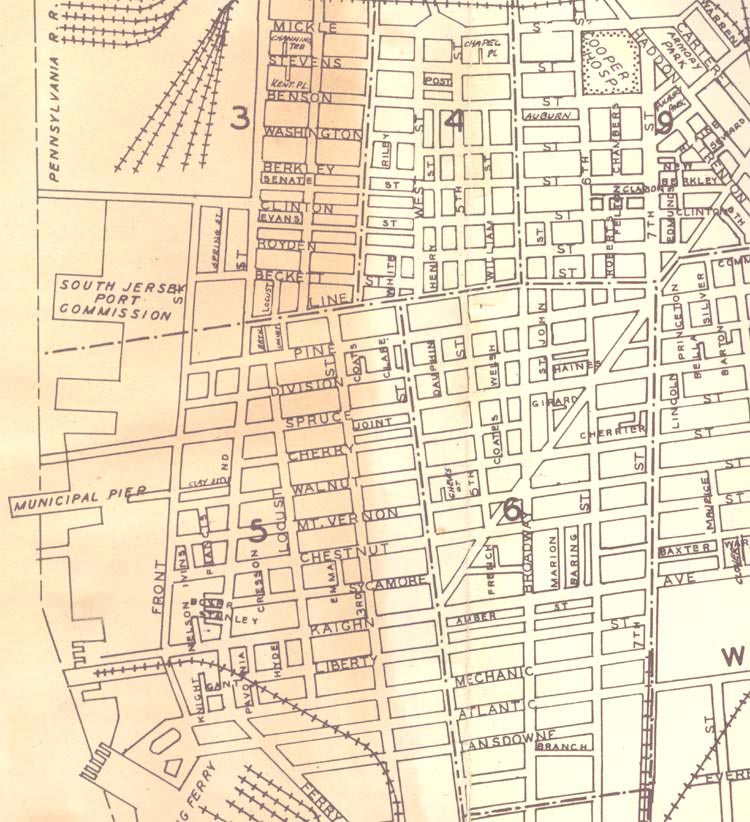
1946 Map of Camden showing Clay Street.
122 Clay Street — Real Estate
Camden Daily Telegram –
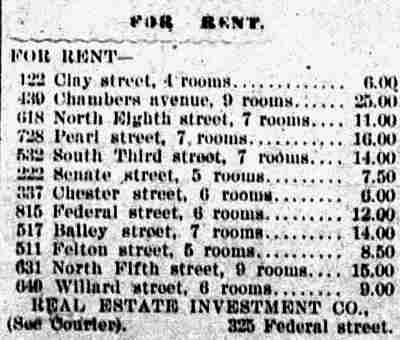
FOR RENT—
122 Clay street, 4 rooms … 6.00
430 Chambers avenue, 9 rooms … 25.00
618 North Eighth street, 7 rooms … 11.00
728 Pearl street, 7 rooms … 16.00
532 South Third street, 7 rooms … 14.00
222 Senate street, 5 rooms … 7.50
337 Chester street, 6 rooms … 6.00
815 Federal street, 6 rooms … 12.00
517 Bailey street, 7 rooms … 14.00
511 Felton street, 5 rooms … 8.50
631 North Fifth street, 9 rooms … 15.00
640 Willard street, 6 rooms … 9.00
REAL ESTATE INVESTMENT CO., (See Courier). 325 Federal street.
124 Clay Street — Real Estate
Camden Daily Telegram –
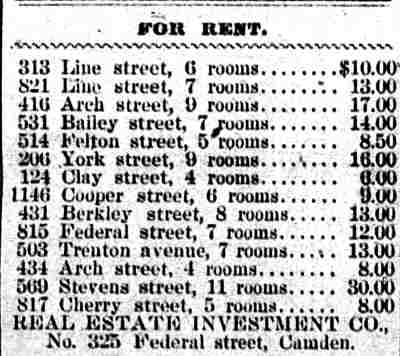
FOR RENT.
313 Line street, 6 rooms … $10.00
821 Line street, 7 rooms … 13.00
416 Arch street, 9 rooms … 17.00
531 Bailey street, 7 rooms … 14.00
514 Felton street, 5 rooms … 8.50
206 York street, 9 rooms … 16.00
124 Clay street, 4 rooms … 6.00
1146 Cooper street, 6 rooms … 9.00
431 Berkley street, 8 rooms … 13.00
815 Federal street, 7 rooms … 12.00
503 Trenton avenue, 7 rooms … 13.00
434 Arch street, 4 rooms … 8.00
569 Stevens street, 11 rooms … 30.00
817 Cherry street, 5 rooms … 8.00
REAL ESTATE INVESTMENT CO., No. 325 Federal street, Camden. — Camden Daily Telegram, March 11, 1897.
Leprosy on Clay Street
Camden Daily Courier –

NEIGHBORS OF THE ALLEGED LEPER’S FAMILY IN FEAR
Residents of Clay Street Alarmed Without Provocation.
SOME HINTS THAT ASYLUM PATIENT HAS OTHER DISEASES
The action of the employees of Camden Coke Company in refusing work with Prince Clarke, the father of Charles Clarke, whom the county authorities think is afflicted with leprosy, has stirred the residents of Clay street to a pitch of excitement that excels anything the neighborhood has ever known. Yesterday when Dr. Leavitt went to examine the standard at Broadway and Mt. Vernon street, the medical man was plied with all kinds of questions bearing on the case and the result of contact with those suspected of having the disease. Many of the colored boys in the locality were alarmed because of the fact that they have intermingled freely with the Clarke boys and if there was anything serious the matter with them they thought that they ran a good chance of getting the disease.
The active first treatment which the leper had at the Douglass Hospital at Fifteenth and Lombard streets, Philadelphia, was by Dr. Gordon Shoemaker, who treated the boy for an affection of the spine. The medical name of the disease as given by Dr. Gordon Shoemaker was “myelitis.” Dr. Gordon claimed the boy had no leprosy resulting from some severe shock affecting the spine, and which resulted in periodical deadening of the circulation of the fingers.
It is stated that Dr. Hurff, of the Blackwood Asylum, is present in his opinion that it is not leprosy, but there have been so many rumors going around that it would be unwise to trust entirely upon them to fully determine the diagnosis. It was learned last night that about a year ago Prince Clarke suffered with an affection of the great right foot.
The health officials have granted the father a clean bill of health, and will continue to do so. Particularly since everything has been done to satisfy their opinion of the boy now at the county hospital. — Camden Daily Courier, October 14, 1908.
Prince Clark — 122 Clay Street
Camden Post-Telegram –
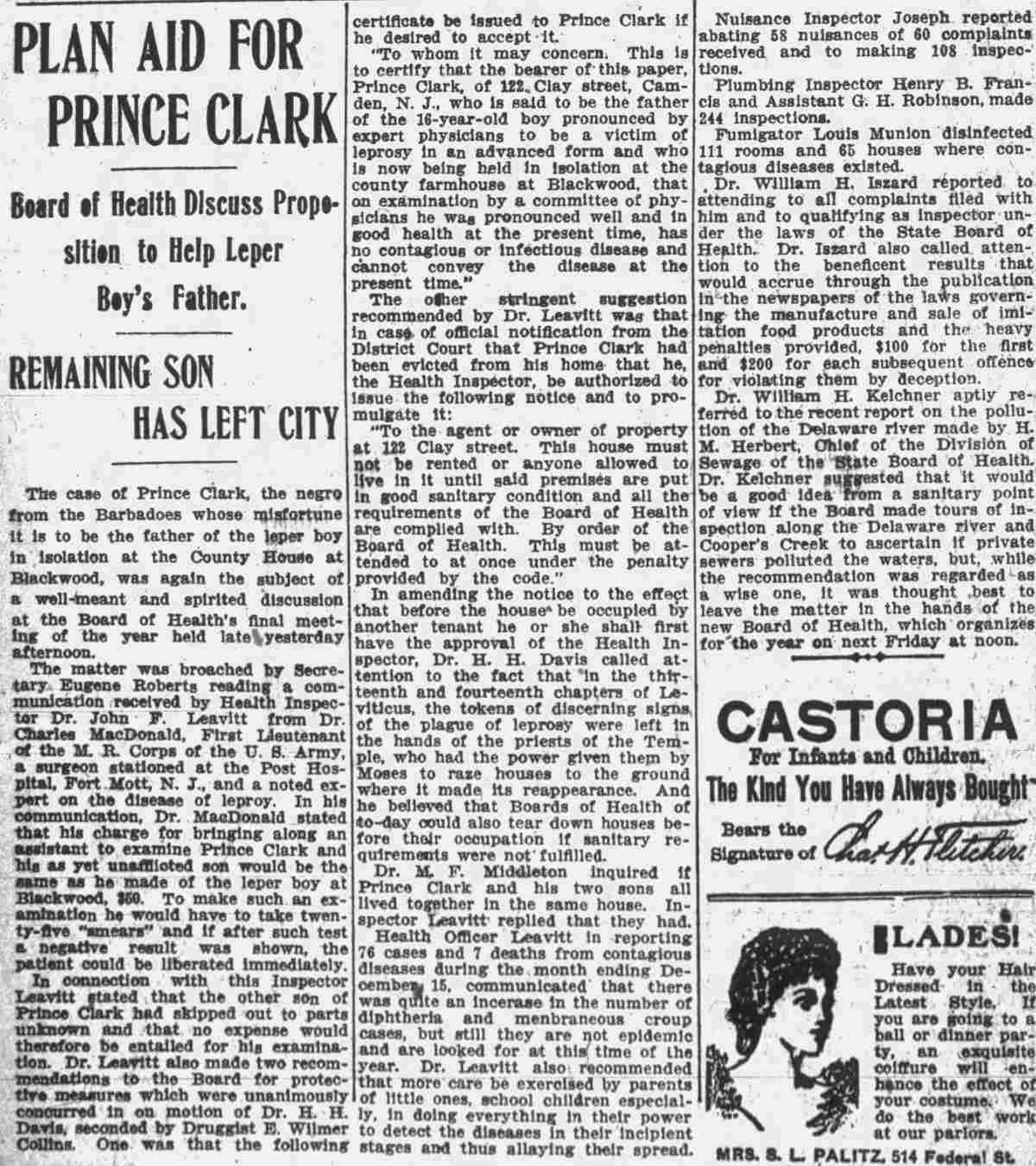
PLAN AID FOR PRINCE CLARK
Board of Health Discuss Proposition to Help Leper Boy’s Father.
REMAINING SON HAS LEFT CITY
The case of Prince Clark, the negro from the Barbadoes whose misfortune it is to be the father of the leper boy in isolation at the County House at Blackwood, was again the subject of a well-meant and spirited discussion at the Board of Health’s final meeting of the year held late yesterday afternoon.
The matter was broached by Secretary Eugene Roberts reading a communication received by Health Inspector Dr. John F. Leavitt from Dr. Charles MacDonald, First Lieutenant of the M. R. Corps of the U. S. Army, a surgeon stationed at the Post Hospital, Fort Mott, N. J., and a noted expert on the disease of leprosy. In his communication, Dr. MacDonald stated that his charge for bringing along an assistant to examine Prince Clark and his as yet unafflicted son would be the same as he made of the leper boy at Blackwood, $50. To make such an examination he would have to take twenty-five “smears” and if after such test a negative result was shown, the patient could be liberated immediately.
In connection with this Inspector Leavitt stated that the other son of Prince Clark had skipped out to parts unknown and that no expense would therefore be entailed for his examination. Dr. Leavitt also made two recommendations to the Board for protective measures which were unanimously concurred in on motion of Dr. H. H. Davis, seconded by Druggist E. Wilmer Collins. One was that the following certificate be issued to Prince Clark if he desired to accept it.
“To whom it may concern. This is to certify that the bearer of this paper, Prince Clark, of 122 Clay street, Camden, N. J., who is said to be the father of the 16-year-old boy pronounced by expert physicians to be a victim of leprosy in an advanced form and who is now being held in isolation at the county farmhouse at Blackwood, that on examination by a committee of physicians he was pronounced well and in good health at the present time, has no contagious or infectious disease and cannot convey the disease at the present time.”
The other stringent suggestion recommended by Dr. Leavitt was that in case of official notification from the District Court that Prince Clark had been evicted from his home that he, the Health Inspector, be authorized to issue the following notice and to promulgate it:
“To the agent or owner of property at 122 Clay street. This house must not be rented or anyone allowed to live in it until said premises are put in good sanitary condition and all the requirements of the Board of Health are complied with. By order of the Board of Health. This must be attended to at once under the penalty provided by the code.”
In amending the notice to the effect that before the house be occupied by another tenant he or she shall first have the approval of the Health Inspector, Dr. H. H. Davis called attention to the fact that in the thirteenth and fourteenth chapters of Leviticus, the tokens of discerning signs of the plague of leprosy were left in the hands of the priests of the Temple, who had the power given them by Moses to raze houses to the ground where it made its reappearance. And he believed that Boards of Health of to-day could also tear down houses before their occupation if sanitary requirements were not fulfilled.
Dr. M. F. Middleton inquired if Prince Clark and his two sons all lived together in the same house. Inspector Leavitt replied that they had.
Health Officer Leavitt in reporting 76 cases and 7 deaths from contagious diseases during the month ending December 15, communicated that there was quite an increase in the number of diphtheria and membraneous croup cases, but still they are not epidemic and are looked for at this time of the year. Dr. Leavitt also recommended that more care be exercised by parents of little ones, school children especially, in doing everything in their power to detect the diseases in their incipient stages and thus allaying their spread.
Nuisance Inspector Joseph reported abating 58 nuisances of 60 complaints received and to making 108 inspections. Plumbing Inspector Henry B. Francis and Assistant G. H. Robinson, made 244 inspections. Fumigator Louis Munion disinfected 111 rooms and 65 houses where contagious diseases existed.
Dr. William H. Iszard reported to attending to all complaints filed with him and to qualifying as inspector under the laws of the State Board of Health. Dr. Iszard also called attention to the beneficent results that would accrue through the publication in the newspapers of the laws governing the manufacture and sale of imitation food products and the heavy penalties provided, $100 for the first and $200 for each subsequent offence for violating them by deception.
Dr. William H. Kelchner aptly referred to the recent report on the pollution of the Delaware river made by H. M. Herbert, Chief of the Division of Sewage of the State Board of Health. Dr. Kelchner suggested that it would be a good idea from a sanitary point of view if the Board made tours of inspection along the Delaware river and Cooper’s Creek to ascertain if private sewers polluted the waters, but, while the recommendation was regarded as a wise one, it was thought best to leave the matter in the hands of the new Board of Health, which organizes for the year on next Friday at noon. — Camden Post-Telegram, December 29, 1908.
Prince Clark — 122 Clay Street
Camden Post-Telegram –
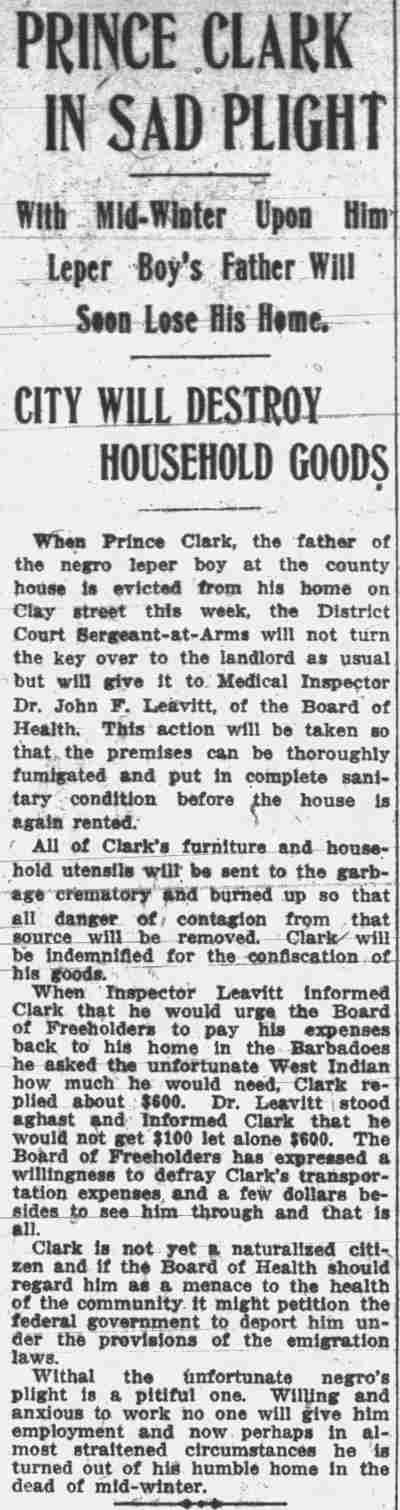
PRINCE CLARK IN SAD PLIGHT
With Mid-Winter Upon Him Leper Boy’s Father Will Soon Lose His Home.
CITY WILL DESTROY HOUSEHOLD GOODS
When Prince Clark, the father of the negro leper boy at the county house is evicted from his home on Clay street this week, the District Court Sergeant-at-Arms will not turn the key over to the landlord as usual but will give it to Medical Inspector Dr. John F. Leavitt, of the Board of Health. This action will be taken so that the premises can be thoroughly fumigated and put in complete sanitary condition before the house is again rented.
All of Clark’s furniture and household utensils will be sent to the garbage crematory and burned up so that all danger of contagion from that source will be removed. Clark will be indemnified for the confiscation of his goods.
When Inspector Leavitt informed Clark that he would urge the Board of Freeholders to pay his expenses back to his home in the Barbadoes he asked the unfortunate West Indian how much he would need, Clark replied about $600. Dr. Leavitt stood aghast and informed Clark that he would not get $100 let alone $600. The Board of Freeholders has expressed a willingness to defray Clark’s transportation expenses and a few dollars besides to see him through and that is all.
Clark is not yet a naturalized citizen and if the Board of Health should regard him as a menace to the health of the community it might petition the federal government to deport him under the provisions of the emigration laws.
Withal the unfortunate negro’s plight is a pitiful one. Willing and anxious to work no one will give him employment and now perhaps in almost straitened circumstances he is turned out of his humble home in the dead of mid-winter. — Camden Post-Telegram, January 20, 1909.
Russell & Essie Davis — 124 Clay Street
Camden Post-Telegram – October 29 &
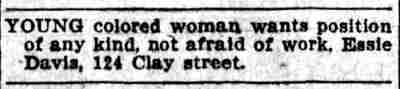
YOUNG colored woman wants position of any kind, not afraid of work. Essie Davis, 124 Clay street. — Camden Post-Telegram, October 29, 1909.
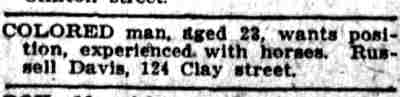
COLORED man, aged 23, wants position, experienced with horses. Russell Davis, 124 Clay street. — Camden Post-Telegram, November 1, 1909.
Sophia Davis — 124 Clay Street
Camden Post-Telegram –
FAILS TO PROSECUTE CHARGE OF ASSAULT
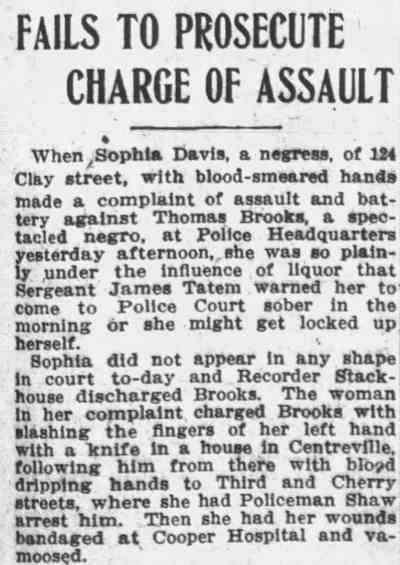
When Sophia Davis, a negress, of 124 Clay street, with blood-smeared hands made a complaint of assault and battery against Thomas Brooks, a spectacled negro, at Police Headquarters yesterday afternoon, she was so plainly under the influence of liquor that Sergeant James Tatem warned her to come to Police Court sober in the morning or she might get locked up herself.
Sophia did not appear in any shape in court to-day and Recorder Stackhouse discharged Brooks. The woman in her complaint charged Brooks with slashing the fingers of her left hand with a knife in a house in Centreville, following him from there with blood dripping hands to Third and Cherry streets, where she had Policeman Shaw arrest him. Then she had her wounds bandaged at Cooper Hospital and vamoosed. — Camden Post-Telegram, December 22, 1909.
Lewis Ford — 124 Clay Street
Camden Post-Telegram –
Robbers at Bootblack’s Home.
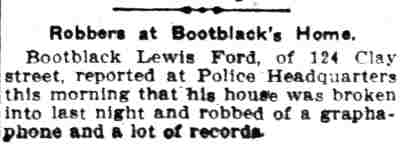
Bootblack Lewis Ford, of 124 Clay street, reported at Police Headquarters this morning that his house was broken into last night and robbed of a graphaphone and a lot of records. — Camden Post-Telegram, March 14, 1911.
Arminto Degrello — 124 Clay Street
Camden Daily Courier –
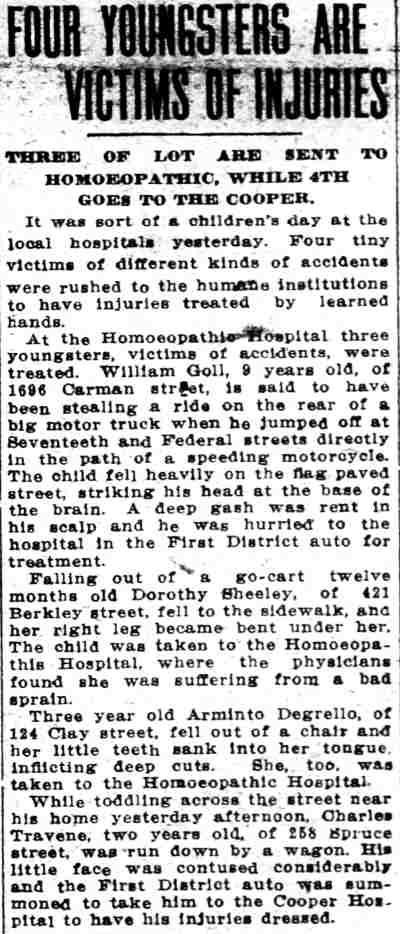
FOUR YOUNGSTERS ARE VICTIMS OF INJURIES
THREE OF LOT ARE SENT TO HOMOEOPATHIC, WHILE 4TH GOES TO THE COOPER.
It was sort of a children’s day at the local hospitals yesterday. Four tiny victims of different kinds of accidents were rushed to the humane institutions to have injuries treated by learned hands.
At the Homoeopathic Hospital three youngsters, victims of accidents, were treated. William Goll, 9 years old, of 1696 Carman street, is said to have been stealing a ride on the rear of a big motor truck when he jumped off at Seventeenth and Federal streets directly in the path of a speeding motorcycle. The child fell heavily on the flag paved street, striking his head at the base of the brain. A deep gash was rent in his scalp and he was hurried to the hospital in the First District auto for treatment.
Falling out of a go-cart twelve months old Dorothy Sheeley, of 421 Berkley street, fell to the sidewalk, and her right leg became bent under her. The child was taken to the Homoeopathic Hospital, where the physicians found she was suffering from a bad sprain.
Three year old Arminto Degrello, of 124 Clay street, fell out of a chair and her little teeth sank into her tongue, inflicting deep cuts. She, too, was taken to the Homoeopathic Hospital.
While toddling across the street near his home yesterday afternoon, Charles Travene, two years old, of 258 Spruce street, was run down by a wagon. His little face was contused considerably and the First District auto was summoned to take him to the Cooper Hospital to have his injuries dressed. — Camden Daily Courier, June 11, 1912.
Clay Street Extinguished
Camden Courier-Post –

AN ORDINANCE RELEASING AND EXTINGUISHING THE PUBLIC RIGHTS IN CLAY STREET BETWEEN SOUTH SECOND STREET AND FRONT STREET.
Whereas, the City of Camden, New Jersey, has entered into a Tri-party Agreement with the West Jersey and Seashore Railroad Company and Pennsylvania-Reading Seashore Lines and the Housing Authority of the City of Camden for the development of urban renewal, City Centre Area Project No. N.J. R-150 including therein the vacation, relocation and construction of certain streets and highways…
Be It Ordained by the Council of the City of Camden that all public rights in and to certain streets as hereinafter described, in the City of Camden, County of Camden and State of New Jersey, be and the same are hereby released and extinguished…
Section 4. This ordinance shall take effect twenty (20) days after final passage and publication as provided by law.
JOHN T. MARINI, Dated: October 10, 1974
MINE McKERNAN, JR, City Attorney
DANIEL CIECHANOWSKI, President, City Council
NOTICE — The foregoing ordinance was introduced at a regular meeting of City Council, held on Thursday, the 10th day of October, 1974, and will be considered for final passage, after public hearing, at the City Hall, on Thursday, the Twenty-fourth day of October, 1974 at 1:00 o’clock P.M. — JOHN T. ODORISIO, City Clerk. — Camden Courier-Post, October 12, 1974.