Pennsauken, N.J. — Polish Heroes War Memorial
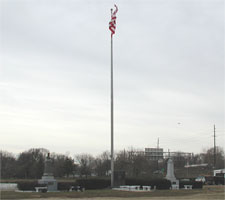
The Pennsauken Polish Heroes War Memorial at Cooper River Park.
On October 1, 1936 the Polish community in Camden announced that a monument to Casimir Pulaski would be dedicated on October 11. The Pulaski Monument was placed at a park that lay at Benson Street and Haddon Avenue. The park came to be known as Pulaski Park.
When Camden's Pulaski Park was designated to be the site of a new medical school, the monuments that were there had to be relocated. The South Jersey Division of the Polish American Congress, along with Polish Army Veterans Post 121 and the Polish American Citizens Committee raised funds to move the Pulaski Monument to a new site, at Park Drive and Route 130 in Pennsauken, N.J. in 1984. A new monument to Thaddeus Kosciusko was dedicated that October.
The two original monuments to Thaddeus Kosciusko and Casimir Pulaski were joined in 1995 by a new monument dedicated to those members of St. Joseph Roman Catholic Church, located at 10th & Liberty Streets in Camden, who gave their lives for our country in World War II. Information from a plaque inside the church was the basis for this monument.
A Note on Names
As Saint Joseph's was and is a predominantly Polish Parish, some of the men here had either changed their names to more “American” versions or had alternate spellings. There are at least four instances of that on this monument, perhaps more. In one case, that of John Shuler, a misspelling was made when the monument was engraved — he is named Shulek on this monument. Similar errors exist through many of the monuments in the county. One must take into consideration that these are all erected years after the fact, and in the pre-computer era of paper records, accurate data was far harder to come by.
In Memory of Our Fallen Heroes
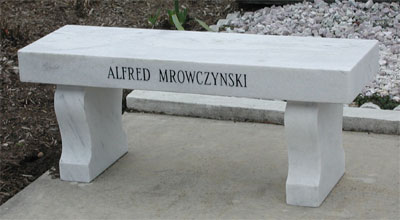
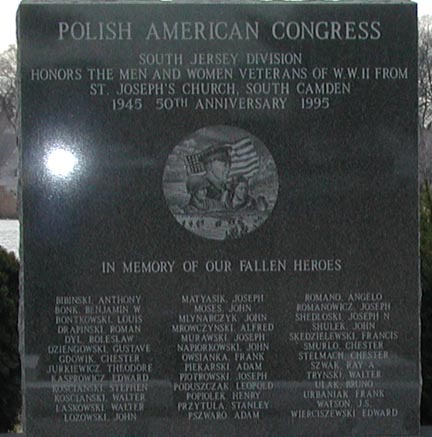
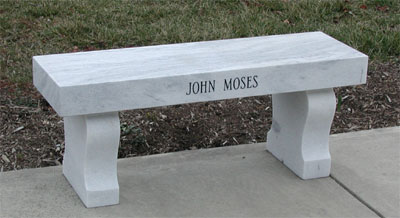
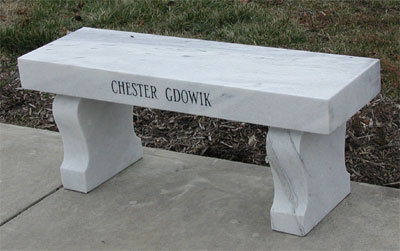
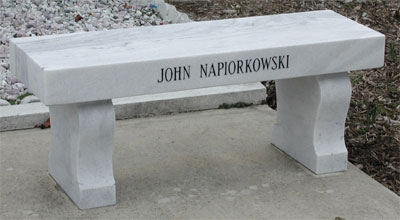
The Pennsauken WWII War Memorial, with portraits of Alfred Mrowczynski, John Moses, Chester Gdowik, and John Napiorkowski.
| Name | Rank | Branch | Unit | Born | Died |
|---|---|---|---|---|---|
| Anthony Joseph Bibinski | PFC | Army | 3rd Infantry Division | 2/28/1917 | 11/20/1944 |
| Benjamin W. Bonk | S1C | Navy | USS Escolar | 1924 | 10/19/1944 |
| Louis Bontkowski | PFC | Army | 26th Infantry Regiment, 1st Infantry Division | 8/13/1920 | 9/18/1944 |
| Roman Drapinski | SSGT | Army | 53rd Armored Engineer Bn, 12th Armored Division | 1918 | 7/18/1943 |
| Boleslaw Dyl | TSGT | Army | 47th Infantry Regiment, 9th Infantry Division | 1916 | 2/5/1945 |
| Gustave Dzingoski (Gustave Dziengowski) | PVT | AAF | 1911 | 1/6/1943 | |
| Chester Gdowik | PFC | Army | 6th Armored Regiment, 1st Armored Division | 2/2/1923 | 5/25/1944 |
| Edward Kasper (Edward Kasperowicz, Edward Kasprowicz) | PVT | Army | Company I, 324th Infantry Regiment, 44th Infantry Division | 10/27/1944 | |
| Stephen V. Koscianski | TEC5 | Army | 31st Signal Construction Bn | 5/23/1907 | 11/27/1943 |
| Walter J. Koscianski | PVT | Army | 63rd Signal Battalion | 10/2/1905 | 2/6/1943 |
| Walter E. Laskowski | TEC5 | Army | 1913th Engineer Bn, Aviation | 1/17/1922 | 4/25/1945 |
| John Lozowski | PVT | USMC | 3/8/1923 | 4/4/1943 | |
| Joseph Alphons Matyasik | PVT | Army | 10th Armored Infantry Battalion, 4th Armored Division | 3/5/1945 | |
| John A. Mlynarczyk | CPL | Army | 382nd Infantry Regiment, 96th Infantry Division | 6/4/1919 | 10/28/1944 |
| John Moses | 2LT | AAF | 428th Bomber Squadron | 3/1/1918 | 9/18/1944 |
| Alfred Mrowczynski | PVT | Army | Coast Artillery | 10/2/1923 | 7/13/1944 |
| Joseph F. Murawski | PVT | Army | 707th Tank Battalion | 12/19/1944 | |
| John C. Napiorkowski, Jr. | PFC | Army | 475th Infantry Regiment | 2/7/1923 | 7/27/1944 |
| Frank J. Owsianka, Jr. | PVT | Army | Quartermaster Corps | 9/27/1920 | 3/1/1944 |
| Adam Piekarski | PFC | Army | 121st Infantry Regiment, 8th Infantry Division | 11/22/1914 | 11/26/1944 |
| Joseph J. Piotrowski | MM1C | Navy | USS Helena CL-50 | 5/3/1921 | 8/10/1945 |
| Leopold Poduszczak | 2LT | AAF | 333rd Bomber Squadron, 94th Bomber Group, Heavy | 12/21/1916 | 7/26/1943 |
| Henry Popiolek | SSGT | AAF | 10/28/1920 | 9/14/1942 | |
| Stanley Przytula | PFC | Army | 2nd Infantry Regiment, 5th Infantry Division | 8/23/1924 | 1/20/1945 |
| Adam Pszwaro | TEC5 | Army | 133rd Infantry Regiment | 2/2/1914 | 9/19/1944 |
| Angelo B. Romano | PVT | Army | 11th Infantry Regiment, 5th Infantry Division | 12/16/1907 | 11/16/1944 |
| Edward Joseph Romanowicz (Joseph Romanowicz) | SC3C | Navy | 5/2/1923 | 1/9/1945 | |
| Joseph N. Shedloski | F1C | Navy | USS Pompano | 8/6/1922 | Aug–Sept 1943 |
| John E. Shuler (John Shulek, John Szuler) | SSGT | Army | 349th Infantry Regiment, 88th Infantry Division | 8/15/1912 | 5/14/1944 |
| Francis P. Scandell (Francis P. Skedzielewski) | 2LT | AAF | 484th Bomber Group | 1/3/1921 | 5/10/1944 |
| Chester Smurlo | PVT | USMC | 2/8/1923 | 6/17/1944 | |
| Chester A. Stelmach | 2LT | AAF | 5/5/1923 | 8/9/1944 | |
| Raymond A. Szwak | PFC | Army | 513th Parachute Infantry Regt., 17th Airborne Division | 9/25/1926 | 3/24/1945 |
| Walter Trynski | TEC5 | Army | Signal Corps | 6/27/1919 | 7/6/1947 |
| Bruno S. Ulak | 1LT | AAF | 698th Ordnance Company, Aviation | 9/2/1914 | 9/7/1944 |
| Frank Urbaniak | S1C | Navy | USS Terror CM-5 | 1925 | 1945 |
| Joseph Stanley Watson | ENS | Navy | 1/4/1924 | 3/6/1946 | |
| Edward Wierciszewski | PVT | Army | 46th Infantry Battalion, 5th Armored Division | 4/13/1945 | |
| Teddy A. Yurkiewicz | SSGT | AAF | 413th Bomber Squadron, 96th Bomber Group, Heavy | 10/9/1943 |
1946 Map of Camden
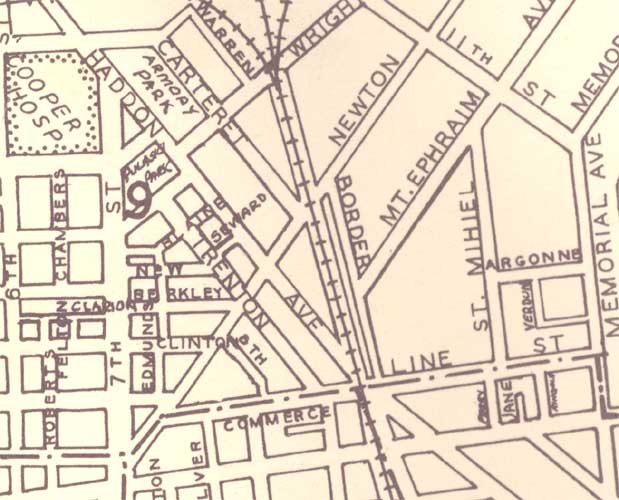
The monument was originally located in Pulaski Park, just southeast of Cooper Hospital, on Haddon Avenue.
Pulaski Monument Will Be Dedicated Here on October 11
Camden Courier-Post —
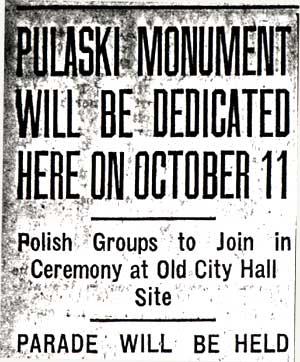
Polish Groups to Join in Ceremony at Old City Hall Site
PARADE WILL BE HELD
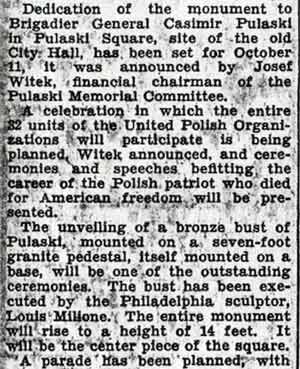
Dedication of the monument to Brigadier General Casimir Pulaski in Pulaski Square, site of the old City Hall, has been set for October 11, it was announced by Josef Witek, financial chairman of the Pulaski Memorial Committee.
A celebration in which the entire 32 units of the United Polish Organizations will participate is being planned, Witek announced, and ceremonies and speeches befitting the career of the Polish patriot who died for American freedom will be presented.
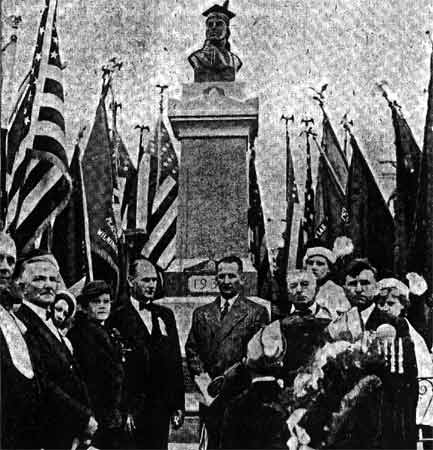
The unveiling of a bronze bust of Pulaski, mounted on a seven-foot granite pedestal, itself mounted on a base, will be one of the outstanding ceremonies. The bust has been executed by the Philadelphia sculptor, Louis Milione. The entire monument will rise to a height of 14 feet. It will be the center piece of the square.
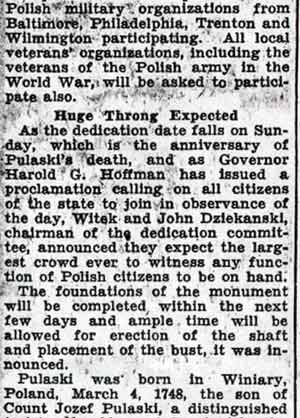
A parade has been planned, with Polish military organizations from Baltimore, Philadelphia, Trenton and Wilmington participating. All local veterans’ organizations, including the veterans of the Polish army in the World War, will be asked to participate also.
Huge Throng Expected
As the dedication date falls on Sunday, which is the anniversary of Pulaski’s death, and as Governor Harold G. Hoffman has issued a proclamation calling on all citizens of the state to join in observance of the day, Witek and John Dziekanski, chairman of the dedication committee, announced they expect the largest crowd ever to witness any function of Polish citizens to be on hand.
The foundations of the monument will be completed within the next few days and ample time will be allowed for erection of the shaft and placement of the bust, it was announced.
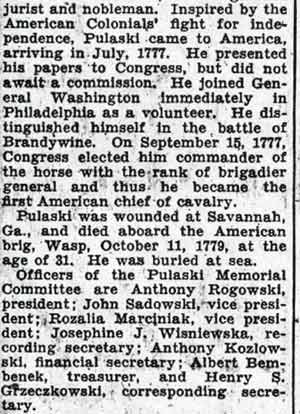
Pulaski was born in Winiary, Poland, March 4, 1748, the son of Count Jozef Pulaski, a distinguished jurist and nobleman. Inspired by the American Colonials’ fight for independence, Pulaski came to America, arriving in July, 1777. He presented his papers to Congress, but did not await a commission. He joined General Washington immediately in Philadelphia as a volunteer. He distinguished himself in the battle of Brandywine. On September 15, 1777, Congress elected him commander of the horse with the rank of brigadier general and thus he became the first American chief of cavalry.
Pulaski was wounded at Savannah, Ga., and died aboard the American brig, Wasp, October 11, 1779, at the age of 31. He was buried at sea.
Officers of the Pulaski Memorial Committee are Anthony Rogowski, president; John Sadowski, vice president; Rozalia Marciniak, vice president; Josephine J. Wisniewska, recording secretary; Anthony Kozlowski, financial secretary; Albert Bembenek, treasurer, and Henry S. Greczkowski, corresponding secretary.
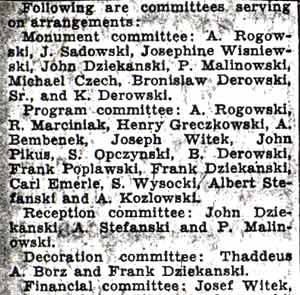
Following are committees serving on arrangements:
Monument committee: A. Rogowski, J. Sadowski, Josephine Wisniewska, John Dziekanski, P. Malinowski, Michael Czech, Bronislaw Derowski, Sr., and K. Derowski.
Program committee: A. Rogowski, R. Marciniak, Henry Greczkowski, A. Bembenek, Joseph Witek, John Pikus, S. Opczynski, B. Derowski, Frank Poplawski, Frank Dziekanski, Carl Emerle, S. Wysocki, Albert Stefanski and A. Kozlowski.
Reception committee: John Dziekanski, A. Stefanski and P. Malinowski.
Decoration committee: Thaddeus A. Borz and Frank Dziekanski.
Financial committee: Josef Witek, S. Wysocki, J. Pikus, S. Opczynski, B. Derowski, P. Malinowski.
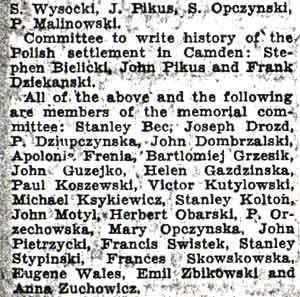
Committee to write history of the Polish settlement in Camden: Stephen Bielicki, John Pikus and Frank Dziekanski.
All of the above and the following are members of the memorial committee: Stanley Bec; Joseph Drozd, P. Dziupczynska, John Dombrzalski, Apoloni Frenia, Bartlomiej Grzesik, John Guzejko, Helen Gazdzinska, Paul Koszewski, Victor Kutylowski, Michael Ksykiewicz, Stanley Kolton, John Motyl, Herbert Obarski, P. Orzechowska, Mary Opczynska, John Pietrzycki, Francis Swistek, Stanley Stypinski, Frances Skowaskowska, Eugene Wales, Emil Zbikowski and Anna Zuchowicz.
Polish Hero Honored Here
Camden Courier-Post —

Pulaski Monument Unveiled Before 5000 Poles Here After Veterans and Lodges Parade
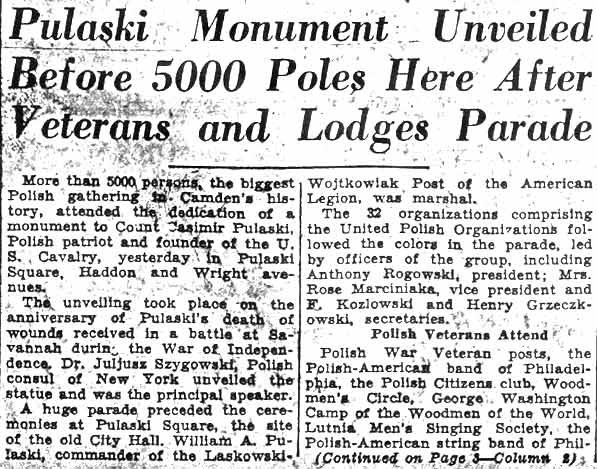
More than 5000 persons, the biggest Polish gathering in Camden’s history, attended the dedication of a monument to Count Casimir Pulaski, Polish patriot and Soldier of the U. S. Cavalry, yesterday in Pulaski Square, Haddon and Wright Avenues.
The unveiling took place on the anniversary of Pulaski’s death of wounds received in a battle at Savannah during the War of Independence. Dr. Szygowski, Polish consul-general of New York, unveiled the statue and was the principal speaker. Governor Harold G. Hoffman sent ceremonies at Pulaski Square, the site of former City Hall. J. A. Kulikowski, commander of the Laskowski-Wojtkowiak Post of the American Legion, was marshal.
All organizations comprising the United Polish Organizations followed the units in the parade, by officers of the group, including Anthony Rogowski, president; Mrs. Rose Marciniak, vice president and Sadowski, secretaries.
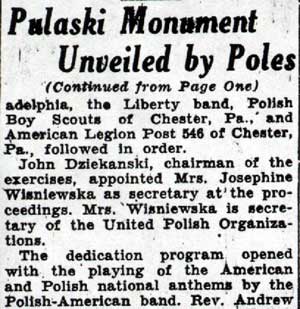
Polish War Veteran posts, the Polish-American band of Philadelphia, the Polish Singers, the Policemen’s Circle, George Washington Council No. 10, the Wiarus Band, the Lutnia Men’s Singing Society, the Polish-American Citizens Club, the Liberty band, Polish Boy Scouts of Chester, Pa., and American Legion Post 546 of Chester, Pa., followed in order.
John Dziekanski, chairman of the exercises, appointed Mrs. Josephine Wisniewska as secretary at the proceedings. Mrs. Wisniewska is secretary of the United Polish Organizations.
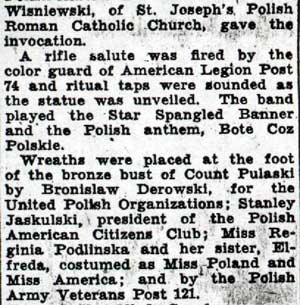
The dedication program opened with the playing of the American and Polish national anthems by the Polish-American band. Rev. Andrew Wisniewski, of St. Joseph’s Polish Roman Catholic Church, gave the invocation.
A rifle salute was fired by the color guard of American Legion Post 74 and ritual taps were sounded as the statue was unveiled. The band played the Star Spangled Banner and the Polish anthem, Bote Coz Polskie.
Wreaths were placed at the foot of the bronze bust of Count Pulaski by Bronislaw Derowski, for the United Polish Organizations; Stanley Jaskulski, president of the Polish American Citizens Club; Miss Regina Podlinska and her sister, Elfreda, costumed as Miss Poland and Miss America; and by the Polish Army Veterans Post 121.
Von Nieda Speaks
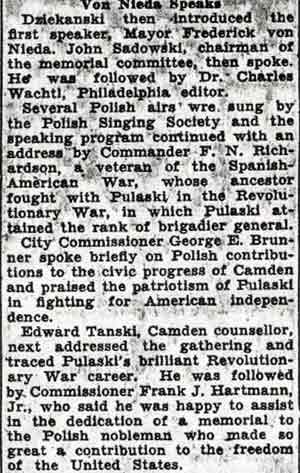
Dziekanski then introduced the first speaker, Mayor Frederick von Nieda. John Sadowski, chairman of the memorial committee, then spoke. He was followed by Dr. Charles Wachti, Philadelphia editor.
Several Polish airs were sung by the Polish Singing Society and the speaking program continued with an address by Commander F. N. Richardson, a veteran of the Spanish-American War, whose ancestor fought with Pulaski in the Revolutionary War, in which Pulaski attained the rank of brigadier general.
City Commissioner George E. Brunner spoke briefly on Polish contributions to the civic progress of Camden and praised the patriotism of Pulaski in fighting for American independence.
Edward Tanski, Camden counsellor, next addressed the gathering and traced Pulaski’s brilliant Revolutionary War career. He was followed by Commissioner Frank J. Hartmann, Jr., who said he was happy to assist in the dedication of a memorial to the Polish nobleman who made so great a contribution to the freedom of the United States.
Monsignor Strenski Speaks
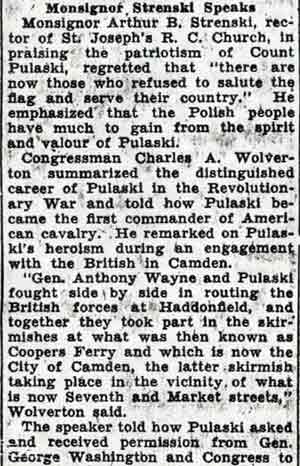
Monsignor Arthur B. Strenski, rector of St. Joseph’s R. C. Church, in praising the patriotism of Count Pulaski, regretted that “there are now those who refused to salute the flag and serve their country.” He emphasized that the Polish people have much to gain from the spirit and valour of Pulaski.
Congressman Charles A. Wolverton summarized the distinguished career of Pulaski in the Revolutionary War and told how Pulaski became the first commander of American cavalry. He remarked on Pulaski’s heroism during an engagement with the British in Camden.
“Gen. Anthony Wayne and Pulaski fought side by side in routing the British forces at Haddonfield, and together they took part in the skirmishes at what was then known as Coopers Ferry and which is now the City of Camden, the latter skirmish taking place in the vicinity of what is now Seventh and Market streets,” Wolverton said.
The speaker told how Pulaski asked and received permission from Gen. George Washington and Congress to organize the famous Pulaski Legion of cavalry, advancing $50,000 of his money for equipment.
Recalls American Revolution
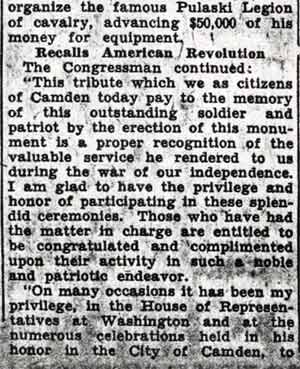
The Congressman continued: “This tribute which we as citizens of Camden today pay to the memory of this outstanding soldier and patriot by the erection of this monument is a proper recognition of the valuable service he rendered to us during the war of our independence. I am glad to have the privilege and honor of participating in these splendid ceremonies. Those who have had the matter in charge are entitled to be congratulated and complimented upon their activity in such a noble and patriotic endeavor.
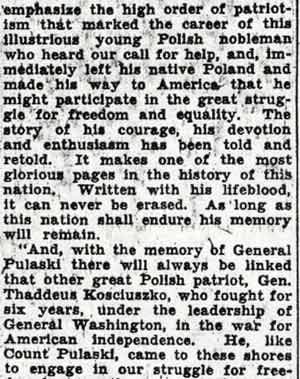
“On many occasions it has been my privilege, in the House of Representatives at Washington and at the numerous celebrations held in his honor in the City of Camden, to emphasize the high order of patriotism that marked the career of this illustrious young Polish nobleman who heard our call for help, and, immediately left his native Poland and made his way to America that he might participate in the great struggle for freedom and equality. The story of his courage, his devotion and enthusiasm has been told and retold. It makes one of the most glorious pages in the history of this nation. Written with his lifeblood, it can never be erased. As long as this nation shall endure his memory will remain.
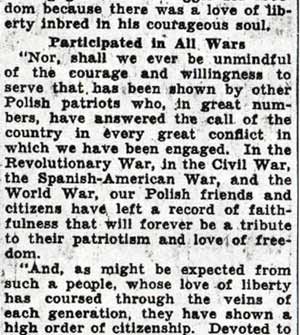
“And, with the memory of General Pulaski there will always be linked that other great Polish patriot, Gen. Thaddeus Kosciuszko, who fought for six years, under the leadership of General Washington, in the war for American independence. He, like Count Pulaski, came to these shores to engage in our struggle for freedom because there was a love of liberty inbred in his courageous soul.
Participated in All Wars
“Nor, shall we ever be unmindful of the courage and willingness to serve that has been shown by other Polish patriots who, in great numbers, have answered the call of the country in every great conflict in which we have been engaged. In the Revolutionary War, in the Civil War, the Spanish-American War, and the World War, our Polish friends and citizens have left a record of faithfulness that will forever be a tribute to their patriotism and love of freedom.
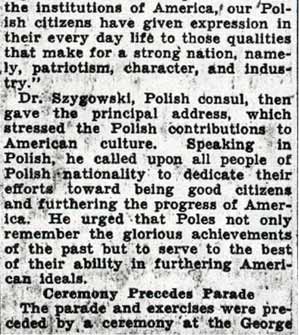
“And, as might be expected from such a people, whose love of liberty has coursed through the veins of each generation, they have shown a high order of citizenship. Devoted to the institutions of America, our Polish citizens have given expression in their every day life to those qualities that make for a strong nation, namely, patriotism, character, and industry.”
Dr. Szygowski, Polish consul, then gave the principal address, which stressed the Polish contributions to American culture. Speaking in Polish, he called upon all people of Polish nationality to dedicate their efforts toward being good citizens and furthering the progress of America. He urged that Poles not only remember the glorious achievements of the past but to serve to the best of their ability in furthering American ideals.
Ceremony Precedes Parade
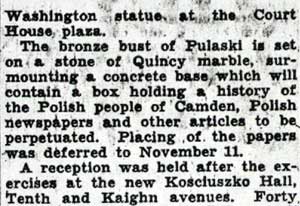
The parade and exercises were preceded by a ceremony at the George Washington statue, at the Court House plaza.
The bronze bust of Pulaski is set on a stone of Quincy marble, surmounting a concrete base, which will contain a box holding a history of the Polish people of Camden, Polish newspapers and other articles to be perpetuated. Placing of the papers was deferred to November 11.
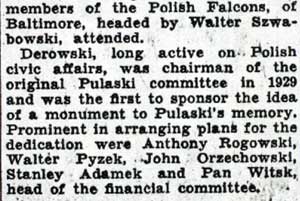
A reception was held after the exercises at the new Kosciuszko Hall, Tenth and Kaighn avenues. Forty members of the Polish Falcons, of Baltimore, headed by Walter Szwabowski, attended.
Derowski, long active on Polish civic affairs, was chairman of the original Pulaski committee in 1929 and was the first to sponsor the idea of a monument to Pulaski’s memory. Prominent in arranging plans for the dedication were Anthony Rogowski, Walter Pyzek, John Orzechowski, Stanley Adamek and Pan Witsk, head of the financial committee.
Thaddeus Kosciusko Monument
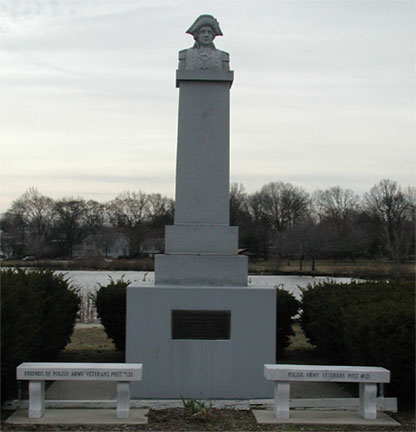
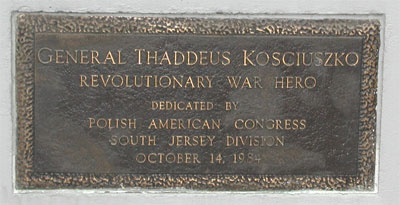
The Thaddeus Kosciusko Monument at Cooper River Park, Pennsauken, N.J.
Casimir Pulaski Monument
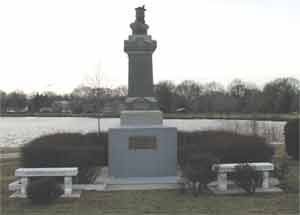
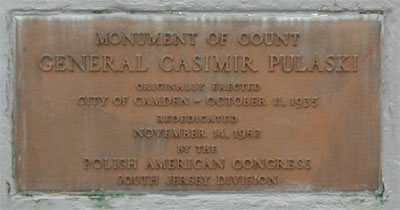
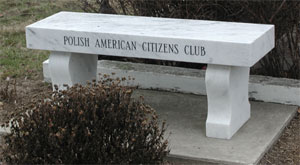
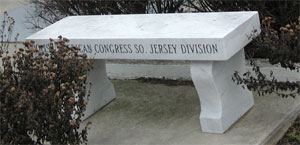
The Casimir Pulaski Monument at Cooper River Park, Pennsauken, N.J.
HMTS Rohna
On November 26th, 1943 twelve young men from Camden County died together when the troop transport HMTS Rohna was struck by a German guided glider bomb and sank off the coast of North Africa. From Camden, Frank Ballerino, Michael Carr, Michael Yachus, Lewis Riondino, Joseph H. Johnson, and Stephen V. Koscianski (memorialized on this monument); Harry V. Taylor Jr. of Haddonfield, William McKeon of Blackwood, Merl Reagle of Lindenwold, Carl Johanson and Jacob Kessler Jenkins of Pennsauken, and Elmer F. Day of Merchantville were lost that day, along with several other men from Southern New Jersey. In total, 1,015 men were lost, but the story was never told to the families or the general public for over 57 years due to wartime censorship.