The Pulaski Monument and the Pulaski Day Parade
On October 1, 1936 the Polish community in Camden announced that a monument to Casimir Pulaski would be dedicated on October 11. The monument was placed at a park that lay at Benson Street and Haddon Avenue, where Camden’s City Hall had stood prior to the present City Hall’s opening in 1931. The park came to be known as Pulaski Park.
At the dedication there were many notables and dignitaries. Among the speakers were Mayor Frederick von Nieda, Commissioner Frank J. Hartmann Jr., Monsignor Arthur B. Strenski of St. Joseph Roman Catholic Church, and Congressman Charles A. Wolverton.
Camden’s Polish community celebrated Pulaski Day with a parade through at least the late 1970s. In more recent times, Polish groups formerly based in Camden such as the Polish American Citizens Club have participated in Philadelphia’s Pulaski Day Parade.
When Camden’s Pulaski Park was designated to be the site of a new medical school, the monuments that were there had to be relocated. The South Jersey Division of the Polish American Congress, along with Polish Army Veterans Post 121 and the Polish American Citizens Committee raised funds to move the Pulaski Monument to a new site. In 1984 the monument was moved to Cooper River Park, at Park Drive and Route 130 in Pennsauken, N.J. A new monument to Thaddeus Kosciusko was also dedicated that October.
The two original monuments to Thaddeus Kosciusko and Casimir Pulaski were joined in 1995 by a new monument dedicated to those members of St. Joseph Roman Catholic Church located at 10th & Liberty Streets in Camden who gave their lives for our country in World War II. Information from a plaque inside the church was the basis for this monument. The site of the three monuments is now known as the Polish Heroes War Memorial at Cooper River Park.
Pulaski Monument
Camden Courier-Post —
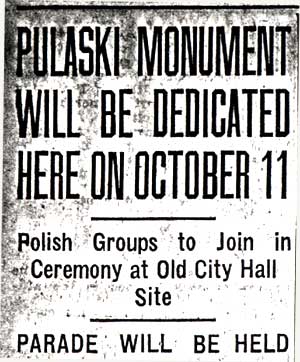
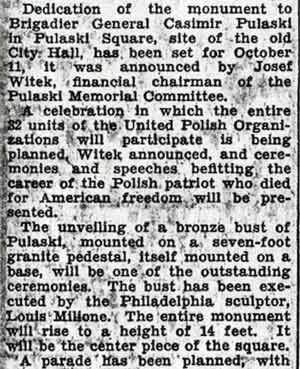
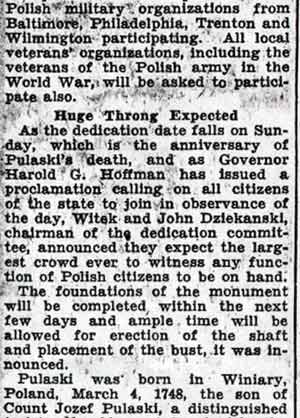
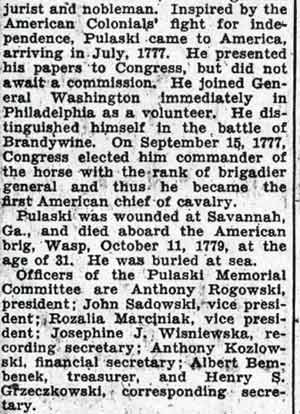
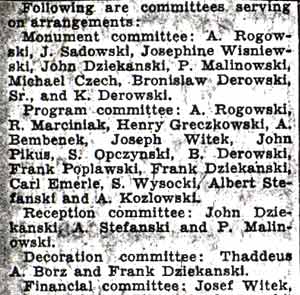
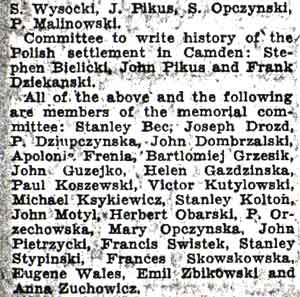
Pulaski Monument Will Be Dedicated Here on October 11
PULASKI MONUMENT WILL BE DEDICATED HERE ON OCTOBER 11
Polish Groups to Join in Ceremony at Old City Hall Site
PARADE WILL BE HELD
Polish Hero Honored Here / Pulaski Monument Unveiled Before 5000 Poles Here After Veterans and Lodges Parade
Camden Courier-Post —

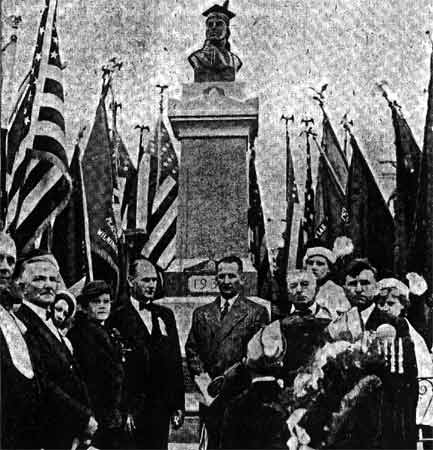

Polish Hero Honored Here
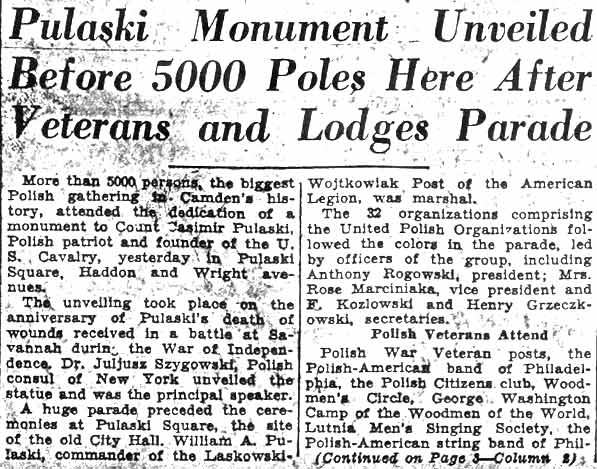
Pulaski Monument Unveiled Before 5000 Poles Here After Veterans and Lodges Parade
More than 5000 persons, the biggest Polish gathering in Camden’s history, attended the dedication of a monument to Count Casimir Pulaski, Polish patriot and founder of the U. S. Cavalry, yesterday in Pulaski Square, Haddon and Wright Avenues.
The unveiling took place on the anniversary of Pulaski’s death of wounds received in a battle at Savannah during the War of Independence. Dr. Szygowski, Polish consul-general of New York, unveiled the statue and was the principal speaker. Governor Harold G. Hoffman sent ceremonies at Pulaski Square, the site of former City Hall. J. A. Kulikowski, commander of the Laskowski-Wojtkowiak Post of the American Legion, was marshal.
The 32 organizations comprising the United Polish Organizations followed the colors in the parade, led by officers of the group, including Anthony Rogowski, president; Mrs. Rose Marciniaka, vice president and F. Kozlowski and Henry Grzeczkowski, secretaries.
Polish War Veteran posts, the Polish-American band of Philadelphia, the Polish Singers, the Policemen’s Circle, George Washington Council No. 10, the Wiarus Band, the Lutnia Men’s Singing Society, the Polish-American Citizens Club, the Liberty band, Polish Boy Scouts of Chester, Pa., and American Legion Post 546 of Chester, Pa., followed in order.
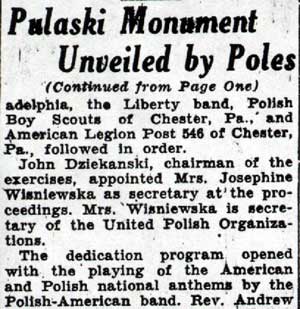
Pulaski Monument Unveiled by Poles
(Continued from Page One)
John Dziekanski, chairman of the exercises, appointed Mrs. Josephine Wisniewska as secretary at the proceedings. Mrs. Wisniewska is secretary of the United Polish Organizations.
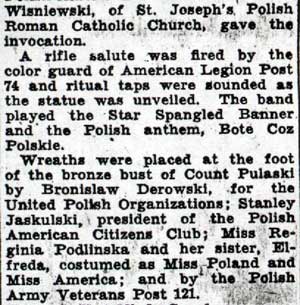
The dedication program opened with the playing of the American and Polish national anthems by the Polish-American band. Rev. Andrew Wisniewski, of St. Joseph’s Polish Roman Catholic Church, gave the invocation.
A rifle salute was fired by the color guard of American Legion Post 74 and ritual taps were sounded as the statue was unveiled. The band played the Star Spangled Banner and the Polish anthem, Bote Coz Polskie.
Wreaths were placed at the foot of the bronze bust of Count Pulaski by Bronislaw Derowski, for the United Polish Organizations; Stanley Jaskulski, president of the Polish American Citizens Club; Miss Regina Podlinska and her sister, Elfreda, costumed as Miss Poland and Miss America; and by the Polish Army Veterans Post 121.
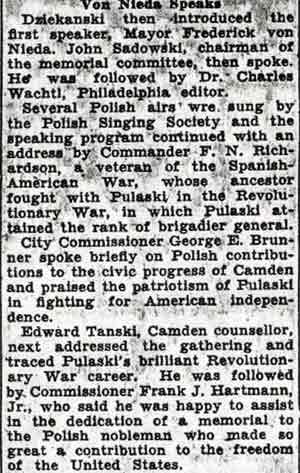
Von Nieda Speaks
Dziekanski then introduced the first speaker, Mayor Frederick von Nieda. John Sadowski, chairman of the memorial committee, then spoke. He was followed by Dr. Charles Wachti, Philadelphia editor.
Several Polish airs were sung by the Polish Singing Society and the speaking program continued with an address by Commander F. N. Richardson, a veteran of the Spanish-American War, whose ancestor fought with Pulaski in the Revolutionary War, in which Pulaski attained the rank of brigadier general.
City Commissioner George E. Brunner spoke briefly on Polish contributions to the civic progress of Camden and praised the patriotism of Pulaski in fighting for American independence.
Edward Tanski, Camden counsellor, next addressed the gathering and traced Pulaski’s brilliant Revolutionary War career. He was followed by Commissioner Frank J. Hartmann, Jr., who said he was happy to assist in the dedication of a memorial to the Polish nobleman who made so great a contribution to the freedom of the United States.
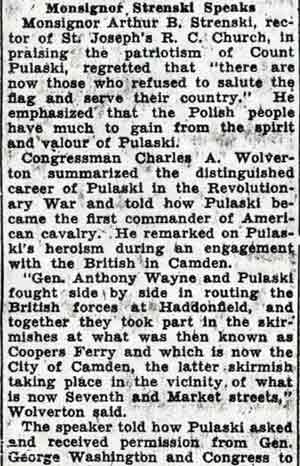
Monsignor Strenski Speaks
Monsignor Arthur B. Strenski, rector of St. Joseph’s R. C. Church, in praising the patriotism of Count Pulaski, regretted that “there are now those who refused to salute the flag and serve their country.” He emphasized that the Polish people have much to gain from the spirit and valour of Pulaski.
Congressman Charles A. Wolverton summarized the distinguished career of Pulaski in the Revolutionary War and told how Pulaski became the first commander of American cavalry. He remarked on Pulaski’s heroism during an engagement with the British in Camden.
“Gen. Anthony Wayne and Pulaski fought side by side in routing the British forces at Haddonfield, and together they took part in the skirmishes at what was then known as Coopers Ferry and which is now the City of Camden, the latter skirmish taking place in the vicinity of what is now Seventh and Market streets,” Wolverton said.
The speaker told how Pulaski asked and received permission from Gen. George Washington and Congress to organize the famous Pulaski Legion of cavalry, advancing $50,000 of his money for equipment.
Recalls American Revolution
The Congressman continued: “This tribute which we as citizens of Camden today pay to the memory of this outstanding soldier and patriot by the erection of this monument is a proper recognition of the valuable service he rendered to us during the war of our independence. I am glad to have the privilege and honor of participating in these splendid ceremonies. Those who have had the matter in charge are entitled to be congratulated and complimented upon their activity in such a noble and patriotic endeavor.
“On many occasions it has been my privilege, in the House of Representatives at Washington and at the numerous celebrations held in his honor in the City of Camden, to emphasize the high order of patriotism that marked the career of this illustrious young Polish nobleman who heard our call for help, and, immediately left his native Poland and made his way to America that he might participate in the great struggle for freedom and equality. The story of his courage, his devotion and enthusiasm has been told and retold. It makes one of the most glorious pages in the history of this nation. Written with his lifeblood, it can never be erased. As long as this nation shall endure his memory will remain.
“And, with the memory of General Pulaski there will always be linked that other great Polish patriot, Gen. Thaddeus Kosciuszko, who fought for six years, under the leadership of General Washington, in the war for American independence. He, like Count Pulaski, came to these shores to engage in our struggle for freedom because there was a love of liberty inbred in his courageous soul.
Participated in All Wars
“Nor, shall we ever be unmindful of the courage and willingness to serve that has been shown by other Polish patriots who, in great numbers, have answered the call of the country in every great conflict in which we have been engaged. In the Revolutionary War, in the Civil War, the Spanish-American War, and the World War, our Polish friends and citizens have left a record of faithfulness that will forever be a tribute to their patriotism and love of freedom.
“And, as might be expected from such a people, whose love of liberty has coursed through the veins of each generation, they have shown a high order of citizenship. Devoted to the institutions of America, our Polish citizens have given expression in their every day life to those qualities that make for a strong nation, namely, patriotism, character, and industry.”
Dr. Szygowski, Polish consul, then gave the principal address, which stressed the Polish contributions to American culture. Speaking in Polish, he called upon all people of Polish nationality to dedicate their efforts toward being good citizens and furthering the progress of America. He urged that Poles not only remember the glorious achievements of the past but to serve to the best of their ability in furthering American ideals.
Ceremony Precedes Parade
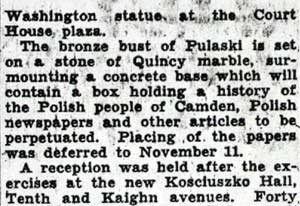
The parade and exercises were preceded by a ceremony at the George Washington statue, at the Court House plaza.
The bronze bust of Pulaski is set on a stone of Quincy marble, surmounting a concrete base, which will contain a box holding a history of the Polish people of Camden, Polish newspapers and other articles to be perpetuated. Placing of the papers was deferred to November 11.
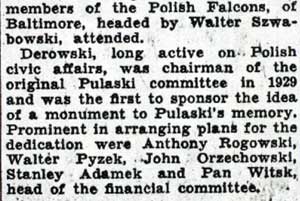
A reception was held after the exercises at the new Kosciuszko Hall, Tenth and Kaighn avenues. Forty members of the Polish Falcons, of Baltimore, headed by Walter Szwabowski, attended.
Derowski, long active on Polish civic affairs, was chairman of the original Pulaski committee in 1929 and was the first to sponsor the idea of a monument to Pulaski’s memory. Prominent in arranging plans for the dedication were Anthony Rogowski, Walter Pyzek, John Orzechowski, Stanley Adamek and Pan Witsk, head of the financial committee.
Monument of Count General Casimir Pulaski at Cooper River Park
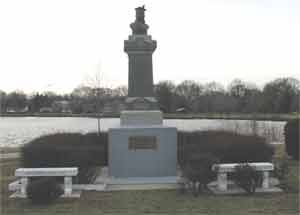
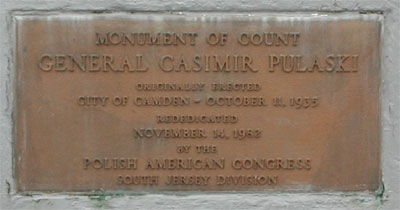
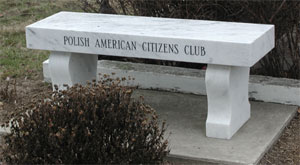
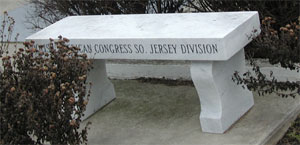
Monument of Count General Casimir Pulaski in its new home at Cooper River Park, Pennsauken, N.J.
Pulaski Day Observed In Camden
Camden Courier-Post —
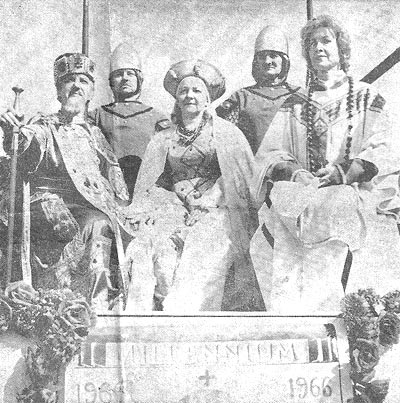
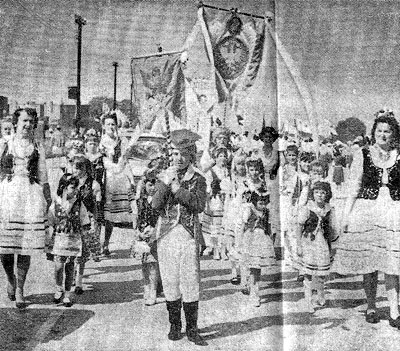
A crowd estimated at nearly 3,000 witnessed Camden’s Pulaski Day observance yesterday commemorating the death of Brigadier General Casimir Pulaski at Savannah, Ga., in 1779, and the 1100th anniversary of Poland’s conversion to Christianity.
Featured in the parade were 40 bands, including Air Force and Army bands, and several floats depicting events in Polish history.
Among those in the reviewing stand were Mayor Alfred R. Pierce, Senators Frederick J. Scholz and A. Donald Bigley, the Most Reverend Celestine J. Damiano, Archbishop of Camden, and all city councilmen and department heads.
Polish Sermon
At the conclusion of the parade Archbishop Damiano celebrated a Pontifical Mass in Whitman Park. Very Reverend Michael M. Zembrzuski, founder-director of the National Shrine of Our Lady of Czestochowa in Doylestown, Pennsylvania, delivered the sermon in Polish.
A 50-voice choir, composed of members of St. Cecilia’s Pennsauken; and Lucia’s Choir of St. Joseph’s Church, South Camden, sang during the Mass under the direction of Leonard Rykaczewski. Joseph Rykaczewski accompanied on the organ.
Start of Christianity in Poland is commemorated by representatives of Polish American Women’s Club, Lowell and Warsaw Streets, during yesterday’s Pulaski Day Parade. Left to right are Mrs. Bernard Weaver as King Mieszko I; Mrs. Ray Baus as a guard; Mrs. Frank Kitchmire as Queen Dabrowski, Mrs. Frank Filipek as a guard, and Mrs. Frank M. Bates as prelate.
Dressed as General Pulaski, John Wrobel carries standard at head of St. Helena’s Group 190, Polish Beneficial Association. Children are carefully arranged according to size to best display their costumes.
Pulaski Day Parade
Camden County Record —
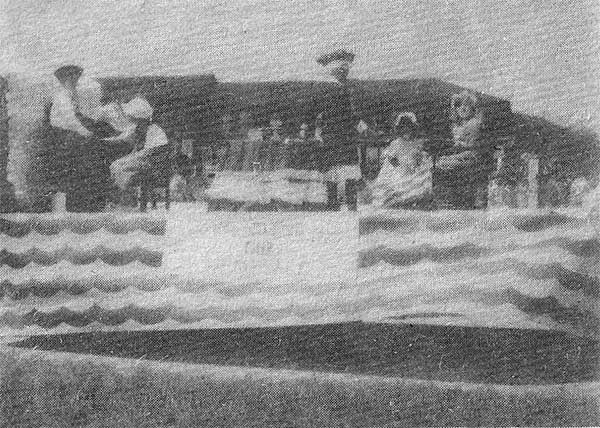
“Mending Our Heritage” won first prize in the float competition of the recent Pulaski Bicentennial parade. The historical scene depicts Betsy Ross sewing the 13th Star before presenting the first United States Flag to Gen. George Washington. The patriotic project was the creation of Frank and Virginia (Ginger) Kitchmire of Barrington, and Kathy (Kitchmire) and Richard Jung of Northeast Philadelphia. The children of both families portrayed the other Colonial figures. Their grandmother, Mrs. Frank (Sally) Kitchmire entered the float for the Whitman Park Bicentennial Chapter of which she is president. Proudly, she added, “Once they got the idea it took both families only one week to complete the job.”
Gov. Brendan Byrne asked Camden’s Mayor Angelo Errichetti to express his appreciation to the people of Whitman Park for their exemplary behavior during the Pulaski parade as they walked at the head of the march. Unlike the governor’s appearances at other statewide functions, he noted there were no organized belittling demonstrations or catcalls. The people here, he told the mayor, came here to enjoy a tremendous parade and pay their respects to those who were a part of the patriotic demonstration in the year of our country’s 200th celebration. He said he was impressed with the warmth and spirit here in a gay atmosphere. They showed great respect for their government and a rare lifestyle seldom seen in these days of confusion. He also repeated these views before the legislative bodies in Trenton.
The parade was held early on account of the Bicentennial celebrations.