Norman Heine
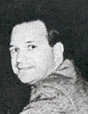
Norman Heine, 1938
NORMAN HEINE was born on March 22, 1907 to Morris and Olga Heine. Besides Norman, the family included older siblings Samuel, Israel, Yetta, Aaron, Edith, and Herman Heine. The Heine family was Jewish, and Norman Heine would play a significant role in both Jewish and civic affairs in Camden throughout his life.
Morris Heine had come to America from Russia in 1902, and brought his wife and older children over the following year. Herman and Norman were born in Camden. The 1910 Census shows the family living at 1112 Baring Street in South Camden.
Morris Heine soon made the acquaintance of furniture merchant Abraham Lichtenstein, who had moved to Camden in 1890, bought property at 335 Liberty Street at the turn of the century and organized a synagogue. It was there that Morris Heine, the learned and pious patriarchal head of one of Camden’s most prominent families, would pray and study.
Morris Heine was by then in business for himself, selling boxes. The family was still at that address when the 1914 City Directory was compiled. Morris Heine was then in the junk business. Oldest son Samuel soon would go into another line, the retail furniture trade. By 1917 he had established a business at 1024 Broadway. This venture proved quite successful. By June of 1917 Samuel Heine was living at 1510 Baird Avenue, while his father and siblings, including young Norman, had moved to 1460 Wildwood Avenue in the upscale Parkside neighborhood.
Norman Heine graduated from Camden High School. While at Camden High he joined the Epsilon chapter of the Jewish student fraternity Sigma Alpha Rho. In time he would serve as the chapter’s Sacred Ruler, a post held at other times by Carl Auerbach, George Tartar, Samuel Cohen, and Sylvan Grass. The 1924 City Directory shows him working for his brother Samuel. He also studied law. By 1929 he was working as a law clerk at the law office of his older brother Aaron.
The 1930 Census shows that Norman Heine was still living with his parents at 1460 Wildwood Avenue, as were brothers Israel and Herman. This block, on the south side of Wildwood Avenue, was rather interesting. There are eight houses, numbering from 1450 to 1464. The 1930 census shows merchant Hyman Lichtenstein, the son of the above-mentioned Abraham Lichtenstein, at 1450; Frank S. Fithian at 1452; lawyer Harry H. Teitelman at 1454; retired businessman Louis Richelson at 1456; merchant Louis Berkowitz and his lawyer son Harry Berkowitz at 1458; the Heine family at 1460; lawyer and politician Rocco Palese at 1462; and the Philip Auerbach family at 1464, son Carl Auerbach also then a lawyer.
A short walk away, on Park Boulevard, Congregation Beth El, founded in 1920, built its synagogue. Beth El was Camden’s first Conservative synagogue. The Berkowitz, Teitelman, Heine, and Auerbach families would all over the years play significant roles at Beth El. Older brother Aaron Heine had joined Beth El by 1928, and helped found the Beth El Men’s Club. In 1932 the Camden Council of Jewish Juniors was organized and elected Norman Heine as first president, he was re-elected in 1933, and served on the organization’s national council in 1935.
Norman Heine was admitted to the New Jersey bar in June of 1933. He and brother Aaron became partners in the law firm of Heine and Heine, which had offices at 126 North Broadway in the 1940s.
The Bureau of Jewish Education was organized by the Federation in 1945. Norman Heine became the first chairman. The Bureau served the Camden Talmud Torah, Beth El, Beth Israel, Beth Sholom, Beth Jacob and the Workmen’s Circle school.
In 1947 Beth El’s rabbi, Philip L. Lipis, gave notice that he was going to take a position in California. A committee, headed by Louis Markowitz, began the search for a new rabbi. Other members of the committee were Louis Berkowitz, Harry Berkowitz, Morris Liebman, Norman Heine, Henry Bass and Herman Z. Cutler. The search ended in July of that year with the choice of Rabbi Harry B. Kellman. Rabbi Kellman would serve Beth El until his retirement in 1970.
The 1947 City Directory shows Norman Heine and his wife Marion living at 1500 Wildwood Avenue. Marion Heine was also active in local Jewish affairs. In 1949 she was a leader of the local Allied Jewish Appeal’s Women’s Division. The following year Norman Heine and Harry Berkowitz, in recognition of their efforts on behalf of the Jewish Theological Seminary, were honored at a breakfast given at the Seminary. The guest speaker was Mrs. Eleanor Roosevelt. By 1956 Norman Heine had served as president of the Allied Jewish Appeal. That year he became President of the Jewish Federation. He was re-elected in 1957 and in 1958 elected chairman of the Middle Atlantic Region of Council of Jewish Federation and Welfare funds.
After serving as Camden City Solicitor, by November of 1961 Norman Heine had been named Camden County Prosecutor. His record of service in the 1960s is exemplary. He successfully argued against appeals by murderers Stanley Cassidy, Sylvester Johnson, and Wayne Godfrey, convicted of a 1958 murder committed in the course of a robbery, in both State and Federal courts, and Joseph Ernst, who killed his estranged girlfriend in Camden in 1959. Prosecutor Heine was part of a team that successfully fought an appeal in the United States Supreme Court of Bellmawr and Barrington policemen caught in a ticket fixing scheme. He also successfully prosecuted the murderers of Frank Adamucci, owner of the Rickshaw Inn on Route 70 in Cherry Hill.
Prosecutor Norman Heine spoke to the Men’s Club at a breakfast on February 9, 1964.
By the early 1970s Norman Heine was serving as a Judge of the Superior Court of New Jersey.
Last a resident of Cherry Hill, New Jersey, Norman Heine passed away on October 15, 1994.
Camden Jews Pick Captains for Drive
Camden Courier-Post —
Committee to Raise $10,000 for Aid, Told of Hardships in Germany
At an executive meeting of the United Committee for Relief of German Jews, held at Beth El Synagogue last night, the captains who will be in charge of teams for the purpose of raising $10,000 for relief of German Jews, were announced by Leon H. Rose, general chairman. In urging the appointees to intensive efforts, Rose said:
“Six hundred thousand Jews are in distress. They are ousted from office, discharged from employment, denied civil and economic rights, persecuted and systematically forced to starve to death.
“There is raging in Germany one of the coldest and cruelest pogroms against the Jews ever known to history.
“We must help. We must rescue those helpless ones. Our weapon for immediate retaliation is money, and we must supply those arms. By the widest stretch of the imagination, it is inconceivable how any Jew in this community can exclude himself from this cause.
“Thousands of German Jews, especially among the young, see a prospect of restarting their lives in Palestine to which some of them already have made their way. Determined, concerted Jewish effort can make it capable of providing a permanent home for a considerable part of German Jewry to whom the rest of the world, with few exceptions, is closed.
“Immediate funds are needed. I appeal to you as self-respecting Jews who understand the suffering of your own race to come to the aid of your stricken brothers and sisters. Give them all you can.”
Those named and the organizations they represent are: Jacob Leventon, Congregation Beth El; David Lefkowitz, congregation Sons of Israel; Morris Josselson, Congregation Beth Israel; Benjamin Friedman, B’nai Brith; Mrs. I.S. Siris, Hadassah; Philip Miller, Hebrew Parent Teachers Association; Herman Odlen, Federation of Jewish Charities; Mrs. Rose Goldstein, Independent Social; Harry W. Markowich, Zionist Organization; Norman Heine, Junior Council; Julius Samson, Upsilon Lambda Phi.
Mrs. William Laub, Council of Jewish Women; A. David Epstein, Sigma Alpha Rho; Mrs. Aaron Heine, Beth El Sisterhood; Samuel Shane, Talmud Torah; M. Snyder, Workmen’s Circle; M. Bard, F. of S. U.; Louis Tarter, Independent Progress Lodge; Mrs. Zelda Lutz, Jacob J. Hernfeld Link; Dr. I.S. Siris, Jewish Welfare Society; Mrs. M. Shapiro, Hebrew Ladies Charities.
Saul Lippman, Mizrachi; Mrs. Samuel Litow, Welfare Social Club; D. Breslow, Gordonia.; Dr. Reuben Cutler, Mizpah Lodge No. 245; F. & A. M.; Meyer Adelman, Camden Level Club; Mrs. Etta Rosen, B’nai Brith Auxiliary; Mrs. L. Weiss, Ladies Auxiliary of Progress Lodge; Miriam Morris, Junior Charity Workers; Mrs. A. Stoolman, Deborah Society; Mrs. M. Leider, Welfare Social.
Moses Bord was appointed captain of the workers. A mass meeting will be held June 20, at the Talmud Torah building, Seventh Street and Kaighn Avenue, and will be addressed by members of national, state and municipal governments, as well as outstanding Jewish leaders from New York and Philadelphia.
8 in Camden Pass State Bar Tests
Camden Courier-Post —
14 Others From South Jersey Given Right to Practice Law
Nine Camden law students and 14 others from South Jersey cities passed the April state bar examinations and may practice as attorneys in New Jersey.
That was announced at Trenton yesterday by Rue Brearley, secretary of the State Bar Examiners. Brearley stated that in the entire state, 206 students passed the tests. The counselor-at-law results were not announced.
Those in Camden were:
Howard G. Kulp, Jr., studying at the law offices of Carr and Carroll.
Norman Heine, law office of his brother, Aaron Heine.
Louis L. Goldman, firm of Orlando and Kisselman.
Franklin L. Deibert, offices of his brother, Edward R. Deibert.
Joseph Lipkin, offices of Judge Frank F. Neutze.
Stanley L. Bennett, law offices of his brother, City Commissioner Harold W. Bennett.
John F. Ruck, law offices of Walter S. Keown.
James D. Stockwell, law firm of Bleakly, Stockwell and Burling, of which his father, Henry F. Stockwell, is a member.
Bartholomew A. Sheehan, law offices of Walter S. Keown.
Among the other South Jersey students who were successful was Harold B. Wells, Jr., son of Judge Harold B. Wells, of Bordentown. The others are: Fred A. Gravino, John B. Wick and Frank Sahl, all of Woodbury; I. Harry Levin and W. Howard Sharp, of Vineland; Wheeler Grey, William B. Brooks and Morgan E. Thomas, of Atlantic City; Thomas H. Munyan and John E. Boswell of Ocean City; Francis Tanner, Toms River; James Edward McGlincy, Bridgeport, and Charles J. Berkowitz, Lakewood.
Future Beth El Community Leaders at a Bar Mitzvah — 1938
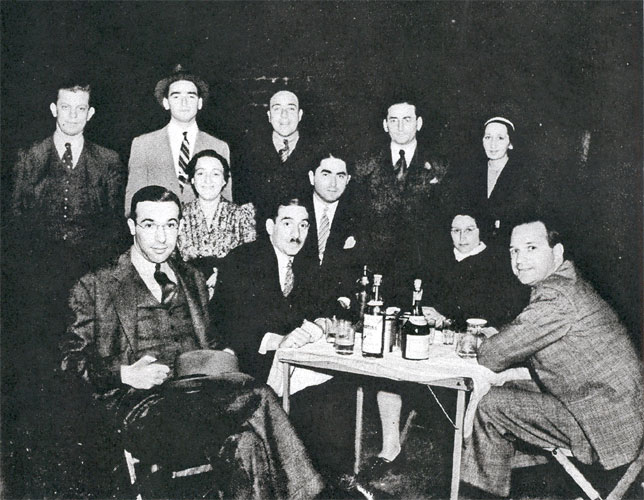
Future Beth El community leaders at a Bar Mitzvah — 1938, standing left to right: Mickey Asbell, Ben Asbell, Nate Asbell, seated, Ada Perlow, Leo Asbell, Frank Viner, Lou Goldman, Eve Goldman, Norman Heine
Two Aides Ousted by Welfare Board Appeal Dismissal
Camden Courier-Post —
Age Relief Investigators Argue Civil Service Applied Without Examinations — FAILED IN THEIR TESTS
Dismissal of two old-age relief investigators by the Camden County Welfare Board has been appealed to the Civil Service Commission in an application for a hearing filed by Norman Heine, attorney. Heine represents Alonzo Norcross, of Winslow, and Joseph DeSorte, who with C. Mae Marsh, of Brooklawn, also an investigator, and Margaret Jackson of Runnemede, a clerk-typist, were let out by the board January 15. In announcing the action, Edward R. Deibert, director, said the move was necessitated by failure of the four to pass competitive examinations with marks sufficiently high to be certified for the positions by the Civil Service Commission.
Deibert referred to a 1936 ruling by the Old Age Division of the State Department of Institutions and Agencies, which, he said, required that all appointees to county welfare boards after a certain date (March 1) must take Civil Service tests.
Therefore, the fact that Norcross and DeSorte were on the payroll when Civil Service was voted by the people of Camden county on November 3, 1936, was not sufficient to bring them automatically under its protection, as in the case of other county employees, Deibert contended.
At the same time, in announcing their dismissals, Deibert commended their work and expressed regret over the necessity for the action.
Heine, in his application to the Civil Service Commission, argues Norcross and DeSorte should not have been required to take examinations, but that if tests were held necessary, they should have been merely qualifying and not competitive.
“Norcross was appointed Aug. 24, 1936, and confirmed by the Board of Freeholders October 14,” Heine said.
“He performed his duties until January 15, 1938. DeSorte was engaged November 2, 1936, and worked through all of 1937.
“The minutes of the county welfare board do not show these men were listed as temporary employees. As a matter of fact, board members tell me they considered them permanent employees and they should have come under Civil Service automatically with passage of the referendum.”
New Jersey Auto Tolls Will Stay
Indiana, Pennsylvania Evening Gazette —
TRENTON, N. J. (Û)—Members of a New Jersey legislative commission which held a public hearing on a planned Camden-Philadelphia bridge auto toll hike yesterday admit privately there isn’t much the Legislature can do about the increase.
The Delaware River Port Authority, operator of the bridge, will raise the tolls from 20 cents to 25 cents around June 20. The additional income has been pledged by the authority to help pay off a 100 million dollar bond issue to finance construction of another bridge from South Philadelphia to Gloucester. Construction of the new bridge will begin in July and it is expected to open in late 1956 or early 1957.
The commission to determine the reasons for the increase was created at the request of Camden assemblymen. Opposition to the increase was led by South Jersey officials.
But one official, Norman Heine, Camden city attorney, said the increase is an accomplished fact. Heine suggested that the authority law be amended so that in the future the authority be required to hold public hearings before increasing rates on its facilities.
Mayor George Brunner of Camden appeared as the lead-off speaker in opposition to raising the toll. He was followed by the mayors of several other South Jersey communities, Camden County freeholders, and representatives of the Veterans of Foreign Wars, the AAA, the AFL and the CIO.
Joseph K. Costello, executive director of the authority, told the commission the authority is netting $3,600,000 a year on the old bridge. With some 30 million cars expected to use the bridge this year, the increase should bring in an additional 1½ million dollars a year, he said.
1955 — U.S. Court of Appeals, Third Circuit
In 1955, Norman Heine successfully argued the following case before the United States Court of Appeals Third Circuit.
226 F.2d 619 — 55-2 USTC P 9713
Nick FIORENTINO, Leon Di Abundo and Nick Di Abundo, Trustees in Dissolution of the Century Transit Co., a corporation of the State of New Jersey v. UNITED STATES of America.
No. 11590 — United States Court of Appeals Third Circuit. Argued Oct. 4, 1955. Decided Oct. 24, 1955.
Carbo Gets Delay On Extradition
Lima, Ohio News —
CAMDEN, N. J. (UPI)—Frankie Carbo, alleged underworld czar of professional boxing, gained an 11-day delay Friday in his fight against extradition to New York where he is charged with illegal boxing operations.
He was returned to the Camden County jail without bail after his scheduled habeas corpus hearing before Judge Benjamin Dzick was postponed until July 7 because of a legal technicality.
Joseph Tomaselli, counsel for Carbo, argued that he did not receive all of the documents in the case and couldn’t proceed without them.
The attorney said he wanted to read all of the indictments and warrants to prepare his case properly. He refused appeals by Dzick and County Prosecutor Norman Heine to proceed without the papers.
Judge Dzick, who previously held Carbo in $25,000 bail and then canceled it, refused again to set bail after the legal interlude, and sent Carbo to prison.
Carbo, 54, is under indictment in New York charged with acting as a boxing manager and promoter without a license. He was arrested May 30 at the home of a friend in Haddon Heights, N. J., two weeks ago.
Both Govs. Robert B. Meyner of New Jersey and Nelson A. Rockefeller of New York have signed the extradition papers to return Carbo to New York jurisdiction.
Plea Changed By Peterson To No Defense
Camden Courier-Post —
Henry W. Peterson, former secretary of the South Jersey Port Commission, changed his plea in Camden County Court from not guilty to no defense to charges of malfeasance in office and false swearing.
The charges grew out of a grand jury investigation of the Port Commission, which operates the Camden Marine Terminal. Peterson, of Woodbury, entered the plea through his attorney, J. Claud Simon, Thursday before Camden County Judge Cohen.
Cohen said he would sentence Peterson June 23. He ordered a pre-sentence investigation. The indictments were returned against Peterson, former Woodbury mayor, in January.
Camden County Prosecutor Heine said at that time that the indictments charged Peterson with malfeasance in office as the result of padding his expense in the amount of $2000 between 1958 and 1959. The other indictment listed four counts of false testimony before the grand jury on September 10.
1961 — U.S. Court of Appeals, Third Circuit
In 1961, Norman Heine successfully argued the following case before the United States Court of Appeals Third Circuit.
294 F.2d 556
Petition of Joseph ERNST for a Writ of Habeas Corpus.
No. 13562 — United States Court of Appeals Third Circuit. Argued June 8, 1961. Decided August 31, 1961.
Joseph Ernst, guilty of murdering Joan Linden in Camden in 1959, was executed on July 31, 1962 in New Jersey’s electric chair at the state prison in Trenton. His last words were “You are not going to miss anything.
Physician Charged With Serum Deaths To Go On Trial For Manslaughter
Oil City, Pennsylvania Derrick —
CAMDEN, N. J. (AP)—Dr. Albert L. Weiner, 43-year-old osteopathic physician of nearby Erlton, is scheduled to go on trial Monday charged with manslaughter.
The charges were lodged after 15 of his patients died of serum hepatitis, a liver disease transmitted by improperly sterilized hypodermic needles or through infection of blood products which have hepatitis in them.
Thirty-six other persons got the disease but survived.
Five of those who died were Pennsylvanians; the others were New Jersey residents.
Norman Heine, Camden County prosecutor, says he expects to call as many as 150 witnesses, and that the trial probably will last from five to seven weeks.
The prosecution indicates it will argue that Weiner, who specializes in psychiatry, was criminally negligent in the way he treated his patients. Weiner’s attorneys say they will deny negligence of any kind.
One lawyer, Louis J. Pantages also represents Weiner in a dozen or so civil cases, which have been filed in state and federal courts in New Jersey and Pennsylvania. All these suits, seeking damages, are pending, since they grew out of the criminal charges.
The state hasn’t specified the degree of manslaughter in its charges, but Heine indicated it will seek an involuntary manslaughter conviction.
New Jersey started an investigation of serum hepatitis among Weiner’s patients about a year ago. His license to practice was suspended in November, 1960. The outbreak of the disease was announced publicly last January. Weiner was indicted May 1 on 15 counts of manslaughter.
Two months ago the state board of medical examiners permitted him to resume practice, but directed him not to use injections, pending the outcome of the legal proceedings. The board’s authorization complied with a ruling of the state Superior Court, upheld by the New Jersey Supreme Court.
If convicted, Weiner could face penalties of up to 10 years in prison, or a fine of $1,000, or both, on each of the 15 counts—a maximum of 150 years imprisonment and $15,000 fine.
Blow Suffered By Prosecution In Doctor’s Trial
Connellsville, Pennsylvania Daily Courier —
CAMDEN, N. J. (UPI) — The prosecution suffered a blow at the manslaughter trial of Dr. Albert L. Weiner Wednesday when a Philadelphia city pathologist testified one of the defendant’s patients died of phosphorus poisoning.
Prosecutor Norman Heine contended in his opening address to the jury that Joseph Brooks, 18, Philadelphia, and 14 other patients of Weiner succumbed to serum hepatitis, a liver disease. Heine said the victims contracted the illness through unsanitary drugs and equipment used by the 43-year-old osteopathic physician.
The pathologist, Dr. Joseph E. Campbell, who appeared as a state witness, testified that while he found Brooks died of poisoning he also listed “serum hepatitis (?)” as a contributing factor.
Asked under cross-examination by Louis Pantages, chief defense counsel, why he had done so, Campbell replied:
“I included a question mark with serum hepatitis because in my opinion no such possibility existed. This was due to my personal prejudice to Dr. Weiner at the time of death. I confess my error.”
Brooks, a Temple University sophomore, died in Metropolitan Hospital in Philadelphia on July 18, 1960. Pantages pointed out that the death certificate was not filed until more than a year later.
Campbell said he had done this partly “out of courtesy to the New Jersey Department of Health who wanted to make an epidemiological survey of these deaths.”
Nevada Prison Letter: Bryan Asked for Chance To Live ‘Normal Life’
Nevada State Journal —
CAMDEN, N.J. (UPI) — Authorities Friday released a letter received from accused kidnap-killer Joseph Francis Bryan Jr., in 1960 in which he begged for a second chance “to live a normal life.”
In the letter, written from the Nevada State Prison where he was serving a term for larceny, Bryan asked Camden County prosecutor Norman Heine to drop extradition proceedings against him so he could “go to work and live like a human being.”
Bryan skipped bail in 1959 after being released from the Camden County Mental Hospital where he underwent observation in connection with charges of molesting two young boys. Heine said the charges later were dropped because he did not feel the state had a strong enough case.
Bryan’s letter said in part:
“I don’t want to do wrong. I already learned the biggest lesson a man can learn and that is never cause anyone any harm by the things you do. I hope you will consider my plea. I love my family and don’t want to hurt them. The papers will carry the story and I will be in jail and my family will be disgraced.
“I want to go to work and live like a human being, not like some of the bums I seen in jail. I can see what that kind of life gets a person. I don’t want to hurt anybody by some foolish act. I know if I pray to God I will be all right.”
Bryan was released from the Nevada prison this year. Last February he returned to his home in Audubon Park, N.J., where he registered with parole officials.
Last week, Bryan was arrested by FBI agents in New Orleans and linked with the kidnap-slayings of three small boys in states from New Jersey to Florida. A fourth boy was with Bryan at the time of the arrest but was unharmed.
Release of Killer Meeting Opposition
Florence, South Carolina Morning News —
CAMDEN, N.J. (AP) — One man wounded by a bullet fired by Howard Unruh 15 years ago said Friday he never wants to see the killer of 13 persons free again.
“If he — Unruh — is sane,” said Armand Harrie, of Bellmawr, N.J., “I’d like to see him get the electric chair.”
Harrie and his mother were shot in the arm during Unruh’s shooting spree along a Camden street Sept. 6, 1949.
Unruh has petitioned the Camden County Court to cancel the 13 murder indictments against him on grounds he was legally insane when he killed. He has never been brought to trial, nor ever officially been declared insane.
Unruh, 42, said he’d like to leave the New Jersey mental hospital where he is confined and enter a veterans hospital.
Relatives of two of the 13 victims also oppose Unruh’s petition.
Joseph P. Hamilton, Blackwood, N.J., whose 2-year-old son was shot dead by a shot through a window, said if Unruh gets his wish “he may get out and do all over again what they put him in for.”
Elmer Pilarchik, 42, Camden, brother of a shoemaker believed to have been Unruh’s first victim, said he is “very much against” any release.
Camden County Prosecutor Norman Heine said he will seek to have Unruh declared insane when a hearing is scheduled on the petition.
Prosecutor Asks Death
Gettysburg, Pennsylvania Times —
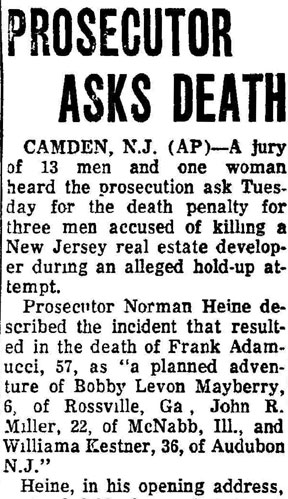
CAMDEN, N.J. (AP)—A jury of 13 men and one woman heard the prosecution ask Tuesday for the death penalty for three men accused of killing a New Jersey real estate developer during an alleged hold-up attempt.
Prosecutor Norman Heine described the incident that resulted in the death of Frank Adamucci, 57, as “a planned adventure of Bobby Levon Mayberry, 6, of Rossville, Ga., John R. Miller, 22, of McNabb, Ill., and Williams Kestner, 36, of Audubon N.J.”
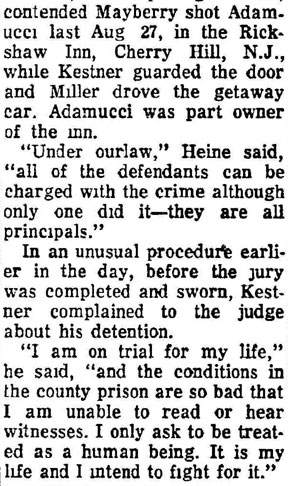
Heine, in his opening address, contended Mayberry shot Adamucci last Aug. 27, in the Rickshaw Inn, Cherry Hill, N.J., while Kestner guarded the door and Miller drove the getaway car. Adamucci was part owner of the inn.
“Under our law,” Heine said, “all of the defendants can be charged with the crime although only one did it—they are all principals.”
In an unusual procedure earlier in the day, before the jury was completed and sworn, Kestner complained to the judge about his detention.
“I am on trial for my life,” he said, “and the conditions in the county prison are so bad that I am unable to read or hear witnesses. I only ask to be treated as a human being. It is my life and I intend to fight for it.”
Mental Case Disrupts Trial
Gettysburg, Pennsylvania Times —
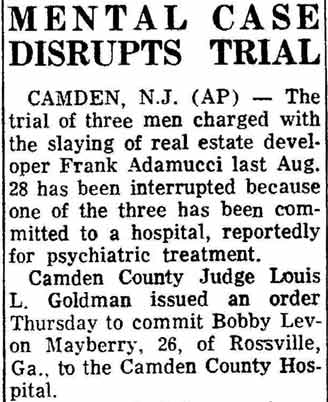
CAMDEN, N.J. (AP) — The trial of three men charged with the slaying of real estate developer Frank Adamucci last Aug. 28 has been interrupted because one of the three has been committed to a hospital, reportedly for psychiatric treatment.
Camden County Judge Louis L. Goldman issued an order Thursday to commit Bobby Levon Mayberry, 26, of Rossville, Ga., to the Camden County Hospital.
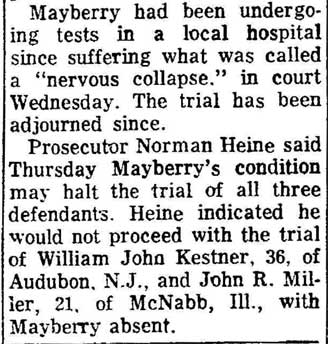
Mayberry had been undergoing tests in a local hospital since suffering what was called a “nervous collapse” in court Wednesday. The trial has been adjourned since.
Prosecutor Norman Heine said Thursday Mayberry’s condition may halt the trial of all three defendants. Heine indicated he would not proceed with the trial of William John Kestner, 36, of Audubon, N.J., and John R. Miller, 21, of McNabb, Ill., with Mayberry absent.
Law Enforcement Officers Unhappy With Court Ruling
Florence, South Carolina Morning News —
On Confessions
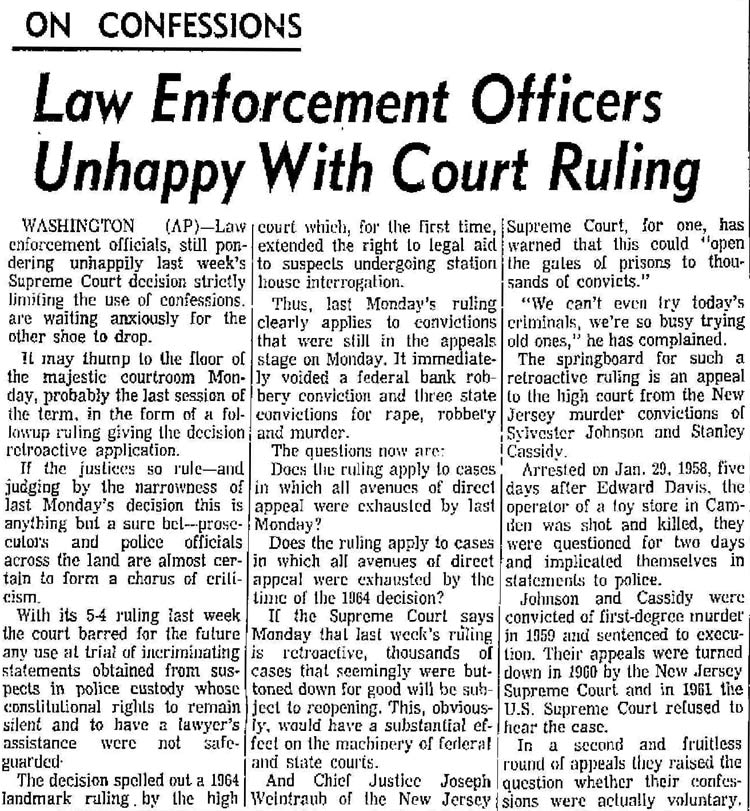
WASHINGTON (AP)—Law enforcement officials, still pondering unhappily last week’s Supreme Court decision strictly limiting the use of confessions, are waiting anxiously for the other shoe to drop.
It may thump to the floor of the majestic courtroom Monday, probably the last session of the term, in the form of a follow-up ruling giving the decision retroactive application.
If the justices so rule—and judging by the narrowness of last Monday’s decision this is anything but a sure bet—prosecutors and police officials across the land are almost certain to form a chorus of criticism.
With its 5-4 ruling last week the court barred for the future any use at trial of incriminating statements obtained from suspects in police custody whose constitutional rights to remain silent and to have a lawyer’s assistance were not safeguarded.
The decision spelled out a 1964 landmark ruling by the high court which, for the first time, extended the right to legal aid to suspects undergoing station house interrogation.
Thus, last Monday’s ruling clearly applies to convictions that were still in the appeals stage on Monday. It immediately voided a federal bank robbery conviction and three state convictions for rape, robbery and murder.
The questions now are:
Does the ruling apply to cases in which all avenues of direct appeal were exhausted by last Monday?
Does the ruling apply to cases in which all avenues of direct appeal were exhausted by the time of the 1964 decision?
If the Supreme Court says Monday that last week’s ruling is retroactive, thousands of cases that seemingly were buttoned down for good will be subject to reopening. This, obviously, would have a substantial effect on the machinery of federal and state courts.
And Chief Justice Joseph Weintraub of the New Jersey Supreme Court, for one, has warned that this could “open the gates of prisons to thousands of convicts.”
“We can’t even try today’s criminals, we’re so busy trying old ones,” he has complained.
The springboard for such a retroactive ruling is an appeal to the high court from the New Jersey supreme murder convictions of Sylvester Johnson and Stanley Cassidy.
Arrested on Jan. 29, 1958, five days after Edward Davis, the operator of a toy store in Camden was shot and killed, they were questioned for two days and implicated themselves in statements to police.
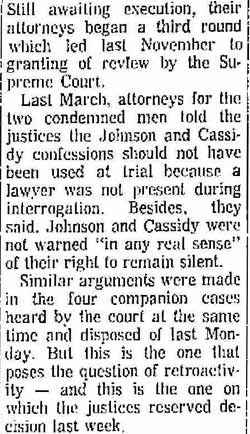
Johnson and Cassidy were convicted of first-degree murder in 1959 and sentenced to execution. Their appeals were turned down in 1960 by the New Jersey Supreme Court and in 1961 the U.S. Supreme Court refused to hear the case.
In a second and fruitless round of appeals they raised the question whether their confessions were actually voluntary.
Still awaiting execution, their attorneys began a third round which led last November to granting of review by the Supreme Court.
Last March, attorneys for the two condemned men told the justices the Johnson and Cassidy confessions should not have been used at trial because a lawyer was not present during interrogation. Besides, they said, Johnson and Cassidy were not warned “in any real sense” of their right to remain silent.
Similar arguments were made in the four companion cases heard by the court at the same time and disposed of last Monday. But this is the one that poses the question of retroactivity — and this is the one on which the justices reserved decision last week.
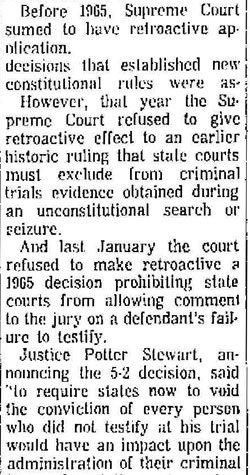
Before 1965, Supreme Court decisions that established new constitutional rules were assumed to have retroactive application.
However, that year the Supreme Court refused to give retroactive effect to an earlier historic ruling that state courts must exclude from criminal trials evidence obtained during an unconstitutional search or seizure.
And last January the court refused to make retroactive a 1965 decision prohibiting state courts from allowing comment to the jury on a defendant’s failure to testify.
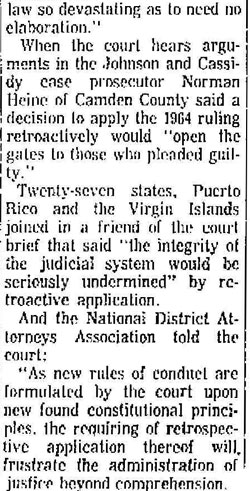
Justice Potter Stewart, announcing the 5-2 decision, said “to require states now to void the conviction of every person who did not testify at his trial would have an impact upon the administration of their criminal law so devastating as to need no elaboration.”
When the court hears arguments in the Johnson and Cassidy case prosecutor Norman Heine of Camden County said a decision to apply the 1964 ruling retroactively would “open the gates to those who pleaded guilty.”
Twenty-seven states, Puerto Rico and the Virgin Islands joined in a friend of the court brief that said “the integrity of the judicial system would be seriously undermined” by retroactive application.
And the National District Attorneys Association told the court:
“As new rules of conduct are formulated by the court upon new found constitutional principles, the requiring of retrospective application thereof will frustrate the administration of justice beyond comprehension.”
3 Sentenced to Life Terms for Slaying
Gettysburg, Pennsylvania Times —
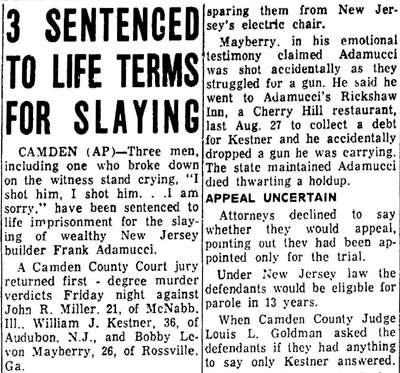
CAMDEN (AP)—Three men, including one who broke down on the witness stand crying, “I shot him. I shot him. … I am sorry,” have been sentenced to life imprisonment for the slaying of wealthy New Jersey builder Frank Adamucci.
A Camden County Court jury returned first-degree murder verdicts Friday night against John R. Miller, 21, of McNabb, Ill., William J. Kestner, 36, of Audubon, N.J., and Bobby Levon Mayberry, 26, of Rossville, Ga., sparing them from New Jersey’s electric chair.
Mayberry, in his emotional testimony claimed Adamucci was shot accidentally as they struggled for a gun. He said he went to Adamucci’s Rickshaw Inn, a Cherry Hill restaurant, last Aug. 27 to collect a debt for Kestner and he accidentally dropped a gun he was carrying. The state maintained Adamucci died thwarting a holdup.
APPEAL UNCERTAIN
Attorneys declined to say whether they would appeal, pointing out they had been appointed only for the trial.
Under New Jersey law the defendants would be eligible for parole in 13 years.
When Camden County Judge Louis L. Goldman asked the defendants if they had anything to say only Kestner answered.
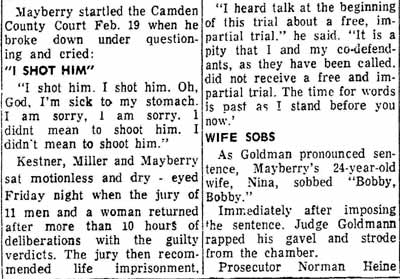
Mayberry startled the Camden County Court Feb. 19 when he broke down under questioning and cried:
“I SHOT HIM”
“I shot him. I shot him. Oh, God, I’m sick to my stomach. I am sorry. I am sorry. I didn’t mean to shoot him. I didn’t mean to shoot him.”
Kestner, Miller and Mayberry sat motionless and dry-eyed Friday night when the jury of 11 men and a woman returned after more than 10 hours of deliberations with the guilty verdicts. The jury then recommended life imprisonment.
“I heard talk at the beginning of this trial about a free, impartial trial,” he said. “It is a pity that I and my co-defendants, as they have been called, did not receive a free and impartial trial. The time for words is past as I stand before you now.”
WIFE SOBS
As Goldman pronounced sentence, Mayberry’s 24-year-old wife, Nina, sobbed “Bobby, Bobby.”
Immediately after imposing the sentence, Judge Goldman rapped his gavel and strode from the chamber.
Prosecutor Norman Heine said: “It’s a complete win for the cops. It represents a splendid team effort by the cops.”
1966 — U.S. Supreme Court: Johnson v. New Jersey
In 1966, Norman Heine, in his capacity as Camden County Prosecutor, successfully argued the following case before the United States Supreme Court.
U.S. Supreme Court — JOHNSON v. NEW JERSEY, 384 U.S. 719 (1966)
JOHNSON ET AL. v. NEW JERSEY. CERTIORARI TO THE SUPREME COURT OF NEW JERSEY. No. 762. Argued February 28, March 1–2, 1966. Decided June 20, 1966.
1966–67 — U.S. Supreme Court: Garrity v. New Jersey
In late 1966, Norman Heine, in his capacity as Camden County Prosecutor, was part of a team that successfully argued the following case before the United States Supreme Court.
U.S. Supreme Court — GARRITY v. NEW JERSEY, 385 U.S. 493 (1967)
GARRITY ET AL. v. NEW JERSEY. APPEAL FROM THE SUPREME COURT OF NEW JERSEY. No. 13. Argued November 10, 1966. Decided January 16, 1967.
Fiorentino v. United States — Full Opinion (1955)
226 F.2d 619 — 55-2 USTC P 9713
Nick FIORENTINO, Leon Di Abundo and Nick Di Abundo, Trustees in Dissolution of the Century Transit Co., a corporation of the State of New Jersey v. UNITED STATES of America.
No. 11590 — United States Court of Appeals Third Circuit. Argued Oct. 4, 1955. Decided Oct. 24, 1955.
Walter Akerman, Washington, D.C. (H. Brian Holland, Asst. Atty. Gen., Ellis N. Slack, A. F. Prescott, Sp. Assts. to the Atty. Gen., Raymond Del Tufo, Jr., U.S. Atty., Newark, N.J., John H. Mohrfeld, III, Asst. U.S. Atty., Camden, N.J., on the brief), for appellant.
Norman Heine, Camden, N.J., for appellee.
Before BIGGS, Chief Judge, and MARIS and GOODRICH, Circuit Judges.
GOODRICH, Circuit Judge.
This case presents a question of the jurisdiction of a district court of the United States in an action to recover taxes paid to the federal government. The District Court for the District of New Jersey gave a money judgment for the taxpayer and the government appeals.
The Commissioner of Internal Revenue in 1943 mailed to the taxpayer a statutory notice of a deficiency for the years 1939, 1940 and 1941. This notice advised it of the determination of the deficiencies in its federal taxes for that period. Within the ninety days thereafter as provided by statute the taxpayer filed a petition for redetermination with the Tax Court. The Commissioner, through his counsel, filed a motion for dismissal on the ground that the petition, in form, failed to comply with the rules and practices of the Tax Court. This motion was heard by the Tax Court and on June 25, 1943, the proceedings were dismissed for lack of prosecution. The Tax Court determined that the deficiencies existed in the amount determined by the Commissioner. Later the taxpayer paid the Collector in Camden, New Jersey, the amount of the deficiencies plus interest and filed claims for a refund which were disallowed and then proceeded to bring suit in the federal court for the district of New Jersey.
The question for our consideration is whether that court had authority to hear the case. The statutory provision is found in section 322 of the Internal Revenue Code of 1939. This section provides that if a notice of deficiency has been sent a taxpayer “and if the taxpayer files a petition with the Board of Tax Appeals within the time prescribed * * * no suit by the taxpayer for the recovery of any part of such tax shall be instituted in any court * * *.” Then follow certain exceptions not relevant here.
When one looks at the facts of this case and then reads the language of the statute there seems little doubt that the statutory language covers the matter precisely. The taxpayer did file his suit for redetermination with the Tax Court. The Tax Court eventually dismissed for lack of prosecution. The taxpayer could have appealed to the Court of Appeals. He did not. The statute, we think, very effectively bars the suit in district court for recovery of the alleged overpayment. There is good authority squarely on the point that a dismissal for want of prosecution is a sufficient determination of the case by the Tax Court to bar the taxpayer from proceeding in district court. Monjar v. Higgins, 2 Cir., 1943, 132 F.2d 990; Resnik v. Welch, D.C.D.Mass.1941, 37 F.Supp. 112; accord, Warren Mfg. Co. v. Tait, D.C.D.Md.1932, 60 F.2d 982. Indeed, this is a situation anticipated by the Congress when the statute was passed, as is shown by the committee report.
The taxpayer cites and relies upon the case of Cutting v. United States, D.C.E.D.N.Y.1939, 26 F.Supp. 586 where a suit was permitted in the district court following taxpayer’s earlier communication to the Board of Tax Appeals. If that case is to be regarded as properly decided it must be on the basis that the communication to the Board was so completely vague that nothing was presented to the Tax Court on which it could tell what the taxpayer wanted or why he wanted it. That a presentation to the Tax Court defective in form does not prevent the jurisdiction of that body from attaching see Continental Petroleum Co. v. United States, 10 Cir., 1936, 87 F.2d 91, certiorari denied 1937, 300 U.S. 679, 57 S.Ct. 670, 81 L.Ed. 883. The Tax Court rules provided amply for amendments to pleadings. It is well settled that pleadings defective in form do not affect the jurisdiction of a court to entertain a case for whatever action may be appropriate therein.
There is only one further point to discuss and the taxpayer makes much of it. As said above, the Commissioner’s objection to the taxpayer’s petition was that it was not in the proper form. The final dismissal by the Tax Court was for want of prosecution. The Commissioner now argues that the filing of the petition, although defective in form, barred the taxpayer from proceeding in the district court. The taxpayer regards this argument as a proof that the Commissioner has blown hot and cold and he does not think the Commissioner should be permitted to do so. He points to no rule of law requiring the Commissioner to be consistent at all stages of the proceeding, even assuming that there is an inconsistency, which we think there is not here.
The judgment of the district court will be reversed and the case remanded with directions to enter judgment for the defendant.
Petition of Joseph Ernst for a Writ of Habeas Corpus — Full Opinion (1961)
294 F.2d 556
Petition of Joseph ERNST for a Writ of Habeas Corpus.
No. 13562 — United States Court of Appeals Third Circuit. Argued June 8, 1961. Decided August 31, 1961.
Chester Apy, Red Bank, N. J., for appellant.
Norman Heine, Camden, N. J., for appellee.
Before BIGGS, Chief Judge, and HASTIE and FORMAN, Circuit Judges.
HASTIE, Circuit Judge.
A jury in the County Court of Camden County, New Jersey, has convicted the petitioner, Joseph Ernst, of murder in the first degree, without recommendation of life imprisonment. Under such a verdict New Jersey law makes a death sentence mandatory, and the petitioner has been so sentenced. The Supreme Court of New Jersey affirmed the conviction and sentence. State v. Ernst, 1960, 32 N.J. 567, 161 A.2d 511. The Supreme Court of the United States denied certiorari. 1961, 364 U.S. 943, 81 S.Ct. 464, 5 L.Ed.2d 374. Ernst then filed this habeas corpus petition in the District Court for the District of New Jersey. The petition was denied without the taking of testimony. This appeal followed.
The deceased, Joan Connor, was a seventeen year old former girl friend of the petitioner. At the time of the homicide he was twenty-two years old and a parolee from the Bordentown Reformatory. Both the petitioner and Joan lived in Camden. In the course of a quarrel some ten days before the homicide he had struck her, inflicting a scalp wound serious enough to require sutures. This assault led Joan’s father to sign a criminal complaint against the petitioner, who fled to Newark.
On the evening of the homicide the petitioner, accompanied by a friend, Robert Lee, returned to Camden. Petitioner was armed with a revolver. He visited the home of a neighbor and there stole a second revolver. He spoke to a neighbor about having returned to Camden seeking revenge. He and his companion then set out to find Joan and a man named Linden whom Ernst mistakenly believed to have made the criminal complaint against him. They located Joan at the Linden home. When she came to the door there was a brief exchange of words. According to the petitioner, Joan spoke insultingly to him and slammed the door in his face. Almost immediately revolver shots were fired through the door fatally injuring the girl. Petitioner fled and was subsequently apprehended. Later he made three confessions, admittedly voluntary, stating essentially the facts outlined above. In two confessions he admitted doing the shooting. In the third, however, he claimed that Lee fired the fatal shots.
Petitioner did not obtain counsel for his own defense. Accordingly, the court assigned Joseph P. DeLuca, an active trial lawyer in Camden County with more than twenty years of experience at the bar, to be defense counsel. Since his conviction, petitioner has retained another attorney who now represents him. One of the principal contentions in the present collateral attack on the conviction is that the conduct of the defense by trial counsel was so deficient as to constitute a denial of such benefit of counsel as the Fourteenth Amendment requires a state to provide for a person accused of a capital offense.
In United States ex rel. Darcy v. Handy, 3 Cir., 1953, 203 F.2d 407, a majority of this court sitting en banc joined in the opinion of Judge Maris on the question whether the alleged mishandling of the defense in a murder trial by counsel of defendant’s own choice constituted a failure of the state to afford the accused due process of law. The limited reach of the due process clause in such a situation was stated as follows:
It is true, as the relator urges, that a denial of due process of law by the state would result if the representation of a defendant by his counsel should be so lacking in competence or good faith that it would become the duty of the trial judge or the prosecutor, as officers of the state, to observe and correct it. For in such a trial the defendant would be practically without representation and it would, therefore, be but a farce and a mockery of justice. It is the duty both of the trial judge and the prosecutor to see that the essential rights of the defendant are preserved. As officers of the state their failure to do so is imputed to the state. But they, and through them the state, may not be convicted of a denial to the defendant of due process of law in this regard unless the incompetence of the defense is so apparent as to call for intervention between counsel and client.” 203 F.2d at page 427.
This case differs from the Darcy case in that counsel here was assigned by the court rather than chosen by the accused. Whether in a borderline case this difference might tip the scales in favor of petitioner’s claim that the state had not discharged its full constitutional duty to provide him with a fair trial, we need not decide. Compare the division of the Court of Appeals for the District of Columbia in Mitchell v. United States, 1958, 104 U.S.App.D.C. 57, 259 F.2d 787. In this case we find it quite clear that there was nothing in the professional history or standing of counsel and nothing in his conduct of the trial which either made his appointment to defend a capital case improper or provided cause during the trial for corrective judicial interference with counsel’s handling of the defense.
In petitioner’s own brief on this appeal it is recognized that assigned counsel was a well qualified and experienced trial lawyer six of whose twenty-one years at the bar had been spent as a deputy prosecutor in the county where this trial was held. Even now his overall professional competency is not challenged. Clearly, his appointment was a proper discharge of the court’s initial responsibility to assign competent and responsible counsel.
Petitioner now criticizes various actions and omissions of defense counsel at the trial. However, we think the matters of which petitioner complains fall far short of establishing that the defendant did not receive professionally acceptable representation and assistance in the conduct of his defense. We approach the problem as did the Court of Appeals for the District of Columbia when it said: “[A]bsence of effective representation of counsel * * * must mean representation so lacking in competence that it becomes the duty of the court or the prosecution to observe it and correct it.” Diggs v. Welch, 1945, 80 U.S. App.D.C. 5, 148 F.2d 667, 670.
Petitioner makes much of the fact that counsel neither introduced evidence nor made an argument calculated to persuade the jurors that they should recommend mercy, even if they should find the accused guilty of murder in the first degree. The record shows that beginning with his opening statement and continuing through his summation defense counsel took and sought to sustain the position that the shooting was not deliberate or premeditated and, therefore, that there could not properly be a first degree verdict, either with or without a recommendation of mercy. He made this clear in his opening statement, saying: “If this boy did the shooting * * * it is nothing more, and I mean nothing more, and I want to say it, that it is a fact that it is second degree. I say to you * * * that all the evidence will not substantiate any verdict of first degree. It has got to be the lesser.” In his effort to establish and maintain this basic position counsel took several steps which petitioner now views as depriving him of the kind of defense to which he was entitled. Counsel commended the police for their work in solving the case and apprehending defendant and his companion. This was not hurtful since there was no dispute, indeed petitioner had admitted, that the right persons had been apprehended. Along the same line counsel spoke of his own experience with the fairness of jury verdicts when he was a prosecutor. This, of course, implied fairness in acquittals as well as convictions. He added that everyone had to accept whatever verdict the jury rendered, at the same time reminding the jurors that they would have to live with their own consciences after the verdict. Since there was no basis for disputing that the defendant or his companion had committed a felonious homicide, counsel also stated that he did not condone his client’s behavior, though even after hearing his client on the stand he was not sure exactly what happened at the time of the homicide. This last concession must be considered in the light of the fact that contradictory statements appeared in petitioner’s confessions. Understandably, counsel may have reasoned that his most helpful course would be to express his own uncertainty as to what the facts were, hoping that the jurors would be similarly puzzled and would give the defendant the benefit of the doubt.
This was a case in which counsel could reasonably have believed that the evidence of felonious homicide by his client was so overwhelming that to go beyond urging the absence of premeditation would outrage and offend the jury to his client’s detriment. On the other hand, the making of concessions which did not weaken the claim that the shooting was not premeditated might emphasize this critical issue and dispose the jury to view it dispassionately. Moreover, a show of candor by counsel is often calculated to impress a jury favorably. In brief, counsel’s various maneuvers may have been part of a strategy of developing a setting and an atmosphere in which the area of controversy would be narrowed to grounds of his selection and in which counsel would be viewed by the jurors as joining with them in the sober and dispassionate search for justice.
Petitioner places special emphasis upon an additional statement by counsel to the jury that he approved the New Jersey statute which provided the death penalty for first degree murder. But, at the same time, he emphasized his position that this was not a first degree case and that before “a person is convicted under the capital statute that every letter of that statute must be met. Where there is doubt, it should not be upheld, because once a life is taken, you cannot erase that error * * *.” Here again counsel apparently was seeking to avoid unnecessary controversy with jurors who might approve capital punishment and at the same time to concentrate attention on the issue of absence of premeditation upon which he would make the case turn.
In this connection, counsel was able to develop some evidentiary basis for his argument that the shooting was not deliberate and premeditated. He showed that the accused made himself known to people at a tavern immediately before he went in search of the victim. He emphasized the position that verbal castigation and the slamming of a door in petitioner’s face created a spontaneous violent reaction in sudden unreasoning anger.
It is argued that in confining his presentation to the issue of premeditation counsel recklessly and to his client’s detriment placed all his eggs in one basket. Yet, he may well have reasoned that the force of his argument that the crime was committed in sudden hot blood would be weakened in the jury’s view by offering an alternative plea for mercy if premeditation should be found. Moreover, it is to be remembered that the judge himself must, as the judge did in this case, explain to the jury its responsibility for considering the granting of mercy in connection with a first degree verdict. So that issue was not eliminated from the case.
Viewing the case in its entirety, and in the light of petitioner’s confessions, it is obvious that the defense had little to work with. Moreover, the items of which petitioner complains could well have been part of a rational plan of a competent lawyer trying to do his best for his client. Certainly, the Constitution does not require the state to provide more than that in the way of effective assistance of counsel in a capital case.
As a second major point petitioner urges that the New Jersey statute under which he has been sentenced is so unfair and discriminatory that it denies persons sentenced to death thereunder due process of law and the equal protection of the laws. The New Jersey statute reads:
Every person convicted of murder in the first degree, his aiders, abettors, counselors and procurers, shall suffer death unless the jury shall by its verdict, and as a part thereof, upon and after the consideration of all the evidence, recommend life imprisonment, in which case this and no greater punishment shall be imposed.
“Every person convicted of murder in the second degree shall suffer imprisonment for not more than 30 years.” N.J.S. 2A:113-4, N.J.S.A.
Petitioner’s first criticism of the statute is that it provides no standard to guide the jury in deciding whether the penalty for first degree murder shall be death or life imprisonment. True, the jury is left to choose between these penalties “upon and after the consideration of all the evidence,” but otherwise without authoritative criteria for the measurement of culpability or extenuation. But such unguided discretion in the choice between penalties which may be imposed under a first degree verdict has long been characteristic of the laws of the United States and of many states. Some twenty states confer this power upon juries in murder cases. See the compilation of such statutes in Knowlton, Problems of Jury Discretion in Capital Cases, 1953, 101 U. of Pa.L.Rev. 1099, 1101–1103. See also the discussion of these statutes in the concurring opinion of Mr. Justice Frankfurter in Andres v. United States, 1948, 333 U.S. 740, 758–763, 68 S.Ct. 880, 92 L.Ed. 1055. Similarly, the pertinent federal statute provides that “whoever is guilty of murder in the first degree, shall suffer death unless the jury qualifies its verdict by adding thereto ‘without capital punishment’ in which event he shall be sentenced to imprisonment for life.” 18 U.S.C. § 1111. Both recent and early decisions of the Supreme Court sanction this sentencing scheme. Andres v. United States, supra; Winston v. United States, 1899, 172 U.S. 303, 19 S.Ct. 212, 43 L.Ed. 456. We have discovered no successful attack upon any similar state statute on the ground that it fails to provide guide lines for the jury in its choice between the death penalty and life imprisonment. This may well be because it is neither practicable nor desirable that any stated criteria should control a jury in deciding whether the circumstances of a premeditated murder are such that draconic punishment should not be imposed. Moreover, it is a matter of legislative history in most jurisdictions, certainly in New Jersey, that the conferring of this power upon juries is potentially advantageous and, in no way hurtful to persons convicted of first degree murder, for the antecedent statutes rather generally made the death sentence mandatory in all such cases. Contrast the present New Jersey law, N.J.S. 2A:113-4, N.J.S.A., with its antecedent, P.L.1898, ch. 235, § 108. In the laws of the United States, contrast 18 U.S.C. § 1111 with Rev.Stat. § 5339. Indeed, the New Jersey courts analyze the present statute as retaining the death sentence as the legislatively prescribed punishment for first degree murder, while adding a special procedure for mitigation wherever the circumstances shall lead the jury so to provide in its verdict. State v. Molnar, 1945, 133 N.J.L. 327, 44 A.2d 197. This method of sentencing may be less than ideal. See Knowlton, supra, 101 U. of Pa.L.Rev. at 1130–1136. Yet, a device in mitigation certainly is not essentially unfair to the wrongdoer because the jury’s power to reduce the normal penalty is not controlled. The argument that due process of law has been denied is without merit.
Petitioner’s final objection to New Jersey sentencing procedure in murder cases is that the jury does not have the benefit of a pre-sentence investigation and report. This is said to be discriminatory because present New Jersey rules of court require that a judge shall obtain a presentence report before he passes sentence for any other serious offense. R.R. 3:7-10(b). This is said to be an arbitrary differentiation in the treatment of offenders and, therefore, a denial of equal protection of the laws to those convicted of murder. But the basic differentiation occurred when the legislature made first degree murder punishable by death or by life imprisonment, as a jury may determine, while in the cases of lesser offenses the trial judge was vested with discretion as to the sentence to be pronounced and whether to require confinement or to grant the convicted person probation. Even the petitioner does not say that this distinction in legislative treatment of the matter of punishment for different crimes is in itself a denial of the equal protection of law. But once this is conceded it ceases to be significant that in administering their sentencing power the courts of New Jersey have seen fit to make a pre-sentence investigation and report a mandatory procedure. Administrative differences are reasonably to be expected in procedures as dissimilar as jury sentencing for first degree murder and sentencing by a judge for lesser crimes. Moreover, New Jersey has made available to every person charged with murder some of the advantages of a presentence investigation by permitting him to include evidence in mitigation as part of his defense. See State v. Mount, 1959, 30 N.J. 195, 152 A.2d 343. But apart from this, we do not view the difference between sentencing procedures of which the defendant complains as the kind of arbitrary and unreasonable differentiation which the equal protection clause forbids.
In finding the petitioner’s constitutional contentions to be without merit, we have not overlooked the fact that these issues were not brought to the attention of the New Jersey courts except by petition for rehearing after the New Jersey Supreme Court had affirmed petitioner’s conviction. And even then the constitutional issues were not disclosed in all of the aspects now presented to us. It is arguable, therefore, that there has not yet been such exhaustion of state remedies as Section 2254 of Title 28 U.S.C. requires before a federal court shall discharge a state prisoner pursuant to a writ of habeas corpus. However, as was pointed out in the concurring opinion in United States ex rel. Auld v. Warden, 3 Cir., 1951, 187 F.2d 615, 620, it is not Section 2254 but rather Section 2241 which gives the district court power to entertain and dispose of petitions for habeas corpus. Section 2254 merely requires as a matter of national policy that, in the exercise of that power, affirmative relief shall not be granted to a state prisoner until he shall have exhausted the remedies available in the state courts. Denial of a state prisoner’s petition for habeas corpus on its merits remains permissible under Section 2241 even though state remedies may not have been exhausted. See also the opinion of Judge Maris in United States ex rel. Darcy v. Handy, supra, 203 F.2d at 421.
The judgment will be affirmed.
BIGGS, Chief Judge (dissenting).
The decision in this case overrules United States ex rel. Auld v. Warden, 3 Cir., 1951, 187 F.2d 615, sub silentio, for here, as the majority opinion points out, “there has not yet been such an exhaustion of state remedies as Section 2254 of Title 28 U.S.C. requires before a federal court shall discharge a state prisoner pursuant to a writ of habeas corpus.” I would vacate the judgment and would remand with the direction to the court below to allow the petitioner a reasonable opportunity to exhaust his state remedies, retaining jurisdiction and staying the execution of the state sentence in the meantime. Comity between the state and federal processes requires this result.
Johnson v. New Jersey — Full Opinion (1966)
U.S. Supreme Court
JOHNSON v. NEW JERSEY, 384 U.S. 719 (1966)
384 U.S. 719
JOHNSON ET AL. v. NEW JERSEY. CERTIORARI TO THE SUPREME COURT OF NEW JERSEY. No. 762. Argued February 28, March 1–2, 1966. Decided June 20, 1966.
Petitioners’ confessions were offered in evidence by the State in their trial for felony murder, at which they were found guilty and sentenced to death. Their convictions became final six years ago. On collateral attack petitioners now argue that the confessions were inadmissible under Escobedo v. Illinois, 378 U.S. 478. The New Jersey Supreme Court held that Escobedo did not apply retroactively. Held:
- 1. Neither Escobedo nor Miranda v. Arizona, ante, p. 436, which set down additional guidelines, is to be applied retroactively. Pp. 726–735.
- (a) Linkletter v. Walker, 381 U.S. 618, and Tehan v. Shott, 382 U.S. 406, established the principle that in criminal litigation concerning constitutional claims the Court may make a rule of criminal procedure prospective, basing its determination upon the purpose of the new standards, the reliance placed on the prior decisions on the subject, and the effect on the administration of justice of a retroactive application of the rule. Pp. 726–727.
- (b) The choice between retroactivity and nonretroactivity does not depend on the value of the constitutional guarantee involved or the provision of the Constitution on which the dictate is based, but takes account of the extent to which other safeguards are available to protect the integrity of the truth-determining process at trial. Pp. 728–729.
- (c) While Escobedo and Miranda guard against the possibility of unreliable statements in cases of in-custody interrogation, they cover situations where the danger is not necessarily as great as when the accused is subjected to overt and obvious coercion. P. 730.
- (d) For persons whose trials have already been completed, the case law on coerced confessions is available, if the procedural prerequisites for direct or collateral attack are met. P. 730.
- (e) Law enforcement agencies fairly relied on prior cases, now no longer binding, in obtaining incriminating statements during the years preceding Escobedo and Miranda, and retroactive application of those cases would seriously disrupt administration of the criminal laws. P. 731.
- (f) Escobedo and Miranda should apply only to cases where the trials have commenced after the decisions were announced, June 22, 1964, and June 13, 1966, respectively. Pp. 733–735.
- 2. The other grounds asserted by petitioners which may be tested by this review are without merit; their contentions relating to the voluntariness of their confessions are beyond the scope of the review in this proceeding. P. 735.
43 N. J. 572, 206 A. 2d 737, affirmed.
Stanford Shmukler and M. Gene Haeberle argued the cause for petitioners. With them on the briefs was Curtis R. Reitz.
Norman Heine argued the cause and filed a brief for respondent.
Telford Taylor, by special leave of Court, argued the cause for the State of New York, as amicus curiae. With him on the brief were Louis J. Lefkowitz, Attorney General, Samuel A. Hirshowitz, First Assistant Attorney General, and Barry Mahoney and George D. Zuckerman, Assistant Attorneys General, joined by the Attorneys General for their respective States and jurisdictions as follows: Richmond M. Flowers of Alabama, Darrell F. Smith of Arizona, Bruce Bennett of Arkansas, Duke W. Dunbar of Colorado, David P. Buckson of Delaware, Earl Faircloth of Florida, Arthur K. Bolton of Georgia, Allan G. Shepard of Idaho, William G. Clark of Illinois, Robert C. Londerholm of Kansas, Robert Matthews of Kentucky, Jack P. F. Gremillion of Louisiana, Richard J. Dubord of Maine, Thomas B. Finan of Maryland, Norman H. Anderson of Missouri, Forrest H. Anderson of Montana, Clarence A. H. Meyer of Nebraska, T. Wade Bruton of North Carolina, Helgi Johanneson of North Dakota, Robert Y. Thornton of Oregon, Walter E. Alessandroni of Pennsylvania, J. Joseph Nugent of Rhode Island, Daniel R. McLeod of South Carolina, Waggoner Carr of Texas, Robert Y. Button of Virginia, John J. O’Connell of Washington, C. Donald Robertson of West Virginia, John F. Raper of Wyoming, Rafael Hernandez Colon of Puerto Rico and Francisco Corneiro of the Virgin Islands.
Duane R. Nedrud, by special leave of Court, argued the cause for the National District Attorneys Association, as amicus curiae, urging affirmance. With him on the brief was Marguerite D. Oberto.
Anthony G. Amsterdam, Paul J. Mishkin, Raymond L. Bradley, Peter Hearn and Melvin L. Wulf filed a brief for the American Civil Liberties Union, as amicus curiae.
Opinion of the Court by MR. CHIEF JUSTICE WARREN, announced by MR. JUSTICE BRENNAN.
In this case we are called upon to determine whether Escobedo v. Illinois, 378 U.S. 478 (1964), and Miranda v. Arizona, ante, p. 436, should be applied retroactively. We hold that Escobedo affects only those cases in which the trial began after June 22, 1964, the date of that decision. We hold further that Miranda applies only to cases in which the trial began after the date of our decision one week ago. The convictions assailed here were obtained at trials completed long before Escobedo and Miranda were rendered, and the rulings in those cases are therefore inapplicable to the present proceeding. Petitioners have also asked us to overturn their convictions on a number of other grounds, but we find these contentions to be without merit, and consequently we affirm the decision below.
Petitioner Cassidy was taken into custody in Camden, New Jersey, at 4 a. m. on January 29, 1958, for felony murder. The police took him to detective headquarters and interrogated him in a systematic fashion for several hours. At 9 a. m. he was brought before the chief detective, two other police officers, and a court stenographer. The chief detective introduced the persons present, informed Cassidy of the possible charges against him, gave him the warning set forth in the margin, concluded that he understood the warning, and obtained his consent to be questioned. Cassidy was then interrogated until 10:25 a. m. and made a partial confession to felony murder. The stenographer recorded this interrogation and read it back to Cassidy for his acknowledgment. Police officers then took him to another part of the building and apparently questioned him further. At 12:15 p. m. he was brought back to the chief detective’s office for another half hour of recorded interrogation. Under circumstances similar to those already described, Cassidy amended his confession to add vital incriminating details. For the next 11 hours he was held in a detention room and may have been subjected to further questioning. At 11:40 p. m. the police returned him to the chief detective’s office for a final brief round of recorded interrogation. Taken together, Cassidy’s three formal statements added up to a complete confession of felony murder, and they were later introduced against him at his trial for that crime.
While the present collateral proceeding was pending following our decision in Escobedo, Cassidy filed affidavits in the New Jersey Supreme Court which detailed for the first time certain supposed circumstances of his confession. In his own affidavit, he claimed that on at least five separate occasions during his interrogation, he asked for permission to consult a lawyer or to contact relatives. The police allegedly either ignored these requests or told him that he could not communicate with others until his statement was completed. Cassidy also produced affidavits from his mother, his uncle, and his aunt, claiming that during this period they called the detective headquarters at least three times and once appeared there in person, seeking information about Cassidy and an opportunity to speak with him. Their efforts allegedly were thwarted by the police. These belated claims were left uncontroverted by the State and were accepted as true by the court below for purposes of the Escobedo issue.
The police took petitioner Johnson into custody in Newark, New Jersey, at 5 p. m. on January 29, 1958, for the same crime as Cassidy. He was taken to detective headquarters and was booked. Later in the evening the police brought him before a magistrate for a brief preliminary hearing. The record is unclear as to what transpired there. Both before and after the appearance in court, he was questioned in a routine manner. At 2 a. m. the police drove Johnson by auto to Camden, the scene of the homicide, 80 miles from Newark. During the auto ride he was again interrogated about the crime. Upon arrival in Camden at about 4:30 a. m., the police took him directly to detective headquarters and brought him before the chief detective, three other police officers, and a court stenographer. As in Cassidy’s case, Johnson was introduced to the persons present, informed of the possible charges against him, and given the same warning already set forth. He stated that he understood the warning and was willing to be questioned under those conditions. The police then interrogated him until 6:20 a. m., a period of about one and one-half hours. During the course of the questioning, he made a full confession to the crime of felony murder. This interrogation was recorded by the stenographer and read back to Johnson for his acknowledgment.
Like Cassidy, Johnson filed affidavits in the New Jersey Supreme Court in this collateral proceeding following our decision in Escobedo, detailing for the first time certain supposed circumstances of his confession. In his own affidavit, he claimed that at four separate points during the period described above, he asked for permission to consult a lawyer or to contact relatives so that they could obtain a lawyer for him. As in Cassidy’s case, the police allegedly either ignored these requests or told him that he could not communicate with others until he had given a statement. Johnson also produced affidavits from his mother and his girl friend, claiming that on three occasions after the homicide and prior to the confession, they called detective headquarters or went there in person, seeking information about Johnson and an opportunity to speak with him. Their efforts allegedly were rebuffed by the police. These belated claims, like Cassidy’s, were left uncontroverted by the State and were accepted as true by the court below for resolution of the Escobedo issue.
The confessions of Johnson and Cassidy were offered in evidence by the State at their joint trial for felony murder. The judge held a hearing out of the presence of the jury on the voluntariness of the confessions. Petitioners made no effort to rebut the testimony adduced by the State relating to this issue. The judge found the confessions voluntary and admitted them into evidence. Petitioners then expressly relinquished their right under state law to have the issue of voluntariness, and the accompanying evidence, submitted to the jury for redetermination. They did not introduce any testimony to dispute the correctness of their confessions.
In summation at the close of trial, defense counsel explicitly asserted that the confessions were truthful and pleaded for leniency on this ground. Cassidy’s lawyer stated to the jury:
Whatever is in this statement made by Stanley Cassidy is true. I know it is true. … [M]y reason for knowing that it is true is because of the meetings and consultations I have had with Stanley. We have been over this many, many times.
“I know it is true because I know Chief Dube, and Chief Dube is a fine interrogator. If you do not answer truthfully, believe me, he will question you until he does get the truth, and Chief Dube got the truth.
Likewise Johnson’s lawyer told the jury:
The statement of Johnson was truthful and honest, because when that was finished, that was the end of it.
. . . . .
“There were no threats. There was no attempt to evade. There was no trickery. Anything that Chief Dube asked him he answered honestly and truthfully.
The jury found Johnson and Cassidy guilty of murder in the first degree without recommendation of mercy, and they were sentenced to death.
The convictions of Johnson and Cassidy became final six years ago, when the New Jersey Supreme Court affirmed them upon direct appeal and the time expired for petitioners to seek certiorari from the decision. There followed a battery of collateral attacks in state and federal courts, based on new factual allegations, in which petitioners repeatedly and unsuccessfully assailed the voluntariness of their confessions. This proceeding arises out of still another application for post-conviction relief, accompanied by a fresh set of factual allegations, in which petitioners have argued in part that their confessions were inadmissible under the principles of Escobedo. The court below rejected the claim, holding that Escobedo did not affect convictions which had become final prior to the date of that decision, and it is this holding which we are principally called upon to review. In view of the standards announced one week ago concerning the warnings which must be given prior to in-custody interrogation, this case also obliges us to determine whether Miranda should be accorded retroactive application.
In the past year we have twice dealt with the problem of retroactivity in connection with other constitutional rules of criminal procedure. Linkletter v. Walker, 381 U.S. 618 (1965); Tehan v. Shott, 382 U.S. 406 (1966). These cases establish the principle that in criminal litigation concerning constitutional claims, “the Court may in the interest of justice make the rule prospective … where the exigencies of the situation require such an application.” 381 U.S., at 628; 382 U.S., at 410. These cases also delineate criteria by which such an issue may be resolved. We must look to the purpose of our new standards governing police interrogation, the reliance which may have been placed upon prior decisions on the subject, and the effect on the administration of justice of a retroactive application of Escobedo and Miranda.
43 N. J. 572, 206 A. 2d 737, affirmed.
MR. JUSTICE CLARK concurs in the opinion and judgment of the Court. He adheres, however, to the views stated in his separate opinion in Miranda v. Arizona, ante, p. 499.
MR. JUSTICE HARLAN, MR. JUSTICE STEWART, and MR. JUSTICE WHITE concur in the opinion and judgment of the Court. They continue to believe, however, for the reasons stated in the dissenting opinions of MR. JUSTICE HARLAN and MR. JUSTICE WHITE in Miranda v. Arizona and its companion cases, ante, pp. 504, 526, that the new constitutional rules promulgated in those cases are both unjustified and unwise.
MR. JUSTICE BLACK, with whom MR. JUSTICE DOUGLAS joins, dissents from the Court’s holding that the petitioners here are not entitled to the full protections of the Fifth and Sixth Amendments as this Court has construed them in Escobedo v. Illinois, 378 U.S. 478, and Miranda v. Arizona, ante, p. 436, for substantially the same reasons stated in his dissenting opinion in Linkletter v. Walker, 381 U.S. 618, at 640.