Louis Berkowitz
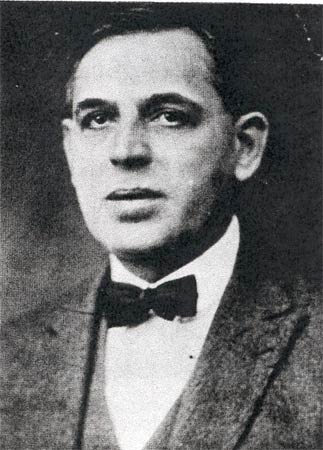
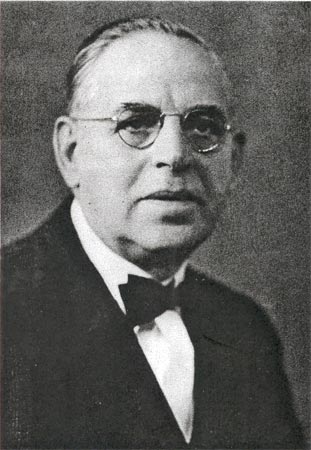
Louis Berkowitz
Louis Berkowitz was a businessman and leader in Camden's Jewish community for many years. He was president of Congregation Beth El from 1922 to 1925, during which time the synagogue on Park Boulevard was completed, and honorary president from 1948 until his death in December of 1959.
Louis Berkowitz was born in Hungary and came to America in 1891. He became a citizen in 1895. He and wife Sarah lived in Pennsylvania during the early years of their marriage, where daughters Blanche and Ethel and son Harry Berkowitz were born.
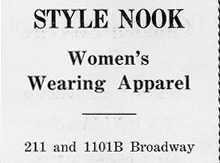
Louis Berkowitz operated a business known as the Style Nook on Broadway for many years. The 1920 Census shows the family at 1101 Broadway, where the business was located. By 1923, when daughter Ethel graduated from Camden High School, the Berkowitz family had moved to 1458 Wildwood Avenue in Parkside. Louis Berkowitz resided at this address for many years thereafter.
1923 Camden High School Purple & Gold Yearbook
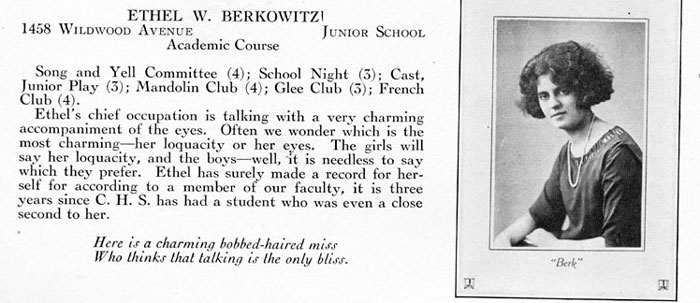
1923 Camden High School Purple & Gold Yearbook — Ethel W. Berkowitz
Congregation Beth El
On October 3, 1920, a meeting was held in Mr. Natal's law office for the purpose of organizing a new congregation in Camden. From this meeting would spring Congregation Beth El, Camden's first Conservative synagogue. The twenty-five men present included Harry Barroway, Dr. Otto Reiter, Reuben Pinsky and Manny Pearl. Each of the latter four contributed fifteen dollars and the dream became real. According to Herman Natal in an interview published in the “Voice” September 1951, others at that meeting were Louis Cades, Kolman Goldstein, Harry Teitelman, Herman Natal, Louis Berkowitz, Morris Handle and A. I. Rovner. Jacob Leventon attended a subsequent meeting.
On November 1, 1921, Beth El was officially incorporated by the state of New Jersey. On the Certificate of Incorporation, dated November 1, 1921, the founders were: Morris Handle, Benjamin Natal, H. S. Lichtenstein, Harry Varbalow, Nathan Robinson, I. E. Silverman, Harry W. Markowich, Israel Paletz, Maurice B. Wessel, Alexander Romm, Israel E. Fridrich, Philip Wendkos, Abraham Rovner, Philip Auerbach, Mark Obus, Otto Reiter, Louis Cades, Manuel A. Pearl, Louis Berkowitz, Harry Nurock, Harry H. Teitelman, Isadore S. Siris, Herman Natal, Israel Weitzman, Jacob Leventon, Kalman Goldstein, Nathan Friedenberg, Louis M. Nelson, Morris Hess, Reuben Pinsky and Isador Mazer.
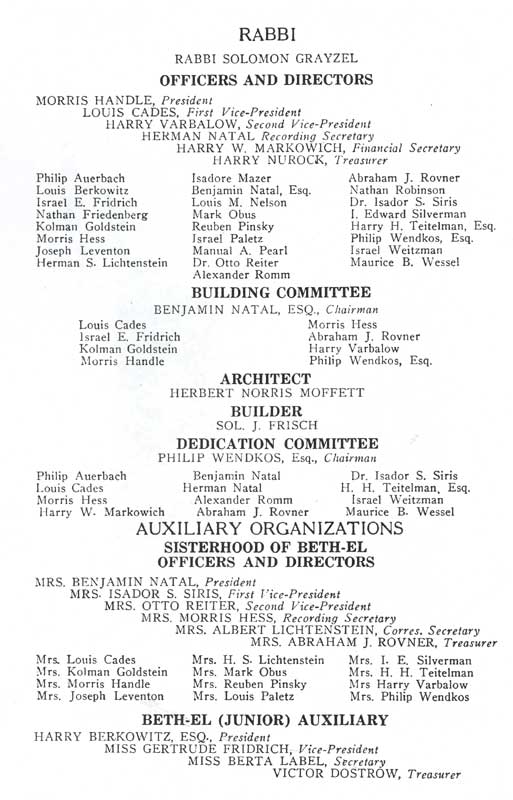
Congregation Beth El — Officers and Directors, Building Committee, Dedication Committee, and Auxiliary Organizations
Morris Handle was the Congregation's first President, serving from 1920 through 1922. Louis Berkowitz succeeded him, and held the post until 1925. During his term as president the synagogue that stood on Park Boulevard across from Farnham Park for so many years was completed.
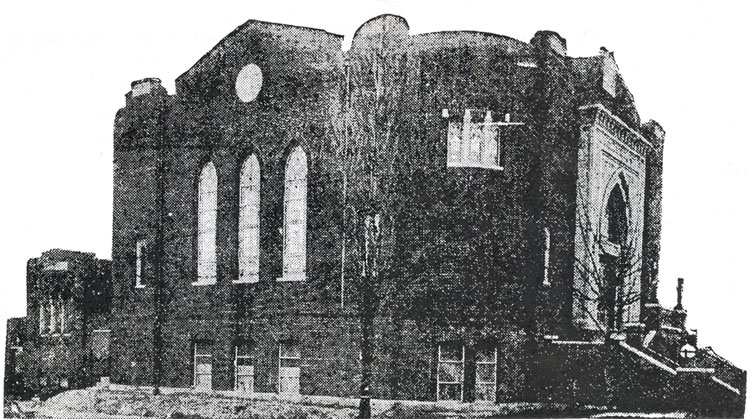
Congregation Beth El, Park Boulevard
In May of 1940, on the recommendation of a nominating committee headed by Morris Liebman, the membership of Congregation Beth El approved the establishment of an honorary Board of Directors to be composed of all former Presidents. The Board consisted of Commissioner E. George Aaron, H. L. Barroway, Louis Berkowitz, Samuel F. Ginns, Morris Handle, Ben Natal and Jesse Satenstein.
Beth El's Rabbi and lay leaders, blessed with foresight, realized that a new school building would eventually be needed. In June of 1942, a group of men jointly bought a lot adjoining the synagogue on Park Boulevard. The men were: Meyer Adleman, Louis Berkowitz, Leon Cooperson, Henry Cooperson, Isadore Blume, Herman Cornfeld, Herman Z. Cutler, Joseph Galanter, Jesse Satenstein, Morris Handle, Max Holzman, Harry Grossman, Jacob Leventon, Sol Rosenberg, Sam Marochnick, Manny Pearl, Walter Saline, Meyer Sakin, Leo Spector and Hy Myers.
After serving as an army chaplain during World War II, Beth El's Rabbi, Philip Lipis, after a year in Camden, accepted another position in Oakland, California. In 1947 a committee, headed by Louis Markowitz, began the search for a new rabbi. Other members of the committee were Louis Berkowitz, Harry Berkowitz, Morris Liebman, Norman Heine, Henry Bass and Herman Z. Cutler. The search ended in July of that year with the choice of Rabbi Harry B. Kellman. Rabbi Kellman, originally from Philadelphia, had graduated from the University of Pennsylvania in 1927 and the Jewish Theological Seminary in 1931. Following his service as an army chaplain in World War II, he became rabbi at Beth Israel in Vineland, New Jersey, for seventeen years. Rabbi Kellman had already established a wide reputation as an “orator of note.” He and his wife, Ruth, and eight-year old daughter, Nadine, moved to Camden at the end of the summer. He was installed as Beth El's Rabbi on September 9 by Dr. Max Artz. Louis L. Goldman was chairman of the installation ceremonies.
Louis Berkowitz became Beth El's first president emeritus.
Beth El's new school building was built in 1949. The building was completed, at a cost of $140,000, in time for the Fall school term. The dedication took place on Dec. 4, 1949. At the dedication ceremonies, Honorary President, Louis Berkowitz, recited the prayer of “Shehechiyanu” over “South Jersey's largest synagogue school building.” The honor of cutting the ribbon was given to Past President, Herman Z. Cutler, the man most responsible for the “realization of the dream.” The doors were officially opened by Honorary President Jacob Leventon.
On October 20, 1950 at Sabbath Services, a new Torah was presented in honor of Louis Berkowitz's 75th birthday.
On March 8, 1953 a dinner honoring Beth El's past presidents and founders was held in the auditorium. Irving Levinsky chaired the event which honored Past Presidents Morris Handle, Louis Berkowitz, Benjamin Natal, Louis Cades, Jacob Leventon, Henry L. Barroway, E. George Aaron, Meyer Adleman, Samuel F. Ginns, Israel Katz, Jesse Satenstein, Meyer Sakin, Herman Z. Cutler, Morris Liebman and Louis Markowitz as well as the surviving founders.
Louis Berkowitz, honorary president of Congregation Beth El since 1948, passed away in December of 1959.
1953 Dinner Honoring Past Presidents and Founders
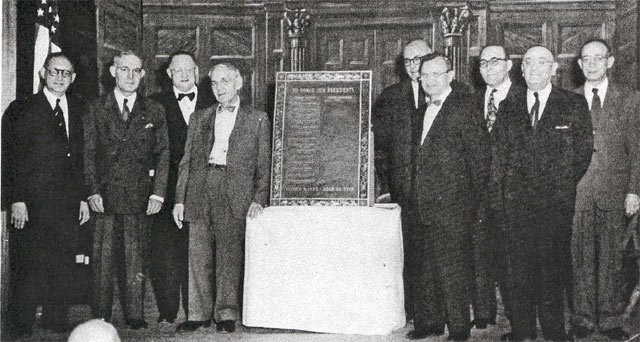
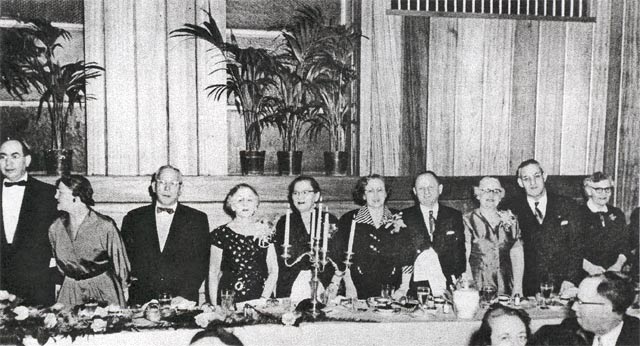
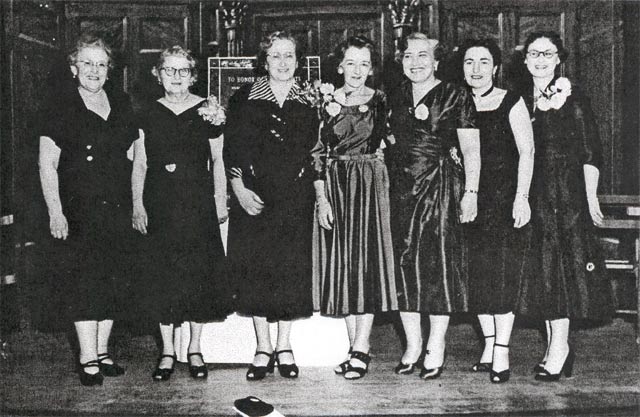
1953 Dinner Honoring Past Presidents and Founders of the Congregation
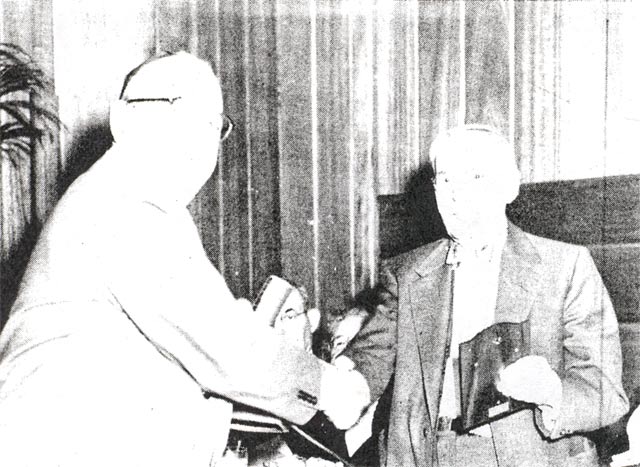
N. Herman “Doc” Rappaport and Louis Berkowitz
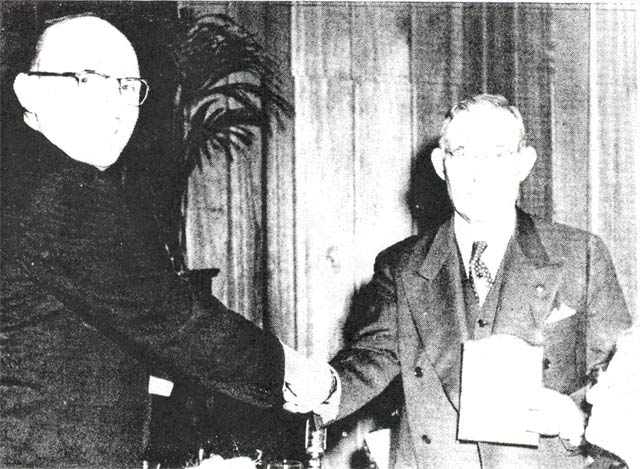
Max Odlen and Benjamin Natal
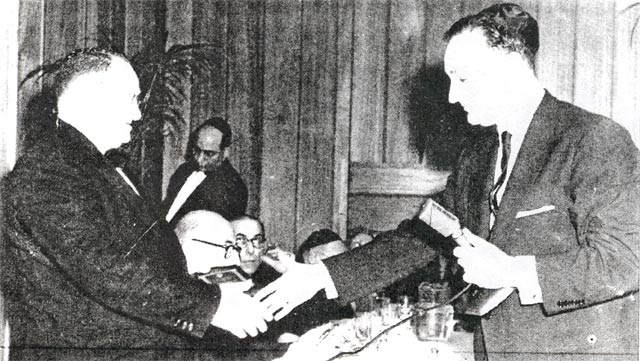
Martin Odlen and Meyer Adleman
Ten Buildings Ordered Down for Post Office
Camden Morning Post —
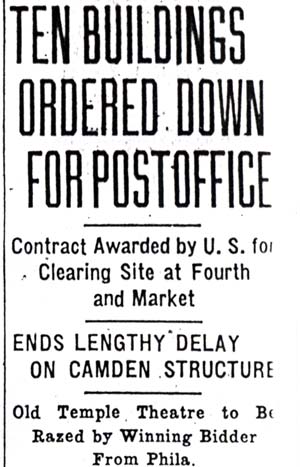
Contract Awarded by U. S. for Clearing Site at Fourth and Market
ENDS LENGTHY DELAY ON CAMDEN STRUCTURE
Old Temple Theatre to Be Razed by Winning Bidder From Phila.
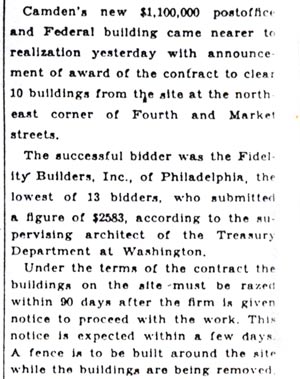
Camden's new $1,100,000 postoffice and Federal building came nearer to realization yesterday with announcement of award of the contract to clear 10 buildings from the site at the northeast corner of Fourth and Market streets.
The successful bidder was the Fidelity Builders, Inc., of Philadelphia, the lowest of 13 bidders, who submitted a figure of $2583, according to the supervising architect of the Treasury Department at Washington.
Under the terms of the contract the buildings on the site must be razed within 90 days after the firm is given notice to proceed with the work. This notice is expected within a few days. A fence is to be built around the site while the buildings are being removed.
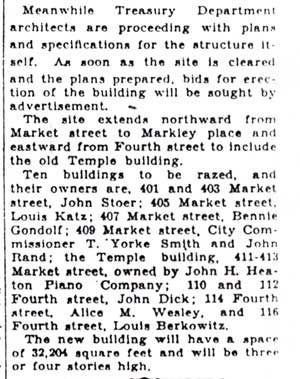
Meanwhile Treasury Department architects are proceeding with plans and specifications for the structure itself. As soon as the site is cleared and the plans prepared, bids for erection of the building will be sought by advertisement.
The site extends northward from Market street to Markley place and eastward from Fourth street to include the old Temple building.
Ten buildings to be razed, and their owners are, 401 and 403 Market street, John Stoer; 405 Market street, Louis Katz; 407 Market street, Bennie Gondolf; 409 Market street, City Commissioner T. Yorke Smith and John Rand; the Temple building, 411–413 Market street, owned by John H. Heaton Piano Company; 110 and 112 Fourth street, John Dick; 114 Fourth street, Alice M. Wesley, and 116 Fourth street, Louis Berkowitz.
The new building will have a space of 32,204 square feet and will be three or four stories high.
Camden Spokesman Lists Ideas On Parley to Aid Small Business
Camden Courier-Post —
Curb on Chiselers, Demand for Fair Trade Practices and Wage-Hour Regulation Urged by Broadway Merchant Named for F.R. Conference
Legislation to eliminate “chiselers” and to establish more stringent fair trade practices and stricter regulations of minimum wages and hours to create more jobs are among the recommendations to be made by a Camden representative at the conference of small businessmen of the nation in Washington, February 8 and 9.
Louis Berkowitz, of the Style Nook Shops, 211 Broadway, was appointed yesterday by Charles M. Heritage, president of the Broadway Business Men's Association to represent that organization at the President's conference.
“The President and Congress both can assist the smaller merchant and businessman,” said Berkowitz. “The trouble is that there is too much pessimism and not enough optimism in business.”
Raps Business ‘Chiselers’
“Business chiselers with their unscrupulous methods, misleading advertising and cut throat competition are driving legitimate businessmen to the wall.
“Regulation of wages and hours in small business also is important. More jobs would create less unemployment and contribute more buying power.
“Legislation is needed nationally and locally to enforce fair trade practices. This unwholesome condition exists more in smaller retail business lines than it does in big business.
“The national administration has been concerned for many years with the problems of big business while the smaller retail merchants and firms have been neglected.”
Berkowitz expressed the opinion that President Roosevelt should do something with the aid of Congress to stimulate business of small businessmen and help restore confidence of the American buying public.
Lays Trouble to Fear
“People have money,” Berkowitz added. “The trouble is they are afraid to spend because of forebodings that the country is running into another depression.
“Fear in business and among buyers of merchandise must be eliminated before the country can snap out of this recession and confidence can be restored.”
Action of President Roosevelt in calling the conference was lauded by Berkowitz, who said he is confident the conference will have a psychological effect on the country and that business generally will shortly feel its effects in renewed buying and increased retail sales.
Camden Man Disgusted by Trade Parley
Camden Courier-Post —
“It was a cut-and-dried affair from start to finish. A mere dog-eat-dog affair. Big Business dominated the meeting from start to finish and through its stooges put through a platform that I don't favor, and that I don't believe two out of ten small business men want in any way, shape, or manner.”
This was the gist of the comment made last night by Louis Berkowitz, “disillusioned and disgusted,” as he returned from Washington where he attended the conference of “small businesses.”
Berkowitz, who is a well known dress goods merchant of Broadway and a member of the Broadway Business Men's Association, declared the entire affair was “staged,” and it was simply another ruse by big business to put over its propaganda.
“I went down there with an idea that I thought was helpful,” he declared last night. “I expected to find business men there who would reflect our ideas of how to climb out of the recession and get the country back to where we were before this recession.
“Instead I found myself in a cut-and-dried affair, which was merely a case of dog-eat-dog. Big Business handled the thing from start to finish, and if the country at large thinks the platform adopted or, rather put through by the stooges of Big Business is my idea on the matter, that is foolish.
“I didn't get a chance to advance my thoughts on the matter. The roll call came by states and when New Jersey was called three others and myself went on the platform, but three of us were waved away:
“'Only one man from each state can talk,' the chairman said.
“And I wasn't the one allowed to talk. I had a statement ready and perhaps you'll want to print it yourself.”
Here is the statement Berkowitz intended to present to the gathering:
I believe that the prosperity of the country depends largely upon the activity of the great mass of smaller business men.
“First, he must have customers. Until large industry can take up the slack, I would recommend large scale Government spending for useful purposes.
“I also would recommend that smaller business be relieved of the nuisance taxes and irksome accounting requirements.
“Labor costs should be fair but not permitted to become excessive.
“An ample supply of credit should be made available.
“If the smaller business man is thus aided, he will buy and spend, not only for merchandise, to be put in the hands of the public, but for improved machinery and facilities. The aggregate of such spending will be sufficient to keep the ball of prosperity rolling.
“We should enlarge at once the WPA.
“We should permit loans to be made to small business by the RFC.
“We should increase the purchasing power and keep Government spending on tap until such time as recovery has been really accomplished.
“One thing that made me believe the whole business was cut and dried,” continued Berkowitz, “was the fact that the man from New Jersey who was permitted to speak didn't know what it was all about. He rambled on about the budget and things like that, while what we wanted was to make the Government understand our condition and how to help us to recovery.
“It was a disgraceful exhibition and was pre-arranged by Big Business to pack the place and nobody can tell me any differently. It didn't reach down to one single one of our troubles, and I for one, will have nothing to do with any such platform as was adopted by that conference.”
Merchants' Group Plans Drive to Cut Light Rates in N.J.
Camden Courier-Post —
Battle for Camden Power Plant Is One Objective of New Association
SPEAKERS RAP HAGUE
Initial steps were taken yesterday at a meeting of the South Jersey Merchants' Association to form the small business men of the state into a front with these objectives:
To force lower commercial rates in electricity.
To battle for the creation of a municipal lighting plant in Camden through enabling legislation.
To destroy the domination of Hague and Public Service, who are linked together in absolute sway over New Jersey, according to various speakers.
Plans were adopted to extend the association into every county in the state and a committee was appointed to initiate the organization work comprising A. C. Herting, president; Maurice Futernick, Fred Wolf, Sol Weiss, Louis Berkowitz, Harry Levinsky and C. A. Edwards.
Members learned that for some time, representatives of the association have been in communication with Senator George W. Norris, Nebraska; Representative John E. Rankin, Mississippi, and various public utility commissioners in Pennsylvania, New York and other states.
Rankin's Letter Read
A letter was read from the Mississippi Congressman which stated: “I agree with you thoroughly. There should be one rate for electricity for all purposes—domestic, commercial and industrial. When you sell a man coal you don't ask him what he is going to do with it. He can burn it in his home, his store or his factory. When you sell water to a customer, you don't ask whether he is going to drink it, bathe in it, or water the garden. Electricity should be sold as electricity, at one rate for all. The crazy quilt program of rates have been developed by the utilities for the purpose of wringing from the consumers all the traffic will bear.”
Futernick was the speaker who insisted that Hagueism and the Public Service were co-partners in an alliance that has the state in its grip.
Hague Comes First
“We have to destroy Hagueism,” said the merchant, “before we can hope to cope with Public Service and its domination over the public affairs of this state. We appeal to the Public Service Commission and have to prove that we are asking what is right, not that Public Service is overcharging us. In other words the commission is created for the benefit of the corporation, not for the benefit of the consumer, the people.
“I think the best way to fight Public Service and the exorbitant rates it charges to the small business man is by putting our efforts behind getting a municipal light plant for Camden. I know there are obstacles, but if we small business men get together from one end of the state to the other, elect representatives to represent us and not Public Service, we can free all obstructions to the light plant and get that one that Camden has voted for and always wanted.
“We want to knock down Hague-ism, too, as Hagueism and Public Service stand together; they represent the same thing. By knocking out Hague we'll bring Public Service to terms and score a tremendous victory in the interest of the whole people.”
Harry Levinsky, who has been chosen to acquire figures from utility commissioners in other states, presented a table showing the difference in rates between Camden and cities, smaller and larger in population.
Says Action Needed
Wolf, a business man of the Eleventh ward, declared he agreed with Futernick, and said one of the primary objectives of the expanded organization was to battle Hague and all his works.
“What is the use of merely talking,” he declared, “when the thing we need is action. We don't have to go into the question of whether Hague dominates Jersey because we know he does.
“We don't have to go into the matter of Hague and Public Service working together, because we know they do. Our first objective is to organize the little business man of the state, then to get into politics and elect our representatives.
“It can be done, and I want to start at work on this matter right away.”
The meeting was held in the Broadway-Stevens building and among the representatives of small business present, was Louis Berkowitz, the Broadway dress goods merchant, who recently attended the convention of small business men called to Washington to present their troubles to President Roosevelt.
“We don't want to make the mistake that was made in that convention,” said Berkowitz, “and play right into the hands of big business. We must see that our organization is one of little business men, controlled by little business men, and free from all domination from Public Service and big business in general.”
Style Nook
Style Nook Women's Wearing Apparel — 211 and 1101B Broadway, January 27, 1939 Banquet Program