Introduction
Earl Adna Cryne was born on May 25, 1884 in New Britain, Connecticut. His father was a traveling salesman. Earl Cryne attended the Sheffield Scientific School at Yale University.
Earl Cryne developed an interest in flying and did some stunt flying prior to the United States’ entrance into World War I. He landed a position as the Army’s chief aircraft inspector, where he made the acquaintance of General Billy Mitchell. After the war he went into the Army’s Air Corps Reserve, and was commissioned as an officer.
By 1924 Earl Cryne and his family had moved to 106 South 27th Street in East Camden, New Jersey. Earl Cryne worked selling airplanes, and had been commissioned as a Major in the United States Army’s Air Corps Reserve. He was instrumental in forming the South Jersey Aviation Club, several of whose members had been involved in military aviation during World War I, including Howard Meyer. The club’s mission was to push for the establishment of an airport in Camden, which was accomplished in 1929 with the establishment of Central Airport.
Recalled to active duty in advance of World War II, Earl Cryne had been promoted to Lieutenant Colonel by November of 1941. In February of 1942 he was assigned to build the Sierra Ordnance Depot at Herlong, California, which at the time was the largest such facility in the nation. By war’s end he had been promoted to full Colonel.
Earl Cryne remained in California after World War II, settling in Ventura. He opened a travel agency in 1946 and did quite well. He died in December of 1961, survived by his wife, three children, and a grandson.
World War I Draft Registration Card
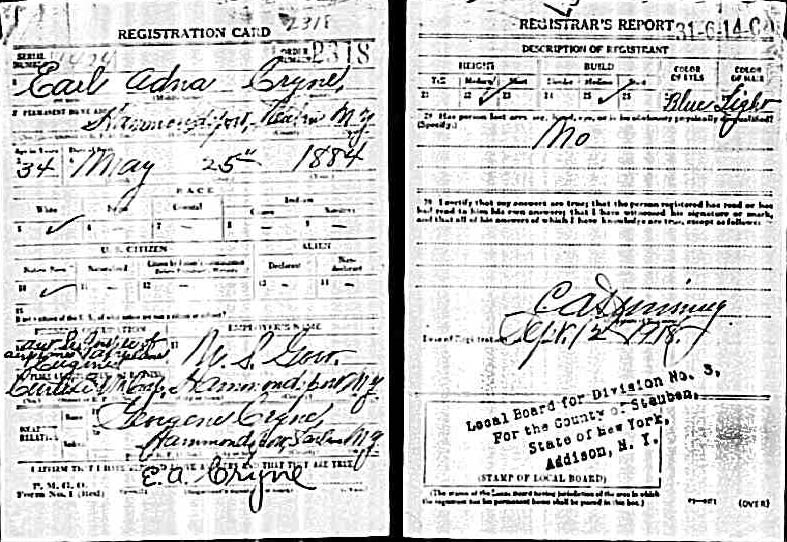
Earl A. Cryne — World War I Draft Registration Card, September 1918
Airplane Scatters Roses on Grave of War Hero
Camden Courier-Post —
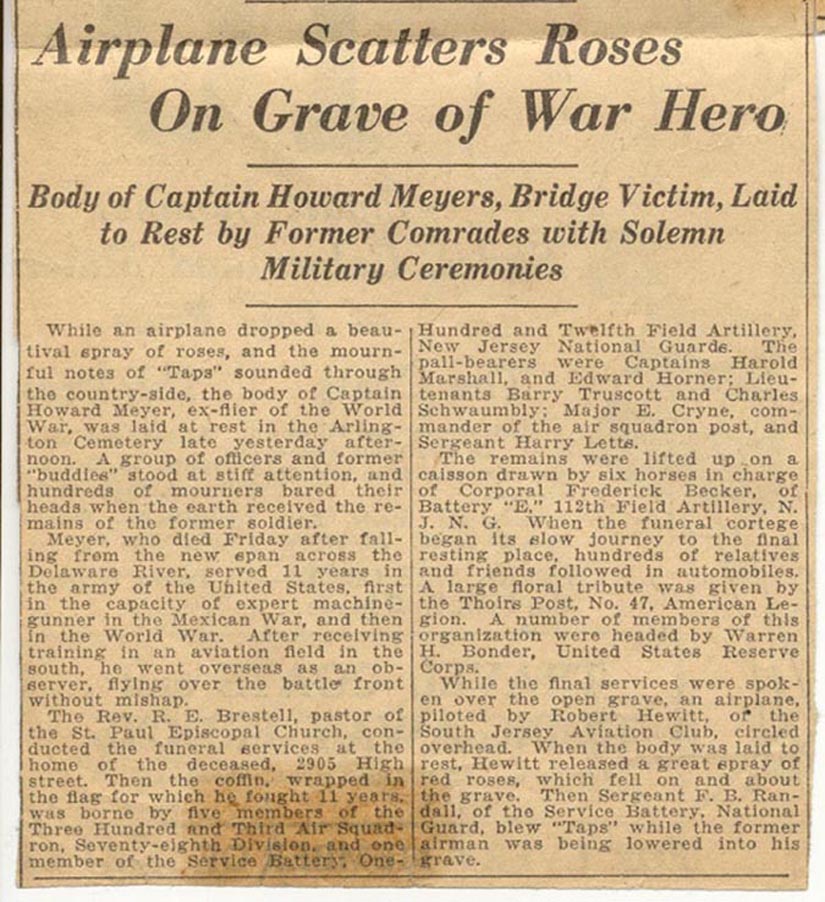
While an airplane dropped a beautiful spray of roses, and the mournful notes of “Taps” sounded through the country-side, the body of Captain Howard Meyer, ex-flier of the World War, was laid at rest in the Arlington Cemetery late yesterday afternoon. A group of officers and former “buddies” stood at stiff attention, and hundreds of mourners bared their heads when the earth received the remains of the former soldier.
Meyer, who died Friday after falling from the new span across the Delaware River, served 11 years in the army of the United States, first in the capacity of expert machinegunner in the Mexican War, and then in the World War. After receiving training in an aviation field in the south, he went overseas as an observer, flying over the battle front without mishap.
The Rev. R. E. Brestell, pastor of the St. Paul Episcopal Church, conducted the funeral services at the home of the deceased, 2905 High street. Then the coffin, wrapped in the flag for which he fought 11 years, was borne by five members of the Three Hundred and Third Air Squadron, Seventy-eighth Division, and one member of the Service Battery, One-Hundred and Twelfth Field Artillery, New Jersey National Guards. The pall-bearers were Captains Harold Marshall, and Edward Horner; Lieutenants Barry Truscott and Charles Schwaumbly; Major E. Cryne, commander of the air squadron post, and Sergeant Harry Letts.
The remains were lifted up on a caisson drawn by six horses in charge of Corporal Frederick Becker, of Battery “E,” 112th Field Artillery, N. J. N. G. When the funeral cortege began its slow journey to the final resting place, hundreds of relatives and friends followed in automobiles. A large floral tribute was given by the Thoirs Post, No. 47, American Legion. A number of members of this organization were headed by Warren H. Bonder, United States Reserve Corps.
While the final services were spoken over the open grave, an airplane, piloted by Robert Hewitt, of the South Jersey Aviation Club, circled overhead. When the body was laid to rest, Hewitt released a great spray of red roses, which fell on and about the grave. Then Sergeant F. B. Randall, of the Service Battery, National Guard, blew “Taps” while the former airman was being lowered into his grave.
South Jersey Aviation Club — Navy Night
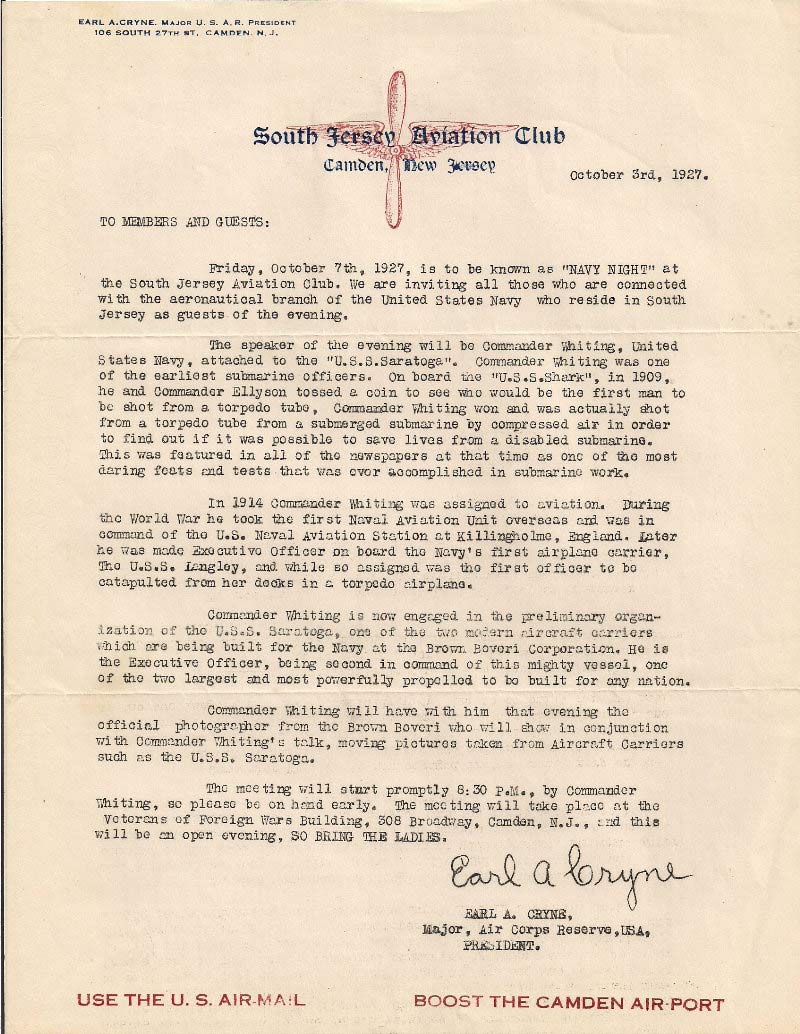
EARL A. CRYNE, MAJOR U.S.A.R. PRESIDENT — 106 SOUTH 27TH ST., CAMDEN, N.J.
South Jersey Aviation Club
Camden, New Jersey
October 3rd, 1927.
TO MEMBERS AND GUESTS:
Friday, October 7th, 1927, is to be known as “NAVY NIGHT” at the South Jersey Aviation Club. We are inviting all those who are connected with the aeronautical branch of the United States Navy who reside in South Jersey as guests of the evening.
The speaker of the evening will be Commander Whiting, United States Navy, attached to the “U.S.S. Saratoga.” Commander Whiting was one of the earliest submarine officers. On board the “U.S.S. Shark,” in 1909, he and Commander Ellyson tossed a coin to see who would be the first man to be shot from a torpedo tube. Commander Whiting won and was actually shot from a torpedo tube from a submerged submarine by compressed air in order to find out if it was possible to save lives from a disabled submarine. This was featured in all of the newspapers at that time as one of the most daring feats and tests that was ever accomplished in submarine work.
In 1914 Commander Whiting was assigned to aviation. During the World War he took the first Naval Aviation Unit overseas and was in command of the U.S. Naval Aviation Station at Killingholme, England. Later he was made Executive Officer on board the Navy’s first airplane carrier, The U.S.S. Langley, and while so assigned was the first officer to be catapulted from her decks in a torpedo airplane.
Commander Whiting is now engaged in the preliminary organization of the U.S.S. Saratoga, one of the two modern aircraft carriers which are being built for the Navy at the Brown Boveri Corporation. He is the Executive Officer, being second in command of this mighty vessel, one of the two largest and most powerfully propelled to be built for any nation.
Commander Whiting will have with him that evening the official photographer from the Brown Boveri who will show in conjunction with Commander Whiting’s talk, moving pictures taken from Aircraft Carriers such as the U.S.S. Saratoga.
The meeting will start promptly 8:30 P.M., by Commander Whiting, so please be on hand early. The meeting will take place at the Veterans of Foreign Wars Building, 308 Broadway, Camden, N.J., and this will be an open evening, SO BRING THE LADIES.
EARL A. CRYNE,
Major, Air Corps Reserve, USA,
PRESIDENT.
Army Orders
Anniston, Alabama Star —
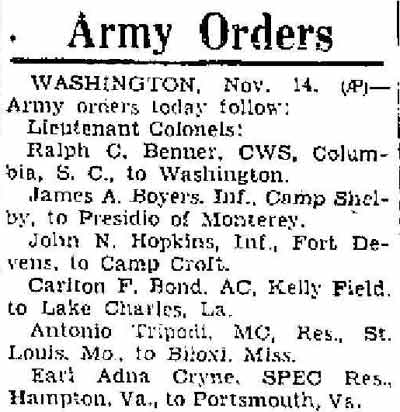
WASHINGTON, Nov. 14. (AP) — Army orders today follow:
Lieutenant Colonels:
… Earl Adna Cryne, SPEC Res., Hampton, Va., to Portsmouth, Va. …
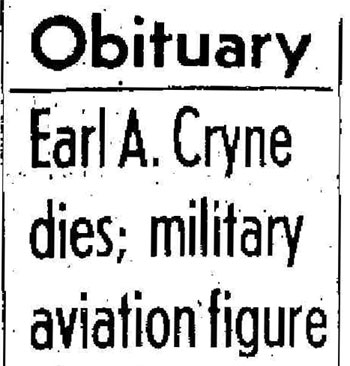
Obituary
Oxnard Press —
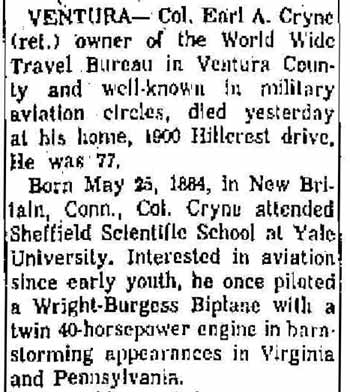
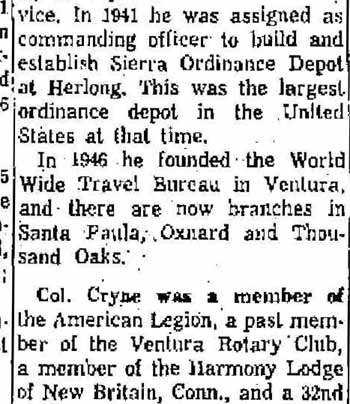
VENTURA — Col. Earl A. Cryne (ret.) owner of the World Wide Travel Bureau in Ventura County and well-known in military aviation circles, died yesterday at his home, 1900 Hillcrest drive. He was 77.
Born May 25, 1884, in New Britain, Conn., Col. Cryne attended Sheffield Scientific School at Yale University. Interested in aviation since early youth, he once piloted a Wright-Burgess Biplane with a twin 40-horsepower engine in barnstorming appearances in Virginia and Pennsylvania.
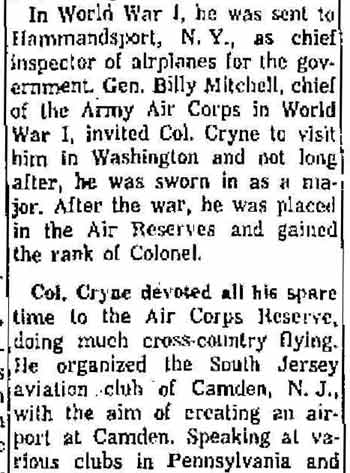
In World War I, he was sent to Hammondsport, N.Y., as chief inspector of airplanes for the government. Gen. Billy Mitchell, chief of the Army Air Corps in World War I, invited Col. Cryne to visit him in Washington and not long after, he was sworn in as a major. After the war, he was placed in the Air Reserves and gained the rank of Colonel.
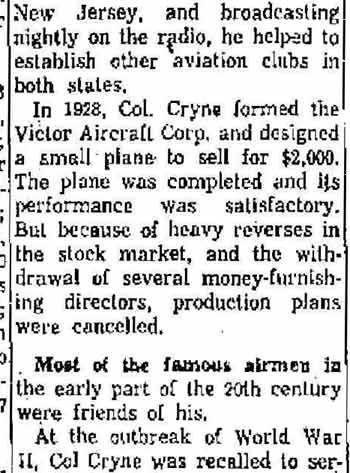
Col. Cryne devoted all his spare time to the Air Corps Reserve, doing much cross-country flying. He organized the South Jersey aviation club of Camden, N.J., with the aim of creating an airport at Camden. Speaking at various clubs in Pennsylvania and New Jersey, and broadcasting nightly on the radio, he helped to establish other aviation clubs in both states.
In 1928, Col. Cryne formed the Victor Aircraft Corp. and designed a small plane to sell for $2,000. The plane was completed and its performance was satisfactory. But because of heavy reverses in the stock market, and the withdrawal of several money-furnishing directors, production plans were cancelled.
Most of the famous airmen in the early part of the 20th century were friends of his.
At the outbreak of World War II, Col. Cryne was recalled to service. In 1941 he was assigned as commanding officer to build and establish Sierra Ordnance Depot at Herlong. This was the largest ordnance depot in the United States at that time.
In 1946 he founded the World Wide Travel Bureau in Ventura, and there are now branches in Santa Paula, Oxnard and Thousand Oaks.
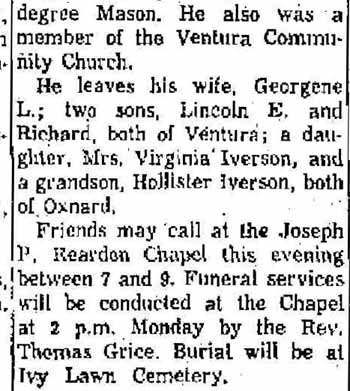
Col. Cryne was a member of the American Legion, a past member of the Ventura Rotary Club, a member of the Harmony Lodge of New Britain, Conn., and a 32nd degree Mason. He also was a member of the Ventura Community Church.
He leaves his wife, Georgene L.; two sons, Lincoln E. and Richard, both of Ventura; a daughter, Mrs. Virginia Iverson, and a grandson, Hollister Iverson, both of Oxnard.
Friends may call at the Joseph P. Reardon Chapel this evening between 7 and 9. Funeral services will be conducted at the Chapel at 2 p.m. Monday by the Rev. Thomas Grice. Burial will be at Ivy Lawn Cemetery.