Introduction
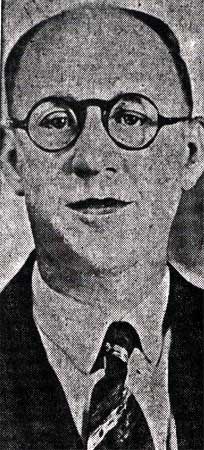
Frank J. Hartmann Jr., Camden Courier-Post, August 1, 1936.
Frank J. Hartmann Jr. was born in Camden, New Jersey, on November 3, 1898, to Frank J. Hartmann Sr. and his wife Anna. His father had emigrated to Camden from Germany around 1865. The Hartmann family lived in Cramer Hill on Cleveland Avenue near Griffee Avenue before the turn of the century. By 1920 Frank Hartmann Sr. had purchased a home at 740 State Street in North Camden and had established a successful cigar business for many years.
Trained as an electrician, Frank J. Hartmann Jr., like his father before him, took an active role in the affairs of the city. He was elected to the City Commission in the May 1935 election; his win, however, was not certified until after a recount, where he won by seven votes. He took his place on the Commission on August 1, 1935, and was appointed Director of Public Works.
Initially aligned with Mayor George Brunner and his New Deal Democrat organization, Frank J. Hartmann Jr. soon split with Brunner, and lost his bid for reelection to the City Commission in 1939. Frank Hartmann Jr.’s term in office was noted by his efforts to control expenditures and reduce spending at the Department of Public Works. This made him few friends in local political circles, as he let many politically connected workers go, and alienated certain powerful business interests. He was a staunch advocate of Camden building its own municipal electrical plant. Although Camden voters voted twice for this improvement, it did not come to pass. He supervised the beautification of Roosevelt Plaza in front of City Hall, and hired Daniel G. Deacon to tend to the extensive flower beds set up with help from the Works Progress Administration.
Frank J. Hartmann Jr. returned to private business after leaving the City Commission. His son, Frank J. Hartmann III, was killed in action while serving with the Army in France on July 18, 1944. Frank J. Hartmann Jr. moved from Camden to Haddon Heights in the 1950s. He spent his later years in Cape May, New Jersey, where he died in June of 1987.
Frank Hartmann Jr. was a member of Mozart Lodge No. 121, Free and Accepted Masons. He was elected to a one-year term as the lodge’s Master in 1933.
Aitken Re-Elected by Pyne Poynt A. A.
Camden Courier-Post —
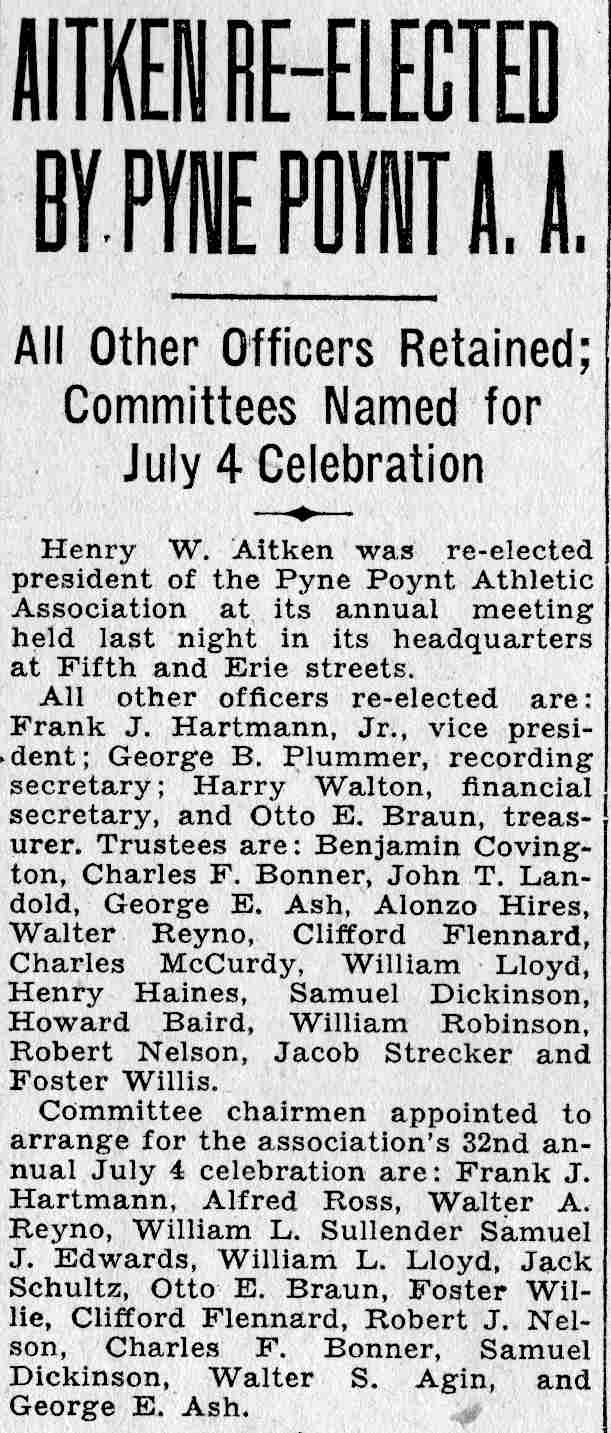
Henry W. Aitken — Pyne Poynt Athletic Association — Frank J. Hartmann Jr.
George B. Plummer — Harry Walton — Otto E. Braun
Benjamin Covington — Charles F. Bonner — John T. Landold
George E. Ash — Alonzo Hires — Walter Reyno — Clifford Flennard
Charles McCurdy — William L. Lloyd — Henry Haines — Samuel Dickinson
Howard Baird — William Robinson — Robert Nelson — Jacob Strecker
Foster Willis — Alfred Ross — William Sullender — Samuel J. Edwards
Jack Schiltz — Walter S. Agin
Camden Courier-Post, June 9, 1932. From the article “Aitken Re-Elected by Pyne Poynt A.A.”
Pyne Poynt Group Plans Dual Fete
Camden Courier-Post —
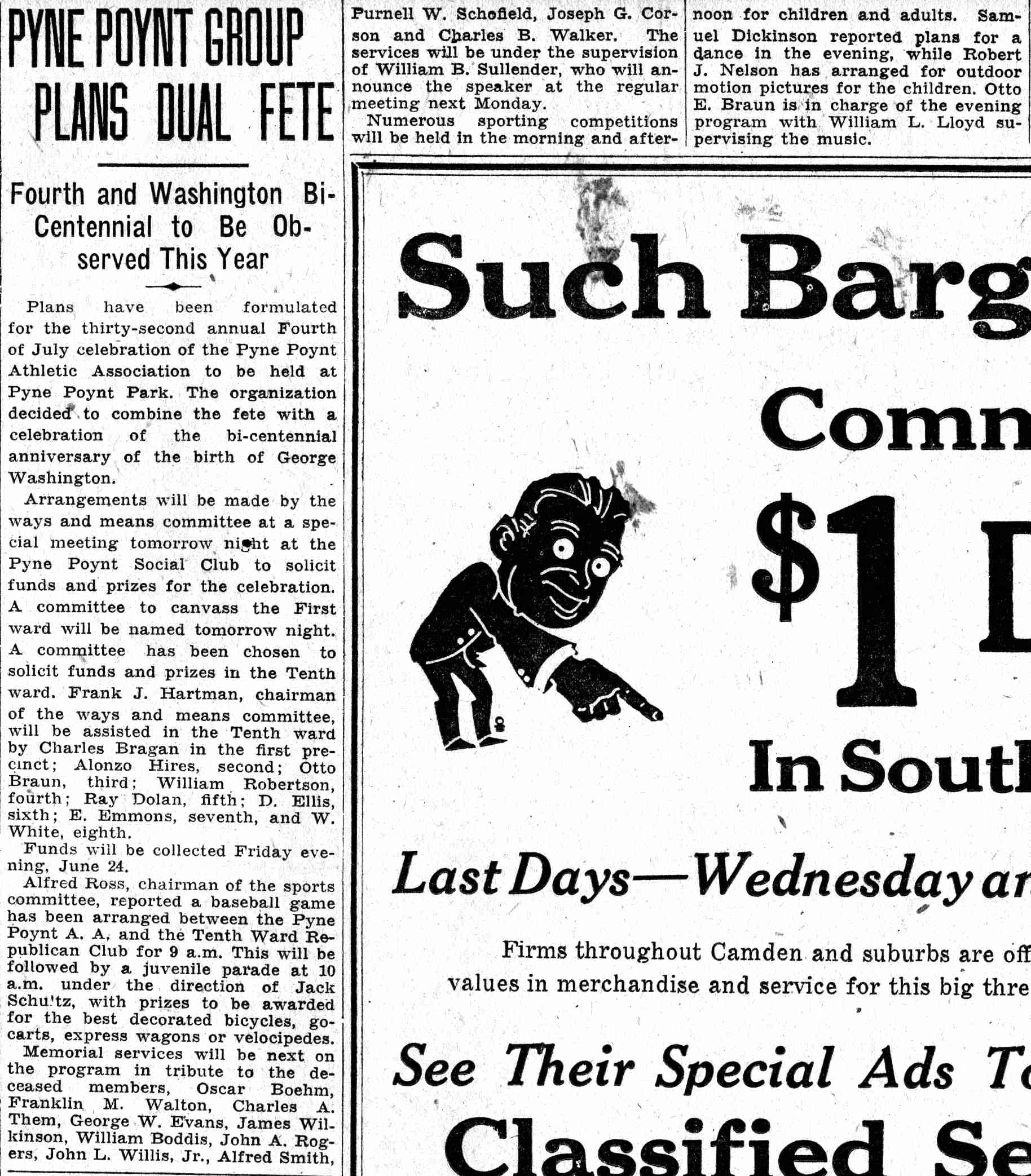
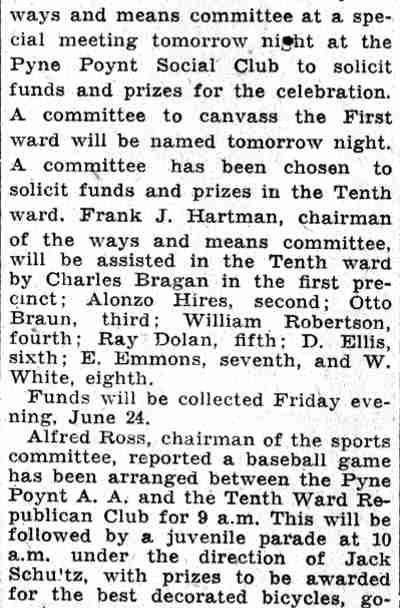
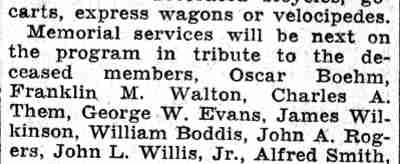
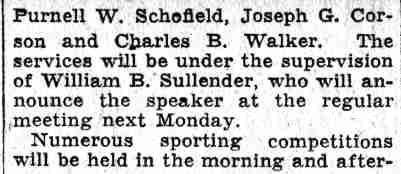
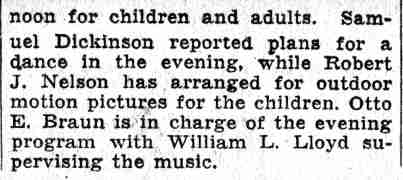
Plans have been formulated for the thirty-second annual Fourth of July celebration of the Pyne Poynt Athletic Association to be held in Pyne Poynt Park. The organization decided to combine the fete with the celebration of the bi-centennial anniversary of the birth of George Washington.
Arrangements will be made by the ways and means committee at a special meeting tomorrow night at the Pyne Poynt Social Club to solicit funds and prizes for the celebration. A committee to canvass the First ward will be named tomorrow night. A committee has been chosen to solicit funds and prizes in the Tenth ward, Frank J. Hartmann, chairman of the ways and means committee, will be assisted in the Tenth ward by Charles Bragan in the first precinct; also Hires, second; Otto Braun, third; William Robertson, fourth; Ray Dolan, fifth; D. Ellis, sixth; E. Emmons, seventh, and W. White, eighth.
Funds will be collected Friday evening at a meeting of the association, together with the ways and means committee.
Purnell W. Schofield, Joseph G. Corson and Chas B. Walker will be in charge of the supervisory work under the supervision of William L. Lloyd. He will announce the speaker at the regular meeting next Monday.
Numerous sporting competitions will be held in the morning and afternoon for children and adults. Samuel Dickinson reported plans for a dance in the evening, while Robert J. Nelson arranged for outdoor motion pictures for the children. Otto E. Braun is in charge of the evening program with William L. Lloyd supervising the music.
City Adopts Cut Budget After Clash
Camden Courier-Post —
Slash of $702,890 Is Revealed in Totals Passed at Session of Rulers
Lease Announced of Radio Station
Commissioners Debate With Von Nieda as He Charges Gross Extravagance
By WALT BATEZEL
The Camden City Commission yesterday approved the 1933 city budget after hearing and rejecting economy recommendations of several civic and labor organizations.
Eight speakers representing five organizations urged budget reductions and protested the total of $3,353,124.60. Verbal clashes over opinions were frequent between Commissioner Harold W. Bennett, director of finance and revenue, and former Councilman Frederick von Nieda and Thomas B. Hall, representatives of the Congress of Civic Associations of New Jersey.
Nearly 300 persons attended the hearing, in marked contrast to the 5000 who marched on city hall last year to demand budget reductions. The hearing lasted three hours. The departmental budget appropriations of $3,353,124.60 with the local school appropriation of $1,250,000 and other appropriations, totaling $960,060.55 to be added in the tax ordinance yet to be adopted, will give the city a total expense of $5,563,185.15 for 1933.
Tax Bill About Same
The tax rate will not be known until the tax ordinance is adopted. After the hearing Commissioner Bennett declared that due to equalization of assessments, the bills of some taxpayers will be a few dollars higher than last year, and a few dollars lower in other cases. The commission, after approving the budget on a motion by Commissioner Bennett, adopted a resolution leasing WCAM to the Broadcast Advertising Company for $1000 per year and a percentage of all receipts over $24,000. All maintenance costs will be born by the company, of which Rudolph Preisendanz, Jr., is head.
After the budget was adopted Bennett declared the City Commission would take into consideration an allegation of Frank J. Hartmann, Jr., secretary of the Civic Congress, that the $125,400 appropriation for street lighting was $26,450 higher than it should be according to figures obtained by him concerning the city’s lighting equipment. “If there has been an error the budget can be amended at any time,” Commissioner Bennett said.
Commissioner Clay W. Reesman, under whose department street lighting comes, declared that figures in his office concerning street lighting were different from those quoted by Hartmann. The figures he used, Hartmann said, were obtained by him from City Comptroller Sidney P. McCord.
Von Nieda Case
Von Nieda was the first citizen to address the commission. Shifting papers in his hands, he faced the commissioners and said: “We have here $40,000 for your Recorder’s Court in 1932, and $25,000 for 1933.”
Commissioner Bennett jumped to his feet.
“Those 1932 figures,” Bennett said, “were merely an estimate of the receipts to be taken in, but that amount did not come in. This year we anticipate only $25,000, which we consider a fair estimate.”
“That’s fine” said von Nieda, “but we have never had a chance to sit in with you on these figures.”
“You can sit in with us at any time,” responded Bennett, “We’re glad to have you.”
“I see here,” said von Nieda, “that the transportation inspector is paid from fees, but you show no fees and the inspector should be paid by the Public Service. I also suggest that you turn Convention Hall over to the poor. Now in dealing with Station WCAM, I see you show a profit for the last three months of $1000, while in 1932, you show no records of receipts, and we are just wondering.’
Worried by WCAM
“Do you want that answered now?” asked Bennett. “WCAM has given myself and the other commissioners some concern during the past year. It is our duty to see that we receive as much income as possible. Different methods have been used in the radio station to make it pay during the past three months, and during this time that station has been in the black. We figure that in 1933 there will be no deficit in this station, and we look for a profit of more than $1000.”
“Now in this matter of eliminating deputy directors,” von Nieda said.
He was interrupted by Commissioner Reesman.
“I’ll tell you,” said Reesman, “about my deputy director Carlton Harris. My deputy receives $1750 a year. He has charge of all labor in the Department of Parks and Public Property. He is on the job every morning at 7:00 AM, and often works until 10 p. m., with the labor outside.”
“In speaking of the assessors,” von Nieda continued, “we should have assessors who are not influenced by politicians or political dictators.”
“You know I won’t stand for that,” answered Bennett. “The readjustment of ratables is only a small part of the work we are doing. Each property is assessed on a basic principal. Any time you have a suggestion that will help us in our work we will be glad to hear from you but I firmly believe that real estate must be relieved of its heavy tax burden by an income and sales tax, and this tax must come sooner or later.”
Seeking Relief
“As far as the city commissioners are concerned, we are studying it from day to day, in efforts to get out of the wilderness.
“In speaking of the purchasing department,” von Nieda continued, “we know what happened there last year. You fired your purchasing agent, and if you had not fired him it probably would have afforded the public some interesting reading about this purchasing department.
“All of my men are working overtime,” replied Bennett. “It is true the purchasing agent is out and his work is being done by an assistant (William Dilmore) at half his salary. We have got rid of as many people in these departments as we can. I had to let one girl go in the purchasing department and one girl in Controller McCord’s department. One man went on pension in the tax office and two were let out in efforts to balance the budget.
“In one of my departments where there were three girls I had to make a $900 cut by leaving one girl out. I called the three girls into my office and told them that one had to go and asked them what their home responsibilities were. One had to take care of her family, including a 77-year-old aunt; another a family with a 66-year-old aunt, and the third was supporting three or four brothers with the help of another brother, who is a barber working for practically what tips he could get.
“But I had to make a $900 cut. The girls asked me not to dismiss any of them, as they each would take a $300 cut in addition to cuts already applied. Another man took an extra $260 cut so that he would not be out of work. But I had the budget to take care of, and I am ready to challenge any city the size of Camden to show so nearly a balanced budget. Our plan is to pay as we go.”
“You cite two or three instances,” protested von Nieda. “But I want to show you scores of families which have no money and they are taxpayers. You say you have cut to the bone, but you should cut through the bone. This is no grandstand play by us. Maybe we can give you some help. Then, too, the debt interest must be paid on this tragedy,” he shouted, pointing to walls of the commission chamber.
“Maybe you can tell me how to get rid of the bonds,” suggested Bennett. “You must remember this year we have cut $900,000 from the budget.”
Offers Recommendation
Von Nieda said the Civic Congress recommended that work now being done by two city solicitors should be done by one, that when more policemen and firemen are needed “little fellows” be restored first wherever possible; that the city incinerating plant be closed; that the personnel of the city’s two sewage disposal plants be reduced; that the city’s lighting bill be cut $40,000; that inspectors of lighting be abolished and their work done by policemen and the city’s engineer’s department. Personally he favored an income tax, he said, to relieve the burden on real estate.
“I realize,” von Nieda said, “that the city commission has done a fair job, but of the congress, with conservatively 15,000 members, think you can do even better.
Commissioner Frank B. Hanna, director of public works, interrupted von Nieda on the subject of the incinerating plant, which von Nieda declared could be abandoned because it did not burn garbage, but only rubbish.
“Can you see me at 9:00 AM tomorrow and go through my department with me?” asked Hanna.
“Any time,” replied von Nieda.
Warns of Tax Strike
“However,” von Nieda continued, “we are wondering what the figures in the right hand corner of the tax bill will be. Assessments may be lower and the tax rate higher, and that does not give a true picture. I fear the bills will be more for 1933 and for one am willing now to take the 1932 assessment on my home.
“The congress vigorously opposes this personality tax. You expect to tax the homeowner for everything he has. I warn you gentlemen that if this tax is imposed in Camden there will be a run on banks and building and loan associations. If that happens homeowners and renters will leave this unfortunate city. There will be a tax strike here, and so help me God, I’m helping it!”
Von Nieda was followed by William Hughes of 578 Mickle Street, who spoke for the Unemployed Council of New Jersey.
Hughes reiterated demands of the union for increased relief payments to unemployed, urged a municipally-owned lighting plant, operated at a profit, the same as the city’s water department; a municipal lodging house; use of hand labor instead of machinery in all city contracts and the employment of labor to “tear down the slums in Camden.”
Hartmann was the next speaker. He read from a prepared statement which he declared was an analysis of the city’s 1932 lighting expenses, and which, he said, could be lowered “had we used larger lamps.”
Reesman Contradicts
After enumerating the individual costs of lamps of various candle power, and contending a change in the lamps would effect a saving this year, Hartmann charged the city has overpaid for electric energy in street lighting.
Commissioner Reesman declared that figures used by Hartmann were in error and that therefore, his computations as to possible savings were wrong. He announced, however, he would study the situation to discover if there was any error in the budget concerning street lighting, as alleged by Hartmann.
“The Civic Congress is now circulating petitions for a referendum on a municipal lighting plant,” Hartmann said. “We now have 10,000 of the required 11,000 signatures, and we do not intend to stop until we have 25,000. You commissioners can stop these petitions by adopting a resolution declaring a referendum on the question.”
He then asked that the work of the city electrical inspector be taken over by the National Board of Fire Underwriters, and that “when the next tax sale is held, all properties be advertised, including banks, garages and to whomever the property belongs.”
Commissioner Bennett then arose and said: “I’ve used discretion on that. There are some who are paying as low as $5 per month, and I think these people should be helped. We commissioners do not want to sell the home of anyone. That is what we are trying to stop. We are in perfect agreement on that.”
Debt Moratorium Asked
“How about the Bridge Garage?” someone in the audience shouted.
“The Bridge Garage has just paid $1500,” Bennett said, “and promises to pay something every month. We are trying to make the tax bills lower by getting in all the monies we can, and where possible to take in delinquent payments no matter how small.”
Clarence Moullette, secretary of the Unemployed Union of New Jersey, then arose. He asked for a moratorium on the city debt service for five years, and urged the commission to adopt such a resolution memorializing the Legislature for that relief. He announced opposition to the personality tax.
“We are not questioning the actions of the commissioners,” Moullette said. “Spending less money will not help the situation. Commissioner Hanna told me if he had $51,000 additional in his department six closed garbage trucks could be purchased. This will help give work. By cutting down salaries you decrease purchasing power. Work must be had. Eventually you will pay in scrip. Why not pay in scrip now and give out work.”
Hall asked that Convention Hall be abandoned and the building used for hospitalization work for the needy, and urged the city commission to “meet in the evenings so that citizens will know and see what is going on.” He asked for abolition of the positions of plumbing, building, sewer and heating inspectors.
‘Close High Schools’
“The commission should face conditions as they are,” he said. “I speak for myself, and not the Civic Congress. I ask that the high schools be closed. I heartily approve closing of the Vocational School, but if choice was to be made between high schools and the Vocational School, I would say close the high schools. Before selling the home of anyone to meet impossible taxes, I say cut to the bone by getting rid of everything that is not absolutely necessary.
“You commissioners must be made to realize that increased taxation is what has destroyed purchasing power in America. Meet this condition!”
Commissioner Bennett challenged the statement of Hall that government costs were responsible for conditions of today.
“There are numerous causes,” Bennett said.
“I would rejoice in debating it with you or anyone you select,” Hall replied, “including United States senators, and convince them in 20 minutes.”
“I’ll debate that with him,” shouted Morris Stempa of Audubon from the audience. Stempa later addressed the commission, speaking for the Socialist party, and urged the moratorium advocated by Moullette, also a Socialist.
Eugene Wasilewski, speaking for the South Camden Civic Association, denounced the commission for failing to call in civic association representatives in their preparation of the Budget.
Bennett Gives Reply
“You called in the bankers, but not those others of us who also are interested in city costs,” Wasilewski said. “You tell us now there is a reduction in assessments and then come along and wallop us with a higher tax rate. That is not fair. You were elected to look after our interests and that you have failed to do. You are making us eat red herring, and we want you to eat red herring with us.”
The last citizen to address the commission was Salvadore Guadelli, president of the Citizens-Taxpayers’ League. He made a general indictment of conditions, and asked that the city commission “do not let sectionalism creep into city affairs.”
Commissioner Bennett then arose and addressed his fellow commissioners and the audience.
“All these things suggested here today have been considered,” he said. “We five men came into office with the idea of serving the people. I know the business of financing the city is a serious problem. We have endeavored to move the budget into that realm of ‘pay-as-you-go.’ We appreciate everything presented here. Every taxpayer we look upon as an employer.
“Looking at it from every angle, this budget cannot be delayed any longer. You’ll find we were severe in preparing this budget; you’ll find we were severe last year. Last year we cut a half million. This year we cut $702,890.74, and to that the board of education, we hope, will add a cut of $250,000. That is a total cut of $952,890.74. Other cities in New Jersey show nothing to compare with it.
Budget Adopted
“I hesitate in making more cuts. I speak from experience when I say I’m a taxpayer. In the past two weeks I’ve been trying to raise money to pay taxes. I want all of you to know we commissioners can sympathize. It is not easy being at the head of a government in times like these. I hope that municipalities will receive federal relief in payment of debt service. There has been a tremendous cut in our budget, including the board of education figures. I feel the commissioners are to be commended for the work they’ve done this year.
“If we pass the budget we won’t stop at that particular point, but will see what else we can do all along the line. I feel the essential thing is to pass the budget. I’m proud of the fact we came through 1932, and are started in 1933 the same way, although I make no promise for the future. I wish for a moratorium for interest on bonds. There are the bondholders on one side and the taxpayers on the other, and the man out of work to be considered.”
Pyne Poynt Plans All-Day 4th Party
Camden Courier-Post —
Plans for the thirty-third anniversary of the Pyne Poynt Athletic Association to be observed with an all-day program at Pyne Poynt Park July 4 were discussed last night at a meeting in the Pyne Poynt Social Club, 929 North Fifth Street.
Among the features tentatively planned are a children’s parade at 9:30 a. m., under the supervision of Isaac Kyler; memorial service at 11 a. m., under direction of William B. Sullender; sporting events for men, women and children to start at 1:30 p. m., under direction of Alfred J. Ross, Jr.; outdoor motion pictures starting at 9 p. m., under supervision of Robert J. Nelson and a dance in charge of Samuel G. Dickinson, Jr., starting at 10:30 p. m.
Committee chairmen chosen by Frank J. Hartmann, Jr., president, are: Grounds, Foster Willis; program, Otto E. Braun; police, Clifford Flennard; dancing, Samuel G. Dickinson, Jr.; first aid, Dr. Joseph E. Nowrey and William Hughes; transportation, Samuel J. Edwards; public speakers, William B. Sullender; motion pictures, Robert J. Nelson; decorations, Walter A. Reyno; sports, Alfred J. Ross, Jr.; ways and means, Frank J. Hartmann, Jr.; publicity, Walter S. Agin; parade marshal, Isaac Kyler; refreshments, George Washington Ash; light, William Hilton, and music, Frank Kelley.
Children of the Sheltering Arms Home, Home for Friendless Children and the Detention Home will be guests of the association during the day. Samuel J. Edwards will be in charge of their entertainment.
The association will meet again next Thursday night.
Suit to End Relief Secrecy Planned by Civic Congress
Camden Courier-Post —
North Camden Association Told Affidavits Are Being Taken; Cramer and Howard Accused of Evasion; Protest Rally Called
Court action to force the Camden County Emergency Relief Administration to reveal its books for public inspection is planned by the Congress of Civic Associations of South Jersey.
This was announced last night at a meeting of the North Camden Civic Association in the headquarters of the Pyne Poynt Social Club, 939 North Fifth Street. Frank J. Hartmann, Jr., secretary of both organizations, presided. Affidavits charging irregularities in the relief administration are being gathered, Hartmann asserted.
Wayland P. Cramer, director of the county relief board and Captain Albert S. Howard, deputy director, were charged with evading public inquiries.
‘Fathers Fired—Girls Hired’
“They’ve given us a grand run-a-round,” Hartmann said in relating his efforts in behalf of a destitute family.
The Congress of Civic Associations, headed by Fred von Nieda, is determined to force inspection of the relief records by applying for a court writ, Hartmann said.
Vince Marinelli, member of the North Camden association and active in the Civic Congress, declared a number of married men were discharged from positions in the relief administration and single women engaged for their posts.
Protest Rally June 11
The association agreed to join with the Unemployed Union of New Jersey in staging a public mass meeting to protest against the relief board. The meeting is scheduled for June 11, at the Convention Hall.
Clarence E. Moullette, executive secretary of the unemployed group, addressed last night’s session, which two score persons attended.
‘Only 8 In 25,600 Rejected’
Hartmann declared that of Camden’s 117,000 persons, 25,600 are receiving emergency relief. Quoting Dr. Arthur L. Stone, who recently resigned as city director of emergency relief, Hartmann asserted 6828 of the 11,400 city’s colored are in the relief line.
“In all these cases the great Emergency Relief Administration has found only eight this year that were not worthy of receiving aid,” Hartmann said he was informed.
“The taxpayers are paying the bills and they have every right to know how the money is being spent.”
“If Director Cramer and Captain Howard can be out of their office all day without anyone knowing where they are I think there is ground for investigation,” he insisted.
Cites Backyard Fires
Hartmann reviewed the plight of 11 families on State Street who were forced to cook meals over a backyard fire last Saturday after gas and electric service had been suspended for non-payment of bills. Thirty-five children were affected.
Hartmann estimated that Public Service could produce electricity to supply the apartment house for one month at a cost of $2. The charge is $22, he said.
Hartmann described advantages of a municipal electric plant, for which more than 11,000 persons have signed petitions circulated by the association and civic congress. He compared this city’s tax rate and assessments with those of Jacksonville, Fla., and said the southern city earned $2,000,000 profit from its municipal light and power plant in 1932.
Moullette, in appealing for support of the civic association for the mass meeting next week, said that the resignation of Dr. Stone was a political move, designed to create a position with pay for some Republican organization favorite.
“Dr. Stone spent $25,000 for emergency relief in Camden. As a result of the efforts of Dr. Stone in his office as municipal relief director there are children in more than 500 families who obtained milk that was not given them before he took the position,” Moullette said. “The purpose of the mass meeting is to bring forcibly to the attention of the authorities here and in the state that there is need for an investigation of the Camden County Emergency Relief Administration.”
North Camden Group Hits Taxpayers’ Ass’n on ‘Failure’ at Trenton
Camden Courier-Post —
North Camden section and Pyne Poynt area, circa 1935.
Hartmann Takes Commission Seat Today
Camden Courier-Post —
3 G.O.P. Rulers in Secret Session
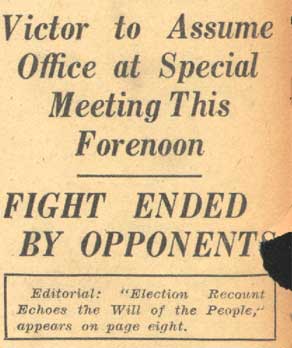
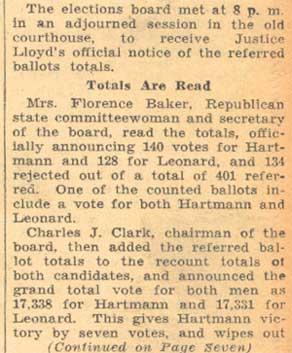
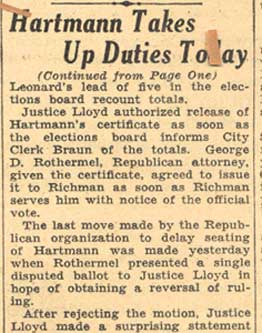
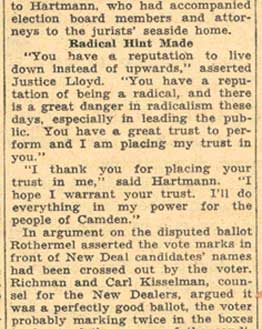
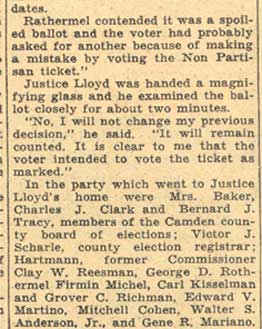
Hartmann Takes Commission Seat Today
Victor to Assume Office at Special Meeting This Forenoon
FIGHT ENDED BY OPPONENTS
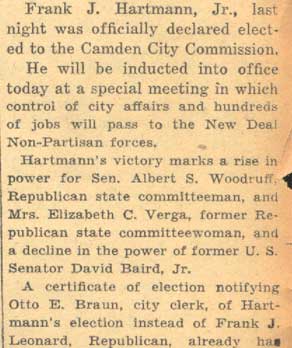
Frank J. Hartmann, Jr., last night was officially declared elected to the Camden City Commission. He will be inducted into office today at a special meeting in which control of city affairs and hundreds of jobs will pass to the New Deal Non-Partisan forces.
Hartmann’s victory marks a rise in power for Sen. Albert S. Woodruff, Republican state committeeman, and Mrs. Elizabeth C. Verga, former Republican state committeewoman, and a decline in the power of former U. S. Senator David Baird, Jr.
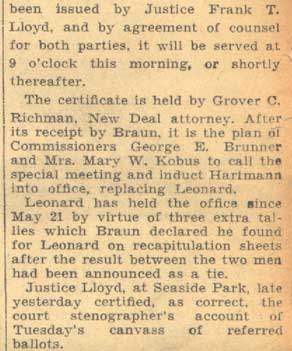
A certificate of election notifying Otto E. Braun, city clerk, of Hartmann’s election instead of Frank J. Leonard, Republican, already had been issued by Justice Frank T. Lloyd, and by agreement of counsel for both parties, it will be served at 9 o’clock this morning, or shortly thereafter.
Leonard has held the office since May 21 by virtue of three extra tallies which Braun declared he found for Leonard on recapitulation sheets after the result between the two men had been announced as a tie.
Mrs. Florence Baker, Republican state committeewoman and secretary of the board, read the totals, officially announcing 140 votes for Hartmann and 128 for Leonard, and 134 rejected out of a total of 401 referred. Charles J. Clark, chairman of the board, then added the referred ballot totals to the recount totals of both candidates, and announced the grand total vote for both men as 17,338 for Hartmann and 17,331 for Leonard. This gives Hartmann victory by seven votes.
Radical Hint Made
“You have a reputation to live down instead of upwards,” asserted Justice Lloyd. “You have a reputation of being a radical, and there is a great danger in radicalism these days, especially in leading the public. You have a great trust to perform and I am placing my trust in you.”
“I thank you for placing your trust in me,” said Hartmann. “I hope I can warrant your trust. I’ll do everything in my power for the people of Camden.”
Hartmann Being Congratulated by Family
Camden Courier-Post —
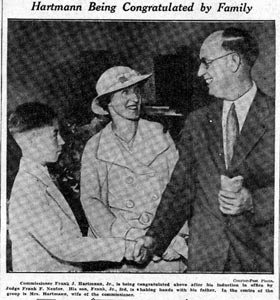
Commissioner Frank J. Hartmann, Jr., being congratulated after his induction in office by Judge Frank F. Neutze. His son, Frank, Jr., 3rd, is shaking hands with his father. In the centre of the group is Mrs. Hartmann, wife of the commissioner. Camden Courier-Post, August 2, 1935.
Camden Courier-Post — August 3, 1935
Hartmann to Seek Lowering of Rates for Street Lights
City Paying Too Much and Not Getting Full Delivery, Commissioner Says
ASKS TRENTON FOR DATA
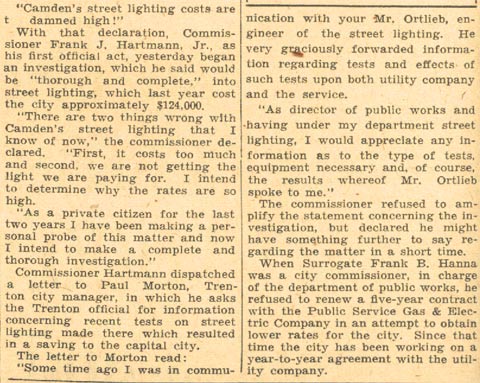
“Camden’s street lighting costs are too damned high!”
With that declaration, Commissioner Frank J. Hartmann, Jr., as his first official act, yesterday began an investigation, which he said would be “thorough and complete,” into street lighting, which last year cost the city approximately $124,000.
“There are two things wrong with Camden’s street lighting that I know of now,” the commissioner declared. “First, it costs too much and second, we are not getting the light we are paying for. I intend to determine why the rates are so high.”
Commissioner Hartmann dispatched a letter to Paul Morton, Trenton city manager, asking for information concerning certain tests on street lighting made there that resulted in a saving to the capital city.
When Surrogate Frank B. Hanna was a city commissioner, in charge of the department of public works, he refused to renew a five-year contract with the Public Service Gas & Electric Company in an attempt to obtain lower rates for the city. Since that time the city has been working on a year-to-year agreement with the utility company.
Orlando to Probe Charge G.O.P. Used City Pay for Poll
Camden Courier-Post —

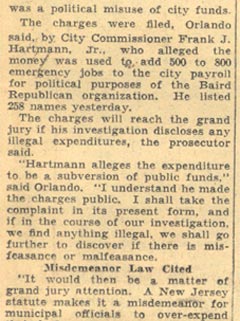
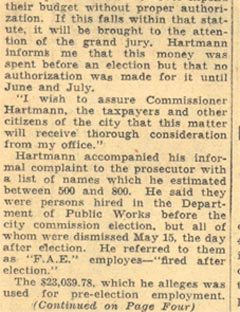
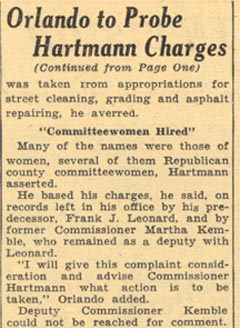
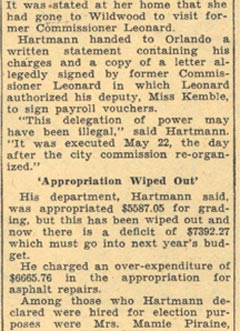
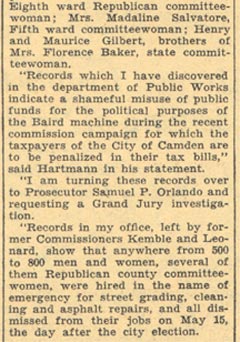
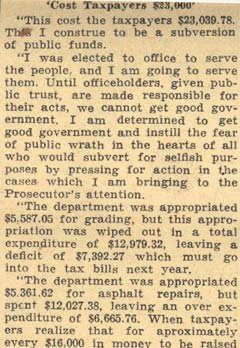
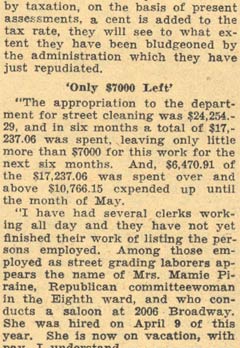
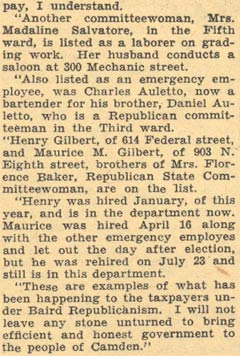
Orlando to Probe Charge G.O.P. Used City Pay for Poll
ORLANDO TO PROBE CHARGE G.O.P. USED CITY PAY FOR POLL
Hartmann Charge Denied by Sayers
Camden Courier-Post —
Hartmann Charge Denied by Sayers
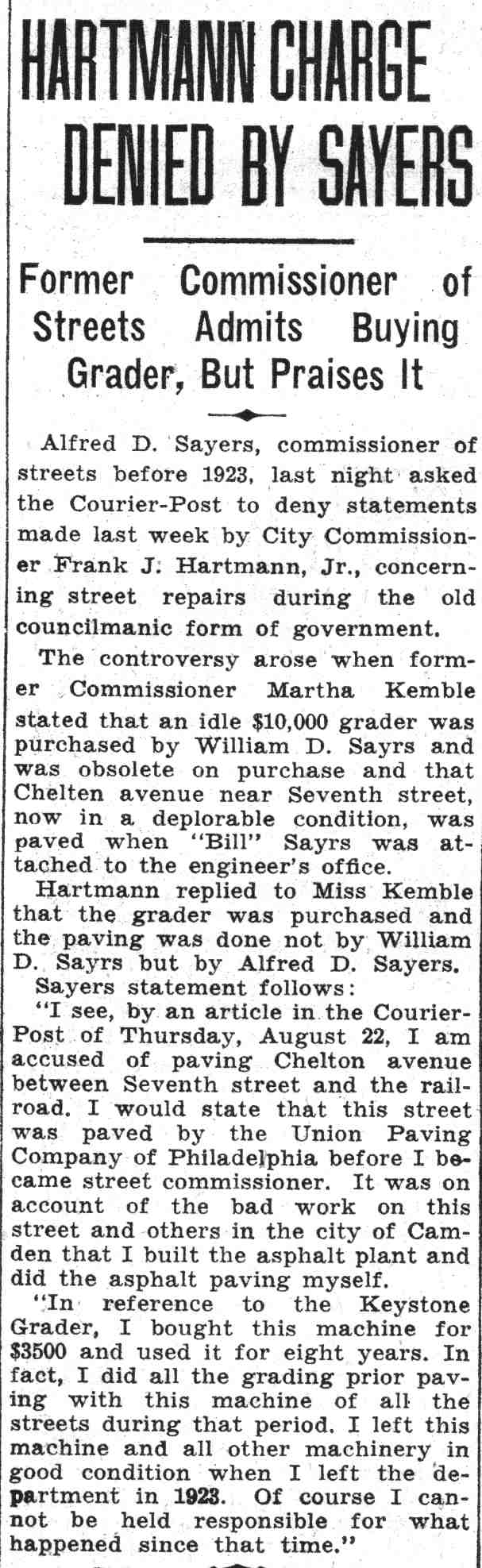
HARTMANN CHARGE DENIED BY SAYERS
Former Commissioner of Streets Admits Buying Grader, But Praises It
Alfred D. Sayers, commissioner of streets before 1923, last night asked the Courier-Post to deny statements made last week by City Commissioner Frank J. Hartmann, Jr., concerning street repairs during the old councilmanic form of government.
The controversy arose when former Commissioner Martha Kemble stated that an idle $10,000 grader was purchased by William D. Sayrs and was obsolete and on purchase and that Chelten avenue near Seventh street, now in a deplorable condition, was paved when "Bill" Sayrs was attached to the engineer's office.
Hartmann replied to Miss Kemble that the grader was purchased and the paving was done not by William D. Sayrs but by Alfred D. Sayers.
Sayers statement follows:
"I see, by an article in the Courier-Post of Thursday, August 22, I am accused of paving Chelten avenue between Seventh street and the railroad. I would state that this street was paved by the Union Paving Company of Philadelphia before I became street commissioner. It was on account of the bad work on this street and others in the city of Camden that I built the asphalt plant and did the asphalt paving myself.
"In reference to the Keystone Grader, I bought this machine for $3500 and used it for eight years. In fact, I did all the grading prior paving with this machine of all the streets during that period. I left this machine and all other machinery in good condition when I left the department in 1923. Of course I can not be held responsible for what happened since that time."
Camden Courier-Post — August 29, 1935
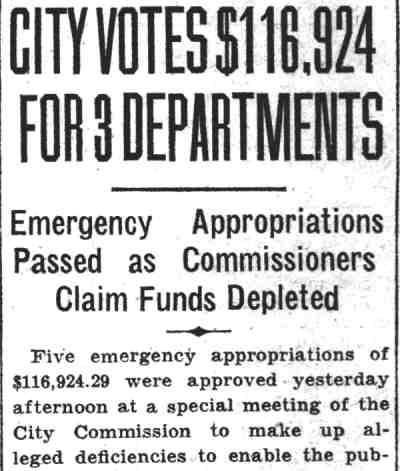
City Votes $116,924 For 3 Departments
Emergency Appropriations Passed as Commissioners Claim Funds Depleted
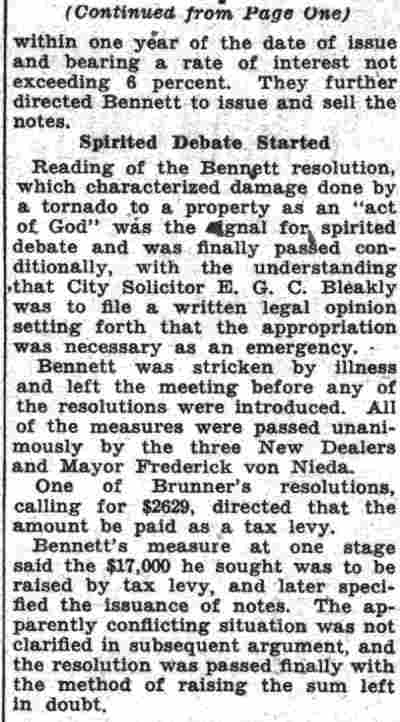
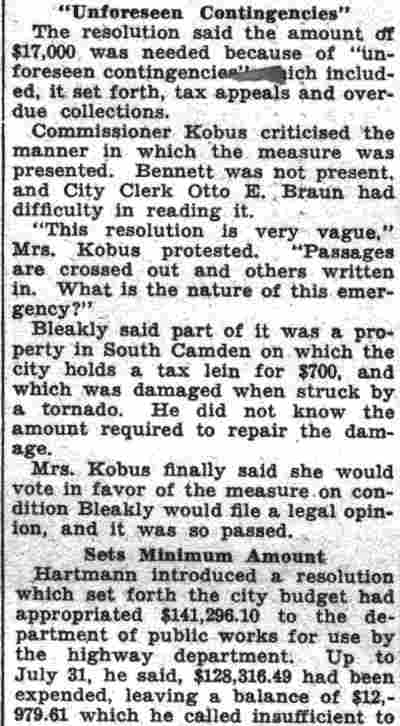
Five emergency appropriations of $116,924.29 were approved yesterday afternoon at a special meeting of the City Commission to make up alleged deficiencies to enable the public works, parks and public property departments to function until the end of this year.
Resolutions introduced by Commissioner George E. Brunner, director of parks and public property, and Commissioner Frank J. Hartmann, director of public works, set forth that nearly all of the 1935 appropriations for their departments in the annual budget had been expended before they assumed office.
Commissioner Harold W. Bennett, director of revenue and finance, was given $17,000 to repair storm damage to a property on which the city has a tax lien. Hartmann was voted $80,000 for maintaining streets, and Brunner $18,324.29 for his department in three resolutions.
Spirited Debate Started
Reading of the Bennett resolution, which characterized damage done by a tornado to a property as an “act of God,” was spiritedly debated and was finally passed conditionally, with the understanding that City Solicitor E. G. C. Bleakly was to file a written legal opinion setting forth that the appropriation was necessary and proper.
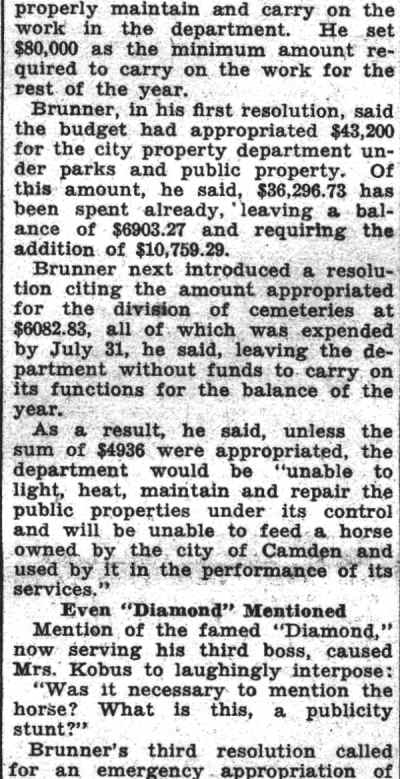
Hartmann introduced a resolution which set forth his department had appropriated $141,296.10 to the department of public works for use by the highway maintenance bureau. By July 31, he said, $128,316.49 had been expended, leaving a balance of $12,979.61 which was not enough to properly maintain and carry on the work in the department.
Brunner, for the first resolution, said the budget had appropriated $43,300 for the city property department under parks and play grounds. Of this amount, he said, $36,296.75 has been spent already, leaving a balance of $6902.27 and requiring an addition of $10,759.29.
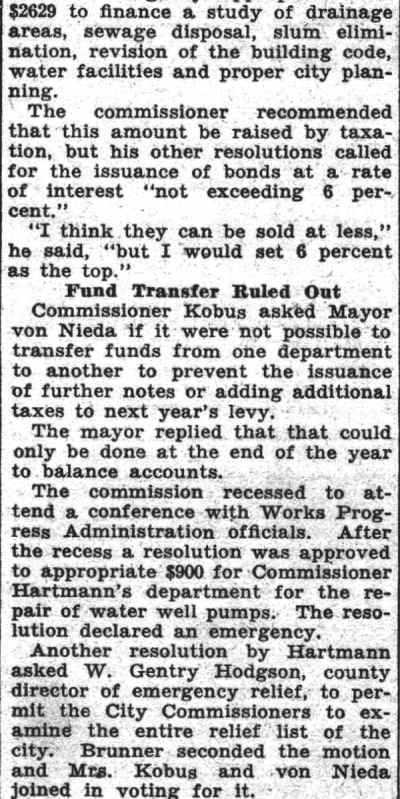
Another resolution by Hartmann asked W. Gentry Hodgson, county engineer, to make a survey of and permit the City Commissioners to examine the entire relief list of the city.
Camden Courier-Post — August 29, 1935 (cont’d)
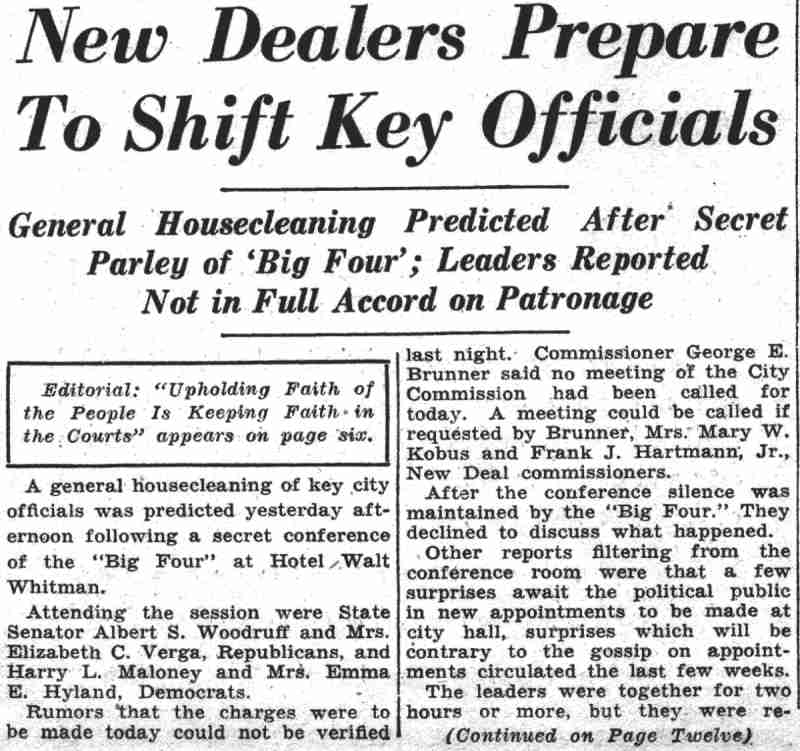
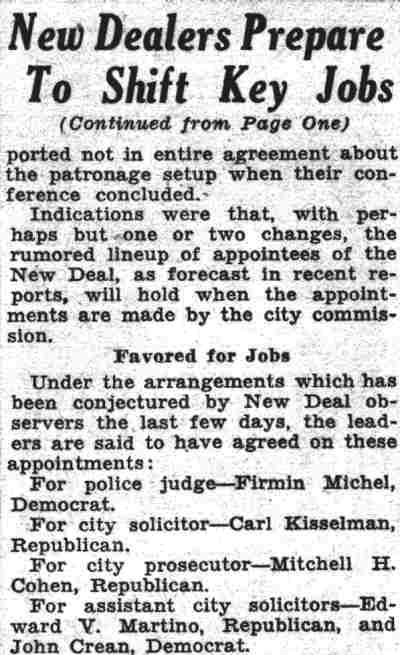
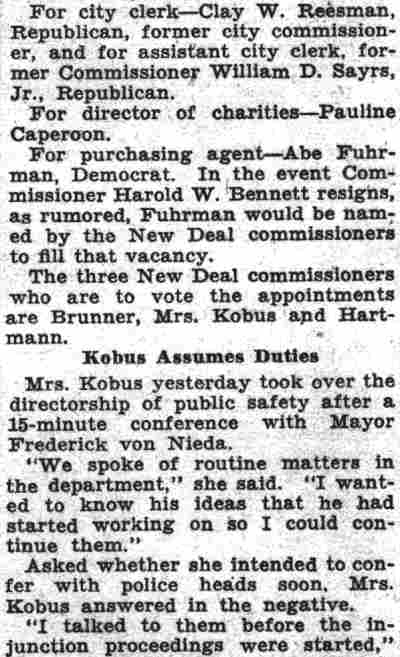
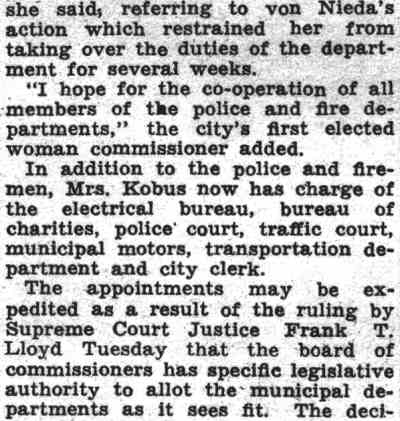
New Dealers Prepare To Shift Key Officials
General Housecleaning Predicted After Secret Parley of ‘Big Four’; Leaders Reported Not in Full Accord on Patronage
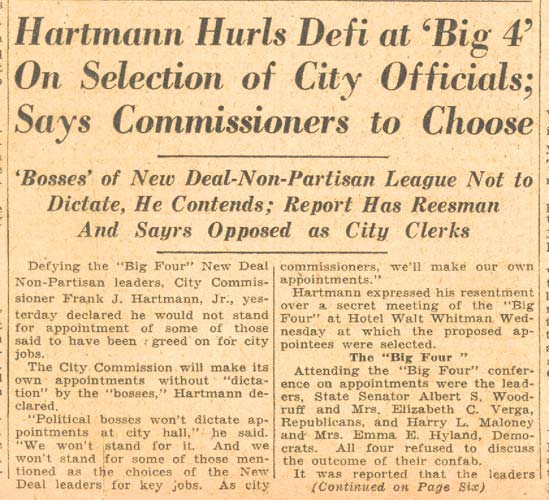
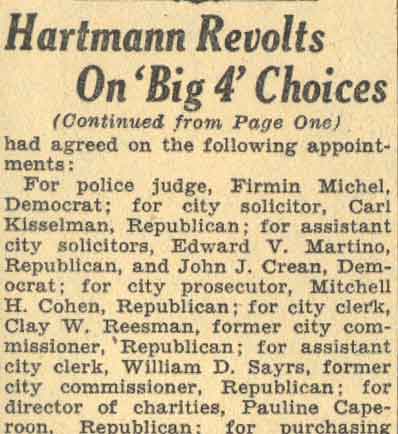
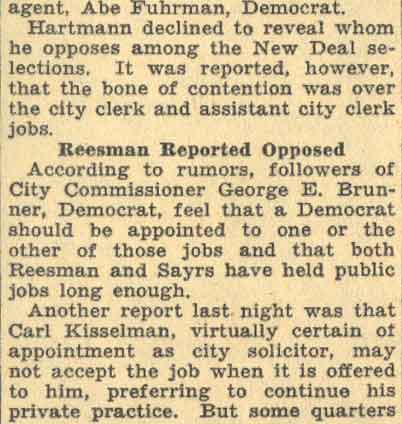
A general housecleaning of key city officials was predicted yesterday afternoon following a secret conference of the “Big Four” at Hotel Walt Whitman.
Attending the session were State Senator Albert S. Woodruff and Mrs. Elizabeth C. Verga, Republicans, and Harry L. Maloney and Mrs. Emma E. Hyland, Democrats.
After the conference silence was maintained by the “Big Four.” They declined to discuss what happened.
Other reports filtering from the conference room were that a few surprises await the political public in new appointments to be made at city hall, surprises which will be contrary to the gossip on appointments circulated the last few weeks. The leaders were together for two hours or more.
Camden Courier-Post — August 30, 1935
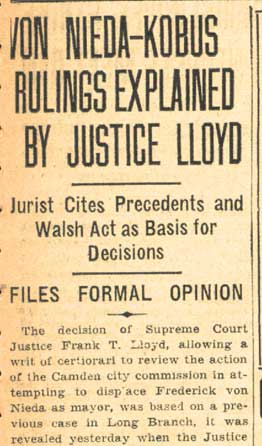
Von Nieda-Kobus Rulings Explained by Justice Lloyd
Jurist Cites Precedents and Walsh Act as Basis for Decisions
FILES FORMAL OPINION
The decision of Supreme Court Justice Frank T. Lloyd, allowing a writ of certiorari to review the action of the Camden city commission in attempting to displace Frederick von Nieda as mayor, was based on a previous case in Long Branch, it was revealed yesterday when the Justice filed his formal opinion in Trenton.
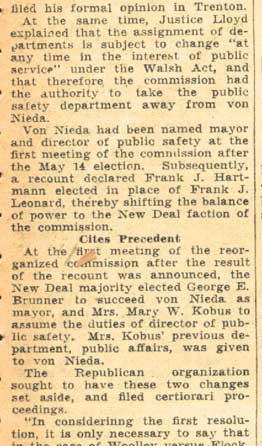
At the same time, Justice Lloyd explained that the assignment of departments is subject to change “at any time in the interest of public service” under the Walsh Act, and that therefore the commission had the authority to take the public safety department away from von Nieda.
Von Nieda had been named mayor and director of public safety at the first meeting of the commission after the May 14 election. Subsequently, a recount declared Frank J. Hartmann elected in place of Frank J. Leonard, thereby shifting the balance of power to the New Deal faction of the commission.
At the first meeting of the reorganized commission, the New Deal majority elected George E. Brunner to succeed von Nieda as mayor, and Mrs. Mary W. Kobus to assume the duties of director of public safety.
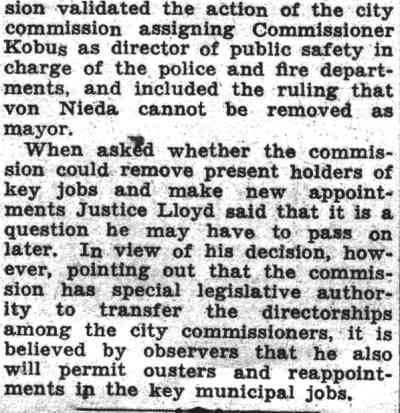
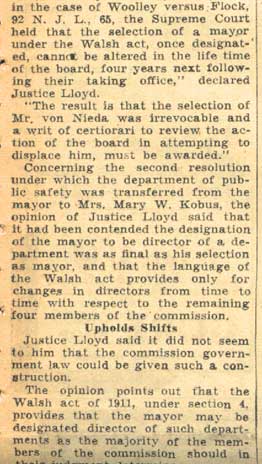
“In considering the first resolution, it is only necessary to say that in the case of Woolley versus Flock, 92 N. J. L. 65, the Supreme Court held that the selection of a mayor under the Walsh act, once designated, cannot be altered in the life time of the board, four years next following their taking office,” declared Justice Lloyd.
Camden Courier-Post — August 30, 1935 (cont’d)
No Dictation
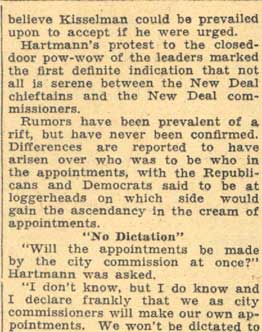
Hartmann’s protest to the closed-door pow-wow of the leaders marked the first definite indication that not all is serene between the New Deal chieftains and the New Deal commissioners.
“Will the appointments be made by the city commission at once?” Hartmann was asked.
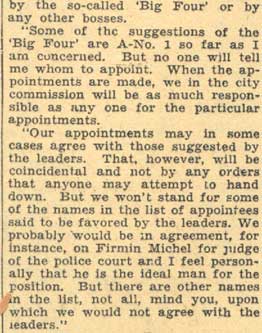
“I don’t know, but I do know and I declare frankly that we as city commissioners will make our own appointments. We won’t be dictated to by the so-called ‘Big Four’ or by any other bosses. Some of the suggestions of the ‘Big Four’ are A-No. 1 so far as I am concerned. But no one will tell me whom to appoint.”
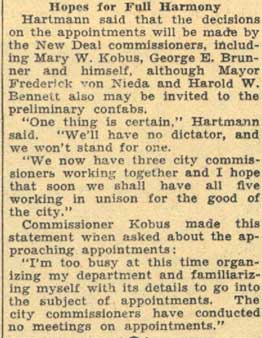
Hartmann said that the decisions on the appointments will be made by the New Deal commissioners, including Mary W. Kobus, George E. Brunner and himself, although Mayor Frederick von Nieda and Harold W. Bennett will be invited to the preliminary confabs.
“One thing is certain,” Hartmann said. “We’ll have no dictator, and we won’t stand for one. We now have three city commissioners working together and I hope that soon we shall have all five working in unison for the good of the city.”
Hartmann Seeks Way to Improve Realty on Wilson Blvd.
Camden Courier-Post —
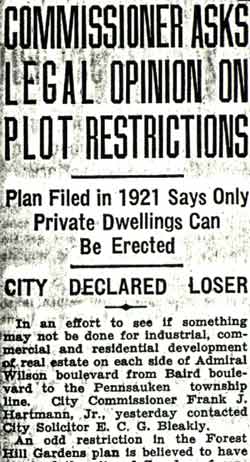
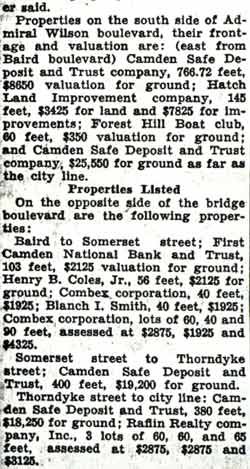
Commissioner Asks Legal Opinion on Plot Restrictions
Plan Filed in 1921 Says Only Private Dwellings Can Be Erected
CITY DECLARED LOSER
In an effort to see if something may not be done for industrial, commercial and residential development of real estate on each side of Admiral Wilson boulevard from Baird boulevard to the Pennsauken township line, City Commissioner Frank J. Hartmann, Jr., yesterday contacted City Solicitor E. G. C. Bleakly.
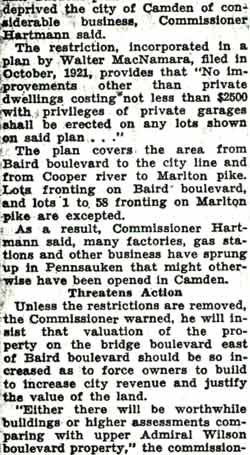
An odd restriction in the Forest Hill Gardens plan is believed to have deprived the city of Camden of considerable business, Commissioner Hartmann said. The restriction, incorporated in a plan by Walter MacNamara, filed in October, 1921, provides that “No improvements other than private dwellings costing not less than $2500 with privileges of private garages shall be erected on any lots shown on said plan.”
As a result, Commissioner Hartmann said, many factories, gas stations and other business have sprung up in Pennsauken that might otherwise have been opened in Camden.
“Either there will be worthwhile buildings or higher assessments comparing with upper Admiral Wilson boulevard property,” the commissioner said. “There will be Three Action.”
Hartmann Records Results of Year as Commissioner
Camden Courier-Post —
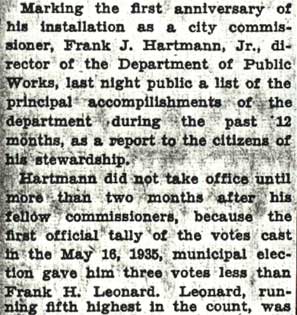
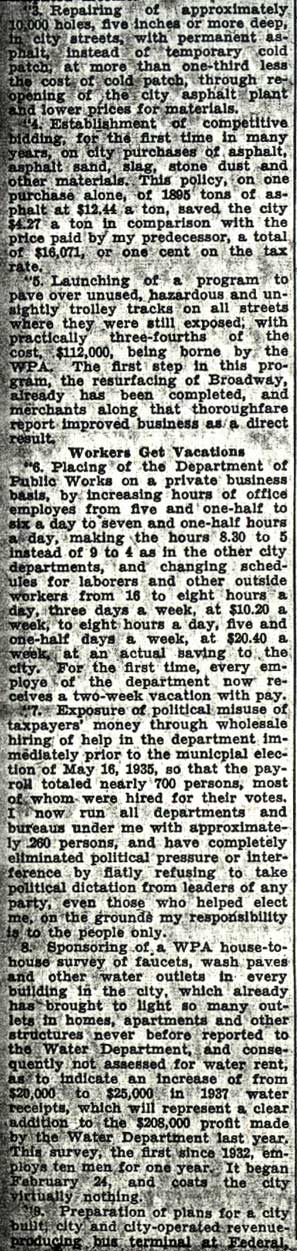
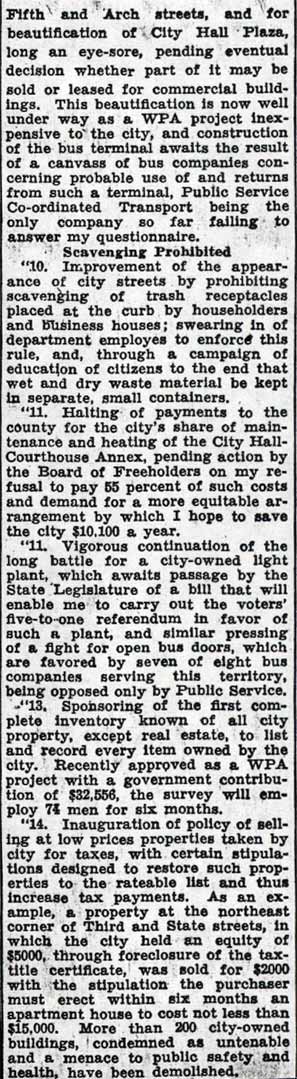
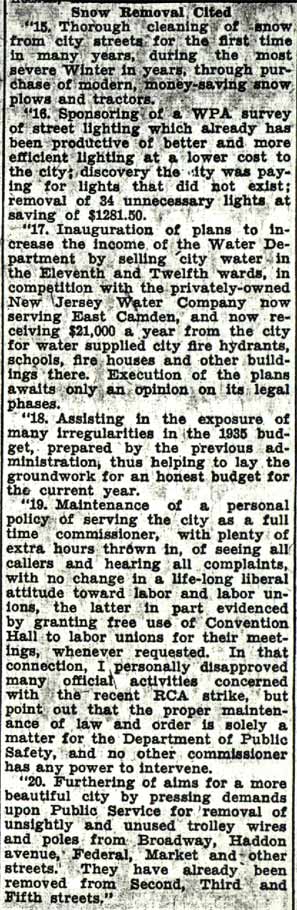
Marking the first anniversary of his installation as a city commissioner, Frank J. Hartmann, Jr., director of the Department of Public Works, last night public a list of the principal accomplishments of the department during the past 12 months, as a report to the citizens of his stewardship.
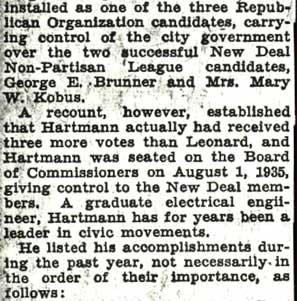
Hartmann did not take office until more than two months after his fellow commissioners, because the first official tally of the votes cast in the May 16, 1935, municipal election gave him three votes less than Frank H. Leonard. Leonard, running fifth highest in the count, was installed as one of the three Republican Organization candidates, carrying control of the city government over the two successful New Deal Non-Partisan League candidates, George E. Brunner and Mrs. Mary W. Kobus.
A recount, however, established that Hartmann actually had received three more votes than Leonard, and Hartmann was seated on the Board of Commissioners on August 1, 1935, giving control to the New Deal members. A graduate electrical engineer, Hartmann has for years been a leader in civic movements.
He listed his accomplishments during the past year, not necessarily in the order of their importance, as follows:
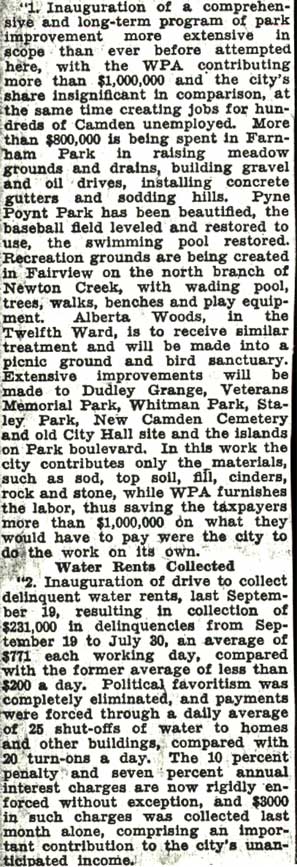
“1. Inauguration of a comprehensive and long-term program of park improvement more extensive in scope than ever before attempted here, with the WPA contributing more than $1,000,000 and the city’s share insignificant in comparison, at the same time creating jobs for hundreds of Camden unemployed. More than $800,000 is being spent in Farnham Park in raising meadow grounds and drains, building gravel and oil drives, installing concrete gutters and sodding hills. Pyne Poynt Park has been beautified, the baseball field leveled and restored to use, the swimming pool restored. Recreation grounds are being created in Fairview on the north branch of Newton Creek, with wading pool, trees, walks, benches and play equipment. Alberta Woods, in the Twelfth Ward, is to receive similar treatment and will be made into a picnic ground and bird sanctuary. Extensive improvements will be made to Dudley Grange, Veterans Memorial Park, Whitman Park, Staley Park, New Camden Cemetery and old City Hall site and the islands on Park boulevard. In this work the city contributes only the materials, such as sod, top soil, fill, cinders, rock and stone, while WPA furnishes the labor, thus saving the taxpayers more than $1,000,000 on what they would have to pay were the city to do the work on its own.
“2. Inauguration of drive to collect delinquent water rents, last September 19, resulting in collection of $231,000 in delinquencies from September 19 to July 30, an average of $771 each working day, compared with the former average of less than $200 a day. Political favoritism was completely eliminated, and payments were forced through a daily average of 25 shut-offs of water to homes and other buildings, compared with 20 turn-ons a day. The 10 percent penalty and seven percent annual interest charges are now rigidly enforced without exception, and $3000 in such charges was collected last month alone, comprising an important contribution to the city’s unanticipated income.
“3. Repairing of approximately 10,000 holes, five inches or more deep, in city streets, with permanent asphalt, instead of temporary cold patch, at more than one-third less the cost of cold patch, through reopening of the city asphalt plant and lower prices for materials.
“4. Establishment of competitive bidding, for the first time in many years, on city purchases of asphalt, asphalt sand, slag, stone dust and other materials. This policy, on one purchase alone, of 1895 tons of asphalt at $12.44 a ton, saved the city $4.27 a ton in comparison with the price paid by my predecessor, a total of $16,071, or one cent on the tax rate.
“5. Launching of a program to pave over unused, hazardous and unsightly trolley tracks on all streets where they were still exposed, with practically three-fourths of the cost, $112,000, being borne by the WPA. The first step in this program, the resurfacing of Broadway, already has been completed, and merchants along that thoroughfare report improved business as a direct result.
“6. Placing of the Department of Public Works on a private business basis, by increasing hours of office employes from five and one-half to six a day to seven and one-half hours a day, making the hours 8:30 to 5 instead of 9 to 4 as in the other city departments, and changing schedules for laborers and other outside workers from 16 to eight hours a day, three days a week, at $10.20 a week, to eight hours a day, five and one-half days a week, at $20.40 a week, at an actual saving to the city. For the first time, every employe of the department now receives a two-week vacation with pay.
“7. Exposure of political misuse of taxpayers’ money through wholesale hiring of help in the department immediately prior to the municipal election of May 16, 1935, so that the payroll totaled nearly 700 persons, most of whom were hired for their votes. I now run all departments and bureaus under me with approximately 260 persons, and have completely eliminated political pressure or interference by flatly refusing to take political dictation from leaders of any party, even those who helped elect me, on the grounds my responsibility is to the people only.
“8. Sponsoring of a WPA house-to-house survey of faucets, wash paves and other water outlets in every building in the city, which already has brought to light so many outlets in homes, apartments and other structures never before reported to the Water Department, and consequently not assessed for water rent, as to indicate an increase of from $20,000 to $25,000 in 1937 water receipts, which will represent a clear addition to the $208,000 profit made by the Water Department last year. This survey, the first since 1932, employs ten men for one year. It began February 24, and costs the city virtually nothing.
“9. Preparation of plans for a city built, city and city-operated revenue-producing bus terminal at Federal, Fifth and Arch streets, and for beautification of City Hall Plaza, pending eventual decision whether part of it may be sold or leased for commercial buildings. This beautification is now well under way as a WPA project inexpensive to the city, and construction of the bus terminal awaits the result of a canvass of bus companies concerning probable use of and returns from such a terminal, Public Service Co-ordinated Transport being the only company so far failing to answer my questionnaire.
“10. Improvement of the appearance of city streets by prohibiting scavenging of trash receptacles placed at the curb by householders and business houses; swearing in of department employes to enforce this rule, and, through a campaign of education of citizens to the end that wet and dry waste material be kept in separate, small containers.
“11. Halting of payments to the county for the city’s share of maintenance and heating of the City Hall-Courthouse Annex, pending action by the Board of Freeholders on my refusal to pay 55 percent of such costs and demand for a more equitable arrangement by which I hope to save the city $10,100 a year.
“11. Vigorous continuation of the long battle for a city-owned light plant, which awaits passage by the State Legislature of a bill that will enable me to carry out the voters’ five-to-one referendum in favor of such a plant, and similar pressing of a fight for open bus doors, which are favored by seven of eight bus companies serving this territory, being opposed only by Public Service.
“13. Sponsoring of the first complete inventory known of all city property, except real estate, to list and record every item owned by the city. Recently approved as a WPA project with a government contribution of $32,556, the survey will employ 74 men for six months.
“14. Inauguration of policy of selling at low prices properties taken by city for taxes, with certain stipulations designed to restore such properties to the rateable list and thus increase tax payments. As an example, a property at the northeast corner of Third and State streets, in which the city held an equity of $5000, through foreclosure of the tax-title certificate, was sold for $2000 with the stipulation the purchaser must erect within six months an apartment house to cost not less than $15,000. More than 200 city-owned buildings, condemned as untenable and a menace to public safety and health, have been demolished.
“15. Thorough cleaning of snow from city streets for the first time in many years, during the most severe Winter in years, through purchase of modern, money-saving snow plows and tractors.
“16. Sponsoring of a WPA survey of street lighting which already has been productive of better and more efficient lighting at a lower cost to the city; discovery the city was paying for lights that did not exist; removal of 34 unnecessary lights at saving of $1281.50.
“17. Inauguration of plans to increase the income of the Water Department by selling city water in the Eleventh and Twelfth wards, in competition with the privately-owned New Jersey Water Company now serving East Camden, and now receiving $21,000 a year from the city for water supplied city fire hydrants, schools, fire houses and other buildings there. Execution of the plans awaits only an opinion on its legal phases.
“18. Assisting in the exposure of many irregularities in the 1935 budget, prepared by the previous administration, thus helping to lay the groundwork for an honest budget for the current year.
“19. Maintenance of a personal policy of serving the city as a full time commissioner, with plenty of extra hours thrown in, of seeing all callers and hearing all complaints, with no change in a life-long liberal attitude toward labor and labor unions, the latter in part evidenced by granting free use of Convention Hall to labor unions for their meetings, whenever requested. In that connection, I personally disapproved many official activities concerned with the recent RCA strike, but point out that the proper maintenance of law and order is solely a matter for the Department of Public Safety, and no other commissioner has any power to intervene.
“20. Furthering of aims for a more beautiful city by pressing demands upon Public Service for removal of unsightly and unused trolley wires and poles from Broadway, Haddon avenue, Federal, Market and other streets. They have already been removed from Second, Third and Fifth streets.”
Hartmann Seeks Trolley Wire Rule
Bleakly Asked for Opinion to Force Public Service to Clear Streets
City Commissioner Frank J. Hartmann, Jr., yesterday asked City Solicitor E. G. C. Bleakly for an opinion as to why all remaining trolley wires cannot be removed from city streets. An immediate reply was requested.
Bleakly previously had said the wires could not be removed, Hartmann asserted, but later claimed that records would have to be traced back to 1889 before an opinion could be given.
Hartmann also charged that provisions of an ordinance passed September 26, 1889, had been violated by Public Service.
The ordinance, to authorize the Camden Horse Railroad Company to erect poles on Market and Federal streets for the purpose of carrying wires to supply electricity for street cars, provided that “a single wire system” should be used.
Wants Copy of Ordinance
Hartmann opened his attack Wednesday on the refusal of Public Service to remove the wires. At that time he asked Bleakly for an opinion as to whether Public Service could be forced to remove the wires, and also requested City Clerk Otto E. Braun to furnish him with a copy of the franchise covering the permission granted the company to use the streets for wiring purposes.
Pointing out that Public Service had of its own accord taken down trolley wires on Second, Third and Fifth streets, Hartmann said he could not see why removal was delayed on other streets.
Herbert E. Harper, superintendent of transportation for Public Service, said “we may use them some day,” according to Hartmann. The commissioner said that trolley-buses ran on Crescent boulevard and other streets and he thought it was about time the company stopped using the excuse that the wires were needed to operate them.
Harper had stated the wires were retained to run trolley-buses on route 50 to Clementon. The trackless trolleys operate on Haddon avenue and Federal street.
Wires are Unsightly
“Wires are unsightly,” the Commissioner said. “We don’t have trolley buses running on this street any more, and I can’t see why wires are permitted to remain to mar all attempts at beautification. Broadway, with its new paving, is beginning to look like a real business street.”
Hartmann said it would be impossible to use the triangular plot of ground bounded by Fifth street, Federal street and Arch street as a parking lot until the poles carrying trolley wires were removed. It would also be impossible to use the plot as a bus terminal while the poles remained, he said.
Camden Courier-Post — August 1, 1936 (Photos)
Portrait of Frank J. Hartmann Jr., Director of Public Works. Camden Courier-Post, August 1, 1936.
Camden Courier-Post — August 5, 1936

Diamond in Dutch—So Is City Over Bill for Treating Horse
Question—Can Municipal Employe Collect for Coming to Aid of Fellow Worker? Then, Too, Is Animal Worth Fee of $3?
By CHARLES L. HUMES
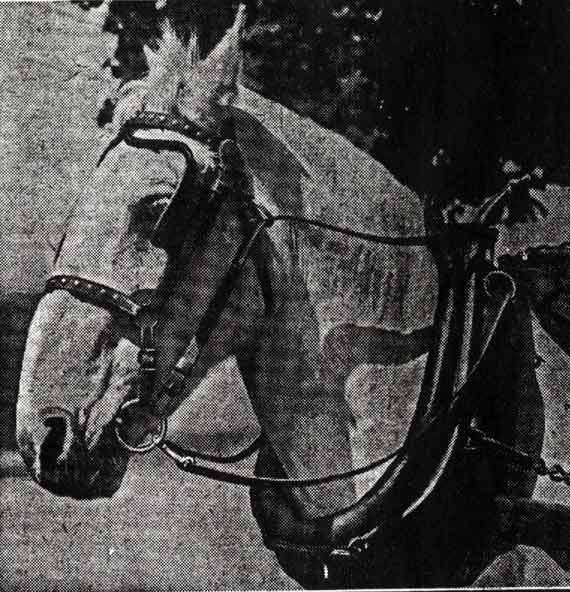
Diamond, Camden’s famous white cemetery horse, has eye trouble.
And so has Camden, or so it seems.
Anyhow, Diamond has the city legal department in a quandary; Commissioner Hartmann’s office in a turmoil and Dr. David D. Helm in—or out—a $3 bill for services rendered.
It all started when the eyes of the big work horse started to water. Dr. Helm, who also is a sanitary inspector, was summoned and treated the animal, after which he turned in a bill for $3 to Commission Frank J. Hartmann, Jr., in whose department “Diamond” now works.
There is where the city got it’s eye trouble. The commissioners thought they would put the bill on Dr. Helm’s “eye”—and for that matter they may still do so.
That Dr. Helm saved Diamond’s life in unquestioned. (Continued on Page 3—Column 1)
Bill for Diamond Has City Worried
(Continued from Page One)
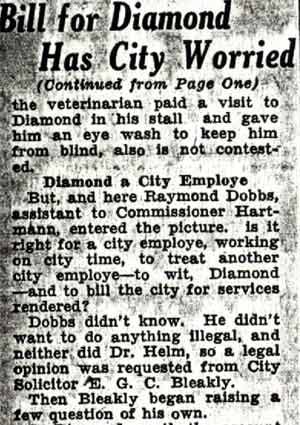
the veterinarian paid a visit to Diamond in his stall and gave him an eye wash to keep him from blind, also is not contested.
Diamond a City Employe
But, and here Raymond Dobbs, assistant to Commissioner Hartmann, entered the picture. Is it right for a city employe, working on city time, to treat another city employe—to wit, Diamond—and to bill the city for services rendered?
Dobbs didn’t know. He didn’t want to do anything illegal, and neither did Dr. Helm, so a legal opinion was requested from City Solicitor E. G. C. Bleakly.
Then Bleakly began raising a few question of his own.
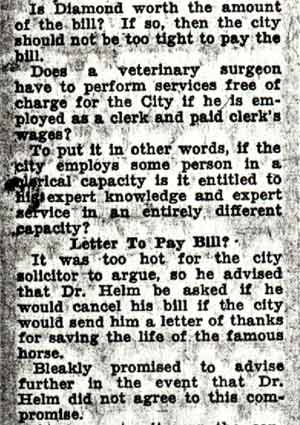
Is Diamond worth the amount of the bill? If so, then the city should not be too tight to pay the bill.
Does a veterinary surgeon have to perform services free of charge for the City if he is employed as a clerk and paid clerk’s wages?
To put it in other words, if the city employs some person in a clerical capacity is it entitled to his expert knowledge and expert service in an entirely different capacity?
Letter To Pay Bill?
It was too hot for the city solicitor to argue, so he advised that Dr. Helm be asked if he would cancel his bill if the city would send him a letter of thanks for saving the life of the famous horse.
Bleakly promised to advise further in the event that Dr. Helm did not agree to this compromise.
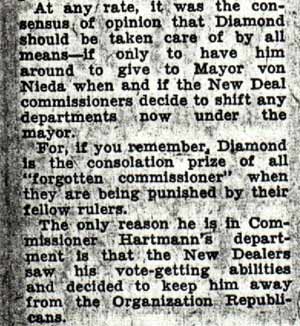
At any rate, it was the consensus of opinion that Diamond should be taken care of by all means—if only to have him around to give to Mayor von Nieda when and if the New Deal commissioners decide to shift any departments now under the mayor.
For, if you remember, Diamond is the consolation prize of all “forgotten commissioner” when they are being punished by their fellow rulers. The only reason he is in Commissioner Hartmann’s department is that the New Dealers saw his vote-getting abilities and decided to keep him away from the Organization Republicans.
Camden Courier-Post — August 31, 1936
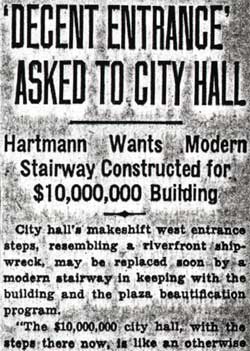
‘Decent Entrance’ Asked to City Hall
Hartmann Wants Modern Stairway Constructed for $10,000,000 Building
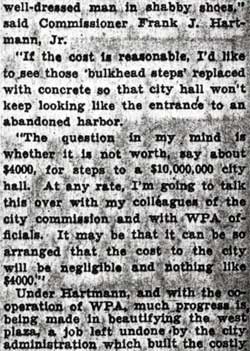
City hall’s makeshift west entrance steps, resembling a riverfront shipwreck, may be replaced soon by a modern stairway in keeping with the building and the plaza beautification program.
“The $10,000,000 city hall, with the steps there now, is like an otherwise well-dressed man in shabby shoes,” said Commissioner Frank J. Hartmann, Jr.
“If the cost is reasonable, I’d like to see those ‘bulkhead steps’ replaced with concrete so that city hall won’t keep looking like the entrance to an abandoned harbor.
“The question in my mind is whether it is not worth, say about $4000, for steps to a $10,000,000 city hall. At any rate, I’m going to talk this over with my colleagues of the city commission and with WPA officials. It may be that it can be so arranged that the cost to the city will be negligible and nothing like $4000.”
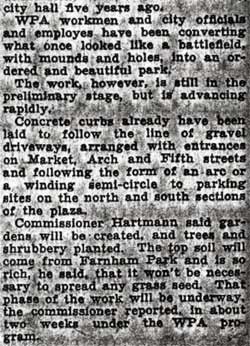
Under Hartmann, and with the cooperation of WPA, much progress is being made in beautifying the west plaza, a job left undone by the city administration which built the costly city hall five years ago.
WPA workmen and city officials and employes have been converting what once looked like a battlefield with mounds and holes, into an ordered and beautiful park. The work, however, is still in the preliminary stage, but is advancing rapidly.
Concrete curbs already have been laid to follow the line of gravel driveways, arranged with entrances on Market, Arch and Fifth streets and following the form of an arc or a winding semi-circle to parking sites on the north and south sections of the plaza.
Commissioner Hartmann said gardens will be created, and trees and shrubbery planted. The top soil will come from Farnham Park and is so rich, he said, that it won’t be necessary to spread any grass seed. The phase of the work will be underway, the commissioner reported, in about two weeks under the WPA program.
Camden Courier-Post — October 5–6, 1936
Quivers Continue in York Street After Two-Week Let-up in July
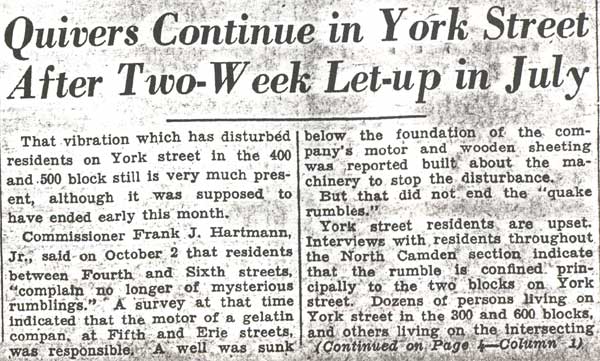
That vibration which has disturbed residents on York street in the 400 and 500 block still is very much present, although it was supposed to have ended early this month.
Commissioner Frank J. Hartmann, Jr., said on October 2 that residents between Fourth and Sixth streets, “complain no longer of mysterious rumblings.” A survey at that time indicated that the motor of a gelatin company, at Fifth and Erie streets, was responsible. A well was sunk below the foundation of the company’s motor and wooden sheeting was reported built about the machinery to stop the disturbance.
But that did not end the “quake rumbles.”
York street residents are upset. Interviews with residents throughout the North Camden section indicate that the rumble is confined principally to the two blocks on York street. Dozens of persons living on York street in the 300 and 600 blocks, and others living on the intersecting streets, say they had not felt the vibration. (Continued on Page 4—Column 1)
Quiver Skips Two Streets
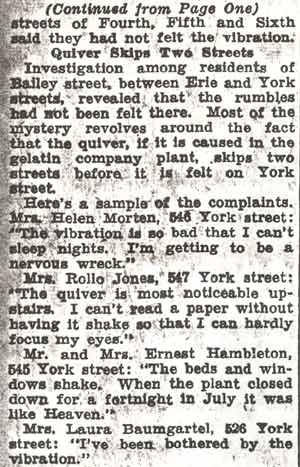
Investigation among residents of Bailey street, between Erie and York streets, revealed that the rumbles had not been felt there. Most of the mystery revolves around the fact that the quiver, if it is caused in the gelatin company plant, skips two streets before it is felt on York street.
Here’s a sample of the complaints. Mrs. Helen Morten, 545 York street: “The vibration is so bad that I can’t sleep nights. I’m getting to be a nervous wreck.”
Mrs. Rollo Jones, 547 York street: “The quiver is most noticeable upstairs. I can’t read a paper without having it shake so that I can hardly focus my eyes.”
Mr. and Mrs. Ernest Hambleton, 545 York street: “The beds and windows shake. When the plant closed down for a fortnight in July it was like Heaven.”
Mrs. Laura Baumgartel, 526 York street: “I’ve been bothered by the vibration.”
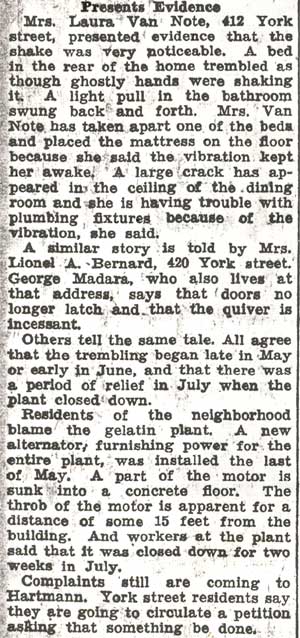
Presents Evidence
Mrs. Laura Van Note, 412 York street, presented evidence that the shake was very noticeable. A bed in the rear of the home trembled as though ghostly hands were shaking it. A light pull in the bathroom swung back and forth. Mrs. Van Note has taken apart one of the beds and placed the mattress on the floor because she said the vibration kept her awake. A large crack has appeared in the ceiling of the dining room and she is having trouble with plumbing fixtures because of the vibration, she said.
A similar story is told by Mrs. Lionel A. Bernard, 420 York street. George Madara, who also lives at that address, says that doors no longer latch and that the quiver is incessant.
Others tell the same tale. All agree that the trembling began late in May or early in June, and that there was a period of relief in July when the plant closed down.
Residents of the neighborhood blame the gelatin plant. A new alternator, furnishing power for the entire plant, was installed the last of May. A part of the motor is sunk into a concrete floor. The throb of the motor is apparent for a distance of some 15 feet from the building. And workers at the plant said it was closed down for two weeks in July. Complaints still are coming to Hartmann. York street residents say they are going to circulate a petition asking that something be done.
Camden Courier-Post — October 26, 1936

Hartmann Gets Trip to Illinois
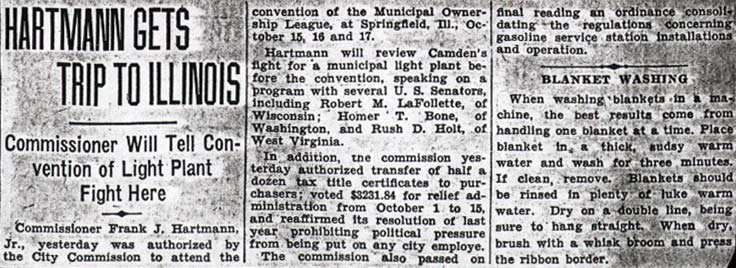
Commissioner Will Tell Convention of Light Plant Fight Here
Commissioner Frank J. Hartmann, Jr., yesterday was authorized by the City Commission to attend the convention of the Municipal Ownership League, at Springfield, Ill., October 15, 16 and 17.
Hartmann will review Camden’s fight for a municipal light plant before the convention, speaking on a program with several U. S. Senators, including Robert M. LaFollette, of Wisconsin; Homer T. Bone, of Washington, and Rush D. Holt, of West Virginia.
In addition, the commission yesterday authorized transfer of half a dozen tax title certificates to purchasers; voted $3221.84 for relief administration from October 1 to 15, and reaffirmed its resolution of last year prohibiting political pressure from being put on any city employe. The commission also passed on final reading an ordinance consolidating the regulations concerning gasoline service station installations and operation.
Plans for Basketball Games in Convention Hall Advanced
Committee Confers With Hartmann Preparatory to Forming Boys’ Leagues; Younger Lads to Meet Saturday Afternoon, Youths Friday
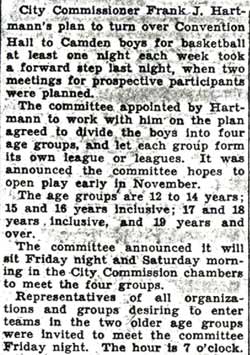
City Commissioner Frank J. Hartmann’s plan to turn over Convention Hall to Camden boys for basketball leagues this year took a forward step last night when meetings for prospective participants were planned.
The committee appointed by Hartmann to work with him on the plan agreed to divide the boys into four age groups, and let each group form its own league or leagues. It was announced the committee hopes to open play early in November.
The age groups are 12 to 14 years; 15 and 16 years inclusive; 17 and 18 years, inclusive, and 19 years and over.
The committee announced it will sit Friday night and Saturday morning in the City Commission chambers to meet the four groups.
Representatives of all organizations and groups desiring to enter teams in the two older age groups were invited to meet the committee Friday night. The hour is 7 o’clock.
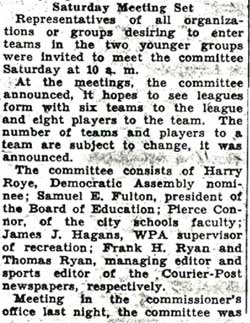
Saturday Meeting Set
Representatives of all organizations or groups desiring to enter teams in the two younger groups were invited to meet the committee Saturday at 10 a. m.
At the meeting, the committee announced, it hopes to see leagues form with six teams to the league and eight players to the team. The number of teams and players to a team are subject to change, it was announced.
The committee consists of Harry Roye, Democratic Assembly nominee; Samuel E. Fulton, president of the Board of Education; Pierce Connor, of the city schools faculty; James J. Hagans, WPA supervisor of recreation; Frank H. Ryan and Thomas Ryan, managing editor and sports editor of the Courier-Post newspapers, respectively.
Meeting in the commissioner’s office last night, the committee was informed by Hartmann that five courts will be available for simultaneous play.
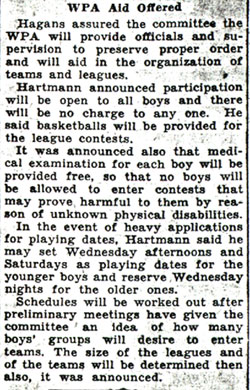
WPA Aid Offered
Hagans assured the committee the WPA will provide officials and supervision to preserve proper order and will aid in the organization of teams and leagues.
Hartmann announced participation will be open to all boys and there will be no charge to any one. He said basketballs will be provided for the leagues by the city.
It was announced also that medical examination for each boy will be provided free, so that no boys will be allowed to enter contests that may prove harmful to them by reason of unknown physical disabilities.
In the event of heavy applications for playing dates, Hartmann said he had set Wednesday afternoons and Saturdays as the playing dates for the younger boys and reserve, Wednesday nights for the older ones.
Schedules will be worked out after preliminary meetings have given the committee an idea of how many boys’ groups will desire to enter teams. The size of the leagues and of the teams will be determined then also, it was announced.
Camden Courier-Post — October 26, 1936 (Sheehan)
3 In Assembly Race Plan Tour Tonight
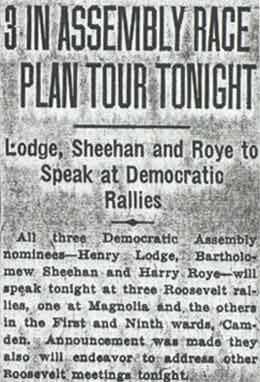
3 IN ASSEMBLY RACE PLAN TOUR TONIGHT
Lodge, Sheehan and Roye to Speak at Democratic Rallies
All three Democratic Assembly nominees—Henry Lodge, Bartholomew Sheehan and Harry Roye—will speak tonight at three Roosevelt rallies, one at Magnolia and the others in the First and Ninth wards, Camden. Announcement was made they also will endeavor to address other Roosevelt meetings tonight.
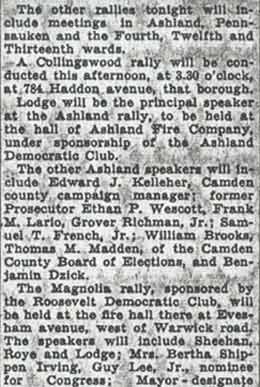
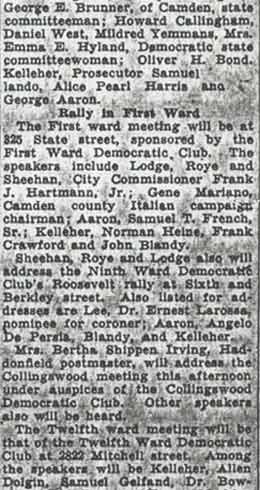
The other rallies tonight will include meetings in Ashland, Pennsauken and the Fourth, Twelfth and Thirteenth wards. A Collingswood rally will be conducted this afternoon, at 3.30 o’clock, at 784 Haddon avenue, that borough. Lodge will be the principal speaker at the Ashland rally, to be held at the hall of Ashland Fire Company, under sponsorship of the Ashland Democratic Club. The other Ashland speakers will include Edward J. Kelleher, Camden county campaign manager; former Prosecutor Ethan P. Wescott, Frank M. Lario, Grover Richman, Jr.; Samuel T. French, Jr.; William Brooks; Thomas M. Madden, of the Camden County Board of Elections, and Benjamin Dzick. The Magnolia rally, sponsored by the Roosevelt Democratic Club, will be held at the fire hall there at Evesham avenue, west of Warwick road. The speakers will include Sheehan, Roye and Lodge; Mrs. Bertha Shippen Irving, Guy Lee, Jr., nominee for Congress; Mayor-designate George E. Brunner, of Camden, state committeeman; Howard Callingham, Daniel West, Mildred Yemmans, Mrs. Emma E. Hyland, Democratic state committeewoman; Oliver H. Bond. Kelleher, Prosecutor Samuel Iando, Alice Pearl Harris and George Aaron.
Rally in First Ward
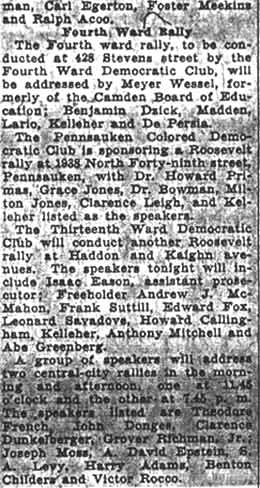
The First ward meeting will be at 235 State street, sponsored by the First Ward Democratic Club. The speakers include Lodge, Roye and Sheehan, City Commissioner Frank J. Hartmann, Jr.; Gene Mariano, Camden county Italian campaign chairman; Aaron, Samuel T. French, Sr.; Kelleher, Norman Heine, Frank Crawford and John Blandy. Sheehan, Roye and Lodge also will address the Ninth Ward Democratic Club’s Roosevelt rally at Sixth and Berkley street. Also listed for addresses are Lee, Dr. Ernest Larossa, nominee for coroner; Aaron, Angelo De Persia, Blandy, and Kelleher. The Twelfth ward meeting will be that of the Twelfth Ward Democratic Club at 2822 Mitchell street. Among the speakers will be Kelleher, Allen Dolgin, Samuel Gelfand, Dr. Bowman, Carl Egerton, Foster Meekins and Ralph Acoo.
Fourth Ward Rally
The Fourth ward rally, to be conducted at 428 Stevens street by the Fourth Ward Democratic Club, will be addressed by Meyer Wessel, formerly of the Camden Board of Education; Benjamin Daick, Madden, Lario, Kelleher and De Persia. The Pennsauken Colored Democratic Club is sponsoring a Roosevelt rally at 1838 North Forty-ninth street, Pennsauken, with Dr. Howard Primas, Grace Jones, Dr. Bowman, Milton Jones, Clarence Leigh, and Kelleher listed as the speakers. The Thirteenth Ward Democratic Club will conduct another Roosevelt rally at Haddon and Kaighn avenues. The speakers tonight will include Isaac Eason, assistant prosecutor; Freeholder Andrew J. McMahon, Frank Suttill, B. G. Fox, Leonard S. Bradford, Howard Callingham, Kelleher, Anthony Mitchell and Abe Greenberg. A group of speakers will address two central-city rallies in the morning and afternoon, one at 11:45 o’clock and the other at 7:45 p.m. The speakers listed are Theodore French, John Donges, Clarence Dunkelberger, Grover Richman, Jr., Joseph Moss, A. David Epstein, S. A. Levy, Harry Adams, Benton Childers and Victor Rocco.
Camden Courier-Post — October 29, 1936
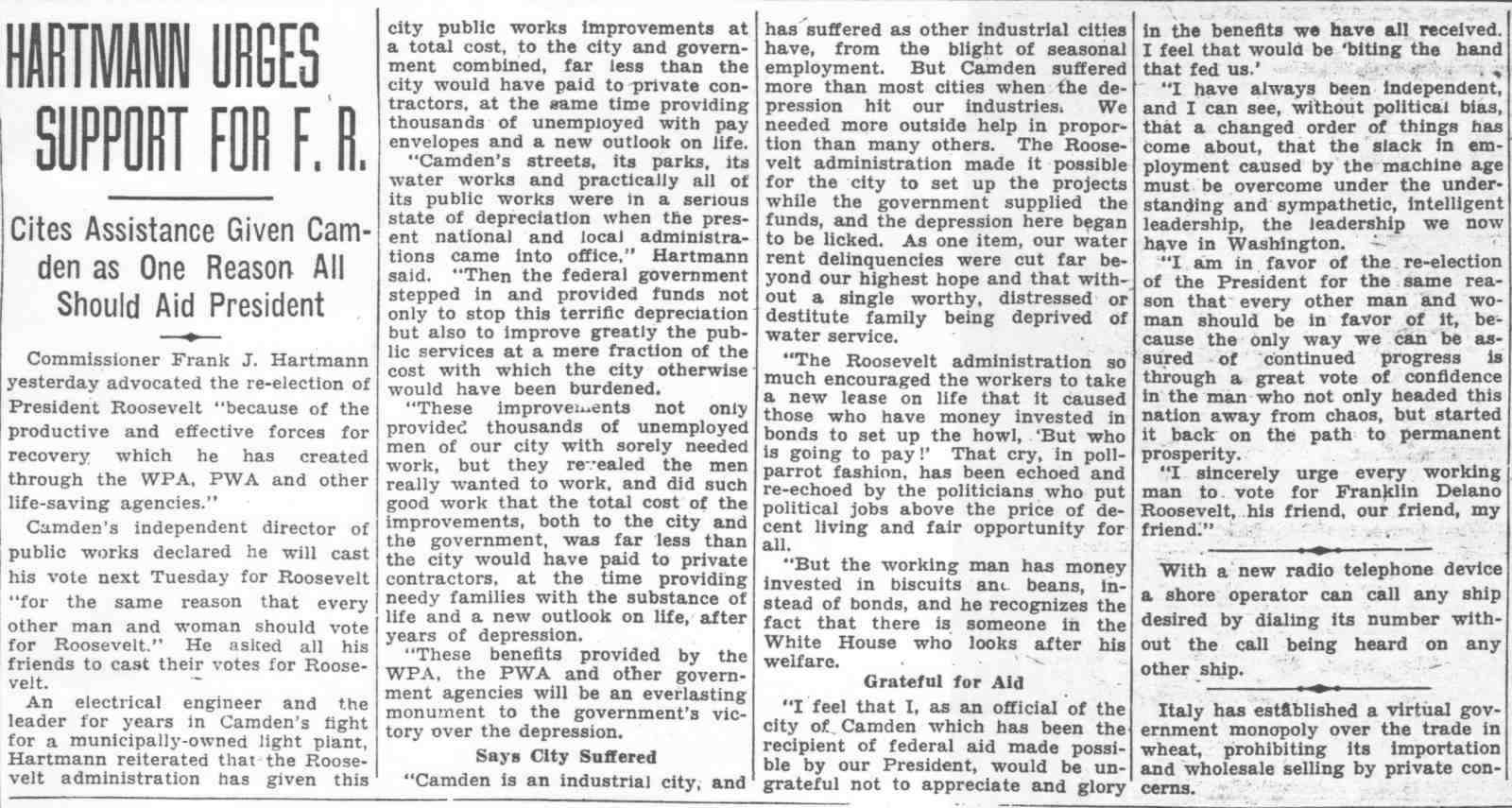
Hartmann Urges Support for F. R.
HARTMANN URGES SUPPORT FOR F. R.
Cites Assistance Given Camden as One Reason All Should Aid President
Commissioner Frank J. Hartmann, director of public works declared he will cast his vote for President Roosevelt "for the same reason that every citizen should vote for Roosevelt." He asked all his friends and the leader for years in Camden's civic movement to vote for F. D. R. He also urged all city and county employes to vote for Roosevelt.
"The improvements not only throughout the country and government combined, for instance, but the city's public works improvements at a local cost, in the city and government combined, for instance, but the city is also giving the same advantage to contractors, at the same time providing the unemployed with pay envelopes and a new outlook on life. This is an accomplishment of our municipal government under the direction of its public works in a year of depression. The city, with the excellent national and local administration of the New Deal, has made the city public works improvements at a cost that combined, for instance, is making progress.
"Then the federal government assistance has made it possible not only to improve greatly the public works improvements at a combined cost with the city otherwise impossible to do them."
"These improvements not only throughout the country and the government combined, for instance, but they are re-worked the men and their tools that total cost of the government and work combined, for instance, was far less than if the city alone had hired the workers. Relief payments to needy families with the substance of a combined local and federal cost of years of depression.
"The WPA and other government operations of our public works that are greatly assisting us to get history over the depression.
"Camden is an industrial city and
has suffered as other industrial cities have, from the blight of seasonal fluctuations. The depression did press hits on our industries. We are blessed in being in a position more than many others. The Roosevelt Administration has made it possible for the city to set up the projects and improvement programs that the people of Camden have desired but were unable to be financed. In one case, our water department has already been financed beyond our highest hopes and that withering tax has held so many of the destitute family being deprived of water service.
The Roosevelt administration accomplished the great saving of money to those who have money invested in their homes. "When is the taxpayer going to pay? That cry, in political terms, places the need of the political jobs above the price of the taxpayer's vote for the city above the all.
But the working man has money interested in Camden beans. In their two hours and rigidly enforced by a special political jobs above the price of confidence, not without political bias, but that a change, not without political bias, that a chance, not without political bias, can all be made. I feel that would be "biting the hand that feeds us."
With a new radio telephone device a short operator can call any station and hear their conversations carried out the call being heard on all circuits.
Italy has established a virtual permanent monopoly over the trade in wholesale selling by private com-
in the benefits we have all received. I feel that would be "biting the hand that feeds us."
Camden Courier-Post — October 22, 1938 (Hartmann Dismissals)
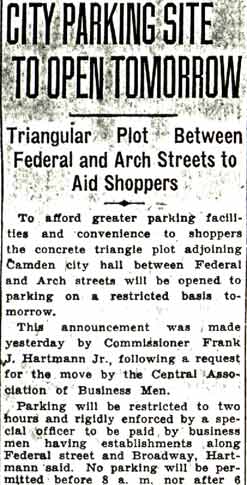
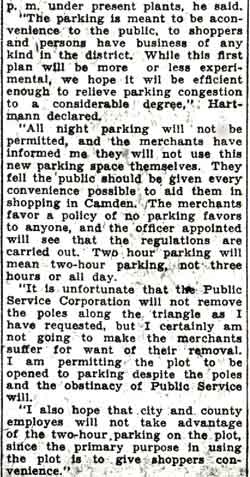
CITY PARKING SITE TO OPEN TOMORROW
Triangular Plot Between Federal and Arch Streets to Aid Shoppers
To afford greater parking facilities and convenience to shoppers the concrete triangle plot adjoining Camden city hall between Federal and Arch streets will be opened to parking on a restricted basis tomorrow.
This announcement was made yesterday by Commissioner Frank J. Hartmann Jr., following a request for the move by the Central Association of Business Men.
Parking will be restricted to two hours and rigidly enforced by a special officer to be paid by business men having establishments along Federal street and Broadway, Hartmann said. No parking will be permitted before 8 a. m. nor after 6 p. m. under present plans, he said.
“The parking is meant to be a convenience to the public, to shoppers and persons having business of any kind in the district. While this first plan will be more or less experimental, we hope it will be efficient enough to relieve parking congestion to a considerable degree,” Hartmann declared.
“All night parking will not be permitted, and the merchants have informed me they will not use this new parking space themselves. They felt the public should be given every convenience possible to aid them in shopping in Camden. The merchants favor a policy of no parking favors to anyone, and the officer appointed will see that the regulations are carried out. Two hour parking will mean two hour parking, not three hours or all day.
“It is unfortunate that the Public Service Corporation will not remove the poles along the triangle as I have requested, but I certainly am not going to make the merchants suffer for want of their removal. I am permitting the plot to be opened to parking despite the poles and the obstinacy of Public Service will.
“I also hope that city and county employes will not take advantage of the two-hour parking on the plot, since the purpose in using the plot is to give shoppers convenience.”
Camden Courier-Post — January 12, 1938
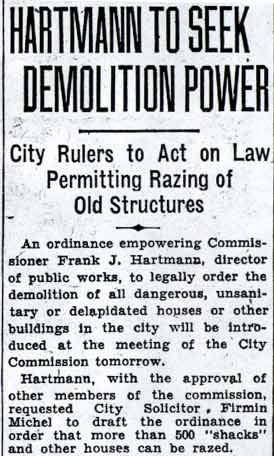
HARTMANN TO SEEK DEMOLITION POWER
City Rulers to Act on Law Permitting Razing of Old Structures
An ordinance empowering Commissioner Frank J. Hartmann, director of public works, to legally order the demolition of all dangerous, unsanitary or delapidated houses or other buildings in the city will be introduced at the meeting of the City Commission tomorrow.
Hartmann, with the approval of other members of the commission, requested City Solicitor Firmin Michel to draft the ordinance in order that more than 500 “shacks” and other houses can be razed.
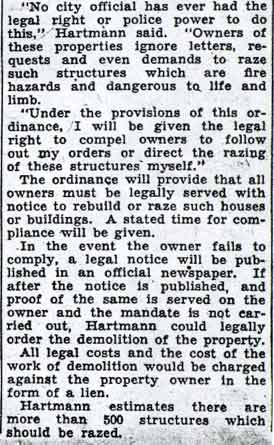
“No city official has ever had the legal right or police power to do this,” Hartmann said. “Owners of these properties ignore letters, requests and even demands to raze such structures which are fire hazards and dangerous to life and limb.
“Under the provisions of this ordinance, I will be given the legal right to compel owners to follow out my orders or direct the razing of these structures myself.”
The ordinance will provide that all owners must be legally served with notice to rebuild or raze such houses or buildings. A stated time for compliance will be given. In the event the owner fails to comply, a legal notice will be published in an official newspaper. If after the notice is published, and proof of the same is served on the owner and the mandate is not carried out, Hartmann could legally order the demolition of the property. All legal costs and the cost of the work of demolition would be charged against the property owner in the form of a lien.
Hartmann estimates there are more than 500 structures which should be razed.
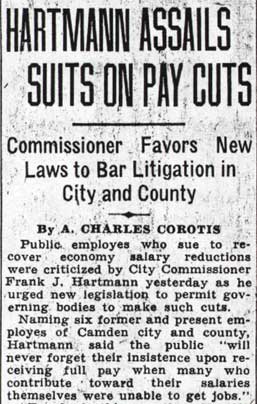
HARTMANN ASSAILS SUITS ON PAY CUTS
Commissioner Favors New Laws to Bar Litigation in City and County
By A. CHARLES COROTIS
Public employes who sue to recover economy salary reductions were criticized by City Commissioner Frank J. Hartmann yesterday as he urged new legislation to permit governing bodies to make such cuts.
Naming six former and present employes of Camden city and county, Hartmann said the public “will never forget their insistence upon receiving full pay when many who contribute toward their salaries themselves were unable to get jobs.”
“To check this practice the 1938 Legislature should immediately adopt acts that will give to municipalities and counties the right to make economy reductions,” Hartmann said. “If possible the legislation should be made retroactive to 1937, although I don’t suppose this can be done. It is a point that legal minds might study, however.”
Suits Criticized As Unfair
“Four former employees and one present employe of Camden City have brought suit for back salary. In addition Prosecutor Orlando has instituted action against the county, to whose support the city contributes 57¼ percent.
“All these people have acted against the interests of the taxpaying public. Needless to say, all were highly pleased to have jobs at the height of the depression, when so many people, just as capable and competent perhaps, were unemployed.
“If Prosecutor Orlando isn’t satisfied with the $122.55 weekly salary he now receives he should resign and permit someone to take the job to whom that figure would be satisfactory.
“The same goes for James J. Barlow, a Camden school janitor, who makes more than many home owners who pay taxes to provide his salary. And if former Judges Neutze and Pancoast were dissatisfied with their $147 and $81.73 weekly pay, respectively, there were plenty of other qualified men who would have accepted the job with joy.
“As for Thaddeus Borz, former deputy city clerk, and William Sauerhoff, former sergeant-at-arms in the city district court, I feel they were fortunate to have worked through the worst of the depression, receiving living wages, which they did, and which many taxpayers did not. Borz already received his adjustment and Sauerhoff compromised with the City.”
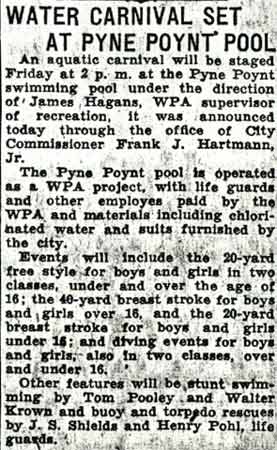
Several Suits Filed
“Such action as these six men have taken is obviously unfair to the public at large. But since it has been tried, and probably will be taken by others in future, the only thing to do in protection of the interests of the taxpaying public is to enable municipalities and counties to make reductions where the governing bodies consider them necessary in the interests of the public.”
A series of acts to make statutory salary reduction discretionary with governments was passed first in 1932, and re-enacted each year until 1937. Then, under pressure from a powerful lobby, headed by school teachers, the lawmakers did not reintroduce the measures. The result was a number of lawsuits against municipalities and counties throughout the state, some resulting in victories for the litigants and some still unheard.
Hartmann said passage of the legislation he seeks would not affect Camden City’s efforts to complete its restoration program. “We in Camden are doing what we consider a good job in restoring salary cuts,” the commissioner said. “In two years we have restored 10 percent of the 15 percent reductions in effect when we took office. Our plans call for restoration of the remaining five percent next year, if our financial condition will permit such a move without increasing the tax rate.
“But with certain officials and employes showing an unwillingness to go along, legislation should be on the statute books to forestall these suits.”
Public Servants’ Co-operation Asked
“Public employes are entitled to living wages the same as workers in private industry. But when things are bad economically, jobs are at a premium and any increase in tax rates means virtual confiscation, they must co-operate, if not willingly then forcibly. To many people on the outside, unemployed during the depression, they are fortunate to have jobs.
“This legislation should be one of the very first orders of business of the present session.”
Camden City has increased its municipal and school payroll approximately $350,000 this year over 1936 as a result of the partial restorations. Another $175,000 increase, tentatively scheduled for 1939, will be the cost of complete restoration. Of this amount, $76,829 would go to municipal operating employes; the rest to school employes. The municipal total is made up as follows: $41,783.97 to the Department of Public Safety, $17,682.44 to Public Work, $6936.88 to Revenue and Finance, $3,227.61 to Public Affairs, $2532.10 to Parks and Public Property and $4666 to the Relief Bureau.
‘Gym’ Attendance Record Winner Fails to Attend to Get Silver Cup
Camden Courier-Post —
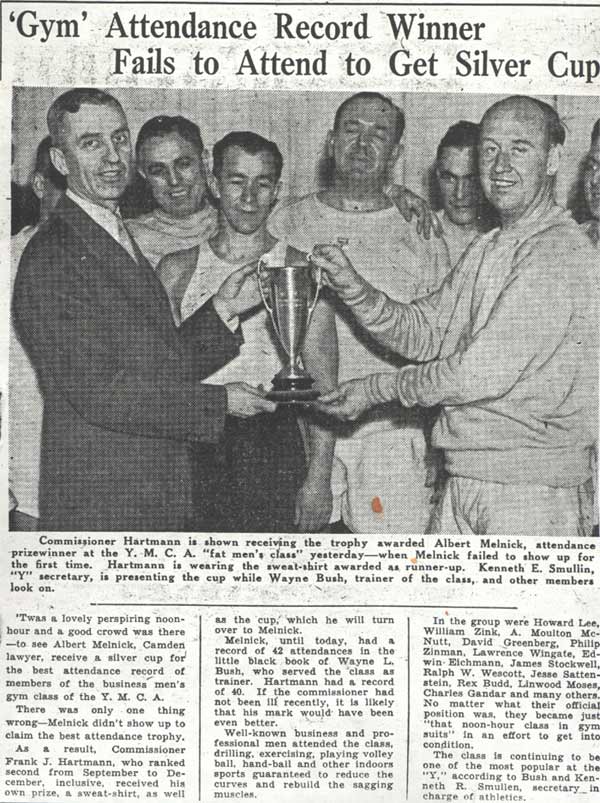
Frank J. Hartmann, Jr., director of public works, who holds the record for attendance at the city’s new gym during the first month of its operation, was absent last night when Director of Revenue and Finance Harold W. Bennett was to present him with the silver cup — in its holder fashioned from a city sink, — awarded the champion attendant.
But Frank was home in bed with a cold. The cup was claimed in his behalf by James Reilly and John Tobin, who attended in his behalf and explained his absence. Hartmann was winner in the group which includes all city employes. He attended 18 of 21 nights the gym was open.
Camden Courier-Post — January 18, 1938
FUTURE OF WCAM AWAITS CITY ACTION
Highest Bidder to Receive Lease of Municipal Radio Station
The future of Camden’s municipally owned radio station WCAM probably will be decided today at a special meeting of the city commission.
The present lease negotiated March 1, 1935, with the Broadcast Advertising Company, 1716 Federal street, expires February 1.
In order to provide for a new lease the City Commission must first approve a resolution authorizing advertisements for bids.
Under the terms of the present lease, the company headed by Mrs. Rud Preisendanz, whose late husband was former president, pays $1500 a year. The contract calls for the company to pay all operating, maintenance, studio and office expenses.
Recent reports indicate several persons have sought to lease the station. It is rumored officials of WCAU, the Columbia Broadcasting System outlet in Philadelphia, would seek the station for short wave and experimental broadcasts.
Future of WCAM Awaits City Action (Continued from Page One)
John J. Crean, assistant city solicitor, has prepared information and data in connection with the plans for a lease. He said the city is interested in getting more revenue from the station. It is understood the lease will be awarded to the highest bidder.
When the present lease was approved the only other bidder was Clarence Moulette, a clerk in the department of revenue and finance. Moulette’s bid at that time was $1800 for the first year, $2400 for the second year and $3000 for the third year, plus 10 percent of the gross receipts over $25,000.
Sale Resolution Defeated
Mayor George E. Brunner revealed last August that he had an offer of $30,000 for the station. The proposal for the sale was defeated by the city rulers. Commissiones [sic] Frank J. Hartmann led the opposition. He averred the call letters WCAM are an advertising asset to the city.
When the resolution was brought up for a vote, Hartmann and Commissioners Frederick S. von Nieda and Harold W. Bennett voted against it. Mayor Brunner also voted no on the resolution.
The original cost of WCAM, when first operated with 1000 watts power, was approximately $30,000. An ordinance creating a bureau of broadcasting was approved September 18, 1926. Prior to that time the city operated a second-hand transmitter bought for $10,000 from Robert Galvin, who operated the first commercial radio station in the city. WCAM has for several years divided time with stations WCAP, Asbury Park, and WTNJ, Trenton. The station equipment has been expanded under permits of the Federal Communications Commission.
Camden Courier-Post — January 27, 1938
HARTMAN TO SPEAK TO PATRIOTIC ORDER
Realtor to Head Jr. O.U.A.M. Delegation at Meeting in Phila. Tomorrow
Harold L. Hartman, secretary of the real estate firm of Evered, Inc., and past state councilor of the Junior Order of United American Mechanics, of New Jersey, will speak at a meeting of the Fraternal Patriotic Americans tomorrow night in P.O.S. of A. Hall, 1317 North Broad street, Philadelphia.
Members of Abraham Browning Council, No. 122, of which Hartman is a past councilor, will accompany him on the Philadelphia visit. Camden members will be guests of Diligent Council, No. 4, Fraternal Patriotic Americans. Pennsylvania and New Jersey state Jr. O.U.A.M. members also will attend.
The delegation will leave the local council headquarters, 531 Penn street, at 7.30 p. m. The committee includes Elwood Sharp, Walter S. Agin and Eugene S. Miller.
HARTMANN ASSAILS LIGHT RATES HERE
Highest for Any Large City in State With Exception of Trenton
Camden consumers pay the highest per capita rate for electricity of any large city in the State with the exception of Trenton, Commissioner Frank J. Hartmann declared yesterday.
Referring to the latest advertised reduction in electric power costs, a reminder of which is printed on current Public Service electric and gas bills, Hartmann discounted the reductions claimed.
“Electric rates to the private consumer have been minutely reduced from time to time,” Hartmann said, “but such reductions were made only after considerable agitation or by manipulation of voltages which tended to compensate for such reductions, in reality, increase the consumer’s bill.”
The commissioner declared it is the sworn duty of every elected municipal official as well as those elected to the State Legislature to fight for legislation aimed to demand more equitable electric and gas rates.
Cites Light Plant Votes
Camden voters, he said, twice voted in favor of a municipal electric plant in Camden and it is the duty of the legislative members from Camden county to make every effort to pass legislation that will enable Camden to obtain PWA funds for its own electric power plant.
“Take the case of street lighting,” Hartmann added. “In the city of Camden the taxpayers in 1937 paid $115,582 for street lighting alone. This figure does not include other electric and gas service. Street lighting costs alone represented 13 percent of my 1937 budget.”
“Street lighting, because of monopolistic control, is not sold at a price for which the service is worth, but at a price for which the company thinks it could get for the service,” he declared.
“The high cost for electric service, largely is due to the fact Public Service loses money on the operation of its vast transportation system and losses are reflected in high electric rates.”
Seeks End of Gas Lights: Hartmann disclosed he will attempt during the year to have all street lighting standardized.
Camden Courier-Post — February 7–11, 1938
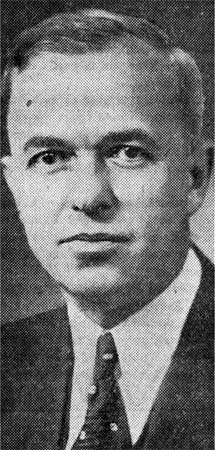
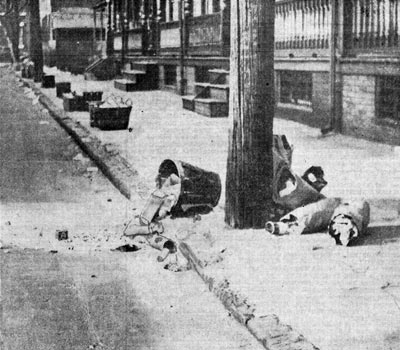
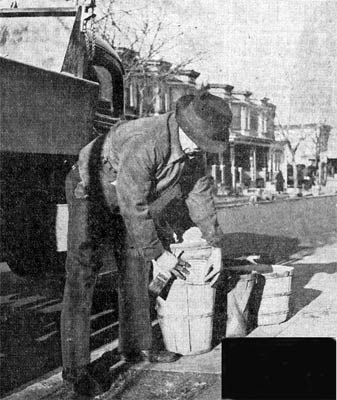
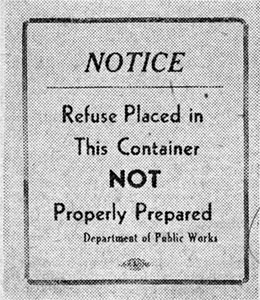
Photographs from the Camden Courier-Post, February 7–9, 1938, illustrating Commissioner Hartmann’s trash and refuse cleanup campaign. The photographs show: a portrait of Harry Willson; trash cans and refuse scattered on a Camden sidewalk; a city worker collecting refuse; and a Department of Public Works notice reading “NOTICE — Refuse Placed in This Container NOT Properly Prepared.”
See also Harry J. Wagner Jr.
Camden Courier-Post — February 12, 1938 (Moose Lodge)
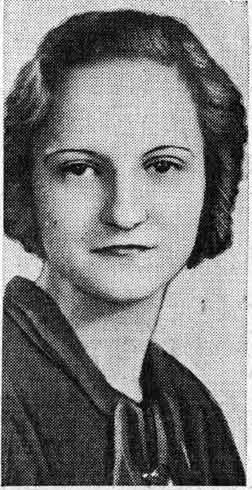
Portrait photograph of a woman associated with Moose Lodge No. 111 event. Camden Courier-Post, February 12, 1938.
Camden Courier-Post — February 21, 1938
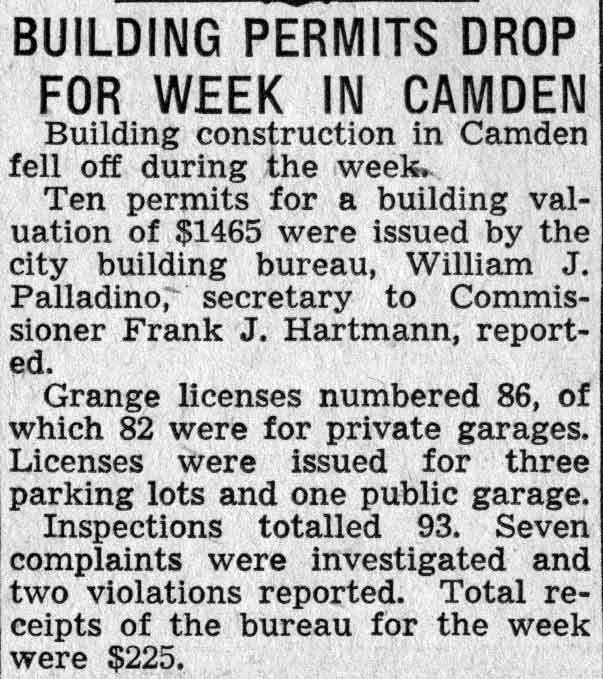
BUILDING PERMITS DROP FOR WEEK IN CAMDEN
Building construction in Camden fell off during the week.
Ten permits for a building valuation of $1465 were issued by the city building bureau, William J. Palladino, secretary to Commissioner Frank J. Hartmann, reported.
Grange licenses numbered 86, of which 82 were for private garages. Licenses were issued for three parking lots and one public garage.
Inspections totalled 93. Seven complaints were investigated and two violations reported. Total receipts of the bureau for the week were $225.
Camden Courier-Post — February 23, 1938 (Dixon)
ASSEMBLY APPROVAL ASSURED ON HOUSING
Further Delay Held Endangering Chance of Obtaining Federal Funds
Assembly approval of the long-delayed housing bills is expected tonight, Assemblyman Rocco Palese declared yesterday in announcing all difficulties confronting the measures have been “ironed out.”
Senate action also is expected, Palese reported.
Horace R. Dixon, secretary of the Camden Municipal Low-Cost Housing Committee has warned repeatedly, as have other members of the committee, that further delay will endanger the chances of obtaining Federal housing funds. Camden expects to apply for $8,000,000, Dixon said.
It has been estimated New Jersey will be allotted about $30,000,000 for slum clearance and low cost housing.
Felix Pitett, a Paterson banker, who is named in one of the bills as State housing administrator, told the members of the Assembly Housing Committee that if the job carries a salary he “would not be interested,” Palese said.
Paid Administrator Opposed
The local committee, which was instrumental in the formation of the New Jersey Conference of Municipal Low-Cost Housing Committees, opposed the naming of an administrator in the bill. Opposition was based on the creation of a high salary position.
Assemblyman Oscar R. Wilensky, of Passaic, drew the bills and named Pitett as administrator, but did not fix his salary. The bill named a deputy director at $4000 annually. The Camden group and members of other State committees withdrew their opposition when Wilensky agreed to drop his plan to set up county regional housing authorities.
“Pitett’s surprise statement changed the complexion of the bill,” Palese said. “I think Pitett’s action is almost without precedent. He is to be commended for his action. He told the committee he cannot give full time to the job but is willing to serve on a part time basis without compensation.”
Dixon scored rumors that municipalities have committees, and those which will set up local housing authorities to conform with the State legislation, seek to spend money for salaries of committee members.
$2500 Limit Demanded
“The local committee and those in the State group have definitely opposed any plans or schemes to set up a lot of salaried jobs,” Dixon said. “We want low-cost housing for Camden and we don’t intend to spend a lot of money for salaries and useless surveys.
“No municipality can spend more than $2500 for anything in connection with low-cost housing. One of the Assembly bills contains this provision.
“Camden is badly in need of low-cost housing. The slum areas must be eliminated and people shall have the right to rent modern, sanitary housing quarters at nominal rentals.”
The local committee and members of the State group, Dixon asserted, have opposed all political influence in the matter of obtaining enabling legislation for Federal funds.
Newark May Recall Action
Dixon said he understood an ordinance recently passed by the Newark City Commission, appointing a housing administrator and providing an annual appropriation of $10,000 for salary and expenses will be repealed, because it may conflict with the Assembly housing bills.
The present Newark ordinance also provides for the appointment of five housing commissioners each for a term of three years, and stipulates the City Commission shall fix the salary of the administrator.
Dixon said the local committee would be opposed to the appointment of a local administrator with a city salary.
Commissioner Frank J. Hartmann, who sponsored the present committee approved by the Camden City Commission, probably will present an ordinance at tomorrow’s meeting of the City Commission for a local housing authority and the appointment of five members as commissioners.
The present committee was created through a resolution approved by the commission.
Housing needs in Camden are more acute now than they were four years ago, Dixon told legislators in Trenton Monday night as he sought action on the housing bills.
Dixon, S. Raymond Dobbs, another member of the committee; Joseph Hettel, the technical adviser, and City Commissioner Harold W. Bennett, solicitor for the group, all attended the legislative session, but no action was taken on the bills.
Mayor Brunner and Commissioner Kobus joined in approving the resolution, but whether or not a vote to name members of an official local authority would be unanimous is a question. Recently, however, Bennett was named counsel for the present committee, indicating he and Commissioner von Nieda will go along with Hartmann if it comes to a controversy.
Bennett is studying the Newark ordinance creating a housing authority.
Camden Courier-Post — February 25, 1938 (Von Nieda)
GARBAGE ORDINANCE FOR CAMDEN PASSED ON INITIAL READING
Licensing of Scavengers Provided in Effort to Keep Streets Clean
CIRCULARS ACT DELAYED
An ordinance to regulate the collection and removal of ashes, rubbish and garbage was passed on first reading yesterday by the Camden City Commission. A companion ordinance to regulate distribution of circulars, hand bills, samples and advertising matter was laid on the table.
Both were introduced by Commissioner Frank J. Hartmann, director of the department of public works, to further his campaign to “clean-up” the city.
The proposal to regulate rubbish and garbage collection was opposed by Commissioner Frederick von Nieda who declared it would be harmful to “a lot of poor people.”
The measure provides that scavengers and others must pay a license fee, wear a badge and further stipulates conveyances used to haul rubbish and other articles must carry the city license number in numerals not less than six inches high.
Heavy Fine Provided
A fine of not more than $200, a county jail sentence of not more than 90 days or both are prescribed as penalties for violations of the many regulations in the ordinance. It provides stringent regulations affecting all householders and a penalty for dumping materials in streets, alleys and on lots. Garbage must be separated from rubbish and the former placed in a metal container weighing not more than 50 pounds. Waste materials including bricks, stone, garbage and similar substances cannot be deposited on lots or dumps without written permission of the director of public works.
It will be unlawful to break open any packages placed on sidewalks for collection as refuse or rubbish. This section is directed toward scavengers who rip open tied packages and permit the contents to litter the streets, Hartmann stated.
The annual license fee, including the identification badge, is 50 cents.
Hartmann said Camden citizens have displayed and expressed a willingness to co-operate in keeping city streets clean. He said more than eight million pounds of rubbish and garbage has been destroyed in the city incinerating plant in the last eight days.
The circular ordinance was laid over after von Nieda asked that copies be given each member of the commission. City Clerk Clay W. Reesman previously read a protest contained in a telegram from Benjamin Shatz, secretary of the South Jersey Grocers Association.
Stamps to Be Sold
It provides a license must be taken out by the distributing company or agency and fixes a charge for badges to be supplied by the city and to be worn by employes engaged in distribution of advertising matter and samples. Each piece of advertising matter and all samples must carry a stamp which will be cancelled by imprints of the licensee number. Stamps will be sold at the rate of 25 cents per hundred.
Other regulations prohibit placing of advertising matter on parked automobiles, makes it an offense to cross lawns or hedges, provides that advertising and samples shall be tightly bound with rubber bands and that same must be fastened to doorways or placed in receptacles for that purpose.
A section permits any householder, resident or business concern to obtain an official card reading “No Circulars,” to be posted on their premises. The cost is 25 cents. It will be unlawful to leave advertising materials at places displaying the signs.
No person under 14 years of age will be permitted to engage in distribution work. The maximum penalty for violations is a fine up to $200, a county jail sentence up to 90 days or both. City Solicitor Firmin Michel said the fees will be decided on at a later date.
Camden Courier-Post — February 26, 1938 (Evered)
REAL ESTATE BOARD URGES CITY-OWNED HOUSES
Sees Means of Improving Living Conditions for Low Wage Earners
WOULD MEAN REVENUE
A proposal for renovation of 250 city-owned properties with WPA funds to provide better living accommodations for families of lower income will be studied by a special housing committee of the Camden County Real Estate Board.
Action for a survey of the situation in co-operation with the office of City Commissioner Frank J. Hartmann, Jr., was taken at the weekly luncheon of the board in Hotel Walt Whitman.
WPA Could Make Survey
Carl R. Evered, chairman of the housing committee, explained the survey would be made at little or no cost to the city. The recommendation was made before the board in the form of a motion, which was unanimously approved. The recommendation was ordered referred to the housing committee for study and action.
Evered stressed need for a housing committee composed of board members who “should stand ready at all times to advise the city” to ensure the housing enterprise is “conducted properly.”
“This Westfield Acres project,” he said, “for the city to recondition properties at a cost of $10,000 or less each, is a good thing for the city. If you will conduct the housing of these people on a business-like basis, I can assure the board that they are not in need of repair and can pay a fair rental.”
Schools and Relief Also Watched
Exception was taken by S. Raymond Dobbs to the statement made by a number of houses specified as condemned. “I think I should know the true condition of city property,” said Dobbs. “I served as the city’s own real estate man from my former position as assistant to Commissioner Hartmann.”
Camden Courier-Post — February 26, 1938 (McConnell)
CONFERENCE CALLED ON BUS TERMINAL
Business Men, Civic, Bridge and Transit Officials to Meet Tuesday
By DAN McCONNELL
Camden business men will renew their campaign to establish a union bus terminal in Roosevelt plaza, opposite City Hall.
This was learned yesterday when James V. Moran and Commissioner Frank J. Hartmann revealed plans for a conference of business men, bus companies, P.R.T., Public Service and officials of the Delaware River Joint Commission at 10 a. m. next Tuesday.
Hartmann said the meeting will be held in his City Hall office and that Moran had rallied the business men and invited others including a committee of the Camden County Chamber of Commerce to attend.
Moran will head the delegation of business men. Public Service will be represented by Thomas N. McCarter, Jr., assistant vice president, and Herbert E. Harper, division manager. David Baird, bridge commissioner, Joseph K. Costello, manager of the bridge, Loyal D. Odhner, executive secretary of the C. of C., operating officials of independent bus companies and officials of the P.R.T. will be present, Moran said. A delegation from the Broadway Businessmen’s Association will also attend. (Continued on Page 15—Column 6)
Conference Called On Bus Terminal (Continued From Page One)
“I feel confident this conference will prove a step nearer the establishment of a union bus terminal,” Moran said. “The City Hall site is ideal inasmuch as the high-speed line station is located at that point. Operation of buses into the terminal and increased service on the high-speed line would bring more people into Camden to shop. Thousands of persons would use the local buses and the high-speed line to avoid the increasing congestion of buses in Philadelphia.
“The majority of business men on Broadway and in downtown Camden approve the bus terminal and are determined it shall be built. If the business interests of the city, the utility companies and bus operating companies co-operate the terminal will prove a sound investment and a profitable enterprise.”
Commissioner Hartmann reiterated he is opposed to a make-shift terminal that would mar the appearance of the city hall plaza. “It has been estimated a modern terminal will cost at least $400,000,” Hartmann said. “I will oppose a terminal that includes ‘cow sheds’ or structures of that type. A modern terminal, properly operated, will bring business to Camden and provide the city with additional revenue.
“The high-speed line is losing money and Public Service and other bus operating companies lose money on every bus that goes over the bridge. A joint agreement to use the proposed union terminal will result in a reduction of losses by the bus companies and increased high-speed line receipts. Such a terminal will serve public convenience and bring suburban shoppers into the city to spend their money here. Local bus service would materially be improved.”
See also Daniel P. McConnell.
By Jiminy
Camden Courier-Post —

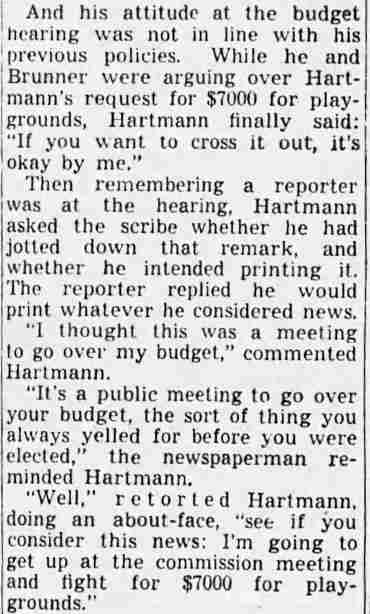
Checked and Double-Checked
By JIMINY
Politix: The question mark of the budding city commission campaign is, of course, Commissioner Frank J. Hartmann. The latter was apparently defeated on the face of election day returns four years ago, but the organizations of Mayor George Brunner and Commissioner Mary Kobus put up the money to finance a recount. The result was that Hartmann was declared the winner, and the Brunner-Kobus-Hartmann majority ran the city’s affairs.
The results accomplished by the Brunner-Kobus-Hartmann administration have caused numerous persons, political and otherwise, to express the wish that the three commissioners run on the same ticket at the May election. Mayor Brunner and Mrs. Kobus are committed to run together, but to date Hartmann has made absolutely no move to join them. In fact, it appears that he has gone out of his way in an effort to antagonize them.
Moreover, his actions of the last week or so have created doubt in the minds of some observers as to whether he intends to run on any ticket, as a lone wolf, or not at all. The last point is easily answered. Hartmann himself declared this week: “I’m GOING to be re-elected!” Furthermore, he has been busy building up an organization of his own. Employes in his department have been ordered to form “Hartmann for Commissioner” Clubs in their wards. A campaign fund is being raised among his employes for his election expenses. He has been having conferences with County Treasurer Ed Kelleher, Democrat, and Irving Levinsky, a Verga Republican, among others.
But some of the things that Hartmann has done or attempted during the last few days has caused a goodly portion of our citizenry to wonder whether someone hasn’t been misleading Hartmann with a great deal of very bad advice.
For instance, this week Hartmann offered a departmental budget that exceeded his last year’s budget by approximately $90,000, which would have meant about a seven-cent increase in the city tax rate for 1939. That is just about political suicide before a city election, and is not at all in line with Hartmann’s past pledges and performances. As head of the finance department Mayor Brunner cut out the greater part of this unusual increase, and was justified in doing so to protect the taxpayers.
There were a few other unusual little affairs this week. Hartmann shouted “Liar!” at City Comptroller Sid McCord this week, but apologized later. “Sid” is probably the best liked city employe and certainly one of the most efficient public servants these last ten decades. One of Hartmann’s employes went to the comptroller’s office Monday—the city payday—and asked for all the salary checks for highway department employes.
Moreover, since his own extra-high budget was trimmed, Hartmann has had an employe going over the Brunner and Kobus payrolls to see how many were hired since 1936. His own payroll might be scrutinized in the same manner.
And his attitude at the budget hearing was not in line with his previous policies. While he and Brunner were arguing over Hartmann’s request for $7000 for playgrounds, Hartmann finally said: “If you want to cross it out, it’s okay by me.”
Then remembering a reporter was at the hearing, Hartmann asked the scribe whether he had jotted down that remark, and whether he intended printing it. The reporter replied he would print whatever he considered news.
“I thought this was a meeting to go over my budget,” commented Hartmann.
“It’s a public meeting to go over your budget, the sort of thing you always yelled for before you were elected,” the newspaperman reminded Hartmann.
“Well,” retorted Hartmann, doing an about-face, “see if you consider this news: I’m going to get up at the commission meeting and fight for $7000 for playgrounds.”
Magin Promotes 3, Rehires 3, Fires 4
Camden Courier-Post —
Temporary Laborers Dismissed, While Men Ousted by Hartmann Are Reinstated
Three dismissals, three promotions and four reinstatements and two new hirings were announced yesterday by City Commissioner Henry Magin, director of public works.
Dismissed were Eugeni Gatti, 208 Washington Street; Giulio Marcozzi, 321 Line Street, and George Pollard, 336 Stevens Street, all temporary laborers at $4 a day. James Carr, 1409 Princess Avenue, a laborer on asphalt repairs at $6 a day, is reclassified as general foreman of the department, effective today, at $2100 a year, subject to Civil Service promotional examination. John Dziekanski, 1414 Mt. Ephraim Avenue, a laborer in the building bureau at $6 a day, is reclassified as architectural draftsman at $2100, also subject to examination. Oscar Moore, 543 Washington Street, Ninth Ward freeholder, will receive $6 instead of $5 a day as a temporary laborer.
Reinstated were Lawrence Abbott, 910 South Third Street, a brother of Frank Abbott, deputy to Mayor Brunner, as a temporary laborer at $5 a day; Anthony Carrier, 416 Benson Street, a temporary laborer at $4 a day; James Jackson, 1117 Lawrence Street, and Otis Still, 261 North Eleventh Street. All were discharged by Frank J. Hartmann, Magin’s predecessor.
Health Bureau Job Given Pete Samko
Camden Courier-Post —
8th Ward Democratic Club Aide Replaces Scheurman; Magin Hires 16
The hiring of Pete Samko, secretary of the Eighth Ward Democratic Club, as a $1380-a-year clerk in the health bureau, was announced yesterday by City Commissioner E. George Aaron. He replaces Frederick Scheurman, of 2969 Hartford Road, former Fourteenth Ward Republican committeeman.
Commissioner Henry Magin announced the hiring of 16 temporary laborers for the Water and Highway departments which come under his Department of Public Works. The jobs, Magin said, are all replacements for persons who have been dismissed since he took office. He explained that 102 have been laid off during the period and 66, including yesterday’s hiring, put on to replace them.
Three of the 16 will be assigned to the water bureau, Magin said, and the others to the highway department.
Hired, Replaced
Employment of two new laborers and reinstatement of two others was announced Wednesday by Commissioner Magin. Three employees who worked under former Commissioner Frank J. Hartmann were dismissed. The pay of all was $4 per day.
The new men are George Poole, of 276 Senate Street, and William Weidman, 1041 North Thirty-fourth. Reinstated were James Jackson, 1117 Lawrence, and Otis Still, 261 North Eleventh. Those let out were Eugene Gatti, 208 Washington; Julio Marcozzi, 321 Line, and George Pollard, 336 Stevens.
Camden Courier-Post — June 9, 1938
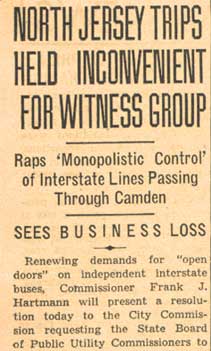
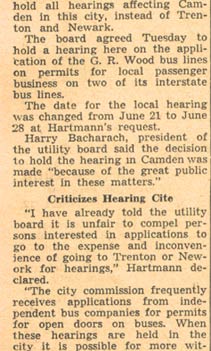
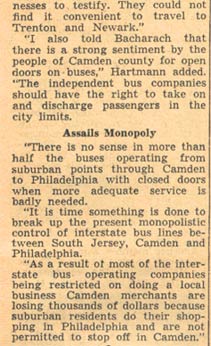
NORTH JERSEY TRIPS HELD INCONVENIENT FOR WITNESS GROUP
Raps ‘Monopolistic Control’ of Interstate Lines Passing Through Camden
SEES BUSINESS LOSS
Renewing demands for “open doors” on independent interstate buses, Commissioner Frank J. Hartmann will present a resolution today to the City Commission requesting the State Board of Public Utility Commissioners to hold all hearings affecting Camden in this city, instead of Trenton and Newark.
The board agreed Tuesday to hold a hearing here on the application of the G. R. Wood bus lines on permits for local passenger buses on two of its interstate bus lines.
The date for the local hearing was changed from June 21 to June 28 at Hartmann’s request.
Harry Bacharach, president of the utility board said the decision to hold the hearing in Camden was made “because of the great public interest in these matters.”
Criticizes Hearing Cite
“I have already told the utility board it is unfair to put people to the expense and inconvenience of going to Trenton or New York for hearings,” Hartmann declared.
“The city commission frequently receives applications from independent bus companies for permits for open doors on buses. When these hearings are involved, it would be possible for more witnesses to testify. They could not find it convenient to travel to Trenton and Newark.”
“I also told Bacharach that there is a strong sentiment by the people of Camden county for open doors on buses,” Hartmann added.
“The independent bus companies are being restricted in doing a local business Camden merchants are losing thousands of dollars because suburban residents do their shopping in Philadelphia and are not permitted to stop off in Camden.”
Assails Monopoly
“There is no sense in more than half the buses operating from suburban points through Camden to Philadelphia, with closed doors, when more adequate service is badly needed.
“It is time something is done to break up the monopolistic control of interstate bus lines between South Jersey, Camden and Philadelphia.
“As a result of most of the interstate bus operating companies being restricted in doing a local business Camden merchants are losing thousands of dollars because suburban residents do their shopping in Philadelphia and are not permitted to stop off in Camden.”