1841
On March 12, 1841 the Camden Mutual Fire Insurance Company was chartered. It continued as a mutual association until July 1, 1870, when it was converted into a stock company, although it was not until 1881 that the word “Mutual” was dropped from the name and the name Camden Fire Insurance Association was adopted. The original office building was erected at the southwest corner of Fifth and Federal Streets in 1858. Prior to that time the Director’s meetings had been held until 1853 at Parson’s Hotel, at the Federal Street Ferry.
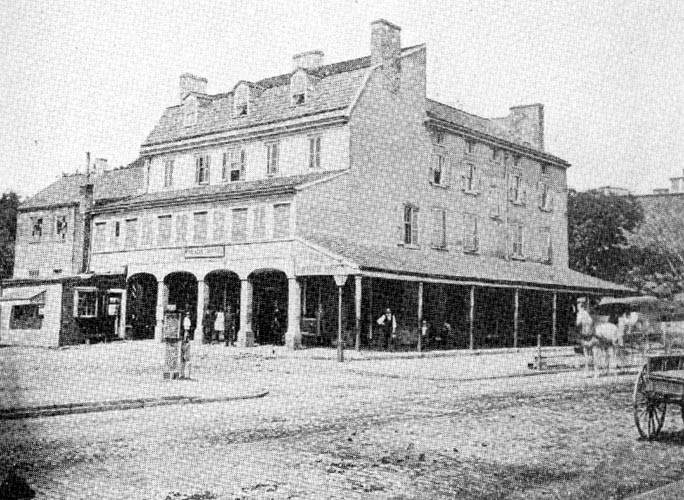
Parson’s Hotel, Camden, New Jersey.
From 1853 to 1858 the “home office” was located in the general store kept by Jonathan Burr at the northeast corner of Third and Plum (Arch) Streets, where the Post Office building was erected at the turn of the century. In 1899 a new building, designed by noted architect Arthur Truscott, was erected at the site of the original location, the southwest corner of Fifth and Federal Streets.
Fire insurance was introduced to Camden as early as 1832. On March 16 of that year the Legislature passed an act incorporating “The Camden Insurance Company” with a capital stock of $50,000 and the privilege to increase to $150,000. After some years the management fell into the hands of persons who did not act in accordance with the provisions of the charter, and the legislature, on March 2, 1849, appointed Abraham Browning, Thomas H. Dudley, and Isaiah Toy as trustees to settle the affairs of the company.
1842
The first night boat between Camden and Philadelphia was put on July 4, 1842, by the Camden and Philadelphia Ferry Company, the last boat leaving Camden at 9:00 PM and Philadelphia at 9:30 PM.
1843
The first election in New Jersey of Members of Congress by Congressional Districts, instead of at large, was held in 1843. The First District comprised Cape May, Cumberland, Salem, Gloucester, and Atlantic Counties. Camden County had not yet been created, and was still a part of Gloucester County. The first nominee sent to Congress by the voters of the First District was Lucius Q. Elmer, of Cumberland County, his majority being about 300 votes in the district.
1844
John K. Cowperthwaite, the first Mayor of Camden, was chosen under the Act of March 9, 1844.
1845
The Camden Water Works Company was incorporated by an act of the Legislature approved April 2, 1845 and authorized “to supply the city of Camden with pure water under such terms, regulations and conditions as city council shall by ordinance ordain and establish.” The principals in the company were Isaac Cole, Benjamin W. Cooper, Charles Kaighn, Henry Allen, William Folwell, Nathan Davis, Benjamin T. Davis, John W. Mickle, and James Elwell. The company became familiarly known as the “Henry Allen Company”.
The original plant was located on a lot 30 by 90 feet at what was then the foot of Cooper Street (later the center of the Esterbrook Pen Works), and was purchased from William D. Cooper for $400. The iron pipe laid by the company came from Jesse Richard’s furnace at Batsto. The supply of water was turned into the mains on November 1, 1846.
In 1854 by a supplement to its charter the company was authorized to increase its capital stock and to hold lands outside the city limits, and it built a plant at Pavonia, which continued to supply water to the city until 1870, when under an act of the Legislature Camden purchased all of its rights and appurtenances for the sum of $200,000.
The city operated the plant at Pavonia from 1870 until the spring of 1899, when the new plant at Morris Station, on the Delaware River just below the mouth of the Pennsauken Creek, was completed and in full operation, and since that time the Pavonia plant has been kept as a reserve station.
In 1903 the supply as taken from the Delaware River became so polluted that a general agitation was started to secure another source of supply, or a method of improving the quality of the supply then used. The report of the expert selected by the city recommended that the Delaware River still be maintained as a source of supply, but that the water be first subjected to sand filtration before running into the service pipes. This, however, did not meet the approval of many citizens, and finally bids were opened on September 3, 1895, by the Water Committee of City Council for furnishing Camden with an improved supply of water. Nothing was done with these proposals, but instead it was decided to sink some test wells to ascertain the character, quality, and quantity of the subterranean waters. The present Morris Station site was selected and finally on April 2, 1896, bids were received and opened for the construction of a plant to furnish 20,000,000 gallons daily supplied by the artesian wells. The contract was awarded to George Pfeiffer Jr. on June 24, 1896 for the sum of $600,000. After considerable trouble, due to the wording of the contract as to time-limit and actual capacity of the plant constructed under the specifications, the city finally seized the plant under authority of a resolution of City Council of January 20, 1899. The city has been supplied entirely with artesian well water since the Spring of 1899.
1846
The First Presbyterian Church effected a permanent organization on June 25, 1846. The West Jersey Presbytery had organized the church on September 27, 1840, but owing to a lack of funds to build a church edifice the project was temporarily abandoned in December of 1841. The first place of worship was in the old City Hall on Federal Street above Fourth. The cornerstone of the first church was laid October 28, 1846, and the building was located on the east side of Fifth Street between Market and Cooper. This edifice was used by the congregation until a church at Fifth and Penn Streets was erected.
The cornerstone of that building was laid on June 22, 1871 and the building was dedicated on June 1, 1873. The tall spire on the original church was taken down in April of 1912. The First Presbyterian Church combined with the Second Presbyterian Church on March 25, 1923, and the Calvary Presbyterian Church also became a part of this congregation on June 22, 1924.
1848
The Second Baptist Church was organized in 1848. The first edifice at Fourth and Division Streets was dedicated in November of 1852. This property was sold in 1867 to the Roman Catholic Church of St. Peter and St. Paul. The congregation erected a new building at Fifth and Mount Vernon Streets, and dedicated it on January 26, 1868. In 1894 the church disbanded and the Emanuel Baptist Church was organized and acquired title to the building formerly owned by the Second Church.
1849
The West Jersey Hotel at Delaware Avenue and Market Street was built by the West Jersey Ferry Company in 1849. The name was changed to New Camden Hotel in 1909. A few years later the name was again changed, this time to the Hotel Ridgway and passed to the management of the company operating the Ridgeway House at the foot of Market Street, Philadelphia. The porches and cupola which adorned the original structure were removed in December of 1911.
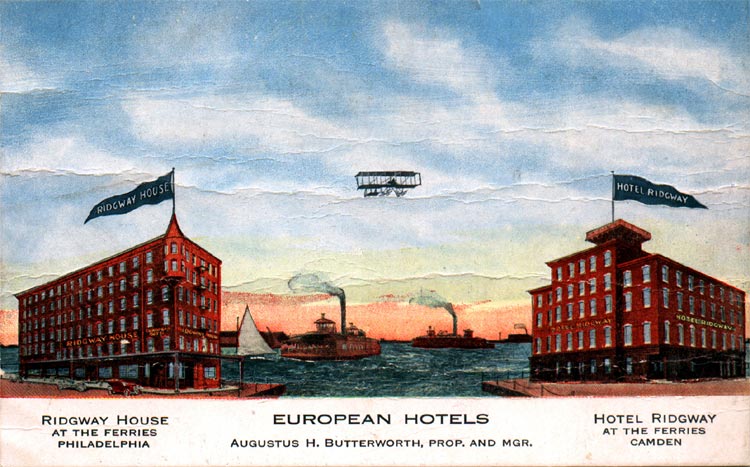
While the airplane indicates that this postcard dates from around 1918, the drawing of the Hotel Ridgway is from before 1911. Note the cupola on the roof of the hotel.