Introduction
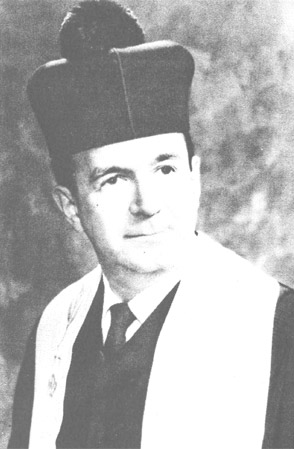
Cantor Louis J. Herman
Cantor Louis J. Herman was originally from Toronto, Canada. His father, Rev. Samuel Herman, had been a Cantor in Montreal and Toronto. A boy soprano, Cantor Louis Herman was a protégé of the world-famous Cantor Yossele Rosenblatt, and had sung on the famous Maxwell House Coffee Hour on New York’s Jewish Station WEVD. During the 1920s and 1930s he sang professionally in Canada and throughout the American middle west and northeast. He hosted a radio show in Canada beginning in 1937.
When Canada entered into World War II, Louis Herman enlisted in the Canadian Army. He appeared in army stage shows in Canada and overseas, and also saw combat duty. He had been promoted to the rank of sergeant by the war’s end.
Returning to Canada, Louis Herman returned to singing, and studied at Canada’s Royal Conservatory of Music. A show business career, however, was not in the works. Louis Herman followed in his father’s footsteps, and became a cantor.
In 1957 Cantor Louis Herman came to Camden NJ, to Congregation Beth El where he succeeded Cantor Simon Kriegsman. Beth El’s 50 year anniversary book states that “Cantor Herman’s beautiful tenor voice and traditional rendition of the service has been warmly and enthusiastically received by the Congregation for these last fourteen years. In addition to his Cantorial duties, he teaches Bar Mitzvah boys and leads the Congregation’s Choral Group.” Cantor Herman took the Choral Group to Israel in 1961 to perform.
The Herman family first settled in Camden’s Parkside section, residing at 1507 Baird Avenue, which had been the home of Peter Carter, who had been the chief of the Camden Fire Department. They resided there until following Beth El in its move to Cherry Hill NJ in the late 1960s.
Cantor Herman’s wife Yetta was deeply involved in Jewish education, first in Philadelphia and later at Beth El. Cantor Herman served Congregation Beth El until his retirement in 1982. He passed away on December 16, 2004.
The Herman family continues to serve the Jewish community. Son David Herman is a Rabbi in Baltimore MD, and is the executive director of Maryland Friends of Boys Town Jerusalem, a school for disadvantaged youth in Israel.
Cantor Shloime Selsky Choir
Toronto, 1920s
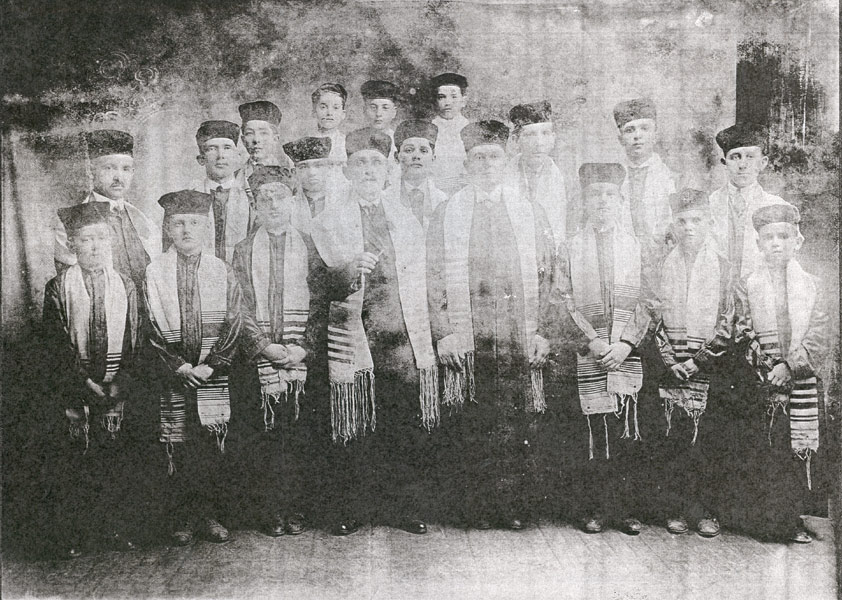
Cantor Shloime Selsky Choir, Toronto, 1920s — Louis J. Herman on bottom row, far left
Cantor Yossele Rosenblatt
Chicago, Fall 1925
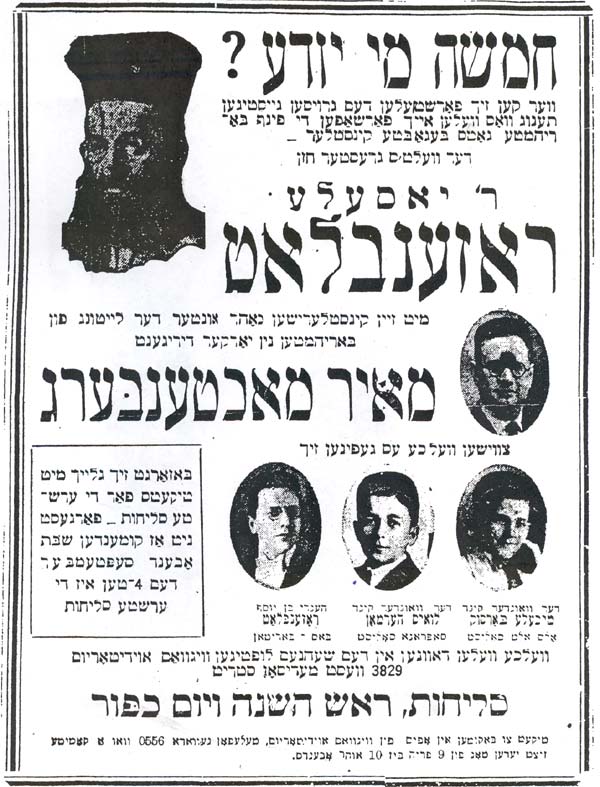
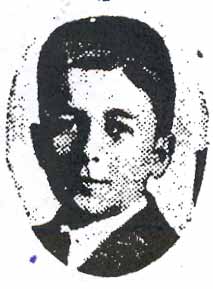
Cantor Yossele Rosenblatt (upper left) at High Holy Day Services in Chicago, IL — Fall, 1925. Below: Louis J. Herman. Read a Review of the Show

Rosenblatt Creates Glorious Melodies at Brilliant Rosh Hashana Service
Chicago Newspaper — 1926
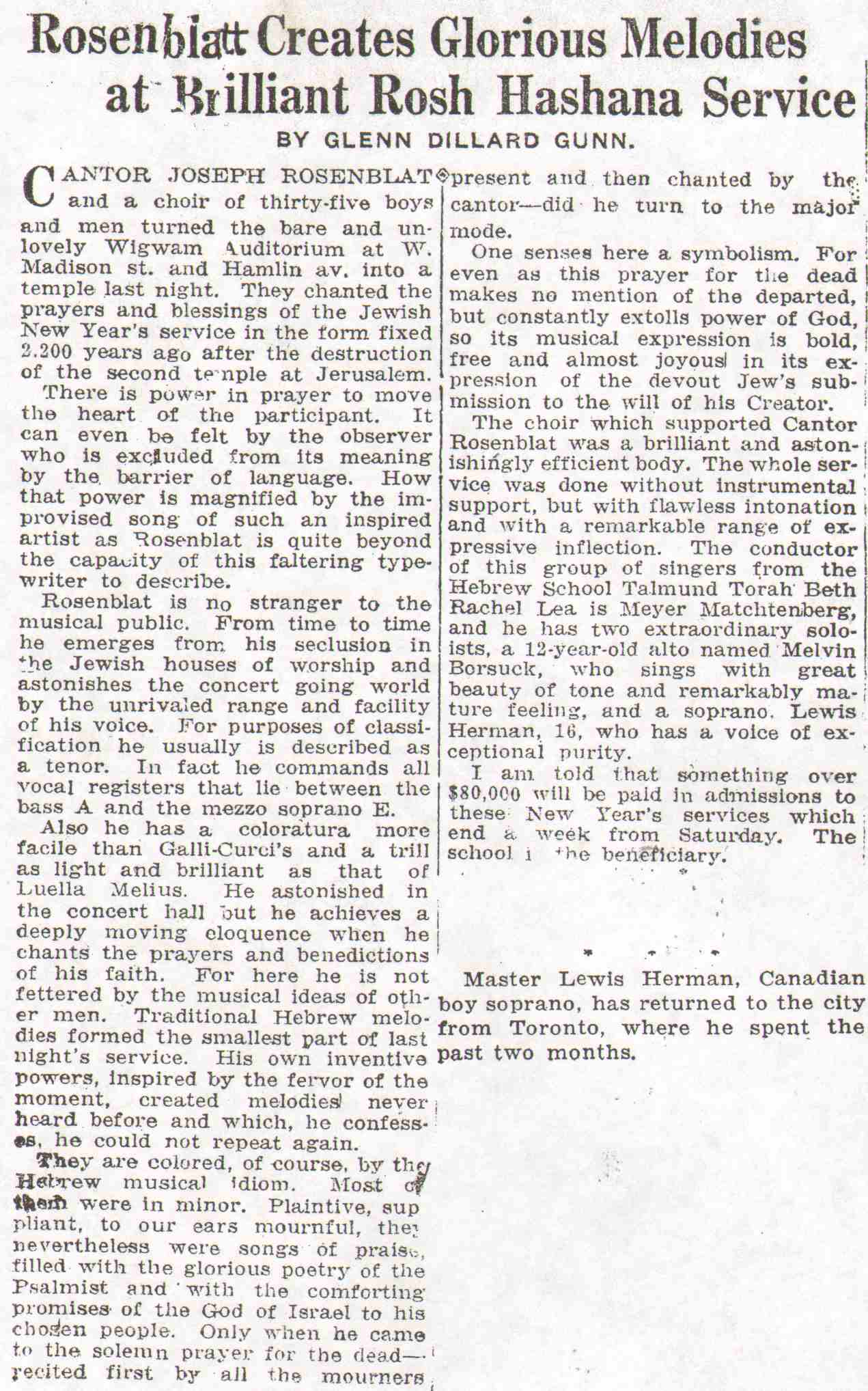
By Glenn Dillard Gunn.
Cantor Joseph Rosenblatt and a choir of thirty-five boys and men turned the bare and unlovely Wigwam Auditorium at W. Madison st. and Hamlin av. into a temple last night. They chanted the prayers and blessings of the Jewish New Year’s service in the form fixed 2,200 years ago after the destruction of the second temple at Jerusalem.
There is power in prayer to move the heart of the participant. It can even be felt by the observer who is excluded from its meaning by the barrier of language. How that power is magnified by the improvised song of such an inspired artist as Rosenblatt is quite beyond the capacity of this faltering typewriter to describe.
Rosenblatt is no stranger to the musical public. From time to time he emerges from his seclusion in the Jewish houses of worship and astonishes the concert going world by the unrivaled range and facility of his voice. For purposes of classification he usually is described as a tenor. In fact he commands all vocal registers that lie between the bass A and the mezzo soprano E.
Also he has a coloratura more facile than Galli-Curci’s and a trill as light and brilliant as that of Luella Melius. He astonished in the concert hall but he achieves a deeply moving eloquence when he chants the prayers and benedictions of his faith. For here he is not fettered by the musical ideas of other men. Traditional Hebrew melodies formed the smallest part of last night’s service. His own inventive powers, inspired by the fervor of the moment, created melodies never heard before and which, he confesses, he could not repeat again.
They are colored, of course, by the Hebrew musical idiom. Most of them were in minor. Plaintive, suppliant, to our ears mournful, they nevertheless were songs of praise, filled with the glorious poetry of the Psalmist and with the comforting promises of the God of Israel to his chosen people. Only when he came to the solemn prayer for the dead—recited first by all the mourners present and then chanted by the cantor—did he turn to the major mode.
One senses here a symbolism. For even as this prayer for the dead makes no mention of the departed, but constantly extolls power of God, so its musical expression is bold, free and almost joyous in its expression of the devout Jew’s submission to the will of his Creator.
The choir which supported Cantor Rosenblatt was a brilliant and astonishingly efficient body. The whole service was done without instrumental support, but with flawless intonation and with a remarkable range of expressive inflection. The conductor of this group of singers from the Hebrew School Talmund Torah Beth Rachel Lea is Meyer Matchtenberg, and he has two extraordinary soloists, a 12-year-old alto named Melvin Borsuck, who sings with great beauty of tone and remarkably mature feeling, and a soprano, Lewis Herman, 16, who has a voice of exceptional purity.
I am told that something over $80,000 will be paid in admissions to these New Year’s services which end a week from Saturday. The school is the beneficiary.
Master Lewis Herman, Canadian boy soprano, has returned to the city from Toronto, where he spent the past two months.
Central Park Theatre
Chicago, 1926
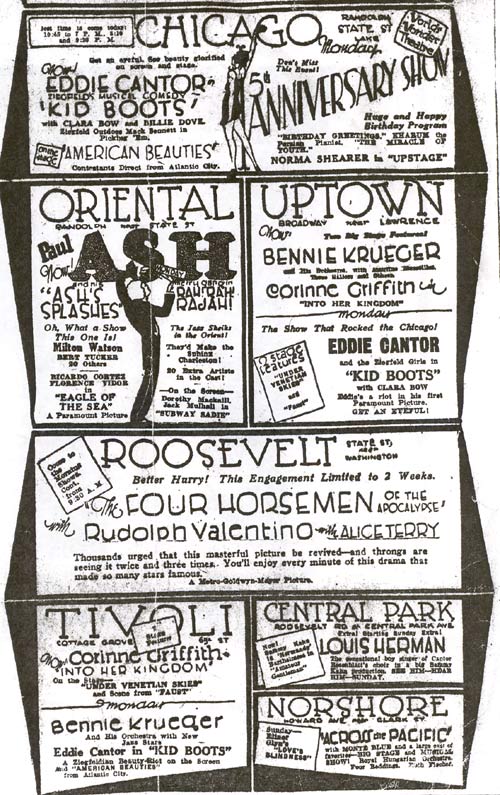
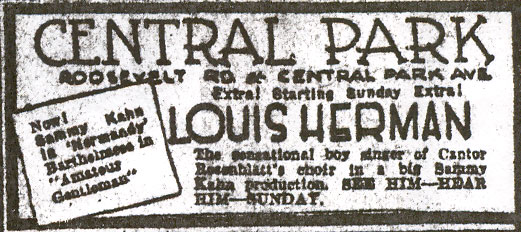
1926 — Louis Herman appeared at the Central Park Theatre in Chicago, Illinois
Photos
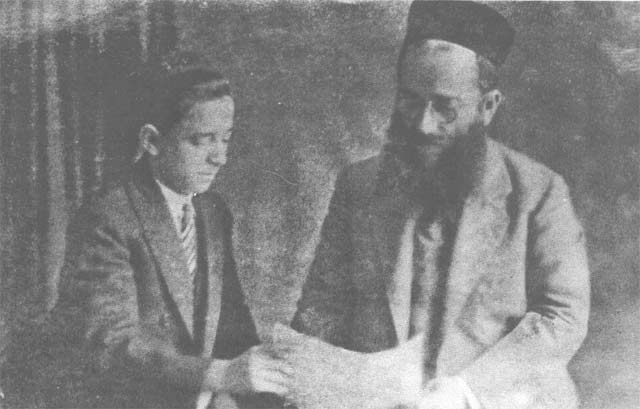
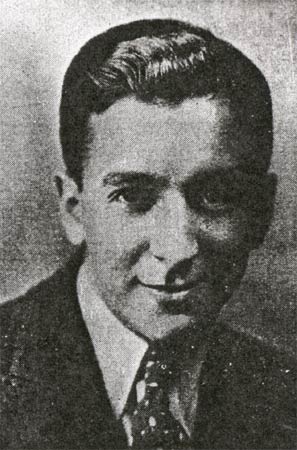
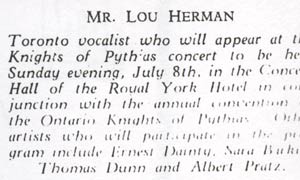
Mr. Lou Herman, Toronto, 1920s
The Scoop
Toronto,
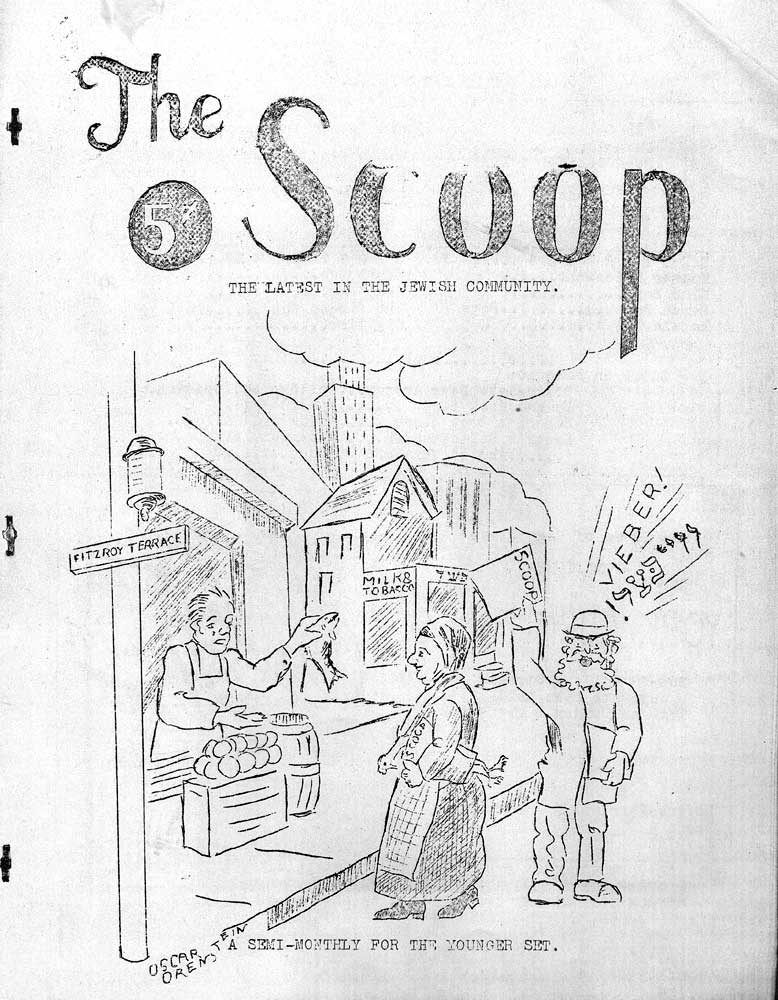
The Scoop — Toronto, May 15, 1931
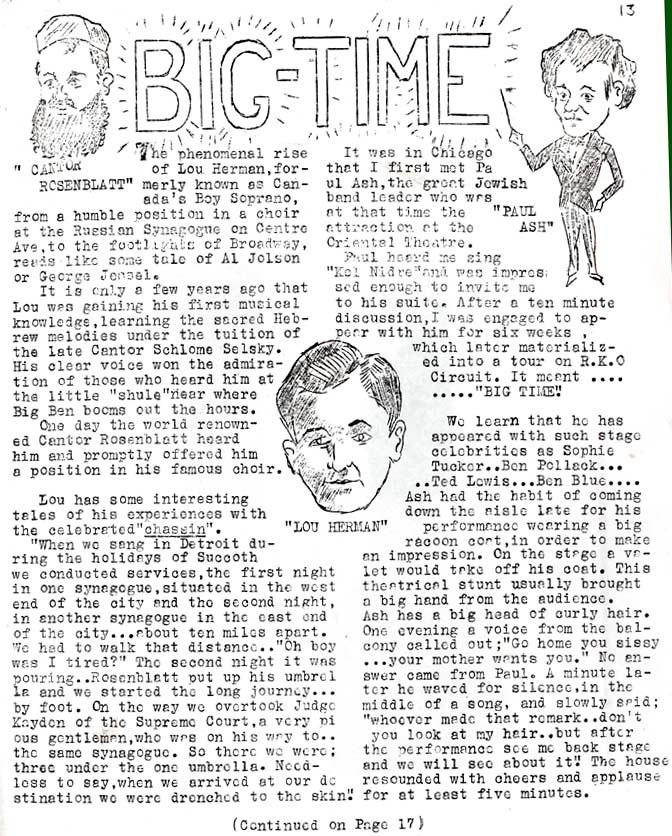
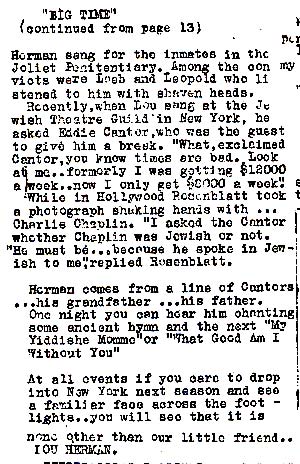
The Scoop — Toronto, May 15, 1931
Eleven Amateurs Rated By Vallee On First Program
Manhattan Beach Sun —
Paul Whiteman To Hear Others at Beach
Eleven amateurs, the pick of more than 50 talented patrons of Manhattan and Oriental who sought the honor, were presented by Rudy Vallee on his first audition program at the Manhattan bandstand.
More than 5,000 persons heard the amateurs, who had qualified at preliminary auditions conducted by Bennie Krueger, leader of the orchestra which inaugurated tea dancing at Oriental.
Rudy rated the entertainers and gave them constructive criticism, advising them to develop their own technique. Imitators never achieve real fame in the theatrical world, he pointed out to the young would-be Bing Crosbys, Rudy Vallees, Kate Smiths and Lawrence Tibbets.
His highest ranking, A minus, went to six of the amateurs, four of them boys and two girls.
Amateurs desiring to appear with Paul Whiteman, singers, dancers, and musicians, may register at the Press Booth, diagonally opposite the Manhattan bandstand.
The A minus rankings were awarded to Bert and Victor Marano, a piano team who play by ear; Ruth Harper, 19, of 2686 Ocean Avenue, a blues singer; Charles Ryan, 19, a baritone crooner; Ruth Jonas, 16, of 345 Montgomery Street, who has appeared in a Fox Movietone short, for her dancing, and to Lou Herman, 24, a protégé of Cantor Rosenblatt and winner of the Wrigley Contest in Canada.
A ranking of B plus went to Gracie Lee, 16, of 2421 West 28th Street, a blues singer who has appeared with Johnny Johnson on the “Tasty Yeast Hour” over WJZ; Alfred Lane, 18, of 16 East 10th Street, who has often sung with Harold Stern; Beula Bernstein, 16, of 2146 79th Street; tap dancer who made her first appearance at the beach, and Grace Tauss, 18, of 1824 Ocean Parkway, who won the title of Miss Brooklyn in the recent beauty contest.
The B plus ranking also was awarded to Harry Braunstein, 21, of 4804 13th Avenue, who has sung on the “City College of the Air” program over WLTH, and to Ruth Jonas for her singing.
Lou Herman to Head Jewish Variety Hour on CKOC
Toronto Daily Star —
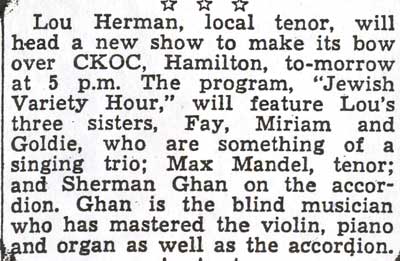
Lou Herman, local tenor, will head a new show to make its bow over CKOC, Hamilton, to-morrow at 5 p.m. The program, “Jewish Variety Hour,” will feature Lou’s three sisters, Fay, Miriam and Goldie, who are something of a singing trio; Max Mandel, tenor; and Sherman Ghan on the accordion. Ghan is the blind musician who has mastered the violin, piano and organ as well as the accordion.
Letter Regarding Radio Show
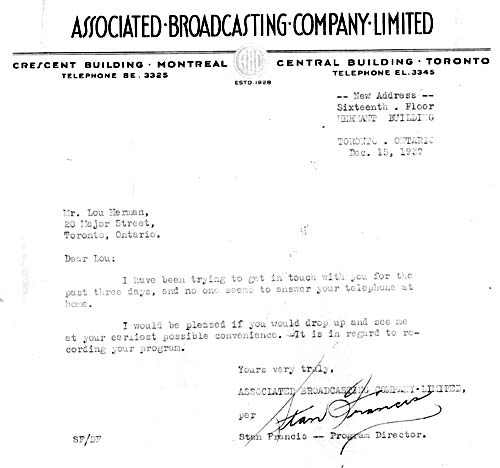
December 15, 1937 — Letter to Louis Herman regarding his radio show
“Quoting the Press”
1930s
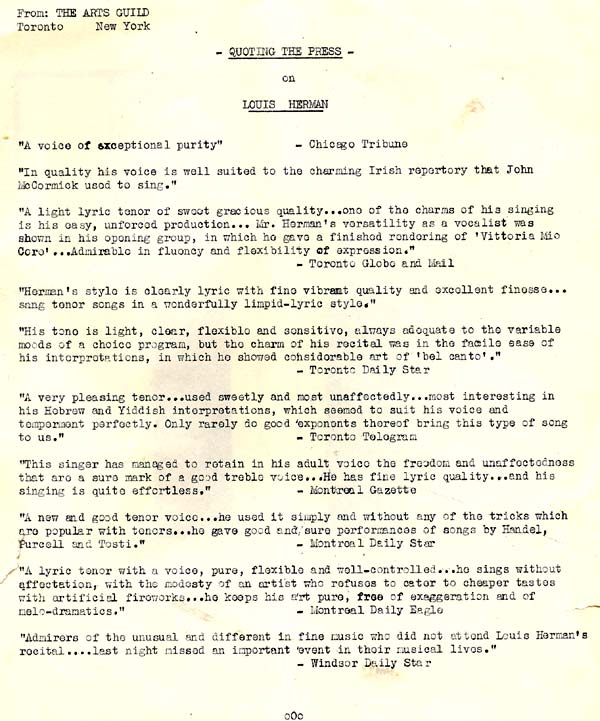
“Quoting the Press” — 1930s
Drive Slows Down
Montreal Gazette —
Drive Slows Down
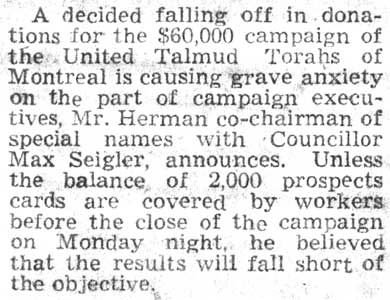
Montreal Gazette — January 22, 1941
Private Louis J. Herman, Canadian Army
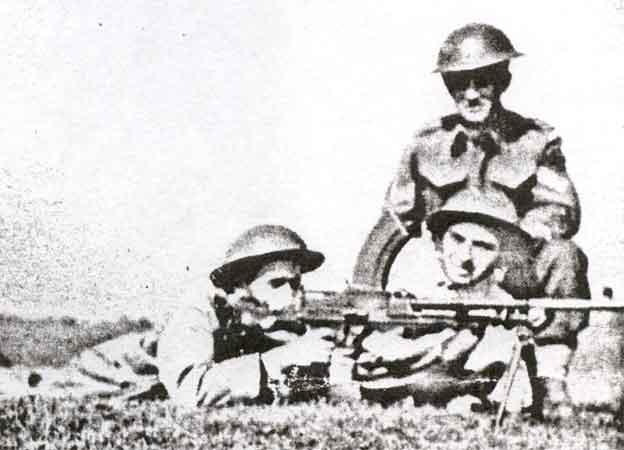
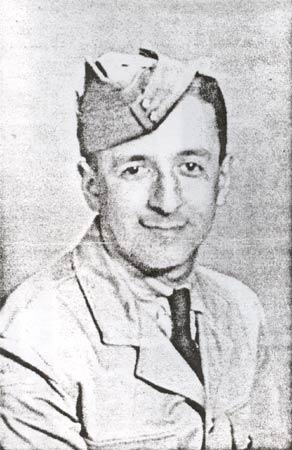
Private Herman at far left, firing a Bren light machine gun
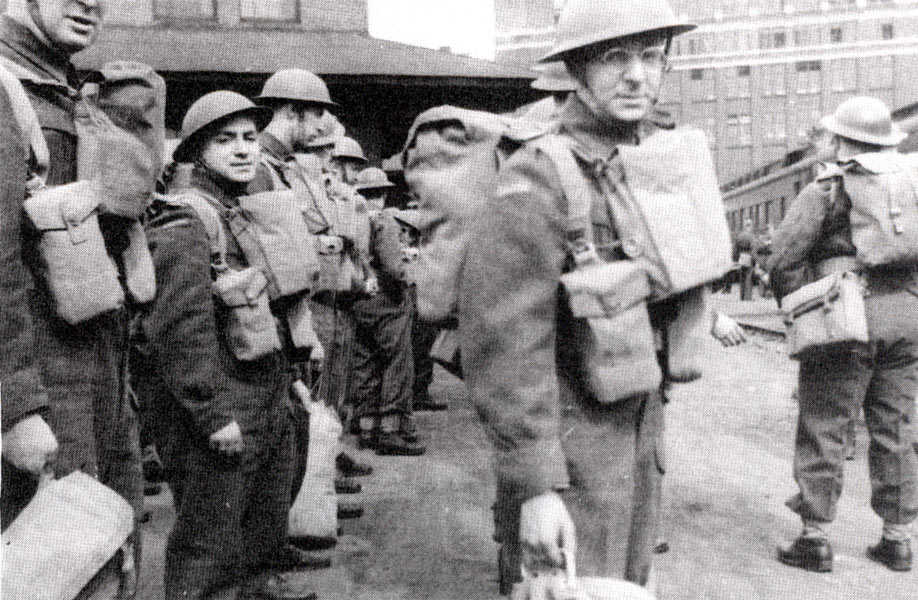
Circa 1942: Private Herman (in foreground, wearing glasses) and comrades preparing to board troop train at Toronto for Halifax, where they would board ships to England.
Army Show Hailed As A Direct Hit On Opening Night
St. John, New Brunswick Evening Times-Globe —
By F. D. McGUIRE
“The Army Show,” Canada’s all-soldier musical extravaganza, opened in Saint John last night and exploded a bevy of mirth, melody and beautiful girls like a Mills grenade on the stage of the Capitol Theatre. Attended by a capacity audience of servicemen and women and a few invited civilian guests, the entertainment was lively from start to finish. It is big-time, and in fact has been labeled “better than anything Broadway has to offer this season.”
Bright, Snappy, Sparkling
It was bright, snappy, sparkling and naughty-but clean-musical comedy, and was the finest stage show to come this way in many years.
Some thought it better than “Dumbells” of the First Great War, but then the girls helped to do that. It is gay and amusing and certainly accomplishes that for which it was created — entertain the soldier.
Its music, its singing and its dancing choruses left nothing to be desired. It was a well-paced musical revue with never a dull moment. Its scenic and lighting effects were striking.
Its ballet numbers were executed with rhythm and grace. Its choruses were peppy and clicked with the slightest move of the conductor’s baton. R.S. Frank Fusco was excellent as concert master and musical conductor. Its comedians, while good, could stand a little polish and rounding-off in some numbers. That was about the only weakness.
Starting off with “That’s an Order From the Army” until its finale, “Let’s Make a Job of It” the whole program was greeted with hearty laughter and spontaneous applause.
Mildred Steals Show
Corporal Doug Romaine and Private Lou Herman, replacing Sergeant Frank Shuster and Sergeant Johnny Wayne, who played with the show earlier in its itinerary in Canada, carried much of the main “acting” as the comedians, while Sergeant Mildred Morey sang, danced and did imitations with a raucous gusto. In her Gracie Field number she stole the show, and it is doubtful if Gracie Fields could have done a better job herself.
Also remembered: The ballet of dancing of Corporal Everett Staples and Sergeant Connie Vernon … The excellence of the precision dancing … the singing of “The Four Brass Hats” … Sergeant Jimmy Shields in his song “Hi’Ya Mom” … “The Soldier’s Dream” with Sergeant Hal Seymour and Sergeant Lynda Tuero and the C.W.A.C. ensemble … “Viva El Furlough in South America.”
One of the strong points of the Army Show is that it is as all-Canadian as it is all-army. What comes out of the whole thing is something that is peculiarly Canadian in character and atmosphere. And it is fast, but not too fast, and thus it goes merrily on its way.
This afternoon the show will be repeated for members of the armed forces and tonight it will be presented for the general public.
Corporal Louis J. Herman with Prime Minister King
Ottawa, 1943
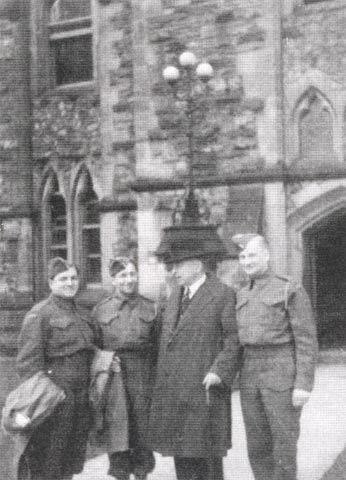
1943: Corporal Louis J. Herman, 2nd from left, standing next to Canadian Prime Minister William Lyon MacKenzie King outside the Parliament Building in Ottawa.
ARMY SHOW OPENS HERE
Halifax Mail —
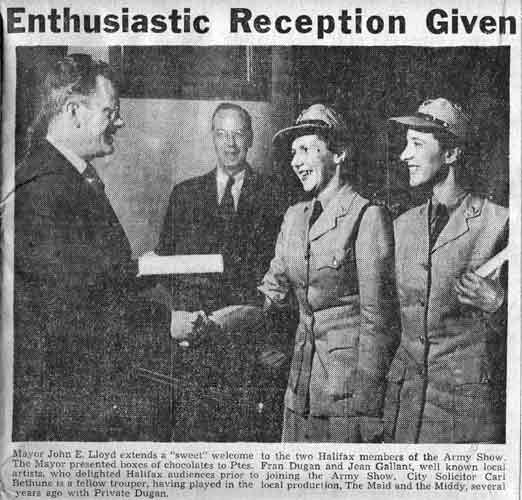
Sparkling with bright comedy, compelling music, lovely costumes and fine talent, The Army Show opened last evening at the Forum to an all-service audience that expressed its approval without reservation.
The show, which will be presented to civilians this evening and Wednesday evening, was preceded to Halifax by weeks of lavish publicity, all as last night’s performance effectively proved, well deserved.
Easily one of the best entertainments this city has seen in many years, The Army Show has so much to offer that it is difficult for the average spectator to take it all in just one evening.
It starts off with plenty of animation and never lets down for a single instant. Members of the cast are so clever and so well directed and rehearsed that there isn’t an awkward moment, a sour note nor an ungraceful movement to mar the smoothness of it. Moreover everyone seems to enjoy the work so thoroughly that the audience immediately is infected with a matching gaiety.
“That’s an order from the army,” the song with which the entire company opens the program, sets the fast and exciting pace that is maintained through more than two hours of appealing songs, beautiful dancing and hilarious comedy.
The stars of the show Frank Shuster, Johnny Wayne and Mildred Morey, who made such a tremendous hit elsewhere in Canada, do not appear in the local presentation but their substitutes, Doug Romaine, Lou Herman and Virginia Stansell are good enough to please the most exacting critic.
Among the many highlights are a remarkably accurate imitation of George Bernard Shaw by Captain Bill Harding, a dream sequence danced by the C.W.A.C. Ensemble, a sidesplitting recruiting skit and a South American interlude, elaborately costumed.
Most of the songs and dialogue poke good-natured fun at army routine and regulations but there is a serious undercurrent that is emphasized in the finale when the troupe sings inspirational songs of the last war and takes a pledge to make a real job of it this time.
The ballet number is one that goes over well with everyone. Effectively staged to Chopin’s music it moves along at an artistic pace for just long enough to be enjoyable then ends in a farcical finish that is as amusing as it is unexpected. An army fashion parade, that takes in everything from battle dress to underwear, provides many laughs and a bit of friendly rivalry between Army, Navy and Air Force gives spectators the opportunity to root for their favorite service.
The orchestra alone is well worth the price of admission, for the musicians, under skilled direction, know exactly what they are doing and how to do it most creditably.
Private Frances Dugan, who belongs to Halifax, and consequently is of special interest to local residents, does a solo tap dance and also takes part in the chorus numbers. All the dance routines are excellently performed and are of satisfying variety.
Throughout the show there is such a wealth of ability on display and such a perfect demonstration of good timing and team work that it is hard to believe the majority of the entertainers are amateurs.
The Army Show’s visit to Halifax will be remembered for a long time. It’s the kind of entertainment for which Broadway theatre-goers stand in line for hours and pay three times as much. — M. H.
Canadian Army Show Stars on a Troop Train
Late 1943 or Early 1944
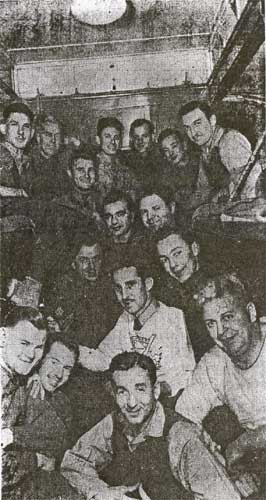
Private Lou Herman at bottom, center. Sixteen United Nations are represented in this picture of Army Show stars on a troop train prior to embarking overseas. Men in the picture are Lance Corporal T. L. Kadzielawa, Vancouver Polish; Corporal C. A. Sawyer, Toronto, English; Lance Corporal R. Wickburgh, Winnipeg, Swedish; Private H. A. D. Rosati, Toronto, Italian; Private F. F. Monte, Hamilton, American; Lance Corporal J. S. Carruthers, Montreal, Scottish; Private J. Dansereau, Montreal, French-Canadian; Private Frank Hosek, Blairmore, Alberta, Czechoslovak; Lance Corporal J.K. Mews, Toronto, Canadian; Private T. Holub, Toronto, Ukrainian; Cpl. S. Kondaka, Montreal, Greek; Private M. Barten, Winnipeg, Russian; Private Lou Herman, Toronto, Jewish.
Saved by the Minyan
Italy — 1944
Cantor Louis Herman was a young Jew who lived in Canada during World War II. After hearing about the terrible things that were happening to the Jews in Europe, he decided to enlist in the army to fight against the Germans.
When he finished his training, young Louis was transferred to Italy. As a sergeant in the army, he was assigned to the front, in the midst of heavy fighting.
Throughout the difficult months of the war, Louis kept as many mitzvos as he possibly could. On the day of his mother’s Yahrzeit, despite being many miles away from any shul, Louis wanted to say Kaddish for her. This prayer, however, would require a minyan, and finding ten Jews in the middle of a battlefield in Italy was not going to be easy. Louis knew of only five other Jewish soldiers in his unit.
Louis approached the army chaplain, who was a priest, and explained his predicament. Louis asked the chaplain if he knew of any other Jewish soldiers in the area. To Louis’s surprise, the chaplain not only knew where he could find other Jewish soldiers, but he also understood the meaning of a minyan.
“See that area over there?” The chaplain pointed to a tall observation tower. “That is where our soldiers guard our unit and watch for advancing German soldiers. When they see any activity, they radio the information back to the artillery unit to help us aim our bombs more precisely. There are four Jews who occupy positions in the observation tower. If you’d like, I can put in a call to them and ask that they come over to our area for your minyan.”
Louis was overjoyed. He would have exactly the ten men required to make up a minyan. And to his great relief, the soldiers were happy to oblige. Louis was able to say Kaddish on his mother’s Yahrzeit with a minyan. After they finished davening, Louis thanked everyone for joining him and enabling him to fulfill this meaningful personal obligation.
As the four soldiers turned to walk back to the observation tower, they suddenly heard a loud explosion and saw a most startling sight. The entire tower and its contents had been blown up. Only the four Jewish soldiers, who had just “happened” to be busy doing a very important mitzvah, had escaped annihilation.
The Talmud tells us (Pesachim 8b) that “Shluchei mitzvah einan nizokin,” messengers who go to do a mitzvah are saved from harm. Not only do acts of chessed help others, but those very acts can also save us from harm.
As told by Rabbi Boruch Brul in his book For Goodness’ Sake: Inspirational Stories of Chessed (Feldheim, 2004)
Pope Spoke in Hebrew
New York Times —
Bestowed Blessing On Jewish Soldiers Visiting Vatican
Toronto (NANA) — A member of the Canadian Army show, Pvt. Lou Herman, who has arrived home after service overseas, described how Pope Pius XII, speaking in Hebrew, blessed a group of Canadian Jewish soldiers during an audience in Rome.
The Jewish soldiers were singled out by the Pontiff when they found themselves standing in a room full of kneeling soldiers.
Describing the unusual scene, Private Herman said that the room was jammed with hundreds of soldiers who knelt when the pope entered.
“We didn’t know what to do so we remained standing,” he said. “The Pope beckoned to us and as we approached he asked: ‘What is your faith, my sons?’ Then he spoke to us in Hebrew.
“After conversing with us in Hebrew, which he spoke fluently, he raised his arms in the manner of the priests of the Hebrew faith and gave us his benediction in Hebrew,” added Herman, noting that the event was “awe-inspiring.”
Bergen-Belsen Concentration Camp
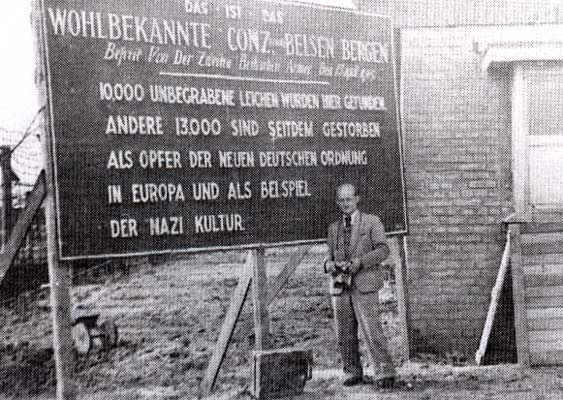
My dad visited Bergen-Belsen Concentration Camp after its liberation in April of 1945. He took this picture of a sign put up by the British Army. The electrified fence can be seen at the far left. The sign, roughly translated says: “This is the world famous Concentration Camp Bergen-Belsen, liberated by the British Army April 15, 1945. 10,000 Corpses were found; 13,000 more about to die, all due to the new German world order in Europe as demonstrated by the Nazi Culture.” The man in the picture is an unknown photographer. — Rabbi David Herman, March 2009
Comedian Lou Herman Voice of Canadians Arriving on Big Bess
Toronto Globe & Daily Mail —
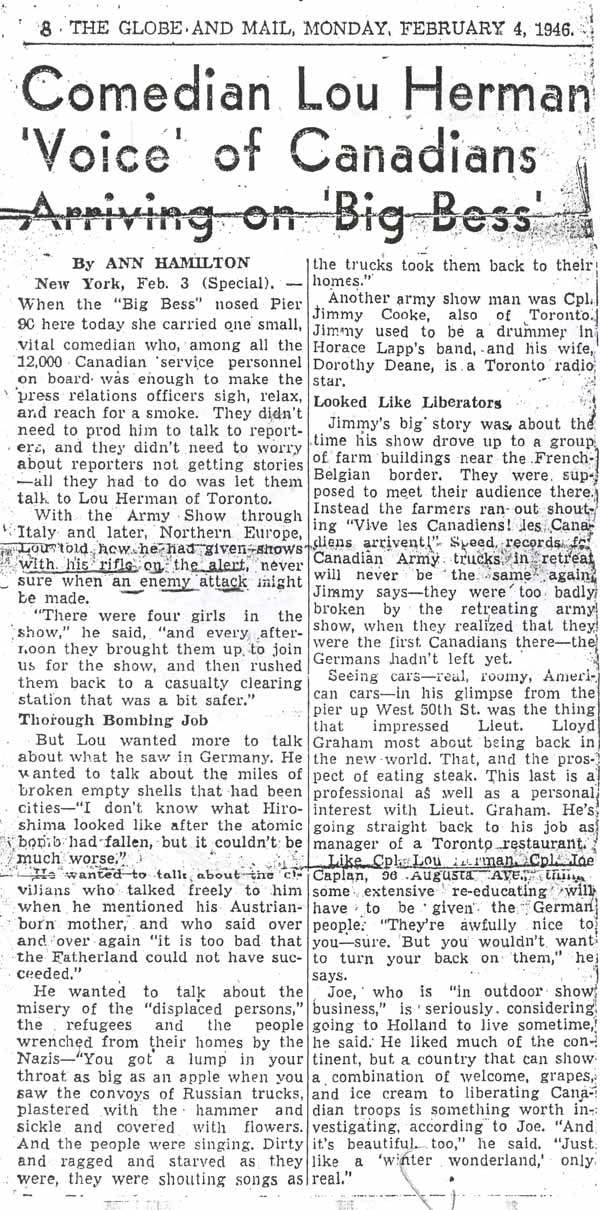
Comedian Lou Herman Voice of Canadians Arriving on Big Bess.
By Ann Hamilton.
New York, Feb 3 (Special).—When the “Big Bess” nosed Pier 90 here today she carried one small, vital comedian who, among all the 2,000 soldiers and civilians on board, was enough to make the press relations officers sigh, relax, and not need to prod him to talk to reporters—all they had to do was let him talk to Lou Herman of Toronto.
With the Army Show through Italy and later, Northern Europe, Lou told how he had given shows just the other day, 18 miles from Berlin, fighting them up to the front, and he never, never attacked anyone’s nationality.
Also he has a coloratura more agile than Lily Pons, as light and brilliant as that of Amelita Galli-Curci. He astonishes the concert hall but he achieves a more moving effect when he chants the prayers and benedictions of faith. He has never been fettered by the musical ideas of either continent, for musical studies formed the smallest part of his art, serving only to enhance powers inspired by the fervor of the deepest religious emotion.
4,000 in Ottawa Enjoy Army Show
Ottawa — 1946
Nearly 4,000 soldiers and their civilian friends stamped their feet, clapped their hands, whistled, and cheered “B Unit” of the Canadian Army Shows which played at the Coliseum last night.
Overseas for 14 months, this show played the whole Central Mediterranean theatre of war and England. The girls in the show included the first C.W.A.C. to land in Italy. On its way to Toronto to form a new show, the troupe gave their audience a taste of what men in action get to take their minds off the war.
The quality of the performance made this “taste” a very pleasant one. Versatile Lance Corporal Jimmy More, of Montreal, kept the show going at a merry pace with his jokes, imitations and a monologue “With the Hairforce at Camp Borden.” “Relax, girls, relax,” he called following Private Gwyn Price’s vocal renditions of ‘Oh, What a Beautiful Morning’, and “My Buddy.” Private Price is from Calgary.
Private Sunny Wilson, C.W.A.C., of Moncton, sang several blues numbers, and Private Mary Moynihan, C.W.A.C., of Regina, offered pleasing soprano vocals. The dance team of Sergeant Eve Staples, of Toronto, and Private Alfreda Phillips of Winnipeg, were a distinct hit. An acrobat with a body she could twist like a corkscrew, and keeping the audience on the edge of their seats, Private Ethel Hendry of Windsor, performed on top of a table! Private Lou Herman, of Toronto, provided laughs in the show, wearing an oversize greatcoat, a tin helmet and floppy shoes.
Special laurels go to the band, led by Sgt. Morris Weinsweig, of Toronto. The members are nearly all from Ontario and they seemed to enjoy playing almost as much as their audience enjoyed listening. At one point, Corporal More called for three volunteers, a member of the C.W.A.C. and two soldiers, to lead the band.
The band followed carefully the movements of the amateur leader’s baton, but in doing so worked themselves into a slap-happy condition — the cellist playing his cello like a guitar, and the brass section playing off-key and out of tempo.
The show is traveling under the command of Captain Bruce Wood, of Winnipeg.
Lou Herman, Well Known Tenor Entertains Rotarians
Huntsville Forester —
Lou Herman, well-known tenor of Toronto, entertained delightfully at the regular Rotary luncheon on Wednesday last. His well controlled tenor voice revealed volume and excellent schooling. Accompanied at the piano by Mrs. Evans, Mr. Herman was rewarded with enthusiastic applause from the delighted audience.
Lou Herman was born in Montreal, son of a cantor, and showed early signs of musical talent. As a boy soprano prodigy, he sang as featured soloist in large theatres and concert halls throughout Canada and the United States.
Critics acclaimed him the best boy soprano on the continent and predicted a great musical future. On various occasions he sang as guest artist with Rudy Vallee, Paul Whiteman and on featured radio programs of American and Canadian networks. Prior to the outbreak of the war, Mr. Herman was touring Eastern Canada and the United States, giving song recitals. He enlisted in the Infantry and served with the Canadian Army overseas, during which time he also entertained the troops in England, France, Italy, Holland, Belgium and Germany.
At present Mr. Herman is studying music at the Royal Conservatory of Music in Toronto, and will enter into his third year this fall.
Herman to Assist at Choir Hazamir Concert
Toronto Globe and Mail —
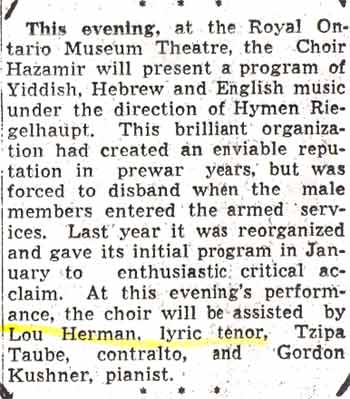
This evening, at the Royal Ontario Museum Theatre, the Choir Hazamir will present a program of Yiddish, Hebrew and English music under the direction of Hymen Riegelhaupt. This brilliant organization had created an enviable reputation in prewar years, but was forced to disband when the male members entered the armed services. Last year it was reorganized and gave its initial program in January to enthusiastic critical acclaim. At this evening’s performance, the choir will be assisted by Lou Herman, lyric tenor, Tzipa Taube, contralto, and Gordon Kushner, pianist.
Concert at the Royal Ontario Museum
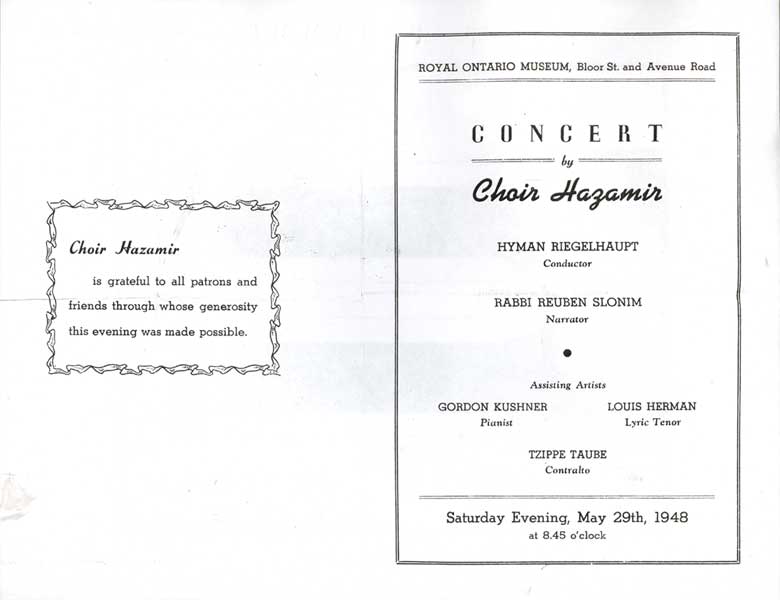
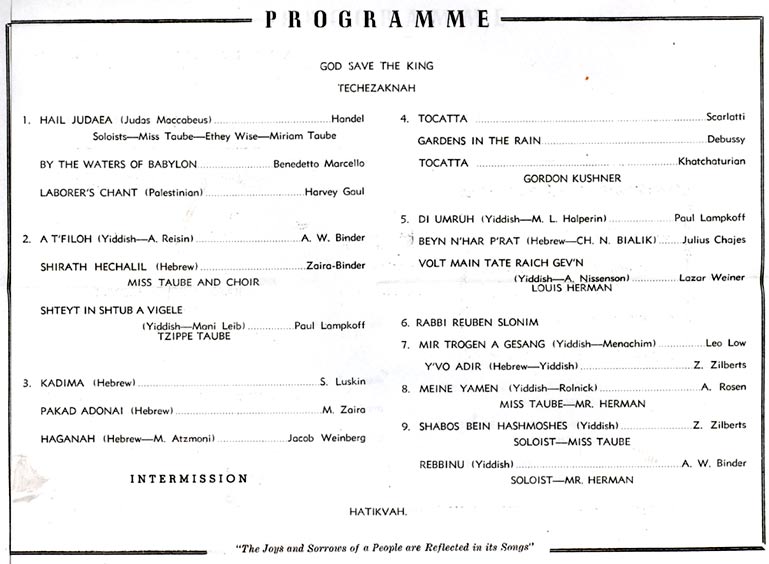
Concert at the Royal Ontario Museum — May 29, 1948
Toronto
1949
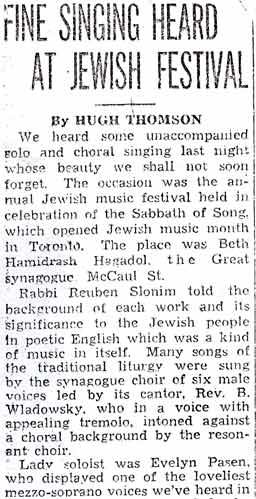
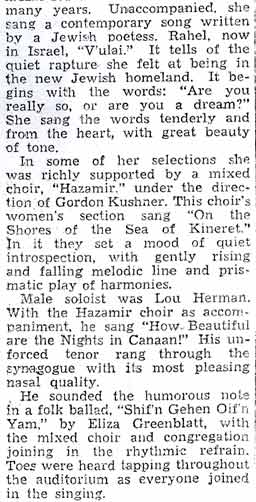
Toronto — 1949
Hazzanuth in Canada
by N. Stolnitz
The cantorial history of the young Canadian Jewish community already has to its credit a colourful and distinctive record. If the quarter million Jewish community in Canada is small in numbers in contrast to the community of the United States, in quality, however, the general Jewish level of culture in this country including cantorial music has nothing to be ashamed of in comparison with the much larger community next door. In certain details Jewish Canada has even shown itself to be a model. The very fact that the development of the Canadian Jewish community came much later than in the United States was responsible to a great extent for a slowing-up of the rapid tempo of the assimilation process of the American melting pot and to a certain extent preserved the Jewish spiritual heritage and the noble traditions bought over from Eastern Europe, a land where culture, music and Torah went together.
Thanks to this the status of Hazzanuth was higher and on a better level in Canada even in the bottom years of economic crisis when the cantorial field in America was dominated by despair and chaos. It is no surprise at all that very often outstanding American cantors were lured into leaving their positions in the U.S.A. to take cantorial posts in Canada. In fact an important number of prominent hazzanim from Europe found a new place of refuge in this country when their old posts were ruined and wiped out after the war years. Canada was also a favorite spot for cantorial attractions. Almost all of the world-famous cantors came on tour here and were so successful with concerts, both secular and devotional, that they won many admirers.
In general Hazzanuth has recently reached a high point here. The historical development of Jewish life has led to the fact that an important number of our estranged youth should take a beam out on the Jewish horizon, hopes which have brought radical change for the better for the cantors of our people. The synagogue — the sacred place — has become the centre of Jewish life and again has received the crown of its sacred importance.
That cantorial art has struck deep roots in this soil can be seen by the fact that even decades ago our Jewish community was able to produce its own cantors who assumed rather important positions in the general professional world on the American continent.
The most popular of them was the late Yossele Shlisky who achieved recognition among the famous artists of his generation.
In that time there were also prominent the Toronto young cantors Abraham Selsky, Abraham Singer and others. In recent years the profession has become enriched by a number of young and gifted cantors — particularly in Toronto, such as Henoch Borenstein (now in California), Jacob Barkin (now in Washington), Samuel Stolnitz (who has served in Vancouver and Minneapolis and is now back in Toronto), Nathan Katzman (the present head of the California region of the American Cantors’ Assembly), Louis Herman (now in New York) and many other young artists who serve in various prominent congregations throughout the U.S. and Canada.
I do not want to overlook the fact that in this present treatment I am giving special emphasis to the Dominion’s second largest community — Toronto — which is celebrating its hundredth year of organized communal life and where I have spent most of my years in this country. As it happens the fact that I was a founder of Toronto’s Cantors Association 25 years ago gives me a special equipment and familiarity with the details of Toronto’s cantorial history.
Toronto’s first hazzan it hundred years ago at the first organization of 17 Jewish families was the Rev. Chaim Goldberg of New York who served the tiny community as rabbi and schochet as well.
With the growth and development of the community the whole profession in later years began to take on a different appearance. The position of hazzan began to become stabilized, he acquired more prestige and more economic security, so that he was able to devote himself fully to his profession and not be subjected to the role of a kol-boi — a general religious factotum — forced to serve the community in all its needs in order to help earn a livelihood for himself.
One of the first recognized hazzanim in Toronto about fifty years ago who was responsible for hazzanuth being recognized as among the most effective spiritual factors in the religious life of our community were M. Shulman and the late Rev. M. Kaplan3 (1868–1935).
Born in Ostrowce, Poland, he came to Toronto at the age of eleven in 1907, with Cantor Moshe Wolman. Later Shlisky studied at the Toronto Conservatory where he graduated as a Mus. Bach. Died after a long illness in New York at 59 in 1955.
His first post was the Goel Tzedev Synagogue in Toronto. Later he moved to Atlanta and later to Baltimore where he served until his death in 1931.
A short biography of Hazzan Kaplan was published in the Jubilee Book of the Beth Hamidrash Hagadol Chevra Tehillim (McCaul Street Synagogue), edited by S. Troub in 1937. Rev. M. Kaplan came to Toronto in 1907 and immediately became cantor of this synagogue. He later entered private business.
At Congregation Beth El, Camden
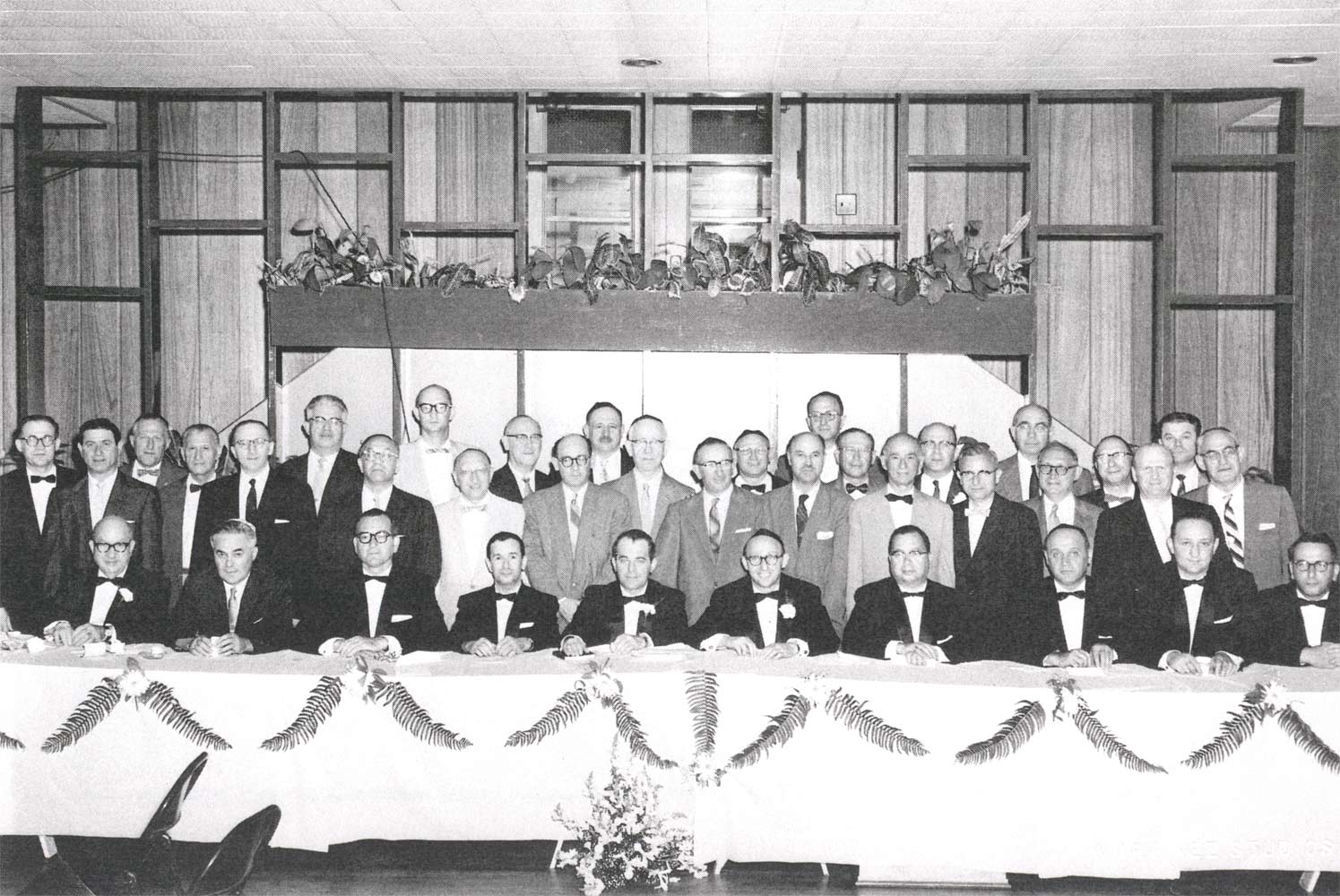
June 11, 1958 — Installation of Beth El Board of Directors
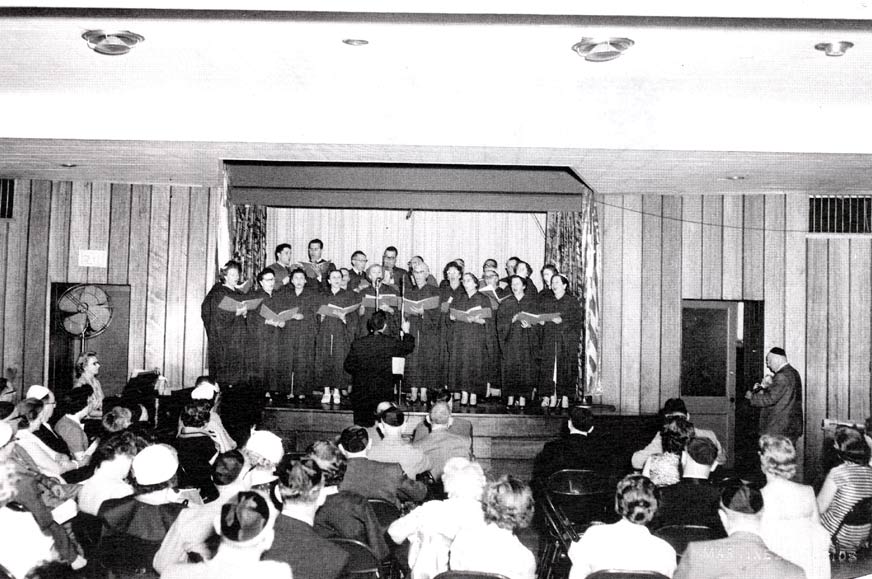
June 11, 1958 — Beth El Choral Group. Cantor Louis J. Herman, conducting; Rose Solomon, pianist.
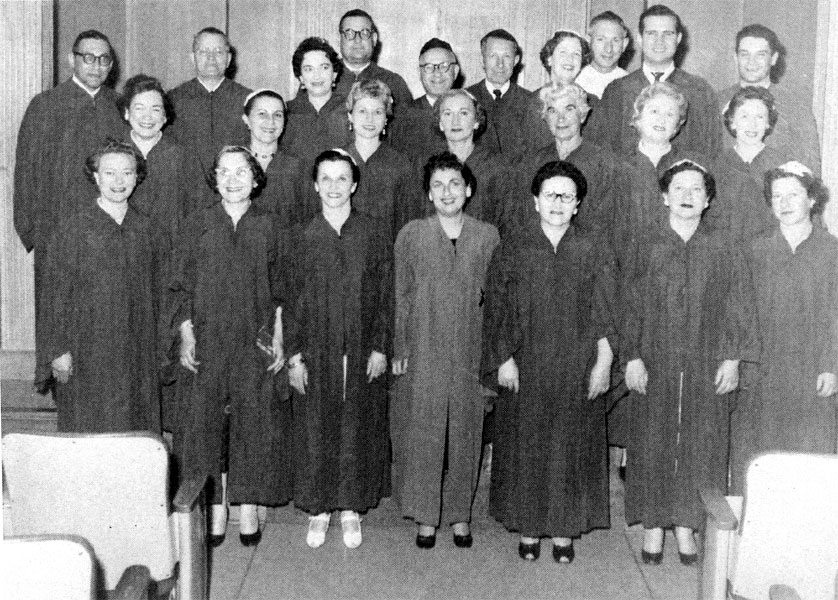
Late 1950s — Beth El Choral Group. First Row, 3rd from left: Mrs. Dora Rose. Second Row, third from right: Mrs. Sadie Russell.
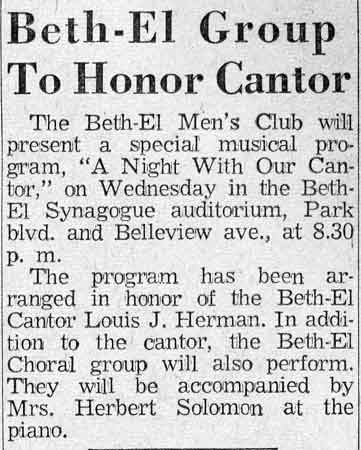
Beth-El Group To Honor Cantor
Camden Courier-Post —
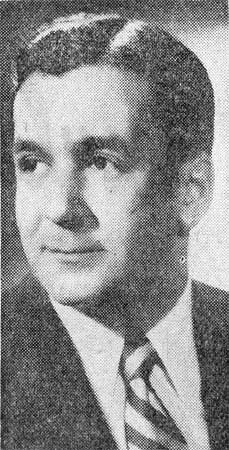
Beth-El Group To Honor Cantor
Beth-El Group To Honor Cantor
The Beth-El Men's Club will present a special musical program, "A Night With Our Cantor," on Wednesday in the Beth-El Synagogue auditorium, Park blvd. and Belleview ave., at 8.30 p. m.
The program has been arranged in honor of the Beth-El Cantor Louis J. Herman. In addition to the cantor, the Beth-El Choral group will also perform. They will be accompanied by Mrs. Herbert Solomon at the piano.
Second Annual Concert of Jewish Music
The Congregations of South Jersey present The Cantors Assembly of America, Philadelphia Regional Branch in its Second Annual Concert of Jewish Music for the benefit of The Cantors Institute of the Jewish Theological Seminary. Congregation Beth-El, Camden, New Jersey — Sunday Evening, February 28, 1960, at 8:00 O’Clock.
Choral Ensemble of the Cantors Assembly
| Hazzan Philip Blackman | Beth El |
| Hazzan Sigmond Blasz | Beth Shalom, Haddon Heights |
| Hazzan Nathan I. Chaitovsky | Temple Sinai |
| Hazzan Leopold Edelstein | Germantown J.C.C. |
| Hazzan Felix Fogelman | Temple Sholom |
| Hazzan Louis D. Goldhirsh | West Oak Lane J.C.C. |
| Hazzan Louis Herman | Beth-El, Camden |
| Hazzan Sidney Karpo | Beth T’Fillah, Yeadon |
| Hazzan Nathan Levinson | Temple Israel, Upper Darby |
| Hazzan Philip Krohn | Brith Israel |
| Hazzan Yehudah L. Mandel | Beth Judah of Logan |
| Hazzan Asher Mandelblatt | Beth Zion |
| Hazzan Martin Purjes | Ahavath Israel |
| Hazzan Yechiel Rosenberg | B’nai Jeshurun |
| Hazzan Andrew Salzer | Wilmington, Del. |
| Hazzan Seymour Schwartzman | Beth Sholom |
| Hazzan Kurt Silbermann | Norristown J.C.C. |
| Hazzan Pinchas Spiro | Emanu-El |
| Hazzan Ernst Steiner | Bridgeton, N. J. |
| Hazzan Isaac I. Wall | Har Zion |
| Hazzan Harry Weinberg | Overbrook Park Cong. |
Participating Artists: Mr. David J. Weiss — Mr. Jacob Perlberg
Additional Members of the Cantors Assembly, Philadelphia Region: Hazzan Asher Balaban, Hazzan Benjamin Klonsky, Hazzan David Reznik, Hazzan Irving S. Feller, Hanan Simon Kreigsman, Hazzan Gedalia Sheinfeld, Hazzan Belskin Ginsburg, Hazzan Morris Lang, Hazzan Rubin Sherer, Hazzan William Horn, Hazzan Moshe Orbach, Hazzan Morris Siegel, Hazzan Aaron Horowitz, Hazzan Harry Paskin, Hazzan Solomon Winter, Hazzan Saul Kirschenbaum, Hazzan Abraham Reiseman.
Officers of the Cantors Assembly, Philadelphia Regional Branch: Hanan Kurt Silbermann, Chairman; Hazzan Yehudah L. Mandel, Vice Chairman; Hazzan Asher Mandelblatt, Treasurer; Hazzan Louis D. Goldhirsh, Recording Secretary; Hazzan Felix Fogelman, Corresponding Secretary.
Program:
| 1. SHIRO CHADOSHO | Jacob Perlberg |
| Choral Ensemble — Hazzan Yechiel Rosen, Soloist | |
| 3. HASHKIVEINU | S. Blash — Hazzan Sigmund Blasz |
| 4. OMNON KEIN | B. Schorr — Choral Ensemble |
| 5. ARAUAH (Song of the Israeli Cowboy) | Nozyk — Hazzan Pinchas Spiro |
| 6. SHIR HAMAALOS | J. Rosenblatt — Choral Ensemble |
| 7. M’CHALKEIL CHAYIM | W. Bass — Hazzan Seymour Schwartzman |
| 8. YISMACH MOSHEH | J. Rumshinsky |
| Choral Ensemble — Hazzan Louis J. Herman, Soloist | |
| 9. ADONOY Z’CHORONU | Z. Zilberts |
| Choral Ensemble — Hazzan Louis J. Herman, Soloist | |
| 10. DOS YIDDISHE LIED | S. Secunda — Hazzan Isaac T. Wall |
| 11. AL TIRO | S. Alman |
| Choral Ensemble — Hazzan Nathan Chaitovsky, Soloist | |
| 12. ELOKAI N’SHOMO | J. Rosenblatt |
| Hazzan Louis J. Herman, Soloist | |
| 13. V’NATAN LONU | E. Jospe — Choral Ensemble |
| 14. REB DOVID’L | arr. Zilberts — Choral Ensemble |
| 15. HEVEINU SHOLOM | arr. J. Weinberg — Choral Ensemble |
| SHALOM ALTMAN, Conductor — Cecile E. Rubin, Accompanist — Mrs. Rose Solomon, At the Organ | |
Patrons: Congregation Beth-El, Camden, N. J.; Congregation Beth Sholom, Haddon Heights, N. J.; Mr. and Mrs. Morris E. Albert.
Sponsors: Congregation Beth Jacob, Merchantville, N.J.; Congregation Sons of Israel, Camden, N. J.; Congregation B’nai Israel, Burlington, N. J.; Temple Emanuel, Merchantville, N. J.; Dr. and Mrs. Milton B. Asbell; Mr. and Mrs. Ellis Goodman; Harry Berkowitz, Esq.; Mr. and Mrs. Reuben Greenberg; Mr. Meyer Borstein; Mr. & Mrs. Max J. Leff; Mr. and Mrs. Abraham Brandt; Mr. and Mrs. Morris Liebman; Beth-El Men’s Club; Mr. and Mrs. David H. Markowitz; Beth-El Sisterhood; Mr. and Mrs. Leon Mickleman; Mr. and Mrs. Leon Cooperson; Mr. and Mrs. Max Odlen; Mr. and Mrs. Julius Fox; Mr. and Mrs. Joseph Ostrov; Mr. Harry Gold; Mr. and Mrs. N. Herman Rappaport; Mr. and Mrs. Arthur Goldman; Mr. and Mrs. Bennett Teitelman; Mr. and Mrs. Harry N. Goldstein.
Concert Committee: Hazzan Yehudah L. Mandel, Chairman; Hazzan Louis J. Herman; Hazzan Asher Mandelblatt; Hazzan Isaac I. Wall; Hazzan Seymour Schwartzman; Hazzan Leopold Edelstein; Hazzan Pinchas Spiro; Hazzan Harry Weinberg.
Grateful Acknowledgments: to the Beth-El Sisterhood for Concert Assistance; to the Beth-El Men’s Club for Ushering and Assistance.
Beth El Chorus
Circa 1960
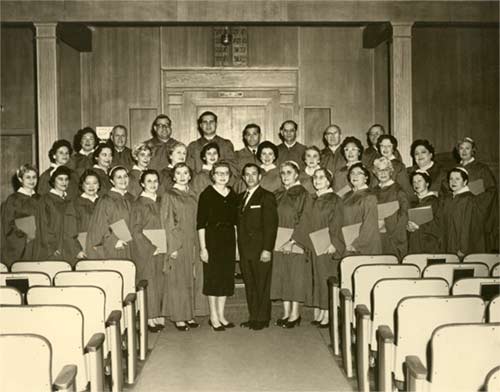
Beth El Chorus — circa 1960, in the old chapel. Front row, sixth from left: Dora Rose, unknown, Rose Solomon, Cantor Louis Herman, Fannie Markowitz, unknown, unknown, Mrs. Murray (Sadie) Russell. Middle Row, sixth from left: Gerri Ostrov, Yetta Herman. Back Row, second from left: Murray Russell.
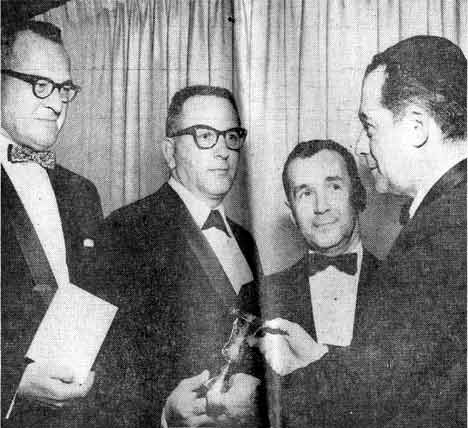
Beth El Marks 40th Anniversary
Philadelphia Inquirer —
(photo caption)
A Kiddush cup is presented to Rabbi Harry B. Kellman (right) of Congregation Beth El, Camden at a dinner Saturday night marking the 40th anniversary of the congregation. Making the presentation, from left, are Morris E. Albert, congregation president; Saul Teitelman, chairman; and Louis Herman, cantor.
Concert Program
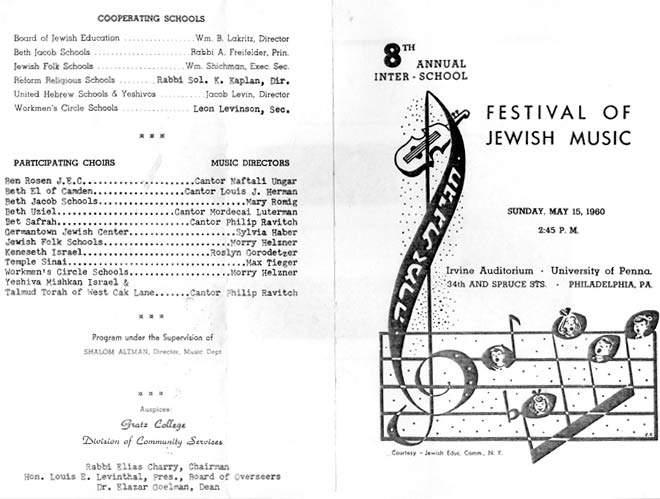
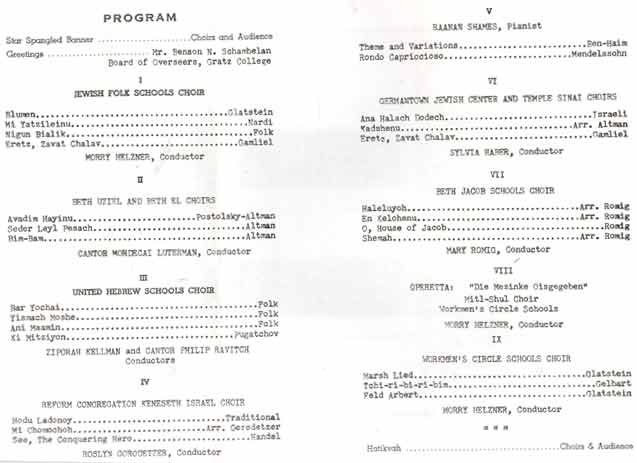
Concert Program — May 15, 1960
Beth El Unit To Hold Class On Passover
Camden Courier-Post —
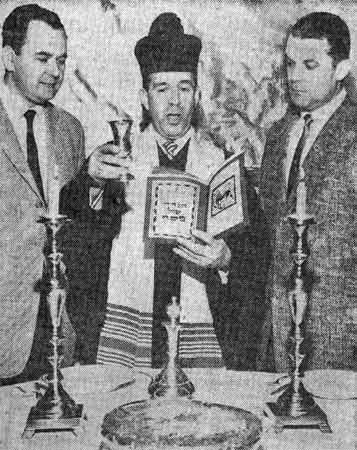
The Beth-El Institute for Adult Students will sponsor a Passover Workshop for all age groups in the Beth-El Auditorium, Belleview Avenue and Park Boulevard, Tuesday at 8:30 p.m.
Purpose of the workshop is to instruct Jewish families in the Passover ritual.
Rabbi Harry B. Kellman, spiritual advisor of the synagogue, will discuss the symbolic meaning of Passover and symbols of the Seder plate. Rabbi Isaac Furman will tell how to prepare the home for Passover, and Irving Natkow will give the sequence of the Seder. Cantor Louis Herman will lead in the traditional Passover melodies.
In charge of tables will be Mrs. Nathan Zausner, Mrs. Fran Grabman, Mrs. Ben Zion Steinberg, Mrs. Edward L. Natal, Mrs. Sara Dworkin, Mrs. Sol Freedman, Mrs. Samuel Stomel, Mrs. Louis Ruttenberg, Mrs. Martin Rosner, Mrs. Albert Rosner, and Mrs. Nathan Sussman, and others.
Upon completion of the workshop, it will be possible for every one attending to participate in or lead a Seder service, explain Passover and know how to prepare the home for Passover.
Dov Gilden, sexton, will assist the Seder preparation and reservations may be made by calling the synagogue office. There will be no charge and the workshop is open to the public.
Workshop committee includes Ben Zion Steinberg, chairman, Mrs. Carl Winter, vice-chairman, Mrs. Natal, registrar; and Rabbi Furman, director.
Concert of Traditional Music for the Synagogue
The Cantors Assembly of America presents A Concert of Traditional Music for the Synagogue. Wednesday Evening, April Nineteenth, 1961 at 10 o’clock. Grossinger’s, Liberty, New York.
This is the second in a series of Two Concerts of Music for the Synagogue. It is dedicated to that Golden Age of Synagogue composition and Hazzanic virtuosity which flourished in Eastern Europe between the mid-nineteenth century and the First World War.
Written for the Jew who was thoroughly at home in the synagogue and passionately loved its music it beautifully mirrors the intensity and devotion of Jewish life of that era.
Hazzanim, in particular, will ever be indebted to these Masters; under their impetus and inspiration Hazzanut flowered to full bloom. Even after their own glorious voices were stilled they continue to live in the works and memories they contributed to the ancient hazzanic art and tradition.
Included in this Concert are the works of some of those who, living in the New World, created in the spirit of the Old.
The participants are the hazzanim of the Choral Ensemble of the Philadelphia Regional Branch of the Cantors Assembly of America, Mr. Sholom Altman, Conductor, Mr. Lazar Weiner, Piano.
Program:
| Rachmone Deonei | Z. Zilberts |
| Hazzan Louis Herman, Soloist, Beth El, Camden, N.J. — Hazzan Isaac Wall, Soloist, Har Zion, Philadelphia, Pa. | |
| Yehi Rotzon (Recitative) | J. Schroeter |
| Hazzan Alvin Schraeter, Temple Petach Tikvah, Brooklyn, N.Y. | |
| Mogen Ovos (A Memorial Tribute) | L. Low |
| The Choral Ensemble | |
| Habet Mishomayim (Recitative) | W. Bogzester |
| Hazzan Michal Hammerman, Kehillat Israel, Brookline, Mass. | |
| Uv’yom Simchaschem | P. Abras |
| Hazzan Nathan Chaitovsky, Soloist, Temple Sinai, Philadelphia, Pa. — Hazzan Seymour Schwartzman, Soloist, Beth Sholom, Philadelphia, Pa. | |
| V’haarev Noh (Recitative) | D. Roitman |
| Hazzan Shabtai Ackerman, Beth Abraham, Detroit, Michigan | |
| Omnom Ken | B. Schorr |
| Hazzan Kurt Silbermann, Soloist, Jewish Community Center, Norristown, Pa. | |
| V’al Y’dei Avodecho (Recitative) | I. Alter |
| Hazzan Solomon Gisser, Shaare Zion, Montreal, Canada | |
| U’v’chen Yiskadash | Grauman-Goldstein |
| The Choral Ensemble | |
| Eilu D’vorim (Recitative) | J. Eideison |
| Hazzan Joseph Eidelson, East Midwood Jewish Center, Brooklyn, N.Y. | |
| Rochel Mivakoh al Boneho (Recitative) | Roitman-Binder |
| Hazzan Jacob Barkin, Congregation Beth Sholom, Pittsburgh, Pa. | |
| Halleluyah | B. Brun / Arr. G. Rabinowitz |
The Choral Ensemble of the Philadelphia Regional Branch of the Cantors Assembly of America — Mr. Shalom Altman, Conductor; Mr. Lazar Weiner, Piano.
Hazzanim: Philip Blackman, Andrew Salzer, Nathan Chaitovsky, Sidney Sharff, Felix Fogelman, Seymour Schwartzman, Louis Goldhirsh, Kurt Silbermann, Louis Herman, Hyman Sky, Sidney Karpo, Pinchas Spiro, Yehudah Mandel, Isaac Wall, Asher Mandelblatt, Harry Weinberg, Martin Purjes, Marshall Wolkenstein.
Mr. Jacob Perlberg, Assisting Artist.
Camden Mayor Presents Check for Israel Choir Festival
1961
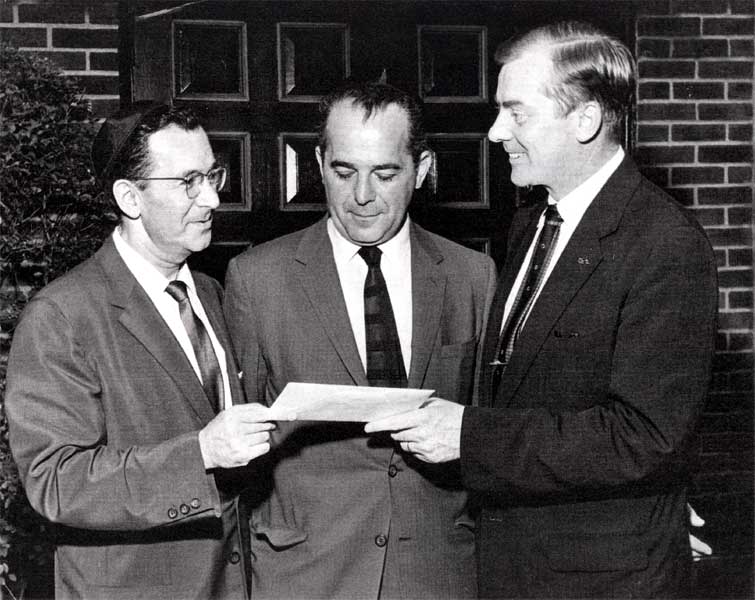
1961 — Camden Mayor Alfred Pierce presenting a check to Cantor Louis J. Herman from the citizens of Camden in honor of their selection to participate in the International Choir Festival in Israel as Rabbi Kellman looks on.
Beth El Choral Group Visits Rome
1961
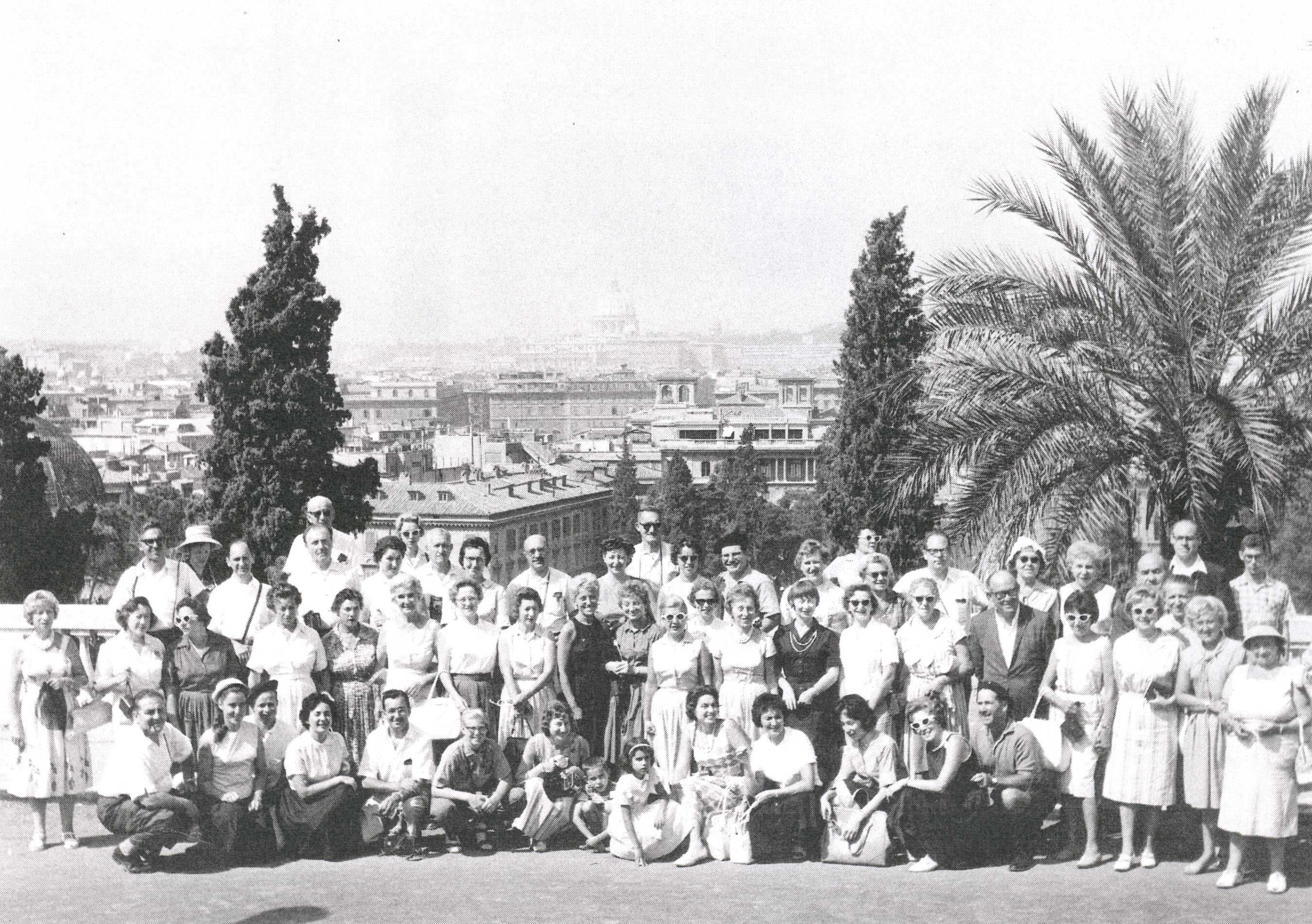
1961 — Beth El Choral Group visits Rome on the way to participate in the Israeli Music Festival. Front row left: Music Director Professor Sholom Altman, 5th from left Cantor Herman. Second Row: 2nd from right, Yetta Herman.
Beth El School Choir
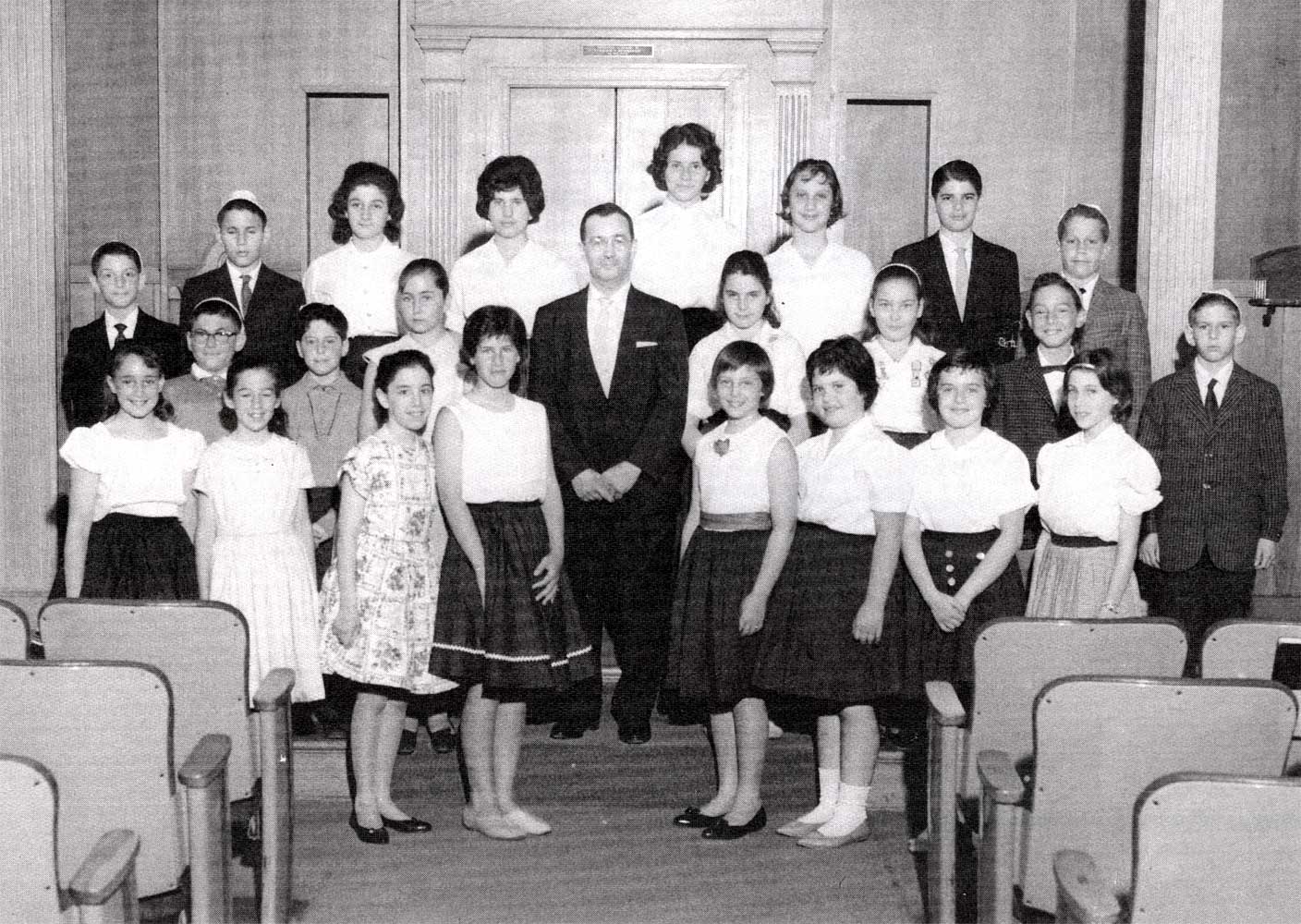
June 11, 1961 — Beth El School Choir. Second Row, second from right: Leon Gilden.
Morris Albert, Rabbi Harry Kellman & Cantor Louis Herman
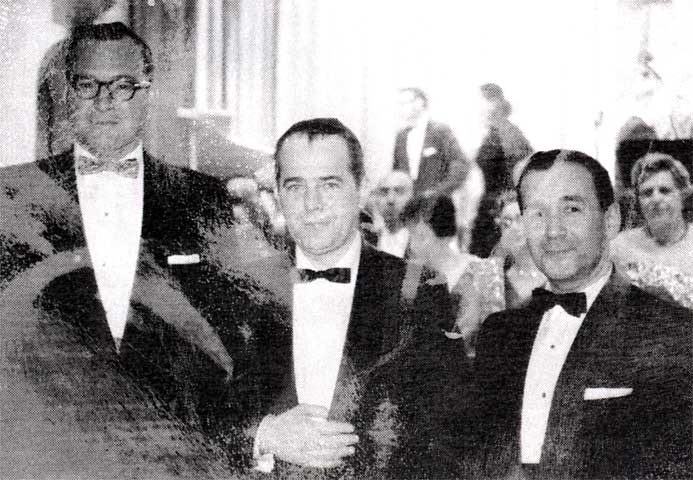
Morris Albert, Rabbi Harry Kellman, and Cantor Louis Herman. Morris Albert was president of Congregation Beth El from 1959 to 1961.
Jewish Aged to Hear Beth-El Choral Group
Philadelphia Jewish Times —
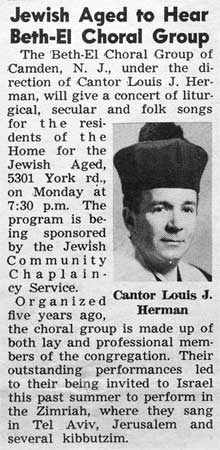
Philadelphia Jewish Times — February 16, 1962
Correspondence
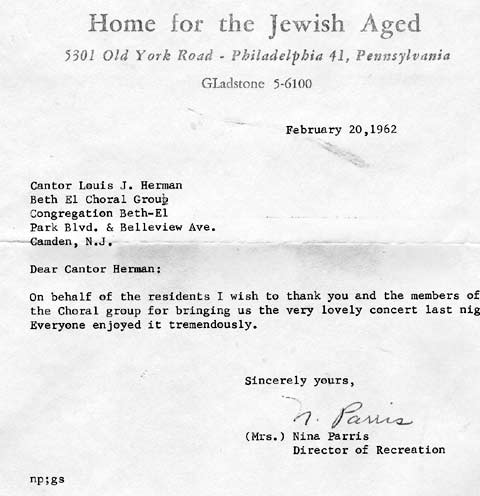
Correspondence — February 20, 1962
Wedding
Mid-1960s
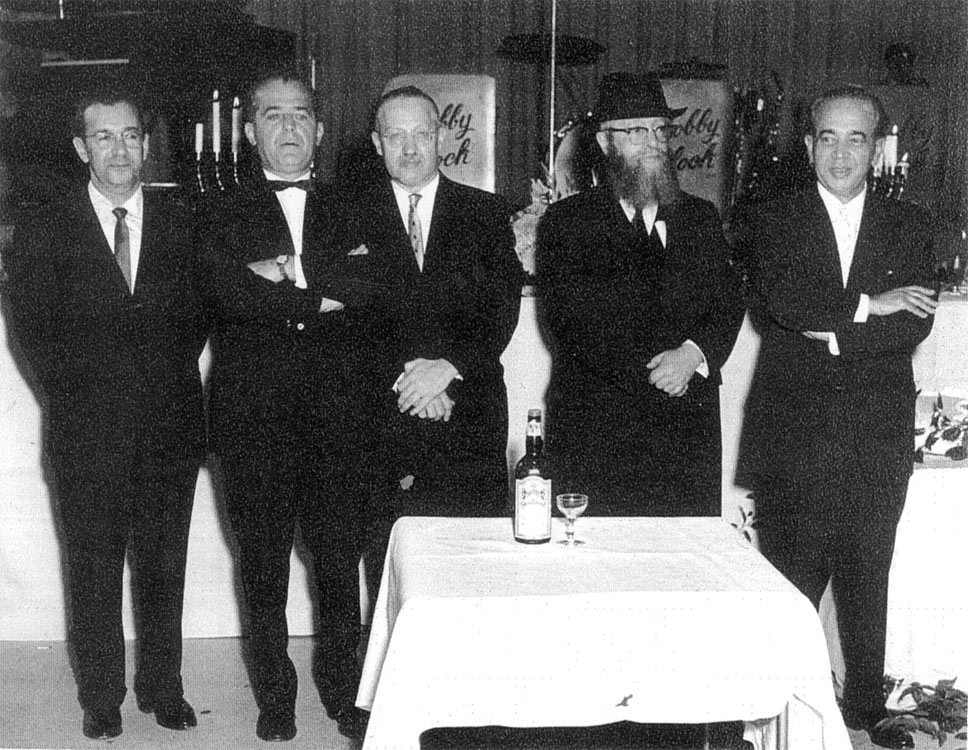
Wedding, mid-1960s. Left to Right: Cantor Louis J. Herman (Beth El), Rabbi Harry Kellman (Beth El), Rabbi Max Wiene (Beth Israel), Rabbi Naphtoli Z.Y. Riff (Sons of Israel), Cantor Simon E. Kriegsman (Formerly of Beth El). The document just sticking out of Rabbi Riff’s jacket pocket was the Ketubah wedding certificate, which he would read during the ceremony.
Groundbreaking Ceremony for the New Beth El
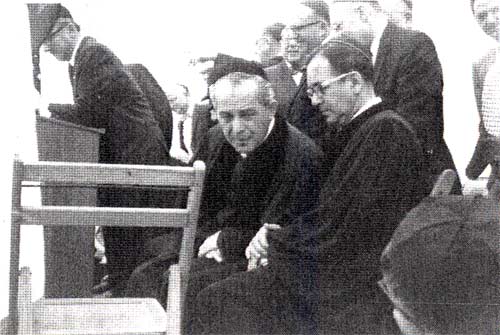
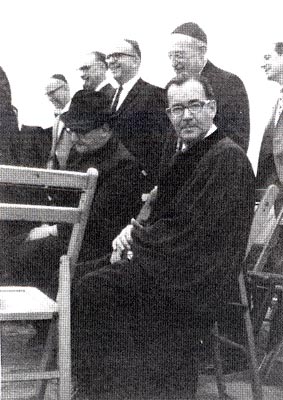
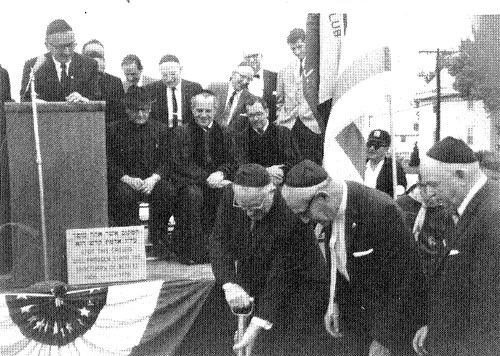
Groundbreaking Ceremony for the new Beth El, June 1966. Above: Rabbi Harry Kellman and Cantor Louis Herman, seated. At microphone, Harry Goldstein. Seated: unknown, Rabbi Kellman, Cantor Herman. Standing at far right with bow tie, Harry Kolosky. With shovel, Meyer Adelman. Also looking on, Herman Natal and Morris Puro.
Hannukah Breakfast
1960s
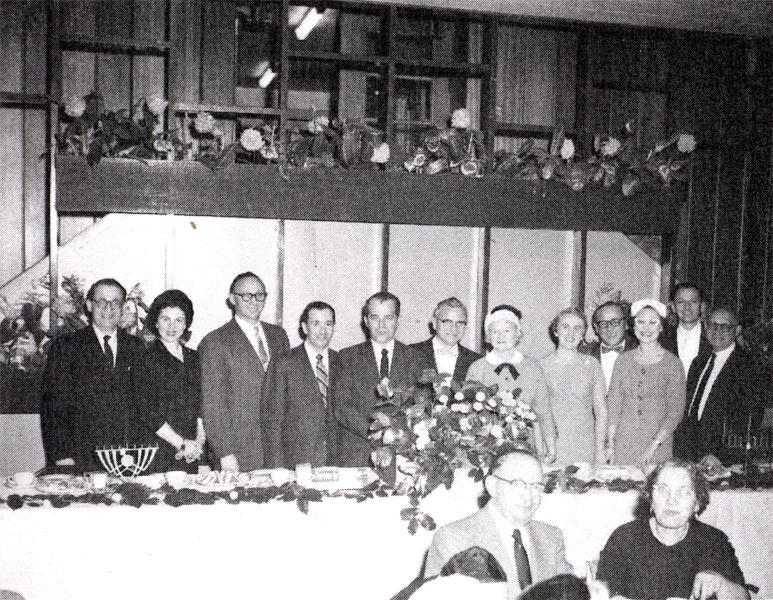
Hannukah Breakfast, 1960s. Standing, from left: Unknown, Gerri Ostrov, Max Odlen, Cantor Louis J. Herman, Rabbi Harry Kellman, Morris Liebman, Mrs. Morris Liebman, Mrs. Yetta Herman, unknown, unknown, Joseph Ostrov, unknown.
Letter from Meyer Adelman
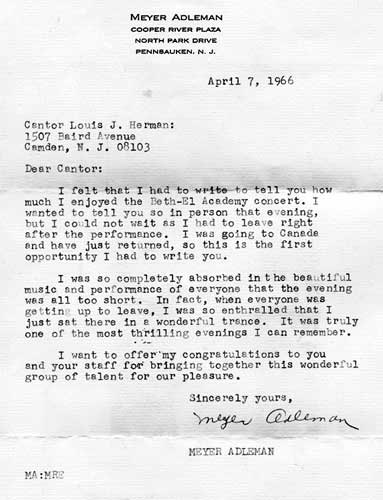
Letter from Meyer Adelman — April 7, 1966
Beth El Choral Group
1960s
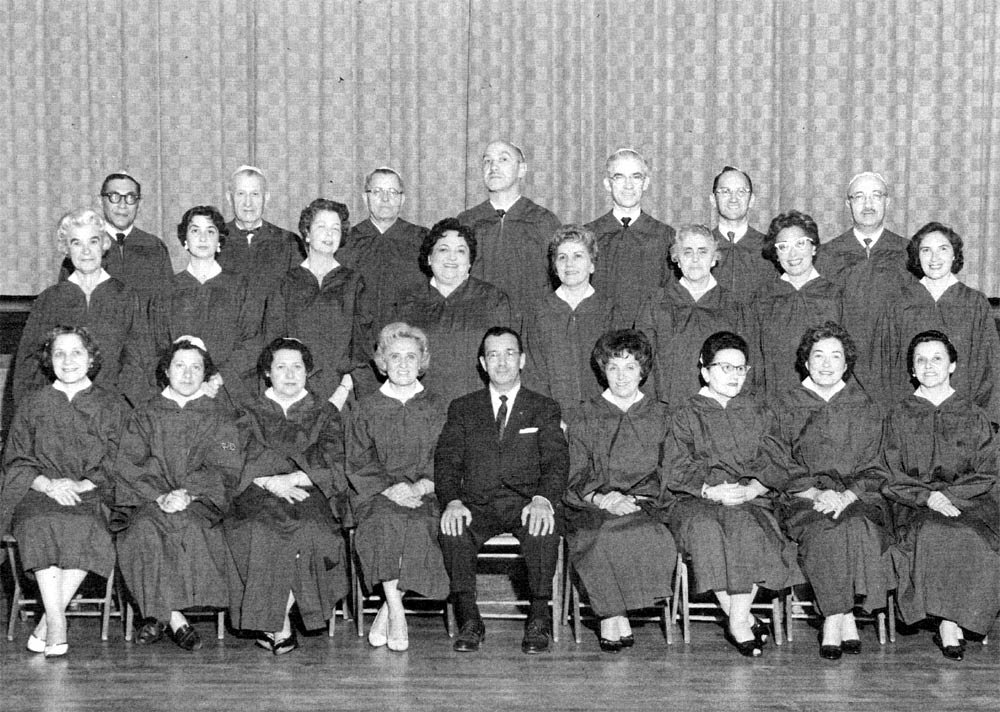
Beth El Choral Group — 1960s
Rabbi Howard Kahn, Rabbi Harry Kellman & Cantor Louis Herman
Beth El, 1980s
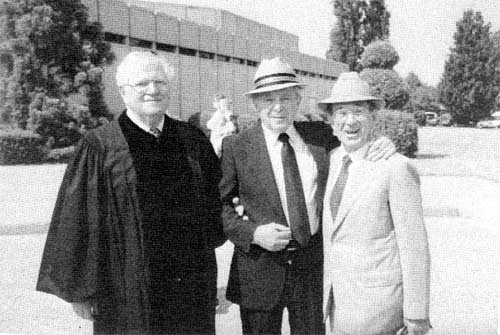
Rabbi Howard Kahn, Rabbi Harry Kellman, and Cantor Louis Herman — Beth El, Cherry Hill, 1980s.
A Typical Light Moment
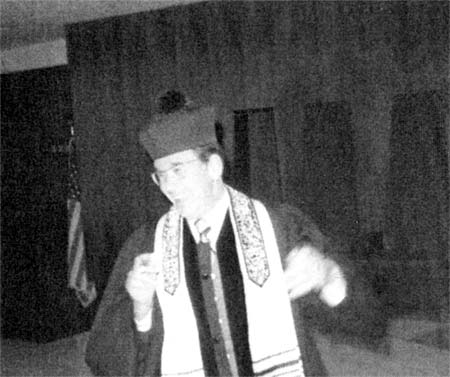
Cantor Louis J. Herman — “A Typical Light Moment.” Although this photo isn’t the clearest, it truly captures the joy that Cantor Herman brought to his work.
Kaighn Avenue Association Due Book
Late 1950s/Early 1960s
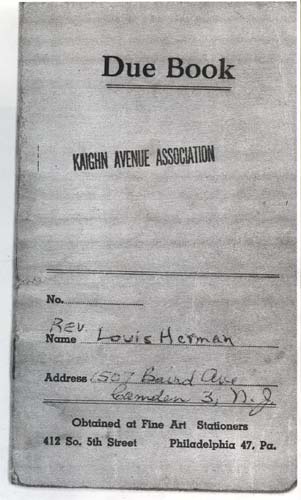
Due Book from the Kaighn Avenue Association. This dates from the late 1950s or early 1960s. — Phil Cohen, March 2009
Testimonial Dinner for Rabbi Riff
The following names appeared in the program for the Testimonial Dinner for Rabbi Naftoly H.J. Riff of Congregation Sons of Israel, May 1976. Images of program pages: Image 1 — Image 2 — Image 3 — Image 4 — Image 5 — Image 6
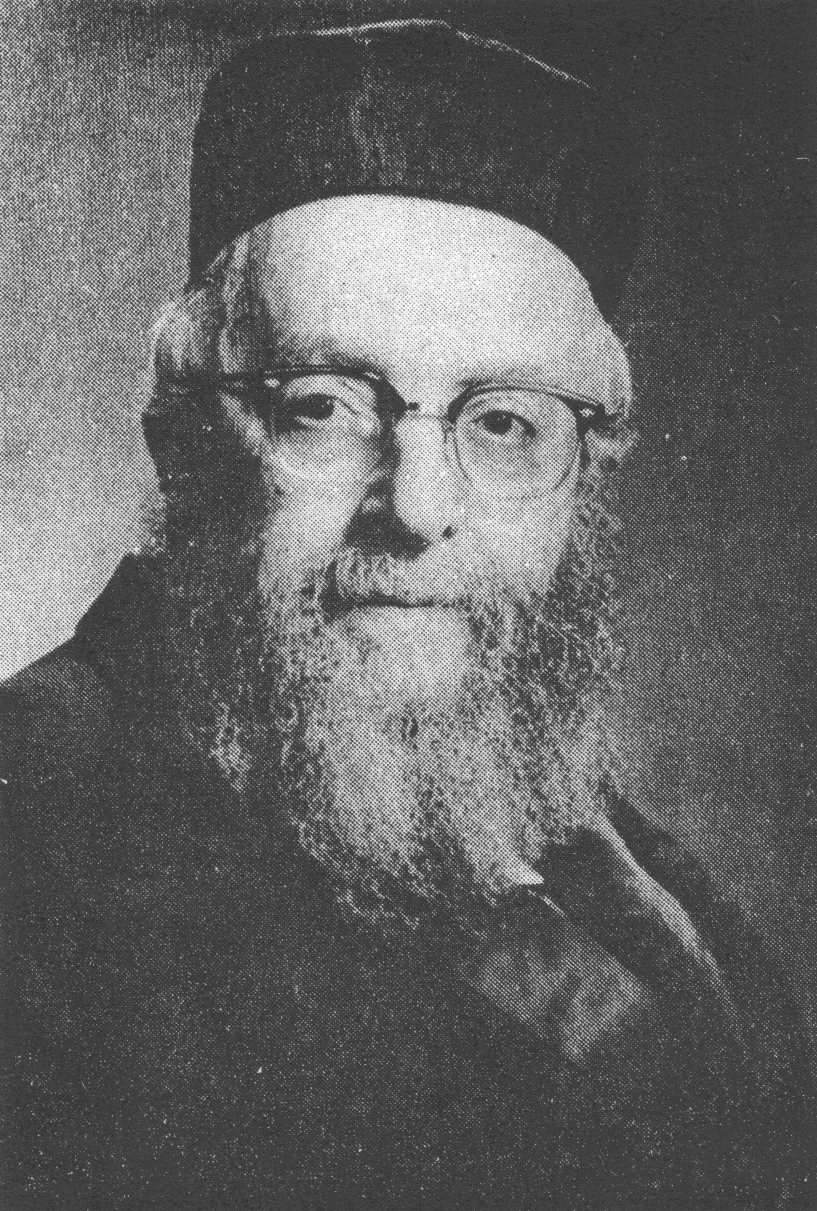
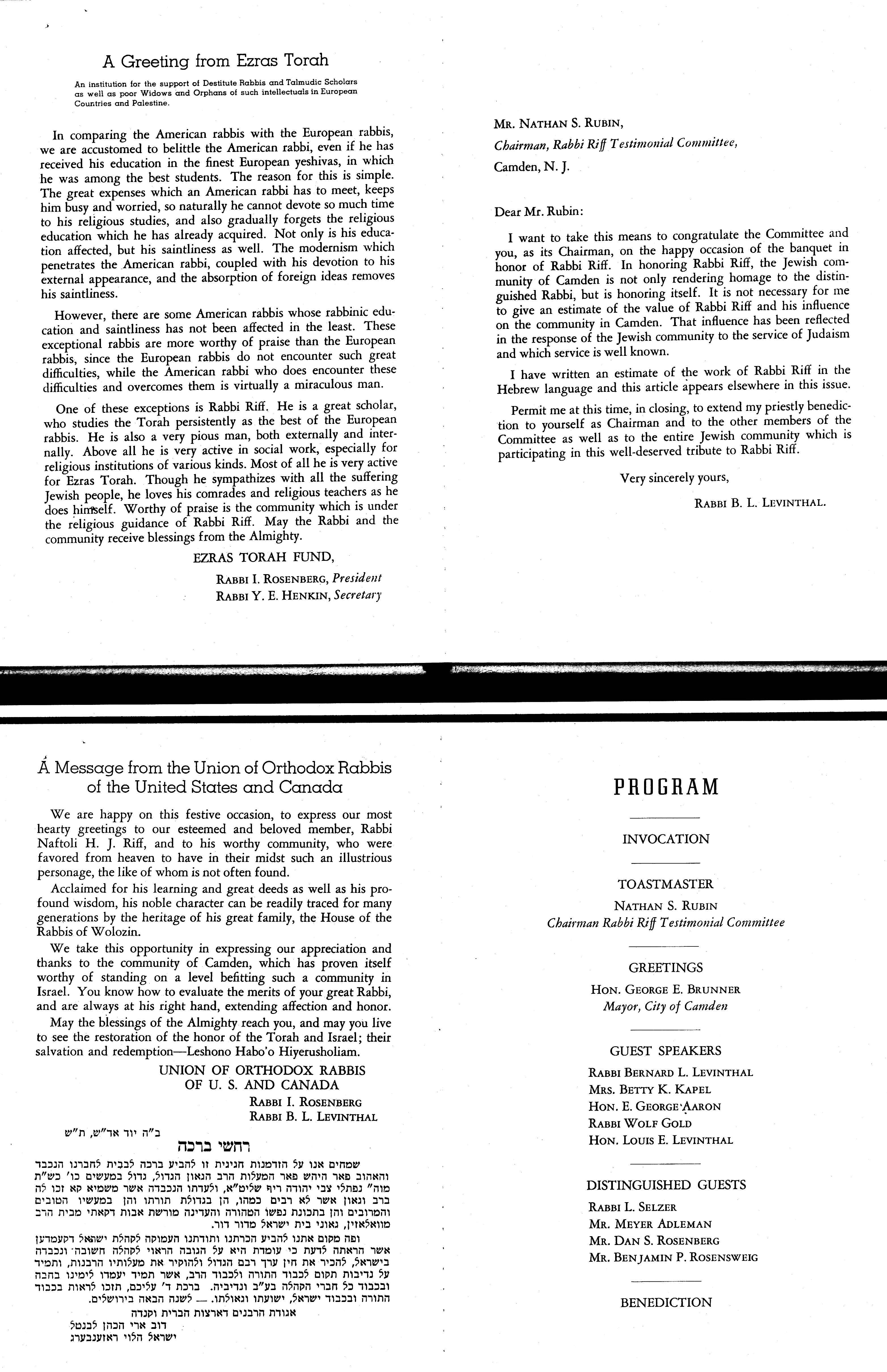
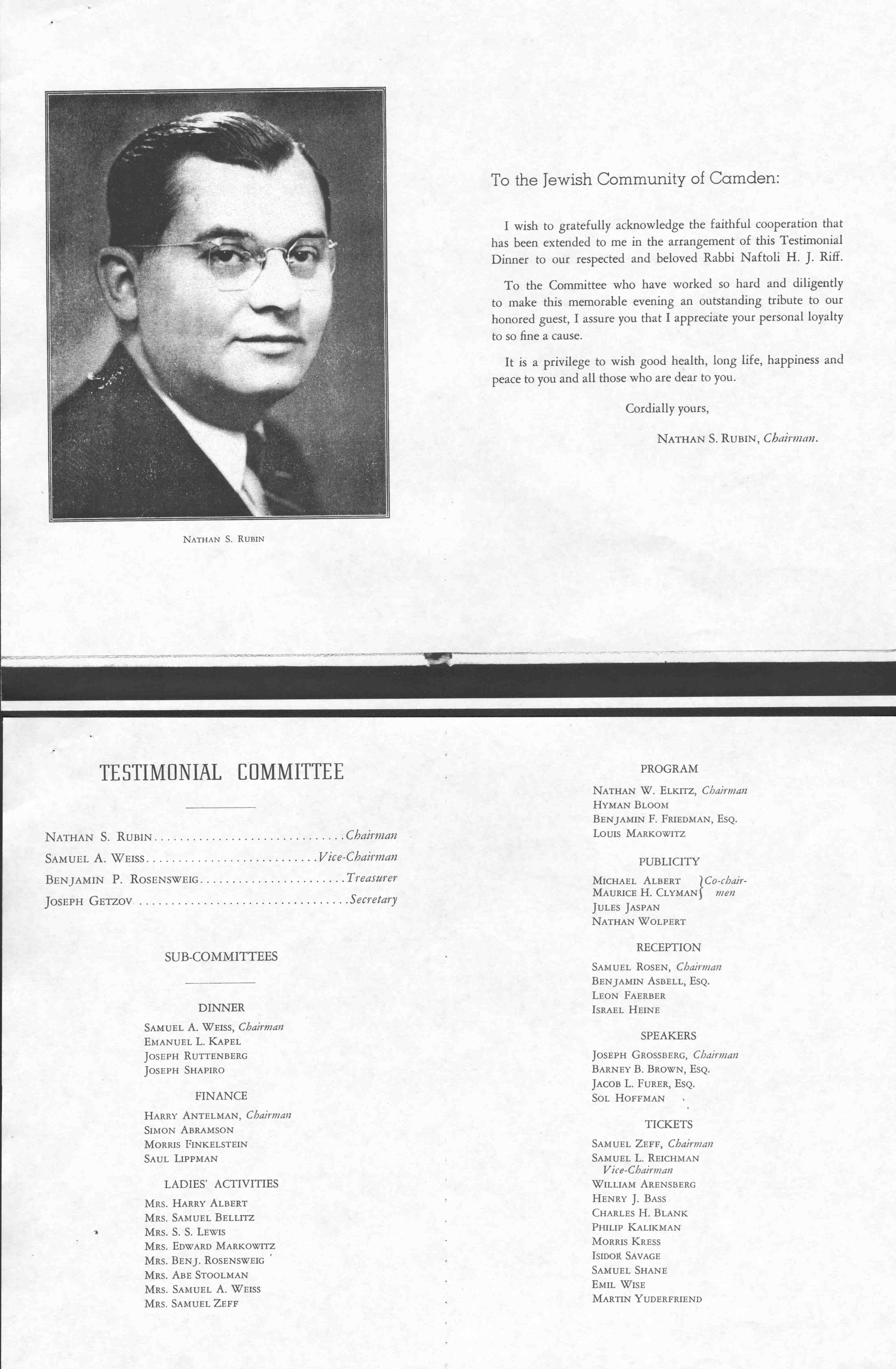
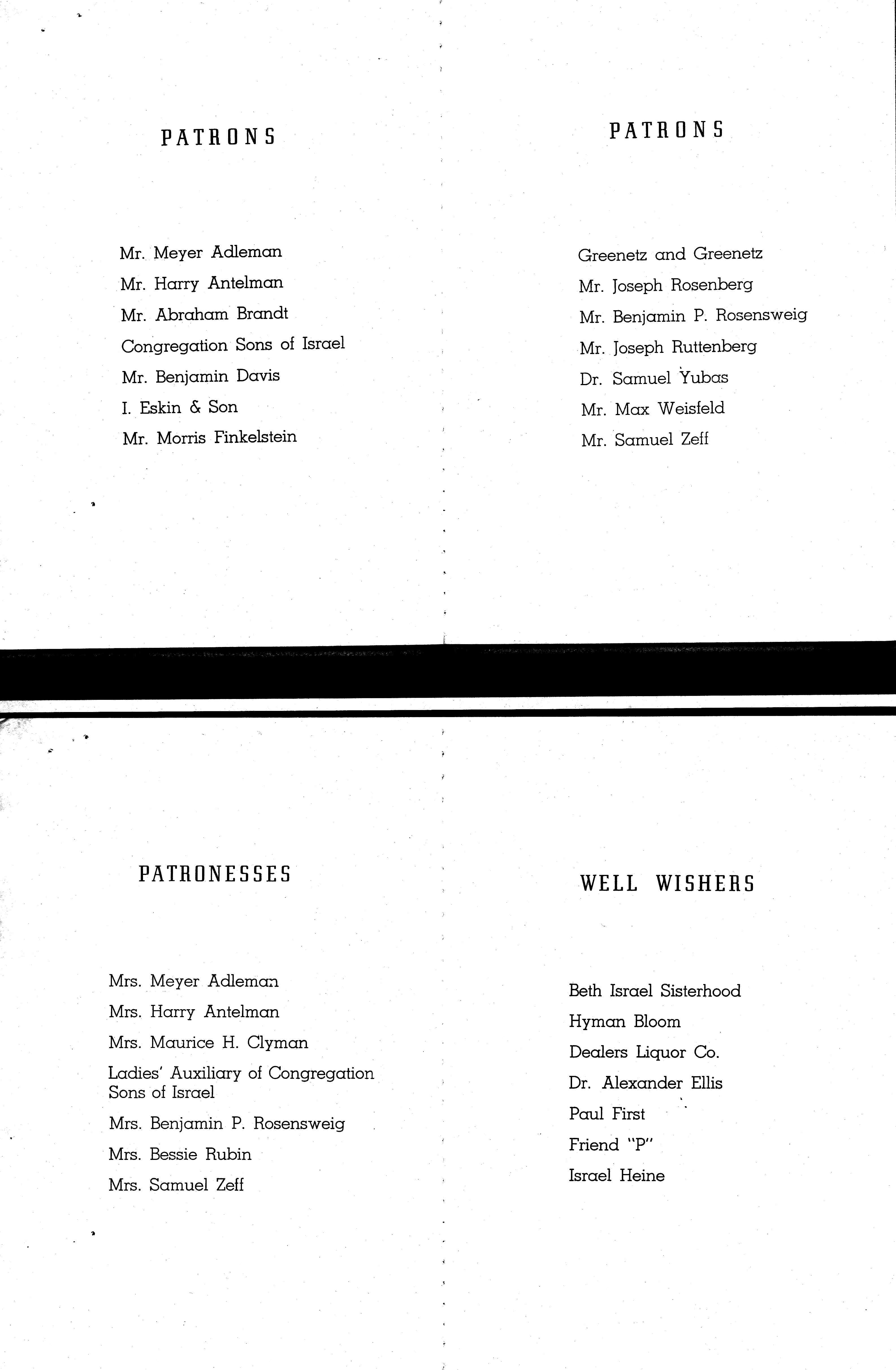
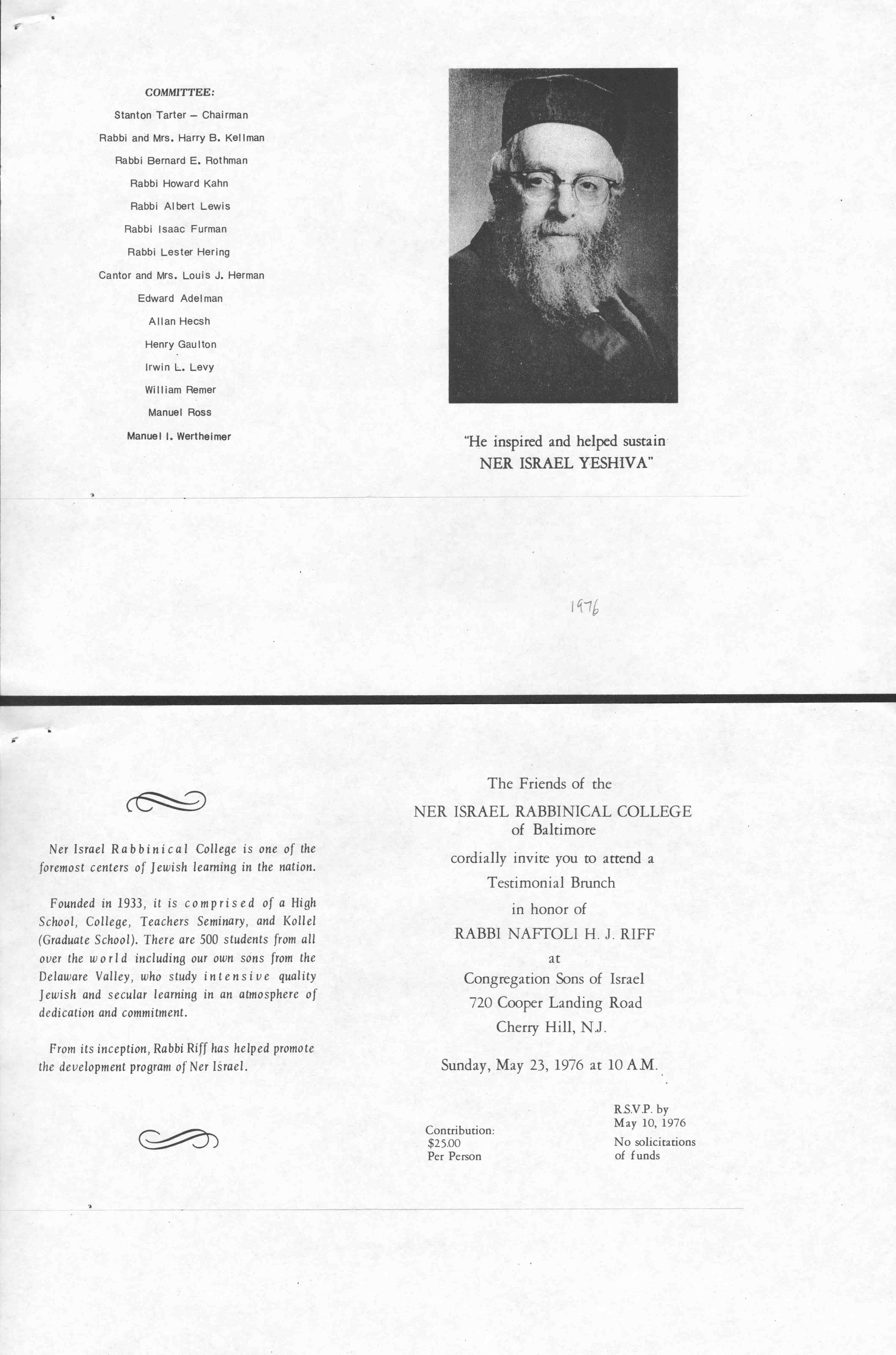
Nathan S. Rubin — George E. Brunner — Rabbi Bernard L. Levinthal — Mrs. Betty K. Kapel — E. George Aaron — Rabbi Wolf Gold — Louis E. Levinthal — Rabbi L. Selzer — Jacob Zuckerman — Meyer Adleman — Mrs. Meyer Adleman — Dan S. Rosenberg — Nathan S. Rubin — Samuel Yaffe — Samuel A. Weiss — Mrs. Samuel A. Weiss — Joseph Getzov — Emanuel L. Kapel — Manuel Ross — Joseph Ruttenberg — Joseph Shapiro — Harry Antelman — Mrs. Harry Antelman — William Remer — Morris Finkelstein — Benjamin P. Rosensweig — Mrs. Benjamin P. Rosensweig — Irwin L. Levy — Saul Lippman — Mrs. Harry Albert — Mrs. Samuel Bellitz — Mrs. S. S. Lewis — Henry Gaulton — Mrs. Edward Markowitz — Mrs. Ben J. Rosensweig — Mrs. Abe Stoolman — Allan Hecsh — Morris Kress — Samuel Zeff — Mrs. Samuel Zeff — Nathan W. Elkitz — Hyman Bloom — Simon Abramson — Isidore Savage — Benjamin F. Friedman — Maurice H. Clyman — Mrs. Maurice H. Clyman — Edward Adelman — Louis Markowitz — Michael Albert — Dr. Alexander Ellis — Stanton Tarter — Henry Schreibstein — Jules Jaspan — Nathan Wolpert — Samuel Rosen — Benjamin Asbell — Leon Faerber — Samuel Shane — Israel Heine — Joseph Grossberg — Barney B. Brown — Jacob L. Furer — Sol Hoffman — Martin Yuderfriend — Samuel L. Reichman — William Arensberg — Henry J. Bass — Cantor and Mrs. Louis J. Herman — Emil Wise — Abraham Brandt — Congregation Sons of Israel — Eskin & Son — Greenetz and Greenetz — Joseph Rosenberg — Dr. Samuel Yubas — Max Weisfeld — Harry Katz — Morris Finkelstein — Benjamin Davis — Mrs. Bessie Rubin — Ruby’s — Charles H. Blank — Philip Kalikman — Manuel I. Wertheimer — Meyer Leider — Beth Israel Sisterhood — Dealers Liquor Co. — Ladies’ Auxiliary of Congregation Sons of Israel — Rabbi and Mrs. Harry B. Kellman — Rabbi Albert Lewis — Rabbi Isaac Furman — Rabbi Lester Hering.