Morris Puro
Morris Puro
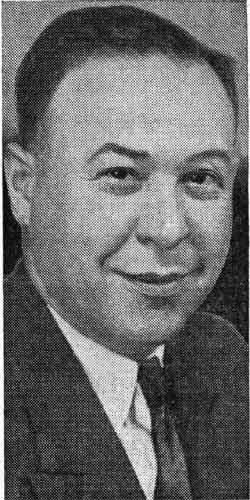
MORRIS PURO was born on July 15, 1898 in Poland. His family came to America in 1900. After serving in the military during World War I, he married at the age of 23.
By 1930 Morris Puro was already a successful automobile dealer. He owned a home at 4 Warren Street in Edgewater Park NJ, where he and his wife Bessie with their two daughters, Florence and Marian. He was still living there in 1936, according to the New Jersey Bell Telephone Directory of that year.
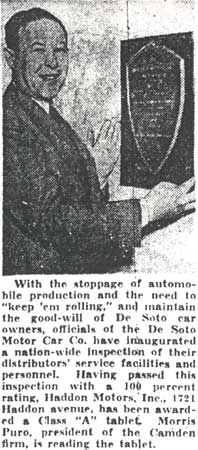
By that year Morris Puro had purchased the Watson Shallcross Inc. car dealership at 1721 Haddon Avenue in Camden, and renamed it Haddon Motors. This business had operated as a Dodge truck and Plymouth franchise. Morris Puro soon was operating a De Soto dealership here, and he did quite well over the years. In the late 1930s, he also served as the president of the Camden Automobile Dealers Association. Haddon Motors was a fixture on Haddon Avenue, Camden’s “other” new car dealer strip, into the late 1950s.
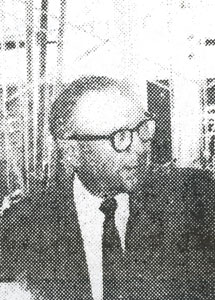
During the 1960s Morris Puro was involved in the relocation of Congregation Beth El from Parkside to Cherry Hill NJ. He served as co-chairman with Edward Saline of the Building Committee.
Morris Puro retired to Florida, where he died, on December 16, 1977, in Broward County.
Is Zat So! by Gordon Mackay
Camden Courier-Post —
RECIPES for the recession cure are as prolific as those in the cook books for viands, but none of them is as tasty as the stock-recipe for oxtail soup, chicken a la king and other toothsome products. Up to date the automobile business has received a kicking about that is as heavy and undesirable as any afforded to other businesses.
Nobody at the present time has advocated that Uncle Sam plow under the used cars. If such a measure were taken, the be-whiskered gentleman given authority to touch a match to the used cars, there would be no weeping, wailing or gnashing of teeth among the gentlemen who engage in that form of merchandising.
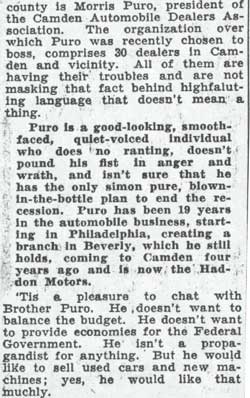
One of the best minds in the automobile business in this city and county is Morris Puro, president of the Camden Automobile Dealers Association. The organization over which Puro was recently chosen boss, comprises 30 dealers in Camden and vicinity. All of them are having their troubles and are not masking that fact behind highfaluting language that doesn’t mean a thing.
Puro is a good-looking, smooth-faced, quiet-voiced individual who does no ranting, doesn’t pound his fist in anger and wrath, and isn’t sure that he has the only simon pure, blown-in-the-bottle plan to end the recession. Puro has been 19 years in the automobile business, starting in Philadelphia, creating a branch in Beverly, which he still holds, coming to Camden four years ago and is now the Haddon Motors.
‘Tis a pleasure to chat with Brother Puro. He doesn’t want to balance a budget. He doesn’t want to provide economies for the Federal Government. He isn’t a propagandist for anything. But he would like to sell used cars and new machines; yes, he would like that muchly.
Revealed Plenty to Questioners
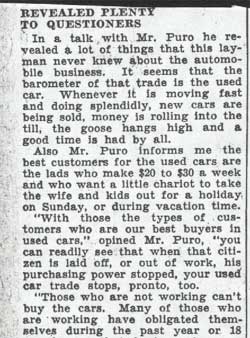
In a talk with Mr. Puro he revealed a lot of things that this layman never knew about the automobile business. It seems that the barometer of that trade is the used car. Whenever it is moving fast and doing splendidly, new cars are being sold, money is rolling into the till, the goose hangs high and a good time is had by all.
Also Mr. Puro informs me the best customers for the used cars are the lads who make $20 to $30 a week and who want a little chariot to take the wife for a ride on Sunday holiday, on Sunday, or during vacation time.
“With those the types of customers who are our best buyers in used cars,” opined Mr. Puro, “you can readily see that when that citizen is laid off, or out of work, his purchasing power stopped, your used car trade stops, pronto, too.
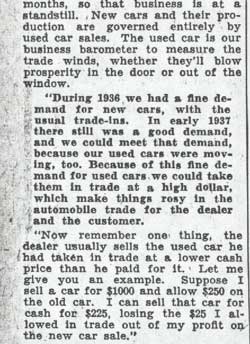
“Those who are not working can’t buy the cars. Many of those who are working have obligated themselves during the past year or 18 months, so that business is at a standstill. New cars and their production are governed entirely by used car sales. The used car is our business barometer to measure the trade winds, whether they’ll blow prosperity in the door or out of the window.
“During 1936 we had a fine demand for new cars, with the usual trade-ins. In early 1937 there still was a good demand, and we could meet that demand, because used cars were still moving, too. Because of this fine demand for used cars we could take them in trade at a high dollar, which make things rosy in the automobile business for the dealer and the customer.
“Now remember one thing, the dealer usually sells the used car he had taken in trade at a lower cash price than he had paid for it. Let me give you an example. I suppose I sell a car for $1000 and allow $250 on the old car. I can sell that car for cash for $225, losing the $25 I allowed in trade out of my profit on the new car sale.”
Sees Revival in Springtime
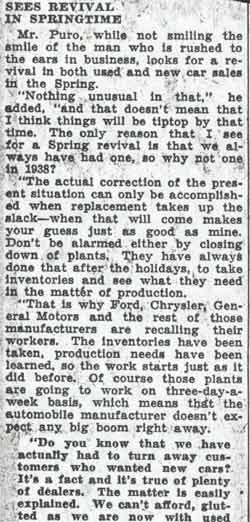
Mr. Puro, while not smiling the smile of the man who is rushed to the ears in business, looks for a revival in both used and new car sales in the Spring.
“Nothing unusual in that,” he added, “and that doesn’t mean that I think things will be tiptop by that time. The only reason that I see for a Spring revival is that we always have had one, so why not one in 1938?
“The actual correction of the present situation can only be accomplished when replacement takes up the slack—when that will come makes your guess just as good as mine. Don’t be alarmed either by closing down of plants. They have always done that after the holidays, to take inventories and see what they need in the way of production.
“That is why Ford, Chrysler, General Motors and the rest of those manufacturers are recalling their workers. The inventories have been taken, production needs have been learned, so the work starts just as it is before. Of course those plants are going to work on a three-day-a-week basis, which means that the automobile manufacturer doesn’t expect any big boom right away.
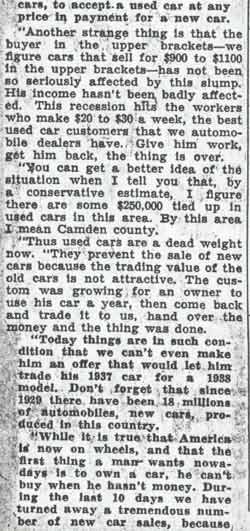
“Do you know that we have actually had to turn away customers who wanted new cars? It’s a fact and it’s true of plenty of dealers. The matter is easily explained. We can’t afford, glutted as we are now with used cars, to accept a used car at any price in payment for a new car.
“Another strange thing is that the buyer in the upper brackets—we figure cars that sell for $900 to $1100 in the upper brackets—has not been so seriously affected. His income hasn’t been badly affected. This recession hits the workers who make $20 to $30 a week, the best used car customers that we automobile dealers have. Give him work, get him back, the thing is over.
“I can get a better idea of the situation, let me tell you that, by a conservative estimate, I figure there are some $250,000 tied up in used cars in this area. By this area I mean Camden county.
“Thus used cars are a dead weight now. They prevent the sale of new cars because the trading value of the car becomes unattractive. The custom was growing for a customer to use his car a year, then come back and trade it to us, hand over the money and the thing was done.
“Today things are in such condition that we can’t even make a fair offer that would let him trade his 1937 for a 1938 model. Don’t forget that since 1929 there have been 18 millions of automobiles, new cars, produced in this country.
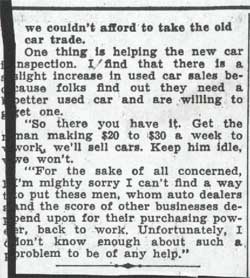
“While it is true that America is now on wheels, and that the first thing a man wants nowadays is to own a car, he can’t buy when he hasn’t money. During the last 10 days we have turned away a tremendous number of new car sales, because we couldn’t afford to take the old car trade.
“One thing is helping the new car inspection. I find that there is a slight increase in used car sales because folks find out they need a better used car and are willing to get one.
“So there you have it. Get the man making $20 to $30 a week to work, we’ll sell cars. Keep him idle, we won’t.
“For the sake of all concerned, I’m mighty sorry I can’t find a way to put these men, whom auto dealers and the score of other businesses depend upon for their purchasing power, back to work. Unfortunately, I don’t know enough about such a problem to be of help.”
Autos Will End Recession, Investment Official Asserts
Camden Courier-Post —
Camden Dealers Signs of Spring Up-turn in Trade Are Appearing
Installment Plan Given Defense
Uncle Sam will ride out of the present recession in the 1938 model automobile. He wheeled out of the 1929 depression on rubber, and he’ll do the same thing over again this year.
This was the message the Camden Automobile Trade Association heard last night from H. J. Fink, vice president of the Commercial Investment Trust Corporation, of New York.
Fink addressed the association at its monthly dinner in the Hotel Walt Whitman. G. E. Weaver, head of the company that makes the apparatus which governs the official inspection of automobiles in New Jersey also was a guest speaker. Morris Puro, president of the organization, introduced the speakers.
“It was the automobile business that pulled the country out of the depression in the 30’s” Fink declared, “and it will be the automobile business that will pull us out of the present depression.”
“Just the means that will be used bY the industry to do this,” he continued, “I do not know personally. But with Spring coming, business taking an upturn and the used car stagnation lessened greatly, the automobile industry will make fresh advances.
“The automobile industry is the greatest of ally key industries in my mind. It is a true barometer of business, a true index of the purchasing power and spending capacity and willingness on the part of the people of this country to invest.
Defends Installment
“Much has been said about installment business. Whenever a writer runs short of material to fill a column he merely reaches out and picks on the installment business. Now let us really see how the installment business has worked as a factor in the home and community life of the Nation.
“Essentially, installment buying on the part of the people is the investment of money in wealth. It is buying something on a margin, save that every week you reduce the margin until there is none remaining and the wealth purchased in that manner belongs to the buyer.
“Persons go into the stock market and buy on margin, why cannot persons who want various things invest in commodities in the same manner? So long as the buyer of wealth, of radios, of automobiles or various things that are really wealth, pays his margins as they come due, installment buying is not only legitimate but it is the surest guarantee of keeping industry busy and people in the market buying.
“The automobile world today faces a problem which was created by a peculiar combination of circumstances. The present depression, I lay largely to fear. It makes no difference in what quarter the fear originated, or how it was stimulated, fear rests at the bottom of the present depression.
“Thus the first thing that people must regain is confidence in themselves, in the country and in the ability of industry to make new advances.
Credit Big Problem
“In the automobile business three factors swayed conditions and governed the situation. They were the manufacturer, the distributor and the finance companies. Today the finance companies are the companies that are really facing the toughest tests of all.
“Automobiles will sell again, no question about that. But to sell the product it is necessary that we tell the truth. Persons who are asked to buy cars must be given the facts of the method of purchase, the method of selling and the method of financing.
“I know the automobile industry will pull this country out of the present rough place. How it will be done I don’t know and I’m not going to stand here and try to tell you something that I don’t know myself.
“I see favorable factors, though.
There is the usual Spring impetus to automobile buying. There will be new methods of financing purchases which won’t clog the market and be a hardship on the finance companies.
“Once the automobile industry starts working back to normal the other industries that rely for the greatest part of their output being absorbed by automobile manufacture will necessarily step up production and put men to work.
Dealers Warned
“Meanwhile the automobile dealer must be ready. He must profit by his experience in this recession and arrange manners differently as to credits and to purchases. He must deflate himself as an agent, and become a good, hard-headed business man who is willing to extend credit to the buyer who is worthy such extension of credit and to refuse a buyer who is not able to keep pace with the credit payments which are due.
“Therefore while this Winter has been hard on automobile dealers, I think that already there are signs that Spring will see an upward movement that will mark the coming of better times.”
Weaver explained the various appliances that are used for testing automobiles. He offered to instruct any dealer in the manner of using these machines to obtain the best results, and went into a technical discussion of inspection.
After the speechmaking the organization went into its usual business meeting. The reports of the committees indicated that conditions were a little easier in the trade. Puro and several associates who had attended a meeting at Newark recited the program which had been carried out there.
Haddon Motors — March 1942
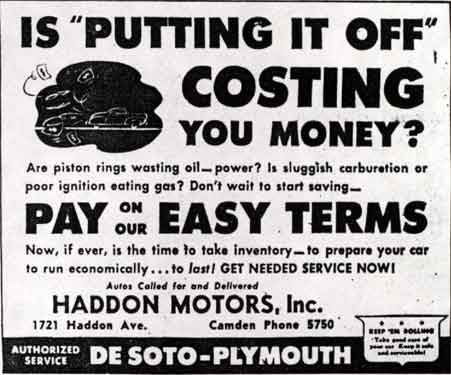
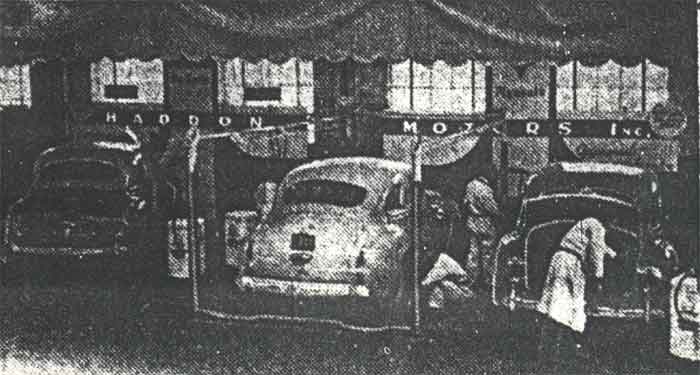
Left: March 1942 ad for Haddon Motors service department. Right: March 1942 photo of same.
Haddon Motors Postcard, circa 1950
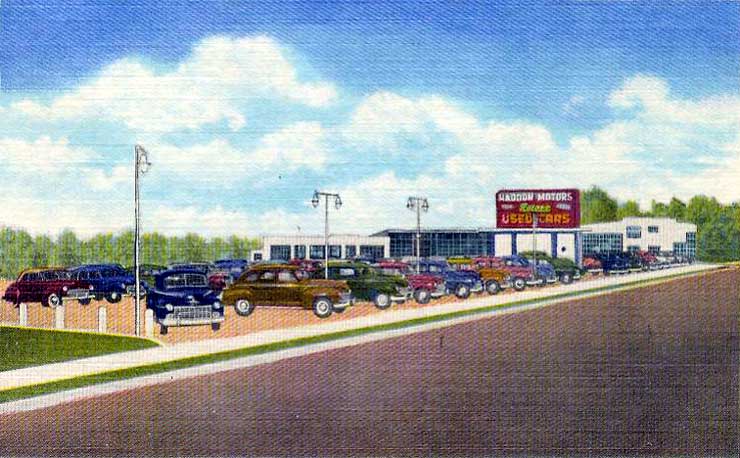
Haddon Motors postcard, circa 1950
1956 New Jersey Bell Yellow Pages
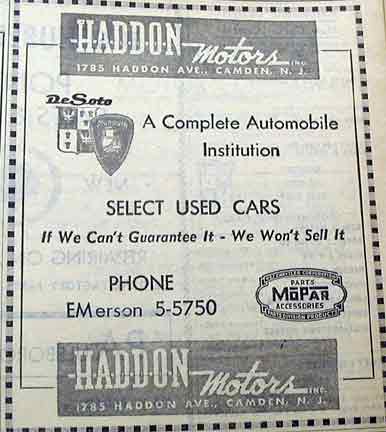
1956 New Jersey Bell Yellow Pages ad for Haddon Motors
Groundbreaking Ceremony for Congregation Beth El — June 1966
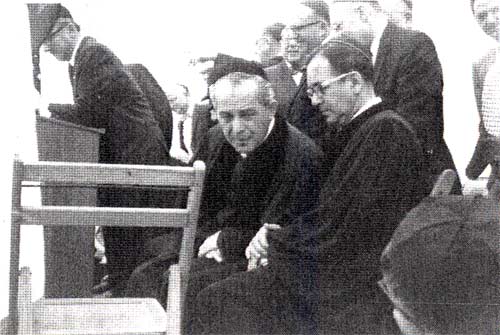
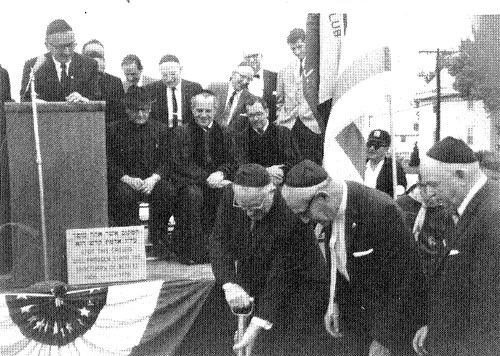
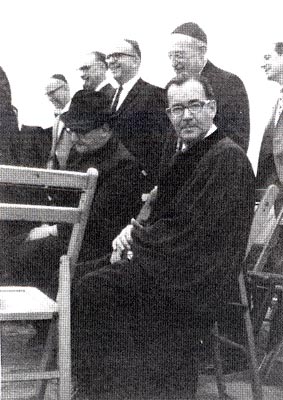
Above: Rabbi Harry Kellman and Cantor Louis Herman, seated. Right: Cantor Herman. Below: At microphone, Harry Goldstein. Seated, unknown, Rabbi Kellman, Cantor Herman. Standing at far right, with bow tie, Harry Kolosky. With shovel, Meyer Adelman. Also looking on, Herman Natal and Morris Puro.
Construction of Congregation Beth El — Cherry Hill, 1968
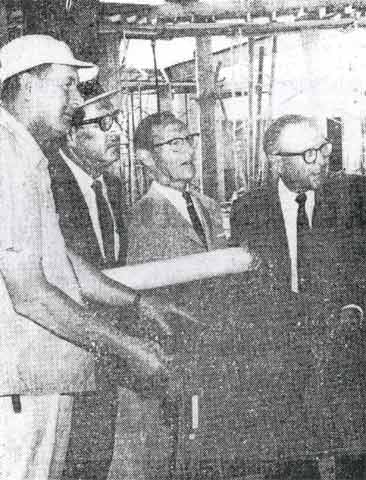
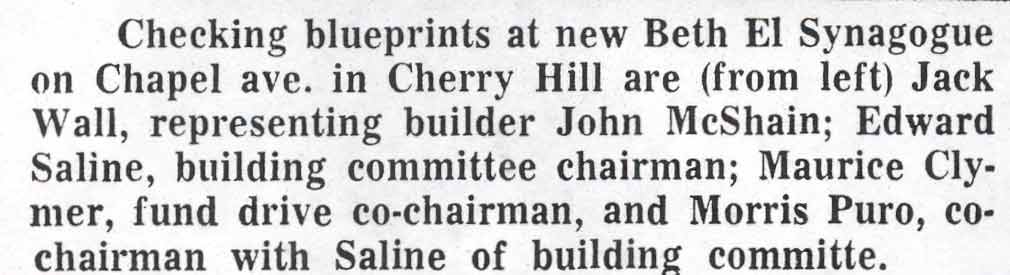
Construction of the new synagogue, Congregation Beth El, Cherry Hill NJ, 1968. Left to Right: Jack Wall, Edward Saline, Morris Clymer, & Morris Puro.
Haddon Motors — Summer 2003
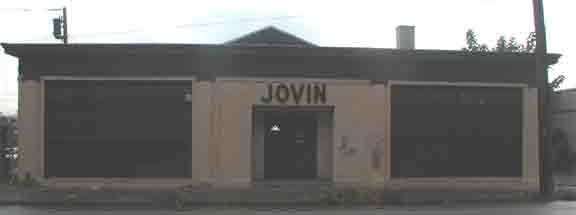
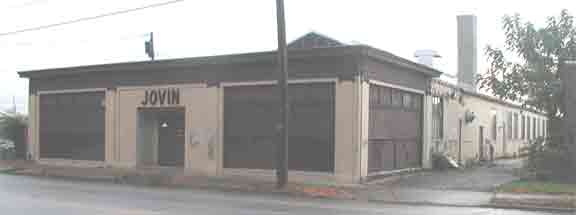
Haddon Motors DeSoto-Plymouth at 1761 Haddon Avenue — Summer of 2003