Introduction
JOHN S. EDWARDS was born in Camden NJ around 1875, the middle child of Martha and John C. Edwards, coming after James and before Lydia. The family lived on Mount Vernon Street near South 6th Street at the time of the 1880 Census. They later moved across the railroad tracks that ran down South 7th Street to a house at 815 Division Street, where they stayed until 1889. John C. Edwards worked at the Camden Iron Works during this time. He was active in politics in what was then Camden’s Seventh Ward and served as an extra man with the Camden Fire Department in 1884 and 1885. The 1890–1891 Directory shows the family at 704 Cherry Street, and John C. Edwards was working as a laborer.
John S. Edwards grew up along the railroad tracks that ran down South 7th Street, and sadly, like so many boys his age, took the trains for granted. On the morning of September 8, 1886 he tried to race across the tracks at Walnut Street. He was struck by the train and thrown about ten feet from the crossing. He was carried to the butcher shop of Julius Bobst at 700 Walnut Street. Dr. William Warnock, who had his home and office at 751 Kaighn Avenue, was called for help, and found the boy badly hurt. Two hours later Dr. Dowling Benjamin performed an amputation on young Edwards’ right foot. His injuries were so severe however that he passed away the following morning at 7:30 AM.
The Edwards family remained in the neighborhood for many years.
A School Boy Mangled
Camden Courier-Post —
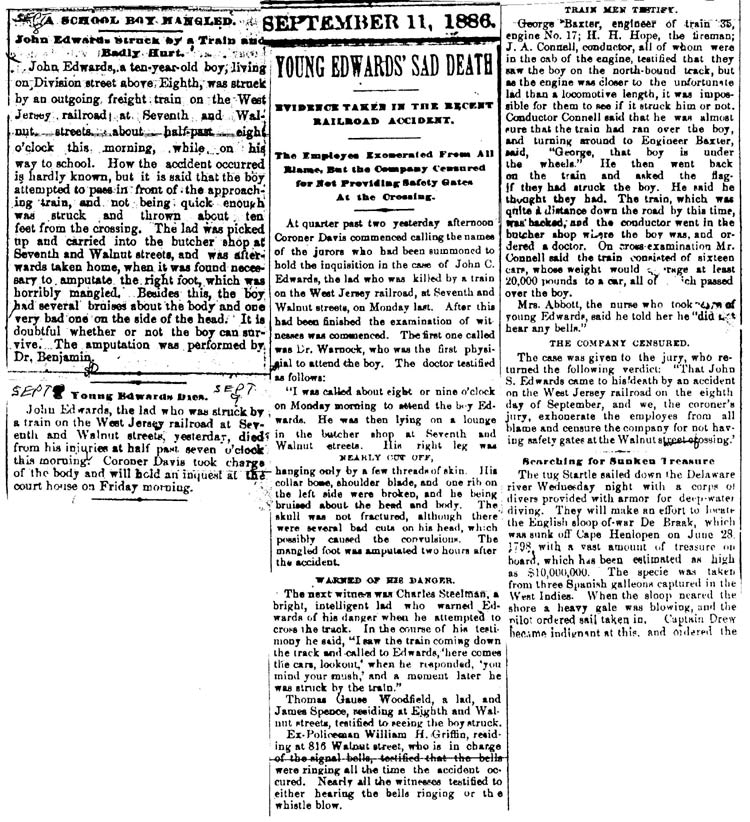
John Edwards Struck by a Train and Badly Hurt.
John Edwards, a ten-year-old boy, living on Division street above Eighth, was struck by an outgoing freight train on the West Jersey railroad at Seventh and Walnut streets, about half-past eight o’clock this morning, while on his way to school. How the accident occurred is hardly known, but it is said that the boy attempted to pass in front of the approaching train, and not being quick enough was struck and thrown about ten feet from the crossing. The lad was picked up and carried into the butcher shop at Seventh and Walnut streets, and was afterwards taken home, when it was found necessary to amputate the right foot, which was horribly mangled. Besides this, the boy had several bruises about the body and one very bad one on the side of the head. It is doubtful whether or not the boy can survive. The amputation was performed by Dr. Benjamin.
Young Edwards Dies.
John Edwards, the lad who was struck by a train on the West Jersey railroad at Seventh and Walnut streets, yesterday, died from his injuries at half past seven o’clock this morning. Coroner Davis took charge of the body and will hold an inquest at the court house on Friday morning.
Young Edwards’ Sad Death
Evidence Taken in the Recent Railroad Accident.
The Employes Exonerated From All Blame, But the Company Censured for Not Providing Safety Gates At the Crossing.
At quarter past two yesterday afternoon Coroner Davis commenced calling the names of the jurors who had been summoned to hold the inquisition in the case of John C. Edwards, the lad who was killed by a train on the West Jersey railroad, at Seventh and Walnut streets, on Monday last. After this had been finished the examination of witnesses was commenced. The first one called was Dr. Warnock, who was the first physician to attend the boy. The doctor testified as follows:
“I was called about eight or nine o’clock on Monday morning to attend the boy Edwards. He was then lying on a lounge in the butcher shop at Seventh and Walnut streets. His right leg was
Nearly Cut Off,
hanging only by a few threads of skin. His collar bone, shoulder blade, and one rib on the left side were broken, and he being bruised about the head and body. The skull was not fractured, although there were several bad cuts on his head, which possibly caused the convulsions. The mangled foot was amputated two hours after the accident.”
Warned of His Danger.
The next witness was Charles Steelman, a bright, intelligent lad who warned Edwards of his danger when he attempted to cross the track. In the course of his testimony he said, “I saw the train coming down the track and called to Edwards, ‘here comes the cars, lookout,’ when he responded, ‘you mind your mush,’ and a moment later he was struck by the train.”
Thomas Gause Woodfield, a lad, and James Spence, residing at Eighth and Walnut streets, testified to seeing the boy struck.
Ex-Policeman William H. Griffin, residing at 816 Walnut street, who is in charge of the signal bells, testified that the bells were ringing all the time the accident occured [sic]. Nearly all the witnesses testified to either hearing the bells ringing or the whistle blow.
Train Men Testify.
George Baxter, engineer of train 35, engine No. 17; H. H. Hope, the fireman; J. A. Connell, conductor, all of whom were in the cab of the engine, testified that they saw the boy on the north-bound track, but as the engine was closer to the unfortunate lad than a locomotive length, it was impossible for them to see if it struck him or not. Conductor Connell said that he was almost sure that the train had run over the boy, and turning around to Engineer Baxter, said, “George, that boy is under the wheels.” He then went back on the train and asked the flag[?] if they had struck the boy. He said he thought they had. The train, which was quite a distance down the road by this time, was backed, and the conductor went in the butcher shop where the boy was, and ordered a doctor. On cross-examination Mr. Connell said the train consisted of sixteen cars, whose weight would average at least 20,000 pounds to a car, all of which passed over the boy.
Mrs. Abbott, the nurse who took care of young Edwards, said he told her he “did not hear any bells.”
The Company Censured.
The case was given to the jury, who returned the following verdict: “That John S. Edwards came to his death by an accident on the West Jersey railroad on the eighth day of September, and we, the coroner’s jury, exonerate the employes from all blame and censure the company for not having safety gates at the Walnut street crossing.”
Searching for Sunken Treasure
The tug Startle sailed down the Delaware river Wednesday night with a corps of divers provided with armor for deep-water diving. They will make an effort to locate the English sloop-of-war De Braak, which was sunk off Cape Henlopen on June 28, 1798, with a vast amount of treasure on board, which has been estimated as high as $10,000,000. The specie was taken from three Spanish galleons captured in the West Indies. When the sloop neared the shore a heavy gale was blowing, and the pilot ordered sail taken in. Captain Drew became indignant at this, and ordered the [cut off at the crop edge]