Introduction
JAMES RUDOLPH SNYDER was born in Camden, New Jersey on January 2, 1932 to Rex W. Snyder and his wife, the former Anna Jackson. He was the sixth of at least seven children, coming after Clarence F. and Woodley R. Snyder, Julius Snyder, Margaret Snyder and Leroy Snyder. A sister, Florence was born in 1936. The Snyders had come to Camden from Philadelphia, shortly after the birth of Woodley Snyder in 1926. The 1930 Census shows them at 919 South 9th Street. Also living with the family were Rex Snyder’s mother Jane and her second husband, Louis Frazier. The family broke apart in the late 1930s, the most likely scenario is that Anna Snyder had passed away, and Clarence F. Snyder does not appear to have survived the 1930s.
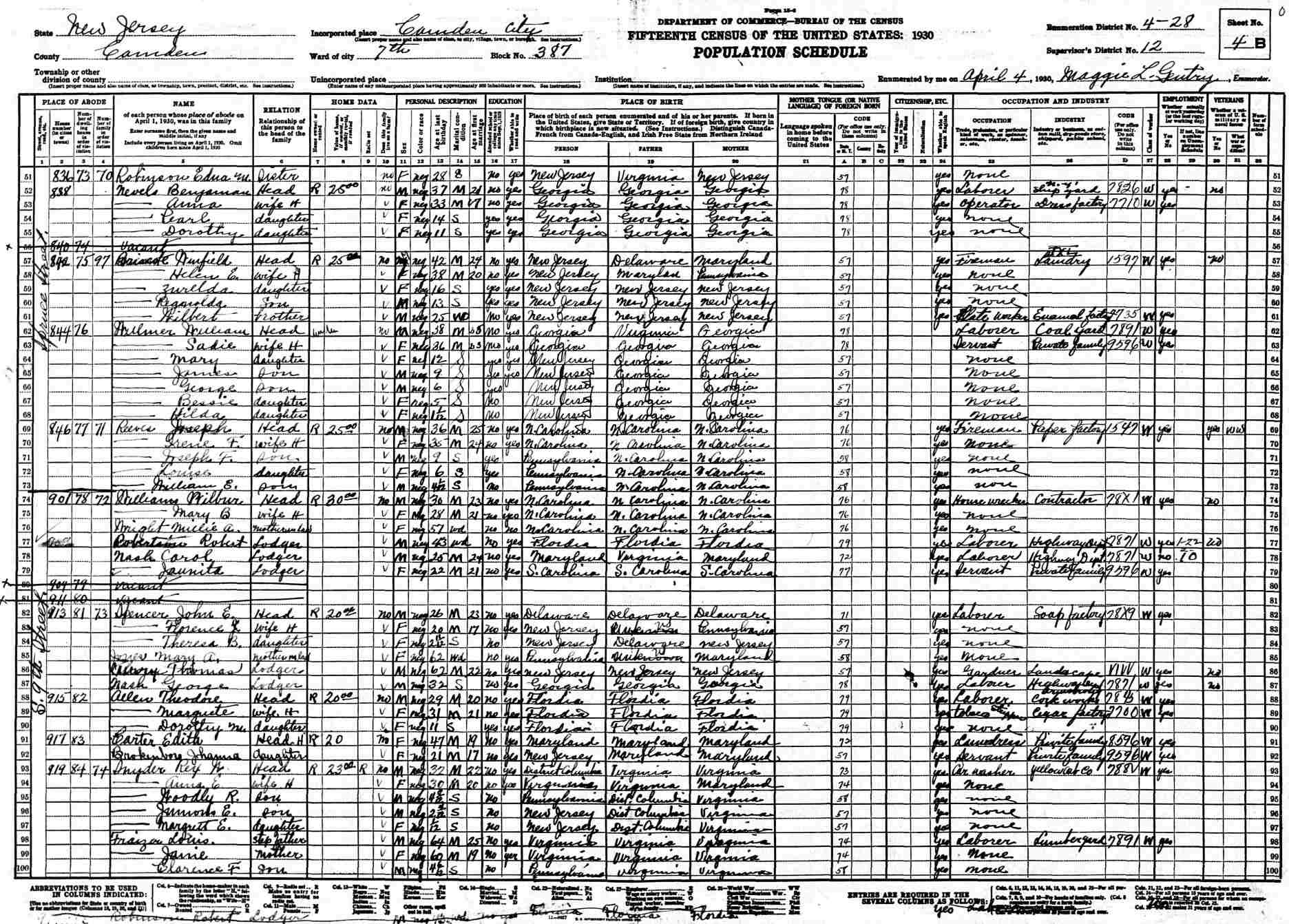
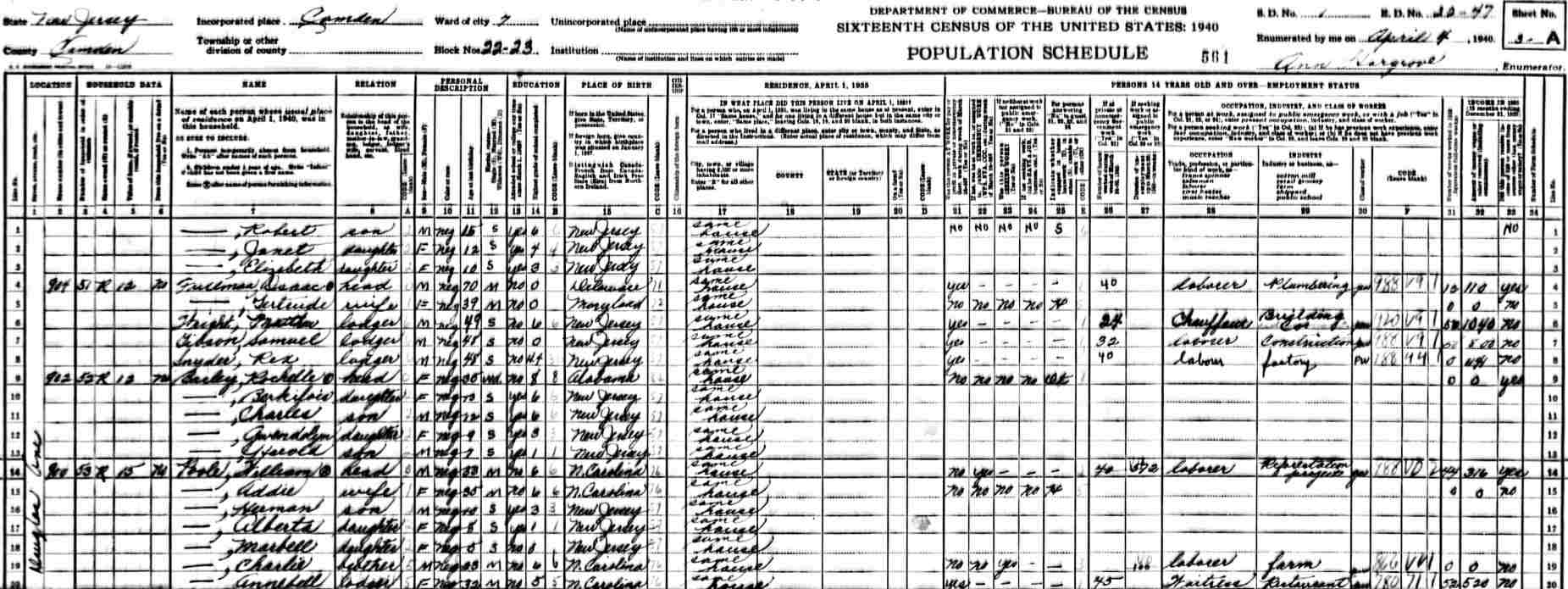
The 1940 Census shows that Woodley Snyder was living at the New Jersey Home for Boys in Middlesex County. Julius, Leroy and James were living with grandparents Howard and Caroline Jackson, listed in the 1940 Census for Sleepy Hole, Virginia, which is now part of the city of Suffolk, Virginia. The Census indicates that the boys were living there as early as 1935. The 1940 Census also shows Rex Snyder was boarding at 904 Douglass Street in Camden, and grandmother Jane Frazier and her husband had moved to 736 Cherry Street. The Snyder daughters were raised elsewhere, Margaret by Chasten and Mary Howard, who lived for many years in Pennsauken, New Jersey. By 1942 Rex Snyder had moved to the 700 block of Mt. Vernon Street.
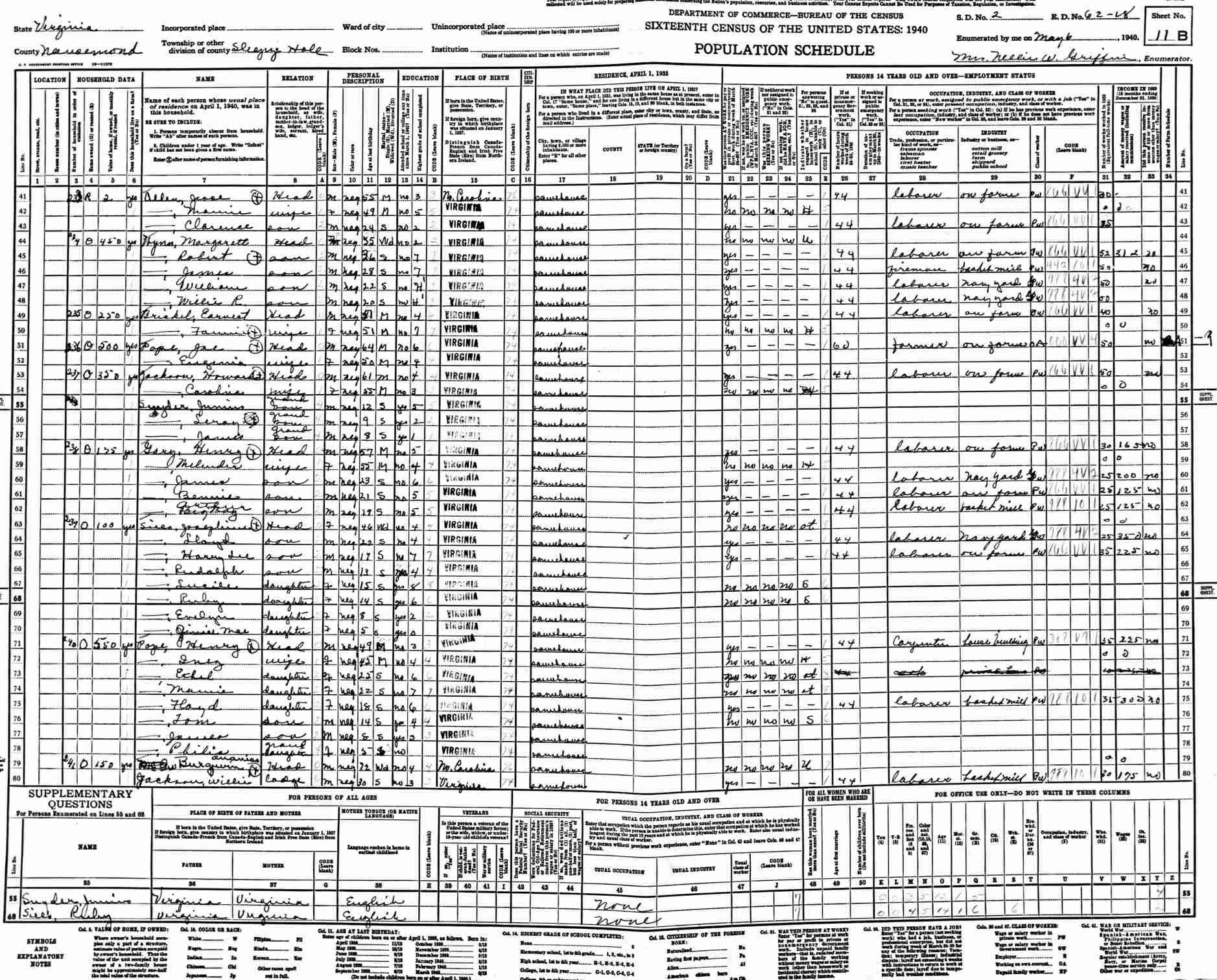
Woodley, Julius, Leroy and James Snyder were all back in Camden in the 1940s. Woodley Snyder had been getting trouble with the law since the age of nine. He was sent to Jamesburg in 1942 for breaking and entering. He escaped from the Boys Home in September of 1942 and was arrested in Camden with stolen goods after a month on the run, and was sentenced to a 10-15 year prison term for beating an elderly woman during a robbery so badly that she was paralyzed. Julius Snyder had at least four brushes with the law between 1946 and 1963 on charges that included gambling, embezzlement, burglary, and assault. Both brothers appear to have straightened as the years passed. Leroy and James Snyder, on the other hand, were a whole other matter.
In December of 1949 Leroy Snyder was arrested for assaulting a young woman and attempting to strangle her with a clothesline. After a too-short time in prison, he returned to Camden, and was sent back to jail for robbing and threatening to kill two young women. He was given four years imprisonment for this crime. Released from prison on June 23, 1955, he was arrested on July 26, 1955 for robbing a Philadelphia cab driver, and sentenced for assault and battery with intent to rob and was given a three to five year sentence. Released from jail in January of 1959, he was arrested in August for armed robbery and prison for ten years. Leroy Snyder was put back on the street in January of 1969 after serving nine years in prison. Within six weeks of his being put back on the street, he had murdered his first victim. Mrs. Lula Crawley was bound, gagged, and stabbed 13 times. Leroy Snyder murdered six more people over the next 8 months. His killing spree was stopped in September, shortly after the rape and murder of Mrs. Friedman. Under New Jersey law, Snyder’s plea of no defense on seven counts of homicide prevented the state from imposing a death penalty for his crimes. On July 16, 1970, he was sentenced to three consecutive life terms, requiring the prisoner to serve 43 years and six months before he is eligible for parole. Referring to a court-ordered psychiatric report, the presiding judge publicly described Snyder as a “malignant psychopath” and a “threat to society,” expressing the hope that he would never be released from jail. Leroy Snyder died in prison October of 2001.
James Snyder attended the Whittier School at South 8th and Chestnut Streets before going into the United States Army, most likely as a draftee, and served in Korea. He was stationed at Walter Reed Hospital in Washington, D.C. and had been promoted to Corporal by May of 1952. He was arrested in Camden on May 10, 1952 for possession of a stolen car and was fined $200 and turned over to the Army at Fort Dix. His life appears to have gone completely off the rails after this. He was sent to prison at the Lorton Reformatory on larceny charges for crimes committed in Washington. Within two weeks of his release, he had robbed and assaulted a nurse, and killed a busboy with a hammer. His trial was delayed until 1959, and he was acquitted for reasons of insanity and confined to the federal mental institution at St. Elizabeth’s Hospital in Washington. Although he had been violent on several occasions, he was allowed street privileges from 9:00 A.M to 9:00 P.M. to work in a vocational program. In 1969 while at one of these programs, he attacked a hospital employee, leaving his victim less one eye. The hospitals’ response was to cut his time allowed off-premises to 9:00 A.M. to 5:00 P.M.
James Snyder escaped from St. Elizabeth’s in July of 1972 and made his way back to Camden. He connected with Mrs. Muskogee Edwards, who had taught him when he had been a student at the John G. Whittier School at South 8th Street and Chestnut Street. Mrs. Edwards hired him as a handyman to do repairs at her home on Kaighn Avenue. This was a fatal mistake, as James Snyder murdered her in her home. She was not seen after August 16, 1972. James Snyder stayed in Mrs. Edwards’ home, told neighbors she had gone to California, and wrote checks from her bank account until he was arrested and returned to St. Elizabeth’s Hospital.
Police searched Mrs. Edwards’ home, but found no body. James Snyder had taken extraordinary measure to conceal his crime, and it is thought by those who investigated the case that he may have eaten her. At a hearing on March 16, 1973 Richard D’Auria, a Camden Police Department detective, testified that on September 20, 1972 the Camden, New Jersey police, investigating the disappearance of Mrs. Muskogee Edwards, went to the basement of her house in Camden. In a trash can they ‘found three fingers, the remains of three fingers, a large amount of human hair, approximately 15 pounds of musk, which was lime, cement and decomposed body tissue.’ Also in the trash can were two sheets, two pillow cases, and a quilt, all saturated with blood. One of the fingers was identified by a print as a finger of Muskogee Edwards. Also in the basement were a hack saw, a meat cleaver, a knife and an ax, all stained with blood. Human hair on the ax and on a hack saw blade found in the trash can matched hair found on a brush and in a bureau drawer belonging to Mrs. Edwards.
One theory is that James Snyder may have eaten Mrs. Edwards, another theory is that he used acid to break down her remains. Richard D’Auria wrote in 2019 “…Having no body, witness or a confession it took me years and a different Prosecutor to proceed with the case.”
James Snyder was not tried until 1975. He was convicted of first degree murder, but apparently never served time in New Jersey prisons, having been returned to federal custody. Criminally insane, James Snyder lived out his years at St. Elizabeth’s, passing away on July 16, 2013.
Shortly before his death, James Snyder participated in the filming of a documentary, Voices From Within, which featured four long-term inmates of St. Elizabeth’s forensic unit, where those adjudged criminally insane are confined. The film gave a very sanitized view of those confined for the safety of themselves, and spoke little of the crimes and the victims. The paragraphs below, from the Amazon.com review of the film, are quite insightful.
This movie is positive propaganda for mental health, which is why it was made, but it would have been far more truthful and effective if they clarified exactly why these seemingly gentle damaged old men were still in St. Elizabeth. A reveal of the patient’s histories at the end of the film would have been shocking and truly demonstrated exactly how dangerous, manipulative patients can appear docile and sympathetic.
These men probably should have just been in prison, not a mental hospital. Their past crimes and ability to present a sympathetic facade leads me to believe they are psychopaths. Lewis Ecker, who gets the most film time, is a diagnosed sexual sadist, rapist and murderer. He raped and murdered a young senator-aide in the 1960’s. Bite marks were all over her dead body. Lewis fought for years to be freed but his own family opposed out of fear for their own safety. He was actually allowed out into the community in the 1990’s got elected to some community position, but they discovered twenty extremely graphic, sadistic sexual stories he had written in his office — one involving the prosecutor who was trying to keep him confined — along with photographs of him in sadistic sexual acts with other patients. Really sick stuff, not to mention a long history of sexual abuse of other patients.
James Snyder, the kindly old black Korean War vet, was originally committed for murdering his gay lover. After being committed he stabbed a fellow patient with an ice-pick 17 times then used it to threaten a nurse and escape for two weeks. Two years later he took out an eye and piece of skull of a staff member with a ballpeen hammer. He managed to escape again in the early 1970s, while he was out he hacked to death a woman he was living with in NJ and buried her body in the basement. He was found driving her car and using her checks when they recaptured him and sent him back to St. Elizabeth’s.
Both men petitioned regularly for release in the courts via attorneys and appeals and were repeatedly denied. They both tried to get into the mental hospital as a way to avoid prison. Both were given measures of freedom in the community at times during their commitment and did things that required their freedom be severely restricted. Given how sympathetic and sane both men come across in the film I think it would have been extremely enlightening to actually detail their histories the reasons for their lifelong confinement, rather than gloss over it. It would have given real insight into how sick and dangerous an individual can be while at the same time convincing others they are just harmless, regretful old men.
I encourage everyone who watched the film to google or look up old newspaper stories about these two men. I’m sure you will agree that lifelong commitment was more than necessary, or that life sentences in a real prison would have been more fitting for them. I have real sympathy for people suffering from mental illnesses like schizophrenia who may commit horrible crimes in the throes of delusions and hallucinations, but these two men weren’t in that category. These men were manipulative psychopaths who were manipulative enough to ensure they could stay in a mental hospital instead of a prison where they probably belonged. One thing is for sure, keeping them locked away from the rest of society was the right decision.
Camden Soldier Fined, Car Theft Charged
Camden Courier-Post —
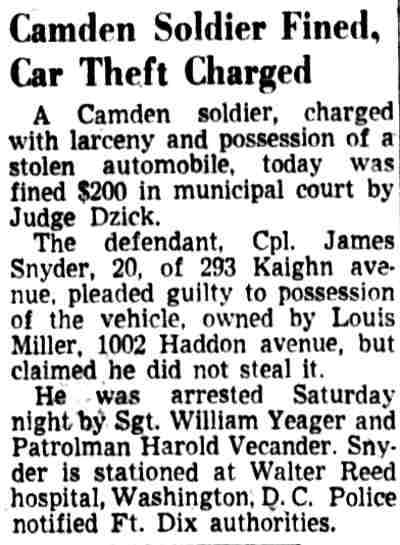
A Camden soldier, charged with larceny and possession of a stolen automobile, today was fined $200 in municipal court by Judge Dzick.
The defendant, Cpl. James Snyder, 20, of 293 Kaighn avenue, pleaded guilty to possession of the vehicle, owned by Louis Miller, 1002 Haddon avenue, but claimed he did not steal it.
He was arrested Saturday night by Sgt. William Yeager and Patrolman Harold Vecander. Snyder is stationed at Walter Reed hospital, Washington, D. C. Police notified Ft. Dix authorities.
FBI Arrests Man As Prison Escapee
Camden Courier-Post —
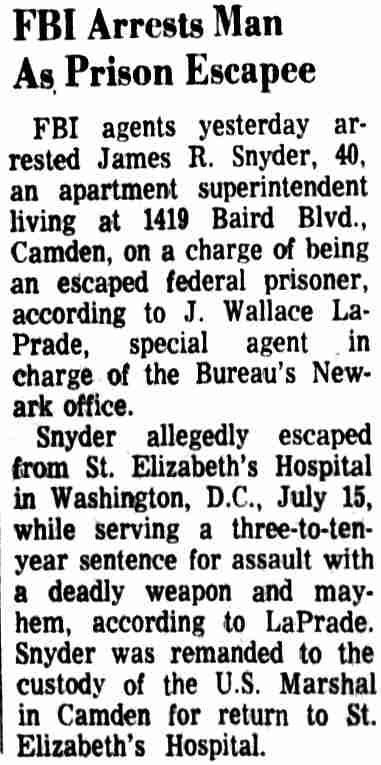
FBI agents yesterday arrested James R. Snyder, 40, an apartment superintendent living at 1419 Baird Blvd., Camden, on a charge of being an escaped federal prisoner, according to J. Wallace LaPrade, special agent in charge of the Bureau’s Newark office.
Snyder allegedly escaped from St. Elizabeth’s Hospital in Washington, D.C., July 15, while serving a three-to-ten-year sentence for assault with a deadly weapon and mayhem, according to LaPrade. Snyder was remanded to the custody of the U.S. Marshal in Camden for return to St. Elizabeth’s Hospital.
Search Intensified For Missing Teacher
Camden Courier-Post —
Three Fingers Still Mystery
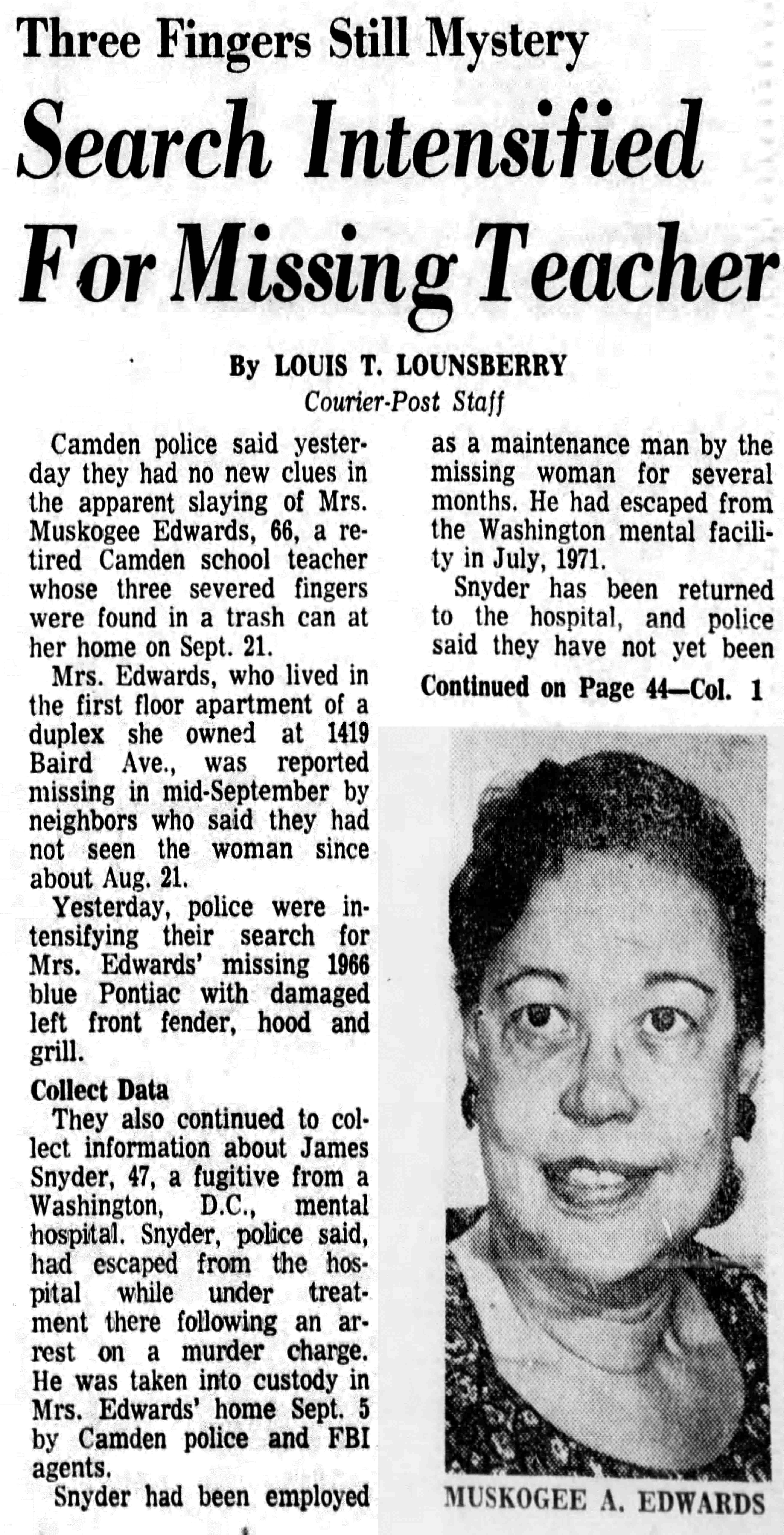
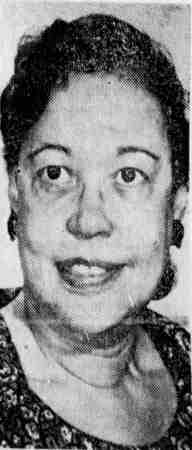
Camden police said yesterday they had no new clues in the apparent slaying of Mrs. Muskogee Edwards, 66, a retired Camden school teacher whose three severed fingers were found in a trash can at her home on Sept. 21.
Mrs. Edwards, who lived in the first floor apartment of a duplex she owned at 1419 Baird Ave., was reported missing in mid-September by neighbors who said they had not seen the woman since about Aug. 21.
Yesterday, police were intensifying their search for Mrs. Edwards’ missing 1966 blue Pontiac with damaged left front fender, hood and grill.
Collect Data
They also continued to collect information about James Snyder, 47, a fugitive from a Washington, D.C., mental hospital. Snyder, police said, had escaped from the hospital while under treatment there following an arrest on a murder charge. He was taken into custody in Mrs. Edwards’ home Sept. 5 by Camden police and FBI agents.
Snyder had been employed as a maintenance man by the missing woman for several months. He had escaped from the Washington mental facility in July, 1971.
Snyder has been returned to the hospital, and police said they have not yet been able to question him about Mrs. Edwards.
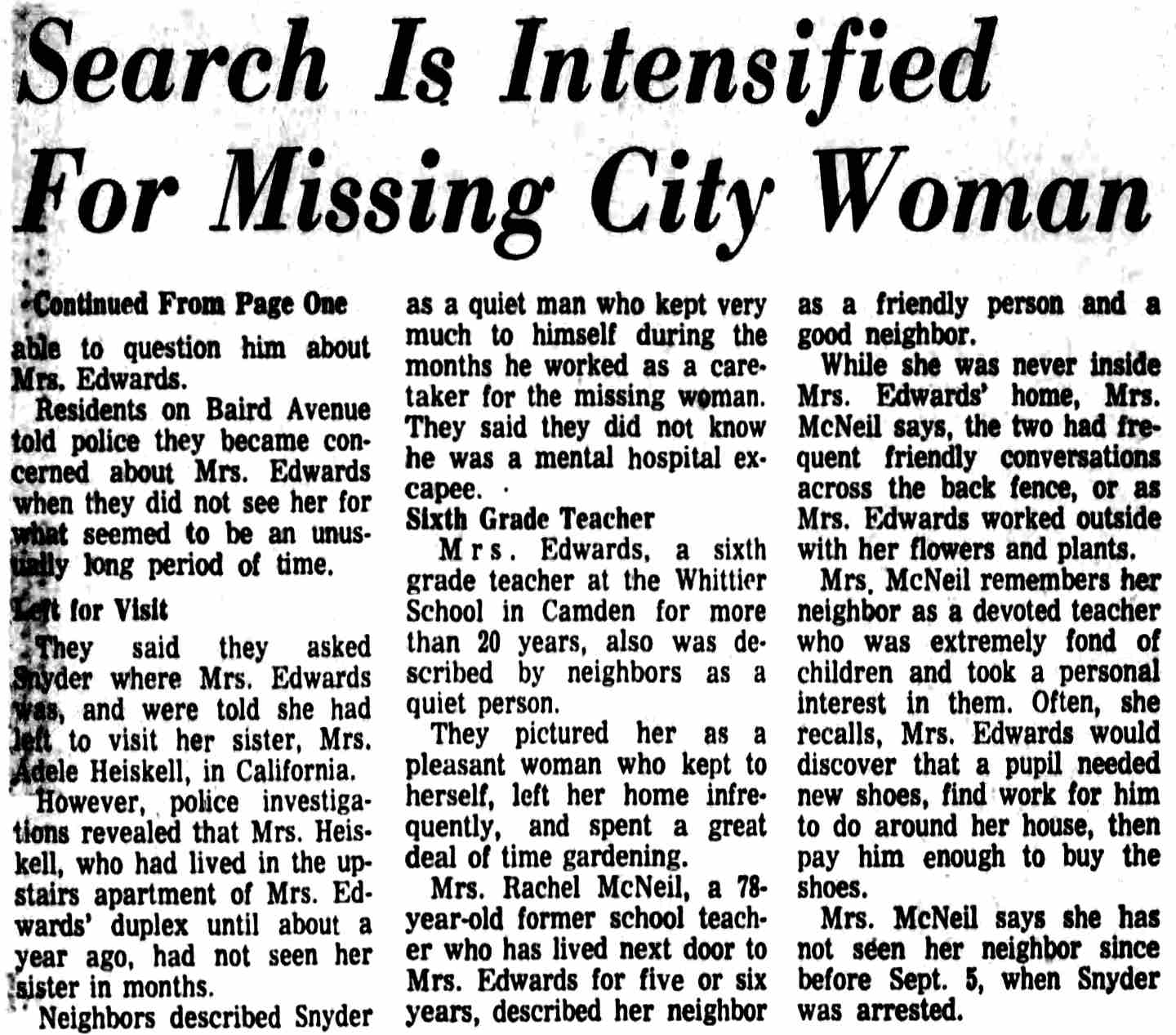
Residents on Baird Avenue told police they became concerned about Mrs. Edwards when they asked to see her, and were told she had to visit her sister, Mrs. Adele Heiskel, in California.
However, police investigations revealed that Mrs. Heiskel had lived in the upstairs apartment of Mrs. Edwards’ duplex until about a year ago and had not seen her neighbor since last summer.
Neighbors described Snyder as a quiet man who kept very much to himself during the months he worked as a caretaker for the missing woman. They said they did not know he was a mental hospital escapee.
Sixth Grade Teacher
Mrs. Edwards, a sixth grade teacher at the Whittier School in Camden for more than 20 years, also was described by neighbors as a quiet person.
They pictured her as a pleasant woman who kept to herself, left her home infrequently, and spent a great deal of time gardening.
Mrs. Rachel McNeil, a 78-year-old former school teacher who had lived next door to Mrs. Edwards for five or six years, described her neighbor as a friendly person and a good neighbor.
Mrs. McNeil says the two had frequent conversations across the back fence, or as Mrs. Edwards worked outside with her garden and plants.
Mrs. McNeil remembers her neighbor as a devoted teacher who was extremely fond of children and took a personal interest in them. Often, she recalls, Mrs. Edwards would discover that a pupil needed new shoes, find work for him to do around her house, then give him money to buy the shoes.
Mrs. McNeil says she has not seen her neighbor since before Sept. 5, when Snyder was arrested.
Missing Teacher Is Called Too Trusting
Philadelphia Inquirer —
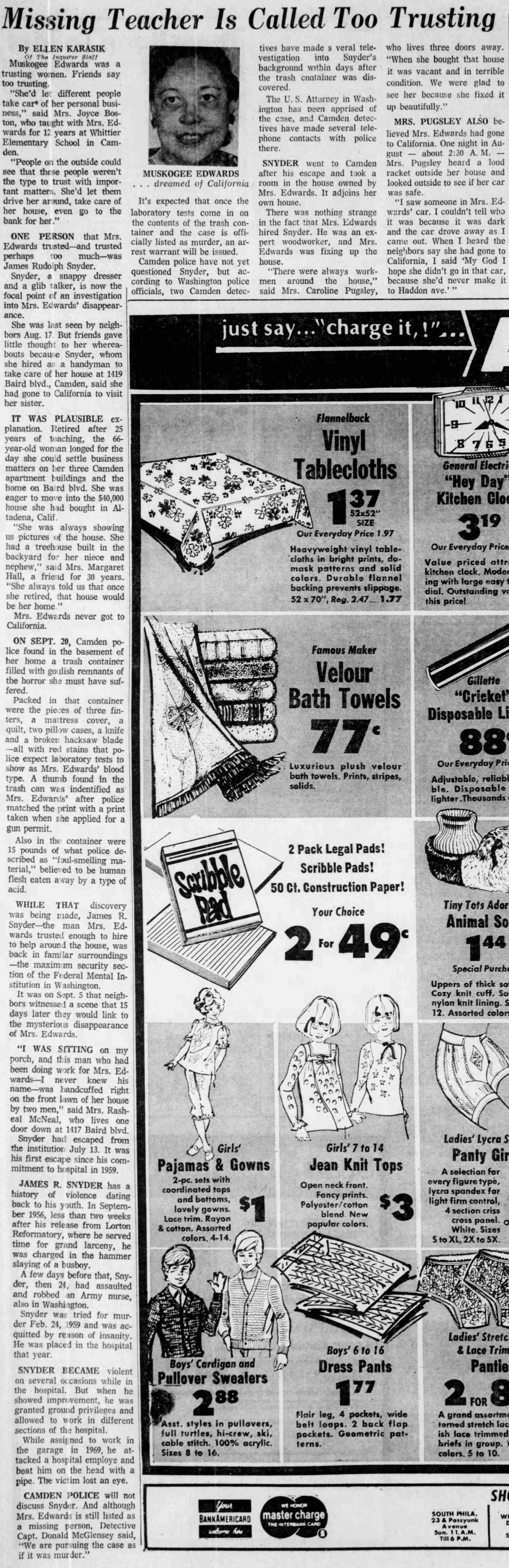
Friends and neighbors of Mrs. Muskogee Edwards, 66, the missing Camden school teacher, say that those who knew her best believe she was “too trusting.”
“She let these people into her life, take over her house, even go to the store for her,” one person who knew Mrs. Edwards well for many years said.
Escapee Indicted In Stolen Car Sale
Camden Courier-Post —
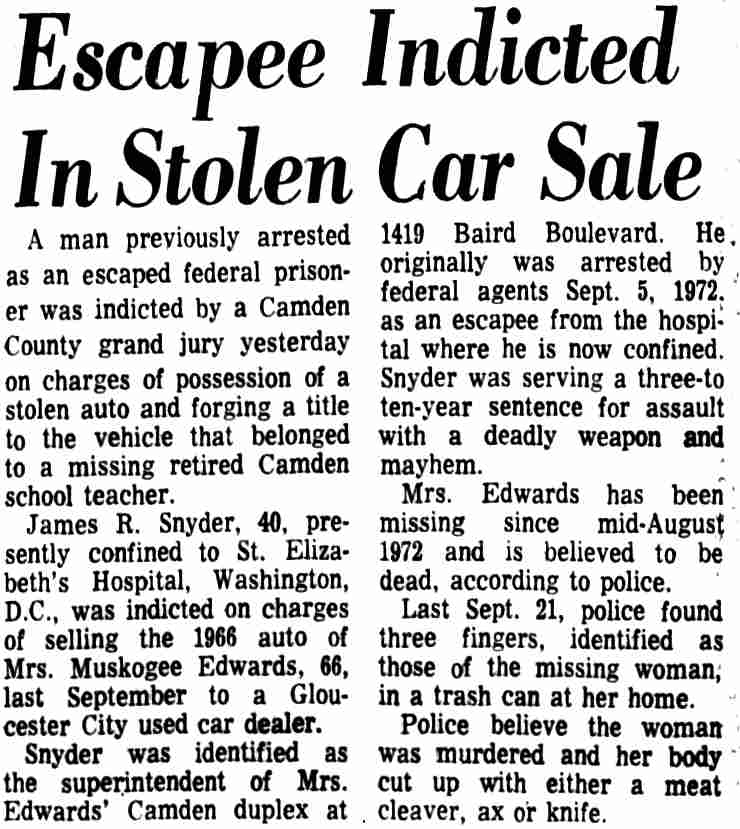
A man previously arrested as an escaped federal prisoner was indicted by a Camden County grand jury yesterday on charges of possession of a stolen auto and forging a title to the vehicle that belonged to a missing retired Camden school teacher.
James R. Snyder, 40, presently confined to St. Elizabeth’s Hospital, Washington, D.C., was indicted on charges of selling the 1966 auto of Mrs. Muskogee Edwards, 66, last September to a Gloucester City used car dealer.
Snyder was identified as the superintendent of Mrs. Edwards’ Camden duplex at 1419 Baird Boulevard. He originally was arrested by federal agents Sept. 5, 1972, as an escapee from the hospital where he is now confined. Snyder was serving a three-to-ten-year sentence for assault with a deadly weapon and mayhem.
Mrs. Edwards has been missing since mid-August 1972 and is believed to be dead, according to police.
Last Sept. 21, police found three fingers, identified as those of the missing woman, in a trash can at her home.
Police believe the woman was murdered and her body cut up with either a meat cleaver, ax or knife.
Snyder Found Guilty of 1st Degree Murder
Camden Courier-Post —
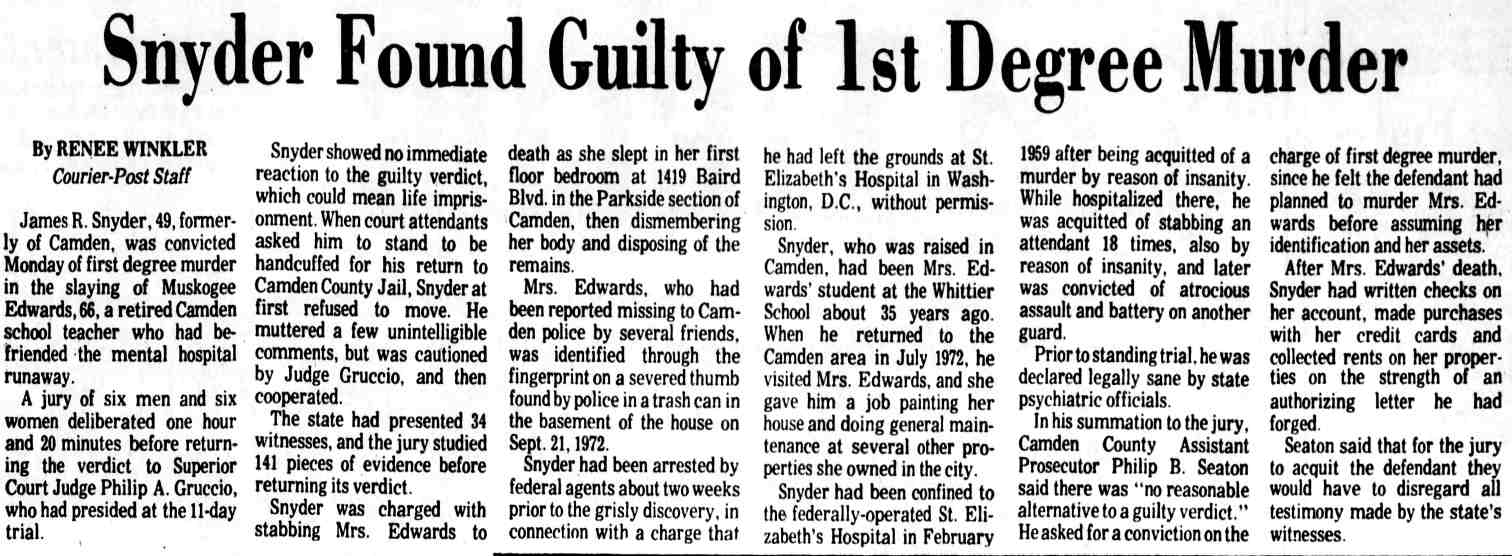
James R. Snyder, 49, formerly of Camden, was convicted Monday of first degree murder in the slaying of Muskogee Edwards, 66, a retired Camden school teacher who had befriended the mental hospital runaway.
A jury of six men and six women deliberated one hour and 20 minutes before returning the verdict to Superior Court Judge Philip A. Gruccio, who had presided at the 11-day trial.
Snyder showed no immediate reaction to the guilty verdict, which could mean life imprisonment. When court attendants asked him to stand to be handcuffed for his return to Camden County Jail, Snyder at first refused to move. He muttered a few unintelligible comments, but was cautioned by Judge Gruccio, and then cooperated.
The state had presented 34 witnesses, and the jury studied 141 pieces of evidence before returning its verdict.
Snyder was charged with stabbing Mrs. Edwards to death as she slept in her first floor bedroom at 1419 Baird Blvd. in the Parkside section of Camden, then dismembering her body and disposing of the remains.
Mrs. Edwards, who had been reported missing to Camden police by several friends, was identified through the fingerprint on a severed thumb found by police in a trash can in the basement of the house on Sept. 21, 1972.
Snyder had been arrested by federal agents about two weeks prior to the grisly discovery, in connection with a charge that he had left the grounds at St. Elizabeth’s Hospital in Washington, D.C., without permission.
Snyder, who was raised in Camden, had been Mrs. Edwards’ student at the Whittier School about 35 years ago. When he returned to the Camden area in July 1972, he visited Mrs. Edwards, and she gave him a job painting her house and doing general maintenance at several other properties she owned in the city.
Snyder had been confined to the federally-operated St. Elizabeth’s Hospital in February 1959 after being acquitted of a murder by reason of insanity. While hospitalized there, he was acquitted of stabbing an attendant 18 times, also by reason of insanity, and later was convicted of atrocious assault and battery on another guard.
Prior to standing trial, he was declared legally sane by state psychiatric officials.
In his summation to the jury, Camden County Assistant Prosecutor Philip B. Seaton said there was “no reasonable alternative to a guilty verdict.” He asked for a conviction on the charge of first degree murder, since he felt the defendant had planned to murder Mrs. Edwards before assuming her identification and her assets.
After Mrs. Edwards’ death, Snyder had written checks on her account, made purchases with her credit cards and collected rents on her properties on the strength of an authorizing letter he had forged.
Seaton said that for the jury to acquit the defendant they would have to disregard all testimony made by the state’s witnesses.
United States v. James R. Snyder — 529 F.2d 871 (D.C. Cir. 1976)
United States of America v. James R. Snyder, Appellant (three Cases), 529 F.2d 871 (D.C. Cir. 1976). Argued Jan. 13, 1975. Decided Jan. 7, 1976.
ROBB, Circuit Judge: Each of these consolidated appeals presents a different issue. In No. 24,575 the appellant Snyder, a patient at Saint Elizabeths Hospital for the mentally ill, was charged with assault with a dangerous weapon, 22 D.C.Code § 502, and mayhem, 22 D.C.Code § 506. After a non-jury trial he was found guilty and sentenced to imprisonment for not less than three nor more than ten years on each count, the sentences to run concurrently. The question presented is whether the District Court rightly declined to interpose an insanity defense when both Snyder and his counsel urged that it not be raised.
In No. 73–1970 Snyder challenges the refusal of the District Court to approve the recommendation of the hospital authorities that he be unconditionally released.
In 1956 Snyder was indicted in the District Court for the murder of his homosexual partner. Found competent to stand trial he was tried in 1959, adjudged not guilty by reason of insanity and committed to Saint Elizabeths Hospital. On August 5, 1963, while still a patient at Saint Elizabeths, he stabbed another patient repeatedly with an ice pick, inflicting serious wounds. By threats with the same weapon he then compelled a nursing assistant to open the door and allow him to escape. Snyder was apprehended some six weeks later and returned to the hospital, but no criminal action was taken against him.
On December 1, 1968 Snyder struck a hospital employee on the head with a blunt instrument, causing him to lose one eye, his olfactory sense, and a piece of his skull. According to the employee, Peter Klaga, Snyder suddenly became violent and struck him from behind. Snyder claimed that Klaga had made homosexual advances to him and that Snyder struck him in self-defense.
On July 15, 1972, before the court acted on the Superintendent’s request for his release, Snyder again escaped from Saint Elizabeths Hospital. He was arrested in Camden, New Jersey, on September 15, 1972 and returned to the hospital.
On December 8, 1972 Snyder was indicted under 18 U.S.C. § 751(a) for his escape of July 15, 1972. A jury trial on September 17, 1973 resulted in a verdict of guilty, the court having again declined to interpose the defense of insanity sua sponte. Snyder was sentenced to be imprisoned for five years, this sentence to run consecutively to any sentence then being served; and the court directed that Snyder be committed to the medical center at Springfield, Missouri.
Having weighed the evidence as he was required to do by 24 D.C. Code § 301(e) the district judge found that Snyder still suffered from mental illness and would in the reasonable future be dangerous to others if released. Accordingly the judge denied release. The judge noted the evidence of Snyder’s involvement in the Camden murder.
In No. 24,575 the record is remanded for supplementation in accordance with this opinion. The judgment in No. 73–1970 is affirmed. The judgment in No. 73–2154 is reversed.
United States v. James R. Snyder — 689 F.2d 1067 (D.C. Cir. 1982)
United States of America v. James R. Snyder, Appellant, 689 F.2d 1067 (D.C. Cir. 1982). Argued May 4, 1982. Decided Aug. 20, 1982. As Amended Dec. 10, 1982.
MacKINNON, Circuit Judge: Following a finding of not guilty by reason of insanity to a 1956 charge of first-degree murder, Snyder has been confined at St. Elizabeth’s Hospital. Through the years there have been several attempts to obtain his release and we here affirm a refusal by the district court to unconditionally release him pursuant to requests by the Superintendent of St. Elizabeth’s Hospital under D.C.Code § 24-301(e) (1981) and by appellant (Snyder) under D.C.Code § 24-301(k) (1981). The facts of this case are almost unbelievable.
On October 15, 1956, James R. Snyder was charged with first-degree murder for killing his homosexual paramour. After various delays, Snyder was tried before a jury on a three-count indictment. The jury rejected his insanity defense and found him guilty. On appeal this court remanded the case to the district court with instructions to enter a judgment of not guilty by reason of insanity. The district court entered judgment as directed and committed Snyder to St. Elizabeth’s Hospital.
On February 24, 1959, Snyder’s first-degree murder trial commenced. Several days later on February 27, 1959, the district court granted Snyder’s motion for a directed verdict of not guilty by reason of insanity and committed him to St. Elizabeth’s Hospital.
While housed at St. Elizabeth’s Hospital, Snyder on August 5, 1963 in a “rage reaction” stabbed another patient seventeen times with an ice pick and then compelled a nursing assistant under threats with the same weapon to open the door so that he could escape. Six weeks later Snyder was apprehended but no criminal charges were filed.
Five years later on December 1, 1968, Snyder while on the hospital grounds assaulted a hospital employee with a ball-peen hammer, causing the employee to lose an eye, his olfactory sense and a piece of his skull. Snyder was subsequently indicted for mayhem and assault with a dangerous weapon and at his own election was tried without a jury. Neither Snyder nor his counsel wanted to raise the insanity defense. Snyder was convicted and sentenced to concurrent sentences of three to ten years on each count.
However, while the Superintendent’s 1972 request for unconditional release was pending, Snyder on July 15, 1972 again escaped from the hospital and traveled to Camden, New Jersey where he began living with a Mrs. Muskogee Edwards. On September 15, 1972, Snyder was arrested in Camden and returned to St. Elizabeth’s. Five days later, Camden police, while investigating Mrs. Edwards’ disappearance, found her mutilated, decomposed remains in the basement of her home. She had apparently been murdered in gruesome fashion with a hack saw, meat cleaver, knife and ax. Camden police found that Snyder had been forging Mrs. Edwards’ signature on her car title certificate, checks and personal correspondence.
Following a jury trial before the Camden County Criminal Court, Snyder on April 21, 1975 was convicted of first-degree murder for killing Mrs. Edwards. Snyder was sentenced to a consecutive life term of imprisonment and was returned to St. Elizabeth’s where the State of New Jersey lodged a detainer that remains in force.
The district court found as a result of the testimony presented at the hearing that Snyder “suffers from anti-social personality disorder, compulsive personality disorder and narcissistic personality disorder.” It is hard to see how any reasonable person could conclude that Snyder is not dangerous to others.
Accordingly, Snyder has not stated a claim upon which relief may be granted. We affirm the district court’s order denying the requests of both the hospital and Snyder for his unconditional release. Judgment accordingly.