1828
On February 13, 1828 the Council and General Assembly passed “An act to incorporate a part of the Township of Newton in the County of Gloucester”. This was the first charter of the City of Camden.
The first section reads as follows:
Be it enacted by the Council and General Assembly of this State, and it is hereby enacted by the authority of the same, that such parts of the township of Newton as are contained within the following limits and bounds, that is to say, beginning at the Pennsylvania line, in the river Delaware, opposite the mouth a small run of water below Kaighnton, which run is the line between lands late of Isaac Mickle, deceased, and Joseph Kaighn, and running thence east to the mouth of said run; and thence up the same, the several courses thereof, crossing the public road leading to Woodbury from the Camden Academy; thence northerly along the east side of said road to the road leading from Kaighnton to Cooper’s Creek bridge; thence along the eastwardly side of said last mentioned road, and the southwardly side of the causeway and bridge to the middle of Cooper’s creek; thence down the middle thereof to the River Delaware; thence due north to the middle of the channel between Petty’s Island and the Jersey fast land or shore; thence down said channel and river to the nearest point on the line established between the states of Pennsylvania and New Jersey; thence down said line to the place of beginning, shall, and the same are hereby erected into a city, which shall henceforth be called and known by the name of “The City of Camden”.
Previous to the erection of the Friends Meeting House, the Friends held their meetings for a short time in the old Camden Academy at the southwest corner of Sixth and Market Streets. Ground on which stood the Friends Meeting House on Cooper Street above Seventh was given by Joseph Cooper to the Society of Friends on July 6, 1828. The Meeting House was built the same year and the building enlarged in 1885.
The first meeting of the City Council of Camden was held on March 13, 1828 at the hotel kept by John M. Johnston on the site of the old Vauxhall Gardens at Fourth and Market Streets. At that time the mayor was elected by City Council.
The history of the newspapers in Camden antedates the incorporation of the city by about nine years. The first newspaper published in Camden was the Gloucester Farmer which had originally been established at Woodbury on January 1, 1817 by John A. Crane. In January 1819 the paper was moved to Camden.
The second newspaper published in Camden was The American Star established by Samuel Ellis, the first City Clerk of Camden. His grandson, Charles H. Ellis, would serve as Camden’s Mayor from 1905 through 1922. The first issue of The American Star was dated Tuesday April 17, 1821. On December 29, 1824, the name was changed to American Star and Rural Record. In the latter part of 1830 Isaac H. Porte and John Wolohon, both of whom had been apprenticed under Samuel Ellis, issued a prospectus of a newspaper to be called The Camden Mail.
1829
Camden’s first City Hall was erected in 1829, pursuant to an ordinance of City Council passed June 18, 1828, appointing John K. Cowperthwaite, Samuel Lanning, and Richard Fetters as commissioners to purchase a plot of ground and build a jail and a courthouse. The commissioners were also authorized to borrow $2500 at 6% interest from Jacob Evaul for this purpose, the funds of the corporation being pledged for the loan. The commissioners secured lots 32, 33, and 34 on the plan of Camden Village, situated on the south side of Federal street between Fourth and Fifth Streets, and erected a stone building two stories in height, the attic, which was of brick, being added later. The lower floor was used as a lock-up, the second floor as a council chamber, and the attic as a city court room. The entrance to the council chamber was by a wooden stairway from the pavement. In 1862 a one-story building was added to each end of the building, one side being the office of the mayor and the other that of the clerk.
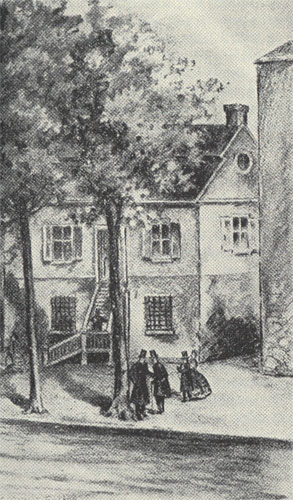
Camden’s First City Hall
The building was torn down in 1878 to make room for a market house which in turn was demolished in 1900 and the building of the Public Service Corporation erected. This building, still standing in 2003, has been the home of the Camden Free Public Library since 1986.
The first Lodge of Odd Fellows in New Jersey organized in the rooms in Vauxhall Gardens on March 30, 1829, as New Jersey Lodge No. 1. Thomas Wildey, organizer of the first lodge in the United States, instituted this lodge in person.
The city, by ordinance passed March 19, 1829, established maximum rates which inns and taverns within the city limits could charge the traveling public. Some of the charges at the time are interesting in comparison with the rates 175 years later. For instance here are a few of the rates from 1829.
| Item | Rate |
|---|---|
| Breakfast | 25 cents |
| Dinner in common | 25 cents |
| Dinner extraordinary | 37.5 cents |
| Supper | 25 cents |
| Lodging per night | 25 cents |
1830
Benjamin Dugdale, son-in-law of James Kaighn, established a tannery on Cooper Street below Front, on the site of what became the Esterbrook Pen Company. In 1845 the place was used as a livery stable by Joseph Myers.
“The Rector, Wardens, and Vestrymen of St. Paul’s Church, Camden,” was organized March 26, 1830, and the certificate of incorporation was filed in the clerk’s office of Gloucester County on April 30, 1830. For several years after the organization of the parish there was no Episcopal house of worship and religious services were held in the old Court House, old City Hall, on Federal Street below Fifth Street. On April 22, 1834 the cornerstone of St. Paul’s Church was laid by Bishop Doane. This building was erected on Lot No. 121 on the Map of Camden, and was purchased for $300, while the adjoining Lot No. 122 was obtained on a perpetual lease upon payment of $25 per year, ground rent. The church was constructed of unhewn stones and in 1846 a resolution was passed “that the unhewn stones of the church be covered with rough casting after the manner of the State House at Trenton and squared in imitation of stones”.
In August of 1856, the church building was enlarged by the addition of transepts and extensions in the rear. In 1895 the parish building were erected and the church redecorated. In 1910 the front of the church was altered by the removal of the old wooden spire and the erection of a stone structure which extended the building line.
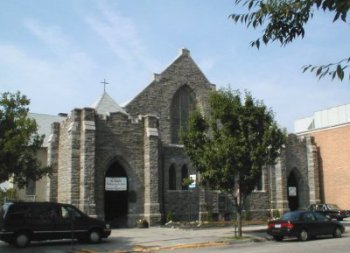
St. Paul’s Episcopal Church, 422 Market Street (c. 2000)
1831
The Township of Camden was created by an act of the Legislature passed November 28, 1831, with boundaries coincident with those contained in the act of February 28, 1828, incorporating the city of Camden. The creation of the Township was made necessary by the fact that the act incorporating the city of Camden did not give the city the right to levy taxes for county purposes. The Township and City of Camden had the same limits and boundaries, and the same assessors and collectors served both. In 1856 the City was given power to levy its own taxes for county purposes, and by an act passed March 5, 1862, the Township of Camden was abolished.
1832
Cholera appeared in Camden. This was said to be the first appearance here of the disease in epidemic form.
Street names changed by ordinance passed May 24, 1832, as follows:
| King Street changed to Front Street |
| Queen Street changed to Second Street |
| White Hall Street changed to Third Street |
| Cherry Street changed to Fourth Street |
| Cedar Street changed to Fifth Street |
| Pine Street changed to Sixth Street |
The original names of these streets appeared on the Joshua Cooper Map of the Town of Camden.
1833
That section of the city commonly known as Fettersville was purchased by Richard Fetters in 1833 from Charity and Grace Kaighn and embraced the land lying between Line and Cherry Streets, extending from Kaighn Avenue to Newton Creek. In 1843 Fetters sold a part of this land to a number of individuals who laid out a tract which they called Fettersville. This was incorporated as a Borough in 1870, but the annexation of Fettersville to Camden was completed in 1871.
Lots originally laid out by Fetters, measured 30x200 feet and in 1835 were assessed at $50 each. These low rates attracted many buyers of modest means, a large portion of them South Jersey and Philadelphia workingmen who built small houses there. The Fettersville section was for many years mainly occupied by working people, and though manufacturing establishments were later erected in the section, it remained mainly a residential district.
Richard Fetters passed away in 1863, in his 72nd year.
1834
By act of Congress on June 30, 1834, Camden became a Port of Entry in the District of Bridgeton. The several surveyors of the Port were:
| 1834–1835 | Morris Croxall |
| 1835–1839 | Jesse Bullock |
| 1839–1841 | Morris Croxall |
| 1841–1843 | Philip J. Gray |
| 1843–1849 | Charles S. Garrett |
| 1849–1853 | Philip J. Gray |
| 1853–1858 | Isaac W. Mickle |
| 1858–1861 | Thomas B. Atkinson |
| 1861–1867 | Dr. Sylvester Burdsall |
In 1867 Camden was put in the Philadelphia District in charge of an Assistant Collector. The Assistant Collectors have been:
| 1867–1875 | Philip J. Gray |
| 1875–1881 | W.P. Robeson |
| 1881–1886 | David S. Heyl |
| 1886–1890 | George D. Borton |
| 1890–1894 | J. Eugene Troth |
| 1894–1898 | David B. Peterson |
| 1898–1912 | Frank F. Patterson Sr. |
| 1912–1913 | William H. Turnbull |
By an act of Congress passed August 24, 1912, Camden was made part of the Port of Philadelphia and the office of Assistant Collector at Camden was abolished on June 30, 1913.
1836
The Camden Cemetery, known in modern times as Old Camden Cemetery, adjoining the Newton Friends’ burying grounds, through an action of a town meeting of the Township of Camden, was founded on March 10, 1836. The control was vested in trustees appointed by the township meeting. A plot of ground containing 2.94 acres was purchased from Isaac Cooper for $590.
The old grounds, donated by Isaac Cooper about 1832 “at the forks of the Roads leading to the (Cooper’s) Ferries and Kaighntown”, situated at the south side of the Camden & Amboy Railroad at Twelfth Street and Newton Avenue, then called Brace Road, were sold to William Carman for $405 upon the condition that the Trustees would have all of the bodies removed at their expense. This was accomplished by November 14, 1836.
The first sale of lots was held on May 29, 1837. The first interment was that of Franklin Burroughs on June 6, 1837. As the old township of Newton was partially absorbed into the City of Camden it became necessary to apply to the Legislature to have the trustees selected in a different manner, and on February 26, 1855 it was incorporated with certain trustees and managers named in the act. By the revised charter of the City of Camden, approved in 1871, the control of the Camden Cemetery was placed with City Council.
In 1864 one acre of land on the south side along the Friends’ Meeting House Lane was purchased from John M. Kaighn for $1000 and in 1868 another addition of two acres on the north side was secured at a cost of $900. In 1876 the old cemetery was enlarged by the purchase of a half acre of land at a cost of $1000.
In 1887 the plot of ground on Mount Ephraim and Ferry Avenues, consisting of twenty-seven and one-half acres, was purchased and laid out as the New Camden Cemetery.
On March 5, 1836 the Camden & Philadelphia Steamboat Ferry Company was incorporated. This Company began operating in May of 1838. The oldest ferry between Camden and Philadelphia was that established by William Cooper in the early part of 1700 which gave the name Cooper’s Ferry to what later became the City of Camden.
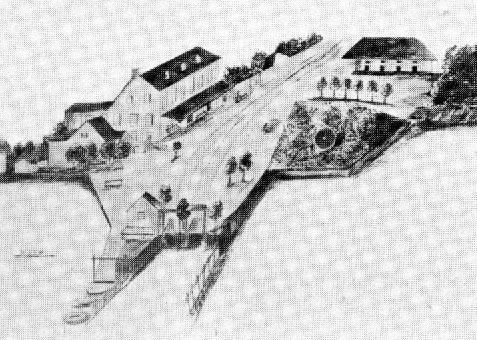
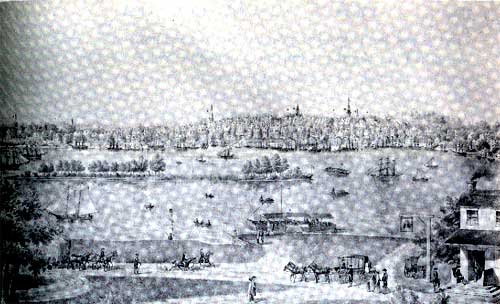
Cooper’s Point Ferry (left) and Upper Ferry (right)
The first ferry was known as the Old Ferry and Lower Billy’s Ferry. The ferries were known in the early days by the names of the proprietors of the hotels adjacent to them. For years passengers between Camden and Philadelphia were served by ferries from the foot of Federal Street; foot of Market Street; foot of Kaighn Avenue; and foot of Vine Street. The ferries at Market and Federal Street were combined when the Pennsylvania Railroad Company erected its new Terminal Building in Camden. This terminal was opened to the public on June 23, 1901. On October 1, 1926, the old ferries from Camden—those operating from Vine Street in Camden to Vine and Shackamaxon streets in Philadelphia were discontinued.
The opening of the Delaware River Bridge in 1926 spelled the end of the remaining ferries across the Delaware at Camden. They too would close. Ferry service returned to Camden in the 1990s with a small boat operating between Wiggins Park at the foot of Mickle Boulevard and Penn’s Landing in Philadelphia.
1837
City Council authorized the construction of a market house on Market Street at the intersection of Third Street on March 13, 1837. This market house containing 8 stalls was erected at a cost of $250, and was ready for use December 28, 1837. It was continued in use until 1871 when it was torn down.
In 1856 a larger public market was erected in the center of Third Street between Arch and Federal at a cost of $1800. It was used until 1876 when it was removed.
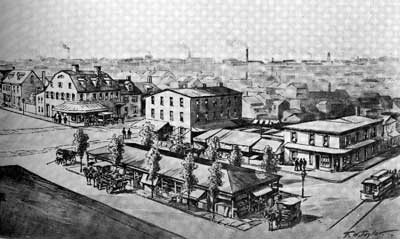
The Public Market on Third Street
In 1855 a charter was obtained for a private market house for the Camden Market Company, but failing to complete the organization the project was abandoned. In 1856 the Washington Market Company was incorporated and plans called for a market house 100 feet square on the west side of Third Street between Arch and Federal Streets. The building of the city market in that year, however, interfered with this plan. The next project was that of 1874 when John S. Read, Jonathan Burr, William P. Tatem, Randal E. Morgan and Edmund E. Read incorporated the Farmers’ Market Company with a capital of $100,000, but this project also failed to mature.
In 1877 the Farmers’ and Butchers’ Market Company, composed of Thomas A. Wilson, Rodolphus Bingham, Abraham Rapp, James W. Wroth, and Charles Stockham, erected a building 150 feet by 175 feet on Bridge Avenue and West Street, extending to Mickle Street. It was intended for a wholesale and retail market, but did not prosper, for the reason that Philadelphia was so near, the wholesale trade could not be gained and the location was not suitable for retailing.
After being used for two years as a market, it was fitted up for theatrical purposes with a seating capacity of 1000 persons. It finally was secured by the Sixth Regiment, National Guard of New Jersey, and was used as the armory and headquarters until it burned down on March 16, 1906. It was the home of the Camden Electrics professional basketball team, part of the National Basketball League, the first professional league, from 1898 to 1904. Coached by William “Billy” Morgenweck, they were the league champions in 1902–1903.
The next market project was carried through by John S. Read and William S. Scull in 1878. This building was erected on the south side of Federal Street between Fourth and Fifth Streets, at the site later occupied by the Public Service Building, since the late 1980s the home of the Camden Free Public Library. This building was operated as a market until it was burned down on May 13, 1900. This was the last public market house in Camden.
1838
The Camden and Woodbury Railroad & Transportation Company, from Camden to Woodbury, was opened to the public January 29, 1838. The first schedule showed trains leaving Woodbury at 7:30 AM, 1:30 PM, and 4:00 PM, and from Camden at 8:30 AM, 2:30 PM, and 5:00 PM. To accommodate a number of stage proprietors, an additional trip was later made, leaving Woodbury at 10:00 AM and arriving at Camden at 11:30 AM with stops at Gloucester Point and at Kaighn’s Point Roads. The rate of fare from Camden to Woodbury was twenty-five cents and from Camden to Westville fifteen cents. The road after numerous “ups and downs” was finally abandoned about 1850.