Raymond E. Haines
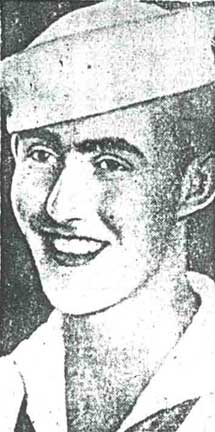
Seaman First Class Raymond Ernest Haines, Serial: 02444643, USS Turner (DD-648), U.S. Navy. He lived at 2728 Cramer Street, Camden NJ. Memorialized at the Tablets of the Missing, East Coast Memorial, New York City.
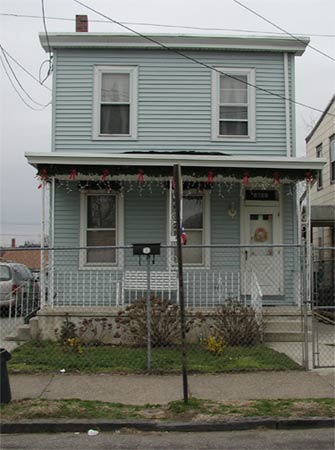
Raymond E. Haines lived with his parents, Mr. and Mrs. Raymond M. Haines, at 2728 Cramer Street in Camden NJ.
Seaman First Class Raymond Ernest Haines was the son of Raymond M. and Olivia Haines of Camden. His father worked at the Parkway Bakery. In 1930 the family was renting a home at 709 New Street in Camden. They later moved to 2728 Cramer Street in the East Camden neighborhood.
Raymond Haines was killed when the destroyer USS Turner DD-648 suffered a series of catastrophic internal explosions off New York on January 3, 1944. He was survived by his parents.
Camden Man Lost In Destroyer Blast
Camden Courier-Post —
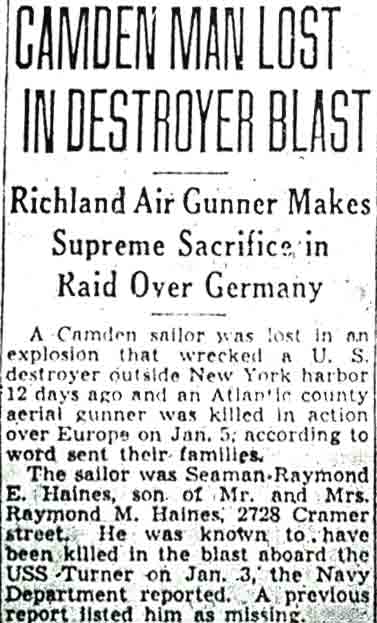
A Camden sailor was lost in an explosion that wrecked a U. S. destroyer outside New York harbor 12 days ago and an Atlantic county aerial gunner was killed in action over Europe on Jan. 5, according to word sent their families.
The sailor was Seaman Raymond E. Haines, son of Mr. and Mrs. Raymond M. Haines, 2728 Cramer street. He was known to have been killed in the blast aboard the USS Turner on Jan. 3, the Navy Department reported. A previous report listed him as missing.
USS Turner (DD-648)
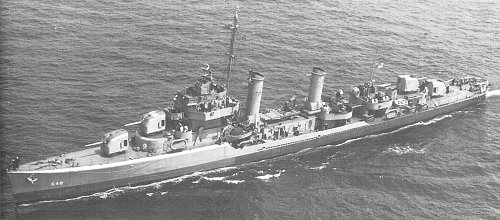
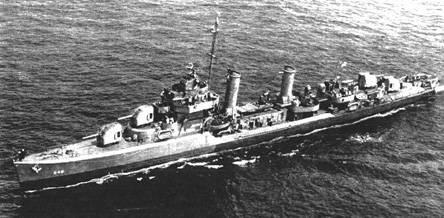
USS Turner (DD-648). Lost January 3, 1944 — 138 men lost.
The second Turner (DD-648) was laid down on 16 November 1942 at Kearny, N.J., by the Federal Shipbuilding & Drydock Co.; launched on 28 February 1943; sponsored by Mrs. Louis E. Denfeld; and commissioned on 15 April 1943 at the New York Navy Yard, Lt. Comdr. Henry S. Wygant in command.
Turner completed outfitting at the New York Navy Yard and then conducted shakedown and antisubmarine warfare training out of Casco Bay, Maine, until early June. On the 9th, she returned to New York to prepare for her first assignment, a three-day training cruise with the newly commissioned carrier, Bunker Hill (CV-17). Returning to New York on 22 June, she departed again the next day on her first real wartime assignment, service in the screen of a transatlantic convoy. First, she sailed with a portion of that convoy to Norfolk, Va., arriving that same day. On the 24th, the convoy departed Hampton Roads and shaped a course eastward across the Atlantic. After an uneventful voyage, she escorted her convoy into port at Casablanca, French Morocco, on 18 July. She departed with a return convoy on the 23d and arrived back in New York on 9 August. Later that month, she was in the screen of a convoy to Guantanamo Bay, Cuba, making a brief stop at Hampton Roads along the way. On the return trip, she rendezvoused with HMS Victorious and accompanied the British carrier to Norfolk.
During the first two weeks of September, Turner conducted ASW training at Casco Bay, Maine, and then returned to New York to prepare for her second transatlantic voyage. On 21 September, the destroyer headed south to Norfolk. She arrived there on the 23d and, the following day, headed out across the Atlantic with her convoy. After an 18-day passage, during which she made one depth-charge attack on a sound contact, Turner arrived at Casablanca on 12 October. Four days later, she departed again and headed for Gibraltar to join another convoy. The warship reached the strategic base on the 17th and, after two days in port, stood out to join the screen of Convoy GUS-18.
On the night of 23 October, Turner was acting as an advance ASW escort for the convoy when she picked up an unidentified surface contact on her SG radar. At 1943, about 11 minutes after the initial radar contact, Turner’s lookouts made visual contact with what proved to be a German submarine running on the surface, decks awash, at about 500 yards distance. Almost simultaneously, Turner came hard left and opened fire with her 5-inch, 40-millimeter, and 20-millimeter guns. During the next few seconds, the destroyer scored one 5-inch hit on the U-boat’s conning tower as well as several 40-millimeter and 20-millimeter hits there and elsewhere. The submarine began to dive immediately and deprived Turner of any opportunity to ram her. However, while the U-boat made her dive, Turner began a depth-charge attack. She fired two charges from her port K-gun battery, and both appeared to hit the water just above the submerged U-boat. Then, as the destroyer swung around above the U-boat, Turner rolled a single depth charge off her stern. Soon after the three depth charges exploded, Turner crewmen heard a fourth explosion, the shock from which caused the destroyer to lose power to her SG and FD radars, to the main battery, and to her sound gear. It took her at least 15 minutes to restore power entirely.
Meanwhile, she began a search for evidence to corroborate a sinking or regain contact with the target. At about 2017, she picked up another contact on the SG radar — located about 1,600 yards off the port beam. Turner came left and headed toward the contact. Not long thereafter, her bridge watch sighted an object lying low in the water. Those witnesses definitely identified the object as a submarine which appeared to be sinking by the stern. Unfortunately, Turner had to break contact with the object in order to avoid a collision with another of the convoy’s escorts. By the time she was able to resume her search, the object had disappeared. Turner and Sturtevant (DE-239) remained in the area and conducted further searches for the submarine or for proof of her sinking but failed in both instances. All that can be said is that probably the destroyer heavily damaged an enemy submarine and may have sunk her. No conclusive evidence exists to support the latter conclusion.
On the 24th, the two escorts rejoined the convoy, and the crossing continued peacefully. When the convoy divided itself into two segments according to destination on 4 November, Turner took station as one of the escorts for the Norfolk-bound portion. Two days later, she saw her charges safely into port and then departed to return to New York where she arrived on 7 November.
Following 10 days in port, the warship conducted ASW exercises briefly at Casco Bay before returning to Norfolk to join another transatlantic convoy. She departed Norfolk with her third and final convoy on 23 November and saw the convoy safely across the Atlantic. On 1 January 1944, near the end of the return voyage, that convoy split into two parts according to destination as Turner’s previous one had done. Turner joined the New York-bound contingent and shaped a course for that port. She arrived off Ambrose Light late on 2 January and anchored.
Early the following morning, the destroyer suffered a series of shattering internal explosions. By 0660, she took on a 16-degree starboard list; and explosions — mostly in the ammunition stowage areas — continued to stagger the stricken destroyer. Then, at about 0750, a singularly violent explosion caused her to capsize and sink. The tip of her bow remained above water until about 0827 when she disappeared completely, taking with her 15 officers and 123 crewmen. After nearby ships picked up the survivors of the sunken destroyer, the injured were taken to the hospital at Sandy Hook. A Coast Guard Sikorsky HNS-1 flown by Lt. Comdr. F. A. Erickson, USCG — in the first use of a helicopter in a life-saving role — flew two cases of blood plasma, lashed to the helicopter’s floats, from New York to Sandy Hook. The plasma saved the lives of many of Turner’s injured crewmen. Turner’s name was struck from the Navy list on 8 April 1944.
— History from DANFS
The USS Turner Goes Down
By Lawrence Principato
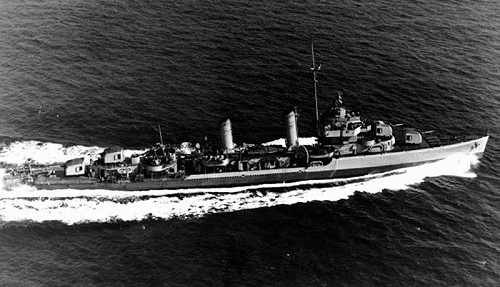
USS Turner (DD-648) underway.
Commander Henry Sollett Wygand Jr. of the U.S.S. Turner never had a chance. Without warning a mysterious explosion ripped open the main deck sending it sky-high, toppling the mast onto the deckhouse and smashing the ship’s only link with the world, destroying the ship’s nerve center and the emergency transmission radio system. Commander Wygand along with many of his officers were killed immediately. Sailors were blown to the deck. Their bleeding bodies were scattered everywhere. Fire erupted instantly while the engine room quickly filled with hot poisonous smoke and fumes.
As the wheelhouse collapsed it was accompanied by an unbearable screech of grinding steel. Many more seaman were blown over the side into the freezing water. The engineers feverishly worked to maintain power in subdued darkness waiting for orders from the bridge. Orders never came.
It was 3:30 A.M., January 3, 1944 when the Turner quietly maneuvered through the wind, rain and sleet in darkness, and dropped anchor, after completing nine months of active sea duty in the North Atlantic. Here she was 4 miles SE of Rockaway Point, Long Island in 60 ft of water awaiting new official orders.
This Bristol Class Navy Destroyer (designated DD648) was one of 56 that were built in Federal Shipyards’ facility in New Jersey. It was named in honor of Captain Daniel Turner, a hero of the war of 1812. It took five months to build, a record time even with today’s automated shipbuilding techniques. This fortress could make in excess of 33 knots with her twin-screw machinery.
Chief Machinist Mate Rene H. Pincet was getting the engine room tuned up so that the Turner could weigh anchor at 7AM sharp. He was lighting off the Boiler and getting ready to start up on time when suddenly and without warning a thunderous explosion violently shook the destroyer. “The concussion threw me across the engine room against the bulkhead,” he recalled.
All communications were now useless and he couldn’t talk to the bridge. The engine room quickly filled with smoke and toxic gases. “I secured the blowers hoping that would slow the smoke from coming down. We were busy. At the time there were six of us in the engine room,” he explained.
Dave Merrill, the radioman tried to send an SOS through the emergency transmitter but found the main radio room useless and in shambles. Later he said that what bothered him most was, “the loss of a brand new suit of tailor made blues … they cost me $49.
The first blast ripped the 5 inch guns out of their mounts like they were toys. Sailors watched in awe and disbelief as the cannons turned end over end. Flames belched suddenly from another gun mount. Coxswain Raymond O. Pomp said that his crew immediately broke out the CO2 extinguishers to put out the flames erupting from #3 mount. When that extinguisher emptied they hooked up the hose. “We were especially concerned in preventing the gun’s ammunition nearby from exploding,” he explained. “All hands were either fighting fire or taking care of some of the guys that got hurt. I heard three blasts in all. There was no confusion, no panic, even when the fuel oil flared up and lit up the stormy winter sky. The way the flames reflected on the rolling waves was weird. It was real scary with the artillery shells exploding around us.
Luckily the crew left the forward mess room a few minutes before the initial blast. That’s where without any warning whatsoever the explosion tore open a gigantic hole. As with most meals of the day, the 200 crewmen were always fed in shifts and the engineers had just finished when it all happened. The engineers worked continuously to maintain enough pressure to operate the ship’s fire water main. It was difficult groping in the semi-darkness, choking and trying to see through blood-shot eyes. The crew heroically remained at their posts attending to stricken buddies in the brightness of the burning fuel oil.
Coxswain Williams on duty at the Coast Guard look-out station on Sandy Hook luckily happened to see the destroyer explode through the haze. A general quarters alarm dispatched a sub-chaser and a 77 foot launch to the scene. The need for assistance spread quickly. Immediately upon arrival the Cutter rescued a man bobbing about on a torn mattress while another clung desperately to the ship’s mascot, a little mongrel terrier called “Turn To.
Survivors were certain the order to ‘abandon ship’ came from the Cutter’s Captain at 7AM. The 83 foot sub-chaser, the larger of the vessels, pushed her bow athwart the burning destroyer and lashed in to receive the stranded seamen. The bright flames of burning oil made the operation easier to see, while other Coast Guard units continued to cruise the area in search of missing Sailors.
Officially the cause of the mysterious explosion was blamed on defective ammunition. This explanation doesn’t ring true simply because the experienced and well disciplined crew would have been alerted to any sensitive munitions problem during the previous nine months they worked together. A more popular theory attributed the blast to U-boat activity. It was a well known fact that Germans had sunk dozens of ships in and about New York harbor. The heavy blustery weather that blanketed the morning of January 3, 1944 could have provided enough cover for a sub to prowl in releasing numerous torpedoes to create the havoc witnessed on the Turner.
A normal compliment on destroyers of this class consisted of approximately 200 men. Of that number 163 were actually rescued. Its logical to presume that 37 men joined Commander Wygand on the “missing-in-action” list.
Ashore, reports later revealed, that the explosion affected people in a variety of ways. Besides the concussion and spooky whistling, gusts were accompanied by unexplainable rumbles that mysteriously rattled and shattered windows. Some thought it was an earthquake. Directly west of where the Turner exploded, covering the entire length of Staten Island’s 15 miles, the countryside residents were bewildered and confused. In the Bay Ridge section along the waterfront, a woman was sure that “the heavy woman upstairs fell out of bed.” Suburban dwellers thought their oil burners exploded. Up and down the New Jersey and Long Island shores and as far away as Bellville, New Jersey, folks reported strange happenings. Even in Bayshore and Babylon on Long Island, reports came in that people felt the explosion’s vibration too.
Before everyone left the Turner Coxswain Ray Pomp went below decks, closed some hatches and checked to see that every one was out. “The next explosion I heard split her in two. That’s when she busted-up after 7AM. Slowly the Turner slid to the bottom 55 ft down,” he sadly remembered. Just as the whirlpool of the sinking ship leveled off, the final and worst detonation occurred. Water flew high in the sky as if to say farewell. With daylight the ocean resumed its repetitive earthly pattern. The U.S.S. Turner is no longer a hazard to navigation since an oil tanker rubbed her bottom on the wreck. This prompted some salvage and the Turner now rests broken up in 50 to 58 ft of water. Although the Navy Department did not officially say so, German U-boats had been lurking around Coney Island area looking to decimate more tonnage as freighters left New York harbor for Europe. There is no doubt that German U-boats torpedoed the Turner not once but twice. Now she is an excellent in-shore search area, within easy reach for both divers and anglers. Bonito, albacore and weakfish have made the Turner their territory and roam about the old girl’s slowly rusting remains. On a good day fishermen can be seen trawling for the big ones while nearby the red orange flag with the diagonal white stripe floats triumphantly nearby signifying … Caution Diver Below.