Nathan Jones
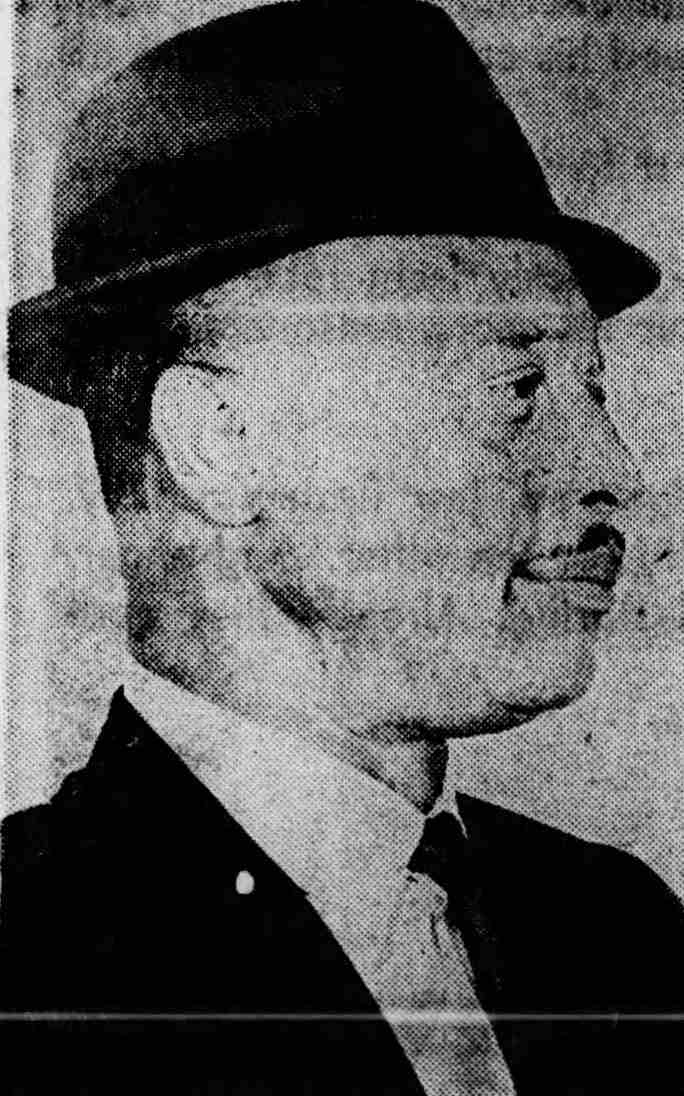
Nathaniel T. “Nate” Jones
NATHANIEL T. “NATE” JONES was a career Camden policeman, serving for many years as a detective.
On April 3, 1954 a banquet was held at Kenney’s restaurant on Market Street in honor of retiring Camden Police Department detective August Pfleiderer. Joseph Mardino chaired the committee which put the banquet together. Other members of the committee include Clifford Carr, Harry Tracy, George Ellis, Nathaniel Jones, James Mulligan, Russell Maurer, Samuel E. Johnson, Edward C. Garrity, Frank H. Ryan, James M. O’Neill, Stephen M. O’Keefe, Edward J. Quinlan and Joseph Webster.
Nathan Jones passed away on January 9, 1991 at the age of 80. He was survived by his wife Dorothy, brother Charles Jones, and sisters Betty Moore, Blanche Cook and Carrie Foreman, who was married to Camden Fire Department member Andrew H. Foreman.
Woman Held In S. Camden Fatal Knifing
Camden Courier-Post —
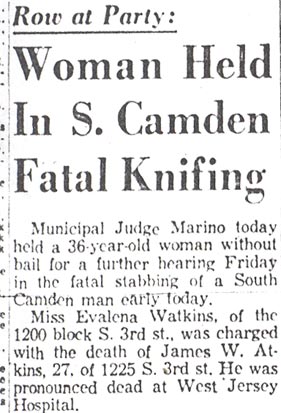
Row at Party:
Municipal Judge Marino today held a 36-year-old woman without bail for a further hearing Friday in the fatal stabbing of a South Camden man early today.
Miss Evalena Watkins, of the 1200 block S. 3rd st., was charged with the death of James W. Atkins, 27, of 1225 S. 3rd st. He was pronounced dead at West Jersey Hospital.
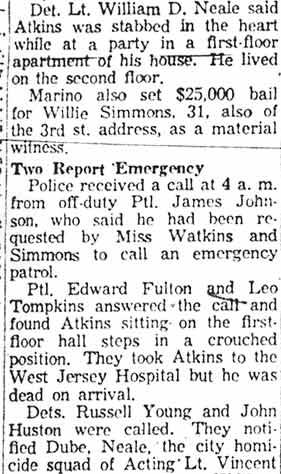
Det. Lt. William D. Neale said Atkins was stabbed in the heart while at a party in a first-floor apartment of his house. He lived on the second floor.
Marino also set $25,000 bail for Willie Simmons, 31, also of the 3rd st. address, as a material witness.
Two Report Emergency
Police received a call at 4 a. m. from off-duty Ptl. James Johnson, who said he had been requested by Miss Watkins and Simmons to call an emergency patrol.
Ptl. Edward Fulton and Leo Tompkins answered the call and found Atkins sitting on the first-floor hall steps in a crouched position. They took Atkins to the West Jersey Hospital but he was dead on arrival.
Dets. Russell Young and John Huston were called. They notified Dube, Neale, the city homicide squad of Acting Lt. Vincent Conley, Nathan Jones, William O’Brien and County Det. James P. McLaughlin.
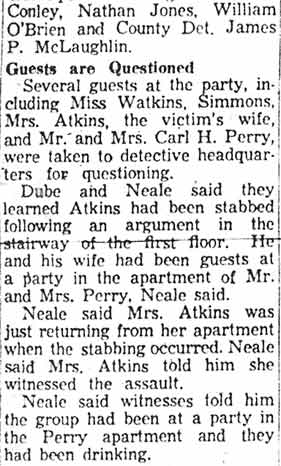
Guests are Questioned
Several guests at the party, including Miss Watkins, Simmons, Mrs. Atkins, the victim’s wife, and Mr. and Mrs. Carl H. Perry, were taken to detective headquarters for questioning.
Dube and Neale said they learned Atkins had been stabbed following an argument in the stairway of the first floor. He and his wife had been guests at a party in the apartment of Mr. and Mrs. Perry, Neale said.
Neale said Mrs. Atkins was just returning from her apartment when the stabbing occurred. Neale said Mrs. Atkins told him she witnessed the assault.
Neale said witnesses told him the group had been at a party in the Perry apartment and they had been drinking.
The Pursuit of a Murderer
Camden Courier-Post —
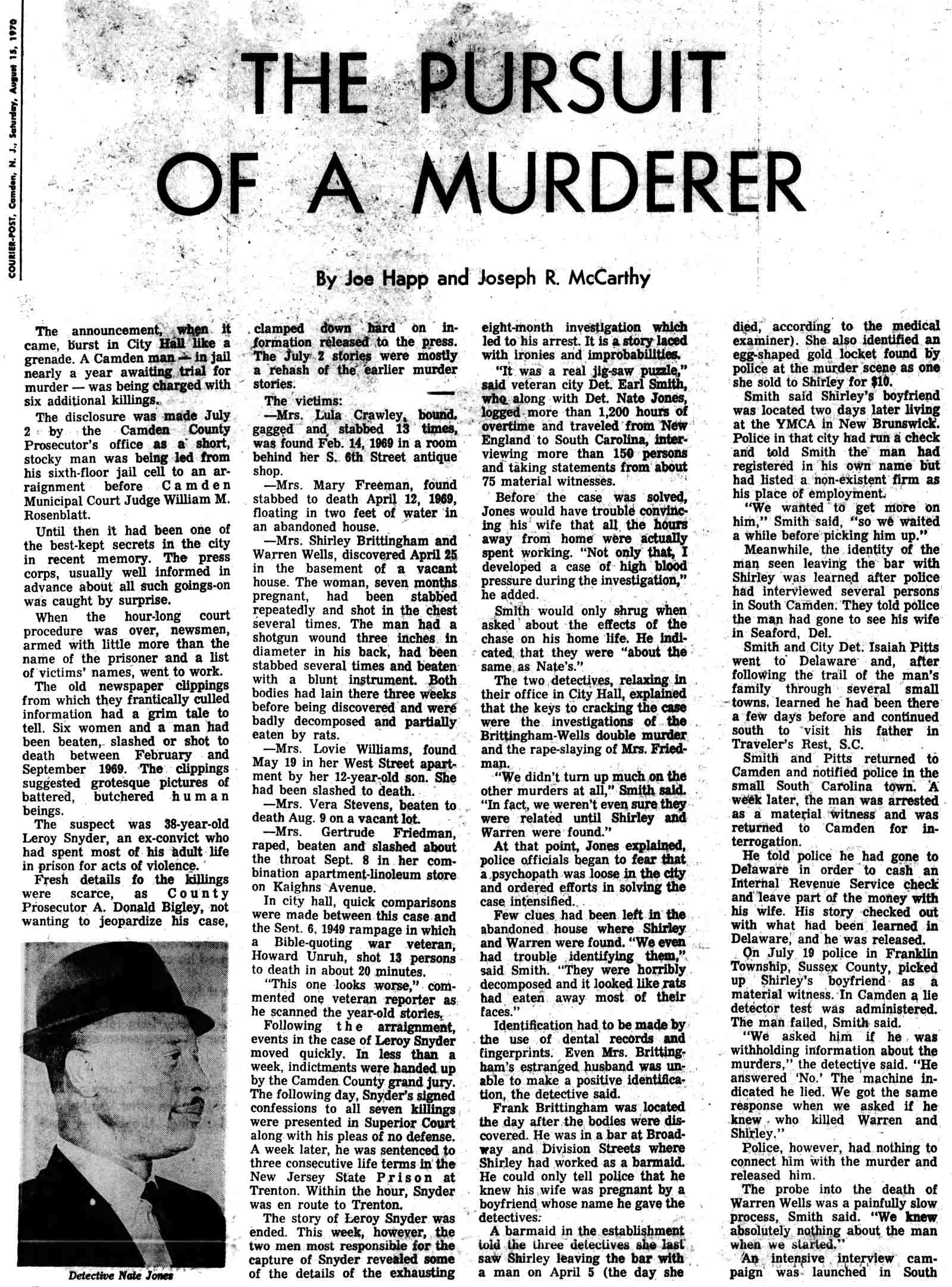
By Joe Happ and Joseph R. McCarthy
The announcement, when it came, burst in City Hall like a grenade. A Camden man — in jail nearly a year awaiting trial for murder — was being charged with six additional killings.
The disclosure was made July 2 by the Camden County Prosecutor’s office as a short, stocky man was being led from his sixth-floor jail cell to an arraignment before Camden Municipal Court Judge William M. Rosenblatt.
Until then it had been one of the best-kept secrets in the city in recent memory. The press corps, usually well informed in advance about all such goings-on was caught by surprise.
When the hour-long court procedure was over, newsmen, armed with little more than the name of the prisoner and a list of victims’ names, went to work.
The old newspaper clippings from which they frantically culled information had a grim tale to tell. Six women and a man had been beaten, slashed or shot to death between February and September 1969. The clippings suggested grotesque pictures of battered, butchered human beings.
The suspect was 38-year-old Leroy Snyder, an ex-convict who had spent most of his adult life in prison for acts of violence.
Fresh details fo [sic] the killings were scarce, as County Prosecutor A. Donald Bigley, not wanting to jeopardize his case, clamped down hard on information released to the press. The July 2 stories were mostly a rehash of the earlier murder stories.
The victims:
Mrs. Lula Crawley, bound, gagged and stabbed 13 times, was found Feb. 14, 1969 in a room behind her S. 6th Street antique shop.
Mrs. Mary Freeman, found stabbed to death April 12, 1969, floating in two feet of water in an abandoned house.
Mrs. Shirley Brittingham and Warren Wells, discovered April 25 in the basement of a vacant house. The woman, seven months pregnant, had been stabbed repeatedly and shot in the chest several times. The man had a shotgun wound three inches in diameter in his back, had been stabbed several times and beaten with a blunt instrument. Both bodies had lain there three weeks before being discovered and were badly decomposed and partially eaten by rats.
Mrs. Lovie Williams, found May 19 in her West Street apartment by her 12-year-old son. She had been slashed to death.
Mrs. Vera Stevens, beaten to death Aug. 9 on a vacant lot.
Mrs. Gertrude Friedman, raped, beaten and slashed about the throat Sept. 8 in her combination apartment-linoleum store on Kaighns Avenue.
In city hall, quick comparisons were made between this case and the Sept. 6, 1949 rampage in which a Bible-quoting war veteran, Howard Unruh, shot 13 persons to death in about 20 minutes.
“This one looks worse,” commented one veteran reporter as he scanned the year-old stories.
Following the arraignment, events in the case of Leroy Snyder moved quickly. In less than a week, indictments were handed up by the Camden County grand jury. The following day, Snyder’s signed confessions to all seven killings were presented in Superior Court along with his pleas of no defense.
A week later, he was sentenced to three consecutive life terms in the New Jersey State Prison at Trenton. Within the hour, Snyder was en route to Trenton.
The story of Leroy Snyder was ended. This week, however, the two men most responsible for the capture of Snyder revealed some of the details of the exhausting eight-month investigation which led to his arrest. It is a story laced with ironies and improbabilities.
“It was a real jig-saw puzzle,” said veteran city Det. Earl Smith, who along with Det. Nate Jones, logged more than 1,200 hours of overtime and traveled from New England to South Carolina, interviewing more than 150 persons and taking statements from about 75 material witnesses.
Before the case was solved, Jones would have trouble convincing his wife that all the hours away from home were actually spent working. “Not only that, I developed a case of high blood pressure during the investigation,” he added.
Smith would only shrug when asked about the effects of the chase on his home life. He indicated that they were “about the same as Nate’s.”
The two detectives, relaxing in their office in City Hall, explained that the keys to cracking the case were the investigations of the Brittingham-Wells double murder and the rape-slaying of Mrs. Friedman.
“We didn’t turn up much on the other murders at all,” Smith said. “In fact, we weren’t even sure they were related until Shirley and Warren were found.”
At that point, Jones explained, police officials began to fear that a psychopath was loose in the city and ordered efforts in solving the case intensified.
Few clues had been left in the abandoned house where Shirley and Warren were found. “We even had trouble identifying them,” said Smith. “They were horribly decomposed and it looked like rats had eaten away most of their faces.”
Identification had to be made by the use of dental records and fingerprints. Even Mrs. Brittingham’s estranged husband was unable to make a positive identification, the detective said.
Frank Brittingham was located the day after the bodies were discovered. He was in a bar at Broadway and Division Streets where Shirley had worked as a barmaid. He could only tell police that he knew his wife was pregnant by a boyfriend whose name he gave the detectives.
A barmaid in the establishment told the three detectives she last saw Shirley leaving the bar with a man on April 5 (the day she died, according to the medical examiner). She also identified an egg-shaped gold locket found by police at the murder scene as one she sold to Shirley for $10.
Smith said Shirley’s boyfriend was located two days later living at the YMCA in New Brunswick. Police in that city had run a check and told Smith the man had registered in his own name but had listed a non-existent firm as his place of employment.
“We wanted to get more on him,” Smith said, “so we waited a while before picking him up.”
Meanwhile, the identity of the man seen leaving the bar with Shirley was learned after police had interviewed several persons in South Camden. They told police the man had gone to see his wife in Seaford, Del.
Smith and City Det. Isaiah Pitts went to Delaware and, after following the trail of the man’s family through several small towns, learned he had been there a few days before and continued south to visit his father in Traveler’s Rest, S.C.
Smith and Pitts returned to Camden and notified police in the small South Carolina town. A week later, the man was arrested as a material witness and was returned to Camden for interrogation.
He told police he had gone to Delaware in order to cash an Internal Revenue Service check and leave part of the money with his wife. His story checked out with what had been learned in Delaware, and he was released.
On July 19 police in Franklin Township, Sussex County, picked up Shirley’s boyfriend as a material witness. In Camden a lie detector test was administered. The man failed, Smith said.
“We asked him if he was withholding information about the murders,” the detective said. “He answered ‘No.’ The machine indicated he lied. We got the same response when we asked if he knew who killed Warren and Shirley.”
Police, however, had nothing to connect him with the murder and released him.
The probe into the death of Warren Wells was a painfully slow process, Smith said. “We knew absolutely nothing about the man when we started.”
An intensive interview campaign was launched in South Camden, but little was learned. On May 19, however, police learned that Wells’ brother-in-law, a suspect in the case, was living in the 400 block of Sycamore Street. Police placed the house under surveillance, but the suspect failed to show up.
Two women living in the house were unable to give any information about the suspect’s whereabouts. The women, both in their early 20’s accompanied the detectives to police headquarters and were arrested and charged with being under the influence of narcotics.
A separate inquiry into the suspect’s background revealed him to be wanted by the U.S. Army for desertion.
The search spread throughout Camden County and on June 12, nearly a month later, he was picked up by State Police from the Toms River barracks.
Brought back to Camden, the suspect failed a lie detector test, Smith said. Yet nothing was established to connect him directly with either murder and he was held pending the arrival of federal authorities.
The suspect’s wife was arrested a few days later while visiting him in Camden County jail. Smith said he recognized the woman from a police photo shown to him earlier by Williamstown police. He said a federal warrant had been issued for her arrest on a charge of mail theft. She was turned over to the U.S. Marshal’s office in Camden.
The search for information in South Camden continued. Detectives began to check through vacant houses in the area. They found a man crouching behind the heater in the basement of one abandoned house. He claimed to be an acquaintance of Wells. An identification check on the man revealed he was wanted on a charge of possession of stolen property. He was arrested.
Under interrogation, the man told detectives he did not know where Wells had been living before his death but said he knew several persons who might know.
One of his tips paid off. A woman living on Kaighns Avenue told detectives that Wells had been living in the 700 block of Walnut Street in the apartment of a man named Leroy Snyder.
Smith and Jones set up a stake-out at the apartment, but Snyder did not return home that night. The following day, the two detectives canvassed the neighborhood and learned that Snyder had a job in a junkyard on Division Street.
“We went to the junkyard and talked with Snyder,” Jones said. “He told us Wells had been living in his apartment since the latter part of March.”
Snyder told police that Wells received a phone call at the apartment on April 4. He said Wells appeared quite shaken by the call and left, saying he would return shortly. Snyder said that was the last he had seen of Warren Wells.
“Snyder even volunteered to come to police headquarters that night to give us a statement and deliver some clothes he said were left behind by Wells,” Smith said. Snyder dictated a four-page statement for police that night, but the information shed no further light on the killing.
“We had checked on Snyder’s background and knew about his prison record,” Smith said. “But we didn’t have enough evidence to hold him. Besides, he seemed to be cooperating with us.” Snyder was released.
That was on May 23. Four days earlier, Lovie Williams was found slashed to death. On Aug. 9, Vera Stevens, her head battered by a rock, was found. No leads were turned up in those investigations.
The Wells probe produced one more lead, however. Police learned that a man believed to operate a house of prostitution in North Camden had been a friend of Wells. Checking at the address, Smith was told the man had recently departed on a trip through New England and Canada.
Police in several states as well as Canada were notified and, on May 28, Wells’ friend was arrested by a Royal Canadian Mounted Police vice squad as he attempted to cross the border in a stolen car.
A joint investigation by the Mounties and police in Camden revealed the names of several women, allegedly involved in prostitution, who were in this country illegally. The women were later deported to Canada, Smith said.
The police investigation of the murders, now numbering six, continued until Sept. 8, when the nude, mutilated body of Gertrude Friedman was discovered in the living room of her apartment on Kaighns Avenue by a neighbor.
Police swarmed into the area that night and found with a woman who said she had seen a man leaving the Friedman apartment that afternoon. She told police he was carrying two suitcases and a brown paper bag filled with clothing.
A state police artist, Tpr. George Homa of the West Trenton barracks, was called in and drew a sketch based on the woman’s description.
Armed with copies of the sketch, police teams again hit the streets in the area around Kaighns Avenue.
A man, when shown the drawing, told police, “This looks like the guy who tried to rape a woman a few weeks ago on 4th Street.” He did not know the assailant’s name, but he gave police the woman’s name and address.
Smith and Jones checked it out.
The woman, who had not reported the incident because she feared reprisals, said the man depicted in the sketch had knocked on her apartment door one night a few weeks earlier saying he was looking for friends who lived in the apartment below hers. Then he forced his way in and tried to assault her, she said. She did not know his name.
The occupants of the downstairs apartment identified the drawing. They said it seemed to be Leroy Snyder.
“The first thing we did after hearing that, was to check on where Snyder was living,” Smith said. “We knew he had moved from the apartment on Walnut Street, but we didn’t know his new address. Later, we learned he was living in the 700 block of Cherry Street.”
A warrant was obtained and, on the evening of Sept. 11, Smith and Jones arrested Snyder at home.
“He was lying on the couch in the living room when we made the arrest,” Smith recalled. “He didn’t offer any resistance.”
Searching the house, detectives found the bags of clothing and other items taken from the Friedman apartment. Positive identification of the articles later was supplied by Mrs. Friedman’s husband.
“He was wearing Mr. Friedman’s wristwatch,” Smith added.
With Snyder in custody, charged with the murder of Mrs. Friedman, larceny, possession of stolen property and assault with intent to rape in the case of the woman on 4th Street, Smith and Jones began a detailed investigation into Snyder’s possible relationship with the other murders.
Since there was no trial, it will never be known just how much evidence the detectives had piled up against Snyder. But apparently, it was enough to convince Snyder and his attorney that a defense against the charges in court would have been futile. Snyder later signed confessions to all seven slayings, but the confessions alone would not be sufficient basis for sentencing.
The contents of those confessions have not been made public, but one unconfirmed report out of the prosecutor’s office had it that a stenographer became ill while transcribing Snyder’s detailed accounts of the killings.
The future holds nothing for Leroy Snyder except prison. Under present New Jersey parole laws, Snyder, with three consecutive life sentences facing him, will not even be eligible for parole for another 43½ years.
Prosecutor Bigley, who sought seven consecutive life sentences for Snyder, summed it up in the courtroom moments after sentence was passed: “There’s a good chance he’ll die in prison.”
Detective Nate Jones
Detective Earl Smith
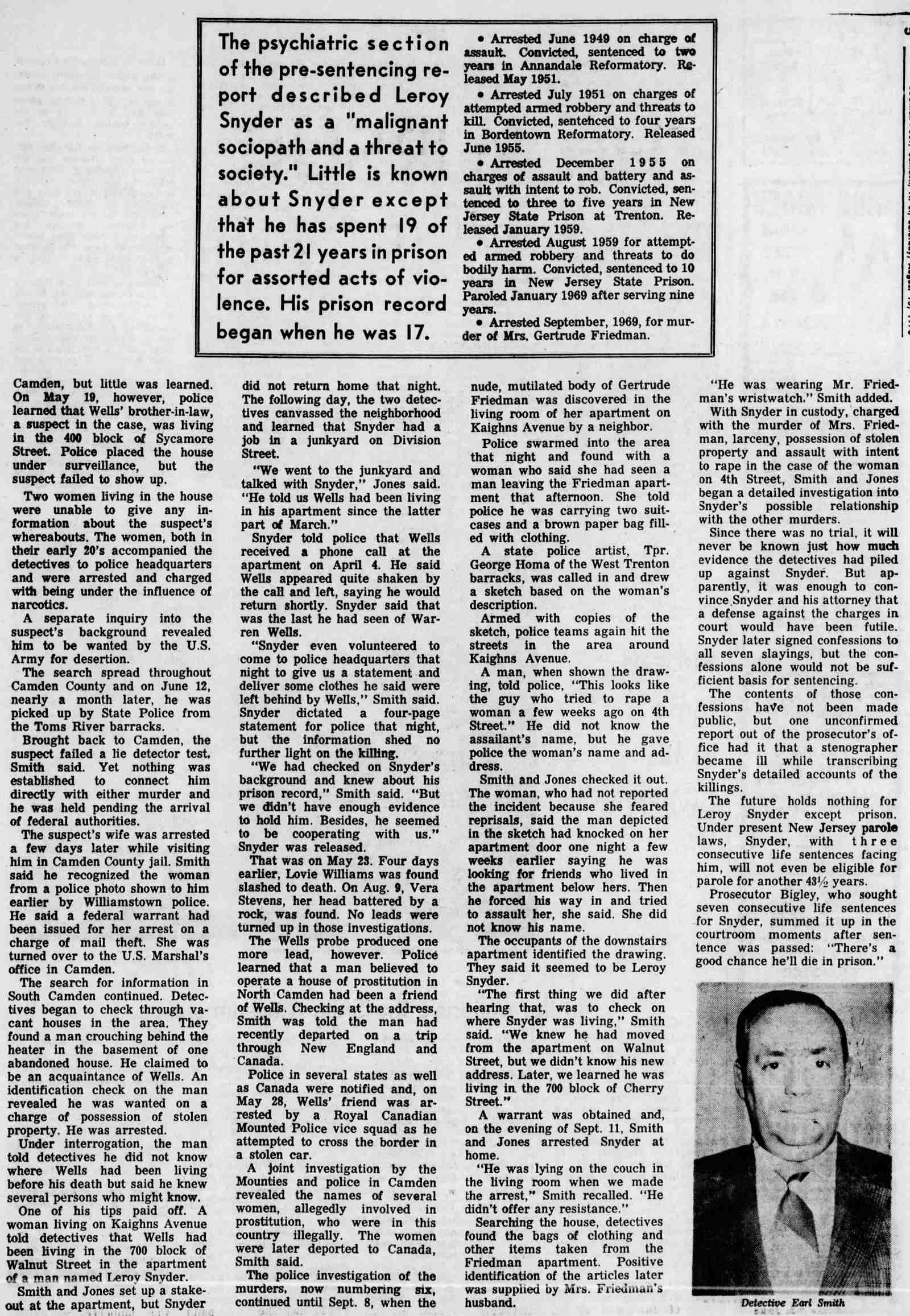
The psychiatric section of the pre-sentencing report described Leroy Snyder as a “malignant sociopath and a threat to society.” Little is known about Snyder except that he has spent 19 of the past 21 years in prison for assorted acts of violence. His prison record began when he was 17.
Arrested June 1949 on charge of assault. Convicted, sentenced to two years in Annandale Reformatory. Released May 1951.
Arrested July 1951 on charges of attempted armed robbery and threats to kill. Convicted, sentenced to four years in Bordentown Reformatory. Released June 1955.
Arrested December 1955 on charges of assault and battery and assault with intent to rob. Convicted, sentenced to three to five years in New Jersey State Prison at Trenton. Released January 1959.
Arrested August 1959 for attempted armed robbery and threats to do bodily harm. Convicted, sentenced to 10 years in New Jersey State Prison. Paroled January 1969 after serving nine years.
Arrested September, 1969, for murder of Mrs. Gertrude Friedman.
Nathaniel T. Jones, 80, retired police detective
Camden Courier-Post —
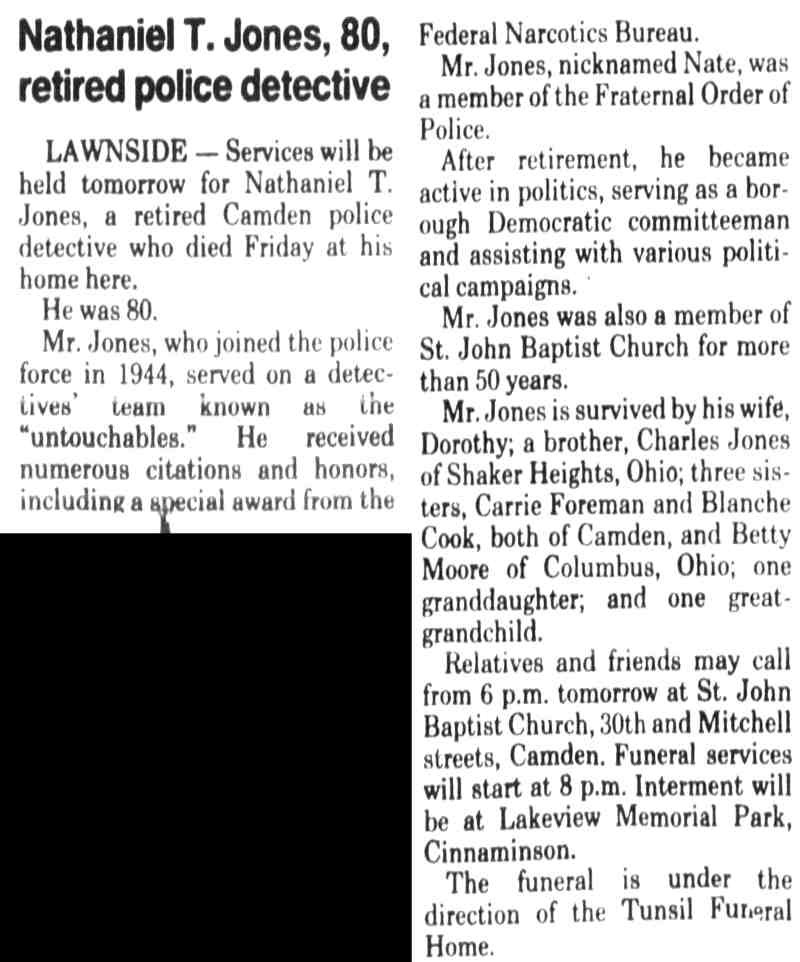
LAWNSIDE — Services will be held tomorrow for Nathaniel T. Jones, a retired Camden police detective who died Friday at his home here.
He was 80.
Mr. Jones, who joined the police force in 1944, served on a detectives’ team known as the “untouchables.” He received numerous citations and honors, including a special award from the Federal Narcotics Bureau.
Mr. Jones, nicknamed Nate, was a member of the Fraternal Order of Police.
After retirement, he became active in politics, serving as a borough Democratic committeeman and assisting with various political campaigns.
Mr. Jones was also a member of St. John Baptist Church for more than 50 years.
Mr. Jones is survived by his wife, Dorothy; a brother, Charles Jones of Shaker Heights, Ohio; three sisters, Carrie Foreman and Blanche Cook, both of Camden, and Betty Moore of Columbus, Ohio; one granddaughter; and one great-grandchild.
Relatives and friends may call from 6 p.m. tomorrow at St. John Baptist Church, 30th and Mitchell streets, Camden. Funeral services will start at 8 p.m. Interment will be at Lakeview Memorial Park, Cinnaminson.
The funeral is under the direction of the Tunsil Funeral Home.
Jones
Camden Courier-Post —
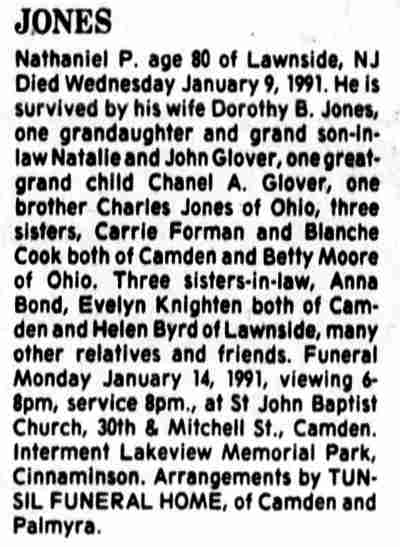
JONES — Nathaniel P. age 80 of Lawnside, NJ Died Wednesday January 9, 1991. He is survived by his wife Dorothy B. Jones, one grandaughter [sic] and grand son-in-law Natalie and John Glover, one great-grand child Chanel A. Glover, one brother Charles Jones of Ohio, three sisters, Carrie Forman and Blanche Cook both of Camden and Betty Moore of Ohio. Three sisters-in-law, Anna Bond, Evelyn Knighten both of Camden and Helen Byrd of Lawnside, many other relatives and friends. Funeral Monday January 14, 1991, viewing 6–8pm, service 8pm., at St John Baptist Church, 30th & Mitchell St., Camden. Interment Lakeview Memorial Park, Cinnaminson. Arrangements by TUNSIL FUNERAL HOME, of Camden and Palmyra.