Mickey Duffy
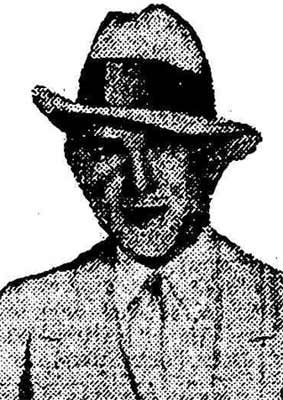
Mickey Duffy
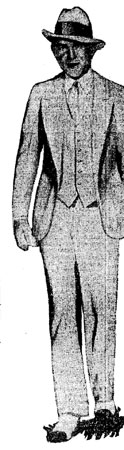
Mickey Duffy
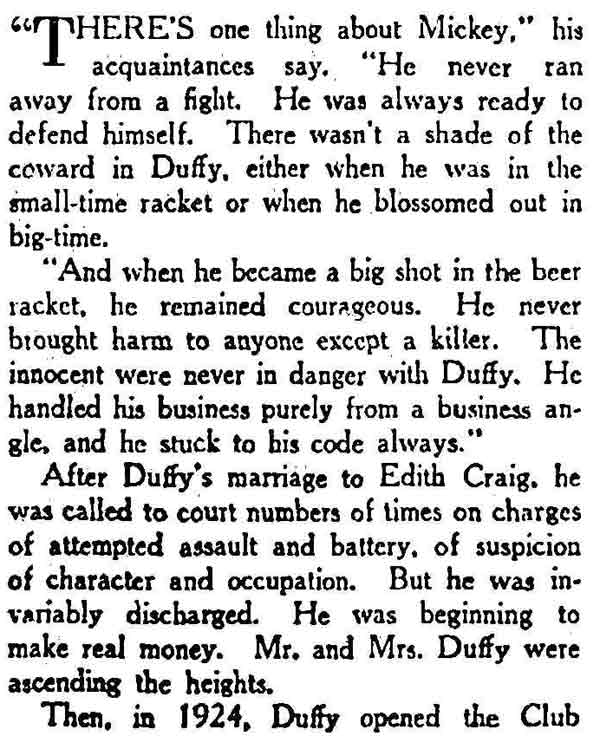
Eighty years ago, a poor Polish-American boy from Grays Ferry was on his way to becoming Philadelphia’s Public Enemy No. 1. Born Michael Joseph Cusick around 1889, the young hoodlum used the Irish-sounding alias, Mickey Duffy, to better fit in with the local gangsters.
Duffy was arrested in May 1919 for assault and battery with intent to kill and served two years and eleven months at the Eastern State Penitentiary in Philadelphia. When he got out, Prohibition was the law of the land and crime syndicates everywhere were in business smuggling, making and selling illegal alcohol to a thirsty nation. He married Edith Craig shortly after his release.
Duffy opened an illegal beer brewery in Camden, N.J., and it wasn’t long before he became known as the Beer Baron of South Jersey.
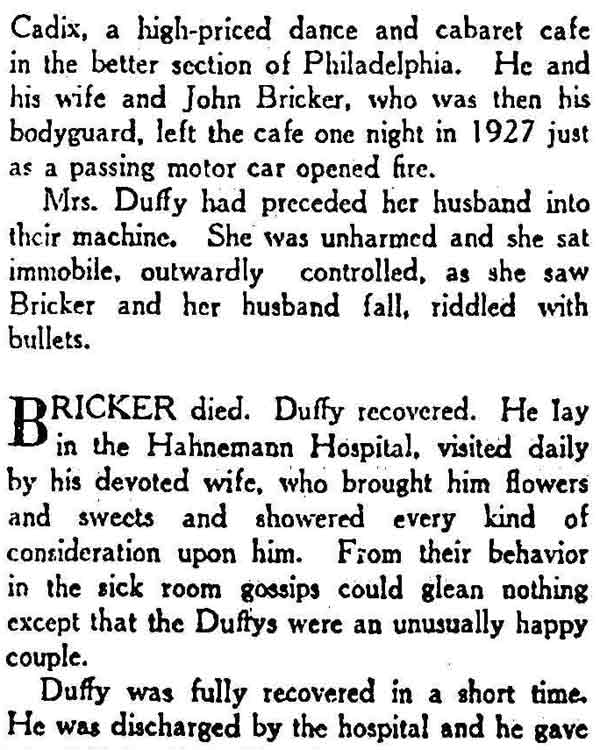
With thousands of dollars in profits pouring in, Mickey Duffy opened the fashionable Club Cadix at 23rd and Chestnut streets in Philadelphia in 1924. He ran his bootlegging and numbers businesses from the old Ritz-Carlton hotel—everybody knew Mickey.
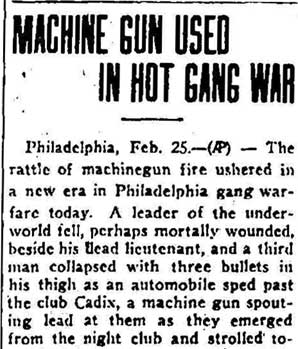
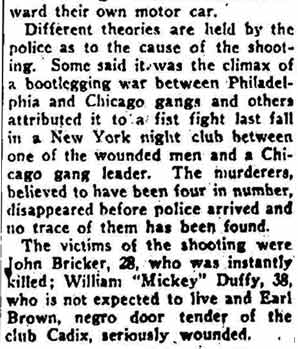
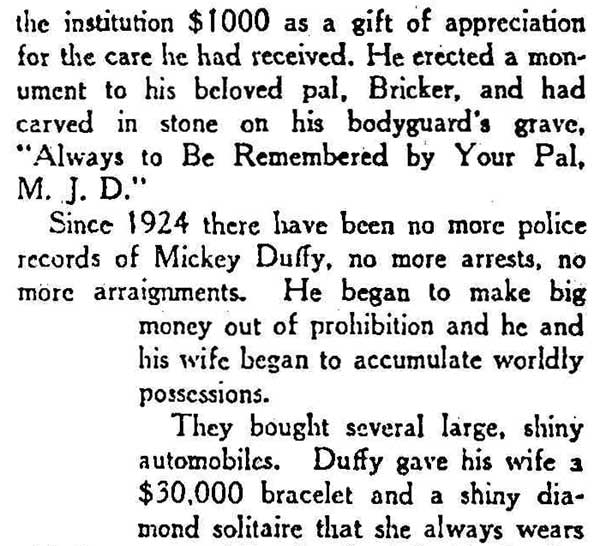
Bootlegging was a violent business, and Duffy was shot three times leaving the Club Cadix late on the night of February 25, 1927. His bodyguard, John Bricker, was killed, and Earl Brown, the club’s doorman, was also wounded. Mickey Duffy was treated at Hahneman Hospital in Philadelphia and returned to his bootlegging business. Duffy purchased a large monument for Bricker, inscribed “Always to Be Remembered by Your Pal M.J.D.”
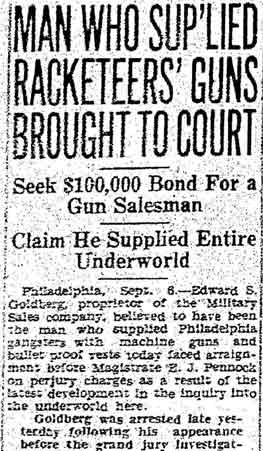
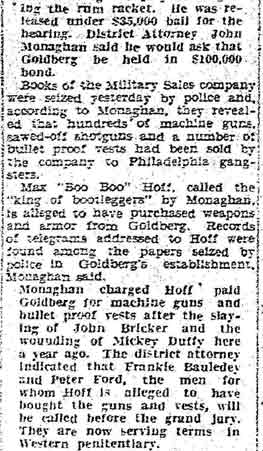
Max “Boo-Boo” Hoff, a fight manager, controlled bootlegging in Philadelphia in the mid-1920s. A 1928 grand jury closed in on Hoff, ending his career as Philadelphia’s beer baron. With Hoff gone, Mickey Duffy took over the Quaker City’s illicit beer racket. Duffy’s propensity for gaining power at gunpoint brought him into conflict with Reading-based bootlegger Max Hassel, who, with Waxey Gordon, controlled numerous breweries in Pennsylvania and Northern New Jersey. The aggressive Duffy elbowed into the rich Jersey territory and Hassel handed over a brewery to him.
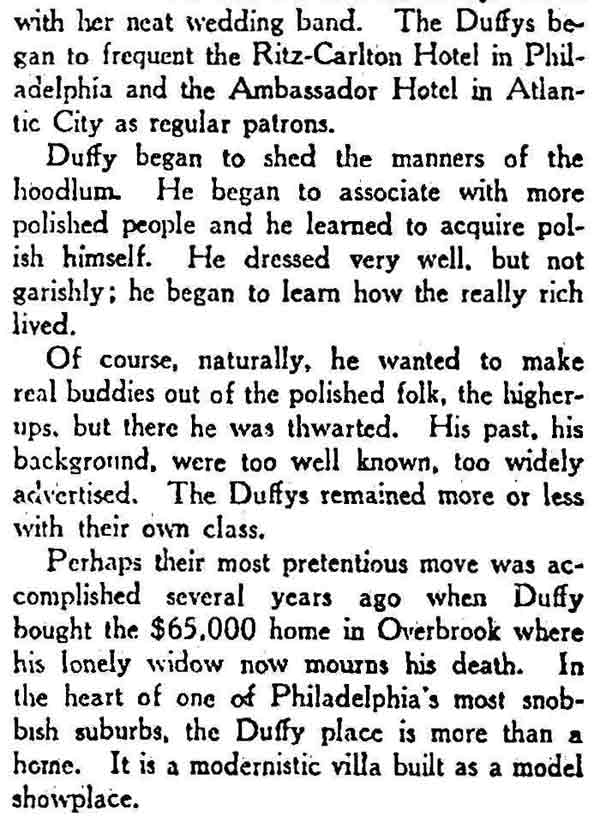
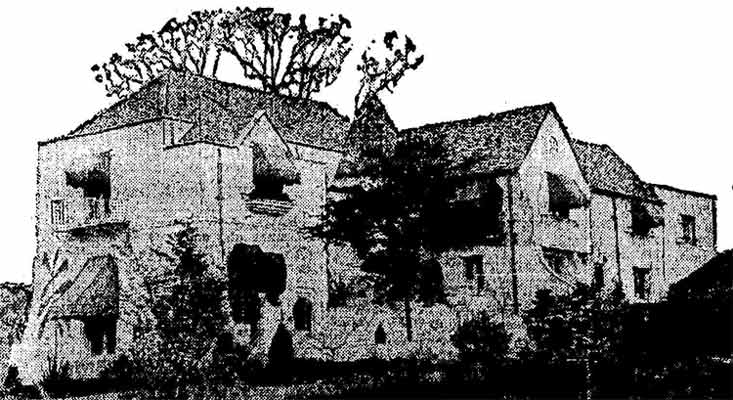
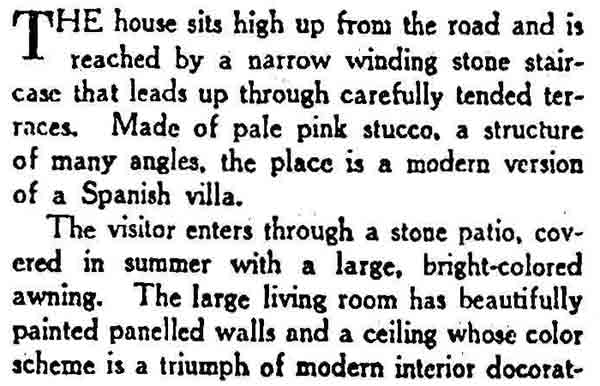
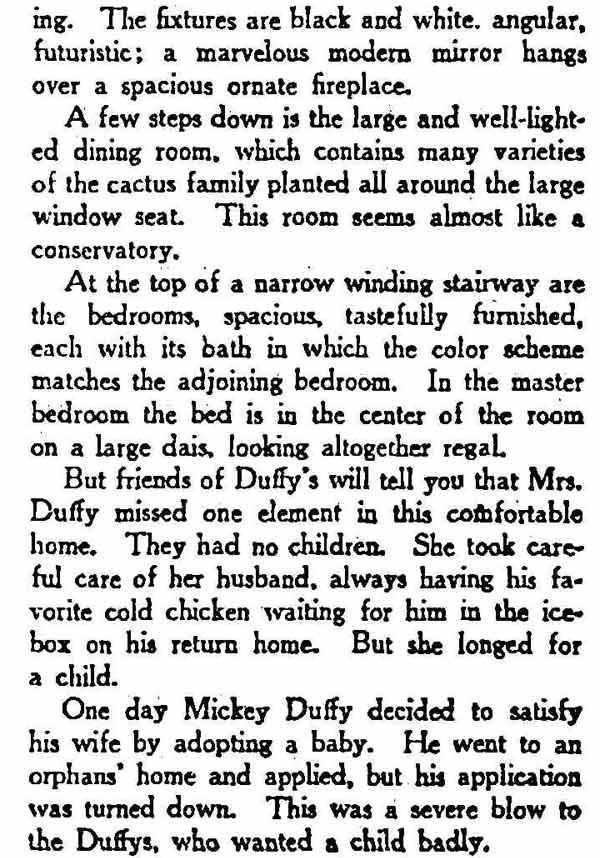
Mickey Duffy had so much money from the beer and numbers businesses that by 1930 he had built a palatial home for himself and his wife Edith at 1505 City Line Avenue near Haverford Avenue in Penn Wynne. Duffy’s mansion was on the Penn Wynne side of City Line across from Seventy-seventh Street. Built by McWilliams & Maloney to look like a Mediterranean villa, the structure was white with green satyrs on the sides and black painted palm trees on the facade. Residents recall a man with the pushcart selling Mickey Duffy ice cream, “the ice cream with a kick in it,” during Prohibition. The mansion was razed in the late 1960s. Mickey Duffy’s next door neighbor at 1511 City Line Avenue was Harry Mercer, who was one of his “business associates.” When the census was taken in 1930 Mickey Duffy gave his occupation as real estate agent, and Mercer claimed to be a “commercial traveler,” a job that today is called a traveling salesman.
Sometimes Duffy would head down to Atlantic City. He often stayed at the luxurious Ambassador Hotel and spent his time strolling the boardwalk or sitting on the beach.
But the Beer Baron had enemies, and on the night of Aug. 29, 1931, as he lay sleeping in his suite at the Ambassador, someone shot him dead.
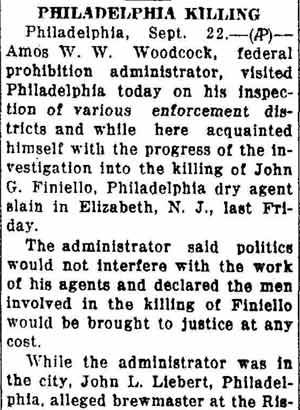
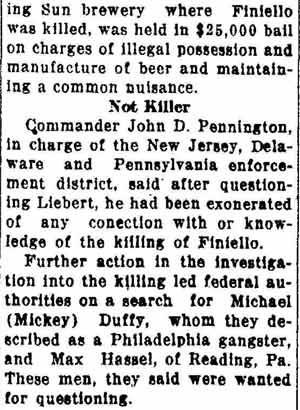
Police suspected that Duffy was slain by his own men, who wanted to take over his rackets. Max Hassel’s style was compromise, not violence; but Waxey Gordon certainly knew people who would take such a contract. No one was ever charged with his murder.
Duffy’s funeral was a big deal. Thousands of people flocked to the cemetery to see him off but a police line kept them back from the entrance gate — friends and family of Duffy needed a special pass to get in. Harry Mercer supervised the proceedings.
After Duffy’s funeral, souvenir hunters took flowers from the hundreds of floral tributes at the gravesite—the better to remember the poor Polish kid from Grays Ferry who had gone on to become, briefly, Philly’s Public Enemy No. 1.
Harry Mercer left Philadelphia after Duffy’s death. He was believed to have gone to Chicago.
Helena, Montana Independent
Helena, Montana Independent — February 26, 1927
Zanesville, Ohio
Zanesville, Ohio — September 6, 1928
Helena, Montana Independent
Helena, Montana Independent — September 23, 1930
Charleston, West Virginia Daily Mail
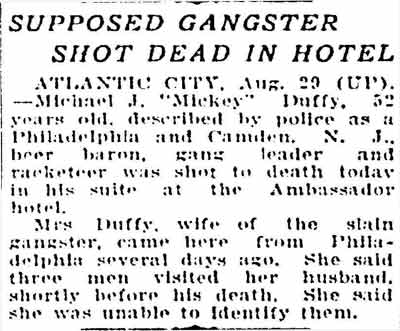
Supposed Gangster Shot Dead in Hotel
Atlantic City, Aug. 29 (UP).—Michael J. “Mickey” Duffy, 52 years old, described by police as a Philadelphia and Camden, N.J., beer baron, gang leader and racketeer was shot to death today in his suite at the Ambassador hotel.
Mrs. Duffy, wife of the slain gangster, came here from Philadelphia several days ago. She said three men visited her husband shortly before his death. She said she was unable to identify them.
Charleston, West Virginia Daily Mail
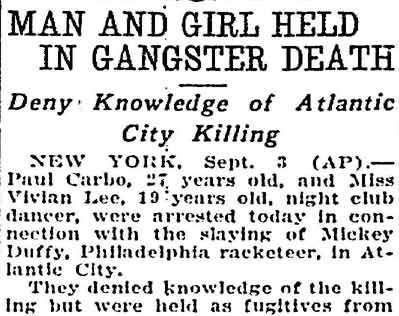
Man and Girl Held in Gangster Death
Deny Knowledge of Atlantic City Killing
New York, Sept. 3 (AP).—Paul Carbo, 27 years old, and Miss Vivian Lee, 19 years old, night club dancer, were arrested today in connection with the slaying of Mickey Duffy, Philadelphia racketeer, in Atlantic City. They denied knowledge of the killing but were held as fugitives from justice for Atlantic City, N. J., authorities.
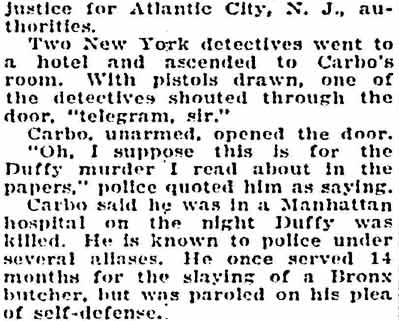
Two New York detectives went to a hotel and ascended to Carbo’s room. With pistols drawn, one of the detectives shouted through the door, “telegram, sir.”
Carbo, unarmed, opened the door.
“Oh, I suppose this is for the Duffy murder I read about in the papers,” police quoted him as saying.
Carbo said he was in a Manhattan hospital on the night Duffy was killed. He is known to police under several aliases. He once served 14 months for the slaying of a Bronx butcher, but was paroled on his plea of self-defense.
Reno, Nevada Evening Gazette
Gangland Barred From Getting Insurance
By Dexter H. Teed
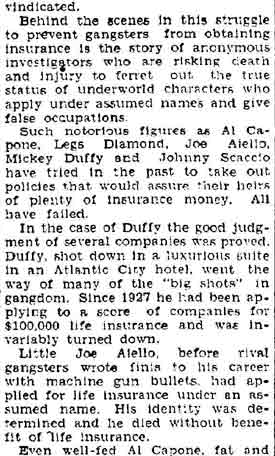
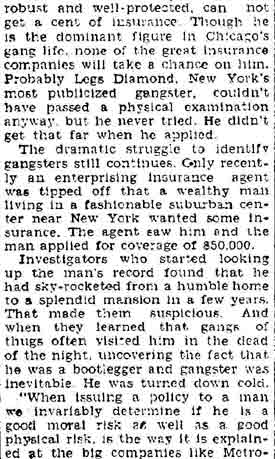
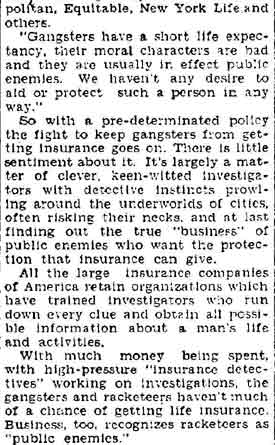
New York, Sep. 22 (NEA)—Big time gangsters and racketeers and all the smaller fry, wealthy though many of them may be, are entirely out of luck when they try to get life insurance. Even if they are robust and healthy their susceptibility to “lead poisoning” makes them poor risks. And now, although it means loss of policies aggregating millions of dollars, the great insurance companies of America have agreed unanimously to refuse life insurance to all racketeers. It is a cold business proposition, and their judgment has been vindicated.
Duffy Numbers Aide, Held in ‘Cold Storage,’ Is Released on Writ
Camden Courier-Post —
An alleged lieutenant of the late Mickey Duffy in the slain racket kings’ numbers racket, arrested Monday and held in “cold storage” by Philadelphia police, was released last night on a writ of habeas corpus.
The man is Benjamin Kauffman, 31, well-known Camden and Philadelphia gambler.
The writ was obtained by Arthur Werblun, former attorney for Duffy. Werblun charged he “discovered” Kauffman in a cell at a central Philadelphia police station, where he had been held for two days incommunicado.
The attorney also declared he was unable to learn the charges against Kauffman or obtain access to him.
According to Director Schofield, the man was arrested while seated on the doorstep of a Philadelphia policeman’s home. That policeman, it was learned, has been suspended for his connections with the number rackets. The policeman’s name has not been revealed.
Mickey Duffy Aide Goes on Trial Today
Camden Courier-Post —
George E. “English George” Sampson, erstwhile “valet” to the late Mickey Duffy, slain gang chieftain, will go on trial today before Judge Samuel M. Shay on a charge of carrying concealed deadly weapons.
Sampson was arrested Labor Day on the White Horse Pike, near Berlin, by a state trooper who stopped him for speeding his high-priced motor car.
Upon investigation, several weapons and ammunition for a submachine gun was discovered in a satchel in the rear.
The former Duffy aide denied knowledge of the weapons, declaring the satchel had been given him in Atlantic City for delivery at a Camden garage.
He was brought to Camden and held in $10,000 bail by Prosecutor Clifford A. Baldwin. After obtaining bail here Sampson was taken to Atlantic City by shore authorities and questioned there regarding the Duffy murder. He is also under bail there.
Justice Comes Last?
Camden Courier-Post, Editorial Page —
Do gangsters laugh at the law?
Here are some curious facts in a curious case.
Harry J. Green and James A. Toland, supposed racketeers, were held in heavy bail as material witnesses in the Mickey Duffy murder. On August 30, they were arrested at Berlin on the serious charge of carrying concealed deadly weapons.
Since that date rumor has been rife that these man made two boasts:
One, that they would not be ‘tried until AFTER election.
The other, that they would be acquitted at that time.
Have they made good the boasts? Glance at the record.
The men were scheduled for trial on September 23.
But Judge Shay was involved in the registration cases then, so the criminal case was postponed—until October 13.
On October 13, Prosecutor Baldwin asked postponement, saying he feared to try the men before the jury panel which heard the Rettberg case, and whose verdict Baldwin severely criticized. This time the case was put off until October 26.
On Monday, October 26, the trial was again postponed.
Green, it seems had bronchitis. They couldn’t try Toland alone, as Green was a leading defense witness.
It was suggested that the trials be postponed a week. But that would bring them THE DAY BEFORE ELECTION. All the attorneys, it seems, would be too busy to bother with the machinery of justice on that day. So the trials were put off another week— until AFTER ELECTION.
It will be interesting to see whether Messrs. Green and Toland now make good their boast of acquittal!
Since everything seems to be more important than the dispensing of criminal justice at the court house these days, that outcome would not be at all surprising.
No sign of the hard-boiled, fast-moving methods Judge Wilkerson, of Chicago, used in the Capone case.
Jersey Justice, it seems is running with its brakes on!
Duffy Leaves A Mere $6000 From ‘Rackets’
Camden Courier-Post —
Reputed Wealth of Gangster Proves as Elusive as His Slayers
Mickey Duffy’s reputed riches—gleaned in gangland—have proved as elusive as his killers.
Mickey, alive, was supposed to be rolling in wealth, with millions to spend.
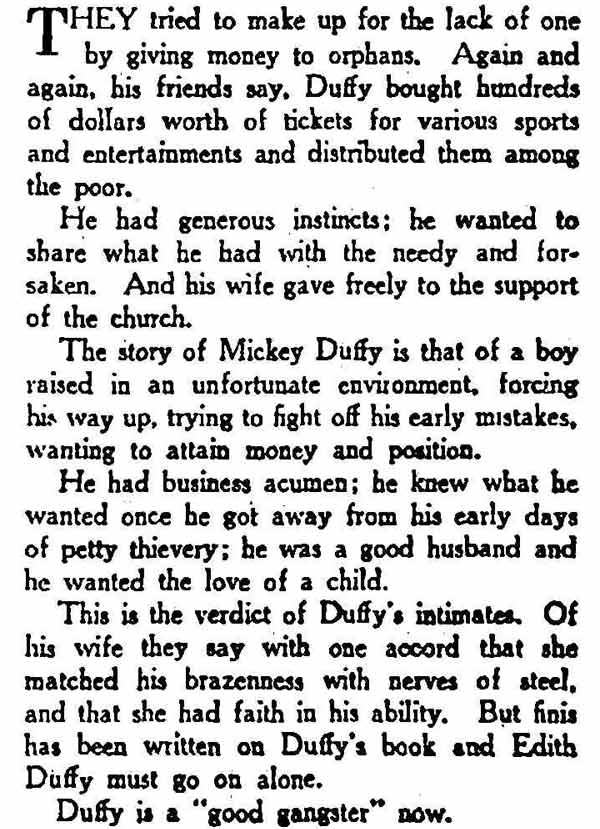
Mickey, dead, left a personal estate of $6000, letters of administration granted yesterday in Norristown to his widow, Mrs. Edith S. Duffy, showed.
But those who claim to know continue to talk of the fabulous sums Mickey made. It has been said that his “take” in the beer racket alone reached $25,000 weekly. In addition he got huge “cuts” from other interests—such as gambling establishments and “protection” associations.
Some claim he was the boss of the “numbers” racket. That he still was interested in the white slave “business.” His share of profits from these would have been in the thousands.
But according to those administration papers the Boss Man of Racketdom left a paltry $5000 worth of personal property and a $1000 equity in a home at 4827 Osage Avenue, Philadelphia.
His Overbrook Hills “Spanish Castle,” which was reputed to have cost more than $65,000, stood revealed, as having been the joint property of he and Mrs. Duffy.
“That is all there is,” Charles Elkman, counsel for Mrs. Duffy, said. “Of course, there are some outstanding notes. Many are doubtful of collection however.”
Helena, Montana Independent
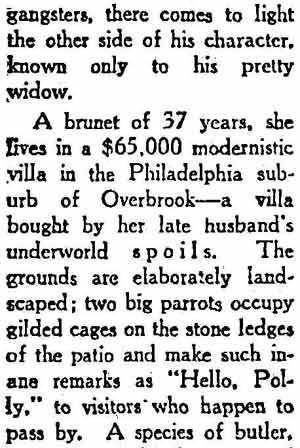
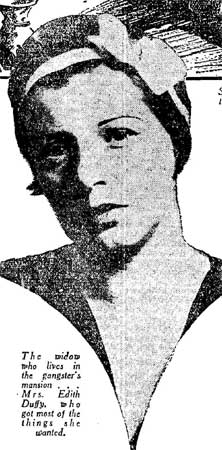
Mrs. Edith Craig Duffy
Helena, Montana Independent — November 15, 1931
Gettysburg, Pennsylvania Times
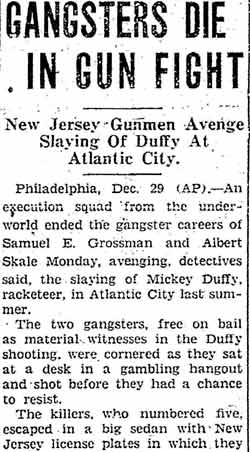
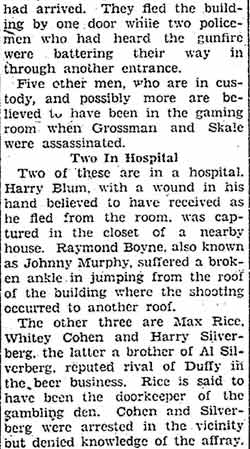
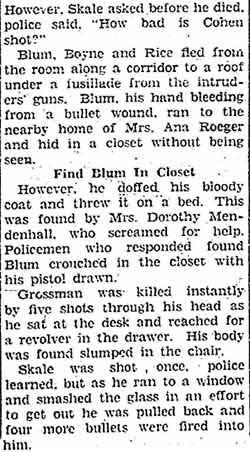
Gangsters Die in Gun Fight
New Jersey Gunmen Avenge Slaying of Duffy at Atlantic City.
Philadelphia, Dec. 29 (AP).—An expedite squad from the underworld ended the gangster careers of Samuel E. Grossman and Albert Stale Monday evening, detectives said, in revenge for the slaying of Mickey Duffy, racketeer, in Atlantic City last summer.
The two gangsters, free on bail as material witnesses in the Duffy shooting, were cornered as they sat at a desk in a hotel hangout and shot before they had a chance to resist. The killers, who numbered five, escaped in a big sedan with New Jersey license plates.
Camden Courier-Post
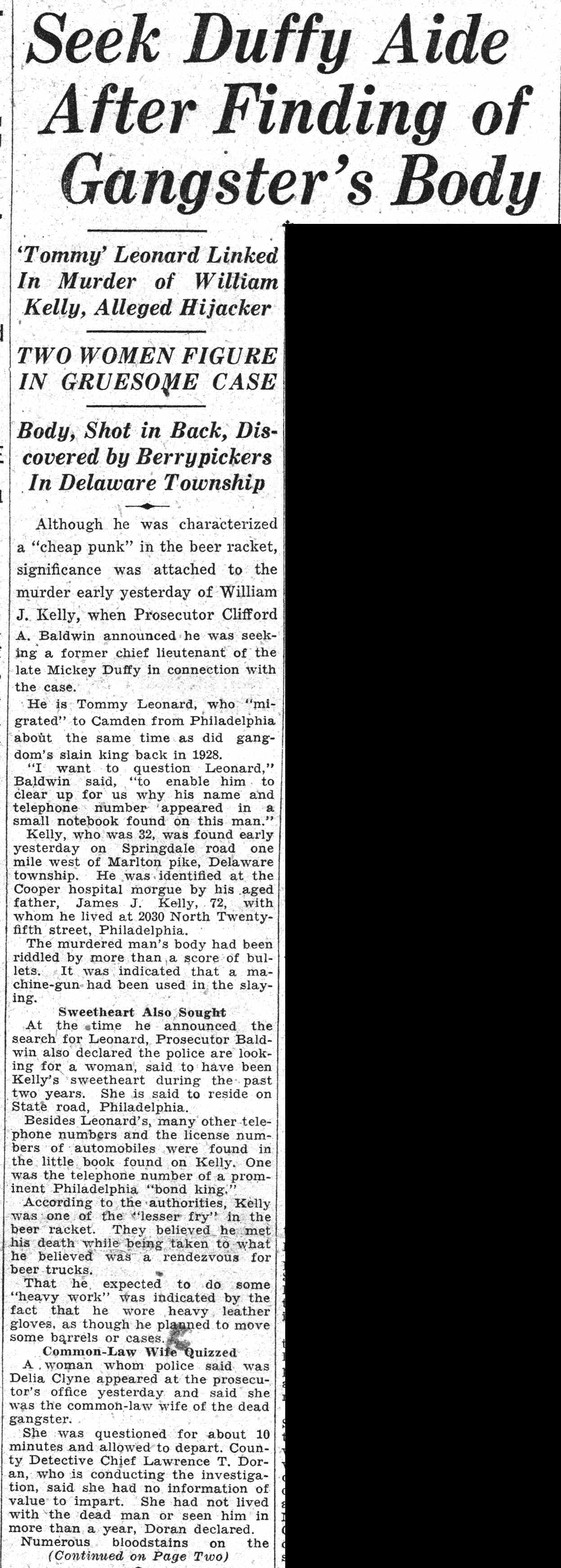
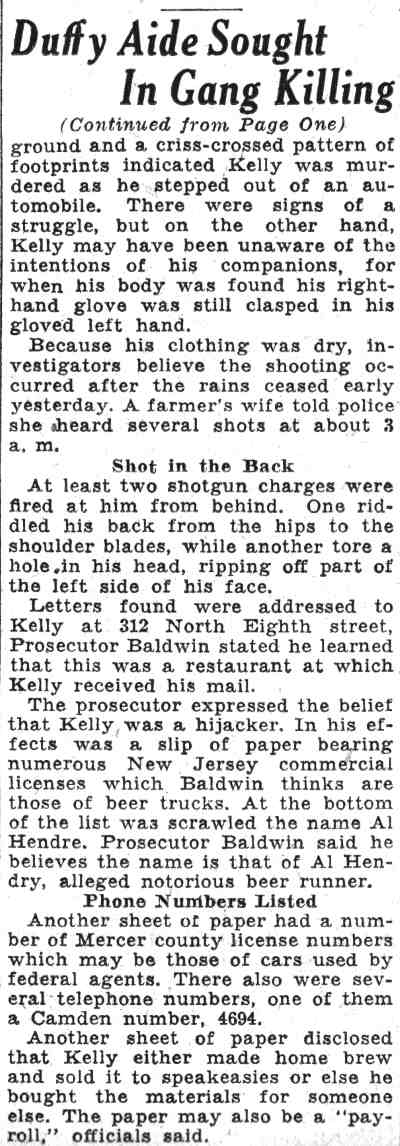
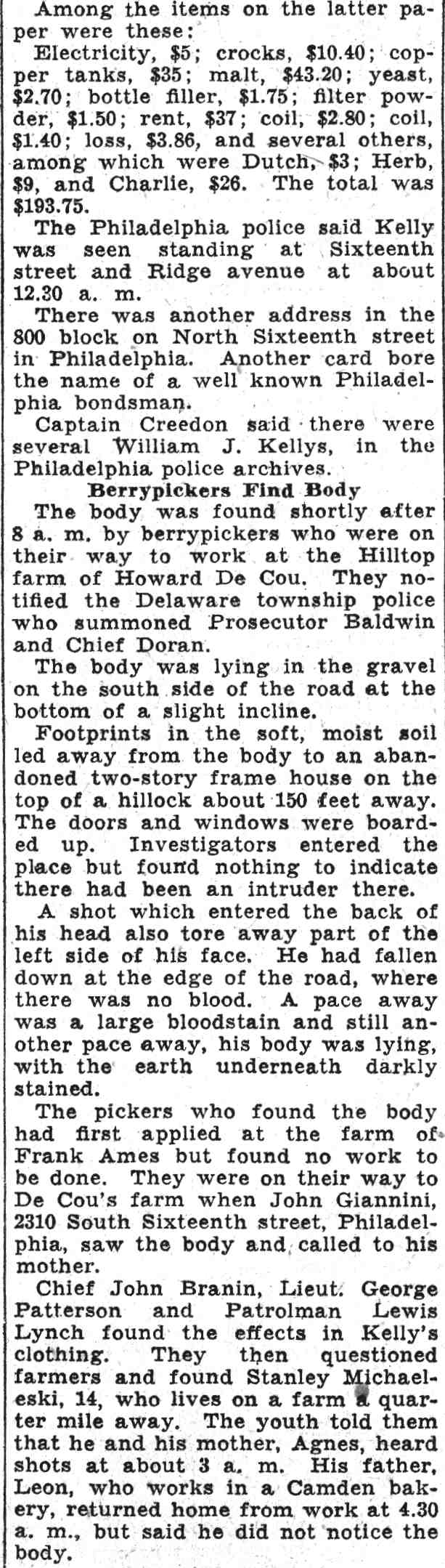
Named: Mickey Duffy, Clifford A. Baldwin, and Lawrence T. Doran.
Camden Thugs to Die; Hunt Brother Here
Camden Courier-Post —
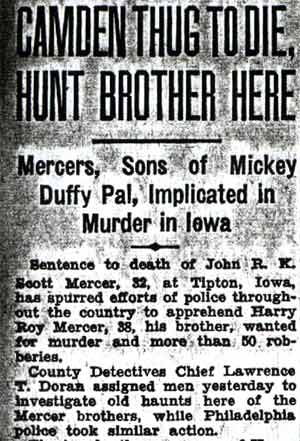
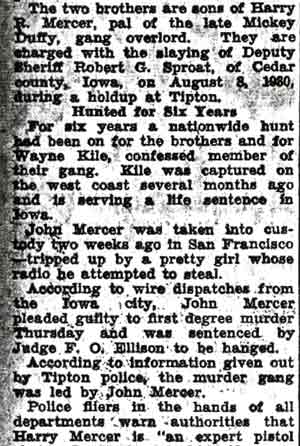
Mercers, Sons of Mickey Duffy Pal, Implicated in Murder in Iowa
Sentence to death of John R. K. Scott Mercer, 32, at Tipton, Iowa, has spurred efforts of police throughout the country to apprehend Harry Roy Mercer, 30, his brother, wanted for murder and more than 50 robberies.
County Detective Chief Lawrence V. Doran assigned men yesterday to investigate old haunts here of the brothers, while police in Philadelphia took similar action.
The two brothers are sons of Harry Mercer, friend of the late Mickey Duffy, gang overlord. They are wanted in connection with the murder of Dentist Robert G. Sprout, of Cedar county, Iowa, during a holdup at Tipton. Wayne Kile, a notorious bandit associate of the brothers, was captured on the west coast some months ago and is serving a life sentence in Iowa.
John Mercer, alias Jack Borne, was captured on a street car in San Francisco. Miss Dolores Daly, 19, of that city, recognized him as the man who had called at her apartment several days earlier to fix a radio. He walked out with the radio and never returned. She trailed him for several blocks until she saw a policeman, and then had him arrested. A reward of $500 offered by the State of Iowa will be paid Miss Daly. A similar reward has been offered for the capture of Harry Mercer.
Harry Mercer left Philadelphia early in July, 1930, for an automobile trip through Canada and the Middle West. When his car was found abandoned near Davenport, Ia., his father expressed belief that he had been killed.
No explanation could be given for a diary which was found in the car, and in which was a quotation: “Sometimes it is nice to kill for the sake of killing. We kill for fun.”
Chief Doran revealed that he had detectives assigned to the case for more than two years. At the time an apartment was rented in Merchantville and four deputy sheriffs from the western city lived there for several months in an effort to capture either of the Mercer boys on the possibility of their returning to see their father.
Although his brother was captured in the West, it is believed by police that Harry Mercer is in hiding in this section, where he has made many friends through connections made by his father. It is reported he has grown a mustache and has changed the manner in which he combs his hair, giving him a decidedly different appearance.