Michael Gapinski Jr.
Watertender, U.S. Navy
USS Fanning DD-37
Entered the Service from: New Jersey
Died: October 22, 1918
Buried at: Calvary Cemetery
Route 70
Cherry Hill NJ
Introduction
Watertender Michael Gapinski Jr. served aboard the USS Fanning DD-37. He was the son of Mr. and Mrs. Michael Gapinski. His father lived at 1130 Atlantic Avenue in Camden NJ. He enlisted in the United States Navy on November 21, 1914 at Philadelphia, Pennsylvania. He was later assigned to the destroyer USS Fanning.
The Fanning was launched January 11, 1912 by the Newport News Shipbuilding Co., Newport News VA. It was sponsored by Mrs. Kenneth McAlpine, and commissioned June 21, 1912 with Lieutenant W. N. Jeffers in command. She was classified DD-37 on 17 July 1920.
In the years that preceded World War I, Fanning took part in the training schedule of the Atlantic Fleet, sailing to the Caribbean for winter maneuvers, and exercising off the coast of New England in the summers. Based at Norfolk during the major portion of each year, she joined in gunnery practice in this area.
As war raged in Europe, Fanning intensified her preparations for any eventuality. When two German auxiliary cruisers visited Norfolk in September 1916, Fanning acted as part of their escort while they sailed in United States territorial waters. On October 8, 1916 Fanning put out of Newport, R.I., to search for the crews of ships sunk not far from Nantucket Light Ship by the German submarine U-53. The destroyer recovered six survivors and landed them at Newport the next day. The presence of U-53 led to the speculation that a secret German submarine base might exist in the Long Island Sound–Block Island Sound area; Fanning searched from October 12 to October 14 for evidence of such a base but found nothing, and returned to her regular operating schedule.
During the latter half of October 1916, Fanning and the fuel ship Jason conducted experiments to develop methods of oiling at sea, a technique which has since given the United States Navy unbounded mobility and sea-keeping qualities. Torpedo and gunnery practices, and fleet maneuvers during the next eight months sharpened Fanning’s war-readiness, so that, true to Navy tradition, she was able to sail for distant service when called on in June 1917.
Based on Queenstown, Ireland, Fanning and her sister destroyers patrolled the eastern Atlantic, escorting convoys and rescuing survivors of sunken merchantmen. In the afternoon of November 17, 1917 an alert lookout on board Fanning sighted the periscope of U-58, and the destroyer quickly moved in on the attack. Fanning’s first depth charge pattern scored, and as Nicholson (DD-52) joined the action, the submarine broke the surface, her crew pouring out on deck, hands raised in surrender. Fanning maneuvered to pick up the prisoners as the damaged submarine plunged to the bottom, the first of two U-boats to fall victim to United States Navy destroyers in World War I.
Fanning continued escort and patrol duty for the duration of the war. Though she made numerous submarine contacts, all of her attacks were inconclusive. On many occasions she went to the aid of torpedoed ships, rescuing survivors and carrying them into port.
Michael Gapinski was shot by a shipmate, Gus Menefee, on September 22, 1918. He was brought home after the war, and buried at Calvary Cemetery in Delaware Township (present-day Cherry Hill) NJ.
Menefee v. Aderhold
U.S. District Court, N.D. Georgia —
MENEFEE v. ADERHOLD
DISTRICT COURT, N.D. GEORGIA
November 10, 1932The opinion of the court was delivered by: UNDERWOOD
UNDERWOOD, District Judge.
Petitioner, on the 1st day of October, 1918, a few weeks prior to the Armistice, was tried at Brest, France, by a general court-martial for the murder, on September 22, 1918, of Michael Gapinski, while on U.S.S. Fanning, off the coast of France.
Petitioner was fireman, second class, and Gapinski was water tender on said vessel.
The general court-martial was convened pursuant to order dated September 28, 1918, by Vice Admiral H. B. Wilson, Commander, Patrol Force, United States Atlantic Fleet. The order provided that the court should be composed of the following members: Capt. Horace W. Harrison, United States Navy (retired); Commander Clarence M. Stone, United States Navy (retired); Commander Adolphus Staton, United States Navy; Lieutenant Commander Robert M. Foyle, Junior, United States Navy; Lieutenant Commander George Joerns, United States Navy (retired); Lieutenant Commander Robert E. Tod, United States Naval Reserve Force; Lieut. Charles A. Macgowan, United States Navy; Lieut. John J. Twomey, United States Navy; Lieut. James T. Strimple, Medical Corps, United States Naval Reserve Force.
The order further provided that “no other officers can be detailed without injury to the service.
The court convened at 10 o’clock a.m. on October 1, 1918, with the following members present: Capt. Horace W. Harrison, United States Navy (retired); Commander Clarence M. Stone, United States Navy (retired); Lieutenant Commander George Joerns, United States Navy (retired); Lieutenant Commander Robert E. Tod, United States Naval Reserve Force; Lieut. Charles A. Macgowan, United States Navy; Lieut. John J. Twomey, United States Navy; and Lieut. James T. Strimple, Medical Corps, United States Naval Reserve Force, members; and Ensign Capers G. Barr, United States Naval Reserve Force, Judge Advocate.
Commander Staton was not present when the court was organized, but, at the afternoon session of the court, explained his absence by saying that notice of his appointment as a member of the court had been received by him only a few minutes previous to his appearance. He was excused from further attendance, and never served as a member of the court.
The record thus shows that only seven of the appointees and the Judge Advocate actually served as members of the court, and that of these three were officers on the retired list; two and the Judge Advocate were officers of the Naval Reserve Force; one was an officer of the Medical Corps, United States Naval Reserves; and only two were active officers of the regular service.
There was nothing in the record of the proceedings of the court-martial to show that any of the retired or reserve force officers were assigned to active duty, nor was any evidence of this fact presented at the trial in this proceeding, though this was one of the issues in the case.
A copy of the charges and specifications was served on petitioner the day before the trial, and counsel then appointed to represent him.
Petitioner was tried, found guilty of murder, and on October 3, 1918, sentenced by the court, two-thirds of the members concurring, “to be shot to death by musketry.
The proceedings, finding, and sentence were approved on October 12, 1918, by the authority convening the court, Admiral Wilson, and the record was referred to the “Secretary of the Navy, for transmission to the President, and for such further action as may be deemed necessary in the premises.
The record, with Admiral Wilson’s approval, was by him transmitted, on October 19, 1918, to “Secretary of Navy (Judge Advocate General) Bureau of Navigation, Washington, D.C.
The Judge Advocate General received the record and referred it, on November 26, 1918, with his opinion upholding the findings of the court-martial, to the Chief of the Bureau of Navigation. The Bureau, on March 15, 1919, concurred “in the endorsement of the Judge Advocate General,” and recommended “approval of the proceedings, finding and sentence.
The record, with the accumulating opinions, endorsements, and approvals, was submitted to the Assistant Secretary of the Navy, and was acted upon by him as Acting Secretary of the Navy, on April 5, 1919. His action is shown by the following order, appearing in the record:
Department of the Navy
Washington
26262—5400
5 April 1919.“The foregoing recommendations of the Judge Advocate General concurred in by the Chief of the Bureau of Navigation are approved, but in view of all the circumstances of the case the sentence is mitigated to confinement for the period of his natural life and to suffer all of the other accessories of said sentence, as mitigated, as prescribed by Section 349, Naval Courts and Boards. The naval prison at the Navy Yard, Portsmouth, N.H. is designated as the place of confinement.
On April 7, 1919, petitioner was, pursuant to the above order, committed to the Naval Prison at Portsmouth, N.H.
By order of May 26, 1920, the Secretary of the Navy ordered: “The Department Action of 5 April, 1919, designating the Naval Prison, Portsmouth, N.H., as the place of confinement in the case of the above-named man, is hereby modified in that the United States Penitentiary, Atlanta, Ga., is designated as the place of confinement.
Petitioner has been in confinement since his arrest on September 22, 1918, something over fourteen years. He filed his application for writ of habeas corpus in this court and was duly given a hearing. Having no lawyer, and it appearing that serious questions of law were involved, the court appointed an attorney to represent him, and continued the hearing to allow time for the preparation of the case.
The petition was amended, rehearing had, and briefs filed. As the case was finally presented, petitioner contended that the proceedings and sentence were void for the following reasons:
(1) The general court-martial was not constituted as required by law because nine officers were appointed and only seven served as members, and because, of the seven members who served, three were retired officers, not shown by the record or otherwise to have been assigned to active duty, and one was a noncombatant officer of the Medical Corps.
(2) The court had no jurisdiction over the offense, because it was not committed “without the territorial jurisdiction of the United States.
(3) The sentence of the court-martial was not approved by the President, as required by law.
Restrictions on the jurisdiction of courts-martial have been repeatedly emphasized by the United States Supreme Court. “But, the court-martial being a special statutory tribunal, with limited powers, its judgment is open to collateral attack, and unless facts essential to sustain its jurisdiction appear, it must be held not to exist.” Collins v. McDonald, 258 U.S. 416, 418, 42 S. Ct. 326, 327, 66 L. Ed. 692.
Petitioner should have raised the question set out in the first of these grounds at the court-martial trial, and, in my opinion, his failure to do so waived any objections he might have had to the personnel of the court. Indeed, the record shows that he went even further and expressly stated that he did not object to any member.
The second of the above grounds raises a more serious question, the determination of which depends upon the construction given to the words “territorial jurisdiction” in the statute conferring jurisdiction in murder cases on courts-martial. The statute is as follows: “If any person belonging to any public vessel of the United States commits the crime of murder without the territorial jurisdiction thereof, he may be tried by court-martial and punished with death.” 34 USCA § 1200, art. 6; R.S. § 1624, art. 6.
Petitioner contends that, inasmuch as the U.S.S. Fanning was a war vessel of the United States, it was United States territory as long as it was on the high seas and not within the territorial boundaries of another nation, and therefore the crime charged was not committed “without the territorial jurisdiction” of the United States, and the court-martial which tried the offense had no jurisdiction over the crime.
However, finding, as I do, that petitioner is now detained under an unlawful sentence, as claimed in the third of the above grounds, it is not necessary in this case to decide this question.
Article 53 of title 34 of the United States Code, Annotated, provides how a court-martial sentence of death may be legally imposed. That article is as follows: “No sentence of a court-martial, extending to the loss of life, or to the dismissal of a commissioned or warrant officer, shall be carried into execution until confirmed by the President. All other sentences of a general court-martial may be carried into execution on confirmation of the commander of the fleet or officer ordering the court.
It has been frequently held that the approval of a sentence of death or dismissal of an officer must be the personal act of the President. As noted above, the sentence in this case was not approved by the President, or even submitted to him for his approval, but was commuted by the Acting Secretary of the Navy.
No statute authorized the Secretary of the Navy, or any other officer than the President, to commute a death sentence. On the other hand, the statutes expressly say they cannot.
It would seem, therefore, that the sentence under which the petitioner is detained is void. The death sentence could not have been executed because never approved by the President, and the life sentence is void because the death sentence was not commuted by the President, and the attempt of the Acting Secretary of the Navy to do so was futile, even if we assume he had as complete power in the premises as the Secretary of the Navy might have had.
Petitioner had been in the Navy about eighteen months and on board the U.S.S. Fanning with Gapinski about fifteen months, before the shooting. All witnesses spoke well of petitioner, and the commanding officer of the vessel, Lieutenant Commander Cogswell, himself, testified that “the accused’s general reputation was a quiet, hard-working fireman.
On the other hand, several officers and seamen testified that Gapinski, though a good water tender, was a brutal bully, very overbearing toward those under him, a man who was determined to have his way, and who often abused and struck those under him. He was a large man, weighing 190 pounds, while petitioner was a small man. On one occasion petitioner and others saw Gapinski attack another with such violence that he broke the victim’s nose and arm, necessitating long hospital treatment. Petitioner testified that he was afraid of Gapinski and tried to stay away from him.
On the morning of the shooting, Gapinski cursed petitioner, and threatened him with serious bodily injury. This was established by several witnesses. Later on in the morning Gapinski cursed and threatened petitioner again for opening a hatch to get some fresh air. Thereafter petitioner, fearing for his life, got a pistol from the racks in the engineers’ petty officer compartment, and put it in his pocket. He carried it the rest of the day. About 11 o’clock that night, after cleaning a burner, petitioner was regulating the steam when Gapinski called him. Petitioner went to Gapinski, noticing at the time that he had a large wrench in his hand.
According to petitioner, Gapinski asked him if the burner which he had just cleaned was clean. Petitioner replied that it was. Gapinski said that he “was a God damned liar,” and petitioner replied that he was another. Whereupon Gapinski struck at petitioner with the wrench and badly injured his right wrist, with which petitioner tried to ward off the blow. At the same time petitioner, who was left-handed, drew the pistol and began shooting and backing the while from Gapinski, “who kept coming at” petitioner. All of petitioner’s testimony was corroborated by the other witnesses except as to what took place immediately before the first shot.
After the shooting, Williams reported the occurrence to the officer of the deck, Lieut. John A. Vinson, who came down on the plates where petitioner was. Petitioner handed Lieut. Vinson the pistol, and asked him what to do. He was told to report on deck, and did so, reporting to the commanding officer, Lieut. Cogswell, the facts as above stated. Petitioner’s injured wrist was examined by Lieutenant Commander Cogswell, and later dressed by the pharmacist.
From a careful study of the record of the court-martial, I believe the above is the truth of the case. Every part of the petitioner’s testimony is fully corroborated by other witnesses, both officers and seamen, except the fact as to whether Gapinski struck first with the wrench, and there was, on this point, no evidence to contradict petitioner’s statement. There is, I think, at least a grave question as to whether the evidence was sufficient to establish petitioner’s guilt beyond a reasonable doubt.
In these circumstances, then, what should be done with petitioner? He cannot be remanded to the court-martial which tried him, if that were called, since it adjourned and ceased to exist years ago and could not be reconvened.
I have reached the conclusion, therefore, on the facts as I see them, that petitioner has already suffered sufficiently for his offense, even if guilty, and that it will be “lawful and just” to order his discharge, which I have done. The discharge, however, will be delayed for sixty days from this date to allow time for an appeal, should respondent wish to take an appeal.
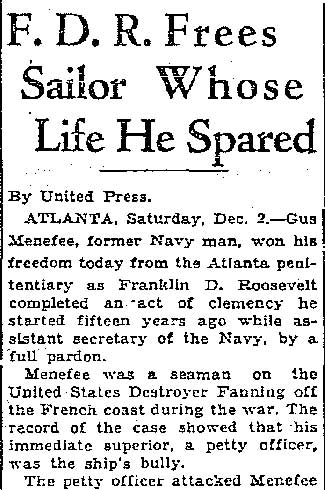
F.D.R. Frees Sailor Whose Life He Spared
Seattle Daily Times —
By United Press.
ATLANTA, Saturday, Dec. 2.—Gus Menefee, former Navy man, won his freedom today from the Atlanta penitentiary as Franklin D. Roosevelt completed an act of clemency he started fifteen years ago while assistant secretary of the Navy, by a full pardon.
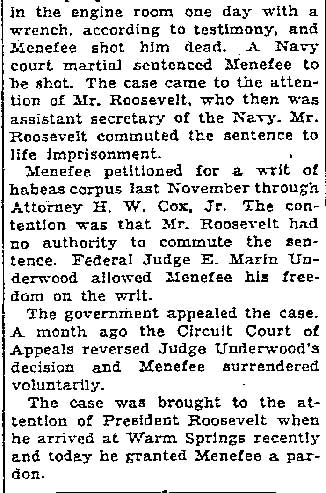
Menefee was a seaman on the United States Destroyer Fanning off the French coast during the war. The record of the case showed that his immediate superior, a petty officer, was the ship’s bully. The petty officer attacked Menefee in the engine room one day with a wrench, according to testimony, and Menefee shot him dead. A Navy court martial sentenced Menefee to be shot. The case came to the attention of Mr. Roosevelt, who then was assistant secretary of the Navy. Mr. Roosevelt commuted the sentence to life imprisonment.
Menefee petitioned for a writ of habeas corpus last November through Attorney H. W. Cox, Jr. The contention was that Mr. Roosevelt had no authority to commute the sentence. Federal Judge E. Marin Underwood allowed Menefee his freedom on the writ.
The government appealed the case. A month ago the Circuit Court of Appeals reversed Judge Underwood’s decision and Menefee surrendered voluntarily.
The case was brought to the attention of President Roosevelt when he arrived at Warm Springs recently and today he granted Menefee a pardon.