Jacob Kessler Jenkins
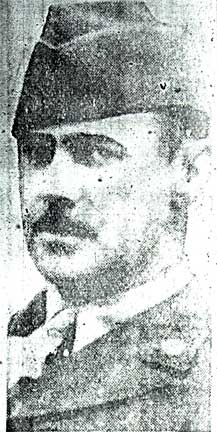
Jacob Kessler Jenkins
Private, U.S. Army Air Forces
Serial: 32487176
853rd Engineer Battalion, Aviation
Entered the Service from: New Jersey
Died: November 27, 1943
Missing in Action or Buried at Sea
Tablets of the Missing at North Africa American Cemetery
Carthage, Tunisia
Awards: Purple Heart
Introduction
Private Jacob Kessler Jenkins was born in 1906 to Jacob K. and Jennie Jenkins. His father was a millwright; his mother, Mary J. Jenkins, was an immigrant from Ireland. In 1920, the family was living at 922 Federal Street in Camden, New Jersey, and Kessler, as he was called, was still in school. He would leave high school after his freshman year. His older brother Emory had already left school to apprentice in a machine shop, and he had a younger sister, Ethel A. Jenkins, at home as well. By 1930 the family had moved to 1937 Springfield Avenue in the Delaware Gardens neighborhood of Pennsauken, New Jersey.
Jacob Kessler Jenkins had moved out of his parents’ house by this time. By April of 1930 he was working as a bus driver for the Public Service Company and had wed, living with his wife Isabella Sauer Jenkins at the home of her parents, Henry and Amelia Sauer, at 11 Clinton Avenue in Merchantville, New Jersey.
Separated from his wife, Jacob Kessler Jenkins was inducted into the United States Army on September 1, 1943 in Camden, New Jersey. By the time of his induction, his father had passed away. Sister Ethel Jenkins had married Robert C. Shinn of Marne Highway, Mt. Holly, New Jersey, and his mother had gone to live with the Shinns. His brother, Emory Jenkins, had moved to Collingswood, New Jersey.
Jacob Kessler Jenkins was assigned, along with many other area men, to the 853rd Engineer Battalion, Aviation, where he trained in the South in the construction of airbases.
In November 1943, Jacob Kessler Jenkins and his comrades shipped out to North Africa, where they were to continue on through the Mediterranean and the Suez Canal to India, where they were to construct airbases to support the war effort in the China-Burma-India Theater of Operations.
On November 26, 1943, Jacob Kessler Jenkins and the 853rd Engineer Battalion, Aviation sailed out of Oran, Algeria on the British-owned and operated transport ship, HMTS Rohna. Later that day, the convoy was attacked by German aircraft. After initially beating off the attack, another German plane approached the convoy and launched a new weapon — a radio-controlled glider bomb, in essence the world’s first guided missile.
The Rohna was struck by the missile, which blew a hole through both sides of the ship, killing 300 Americans immediately, many of them members of the 853rd Engineers. Jacob Kessler Jenkins most likely met his fate there. The ship quickly sank, and over 1,000 Americans were lost in the ensuing hours.
The sinking of the Rohna was kept secret from the public during the war for reasons of wartime security. Sadly, the government waited over 50 years before declassifying the story, and the families of those lost on the Rohna were never told the truth of their loved ones’ fate. Only in the 1990s, due to efforts of survivors of the sinking, was any official acknowledgement made.
Private Jenkins was survived by his wife Isabella Jenkins, his mother Jennie Jenkins, his brother Emory Jenkins, and his sister Ethel Jenkins Shinn.
15 Dead, 2 Missing from South Jersey
Camden Evening Courier —
Former Camden Resident, Holder of Six Awards, Among New Casualties
Shiloh Flier Listed Downed in Europe
Fifteen South Jersey men were among the 1,511 reported by the War Department today as killed in action on the six fighting fronts. Two others from this area are reported missing.
Killed:
Staff Sergeant Ronald J. Pearce, of 330 Delancey Street, Philadelphia, formerly of 3404 Federal Street, Camden.
Private First Class Charles La Porta, of 142 Chestnut Street, Williamstown.
Private Frank Ballerino, of 2004 South 10th Street, Camden.
Sergeant Elmer F. Day, of 521 Lexington Avenue, Merchantville.
Corporal William T. Eastlack, of 142 I Street, Carney’s Point.
Private Clarence T. Jaggers, of Columbia Road and St. James Walk, National Park.
Sergeant Carl E. Johanson, of 5019 Jefferson Avenue, Pennsauken.
Corporal Steven V. Koscianski, of 966 Bulson Street, Camden.
Private First Class William R. McKeon, of Pine Avenue, Blackwood.
Sergeant Andrew W. Olsen, of Dorothy.
Corporal Aldo Steffanice, of 74 Norman Avenue, Pennsgrove.
Private First Class John A. Landicina, of 402 Southeast Avenue, Vineland.
Michael Carr, of 1059 Everett Street, Camden.
Captain Carlton P. Hogan, of 207 East Union Street, Burlington.
Corporal Millard E. Buckingham, of 38 Grant Street, Deepwater.
Missing:
Lt. Robert Probasco, of Shiloh.
Lt. John Ruggiero, of Bridgeboro Road, Beverly.
3 On Troopship Lost
Ballerino, Koscianski, and Carr are believed to have met their fates on the same transport. War Department telegrams to families of all three men reveal that each was a passenger on a troopship that was lost due to enemy action in the Mediterranean on Nov. 27, 1943. All have been awarded Purple Hearts.
This was the closest that the general public got to the truth of the matter. As a matter of fact, 12 of the fifteen men listed above were on that transport, the HMTS Rohna. Five other Rohna victims were also on the War Department casualty lists for that day.
The following reported as dead in today’s official casualty list were previously reported as missing: Sergeant Day, Private Jaggers, Corporal Koscianski, Private McKeon, and Private Steffanice.
Also listed as dead in today’s official casualty list but previously reported in these columns are: Private Michael Yachus, 679 Ferry Avenue, Camden; Joseph H. Johnson, 1273 South Merrimac Road, Camden; Private Harry V. Taylor, 3 Kings Highway East, Haddonfield; Private Merl H. Reagle, Maple Avenue, Lindenwold; Private Jacob K. Jenkins, Marne Highway, Mt. Holly, formerly of Pennsauken; Private Harry E. Harker, 6 Beach Avenue, Blackwood; PFC Jack S. Dubois, Church Street, Williamstown; and Charles R. Stewart Jr., 319 Linden Street, Camden.
Eagle Ball Was Grand Success
Camden Daily Courier —
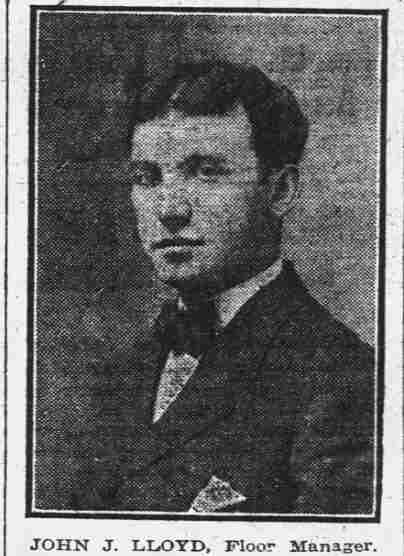
JOHN J. LLOYD, Floor Manager.
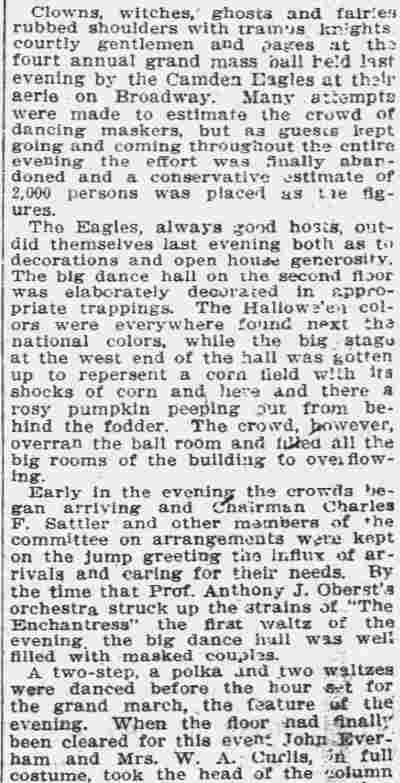
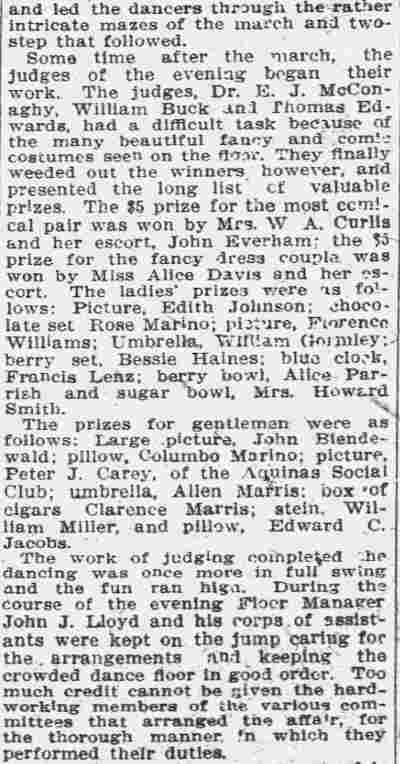
Clowns, witches, ghosts and fairies rubbed shoulders with tramps, knights, courtly gentlemen and pages at the fourth annual grand mass ball held last evening by the Camden Eagles at their aerie on Broadway. Many attempts were made to estimate the crowd of dancing maskers, but as guests kept going and coming throughout the entire evening the effort was finally abandoned and a conservative estimate of 2,000 persons was placed as the figures.
The Eagles, always good hosts, outdid themselves last evening both as to decorations and open house generosity. The big dance hall on the second floor was elaborately decorated in appropriate trappings. The Hallowe’en colors were everywhere found next the national colors, while the big stage at the west end of the hall was gotten up to represent a corn field with its shocks of corn and here and there a rosy pumpkin peeping out from behind the fodder. The crowd, however, overran the ball room and filled all the big rooms of the building to overflowing.
Early in the evening the crowds began arriving and Chairman Charles F. Sattler and other members of the committee on arrangements were kept on the jump greeting the influx of arrivals and caring for their needs. By the time that Prof. Anthony J. Oberst’s orchestra struck up the strains of “The Enchantress” the first waltz of the evening, the big dance hall was well filled with masked couples.
A two-step, a polka and two waltzes were danced before the hour set for the grand march, the feature of the evening. When the floor had finally been cleared for this event John Everham and Mrs. W. A. Curlis, in full costume, took the head of the column and led the dancers through the rather intricate mazes of the march and two-step that followed.
Some time after the march, the judges of the evening began their work. The judges, Dr. E. J. McConaghy, William Buck and Thomas Edwards, had a difficult task because of the many beautiful fancy and comic costumes seen on the floor. They finally weeded out the winners, however, and presented the long list of valuable prizes. The $5 prize for the most comical pair was won by Mrs. W. A. Curlis and her escort, John Everham; the $5 prize for the fancy dress couple was won by Miss Alice Davis and her escort. The ladies’ prizes were as follows: Picture, Edith Johnson; chocolate set, Rose Marino; picture, Florence Williams; Umbrella, William Gormley; berry set, Bessie Haines; blue clock, Francis Lenz; berry bowl, Alice Parrish and sugar bowl, Mrs. Howard Smith.
The prizes for gentlemen were as follows: Large picture, John Blendewald; pillow, Columbo Marino; picture, Peter J. Carey, of the Aquinas Social Club; umbrella, Allen Marris; box of cigars, Clarence Marris; stein, William Miller, and pillow, Edward C. Jacobs.
The work of judging completed the dancing was once more in full swing and the fun ran high. During the course of the evening Floor Manager John J. Lloyd and his corps of assistants were kept on the jump caring for the arrangements and keeping the crowded dance floor in good order. Too much credit cannot be given the hard-working members of the various committees that arranged the affair, for the thorough manner in which they performed their duties.
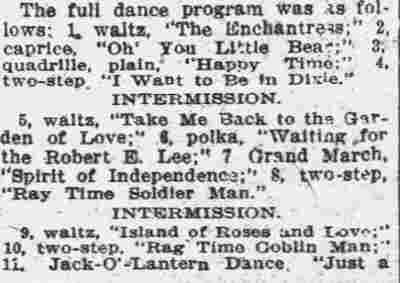
The full dance program was as follows: 1, waltz, “The Enchantress;” 2, caprice, “Oh! You Little Bear;” 3, quadrille, plain, “Happy Time;” 4, two-step, “I Want to Be in Dixie.”
INTERMISSION.
5, waltz, “Take Me Back to the Garden of Love;” 6, polka, “Waiting for the Robert E. Lee;” 7 Grand March, “Spirit of Independence;” 8, two-step, “Ray Time Soldier Man.”
INTERMISSION.
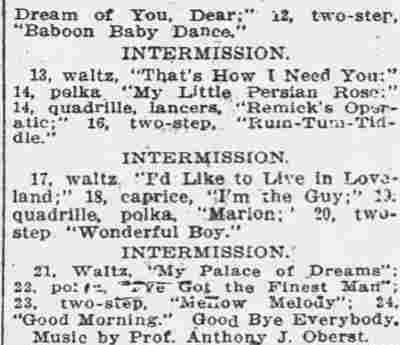
9, waltz, “Island of Roses and Love;” 10, two-step, “Rag Time Goblin Man;” 11, Jack-O’-Lantern Dance, “Just a Dream of You, Dear;” 12, two-step, “Baboon Baby Dance.”
INTERMISSION.
13, waltz, “That’s How I Need You;” 14, polka, “My Little Persian Rose;” 14 [sic], quadrille, lancers, “Remick’s Operatic;” 16, two-step, “Rum-Tum-Tiddle.”
INTERMISSION.
17, waltz, “I’d Like to Live in Loveland;” 18, caprice, “I’m the Guy;” 19, quadrille, polka, “Marion;” 20, two-step, “Wonderful Boy.”
INTERMISSION.
21, Waltz, “My Palace of Dreams;” 22, polka, “I’ve Got the Finest Man;” 23, two-step, “Mellow Melody;” 24, “Good Morning.” Good Bye Everybody. Music by Prof. Anthony J. Oberst.
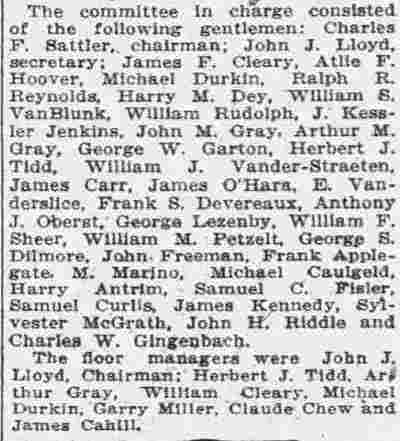
The committee in charge consisted of the following gentlemen: Charles F. Sattler, chairman; John J. Lloyd, secretary; James F. Cleary, Atlie F. Hoover, Michael Durkin, Ralph R. Reynolds, Harry M. Dey, William S. VanBlunk, William Rudolph, J. Kessler Jenkins, John M. Gray, Arthur M. Gray, George W. Garton, Herbert J. Tidd, William J. Vander-Straeten, James Carr, James O’Hara, E. Vanderslice, Frank S. Devereaux, Anthony J. Oberst, George Lezenby, William F. Sheer, William M. Petzelt, George S. Dilmore, John Freeman, Frank Applegate, M. Marino, Michael Caulgeld, Harry Antrim, Samuel C. Fisler, Samuel Curlis, James Kennedy, Sylvester McGrath, John H. Riddle and Charles W. Gingenbach.
The floor managers were John J. Lloyd, Chairman; Herbert J. Tidd, Arthur Gray, William Cleary, Michael Durkin, Garry Miller, Claude Chew and James Cahill.