Frank F. Schwartz
Heroes of Camden, New Jersey
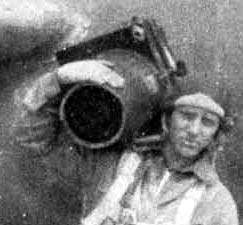
S/Sgt. Frank F. Schwartz — aerial photographer, 353rd Bomb Squadron, 301st Bomb Group.
S/Sgt. Frank F. Schwartz — Aerial Photographer, 301st Bomb Group
Camden Record

by Elaine J. Barton, Camden Record Staff
World War II veteran Frank Schwartz not only vividly recalls the bombs bursting in air over Europe, he photographed them from almost 24,000 feet in the sky through the open door of a B-17 bomber.
It was a daunting task for the young U.S. Army Air Corpsman just barely in his 20s.
But Schwartz, a native of California who transplanted with his family to the east coast as a child, was a “man with a mission,” or more accurately, a man with 50 missions under his belt before he returned from overseas after a 10 month stint as an aerial photographer in 1944.
At age 78½, Schwartz, a resident of Heritage Village in Mount Laurel, remembers his enthusiasm when he decided to join the Army.
“I was 18 1/2 in the fall of 1942, the war was well underway and I wanted to serve my country,” said Schwartz.
“I was interested in flying and I knew I didn’t want to get drafted into the infantry so I enlisted in the Army Air Corps.”
He spent more than a year completing basic training, studying armaments and attending gunnery school before being assigned to a 10-man crew on the B-17, “the best plane we had at the time.”
There was more training, then the crew picked up a brand new plane in Savannah, Georgia, and headed for an air base in Foggia, Italy, a trip which involved six stops and should have taken only a few days but ended up being a three week haul because of mechanical problems.
Once in place, the crew, with Schwartz as a gunner, began flying missions over Germany, Romania, Yugoslavia, Italy, France and Hungary.
“We were like a family. We trained together, lived, ate and played together,” he said.
On the crew’s 11th mission, Schwartz got “bumped off the flight,” replaced by a radio operator. The B-17 was shot down, his buddies all killed.
He was a man with no crew, just “floating around the base and waiting to put in 25-30 missions so I could go home,” he said.
Then a second bombing sortie went out involving a number of planes, all carrying serial lensman. The higher-ups could assess the damage and the precision of the mission.
Schwartz stepped up and volunteered to become a replacement for the lost cameramen. With only three hours of training in the specialty, he was sent aloft to do the job carrying large pieces of equipment with 12- and 20-inch lens.
Schwartz had another close brush with death on his 25th mission. A large piece of equipment in a B-17 in which he was flying got hung up in the bay and failed to release as the plane flew over Poleste Oil Fields in Romania.
When no one could figure out the problem, Schwartz drew upon his training in armaments, wearing a portable oxygen tank, he navigated a narrow catwalk and released the device only moments before it might have blown up the aircraft.
For his efforts, he was promised a military commendation, an honor he has yet to receive.
He did his 50 missions in seven months and has the photos to prove it. Many of his WW II works are displayed in the sunroom of the home he shares with his wife of 51 years, Beatrice.
He recently had his pictures on exhibit at the Mount Laurel Library and has shown them at the Camden County Library.
In late 1944, he returned home and served as an Army photographic instructor for a year. But his war experiences took their toll.
“I was young. I thought I could take anything, but I saw too much. Since I returned, I’ve never flown again. … I had good luck going through what I did. I’m not going to tempt fate,” said Schwartz.
Schwartz steadfastly remains committed to the military and believes “it should be built to the fullest and its members should have the backing of the citizens.”
Schwartz is active in veteran’s groups, helping those in VA hospitals and participating in veteran’s events, including the dedication of the World II monument at Shawnee High School on Dec. 7, 1999.
How He Came to Camden
After the war, Frank Schwartz came to Camden, New Jersey, to work and make his way in the world. By chance one day, he stopped at the shoe repair shop of Jacob Leon, at 1006 North 27th Street in Camden’s Cramer Hill section.
…Our dad came into our grandpop’s shop to get his shoes shined. The reason? He was going on a date! My grandfather refused to shine his shoes for ‘the other woman’ until my dad would take my mom’s phone number. My dad initially refused, but finally took the phone number just to get this man off his back. Sometime later, my dad’s girlfriend went out of town for the weekend, and rogue that he was (back then), he thought ‘what the heck’ and gave our mom a call. The rest is history!
— Tobi Schwartz-Cassel, April 2004
Frank Schwartz married Beatrice Leon. The couple lived for many years at 312 Morse Street in East Camden, and raised two daughters, Molly and Tobi, before moving to Cherry Hill in the 1960s.
Photos
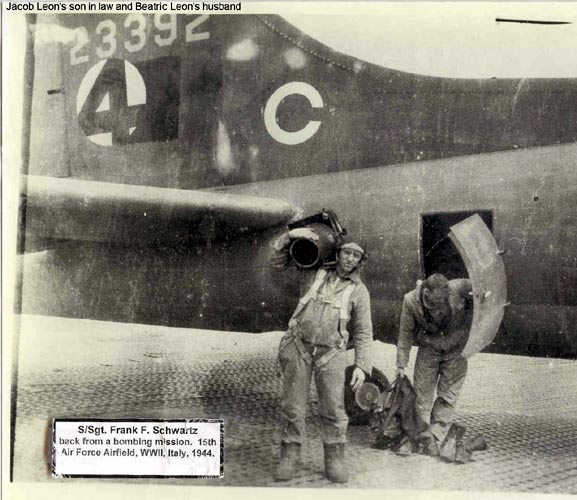
S/Sgt. Frank F. Schwartz back from a bombing mission. 15th Air Force Airfield, WWII, Italy, 1944. He is standing beside B-17F serial #42-3392 of the 353rd Bomb Squadron, 301st Bomb Group. Built by Douglas at Long Beach, California, this plane survived the war, was returned to the United States, and was scrapped.
The monument at Shawnee High School reads: “When you get home / Tell them of us and say / For your tomorrow / We gave our today.”
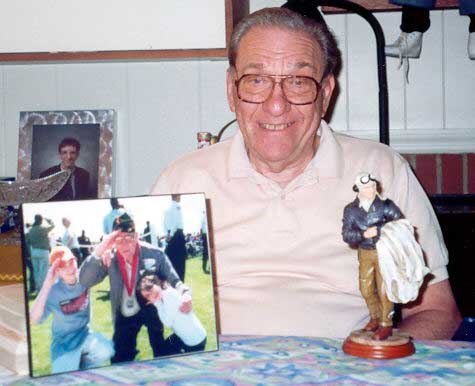
Frank Schwartz in later life, with his wartime photographs on display.