Introduction
CHARLES SWOPE was appointed to the Camden Fire Department on April 8, 1876 as an extra man, taking the place of Isaac Randolph with Engine Company 2. Charles Swope worked as a laborer prior to his appointment to the Fire Department. Charles Swope served for one year. He was replaced in April of 1877 by John Holland.
Charles Swope was born in New Jersey around 1851 to John and Catherine Swope. His parents appear in the Census of 1850 in Camden’s South Ward, with older siblings Henry W., George W., and Caroline. The family name of Swope appears to be an “Americanization” of the German Schwaab. There was at least one and possibly two families in Camden of whose family members adopted the last name Swope during the 1800s. As to where the family lived and what they were doing, the Census of 1860 is inconclusive, however it does appears that John Swope had passed.
When the Census was taken in 1870 the Swope family was living in Camden’s North Ward. Charles Swope was living with his widowed mother and his siblings. His older brother Henry was working as a locksmith, and older brother George W. Swope was working as a butcher. Sister Caroline, as yet unmarried, lived with them. Charles Swope had begun working as a stone cutter. Later Censuses indicate that Charles Swope had married in the late 1860s, and that there was a son, Charles Jr., born prior to the Census. Young Charles appears to have been raised by his mother’s family, the Sweeneys.
As stated above, Charles Swope was appointed to the Camden Fire Department as an extra man on April 8, 1876. By this time he was living at 319 Arch Street, where he would maintain a presence into the early 1920s. The 1880 Census shows him living with his widowed mother and his sister Caroline, also a widow, at 319 Arch Street.
The 1887 City Directory shows that Charles Swope had gone into partnership in a marble works known as Swope & Carter, at 33 North 4th Street. By 1898 he was in business for himself at 1027 Market Street.
The 1900 Census shows Charles Swope living alone at 319 Arch Street. Living next door at 321 was the William Swope family. William Swope was a butcher, and news articles of the day indicate that Charles Swope had an interest in the butcher shop.
The 1910 Census shows that Charles Swope and his son had reunited. Charles Sr. and Charles Jr. were living together at 319 Arch Street with Charles Jr.’s wife Anna and their children, Miriam and Maurice Swope. Charles Swope Jr. worked as a painter.
Sadly, Charles Jr. was killed in 1916 when he fell from a scaffold. The 1920 Census shows Charles Swope Sr., his daughter-in-law and grandchildren at 319 Arch Street. Charles Swope Sr. passed on March 16, 1923 at the age of 71. His daughter-in-law, Anna Swope was still at 319 Arch Street when the 1929 City Directory was compiled, and members of William Swope’s family were still living at 321 Arch Street into the 1930s.
In 1949, history tragically repeated itself when Charles Swope’s grandson, Maurice Swope, was killed after falling off a roof.
Fatal Curiosity
Philadelphia Inquirer —
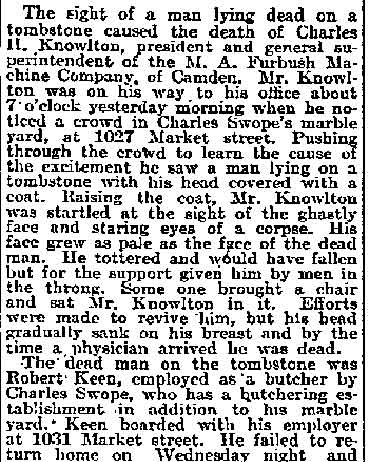
The sight of a man lying dead on a tombstone caused the death of Charles H. Knowlton, president and general superintendent of the M. A. Furbush Machine Company, of Camden. Mr. Knowlton was on his way to his office about 7 o’clock yesterday morning when he noticed a crowd in Charles Swope’s marble yard, at 1027 Market street. Pushing through the crowd to learn the cause of the excitement he saw a man lying on a tombstone with his head covered with a coat. Raising the coat, Mr. Knowlton was startled at the sight of the ghastly face and staring eyes of a corpse. His face grew as pale as the face of the dead man. He tottered and would have fallen but for the support given him by men in the throng. Some one brought a chair and sat Mr. Knowlton in it. Efforts were made to revive him, but his head gradually sank on his breast and by the time a physician arrived he was dead.
The dead man on the tombstone was Robert Keen, employed as a butcher by Charles Swope, who has a butchering establishment in addition to his marble yard. Keen boarded with his employer at 1031 Market street. He failed to return home on Wednesday night and Swope started in search of him early yesterday morning. He discovered Keen lying dead in the marble yard with his head on a tombstone.
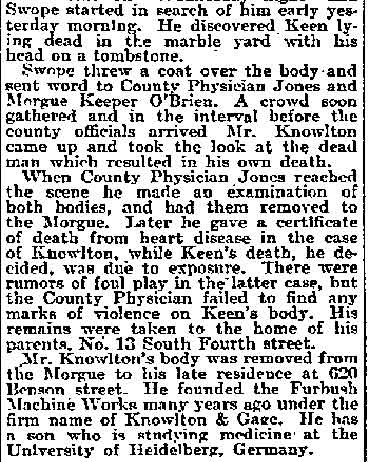
Swope threw a coat over the body and sent word to County Physician Jones and Morgue Keeper O’Brien. A crowd soon gathered and in the interval before the county officials arrived Mr. Knowlton came up and took the look at the dead man which resulted in his own death.
When County Physician Jones reached the scene he made an examination of both bodies, and had them removed to the Morgue. Later he gave a certificate of death from heart disease in the case of Knowlton, while Keen’s death, he decided, was due to exposure. There were rumors of foul play in the latter case, but the County Physician failed to find any marks of violence on Keen’s body. His remains were taken to the home of his parents, No. 13 South Fourth street.
Mr. Knowlton’s body was removed from the Morgue to his late residence at 620 Benson street. He founded the Furbush Machine Works many years ago under the firm name of Knowlton & Garc. He has a son who is studying medicine at the University of Heidelberg, Germany.
Broke Leg on a Piano
Philadelphia Inquirer —
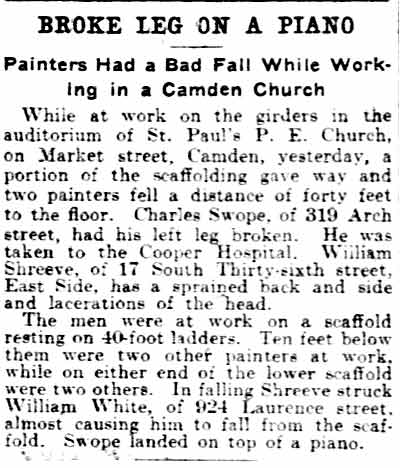
While at work on the girders in the auditorium of St. Paul’s P. E. Church, on Market street, Camden, yesterday, a portion of the scaffolding gave way and two painters fell a distance of forty feet to the floor. Charles Swope, of 319 Arch street, had his left leg broken. He was taken to the Cooper Hospital. William Shreeve, of 17 South Thirty-sixth street, East Side, has a sprained back and side and lacerations of the head.
The men were at work on a scaffold resting on 40-foot ladders. Ten feet below them were two other painters at work, while on either end of the lower scaffold were two others. In falling Shreeve struck William White, of 924 Laurence street, almost causing him to fall from the scaffold. Swope landed on top of a piano.
Fall From Scaffold Kills Camden Painter
Philadelphia Inquirer —
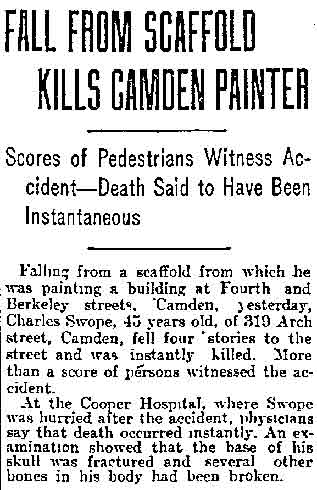
Falling from a scaffold from which he was painting a building at Fourth and Berkeley streets, Camden, yesterday, Charles Swope, 45 years old, of 319 Arch street, Camden, fell four stories to the street and was instantly killed. More than a score of persons witnessed the accident.
At the Cooper Hospital, where Swope was hurried after the accident, physicians say that death occurred instantly. An examination showed that the base of his skull was fractured and several other bones in his body had been broken.