Introduction
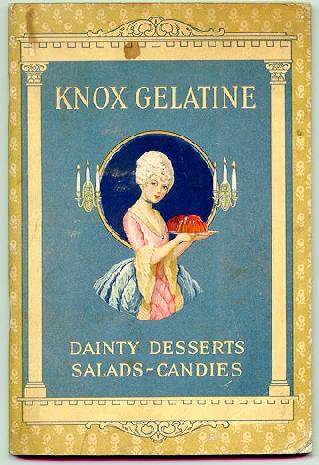
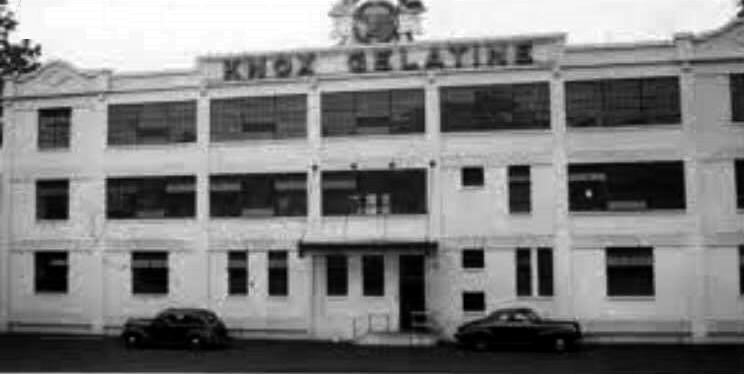
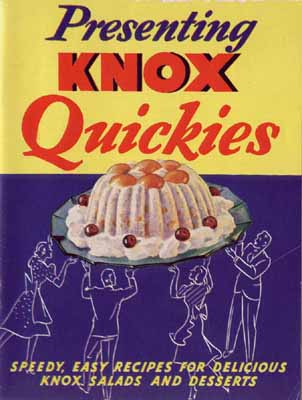
Knox Gelatin, North Camden — Knox Gelatine Cookbook, circa 1955
The Knox Gelatin Co., which specialized in the production of gelatin used in the food, photographic and pharmaceutical industries, started at 4th and Erie streets in Camden in the early 20th century and was originally known as the Landesman Co. The firm was later acquired by Maurice Kind, a German-born brewer who came to America in 1898. Maurice Kind bought into the business, which operated as the Camden Gelatin Company. Kind's son, chemist Paul Adolf Kind, became involved in the business after completing his education. Maurice Kind died in 1915, a few years after a major fire at the gelatin factory in 1912.
The fire occurred during the early morning hours of January 30th. The blaze began on the first floor of a factory building at the Camden Gelatin Company at Fifth Street and the Delaware River, North Camden. Box 14 at Fifth and Erie Streets was pulled, also accompanied by a phone alarm. Flames lit up the night sky as second and third alarms were transmitted in rapid succession. Frozen hydrants seriously hampered arriving engine companies and firemen built bon fires under the hydrants to thaw them while other hydrants were sought. At least a dozen master streams surrounded the fire. Collapsing walls produced severe flying embers that started a blaze in the machine shop at the Camden Ship Yard and a third fire in the Troth Warehouse. Fireman Edward Finley of Hook & Ladder Company 1 was overcome by heavy smoke and removed from the scene unconscious. He was transported to West Jersey Homeopathic Hospital where he was revived. By 2 A.M., fire fighters had the fire under control. The gelatin plant owned by Kind and Landesman consisted of an office building and two, two-and-one-half-story factory buildings, all destroyed in the fire. Engine Company 4 remained at the scene until the afternoon, wetting down the smoldering ruins.
Charles Knox bought into the business in 1916, and the firm was then known as Kind & Knox. Kind & Knox became a wholly owned subsidiary of Knox Gelatin in 1955; Knox itself, based in Johnstown, N.Y., was sold to the Lipton Tea Co. in May 1972, which in turn sold it to a German-owned company in 1992.
In its day, Knox Gelatine was as much a presence in American kitchens, and in the culinary repertoire of American housewives, as Campbell’s Soup is today.
The Camden plant was a major employer for many years in North Camden. City government and a local community group, the North Camden Land Trust, both have explored ways to redevelop the site, which lies just west of Pyne Point Park. As of the fall of 2003, action on this project has not commenced.
Camden Memories of Knox Gelatine
I am acquainted with a 93 year-old lady who as a young bride moved to Byron Street between 3rd and 4th Streets. She tells me that about 1935 or 1936 the Knox Gel plant was built between 4th and 5th Streets. Everybody that came from that neighborhood called it Knox Gel. To this day I will not eat Jello. I was born right around the corner on Bailey Street. Every few weeks on wash day Knox would have a problem with their combustion controls on their boilers and of course in the 40s and 50s everyone hung wash on the line in the backyard. A lot of otherwise prime and very proper house wives had some very nasty things to say about Knox.
John Cianfrani, November 2003
Camden Memories of Knox Gelatine
Thank you for the articles on your web site regarding K&K Gel. When I read the article, memories of my late father and his friends came streaming back. My dad (Charlie Jones) worked his entire life at the plant at 1000 North 5th Street. He started when he was 14 years old in 1942 and worked until the second closing by Peter Cooper Corporation in 1981. He knew and worked for Mr. Downey and his son Thomas III.
A few of my other family members worked there — an uncle, a brother-in-law and yes, I landed my first real job there in 1977 (Peter Cooper Corporation) cleaning acid extracted bone out of large battery tanks. I grew up knowing many of the men my father worked with in the Knox days — what wonderful memories. Thank you again for the K&K info on your site.
Chuck Jones, January 2010
Aerial View

Aerial view of the Knox Gelatine Factory Site, North Camden
Kind & Knox Gelatine, Inc.
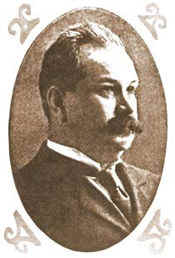
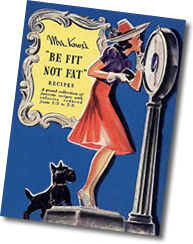
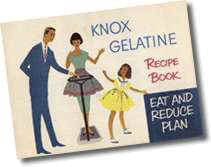
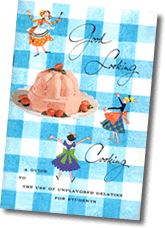
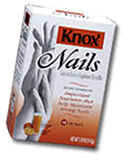
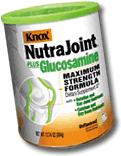
Knox Gelatine — Charles Knox, products, and promotional materials
Kind & Knox Gelatine Inc.’s roots as a quality gelatine manufacturer stem from the foundation built a century ago by two North American gelatine pioneers — Charles Knox and Maurice Kind.
Charles Knox founded the Knox Gelatine Company in 1890 in Johnstown, New York. His ambition — to find an easier way to make gelatine. During this era, people spent hours making gelatine from soup bones. Knox delivered by introducing granulated gelatine convenient for easy mixing.
In addition to his affinity for satisfying his customers’ needs, Knox quickly became known for revolutionary marketing techniques. From brash slogans to innovative advertising (he was the first to use airborne advertising), his unorthodox ways earned him the title of the Napoleon of Advertising and a successful business. When he died in 1908, his wife Rose assumed leadership of the largest manufacturer of unflavored gelatine in the world – a very unusual role for a woman in this era. Rose quickly earned the respect of her employees and male counterparts. She also developed a large and loyal following among women nation-wide.
Meanwhile, in nearby New Jersey, Maurice Kind had also built a successful gelatine business. Kind had grown up learning to make gelatine in the family business in Czechoslovakia. Maurice Kind and Rose Knox met at a Grocers Association meeting and the two soon became friends. When Maurice died in 1910, his son Paul assumed leadership of the business and continued the personal friendship with Rose Knox. The friendship blossomed into a business relationship when Knox purchased part interest in the Kind Gelatine plant in 1916. This association proved a savvy move for both families as Knox needed quality gelatine for their product line and Kind needed the marketing expertise the Knox family could supply. The successful relationship between the Kind & Knox families continued until Mrs. Knox’s death in 1950 and Paul Kind’s death in 1954.
At this time, the family members assumed management of the operation. Ten years later, the Kind family sold their interests to the Knox family. With the sale came the stipulation that the Kind name continue to be part of the company identification — as it continues today.
Different uses for gelatine flourished in the 50’s and 60’s and growing demand created a need to increase gelatine production. A new manufacturing facility in Sioux City, Iowa began operations in late 1966.
Six years later, the T.J. Lipton Company purchased the Kind & Knox business and invested in the addition of a new bone gelatine processing plant to respond to surging gelatine demand in the pharmaceutical and photographic industries. The business continued growing in Sioux City. Kind & Knox added a Research and Development department in 1983, enhanced Processing in 1988, and developed a waste recovery operation in 1991.
The following year, DGF Stoess AG, a global gelatine manufacturing company with multinational holdings and more than 100 years of gelatine expertise, purchased Kind & Knox Gelatine. In 1993, Kind & Knox expanded the Quality Control Labs and corporate offices. While Kind & Knox enjoyed a reputation for producing quality gelatine, this quality commitment was affirmed by becoming the first United States gelatine manufacturer to achieve ISO 9001 certification — an International benchmark for quality.
The Birth of an American Brand
In 1890, Charles Knox developed the world’s first pre-granulated gelatine. He had watched his wife go through the long and difficult process of making gelatine and resolved to find an easier method. He experimented until he found a process that resulted in a product that was superior to any on the market. As his granulated gelatine steadily gained popularity with homemakers, it began to revolutionize gel cookery.
The Napoleon of Advertising
During the William Jennings Bryan – William McKinley presidential campaign of 1900, Charles Knox got permission from the Commissioner of Highways to hang fifteen political banners over the streets of New York with the words “Hopes to Win” under each candidate, and across the top: “Knox’s Gelatine Always Wins.” City officials were irate, but Knox had the permit to hang the banners and declined to remove them. The story, of course, made every newspaper in the state and led to Charles Knox becoming known as “the Napoleon of Advertising.”
In 1906, Charles Knox made the news once again, this time with “New Celestial Yacht,” an airship he named “Gelatine,” one of the very first motorized balloons. Knox appeared in air shows from coast to coast, making headlines and breaking records.
In addition to an already famous string of race horses, Knox purchased Anaconda, “The World’s Fastest Race Horse.” He renamed the horse Gelatine King and raced it against many of the prize-winning horses of the day. In 1904, Knox offered the horse as a prize in a contest for grocers.
Mrs. Knox Takes Over the Reins
By the time of his death in 1908, Charles Knox was the leading manufacturer of unflavored gelatine in the world. Although his wife Rose was not as flamboyant as her husband, she had always been an important part of the success of Knox Gelatine. In fact, it was her delicious recipes which had been used to promote Knox Gelatine, and which had introduced home economic teachers everywhere to the benefits of granulated gelatine.
When Charles Knox died at age 58, he left his wife to run the largest gelatine manufacturing company in the United States. So, at the age of 50, Mrs. Knox became head of an important business, at a time when few women were even in business at all. Assuming responsibility for Knox Gelatine, she reevaluated her husband’s business methods and elaborate advertising stunts. Gelatine, she reasoned, was bought and used by women; and women were more interested in foods that were economical, nutritious, and easy to prepare. She set up an experimental laboratory and developed hundreds of recipes which were printed on Knox packages, on leaflets, and in illustrated cookbooks. They also appeared in newspapers and magazines under the heading “Mrs. Knox says…”
One of the Six Greatest American Women
Mrs. Knox operated the company for more than 40 years. Under her able direction, the company expanded enormously. She became America’s foremost woman industrialist and the first woman to be elected director of the American Grocery Manufacturers Association.
In September of 1922, the Pictorial Review ran a guessing game describing the six greatest women in America. This was one of the descriptions: “American women actually lead the procession when it comes to women of striking business ability. There are many of them. But one stands out as unquestionably entitled to be called great. There is scarcely a housekeeper anywhere who is not familiar with the name of the business she conducts, who does not use the product she makes. When we use these products and enjoy them do we know that the genius of an American woman is responsible for them?” The answer, of course, was Rose Knox.
End of an Era
Mrs. Knox died in 1950 at the age of 93. Her dedication to the company was evidenced by the fact that she was still serving as Chairman of the Board of Directors at the time of her death. The Knox founders, Charles and Rose Knox, left behind a rich legacy. They were benefactors of the local high school, churches, YMCA, Johnson Hall state historic site, and other community causes, including the establishment of a home for elderly women.
James Knox Takes The Helm
Rose Knox was succeeded by her son, James E. Knox. James had been active in the company since 1913, when as a 20 year old he began to familiarize himself with every aspect of the business. In the course of a year and a half, he “worked every machine in the place.” More importantly, he got to know personally all the employees and their families.
James Knox believed that the business could be no stronger or better than people’s opinion of it. Throughout his career, he often traveled to stores and conventions, making it a point to keep in contact with grocers. James became legendary for his dedication to the business, spending about five months of the year on the road. Given his diligence, the company continued to perform well. Even during the Depression, the company grew at a rate of about five percent a year — no easy feat for those days!
Heritage of Innovation
Under James Knox’s direction, the company also continued its heritage of innovation. By the late 1920s, Knox had produced the first pharmaceutical gelatine, used mainly to encapsulate vitamins and medication. These were the first “gel caps.” It was also about this time that James Knox was responsible for the development of a “plasma extender” at the Knox Laboratories. This intravenous solution was used as a blood plasma substitute during World War II, and saved many lives.
John Knox, Grandson of Founder, Takes Over
When James Knox died in 1958, his son became president of the company. Carrying on the family tradition, John Knox continued to provide consumers with recipes and information about Knox products, but he also developed new ones that focused on diet and nail care. The Knox Eat and Reduce Plan and Knox Drink for Nails proved to be popular with the growing number of health conscious consumers.
John Knox also maintained his company’s high standards of quality. And through the years, beginning way back in 1890, quality gelatine has always been synonymous with Knox.
The Knox Healthy Tradition Continues Today
More than one hundred years since the brand was first introduced, Knox Unflavored Gelatine is as timely as ever. As a low-calorie, pure-protein food, it fits perfectly into modern lifestyles as an essential ingredient for light, healthful cooking.
KNOX is a registered trademark of NBTY, Inc., used by Kraft Foods under license.
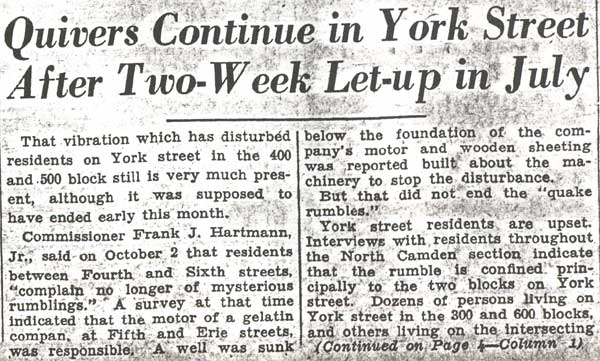
Quivers Continue in York Street After Two-Week Let-up in July
Camden Courier-Post —
QUIVERS CONTINUE IN YORK STREET AFTER TWO-WEEK LET-UP IN JULY
That vibration which has disturbed residents on York street in the 400 and 500 block still is very much present, although it was supposed to have ended early this month.
Commissioner Frank J. Hartmann, Jr., said on October 2 that residents between Fourth and Sixth streets, “complain no longer of mysterious rumblings.” A survey at that time indicated that the motor of a gelatin company, at Fifth and Erie streets, was responsible. A well was sunk below the foundation of the company’s motor and wooden sheeting was reported built about the machinery to stop the disturbance.
But that did not end the “quake rumbles.”
York street residents are upset. Interviews with residents throughout the North Camden section indicate that the rumble is confined principally to the two blocks on York street. Dozens of persons living on York street in the 300 and 600 blocks, and others living on the intersecting streets of Fourth, Fifth and Sixth said they had not felt the vibration.
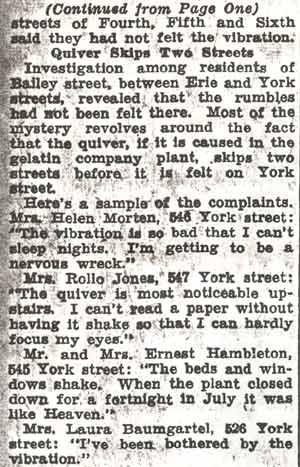
Quiver Skips Two Streets
Investigation among residents of Bailey street, between Erie and York streets, revealed that the rumbles had not been felt there. Most of the mystery revolves around the fact that the quiver, if it is caused in the gelatin company plant, skips two streets before it is felt on York street.
Here’s a sample of the complaints. Mrs. Helen Morten, 545 York street: “The vibration is so bad that I can’t sleep nights. I’m getting to be a nervous wreck.”
Mrs. Rollo Jones, 547 York street: “The quiver is most noticeable upstairs. I can’t read a paper without having it shake so that I can hardly focus my eyes.”
Mr. and Mrs. Ernest Hambleton, 545 York street: “The beds and windows shake. When the plant closed down for a fortnight in July it was like Heaven.”
Mrs. Laura Baumgartel, 526 York street: “I’ve been bothered by the vibration.”
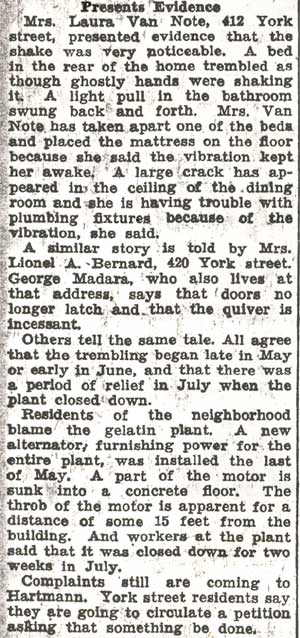
Presents Evidence
Mrs. Laura Van Note, 412 York street, presented evidence that the shake was very noticeable. A bed in the rear of the home trembled as though ghostly hands were shaking it. A light pull in the bathroom swung back and forth. Mrs. Van Note has taken apart one of the beds and placed the mattress on the floor because she said the vibration kept her awake. A large crack has appeared in the ceiling of the dining room and she is having trouble with plumbing fixtures because of the vibration, she said.
A similar story is told by Mrs. Lionel A. Bernard, 420 York street. George Madara, who also lives at that address, says that doors no longer latch and that the quiver is incessant.
Others tell the same tale. All agree that the trembling began late in May or early in June, and that there was a period of relief in July when the plant closed down.
Residents of the neighborhood blame the gelatin plant. A new alternator, furnishing power for the entire plant, was installed the last of May. A part of the motor is sunk into a concrete floor. The throb of the motor is apparent for a distance of some 15 feet from the building. And workers at the plant said that it was closed down for two weeks in July.
Complaints still are coming to Hartmann. York street residents say they are going to circulate a petition asking that something be done.
Workman Injured Seriously in Cave in at Camden Plant
Camden Evening Courier —
One workman was trapped and seriously injured, while two others scrambled to safety when a seven-foot pipeline trench collapsed Thursday in the yard of the Kind & Knox Gelatin Co., Fifth and Erie Streets.
Lewis Edwards, 45, of 934 North 2nd Street, was buried up to his armpits in tons of earth when the cave in occurred at 3:00 PM. Doctors at Cooper Hospital said he suffered several cracked ribs, shock, and possible internal injuries.
The Fire Department Rescue Squad from Fifth and Arch aided company employees in digging Edwards out after more than ten minutes of partial entombment.
Dr. Thomas B. Downey, vice president of the company, said the accident occurred while a new pipeline in the plant was being laid on the Fifth Street side.
“The side walls undoubtedly were caused to collapse by vibrations set up by several heavy trucks which were using the street at the time,” Dr. Downey said.
The two other workmen in the trench with Edwards were not immediately identified, but both scrambled to safety before the crumbling earth caught them.
New Firm Opens City Knox Plant
Camden Courier-Post —
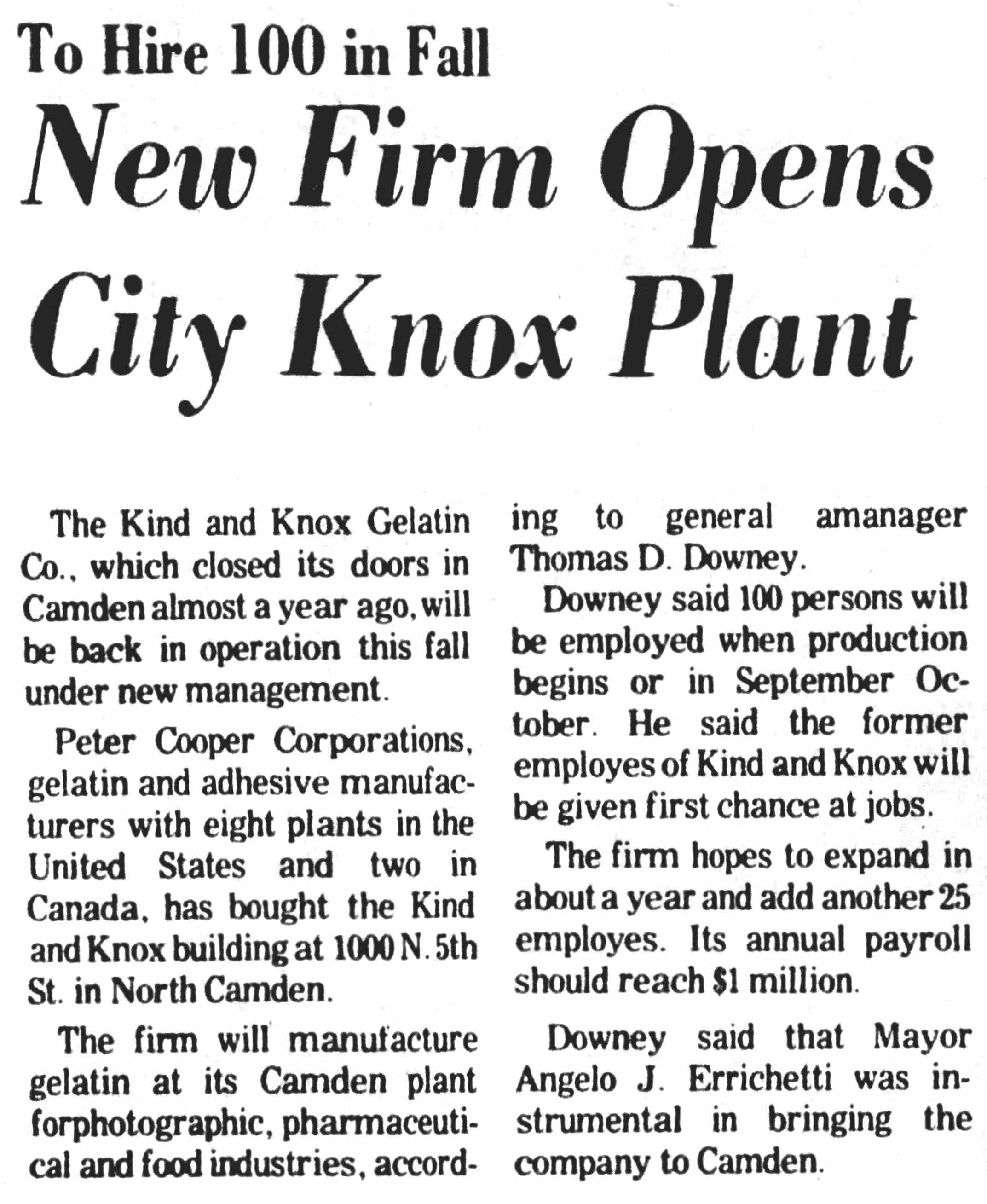
TO HIRE 100 IN FALL
The Kind and Knox Gelatin Co., which closed its doors in Camden almost a year ago, will be back in operation this fall under new management.
Peter Cooper Corporations, gelatin and adhesive manufacturers with eight plants in the United States and two in Canada, has bought the Kind and Knox building at 1000 N. 5th St. in North Camden.
The firm will manufacture gelatin at its Camden plant for photographic, pharmaceutical and food industries, according to general amanager [sic] Thomas D. Downey.
Downey said 100 persons will be employed when production begins or in September October. He said the former employes of Kind and Knox will be given first chance at jobs.
The firm hopes to expand in about a year and add another 25 employes. Its annual payroll should reach $1 million.
Downey said that Mayor Angelo J. Errichetti was instrumental in bringing the company to Camden.