Baseball 1929: When Father Was a Boy
Camden was a baseball town as early as the 1860s… and probably before that, although the game as it was played in those times was quite a bit different than played today. That there were very good players in the city even then is beyond dispute, for the very first run scored in a major league baseball game was scored by Camden’s Wes Fisler, the first baseman of the Philadelphia team in the old National Association. A number of other Camden men who got their start playing in the 1880s went on to the majors including Charles Alcott and Kid Gleason, and more would follow in the decades that followed. To say that Camden had a thriving semi-pro baseball scene into the 1940s would be an understatement of large proportions. After World War II the baseball scene in Camden ebbed, for a number of reasons, a few of which included the post World War II draft that took young men out of the city, the economic collapse that took potential team sponsors out of the city, and television… no longer did one have to go TO the game to witness the game. The Golden Age of Baseball in Camden came to an end… but believe you me, when it was good, it was VERY, VERY good.
In 1929 the Camden Courier-Post newspapers ran a series of articles on teams of the 1900s.
Old Camden Police Team Had Loads of Fun in 1907
Camden Courier-Post —
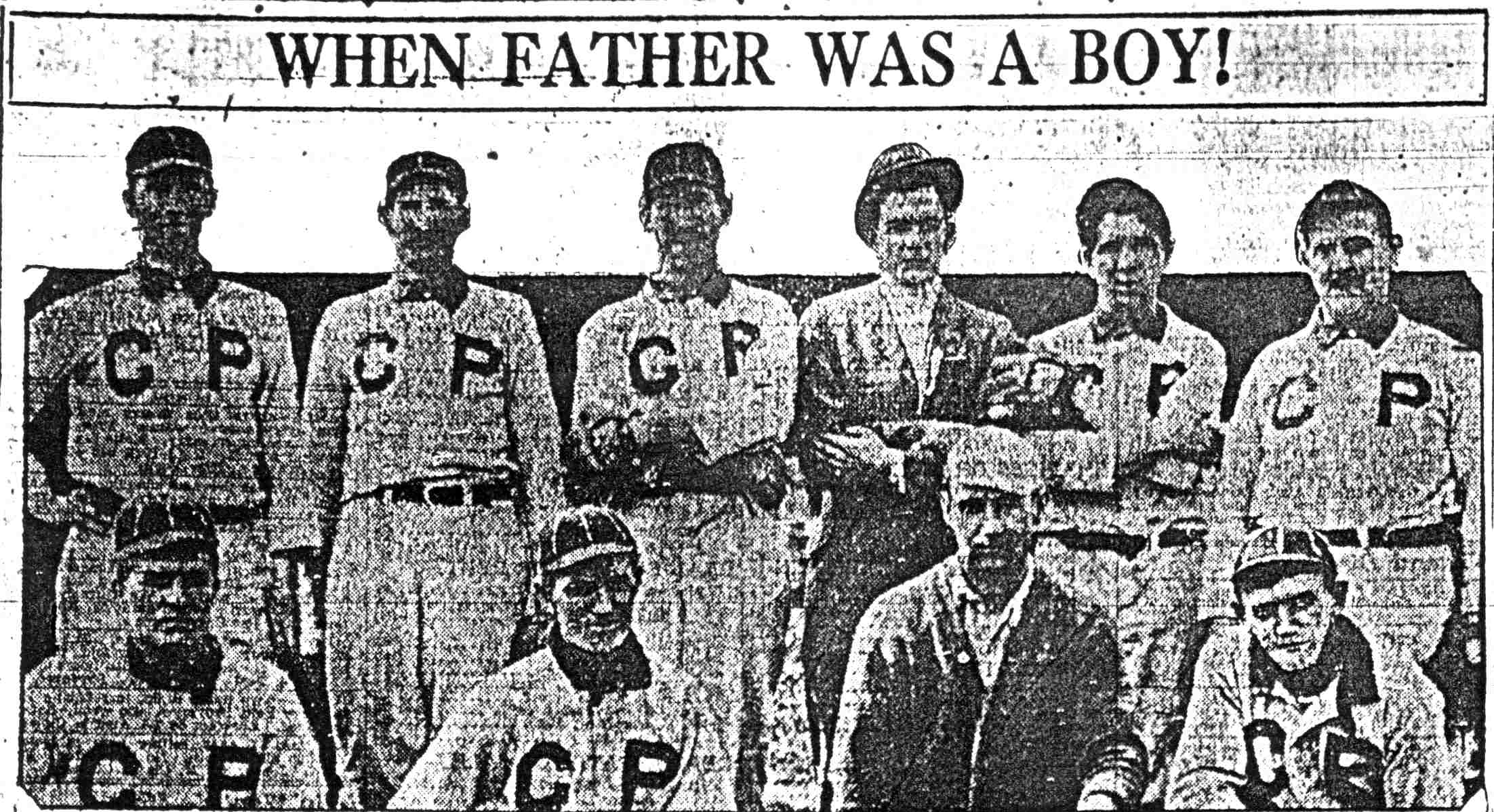

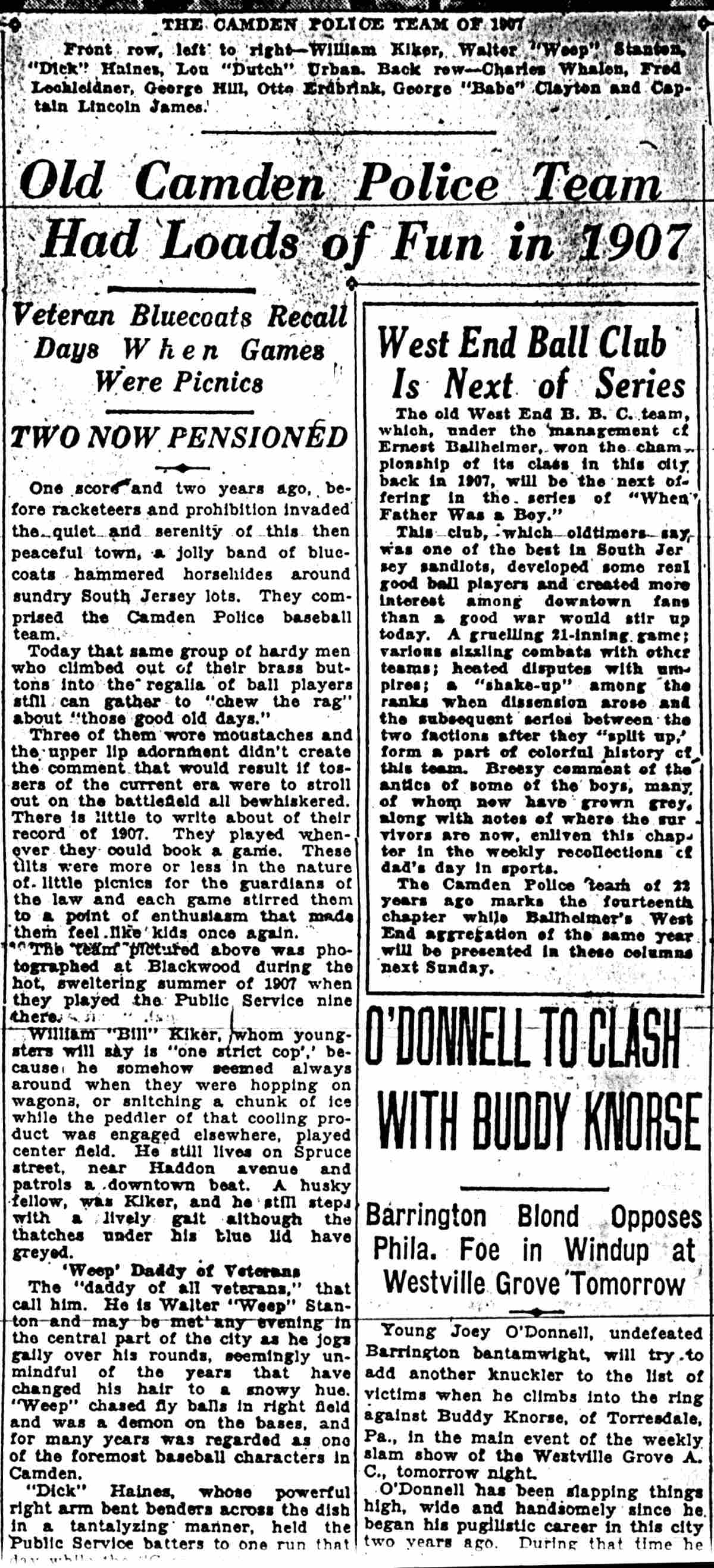
THE CAMDEN POLICE TEAM OF 1907. Front row, left to right—William Kiker, Walter “Weep” Stanton, “Dick” Haines, Lou “Dutch” Urban. Back row—Charles Whalen, Fred Lechleidner, George Hill, Otto Erdbrink, George “Babe” Clayton and Captain Lincoln James.
Veteran Bluecoats Recall Days When Games Were Picnics
TWO NOW PENSIONED
One score and two years ago, before racketeers and prohibition invaded the quiet and serenity of this then peaceful town, a jolly band of bluecoats hammered horsehides around sundry South Jersey lots. They comprised the Camden Police baseball team.
Today that same group of hardy men who climbed out of their brass buttons into the regalia of ball players still can gather to “chew the rag” about “those good old days.”
Three of them wore moustaches and the upper lip adornment didn’t create the comment that would result if tossers of the current era were to stroll out on the battlefield all bewhiskered. There is little to write about of their record of 1907. They played whenever they could book a game. These little games were more or less in the nature of little picnics for the guardians of the law and each game stirred them to a point of enthusiasm that made them feel like kids once again.
The team pictured above was photographed at Blackwood during the hot, sweltering summer of 1907 when they played the Public Service nine there.
William “Bill” Kiker, whom youngsters will say is “one strict cop,” because he somehow seemed always around when they were hopping on wagons, or snitching a chunk of ice while the peddler of that cooling product was engaged elsewhere, played center field. He still lives on Spruce street, near Haddon avenue and patrols a downtown beat. A husky fellow was Kiker, and he still steps with a lively gait although the thatches under his blue lid have greyed.
‘Weep’ Daddy of Veterans
The “daddy of all veterans,” that call him. He is Walter “Weep” Stanton and may be met any evening in the central part of the city as he jogs gaily over his rounds, seemingly unmindful of the years that have changed his hair to a snowy hue. “Weep” chased fly balls in right field and for many years was regarded as one of the foremost baseball characters in Camden.
“Dick” Haines, whose powerful right arm bent benders across the dish in a tantalizing manner, held the Public Service batters to one run that day while the “Coppers” tallied seven. Throughout the entire heaving career of this genial, smooth-faced lad his slants escaped the murderous aims of his opposing sluggers. “Dick” had a good whip, knew when to stick his fast one over and only required a fair amount of breaks in the field along with a good backstop to come out on top.
Haines is now a prosperous furrier in Brooklyn, N. Y., and recently paid a visit to Camden, to renew acquaintances here.
‘Babe’ Played All Over
George “Babe” Clayton, whose black curly hair and ever-present smile drew attention from what few fair fans attended the games in those days, was battery mate to Haines. A peppery player who kept up a rapid-fire line of chatter “Babe” held Haines keyed up from start to finish and his snappy wing cut many daring runners off the bags or when they tried to pilfer the sacks.
Clayton undoubtedly played with more teams than any other member of this squad. A consistent hitter, to a degree, he knocked around with nearly all of the leading teams in this city. Then he toiled under the banners of Merchantville, Medford, Vincentown and even down in Salem during the old South Jersey circuit. “Babe” later played with Baltimore of the Union League and had a fling up in Connecticut with an Eastern League outfit.
He’s a bit enlarged around the waist now and it seems that his once jet-black locks are beginning to turn, but the “Babe” is just as jolly and can spin a police motor-bike around in his same lively fashion.
‘Cap’ James Still on the Job
Captain Lincoln James, then a veteran tosser for one of the old Camden clubs, played third base for the coppers, being teamed up in the infield with Charley Whalen, at first, George Hill at second and Lou “Dutch” Urban at the shortfield.
Captain James is still in active charge out at the City Hall while Whalen and Hill both have retired via the pension route. Urban played with a number of teams hereabouts and is a keen follower of the national pastime today. This quartet proved a huge problem for any opposing players and freely handed out headaches to umpires.
Fred Lechleidner, one of the outfielders who sported a moustache, patroled the left side of the pasture. He is that dignified gendarme who occupies the post of sergeant-at-arms in the Camden Police Court where Judge Garfield Pancoast is the umpire-in-chief.
Otto Erdbrink, shown in the above photo, was one of those fellows who liked to travel around with “the boys.” He was a loyal fan, rarely missing a game in which the “cops” were booked to battle.
West End Ball Club Is Next of Series
Camden Courier-Post —
The old West End B. B. C. team, which, under the management of Ernest Ballheimer, won the championship of its class in this city back in 1907, will be the next offering in the series of “When Father Was a Boy.”
This club, which oldtimers say was one of the best in South Jersey sandlots, developed some real good ball players and created more interest among downtown fans than a good war would stir up today. A gruelling 21-inning game; various sizzling combats with other teams; heated disputes with umpires; a “shake-up” among the ranks when dissension arose and the subsequent series between the two factions after they “split up,” form a part of colorful history of this team. Breezy comment of the antics of some of the boys, many of whom now have grown grey, along with notes of where the survivors are now, enliven this chapter in the weekly recollections of dad’s day in sports.
The Camden Police team of 22 years ago marks the fourteenth chapter while Ballheimer’s West End aggregation of the same year will be presented in these columns next Sunday.