The Price of Freedom
It has often been asked, what is the cost of freedom. 10,000 years of recorded history has shown us that freedom is not free. Freedom, like most everything else of any value on this Earth, comes at a cost, and sometimes the cost is the lives of those willing to fight for what they believe in, those willing to serve, those who answer when duty and responsibility call.
Some fall in battle. Others lose their lives while serving their country through accident or disease. Some are wounded, are disabled, and bear the physical scars of service to country and fellow man. Some bear injuries and scars within, scars that cannot be seen.
In the early fall of 1944, three young men took their own lives in South Jersey. Two were American soldiers who had seen combat in the Pacific and had been sent home. The third was a German POW who had escaped from his prison camp, and spent three months on the run, only to turn himself in and return to confinement.
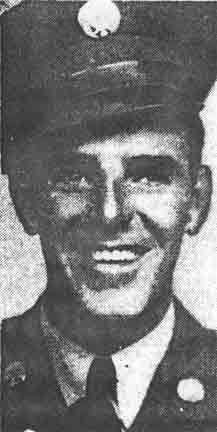
- Private Alexander Slowey, Jr.
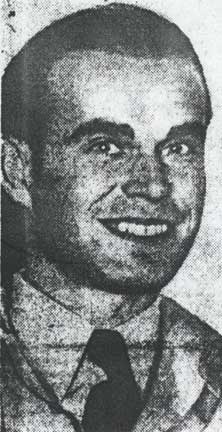
- Hans Bergmann
- Corporal Lee W. Hartshorn
A fourth, a veteran of 22 months duty in the Pacific, had taken his own life as his furlough drew to a close the previous April.
- Technician 4th Class Paul R. Barrager
Below are their stories, as told in the Courier-Post of Camden NJ in September and October of 1944.
Vet Hangs Self; Mother Finds Body in Cellar
Camden Courier-Post
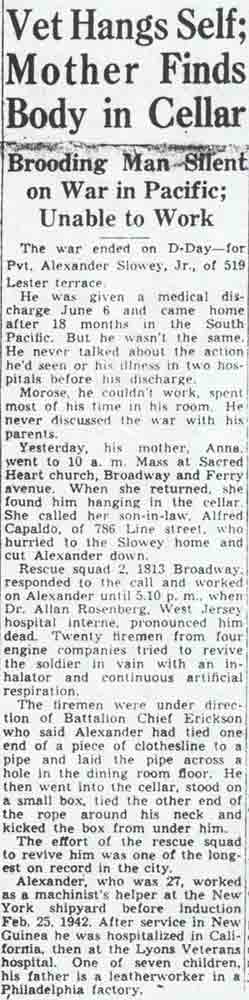
Brooding Man Silent on War in Pacific; Unable to Work
The war ended on D-Day—for Pvt. Alexander Slowey, Jr., of 519 Lester terrace.
He was given a medical discharge June 6 and came home after 18 months in the South Pacific. But he wasn't the same. He never talked about the action he'd seen or his illness in two hospitals before his discharge.
Morose, he couldn't work, spent most of his time in his room. He never discussed the war with his parents.
Yesterday, his mother, Anna, went to 10 a. m. Mass at Sacred Heart church, Broadway and Ferry avenue. When she returned, she found him hanging from the cellar. She called her son-in-law, Alfred Capaldo, of 786 Line street, who rushed to the Slowey home and cut Alexander down.
Rescue squad 2, 1813 Broadway, responded to the call and worked on Alexander until 5.10 p. m., when Dr. Allan Rosenberg, West Jersey hospital interne, pronounced him “dead.” It is believed fire and engine companies tried to revive the soldier in vain with an inhalator and continuous artificial respiration.
The firemen were under direction of Battalion Chief Erickson who said Alexander had tied one end of a pipe in the clothes-line pipe and laid the pipe across a hole in the dining room floor. He then went into the cellar, stood on a small box, tied the other end of the rope around his neck and kicked the box from under him.
Battalion Chief Erickson said the squad to revive him was one of the longest on record in the city.
Alexander, who was 27, worked as a machinist helper at the New York shipyard before induction Feb. 25, 1942. After service in New Guinea, he was hospitalized in California, then at the Lyons Veterans hospital. One of seven children, his father is a leatherworker in a Philadelphia factory.
Nazi Who Fled Salem Prison Ends Own Life
Camden Courier-Post
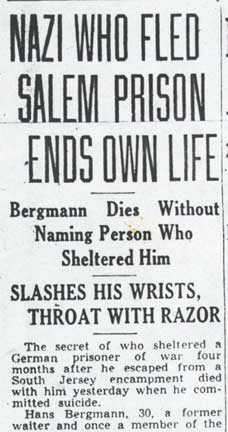
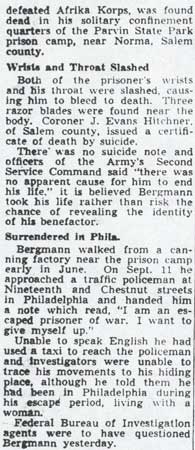
Bergmann Dies Without Naming Person Who Sheltered Him
Slashes His Wrists, Throat With Razor
The secret of who sheltered a German prisoner of war four months after he escaped from a South Jersey encampment died with him yesterday when he committed suicide.
Hans Bergmann, 30, a former waiter and once a member of the defeated Afrika Korps, was found dead in his solitary confinement quarters of the Parvin State Park prison camp, near Norma, Salem county.
Wrists and Throat Slashed
Both of the prisoner's wrists and his throat were slashed, causing him to bleed to death. Three razor blades were found near the body. Coroner J. Evans Hitchner, of Salem county, issued a certificate of death by suicide.
The prisoner's note and officers of the Army's Second Service Command said “there was no apparent cause for him to end his life.” It is believed Bergmann took his life rather than risk the chance of revealing the identity of his hiding place.
Surrendered in Phila.
Bergmann walked from a canning factory near the prison camp early in June. On Sept. 11 he surrendered to a policeman at Nineteenth and Chestnut streets in Philadelphia and handed him a note which read, “I am an escaped prisoner. I want to give myself up.”
Unable to speak English he had used a taxi to reach the policeman. Investigators said they were unable to trace his movements to his hiding place, although he told them he had been in Philadelphia during his escape period, living with a woman.
Federal Bureau of Investigation agents have questioned Bergmann yesterday.
Paulsboro Vet of New Guinea Ends Own Life
Camden Courier-Post —
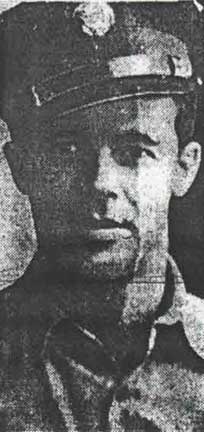
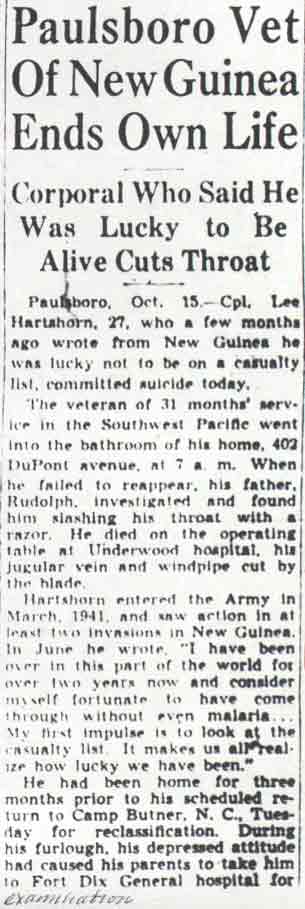
Corporal Who Said He Was Lucky to Be Alive Cuts Throat
Paulsboro, Oct. 15.—Cpl. Lee Hartshorn, 27, who a few months ago wrote from New Guinea he was lucky not to be on a casualty list, committed suicide today.
The veteran of 31 months' service in the Southwest Pacific went into the bathroom of his home, 402 DuPont avenue, at 7 a. m. When he failed to reappear, his father, Rudolph, investigated and found him slashing his throat with a razor. He died on the operating table at Underwood hospital, his jugular vein and windpipe cut by the blade.
Hartshorn entered the Army in March, 1941, and saw action in at least two invasions in New Guinea. In June he wrote, “I have been over in this part of the world for over two years now and consider myself fortunate to have come through without even malaria… My first impulse is to look at the casualty list. It makes us all realize how lucky we have been.”
He had been home for three months prior to his scheduled return to Camp Butner, N. C., Tuesday for reclassification. During his furlough, his depressed attitude had caused his parents to take him to Fort Dix General hospital for examination.
Technician 4th Class Paul R. Barrager
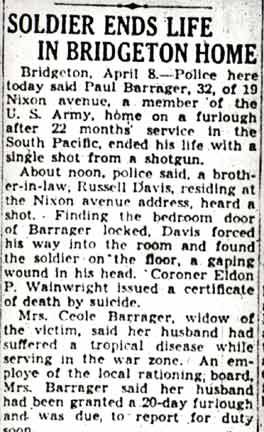
A fourth veteran, Technician 4th Class Paul R. Barrager, a veteran of 22 months duty in the Pacific, had taken his own life as his furlough drew to a close the previous April.
In the 60 plus years since these men served, suffered, and died, attitudes towards mental illness have changed. Our understanding of the disease of clinical depression, which at least two of these men's deaths can be attributed to, has increased greatly. A less tolerant time would accuse these men of a defect in character. A less tolerant time, with prejudice fueled by those who cloak themselves in religion, would call these men sinners. A less tolerant time would dare to call these men cowards. All these labels are cruelly, horribly wrong.
It may have taken a greater courage than many of us can understand for Paul Barrager, Alexander Slowey, Lee Hartshorn, and Hans Bergmann to carry on for as long as they did. When they had gone as far as they could, when they had gone, in reality further than they could, the four men could go no further.
Three are America's honored dead. The fourth is a more compassionate America's honored guest.
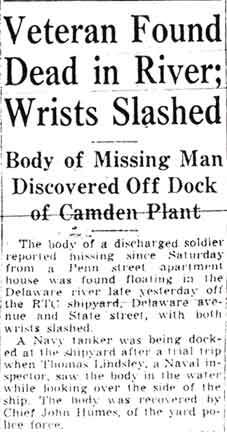
Veteran Found Dead in River; Wrists Slashed
Camden Courier-Post
Body of Missing Man Discovered Off Dock of Camden Plant
The body of a discharged soldier reported missing since Saturday from a Penn street apartment house was found floating in the Delaware river late yesterday off the RTC shipyard, Delaware avenue and State street, with both wrists slashed.
A Navy tanker was being docked at the shipyard after a trial trip when Thomas Lindsley, a Naval inspector, saw the body in the water while looking over the side of the ship. The body was recovered by Chief John Humes, of the yard police force.
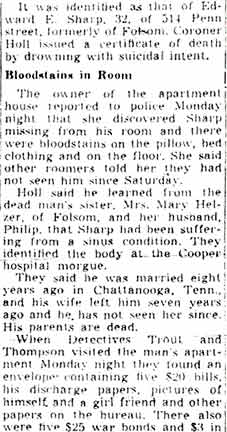
It was identified as that of Edward E. Sharp, 32, of 514 Penn street, formerly of Folsom. Coroner Holl issued a certificate of death by drowning with suicidal intent.
Bloodstains in Room
The owner of the apartment house reported to police Monday night that she discovered Sharp missing from his room and there were bloodstains on the pillow, bedclothing and on the floor. She said other roomers told her they had not seen him since Saturday.
Holl said he learned from the dead man's sister, Mrs. Mary Helzer, of Folsom, and her husband, Philip, that Sharp had been suffering from a sinus condition. They identified the body at the Cooper hospital morgue.
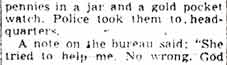
When Detectives Trout and Thompson visited the man's apartment Monday night they found an envelope containing five $20 bills, his discharge papers, pictures of himself and a girl friend and other papers on the bureau. There also were five $25 war bonds and $3 in pennies in a jar and a gold pocket watch. Police took them to headquarters.
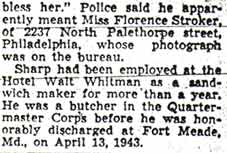
A note on the bureau said: “She tried to help me. No wrong. God bless her.” Police said he apparently meant Miss Florence Stroker, of 2237 North Palethorpe street, Philadelphia, whose photograph was on the bureau.
Sharp had been employed at the Hotel Walt Whitman as a sandwich maker for more than a year. He was a butcher in the Quartermaster Corps before he was honorably discharged at Fort Meade, Md., on April 13, 1943.
Veteran Kills Wife and Self in Trenton
Camden Courier-Post —
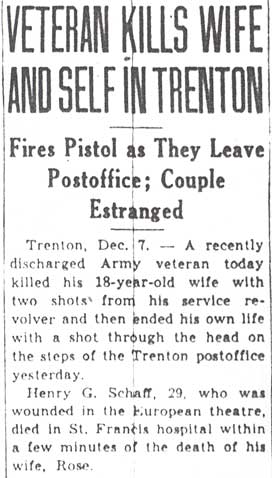
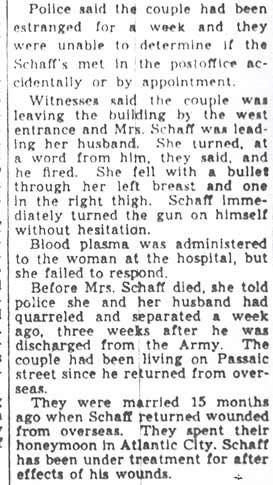
Fires Pistol as They Leave Postoffice; Couple Estranged
Trenton, Dec. 7.—A recently discharged Army veteran today killed his 18-year-old wife with two shots from his service revolver and then ended his own life with a shot through the head on the steps of the Trenton postoffice yesterday.
Henry G. Schaff, 29, who was wounded in the European theatre, died in St. Francis hospital within a few minutes of the death of his wife, Rose.
Police said the couple had been estranged for a week and they were unable to determine if the Schaffs met in the postoffice accidentally or by appointment.
Witnesses said the couple was leaving the building by the west entrance and Mrs. Schaff was leading her husband. She turned, at a word from him, they said, and he fired. She fell with a bullet through her left breast and one in the right thigh. Schaff immediately turned the gun on himself without hesitation.
Blood plasma was administered to the woman at the hospital, but she failed to respond.
Before Mrs. Schaff died, she told police she and her husband had quarreled and separated a week ago, three weeks after he was discharged from the Army. The couple had been living on Passaic street since he returned from overseas.
They were married 15 months ago when Schaff returned wounded from overseas. They spent their honeymoon in Atlantic City. Schaff has been under treatment for after effects of his wounds.
Hitchhikers Find Medford Veteran Suicide in Car
Camden Courier-Post —
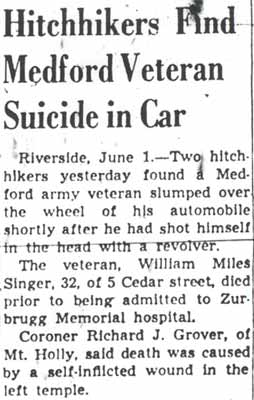
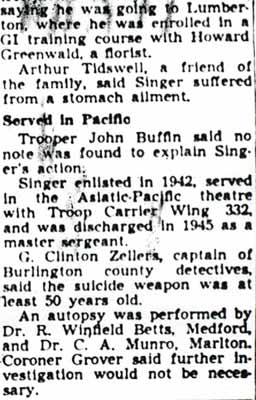
Riverside, June 1.—Two hitchhikers yesterday found a Medford army veteran slumped over the wheel of his automobile shortly after he had shot himself in the head with a revolver.
The veteran, William Miles Singer, 32, of 5 Cedar street, died prior to being admitted to Zurbrugg Memorial hospital.
Coroner Richard J. Grover, of Mt. Holly, said death was caused by a self-inflicted wound in the left temple.
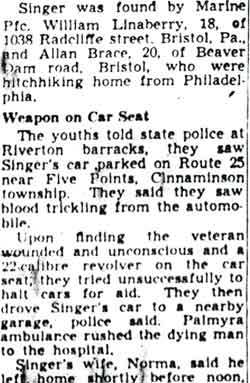
Singer was found by Marine Pfc. William Linaberry, 18, of 1038 Radcliffe street, Bristol, Pa., and Allan Brace, 20, of Beaver Dam road, Bristol, who were hitchhiking home from Philadelphia.
Weapon on Car Seat
The youths told state police at Riverton barracks, they saw Singer's car parked on Route 25 near Five Points, Cinnaminson township. They said they saw blood trickling from the automobile.
Upon finding the veteran wounded and unconscious and a .22 calibre revolver on the car seat, they tried unsuccessfully to halt cars for aid. They then drove Singer's car to a nearby garage, police said. Palmyra ambulance rushed the dying man to the hospital.
Singer's wife, Norma, said he left home shortly before noon saying he was going to Lumberton, where he was enrolled in a GI training course with Howard Greenwald, a florist.
Arthur Tidswell, a friend of the family, said Singer suffered from a stomach ailment.
Served in Pacific
Trooper John Buffin said no note was found to explain Singer's action.
Singer enlisted in 1942, served in the Asiatic-Pacific theatre with Troop Carrier Wing 332, and was discharged in 1945 as a master sergeant.
G. Clinton Zellers, captain of Burlington county detectives, said the suicide weapon was at least 50 years old.
An autopsy was performed by Dr. R. Winfield Betts, Medford, and Dr. C. A. Munro, Marlton. Coroner Grover said further investigation would not be necessary.
Vet Tries Suicide After Brooding Over Palestine
Camden Courier-Post —
A 27-year-old Palestine-born veteran of War II attempted suicide today by hanging. Relatives said he had been brooding over the Palestine situation. Isaac Kosov, 27, who has been living with relatives at 1119 Empire Avenue since his return from Palestine 10 months ago, went to the basement of the home shortly after 6 a. m. today and suspended himself from a joist.
Henry Pinsky, former Camden merchant with whom Kosov, a cousin, was living, heard a noise and went to investigate. He found Kosov hanging and unconscious. He cut the victim down and called police.
Patrolmen Theodore Woods and Carmin Fuscellaro, of the emergency squad, rushed Kosov to Cooper hospital where he was revived and is reported in fair condition. He was placed in an oxygen tent.
According to Mrs. Pinsky, Kosov had been brooding over the Palestine situation since his return to this country. He has a married sister living in Palestine.
During War II, Kosov served with the British navy, and then became an American citizen. Mrs. Pinsky said every time news of Palestine came on the radio, Kosov became morose and brooded for hours.
Burlington Vet, 28, Found Dead in Car; Listed Suicide
Camden Courier-Post —
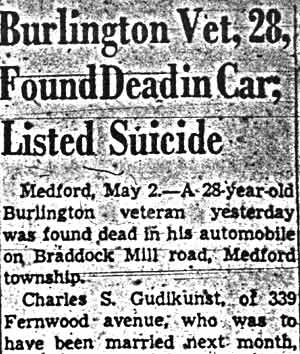
Medford, May 2.—A 28-year-old Burlington veteran yesterday was found dead in his automobile on Braddock Mill road, Medford township.
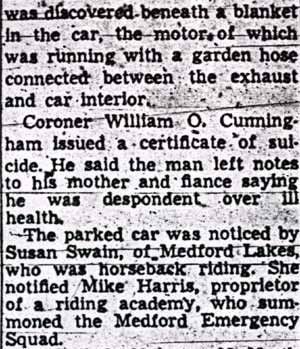
Charles S. Gudikunst, of 339 Fernwood avenue, who was to have been married next month, was discovered beneath a blanket in the car, the motor of which was running with a garden hose connected between the exhaust and car interior.
Coroner William O. Cunningham issued a certificate of suicide. He said the man left notes to his mother and fiancée saying he was despondent over ill health.
The parked car was noticed by Susan Swain, of Medford Lakes, who was horseback riding. She notified Mike Harris, proprietor of a riding academy, who summoned the Medford Emergency Squad.
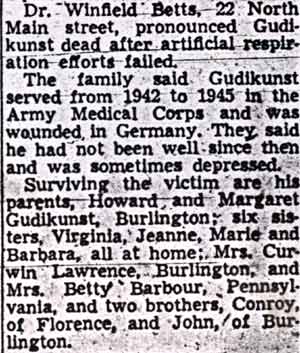
Dr. Winfield Betts, 22 North Main street, pronounced Gudikunst dead after artificial respiration efforts failed.
The family said Gudikunst served from 1942 to 1945 in the Army Medical Corps and was wounded in Germany. They said he had not been well since then and was sometimes depressed.
Surviving the victim are his parents, Howard, and Margaret Gudikunst, Burlington; six sisters, Virginia, Jeanne, Marie and Barbara, all at home; Mrs. Curwin Lawrence, Burlington, and Mrs. Betty Barbour, Pennsylvania, and two brothers, Conroy of Florence, and John, of Burlington.
Gas Hose Leads Into His Car; Bullet Weapon
Camden Courier-Post —


By J. Herbert Phillips
Leonard Buffetta, 32, of 604 Point street, a checker for a Camden supermarket, was found dead at dawn today in an isolated field near Timber creek in Bellmawr.
Police Chief James Garrity, of Bellmawr, listed the death as suicide.
According to Patrolman George Dott's report to Garrity, the motor of the car was still running when he found it at 6:30 a.m. The interior of the car was filled with monoxide gas, still pouring through a strip of garden hose, attached to the exhaust pipe.
Weighted Accelerator
“To make certain he'd do a good job of it,” said Garrity, “Buffetta had weighted down the foot accelerator with a lug wrench. There was still half a tank full of gasoline in the 17-gallon tank, when Dott discovered the car.”
Dott said on his rounds at 5 a.m., the car had not been in the field, some 200 yards up the narrow lane from Creek road.
Coroner Robert J. Blake, who examined the body, said he would order a post-mortem to determine whether Buffetta died from suffocation or bled to death from the self-inflicted wound.
Revolver in Hand
And in the right temple of the body, slouched on the rear seat of the auto, was a bullet from a .32 calibre revolver in the right hand of the corpse. Under his left hand was the hose.
Within half an hour, Garrity learned that Buffetta at 6:30 p.m., Friday was embroiled in an argument with Bernadette Eshelman, 17, of 181 Lawnside avenue, Collingswood.
Police reported the girl accused Buffetta of brutally beating her, before she fled from his car, abandoning her unopened pay envelope issued that afternoon from another supermarket, where she, too, is employed as a checker.
Snapshot in Purse
The girl's name was drawn into the case when police found her handbag, containing a few dollars in cash, an unopened pay envelope, bearing the name Eshelman, and a figure indicating the envelope contained $30.50, and a snapshot of two girls, one of them, possibly Bernadette, Garrity said.
The body of Buffetta lay in the morgue of the West Jersey hospital. His oil-stained car was parked in the hospital yard, held for examination by Camden county detectives.
Garrity said he would start interviewing the 17-year-old Eshelman girl at her home, said she was in a highly nervous state.
“The girl told me Buffetta beat her up,” Garrity reported. “Her eye was blackened and she had other bruises.”
“She told me she left Buffetta's car in Westmont, after he picked her up, but would not count. Buffetta drove on, with her handbag.”
Calls Her Brother
The girl called her home and hysterically told her brother what had happened.
The brother drove to Westmont, put his sister in his car, and took her home.
Here the stories of Collingswood police and Garrity differ slightly.
Patrolman Kenneth Crane, on the desk of the Collingswood police station, told the Courier-Post he had heard the girl's family “tried to locate the man” Friday night, after they heard Berndatte’s [sic] story.
Had ‘Family Conference’
Garrity said the girl insisted today a “family conference” had decided that Buffetta would be questioned by the Eshelmans “tomorrow” . . . that is, today.
Edwin Eshelman, the father, works nights, Garrity said, and is not due home until 2 o'clock on Saturday mornings.
Bellmawr's police chief said he would turn over further investigation of Buffetta's background to county authorities.
Garrity, however, added that the Eshelman girl admitted she had been meeting the older man for “some time” after he finished work in Camden, and she was through for the day at the counter of the Collingswood supermarket, where she works.
See Leonard Buffetta for more of his story.
As the war drew to a close, an honorably discharged veteran, Edward Sharp, also brought his journey to an end.
Soldiers, sailors, and airmen who had been wounded and returned to the United States, upon discharge from military hospitals and the structure of service, began returning home. Most made a successful readjustment to civilian life. For others, the return home was harder, and the psychological problems of certain returning veterans began to attract the attention of the government. Probably the most notorious case would be that of Camden NJ native Howard Unruh, a combat veteran who developed paranoid schizophrenia, was not diagnosed, and went on a shooting rampage that left 13 people dead. The Veterans Administration reacted to the evident problems of America's veterans by enlarging the psychological and psychiatric services in its system of hospitals. For some, help came far too late.
At the end of hostilities, hundreds of thousands of men and women came home. This was the hand dealt to Henry G. Schaff in December of 1945.
This website will continue to honor these casualties of war as they are discovered.
Phillip Cohen, Webmaster