1910
The keel of the 26,000-ton battleship USS Arkansas was laid at the New York Shipbuilding Corporation shipyard on January 25, 1910. Laid down by New York Shipbuilding, Camden, N.J., January 25, 1910. Launched January 14, 1911. Commissioned September 17, 1912. Decommissioned July 29, 1946. Stricken August 15, 1946. Sunk July 25, 1946 during Atomic Bomb Test “Baker”, Bikini Atoll, Marshall Islands.
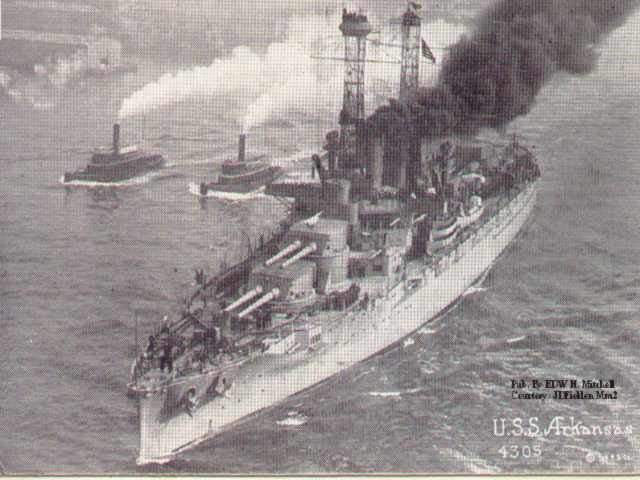
USS Arkansas (BB-33) underway, shortly after commissioning, 1912.
1911
“California Row”, the name given to a row of frame buildings which stood on the south side of Federal Street east of 11th Street, were demolished in May and June of 1911 to make room for sixteen brick houses. These original buildings were constructed in parts by William Carman at his sawmill on Front Street near Cooper, to be sent to California during the gold rush of 1849. For some reason the houses were not shipped West, but were erected in Camden in 1849.
1912
About 7:00 PM on April 2, 1912 a tornado, which in those times was commonly called a cyclone, visited the northern section of Camden, tearing roofs off of houses, uprooting trees, and injuring a number of people. The wind storm was followed by a deluge of rain. The area affected reached from Pearl Street to State Street and from the Delaware River to the Cooper River.
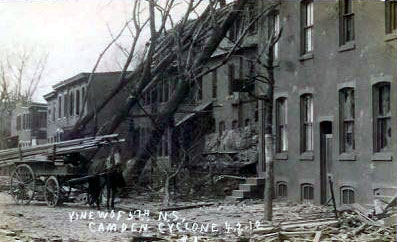
Vine Street West of 5th, North Side, after the tornado of April 2, 1912.
1913
At a special election held July 1, 1913 the adoption of Commission Form of Government for Camden was voted down. The vote was 2,406 in favor and 4,692 against.
1914
A blizzard struck Camden on March 2, 1914. It crippled the trolley lines and steam railroads, and the city was plunged into darkness because of the many fallen wires. The snowfall was 10 inches and the thermometer registered 16 degrees.
1915
The Columbus Monument in Forest Hill Park, presented to the city by the Italian-Americans of Camden, was unveiled on October 12, 1915.
1916
The cornerstone of the handsome High School Building, now standing in Forest Hill Park, was laid on October 14, 1916. This, of course, is our present-day Camden High School.
1917
Parkside Baptist Church dedicated December 9, 1917.
1918
On January 18, 1918 the following announcement was made: Camden has over-subscribed its quota on two Liberty Loans, pledging $11,800,000 for defense; has subscribed $173,000 to the Red Cross, $23,000 more than was asked; $120,000 to the YMCA War Work Fund, $20,000 more than what was asked; and $80,000 to the West Jersey Homeopathic Hospital; and has given more than 1,700 of her sons to the fighting forces.
1919
Camden County made a splendid record in raising money for the World War. The subscription for Liberty Loan Bonds resulted as follows:
| First Loan | $5,053,000 |
| Second Loan | $6,757,000 |
| Third Loan | $6,950,000 |
| Fourth Loan | $10,710,150 |
| Fifth Loan | $9,125,000 |
| Total of Liberty Loans | $38,595,150 |
| War Savings Stamps | $2,000,000 |
| YMCA | $116,641 |
| United War Work | $335,690 |
| Grand Total Subscribed | $41,047,481 |
Melbourne F. Middleton was chairman of the Liberty Loan campaigns, Charles K. Haddon and David Baird Jr. for the War Stamps, F. Morse Archer, for the YMCA and United War Work campaigns.