A History of Post Offices in Camden
By Charles S. Boyer — From Span of a Century, 1928
From “Span of a Century 1828–1928, 100 Years in the History of Camden as a City.” Compiled from notes and data collected by Charles S. Boyer, President of the Camden County Historical Society. Published by the Centennial Anniversary Committee of Camden, New Jersey in 1928. Additional notes and pictures by Phillip Cohen in 2003.
A Post Office was established in Camden in 1803 and called Cooper’s Ferry Post Office, under which name it continued until 1829 when it was changed to Camden. The office was first located in the hotel at the foot of Cooper Street and the first postmasters were Benjamin Cooper, 1803–1806; Charles Cooper, 1806–1810; Richard M. Cooper, 1810–1829.
In 1829, under Isaac Toy, the Post Office was removed to the hotel at the foot of Federal Street. In 1840 it was removed by Postmaster James Elwell to the Railroad Hotel at the foot of Bridge Avenue.
In 1849 the Post Office was removed to the southeast corner of 2nd and Plum Street, Plum Street being renamed Arch Street at a later time, by Charles Bontemps, where it remained until 1853, when it was located at the northeast corner of 3rd & Plum Streets, which, nearly 50 years later, became its location once again.
On April 18, 1853 it was removed by Postmaster John Hanna to the old frame building next to Woolston’s Hotel (later known as Parson’s Hotel), on Federal Street. In 1861 Postmaster Samuel Andrews moved the office to 214 Federal Street. On the death of Andrews in 1863, Captain Richard H. Lee was made Postmaster, and leased the Roberts Building, at the southeast corner of 3rd and Federal Streets, where the office remained until it was removed to the northwest corner of 3rd and Arch Streets in 1870, where it remained until June of 1875.
From that time until 1900 the Post Office was located at 420–424 Federal Street in a building erected solely for this purpose by John S. Read.
A new Post Office Building, at 3rd and Arch Streets, was officially turned over to the U.S. Government on December 8, 1899, by the contractor, Charles McCaul. This was the first post office building in Camden owned by the United States Government. The building was opened for public inspection on January 31, 1900, and officially used as a Post Office for the first time on February 1, 1900.
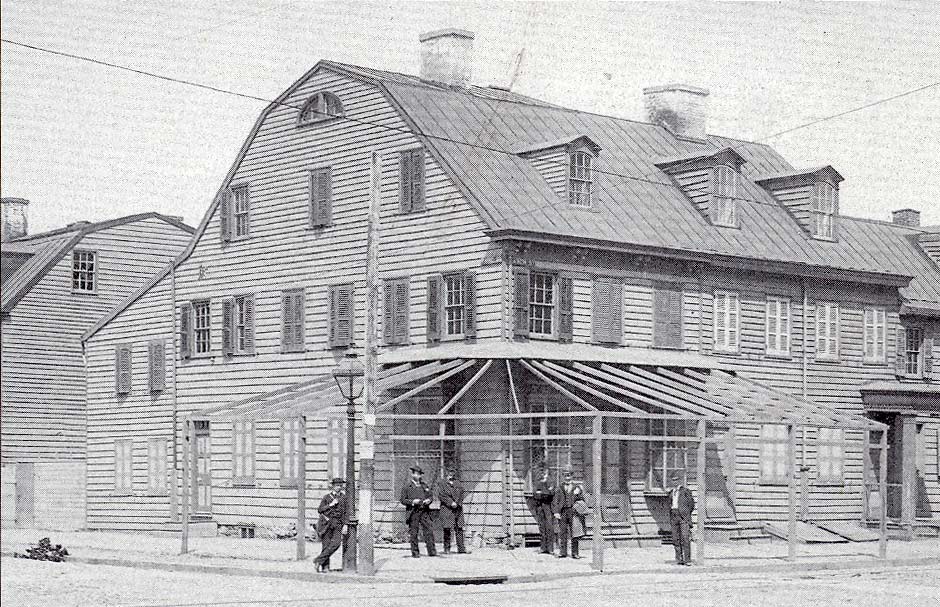
Post Office at NW Corner of 3rd and Arch Streets, circa 1890.
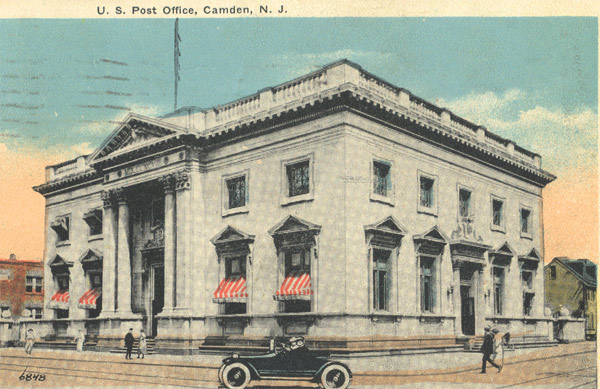
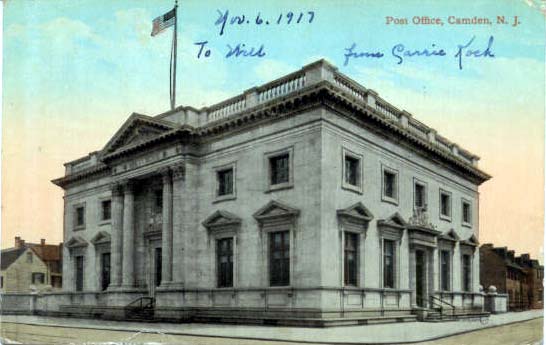
The U.S. Post Office. Left: postcard circa 1910. Right: postcard dated 1917.
The new century saw great growth in the City of Camden, and the Post Office kept pace during these years. In 1922 Charles H. Ellis, who had served as the Mayor of Camden since 1905, was named postmaster. During his tenure a new Post Office and Federal Court House was built at the corner of North 4th and Market Streets, on the site where Ed Gondolff’s Temple Bar and Hotel and the adjacent Temple Theater Building had stood. This building was expanded in the 1990s and renamed the Mitchell H. Cohen US Courthouse in honor of Camden-born lawyer and judge Mitchell H. Cohen.
In 1934 President Franklin D. Roosevelt named Democrat political leader Emma Hyland as postmaster. She was the first woman to hold the job, and served in that capacity until shortly before her death in 1945.
In later years the Postal Service established branch offices on Federal Street in East Camden, and on Broadway in South Camden.
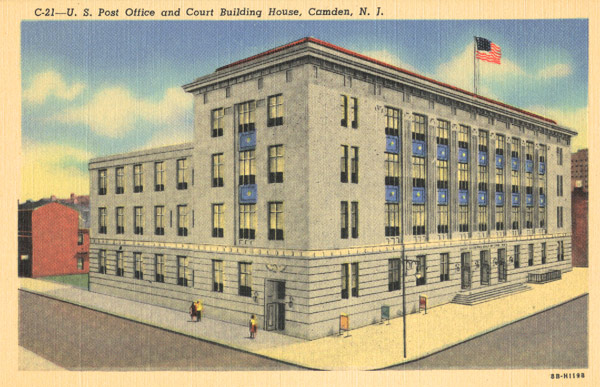
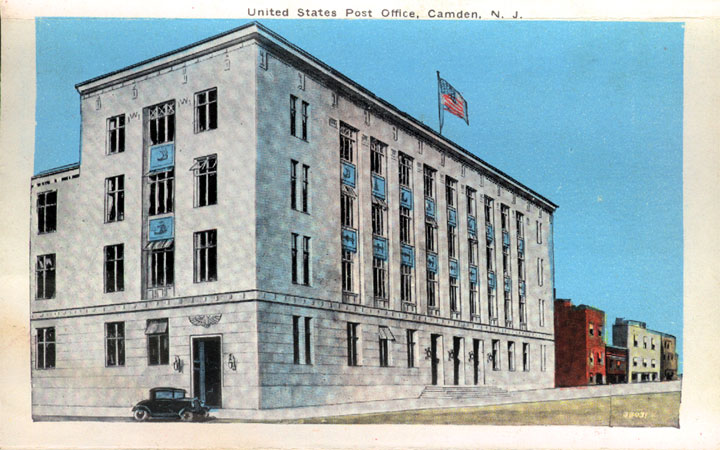
Left: Camden Post Office, 3rd & Market Streets, 1930s. Right: viewed from SW Corner of 4th & Market St.
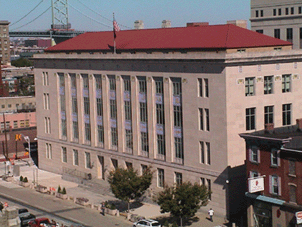
The Camden Post Office, 401–421 Market Street.
Camden Post Office Business Has Huge Increase Under F.R.
Camden Courier-Post —
Mrs. Hyland Cites Gain of $78,827 Over Last Year of Hoover Regime; Says Records Are Barometer of Trade Activity
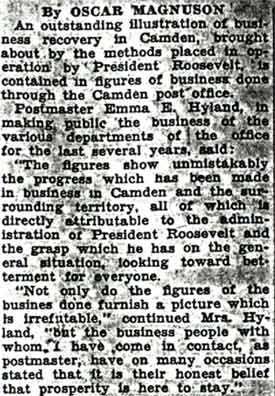
An outstanding illustration of business recovery in Camden, brought about by the methods placed in operation by President Roosevelt, is contained in figures of business done through the Camden post office.
Postmaster Emma E. Hyland, in making public the business of the various departments of the office for the last several years, said:
“The figures show unmistakably the progress which has been made in business in Camden and the surrounding territory, all of which is directly attributable to the administration of President Roosevelt and the grasp which he has on the general situation, looking toward betterment for everyone.”
“Not only do the figures of the busines [sic] done furnish a picture which is irrefutable,” continued Mrs. Hyland, “but the business people with whom I have come in contact, as postmaster, have on many occasions stated that it is their honest belief that prosperity is here to stay.”
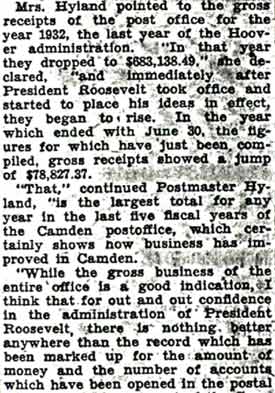
Mrs. Hyland pointed to the gross receipts of the post office for the year 1932, the last year of the Hoover administration. “In that year they dropped to $683,138.49,” she declared, “and immediately after President Roosevelt took office and started to place his ideas in effect, they began to rise. In the year which ended with June 30, the figures for which have just been compiled, gross receipts showed a jump of $78,827.37.”
“That,” continued Postmaster Hyland, “is the largest total for any year in the last five fiscal years of the Camden postoffice, which certainly shows how business has improved in Camden.
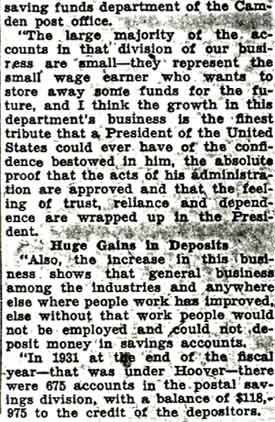
“While the gross business of the entire office is a good indication, I think that for out and out confidence in the administration of President Roosevelt, there is nothing better anywhere than the record which has been marked up for the amount of money and the number of accounts which have been opened in the postal savings funds department of the Camden post office.
“The large majority of the accounts in that division of our business are small—they represent the small wage earner who wants to store away some funds for the future, and I think the growth in this department’s business is the finest tribute that a President of the United States could ever have of the confidence bestowed in him, the absolute proof that the acts of his administration are approved and that the feeling of trust, reliance and dependence are wrapped up in the President.”
Huge Gains in Deposits
“Also, the increase in this business shows that general business among the industries and anywhere else where people work has improved, else without that work people would not be employed and could not deposit money in savings accounts.
“In 1931 at the end of the fiscal year—that was under Hoover—there were 675 accounts in the postal savings division, with a balance of $118,975 to the credit of the depositors.
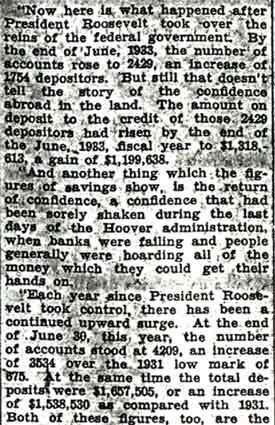
“Now here is what happened after President Roosevelt took over the reins of the federal government. By the end of June, 1933, the number of accounts rose to 2429, an increase of 1754 depositors. But still that doesn’t tell the story of the confidence abroad in the land. The amount on deposit to the credit of those 2429 depositors had risen by the end of the June, 1933, fiscal year to $1,318,613, a gain of $1,199,638.
“And another thing which the figures of savings show, is the return of confidence, a confidence that had been sorely shaken during the last days of the Hoover administration, when banks were failing and people generally were hoarding all of the money which they could get their hands on.
“Each year since President Roosevelt took control, there has been a continued upward surge. At the end of June 30, this year, the number of accounts stood at 4209, an increase of 3534 over the 1931 low mark of 675. At the same time the total deposits were $1,657,505, or an increase of $1,538,530 as compared with 1931. Both of these figures, too, are the best in this department that the Camden post office has had in the last seven years.
“President Roosevelt’s administration, judged by the Camden post office figures alone, has met with approval in this area—business shows that and business speaks from the standpoint of business done.”