Henry L. Bonsall Elementary School
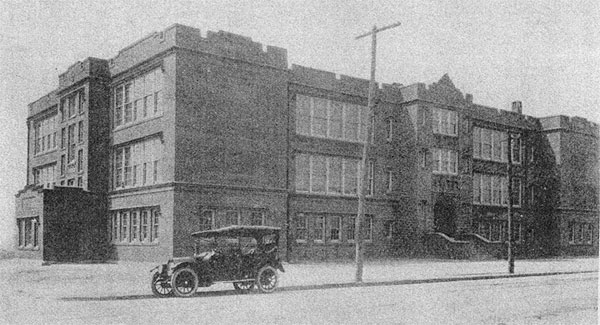
The Henry L. Bonsall School opened in 1914, during the administration of Mayor Charles H. Ellis, on Mount Ephraim Avenue in the Whitman Park section of Camden, in response to the rapidly growing population in that section of the city. It was one of many schools built in Camden during the 32-year tenure of Dr. James E. Bryan as superintendent of schools.
In 1912, the board purchased land near Mount Ephraim Avenue and Jackson Street, and on this land, they erected the Henry L. Bonsall School, named for the school district’s long-time school superintendent, and appointed Mr. A. N. Bean, a graduate of Dickinson College, as the school’s first principal. Because of numerous change orders and construction delays, the school did not open until September 28, 1914.
Henry L. Bonsall
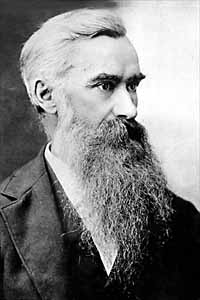
Henry L. Bonsall (1834–1901)
Henry L. Bonsall was for 35 years a journalist in South Jersey. He was born in Philadelphia, in 1834, and at the age of 12, began working at the West Jerseyman. By age 20, he was editing and publishing the American Mechanic, a labor newspaper, in Philadelphia, and a few years later, he was managing the Pennsylvania State Sentinel. Bonsall next established the United States Mechanics Own, initially in Philadelphia, and then in New York. At the outbreak of the Civil War, his paper had the largest circulation of any labor journal in the country. He went to the war front, and served as a war correspondent for the Philadelphia Inquirer. At the end of the war, he founded the New Republic, a newspaper he published in Camden. In 1875, he opened the Camden Daily Post, which merged with the Telegram in 1900. The combined newspapers published under the new name of the Camden Post-Telegram. He was also four times a member of the Legislature and for 11 years, Camden’s Superintendent of Schools. From 1898 to 1901, Bonsall was Chairman of the Camden County Board of Elections. He died in his home in Delair, New Jersey, in 1901, and was buried in the Evergreen Cemetery.
Henry L. Bonsall School and Alfred Cramer School
Philadelphia Inquirer —
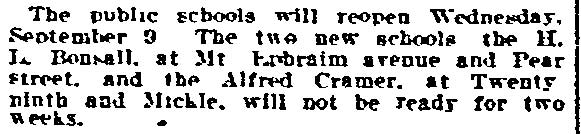
The public schools will reopen Wednesday, September 9. The two new schools the H. L. Bonsall, at Mt. Ephraim avenue and Pear street, and the Alfred Cramer, at Twenty-ninth and Mickle, will not be ready for two weeks.
Parent-Teacher Association News
Camden Courier-Post —
Bonsall — “Father’s Night” was the feature of the meeting last Tuesday during which Mrs. Elizabeth Addis presided. Mrs. Kathryn Atkinson was program chairman. Barney Brown, zone chairman of men’s membership, spoke. There were musical features and playlets given by the boys of the school. Charles Miller delivered the essay written by Morton Kline on “Why Fathers Should be Interested in the P.T.A.” The following children participated: Herbert Obarski, Edward Boreck, Frank Schuda, Richard Sorbicki, Benny Bonk, Thomas Del Rossi, Alexander Sochacki, the Lyons brothers, Lloyd, Rudolph and James; Leonard Lewandowski, Robert Trace, Francis Dougherty, Edward Slupinski, Frank Tolkacz, Edward De Lecce, Charles Cooper, Joseph Garner, Richard Kimakovich, Fortune Frenoy, German Cooper, William Schuda, Edward Wnuk and Alfred Wassynger.
History
By 1921, it was apparent that the school construction frenzy from the last decade was still unable to keep up with the substantial, but slowing, influx of immigrants and a steady stream of migrant southern Negroes into Camden. This inundation coupled with the reduced need for young labor, swelled the classrooms. To alleviate the overcrowding, the board initiated the construction of new schools, additions to existing schools, and the placement of portable classrooms on existing school property. (The passage of federal immigration laws in 1921 and 1924 restricted the number of European immigrants entering the United States, which led to increased demand for African-American labor in the industrial North. The south experienced a serious decline in cotton production that started about 1923, and led to a large-scale movement of southern Negroes into northern industrial centers, such as Camden.)
The board named Paul Davis the architect for additions to Whittier and Bonsall Schools. Davis had previously been instrumental in designing Camden High School, and had also been involved in the Parkside School, George Washington School, and H.B. Wilson School projects. The six-room addition to the Whittier was ready for students in July 1922, and the Bonsall School addition was ready in October.
During World War II, Bonsall teachers and students were active in the War Bond and stamp drives. The United States government awarded the Bonsall School a War Minuteman Flag in February of 1943, for raising the largest amount in total sale of war bonds and stamps, more than $92,480. The school topped the $100,000 mark the next month. It should be noted, with pride, that New Jersey led the nation in per capita purchase of War Bonds and stamps. By the end of the war Camden schools had collectively sold $835,311.98 in bonds and stamps.
Bonsall is considered a family school, one in which pupils remain in the same school from kindergarten through eighth grade.
Sadly, it must be noted that the complete deterioration of the neighborhood that the Bonsall School serves had its effect. In 2003, Bonsall Family School, Camden High School and East Camden Middle School were identified as three of the seven “persistently dangerous” schools in New Jersey.
The school was closed in the 2010s and razed in 2019.
Thanks to Brian Abdullah, who attended Bonsall from 1967 to 1974, for help in creating this web-page; and to Dr. Fred Reiss, whose book Public Education in Camden, N.J.: From Inception to Integration, served as the basis for this page.