William Parke
WILLIAM PARKE had a career in show business that spanned at least six decades. He was born in Bethlehem, Pennsylvania on June 18, 1873 to Anthony Parke and his wife, the former Mary Hallman. Prior to 1895 no records regarding him have been found, but he does appear in that year's Camden City Directory at 1112 Locust Street, and his occupation was listed as actor. From 1895 through 1898 he was a member of George Holland's stock company, which put on plays at the Girard Avenue Theater in Philadelphia. In time he became the assistant stage manager for the Holland Stock Company.
William Parke married Julia Peacock, the daughter of Camden restaurant owner George Washington Peacock on June 27, 1896 at Bethany Methodist Church in Camden. Julia Peacock bore two sons, William Parke Jr. in 1897 and George Washington Parke in 1898. The family is listed at 316 Clinton Street in 1897 and 45 Cooper Street in 1898.
In 1899 William Parke went to New York City, where he staged a revival of The Sporting Duchess and took the production on tour. Parke's production played in Baltimore, Philadelphia and Wilkes-Barre, Pennsylvania in October of 1899, in Dallas in November and in Evansville, Indiana in December, and possibly also appeared in Salt Lake City and other western cities.
The 1900 Census shows the Parke family at 231 North Front Street. Around this time William Parke began to work even further away from Camden. In the March of that year he went to Denver, Colorado with a newly organized theater troupe known as The Western Amusement Company. William Parke did double duty in the show as an actor and as assistant stage manager to Harry Saint Maur, well known as an actor, playwright, and author, and remained in Denver until at least September of 1900. William Parke would go on to directing and producing plays and in time movies, with occasional roles as an actor on stage, film, and on Broadway.
In 1900 Parke joined Shakespearean actor E.H. Sothern's company as advance stage manager for a road tour of Hamlet. For several years, Sothern dreamed of mounting a spectacular and precise production of Hamlet. He finally opened the play in New York in 1900, but during the first week, he was stabbed in the foot by Laertes' sword and was stricken with blood poisoning, closing the production. After he recovered, he revived the piece on tour, but the sets and costumes were destroyed by a fire in Cincinnati, Ohio. In 1901, he played the title role in Richard Lovelace and then François Villon in If I Were King. It was in this production where William Parke made his debut on Broadway. He also had a role in The Proud Prince at the Lyceum Theatre, New York City. He later worked with E.H. Sothern on a road production of The Proud Prince.
The 1901 City Directory shows the William Parke family at 214 Ambler Street. The family never did live very far from Julia Parke's parents, whose home and business was at 60 Delaware Avenue. The Parkes are listed at 215 Stevens Street in 1902 and 1903. By the time the 1904 Directory was compiled, they had moved to 306 Cole Street.
By 1902 William Parke was no longer the assistant, he was the stage manager for large productions in major cities. In 1903 he was again working for E.H. Sothern on The Proud Prince, which required casting 100 extras for a mob scene on stage. The show played in Baltimore in late November, 1903.
In 1904 William Parke became a member of The Players, a social club founded by the great stage actor Edwin Booth, considered by many to be America's greatest 19th Century actor, whose achievements unfortunately are over shadowed by the single deed of his brother, John Wilkes Booth, who assassinated President Abraham Lincoln in 1865. William Parke remained an active member of the club until his passing in 1941.
Subsequently William Parke was hired as stage manager Richard Mansfield's company, and appeared as an actor in productions of Beau Brummell and The Strange Case of Dr. Jekyll and Mr. Hyde, a role that Mansfield had originated. He was stage manager for Mansfield's production of Henrik Ibsen's Peer Gynt, which was the first U.S. production of this play. It opened at the Chicago Grand Opera House on October 24, 1906, and toured the entire nation.
Richard Mansfield's popularity as a Shakespearean actor was immense. At the time of his death, The New York Times stated: “As an interpreter of Shakespeare, he had no living equal in his later days, as witnessed by the princely grace, the tragic force of his Richard, his thrilling acting in the tent scene of ‘Caesar’, the soldierly dignity and eloquence of his Prince Hal, and the pathos of the prayer in that play. He was the greatest actor of his hour, and one of the greatest of all times.” Mansfield died in New London, Connecticut, on August 30, 1907 at age 50, from liver cancer.
1906 is the last year William Parke is listed in Camden City Directories. It can be assumed that being away from home for months at a time did the marriage no good, and, as Julia Parke, beginning in 1908 referred to herself as a widow in city directories and census enumerations, that the divorce was acrimonious. During the 1910s William Parke Jr. joined his father and began a career as an actor, while younger son George W. Parke remained in Camden for pretty much the rest of his life.
After Mansfield's company had disbanded, William Parke joined Arnold Daly, who had founded “The Theatre of Ideas” at the Berkley Lyceum which presented three one-act plays each night. He worked with Daly in the capacity of stage manager and also as an actor in several one-act plays. Daly disbanded his troupe late in 1907.
In 1908 William Parke began working as the stage manager for the stock company of John Craig and Mary Young at the Castle Square Theater in Boston. On November 16, 1908 he married actress Alice Harrington, a Massachusetts native, who bore him a son, Richard Harrington Parke, on March 21, 1909. The 1910 Census, taken April 26, shows William, Alice and Richard at 5 Durham Street in Boston, with a nurse, a cook, and a few lodgers.
During the summers, when the Castle Square troupe was not working, William Parke had his own company in Pittsfield, Massachusetts. In 1912 William Parke's stock company included Edith Luckett, who in 1921, had a daughter Anne, nicknamed “Nancy,” by her first husband, car salesman Kenneth Robbins. The couple separated in 1923 and divorced in 1928. Edith Luckett later married Chicago businessman Loyal Davis, who adopted her daughter, whose name became Nancy Davis. Following her mother into acting, Nancy Davis made a number of movies, but is best remembered for marrying an actor by the name of Ronald Reagan, and I am sure you know the rest of that story!
Wallace Worsley Jr., in a communication to author Q. David Bowers, noted: “William Parke was a partner with my father in a summer stock company for two or three seasons, circa 1911–1915, at the Colonial Theatre in Pittsfield, Massachusetts. My mother [julia taylor, who also acted in thanhouser films] played most of the leading parts in their programs. i remember that at three years of age i was greatly impressed with the storm at sea in east lynne — especially the lightning, waves (billowing canvas), and the thunder (probably cymbals clashing).”
William Parke disbanded his summer stock company in July of 1913 and went to New York where he directed the rehearsals of seven road companies of Potash and Perlmutter and was also with the same production at the Cohan Theatre in New York City.
The 1915 New York State Census shows William Parke, wife Alice, and son Richard H. Parke living in New York City. His occupation was listed as Stage Director. Before the year was out he would transition to movie director. By November his oldest son, William Parke Jr., was working in Massachusetts as a stage actor.
In 1916 William Parke began directing movies for the Thanhouser Film Corporation, which was based in New Rochelle, New York. After making two shorts, Parke directed his first full-length film for Thanhouser, Other People's Money, which featured Gladys Hulette, not twenty years old and already a screen veteran, having made dozens of shorts beginning in 1908. Parke and Hulette went on to make nine films together. William Parke Jr. had also come to work Thanhouser as an actor and he and Gladys married on August 21, 1917.
William Parke next went to work for Astra Film Corporation where he made nine movies. In 1918 he completed a film whose working title was The Romance of Coal, which was due to be released in late 1918. Due to the influenza pandemic that killed millions worldwide, the film like many others was held back from theaters. Renamed Key To Power, it was released in January of 1920. This film is believed to be the first major studio production to be filmed on location in West Virginia. After the completion of this film, William Parke and family went to California.
The January 1920 Census shows William Parke Jr. and Gladys Hulette Parke living in New Rochelle, New York. The 1920 Motion Picture Studio Directory gives William and Alice Parke's address as 1815 LaBrea Avenue, Hollywood, California. William Parke's next film was for the Goldwyn Pictures Corporation. The Paliser Case was released on February 15, 1920. By May of 1921 he had completed three other pictures. He went to work for Carl Laemmle's Universal Studios in 1923 where he completed three films including Legally Dead, something of a precursor to Laemmle's 1931 Frankenstein in that it had to do with bringing the dead back to life.
William Parke apparently did not care too much for California, and after completing a ten-part serial, Ten Scars Make A Man, he returned to New York. He invented a safety oven rack, patented it, and spent much of the next fifteen years promoting it. A business, William Parke Inc. was organized in 1928 with a factory on Camden, New Jersey devoted to its manufacture. At the same time he kept in touch with the stage and was said to have been an almost daily visitor to The Players social club in New York City, of which he had been a member since 1904. He also appeared on occasion on stage, and is known to have five appearances on Broadway after his return from the West Coast.
The 1930 Census shows William Parke with his wife Alice in an apartment at 29 Perry Street, New York City, New York, in the same building as New York Herald-Tribune reporter Beverly Smith. Next door at 33 Perry Street was the author Rex Stout, who in 1934 published the first of 33 mystery novels and 39 short stories with his character Nero Wolfe. The Nero Wolfe character has appeared in two Hollywood movies, six American television series, and as of this writing four international television series, two of them in Italy, the others in Germany and Russia. Son William Parke Jr., divorced since 1925 from Gladys Hulette, was living in New York and working as an actor. Son H. Richard Parke had married and was also living in New York, and was employed as a reporter by the New York Times. George W. Parke had remained in Camden. By 1930 he, his wife, the former Elsie Atkinson, and daughter Mary Jane “Mollie” Parke lived at 3184 Westfield Avenue. They later moved to 3192 Westfield Avenue, where they were listed at that address in New Jersey Bell Telephone Directories as late as 1970.
William Parke, a trouper to the end, went out on top, as a member of the original cast of the Broadway hit show, Arsenic and Old Lace, which opened in January of 1941. He created the role of Mr. Witherspoon, which, when the movie was made several years later, was played by Edward Everett Horton. After the Saturday night showing of Arsenic and Old Lace on July 27, 1941, William Parke returned to his apartment, where he died of a heart attack the following day.
Aside from Arsenic and Old Lace, William Parke's career on Broadway in his later years is notable in that he appeared on stage in three different shows that featured actors who starred in the three great Universal horror classics, Dracula, Frankenstein, and The Mummy. He appeared with Helen Chandler (Dracula) in 1927's Creoles; Zita Johann (The Mummy) in 1930's Troyka, and Boris Karloff (Frankenstein and The Mummy) in Arsenic and Old Lace.
Alice Harrington Parke died June 6, 1954 in Connecticut. Richard H. Parke retired from The New York Times as an editor, then stayed active as a reporter with a local paper in Connecticut. He died in 1989. George W. Parke passed away in 1969, leaving a wife and a daughter. What became of William Parke Jr. after 1930 is not known to this writer at present. Julia Peacock Parke was still residing in Camden as late as April of 1930. She had not remarried.
Of William Parke's films, all appear to be lost except for The Mystery of the Double Cross, a ten-part serial. Much more can be learned about William Parke, his films, life and times, and the people he interacted with, in the rest of this web-page. Much insight can be gained into his years as a stage director in theater from an article published in The American Magazine in November 1912, which you can read here, and from a newspaper article written a few years after his death which can be read here, and from the many newspaper articles presented below.
Philadelphia Inquirer
Philadelphia Inquirer —
Philadelphia Inquirer,
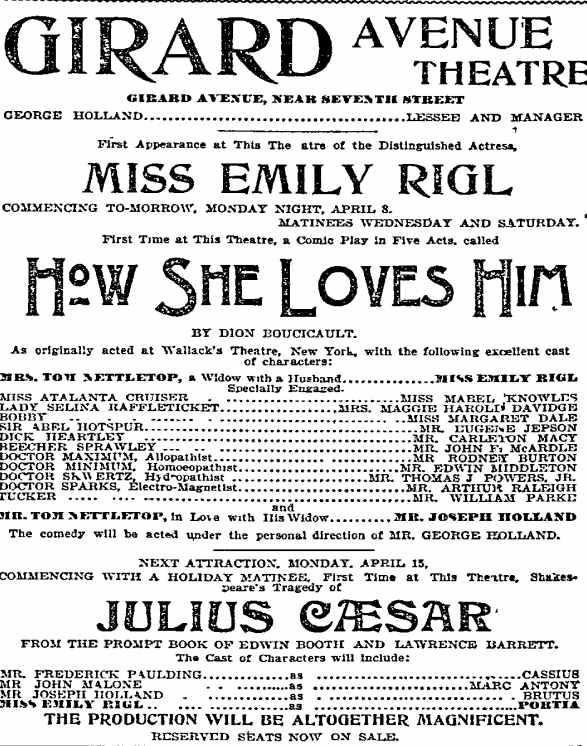
GIRARD AVENUE THEATRE
GIRARD AVENUE, NEAR SEVENTH STREET
GEORGE HOLLAND ................ LESSEE AND MANAGER
First Appearance at This Theatre of the Distinguished Actress,
MISS EMILY RIGL
COMMENCING TO-MORROW, MONDAY NIGHT, APRIL 8.
MATINEES WEDNESDAY AND SATURDAY.
First Time at This Theatre, a Comic Play in Five Acts, called
HOW SHE LOVES HIM
BY DION BOUCICAULT.
As originally acted at Wallack's Theatre, New York, with the following excellent cast of characters:
MRS. TOM NETTLETOP, a Widow with a Husband ................ MISS EMILY RIGL
Specially Engaged.
MISS ATALANTA CRUISER ................ MISS MABEL KNOWLES
LADY SELINA RAFFLETICKET ................ MRS. MAGGIE HAROLD DAVIDGE
BOBBY ................ MISS MARGARET DALE
SIR ABEL HOTSPUR ................ MR. EUGENE JEPSON
DICK HEARTLEY ................ MR. CARLETON MACY
BEECHER SPRAWLEY ................ MR. JOHN F. McARDLE
DOCTOR MAXIMUM, Allopathist ................ MR. RODNEY BURTON
DOCTOR MINIMUM, Homoeopathist ................ MR. EDWIN MIDDLETON
DOCTOR SKWERTZ, Hydropathist ................ MR. THOMAS J. POWERS, JR.
DOCTOR SPARKS, Electro-Magnetist ................ MR. ARTHUR RALEIGH
TUCKER ................ MR. WILLIAM PARKE
and
MR. TOM NETTLETOP, in Love with His Widow ................ MR. JOSEPH HOLLAND
The comedy will be acted under the personal direction of MR. GEORGE HOLLAND.
NEXT ATTRACTION, MONDAY, APRIL 15,
COMMENCING WITH A HOLIDAY MATINEE, First Time at This Theatre, Shakespeare's Tragedy of
JULIUS CAESAR
FROM THE PROMPT BOOK OF EDWIN BOOTH AND LAWRENCE BARRETT.
The Cast of Characters will include:
MR. FREDERICK PAULDING ................ as ................ CASSIUS
MR. JOHN MALONE ................ as ................ MARC ANTONY
MR. JOSEPH HOLLAND ................ as ................ BRUTUS
MISS EMILY RIGL ................ as ................ PORTIA
THE PRODUCTION WILL BE ALTOGETHER MAGNIFICENT.
RESERVED SEATS NOW ON SALE.
Girard Avenue THEATRE
Philadelphia Inquirer —
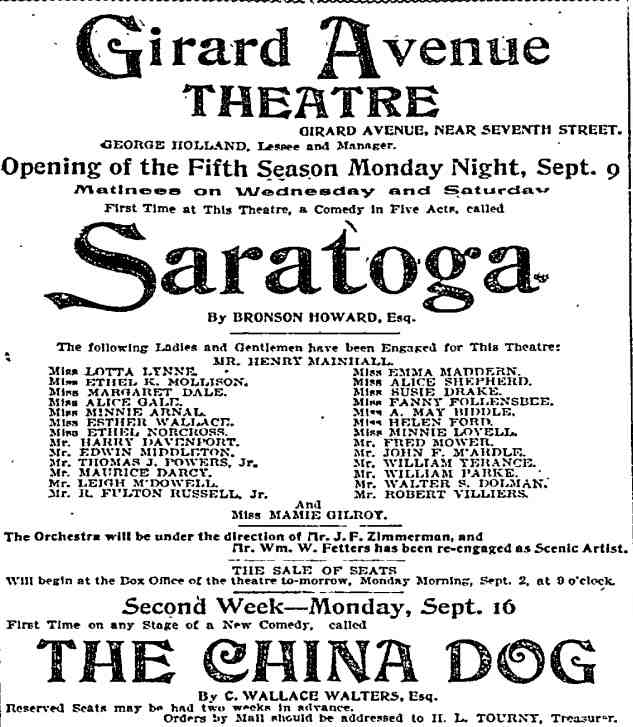
GIRARD AVENUE, NEAR SEVENTH STREET. GEORGE HOLLAND, Lessee and Manager.
Opening of the Fifth Season Monday Night, Sept. 9 Matinees on Wednesday and Saturday First Time at This Theatre, a Comedy in Five Acts, called
Saratoga
By BRONSON HOWARD, Esq.
The following Ladies and Gentlemen have been Engaged for This Theatre: MR. HENRY MAINHALL.
Miss LOTTA LYNNE. Miss ETHEL K. MOLLISON. Miss MARGARET DALE. Miss ALICE GALE. Miss MINNIE ARNAL. Miss ESTHER WALLACE. Miss ETHEL NORCROSS. Mr. HARRY DAVENPORT. Mr. EDWIN MIDDLETON. Mr. THOMAS J. POWERS, Jr. Mr. MAURICE DARCY. Mr. LEIGH McDOWELL. Mr. R. FULTON RUSSELL, Jr.
Miss EMMA MADDERN. Miss ALICE SHEPHERD. Miss SUSIE DRAKE. Miss FANNY FOLLENSBEE. Miss A. MAY BIDDLE. Miss HELEN FORD. Miss MINNIE LOVELL. Mr. FRED MOWER. Mr. JOHN F. McARDLE. Mr. WILLIAM YERANCE. Mr. WILLIAM PARKE. Mr. WALTER S. DOLMAN. Mr. ROBERT VILLIERS.
And Miss MAMIE GILROY.
The Orchestra will be under the direction of Mr. J. F. Zimmerman, and Mr. Wm. W. Fetters has been re-engaged as Scenic Artist.
THE SALE OF SEATS Will begin at the Box Office of the theatre to-morrow, Monday Morning, Sept. 2, at 9 o’clock.
Second Week—Monday, Sept. 16 First Time on any Stage of a New Comedy, called
THE CHINA DOG
By C. WALLACE WALTERS, Esq.
Reserved Seats may be had two weeks in advance. Orders by Mail should be addressed to H. L. TOURNY, Treasurer.
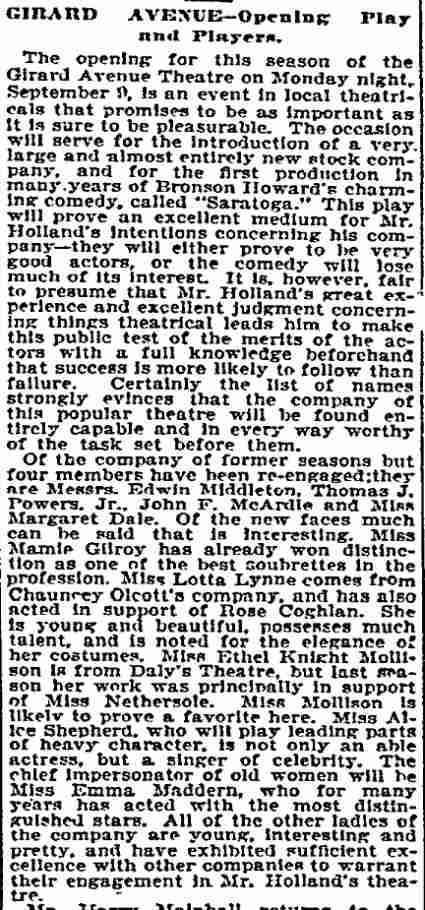
GIRARD AVENUE—Opening Play and Players.
The opening for this season of the Girard Avenue Theatre on Monday night, September 9, is an event in local theatricals that promises to be as important as it is sure to be pleasurable. The occasion will serve for the introduction of a very large and almost entirely new stock company, and for the first production in many years of Bronson Howard’s charming comedy, called “Saratoga.” This play will prove an excellent medium for Mr. Holland’s intentions concerning his company—they will either prove to be very good actors, or the comedy will lose much of its interest. It is, however, fair to presume that Mr. Holland’s great experience and excellent judgment concerning things theatrical leads him to make this public test of the merits of the actors with a full knowledge beforehand that success is more likely to follow than failure. Certainly the list of names strongly evinces that the company of this popular theatre will be found entirely capable and in every way worthy of the task set before them.
Of the company of former seasons but four members have been re-engaged; they are Messrs. Edwin Middleton, Thomas J. Powers, Jr., John F. McArdle and Miss Margaret Dale. Of the new faces much can be said that is interesting. Miss Mamie Gilroy has already won distinction as one of the best soubrettes in the profession. Miss Lotta Lynne comes from Chauncey Olcott’s company, and has also acted in support of Rose Coghlan. She is young and beautiful, possesses much talent, and is noted for the elegance of her costumes. Miss Ethel Knight Mollison is from Daly’s Theatre, but last season her work was principally in support of Miss Nethersole. Miss Mollison is likely to prove a favorite here. Miss Alice Shepherd, who will play leading parts of heavy character, is not only an able actress, but a singer of celebrity. The chief impersonator of old women will be Miss Emma Maddern, who for many years has acted with the most distinguished stars. All of the other ladies of the company are young, interesting and pretty, and have exhibited sufficient excellence with other companies to warrant their engagement in Mr. Holland’s theatre.
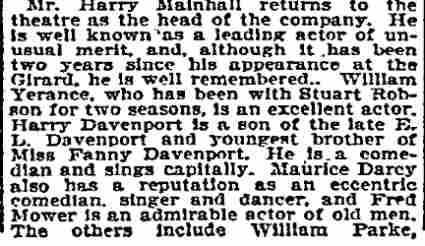
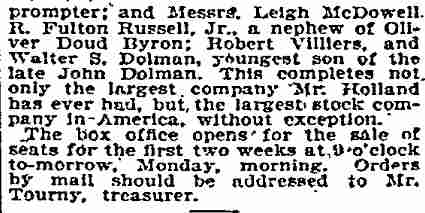
Mr. Harry Mainhall returns to the theatre as the head of the company. He is well known as a leading actor of unusual merit, and, although it has been two years since his appearance at the Girard, he is well remembered. William Yerance, who has been with Stuart Robson for two seasons, is an excellent actor. Harry Davenport is a son of the late E. L. Davenport and youngest brother of Miss Fanny Davenport. He is a comedian and sings capitally. Maurice Darcy also has a reputation as an eccentric comedian, singer and dancer, and Fred Mower is an admirable actor of old men. The others include William Parke, prompter; and Messrs. Leigh McDowell, R. Fulton Russell, Jr., a nephew of Oliver Doud Byron; Robert Villiers, and Walter S. Dolman, youngest son of the late John Dolman. This completes not only the largest company Mr. Holland has ever had, but the largest stock company in America, without exception.
The box office opens for the sale of seats for the first two weeks at 9 o’clock to-morrow, Monday, morning. Orders by mail should be addressed to Mr. Tourny, treasurer.
Philadelphia Inquirer,
Philadelphia Inquirer
Philadelphia Inquirer —
Philadelphia Inquirer,
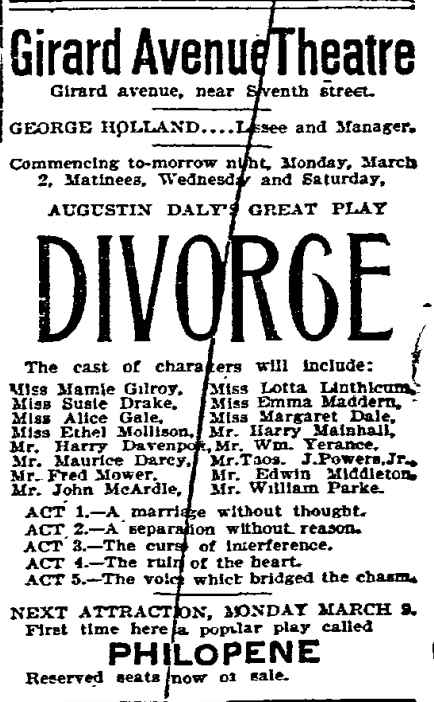
Girard Avenue Theatre
Girard avenue, near Seventh street.
GEORGE HOLLAND .... Lessee and Manager.
Commencing to-morrow night, Monday, March 2, Matinees, Wednesday and Saturday,
AUGUSTIN DALY'S GREAT PLAY
DIVORCE
The cast of characters will include:
Miss Mamie Gilroy.
Miss Susie Drake.
Miss Alice Gale.
Miss Ethel Mollison.
Mr. Harry Davenport.
Mr. Maurice Darcy.
Mr. Fred Mower.
Mr. John McArdle.
Miss Lotta Linthicum.
Miss Emma Maddern.
Miss Margaret Dale.
Mr. Harry Mainhall.
Mr. Wm. Yerance.
Mr. Thos. J. Powers, Jr.
Mr. Edwin Middleton.
Mr. William Parke.
ACT 1.—A marriage without thought.
ACT 2.—A separation without reason.
ACT 3.—The curse of interference.
ACT 4.—The ruin of the heart.
ACT 5.—The voice which bridged the chasm.
NEXT ATTRACTION, MONDAY MARCH 9.
First time here a popular play called
PHILOPENE
Reserved seats now on sale.
Girard Avenue Opening.
Philadelphia Inquirer —
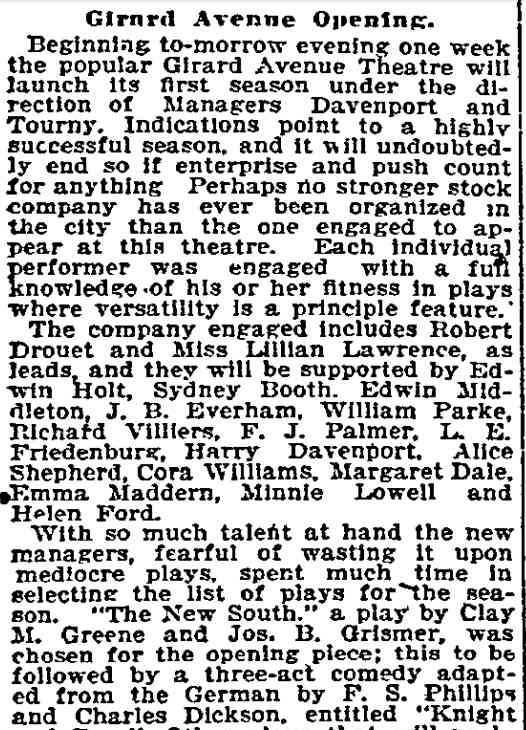
Beginning to-morrow evening one week the popular Girard Avenue Theatre will launch its first season under the direction of Managers Davenport and Tourny. Indications point to a highly successful season, and it will undoubtedly end so if enterprise and push count for anything. Perhaps no stronger stock company has ever been organized in the city than the one engaged to appear at this theatre. Each individual performer was engaged with a full knowledge of his or her fitness in plays where versatility is a principle feature.
The company engaged includes Robert Drouet and Miss Lillian Lawrence, as leads, and they will be supported by Edwin Holt, Sydney Booth, Edwin Middleton, J. B. Everham, William Parke, Richard Villiers, F. J. Palmer, L. E. Friedenburg, Harry Davenport, Alice Shepherd, Cora Williams, Margaret Dale, Emma Maddern, Minnie Lowell and Helen Ford.
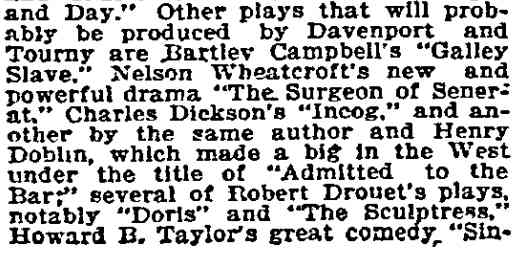
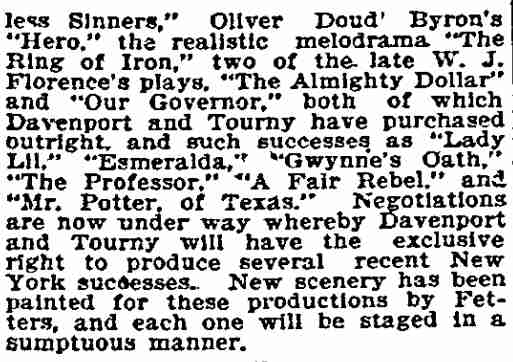
With so much talent at hand the new managers, fearful of wasting it upon mediocre plays, spent much time in selecting the list of plays for the season. “The New South,” a play by Clay M. Greene and Jos. B. Grismer, was chosen for the opening piece; this to be followed by a three-act comedy adapted from the German by F. S. Phillips and Charles Dickson, entitled “Knight and Day.” Other plays that will probably be produced by Davenport and Tourny are Bartley Campbell’s “Galley Slave,” Nelson Wheatcroft’s new and powerful drama “The Surgeon of Senerat,” Charles Dickson’s “Incog,” and another by the same author and Henry Doblin, which made a big in the West under the title of “Admitted to the Bar;” several of Robert Drouet’s plays, notably “Doris” and “The Sculptress,” Howard B. Taylor’s great comedy “Sinless Sinners,” Oliver Doud Byron’s “Hero,” the realistic melodrama “The Ring of Iron,” two of the late W. J. Florence’s plays, “The Almighty Dollar” and “Our Governor,” both of which Davenport and Tourny have purchased outright, and such successes as “Lady Lil,” “Esmeralda,” “Gwynne’s Oath,” “The Professor,” “A Fair Rebel,” and “Mr. Potter, of Texas.” Negotiations are now under way whereby Davenport and Tourny will have the exclusive right to produce several recent New York successes. New scenery has been painted for these productions by Fetters, and each one will be staged in a sumptuous manner.
Philadelphia Inquirer
Philadelphia Inquirer —
Philadelphia Inquirer,
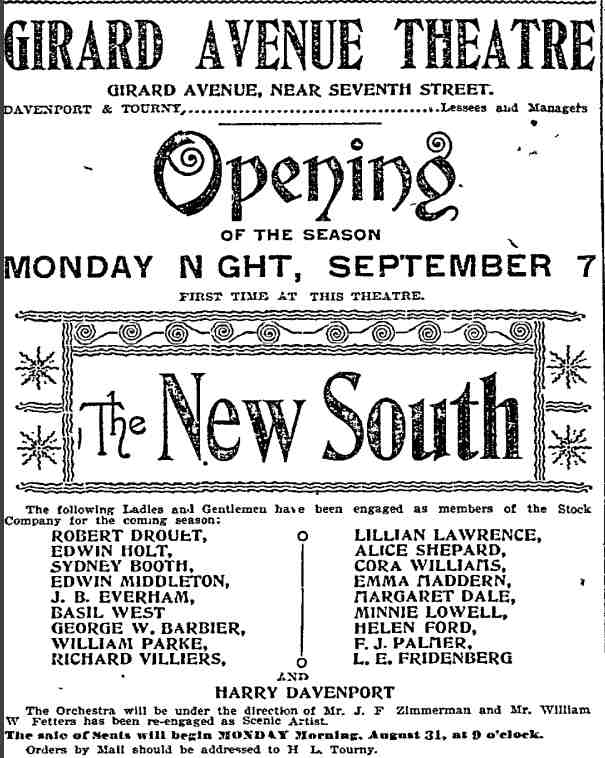
GIRARD AVENUE THEATRE
GIRARD AVENUE, NEAR SEVENTH STREET.
DAVENPORT & TOURNY, ................ Lessees and Managers
Opening
OF THE SEASON
MONDAY NIGHT, SEPTEMBER 7
FIRST TIME AT THIS THEATRE.
The New South
The following Ladies and Gentlemen have been engaged as members of the Stock Company for the coming season:
ROBERT DROUET,
EDWIN HOLT,
SYDNEY BOOTH,
EDWIN MIDDLETON,
J. B. EVERHAM,
BASIL WEST,
GEORGE W. BARBIER,
WILLIAM PARKE,
RICHARD VILLIERS,
LILLIAN LAWRENCE,
ALICE SHEPARD,
CORA WILLIAMS,
EMMA MADDERN,
MARGARET DALE,
MINNIE LOWELL,
HELEN FORD,
F. J. PALMER,
L. E. FRIDENBERG
AND
HARRY DAVENPORT
The Orchestra will be under the direction of Mr. J. F. Zimmerman and Mr. William W. Fetters has been re-engaged as Scenic Artist.
The sale of Seats will begin MONDAY Morning, August 31, at 9 o'clock.
Orders by Mail should be addressed to H. L. Tourny.
Captain Paul—Girard
Philadelphia Inquirer —
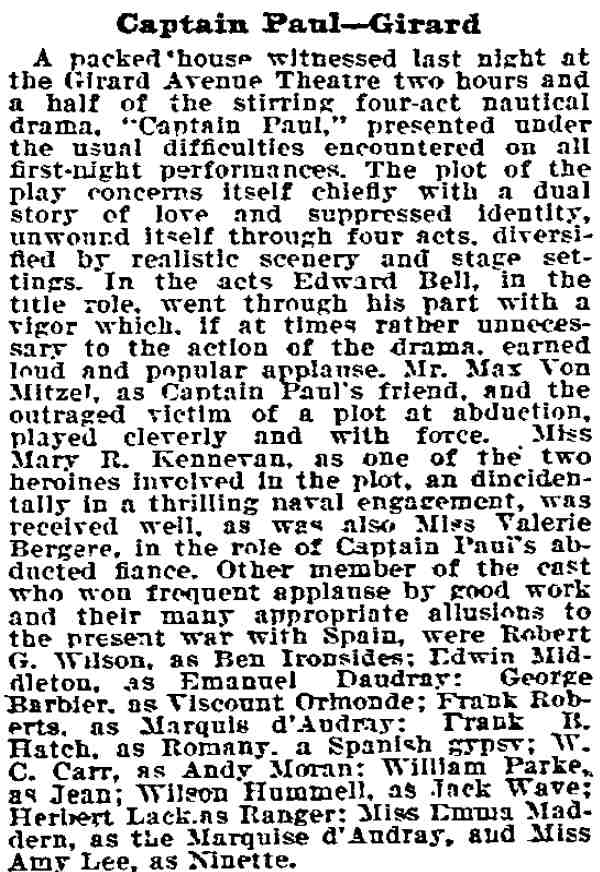
A packed house witnessed last night at the Girard Avenue Theatre two hours and a half of the stirring four-act nautical drama, “Captain Paul,” presented under the usual difficulties encountered on all first-night performances. The plot of the play concerns itself chiefly with a dual story of love and suppressed identity, unwound itself through four acts, diversified by realistic scenery and stage settings. In the acts Edward Bell, in the title role, went through his part with a vigor which, if at times rather unnecessary to the action of the drama, earned loud and popular applause. Mr. Max Von Mitzel, as Captain Paul’s friend, and the outraged victim of a plot at abduction, played cleverly and with force. Miss Mary R. Kenneran, as one of the two heroines involved in the plot, and incidentally in a thrilling naval engagement, was received well, as was also Miss Valerie Bergere, in the role of Captain Paul’s abducted fiance. Other member of the cast who won frequent applause by good work and their many appropriate allusions to the present war with Spain, were Robert G. Wilson, as Ben Ironsides; Edwin Middleton, as Emanuel Daudray; George Barbier, as Viscount Ormonde; Frank Roberts, as Marquis d’Audray; Frank B. Hatch, as Romany, a Spanish gypsy; W. C. Carr, as Andy Moran; William Parke, as Jean; Wilson Hummell, as Jack Wave; Herbert Lack, as Ranger; Miss Emma Maddern, as the Marquise d’Audray, and Miss Amy Lee, as Ninette.
Philadelphia Inquirer,
If I Were King
This play, set in France, ran on Broadway for 56 nights. William Parke worked with E.H. Sothern in this show, who had employed him as a stage manager in his production of Hamlet. Also in the cast was a young Cecilia Loftus.
If I Were King
William Parke as Jehan Le Loup
October 14, 1901–December 1901
ANXIOUS TO GO ON STAGE
Baltimore Sun —
A Crowd Of Women Apply At Ford’s Through Sun Advertisement.
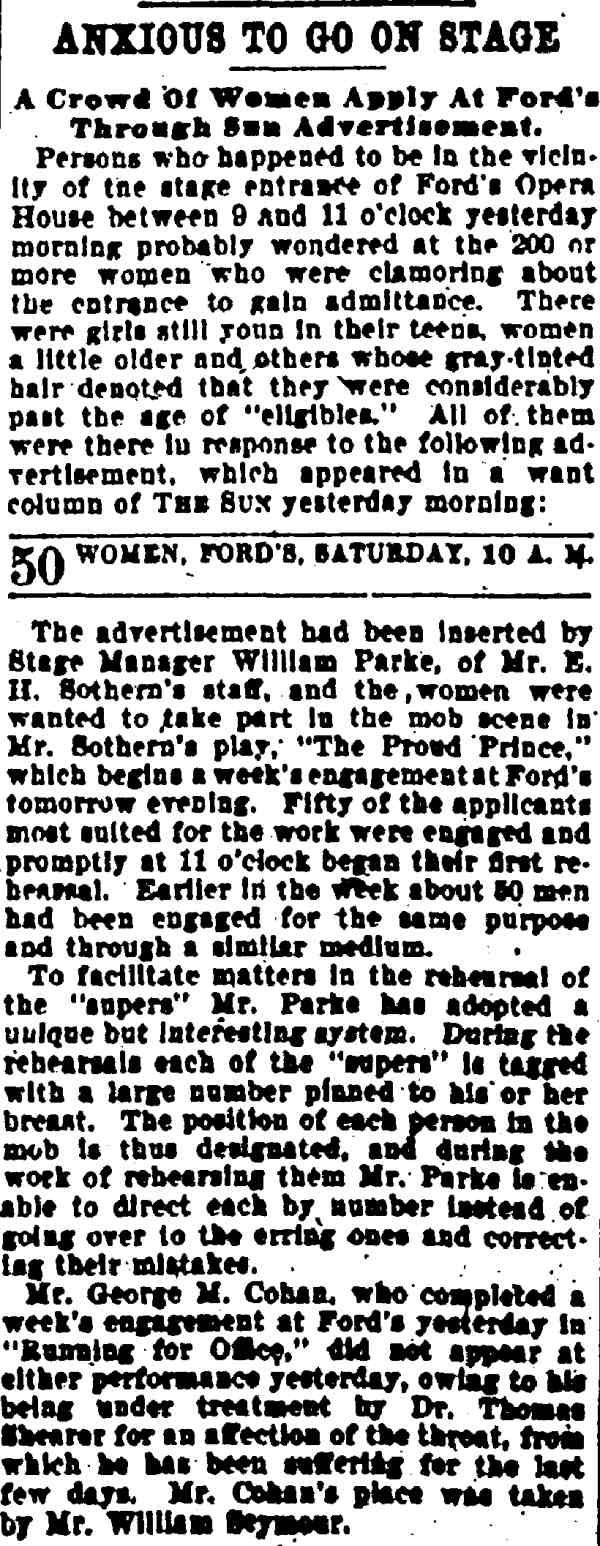
Persons who happened to be in the vicinity of the stage entrance of Ford’s Opera House between 9 and 11 o’clock yesterday morning probably wondered at the 200 or more women who were clamoring about the entrance to gain admittance. There were girls still young in their teens, women a little older and others whose gray-tinted hair denoted that they were considerably past the age of “eligibles.” All of them were there in response to the following advertisement, which appeared in a want column of THE SUN yesterday morning:
50 WOMEN, FORD’S, SATURDAY, 10 A. M.
The advertisement had been inserted by Stage Manager William Parke, of Mr. E. H. Sothern’s staff, and the women were wanted to take part in the mob scene in Mr. Sothern’s play, “The Proud Prince,” which begins a week’s engagement at Ford’s tomorrow evening. Fifty of the applicants most suited for the work were engaged and promptly at 11 o’clock began their first rehearsal. Earlier in the week about 50 men had been engaged for the same purpose and through a similar medium.
To facilitate matters in the rehearsal of the “supers” Mr. Parke has adopted a unique but interesting system. During the rehearsals each of the “supers” is tagged with a large number pinned to his or her breast. The position of each person in the mob is thus designated, and during the work of rehearsing them Mr. Parke is enabled to direct each by number instead of going over to the erring ones and correcting their mistakes.
Mr. George M. Cohan, who completed a week’s engagement at Ford’s yesterday in “Running for Office,” did not appear at either performance yesterday, owing to his being under treatment by Dr. Thomas Shearer for an affection of the throat, from which he has been suffering for the last few days. Mr. Cohan’s place was taken by Mr. William Seymour.
Baltimore Sun,
Boston Herald
Boston Herald —
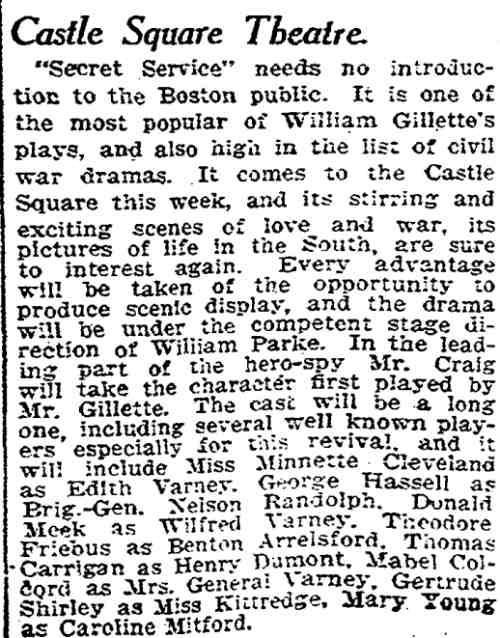
Boston Herald, — “Secret Service” cast: William Gillette, John Craig, Minette Cleveland, George Hassell, Donald Meek, Theodore Friebus, Thomas Carrign, Mabel Colcord, Gertrude Shirley, Mary Young
Springfield Daily News
Springfield Daily News —
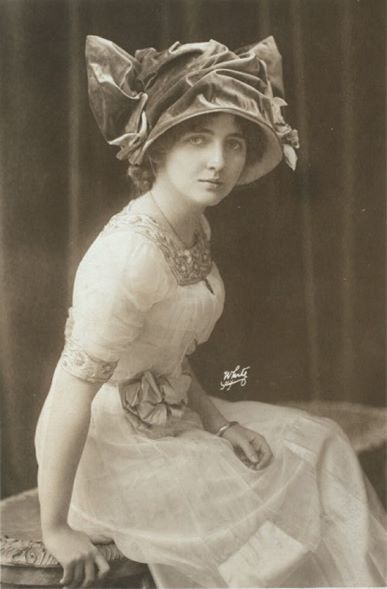
Portrait of Edith Luckett, photograph by White
EDITH LUCKETT.
Springfield Daily News —

She Returns to Springfield Thursday Evening with William Parke’s Stock Company in “Her Husband’s Wife.”
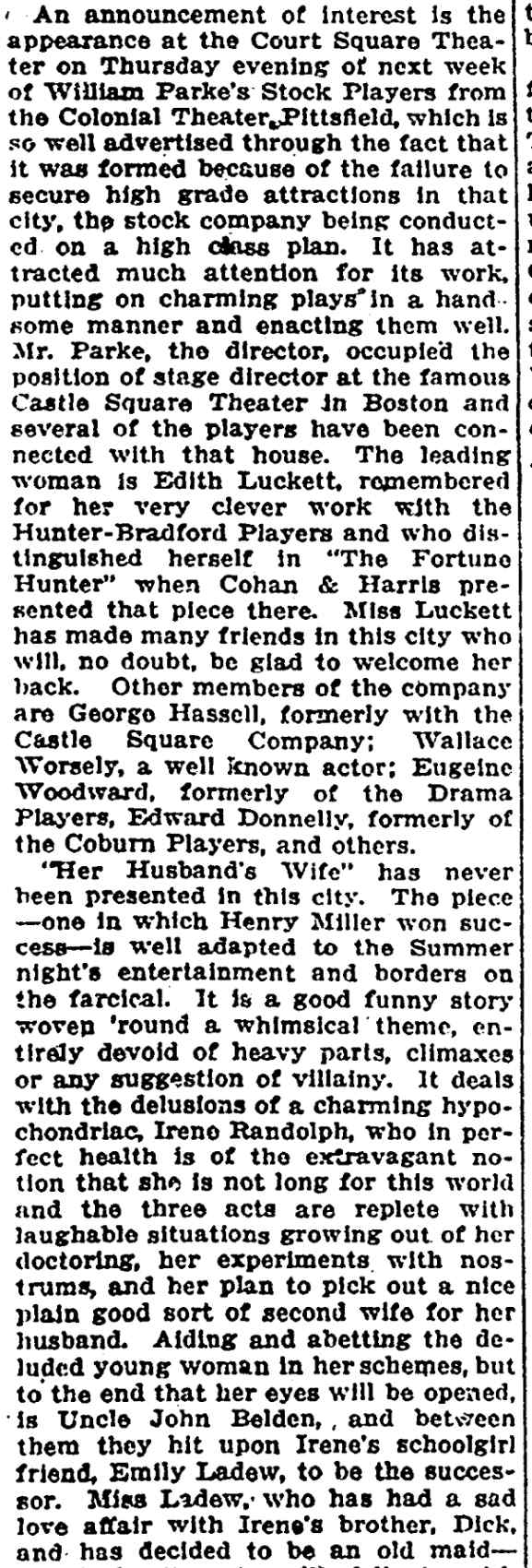
An announcement of interest is the appearance at the Court Square Theater on Thursday evening of next week of William Parke’s Stock Players from the Colonial Theater, Pittsfield, which is so well advertised through the fact that it was formed because of the failure to secure high grade attractions in that city, the stock company being conducted on a high class plan. It has attracted much attention for its work, putting on charming plays in a handsome manner and enacting them well. Mr. Parke, the director, occupied the position of stage director at the famous Castle Square Theater in Boston and several of the players have been connected with that house. The leading woman is Edith Luckett, remembered for her very clever work with the Hunter-Bradford Players and who distinguished herself in “The Fortune Hunter” when Cohan & Harris presented that piece there. Miss Luckett has made many friends in this city who will, no doubt, be glad to welcome her back. Other members of the company are George Hassell, formerly with the Castle Square Company; Wallace Worsely, a well known actor; Eugene Woodward, formerly of the Drama Players, Edward Donnelly, formerly of the Coburn Players, and others.
“Her Husband’s Wife” has never been presented in this city. The piece—one in which Henry Miller won success—is well adapted to the Summer night’s entertainment and borders on the farcical. It is a good funny story woven ‘round a whimsical theme, entirely devoid of heavy parts, climaxes or any suggestion of villainy. It deals with the delusions of a charming hypochondriac, Irene Randolph, who in perfect health is of the extravagant notion that she is not long for this world and the three acts are replete with laughable situations growing out of her doctoring, her experiments with nostrums, and her plan to pick out a nice plain good sort of second wife for her husband. Aiding and abetting the deluded young woman in her schemes, but to the end that her eyes will be opened, is Uncle John Belden, and between them they hit upon Irene’s schoolgirl friend, Emily Ladew, to be the successor. Miss Ladew, who has had a sad love affair with Irene’s brother, Dick, and has decided to be an old maid—
Springfield Daily News, — Edith Luckett, Edward Donnelly, George Hassell, Wallace Worsley; “Her Husband's Wife”; “The Fortune Hunter”; Cohan & Harris
STOCK COMPANY CHANGES.
Springfield Union —
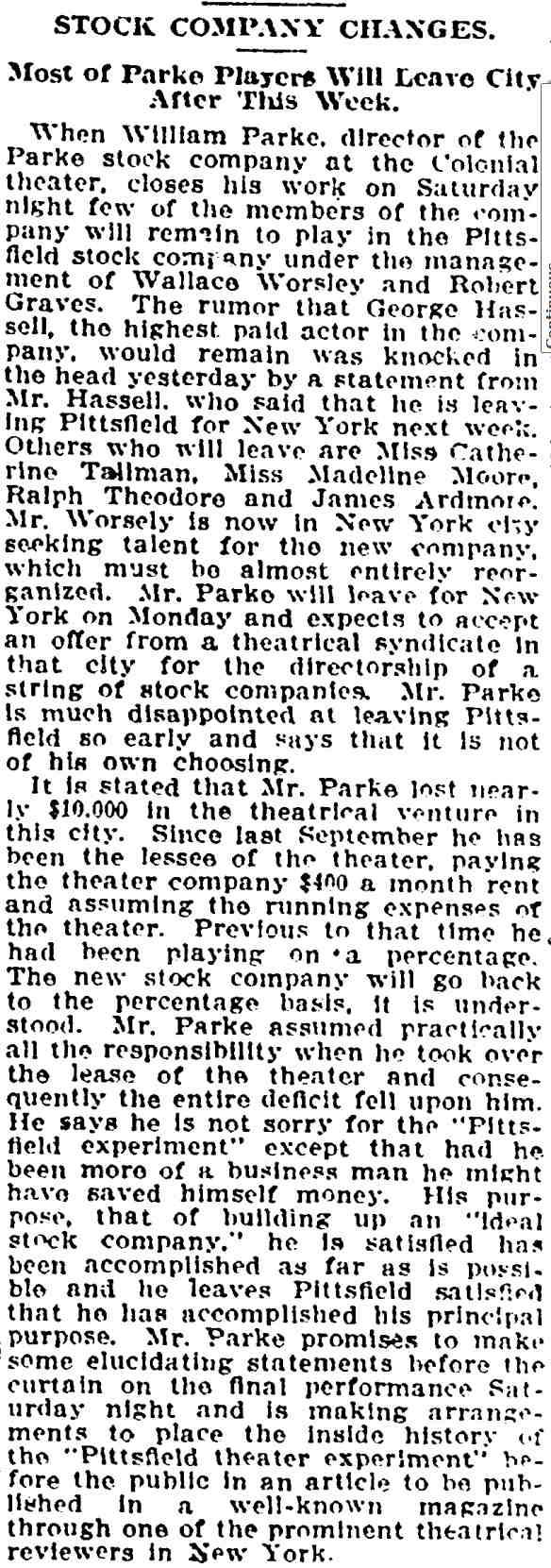
Most of Parke Players Will Leave City After This Week.
When William Parke, director of the Parke stock company at the Colonial theater, closes his work on Saturday night few of the members of the company will remain to play in the Pittsfield stock company under the management of Wallace Worsley and Robert Graves. The rumor that George Hassell, the highest paid actor in the company, would remain was knocked in the head yesterday by a statement from Mr. Hassell, who said that he is leaving Pittsfield for New York next week. Others who will leave are Miss Catherine Tallman, Miss Madeline Moore, Ralph Theodore and James Ardmore. Mr. Worsely is now in New York city seeking talent for the new company, which must be almost entirely reorganized. Mr. Parke will leave for New York on Monday and expects to accept an offer from a theatrical syndicate in that city for the directorship of a string of stock companies. Mr. Parke is much disappointed at leaving Pittsfield so early and says that it is not of his own choosing.
It is stated that Mr. Parke lost nearly $10,000 in the theatrical venture in this city. Since last September he has been the lessee of the theater, paying the theater company $400 a month rent and assuming the running expenses of the theater. Previous to that time he had been playing on a percentage. The new stock company will go back to the percentage basis, it is understood. Mr. Parke assumed practically all the responsibility when he took over the lease of the theater and consequently the entire deficit fell upon him. He says he is not sorry for the “Pittsfield experiment” except that had he been more of a business man he might have saved himself money. His purpose, that of building up an “ideal stock company,” he is satisfied has been accomplished as far as is possible and he leaves Pittsfield satisfied that he has accomplished his principal purpose. Mr. Parke promises to make some elucidating statements before the curtain on the final performance Saturday night and is making arrangements to place the inside history of the “Pittsfield theater experiment” before the public in an article to be published in a well-known magazine through one of the prominent theatrical reviewers in New York.
Springfield Union, Springfield, Massachusetts,
Great Men Among Us (1915)
William Parke's film directorial debut, entitled Great Men Among Us. Little is known of this movie and it, like most of William Parke's works, is presumed lost.
1915
A Burglar's Picnic (1916)
“A three-reel subject with pleasing juvenile interest, by Clinton H. Stagg. The Fairbanks Twins are featured. They and their schoolgirl chums go into the woods for a midnight picnic. The old professor follows, loses his glasses and gets into a deserted house where two burglars are making headquarters. The girls appear and the burglars are captured. The later scenes, on the wrecked train, contain more action and the close is satisfying. There is no effort at sensationalism, the pleasing results being obtained by a natural development of the story. The Twins are very attractive in this.”
A Burglar's Picnic
Directed by William Parke
for Thanhouser Film Corporation
Released January 26, 1916
Moving Picture World, February 5, 1916
The Knotted Cord (1916)
“A three-reel mystery story, by Clinton H. Stagg, featuring Bert Delaney, Mignon Anderson, and others. The story is one that catches and holds the interest from the beginning. The appearance of a knotted cord means that the millionaire and the young detective are marked for death. The former is killed, but the detective outwits the gang after numerous adventures. This is well constructed and has several moments of melodrama, which is enjoyable in this type of story. The ending contains a surprise. Altogether this makes a successful offering.”
The Knotted Cord
Directed by William Parke
for Thanhouser Film Corporation
Released February 2, 1916
Moving Picture World, February 5, 1916
The Reunion (1916)
“A three-reel story of delicate sentiment and true pathos by Virginia T. Hudson and Clinton H. Stagg. J.H. Gilmour appears as a soldier boy of '61 and later as a veteran attending the Grand Army reunion in Washington, D.C. Actual scenes from the parade are deftly woven into the story. The former nurse attends the reunion and sees her lover of war days in the parade. This plot has been used before, but is handled very effectively here. The letter incident is well pictured. This is full of genuine feeling and has good humorous touches running through it.”
The Reunion
Directed by William Parke
for Thanhouser Film Corporation
Released February 23, 1916
Moving Picture World, February 26, 1916
The Whispered Word (1916)
“A two reel subject written by Clinton H. Stagg, featuring J.H. Gilmour and Grace DeCarlton. This starts out with divorce proceedings in which the father is awarded custody of his little daughter. The girl grows up lonely and neglected, and at length runs off to a cabaret for a good time. Here she meets a party of young people. Her father casts her off and she marries one of the men, who becomes a drunkard. The transition scene is too sudden. The husband later reforms so that when the baby is about to be born there is a reconciliation with the father. The story is interesting, but not very convincing at times. This makes only a fairly strong offering.”
The Whispered Word
Directed by William Parke
for Thanhouser Film Corporation
Released February 23, 1916
Moving Picture World, March 25, 1916
The Fifth Ace (1916)
“A two-reel number by Clinton H. Stagg, featuring Alice Lake, Wayne Arey, and others. This pictures the way a card sharp breaks into a house party and throws suspicion on the hero. The card game is well put on. Later the crook tries to get away with a valuable necklace and the hero turns tables on him. This is well constructed and holds the interest closely throughout.”
The Fifth Ace
Directed by William Parke
for Thanhouser Film Corporation
Released February 23, 1916
Moving Picture World, April 1, 1916
Other People's Money (1916)
“Exposé of a band of notorious get-rich-quick schemers and their nefarious methods pursued in obtaining the confidences and frequently the savings of a gullible public has been made the basis for a stirring photodrama to be released shortly by the Mutual Film Corporation. In the preparation of the scenario the Thanhouser-Mutual studios were furnished with considerable data by federal agents and by several noted government sleuths who have been instrumental in breaking up a number of bands of notorious get-rich-quick plotters. This stirring production will be released through the Mutual as a Masterpicture, DeLuxe Edition, under the title of Other People's Money. The five acts of the piece are alive with action and replete with thrilling situations. Throughout runs an unusually pleasing love story, ending with the happy marriage of the young girl who brings about the exposé of the band and the young detective, with whom she worked. Gladys Hulette, the five-foot star of the Thanhouser-Mutual productions, is the featured player, supported by an extraordinary company of players, headed by Fraunie Fraunholz, a newcomer, but by no means an unknown player. Other People's Money will be released in five acts, May 29.”
Other People's Money
Directed by William Parke
for Thanhouser Film Corporation
Released June 1, 1916
Moving Picture World, June 3, 1916
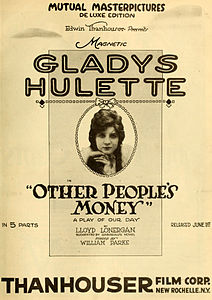
Other People's Money (1916)
MUTUAL MASTERPICTURES
DE LUXE EDITION
Edwin Thanhouser Presents
MAGNETIC
GLADYS HULETTE
"OTHER PEOPLE'S MONEY"
A PLAY OF OUR DAY
IN 5 PARTS RELEASED JUNE 8?
LLOYD LONERGAN
[illegible line]
WILLIAM PARKE
THANHOUSER FILM CORP.
NEW ROCHELLE, N.Y.
The Shine Girl (1916)
“The Park Theatre in Boston, managed by Thomas D. Sorerio, had one of the biggest days in its history on Monday, September 25. Gladys Hulette, the Thanhouser star, appeared in person at three showings of her Pathé Gold Rooster play, The Shine Girl all week. Such a drawing card was Miss Hulette that the Park played to capacity all day and crowds were waiting to get in even for the 6 o'clock performance. When Miss Hulette arrived at the theatre for her afternoon appearance, after she was snapped by the newspaper photographers and the Pathé Weekly [newsreel] man, she was taken to her dressing room over the entrance to the theatre. Ten minutes later, when she tried to leave the room, the key jammed in the lock and she was unable to get out. (At least so said the Thanhouser press agent.) She had to appear on the stage at 3 o'clock. An extension ladder was run up to the window from which Miss Hulette was calling for aid. By this time the street was crowded with people from curb to curb. Miss Hulette obviously couldn't climb down three stories, above the heads of such a crowd in the gown she was going to wear on the stage. Somebody solved the problem by finding a pair of overalls. Miss Hulette donned the overalls, scrambled down the ladder and ran into the theatre, on time for her performance. In the evening Mr. Sorerio gave a banquet for Miss Hulette.”
The Shine Girl
Directed by William Parke
for Thanhouser Film Corporation
Released August 27, 1916
Unknown Boston newspaper, Late September, 1916
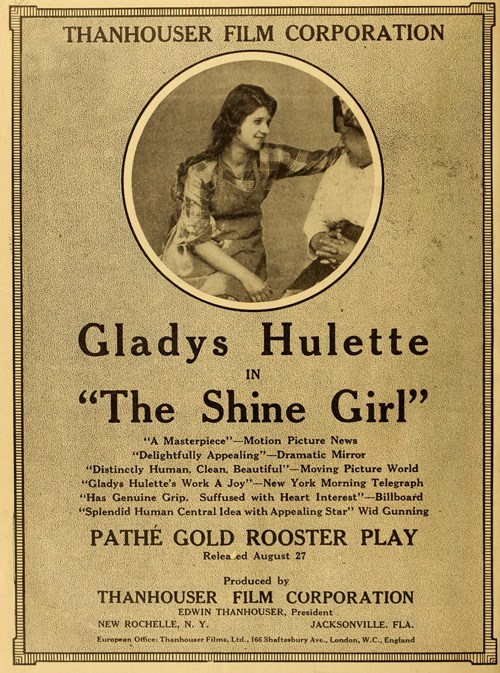
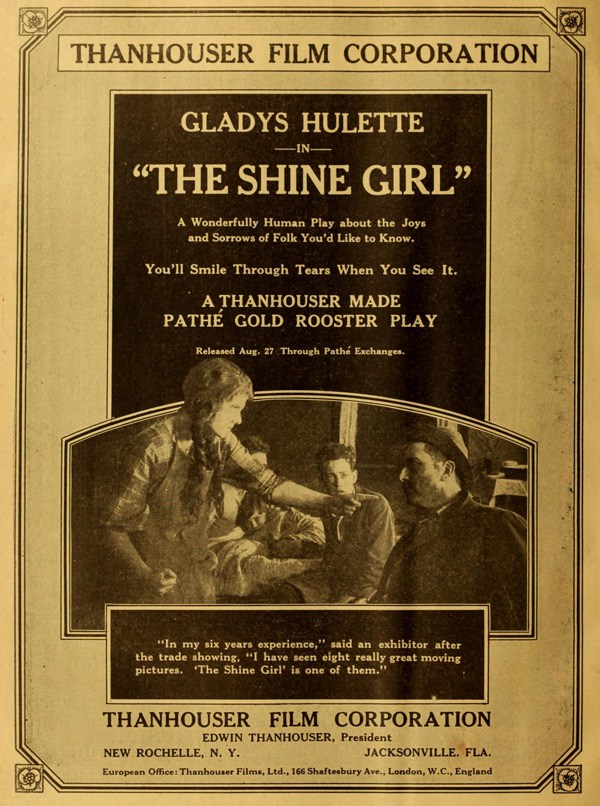
Gladys Hulette in The Shine Girl (1916)
THANHOUSER FILM CORPORATION
Gladys Hulette
IN
"The Shine Girl"
"A Masterpiece"—Motion Picture News
"Delightfully Appealing"—Dramatic Mirror
"Distinctly Human, Clean, Beautiful"—Moving Picture World
"Gladys Hulette's Work A Joy"—New York Morning Telegraph
"Has Genuine Grip. Suffused with Heart Interest"—Billboard
"Splendid Human Central Idea with Appealing Star" Wid Gunning
PATHÉ GOLD ROOSTER PLAY
Released August 27
Produced by
THANHOUSER FILM CORPORATION
EDWIN THANHOUSER, President
NEW ROCHELLE, N. Y. JACKSONVILLE, FLA.
European Office: Thanhouser Films, Ltd., 166 Shaftesbury Ave., London, W.C., England
THANHOUSER FILM CORPORATION
GLADYS HULETTE
—IN—
"THE SHINE GIRL"
A Wonderfully Human Play about the Joys and Sorrows of Folk You'd Like to Know.
You'll Smile Through Tears When You See It.
A THANHOUSER MADE
PATHÉ GOLD ROOSTER PLAY
Released Aug. 27 Through Pathé Exchanges.
"In my six years experience," said an exhibitor after the trade showing, "I have seen eight really great moving pictures. 'The Shine Girl' is one of them."
THANHOUSER FILM CORPORATION
EDWIN THANHOUSER, President
NEW ROCHELLE, N. Y. JACKSONVILLE. FLA.
European Office: Thanhouser Films, Ltd., 166 Shaftesbury Ave., London, W.C., England
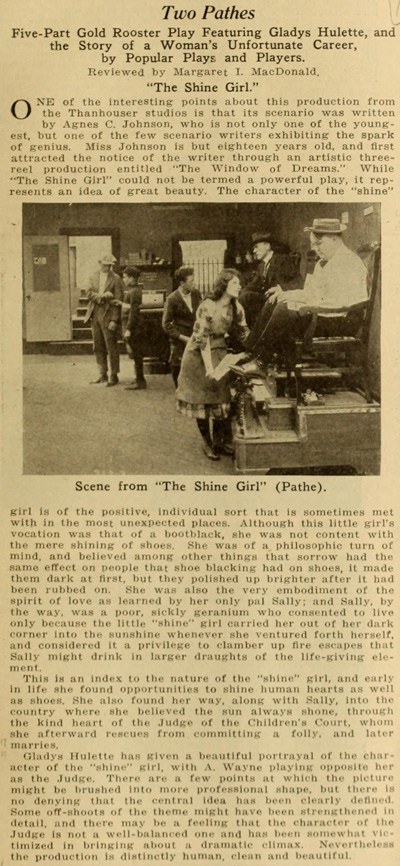
Two Pathés
Five-Part Gold Rooster Play Featuring Gladys Hulette, and the Story of a Woman's Unfortunate Career, by Popular Plays and Players.
Reviewed by Margaret I. MacDonald.
"The Shine Girl."
ONE of the interesting points about this production from the Thanhouser studios is that its scenario was written by Agnes C. Johnson, who is not only one of the youngest, but one of the few scenario writers exhibiting the spark of genius. Miss Johnson is but eighteen years old, and first attracted the notice of the writer through an artistic three-reel production entitled "The Window of Dreams." While "The Shine Girl" could not be termed a powerful play, it represents an idea of great beauty. The character of the "shine" girl is of the positive, individual sort that is sometimes met with in the most unexpected places. Although this little girl's vocation was that of a bootblack, she was not content with the mere shining of shoes. She was of a philosophic turn of mind, and believed among other things that sorrow had the same effect on people that shoe blacking had on shoes, it made them dark at first, but they polished up brighter after it had been rubbed on. She was also the very embodiment of the spirit of love as learned by her only pal Sally; and Sally, by the way, was a poor, sickly geranium who consented to live only because the little "shine" girl carried her out of her dark corner into the sunshine whenever she ventured forth herself, and considered it a privilege to clamber up fire escapes that Sally might drink in larger draughts of the life-giving element.
This is an index to the nature of the "shine" girl, and early in life she found opportunities to shine human hearts as well as shoes. She also found her way, along with Sally, into the country where she believed the sun always shone, through the kind heart of the Judge of the Children's Court, whom she afterward rescues from committing a folly, and later marries.
Gladys Hulette has given a beautiful portrayal of the character of the "shine" girl, with A. Wayne playing opposite her as the Judge. There are a few points at which the picture might be brushed into more professional shape, but there is no denying that the central idea has been clearly defined. Some off-shoots of the theme might have been strengthened in detail, and there may be a feeling that the character of the Judge is not a well-balanced one and has been somewhat victimized in bringing about a dramatic climax. Nevertheless the production is distinctly human, clean and beautiful.
Scene from "The Shine Girl" (Pathe).
Gladys Hulette, Thanhouser star, seeks the ugliest pup in the world. Other motion picture actresses may have overpowering ambitions for a herd of motor cars, some may seek jewels, a few may hope to marry the most beautiful man alive, but those desires are not a part of Gladys Hulette. She wants an ugly pup.
Evansville Evening Courier —
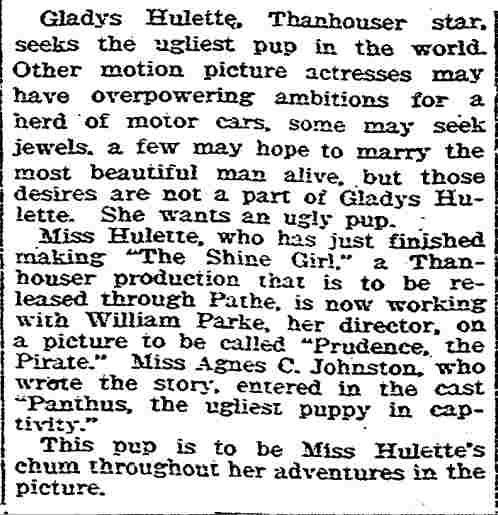
Miss Hulette, who has just finished making “The Shine Girl,” a Thanhouser production that is to be released through Pathe, is now working with William Parke, her director, on a picture to be called “Prudence, the Pirate.” Miss Agnes C. Johnston, who wrote the story, entered in the cast “Panthus, the ugliest puppy in captivity.”
This pup is to be Miss Hulette’s chum throughout her adventures in the picture.
Evansville Evening Courier, Evansville, Indiana, — Gladys Hulette, Panthus the Pup, Agnes C. Johnston
SUCCESS OF A COBBLER WHO DEFIED AN ADAGE
Elkhart Truth —
Pete Ragolli’s Work in Pictures Proves That it Isn’t Always Wise to Stick to Your Last.
FEATURE OF “THE SHINE GIRL”
You know the old saying—“Some are born great, others achieve greatness and still others have it thrust upon them.” Pete Ragolli comes under the last head.
Pete is a 74-year-old Italian cobbler with a little shop in the basement of a Mulberry street tenement in New York. Until a few weeks ago fame had never blinked an eyelash at him and it looked like “tap, tap, tap,” with his hammer until the end of his days. But Dame Fortune is an erratic lady. She saw that Pete was a good cobbler, that he worked hard and was honest, so she crooked her finger to William Parke, the Thanhouser director, who was casting “The Shine Girl,” the Pathe Gold Rooster Play. Mr. Parke didn’t see the lady but something led him to the Ragolli shoe repairing emporium. He was looking for an Italian cobbler “type” and in Pete he found it. Not only did he persuade Pete to leave his shop for a while to work in pictures but Mrs. Ragolli as well.
Peter liked working in pictures. No young tyro ever worked more enthusiastically than he. His ardor was infectious. No scene that he appeared in required a retake. Pete proved to be a true actor despite the fact that for fifty years he had been serving humanity along humble lines.
When you see Pete’s honest old wrinkled face in “The Shine Girl” you’ll like him, for he plays his part as to the manner born (as indeed he was) and he very evidently is enjoying himself.
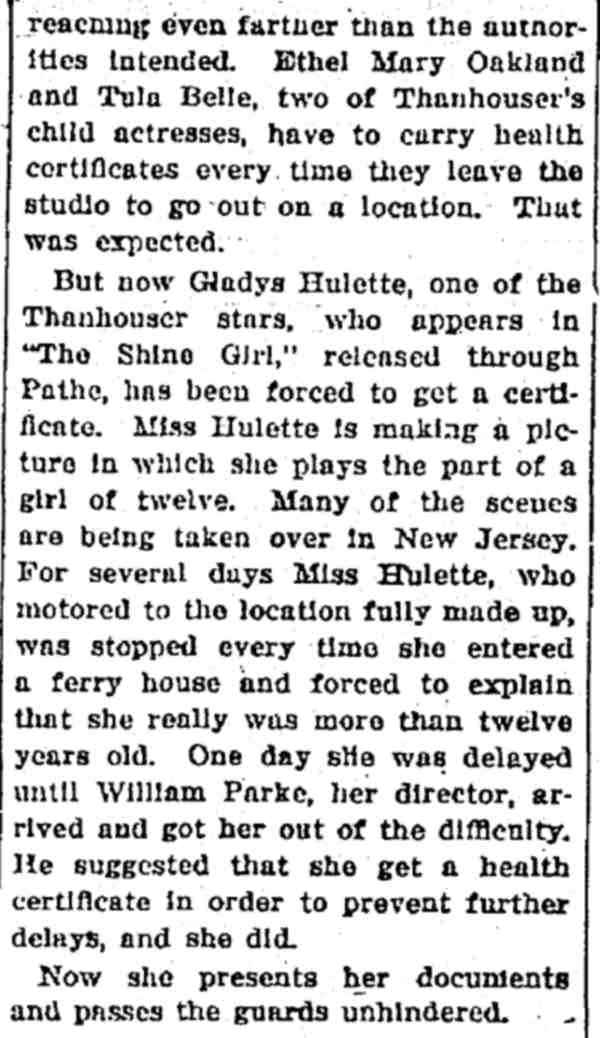
GLADYS HULETTE
Precautions to check the infantile paralysis epidemic in New York are reaching even farther than the authorities intended. Ethel Mary Oakland and Tula Belle, two of Thanhouser’s child actresses, have to carry health certificates every time they leave the studio to go out on a location. That was expected.
But now Gladys Hulette, one of the Thanhouser stars, who appears in “The Shine Girl,” released through Pathe, has been forced to get a certificate. Miss Hulette is making a picture in which she plays the part of a girl of twelve. Many of the scenes are being taken over in New Jersey. For several days Miss Hulette, who motored to the location fully made up, was stopped every time she entered a ferry house and forced to explain that she really was more than twelve years old. One day she was delayed until William Parke, her director, arrived and got her out of the difficulty. He suggested that she get a health certificate in order to prevent further delays, and she did.
Now she presents her documents and passes the guards unhindered.
Elkhart Truth, Elkhart, Indiana, — Ethel Mary Oakland, Tula Belle, Gladys Hulette; Pete Ragolli
GLADYS HULETTE IN “SHINE GIRL”
Trenton Evening Times —
“The Shine Girl,” which the St. Regis Theatre will present today, is said by a motion picture authority to be one of the eight great pictures he has seen in the last six years.
“The Shine Girl” has been described as “The Peg-o’-My-Heart” of the screen. In it, Gladys Hulette plays a Mary Pickford part with such charm as to bring from the New York Morning Telegraph this comment: “Gladys Hulette is the little slum philosopher, and her work is a joy.”
“The Shine Girl” is a human interest gem in five parts. It was written by Agnes C. Johnston, and it shows the hand of a master director, William Parke.
The dingy depths of a shoe-shining basement hold 5,000 feet of sunniness. “The Shine Girl,” while shining shoes with her little hands, polishes up the grouchy and brooding souls with a cheerful word and smile.
Trenton Evening Times, — Gladys Hulette, Mary Pickford, Agnes C. Johnston
Prudence the Pirate (1916)
“As a whole: entertaining; story: conventional; star: lacks vivacity; cast: adequate; settings: good; photography: clear.
“In this Thanhouser photoplay we are given some fine touches of comedy, good direction and excellent screen acting. Flora Finch is cast in the role of Aunty, while Riley Chamberlin contributes a goodly portion of the fun as Meeks. Miss Hulette, beautiful and pleasing as ever, did not seem to get all the comedy out of the part assigned to her. The supporting cast is well chosen. Prudence should prove to be a good attraction and is well up to the Thanhouser standard. Prudence, just out of boarding school, returns to her aunt's home where she is to enter society. She objects decidedly, and after several escapades, particularly directed against one Astorbilt, the season's 'catch,' she finds a warm friend finally in the person of the family butler. Meeks confides to Prudence that he has been a sailor and 'seen things.' When pressed further concerning his seafaring life he confides that he was once a pirate. He tells of his adventures and Prudence, her romantic nature fired, decides to becomes a buccaneer. A schooner is rented and christened The Bucket of Blood, a motley crew of tramps are put aboard, and all is in readiness for a voyage except a chaperon and a deck scrubber. Prudence attacks her aunt's houseboat and kidnaps the old lady and Astorbilt to fill those capacities. Astorbilt, however, bribes the crew to mutiny, and Prudence finds herself in irons on her own ship. The rough and tumble life aboard The Bucket of Blood changes Astorbilt from a pink tea person to a man of steel and Prudence falls in love with him. Fire breaks out on the ship and Astorbilt swims with Prudence to a bell buoy and saves her life. There Prudence, with her customary disregard for convention, promises to lower the black flag and surrender her heart forever. It is a clever comedy, indeed.”
Prudence the Pirate
Directed by William Parke
for Thanhouser Film Corporation
Released October 22, 1916
Exhibitor's Herald, October 21, 1916
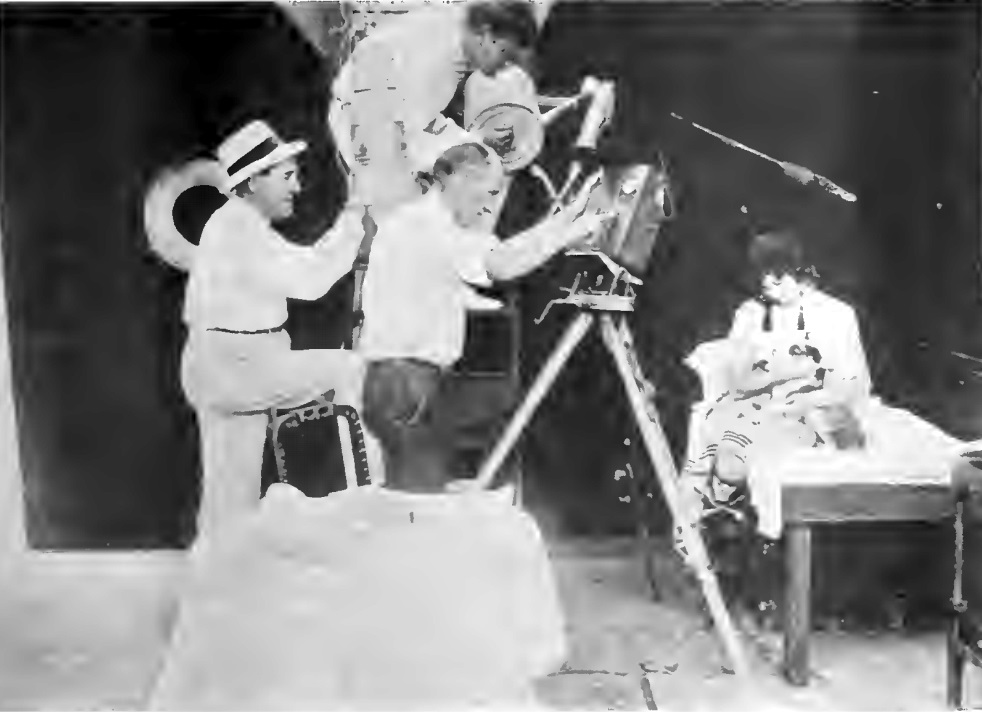
Behind-the-scenes photo from Prudence the Pirate — the man in the hat may be William Parke
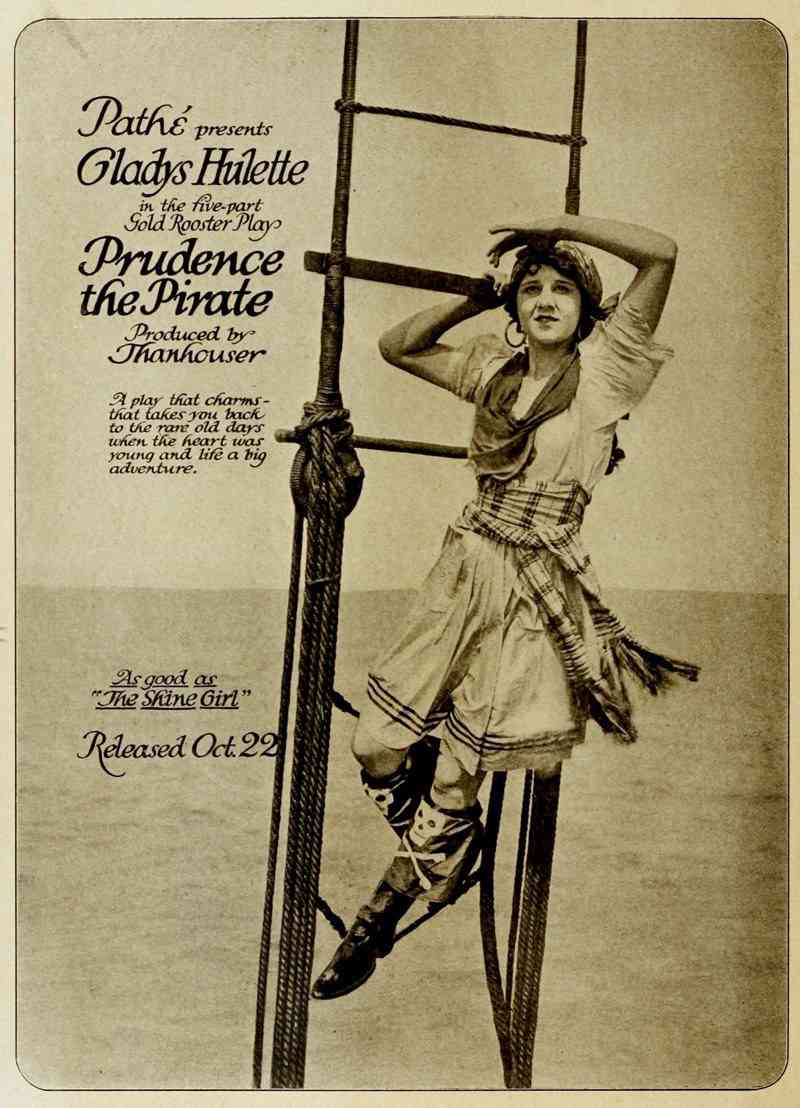
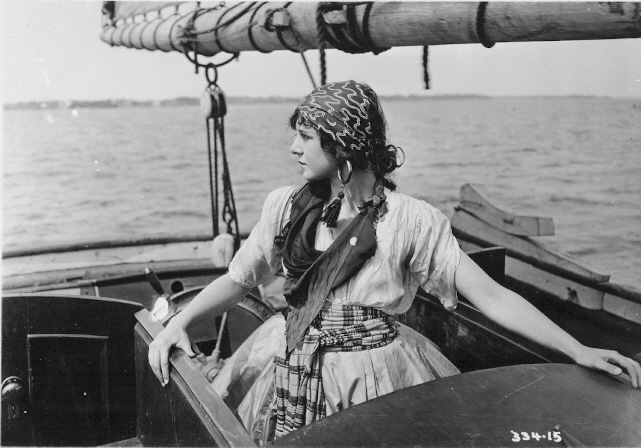
Gladys Hulette as Prudence the Pirate Pathé presents
Gladys Hulette
in the five-part Gold Rooster Play
Prudence the Pirate
Produced by Thanhouser A play that charms—that takes you back to the rare old days when the heart was young and life a big adventure. As good as "The Shine Girl" Released Oct. 22
Pathé presents
Gladys Hulette
in the five-part Gold Rooster Play
Prudence the Pirate
Produced by Thanhouser
A play that charms—that takes you back to the rare old days when the heart was young and life a big adventure.
As good as "The Shine Girl"
Released Oct. 22
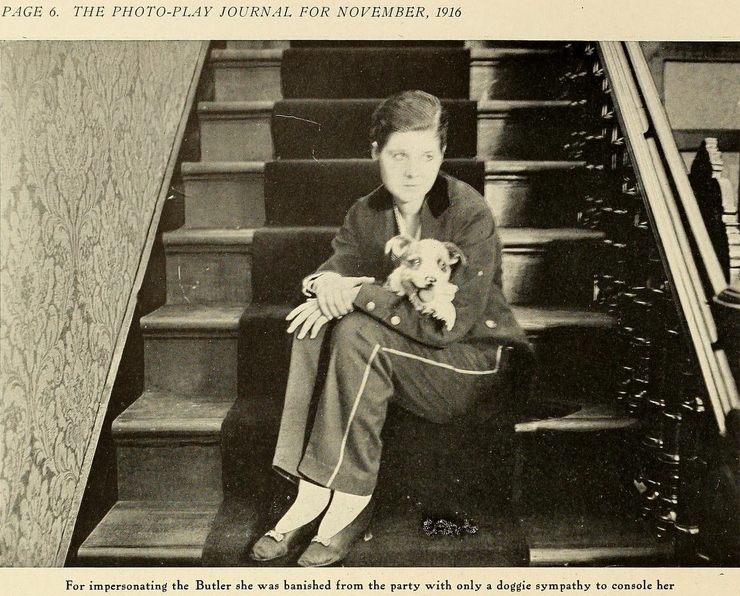
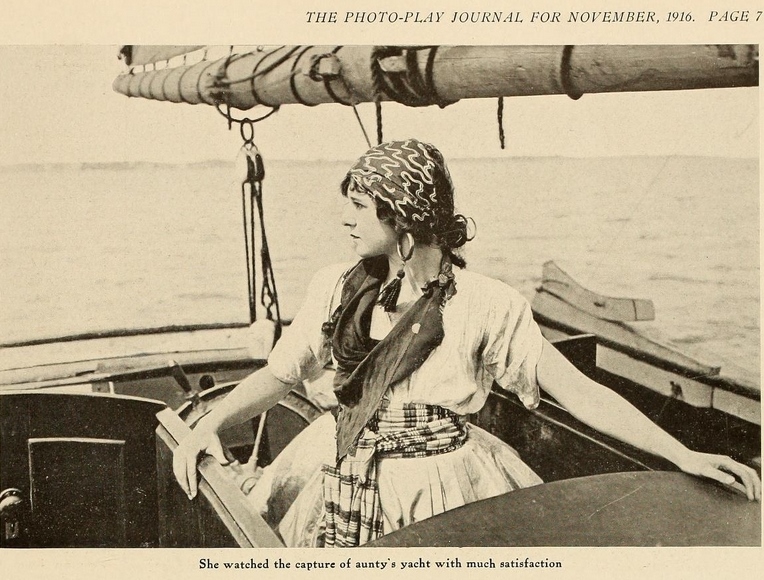
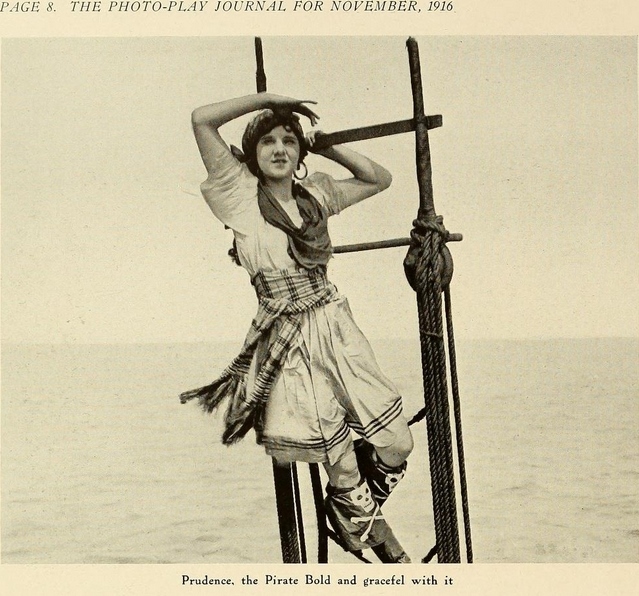
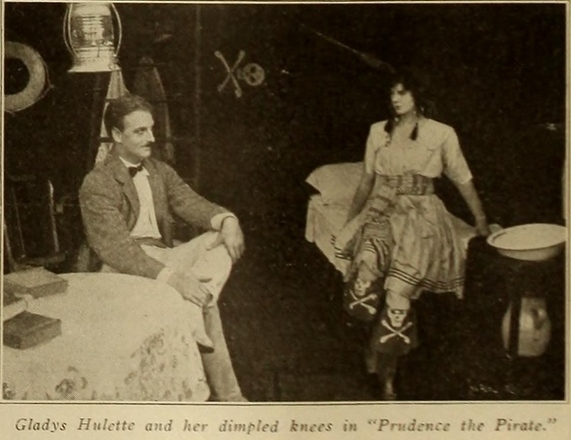
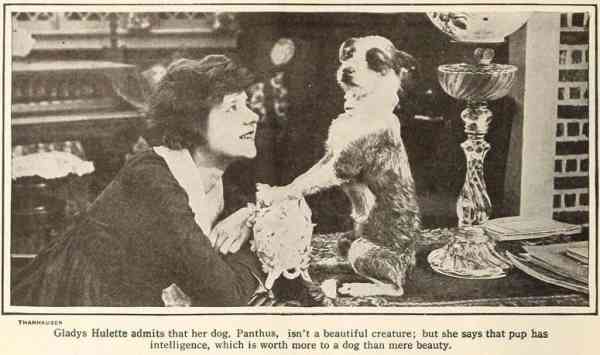
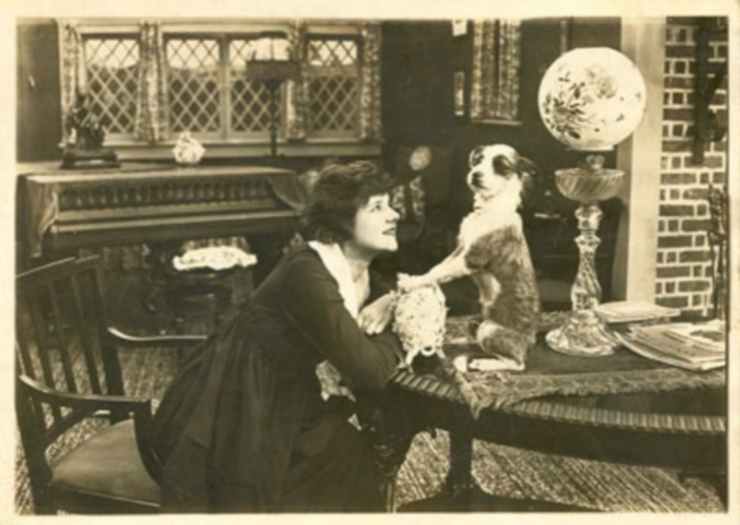
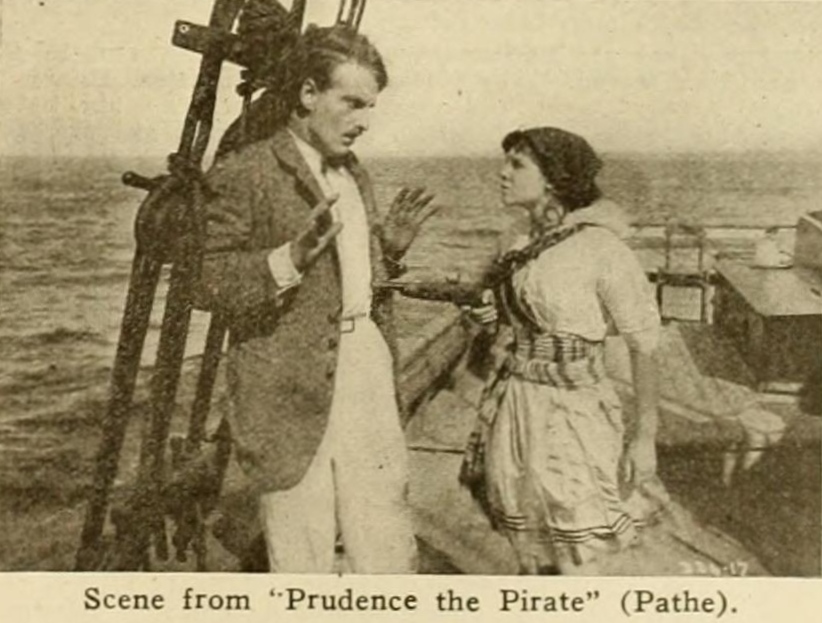
Prudence the Pirate — trade and fan press coverage, 1916 PAGE 6. THE PHOTO-PLAY JOURNAL FOR NOVEMBER, 1916 For impersonating the Butler she was banished from the party with only a doggie sympathy to console her THANHAUSER Gladys Hulette admits that her dog, Panthus, isn't a beautiful creature; but she says that pup has intelligence, which is worth more to a dog than mere beauty. Scene from "Prudence the Pirate" (Pathe). PAGE 8. THE PHOTO-PLAY JOURNAL FOR NOVEMBER, 1916 Prudence, the Pirate Bold and graceful with it
Gladys Hulette and her dimpled knees in "Prudence the Pirate."
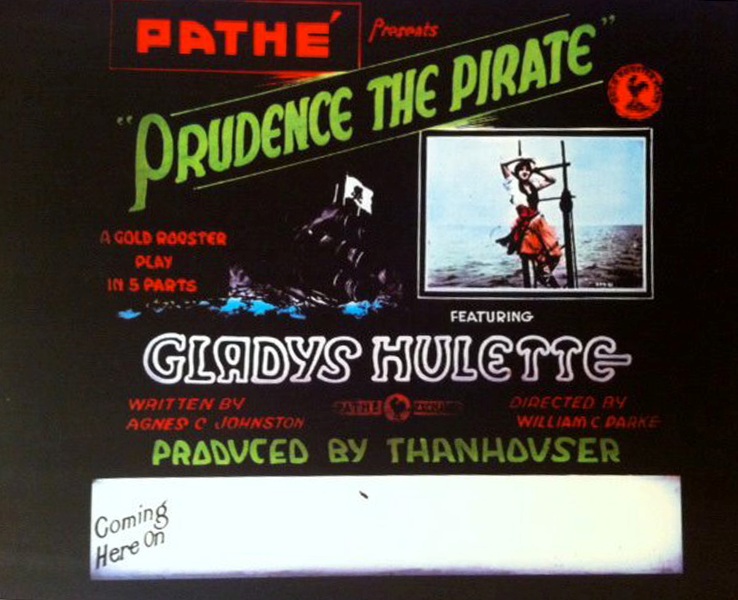
Prudence the Pirate glass slide
PATHÉ Presents
"PRUDENCE THE PIRATE"
A GOLD ROOSTER PLAY IN 5 PARTS
FEATURING
GLADYS HULETTE
WRITTEN BY AGNES C. JOHNSTON
DIRECTED BY WILLIAM C. PARKE
PRODUCED BY THANHOUSER
Coming Here On
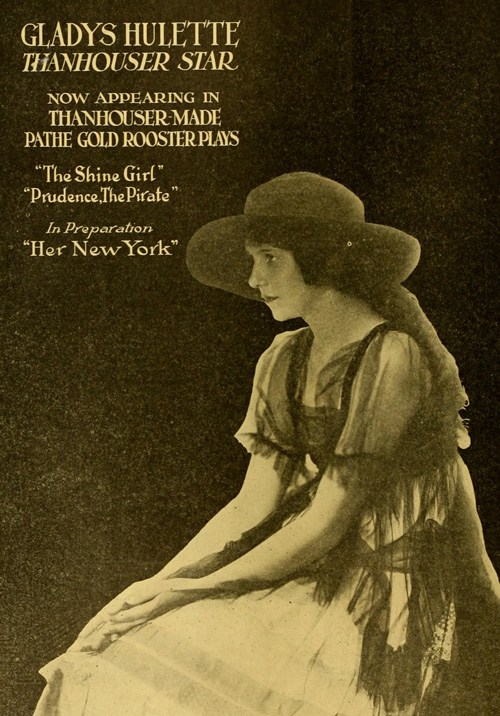
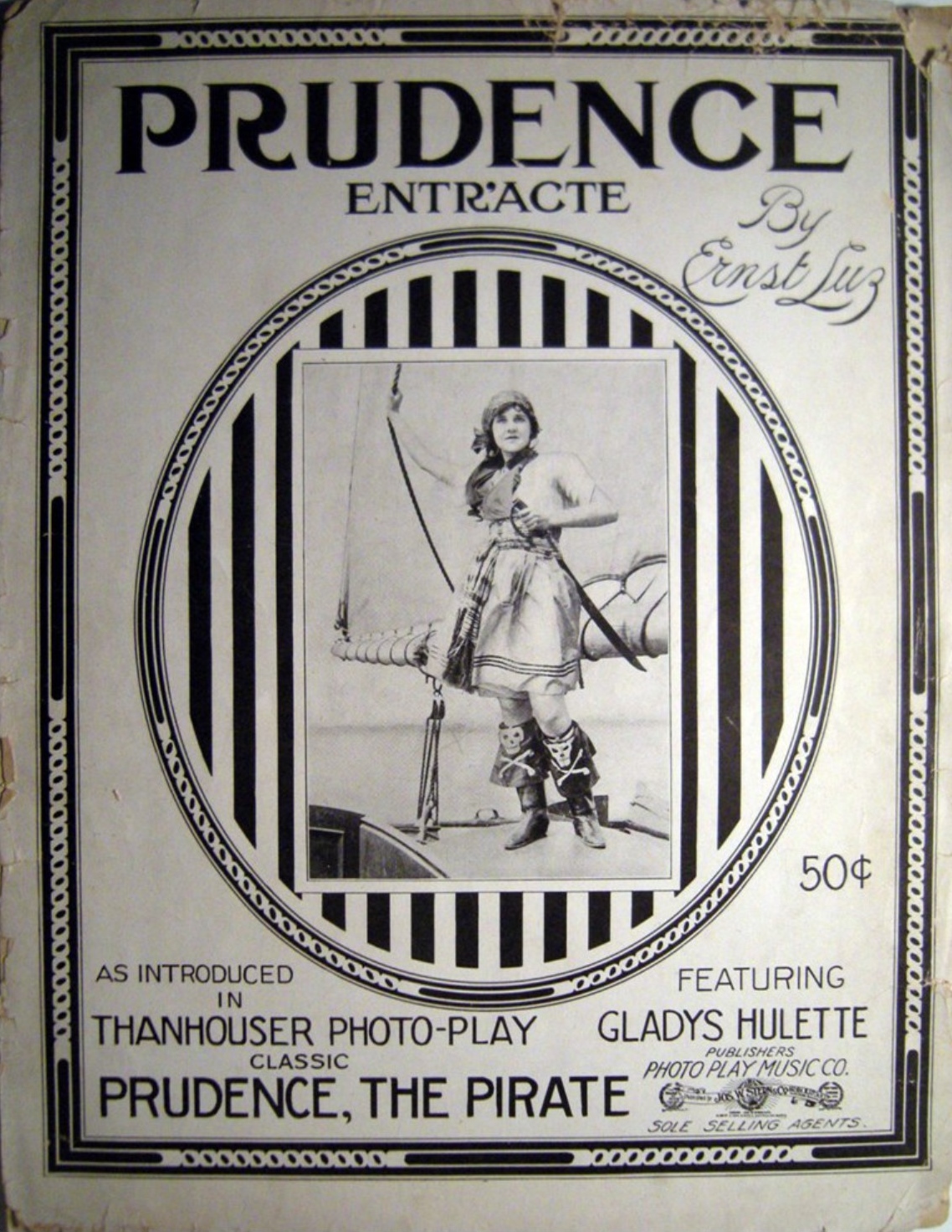
Merchandising, 1916 style — sheet music from Prudence the Pirate, Thanhouser Company GLADYS HULETTE
THANHOUSER STAR NOW APPEARING IN
THANHOUSER-MADE
PATHE GOLD ROOSTER PLAYS "The Shine Girl"
"Prudence, The Pirate" In Preparation
"Her New York"
PRUDENCE
ENTR'ACTE
By Ernst Luz
50¢
AS INTRODUCED IN
THANHOUSER PHOTO-PLAY CLASSIC
PRUDENCE, THE PIRATE
FEATURING
GLADYS HULETTE
PUBLISHERS
PHOTO PLAY MUSIC CO.
SOLE SELLING AGENTS
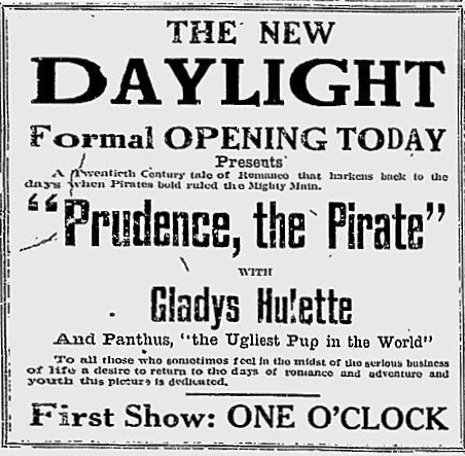
Prudence the Pirate advertisement, Saskatoon, Saskatchewan
THE NEW
DAYLIGHT
Formal OPENING TODAY
Presents
A Twentieth Century tale of Romance that harkens back to the days when Pirates bold ruled the Mighty Main.
"Prudence, the Pirate"
WITH
Gladys Hulette
And Panthus, "the Ugliest Pup in the World"
To all those who sometimes feel in the midst of the serious business of life a desire to return to the days of romance and adventure and youth this picture is dedicated.
First Show: ONE O'CLOCK
“Prudence the Pirate”
Trade paper (not named on the crop) —
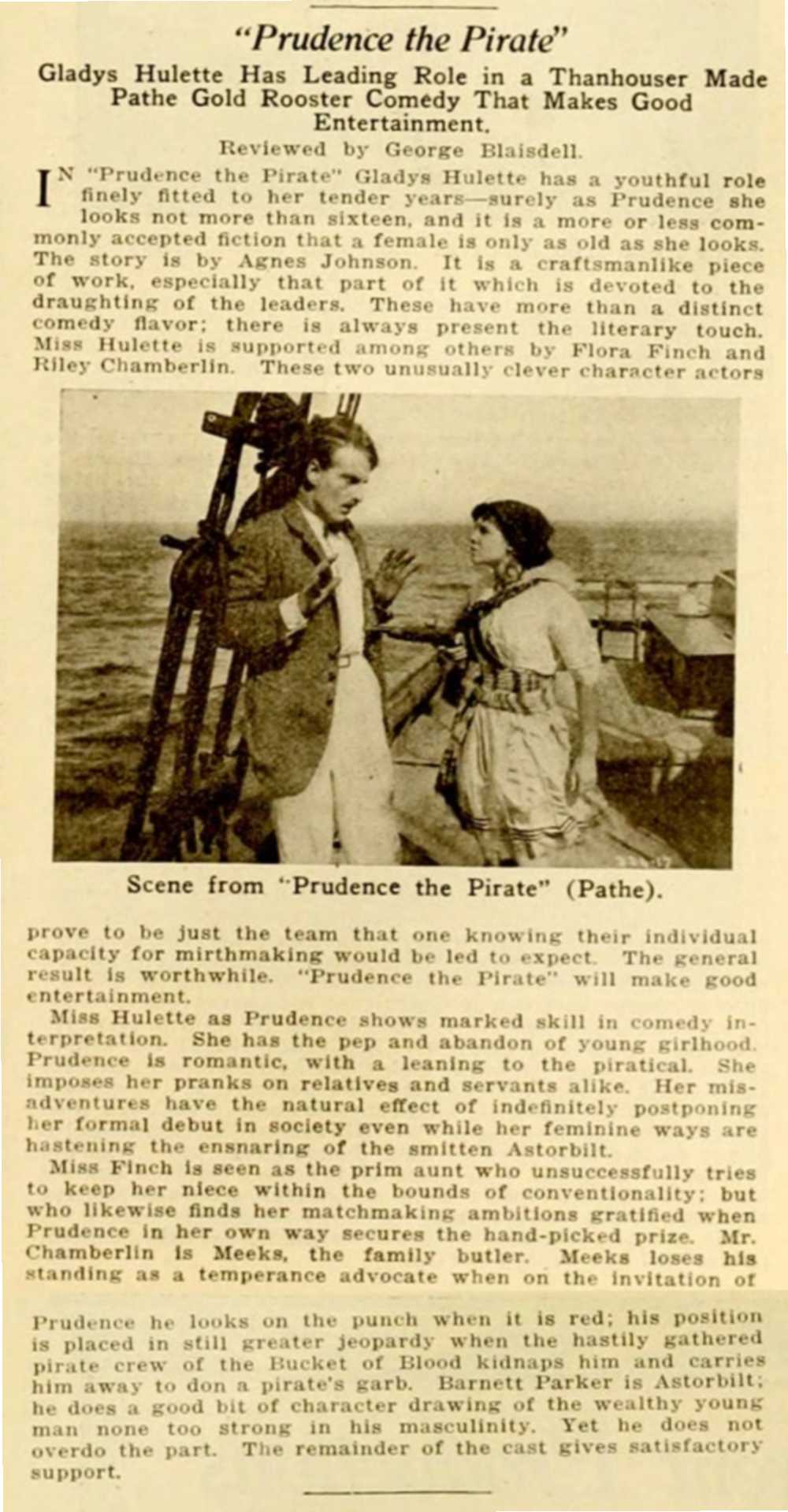
Gladys Hulette Has Leading Role in a Thanhouser Made Pathe Gold Rooster Comedy That Makes Good Entertainment.
Reviewed by George Blaisdell.
IN “Prudence the Pirate” Gladys Hulette has a youthful role finely fitted to her tender years—surely as Prudence she looks not more than sixteen, and it is a more or less commonly accepted fiction that a female is only as old as she looks. The story is by Agnes Johnson. It is a craftsmanlike piece of work, especially that part of it which is devoted to the draughting of the leaders. These have more than a distinct comedy flavor; there is always present the literary touch. Miss Hulette is supported among others by Flora Finch and Riley Chamberlin. These two unusually clever character actors prove to be just the team that one knowing their individual capacity for mirthmaking would be led to expect. The general result is worthwhile. “Prudence the Pirate” will make good entertainment.
Miss Hulette as Prudence shows marked skill in comedy interpretation. She has the pep and abandon of young girlhood. Prudence is romantic, with a leaning to the piratical. She imposes her pranks on relatives and servants alike. Her misadventures have the natural effect of indefinitely postponing her formal debut in society even while her feminine ways are hastening the ensnaring of the smitten Astorbilt.
Miss Finch is seen as the prim aunt who unsuccessfully tries to keep her niece within the bounds of conventionality; but who likewise finds her matchmaking ambitions gratified when Prudence in her own way secures the hand-picked prize. Mr. Chamberlin is Meeks, the family butler. Meeks loses his standing as a temperance advocate when on the invitation of Prudence he looks on the punch when it is red; his position is placed in still greater jeopardy when the hastily gathered pirate crew of the Bucket of Blood kidnaps him and carries him away to don a pirate’s garb. Barnett Parker is Astorbilt; he does a good bit of character drawing of the wealthy young man none too strong in his masculinity. Yet he does not overdo the part. The remainder of the cast gives satisfactory support.
Scene from “Prudence the Pirate” (Pathe).
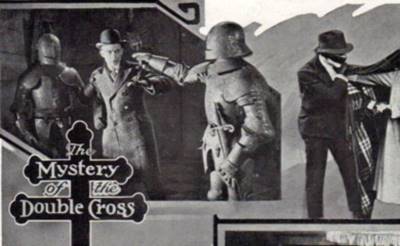
The Mystery of the Double Cross (1917)
The Mystery of the Double Cross is a 1917 film and one of the few American silent action film serials to survive in complete form. It was directed by Louis J. Gasnier and William Parke, from a story written by Gilson Willets, produced by the Astra Film Corporation and released in weekly chapters by Pathé, starting March 18, 1917. Starring Molly King, this 15-part, action-adventure serial was also released in France and Portugal.
Chapter 1 can be seen here. Prints exist in the Library of Congress film archive (AFI/Blackhawk Films collection), and various incomplete sets and individual episodes have been marketed on-line.
The Mystery of the Double Cross
Directed by William Parke
for Astra Film Corporation
Released March 18, 1917
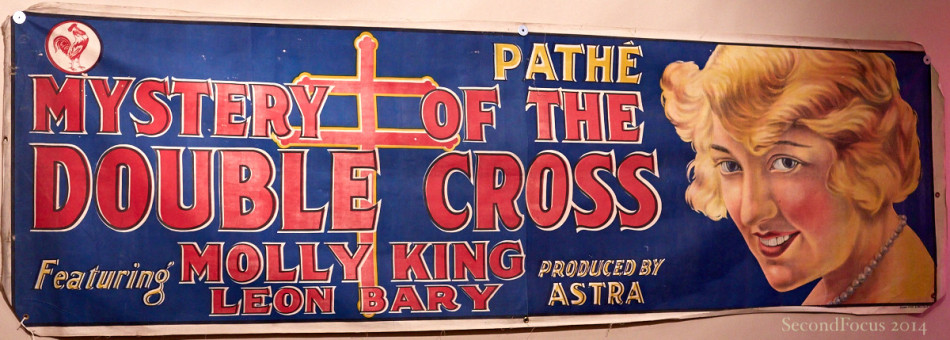
The Mystery of the Double Cross (1917)
PATHÉ
MYSTERY OF THE DOUBLE CROSS
Featuring MOLLY KING
LEON BARY
PRODUCED BY ASTRA
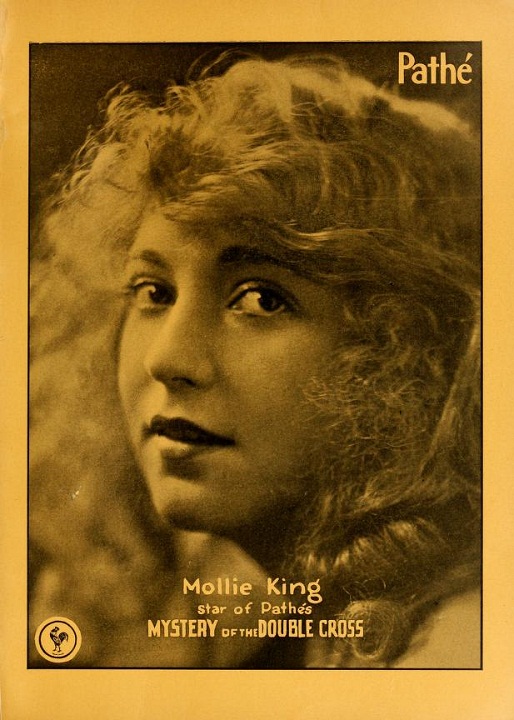
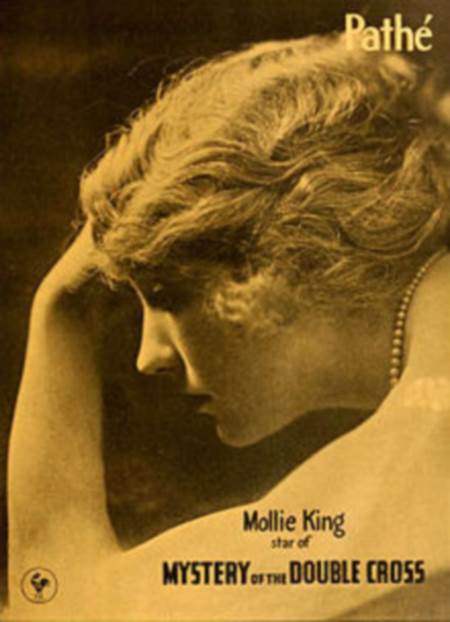
Mollie King and The Mystery of the Double Cross (1917)
Pathé
Mollie King
star of Pathé's
MYSTERY OF THE DOUBLE CROSS
Pathé
Mollie King
star of
MYSTERY OF THE DOUBLE CROSS
Houston Chronicle
Houston Chronicle —
Houston Chronicle,
WITH
MOLLIE KING
MYSTERY
OF THE
DOUBLE
CROSS
WILL BEGIN AT
LIBERTY
Houston, April 10-11
PATHÉ
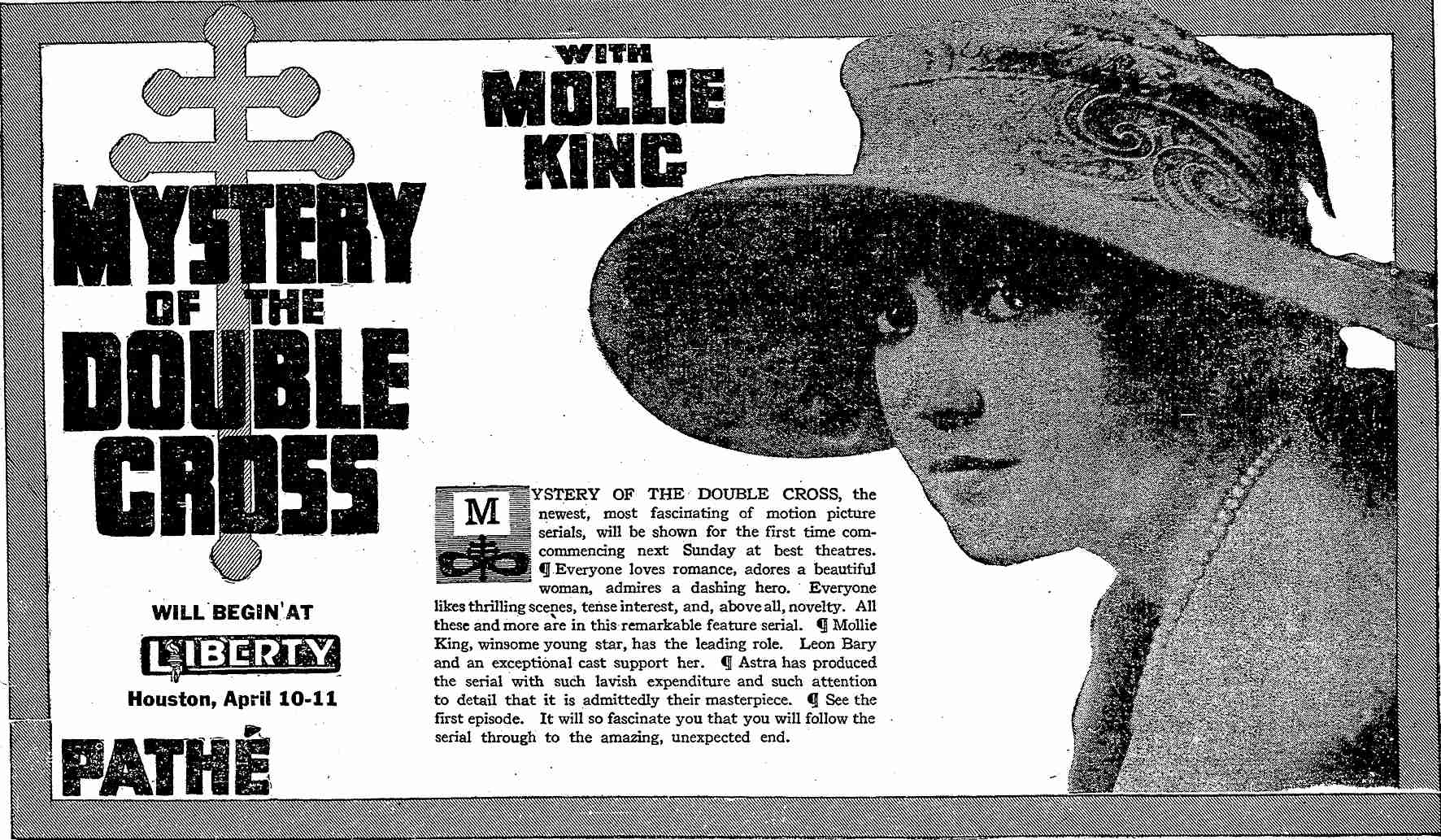
MYSTERY OF THE DOUBLE CROSS, the newest, most fascinating of motion picture serials, will be shown for the first time commencing next Sunday at best theatres. ¶ Everyone loves romance, adores a beautiful woman, admires a dashing hero. Everyone likes thrilling scenes, tense interest, and, above all, novelty. All these and more are in this remarkable feature serial. ¶ Mollie King, winsome young star, has the leading role. Leon Bary and an exceptional cast support her. ¶ Astra has produced the serial with such lavish expenditure and such attention to detail that it is admittedly their masterpiece. ¶ See the first episode. It will so fascinate you that you will follow the serial through to the amazing, unexpected end.
Bold Attempt to Discover the “Girl of the Double Cross”
Houston Chronicle —
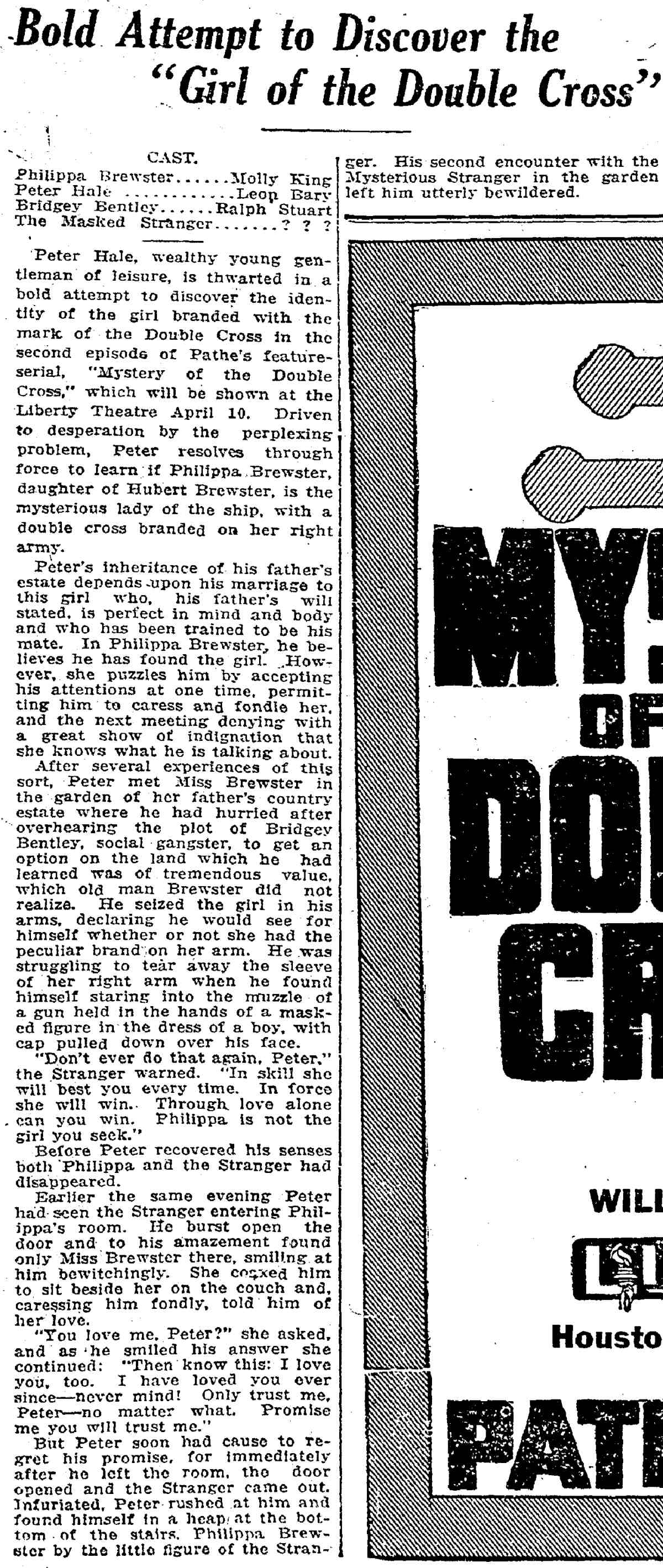
CAST. Philippa Brewster...... Molly King Peter Hale ...... Leon Bary Bridgey Bentley...... Ralph Stuart The Masked Stranger...... ? ? ?
Peter Hale, wealthy young gentleman of leisure, is thwarted in a bold attempt to discover the identity of the girl branded with the mark of the Double Cross in the second episode of Pathe’s feature-serial, “Mystery of the Double Cross,” which will be shown at the Liberty Theatre April 10. Driven to desperation by the perplexing problem, Peter resolves through force to learn if Philippa Brewster, daughter of Hubert Brewster, is the mysterious lady of the ship, with a double cross branded on her right army.
Peter’s inheritance of his father’s estate depends upon his marriage to this girl who, his father’s will stated, is perfect in mind and body and who has been trained to be his mate. In Philippa Brewster, he believes he has found the girl. However, she puzzles him by accepting his attentions at one time, permitting him to caress and fondle her, and the next meeting denying with a great show of indignation that she knows what he is talking about.
After several experiences of this sort, Peter met Miss Brewster in the garden of her father’s country estate where he had hurried after overhearing the plot of Bridgey Bentley, social gangster, to get an option on the land which he had learned was of tremendous value, which old man Brewster did not realize. He seized the girl in his arms, declaring he would see for himself whether or not she had the peculiar brand on her arm. He was struggling to tear away the sleeve of her right arm when he found himself staring into the muzzle of a gun held in the hands of a masked figure in the dress of a boy, with cap pulled down over his face.
“Don’t ever do that again, Peter,” the Stranger warned. “In skill she will best you every time. In force she will win. Through love alone can you win. Philippa is not the girl you seek.”
Before Peter recovered his senses both Philippa and the Stranger had disappeared.
Earlier the same evening Peter had seen the Stranger entering Philippa’s room. He burst open the door and to his amazement found only Miss Brewster there, smiling at him bewitchingly. She coaxed him to sit beside her on the couch and, caressing him fondly, told him of her love.
“You love me, Peter?” she asked, and as he smiled his answer she continued: “Then know this: I love you, too. I have loved you ever since—never mind! Only trust me, Peter—no matter what. Promise me you will trust me.”
But Peter soon had cause to regret his promise, for immediately after he left the room, the door opened and the Stranger came out. Infuriated, Peter rushed at him and found himself in a heap at the bottom of the stairs. Philippa Brewster by the little figure of the Stranger. His second encounter with the Mysterious Stranger in the garden left him utterly bewildered.
Hundreds of Girls Could Succeed on Screen, Says William Parke
Houston Chronicle —
There are hundreds of girls throughout the country who would be motion picture stars if they had the opportunity of meeting a director who could see their possibilities and develop them, according to William Parke, who directed the “Mystery of the Double Cross” serial, tenth episode of which is to be shown at the Liberty Theatre Tuesday and Wednesday.
“Give me half an hour,” says Mr. Parke, “and I will tell you whether or not a girl can act for the screen. Of course girls with no ability at all are hopelessly out of it right at the start.
“Acting for the stage or for the screen requires dramatic intensity and dramatic feeling. It is much easier to learn to act for the screen than for the stage. On the stage you have to depend on the voice to a great extent to get things over. A lot of people who are stars in motion pictures would probably never be even heard of on the spoken stage.
“We hear much talk today about the high salaries that are paid to motion picture actresses. It is my opinion that if a director knew his business and was allowed to pick his cast he would get very much better results, the public would get a better picture at far less cost to the producer, because it would not be necessary to pay these high salaries.”
It is recalled by Mr. Parke that some of the greatest motion picture stars of the day have been recruited from the ranks of the “extra” girls. He recalled one incident when he was directing a picture for Thanhouser. The script called for a railroad wreck in which a number of persons were injured. Mr. Parke wanted some one to play the part of a mother whose baby was lost in the wreck. He selected a girl who was doing her first work in pictures. She did so well that he afterward selected her for the lead in another picture.
This girl, who came to the studio under the name of Lillian Vanderveer, gave up her position disappointed, because she didn’t believe that she had been a success. After the release of the picture Mr. Parke met a friend who inquired about the young lady. He expressed his opinion that she gave one of the finest screen performances he had ever seen. Even Mr. Parke had forgotten about her.
“I believe there was a big future in pictures ahead for that girl,” said Mr. Parke. “I made many efforts to find her, but was unsuccessful.”
Houston Chronicle,
The Cigarette Girl (1917)
The Cigarette Girl paired Gladys Hulette with William Parke Jr., and also starred Warner Oland, the Swedish actor who went on to great fame as the original Charlie Chan in sixteen movies.
The Cigarette Girl
Directed by William Parke
for Astra Film Corporation
Released March 18, 1917
ORPHEUM TREAT FOR JUNE CAPRICE FANS
Rockford Register —
The attraction at the Orpheum tonight will be “The Cigarette Girl,” with Gladys Hulette, who was the star in “The Shine Girl,” “Her New York,” “The Candy Girl”. This is her first picture since joining the Astra forces. It is directed by William Parke, director of “The Shine Girl,” and other hits, and it was written by Philip Bartholomae, author of “Over Night,” “Very Good Eddie,” “Little Miss Brown,” and other stage successes. In the cast are Warner Oland, the villain of “Patria” and William Parke Jr.
Rockford Register, Rockford, Illinois, — William Parke Jr., Gladys Hulette
The Last of the Carnabys (1917)
Another feature starring paired Gladys Hulette with William Parke Jr.
The Last of the Carnabys
Directed by William Parke
for Astra Film Corporation
Released July 22, 1917
The Streets of Illusion (1917)
Gladys Hulette and William Parke Jr. are joined by a young actor named Richard Barthelmess, who soon would become one of the biggest stars of the silent era, and made a number of films after sound was introduced, most notably Only Angels Have Wings, with Cary Grant and Jean Arthur. Barthelmess' mother was the then-famous actress Alla Nazimova, who was a great friend of Edith Luckett, one of William Parke's leading ladies in his stage years in Massachusetts.
The Streets of Illusion
Directed by William Parke
for Astra Film Corporation
Released August 12, 1917
Miss Nobody (1917)
Another Gladys Hulette and William Parke Jr. pairing. The two would announce their engagement a few months later.
Miss Nobody
Directed by William Parke
for Astra Film Corporation
Released August 19, 1917
AT THE MAJESTIC
Charleston Evening Post —
Gladys Hulette, Pathe Star, in “The Streets of Illusion”
Gladys Hulette, the charming little Pathe star, will be seen at the Majestic theater today in her latest and probably her best picture, “The Streets of Illusion.”
A boarding house is not commonly supposed to be a fertile ground for the finer qualities of mankind or for romance, yet in “The Streets of Illusion” is romance and human interest aplenty. Director William Parke has surrounded this delightful star with a cast of unusual merit. Some of these players have been starred in feature productions. Not one of them but is well cast. The picture was produced by Astra.
The boarders whom the little heroine secures form a charming character study. They are of all kinds and conditions from the made-up, dashing blonde who regrets the little son who acts as a drag upon the pace she is traveling to the sneakthief who is respectable only to those who do not know him. Grouchy, narrow, mean, crooked, unscrupulous, they fall under the spell of their charming little landlady, who, innocent of the world, thinks them all as worthy as herself.
Pearl White will also be seen in the eight chapter of “The Fatal Ring,” entitled “The Switch in the Safe.” A thrilling fight and a climax that ends the picture with great suspense are features of this chapter.—Adv.
Charleston Evening Post, Charleston, South Carolina, — Gladys Hulette; The Streets of Illusion; Pearl White
A Crooked Romance (1917)
Another Gladys Hulette and William Parke Jr. pairing. The two would announce their engagement a few months later. The film was the eighth of eleven films William Parke made featuring veteran actor J.H. Gilmore, who made 51 movies between 1909 and 1921; Gilmour passed in November of 1922.
A Crooked Romance
Directed by William Parke
for Astra Film Corporation
Released September 30, 1917
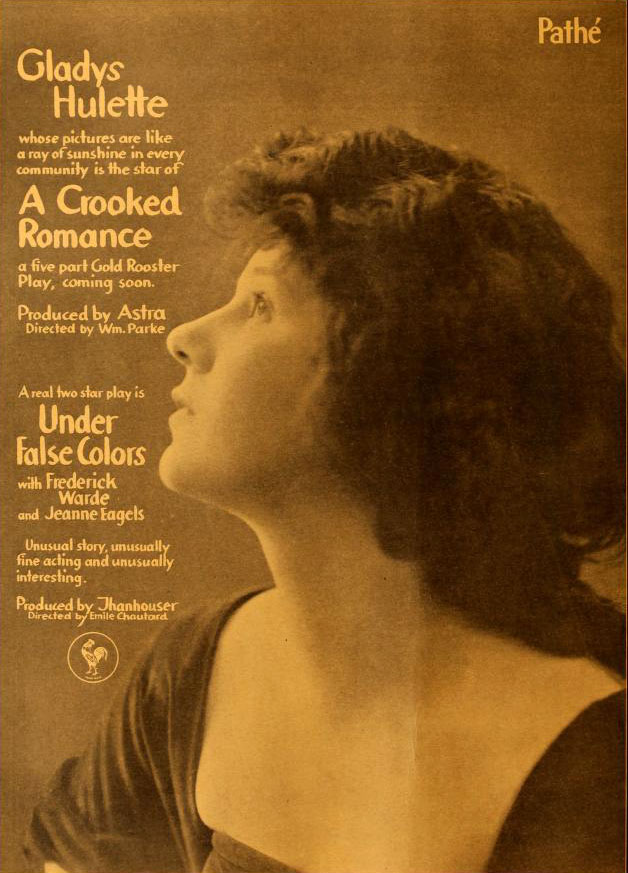
A Crooked Romance (1917)
Pathé
Gladys Hulette
whose pictures are like a ray of sunshine in every community is the star of
A Crooked Romance
a five part Gold Rooster Play, coming soon.
Produced by Astra
Directed by Wm. Parke
A real two star play is
Under False Colors
with Frederick Warde
and Jeanne Eagels
Unusual story, unusually fine acting and unusually interesting.
Produced by Thanhouser
Directed by Emile Chautard
Mae Marsh to Wed.
Illinois State Register —
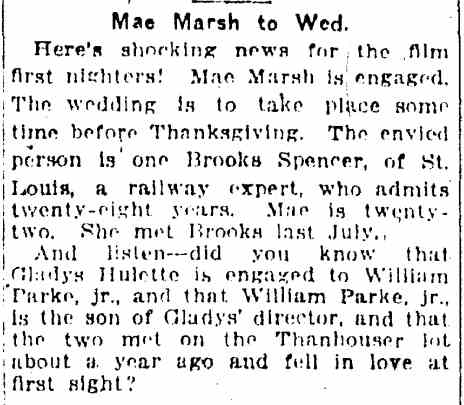
Here’s shocking news for the film first nighters! Mae Marsh is engaged. The wedding is to take place some time before Thanksgiving. The envied person is one Brooks Spencer, of St. Louis, a railway expert, who admits twenty-eight years. Mae is twenty-two. She met Brooks last July.
And listen—did you know that Gladys Hulette is engaged to William Parke, Jr., and that William Parke, Jr., is the son of Gladys’ director, and that the two met on the Thanhouser lot about a year ago and fell in love at first sight?
Illinois State Register, — Mae Marsh, Brooks Spencer, Gladys Hulette, William Parke Jr.
At the Isis Today.
Greensboro Daily News —
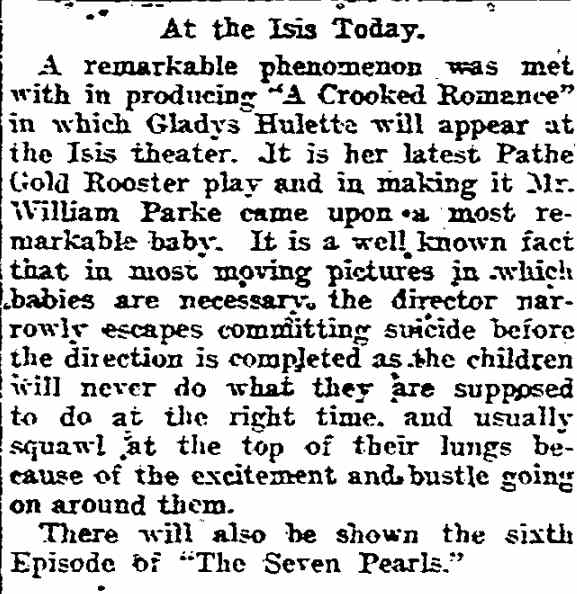
A remarkable phenomenon was met with in producing “A Crooked Romance” in which Gladys Hulette will appear at the Isis theater. It is her latest Pathe Gold Rooster play and in making it Mr. William Parke came upon a most remarkable baby. It is a well known fact that in most moving pictures in which babies are necessary, the director narrowly escapes committing suicide before the direction is completed as the children will never do what they are supposed to do at the right time, and usually squawl at the top of their lungs because of the excitement and bustle going on around them.
There will also be shown the sixth Episode of “The Seven Pearls.”
Greensboro Daily News, Greensboro, North Carolina, — Gladys Hulette; A Crooked Romance; The Seven Pearls
Over the Hill (1917)
The fourth film with Gladys Hulette, William Parke Jr., and J.H. Gilmore has them joined by actor and writer Chester Barnett and Dan Mason. Gilmore had also appeared in four shorts that Parke had made with the Thanhouser Film Corporation in 1916.
Over the Hill
Directed by William Parke
for Astra Film Corporation
Released December 30, 1917
Convict 993 (1918)
Irene Castle, who with her husband Vernon were the most famous ballroom dancers of the early 20th century, starred in this film opposite Warner Oland. Vernon and Irene Castle appeared in nine Broadway musicals from 1906 to 1913, then operated several clubs and dance studios in the New York City area, toured the country dancing, and were able to charge as much as a thousand dollars an hour for lessons. When the USA entered World War I Vernon joined the Army as a military flying instructor and was killed in an airplane accident on February 15, 1918. A movie, The Story of Vernon and Irene Castle, starring Fred Astaire and Ginger Rogers was made in 1939.
Convict 993
Directed by William Parke
for Astra Film Corporation
Released January 6, 1918
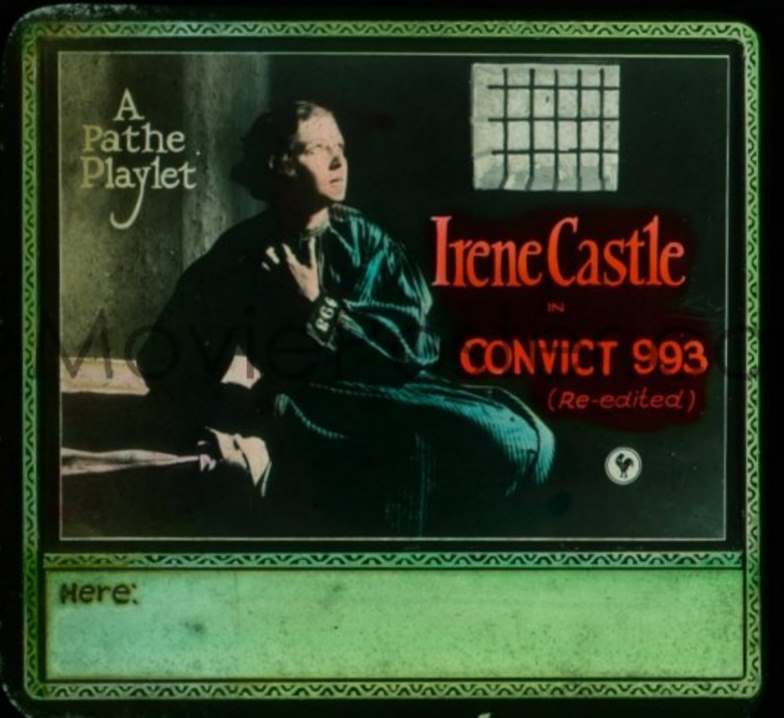
Convict 993 (1918) lantern slide
A Pathe Playlet
Irene Castle
IN
CONVICT 993
(Re-edited)
Here:
The Yellow Ticket (1918)
The last film William Parke made that was released by Astra, The Yellow Ticket was the movie version of A.H. Wood's play, which ran for six months on Broadway beginning in January of 1914. Oddly enough, in 1918, another version was being filmed in Germany, starring Pola Negri. This version was released in the United States in 1922 and is still in print.
Parke had a strong cast, including the notorious Fannie Ward, Warner Oland, and Milton Sills, a now forgotten leading man who starred in film versions of Adam's Rib, The Sea Wolf, and The Sea Hawk. His career was cut short at the dawn of the sound era when he died of a heart attack on September 15, 1930.
The Yellow Ticket
Directed by William Parke
for Astra Film Corporation
Released May 26, 1918
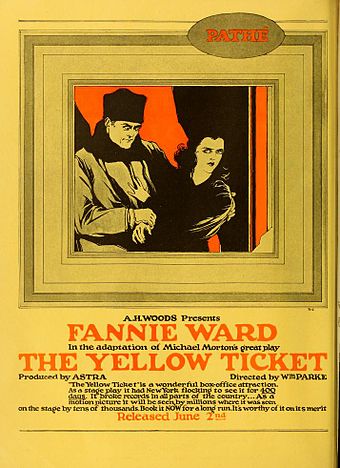
The Yellow Ticket (1918) lobby card
PATHÉ
A. H. WOODS Presents
FANNIE WARD
In the adaptation of Michael Morton's great play
THE YELLOW TICKET
Produced by ASTRA Directed by Wm. PARKE
"The Yellow Ticket" is a wonderful box-office attraction. As a stage play it had New York flocking to see it for 400 days. It broke records in all parts of the country... As a motion picture it will be seen by millions where it was seen on the stage by tens of thousands. Book it NOW for a long run. It's worthy of it on its merit
Released June 2nd
FANNIE WARD STAR OF “THE YELLOW TICKET”
Columbia State —
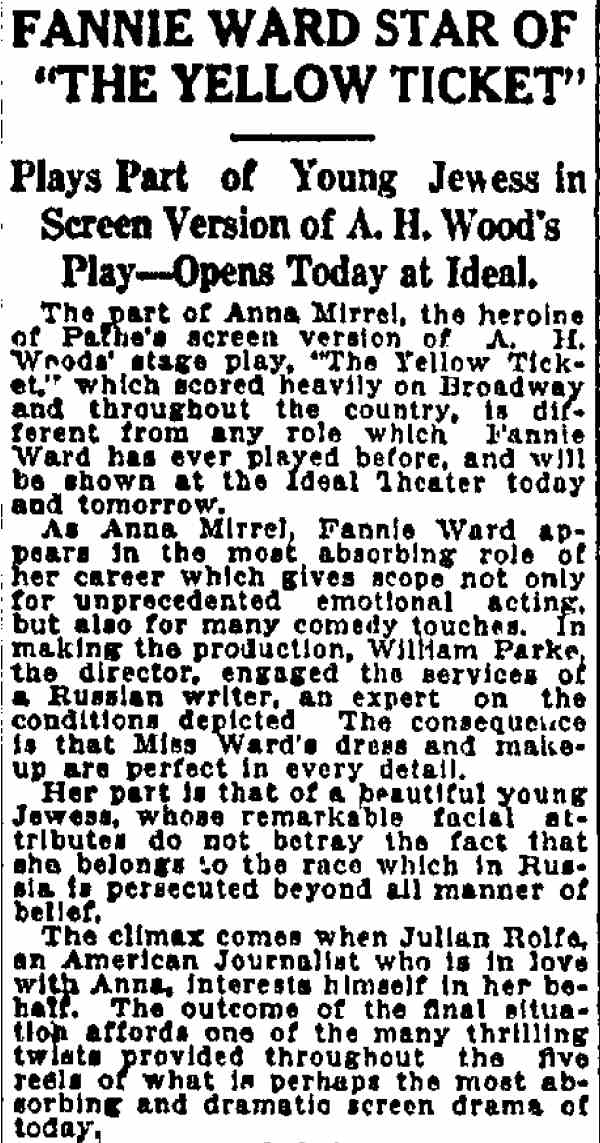
Plays Part of Young Jewess in Screen Version of A. H. Wood’s Play—Opens Today at Ideal.
The part of Anna Mirrel, the heroine of Pathe’s screen version of A. H. Woods’ stage play, “The Yellow Ticket,” which scored heavily on Broadway and throughout the country, is different from any role which Fannie Ward has ever played before, and will be shown at the Ideal Theater today and tomorrow.
As Anna Mirrel, Fannie Ward appears in the most absorbing role of her career which gives scope not only for unprecedented emotional acting, but also for many comedy touches. In making the production, William Parke, the director, engaged the services of a Russian writer, an expert on the conditions depicted The consequence is that Miss Ward’s dress and make-up are perfect in every detail.
Her part is that of a beautiful young Jewess, whose remarkable facial attributes do not betray the fact that she belongs to the race which in Russia is persecuted beyond all manner of belief.
The climax comes when Julian Rolfe, an American journalist who is in love with Anna, interests himself in her behalf. The outcome of the final situation affords one of the many thrilling twists provided throughout the five reels of what is perhaps the most absorbing and dramatic screen drama of today.
Columbia State, Columbia, South Carolina,
William Parke To Appear in Hulette Play
Salt Lake Telegram —
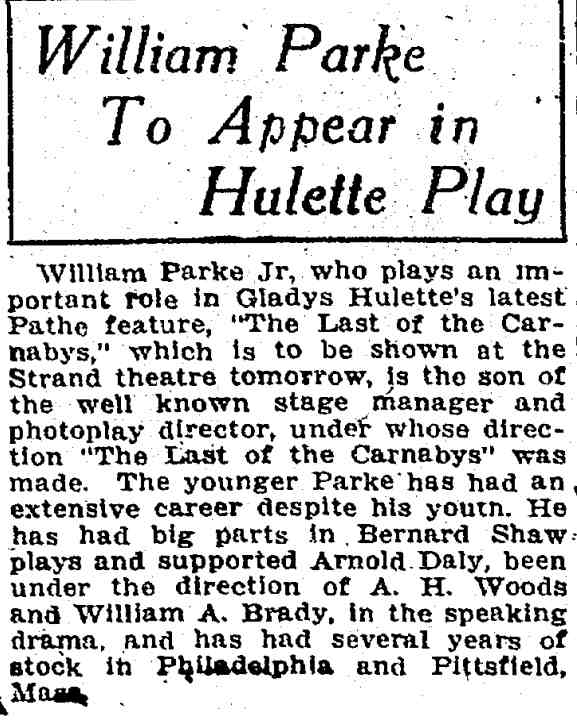
William Parke Jr, who plays an important role in Gladys Hulette’s latest Pathe feature, “The Last of the Carnabys,” which is to be shown at the Strand theatre tomorrow, is the son of the well known stage manager and photoplay director, under whose direction “The Last of the Carnabys” was made. The younger Parke has had an extensive career despite his youth. He has had big parts in Bernard Shaw plays and supported Arnold Daly, been under the direction of A. H. Woods and William A. Brady, in the speaking drama, and has had several years of stock in Philadelphia and Pittsfield, Mass[.]
Salt Lake City Telegram, — Gladys Hulette, William Parke Jr., George Bernard Shaw, Arnold Daly, A.H. Woods, William A. Brady; The Last of the Carnabys
World War I Draft Card
World War I Draft Card –
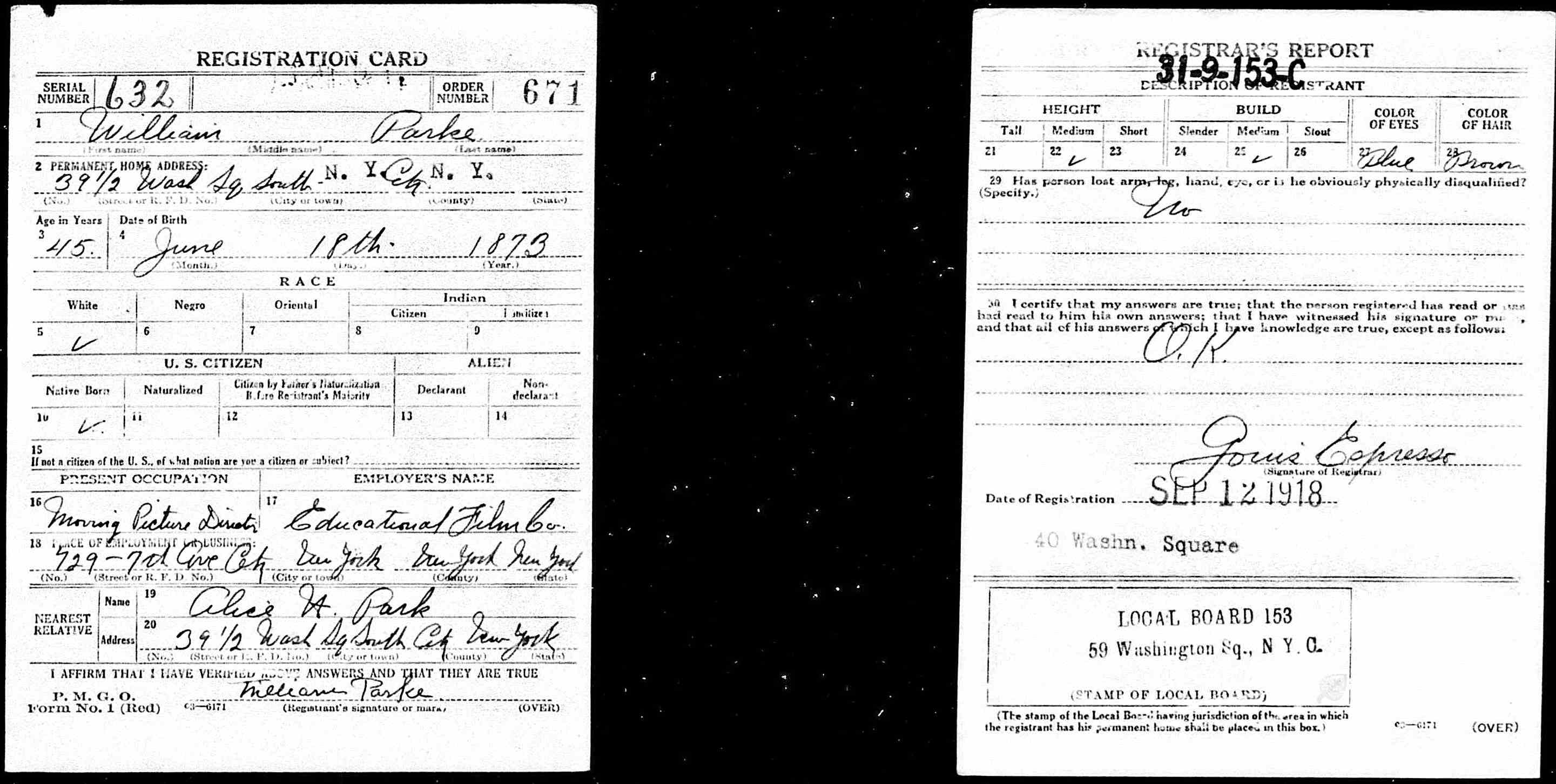
William Parke World War I Draft Card,
REGISTRATION CARD
SERIAL NUMBER 632 ORDER NUMBER 671
1 William Parke
(First name) (Middle name) (Last name)
2 PERMANENT HOME ADDRESS: 39½ Wash Sq South, N. Y. City, N. Y.
(No.) (Street or R. F. D. No.) (City or town) (County) (State)
3 Age in Years: 45. 4 Date of Birth: June 18th, 1873
RACE: 5 White ✓
U.S. CITIZEN: 10 Native Born ✓
16 PRESENT OCCUPATION: Moving Picture Director 17 EMPLOYER'S NAME: Educational Film Co.
18 PLACE OF EMPLOYMENT OR BUSINESS: 729 - 7th Ave City, New York, New York, New York
NEAREST RELATIVE: 19 Name: Alice H. Park 20 Address: 39½ Wash Sq South City New York
I AFFIRM THAT I HAVE VERIFIED ABOVE ANSWERS AND THAT THEY ARE TRUE
William Parke
(Registrant's signature or mark)
P. M. G. O. Form No. 1 (Red)
REGISTRAR'S REPORT
31-9-153-C
DESCRIPTION OF REGISTRANT
HEIGHT: 22 Medium ✓ BUILD: 25 Medium ✓ 27 COLOR OF EYES: Blue 28 COLOR OF HAIR: Brown
29 Has person lost arm, leg, hand, eye, or is he obviously physically disqualified? (Specify.) No
30 I certify that my answers are true; that the person registered has read or has had read to him his own answers; that I have witnessed his signature or mark, and that all of his answers of which I have knowledge are true, except as follows: O.K.
[illegible signature]
(Signature of Registrar)
Date of Registration: SEP 12 1918
40 Washn. Square
LOCAL BOARD 153
59 Washington Sq., N. Y. C.
(STAMP OF LOCAL BOARD)
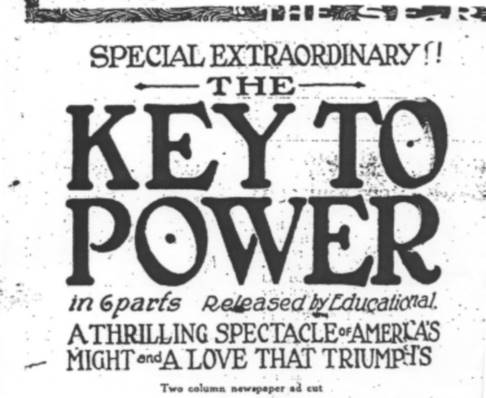
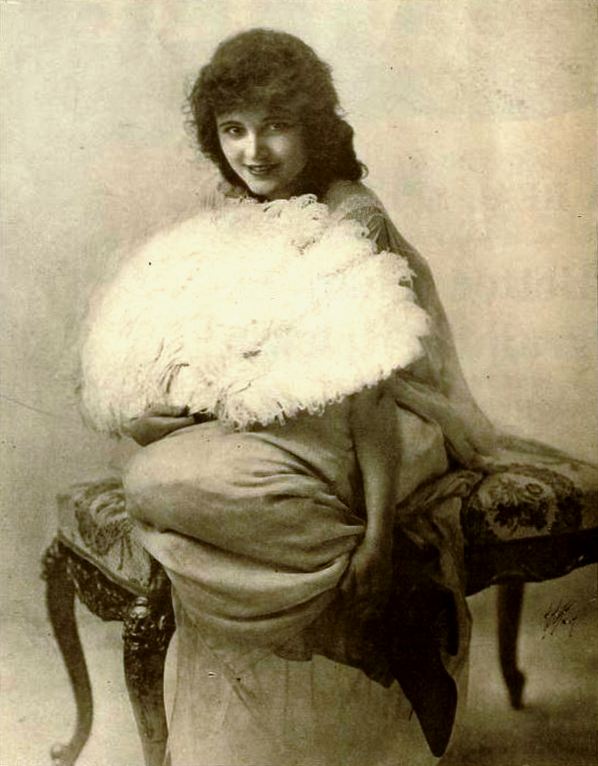
The Key to Power (1920)
The Key to Power was completed in 1918, but not released until January of 1920, in great part due to the Spanish Flu pandemic that killed millions worldwide in late 1918 and 1919. Although released by Educational Films Corporation of America, this film was most likely an Astra Film Corporation production distributed through Educational.
Originally titled The Romance of Coal, it was the first major Hollywood-style movie to be shot on location in West Virginia. Although the film itself is lost, much can be learned about it and about William Parke from the article written in April of 2009 by Steve Fessenamier for the Charleston, West Virginia Gazette-Mail and a follow-up article from May 22, 2009.
The Key to Power, aka The Romance of Coal
Directed by William Parke
for Educational Films Corporation of America
Released January 1920
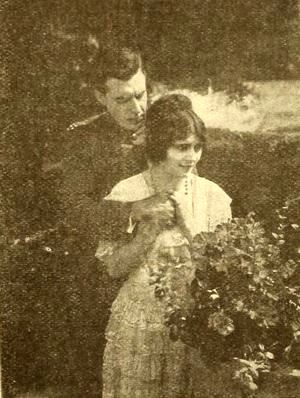
The Key to Power (1920)
SPECIAL EXTRAORDINARY!!
THE
KEY TO POWER
in 6 parts Released by Educational
A THRILLING SPECTACLE OF AMERICA'S MIGHT and A LOVE THAT TRIUMPHS
Two column newspaper ad cut
Claire Adams in The Key to Power (1920)
Washington Evening Star
Washington Evening Star —
Washington Evening Star, Washington, D.C., — Warburton Gamble, Pauline Frederick
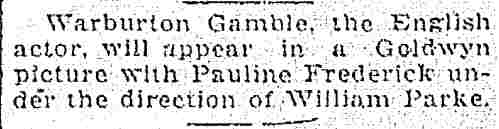
Warburton Gamble, the English actor, will appear in a Goldwyn picture with Pauline Frederick under the direction of William Parke.
Denver Post
Denver Post —
Denver Post, — Pauline Frederick
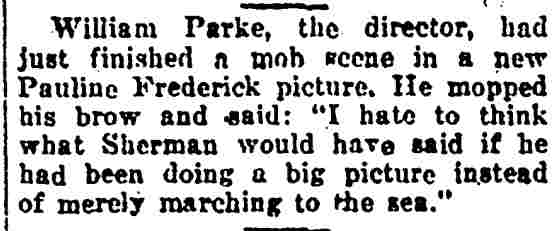
William Parke, the director, had just finished a mob scene in a new Pauline Frederick picture. He mopped his brow and said: "I hate to think what Sherman would have said if he had been doing a big picture instead of merely marching to the sea."
Portland Oregonian
Portland Oregonian —
Director William Parke is taking the final scenes for Gertrude Atherton's "Tower of Ivory." The wrecking of a sea-going yacht provides one of the big thrills that is being obtained with much difficulty and at a heavy expense.
Once in Stock.
Richmond Times-Dispatch —
Director William Parke of the Goldwyn Studios once conducted a splendid stock company in Pittsfield, Mass. His leading man at that time was Wallace Worsley, now a director at the Goldwyn Studios, and his leading lady, Miss Julia Taylor, who later became Mrs. Wallace Worsley. Director Parke has just completed “The Tower of Ivory,” an Eminent Authors production by Gertrude Atherton, and Director Worsley is screening “The Little Shepherd of Kingdom Come,” starring Jack Pickford.
Richmond Times-Dispatch, Richmond, Virginia, — Wallace Worsley, Julia Taylor, Jack Pickford, Gertrude Atherton; The Little Shepherd of Kingdom Come
The Paliser Case (1920)
In 1919 William Parke went to Hollywood, where he made a film with one of the biggest stars of the day, Pauline Frederick. Sadly of her sixty-seven films, only fifteen survive (8 silents and 7 talkies). Unfortunately, this is one of the lost films, but you can see still photos and read reviews here, or better yet, time permitting, read the book by Edgar Saltus.
The Paliser Case
Directed by William Parke
for Goldwyn Pictures Corporation
Released February 15, 1920
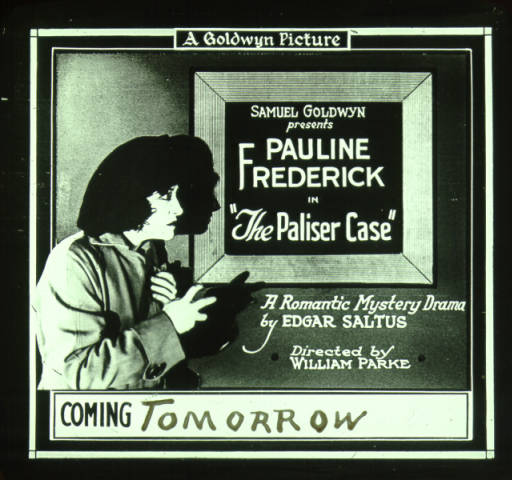
The Paliser Case (1920) lantern slide
A Goldwyn Picture
SAMUEL GOLDWYN presents
PAULINE FREDERICK
IN
"The Paliser Case"
A Romantic Mystery Drama
by EDGAR SALTUS
Directed by WILLIAM PARKE
COMING TOMORROW
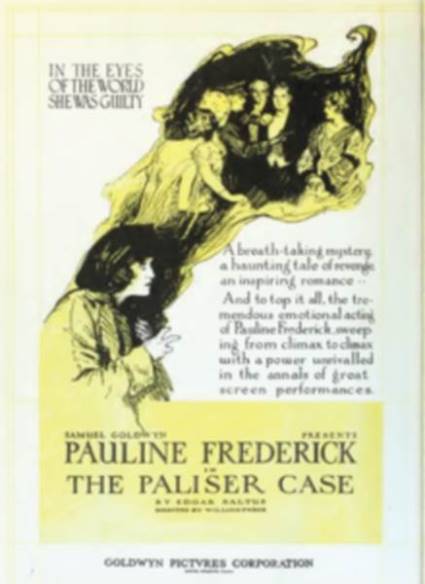
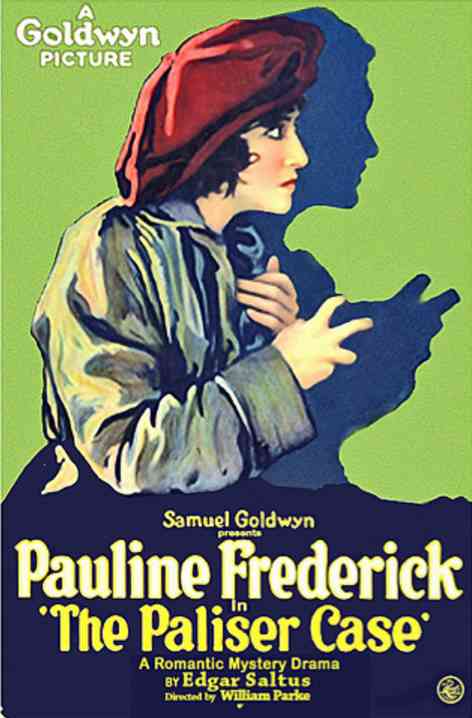
Pauline Frederick in The Paliser Case (1920)
IN THE EYES OF THE WORLD SHE WAS GUILTY
A breath-taking mystery, a haunting tale of revenge, an inspiring romance—
And to top it all, the tremendous emotional acting of Pauline Frederick, sweeping from climax to climax with a power unrivalled in the annals of great screen performances.
SAMUEL GOLDWYN PRESENTS
PAULINE FREDERICK
IN
THE PALISER CASE
BY EDGAR SALTUS
DIRECTED BY WILLIAM PARKE
GOLDWYN PICTURES CORPORATION
A Goldwyn PICTURE
Samuel Goldwyn presents
Pauline Frederick
in
'The Paliser Case'
A Romantic Mystery Drama
BY Edgar Saltus
Directed by William Parke
A Woman Who Understood (1920)
The Robertson-Cole corporation became Film Booking Office of America (FBO) in 1922. FBO was controlled by Joseph P. Kennedy, the father of future president John F. Kennedy, and in turn became the far-better remembered RKO, when David Sarnoff, then president of RCA merged FBO and the Keith-Orpheum vaudeville circuit into RKO Pictures, which stood for Radio-Keith-Orpheum, in 1928.
Robertson-Cole began producing movies in its own studios in 1920. Given the date of release, it is likely this was produced elsewhere.
A Woman Who Understood
Directed by William Parke
for Robertson-Cole Pictures Corporation
Released March 14, 1920
Out of the Storm (1920)
This movie was based on Gertrude Atherton's 1910 novel, Tower of Ivory, which you can read for free by clicking here.
Out of the Storm
Directed by William Parke
for Eminent Authors Pictures Inc., distributed by Goldwyn Pictures Corporation
Released March 14, 1920
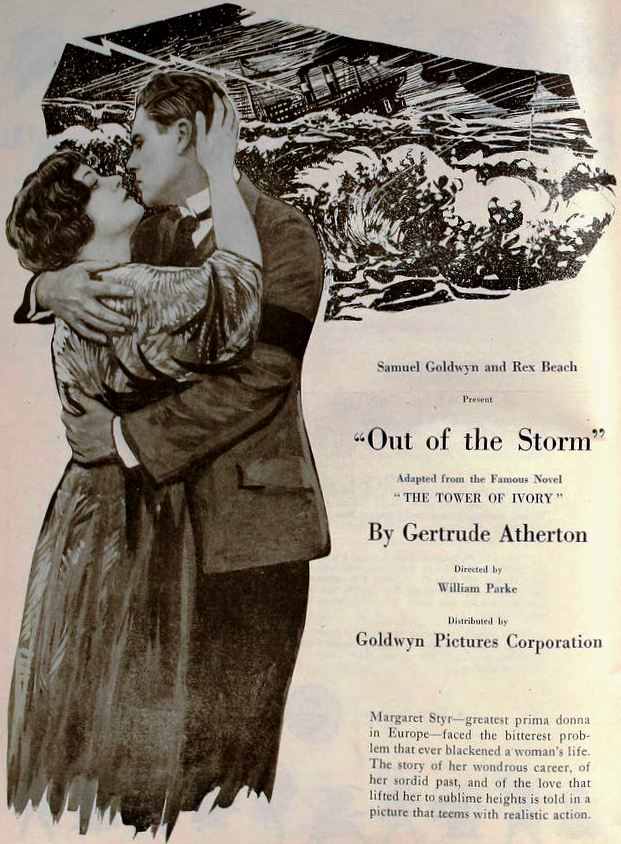
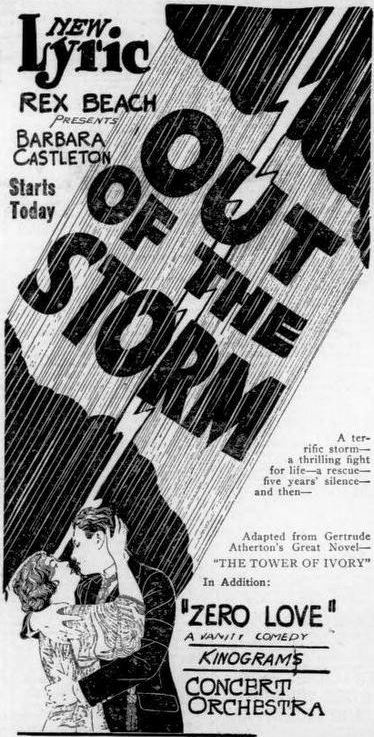
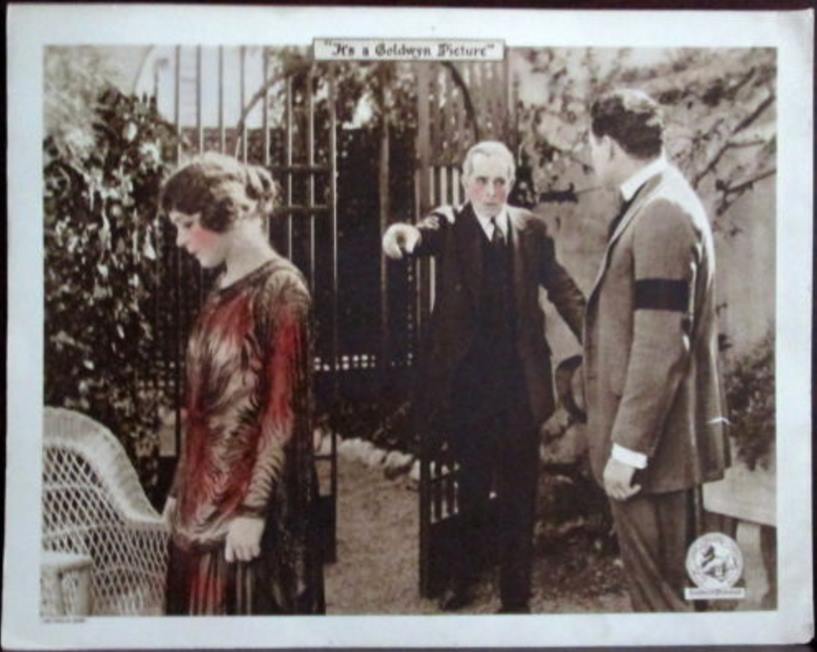
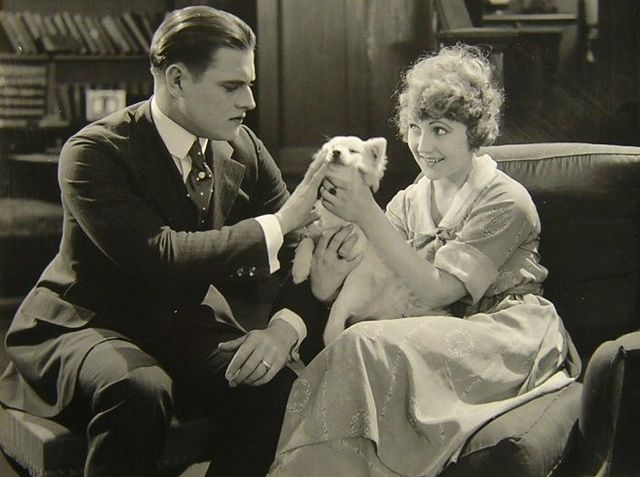
Out of the Storm (1920)
Samuel Goldwyn and Rex Beach
Present
"Out of the Storm"
Adapted from the Famous Novel
"THE TOWER OF IVORY"
By Gertrude Atherton
Directed by William Parke
Distributed by Goldwyn Pictures Corporation
Margaret Styr—greatest prima donna in Europe—faced the bitterest problem that ever blackened a woman's life. The story of her wondrous career, of her sordid past, and of the love that lifted her to sublime heights is told in a picture that teems with realistic action.
NEW Lyric
REX BEACH
PRESENTS
BARBARA CASTLETON
Starts Today
OUT OF THE STORM
A terrific storm—a thrilling fight for life—a rescue—five years' silence—and then—
Adapted from Gertrude Atherton's Great Novel—"THE TOWER OF IVORY"
In Addition: "ZERO LOVE" A VANITY COMEDY
KINOGRAMS
CONCERT ORCHESTRA
Trenton Times-Advertiser
Trenton Times-Advertiser —
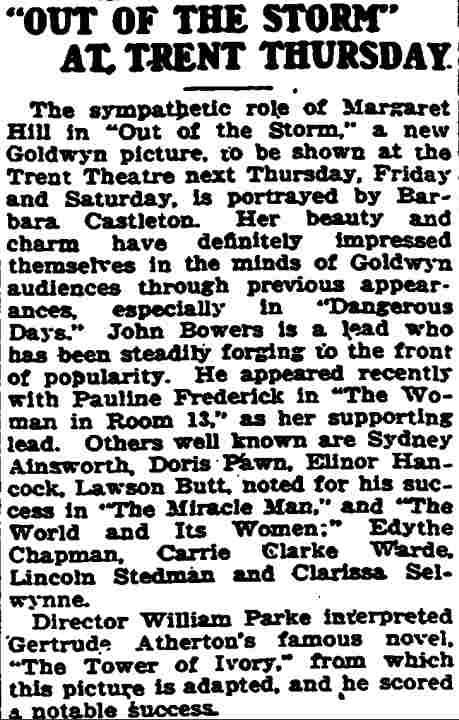
Trenton Times-Advertiser, — Barbara Castleton, John Bowers, Pauline Frederick, Sydney Ainsworth, Doris Pawn, Elinor Hancock, Lawson Butt, Edythe Chapman, Carrie Clarke Warde, Lincoln Stedman, Gertrude Atherton
Beach of Dreams (1921)
Beach of Dreams starred Noah Beery and Edith Storey, who, beginning in 1909 at the age of 17, had appeared in 178 films when this was made. She was an athletic brunette heroine with Vitagraph and Metro. She often appeared in westerns, period dramas and adventure films. At the height of the Spanish Influenza Epidemic, Edith Storey drove an ambulance for the National League for Women's Service in New York and worked as a night nurse in the overcrowded hospitals of the city. She made one more movie after Beach of Dreams, then retired from films in 1921, living out the remainder of her life in rural Long Island. Noah Beery was well known as was his brother Wallace Beery. He made over 200 movies, often in the role of a cruel villain. His son Noah Beery Jr. spent 64 of his 81 years in front of the camera, and is best remembered as James Garner's father in The Rockford Files television show.
Beach of Dreams
Directed by William Parke
for Haworth Studios, distributed by Robertson-Cole Pictures Corporation
Released May 8, 1921
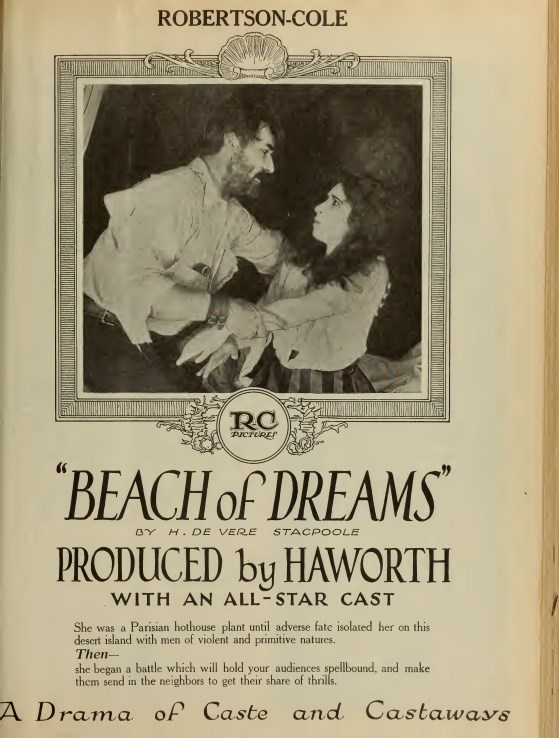
Beach of Dreams — Film Daily review, 1921
ROBERTSON-COLE
"BEACH of DREAMS"
BY H. DE VERE STACPOOLE
PRODUCED by HAWORTH
WITH AN ALL-STAR CAST
She was a Parisian hothouse plant until adverse fate isolated her on this desert island with men of violent and primitive natures.
Then—
she began a battle which will hold your audiences spellbound, and make them send in the neighbors to get their share of thrills.
A Drama of Caste and Castaways
ORPHEUM—EUGENE O’BRIEN
Trenton Evening Times —
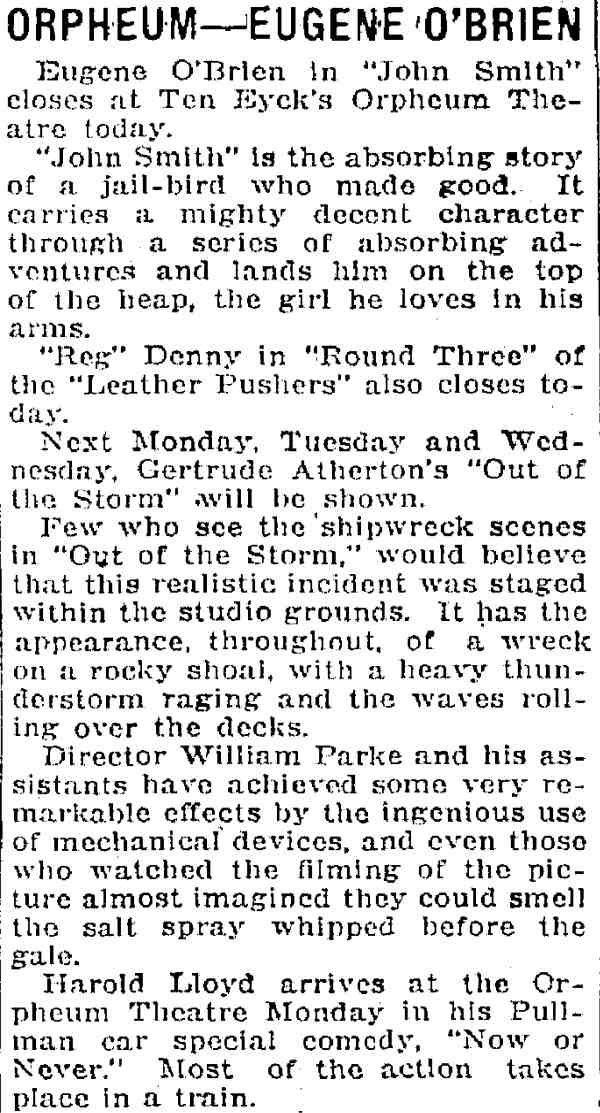
Eugene O’Brien in “John Smith” closes at Ten Eyck’s Orpheum Theatre today.
“John Smith” is the absorbing story of a jail-bird who made good. It carries a mighty decent character through a series of absorbing adventures and lands him on the top of the heap, the girl he loves in his arms.
“Reg” Denny in “Round Three” of the “Leather Pushers” also closes today.
Next Monday, Tuesday and Wednesday, Gertrude Atherton’s “Out of the Storm” will be shown.
Few who see the shipwreck scenes in “Out of the Storm,” would believe that this realistic incident was staged within the studio grounds. It has the appearance, throughout, of a wreck on a rocky shoal, with a heavy thunderstorm raging and the waves rolling over the decks.
Director William Parke and his assistants have achieved some very remarkable effects by the ingenious use of mechanical devices, and even those who watched the filming of the picture almost imagined they could smell the salt spray whipped before the gale.
Harold Lloyd arrives at the Orpheum Theatre Monday in his Pullman car special comedy, “Now or Never.” Most of the action takes place in a train.
Trenton Evening Times, — Reginald Denny, Harold Lloyd, Gertrude Atherton, Eugene O'Brien; second-run showing of Out of the Storm
IN CAST BY ACCIDENT.
Canton Repository —
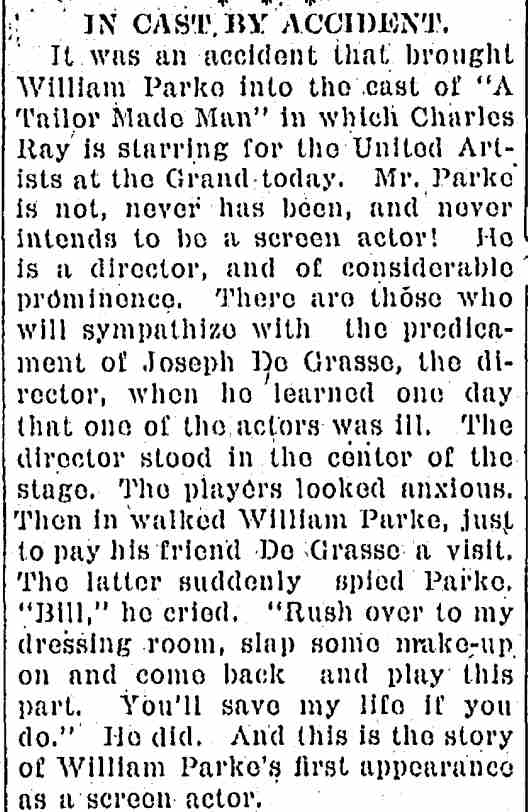
It was an accident that brought William Parke into the cast of “A Tailor Made Man” in which Charles Ray is starring for the United Artists at the Grand today. Mr. Parke is not, never has been, and never intends to be a screen actor! He is a director, and of considerable prominence. There are those who will sympathize with the predicament of Joseph De Grasse, the director, when he learned one day that one of the actors was ill. The director stood in the center of the stage. The players looked anxious. Then in walked William Parke, just to pay his friend De Grasse a visit. The latter suddenly spied Parke. “Bill,” he cried. “Rush over to my dressing room, slap some make-up on and come back and play this part. You’ll save my life if you do.” He did. And this is the story of William Parke’s first appearance as a screen actor.
Canton Repository, Canton, Ohio, — “A Tailor Made Man”; Charles Ray, Joseph DeGrasse
EXCEPTIONAL CAST IN NEW RAY PICTURE
Tampa Tribune —
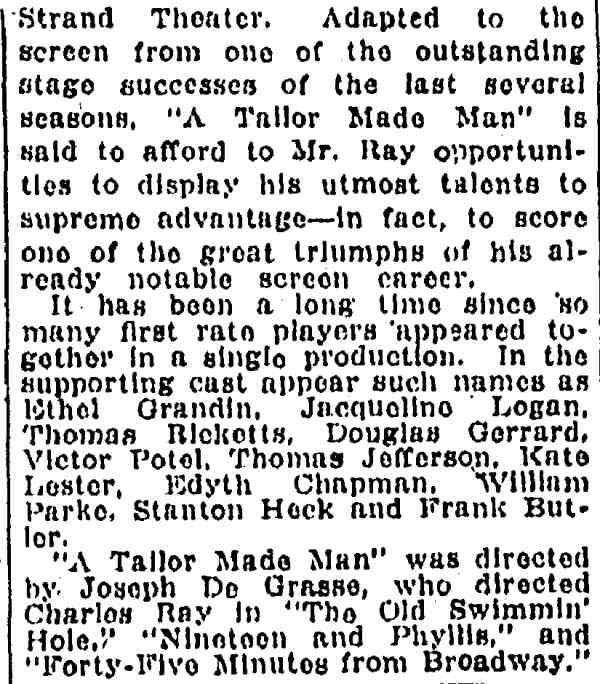
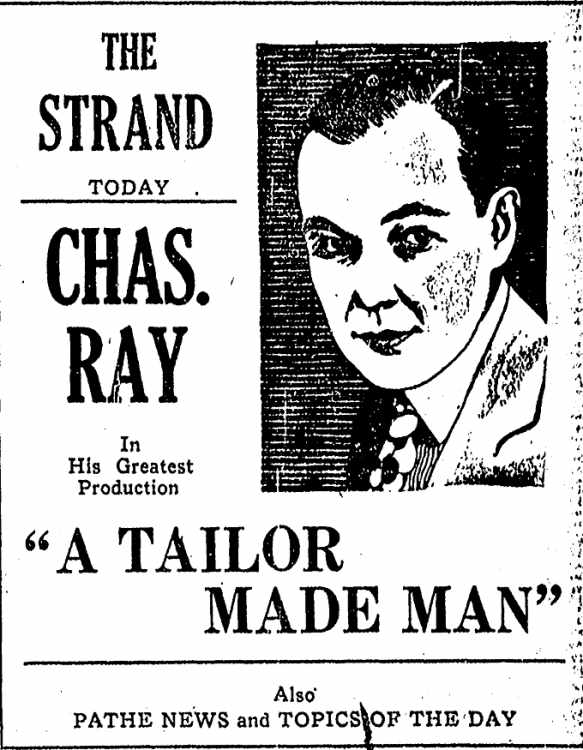
Charles Ray, in his initial United Artists production, “A Tailor Made Man,” is the stellar attraction at the Strand Theater. Adapted to the screen from one of the outstanding stage successes of the last several seasons, “A Tailor Made Man” is said to afford to Mr. Ray opportunities to display his utmost talents to supreme advantage—in fact, to score one of the great triumphs of his already notable screen career.
It has been a long time since so many first rate players appeared together in a single production. In the supporting cast appear such names as Ethel Grandin, Jacqueline Logan, Thomas Ricketts, Douglas Gerrard, Victor Potel, Thomas Jefferson, Kate Lester, Edyth Chapman, William Parke, Stanton Heck and Frank Butler.
“A Tailor Made Man” was directed by Joseph De Grasse, who directed Charles Ray in “The Old Swimmin’ Hole,” “Nineteen and Phyllis,” and “Forty-Five Minutes from Broadway.”
THE STRAND TODAY CHAS. RAY In His Greatest Production ”A TAILOR MADE MAN” Also PATHE NEWS and TOPICS OF THE DAY
Tampa Tribune, — William Parke Jr.
Legally Dead (1923)
William Parke made three pictures for Carl Laemmle's Universal Studios in 1923. Universal reached film immortality several years later in the horror genre with Dracula, Frankenstein, and The Mummy, but the film Legally Dead proves that Laemmle had an eye for what could be called unconventional subjects in film. Milton Sills and Claire Adams, who had starred in Key To Power, also appear in this film.
Legally Dead
Directed by William Parke
for Universal Pictures Corporation
Released July 30, 1923
MILTON SILLS, versatile actor who assumes the role of a newspaper man in “Legally Dead,” which opens a three-day engagement at the Strand Thursday. Mr. Sills has gained a wide popularity with the hero-worshiping fans through his work in many different types of plays.
Idaho Statesman —
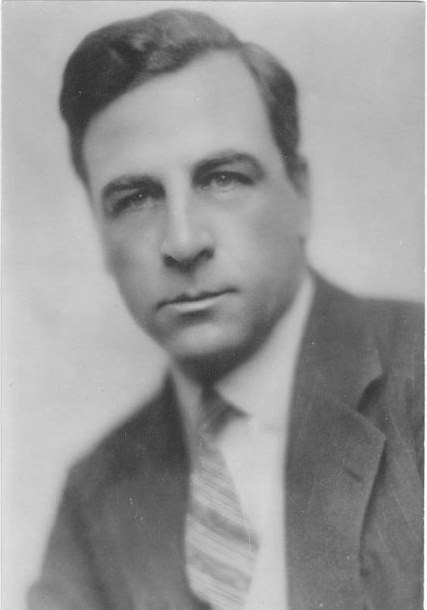

Adrenalin Basis for Feature Film at the Strand Thursday
Newspapers throughout the country have devoted countless columns to a discussion of the merits of adrenalin, the drug which is credited with having restored life in a number of instances. The drug has long been known, but its powers of resurrection are a recent discovery. If it can be definitely proven to be successful in the majority of cases, then it is going to prove one of the most important discoveries ever made by medical scientists.
Just how it would work out in certain cases is clearly covered in a new, sensational photoplay entitled “Legally Dead,” which comes to the Strand theatre for a run of three days, starting Thursday.
“Legally Dead” occupies itself a great deal with the question of capital punishment. Its hero is a newspaper man who commits a minor crime and goes to prison in order to study criminals. He is caught in a web of circumstantial evidence after he is pardoned, and again thrown into the hands of the law on a murder charge. He is hanged!
It is certainly unusual to have the hero of a photoplay treated this way, but then “Legally Dead” comes to the local screen with the reputation of being a most unusual picture.
Milton Sills, one of the screen’s most popular leading men, plays the role of this dead-and-reborn man. Claire Adams, Herbert Fortier, Edwin Sturgis, Faye O’Neil, Charles A. Stevenson, Charles Wellsley, Brandon Hurst, Robert Homans, Joseph Girard, Albert Prisco, Margaret Campbell and others of note handle principal characterizations. William Parke directed.
Several of the most noted chemical and medical experts in the United States acted as technical advisers with Mr. Parke, film director. The experts supervised the details of the scenes showing life being restored by the use of adrenalin.
The actual details of the operation, as portrayed on the film, were supervised by George C. Frolich of Boston, sales manager of the drug and chemical division of the United Drug company, an international organization. Frolich 20 years ago put the first adrenalin on the market in America, when a member of the research staff of the Parke-Davis laboratories, and since then has been internationally known as an expert on the drug. With him were H. L. Simpson, vice president of the firm; George A. Wilson, research expert, and his son, Russell Simpson, and G. F. Pfaffenberger, general manager of the Owl Drug company.
Milton Sills, as the executed convict in the play, underwent the operation in mimic several times, while the experts checked every move. Several physicians also were on hand to criticize and suggest.
Idaho Statesman, Boise, Idaho,
DOCTOR AIDES IN DIRECTION OF PHOTOPLAY
Rockford Register —
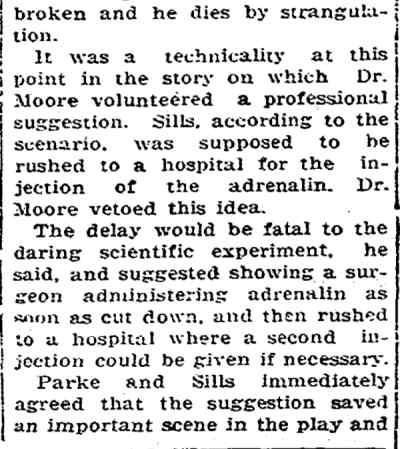

The filming of “Legally Dead,” scientific mystery drama now showing on the Orpheum screen, and which is based on the life restoring properties of adrenalin, occasioned the visit of many noted persons to the studios.
Among the visitors was Dr. Ross Moore, physician and criminologist. Dr. Moore is a personal friend of William Parke, director of the play, and expressed a professional interest in the technique of the operation around which the interest in the play centers.
Milton Sills, playing the title role in the production, is convicted of murder on circumstantial evidence and hanged. His neck is not broken and he dies by strangulation.
It was a technicality at this point in the story on which Dr. Moore volunteered a professional suggestion. Sills, according to the scenario, was supposed to be rushed to a hospital for the injection of the adrenalin. Dr. Moore vetoed this idea.
The delay would be fatal to the daring scientific experiment, he said, and suggested showing a surgeon administering adrenalin as soon as cut down, and then rushed to a hospital where a second injection could be given if necessary.
Parke and Sills immediately agreed that the suggestion saved an important scene in the play and the working script was revised to include the new scene.
Rockford Register,
The Clean-Up (1923)
Claire Adams and Herbert Rawlinson are the leads in this film. Also credited are Margaret Campbell and Herbert Fortier who had both worked in Legally Dead.
The Clean-Up
Directed by William Parke
for Universal Pictures Corporation
Released September 24, 1923
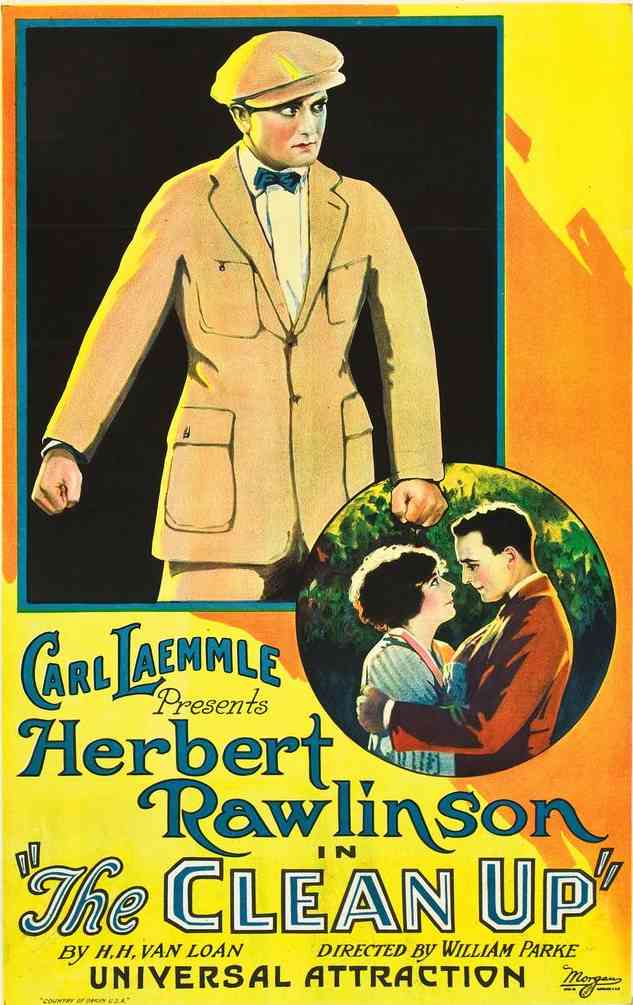
The Clean-Up (1923) lobby card
CARL LAEMMLE
Presents
Herbert
Rawlinson
IN
"The CLEAN UP"
BY H.H. VAN LOAN DIRECTED BY WILLIAM PARKE
UNIVERSAL ATTRACTION
A Million to Burn (1923)
Claire Adams and Herbert Rawlinson return in Parke's last Universal film. By this time it appeared that he had enough of California. He made one more feature, a serial, in 1924, then returned to New York and to the stage.
A Million to Burn
Directed by William Parke
for Universal Pictures Corporation
Released October 26, 1923
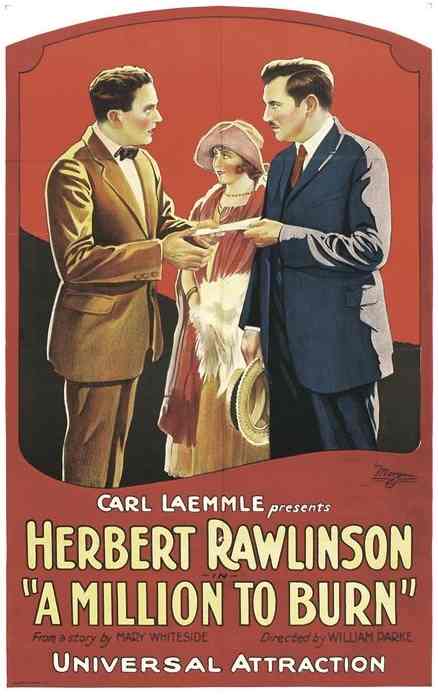
A Million to Burn (1923) lobby card
CARL LAEMMLE presents
HERBERT RAWLINSON
IN
"A MILLION TO BURN"
From a story by MARY WHITESIDE Directed by WILLIAM PARKE
UNIVERSAL ATTRACTION
“A Million to Burn.”
Omaha World-Herald —
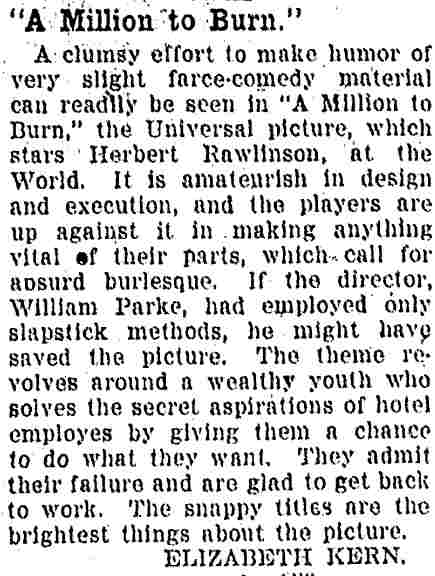
A clumsy effort to make humor of very slight farce-comedy material can readily be seen in “A Million to Burn,” the Universal picture, which stars Herbert Rawlinson, at the World. It is amateurish in design and execution, and the players are up against it in making anything vital of their parts, which call for absurd burlesque. If the director, William Parke, had employed only slapstick methods, he might have saved the picture. The theme revolves around a wealthy youth who solves the secret aspirations of hotel employes by giving them a chance to do what they want. They admit their failure and are glad to get back to work. The snappy titles are the brightest things about the picture.
ELIZABETH KERN.
Omaha World-Herald, Omaha, Nebraska, — Herbert Rawlinson
Idaho Statesman
Idaho Statesman —
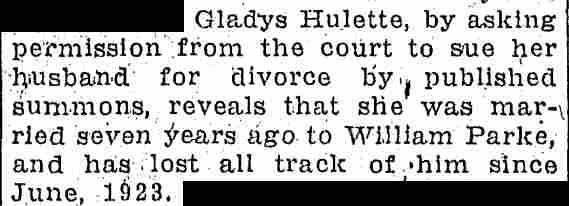
Idaho Statesman, Boise, Idaho, — Gladys Hulette, William Parke Jr.
Gladys Hulette, by asking permission from the court to sue her husband for divorce by published summons, reveals that she was married seven years ago to William Parke, and has lost all track of him since June, 1923.
Ten Scars Make A Man (1924)
An action serial in ten-parts starring the great Allene Ray, who did ALL of her own stunts, and Jack Mower, who in mostly un-credited roles appeared 607 different movies between 1914 and 1963, and produced several films in the 1920s. Ten Scars Make A Man was also released in Brazil as Dez Cicatrizes Fazem um Homem, with Portuguese title cards.
Ten Scars Make A Man
Directed by William Parke
for Pathé Exchange
Released October 26, 1924
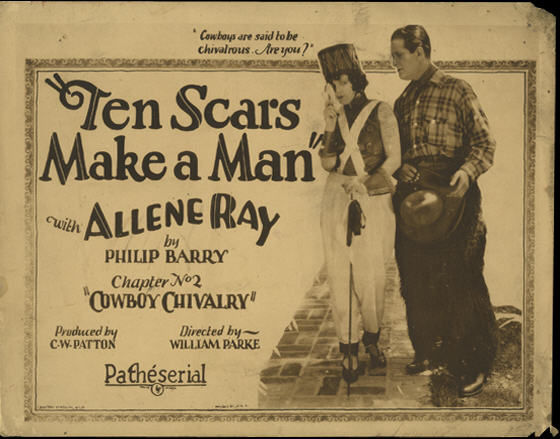
Ten Scars Make A Man (1924)
Cowboys are said to be chivalrous. Are you?
"Ten Scars Make a Man"
with ALLENE RAY
by PHILIP BARRY
Chapter No. 2
"COWBOY CHIVALRY"
Produced by C. W. PATTON Directed by WILLIAM PARKE
Pathéserial
Two by Two (1925)
This play ran on Broadway for 16 performances. William Parke was one of the 20 actors cast as “Part of the Marriage Bureau.” Also in that row was Una Merkel, one of the finest comediennes to appear in movies during the 1940s and 1950s.
Two by Two
William Parke as Part of the Marriage License Bureau
February 23, 1925–March 1925
Portland Oregonian
Portland Oregonian —
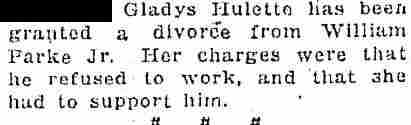
Portland Oregonian, — Gladys Hulette, William Parke Jr.
Gladys Hulette has been granted a divorce from William Parke Jr. Her charges were that he refused to work, and that she had to support him.
Creoles (1927)
A three act play that ran for 28 performances on Broadway at the Klaw Theatre. This play was set in 1850 New Orleans. The star was Helen Chandler, who was quite successful on Broadway before going to Hollywood. She is best remembered for her role in the 1931 Universal film Dracula as Mina, the female lead opposite Bela Lugosi.
Creoles
William Parke as Monsieur Andre
September 22–October 16, 1927
Parke’s Safety Oven
Variety —
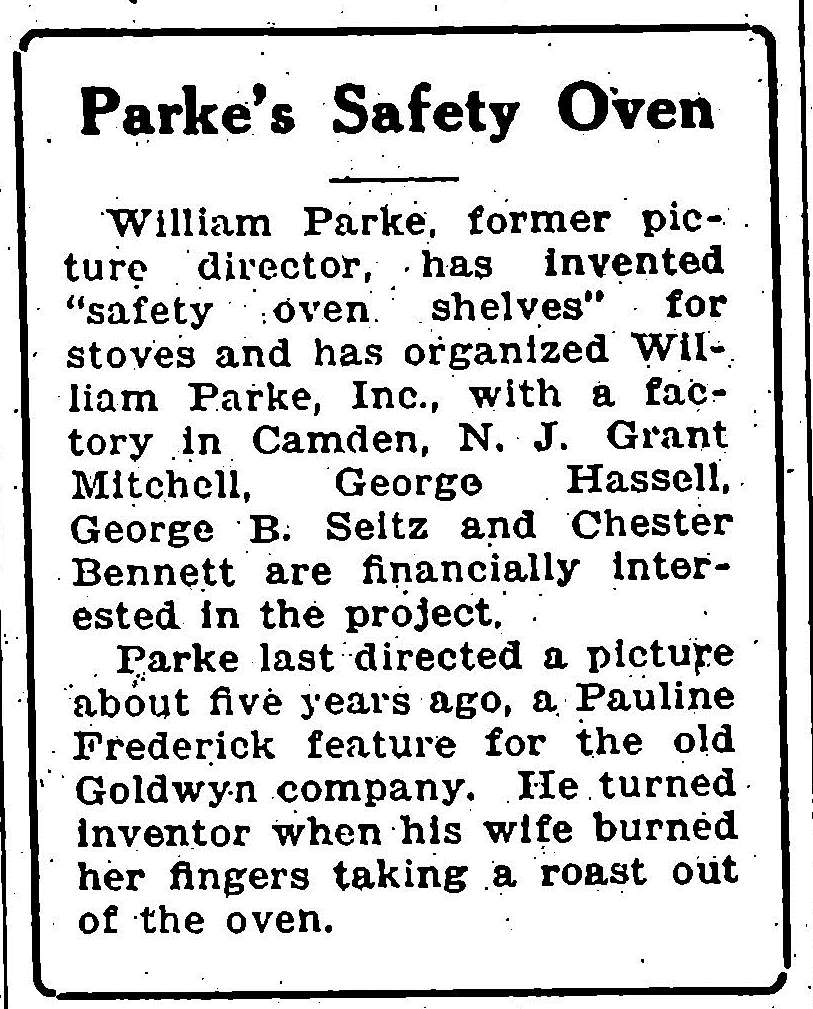
William Parke, former picture director, has invented “safety oven shelves” for stoves and has organized William Parke, Inc., with a factory in Camden, N. J. Grant Mitchell, George Hassell, George B. Seitz and Chester Bennett are financially interested in the project.
Parke last directed a picture about five years ago, a Pauline Frederick feature for the old Goldwyn company. He turned inventor when his wife burned her fingers taking a roast out of the oven.
Variety, — William Parke, Inc.; Grant Mitchell, George Hassell, George B. Seitz, Chester Bennett
Troyka (1930)
A drama set in the prison camp on the island of Sakhalin, Siberia was not exactly light entertainment. The show closed after 15 performances. A “Universal Coincidence”… the second of three in Parke's Broadway career, was the presence of Zita Johann, who played the female lead in 1932 Universal horror classic, The Mummy.
Troyka
William Parke as the First Soldier
April 1, 1930–April 1930
Jefferson Davis (1936)
This show ran for only 3 nights, at the Biltmore Theatre. It was a W.P.A. production and had Sir Guy Standing in the title role.
Jefferson Davis
William Parke as Leroy Walker
February 18, 1936–February 1936
Arsenic and Old Lace (1941)
William Parke's final bow in show business was as Mr. Witherspoon in the original cast version of Arsenic and Old Lace, a massive hit that ran for three and one-half years on Broadway where it was performed 1,444 times. This was also the third “Universal Coincidence” as Boris Karloff, the monster in Frankenstein AND Imhotep in The Mummy, was a member of the cast, as was a young Bruce Gordon, who played Frank Nitti in the television show, The Untouchables. Other members of the original cast also worked in movies and television as well.
His last performance was on Saturday, July 27, 1941. William Parke died of a heart attack at his apartment the next day.
Arsenic and Old Lace
William Parke as Mr. Witherspoon
January 10, 1941–June 17, 1944
WM. PARKE DIES; VETERAN OF STAGE
New York Times —

As Mr. Witherspoon He Took Here Nightly Last Laugh in ‘Arsenic and Old Lace’
HAD PLAYED WITH SOTHERN
Appeared in ‘If I Were King’—Subsequently Was Manager for Richard Mansfield
William Parke, the veteran actor who nightly took the last laugh in “Arsenic and Old Lace,” the current Broadway play, died yesterday of a heart attack at his home, 333 West Fifty-sixth Street. He was 68 years old.
Mr. Parke, who appeared with E. H. Sothern in ‘If I Were King’ many years ago, and who had been a motion-picture director in later years, emerged from a long retirement from the stage to take the part of Mr. Witherspoon in the play now at the Fulton. He appeared in every performance, including last Saturday night’s.
Born in Bethlehem, Pa., Mr. Parke went on the stage in 1896, appearing with George Holland’s company at the old Girard Avenue Theatre. After acting with other stock companies, he joined Sothern’s famous company in 1900. In 1901 he played in “If I Were King,” and he was in “The Proud Prince,” the play by Justin McCarthy, which opened the Lyceum Theatre. His last appearance with Sothern was in “Hamlet.”
With Arnold Daly’s Company
Mr. Parke next was advance stage manager for Arnold Daly. He appeared in that producer’s series of one-act plays, the first productions of the kind to be given on Broadway. Among the actors with whom he acted was Holbrook Blinn.
He then joined Richard Mansfield’s company as stage manager and director. Among the well-known plays in which he had parts at that time were “Peer Gynt,” “Dr. Jekyl and Mr. Hyde,” and “Beau Brummel.” After leaving Mr. Mansfield, he was, from 1908 to 1912, stage manager for John Craig’s and Mary Young’s stock company at the old Castle Square in Boston. In 1913 he had his own company at Pittsfield, Mass., a forerunner of the present Summer theatre. Next he was with the “Potash and Perlmutter” company, and staged all of its seven road shows.
Goes Into Movies
He became interested in the moving pictures and directed several films at the old Biograph Studios in New Rochelle. He then went to Hollywood, where he was successful as a director, but his independence and his insistence upon choosing his own stories caused him eventually to leave the industry. He was a director for Pathe and Samuel Goldwyn, and directed Pauline Frederick in “The Policy Case.”
Of an inventive frame of mind, he developed a safety device for ovens and devoted his time to promoting this for about fifteen years. He did not lose touch with the theater, however, and was a daily visitor to The Players, of which he had been a member since 1904.
There he met Howard Lindsay, producer of “Arsenic and Old Lace,” who offered him the small but important role of Mr. Witherspoon, and, although most of his career had been in the directorial line, he accepted and was a success.
He leaves a widow, Mrs. Alice Harrington Parke. Two sons by a former marriage, William Parke Jr. of New York and George Parke of Camden, N. J., and a third son, Richard Harrington Parke, a member of the staff of THE NEW YORK TIMES, also survive.
A funeral service will be held on Wednesday at the Church of the Transfiguration (The Little Church Around the Corner).
Mr. Parke was a member of the Episcopal Actors Guild.
New York Times Obituary — New York Times,
The Note Book
Berkshire Evening Eagle —
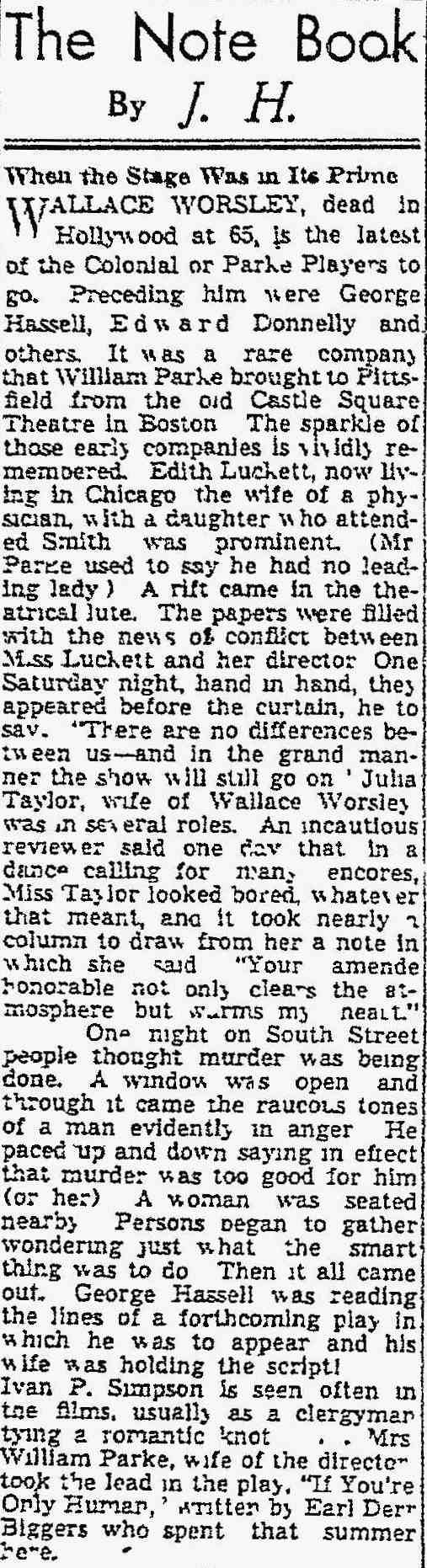
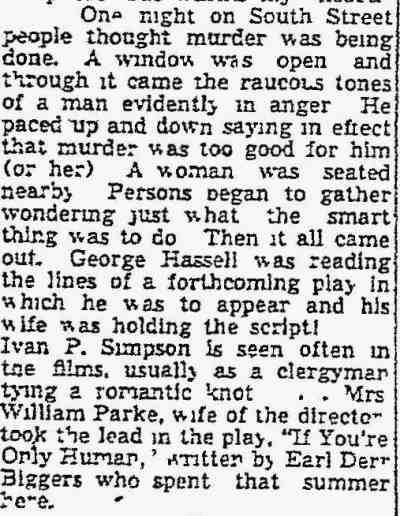
By J. H.
When the Stage Was in Its Prime
WALLACE WORSLEY, dead in Hollywood at 65, is the latest of the Colonial or Parke Players to go. Preceding him were George Hassell, Edward Donnelly and others. It was a rare company that William Parke brought to Pittsfield from the old Castle Square Theatre in Boston. The sparkle of those early companies is vividly remembered. Edith Luckett, now living in Chicago the wife of a physician, with a daughter who attended Smith was prominent. (Mr. Parke used to say he had no leading lady.) A rift came in the theatrical lute. The papers were filled with the news of conflict between Miss Luckett and her director. One Saturday night, hand in hand, they appeared before the curtain, he to say, “There are no differences between us—and in the grand manner the show will still go on.” Julia Taylor, wife of Wallace Worsley, was in several roles. An incautious reviewer said one day that in a dance calling for many encores, Miss Taylor looked bored, whatever that meant, and it took nearly a column to draw from her a note in which she said “Your amende honorable not only clears the atmosphere but warms my heart.”
One night on South Street people thought murder was being done. A window was open and through it came the raucous tones of a man evidently in anger. He paced up and down saying in effect that murder was too good for him (or her). A woman was seated nearby. Persons began to gather wondering just what the smart thing was to do. Then it all came out. George Hassell was reading the lines of a forthcoming play in which he was to appear and his wife was holding the script!
Ivan P. Simpson is seen often in the films, usually as a clergyman tying a romantic knot . . . Mrs. William Parke, wife of the director, took the lead in the play, “If You’re Only Human,” written by Earl Derr Biggers who spent that summer here.
Berkshire Evening Eagle, Springfield, Massachusetts,
The American
The American —
There is quite a lot about William Parke's summer company in this article.
THE THEATRE
The American Magazine —
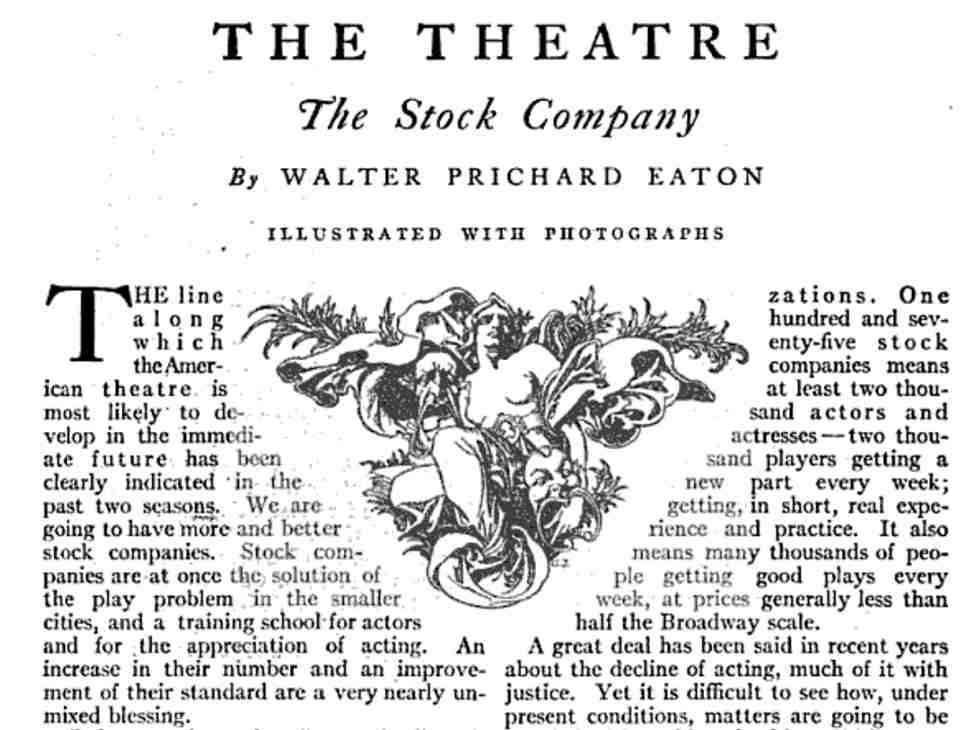
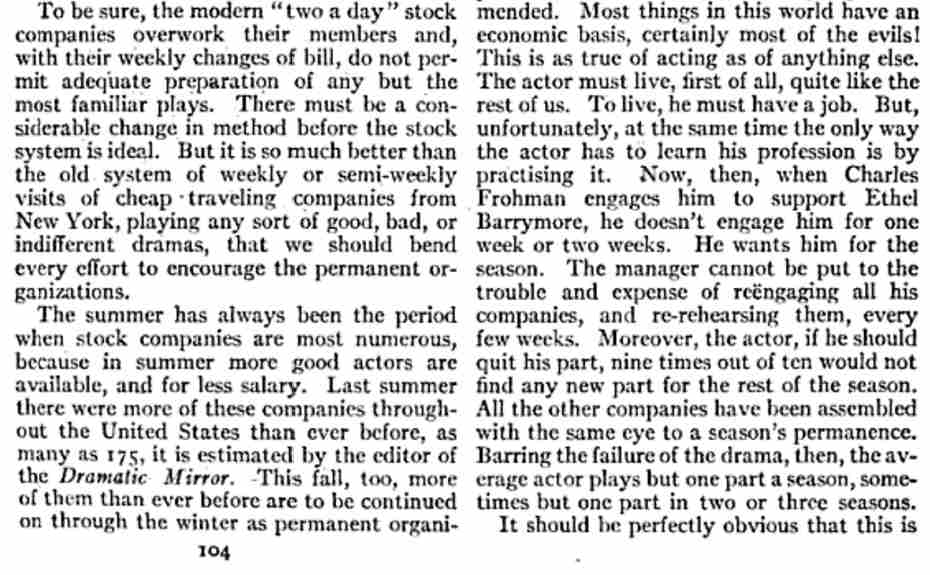
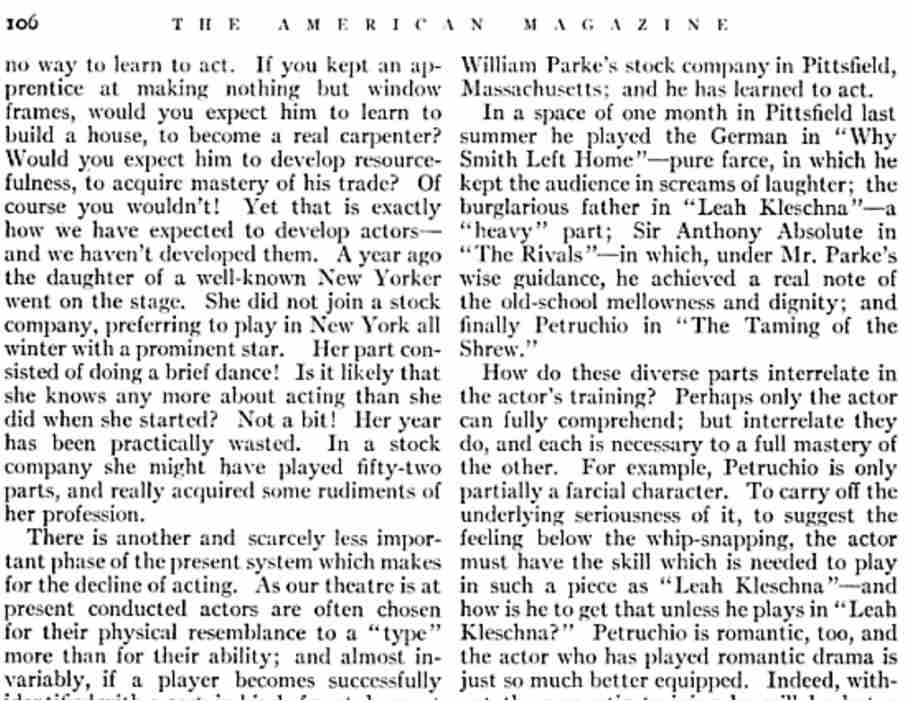
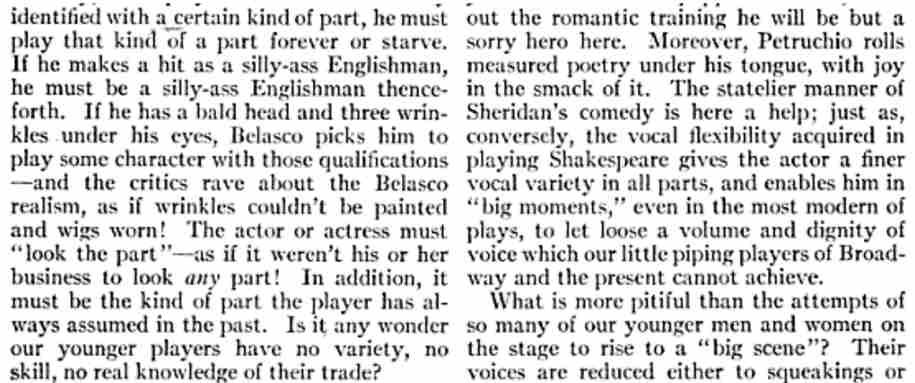
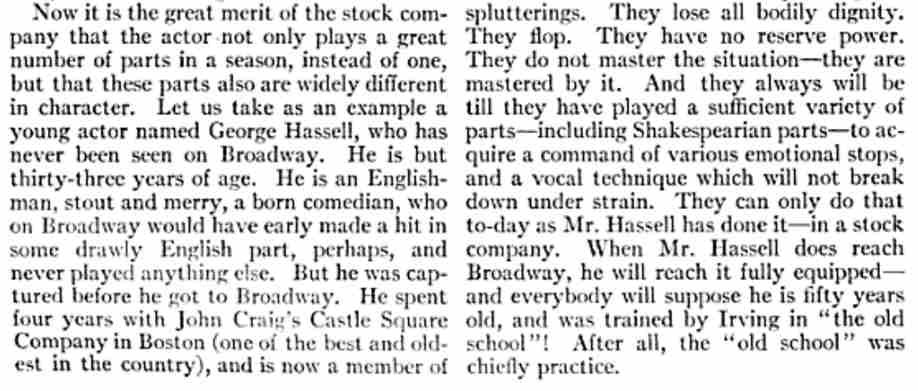
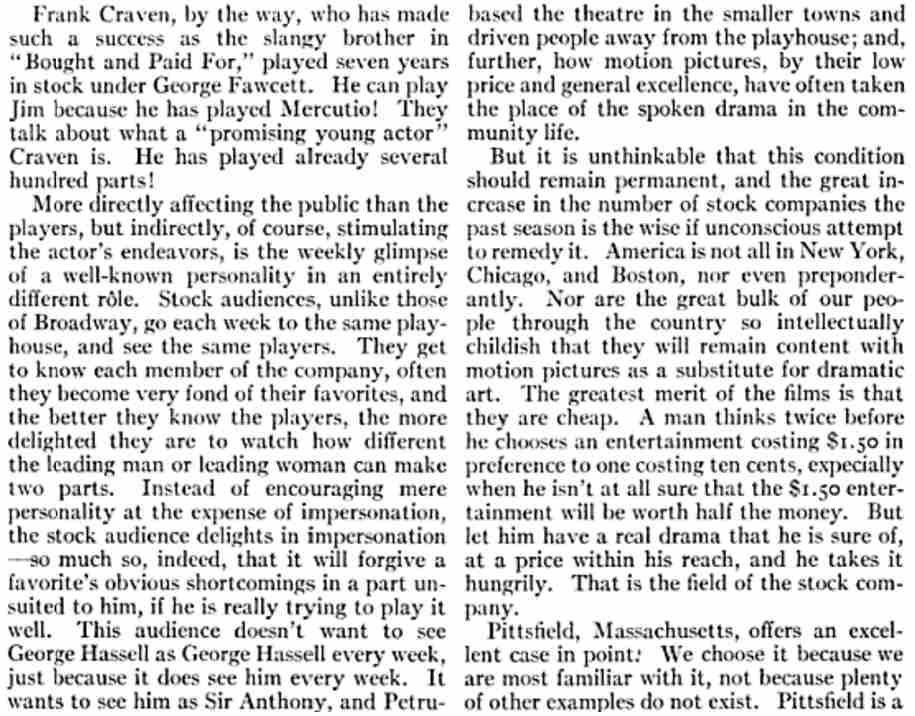
The Stock Company
By WALTER PRICHARD EATON
ILLUSTRATED WITH PHOTOGRAPHS
THE line along which the American theatre is most likely to develop in the immediate future has been clearly indicated in the past two seasons. We are going to have more and better stock companies. Stock companies are at once the solution of the play problem in the smaller cities, and a training school for actors and for the appreciation of acting. An increase in their number and an improvement of their standard are a very nearly unmixed blessing.
To be sure, the modern “two a day” stock companies overwork their members and, with their weekly changes of bill, do not permit adequate preparation of any but the most familiar plays. There must be a considerable change in method before the stock system is ideal. But it is so much better than the old system of weekly or semi-weekly visits of cheap traveling companies from New York, playing any sort of good, bad, or indifferent dramas, that we should bend every effort to encourage the permanent organizations.
The summer has always been the period when stock companies are most numerous, because in summer more good actors are available, and for less salary. Last summer there were more of these companies throughout the United States than ever before, as many as 175, it is estimated by the editor of the Dramatic Mirror. This fall, too, more of them than ever before are to be continued on through the winter as permanent organizations. One hundred and seventy-five stock companies means at least two thousand actors and actresses—two thousand players getting a new part every week; getting, in short, real experience and practice. It also means many thousands of people getting good plays every week, at prices generally less than half the Broadway scale.
A great deal has been said in recent years about the decline of acting, much of it with justice. Yet it is difficult to see how, under present conditions, matters are going to be mended. Most things in this world have an economic basis, certainly most of the evils! This is as true of acting as of anything else. The actor must live, first of all, quite like the rest of us. To live, he must have a job. But, unfortunately, at the same time the only way the actor has to learn his profession is by practising it. Now, then, when Charles Frohman engages him to support Ethel Barrymore, he doesn’t engage him for one week or two weeks. He wants him for the season. The manager cannot be put to the trouble and expense of reëngaging all his companies, and re-rehearsing them, every few weeks. Moreover, the actor, if he should quit his part, nine times out of ten would not find any new part for the rest of the season. All the other companies have been assembled with the same eye to a season’s permanence. Barring the failure of the drama, then, the average actor plays but one part a season, sometimes but one part in two or three seasons.
It should be perfectly obvious that this is no way to learn to act. If you kept an apprentice at making nothing but window frames, would you expect him to learn to build a house, to become a real carpenter? Would you expect him to develop resourcefulness, to acquire mastery of his trade? Of course you wouldn’t! Yet that is exactly how we have expected to develop actors—and we haven’t developed them. A year ago the daughter of a well-known New Yorker went on the stage. She did not join a stock company, preferring to play in New York all winter with a prominent star. Her part consisted of doing a brief dance! Is it likely that she knows any more about acting than she did when she started? Not a bit! Her year has been practically wasted. In a stock company she might have played fifty-two parts, and really acquired some rudiments of her profession.
There is another and scarcely less important phase of the present system which makes for the decline of acting. As our theatre is at present conducted actors are often chosen for their physical resemblance to a “type” more than for their ability; and almost invariably, if a player becomes successfully identified with a certain kind of part, he must play that kind of a part forever or starve. If he makes a hit as a silly-ass Englishman, he must be a silly-ass Englishman thenceforth. If he has a bald head and three wrinkles under his eyes, Belasco picks him to play some character with those qualifications—and the critics rave about the Belasco realism, as if wrinkles couldn’t be painted and wigs worn! The actor or actress must “look the part”—as if it weren’t his or her business to look any part! In addition, it must be the kind of part the player has always assumed in the past. Is it any wonder our younger players have no variety, no skill, no real knowledge of their trade?
Now it is the great merit of the stock company that the actor not only plays a great number of parts in a season, instead of one, but that these parts also are widely different in character. Let us take as an example a young actor named George Hassell, who has never been seen on Broadway. He is but thirty-three years of age. He is an Englishman, stout and merry, a born comedian, who on Broadway would have early made a hit in some drawly English part, perhaps, and never played anything else. But he was captured before he got to Broadway. He spent four years with John Craig’s Castle Square Company in Boston (one of the best and oldest in the country), and is now a member of William Parke’s stock company in Pittsfield, Massachusetts; and he has learned to act.
In a space of one month in Pittsfield last summer he played the German in “Why Smith Left Home”—pure farce, in which he kept the audience in screams of laughter; the burglarious father in “Leah Kleschna”—a “heavy” part; Sir Anthony Absolute in “The Rivals”—in which, under Mr. Parke’s wise guidance, he achieved a real note of the old-school mellowness and dignity; and finally Petruchio in “The Taming of the Shrew.”
How do these diverse parts interrelate in the actor’s training? Perhaps only the actor can fully comprehend; but interrelate they do, and each is necessary to a full mastery of the other. For example, Petruchio is only partially a farcical character. To carry off the underlying seriousness of it, to suggest the feeling below the whip-snapping, the actor must have the skill which is needed to play in such a piece as “Leah Kleschna”—and how is he to get that unless he plays in “Leah Kleschna?” Petruchio is romantic, too, and the actor who has played romantic drama is just so much better equipped. Indeed, without the romantic training he will be but a sorry hero here. Moreover, Petruchio rolls measured poetry under his tongue, with joy in the smack of it. The statelier manner of Sheridan’s comedy is here a help; just as, conversely, the vocal flexibility acquired in playing Shakespeare gives the actor a finer vocal variety in all parts, and enables him in “big moments,” even in the most modern of plays, to let loose a volume and dignity of voice which our little piping players of Broadway and the present cannot achieve.
What is more pitiful than the attempts of so many of our younger men and women on the stage to rise to a “big scene”? Their voices are reduced either to squeakings or splutterings. They lose all bodily dignity. They flop. They have no reserve power. They do not master the situation—they are mastered by it. And they always will be till they have played a sufficient variety of parts—including Shakespearian parts—to acquire a command of various emotional stops, and a vocal technique which will not break down under strain. They can only do that to-day as Mr. Hassell has done it—in a stock company. When Mr. Hassell does reach Broadway, he will reach it fully equipped—and everybody will suppose he is fifty years old, and was trained by Irving in “the old school”! After all, the “old school” was chiefly practice.
Frank Craven, by the way, who has made such a success as the slangy brother in “Bought and Paid For,” played seven years in stock under George Fawcett. He can play Jim because he has played Mercutio! They talk about what a “promising young actor” Craven is. He has played already several hundred parts!
More directly affecting the public than the players, but indirectly, of course, stimulating the actor’s endeavors, is the weekly glimpse of a well-known personality in an entirely different rôle. Stock audiences, unlike those of Broadway, go each week to the same playhouse, and see the same players. They get to know each member of the company, often they become very fond of their favorites, and the better they know the players, the more delighted they are to watch how different the leading man or leading woman can make two parts. Instead of encouraging mere personality at the expense of impersonation, the stock audience delights in impersonation—so much so, indeed, that it will forgive a favorite’s obvious shortcomings in a part unsuited to him, if he is really trying to play it well. This audience doesn’t want to see George Hassell as George Hassell every week, just because it does see him every week. It wants to see him as Sir Anthony, and Petruchio, and the like; and the more widely he can differentiate his parts, the better it loves him.
That is the unescapable psychology of stock audiences, and therefore it is apparent that these same audiences both learn more about acting, gain a juster appreciation of it, and also indirectly stimulate the efforts of the players to achieve truer impersonation, than do the audiences on Broadway, where a new set of faces greets the player every night for a year on end, while he goes on repeating the same old part, often but parading his personal idiosyncrasies.
These are the facts which led William Parke, the able director of the Pittsfield Company, to say to the writer recently: “Stock companies must be encouraged, for they are the only salvation of the art of acting in America.”
We might almost go so far as to say that they are also the salvation of the drama in America—outside of the largest cities, at any rate. This magazine has already discussed the problems of the one-night stands. It has shown how the available supply of good new productions sent out from Broadway is not sufficient to go around, how cheap second companies and tawdry attractions have debased the theatre in the smaller towns and driven people away from the playhouse; and, further, how motion pictures, by their low price and general excellence, have often taken the place of the spoken drama in the community life.
But it is unthinkable that this condition should remain permanent, and the great increase in the number of stock companies the past season is the wise if unconscious attempt to remedy it. America is not all in New York, Chicago, and Boston, nor even preponderantly. Nor are the great bulk of our people through the country so intellectually childish that they will remain content with motion pictures as a substitute for dramatic art. The greatest merit of the films is that they are cheap. A man thinks twice before he chooses an entertainment costing $1.50 in preference to one costing ten cents, especially when he isn’t at all sure that the $1.50 entertainment will be worth half the money. But let him have a real drama that he is sure of, at a price within his reach, and he takes it hungrily. That is the field of the stock company.
Pittsfield, Massachusetts, offers an excellent case in point: We choose it because we are most familiar with it, not because plenty of other examples do not exist. Pittsfield is a city of 35,000 people, with a “drawing” population of perhaps 15,000 more. There was one first-class theatre in the town, which had been allowed to run down in appearance, and under the system of uncensored and unintelligent bookings from New York had practically ceased to attract patronage. Nobody went to the theatre. The middle classes and factory hands went to vaudeville and motion pictures, the more wealthy got their drama in New York. Finally, in desperation, several prominent men clubbed together and bought the theatre. After a few months of experiment, they discovered that they couldn’t get a consistent series of the right attractions from New York, so they turned to a stock company as a solution.
They sent to Boston, where John Craig has for many years conducted one of the most successful stock theatres in the country, and secured his assistant, William Parke, to conduct the Pittsfield house. Mr. Parke came late last spring. He brought with him a company which numbered a few trained actors, such as George Hassell, Kate Ryan (once with the famous Boston Museum Stock Company), and Ivan Simpson, but for the most part composed of youngsters. He opened with Shaw’s “Arms and the Man,” at prices which scaled from fifty cents down. The bill was changed every week, but only two matinees were given. Mr. Parke was not on a salary; he had a sharing interest in the experiment.
At first there was no business. Pittsfield had forgotten the theatre habit. It had to be retaught. Moreover, it had to be shown that this stock company was worth while. But Mr. Parke was in earnest. He plugged away. He knows his business; he is a careful, painstaking, thoroughgoing stage director. He gave good performances. His young players followed his lead with eagerness. They began to be known personally in the town, and to be liked. They were ladies and gentlemen, Pittsfield discovered (to its own amazement and their amusement, perhaps!). The second week business was better than the first, and still better the third; after five weeks the house was making money, and at the Wednesday matinee the eighth week, when “The Rivals” was given, not a seat remained unsold, while outside stood a long line of motors from the summer colonies of Lenox and Stockbridge. Here was a company good enough to attract these rich New Yorkers from tennis court and golf links—a stock company of young players without reputation, in a little New England city of 35,000 people!
Mr. Parke’s company is to remain in Pittsfield all this winter. Instead, therefore, of seeing only occasionally a good play, and not being certain in advance whether even that will be well played, Pittsfield will see a good play every week, and it will be certain of seeing it well acted; not so well acted, of course, nor so elaborately mounted as a Belasco production, but acted with intelligence in every part and the real histrionic flare in some, and with settings that are simple and unobtrusive, to be sure, but which well enough indicate the scene. Pittsfield’s school children will see some Shakespeare; indeed, the high schools of all the surrounding towns will have their first opportunity in years to know what these plays they study are really like! Pittsfield will see some of the old, classic comedies, and the best plays by Thomas, Fitch, Walter, and other modern American playwrights. Probably they will get some Pinero and Shaw. They will see both farce and serious drama, and even a musical comedy or two, sung as well as usual, and five times better acted! In other words, they have a real theatre in the town at last, which is part of the community life, and is preserving and making available the drama there, as the public library preserves and makes available printed literature.
“All very well,” says the impatient reader, “but do you mean to tell me that a company which puts on a new play every week, at popular prices, can put that play on properly? Why, the actors can’t find the time for rehearsals, nor the manager afford the money for the scenery! Such performances cannot be really good.”
No, dear reader, we do not say that the system is ideal, nor that the performances rival a Belasco production. We have distinctly stated that they do not. But when the director is a good one the performances are far better than you suppose, and even under the present stock system there are compensations you haven’t taken into account.
In the first place, the actors of a stock company work and play together all the time; they are not suddenly assembled, as is a company to mount a new play for a winter in New York. They know each other’s methods. They come very soon to learn just how to play into each other’s hands, to work together as a team for the desired effect. Usually they are sure of their jobs, they have permanent, comfortable homes, they like and are liked by their audiences; they are happy and put their best efforts into their work. Playing a new part every week means, to be sure, rehearsals every morning and Sunday night, as well as matinee and evening performances. It means committing a new collection of lines to memory every week, in addition. It means, for the women, weekly trips to the dressmakers. It means, in short, almighty hard work. But—and here is the great compensation—it also means that every week the player meets a new problem in his art to wrestle with. It means his enthusiasm, his ambition, his interest are kept constantly alive, his faculties constantly on edge. It means he is growing all the time—and it is only when we are growing that, after all, we are really alive!
As for scenery, thank the Lord the stock companies cannot afford it! We have had too much scenery. When a playwright or producer relies on his scenery to carry his play, you may be sure the play is not the thing. Scenery is an accessory only. It ought to be illusive and tasteful; but it ought never to divert attention from the drama and the acting. Stock audiences readily forgive the makeshifts to which the managers are sometimes put. They are interested in the play and players. That is as
The American,
Acknowledgments
Many thanks to Q. David Bowers, whose work, which appears on the website www.thanhouser.org was invaluable in the creation of this web-page.