William F. Carroll
WILLIAM F. CARROLL, whose real name was William F. Muldoon, had a long and distinguished career in theater and vaudeville under the name of William F. Carroll, perhaps died as every actor would, on stage, at the old Broadway Theater in Camden, on February 22, 1909. It was opening night of the Camden presentation of a one-act play featuring Mayme Gehrue titled June, part of a seven feature bill. Carroll, who was both a cast member and stage manager of the feature, had assembled the cast prior to the raising of the curtain, called “Ready,” and in the next instant suffered a fatal heart attack.
William F. Carroll was born William F. Muldoon in Philadelphia, the son of Irish immigrants. There is some conflict in the records as to one of the parents being born in England or Scotland. His career on stage went as far back as 1870, and records as early as 1880 show his occupation as actor. He was known on stage as William F. Carroll. He was married to an actress, whose real name was Catherine (Tarr) Muldoon. She too used a stage name. She appeared on stage with him in All on Account of Eliza.
William F. Carroll got his start in theater in Philadelphia with Edwin Forrest, for whom the Forrest Theater is named. He soon established himself as a dancer and Irish comedian. While appearing at the Arch Street Theater in Philadelphia, he appeared in a parody of the play Camille, to the delight of world renown actress Sarah Bernhardt. He later became part of the comedy team of Harris and Carroll. Later he turned his hand to writing one-act plays. Success led him to writing three-act efforts, and he scored hits with Muldoon’s Picnic and My Aunt Bridget.
William F. Carroll appeared in at least three Broadway productions, All on Account of Eliza, which opened in September of 1900; The Red Kloof, a September 1901 production; and The White Hen, which ran for 94 shows beginning in February of 1907. He worked with some of the top performers of his day, including Ralph C. Herz, Louis Mann, Lionel Adams, Walter D. Greene, Daniel Jarrett, Stephen Maley, Edward See, Clara Lipman, Emma Janvier, and Edwin Nicander.
The stage veteran was concerned with the welfare of his fellow actors, and was a charter member and sat in the Board of Directors of The White Rats, an early Union for actors and theater personnel, which later evolved into Actors Equity.
Written by Phil Cohen.
The Last Call Proved Fatal
Camden Courier —
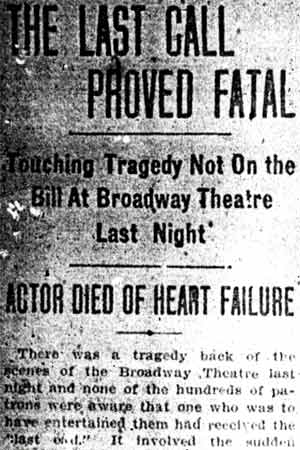
Touching Tragedy Not On the Bill At Broadway Theatre Last Night
Actor Died of Heart Failure
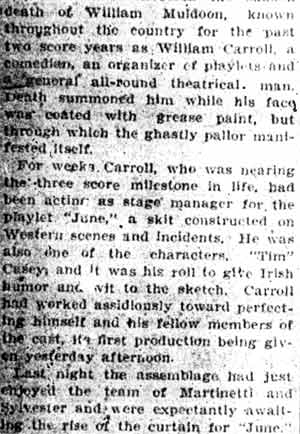
There was a tragedy back of the scenes of the Broadway Theatre last night and none of the hundreds of patrons were aware that one who was to have entertained them had received the “last call.” It involved the sudden death of William Muldoon, known throughout the country for the past two score years as William Carroll, a comedian, an organizer of playlets and a general all-round theatrical man. Death summoned him while his face was coated with grease paint, but through which the ghastly pallor manifested itself.
For weeks Carroll, who was nearing the three score milestone in life, had been acting as stage manager for the playlet “June,” a skit constructed on Western scenes and incidents. He was also one of the characters, “Tim Casey,” and it was his roll to give Irish humor and wit to the sketch. Carroll had worked assiduously toward perfecting himself and his fellow members of the cast, its first production being given yesterday afternoon.
Last night the assemblage had just enjoyed the team of Martinetti and Sylvester and were expectantly awaiting the rise of the curtain for “June.”
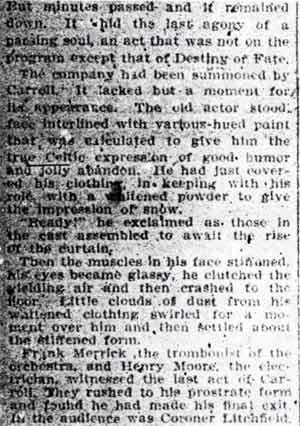
But minutes passed and it remained down. It held the last agony of a passing soul, an act that was not on the program except that of Destiny or Fate. The company had been summoned by Carroll. It lacked but a moment for his appearance. The old actor stood, face interlined with various-hued paint that was calculated to give him the true Celtic expression of good humor and jolly abandon. He had just covered his clothing in keeping with his role with a whitened powder to give the impression of snow.
“Ready!” he exclaimed as those in the cast assembled to await the rise of the curtain.
Then the muscles in his face stiffened. His eyes became glassy, he clutched the yielding air and then crashed to the floor. Little clouds of dust from his whitened clothing swirled for a moment over him and then settled about the stiffened form.
Frank Merrick, the trombonist of the orchestra, and Henry Moore, the electrician, witnessed the last act of Carroll. They rushed to his prostrate form and found he had made his final exit. In the audience was Coroner Litchfield.
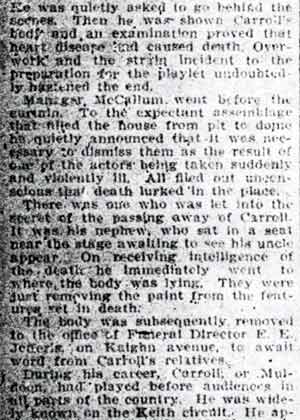
He was quietly asked to go behind the scenes. Then he was shown Carroll’s body, and an examination proved that heart disease had caused death. Overwork and the strain incident to the preparation for the playlet undoubtedly hastened the end.
Manager McCallum went before the curtain. To the expectant assemblage that filled the house from pit to dome he explained that it was only necessary to dismiss them as the result of one of the actors being taken suddenly and violently ill. All filed out unconscious that death lurked in the place.
There was one who was let into the secret of the passing away of Carroll. It was his nephew, who sat in a seat near the stage awaiting to see his uncle appear. On receiving intelligence of the death he immediately went to where the body was lying. They were just removing the paint from the features set in death.
The body was subsequently removed to the office of Funeral Director F. E. Jefferis, on Kaighn avenue, to await word from Carroll’s relatives.
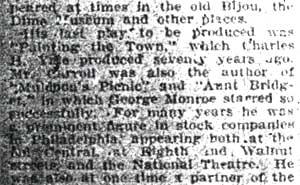
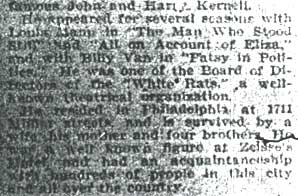
During his career Carroll, or Muldoon, had played before audiences in all parts of the country. He was wide-known on the Keith circuit. He appeared at times in the old Bijou, the Dime Museum and other places. His last play to be produced was “Painting the Town.” Mr. Carroll was also the author of “Muldoon’s Picnic” and “Aunt Bridget,” in which George Monroe starred so successfully. For many years he was a prominent figure in stock companies, appearing both at the Colonial at Eighth and Walnut Streets, and the National Theatre. He was also at one time a partner of the famous John and Hart, Kernell. He appeared for several seasons with Louis Mann in “The Man Who Stood Pat” and “All on Account of Eliza,” and with Billy Yay in “Patsy in Politics.” He was one of the Board of Directors of the “White Rats,” a well-known actors’ organization.
He lived in Philadelphia at 1711 Ann Street, and is survived by a wife, a mother and four brothers. He was a well-known figure at Zelese’s and had an acquaintanceship of hundreds of people in this city and the country.
Broadway Theatre, Camden — February 22
Camden Courier —
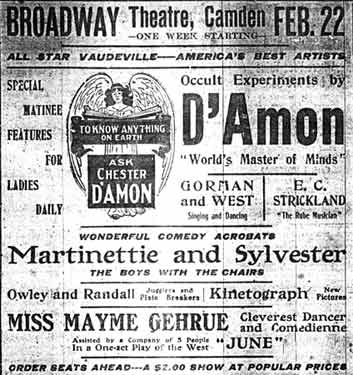
BROADWAY Theatre, Camden FEB. 22 —ONE WEEK STARTING— ALL STAR VAUDEVILLE—AMERICA’S BEST ARTISTS
Occult Experiments by D’Amon “World’s Master of Minds” — GORMAN AND WEST Singing and Dancing — E. C. STRICKLAND “The Bobe Musician”
WONDERFUL COMEDY ACROBATS Martinettie and Sylvester THE BOYS WITH THE CHAIRS
Owley and Randall Jugglers and Plate Breakers — Kinetograph New Pictures
MISS MAYME GEHRUE Cleverest Dancer and Comedienne — Assisted by a Company of 5 People In a One-act Play of the West “JUNE”
ORDER SEATS AHEAD—A $2.00 SHOW AT POPULAR PRICES
Broadway Theatre, Camden — To-Night
Camden Courier —
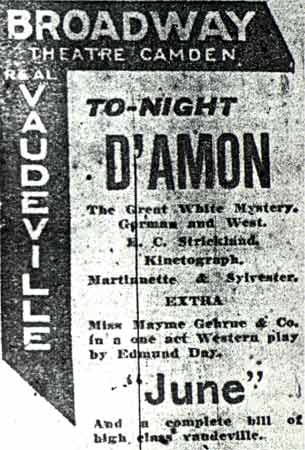
BROADWAY THEATRE CAMDEN — REAL VAUDEVILLE
TO-NIGHT — D’AMON — The Great White Mystery. Gorman and West. E. C. Strickland. Kinetograph. Martinette & Sylvester.
EXTRA — Miss Mayme Gehrue & Co. in a one act Western play by Edmund Day. “June” — And a complete bill of high class vaudeville.
Irish Billy Carroll
Variety — Week of
William F. Carroll, better known in the profession as “Irish Billy” Carroll, dropped dead on the stage of the Broadway Theater, Camden, Monday night while waiting to go on in the vaudeville sketch “June,” presented by Mayme Gehrue and company.
Billy Carroll was known throughout the theatrical profession. He was 58 years old and made his first appearance on the stage as a super under Edwin Forrest. Later he became a dancer and in an Irish character song and dance act he was known all over the world. He lived in Philadelphia all of his life.
His success in writing sketches led him to try his hand at three-act comedies, and he later turned out such successes as “Muldoon’s Picnic,” and “My Aunt Bridget” and others. Carroll’s name in private life was William F. Muldoon, but he once was known by this name only to his intimate acquaintances.
A member of the Board of Directors of the White Rats of America, he was a staunch friend and was beloved by a multitude in and out of the profession. He is survived by his widow, who appeared in “All on account of Eliza” with him, a mother and four brothers.