Emma Janvier
Stars of American Theater and Vaudeville
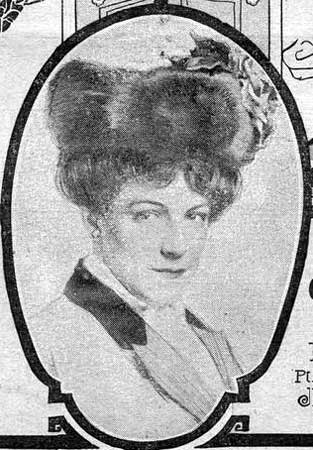
Emma Janvier — from the sheet music “Perfectly Terrible,” 1908
Emma Janvier was born Emma Pohlamus Spicer in New York around 1875 to a very prominent New York family. Her father was John Worthington Spicer. Her mother, of Mohawk Indian descent, was Nellie Francis Mansfield. The 1880 Census shows the family living at 620 Lexington Avenue in New York City. John Spicer was a “white goods merchant.” There were four older children then living at home, William, 21; Mary, 20; Edith, 14; and Nellie, 11 years of age.
Her father disowned her when she became a chorus girl, saying she disgraced the family. The Spicers were a prominent merchant family in New York City and in the Navy and militia of New York in the post-Revolutionary War years. She borrowed her stage name from an uncle, Thomas A. Janvier (1849–1913), the author of several books, both fiction and non-fiction and who wrote columns occasionally for some New York newspapers. Her aunt, Margaret Thomson Janvier (1844–1913), wrote many books for children under the pen name Margaret Vandergrift.
Emma Pohlamus Spicer studied opera under a teacher known as Agremonto, whose identity apparently has been lost to history. She studied at the New York Conservatory of Music. Emma Spicer had started with the intent of singing in her Episcopal church choir, but ended up being a chorus girl in “Lost, Strayed or Stolen.” Her next show was a small part in “The Moth and the Flame,” and then the next bit part was “the Telephone Girl.” She also appeared in “Papa Gou-Gou” in 1899. In 1901 she made her Broadway debut with “All on Account of Eliza.” Also making his Broadway debut that night was William F. Carroll, popularly known as “Irish Billy” Carroll.
Broadway Productions
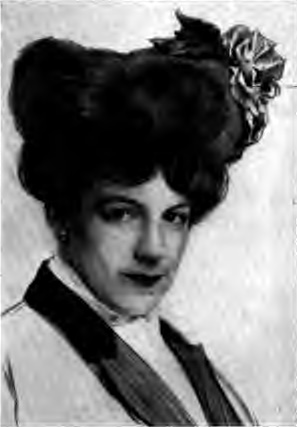
Emma Janvier — from “The Actors Birthday Book,” 1908
A deservedly popular comedienne, one whose fame and reputation increases with successive seasons, Emma Janvier now occupies a proud professional position as a feminine fun-maker, such as very few of her sex can boast. For sheer artistry and subtle comedy touches, she is nothing short of a wonder, injecting rare characterization into each of her varied roles, and without stooping to any coarse or low comedy methods, she can strike a telling note with an effectiveness that brings an immediate response from her audience.
Though her fame is of comparatively recent date, she is by no means a novice in stage circles, she is not one of the “flash-in-the-pan” variety, those who have their brief triumph and then sink into oblivion.
Miss Janvier’s early stage days were passed playing small rôles in such productions as Lost, Strayed or Stolen, “Papa Gou-Gou,” with Thomas Q. Seabrooke in 1899 at the Casino, and with Herbert Kelcey and Effie Shannon in “The Moth and the Flame.” It was the season of 1900–01 that really saw the turning-point in Miss Janvier’s career, she appearing that season as the gossiping villager, Susie Lennon, in “All on Account of Eliza,” with Louis Mann and Clara Lipman. The next year she appeared on tour as the schoolmistress, Molly Mealey, in “Lovers’ Lane,” after which she spent a season in “The Ninety and Nine.” The two years following this Miss Janvier filled four very congenial engagements, divided equally between “Glad of It.” at the Savoy, and with Mary Mannering in “Harriet’s Honeymoon” and with Blanche Ring in “Vivian’s Papas” and Edna Wallace Hopper in “A Country Mouse.” Then came Miss Janvier’s sweeping triumph as Madame Stitch in “The Mayor of Tokio,” supporting Richard Carle, she being at once conceded a leading place among our principal comediennes, displaying exceptional originality in her conception of this rôle. She remained with Mr. Carle a second season, creating Mrs. Girdle in “The Spring Chicken” and all of her previous success was again to the fore.
The season of 1907–08. Miss Janvier originated the role of Mrs. Tilford in “50 Miles From Boston.” and her happy knack of making a faithful portraiture of a gossiping busybody was clearly illustrated, bringing to the part all the clever, brainy touches for which the name of Emma Janvier has now become a synonym. In the summer of 1908 she appeared in Chicago as leading woman in “The Top o’ the World.” A remarkably gifted woman is Miss Janvier, one whose work is ever full of delightful surprises, she being a much younger and prettier woman than the type of character roles with which she has become identified, and it is a keen pleasure to anticipate her appearance in a new role each season.
| Production | Dates |
|---|---|
| All on Account of Eliza — Performer: Emma Janvier | Sep 3, 1900 – Mar 1901 |
| Glad of It — Performer: Emma Janvier | Dec 28, 1903 – Jan 1904 |
| The Mayor of Tokio — Performer: Emma Janvier [Madame Stitch] | Dec 4, 1905 – Jan 13, 1906 |
| The Spring Chicken — Performer: Emma Janvier [Mrs. Girdle] | Oct 8, 1906 – Apr 20, 1907 |
| Fifty Miles from Boston — Starring: Emma Janvier [Mrs. Tilford] | Feb 3, 1908 – Mar 8, 1908 |
| Miss Innocence — Starring: Emma Janvier [Miss Sniffins; Mme. Pompignac] | Nov 30, 1908 – May 1, 1909 |
| The Silver Star — Performer: Emma Janvier [Mrs. Vera Willing] | Nov 1, 1909 – Feb 1910 |
| Some Baby! — Performer: Emma Janvier | Aug 12, 1915 – Oct 1915 |
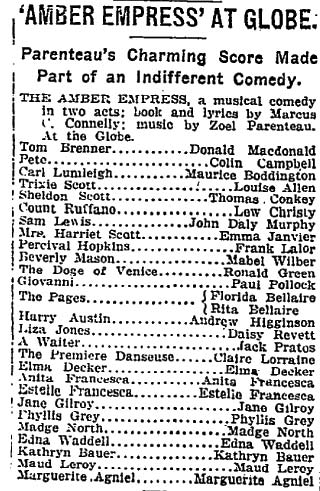
| The Amber Empress — Performer: Emma Janvier [Mrs. Harriet Scott] | Sep 19, 1916 – Sep 30, 1916 |
| Go to It — Performer: Emma Janvier | Oct 24, 1916 – Nov 1916 |
| Two Little Girls in Blue — Performer: Emma Janvier [Hariette Neville] | May 3, 1921 – Aug 27, 1921 |
| Molly Darling — Performer: Emma Janvier [Mrs. Redwing] | Sep 1, 1922 – Nov 25, 1922 |
| Poppy — Performer: Emma Janvier [Princess Vronski Mameluke Pasha Tubbs] | Sep 3, 1923 – Jun 28, 1924 |
The next year she went on tour in “Lovers’ Lane,” and followed that with a long engagement in “The Ninety and Nine.” In December of 1904 Emma Janvier returned to Broadway, appearing in “Glad of It” which ran for a month at the Savoy, and then three subsequent roles in “Harriet’s Honeymoon,” “Vivian’s Papas,” and “A Country Mouse.”
In December of 1905 Emma Janvier appeared in a role that put her among Broadway’s leading comediennes of the day, as Madame Stitch in “The Mayor of Tokio.” “The Mayor of Tokio” played all over the country to large crowds, and the overture was recorded by Vess Ossman, playing banjo for Columbia Records. There was even a popular candy-bar called “Sa-Yo” with the picture of a Japanese maid on the wrapper. She followed that up with another triumph, “The Spring Chicken,” which ran from October 1906 through April of 1907. This was followed by another huge success, in George M. Cohan’s “50 Miles From Boston,” from whence came the famous song “Harrigan.” Early recording-star Billy Murray made the song a standard; Murray’s 1907 recording of “Harrigan” was the best-selling song in the country by September of that year.
After “50 Miles From Boston” closed she went to Chicago for a long engagement in “The Top o’ The World.” After returning to New York, she appeared on Broadway in Florenz Ziegfeld’s “Miss Innocence” opposite Anna Held. 1909 brought her a role in “The Silver Star,” which wrapped up in February of 1910.
Emma Janvier married David Bryce Torrence in 1898, but the two eventually divorced. David Bryce Torrence was a Scottish stage actor. Both he and his brother, Ernest Torrence, would head west to Hollywood and make their marks in both silent and talking pictures. David and Emma were living at 620 West 116th Street in April of 1910, according to Census records.
Shortly thereafter Emma Janvier met and married Mortimer Fuller Smith, of Lynn, Massachusetts. His family’s business, the Boston Woven Hose and Rubber Company, had one of the early patents on vulcanizing fire hoses, and was quite well known at the time. Emma and Mortimer Smith moved to Connecticut. Leaving the stage behind her, Emma gave birth to identical twins, John Spicer Smith and Joseph Mortimer Smith in 1911. The twins appeared in vaudeville on several occasions, including some bits with W.C. Fields, who was a close friend of hers. A few years later, another son, Newhall Smith was born; sadly he died when he was 16 of encephalitis.
Emma Janvier returned to Broadway in the summer of 1915 in Some Baby!, and worked in two productions in the fall of 1916 on the Great White Way, “The Amber Empress” and “Go to It.”
Emma and Mortimer divorced on June 27, 1918 in Connecticut. Emma remained in Connecticut. By September of 1918, when he registered for the draft, Mortimer Smith had taken up residence in New York City, where he worked for the Red Cross. He died during World War I, of mustard gas. The 1920 Census shows Emma (Janvier) Smith and her children at 19 Stevens Street in Danbury, Connecticut.
1921 saw Emma Janvier in another Broadway production, “Two Little Girls in Blue,” and 1922 she returned again in “Molly Darling.” In 1923 she created her final role, as Princess Vronski Mameluke Pasha Tubbs in the Broadway version of Poppy, which starred W.C. Fields.
Emma Janvier died during the production of Poppy, which was the first stage play at the Apollo Theater. Her gravestone was paid for by the cast of Poppy. The family story is that W.C. Fields would not have gotten the part in the play, because he wasn’t considered suitable for stage. She intervened on his behalf and insisted. He was hired, and then went on to recreate that role in a full length motion picture. As Emma Janvier never appeared in movies, seeing Catherine Doucet in her role in the film version of Poppy is probably as close as one can come on video to one of Emma Janvier’s roles.
The Mayor of Tokio
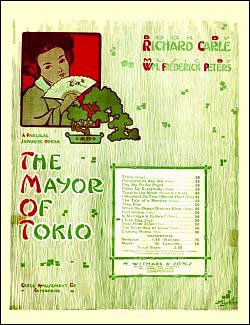
The Mayor of Tokio — book by Richard Carle, music by Frederick Peters
The Spring Chicken
New York Times —
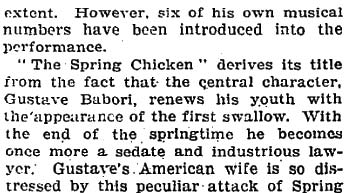
To-morrow evening Richard Carle comes to Daly’s Theatre in “The Spring Chicken,” which was taken from the French, furnished with music by Ivan Caryll and performed for two seasons at George Edwardes’s Gaiety Theatre in London. Mr. Carle, who was himself author of his recent productions, “The Tenderfoot” and “The Mayor of Tokio,” had no share in the composition of this entertainment except in so much as he “Americanized” the book to a certain extent. However, six of his own musical numbers have been introduced into the performance.
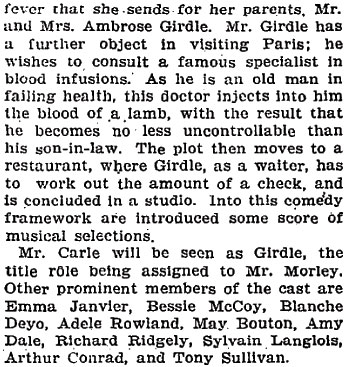
“The Spring Chicken” derives its title from the fact that the central character, Gustave Babori, renews his youth with the appearance of the first swallow. With the end of the springtime he becomes once more a sedate and industrious lawyer. Gustave’s American wife is so distressed by this peculiar attack of Spring fever that she sends for her parents, Mr. and Mrs. Ambrose Girdle. Mr. Girdle has a further object in visiting Paris; he wishes to consult a famous specialist in blood infusions. As he is an old man in failing health, this doctor injects into him the blood of a lamb, with the result that he becomes no less uncontrollable than his son-in-law. The plot then moves to a restaurant, where Girdle, as a waiter, has to work out the amount of a check, and is concluded in a studio. Into this comedy framework are introduced some score of musical selections.
Mr. Carle will be seen as Girdle, the title rôle being assigned to Mr. Morley. Other prominent members of the cast are Emma Janvier, Bessie McCoy, Blanche Deyo, Adele Rowland, May Bouton, Amy Dale, Richard Ridgely, Sylvain Langlois, Arthur Conrad, and Tony Sullivan.
With American Dressing
New York Times —
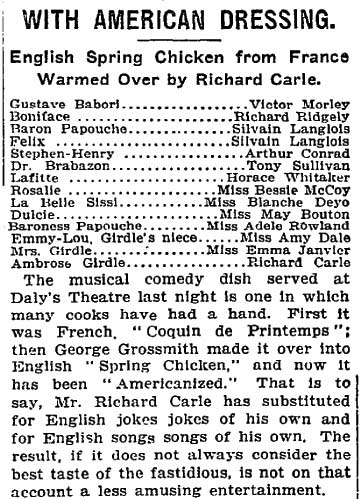
English Spring Chicken from France Warmed Over by Richard Carle
The musical comedy dish served at Daly’s Theatre last night is one in which so many cooks have had a hand. First it was French, “Coquin de Printemps”; then George Grossmith made it over into English “Spring Chicken,” and now it has been “Americanized.” That is to say, Mr. Richard Carle has substituted for English jokes jokes of his own and for English songs songs of his own. The result, if it does not always consider the best taste of the fastidious, is not on that account a less amusing entertainment.
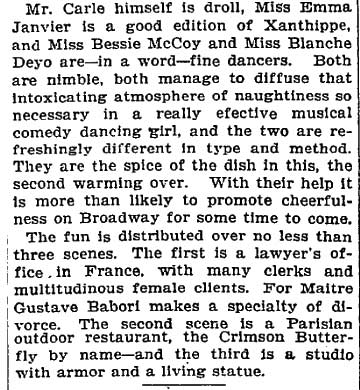
Mr. Carle himself is droll, Miss Emma Janvier is a good edition of Xanthippe, and Miss Bessie McCoy and Miss Blanche Deyo are—in a word—fine dancers. Both are nimble, both manage to diffuse that intoxicating atmosphere of naughtiness so necessary in a really effective musical comedy dancing girl, and the two are refreshingly different in type and method. They are the spice of the dish in this, the second warming over. With their help it is more than likely to promote cheerfulness on Broadway for some time to come.
The fun is distributed over no less than three scenes. The first is a lawyer’s office in France, with many clerks and multitudinous female clients. For Maitre Gustave Babori makes a specialty of divorce. The second scene is a Parisian outdoor restaurant, the Crimson Butterfly by name—and the third is a studio with armor and a living statue.
Fifty Miles from Boston
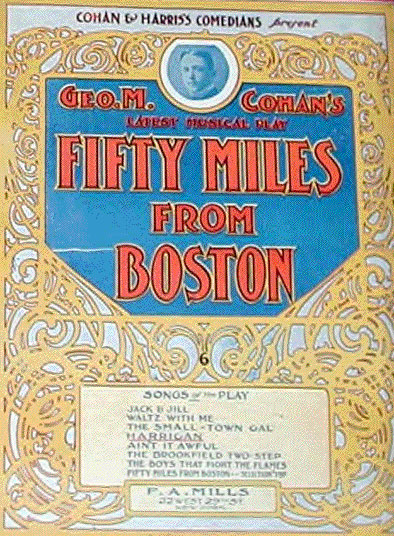
Cohan & Harris Comedians present Geo. M. Cohan’s Latest Musical Play, “Fifty Miles from Boston”
Perfectly Terrible
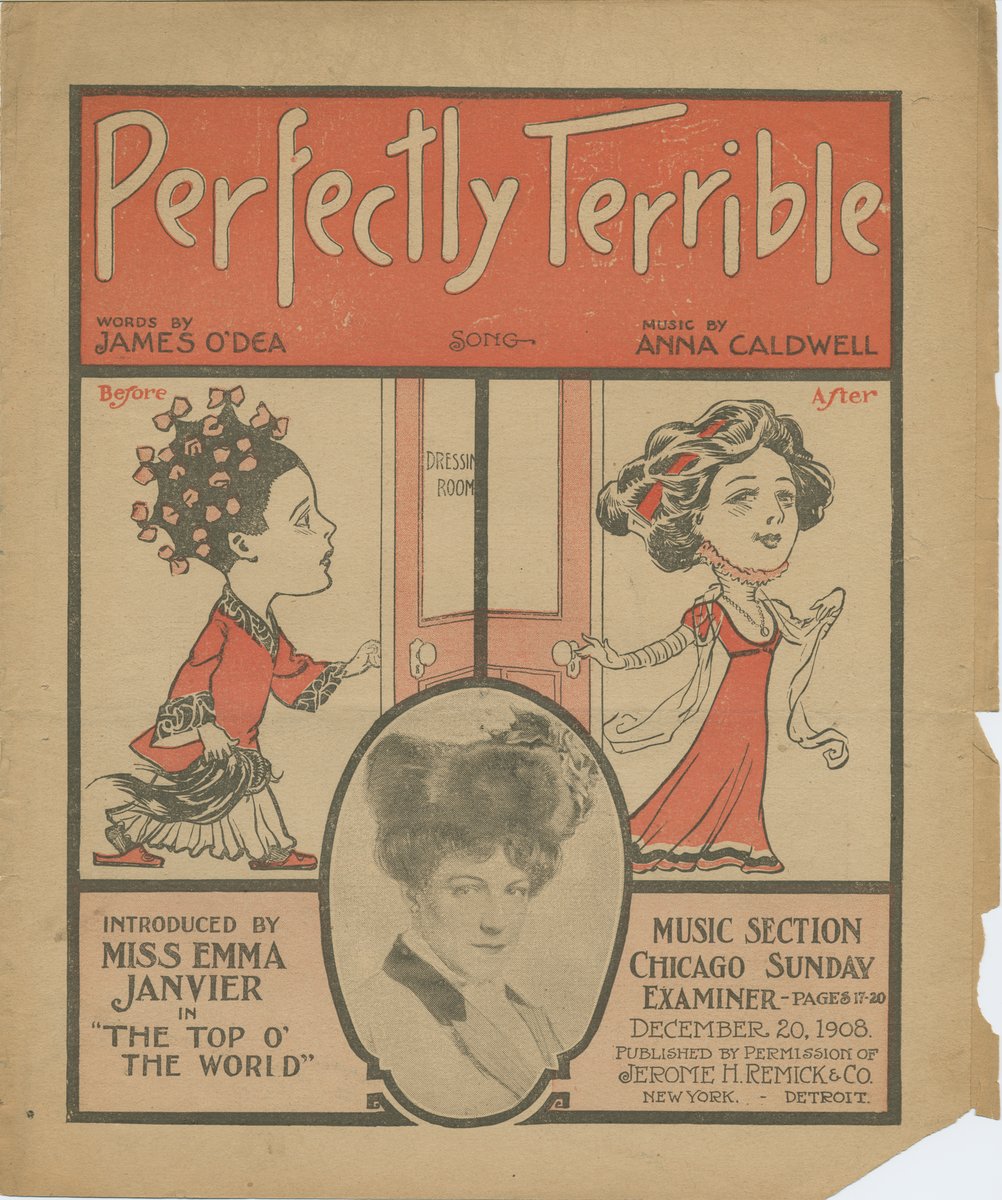
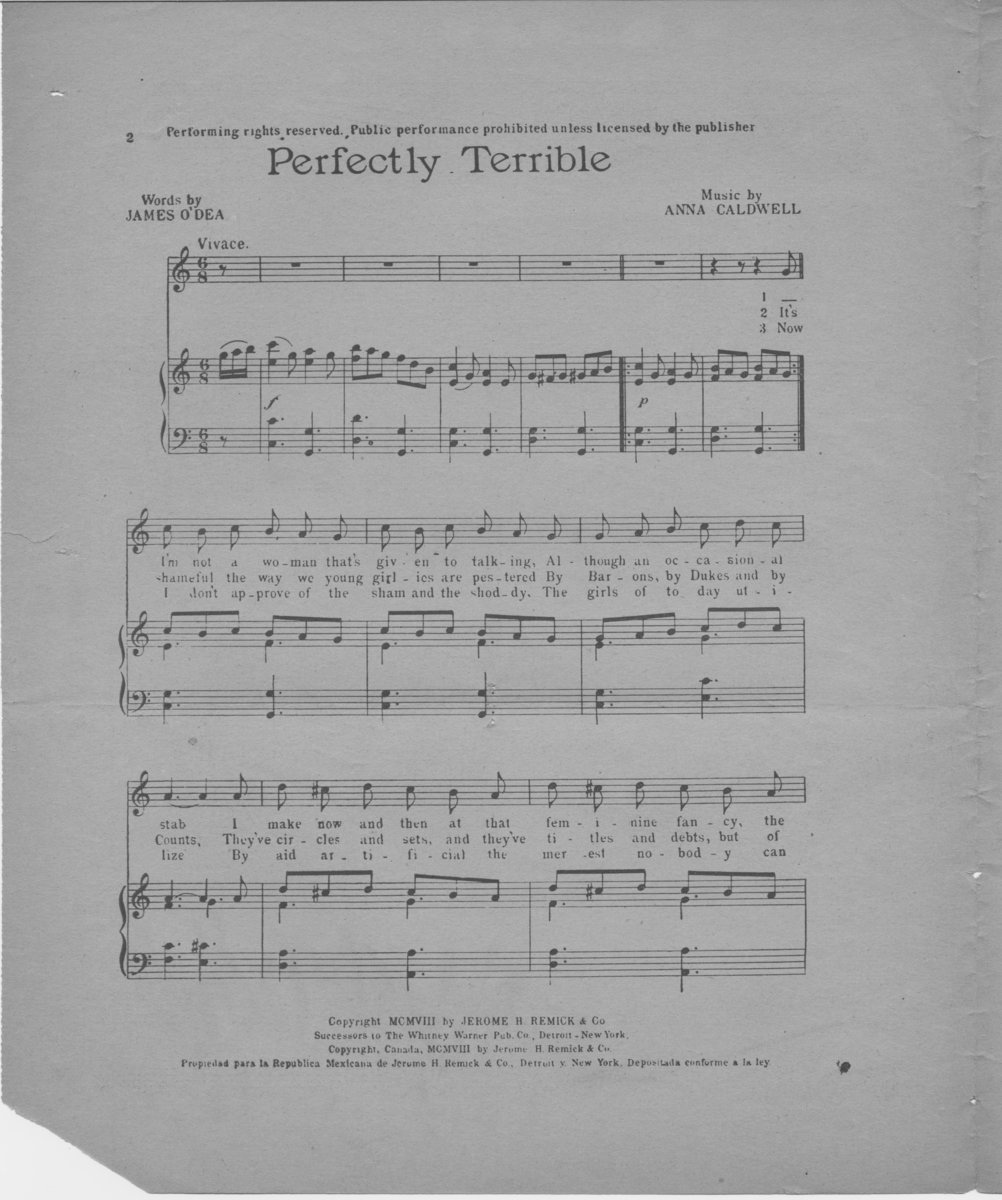
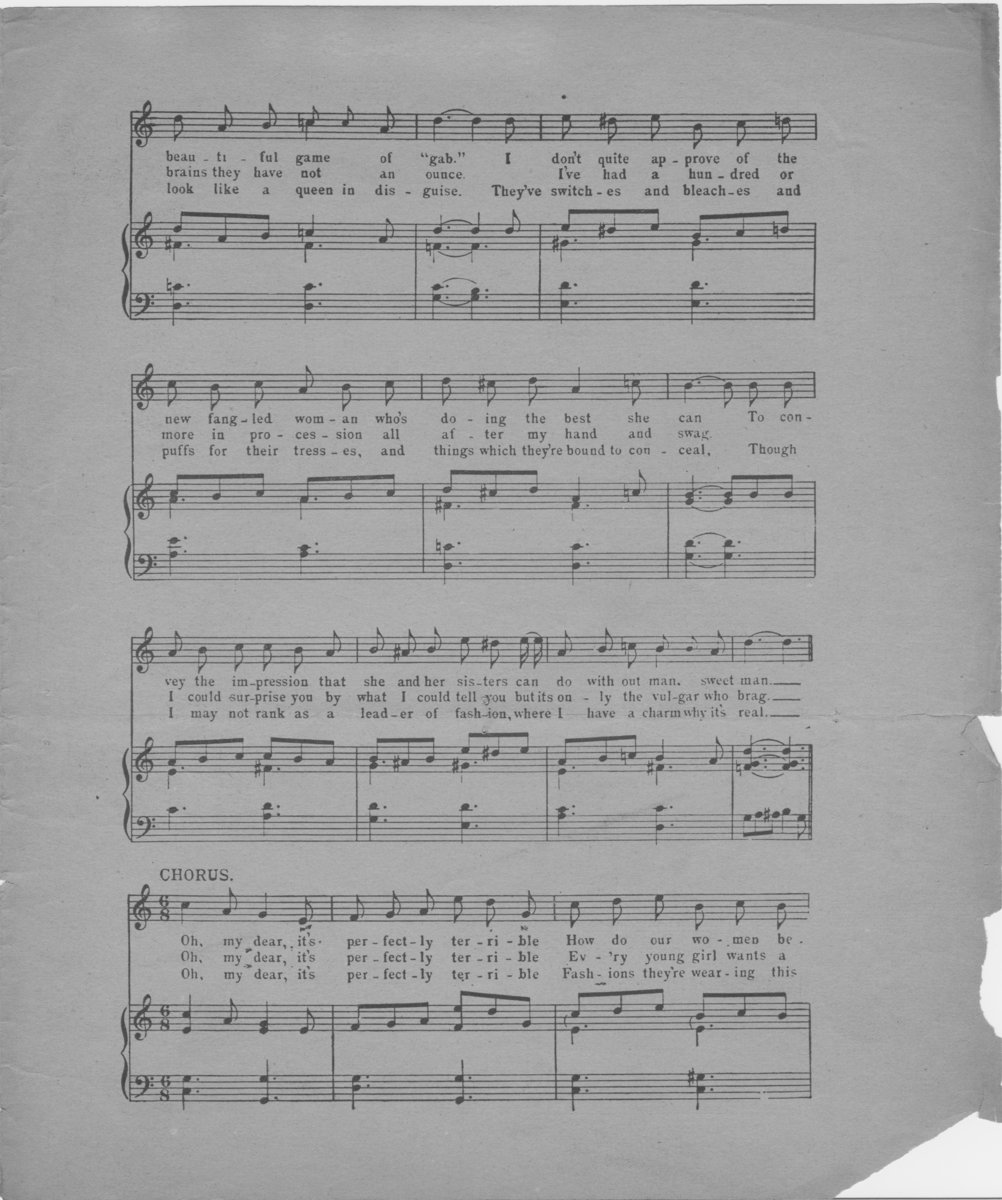
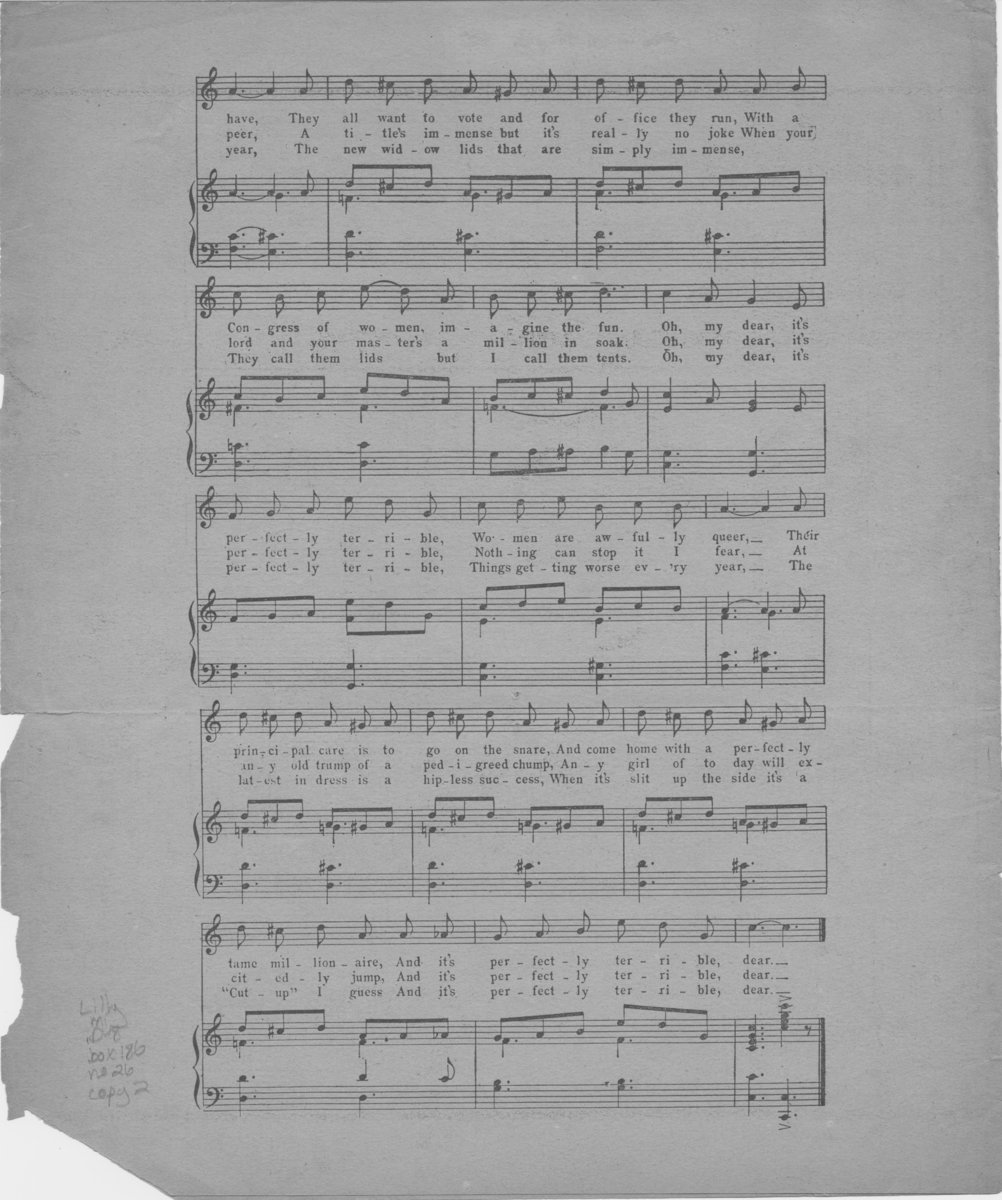
“Perfectly Terrible” — words by James O’Dea, music by Anna Caldwell; introduced by Miss Emma Janvier in “The Top o’ the World.” Chicago Sunday Examiner, December 20, 1908.
Miss Innocence
New York Times —
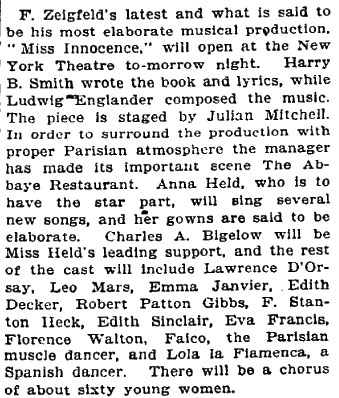
F. Zeigfeld’s latest and what is said to be his most elaborate musical production, “Miss Innocence,” will open at the New York Theatre to-morrow night. Harry B. Smith wrote the book and lyrics, while Ludwig Englander composed the music. The piece is staged by Julian Mitchell. In order to surround the production with proper Parisian atmosphere the manager has made its important scene The Abbaye Restaurant. Anna Held, who is to have the star part, will sing several new songs, and her gowns are said to be elaborate.
Charles A. Bigelow will be Miss Held’s leading support, and the rest of the cast will include Lawrence D’Orsay, Leo Mars, Emma Janvier, Edith Decker, Robert Patton Gibbs, F. Stanton Heck, Edith Sinclair, Eva Francis, Florence Walton, Faico, the Parisian muscle dancer, and Lola la Flamenca, a Spanish dancer. There will be a chorus of about sixty young women.
Minute Visits in the Wings
New York Times —
Minute Visits in the Wings
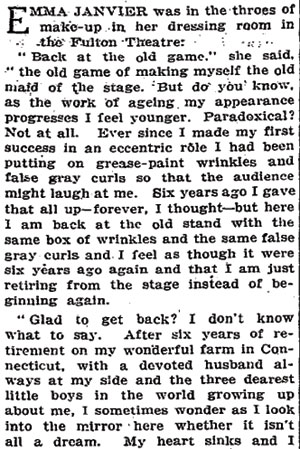
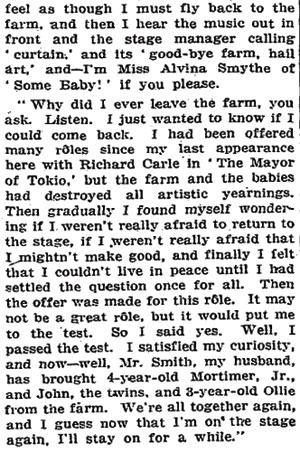
Emma Janvier was in the throes of make-up in her dressing room in the Fulton Theatre.
“Back at the old game,” she said. “the old game of making myself the old maid of the stage. But do you know, as the work of ageing my appearance progresses I feel younger. Paradoxical? Not at all. Ever since I made my first success in an eccentric rôle I had been putting on grease-paint wrinkles and false gray curls so that the audience might laugh at me. Six years ago I gave that all up—forever, I thought—but here I am back at the old stand with the same box of wrinkles and the same false gray curls and I feel as though it were six years ago again and that I am just retiring from the stage instead of beginning again.
“Glad to get back? I don’t know what to say. After six years of retirement on my wonderful farm in Connecticut, with a devoted husband always at my side and the three dearest little boys in the world growing up about me, I sometimes wonder as I look into the mirror here whether it isn’t all a dream. My heart sinks and I feel as though I must fly back to the farm, and then I hear the music out in front and the stage manager calling ‘curtain,’ and its ‘good-bye farm, hail art,’ and—I’m Miss Alvina Smythe of ‘Some Baby!’ if you please.
“Why did I ever leave the farm, you ask. Listen. I just wanted to know if I could come back. I had been offered many rôles since my last appearance here with Richard Carle in ‘The Mayor of Tokio,’ but the farm and the babies had destroyed all artistic yearnings. Then gradually I found myself wondering if I weren’t really afraid to return to the stage, if I weren’t really afraid that I mightn’t make good, and finally I felt that I couldn’t live in peace until I had settled the question once for all. Then the offer was made for this rôle. It may not be a great rôle, but it would put me to the test. So I said yes. Well, I passed the test. I satisfied my curiosity, and now—well, Mr. Smith, my husband, has brought 4-year-old Mortimer, Jr., and John, the twins, and 3-year-old Ollie from the farm. We’re all together again, and I guess now that I’m on the stage again, I’ll stay on for a while.”
‘Amber Empress’ at Globe
New York Times —
‘Amber Empress’ at Globe
Parenteau’s Charming Score Made Part of an Indifferent Comedy
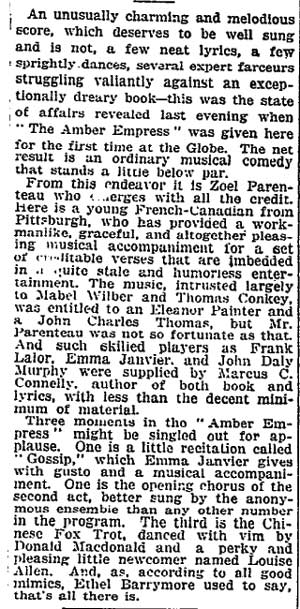
An unusually charming and melodious score, which deserves to be well sung and is not, a few neat lyrics, a few sprightly dances, several expert farceurs struggling valiantly against an exceptionally dreary book—this was the state of affairs revealed last evening when “The Amber Empress” was given here for the first time at the Globe. The net result is an ordinary musical comedy that stands a little below par.
From this Parenteau, a Zoel Parenteau who emerges with all the credit, here is a young French-Canadian from Montreal who has a workmanlike, graceful, and altogether pleasing musical accompaniment for a set of verse which is in but lightly in a quite stale and humorless entertainment. The music, intrusted largely to John Charles Thomas, and such skilled players as Frank Lalor, Emma Janvier, and John Daly in a play by Marcus T. Connelly, author of both book and lyrics, with less than the decent minimum of material.
Three moments in the “Amber Empress” might be singled out for applause. First is a recitation called “Gossip,” which Emma Janvier gave with gusto and a musical accompaniment, and the opening chorus of the second act, better sung by the luminous ensemble than any other number in the program. Emma Janvier danced the Chinese Fox Trot, danced with a kind Donald Macdonald and a perky and disastrously incompetent comedienne, Ethel Allen. And, as, according to all good mimics, Ethel Barrymore used to say, that’s all there is.
Go to It
New York Times —
Go to It — Tuesday night at the Princess
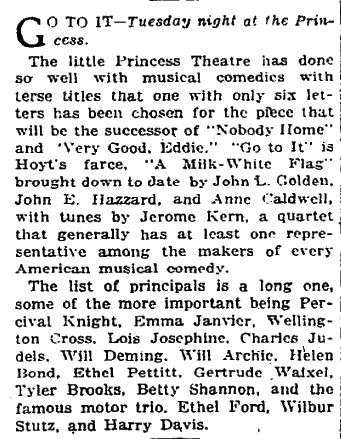
The little Princess Theatre has done so well with musical comedies with terse titles that one with only six letters has been chosen for the piece that will be the successor of “Nobody Home” and “Very Good, Eddie.” “Go to It” is Hoyt’s farce, “A Milk-White Flag” brought down to date by John L. Golden, John E. Hazzard, and Anne Caldwell, with tunes by Jerome Kern, a quartet that generally has at least one representative among the makers of every American musical comedy.
The list of principals is a long one, some of the more important being Percival Knight, Emma Janvier, Wellington Cross, Lois Josephine, Charles Judels, Will Deming, Will Archie, Helen Bond, Ethel Pettitt, Gertrude Waixel, Tyler Brooks, Betty Shannon, and the famous motor trio, Ethel Ford, Wilbur Stutz, and Harry Davis.
Two Little Girls in Blue
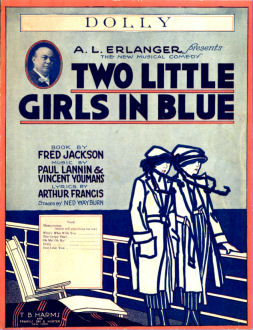
Two Little Girls in Blue premiered on May 3, 1921 at the George M. Cohan’s Theater. The show enjoyed moderate success but closed after 135 performances on August 27 of the same year. The show is set aboard a ship at sea, the S.S. Empress, all three acts take place aboard ship. The cast included Madeline Fairbanks (1900–1989), her twin sister Marion (1900–1973), Emma Janvier, and Frederic Santly (1887–1953).
“Dolly” is a duet between two characters, “Bobby” and “Jerry” played by Oscar Shaw and Fred Santly, and is a wonderfully melodic and gay (happy, carefree) song. The verse begins with a lovely slow ballad that sets the stage for a beautiful refrain that is more upbeat. This song is a great example of Broadway music at its best. It has a great deal of expressiveness and even a bit of drama.
An interesting side note to this is that the co-lyricist, “Arthur Francis,” was actually Ira Gershwin. One has to wonder why he resorted to use of a pseudonym? In many cases, such actions were taken to avoid contract conflicts, perhaps that was his reason.