Wilbur Charles Keckhut
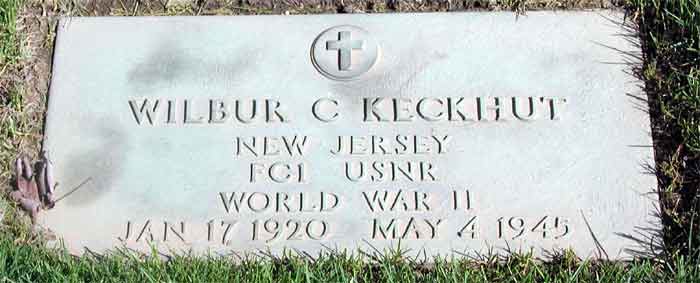
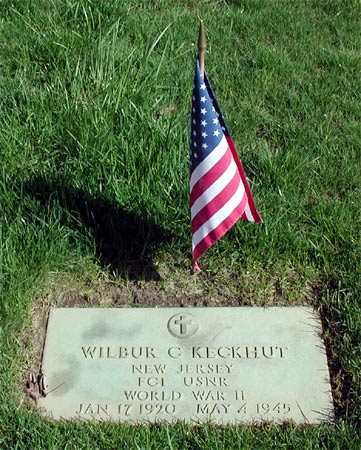
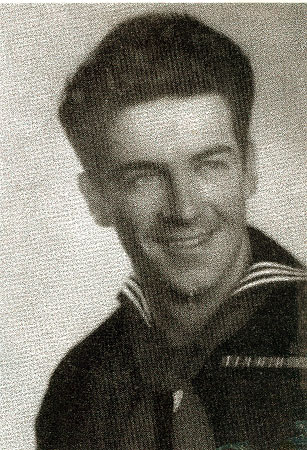
Wilbur Charles Keckhut.
Fire Controlman First Class, U.S. Navy
Serial: 4049837
USS Ingraham DD-694
Entered the Service from: New Jersey
Died: May 5, 1945
Buried at: Locustwood Cemetery
Route 70 and Cooper Landing Road
Cherry Hill, New Jersey
Awards: Purple Heart, Good Conduct Medal
Introduction
Fire Controlman First Class Wilbur Charles Keckhut grew up in Collingswood NJ. Born January 17, 1920, he was the first son of Richard P. and Joetta Turner Keckhut. His father was a fireman, and the family lived in 1930 with Joetta’s widowed mother at 902 Collings Avenue. Besides Wilbur, there was an older sister, Dorothea, and three boys Richard, Walter, and Henry.
Wilbur Keckhut attended high school in Collingswood NJ as a member of the Collingswood High class of 1940. He lived with his wife, Gertrude Elizabeth Keckhut, at 362 Dudley Street, in the then new Westfield Acres Apartments in Camden NJ. He had enlisted in the Navy reserve on July 15, 1940, in Camden, serving initially on the USS Decatur. The Decatur at that time was based at the Philadelphia Navy Yard and the Brooklyn NY Navy Yard. Trained as a range finder and sight setter on a gun crew, he took part in the Decatur’s patrols of the Gulf of Mexico and areas near Key West FL. In August of 1941 he was sent to Washington to attend Fire Control school.
After Pearl Harbor he returned to the Decatur, and took part in her patrols near Iceland in March 1942. On May 6, he was returned to Boston Navy Yard. He took ill and was operated at the Norfolk Naval Hospital in June 1942. Returning to active service, he took part in action in the Mediterranean near Tunis, Algiers, Sicily, and at Anzio. He returned to the United States on Christmas, 1943, and was sent to Washington.
He returned to the east coast, and in March of 1944 he was assigned to a destroyer, the USS Ingraham (DD-694).
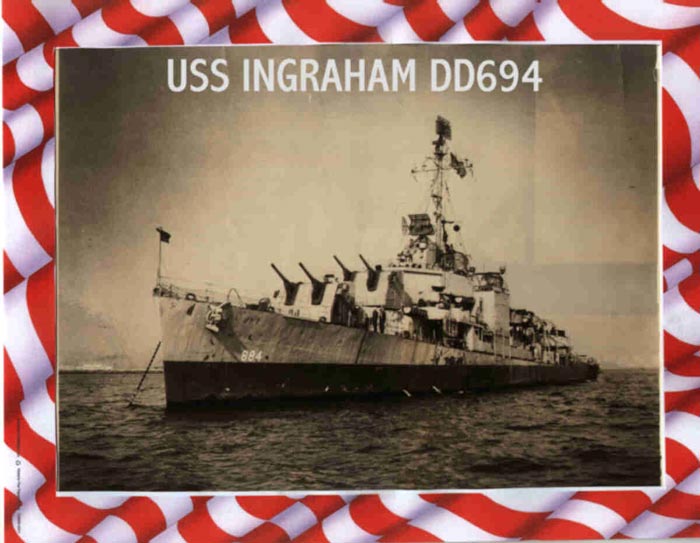
USS Ingraham DD-694.
The Ingraham (DD-694) was launched 16 January 1944 by Federal Shipbuilding & Drydock Co., Kearny, N.J.; sponsored by Mrs. George Ingraham Hutchinson; and commissioned 10 March 1944, with Commander H. W. Gordon in command.
After shakedown in Bermuda and training out of Norfolk, Ingraham sailed for duty with the Pacific Fleet, arriving Eniwetok 31 October in time to begin the final push of the enemy to its home islands. In mid-November she commenced screening carriers during strikes on Luzon in which considerable damage was done to the dwindling Japanese navy and air force. The destroyer continued patrol and antisubmarine duty until 12 December when she sailed for the assault and landings on Mindoro. Three days later in company with Barton, she sank a Japanese cargo ship off the southwest tip of Mindoro.
After a brief stay, she departed San Pedro 2 January 1945, for the operations in the Lingayen Gulf. Arriving off the Gulf on the sixth, she added her powerful anti-aircraft fire to that of the invasion fleet, and bombarded shore targets behind the beaches.
At the end of January, Ingraham joined a fast carrier task force for strikes on the Japanese homeland. Following repair at Saipan 20 February, she joined the invasion fleet off Iwo Jima 23 February, and provided accurate call fire for the Marines ashore.
On 21 March the ship took up radar picket station in support of the Okinawa-Gunto operation. On 5 May, she came under concerted air attack, and shot down four of the enemy planes before a fifth crashed the ship above the waterline on the port side, its bomb exploding in the generator room. With only 1 gun operative, and with 51 casualties aboard, Ingraham retired to Hunter’s Point, Calif., for repairs.
Wilbur Keckhut was killed in action during this attack. Besides his wife, he left three brothers, Walter, Henry, and Richard P. Keckhut Jr.
Fire Controlman First Class Keckhut was awarded the Good Conduct Medal, the Purple Heart, the American Theater Ribbon, the European Theater Ribbon with four Battle Stars, the South Pacific and Asiatic Theater Ribbon with six battle stars, and the pre-Pearl Harbor ribbon.
After the war, his body was returned to New Jersey. He rests at Locustwood Cemetery in Cherry Hill NJ, near his parents.
* Wilbur Keckhut’s rank was reported as Fire Controlman Second Class in the Department of Navy Casualty Lists issued in 1946. Newspaper accounts and his grave marker indicate the higher rank.
Destroyer Is Badly Crippled
Camden Courier-Post —
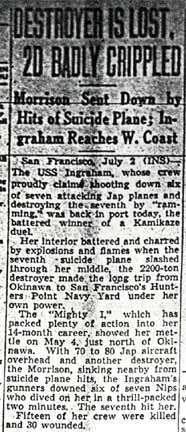
Morrison Sent Down by Hits of Suicide Plane; Ingraham Reaches W. Coast
San Francisco, July 2 (INS). — The USS Ingraham, whose crew proudly claims shooting down six of seven attacking Jap planes and destroying the seventh by “ramming,” was back in port today, the proud winner of a Kamikaze duel.
Her interior battered and charred by explosions and flames when the seventh suicide plane slashed through her middle, the 2,200-ton destroyer made the long trip from Okinawa to San Francisco’s Hunters Point Navy Yard under her own power.
The “Mighty I,” which has packed plenty of action into her 18-month career, showed her mettle on May 4, just north of Okinawa. With 70 to 80 Jap aircraft overhead and another destroyer, the Morrison, sinking nearby from suicide plane hits, the Ingraham’s gunners downed six of the Nips who dived on her in a thrill-packed two minutes. The seventh hit her. Fifty of her crew were killed and 30 wounded.
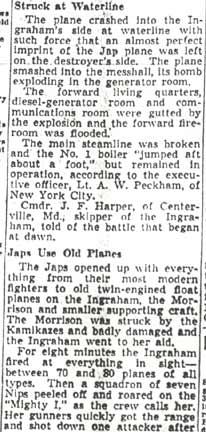
Struck at Waterline
The plane crashed into the Ingraham’s side at waterline with such force that an almost perfect imprint of the Jap plane was left on the destroyer’s side. The plane smashed into the messroom, its bomb exploding in the generator room.
The forward living quarters, diesel-generator room and communications room were gutted by the explosion, and the forward fireroom was flooded.
The main steamline was broken and No. 1 boiler “jumped” aft about a foot from its original operation, according to the executive officer, Lt. A. W. Peckham, of New London.
Cmdr. J. F. Harper, of Centerville, Md., skipper of the Ingraham, told of the battle that began at dawn.
Japs Use Old Planes
The Japs opened up with everything — firing at us from modern fighters to old twin-engined float planes on the Ingraham, the Morrison and smaller supporting craft. The Morrison was struck by the Kamikazes and badly damaged and the Ingraham went to her aid.
For eight minutes the Ingraham fought her attackers. In that time, between 70 and 80 planes of all types. Then a squadron of seven Nips peeled off and roared on the Ingraham. Her gunners quickly got into action and shot down one attacker after another until only one of seven was left.
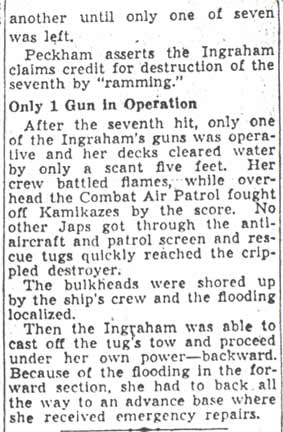
Peckham asserts the Ingraham claims credit for destruction of the seventh by “ramming.”
Only 1 Gun in Operation
After the seventh hit, only one of the Ingraham’s guns was operative and her decks cleared water by only a scant five feet. Her crew battled flames, while overhead the Combat Air Patrol fought off Kamikazes by the score. No other Japs got through the anti-aircraft and patrol screen and rescue tugs quickly reached the crippled destroyer.
The bulkheads were shored up by the ship’s crew and the flooding localized.
Then the Ingraham was able to cast off the tug’s tow and proceed under her own power — backward. Because of the flooding in the forward section, she had to back all the way to an advance base where she received emergency repairs.
Services Tomorrow For Wilbur C. Keckhut
Camden Courier-Post —
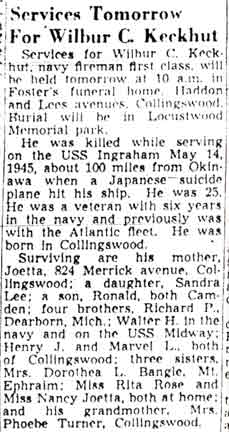
Services for Wilbur C. Keckhut, navy fireman first class, will be held tomorrow at 10 a.m. in Foster’s funeral home, Haddon and Lees avenues, Collingswood. Burial will be in Locustwood Memorial park.
He was killed while serving on the USS Ingraham May 14, 1945, about 100 miles from Okinawa when a Japanese suicide plane hit his ship. He was 25. He was a veteran with six years in the navy and previously was with the Atlantic fleet. He was born in Collingswood.
Surviving are his mother, Joetta, 824 Merrick avenue, Collingswood; a daughter, Sandra Lee; a son, Ronald, both Camden; four brothers, Richard P., Dearborn, Mich.; Walter H. in the Navy and at USS Midway; Henry J. and Marvel L., both of Collingswood; three sisters, Mrs. Dorothea L. Bangle, Mt. Ephraim; Miss Rita Rose and Miss Nancy Joetta, both at home; and his grandmother, Mrs. Phoebe Turner, Collingswood.