The Story of Rudolph Warrington
What happened to Rudolph Sylvester Warrington in March of 1950 is happening to our elderly veterans today still. Our veterans deserve better.
Rudolph Sylvester Warrington was born on September 1, 1870 to Benjamin I. Warrington and his wife, the former Mary K. Birdsell. His maternal grandfather was Dr. Sylvester Birdsell, a well-known physician in Camden. By 1880 his father had passed, and Rudolph Warrington was living with his mother, brother B. Laird, and sister Mary at the home of his grandfather, 614 South 5th Street in South Camden. This would be his home address through the 1900 Census. He had, however, joined the United States Navy while in his teens. By the time the 1890 Camden City Directory was published, his father had died, and his mother was living at 757 Spruce Street in Camden NJ with his brother Laird B. Warrington, then a shoemaker.
Rudolph S. Warrington made a career of the United States Navy. He was a veteran of the Spanish-American War, serving aboard a gunboat, the USS Wilmington. Remaining aboard the Wilmington, he was with the ship during its journey to South America and its trip up the Amazon River. When the Census was taken in 1900, Rudolph Warrington, the Chief Master at Arms, was with the Wilmington in Montevideo, Uruguay.
Rudolph Warrington was still on active duty as late as the summer of 1910. He then was stationed aboard the old USS Independence, then docked at the Mare Island Navy Yard in California, where it was being used as a receiving ship. The USS Independence was disposed of a few years later. Rudolph Warrington had not returned to Camden when the 1914 Camden City Directory was compiled.
By January 1920, Rudolph Warrington had retired from the service with the rank of Chief Master at Arms. He had returned to Camden and was living with his mother, Mary Warrington, at 757 Spruce Street. He had briefly married around 1916, but he was a widower at the time of the census. Ten years later, Rudolph S. Warrington was still living at 757 Spruce Street in Camden. His mother had passed, and he was renting an apartment. Rudolph Warrington lived alone, save for a housekeeper, Amy Yetter.
Rudolph Warrington apparently fell on hard times afterwards. He had moved to 64 Oakland Avenue in Runnemede NJ, where he lived by himself. Missed by neighbors in March of 1950, he was discovered alone in the home, which had no food or heat. He was rushed to West Jersey Hospital on March 22, 1950, where he died.
Chief Warrington was buried at Beverly National Cemetery on March 27, 1950.
Camden Courier-Post – March 22, 1950
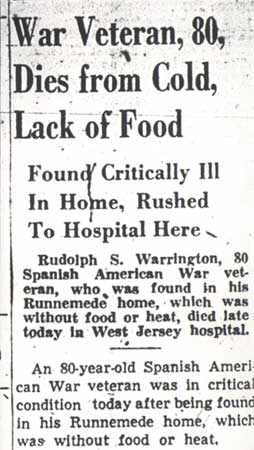
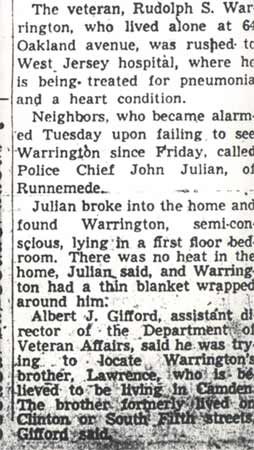
USS Wilmington PG-8
Rudolph Warrington was a Spanish-American War veteran. Census records show that he was a member of the crew of USS Wilmington in the summer of 1900 during its stay in Montevideo, Uruguay. It is believed he was with Wilmington from the time it was commissioned in May of 1897 through at least 1901, when the ship reached Manila in the Philippines after an extended tour of duty in South America which included trips up the Orinoco and Amazon Rivers.
Wilmington (Gunboat No. 8) was laid down on 8 October 1894 at Newport News, VA., by the Newport News Shipbuilding Co., launched on 19 October 1895 sponsored by Mrs. Anne B. Gray, and commissioned on 13 May 1897, Comdr. Chapman C. Todd in command.
The new gunboat conducted sea trials and underwent training off the east coast and joined the North Atlantic Squadron at Key West. Wilmington trained and underwent exercises in gunnery and tests in late 1897 and early 1898 as tension between the United States and Spain was rising steadily closer to open hostilities.
On 21 April 1898, two months after the sinking of battleship Maine in Havana harbor, Cuba, the United States declared war on Spain. Meanwhile, the Navy had moved its warships into position to attack Spanish possessions in the Far East and in the Caribbean. On 15 July 1898, Wilmington arrived off Cape Cruz, near Manzanillo, Cuba, and joined Wompatuck on station with the blockading forces.
The following day, Wilmington overhauled two small charcoal-burning fishing boats off the harbor mouth and questioned their Cuban crews. From the brief interrogation, the Americans learned that a submarine cable connected Santa Cruz and Juearo. The gunboat then proceeded to the spot mentioned by the fishermen and lowered a grappling hook. Finding the cable, Wilmington cut it and made for Cuarto Reales to join Helena (Gunboat No. 9), Wompatuck, and Hist.
On 17 July, Wilmington led the three other ships to El Guayabal, 20 miles north of Manzanillo, Cuba. Upon their arrival at Guayabal, the warships found Scorpion, Hornet, and Osceola. During the afternoon hours, the four commanding officers met in conference and formulated preliminary plans for an expedition to Manzanillo to destroy the Spanish shipping there.
Accordingly, at 0300 on 18 July, the American ships set out from Guayabal and set course for Manzanillo. At 0645, the group split up according to plan: Wilmington and Helena made for the north channel; Hist, Hornet, and Wompatuck for the south; Scorpion and Osceola for the central harbor entrance. Fifteen minutes later, the two largest ships entered the harbor with black smoke billowing from their tall funnels and gunners ready at their weapons.
Taking particular care not to damage the city beyond the waterfront, the American gunners directed their gunfire solely at the Spanish ships and took a heavy toll of the steamers congregated there. Spanish supply steamer Purissima Concepcion caught fire alongside a dock and sank at her moorings, gunboat Maria Ponton blew up when her magazines exploded; gunboats Estrella and Delgado Perrado also burned and sank while two transports, Gloria and Jose Garcia, went down as well. Two small gunboats, Guantanamo and Guardian were driven ashore and shot to pieces.
Beyond the effective range of Spanish shore batteries, the Americans emerged unscathed, leaving columns of smoke to mark the pyres of the enemy’s supply and patrol vessels. The twenty-minute engagement ended with the attackers withdrawing to sea to resume routine patrol duties with the North Atlantic Squadron for the duration of hostilities.
Late in the summer, the gunboat headed home and was drydocked at Boston from 24 September to 3 October. Following repairs, the ship departed the Massachusetts coast on 20 October, bound, via Charleston S.C., for Norfolk. Arriving at Hampton Roads on 31 October, the ship put into the Norfolk Navy Yard on the following day for further repairs, overhaul, and preparation for foreign service.
With the reestablishment of the South Atlantic Squadron, Wilmington got underway on Christmas Eve and set her course for Puerto Rico. She arrived at San Juan on 30 December 1898 but resumed her voyage south on 2 January 1899 and proceeded via Port Castries, St. Lucia, to Port-of-Spain, Trinidad, where she made port on the 16th.
Six days later, the gunboat left Trinidad behind and pointed her straight stem toward Venezuela. On the 23d, the ship arrived off Barima Point and stood up the Santa Catalina River, which led to the main branch of the Orinoco. After a brief stop at the town of Las Tablas, Wilmington put into Ciudad Bolivar on the 24th where the mayor, the American consul, and a number of city officials came on board the ship for a visit. Diplomatic affairs occupied the officers, with the commanding officer visiting the provincial governor and collector of customs.
She was based at Trinidad through February and into March. During this time she visited Guanta in northern Venezuela; Georgetown, British Guiana; and proceeded up the Surinam River to Paramaribo, Dutch Guiana.
Departing Paramaribo on 6 March, she commenced the initial leg of her cruise up the Amazon River. Navigable for nearly 2,300 miles of its 3,200-mile length during the rainy season, the Amazon and its verdant banks presented the ship’s company with interesting and unusual flora and fauna as she proceeded upriver. Calling at Para and Manaos, Brazil, en route, the ship arrived at the Peruvian border at Leticia, Peru, on 11 April. With permission granted, Wilmington again got underway and arrived at Iquitos on 13 April. While numerous official calls were exchanged during the visit, the gunboat also acquired a small menagerie: three monkeys and one tiger cat which were presented to the ship by the Peruvians.
On 18 April, the gunboat departed Iquitos, headed back down stream, and reached Rio de Janeiro on 28 May, completing a 4,600-mile round-trip voyage on the Amazon. On 6 June, Wilmington entered the Brazilian government drydock at Rio de Janeiro for routine bottom cleaning and remained there until 4 July when she got underway and cruised south along the coast visiting Brazilian and Uruguayan ports. She arrived at Montevideo on 16 July and spent one month operating out of that port.
Once the repairs were finally corrected after dockyard overhaul and a trial period, Wilmington continued cruising on the South American station through the summer and early fall of 1900. On 16 October 1900, the ship departed Pernambuco, Brazil, bound for the Far East.
Arriving at Gibraltar on 3 November, the ship pushed on across the Mediterranean and transited the Suez Canal early in December, arriving at Port Said on the 4th. On 21 January 1901, the gunboat made port at Manila, in the Philippines, to commence her Asiatic service.
It is probable that Rudolph Warrington was re-assigned to another ship at this time.
Departing from Cavite on 10 May, the ship headed for the China coast and called at Hong Kong on the 13th. Still nominally attached to the South Atlantic Fleet, Wilmington served in Chinese waters through 1904 on routine cruises showing the stars and stripes along the China coast at ports such as Swatow, Amoy, Foochow, Shanghai, and Hong Kong. On 30 June 1904, the ship was decommissioned at Cavite.
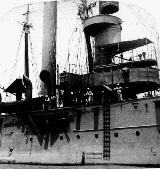
USS Wilmington (PG-8) — view of midships area, 1898, with crewmen on deck. Photo #: NH 91824. U.S. Naval Historical Center Photograph. Courtesy of Commander Donald J. Robinson, USN(MSC), 1981.
Rudolph Warrington was stationed in California in the summer of 1912.
On 7 April 1917, while at Shanghai, Wilmington received a cable informing the ship that Germany and the United States were at war. Arriving at Manila on 11 May, the gunboat moored alongside Brooklyn (Cruiser No. 3). The ship commenced patrol duties in the Philippine Islands, off Corregidor Island’s north channel. She remained in the archipelago into February 1919, when she again steamed to Shanghai, China.
Rudolph Warrington was retired from the Navy by January of 1920.
The ship continued routine patrol and “flag-showing” duties through 1919 and 1920 and into 1921. She remained as training vessel on the Great Lakes for reservists through the 1930s, occasionally calling at Chicago, as well as her normal ports of call Toledo, Buffalo, and Cleveland.
On 27 January 1941, the gunboat was designated IX-30 and renamed Dover. Based at Toledo, Ohio, the ship cruised on Lake Erie between Toledo and Cleveland until the autumn of 1942. Subsequently operating under orders of the Commandant, 8th Naval District, at New Orleans, La., Dover served as an armed guard training ship, performing this duty through the remainder of the war.
Decommissioned on 20 December 1945, she was struck from the Navy list on 8 January 1946 and sold for scrap on 30 December 1946.