Ralph F. Adams
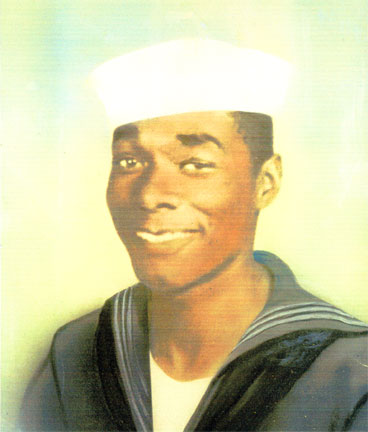
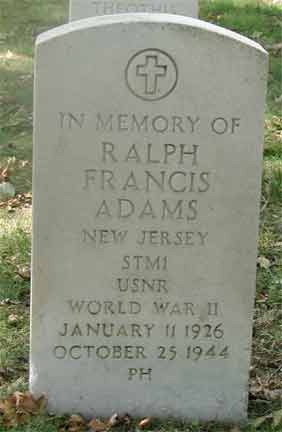
Steward’s Mate First Class Ralph Francis Adams, Serial: 09066066, USS Tang (SS-306), U.S. Navy Reserve. Awards: Purple Heart. He lived at 704 Chestnut Street, Camden NJ. Memorialized on the Tablets of the Missing, Manila American Cemetery, Manila, Philippines. A memorial headstone was placed at Beverly National Cemetery, Beverly, NJ.
Steward’s Mate First Class Ralph Francis Adams was born on January 11, 1926, the fourth of 6 children born to Thomas E. and Emma Adams. In 1930 the Adams family lived at 315 Stevens Street in Camden NJ, where Thomas Adams Sr. worked as a laborer in a department store. Two doors down, at 319 Stevens Street, lived the Saporito family — their son Salvatore Saporito would also not come home from the war. The family later moved to 704 Chestnut Street in Camden. Besides Ralph Adams, there were older brothers Logan W. and Charles J., older sister Jeanette R., and younger siblings Doris E., Thomas E. Adams Jr., and Wilson Adams.
Steward’s Mate First Class Adams served aboard the USS Tang (SS-306), the most successful of all American submarines. The Navy was still a segregated service during World War II, and Steward’s Mate was the only rating open to African-Americans in that service. One of two Steward’s Mates aboard Tang, his duties included serving in the officer’s mess, aiding in the galley, the officer’s wardroom, and the officer’s personal quarters.
Ralph Adams was listed as missing in action on October 25, 1944 when the Tang was struck by one of her own torpedoes, taking 78 of her 87-man crew to their doom. According to Tang survivor Motor Machinist’s Mate Second Class Jesse DaSilva, one of the two Steward’s Mates escaped the stricken submarine and reached the surface, only to drown before he could be rescued. It is not known if this individual was Ralph Adams or ST3 H.M. Walker. He was declared dead in December 1944. Ralph Adams was survived by his parents, Thomas and Emma Adams, brothers and sisters.
A headstone was laid at Beverly National Cemetery in Beverly NJ in his memory. The Hudson-Adams-Carpenter Post 473 of the American Legion in Camden NJ is named in part for him, and a distant relative, Jerome L. Carpenter, who died while serving with the United States Army in 1943.
USS Tang (SS-306)
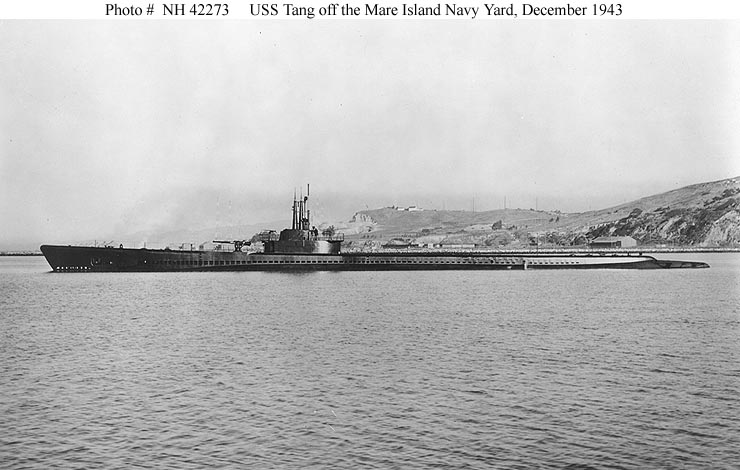
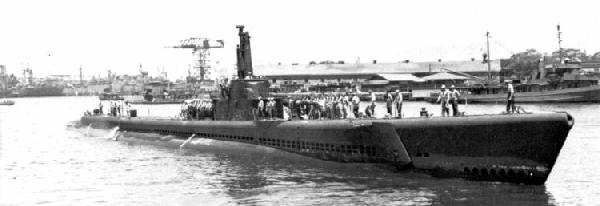
USS Tang (SS-306). Displacement: 1870 tons (surf.), 2391 tons (subm.); length 311.7′; breadth 27′. Speed: 20.25k (surf.), 8.75k (subm.). Test depth: 400′. Armament: 1–5″/25; torpedo tubes: 6–21″ fwd, 4–21″ aft. Complement: 6 officers — 60 enlisted men. Class: “BALAO.” Lost October 24, 1944.
Keel laid down by the Mare Island Naval Shipyard, Vallejo, CA 15 Jan 43; Launched: 17 Aug 43; Sponsored by Mrs. Antonio S. Pitre; Commissioned: 15 Oct 43 with LCDR Richard H. O’Kane in command.
USS Tang (SS-306) completed fitting out at Mare Island and then moved south to San Diego for 18 days of intensive training before sailing for Hawaii. She arrived at Pearl Harbor on 8 January 1944 and conducted two more weeks of exercises in preparation for combat. Tang stood out of Pearl Harbor on 22 January to begin her first war patrol in the Caroline-Mariana Islands area.
On the morning of 17 February, she sighted a convoy of two freighters, their escorts, and five smaller ships. The submarine tracked the convoy, plotted its course, and then prepared to attack. An escort suddenly appeared at a range of 7,000 yards and closing. Tang went deep and received five depth charges before the escort departed. Undamaged, she returned to periscope depth and resumed the attack. The range on the nearest freighter closed to 1,500 yards, and Tang fired a spread of four torpedoes. Three of them hit and the freighter sank by the stern.
During the night of 22 February, Tang made a surface attack on a convoy of three cargo ships and four escorts. She tracked the Japanese ships for half an hour before attaining a firing position 1,500 yards off the port bow of a freighter. A spread of four torpedoes hit one of the cargomen from bow to stern, and the enemy ship disintegrated. Early the next morning, Tang made another approach on the convoy. The escort of the lead ship moved from its covering position on the port bow, and the submarine slipped into it and fired four torpedoes. The first hit the stern of the cargoman, the second struck just aft of the stack; and the third burst just forward of the bridge and produced a terrific secondary explosion. The ship was twisted, lifted from the water, and began belching flames as she slid beneath the waves.
On the morning of the 24th, Tang sighted a tanker, a freighter, and a destroyer. Rain squalls hampered her as she attempted to attain a good firing position, so she tracked the ships until night and then made a surface attack. She fired four torpedoes and scored three hits which sank the freighter. She shadowed the enemy until morning and then closed the tanker for a submerged attack. Additional lookouts had been posted on the target’s deck and, when the spread of torpedoes from Tang struck her, they were hurled into the air with other debris from the ship. The tanker sank in four minutes. The next day, the submarine sank a 1,794-ton cargo ship.
Tang contacted a convoy consisting of a freighter, transport, and four escorts on the evening of the 26th. She maneuvered into position to attack the wildly zigzagging transport and fired her last four torpedoes. All passed astern as the transport speeded up. Having expended all of her torpedoes and scored 16 hits out of 24 attempts, the submarine put into Midway Island for refit.
Tang’s second patrol began on 16 March and took her to waters around the Palaus, to Davao Gulf, and to the approaches to Truk. She made only five surface contacts and had no opportunity to launch an attack before she was assigned to lifeguard duty near Truk. Tang rescued 22 downed airmen and transported them to Hawaii at the conclusion of the patrol.
Her third war patrol was one of the most devastating carried out against Japanese shipping during the war. Tang got underway from Pearl Harbor on 8 June and hunted enemy shipping in the East China Sea and Yellow Sea areas. The box score for her third patrol was 10 enemy merchant ships sunk totaling 39,160 tons.
Her fourth war patrol was conducted from 31 July to 3 September in Japanese home waters off the coast of Honshu. Among several actions, on 23 August the submarine closed a large ship — Japanese in white uniforms could be seen lining its superstructure — and fired three torpedoes, two hits causing the 8,135-ton transport to slip under the waves.
Tang set out from Pearl Harbor on 24 September 1944, to begin her fifth war patrol during WWII. On 27 September she topped off with fuel at Midway and left there the same day, heading for an area between the northwest coast of Formosa and the China coast. Tang chose to make the passage alone and no base heard from her after she left Midway.
The story of Tang’s sinking comes from the report of her surviving Commanding Officer. A night surface attack was launched on 24 October 1944 against a transport which had been stopped in an earlier attack. The first torpedo was fired, and when it was observed to be running true, the second and last was loosed. It curved sharply to the port, broached, porpoised and circled. Emergency speed was called for and the rudder was thrown over. These measures resulted only in the torpedo striking the stern of Tang, rather than amidships.
The explosion was violent, and crewmembers as far forward as the Control Room received broken limbs. The boat went down by the stern with the after three compartments flooded. Of the nine officers and men on the bridge, three were able to swim through the night until picked up eight hours later. One officer escaped from the flooded Conning Tower, and was rescued with the others.
The submarine came to rest on the bottom at 180 feet, and the men in her crowded forward as the after compartments flooded. Publications were burned, and all assembled to the Forward Torpedo Room to escape. The escape was delayed by a Japanese patrol, which dropped charges, and started an electrical fire in the Forward Battery. Thirteen men escaped from the forward room, and by the time the last made his exit, the heat from the fire was so intense that the paint on the bulkhead was scorching, melting, and running down. Of the 13 men who escaped, only eight reached the surface, and of these but five were able to swim until rescued.
When the nine survivors were picked up by a destroyer escort, there were victims of Tang’s previous sinkings on board, and they inflicted tortures on the men from Tang. With great humanity, O’Kane states, When we realized that our clubbings and kickings were being administered by the burned, mutilated survivors of our own handiwork, we found we could take it with less prejudice.
The nine captives were retained by the Japanese in prison camps until the end of the war. The loss of Tang by her own torpedo, the last one fired on the most successful patrol ever made by a U.S. submarine, was a stroke of singular misfortune. On her last patrol Tang fired twenty-four torpedoes in four attacks. Twenty-two torpedoes found their mark in enemy ships, sinking 13 of them; one missed, and the last torpedo, fired after a careful checkover, sank Tang.
Cdr. O’Kane has been called the Submarine Force’s most outstanding officer; he served as Executive Officer of the very successful USS Wahoo (SS-238) before taking command of Tang. Tang received four battle stars and two Presidential Unit Citations for World War II service. Her commanding officer received the Congressional Medal of Honor for Tang’s final action.
Shipmates on Eternal Patrol — USS Tang (SS-306)
| Name | Rate |
|---|---|
| Accardy, J. G. | SM3 |
| Adams, R. F. | STM1 |
| Allen, D. D. | MOMM2 |
| Anderson, P. E. | TM3 |
| Andriolo, C. | RM2 |
| Anthony, H. | F1 |
| Ballinger, W. F. | CTM |
| Bauer, E. C. | Y3 |
| Beaumont, E. H. | LT |
| Bergman, E. F. | RM1 |
| Bisogno, F. N. | TM3 |
| Boucher, W. J. | TM3 |
| Bresette, B. V. | QM3 |
| Bush, J. | EM2 |
| Chiavetta, B. | S1 |
| Clark, W. J. | QM3 |
| Coffin, R. J. | EM3 |
| Culp, J. H. | CEM |
| Darienzo, A. J. | EM2 |
| DeLapp, M. V. | CMOMMA |
| Dorsey, W. E. | MOMM1 |
| Enos, F. M., Jr. | LTJG |
| Eriksen, L. H. | F1 |
| Fellicetty, D. C. | Y3 |
| Finckbone, B. H. | EM2 |
| Fluker, J. W. | TM1 |
| Foster, J. M. | TM1 |
| Galloway, W. C. | TM2 |
| Gentle, T. E. | F1 |
| Gorab, G. J., Jr. | EM3 |
| Gregg, O. D. | COX |
| Hainline, H. W. | QM3 |
| Harms, F. G. | MOMM2 |
| Haws, G. O. | F1 |
| Henry, J. F. | F1 |
| Heubeck, J. H. | LTJG |
| Hudson, A. L. | CMOMMA |
| Ijames, H. W., Jr. | RCM3 |
| Imwold, S. S. | MOMM2 |
| Jenkins, D. M. | Y3 |
| Jones, S. W. | CQM |
| Kaiser, L. C. | MOMM3 |
| Kanagy, J. T. | EM1 |
| Kassube, J. T. | COX |
| Key, J. A. | SC3 |
| Knapp, R. B. | FC3 |
| Kroth, R. J. | LTJG |
| Lane, L. R. | EM1 |
| Larson, P. I. | CPHMA |
| Lee, R. P. | RM3 |
| Llewellyn, L. H. | RM2 |
| London, C. W. | F1 |
| Loveless, C. | MOMM1 |
| Lytton, E. | MOMM1 |
| McMorrow, R. V. | MOMM1 |
| McNabb, J. J. | F1 |
| Parker, J. J. | CCSA |
| Pearce, B. C., Jr. | ENS |
| Raiford, R. M. | CK3 |
| Reabuck, F. J. | F1 |
| Rector, D. D. | GM3 |
| Reinhardt, E. | F1 |
| Roberts, J. L. | SC3 |
| Robertson, G. L. | MOMM2 |
| Smith, S. G., Jr. | QM3 |
| Springer, F. H. | LT |
| Stepien, E. F. | S1 |
| Sunday, F. L. | EM3 |
| Vaughn, P. B., Jr. | COX |
| Wadsworth, C. W. | TM3 |
| Walker, H. M. | ST3 |
| Weekley, L. S. | CTMA |
| Welch, R. E. | QM2 |
| White, J. M. | GM1 |
| Williams, W. H. | Y2 |
| Wines, P. T. | LTJG |
| Wukovich, G. | MOMM1 |
| Zofcin, G. | MOMM1 |
“Sailors, Rest Your Oars!”
Survivors: Caverly, F. M. RT1 — DaSilva, J. B. MOMM2 — Decker, C. O. MOMM3 — Flanagan, H. J. LTJG — Liebold, W. R. CBMA — Narrowanski, P. TM3 — O’Kane, R. H. CDR — Savadkin, L. LT — Trukke, H. O. TM2