Leo James Kelly
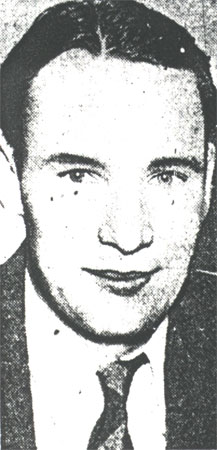
Seaman Second Class Leo James Kelly, Serial: 06502186, USS South Dakota (BB-57), U.S. Navy. Awards: Purple Heart. He lived at 55 State Street, Camden NJ. Memorialized on the Tablets of the Missing, Manila American Cemetery, Manila, Philippines.
Seaman Second Class Leo James Kelly was born in 1919 to John and Mary Kelly of Camden NJ. The Kelly family had moved to New Jersey from Pennsylvania in the early 1910s. By 1930 John Kelly Sr. had been a Philadelphia policeman for many years, and in 1930 he worked as a truck driver. The family had by this time owned a home at 55 State Street in Camden NJ. The two oldest brothers, John Jr. and Cornelius, were working as clerks in the transportation industry. Still at home besides Leo were brothers William and Jeremiah, and sisters Jane Catherine and Julia Kelly. John Kelly Sr. passed away in 1931. Brother William later became a Camden police officer.
Leo Kelly graduated from Holy Name Catholic School in 1932 and from Camden Catholic High School in 1938. An accomplished musician, he played saxophone and bass horn on radio programs in Philadelphia. He played semi-pro football, and worked as a timekeeper at the Campbell Soup plant, a short walk from his home. On March 6, 1941, he was held up by a bandit, but saved his salary by hiding it under the time cards in his rear pocket. He enlisted in the United States Navy in February of 1942, and was stationed at the Philadelphia Navy Yard before going overseas as a crewmember of the newly commissioned battleship USS South Dakota BB-57.
Seaman Second Class Leo James Kelly was killed in action in the naval fighting around Guadalcanal on November 15, 1942, at the age of 23. He was survived by his mother, Mrs. Mary Kelly of 55 State Street, Camden NJ, and his siblings. Mary Kelly passed away in Camden on May 28, 1943. His brother William Kelly served in the Army Air Force, and was wounded twice in 1943. His brother Jeremiah also served in the Army Air Force. Sister Jane was superintendent of night nurses at West Jersey Hospital, and Julia was a student nurse at that time.
Leo Kelly’s brother Cornelius “Babe” Kelly owned and operated the tavern that stood on the block where they lived, at 69 State Street, during the 1950s, 1960s, and 1970s. It was called Kelly’s Cafe, and was located at 69 State Street.
3rd Brother Goes Into Armed Service
Camden Courier-Post —
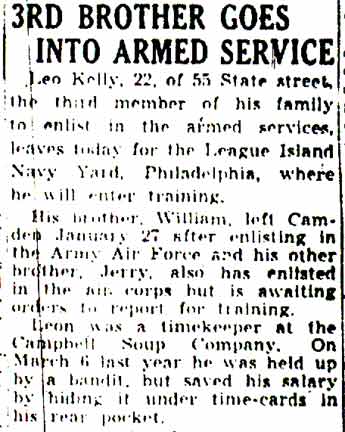
Leo Kelly, 22, of 55 State street, the third member of his family to enlist in the armed services, leaves today for the League Island Navy Yard, Philadelphia, where he will enter training.
His brother, William, left Camden January 27 after enlisting in the Army Air Force and his other brother, Jerry, also has enlisted in the air corps but is awaiting orders to report for training.
Leo was a timekeeper at the Campbell Soup Company. On March 6 last year he was held up by a bandit, but saved his salary by hiding it under time-cards in his rear pocket.
Holy Name School Holds Graduation
Camden Courier-Post —
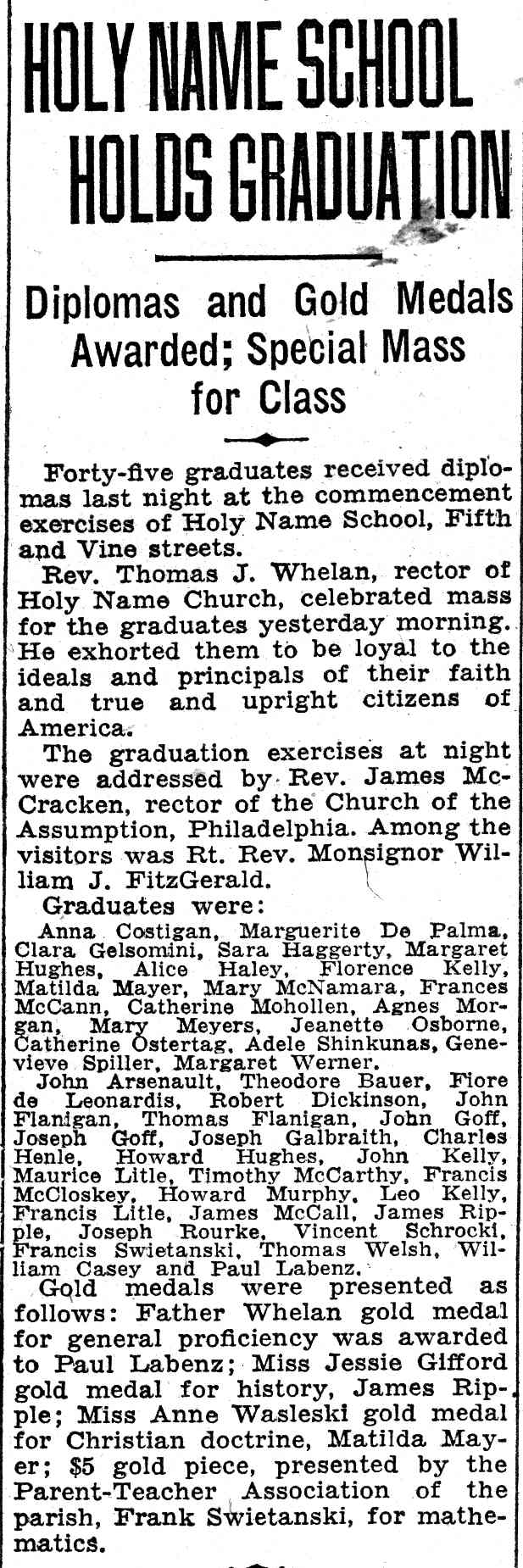
Diplomas and Gold Medals Awarded; Special Mass for Class
Forty-five graduates received diplomas last night at the commencement exercises of Holy Name School, 8th and Vine streets.
Leo Kelly is among the graduates listed.
USS South Dakota (BB-57)
Naval Historical Center — Dictionary of American Naval Fighting Ships
Statistics
Displacement: 35,000 tons
Length: 680′ 10″
Beam: 108′ 2″
Draft: 36′ 4″
Speed: 27.8 knots
Complement: 2,354
Armament: Nine 16″ guns; sixteen 5″ guns; sixty-eight 40 mm guns and seventy-six 20 mm guns
Class: South Dakota
The second South Dakota (BB-57) was laid down on 5 July 1939 at Camden, NJ, by the New York Shipbuilding Corp.; launched on 7 June 1941; sponsored by Mrs. Harlan J. Bushfield; and commissioned on 20 March 1942, Capt. Thomas L. Gatch in command.
After fitting out at Philadelphia, South Dakota held shakedown training from 3 June to 26 July 1942. She stood out of Philadelphia Navy Yard on 16 August and headed for Panama. The battleship transited the Panama Canal on 21 August and set course for the Tonga Islands, arriving at Nukualofa, Tongatabu, on 4 September. Two days later, she struck an uncharted coral pinnacle in Lahai Passage and suffered extensive damage to her hull. On 12 September, the ship sailed for the Pearl Harbor Navy Yard and repairs.
South Dakota was ready for sea again on 12 October 1942 and began training with Task Force (TF) 16 which was built around aircraft carrier USS Enterprise (CV-6). The task force sortied from Pearl Harbor on 16 October to join TF 17, which was centered on carrier USS Hornet (CV-8), northeast of Espiritu Santo. The rendezvous was made on the 24th; and the combined force, now operating as TF 61 under Rear Admiral T. C. Kinkaid, was ordered to make a sweep of the Santa Cruz Islands and then move southwest to block any Japanese forces approaching Guadalcanal.
Catalina patrol bombers sighted a Japanese carrier force at noon on October 25, 1942, and TF 61 steamed northwest to intercept it. Early the next morning, when all carrier forces were within striking range, a Japanese snooper spotted the American force, triggering the Battle of Santa Cruz. South Dakota and the Enterprise group were approximately 10 miles from the Hornet group when the air battle began.
The first enemy attack was concentrated against Hornet. At 1045, South Dakota was operating near Enterprise to provide protective fire from her numerous antiaircraft guns when their group was attacked by dive bombers. Approximately an hour later, about 40 torpedo planes struck at the two ships. A third aerial assault, made by dive bombers and torpedo planes, came in at 1230. South Dakota sustained a 500-pound bomb hit on top of her number one turret. When the action was broken off that evening, the American forces retired toward Noumea, New Caledonia, with the battleship credited with downing 26 enemy planes.
At 0414 on 30 October, while avoiding a submarine contact, South Dakota and USS Mahan (DD-364) collided, causing damage to both ships. Mahan’s bow was turned to port and crumpled to frame 14, and a fire, soon brought under control, started in her forward hold. Both ships continued to Noumea where USS Vestal (AR-4) repaired South Dakota’s collision and battle damage.
On 11 November 1942, South Dakota, as part of TF 16, sortied from Noumea for Guadalcanal. On 13 November, she joined battleship USS Washington (BB-56) and destroyers USS Preston (DD-379), USS Walke (DD-418), USS Benham (DD-397), and USS Gwin (DD-433) to form TF 64 under command of Rear Admiral W. A. Lee. The next evening at 2330, the force was operating 50 miles southwest of Guadalcanal when Lee learned that an enemy convoy was coming through the passage off Savo sometime between 0030 and 0230. This was Admiral Kondo’s bombardment group consisting of the battleship Kirishima; heavy cruisers Takao and Atago; and a destroyer screen.
Admiral Kondo’s forces were divided into three sections: the bombardment group; a close screen of cruiser Nagara and six destroyers; and a distant screen of cruiser Sendai and three destroyers in the van of the other forces. A quarter moon assured good visibility. Three ships were visually sighted from the bridge of South Dakota, range 18,100 yards. Washington fired on the leading ship, thought to be a battleship or heavy cruiser; and, a minute later, South Dakota’s main battery opened on the ship nearest to her. Both initial salvos started fires on the targets. South Dakota then fired on another target and continued firing until it disappeared from her radar screen. Turret No. 3 — firing over her stern and demolishing her own planes in the process — opened on another target and continued firing until the target was thought to sink. Her secondary batteries were firing at eight destroyers close to the shore of Savo Island.
A short lull followed after which radar plot showed four enemy ships, just clear of the left tangent of Savo, approaching from the starboard bow; range 5,800 yards. Searchlights from the second ship in the enemy column illuminated South Dakota. Washington opened with her main battery on the leading, and largest, Japanese ship. South Dakota’s secondary batteries put out the lights; and she shifted all batteries to bear on the third ship, believed to be a cruiser, which soon gushed smoke. South Dakota, which had been under fire from at least three of the ships, had taken 42 hits which caused considerable damage. Her radio communications failed; radar plot was demolished; three fire control radars were damaged; there was a fire in her foremast; and she had lost track of Washington. As she was no longer receiving enemy fire and there were no remaining targets, she withdrew; met Washington at a prearranged rendezvous; and proceeded to Noumea. Of the American destroyers, only Gwin returned to port. The other three had been severely damaged early in the engagement. Walke and Preston were sunk. Benham had part of her bow blown off by a torpedo and, while en route to Noumea with the damaged Gwin as her escort, had to be abandoned. Gwin then sank her by gunfire. On the enemy side, hits had been scored on Takao and Atago; Kirishima and destroyer Ayanami, severely damaged by gunfire, were abandoned and scuttled.
Camden Sailor, 23, Slain Fighting Japs
Camden Courier-Post —
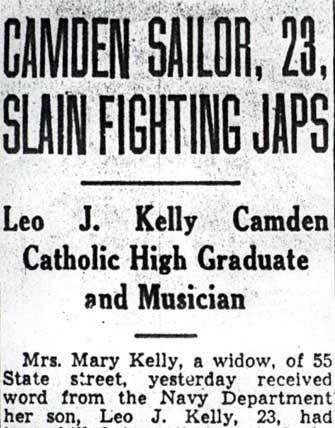
Leo J. Kelly — Camden Catholic High Graduate and Musician
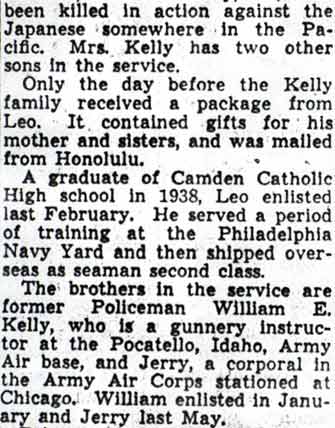
Mrs. Mary Kelly, a widow, of 55 State street, yesterday received word from the Navy Department her son, Leo J. Kelly, 23, had been killed in action against the Japanese somewhere in the Pacific. Mrs. Kelly has two other sons in the service.
Only the day before the Kelly family received a package from Leo. It contained gifts for his mother and sisters, and was mailed from Honolulu.
A graduate of Camden Catholic High school in 1938, Leo enlisted last February. He served a period of training at the Philadelphia Navy Yard and then shipped overseas as seaman second class.
The brothers in the service are former Policeman William E. Kelly, who is a gunnery instructor at the Pocatello, Idaho, Army Air base, and Jerry, a corporal in the Army Air Corps stationed at Chicago. William enlisted in January and Jerry last May.
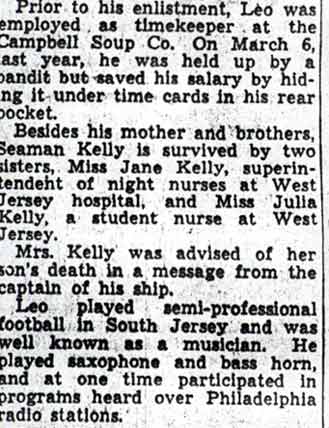
Prior to his enlistment, Leo was employed as timekeeper at the Campbell Soup Co. On March 6, last year, he was held up by a bandit but saved his salary by hiding it under time cards in his rear pocket.
Besides his mother and brothers, Seaman Kelly is survived by two sisters, Miss Jane Kelly, superintendent of night nurses at West Jersey hospital, and Miss Julia Kelly, a student nurse at West Jersey.
Mrs. Kelly was advised of her son’s death in a message from the captain of his ship.
Leo played semi-professional football in South Jersey and was well known as a musician. He played saxophone and bass horn, and at one time participated in programs heard over Philadelphia radio stations.