Introduction
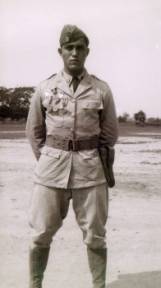
John Tisa
John Tisa was born on April 6, 1914 in Philadelphia PA to Sicilian immigrant parents Benedetto and Maria Tisa. The family, which included brothers Dominic, Charles, and Joseph Tisa, lived at 1040 Reese Street in Philadelphia when the Census was taken in 1920. The Tisas subsequently moved to Camden where in 1930 they lived at 214 Benson Street. He graduated from Camden High School in 1933, where he was known as the class socialist; his ambition then was to travel the world. John Tisa was a member of the Young People’s Socialist League, the Socialist Party and various other socialist and communist movements. He was a union organizer at the Campbell Soup Company and took part in the abortive strike of 1934.
John Tisa studied at Brookwood Labor College and the Charles Morris Price School of Journalism in Philadelphia. In 1936 he took a job with the WPA but continued his union activities at Campbell’s Soup. In November of 1936 he was sent as a delegate to the American Federation of Labor National Convention in Tampa FL. It was here that he heard about the struggle of the Republicans in the war against the Fascists in Spain.
John Tisa left for Spain in January of 1937 to join the American Lincoln Brigade. He fought at the battle of Jarama and later became the editor of Volunteer for Liberty, the official English-language brigade publication. At the defeat of the Republicans, he remained in Barcelona to help collect documentation on the International Brigades. He continued his documentation efforts in Paris, returning to Camden in 1939.
Upon his return, John Tisa renewed his efforts to organize workers at the Campbell Soup plants and help organize and win the first union contract for Local 80, United Cannery, Agricultural, Packing and Allied Workers of America, UCAPAWA-CIO. He next went to Chicago to help organize a similar plant, then returned to Camden to help organize unions at the La Palina Factory of the Consolidated Cigar Company, the Siegel Cigar Company, the Knox Gelatine Company, and tobacco companies in Trenton, Philadelphia, Charleston SC, and the middle west.
He served from 1942 through 1945 in the armed services. Because of his service in the Lincoln Brigade and membership in Communist and Socialist organizations, he was refused promotion and overseas service.
After the war, he returned to union organizing and was elected president of the Food, Tobacco, Agricultural, and Allied Workers Union of America (FTA) local in Chicago (formerly the UCAPAWA). During the 1940s and 1950s he continued his work in the trade union movement and helped organize leaf tobacco workers in the South and fruit and vegetable packers in California.
At the CIO convention in December 1948, CIO President Philip Murray charged that the FTA consistently supported Communist Party interests rather than those of the CIO. Although John Tisa and other union officers filed a non-Communist affidavit in August of 1949, the FTA was expelled from the CIO in December of that year. The remnants of the union merged with the Distributive Processing and Office Workers of America, an amalgamation of several Communist-dominated unions expelled from the CIO.
In 1952 John Tisa was called to testify before the House Un-American Activities Committee but refused to answer any of the questions put to him. Finally forced out of his union position, he opened a pet shop in Merchantville which later moved to a location on Route 38 west of Mansion Avenue in Pennsauken NJ. In 1981 he moved to Florida with his wife May, where he resided until his death on December 12, 1991.
During his time in Spain, John Tisa kept a diary to contribute to the Republican forces’ program of tactical documentation and analysis. After retiring to Florida, John Tisa wrote Recalling the Good Fight, an account of his time in Spain. He described the training, or lack of it, of new recruits and recalled his experiences in battle and as historian and editor attached to the International Brigades headquarters. The book was published in 1985. He also edited a collection of propaganda posters, The Palette and the Flame: Posters of the Spanish Civil War.
John Tisa also donated a collection of pamphlets, books, and periodicals relating to his Spanish Civil War and trade union experiences to the Rutgers-Camden Library. These items are now housed at the Camden County Historical Society in Camden NJ.
Antoinette Tisa, the wife of his brother Dominic, was well known in Philadelphia, Camden, and South Jersey as an opera singer during a career that ran from the 1940s through the 1960s. Dominic Tisa owned and operated the London Barber Shop on South 3rd Street in the 1940s and 1950s.
John Tisa: Union Organizer and Fighter Against Fascism
by Benedict Tisa
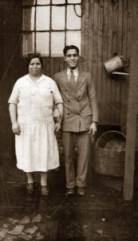
John Tisa
John Tisa was the son of Sicilian immigrants, born in Philadelphia on April 30, 1913 and raised in Camden, New Jersey. Throughout his life he was active in the struggle for workers and civil rights. John attended Camden High School and early in his life became active in trade unionism. In 1934 while working in Campbell Soup he was part of the first attempt to unionize the industry that employed many immigrant families in the area. The factory was just a few short blocks from his home on Benson Street. His mother was a worker on the chicken line.
In 1936 he was with the WPA in a writers program working with various trade union activities. While attending a union meeting he heard of the Spanish Civil War and how Hitler and Mussolini’s military were attempting to overthrow the elected government in Spain.
John joined the first group of American volunteers in Spain in January 1937 and fought in the first major battle for the American volunteers at Jarama. Because of his special role as Brigade historian, he was the last volunteer to exit Spain in 1939 during the general retreat from Catalonia.
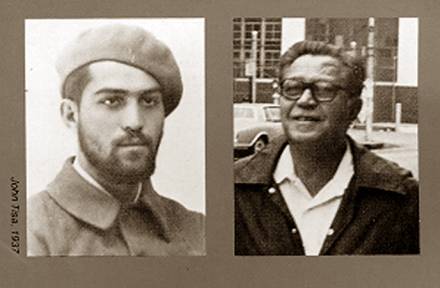
John Tisa at the Hotel Florida in Madrid, May 1937. He recalled: “At the Hotel Florida in Madrid, where my friend of the Lincoln Battalion recommended I stay, I was not doing well in my still faltering Spanish in conversation with the desk clerk when a tall, heavily built, mustachioed man listening to us quickly translated and got me accommodations. I thanked him. He stuck out his hand and introduced himself: ‘My name is Ernest Hemingway…’ He invited me up to his room for a drink, then supper.”
Returning to Camden after Spain, John resumed his prominent career in union organizing in New Jersey. He organized the workers of the Campbell Soup Company. Later in the 1940s he organized tobacco workers in Trenton, Philadelphia and the Knox Gelatin workers in Camden.
When World War II broke out he enlisted and served in the US Armed forces. After the war he resumed his Trade Union activities but that came to an end during the McCarthy era in the 1950s. John was continuously an active member of the Veterans of the Abraham Lincoln Brigade, was a committed leader of peace activities during the Vietnam War, and became an outspoken advocate for the rights of workers and veterans.
After the McCarthy investigation John had to withdraw from union activities and opened what was to become an area landmark on Rt 38, Tisa’s Pet Shop. He maintained his home on Highland Avenue in East Camden until the late 1960s when he and his wife, May Tisa, retired to Florida where he passed away on December 12, 1991.
John Tisa has been the prime source for many books written about the Spanish Civil War, including his own: The Story of the Abraham Lincoln Brigade (written between the battles in Madrid during 1937), The Palette and the Flame, and Recalling the Good Fight: An Autobiography of the Spanish Civil War.
Many thanks to Benedict Tisa for his assistance in creating this page. Benedict Tisa’s websites: www.btisa.org and www.digital-sistas.org.
CIO Food Union’s Director Faces NLRB Oath Crackdown
Berkshire Evening Eagle —
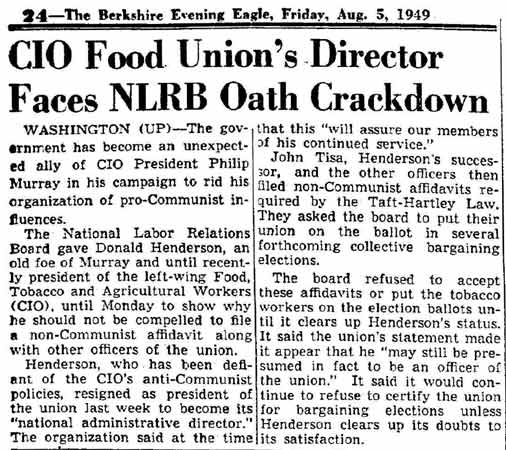
WASHINGTON (UP)—The government has become an unexpected ally of CIO President Philip Murray in his campaign to rid his organization of pro-Communist influences.
The National Labor Relations Board gave Donald Henderson, an old foe of Murray and until recently president of the left-wing Food, Tobacco and Agricultural Workers (CIO), until Monday to show why he should not be compelled to file a non-Communist affidavit along with other officers of the union.
Henderson, who has been defiant of the CIO’s anti-Communist policies, resigned as president of the union last week to become its “national administrative director.” The organization said at the time that this “will assure our members of his continued service.”
John Tisa, Henderson’s successor, and the other officers then filed non-Communist affidavits required by the Taft-Hartley Law. They asked the board to put their union on the ballot in several forthcoming collective bargaining elections.
The board refused to accept these affidavits or put the tobacco workers on the election ballots until it clears up Henderson’s status. It said the union’s statement made it appear that he “may still be presumed in fact to be an officer of the union.” It said it would continue to refuse to certify the union for bargaining elections unless Henderson clears up its doubts to its satisfaction.
6 More Unions Of CIO’s Left Lose Standing
Berkshire Evening Eagle —
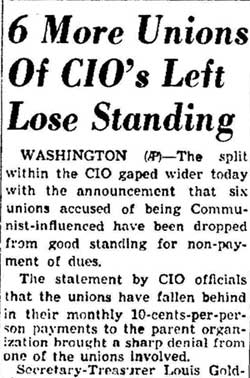
WASHINGTON (AP)—The split within the CIO gaped wider today with the announcement that six unions accused of being Communist-influenced have been dropped from good standing for non-payment of dues.
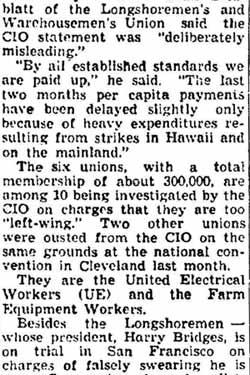
The statement by CIO officials that the unions have fallen behind in their monthly 10-cents-per-person payments to the parent organization brought a sharp denial from one of the unions involved. Secretary-Treasurer Louis Goldblatt of the Longshoremen’s and Warehousemen’s Union said the CIO statement was “deliberately misleading.”
“By all established standards we are paid up,” he said. “The last two months per capita payments have been delayed slightly only because of heavy expenditures resulting from strikes in Hawaii and on the mainland.”
The six unions, with a total membership of about 300,000, are among 10 being investigated by the CIO on charges that they are too “left-wing.” Two other unions were ousted from the CIO on the same grounds at the national convention in Cleveland last month. They are the United Electrical Workers (UE) and the Farm Equipment Workers.
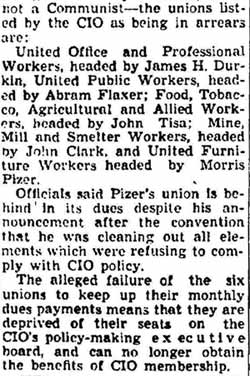
Besides the Longshoremen—whose president, Harry Bridges, is on trial in San Francisco on charges of falsely swearing he is not a Communist—the unions listed by the CIO as being in arrears are: United Office and Professional Workers, headed by James H. Durkin; United Public Workers, headed by Abram Flaxer; Food, Tobacco, Agricultural and Allied Workers, headed by John Tisa; Mine, Mill and Smelter Workers, headed by John Clark; and United Furniture Workers headed by Morris Pizer.
Officials said Pizer’s union is behind in its dues despite his announcement after the convention that he was cleaning out all elements which were refusing to comply with CIO policy. The alleged failure of the six unions to keep up their monthly dues payments means that they are deprived of their seats on the CIO’s policy-making executive board, and can no longer obtain the benefits of CIO membership.
John Tisa; Fought Franco’s Revolt
Philadelphia Inquirer —
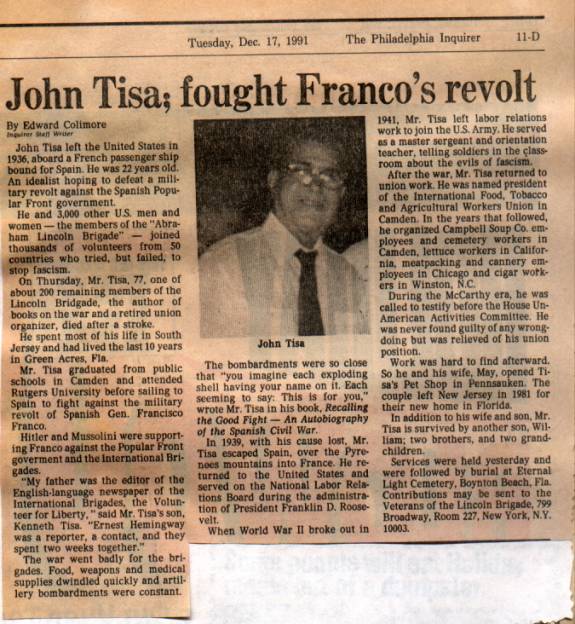
By Edward Colimore, Inquirer Staff Writer
John Tisa left the United States in 1936, aboard a French passenger ship bound for Spain. He was 22 years old. An idealist hoping to defeat a military revolt against the Spanish Popular Front government.
He spent most of his life in South Jersey and had lived the last 10 years in Green Acres, Fla.
Mr. Tisa graduated from public schools in Camden and attended Rutgers University before sailing to Spain to fight against the military revolt of Spanish Gen. Francisco Franco. Hitler and Mussolini were supporting Franco against the Popular Front government and the International Brigades.
“My father was the editor of the English-language newspaper of the International Brigades, the Volunteer for Liberty,” said Mr. Tisa’s son, Kenneth Tisa. “Ernest Hemingway was a reporter, a contact, and they spent two weeks together.”
The war went badly for the brigades. Food, weapons and medical supplies dwindled quickly and artillery bombardments were constant. The bombardments were so close that “you imagine each exploding shell having your name on it. Each seeming to say: This is for you,” wrote Mr. Tisa in his book, Recalling the Good Fight – An Autobiography of the Spanish Civil War.
In 1939, with his cause lost, Mr. Tisa escaped Spain, over the Pyrenees mountains into France. He returned to the United States and served on the National Labor Relations Board during the administration of President Franklin D. Roosevelt.
In 1941, Mr. Tisa left labor relations work to join the U.S. Army. He served as a master sergeant and orientation teacher, telling soldiers in the classroom about the evils of fascism.
After the war, Mr. Tisa returned to union work. He was named president of the International Food, Tobacco and Agricultural Workers Union in Camden. In the years that followed, he organized Campbell Soup Co. employees and cemetery workers in Camden, lettuce workers in California, meatpacking and cannery employees in Chicago and cigar workers in Winston, N.C.
During the McCarthy era, he was called to testify before the House Un-American Activities Committee. He was never found guilty of any wrongdoing but was relieved of his union position.
Work was hard to find afterward. So he and his wife, May, opened Tisa’s Pet Shop in Pennsauken. The couple left New Jersey in 1981 for their new home in Florida.
In addition to his wife and son, Mr. Tisa is survived by another son, William; two brothers; and two grandchildren.
Services were held yesterday and were followed by burial at Eternal Light Cemetery, Boynton Beach, Fla. Contributions may be sent to the Veterans of the Lincoln Brigade, 799 Broadway, Room 227, New York, N.Y. 10003.