John H. Dialogue Jr.
John H. Dialogue Jr. was born in Camden in 1862 to John H. and Mary Dialogue. His father, John H. Dialogue Sr. founded the Dialogue shipyards and was one of Camden’s leading citizens for many years. John H. Dialogue Jr. took over the shipyard upon the death of his father in October of 1898.
In 1907 the Dialogue yard built two ocean-going tugs for use on the west coast, the Goliah and the Hercules. Hercules is still in use today, 99 years after her launch.
The Dialogue company was forced into bankruptcy in 1912, and the yard was sold to the Reading Railroad for a fraction of its value. The Reading built a large terminal and ferry facility, which was obsolete almost as soon as it was completed due to the opening of the Delaware River Bridge in 1926.
After the shipyard closed, John H. Dialogue Jr. took a position with the Luckenbach Steamship Lines. He died in New York in 1924. John H. Dialogue Jr. was brought home and rests in Harleigh Cemetery.
John H. Dialogue and Son — Shipbuilders
The Nautical Gazette —
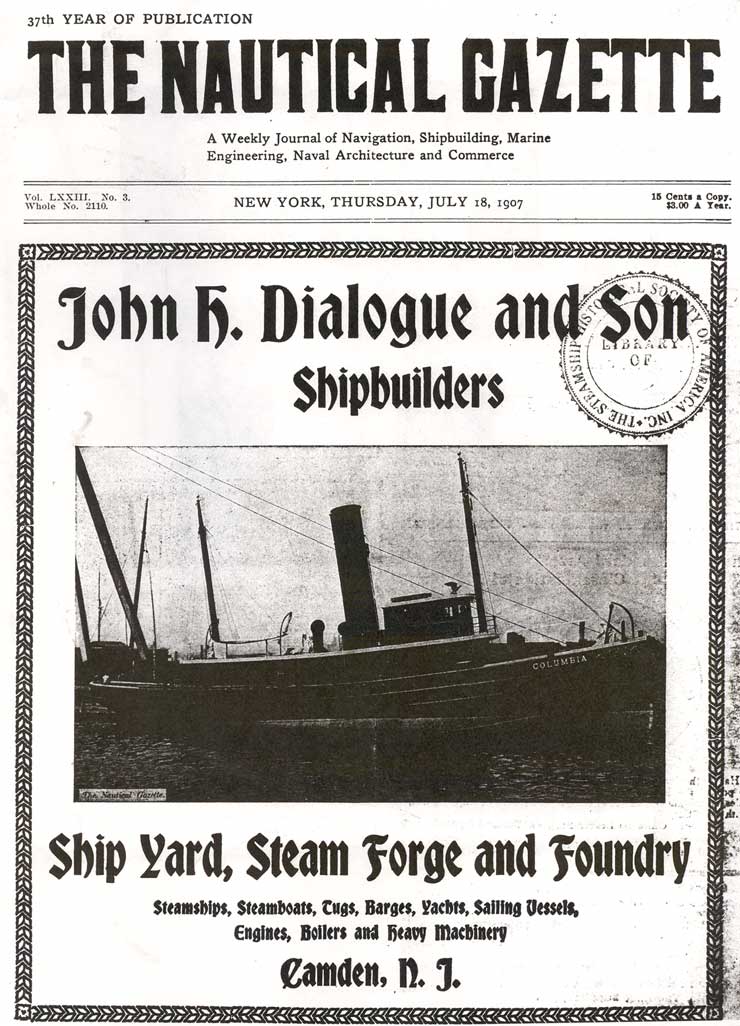
THE NAUTICAL GAZETTE
A Weekly Journal of Navigation, Shipbuilding, Marine Engineering, Naval Architecture and Commerce
Vol. LXXIII. No. 3. Whole No. 2110. NEW YORK, THURSDAY, JULY 18, 1907 15 Cents a Copy. $3.00 A Year.
John H. Dialogue and Son
Shipbuilders
Ship Yard, Steam Forge and Foundry
Steamships, Steamboats, Tugs, Barges, Yachts, Sailing Vessels, Engines, Boilers and Heavy Machinery
Camden, N. J.
Official Historical Souvenir: Philadelphia, 1908
Prominent among the shipbuilding concerns of the United States is that of John H. Dialogue and Son, located at Camden. N.J.
John H. Dialogue, the founder of the works, was born in Philadelphia, May 13, 1828, and started a small shop at Second Street and Bridge Avenue, Camden, where he did repair work for the Camden and Amboy Railroad and the Camden and Philadelphia and West Jersey Ferry Companies. The business grew rapidly and when in 1856 Mr. Dialogue commenced the construction of Corliss engines under a special license from the inventor he found larger works necessary, and two years later erected the present large establishment at Kaighn’s Point.
In 1870 the name of the concern was changed to the River Iron Works, with Dialogue and Wood as proprietors, and the iron shipbuilding business was engaged in with constantly increasing success. During the ensuing twenty-five years every conceivable form of river, coast and ocean-going steamer was built, and several contracts were executed for the government.
The vessels built by the firm are to be found in every part of the United States and many foreign countries.
The shipyards at Kaighn’s Point cover an area of thirty-four acres, with a frontage on the Delaware River of two thousand feet, and a water depth of twenty-eight feet, making an admirable location for the business.
The plant, which is equipped with every modern appliance, gives employment, in seasons, of from two hundred to eight hundred men.
John H. Dialogue, founder of the firm, after an eventful life, in which he took active part in the civic and political history of his adopted city, died Sunday, October 3, 1898, and the business descended to his son, who had been made a partner in the firm upon the retirement of Mr. Wood, when the title of the firm was changed from the River Iron Works to John H. Dialogue & Son. Mr. Dialogue, Jr., present owner of the works, received a practical education with his father, and since his proprietorship has materially advanced the operations of this large industry.
The Hercules and Goliah
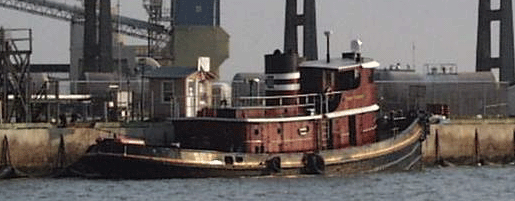
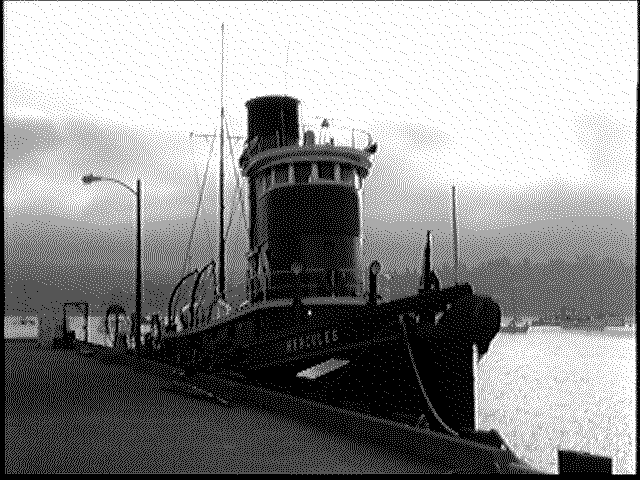
Hercules
An ocean-going tug, the John H. Dialogue and Son Company built Hercules in 1907. When completed, Hercules towed her sister ship, the Goliah, through the Strait of Magellan to San Francisco. Both vessels were oil-burners; Goliah carried fuel, water and supplies for her sister. After a long career ending in 1962, she avoided the scrap yard, but languished until the California State Park Foundation acquired her for the San Francisco Maritime State Historic Park, in 1975. The National Park Service took over the task of her restoration in 1977. Today, after a thirty-year lay-up, she is operable again, and regularly steams San Francisco Bay with a highly-trained volunteer crew.
Two New Dialogue-Built Tugs for Service on the Pacific Coast
The Nautical Gazette —
Two vessels left the Delaware River last week on what promises to be a memorable as well as record-breaking voyage. They were the new sea-going tugboats Hercules and Goliah, built at the shipyard of John H. Dialogue & Son, ship and engine builders, Camden, N. J., for the Shipowners & Merchants’ Tugboat Co., of San Francisco. They are bound for San Francisco, via the Straits of Magellan, and what is unusual, the Goliah is being towed by the Hercules. Both boats were built to burn oil as fuel, and with tanks well filled on either boat, it is said there will be sufficient fuel for the Hercules’s boilers for the entire trip of about 14,000 miles with a good margin to spare, the towing steamer replenishing her tanks from those of the Goliah when her fuel is exhausted.
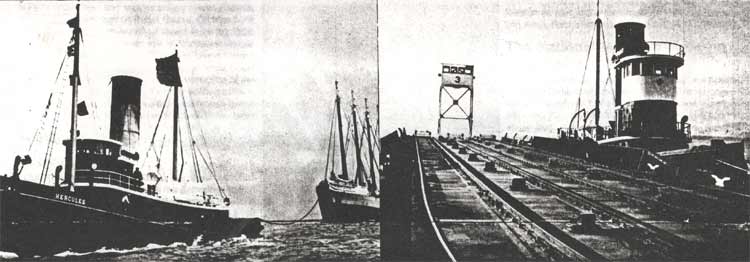
Our illustration shows the Hercules as she appeared a few days before leaving the Shipyard. The Goliah lies under the shears at the end of the pier. As will be noticed the tugs have two masts, the foremast being placed just forward of the main deck house, and the main mast about equidistant between the smoke-stack and after end of the deck house. During the voyage a large square sail on the foremast may be used on both boats for raising in order to take advantage of any favorable wind.
The company for whom the tugboats have been built is best known on the Pacific Coast as the “Red Stack Line,” and in addition to the Hercules and Goliah are the owners of the tugs Sea Rover, Sea Lion, Sea King, Sea Queen, Sea Witch, Sea Prince, Sea Fox, Sea Lark, Monarch, Rescue and Liberty. The Sea Lion was built by John H. Dialogue & Son for the same owners in the latter part of 1884. The original boiler is still in her and in good order, and the boat is still doing good service. The new Hercules and Goliah were built under the direction of Capt. W. J. Gray, and under the personal supervision of Chief Engineer W. Hanell, both of San Francisco.
The Hercules and Goliah are of the following general dimensions:
| Length between perpendiculars | 140 ft. |
| Length over all | 150 ft. |
| Beam | 27 ft. |
| Depth of hold | 17 ft. |
| Gross tonnage | 414 tons |
| Net tonnage | 221 tons |
They are constructed of steel throughout, with complete steel decks, steel bulkheads for oil tanks (with necessary subdivisions), high coamings, and steel deck houses. Both boats have, in addition to the transverse oil-tight bulkheads, longitudinal bulkheads to prevent the movement of the oil, the stern as well as both the forward and after bitts being especially constructed for this particular service. They are fitted with a complete railing around the upper deck as well as around the roof of the pilot house. The deck house is arranged so that it will be possible to go from one end of the boat to the other without going outside. The crew’s accommodations are, as usual, located in the forecastle, with a special dining room for their use, the senior officers being located in the forward end of the deck house, and the junior officers housed just behind the fire room.
As the tugs will use oil for fuel on the Pacific Coast, they have been fitted in the East to use this kind of fuel instead of coal, so that on their arrival at San Francisco it will not be necessary to make any changes in their arrangements, and they may be put to work at once. They have a tank capacity of about 105,000 gallons of fuel each, which will give them a cruising radius of not less than 8,000 miles apiece.
The engines are of the usual vertical, inverted, direct-acting, triple-expansion type, having cylinders 17 in., 24 in., and 41 in., by 30-in. stroke, constructed for a working pressure of 180 lbs. The air and bilge pumps are connected to the main engine, and the circulating, donkey, fire, and sanitary pumps are independent.
All stuffing boxes are fitted with metallic packing.
There is a special pump for circulating water in the boilers while getting steam. Two oil pumps with heaters are also provided for supplying the furnaces, also duplex compressing engines for supplying air for combustion. Steam towing engines suitable for taking care of 1-3/4 inch diameter of wire hawser have been fitted. There is also a complete electric light installation, including searchlight, of 7-1/2 K.W., made by the General Electric Co., all wires being run in iron pipe. A steam steering engine of the Williamson Bros. Co. type has been fitted. Steam windlass, suitable for 1-5/8 inch chain, made by the Hyde Windlass Co., of Bath, Maine, is included. Steam capstans have been supplied by the builders of the vessels, everything in them being of the latest improved type and thoroughly modern throughout.
The boilers are of the Scotch type, 15 ft. diameter by 12 ft. long, each having four furnaces, and constructed for a working pressure of 180 lbs. The furnaces are of the “Fox” type and are arranged for burning oil as fuel.
Each boat is provided with a steel hawser 200 fathoms long. In addition, one of the boats is provided with a manila hawser 200 fathoms long. Both boats are likewise provided with a donkey boiler arranged for burning coal or oil as fuel, as may be required. Capt. Thomsen goes out in command of the Hercules, and Chief Engineer Hanell looks after her machinery. Capt. Hanson commands the Goliah.
Knowing the distance to be traveled, it is considered a remarkable trip for these two boats to undertake the trip from here to San Francisco, without having to take additional fuel on the entire route, and will no doubt be watched with considerable interest by the entire shipping fraternity.
Fifty-eight years ago, or on April 1, 1850, a tugboat named Goliah, built by the late Wm. H. Webb, left the port of New York for San Francisco, going via the Straits of Magellan. She was a sidewheeler and she was just nine months on the passage, turning up in San Francisco on Jan. 1, 1851. During the trip the crew often had to go ashore to cut wood for use in the boiler. The new Goliah, in tow of her sister boat, should not be more than 65 days on the passage.
Hercules and Goliah Photos
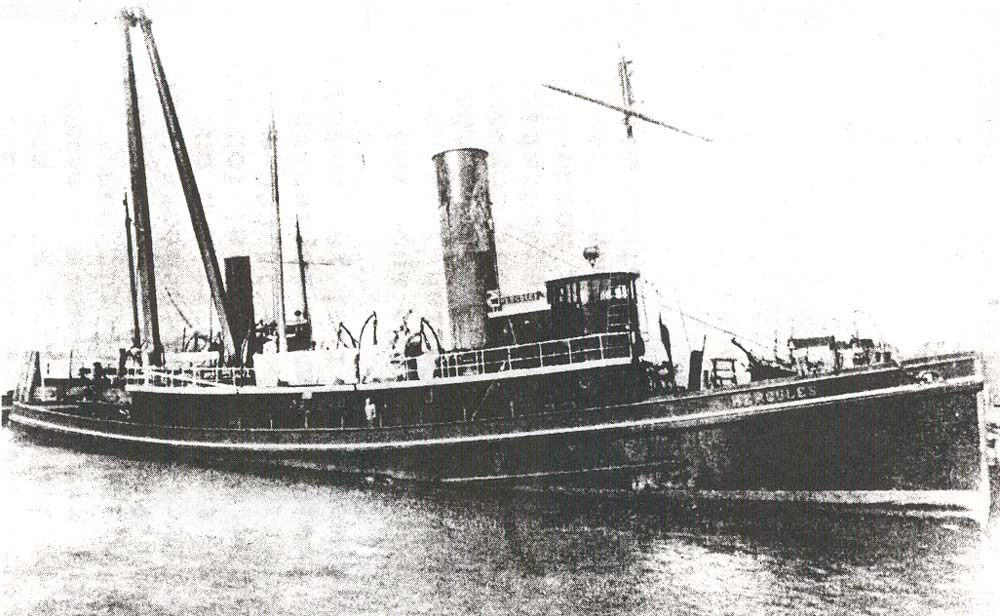
The legendary tugboat Hercules at the outfitting dock of John H. Dialogue and Sons shipyard in 1908, just after she was launched. The Hercules and her sister Goliah, just visible in the photo behind the shear legs, were built in Camden, New Jersey, for service on the West Coast. They were unusual for the time because they burned fuel oil, rather than coal, to power their 500-horsepower, triple-expansion steam engines. Coal, which was cheap and abundant at that time, was burned by the vast majority of steam tugs.
The voyage of the sister tugs from New Jersey to San Francisco, through the Straits of Magellan, was unique. The Hercules towed the Goliah all the way. The Goliah was outfitted as a supply ship for the passage and carried the extra fuel oil required by the Hercules for such a long distance. The owners chose to carry their own fuel, rather than rely on South American ports along the way for bunkers. Both tugboats were rigged with yards crossed on their masts for setting squaresails to take advantage of fair winds. When they reached the West Coast, the yards were removed.
The Hercules and the Goliah were identical, except that the beam of the Goliah was slightly greater due to last-minute design changes when they were under construction. When the decision came to increase the beam, the Hercules was already plated, so it was too late for an alteration. The Goliah was only in frame, however, so she was widened by heating the frames and bending them outward. Both tugs were 150 feet overall.
The Hercules became a West Coast stalwart engaged in all types of assignments over the years, from towing ships and barges to towing railroad car floats in San Francisco Bay. She is still afloat in San Francisco, undergoing restoration as an exhibit at the San Francisco Maritime State Historic Park.
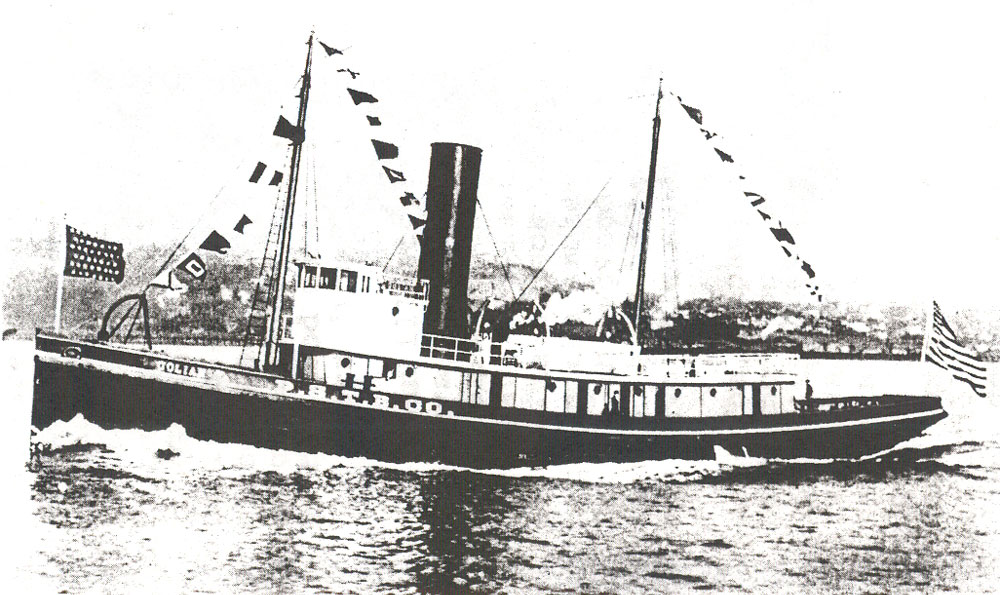
The Goliah, the Hercules’s sister, decked out for a special occasion. At the time of this photograph, she was owned by the Puget Sound Tug Boat Company, which purchased her from her original San Francisco owners in 1909. During World War I, she was sold to the U.S. Navy and served in Europe as a salvage and rescue tug. After the war, she was returned to private ownership on the East Coast, where she spent her final years towing oil and coal barges and dredging equipment for the Wood Towing Company of Norfolk, Virginia. She was scrapped in 1952.
Captain William J. Grey, construction supervisor for the Hercules and Goliah, said afterwards that the Hercules was hard on men, but that she was always pulling. He often said that the duties of the two tugs when they worked the Pacific Coast should have been reversed—the Goliah was more suited to ship-handling and short hauls out of San Francisco, and the Hercules was ideal for the longer hauls and log-raft work in Puget Sound.
Hercules Layout Diagram
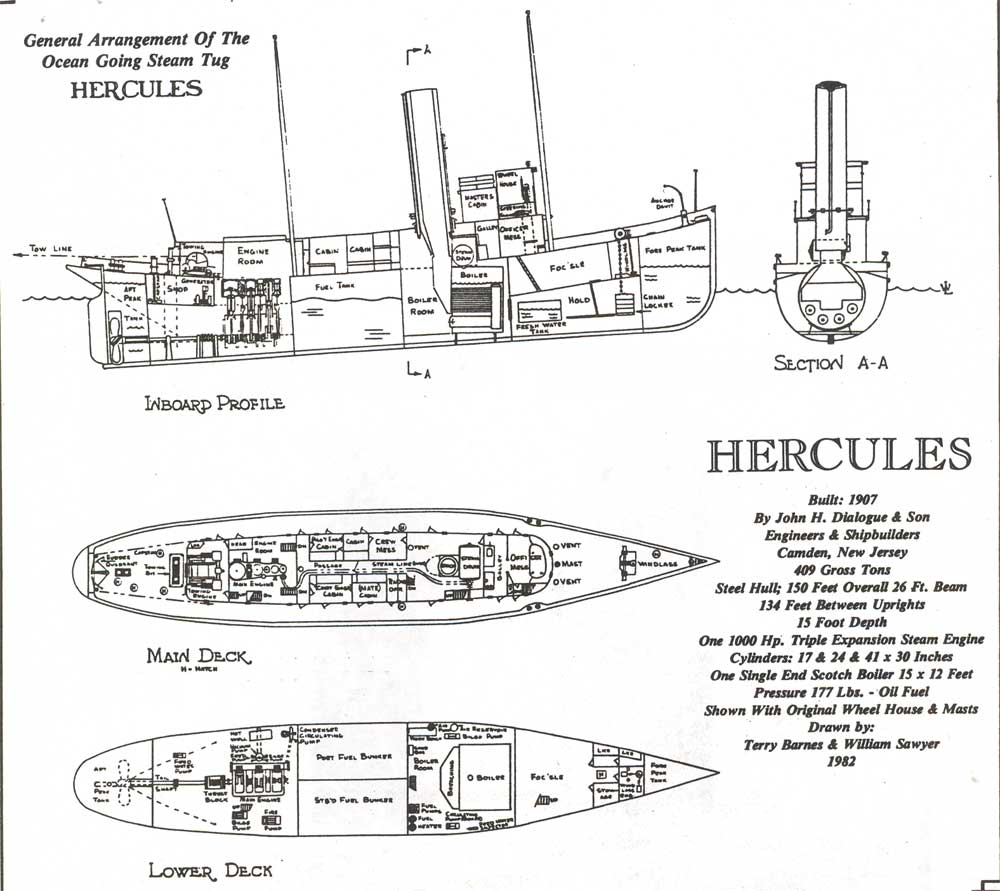
Layout diagram of the steam tug Hercules
Hercules: “She Was the Best We Had!”
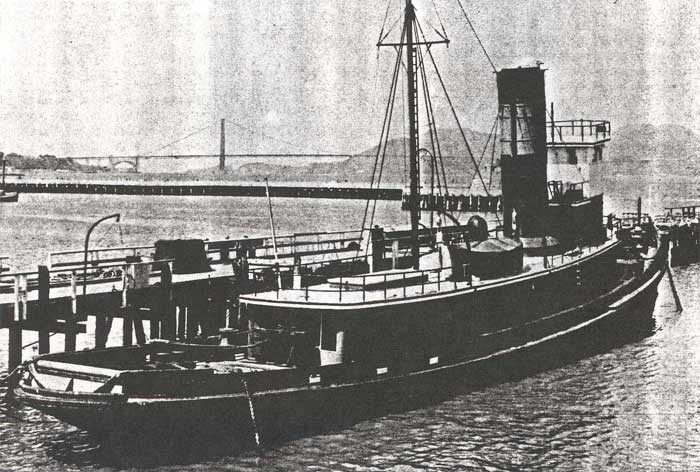
Hercules, “She Was the Best We Had!”
Hercules is an ocean-going steam tug—a hardworking type of craft that reached peak development around the turn of the century. Her deep, narrow hull and her 1,000 horsepower triple-expansion engine were designed to provide sure steering and steady pulling ability, even in high seas. Hercules represents the finest of American-built steam tugs, and is today one of the last of her kind afloat. Captain Fred Klebingat, a veteran in West Coast steam and sail, once said of her, “Hercules, she was the best we had!”
Long Tows and Open Ocean
Hercules was one of two nearly identical tugs designed and built in 1907 by John H. Dialogue and Son, of Camden, New Jersey. She was built for the “Red Stack” fleet of the San Francisco-based Shipowners’ and Merchants’ Tugboat Company, a business combine set up in 1885 to break the Spreckels monopoly in the San Francisco Bay towing business.
Upon completion, Hercules towed her sister ship, Goliah, through the Strait of Magellan to San Francisco, and then went to work towing barges, sailing ships, and log rafts between various Pacific Ocean ports. Because prevailing northwest winds generally made traveling up the coast by sail both difficult and circuitous, tugs were often used to tow large sailing vessels to points north of San Francisco. On one such assignment in 1916, Hercules spent six days towing both C. A. Thayer (now berthed at Hyde Street Pier) and another sailing vessel, Espada, north to Port Townsend on Puget Sound. On trips back down the coast, Hercules often towed huge log rafts, made up of millions of board feet of Northwest timber, to southern California mills. She also towed barges laden with various bulk cargoes between West Coast ports, as well as to Hawaii. During construction of the Panama Canal, Hercules towed a huge floating caisson to the Canal Zone, where it was destined for use in one of the canal’s locks. Later, she passed through the canal on a voyage to Jacksonville, Florida, with the dredge San Diego in tow.
Life on Board
Out through the Golden Gate, the most beautiful harbor in the world. North, towing this barkentine to Port Washington in Canada. Thence south, empty, to Astoria where we picked up six million feet of timber in a raft to tow south to San Diego. Long, slow lazy days, making no more than three knots. Even the patent log would not work. We rigged a fishing line on it and caught beautiful king salmon on the way.
In her deep-sea days, Hercules usually carried a crew of fifteen—enough manpower to work three watches while under way: four hours on and eight off. Life on an ocean-going tug could be uncomfortable for the crew because the deep, narrow hull rode so low in the water that the main deck was awash much of the time. There were, however, many advantages to the trade. The food was good, and, for an experienced hand, the work was steady. Tugboat captains were generally well paid and highly respected, for it took considerable experience and judgment to safely bring a tug and a heavy tow through high seas in bad weather, or to get them in and out of West Coast ports that were characterized by shallow bars and narrow entrances.
Hercules Becomes a Bay Tug
In 1918 the “Red Stack” fleet was acquired by Crowley Tug and Launch Company. Crowley in turn sold Hercules to the colorful Mayor of San Francisco, James A. “Sunny Jim” Rolph, Jr. In 1923 Hercules was acquired by the Moore Drydock Company of Oakland, and in 1924 was sold once again, this time to the Western Pacific Railroad Company.
Her ocean-going career at an end, Hercules was put to work moving barges loaded with railroad freight cars to and from various ports on San Francisco Bay. In 1933 she rammed the McCormick steam schooner Point San Pedro in a heavy fog. Hercules’ bow was smashed, and an eight-foot hole was opened up near the waterline of Point San Pedro. Both vessels were repaired, however, and put back in service.
In 1941, Hercules’ foremast was removed and her wheelhouse was raised, so that her helmsman could better see over the railroad cars on the barges she towed. With these exceptions, she remained little altered from her original appearance. Hercules continued to move barges around the Bay until 1962, when a diesel powered, self-propelled barge finally made her obsolete, thus ending a busy, 55-year long working life.
Although kept from the scrapyard, the old tug languished in the Oakland Estuary until she was acquired by the California State Parks Foundation and brought to the Hyde Street Pier for preservation. Later transferred to the National Park Service, Hercules was designated a National Historic Landmark in 1986, in recognition of her exceptional significance as a tangible link to America’s maritime past.
Two Men Hurt at Dialogue Shipyard
Philadelphia Inquirer —
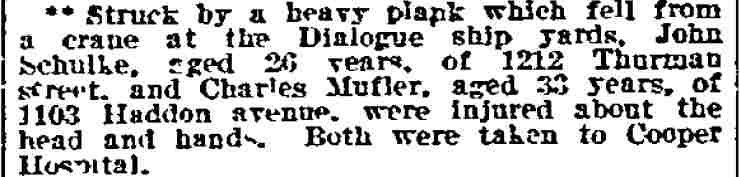
Struck by a heavy plank which fell from a crane at the Dialogue ship yards, John Schulke, aged 26 years, of 1212 Thurman street, and Charles Mufler, aged 33 years, of 1103 Haddon avenue, were injured about the head and hands. Both were taken to Cooper Hospital.
Hercules Photos
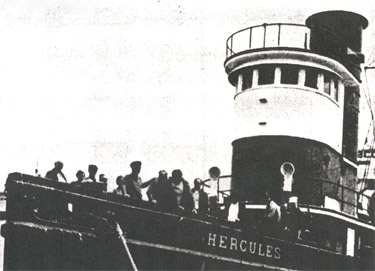
Hercules
Dialogue’s Finances Good
Camden Board of Trade Journal — 1914
Assets, $805,759.50 and liabilities, $287,642.61, is the showing made, according to the experts appointed to appraise the property of the John H. Dialogue Shipbuilding Company, as a result of the involuntary bankruptcy proceedings brought against the big South Camden concern by anxious creditors.
The appraisement, just completed, is said to be a most conservative one. It was conducted by Frank Bancroft, an expert engineer; Crawford Hillman, a marine architect and expert, and Adam Sloan, a Camden lawyer and real estate expert. According to their report, filed with Referee in Bankruptcy S. Conrad Ott, the property, which has a frontage of 850 feet on the Delaware River, is worth $322,120, while the buildings are valued at $36,876. The real estate held by the bankrupt in this and other New Jersey cities is valued at a total of $760,650, while the machinery of the plant is placed at $44,287.
The total amount of debts is $287,642.61, out of which $137,888.98 is fully secured. Judging from the showing made on the appraisement the company should be able to meet all of its debts and have a neat balance left after the adjudication is ended.
Before Referee in Bankruptcy
Philadelphia Inquirer —
CAMDEN AT A GLANCE
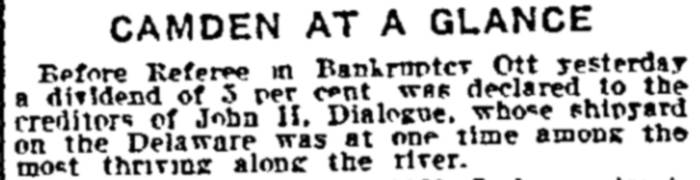
Before Referee in Bankruptcy Ott yesterday a dividend of 5 per cent was declared to the creditors of John H. Dialogue, whose shipyard on the Delaware was at one time among the most thriving along the river.
Title Page of Auction Listing, 1915
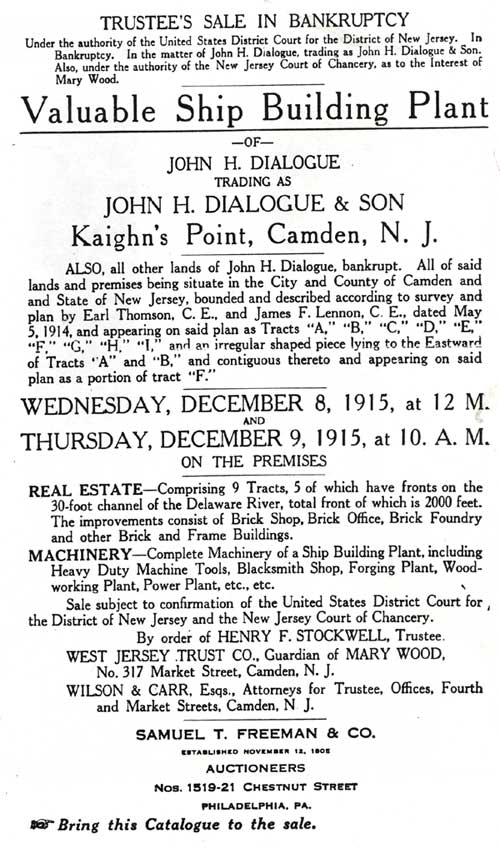
Title page of the auction listing for the John H. Dialogue Shipbuilding Company, 1915
Tract No. 1 — Forging Shop and Large Machine Shop
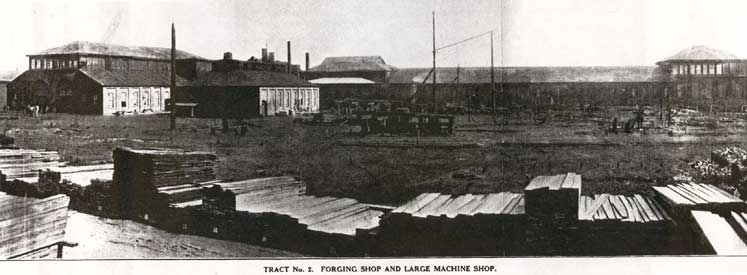
Tract No. 1 — Forging Shop and Large Machine Shop, Dialogue Shipyard
Dialogue-Plant Sold
Camden Board of Trade Journal —
Present developments in the trustee’s sale of the plant and lands of the John H. Dialogue & Son Shipbuilding Company, which took place December 8th, further establishes foundation for the rumor that the Reading Railroad has really been the purchaser of virtually all of the Dialogue plant. This rumor was strengthened when Attorney Hepburn, of Philadelphia, denied that he was representing a company of bondholders, and refused to disclose the identity of the firm or corporation for which he was bidding.
Hepburn purchased the lands which contained the real plant and factory buildings for $196,000, while Attorney D. E. Dallam, of Philadelphia, who openly admits being a representative of the railroad, secured the meadow lands for $111,000. It was said that the Reading had secured the entire Dialogue belongings for virtually one-half their value.
The Reading Railroad did not interest itself in the purchase of machinery, which was left to private bidders. This, according to Trustee in Bankruptcy Henry F. Stockwell, will amount to about $25,000. In all, it was calculated that the entire sale brought about $330,000, or about one-half of what the whole thing is worth.
It was further rumored that there had been a combination of bidders organized for the purpose of preventing the bids on the land from rising high. If this had not been the case, it was asserted that the money brought for the plant would total half a million dollars.
Another important fact brought out shows that the sale must first be confirmed by Referee in Bankruptcy S. Conrad Ott and by the Court of Chancery. If the report that the Reading Railroad has purchased all the property is authentic, it dispels all possible rumors that the plant was being purchased by a company intent upon manufacturing war munitions for the countries in Europe now engaged in war. Before Hepburn announced positively that he was not representing the bondholders, this appeared to be the common belief.
When the superintendent of the Reading Railroad here was asked what he thought would be done on the property, he professed to have no knowledge of the sale outside of what he had read in the newspapers.
It was first suspected as soon as this rumor became current that the railroad would announce its intention of erecting a huge terminal, rivaling in importance the one now owned by the Pennsylvania Railroad. This, however, was dispelled.
“If they agreed upon such a move,” a prominent person connected with the sale declared, “they would have no fear in announcing it to the public, for it certainly would meet with favor.”
On the ground purchased by Hepburn are piers, wharves, docks, office buildings, pattern shops, together with about a dozen buildings devoted to manufacturing purposes.
The sale was continued in the Machine Shop wharf, in what is known as the Riggers’ Loft. Although the bidding at first seemed rather brisk, the smaller men began to drop out as the bids rose. Spirited bidding was the feature of the smaller pieces of machinery, in which several local manufacturers were engaged.
John H. Dialogue, Shipbuilder, Dies
Camden Daily Courier —
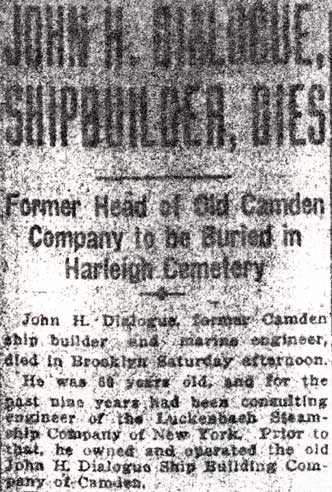
JOHN H. DIALOGUE, SHIPBUILDER, DIES
Former Head of Old Camden Company to be Buried in Harleigh Cemetery
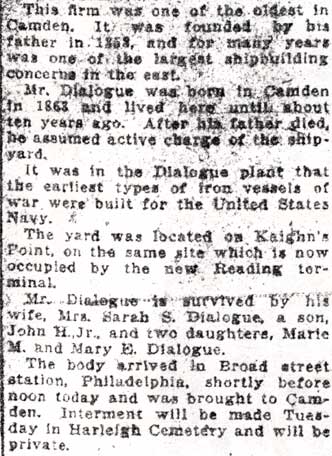
John H. Dialogue, former Camden ship builder and marine engineer, died in Brooklyn Saturday afternoon. He was 60 years old, and for the past nine years had been consulting engineer of the Luckenbach Steamship Company of New York. Prior to that, he owned and operated the old John H. Dialogue Ship Building Company of Camden.
This firm was one of the oldest in Camden. It was founded by his father in 1853, and for many years was one of the largest shipbuilding concerns in the east. Mr. Dialogue was born in Camden in 1863 and lived here until about ten years ago. After his father died, he assumed active charge of the shipyard. It was in the Dialogue plant that the earliest types of iron vessels of war were built for the United States Navy. The yard was located on Kaighn’s Point, on the same site which is now occupied by the new Reading terminal. Mr. Dialogue is survived by his wife, Mrs. Sarah S. Dialogue, a son, John H. Jr., and two daughters, Marie M. and Mary E. Dialogue. The body arrived in Broad street station, Philadelphia, shortly before noon today and was brought to Camden. Interment was made Tuesday in Harleigh Cemetery and will be private.
John Henry Dialogue
Transactions of the Society of Naval Architects & Marine Engineers — 1924
Mr. Dialogue was born in Camden, New Jersey, August 30, 1862. At an early age he entered his father’s shipyard at Kaighn’s Point, Camden, New Jersey, and learned the business of iron shipbuilding “from the ground up.” After serving an apprenticeship in practically every department of the yard, he became his father’s partner, the firm name being John H. Dialogue & Son, and thus continued for many years. Until the advent of the New York Shipbuilding Company’s plant farther down the river, there was no shipyard on that side of the Delaware so large as that of the Dialogues, whose plant covered 34 acres and had a water frontage of 2,000 feet.
A generation ago the yard was rated as one of the four largest in the country, and at present there is hardly a principal port on the east and west coast in which one cannot find craft that was constructed there. No firm in the country excelled it in the construction of towboats of all sizes, and “Built at Dialogues” was long a hall-mark for this class of vessel. While the firm confined itself mainly to the building of towboats, vessels of other types were occasionally turned out, the largest being the Lewis Luckenbach, of 3,905 tons, which was launched in 1903. The famous old frigate Constitution was reconstructed by this firm in 1876 and the U.S. gunboat Princeton built by them in 1895. After the elder Dialogue’s death, Mr. Dialogue carried on the business for a long period but eventually gave it up, and the yard was sold to the Philadelphia & Reading Railroad to be used in the extension of its Camden Terminal.
Since 1915, Mr. Dialogue had been employed by the Luckenbach Steamship Company as its Consulting Engineer, a position for which his wide experience and intimate knowledge of the technical as well as the practical side of shipbuilding and marine engineering particularly fitted him and, in conjunction with Mr. J. L Luckenbach, he supervised the designing and construction of ten of the vessels built for the company.
In addition to being a charter member of this Society, he also belonged to the American Society of Mechanical Engineers. He died April 19, 1924.
Is Zat So!
Camden Courier-Post —
By Gordon Mackay
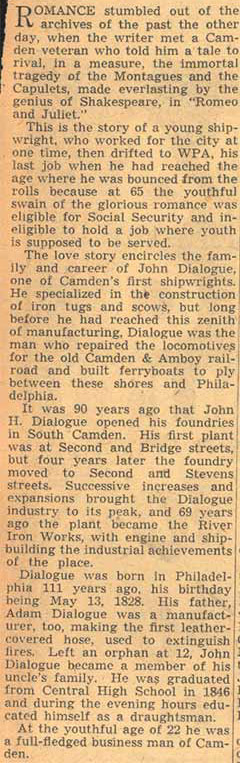
Romance stumbled out of the archives of the past the other day, when the writer met a Camden veteran who told him a tale to rival, in a measure, the immortal tragedy of the Montagues and the Capulets, made everlasting by the genius of Shakespeare, in “Romeo and Juliet.”
The tale of the Dialogues and the Kaighn family dates back to the earliest days of Camden’s history, when John H. Dialogue established the famous shipyard on the Delaware river front.
Dialogue was born in Philadelphia, May 13, 1828, and came here as a young man. He was a marine engineer and ship builder and had his establishment at Kaighn’s Point — the finger of land that juts into the Delaware at the foot of Kaighn Avenue. He built tugs, ferries, and other river craft in his yards and in some instances, built vessels for the United States government.
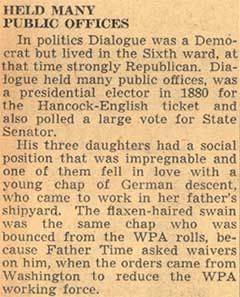
HELD MANY PUBLIC OFFICES
In politics Dialogue was a Democrat but lived in the Sixth ward, at that time strongly Republican. He was president of city council and held other public offices. He had three daughters who were said to be among the most beautiful in Camden. In those days the families of the Democrats and Republicans did not mingle and there was almost as definite a social line between them as between the Montagues and the Capulets. Despite this, a young Republican named Kaighn fell deeply in love with one of the Dialogue girls. He took her out of the Democratic camp and married her and his family — the Kaighns — owned much of the land on which the Dialogue shipyard was located and which was known as Kaighn’s Point. Thus, through marriage, did the Dialogues become affiliated with the great Kaighn family of Camden.
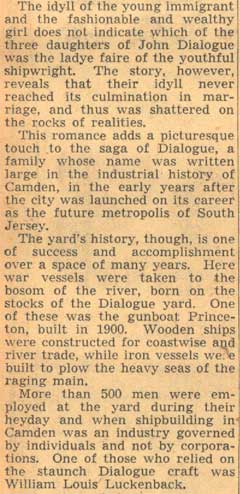
The Dialogue shipyard, in its heyday, employed 500 men and was one of the most thriving establishments along the Delaware. Among the notable vessels built there was the steam tug William Louis Luckenbach, which plied the waters of the Delaware for many years. The Luckenbach family was closely associated with the Dialogue enterprise and it was through this connection that John H. Dialogue Jr., the son, later became consulting engineer of the Luckenbach Steamship Company of New York.
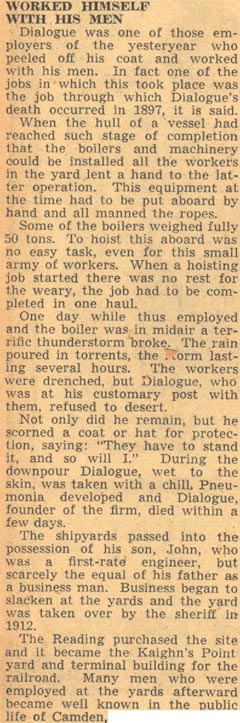
WORKED HIMSELF WITH HIS MEN
Dialogue was one of those employers of the yesteryear who peeled off his coat and worked with his men. In fact one of the jobs in which this took place was the job through which Dialogue’s death occurred in 1897, it is said.
When the hull of a vessel had reached such stage of completion that the boilers and machinery could be installed all the workers in the yard lent a hand to the latter operation. This equipment at the time had to be put aboard by hand and all manned the ropes.
Some of the boilers weighed fully 50 tons. To hoist this aboard was no easy task, even for this small army of workers. When a hoisting job started there was no rest for the weary, the job had to be completed in one haul.
One day while thus employed and the boiler was in midair a terrific thunderstorm broke. The rain poured in torrents, the storm lasting several hours. The workers were drenched, but Dialogue, who was at his customary post with them, refused to desert.
Not only did he remain, but he scorned a coat or hat for protection, saying: “They have to stand it, and so will I.” During the downpour Dialogue, wet to the skin, was taken with a chill. Pneumonia developed and Dialogue, founder of the firm, died within a few days.
The shipyards passed into the possession of his son, John, who was a first-rate engineer, but scarcely the equal of his father as a business man. Business began to slacken at the yards and the yard was taken over by the sheriff in 1912.
The Reading purchased the site and it became the Kaighn’s Point yard and terminal building for the railroad. Many men who were employed at the yards afterward became well known in the public life of Camden.
John H. Dialogue — Shipbuilding Pioneer on the Delaware River
By Kenneth Kogan
Skeletons of steel are all that remain of Camden’s shipbuilding industry, at one time a center of American maritime ingenuity, innovation, and design. A moving force in this industrial revolution on the Delaware River was John H. Dialogue, who was born in Philadelphia on May 13, 1828. His father, Adam, had invented and manufactured the riveted leather fire hose found in pictures of horsedrawn firewagons racing through city streets. By the age of twelve young Dialogue was an orphan living with his uncle, a machinist. After graduating from Central High School in 1846 he was apprenticed to his uncle and became a self-taught draftsman in his spare time.
A forty-eight-year career on the Delaware River commenced in 1850 as Dialogue, at just twenty-two years of age, began his first enterprise at Second Street and Bridge Avenue in Camden. Here, at the southern terminus of the thriving Camden and Amboy Railroad Company, he employed approximately 100 men in the repair of locomotives and Delaware River ferry boats. The company prospered and in 1859 moved to the thirty-four-acre riverfront site at Kaighn’s Point that would house the Dialogue works until its demise. While marine and railroad repair work continued as the company’s mainstay, Dialogue entered the vanguard of industrial innovation via a licensing agreement to manufacture the Corliss stationary steam engine. George Corliss, a largely self-taught engineer, had patented two important innovations—a special engine governor and a new valve design, both of which greatly increased a steam engine’s efficiency. His most famous creation was the huge engine that powered the machinery displayed at the 1876 Centennial Exposition. Its flywheel was thirty feet in diameter.
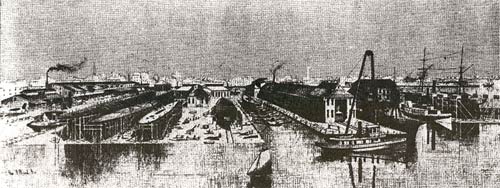
In 1870 the Dialogue works expanded in size and employed over 100 men and boys. This advertisement appeared in the New York Daily Graphic in 1875. [NJHS]
In 1862 Dialogue became associated with the newly formed National Armor and Shipbuilding Company, also in Camden. The first vessel built by National was the thirty-five-ton Lookout which, after a 1942 diesel engine installation, was still operating in 1973. National’s history is obscure but the company failed within two years of its founding. The firm of Wilcox and Whiting took over their works with Dialogue possibly continuing as a subcontractor. As no records attribute ship launchings to the Dialogue works during the period from 1865 to 1870, the yard presumably continued to rely on general repair and engine building. This approach may well have reflected a sound business judgment as the immediate post-Civil War shipbuilding industry was buffeted by inflation and experienced an almost complete lack of military orders. During this lean period other yards went so far afield as to produce paper-making machinery and railroad cars to ride out the shipbuilding doldrums.
In 1870 the Dialogue works expanded in size and importance when Randolph Wood combined his adjoining land with Dialogue’s and became a partner in the firm of Wood, Dialogue and Co. (The various names used by the Dialogue yard are a source of confusion. The 1870 Camden County Census of Industry listed “Wood and Dialogue” as the owners but gave “National Iron Works and Shipbuilding Company” as the name of the business.) As of June 1870 the partners employed 100 “males above 16 years” and 15 “children and youth.” Their business capital was given as $200,000. The first iron vessel launched by Wood and Dialogue was probably the cutter Colfax for the United States Revenue Cutter Service. This was followed by the forty-eight-ton iron tug Frank G. Fowler and the icebreaker City Ice Boat No. 3 for the city of Philadelphia. In 1874 they built one of the first compound-engine tugboats, the George W. Childs. The compound engine was a more compact and economical design than previous engine types and this early marine installation preceded those of many larger, more established yards. Another first of a sort was the March 14, 1876, delivery of the venerated, and neglected, USS Constitution from the League Island Navy Yard. After years of on-again, off-again repairs Wood and Dialogue was selected to restore “Old Ironsides” for exhibit at the 1876 Centennial Exposition. There is no record of the exact work performed in Camden. In any event the ship missed the Centennial, remaining in Camden until December 31, 1876, and was placed back in active commission a month later.
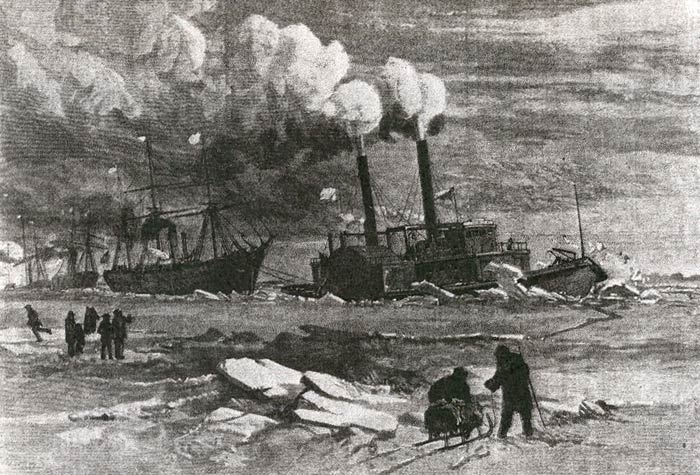
City Ice Boat Number 3, built in 1875 by Wood, Dialogue and Company, served as an icebreaker on the Delaware River until it sank in 1905. This engraving appeared in Harper’s Weekly in 1877. [NJHS]
A few years after the partnership’s formation, Wood’s suicide in April 1874 left Dialogue in sole control of the company, although Wood’s widow retained ownership of her husband’s portion of the shipyard real estate. Business was further complicated by a serious fire in 1877. If past performance is any measure it may be inferred that Dialogue surmounted the setback with his usual aplomb. The yard’s founder apparently decided to concentrate on the building of tugboats rather than larger commercial and military vessels, while the general repair business continued as before. Perhaps Dialogue felt this an ideal niche, preferring to remain on the sidelines as Philadelphia’s William Cramp and Chester’s John Roach fought for the large vessel orders.
Specialization, whether intended or not, bore fruit as the yard’s reputation for first-class tugboats spread throughout the industry. Dialogue-built tugs, or “towboats” as they were popularly known (the term “towboat” deriving from their early use in towing sailing vessels and canal boats), did yeoman service in major United States and South American ports. From about 1880 onwards the proportion of iron-hulled versus steel-hulled vessels rapidly reversed with the Dialogue works completing its own conversion to the latter by about 1890. The year 1890 also saw the Dialogue firm included in an area fire insurance survey undertaken by E. Hexamer & Son of Philadelphia. It noted the employment of “500 men and a few boys” in the manufacture of “Ship Building, Engines and Boilers, Machinery in general.” By the time of the survey twenty-eight year-old John H. Dialogue, Jr., had become his father’s partner after serving apprenticeships in nearly every department of the yard. The firm was now renamed for the last time as John H. Dialogue & Son.
The senior Dialogue passed away on October 23, 1898, at age seventy. During his forty-year Camden residence he had served three terms on the board of education, presided over the Camden City Council, and been elected president of the New Jersey Electoral College. His obituary was front-page news in the Camden Daily Courier. Eight foremen of the shipyard’s various departments served as his pallbearers.
Dialogue’s son subsequently assumed proprietorship of the yard and under his supervision fifty-three ships, mostly tugs, were launched. Anxious creditors forced the younger Dialogue into bankruptcy in late 1913. An auctioneer’s brochure describing the yard’s real estate and equipment ran fifty pages and is a unique record of the variety of tools and machinery that a modern yard required. The property’s buyer was the Reading Railroad which, through hidden buyers, obtained the real estate for little more than half its appraised value. In short order the yard’s buildings were demolished to make way for an extension of the Reading’s Camden terminal. The shipbuilding business has traditionally been one of boom and bust cycles, a relatively modest capital return, and an uncertain future. Perhaps these factors, combined with the absence of the man who had begun the enterprise, caused his son to lose the mettle that had carried the yard through its first thirty-eight years.
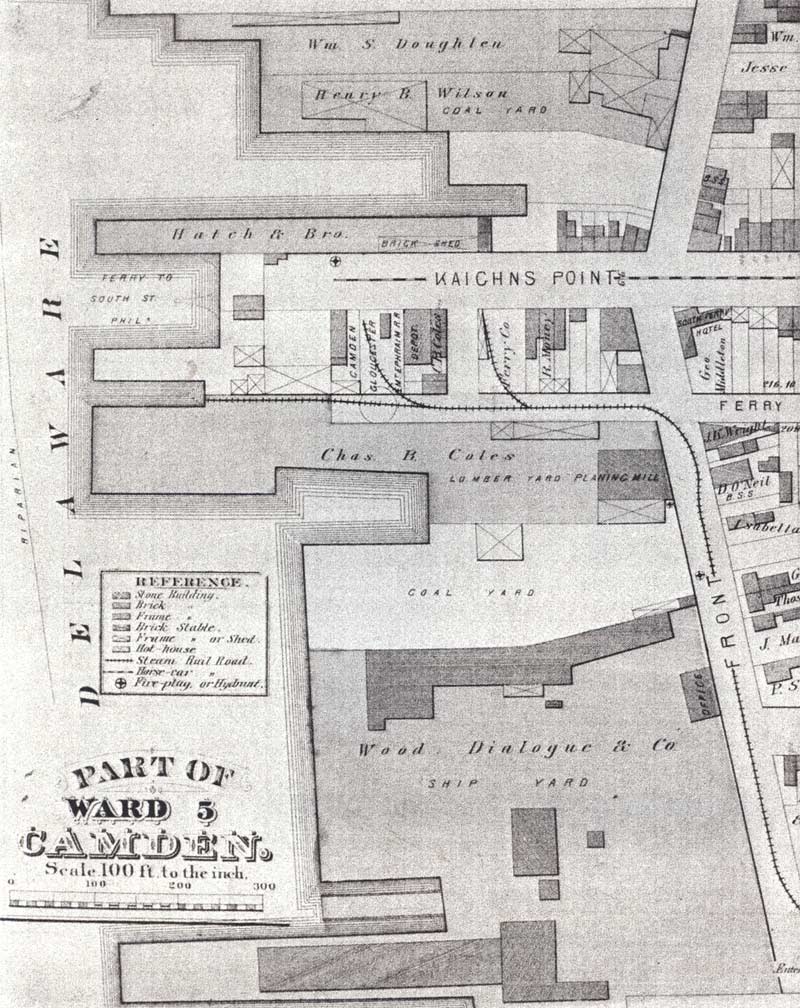
The River Iron Works, one of several names used to describe Dialogue’s firm, manufactured boilers and steam engines in addition to ships. This is a detail from a map in the 1877 City Atlas of Camden, New Jersey. [NJHS]
Dialogue found employment as a consulting engineer for one of the yard’s old customers, the Luckenbach Steamship Company of New York City, and oversaw the construction of ten of that company’s vessels. He died on April 19, 1924, bringing to an end the Dialogues’ fifty-five-year association with the shipbuilding industry of the Delaware River. In its years of active operation the Dialogue yard had pioneered in the adaptation of new materials and technology to shipbuilding—the first marine compound engine, the first steel-hulled steamer with twin screws and rudder posts, and the construction of one of the earliest of the federal government’s all-iron ships. The firm’s displaced work force took their skills to the six yards still operating on the Delaware River’s New Jersey waterfront. Of these, the burgeoning New York Shipbuilding Company would become the shipbuilding equivalent of Henry Ford’s River Rouge Works—a self-contained industrial empire of almost limitless capacity. It was also the last to die, existing at least in name through the 1970s.
Figure 1. Chronology of John H. Dialogue’s Business Names
| Name | Dates | Primary Business |
|---|---|---|
| John H. Dialogue | 1850–62 | Railroad repairs, manufacture of Corliss stationary steam engines under license. |
| John H. Dialogue | 1862–64 | Associated with short-lived National Iron Armor and Shipbuilding Co., subsequently a subcontractor to their successors, Wilcox & Whiting. |
| John H. Dialogue | 1865–70 | Activities unclear. Presumably general marine and railroad repair work and engine manufacture continued. |
| River Iron Works | 1870–75(?) | Partnership with Randolph Wood, expansion of the yard, design and building of ships becomes main focus. |
| John H. Dialogue Shipyard | 1875(?)–85(?) | Shipbuilding, boiler and steam engine manufacture. |
| John H. Dialogue & Son | 1885(?)–1914 | Shipbuilding, boiler and steam engine manufacture. |
Notes: The firm name was listed as “National Iron & Shipbuilding Company” in the 1870 Camden County Census, but this name seems never to have been used. During the partnership’s duration the company is also referred to as “Wood, Dialogue & Co.” and “Dialogue, Wood & Co.” The date of the name change to include John H. Dialogue, Jr., is presumed. In 1885 the younger Dialogue, at twenty-three years of age is assumed to have completed his shipyard apprenticeship and become a principal of the firm.
A Few Dialogue Ships
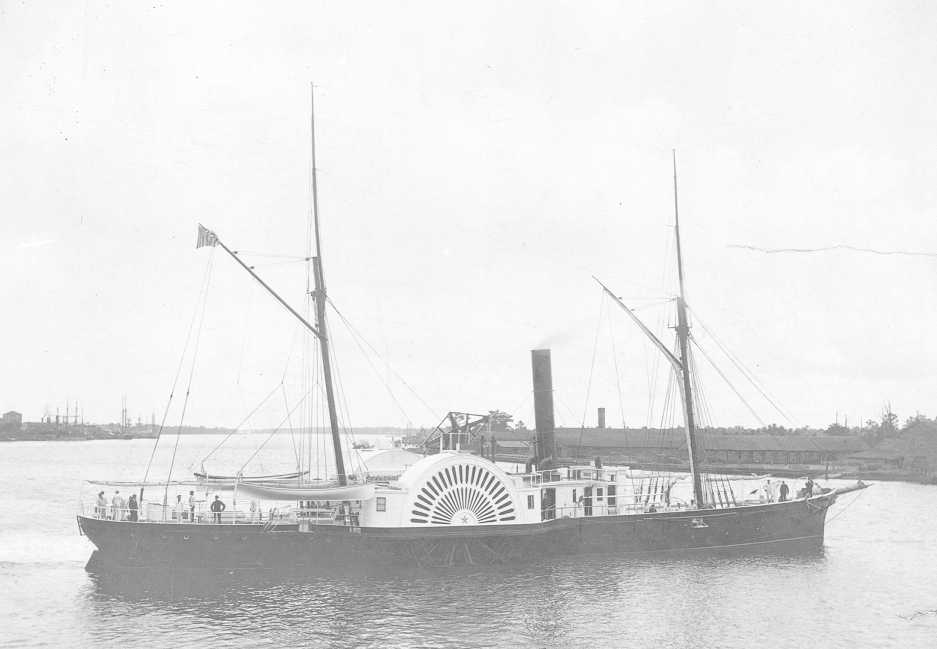
USRC Colfax
USRC Colfax, commissioned in 1871, was a 140-foot, 250-ton, side paddlewheel steamer. She was built with a composite hull (iron frames planked with wood) by Dialogue and Wood of Camden, NJ. She spent her career in the waters of the southeast coast, from Baltimore to Savannah. She enforced quarantine restrictions at Fort Monroe in 1893, operated with the USS Vesuvius, the Navy’s unique dynamite gun cruiser, in April, 1897, assisted the disabled cutter Morrill in 1898, and hosted President William McKinley in 1899 and was decommissioned in September of that year. She was then used as a station ship in the Coast Guard Depot at Curtis Bay, MD until she was sold in 1924 to Mr. Charles A. Jording of Baltimore, MD, for $1,440.
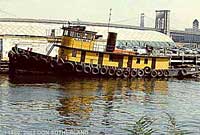
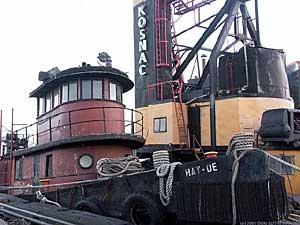
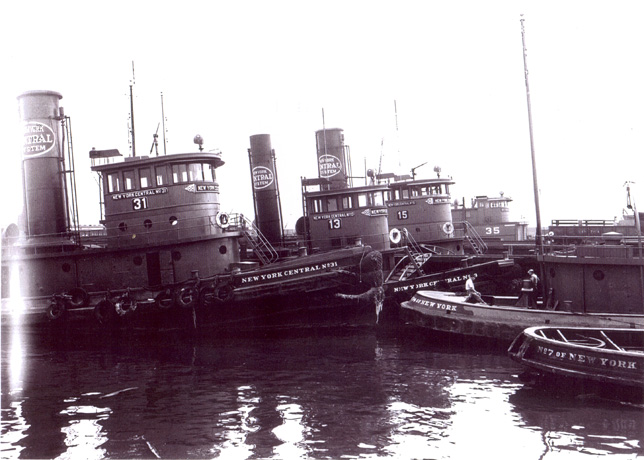
New York Central 13 / Hay-De
The New York Central 13, later known as the Hay-De, a tugboat docked in Staten Island, N.Y., was in imminent danger of being sunk as a reef. Hay-De starred, along with Bruce Willis, in the final scene of the 1991 movie “Billy Bathgate.” The boat was built as New York Central 13 in 1887 by the John H. Dialogue Ship Building Works of Camden, NJ for the New York Central Railroad, which pushed barges that carried boxcars across New York Harbor. Its riveted iron hull is one of about a half-dozen surviving Dialogue hulls. The boat’s engine was dieselized in the 1950s and still works. After a long and productive career, she was days away from being sunk as an artificial reef before being saved by her current owner in August, 2002.
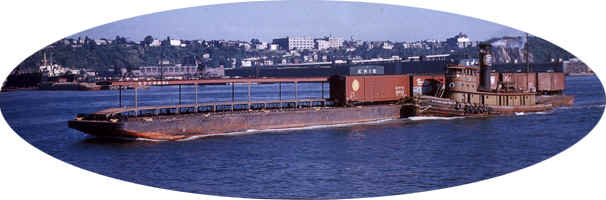
NY Central No. 32 pushing a carfloat and boxcars on the Hudson River. 1957 photo by Al Holz — from “New York Harbor Railroads In Color” by Thomas R. Flagg.
Susan Elizabeth / C. C. Clark
The Susan Elizabeth was launched in 1886 as the C. C. Clark. She served under various names until 2002, when she went, under her own power, to her present home at the National Tugboat Museum in Kingston NY.
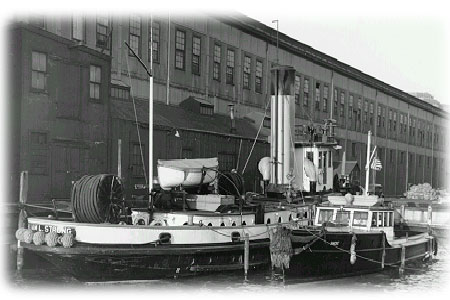
William L. Strong
A fireboat built for the Fire Department of the City of New York’s Marine Division, the William L. Strong was built at the Dialogue shipyard in 1898. 100’ long with a 24’ beam, she drew 12’. The William L. Strong could put 6500 gallons of water per minute on a fire. Built with a steel hull, the Strong was coal-fired with a single screw engine. She was stationed at Grand Street and the East River as Engine 66 for 50 years, until being removed from service in May of 1948.
Elise Anne Connors is a canal tug built in 1881. The Connors has an iron hull, a Length of 76’6,” a beam of 18’, and a draft of 7’6.” She can be seen at the North River Tugboat Museum in Kingston NY.
The first Barnegat (SP-1232) was built in 1898 by Dialogue as Luckenbach No 1. Purchased by the Navy in 1917, she was delivered on 12 October 1917 and commissioned the same day. With a crew of 40 and armed with a 3” gun, Barnegat sailed in convoy from Philadelphia on 20 December 1917 and arrived at Brest, France, 23 April 1918. She was assigned to Division 9, Patrol Force, and carried out patrol and towing operations in the vicinity of Brest until departing for the United States late in September 1919. Sailing in October she arrived at Norfolk 28 November 1919 and was assigned to the 5th Naval District until transferred to the 4th Naval District 26 January 1920. She remained on duty there until 20 August 1920 when she was decommissioned and transferred to the War Department.
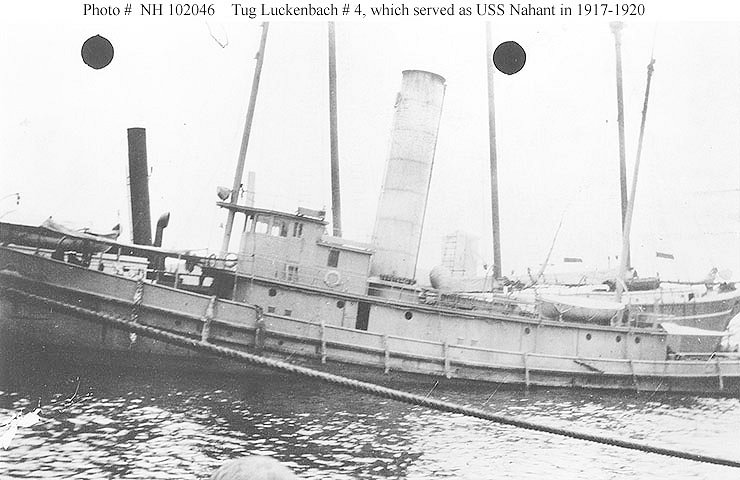
USS Nahant SP-1250
The USS Nahant SP-1250, a harbor tug built in 1913 by the Dialogue shipyard as Luckenback No. 4, was acquired by the Navy from Luckenback Steamship Co., Inc., New York City 1 December 1917 and commissioned 12 December 1917. Operating in the 3rd Naval District and armed with a 3” gun and two machine guns, Nahant performed towing tasks in New York Harbor during her Naval career. Decommissioning early in 1920, Nahant was transferred to the City of New York and served the Police Department as Service No. 2 and as John F. Harlan. Returned to the Navy in 1928, Nahant was struck from the Naval Register 27 September 1928 and sold to Joseph O’Boyle of New York 24 December 1928. Her fate is unknown.
The Underwriter was an iron-hulled screw tug completed in 1881 at Camden, N.J., by John H. Dialogue and rebuilt in 1908. She was taken over by the Navy at the Naval Station New Orleans, La. on 1 July 1918 and was commissioned there on 9 August 1918, Boatswain Joseph W. Elfert, USNRF, in command. She was renamed the USS Adirondack in the fall of 1920, and served with distinction until March 1, 1922. She was sold June 6, 1922 and struck from the Navy list that same day.
The USS Chickasaw II was a tug, built in 1882 by John H. Dialogue of Camden NJ, as Hercules. She was purchased by the Navy 25 June 1898 and was placed in commission briefly for service during the Spanish-American War operating from Port Royal and Charleston, S.C. Decommissioned 26 August 1898, Chickasaw was placed in ordinary for repairs, then in April 1900 was ordered to New York Navy Yard for use as a harbor tug and tender for the receiving ship Vermont. From 1908 she served as a harbor tug at Newport and remained there until 1913 when she returned to New York and was sold.
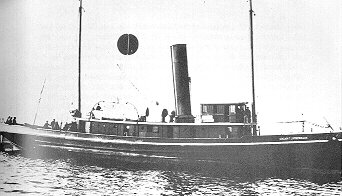
USS Cherokee
The third Cherokee (No. 458) was built in 1891 by John H. Dialogue & Sons, Camden, N.J., as Edgar F. Luckenbach (later renamed Luckenbach No. 2); purchased by the Navy; delivered at New York 12 October 1917; and commissioned 5 December 1917. Armed with a 3” gun and outfitted for distant service at New York and at the Philadelphia Navy Yard, Cherokee cleared Newport, R.I., 24 February 1918 for Washington, D.C. On 26 February, in a heavy gale, she foundered about 12 miles off Fenwick Island Light Vessel, with the loss of 30 of her crew. The tanker British Admiral rescued 12 survivors, two of whom died before the tanker reached port. The Cherokee, or “Gunboat Wreck,” sits in 90’ of water and is regularly visited by divers. To this day, artifacts are still occasionally recovered.
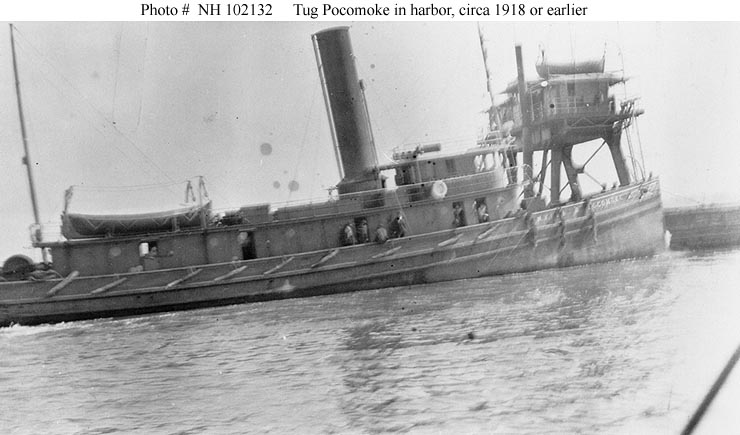
Pocomoke
Pocomoke, a 293 gross ton steam tug, was built at Camden, New Jersey, in 1906. She subsequently was owned and operated by the New York, Philadelphia & Norfolk Railroad Company. In 1918, as part of the World War I ship acquisition effort, Pocomoke was evaluated by the Navy and assigned the identification number 2265. However, she remained in civilian hands and had no Naval service.
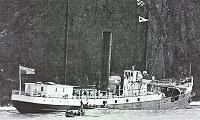
USS Armeria
Commissioned on December 4, 1890, the USS Armeria was a lighthouse tender built by the Dialogue shipyard. Lighthouse tenders operated under the various district offices under the overall direction of the Superintendent of Lighthouses. Analogous to the Coast Guard buoy tenders of today, these vessels were tasked to place, repair and move floating navigational aids, deliver fuel, supplies and materials, transport construction and repair personnel to different stations, and transport LHS officers on official business. They also performed police duties such as assisting in smuggling prevention and protection of government property. Along with the Revenue Cutter Service, the Lighthouse Service was placed under the direction of the Navy by Executive Order as tensions with Spain increased and the clamor for war grew in the late 1890s.
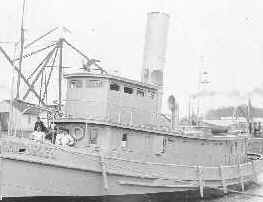
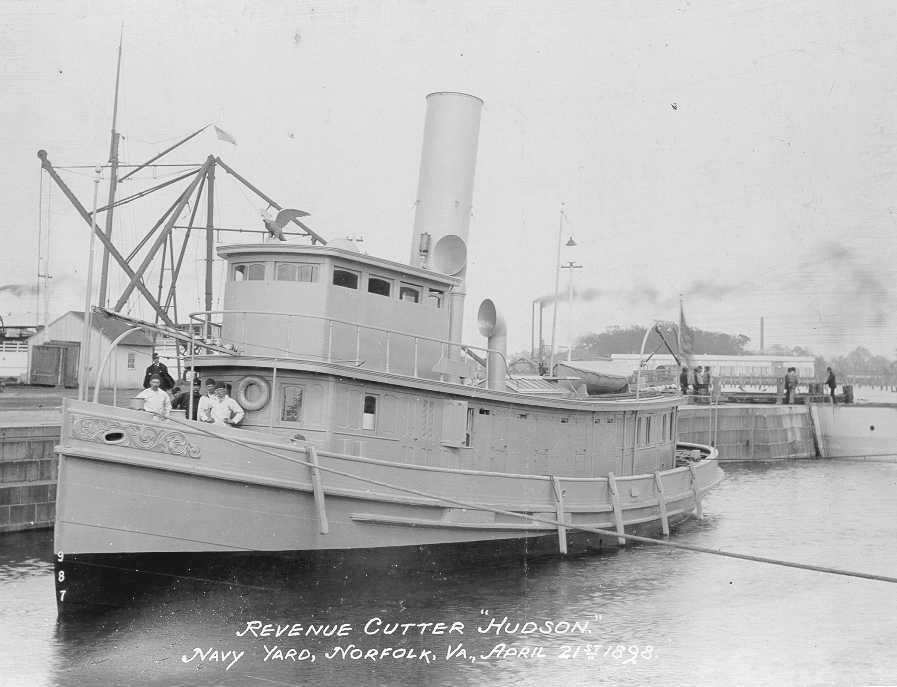
USRC Hudson
Built in 1893 for the Treasury Department, the Hudson was the Revenue Service’s first vessel to have a steel hull and triple-expansion plating. The Hudson was assigned to New York harbor before coming under naval direction for the Spanish-American War. On 11 May 1898 the cutter Hudson, along with the Navy warships Winslow, Machias, and Wilmington, had pursued three Spanish gunboats into the bay of Cardenas, Cuba. There, shore batteries fired on the U.S. vessels and disabled the Winslow, knocking out her steering and a boiler, thereby putting Winslow adrift. The accurate Spanish fire wounded the Winslow’s commanding officer and killed another officer and many of the crew.
Hudson returned to service with the Treasury Department out of New York. She continued with her traditional duties and was once again taken into the Navy for service during World War I beginning on 6 April 1917. She continued her service with the Navy until returned to Treasury Department control on 28 August 1919. She returned to service with the Coast Guard until she was decommissioned in 1935.
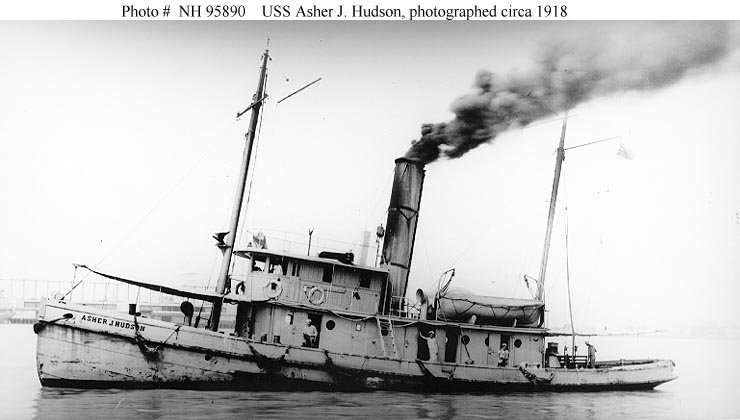
Asher J. Hudson — probably photographed at New Orleans, Louisiana, circa 1918.
The Asher J. Hudson was an iron-hulled, single-screw steam tug completed in 1891 at Camden at the Dialogue shipyard. She was inspected in the 8th Naval District on 1 July 1918 and, on the 24th, was ordered taken over by the Navy. Acquired from the Alabama Coal Transport Co. of New Orleans LA, Asher J. Hudson, classified as SP-3104, was commissioned at the Naval Station, New Orleans, on 1 August 1918, Ens. Alva Carlton, USNRF, in command. Equipped as a minesweeper, she served the port of New Orleans and the Mississippi River headwaters through the end of World War I. Returned to civilian duty in 1921, Asher J. Hudson worked out of New Orleans, and later Port Arthur TX, until 1963.
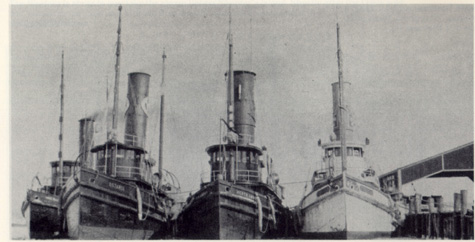
Left to right: Erie Railroad’s Daniel Willard, O&W’s Ontario, Lehigh Valley’s Perth Amboy and Lackawanna’s Scranton at Vineyard Haven, Martha’s Vineyard due to ice.
The Ontario and the Western were built by Dialogue in 1908 and were operated by the Ontario and Western Railway.
The steel tug Lackawanna was built in 1900 for the Delaware, Lackawanna & Western Railroad. Late in the evening of August 15, 1915 Lackawanna was towing three barges from New York to Portland, Maine. While proceeding up Nantucket Sound toward Pollack Rip Channel she met the tug Triton with the barge Nanticoke in tow. The tugs cleared one another but for some reason Nanticoke swung out and collided with the eastbound vessel. Whether it was the result of wind or current cannot be said, but the barge tore open Lackawanna’s side. Mortally wounded the tug sank within minutes carrying two of her crewmen to their death. Lackawanna’s barges were anchored and later towed to Portland by the Triton.
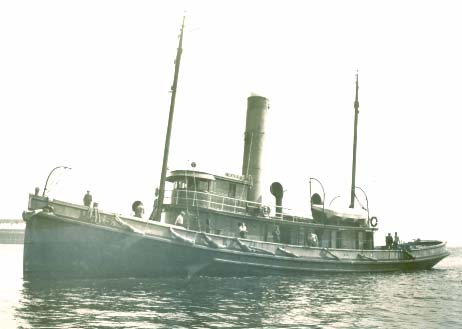
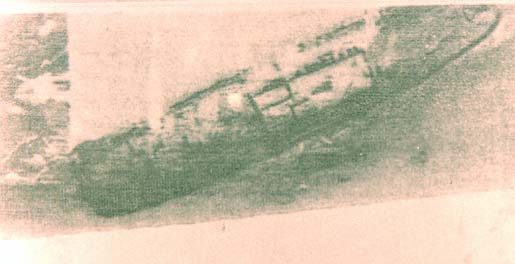
Above: The Mars. Below: Sonar imagery of the Mars wreck.
The Mars was built in 1890. Built to haul coal laden barges the vessel was sold to a Philadelphia Company in 1920 and then again in 1936 to the Martin Marine Transportation Company, and sailed from Wilmington DE. On September 13, 1942 Mars sank in collision with the coastal tanker Bidwell. The tanker sheared off the tug’s bow and she quickly went down in 120 feet of water near Plymouth MA east of Manomet Point.
Challenge (No. 1015) was a tug built in 1889 by Dialogue at Camden. Originally named Defiance, she was commandeered by the Navy 13 June 1918; delivered 24 June, outfitted at Mare Island Navy Yard with two 3 pound guns, and commissioned 29 July 1918, Lieutenant M. J. Downes USNRF, in command. She was renamed Challenge 16 August 1918. Challenge towed oil barges between California and Mexico until 31 May 1920, when she arrived at Bremerton, Wash., for duty under the 13th Naval District. She served as a harbor tug at Puget Sound Navy Yard until decommissioned 13 May 1922. Recommissioned and reclassified AT-59 on 21 February 1925, Challenge resumed duty as a yard tug at Puget Sound. On 31 January 1936, she was reclassified YT 126; on 2 December 1940, decommissioned and placed “in service”; reclassified YTM-126 on 13 April 1944; and on 16 October 1946, transferred to the Maritime Commission.
Tybee—a steam launch built for the United States Revenue Cutter Service by J. H. Dialogue and Son, of Camden, N.J., and completed late in 1895—was delivered to the Revenue Cutter Service on 19 November 1895. Three days later, she sailed for Savannah, Ga., where, after a voyage which touched at Baltimore, Md.; Norfolk, Va.; Beaufort, N.C.; and Charleston, S.C., she arrived on 21 January 1896. She conducted local operations at Savannah through the turn of the century and, on occasion, patrolled regattas staged in the Savannah area. After the United States entered World War I on 6 April 1917, Tybee was taken over by the Navy and served on local patrol duties out of Savannah for the duration of hostilities. She was returned to the Treasury Department on 28 August 1919. Assigned to the gulf division on 11 October 1920, Tybee was subsequently assigned a permanent station at Savannah on 1 January 1923. She lost the name Tybee on 6 November of the same year and was classified and named AB-15. She alternated bases between Norfolk and Savannah for the remainder of her career. She was condemned on 23 June 1930 and sold to D. E. Little of Jacksonville, Fla., on 25 September 1930.
Keshena (YN-37), formerly Raymond Card, was a tug launched in 1910. She was acquired by the Navy 20 September 1940 from the Card Towing Line, New York; and placed in service 19 October 1940. Keshena cleared Hampton Roads, Va., 30 October and arrived Guantanamo 9 November for service as a net tender. She remained in the 10th Naval District operating out of Guantanamo throughout the war. She was reclassified YNT-5 on 8 April 1942, and subsequently YTM-731 on 4 August 1945. Keshena was struck from the Navy List 28 August 1946 and transferred to the Maritime Commission for disposal on 12 February 1947.
Acknowledgments
Thanks to Harry Kyriakodis and Kenneth Kogan for their invaluable assistance in creating this page.