Nature Boy Buddy Rogers
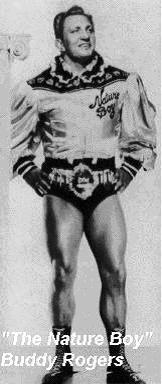
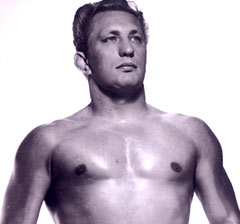
Buddy “Nature Boy” Rogers
BUDDY ROGERS was born Herman G. Rohde Jr. to Herman and Freda Rohde in Camden NJ on February 20, 1921. Both his parents were born in Germany. In 1920 his father had been working as a machinist at the Samuel Langston Company in Camden's Eighth Ward, ten years later he was a stationary engineer at the Camden Brewery at 6th and Bulson Streets. Young Herman was the baby of the family, his father was 49 when he was born, and mother Freda was 37 at his birth. In 1930 the Rohde family lived at 2033 Arlington Street in Camden's Eighth Ward, in the shadow of the Howland Croft & Sons Co. mill, and a short walk from the brewery.
He began wrestling in 1939 as Dutch Rogers, and wrestled in the Camden area under his own name, Herman “Dutch” Rohde. His father passed away on December 5th of that year. Realizing that marketing meant as much in wrestling as what took place in the ring, Herman Rohde took on the name Buddy Rogers, dyed his hair blond, and, borrowing a term from the 1960s, let it all hang out.

Herman C. Rohde, aka Buddy Rogers appears in the 1947 Camden City Directory. The directory shows that he had married and was working as policeman in Camden. Along with wife Ella he was still living at 2033 Arlington Street. Also at home were his widowed mother Freda and older brother John.
The new invention, television, was about to sweep the country. Wrestling became a staple during the first 15 years or so of the new medium, and Nature Boy Buddy Rogers, with his dyed hair, flamboyant costumes, and bad behavior became the sport's first televised star.
The Nature Boy
Hard to believe but The Original Nature Boy was born in the city of Camden, NJ. Buddy Rogers, real name Herman Rohde was born February 20, 1921, and made his pro debut in July of 1939 under the ring name of Dutch Rogers, and even wrestled under his own name. Knowing he would need a name and an image that would distinguish him from every other wrestler, he took the name of movie star Buddy Rogers in 1941, dyed his hair platinum blond and in short order became the Nature Boy, taking the tag from Nat King Cole's hit record… “there was a boy, a strange enchanted boy”…
To further establish himself, Rogers made sure the fans despised him every night in every town he competed in. His character was an arrogant, flamboyantly dressed villain that competed in both the tag team and single divisions. From an insider's view he was so well received by the fans that promoters had him in one form or another a champion in their territory.
In 1961, Rogers reached the very top of wrestling when he won the NWA World Championship from Pat O'Connor at Old Comiskey Park in Chicago in front of 34,000 fans. His reign lasted over two years, drawing sellout crowds hoping to see him get his and the belt around one of their favorites. He was defeated in 1963 by Lou Thesz after one fall, which itself was controversy. At the time all title matches were best of three falls matches. Promoters in the Northeastern United States were so furious that they withdrew from the NWA and formed the World Wide Wrestling Federation (now known as World Wrestling Entertainment) and he was named their first champion. Through this unusual series of events, Rogers became the first man to hold both the NWA and WWWF Title belts. That would stand until January 1992 when another Nature Boy, namely Ric Flair accomplished that same feat. It was also accomplished by Hulk Hogan, Bret “Hitman” Hart, 1996 Olympic Gold Medal winner Kurt Angle, Chris Jericho, & Randy Savage.
Rogers would hold onto the WWWF title until he faced Bruno Sammartino on May 17, 1963 in Madison Square Garden. It is said Rogers suffered a heart attack a few weeks before the match took place, but what really happened was that Rogers was just a transitional champion. He never won the belt, it was just awarded to him, and this was the first opportunity to get the belt around the waist of Bruno. Rogers would retire from the ring a few months later.
Rogers would resurface in the 1970s as a manager for the less charismatic wrestlers of the time such as Jimmy Snuka, John Studd and Ken Patera. He would again step into the ring in July 1979 to face Ric Flair in a battle of the nature boys, and would lose by submission. According to legend, Flair idolized Rogers and copied his total gimmick down to the ring robes, grand entrances, blond hair, ego & finishing maneuver (The Figure Four leg lock).
When he finally retired from wrestling for good, just prior to the rise of “Hulkamania,” he took a job as a Casino manager. Remarkably, at the age of 70, Rogers was going to challenge wrestling's third Nature Boy, Buddy Landel, but suffered a massive stroke and passed away on June 26, 1992.
Rhode-Garibaldi and Kelly-Leone Appear in Camden Double Topliner
The Flying Mare Wrestling Magazine —
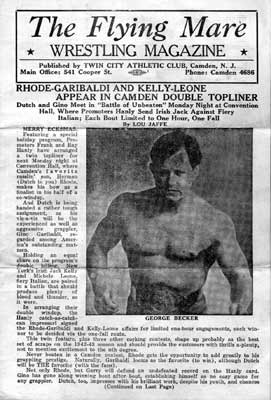
Dutch and Gino Meet in "Battle of Unbeaten" Monday Night at Convention Hall, Where Promoters Hanly Send Irish Jack Against Fiery Italian; Each Bout Limited to One Hour, One Fall
The Flying Mare WRESTLING MAGAZINE
Published by TWIN CITY ATHLETIC CLUB, Camden, N. J. Main Office: 541 Cooper St. Phone: Camden 4686
By LOU JAFFE
MERRY [?]MAS
Featuring a special holiday program, Promoters Frank and Ray Hanly have arranged a twin topliner for next Monday night at Convention Hall, where Camden's favorite [?]lin' son, Herman (Dutch to you) Rhode, makes his bow as a finalist in his half of a co-windup.
And Dutch is being handed a rather tough assignment, as his [?] will be the experienced as well as aggressive grappler, Gino Garibaldi, regarded among America's outstanding matmen.
Holding an equal share on the program's double [?], New York's Irish Jack Kelly and Michele Leone, fiery Italian, are paired in a battle that should produce plenty of blood and thunder, as it were.
In arranging their double windup, the Hanly catch-as-catch-can impresario signed the Rhode-Garibaldi and Kelly-Leone affairs for limited one-hour engagements, each winner to be decided via the one-fall route.
This twin feature, plus three other [?] contests, shape up probably as the best set of scraps on the 1942-43 season and should provide the customers with thrills a-plenty, not to mention excitement to the nth degree.
Never beaten in a Camden contest, Rhode gets the opportunity to add greatly to his grappling prestige. Naturally, Garibaldi looms as the favorite (to win), although Dutch will be THE favorite (with the fans).
Not only Rhode, but G[?]y will defend an undefeated record on the Hanly card. Gino has gone along winning bout after bout, establishing himself as no easy game for any grappler. Dutch, too, impresses with his brilliant work, despite his youth, and chances
GEORGE BECKER
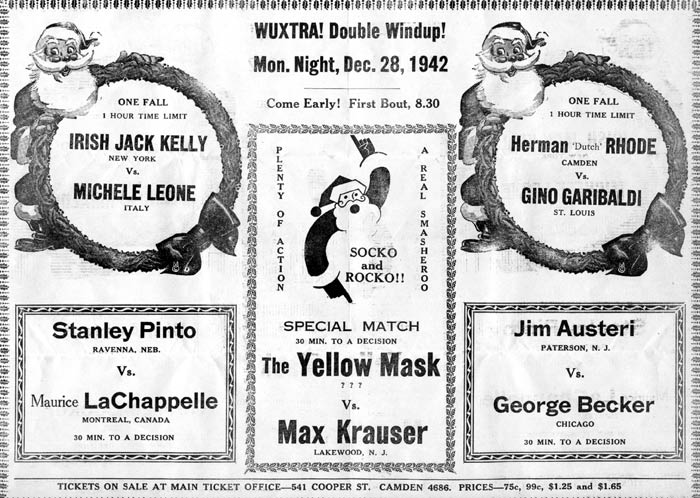
WUXTRA! Double Windup!
Mon. Night, Dec. 28, 1942
Come Early! First Bout, 8.30
ONE FALL 1 HOUR TIME LIMIT IRISH JACK KELLY NEW YORK Vs. MICHELE LEONE ITALY
PLENTY OF ACTION A REAL SMASHEROO
SOCKO and ROCKO!!
SPECIAL MATCH 30 MIN. TO A DECISION The Yellow Mask ??? Vs. Max Krauser LAKEWOOD, N. J.
ONE FALL 1 HOUR TIME LIMIT Herman 'Dutch' RHODE CAMDEN Vs. GINO GARIBALDI ST. LOUIS
Stanley Pinto RAVENNA, NEB. Vs. Maurice LaChappelle MONTREAL, CANADA 30 MIN. TO A DECISION
Jim Austeri PATERSON, N. J. Vs. George Becker CHICAGO 30 MIN. TO A DECISION
TICKETS ON SALE AT MAIN TICKET OFFICE—541 COOPER ST. CAMDEN 4686. PRICES—75c, 99c, $1.25 and $1.65
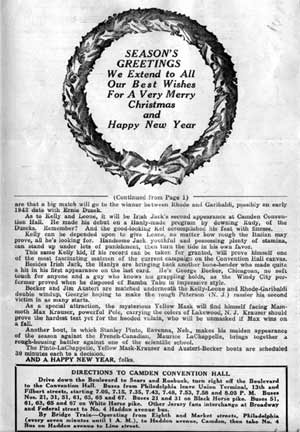
SEASON'S GREETINGS We Extend to All Our Best Wishes For A Very Merry Christmas and Happy New Year
(Continued from Page 1)
are that a big match will go to the winner between Rhode and Garibaldi, possibly an early 194[?] date with Ernie Dusek.
As to Kelly and Leone, it will be Irish Jack's second appearance at Camden Convention Hall. He made his debut on a Hanly-made program by downing Rudy, of the Duseks. Remember? And the good-looking Kel accomplished his feat with finesse.
Kelly can be depended upon to give Leone, no matter how rough the Italian may prove, all he's looking for. Handsome Jack, youthful and possessing plenty of stamina, can stand up under lots of punishment, then turn the tide in his own favor.
This same Kelly kid, if his record can be taken for granted, will prove himself one of the most fascinating matmen of the current campaign on the Convention Hall canvas.
Besides Irish Jack, the Hanlys are bringing back another lone-hander who made quite a hit in his first appearance on the last card. He's George Becker, Chicagoan, no soft touch for anyone and a guy who knows his grappling holds, as the Windy City performer proved when he disposed of Bamba Tabu in impressive style.
Becker and Jim Austeri are matched underneath the Kelly-Leone and Rhode-Garibaldi double windup, Georgie hoping to make the rough Paterson (N. J.) rassler his second victim in as many starts.
As a special attraction, the mysterious Yellow Mask will find himself facing Mammoth Max Krauser, powerful Pole, carrying the colors of Lakewood, N. J. Krauser should prove the hardest test yet for the hooded villain, who will be unmasked if Max wins on a fall.
Another bout, in which Stanley Pinto, Ravenna, Neb., makes his maiden appearance of the season against the French-Canadian, Maurice LaChappelle, brings together a rough-housing battler against one of the scientific school.
The Pinto-LaChappelle, Yellow Mask-Krauser and Austeri-Becker bouts are scheduled 30 minutes each to a decision.
AND A HAPPY NEW YEAR, folks.
DIRECTIONS TO CAMDEN CONVENTION HALL
Drive down the Boulevard to Sears and Roebuck, turn right off the Boulevard to the Convention Hall. Buses from Philadelphia leave Union Terminal, 13th and Filbert streets, starting 7.05, 7.15, 7.[?]5, 7.4[?], 7.[?]8, 7.[?]3, 7.58 and 8.03 P. M. Buses Nos. 21, 31, 51, 61, 63, 65 and 67. Buses 21 and 31 on Black Horse pike. Buses 51, 61, 63, 65 and 67 on White Horse pike. Other Jersey fans interchange at Broadway and Federal street to No. 4 Haddon avenue bus.
By Bridge Train—Operating from Eighth and Market streets, Philadelphia (every seven minutes until 1 A. M.), to Haddon avenue, Camden, then take No. 4 Bus on Haddon avenue to Line street.
Herman 'Dutch' Rohde in Camden, 1942
Buddy Rogers fought under his birth name in Camden early in his career. This advertisement from December 1942 shows him as Herman “Dutch” Rohde.
WWE Hall of Fame
Buddy Rogers was never demure in broadcasting his attributes. So in 1961, when he dethroned Pat O'Connor for the National Wrestling Alliance (NWA) World Title in front of 38,622 fans at Chicago's Comiskey Park, the original “Nature Boy” couldn't resist getting on the microphone and heaping praise on himself.
Said the smug Rogers, “To a nicer guy, it couldn't happen.”
This was Rogers' style throughout his wrestling career, a manner that grated on the wrestlers behind the scenes as much as it did on the spectators. But the inaugural WWE Champion seemed to care little about how he was perceived. He legitimately was great, and even his harshest detractors could do nothing to change that.
Rogers was a former Camden, New Jersey police officer who took the name, “Nature Boy” from a popular song. In the 1950s, he received national exposure while wrestling from Chicago on the old Dumont Network. With his platinum blond locks, rich tan, haughty strut and Figure-Four Leglock, Rogers stood out.
His services were sought all over the country, and are credited with galvanizing business in struggling promotions. His 1961 match with O'Connor set attendance and gate records that would not be surpassed for two decades. But Rogers was considered a difficult person by many peers, and was continuously embroiled in controversy.
In early 1963, he lost the NWA Championship to Lou Thesz in Toronto. While most promotions in the U.S. recognized the title switch, Vincent J. McMahon — father of current WWE Owner, Vincent K. McMahon — and his partner Toots Mondt cried foul. They insisted that the NWA Title could only change hands on a two-out-of-three falls match, and declared the result of the single-fall contest invalid. In fact, they claimed that Rogers had won a tournament to become the titlist of their new company, an organization that would eventually morph into World Wrestling Entertainment.
Rogers did not wear the crown for long. On May 17, 1963, Bruno Sammartino defeated him in 48 seconds in Madison Square Garden. Rogers claimed he'd suffered a heart attack shortly before the match. Sammartino claims the dethroned king was simply making excuses.
After the title change, Rogers vanished from sight, turning up briefly in different promotions, and disappearing almost as quickly. Then, in 1979, he appeared in North Carolina, heckling, then attacking a new “Nature Boy,” Ric Flair, in the Mid-Atlantic wrestling territory.
The “battle of the Nature Boys” was a pivotal moment in Flair's career. “Slick Ric” admitted to emulating many of Rogers' mannerisms and ring moves. But when Flair defeated his idol with a Figure-Four in Greensboro, he earned the right to proclaim, “To be The Man, you have to beat The Man.”
In the 1980s, Rogers was back in WWE, hosting an interview segment, Rogers' Corner. In an example of enterprising journalism, Rogers discovered that Capt. Lou Albano had misappropriated funds due his protégé, “Superfly” Jimmy Snuka. Rogers began managing the popular Superfly, and occasionally showed traces of the old “Nature Boy” when they paired up in tag team bouts.
Tributes
Buddy Rogers was an out-and-out star. He had a knack for what we call ring showmanship. No one was better than Buddy Rogers. Buddy Rogers… owned every moment in the ring. You'd watch him and forget he had an opponent.
— Lillian Ellision aka The Fabulous Moolah, from her 2002 autobiography The Fabulous Moolah: First Goddess of the Squared Circle
Buddy was so flamboyant. He had a great physique and was very charismatic. Buddy was also very reliable. A tremendous athlete — Buddy was far and away one of the best athletes ever in the business. And very smart, in the ring and outside the ring.
— Vincent K. McMahon, in the book WWE Legends (2006)
I'm not sure a lot of stories about Buddy Rogers are true. But I'm glad to say that THAT Nature Boy did the right thing for THIS Nature Boy. The one thing I learned from the experience (of working with him) was to judge people by the way they treat you.
— Richard Flair aka Ric Flair, in his autobiography To Be The Man… (2004)