Harry M. Dey
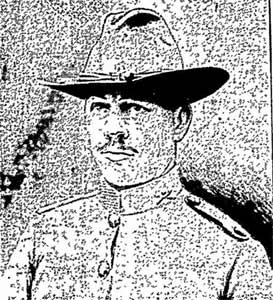
Captain Harry M. Dey.
CAPTAIN HARRY MORTIMER DEY served with National Guard units in Camden in the 1880s and 1890s, primarily with Gatling Gun Company B.
Harry M. Dey was born in Pennsylvania in December of 1863 to B. Franklin and Elmira Dey. He was one of at least four children, the others being B. Franklin Dey Jr., Minnie, and Ada Dey. When the census was taken in 1880 Harry M. Dey was living with his parents on Filbert Street in Philadelphia and working as a messenger. There were members of the Dey family living at 330 Bridge Avenue as early as 1882. By 1886 Harry M. Dey had moved to Camden, and had joined Gatling Gun Company B of the New Jersey National Guard. By that year he had been elected sergeant.
Harry Dey made his home in the late 1880s and early 1890s at 330 Bridge Avenue, and worked for a time as a brakeman with the Pennsylvania Railroad. By 1892 he had gone to work as a laborer at the Campbell Soup Company. By 1894 he had been promoted to clerk. The city directory for that year shows that he had moved to 120 West Street. By the following year he had moved to 119 North 10th Street. The 1898 Directory gives his address as 495 Newton Avenue.
When the Spanish-American War broke out Harry M. Dey was commissioned as a First Lieutenant with the 4th Regiment, N. J. Infantry on June 30, 1898. He was promoted to Captain on November 30, 1898. Honorably mustered out April 6, 1899, he subsequently volunteered for further service and was commissioned as First Lieutenant with the 43rd Regiment, U. S. Infantry, on August 17, 1899 and promoted to Captain, effective September 18, 1899. Captain Dey and his unit were sent to the Philippines, where he served with great distinction against bandits and insurgents, in the rebuilding of towns and villages and administration and institution of civic government in the islands.
When the census was taken on June 30, 1900 Captain Dey was commanding the garrison at Barugo on the island of Leyte in the Philippines. His family was then living at 452 Berkley Street in Camden.
An employee of the Campbell Soup Company prior to going overseas with the Army, Harry M. Dey returned to Camden in July of 1901, and went back to work at Campbell Soup. He married for the second time around 1904, and by the summer of 1910 his wife Mary R. Mulford had borne three children, Clara, Harry M. Jr., and Joseph M. Dey. The Deys were living at 519 South 6th Street. They were still at that address in 1914. By January of 1920 the family had moved to 608 South 5th Street. By this time there were three more daughters, Elizabeth, Mary, and Alice Dey. Another daughter, Jean Dey, was born shortly after the Census was enumerated. The family left Camden not long afterwards, and were in the Woodbury area by 1924. Harry M. Dey and family were living at 18 Hessian Avenue in West Deptford Township by April of 1930.
Gatling Gun Company B
History of Camden County, New Jersey — George Reeser Prowell, 1886
GATLING GUN COMPANY B, of Camden, was organized in 1878 under the new law providing for the organization of two companies of infantry to be drilled in the use of Gatling guns. Captain E. D. French was the prime mover in its organization and the first commandant. The membership was recruited principally from old Battery B. The artillery uniform was worn, and in addition to the Gatlings, the company was armed with rifles and sabers.
John H. Piatt was elected first lieutenant on July 24, 1879, and the first conspicuous public display made by the new company was at Grant’s reception in Philadelphia, December 16, 1879. In 1880 the company participated in the State G. A. R. encampment at Bonaparte Park, Bordentown, and took a prominent part in the sham battle with their Gatling guns. Captain French resigned on April 17, 1880, and Mr. Piatt was elected captain and John J. Brown first lieutenant, George G. Randall having been elected second lieutenant on January 18th. Mr. Randall resigned in June, 1881, and Charles Shivers, Jr., was elected to his position October 13th. Two weeks after this the company turned out in the Bicentennial military parade with its Gatlings.
This command is attached to the Second Brigade under General William J. Sewell as the brigade commander. In September, 1883, Lieutenant Brown resigned and on October 1st Captain Piatt and Lieutenant Shivers also resigned. Lieutenant-Colonel D. B. Murphy was placed in command until December 28, 1883, when its present efficient commandant, Captain Robert R. Eckendorf, was elected. The company was then recruited up to the legal standard. Gatling Gun Company B occupies quarters in the new armory adjoining the Camden Battalion.
The following are its officers and members: Captain, R. R. Eckendorf; First Lieutenant, John R. Jones; Second Lieutenant, G. Walter Garton; First Sergeant, Owen B. Jones; Second Sergeant, James Duffy; Third Sergeant, Harry M. Dey; Fourth Sergeant, Harry Nichuals; Fifth Sergeant, Samuel Grovier; First Corporal, Louis B. Harris; Second Corporal, Harry Tobin; Third Corporal, Ulie J. Lee; Musicians, David Mead, Charles Mead; Privates, Charles M. Baldwin, Harry F. Campbell, Alonzo W. Powers, John J. Chambers, William Grover, David Ewan, Earnest Haines, Leander Hyatt, George H. Beard, Thomas F. Miugen, Samuel C. Grover, John Mulholland, Harry G. Rathgeb, Charles Enger, Jacob Haines, Edwin Hillman, Webster McClellan, Charles A. Fowler, James J. Duffy, Charles H. Jefferies, Frederick W. Kalt, Harry D. Nichuals, William Lawler, Dalgren Albertson, George Middleton, John E. Shannon, John Nixon, George H. Snowhill, William H. Adams, J. R. Smyth, Ralph Bond, Archie S. Royal, G. Parker Johnson, Frank Smith, D. Harry Condit, M. A. Cole, Frank T. Hayes, Charles P. Householder, Samuel Donaldson.
Philadelphia Inquirer — February 18, 1890

Harry M. Dey, a brakeman on the Pennsylvania Railroad, living at 330 Bridge avenue, was thrown from the train at Palmyra yesterday and had a leg broken.
Harry M. Dey, a brakeman on the Pennsylvania Railroad, living at 330 Bridge avenue, was thrown from the train at Palmyra yesterday and had a leg broken.
Gatling Gun Company B vacancies filled after Dey and Martin resign
Philadelphia Inquirer —
* The vacancies caused by the resignation of Lieutenants Harry M. Dey and Storrs Martin, of Gatling Gun Company B, have been filled by the election of the following: First lieutenant, Joseph W. Hinckley; second lieutenant, William Sheridan; junior second lieutenant, D. Harry Condit.
The vacancies caused by the resignation of Lieutenants Harry M. Dey and Storrs Martin, of Gatling Gun Company B, have been filled by the election of the following: First lieutenant, Joseph W. Hinckley; second lieutenant, William Sheridan; junior second lieutenant, D. Harry Condit.
Over in Camden
Philadelphia Inquirer —
OVER IN CAMDEN
Contributions to the Citizens’ Relief Association now amount to $1427.20. Merchants have also contributed groceries and provisions.
The old officers of the Philadelphia and Kaighn’s Point Ferry Company and the Delaware River Ferry Company were re-elected at the annual meetings, of the stockholders yesterday.
Charged with robbing the till of Saloon Keeper Jonathan J. Cox, of Fourth and Mechanic streets, of $1.38, Charles McCann was committed to the county jail by Mayor Westcott.
The advisability of the Democratic party forming a combination with the Committee of One Hundred in the coming municipal election was discussed at some length by the Americus Club on Monday night, but no conclusion was reached.
Annual meetings of the stockholders of the National State, First National, Camden National and Haddonfield National Banks and the Security Trust and Safe Deposit Company, of Camden, were held yesterday, when the, old Boards of Directors were re-elected.
At the annual meeting of Gatling Gun Company B the following officers of the civil organization were elected: Secretary, Sergeant William E. Andrews; treasurer, Harry M. Dey; Executive Committee, Edward Austermuhl, G. Walter Carton and Samuel Burr.
In Camp at Sea Girt
Bridgeton Evening News —
IN CAMP AT SEA GIRT.
The Woodbury Company With the Bridgeton Volunteers Expected to Reach There To-Day.
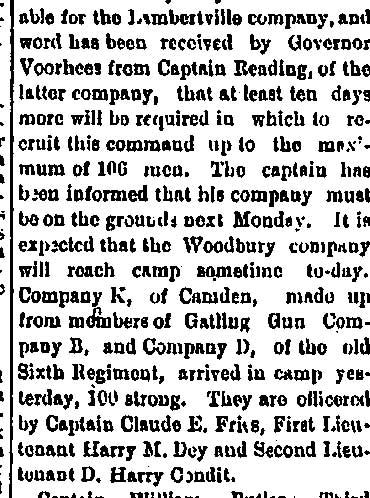
Camp Voorhees, Sea Girt, July 15. No evidences were visible yesterday of the terrific hammering of the State camp sustained from the storm of Wednesday, and the soldier boys all appeared as serene and happy as if they had never been drenched to the skin and rendered shelterless. Some vexatious delay in recruiting the men for the Woodbury, Vineland and Lambertville companies will prevent the hoped for completion of the regiment in time for a full regimental dress parade on Sunday, as had been scheduled. Only sixty men are available for the Lambertville company, and word has been received by Governor Voorhees from Captain Reading, of the latter company, that at least ten days more will be required in which to recruit this command up to the maximum of 106 men. The captain has been informed that his company must be on the grounds next Monday. It is expected that the Woodbury company will reach camp sometime to-day. Company K, of Camden, made up from members of Gatling Gun Company B, and Company D, of the old Sixth Regiment, arrived in camp yesterday, 100 strong. They are officered by Captain Claude E. Frix, First Lieutenant Harry M. Dey and Second Lieutenant D. Harry Condit.
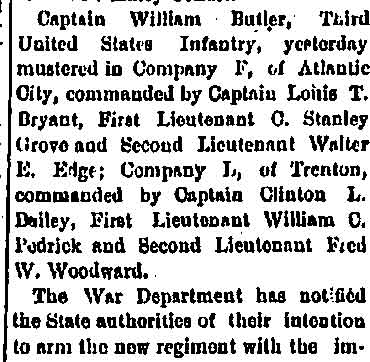
Captain William Butler, Third United States Infantry, yesterday mustered in Company F, of Atlantic City, commanded by Captain Louis T. Bryant, First Lieutenant C. Stanley Grove and Second Lieutenant Walter E. Edge; Company L, of Trenton, commanded by Captain Clinton L. Dailey, First Lieutenant William C. Podrick and Second Lieutenant Fred W. Woodward.
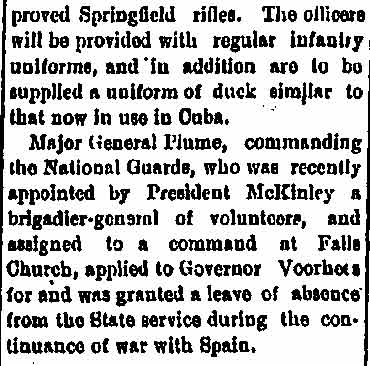
The War Department has notified the State authorities of their intention to arm the new regiment with the improved Springfield rifles. The officers will be provided with regular infantry uniforms, and in addition are to be supplied a uniform of duck similar to that now in use in Cuba.
Major General Plume, commanding the National Guards, who was recently appointed by President McKinley a brigadier-general of volunteers, and assigned to a command at Falls Church, applied to Governor Voorhees for and was granted a leave of absence from the State service during the continuance of war with Spain.
Promotions in the Fourth
Philadelphia Inquirer —
PROMOTIONS IN THE FOURTH
Acting Governor Watkins Signs a Batch of Commissions
Special to The Inquirer.
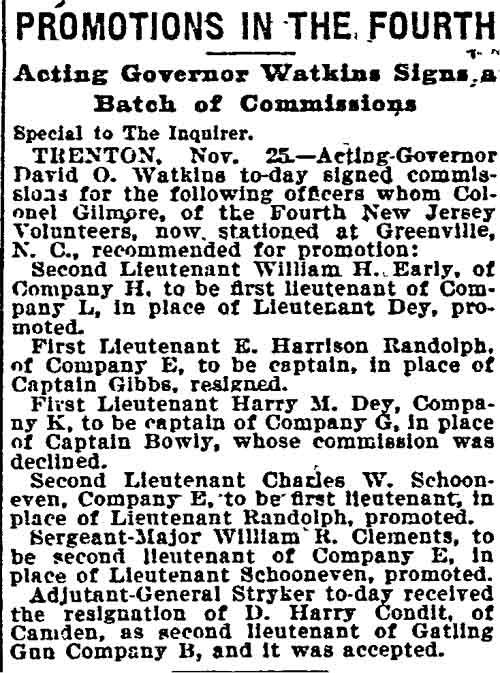
Trenton, Nov. 25.—Acting-Governor David O. Watkins to-day signed commissions for the following officers whom Colonel Gilmore, of the Fourth New Jersey Volunteers, now stationed at Greenville, N. C., recommended for promotion:
Second Lieutenant William H. Early, of Company H, to be first lieutenant of Company L, in place of Lieutenant Dey, promoted. First Lieutenant E. Harrison Randolph, of Company E, to be captain, in place of Captain Gibbs, resigned. First Lieutenant Harry M. Dey, Company K, to be captain of Company G, in place of Captain Bowly, whose commission was declined. Second Lieutenant Charles W. Schooneven, Company E, to be first lieutenant, in place of Lieutenant Randolph, promoted. Sergeant-Major William R. Clements, to be second lieutenant of Company E, in place of Lieutenant Schooneven, promoted. Adjutant-General Stryker to-day received the resignation of D. Harry Condit, of Camden, as second lieutenant of Gatling Gun Company B, and it was accepted.
Called on Governor Voorhees
Trenton Times —
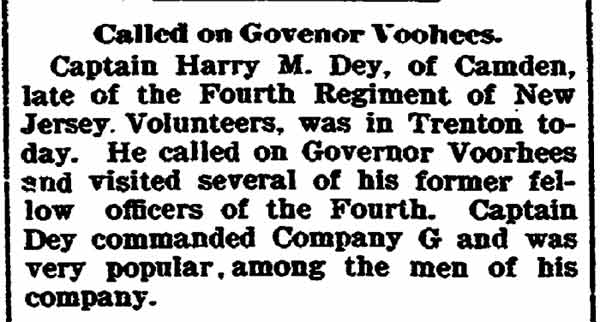
Captain Harry M. Dey, of Camden, late of the Fourth Regiment of New Jersey Volunteers, was in Trenton to-day. He called on Governor Voorhees and visited several of his former fellow officers of the Fourth. Captain Dey commanded Company G and was very popular, among the men of his company.
Will Go to Manila
Jersey Journal —
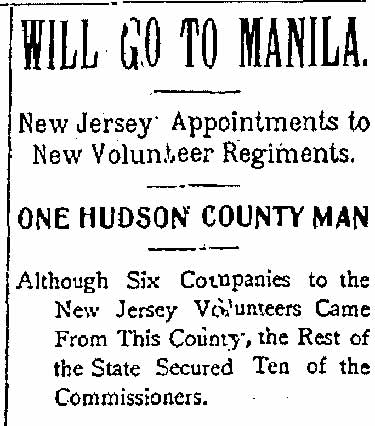
WILL GO TO MANILA.
New Jersey Appointments to New Volunteer Regiments.
ONE HUDSON COUNTY MAN
Although Six Companies to the New Jersey Volunteers Came From This County, the Rest of the State Secured Ten of the Commissioners.
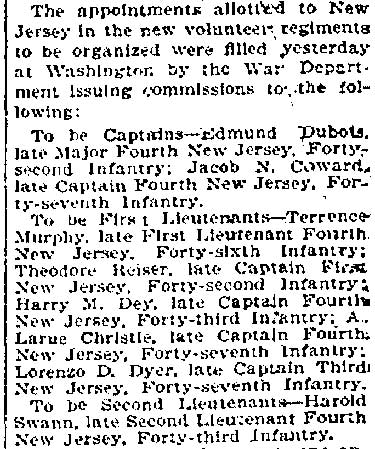
The appointments allotted to New Jersey in the new volunteer regiments to be organized were filled yesterday at Washington by the War Department issuing commissions to the following:
To be Captains—Edmund Dubois, late Major Fourth New Jersey, Forty-second Infantry; Jacob N. Coward, late Captain Fourth New Jersey, Forty-seventh Infantry. To be First Lieutenants—Terrence Murphy, late First Lieutenant Fourth New Jersey, Forty-sixth Infantry; Theodore Reiser, late Captain First New Jersey, Forty-second Infantry; Harry M. Dey, late Captain Fourth New Jersey, Forty-third Infantry; A. Larue Christie, late Captain Fourth New Jersey, Forty-seventh Infantry; Lorenzo D. Dyer, late Captain Third New Jersey, Forty-seventh Infantry. To be Second Lieutenants—Harold Swann, late Second Lieutenant Fourth New Jersey, Forty-third Infantry.
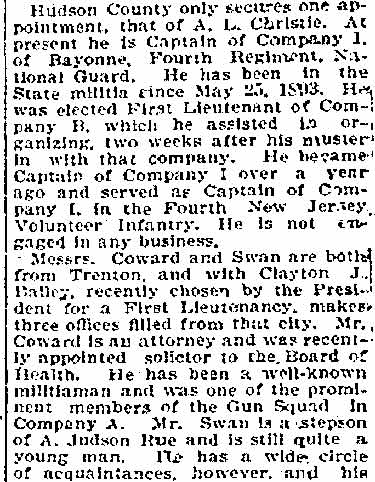
Hudson County only secures one appointment, that of A. L. Christie. At present he is Captain of Company I, of Bayonne, Fourth Regiment, National Guard. He has been in the State militia since May 25, 1893. He was elected First Lieutenant of Company B, which he assisted in organizing, two weeks after his muster in with that company. He became Captain of Company I over a year ago and served as Captain of Company I in the Fourth New Jersey Volunteer Infantry. He is not engaged in any business.
Messrs. Coward and Swan are both from Trenton, and with Clayton J. Bailey, recently chosen by the President for a First Lieutenancy, makes three offices filled from that city. Mr. Coward is an attorney and was recently appointed solicitor to the Board of Health. He has been a well-known militiaman and was one of the prominent members of the Gun Squad in Company A. Mr. Swan is a stepson of A. Judson Rue and is still quite a young man. He has a wide circle of acquaintances, however, and his selection is being generally commended.
Harry M. Dey and L. D. Dyer are residents of Camden. Edmund Dubois is a resident of Woodbury. At present he is a Lieutenant-Colonel of the Third New Jersey Regiment, National Guard, and was formerly Captain of Company E, Woodbury. During the war with Spain he was a Major in the Fourth New Jersey. Dyer is also a member of the Third Regiment, being Captain of Company C. He commanded a company in the Fourth New Jersey during the Spanish war. Dey is a lieutenant in Battery B, and was also an officer in the Fourth Regiment during this conflict. Local officers who served in the Fourth New Jersey Volunteer Infantry are proud of the fact that so far eleven commissions have been issued for the new volunteer forces to former officers of that regiment. Hudson County furnished six companies for the Fourth and now gets one commission. The other parts of the State sent six companies to the same regiment and secure ten commissions.
Report of an Engagement with Insurgents at Catubig, Island of Samar, April 15–19, 1900
Hdqrs. Company H, Forty-third Infantry, U. S. V.,
Laguan, Samar, April 21, 1900. The Adjutant,
Second Battalion, Forty-third Infantry, U. S. V.
Sir: I have the honor to report to you the result of an engagement of the garrison at Catubig, composed of 31 enlisted men of Company H, Forty-third Infantry, U. S. V., with a party estimated at over 600 insurgents, beginning on Sunday morning, April 15, and lasting until rescued by a party under command of First Lieut. J. T. Sweeney on Thursday, April 19, 1900.
About 5.30 a. m. Sunday April 15, the garrison was alarmed by shots coming from the rear of the church on the left side of the barracks. The men immediately prepared to resist the attack. Almost at the same time a heavy fire was opened on them from the hills on the right and left, and also from every available part of the city which could be utilized by the insurgents. This fire was kept up all day long, but the garrison, with great courage and coolness, met and returned the fire, with the result that several insurgents were killed or wounded, the garrison remaining intact. All during the night the firing was kept up, but not quite so heavy as during the day. About 5 a. m. on Monday the firing was resumed, and as each hour went by it became more general. At about 8 a. m. they commenced firing a cannon which was planted on the hill to the right of the barracks, using cut nails and spikes for projectiles. Sergeant George, who commanded the garrison, ordered all the fire from the barracks to be concentrated on this cannon, for the purpose of silencing it, and after two volleys had been fired succeeded in his purpose. Heavy rifle firing was kept up all day and until about 12 p. m., when it lessened up until daylight Tuesday morning, at which time the heavy firing was resumed, about 9 a. m., from the front and across the river, from the cannon, the cannon having been changed to this new position during the night, but a few well-directed shots from the garrison silenced it for the time being. Up to this time but one man of the garrison had been wounded—Private Lee, who was shot on the left arm—but a great number of insurgents had been killed, some from their position in trees, some from trying to charge the barracks. About this time a large number of insurgents had managed to make their way into the church adjoining the barracks and were causing so much trouble that it became necessary to silence them. Sergeant George called for ten men to charge the church and drive them out. The men immediately responded, and under a terribly heavy fire from all sides they succeeded in getting in, and, finding nearly 100 insurgents there, immediately poured several volleys into them, killing a great number. By this time all the firing was centered on the church, and Sergeant George, finding that to remain longer would be fatal to his little band, retreated back to the barracks. This brave deed was accomplished without the loss of a single man. The firing became so heavy and the terrible strain on the men so great from their long and continuous fighting that it required them to put forth their greatest efforts to meet this heavy fire. About this time the insurgents had managed to regain the church, and from the windows made several unsuccessful efforts to set fire to the barracks. Finally they managed to throw some hemp saturated with oil against the building, and succeeded in setting fire to it. All efforts to subdue this fire proved unavailing, and when the building became untenable, the heat being so intense, the garrison hastily decided that the only course open to them was to make a dash for the river and attempt to get across, hoping to intrench themselves on the opposite shore. They destroyed everything which would be of value to the insurgents, divided the ammunition between them, cut a hole in the floor and dropped through one at a time to the basement below. When all of them had gotten through they made a rush for the river. Some of them were killed before they reached the river. Corporal Carson, with 15 men, immediately started to build a trench, using their bayonets to dig with. The rest of the men attempted to cross the river in a boat, but were all killed while getting in the boat. For two days Corporal Carson and his squad held this trench, fighting all the time against great odds, and having 2 men killed and 3 wounded (one of whom, Sergeant Hall, has since died), until he was finally rescued on Thursday morning by Lieutenant Sweeney and his detachment. His report accompanies this one, and shows the difficulties which he encountered in the rescue. A conservative estimate of the number of insurgents killed is upward of 200, but have no record of the number of wounded. The loss we sustained is 18 killed and 5 wounded, one of whom has since died. I also lost a large amount of ordnance stores, quartermaster and commissary supplies, of which I will submit certificate to the officers of those departments.
I desire to call your attention to the excellent work of this small garrison, who for nearly five days and nights successfully held at bay a force of over twenty times the number of their own, and of the many sacrifices they made and the heroic conduct displayed in the protection of their comrades. I also desire to call attention to the work performed by Corporal Carson, who, being the only noncommissioned officer left, used extraordinary good judgment in the handling of his men, thereby saving the lives of the survivors and protecting the wounded until relief came to his aid. I therefore desire to recommend him for a certificate of merit for gallant and meritorious services performed at the fight at Catubig, Samar, April 15 to 19, inclusive. I desire also to call attention to the men who for so long supported the said corporal in this work. The many hardships they endured, the gallant resistance they made, the sacrifices made in the support of their wounded comrades under the most trying circumstances, are all of them acts which call forth the highest praise for their zeal and ability, and is a fitting example of the worth and courage of the American soldier.
The following is the list of casualties of this engagement: Killed: Sergts. Dustin L. George, William J. Hall; Corpls. Herbert Edwards, John F. J. Hamilton; Cook Burton E. Hess; Musician Burton R. Wagner; Privates Trefflic Pomelow, Otto B. Loose, Stephen Apperti, Joseph Noeil, John E. Kuhn, Ralph H. Zinn, Edward Bramen, Chester A. A. Conklin, Walter E. Collins, Joseph J. Kerins, Henry Dumas, Philip Saling, and George A. Slack.
Wounded: Corpl. Lester Rushworth, shot in right leg; Privates Harry C. Lee, shot in left arm; Michael J. Farron, shot in calf of right leg; Corporal White, of Company F, shot near right hip, slight.
Very respectfully,
H. M. Dey,
Captain, Forty-third Infantry, U. S. V.,
Commanding Company H.
Laguan, Samar, P. I., April 21, 1900.
The Adjutant, Second Battalion, Forty-third Infantry, U. S. V.
Sir: I have the honor to report an engagement of a detachment under my command at Catubig, Samar, P. I., on the 19th day of April, 1900.
My detachment, which consisted of 1 corporal and 6 privates of Company H, 1 corporal and 9 privates of Company F, Forty-third Infantry, U. S. V., embarked at Laguan on the steamer Lao-ang 7.30 a. m. on the 19th of April, 1900, en route to Catubig, where I had orders to resume command of that garrison. When we had reached a point about 1 mile from Catubig the captain of the steamer was compelled to stop his boat because the river was blocked with trees lashed together, and it was impossible to proceed farther without damaging the steamer. I immediately procured all the axes available and, lowering the small boats, landed a corporal and 4 men on each side of the river to stand guard while I took the remainder of the men to the blockade, which we destroyed after much hard work. A tree 100 feet high, bordering on the river bank, was cut at the base, so that a strong pull on the ropes that were tied near the top and stretched across the river to the other bank would have formed a second blockade almost as complete as the first. Those ropes my men cut and destroyed. In four nipa houses on the banks of the river, which had been used as barracks by the insurgents, I found over 100 pounds of fresh beef, which I ordered to be thrown in the river, and 150 pounds of rice, which I confiscated. I ordered those houses burned, and proceeded down the river. When within a quarter of a mile from Catubig noise of an engagement could be heard coming from that direction, and I ordered the captain of the steamer to run his boat at full speed, and we steamed into a fire of Mauser rifles coming from every direction. My men immediately returned the fire. I had the small boats lowered and prepared to load after calling to the men of the garrison to locate their position, as their barracks and a part of the village were in ashes and other houses were burning. Leaving 3 men on the steamer with orders to hold it, I immediately proceeded to make a landing, but before every man was able to get into boats Corporal White, Company F, was shot in the left side, and Private Farron, Company H, in the calf of right leg. These two men were put back on the steamer and we started for shore, rifle fire coming from both sides of the river. We fortunately made a landing and were compelled to fight our way across open ground to rescue our men, who were in some tall grass, a distance over 75 yards. Private Clancy, Company H, was shot in the right instep in our advance across this ground. There was no cover of any kind that we could avail ourselves of, and we were placed in a position in the center of a circle of rifle fire on open ground. We could have taken a position in the grass, where we could not be seen, but by doing so we could not command a view of the enemy’s movements. I sent two men in there to bury Privates Pomelow and Loose in the trenches the men had made while we guarded them, the insurgents continuing the fire and we returning it. As soon as I could I got the wounded men and their companions, 13 in all, into the boats and we boarded the steamer and returned. The streets of Catubig were covered with dead insurgents, and I saw 2 floating down the river. I should estimate their loss was over 200. The town was fortified at every turn, particularly along the river front, where the insurgents used bags of rice, dirt, and hemp for breastworks. On arriving at the place where we had destroyed their blockade I found that they had made another attempt to block our passage, for they had made a rope of long bamboo strips and cane, had attached it to the highest tree and stretched it across the river in the hope that the smokestacks of the steamer would pull it down on us, but the rope was hurriedly and poorly made and snapped.
I strongly recommend the men of my detachment for the bravery and courage and perseverance they displayed in their earnestness to rescue their companions when there was no support available for them if they should lose, and absolutely no retreat. Very respectfully,
Jos. Thos. Sweeney
First Lieutenant, Forty-third Infantry.
Routed a Bandit
Philadelphia Inquirer —
ROUTED A BANDIT
Captain Harry Dey Is Praised For Good Work in the Philippines
Captain Harry W. Dey, a Camden resident and former officer of the National Guard, who went to the Philippines in command of Company H, Forty-third U. S. Volunteer Infantry, is given a glowing tribute for bravery and executive efficiency in a late issue of The American, the new Manila daily newspaper. The paper relates how Captain Dey and his company put to flight a notorious bandit named Abonqui, in Northern Samar. The Camden captain has driven the bandit from his haunts, where he had been in the habit of forcing Filipinos to enlist in the insurgent army, and butchering those who were inclined to be friendly with the Americans. It was a portion of Captain Dey’s company, under command of First Lieutenant Joseph T. Sweeney, who recently held out for four days against an overwhelming force of Filipinos who had ambushed them near Catubig. They were rescued by another detachment, after Lieutenant Sweeney had been wounded five times, and half of his men were killed or disabled.
The Fight at Catubig
New York Times —


THE FIGHT AT CATUBIG.
A Graphic Tale of American Pluck from the Philippines.
Thirty-one Hold Six Hundred at Bay—“An Example of the Courage of the American Soldier.”
Washington, June 8.—The War Department has received reports from Capt. H. M. Day of the Forty-third Volunteer Infantry, and First Lieut. J. T. Sweeney of the same regiment, giving a graphic description of one of the most thrilling and picturesque incidents of the entire Philippine war. The occurrence took place at Catubig, on the Island of Samar, where a party of thirty-one enlisted men of Company H, Forty-third Infantry Volunteers, held at bay a force of some six hundred insurgents during four days of the fiercest fighting, reinforcements arriving just in the nick of time.
According to the reports of Capt. Day and Lieut. Sweeney, who led the relief party, the attack on the garrison at Catubig began without warning on Sunday morning, April 15. From the hills on all sides, from every point of vantage in the town, and from a deserted church directly adjoining came a rifle and cannon fire of terrible intensity. On Tuesday morning handfuls of burning hemp were thrown into the barracks by the insurgents in the church, and soon the soldiers’ refuge was on fire. All efforts to subdue the fire failed, and finally the little band made a dash for the river bank. Some were killed before the bank was reached, others fell dead in a boat in which they were attempting to make the opposite shore, and when a trench was finally dug with bayonets, there were but sixteen of the thirty-one left to man it. Here for two more days Corp. Carson, handling his men with the judgment of a veteran, lay down under a heavy fire, and the rescuers fought their way through the open to their besieged comrades in the trenches, buried the dead within reach, brought back to the boat the besieged party, numbering now only thirteen men, and then steamed down the river.
Capt. Dey bestows the highest commendation upon Corp. Carson as “displaying extraordinary good judgment in the handling of his men, thereby saving the lives of the survivors, and protecting the wounded until relief came.” To each of the little command and their rescuers he gives the highest praise. “Their zeal and ability,” he says, “were a fitting example of the worth and courage of the American soldier.”
Captain Dey Writes of Philippine Fights
Philadelphia Inquirer —
Captain Harry M. Dey, of Camden, the gallant commander of a company of the Forty-third Regiment, stationed at Laguan, Samar, P. I., is experiencing his full share of hostilities in the Luzon. In a letter to Frank A. Johnson, of 120 West street, he tells of a five days’ engagement thirty-one members of his company had with over 600 rebels in the town of Catubig. The fight began on Easter Sunday morning at 5.30 o’clock and lasted until 2 P. M. Thursday. Captain Dey’s company was located in an old frame convent. These barracks were attacked from four sides.
The barracks were burned on the third day and the American soldiers had to seek refuge in trenches they dug along the river in front of where the building had stood. Captain Dey reports: “I lost nineteen killed and five wounded. The enemy didn’t get a thing done to them, 250 killed and I don’t know how many wounded.
“The streets are full of dead,” he writes. “In every house in town and behind the barricades they put up they are piled up. In the church we killed 70 out of 100. It is the worst sight any one would ever care to see, just to walk through the town now or what is left of it.
“I am beginning to have a small company now, over one-third dead or wounded, 22 dead, 14 wounded altogether. I am at Laguan writing this in the barracks, which are fortified with stones and bags of sand, as the rebels are surrounding this place getting ready for another go. Firing keeps up off and on all day and night. We can’t get any sleep until the thing is over.”
The Associated Press dispatches yesterday told of the gallant work of Captain Dey’s little band in his report to the War Department. Captain Dey was for a number of years an officer of a Camden military company.
Sub-report of Captain H.M. Dey — July 31, 1900
Report of Col. Arthur Murray, 43rd Regiment U.S.V.
Barugo, Leyte, P. I., July 31, 1900
The Adjutant, First Subdistrict Of Leyte.
Sir: I have the honor to submit report of the condition of the province of Barugo for the balance of month of July, 1900.
I have had a patrol going continually around the province and over all the roads and paths throughout the country. I have visited San Miguel, which I find still deserted of inhabitants, and I have been unable to come in contact with any large bands of insurgents. All I have been able to discover are in small parties of from five to ten or fifteen, they being simply bent on stealing expeditions; but owing to the nature of the country and their knowledge of it so well, they are able to see us and get out of our reach long before we can come up to them. On July 17 we located a house 3 miles out on the San Miguel road on a trail leading down to the river, which was full of rice, hidden by some of these small bands. On investigation I found it had been stolen, and I sent carts out and hauled it into town, where I am using it to feed police and prisoners. On the 19th, with a detachment, I made a thorough search of the same neighborhood and succeeded in finding a large quantity of clothing contained in chests and boxes hidden in a clump of bushes near the San Miguel River and covered in such a manner that it would have been impossible to discover them except by accident. It required four bull carts to bring it into town, where some of it was identified as being stolen, and I turned it over to the owners; the balance, consisting of men’s and women’s clothing, I have stored in the tribunal, awaiting a claimant. Some of it has been very costly, but exposure to the rains and weather has practically ruined them. About a half mile farther on we found a house occupied by insurgents, some of whom were there and fled on our approach. Found at this place some insurgents’ trousers and a quantity of insurgent military papers, including letters and orders from General Moxica. Also some rolls, evidently intended for pay rolls, with a list of their names on. I have these papers at my quarters now. July 23 Lieutenant Wilson and 15 men, with 20 native police, encountered a party of insurgents on the Tunga road just beyond the crossing of the Jaro road. They attempted to attack the police, but a few shots scattered them; some of them were wounded, but am unable to tell exactly. The police tracked blood trails to the river, where they were lost. Four prisoners were taken; 3 carabaos and 1 pony, all stolen property, were recaptured and restored to the owners, they being identified by brands and marks. I have sent out a large detachment of police, accompanied by soldiers; divided them in smaller detachments to patrol the country; and under their protection a large number of the natives, with all the available carabaos and carts, went out in the country to work and get in supplies. I will do this once a week, which I find necessary in order to keep the town supplied with food. I have recaptured in the past two weeks 8 carabaos and 4 ponies, which had been stolen, and returned them to their owners.
The civil government is gradually improving at each meeting of the town council; the different taxes and licenses are being taken up and settled upon. A list of those already in force you will find further on. At present 148 new houses are being erected and ground is being prepared in a number of places for more. On the site of the recent fire one new one is going up and preparations made for more at the same place. The ground is being cleared to the river on the west side of the town and all streets will be opened to it and bridged across, on the other side of which it is being rapidly cleared; new streets will be laid out and in a short time a new and a very necessary addition to the town will be added. There is not an empty house in town and hundreds of people are jammed in with each other’s families, waiting the opportunities for a place to build their houses. The police force is doing very good work in the way of patrolling the country during the daytime and assisting in guarding the town at night. The town council have arranged a dog tax; licenses for the sale of liquors, both wholesale and retail; one governing fish pounds, and several others which will be put in force as soon as thoroughly understood. The schools are running along regularly with a large number of pupils, about 300 boys and girls, but we are handicapped for the want of books and other supplies for their use. There is a great interest taken by the children in the schools, and as soon as the supplies, which I understood had been ordered before my coming here, arrive, I have no doubt but what they will eagerly and quickly learn American ways. July 31 Lieutenant Wilson and 15 men, accompanied by 10 police, proceeded to Tunga and from there across to the San Miguel road, where they were fired on by insurgents. They immediately replied to it and scattered them, killing 4 and wounding 5 and taking 5 prisoners. I now have in the guardhouse 35 prisoners, all of whom excepting 8 have been captured out in the country and with insurgents. The births during July have been 67, deaths 44, marriages 4.
Very respectfully, H. M. Dey,
Captain, Forty-third Infantry, U. S. V., Commanding Barugo
Sub-report of Captain H.M. Dey — August 16, 1900
Report of Col. Arthur Murray, 43rd Regiment U.S.V.
Barugo, Leyte, P. I., August 16, 1900
The Adjutant, First Subdistrict Of Leyte.
Sir: I have the honor to submit report of the condition of this province from August 1 to 15, inclusive, as follows: I find everything throughout the country very quiet at the present time. Have sent detachments to patrol the different roads and trails every other day with squads of police, but with one exception found it very peaceful. On the afternoon of the 8th we ran into a small party of insurgents, about 15 or 20 in number, who, not knowing we were around, attacked the police squad who were coming in the San Miguel road, about 1 mile above the Tunga road crossing. They soon discovered their mistake and retreated through the brush down to the river, and managed to get across and out of sight before we could get to them. It coming on darkness, we came back into town. One volley was fired at them and one prisoner taken. Reports coming in since are to the effect that several of them were wounded, but I have no proofs only from natives wandering into town. I have selected 9 of the police force, and when a detachment goes out they go with them, taking rifles, which I loan them, and with about 10 to 20 of the other police with bolos, I find they can do very good work. I also find by working these reliable natives this way has a very good effect, and seems to have a tendency to make the insurgents give this section a wide berth. I have sent out copies of the amnesty proclamation, one of which I managed to have delivered to “Captain Domingo,” and received a note from him saying he would be unable to give in unless he received orders to that effect from his superior officer. But I am certain that sooner or later all of them will be willing and glad to come in. They are very near starving, have no clothes, sickness is coming on them, and they are being driven from place to place, and the mountains at present offer no shelter on account of the frequent rains we are having, so that I think it is safe to predict that in a short time will witness the breaking up of the bands of ladrones. The civil government of the town is getting along in a very fair shape, while the natives are very intelligent. Yet it requires considerable work to guide them and keep them within the limits as published in General Orders, No. 40, everything being so much different than what they have been used to doing. But they are making good progress and are very anxious to keep straight.
A large number of new houses are going up all over town. The new street on the other side of the river, west of the town, is rapidly building up. A new road down the beach is being cleared and several buildings are going up. The police are getting a new place fixed up back of the barracks and will vacate the school building which they now occupy so I can have it for school purposes. The schools are getting new additions of pupils every day, and so far have 248 boys and 218 girls. But we are in need badly of books and all the necessary school supplies to properly run them. The sanitation of the town is being looked after, but owing to the great amount of work necessary to properly drain it, and the absence of the proper tools to work with, the work goes on slowly, and in time we will have it so the water from the rains will run off, and will also fill up all the low ground, thus preventing the water from forming in pools as heretofore. Considering the large number of people in town, the sickness and death rate is comparatively small. The new market place recently finished is filled up and in operation, and before long it will be necessary to build additions to it to accommodate all the people. I am now getting some houses straightened and moved to allow the opening through of the streets to the new parts of the town, after which I will arrange to have them all numbered. During the past ten days the continuous rains have held us back considerable on work, but we will manage to push ahead slowly.
Very respectfully, H. M. Dey,
Captain, Forty-third Infantry, U. S. V., Commanding Barugo
Sub-report of Captain H.M. Dey — October 1, 1900
Report of Major L.C. Andrews, 43rd Regiment U.S.V.
Barugo, Leyte, P. I., October 1, 1900.
The Adjutant, First And Second Subdistricts Of Leyte.
Sir: I have the honor to report the condition of this province since September 15, 1900. The country at the present time appears to be very quiet. I have received no complaints from the large numbers of natives who go out every day to work of their being molested in any way, as has been the case heretofore. The party of insurgents who have been causing so much trouble in the vicinity of Tonga I have completely broken up and scattered. A large number of them having taken advantage of the amnesty proclamation came in and took the oath of allegiance. There is a band of them in the mountains between San Miguel and Babatungon, and I am now working that part of the country, with very good prospects of cleaning them out. We have discovered and destroyed three of their places in the mountains, burning the buildings used as quarters and a storehouse containing their supply of rice, captured 2 prisoners, killed 2 insurgents, and recovered 4 stolen carabaos.
Lieutenant Sterrett and his detachment returned here on the evening of the 21st, accompanied by Lieutenant Phillips and a detachment of Company F, after having scoured the entire country from Alangalaug to San Miguel. They crossed over and came down through the mountains, discovering and destroying three more quarters used by insurgents.
On September 21 I sent 15 men to Carigara to assist Captain Hanson on an expedition from that place. They returned on the night of the 22d. On September 25 Lieutenant Phillips returned to Alangalang, by way of San Miguel, and Lieutenant Sterrett, with his detachment, left to go overland to Tacloban.
The native scouts, accompanied by detachments of men from here, have scoured the country almost continuously, but find it pretty well cleared up. I have had so far 121 men from different bands come in and give themselves up and take the oath, but they bring in very few bolos and no rifles. They tell me all the men with rifles have gone farther down the coast with their officers, and I think there is some truth in that, as they are very scarce in this section.
I have a prisoner captured in the mountains who confesses to having burned two buildings and to being with four other men in the killing and wounding of several people in this town in June last.
The civil government continues to run along smoothly. Since the breaking up of the lawless bands the people go out in large numbers to work in the country, and planting will commence this week.
The population is still on the increase. Two more new streets are to be added to the town.
The sanitary condition continues good. We had one case of smallpox brought here from another island, but, owing to the effective measures taken, succeeded in preventing any further spread of it. The health of the men continues good. A few cases of fever developed, due to exposure during the work in the country, but they are all in good shape now and are practically well.
Very respectfully, H. M. Dey,
Captain, Forty-third Infantry, U. S. V., Commanding Barugo
Sub-report of Captain H.M. Dey — December 1, 1900
Report of Col. Arthur Murray, 43rd Regiment U.S.V.
Barugo, Leyte, P. I., December 1, 1900.
The Adjutant, First And Second Subdistricts Of Leyte.
Sir: I have the honor to report conditions of this province for the balance of month of November, as follows:
Everything appears to be quiet in the country. Natives going out to work every day are not molested and report not seeing any organized bands of ladrones or insurgents.
Sunday, November 18, with 30 men of Company H and 10 native scouts I proceeded to Babatungon, being transported in steamer Pittsburg. I found everything quiet and peaceable, the natives being glad of having us come, and informing me of their desire to have some troops stationed at the town, owing to its near proximity to Samar, and being at the entrance to the straits they desired to have some troops for their protection. After staying at Babatungon Sunday and Monday, during which time I scoured the mountains in the vicinity, I left for San Miguel district, going over the mountains. After following all the trails we could possibly get over and making a complete investigation of all that part of the country and finding nothing but lumber camps, I came into Babon and rested for the night. Next day I scoured all the country between Babon and Barugo, arriving at the latter place Wednesday night.
In my opinion, after going over the province, I don’t think there are any organized bands of insurgents in it. Everything in the town of Barugo is running along smoothly. The schools have a good attendance. Sickness is on the decrease; in fact, the health of the town is very good considering the large number of persons cramped into it.
The health of the garrison is good, but one case in the hospital at present, and that one slight.
Very respectfully, H. M. Dey,
Captain, Forty-third Infantry, U. S. V., Commanding Barugo
Sub-report of Captain H.M. Dey — December 15, 1900
Report of Col. Arthur Murray, 43rd Regiment U.S.V.
Barugo, Leyte, P. I., December 15, 1900.
The Adjutant, First And Second Subdistricts Of Leyte.
Sir: I have the honor to submit report of condition of this province during the first fifteen days of this month, as follows:
The town and surrounding country of Barugo is peaceable and quiet; natives are out working all day in the fields planting. That part of the country along the San Miguel River from Sabon to and including San Miguel has during the past week become very unsettled owing to the numerous bands of insurgents who have lately taken their station there.
Thursday morning, December 11, I proceeded to San Miguel with detachment of 25 men, taking rations for detachments from Tacloban. After waiting until the morning of the 13th, I crossed over to Alangalang and turned over the rations to Lieutenant Lindsay. On my way to San Miguel I discovered and destroyed 6 traps placed in the road leading through the canebrake close to San Miguel on the road leading from Barugo. I also destroyed several traps arranged on the sides of the road fixed so as to pierce a man’s side and head.
On the night of the 12th, while the men were preparing to sleep in San Miguel, we were fired on from the bushes in our rear across a small swamp, some 40 or 50 shots. I immediately replied to it by two volleys, and after twenty minutes of scattering shots I drove them off. I had no casualties and do not know how many the insurgents had. Owing to the darkness and the swamp, I was unable to follow them up.
On the 13th I proceeded to Alangalang, finding and destroying several traps along the road; also two dummies arranged in lookout shacks on the side of the road. After getting rid of my rations at Alangalang, I proceeded to Jaro and stayed over night and arrived in Barugo 12 o’clock, December 14, coming by way of Tunga.
The civil government is progressing as usual, schools are being run as usual, and since some of the books and charts arrived the children are rapidly learning.
Very respectfully, H. M. Dey,
Captain, Forty-third Infantry, U. S. V., Commanding Barugo
Sub-report of Captain H.M. Dey — December 31, 1900
Report of Col. Arthur Murray, 43rd Regiment U.S.V.
Barugo, Leyte, P. I., December 31, 1900.
The Adjutant, First And Second Subdistricts Of Leyte.
Sir: I have the honor to submit report of the condition of this province for the last half of December, 1900, as follows:
On the afternoon of the 14th a squad came in by boat, bringing information that Lieutenants Swann and Leaf, with detachment, had been attacked about a mile above Sabon while on their way from Babatungon, and 2 of their men killed and 5 wounded, including Lieutenant Leaf. I immediately dispatched squads along the beach, and also sent boats to get the wounded and bring them to the hospital at this place. At 4.30 p. m. they returned, bringing Lieutenant Leaf, who was badly wounded twice in right leg; Private Carr, Company L, who died same night; Private Higgins, Company L, who died on December 16, 1900; Privates Taylor, Company L, and Lucier, Company K. It was found necessary to amputate Lieutenant Leaf’s leg above the knee in order to save his life, and the operation was performed successfully by Major Combe and A. A. Surg. J. F. Leeper December 19. Privates Higgins and Carr’s bodies I buried on the lawn in front of the church near the bell tower. The graves are marked and numbered 1 and 2, respectively.
December 10 I sent Lieutenant Wilson and 30 men to Sabon to try and capture or kill this band who had attacked Lieutenant Swann, but they had abandoned the place and fled before his arrival. December 16 I took the steamer San Bernadino, which had just come in the harbor, and with a detachment of 30 men proceeded to Babatungon, where I found Lieutenant Lindsay, with his detachment, had arrived from Alangalang, coming over the mountains from San Miguel. He had 1 prisoner, captured near Sabon, and who, I am convinced, was one of the party that attacked Lieutenant Swann. By closely questioning him I find he knows the number of men, time and place of the attack, and also the nature of arms used. Lieutenant Lindsay being out of rations, I loaded his detachment on the steamer, together with the vice-presidente, delegado justicia, delegado rentas, and 1 policeman, all of Babatungon, whom I brought to Barugo as prisoners.
On the night of December 15 Lieutenant Elmer and detachment arrived here, coming from San Miguel. He reported having engagement with insurgents along the San Miguel river, but was unable to follow them up. December 16 Lieutenant Morris and detachment arrived from same neighborhood, but did not see any insurgents. He found the empty trenches, but the insurgents had left before his arrival. December 17 Lieutenants Swann and Lindsay, with their detachments, left here, going by way of San Miguel.
I have had patrols in all parts of this section wherever I could get information of any chance of insurgents congregating—from Sabon to San Miguel and across to Tunga—but was unable to run into any. Several reliable natives of this town who have been working out in the country report that for three days following the fight at Sabon large numbers of insurgents have been leaving the mountains to the south. I have every reason to believe there is considerable truth in these reports, as not a single case of disturbance has been reported by the natives at work through the country, and the patrols have been unable to find any.
December 26 Lieutenant Wilson and detachment of 6 Americans and 12 native scouts started for Tacloban, going by way of Jaro, but owing to the impassable condition of the roads, due to the heavy rains of late, he was unable to proceed, and after making a detour of the country around Tunga returned to this post on the 27th.
I have made two attempts to recover the bodies of Privates Simms and Hamilton, but owing to the heavy seas and winds was unable to succeed. I am getting some boats ready now, and at the first favorable turn of the weather I will get them down to this post for reinterment.
During the past week the continuous heavy rains have made it well-nigh impossible to do any extended outside work. The roads are in an impassable condition from the mud and water, all the rivers are swollen beyond their normal capacities, making it very difficult and dangerous at present to cross them.
Information came in to the effect that Domitigo Umbria has crossed over into Samar, leaving his men here.
The general condition of the country in this province is gradually improving. All that part coming under the jurisdiction of Barugo, including Tunga, is beginning to assume its normal condition. Natives have been planting their crops during the entire month, and the outlook is bright for a return of prosperity in the near future. The hemp districts are again being opened up, and considerable quantities of it is being brought in every day. The roads, owing to the late heavy rains, are soft and muddy, but otherwise in good condition. The Tunga road is an exceptionally good one, being on an average of from 30 to 40 feet wide and a considerable portion of it broken stone. One large bridge on this road is now having the floor finished, after which it will be in very good condition. The San Miguel road is cleared and in good condition up to within a mile of San Miguel. This part of the road runs through a canebrake, and as soon as the weather gets dry enough this cane will be burned in order to effectually clear it off. There are 7 bridges on this road. Two of them I had rebuilt, and 2 of them under way. During the past three weeks, while the numerous bands of insurgents were in this vicinity, they cut these bridges down; also those partly finished, cutting the lumber in them into small pieces. I am arranging to have all of them again rebuilt. The road to Carigara and bridges are in good condition, and other roads in this section are simply trails, and at present they are all in an impassable state from the rains.
From observation of and the necessary frequent intercourse with the natives, I find they are an easy, tractable race of people to handle; are willing and anxious to learn and be guided. This is especially true of the younger people. As a rule they take great interest in learning American ways and customs.
The schools are attended by about 500 children, and there are at least 300 more in the town who in a short time will be available, or as soon as room can be made for them. Four teachers are employed—2 male and 2 female. I have received some American charts and books, and all the lessons are being given from them. As the children are bright and quick to learn, very good progress is being made by them. It is contemplated to erect two additional schoolhouses, as soon as it is possible to get the necessary lumber.
As nearly as can be estimated to the nearest degree of accuracy, the population of Barugo is 12,000. The civil officials and salaries paid to them are as follows: Alcalde, Vedasto Adrales, $75 (Mexican) per month; municipal secretary, Patricio Penas, $40 (Mexican) per month. These officials are bright and energetic, especially the alcalde, through whose untiring efforts the people have been taught to be law-abiding and to accept and assist in the carrying into effect all laws and decrees promulgated by the American Government.
The police force consists of 1 delegado de policia, at $40 (Mexican) per month; 1 captain of police, at $25; 1 lieutenant of police, at $20; 1 sergeant, at $15; 2 corporals, at $12; and 10 policemen, at $10 each. They are armed with 6 Colt’s revolvers, bolos, and short clubs.
There are also 3 municipal clerks, at a salary of $8 (Mexican) each per month.
Names and salaries per month of school-teachers are as follows: Boys—Simeon Ajusta, principal, $20 (Mexican); Pedro Avestues, assistant, $15 (Mexican). Girls— Amular Avestues, principal, $20 (Mexican); Emelia Unneneta, assistant, $15 (Mexican).
The town council consists of 10 councilors elected by the people; no salaries.
Since my occupation of the town four new streets have been opened and built up and 643 new houses erected, a market place built and in operation, a new bridge built connecting the new part of the town, several new stores opened up, and the lighting of the town at night considerably improved.
The building used for hospital, commissary storehouse, and barracks for native scouts are all confiscated buildings, and no rent paid for them. The barracks of United States troops is the upper part of the tribunal, no rent being paid. The building used for officers’ quarters is rented at $50 (Mexican) per month.
There is ample supply of fresh water in the town, but all used by the garrison is thoroughly boiled first.
Very respectfully, H. M. Dey,
Captain, Forty-third Infantry, U. S. V., Commanding Barugo
Sub-report of Captain H.M. Dey — February 28, 1901
Report of Col. Arthur Murray, 43rd Regiment U.S.V.
Barugo, Leyte, P. I., February 28, 1901.
The Adjutant, First And Second Subdistricts Of Leyte.
Sir: I have the honor to submit report of condition of this province during month of February. During the fore part of the month nothing of importance occurred, the time being taken up with cleaning and fumigating the town in order to stamp out the smallpox epidemic, which at the present time has been successfully accomplished. All cases that were found were removed and quarantined outside of town and the houses cleaned and fumigated as well as could be under the condition.
Patrols consisting of armed police, soldiers, and native scouts have been sent out over all parts of the country, but found everything quiet and natives working, planting and gathering hemp, etc. Beginning the first of the month between four and five hundred natives started in to work digging a canal from a point above Tunga for the purpose of irrigating the land south of Barugo. A distance of about 4 miles will be gone over and what has been heretofore nonproductive land will be made, through this irrigation system, of considerable more value. The work is expected to be finished in another month. All labor so far has been voluntary, thereby making it inexpensive to the town.
On the morning of the 11th, with 25 men, I proceeded to San Miguel, where I found everything quiet. I proceeded to the river about 1½ miles south of the town, where I found about 10 bolomen near the trenches. They scattered and fled toward the mountains while I was getting a place to cross. I camped at this place until the morning of the 13th and had patrols out in all directions in the hope of locating them, but they failed to show up. I then moved to a point a mile further east, toward the mountains, and camped near the trail leading to Sabong until the morning of the 15th, at the same time scouring the surrounding country by patrols. I found several traces of them being in the neighborhood, but they were not of recent occurrence. Quite a number of small sharpened bamboo sticks were found, located at convenient places, stuck in the paths, but we destroyed them all without experiencing any trouble from them.
One hombre was seen sneaking through the bushes and as he failed to heed a warning to halt he was fired on and killed; he was evidently one of those who fled from the trenches on our first approach. Nothing more was seen at this place, and I moved further down the Sabong trail and learned that some insurgents with 10 rifles had passed that were from San Miguel, and then returned, going in the direction of the mountains south of San Miguel about ten days before. I stayed at this place until Saturday, 16th; not seeing or hearing anything more I returned to Barugo, making a circle through the country.
On the 19th I sent a patrol of native scouts, police, and Americans under First Sergeant Graham to the district around Sabong, but everything was found quiet.
The schools have been closed during the month on account of smallpox. As it is now practically over I will open them again on the 1st of March.
The hospital has been moved under the barracks, and the offices and police headquarters are located in the building lately vacated by the hospital.
About 7.30 p. m. the evening of 27th, 7 or 8 shots were fired into the town from the bushes east of town. Patrols scoured the entire neighborhood, but in the darkness they escaped.
Very respectfully, H. M. Dey,
Captain, Forty-third Infantry, U. S. V., Commanding Barugo
Sub-report of Captain H.M. Dey — March 15, 1901
Report of Col. Arthur Murray, 43rd Regiment U.S.V.
Barugo, Leyte, P. I., March 15, 1901.
The Adjutant, First And Second Subdistricts Of Leyte.
Sir: I have the honor to submit report for March, 1901, as follows:
March 3. At 6.30 a. m. I left Barugo with 20 men, carrying three days’ rations, proceeding north toward Sabong. After experiencing considerable difficulty in crossing the rivers, on account of the high tides, I arrived at Sabong about 3 p. m., finding everything quiet, and not meeting any opposition. I followed the river leading to and east of San Miguel. I camped for the night midway between the two towns and close by the mountains. On the morning of the 4th, about 6.30 a. m., I proceeded farther on toward San Miguel, stopping at noon at the citio of Gowin. This is the place where a few weeks ago we routed a bad bolo gang, but at present it appears to be very peaceable and quiet. At 1 p. m. resumed the march, arriving in the country east of San Miguel about 5.30 p. m., where I camped for the night. About 5.30 on the morning of the 5th I resumed the march, making almost a complete circle around San Miguel through the country, coming across and striking a point just south of Tunga, where I stopped an hour for rest and dinner, afterwards going across from Tunga to the San Miguel road, and thence into Barugo, arriving at 5.20 p. m. On this trip I did not encounter an insurgent nor hear any warning signals given, a fact which denotes there are very few of them around at present. For several miles the country is getting rapidly under cultivation, large numbers of natives being at work all through it. At Tunga the work of rebuilding has begun, and indications are that in a short time a new town will replace the one destroyed some time back.
March 12. At 6.30 a. m. Lieutenant Wilson and 20 men, with three days’ rations, left for San Miguel, returning here March 14 about 5.30 p. m. He reports having patrolled that part of the country east of San Miguel, but did not see nor hear of any insurgents. In addition, patrols of 10 to 20 men have been going out daily.
The work of repairing the Tunga bridge is progressing, and when finished those of the San Miguel road will be begun.
The peace committee have been busily sending noticias out, in order to get all insurgents to come in, but at present have heard nothing from them.
The schools are running regularly again and continue to be well attended, but it will be necessary to erect larger ones to accommodate all the children.
The health of the town is improving; practically all smallpox has been stamped out. The streets and houses are kept in a clean condition, and nearly all houses are having fences built around them, which materially adds to their appearance, and will also be a means of helping to keep the places clean. The health of the men is in excellent condition, no cases of sickness among them, but one man marked quarters, he having a slight sore foot.
Very respectfully, H. M. Dey,
Captain, Forty-third Infantry, U. S. V.
Sub-report of Captain H.M. Dey — March 15, 1901 (Addendum)
Report of Col. Arthur Murray, 43rd Regiment U.S.V.
Barugo, Leyte, P. I., March 15, 1901.
The Adjutant, First And Second Subdistricts Of Leyte.
Sir: I have the honor to inform you that since finishing my report for March I have received the surrender of Capt. Claudio Claresa and 13 of his men. This occurred this morning, and is practically the last band of insurgents known to be out in this province. Sabong, San Miguel, and Tunga and the intervening country is now clear of them, and arrangements are now being made by the natives to clear and rebuild at all of the above places, also a visita of San Miguel, on the main road from here, about two-thirds of the way out.
The information received from all who have come in is to the effect that Domingo Umbria, after instructing all of them to come in and surrender, gathered all his rifles (18 in all) and crossed the mountains with the intention of going to Samar to surrender. Two other Tenientes, Simon and Clave, refused to come in, and Captain Claresa spent two days in the mountains searching for them in order to bring them in by force, but they finally escaped in boats to Samar.
The last two weeks has witnessed the complete dissolution of the numerous small bands that have infected this province, and unless another force from outside invades here, it is safe to predict that the future will witness a state of progress and advancement that has remained dormant for the past two years. A greater sense of security prevails among the natives in going about their work; outside of town such is very noticeable.
Very respectfully, H. M. Dey,
Captain, Forty-third Infantry, U. S. V.
Sub-report of Captain H.M. Dey — March 31, 1901
Report of Col. Arthur Murray, 43rd Regiment U.S.V.
Barugo, Leyte, P. I., March 31, 1901.
The Adjutant, First And Second Subdistricts Of Leyte.
Sir: The following is the report for the last half of March, 1901.
On account of the peace committee sending natives throughout the San Miguel and Sabon districts for all natives to come in, and as they met with encouraging reports from them, I deemed it wiser not to send any expeditions out in the neighborhoods pending results.
The results have been very satisfactory so far, a large number going into Babatungon, also to Alangalang, while up to date 121 have presented themselves.
The feeling among all seems to be “they have had enough,” and desire to accept terms of peace and take the oath of allegiance. Among those who presented here were 4 lieutenants and 3 sergeants, all of whom had some kind of a small command for various work.
The natives of San Miguel are all desirous of getting the town rebuilt and settling down to work again.
Throughout Tunga district everything is quiet, every insurgent who was known to be in that vicinity having presented and taken the oath. Those around Saining are gradually coming in, while Babatungon is rapidly moving to the front as a peaceful, law-abiding town.
In fact, the pacification of this province at present is almost complete. In Barugo everything continues to run along smoothly; nearly all houses are undergoing repairs of some kind, which, as they are finished, materially adds to their appearance and effect. The town is in a clean and sanitary condition, very little sickness and no cases of contagious disease. The health of the garrison is in excellent condition, no cases of sickness either in quarters or hospital. The schools continue to be well attended, but it will be necessary to erect new buildings with better accommodations, as there are something over 1,000 children here; this will become imperative in the near future.
Very respectfully, H. M. Dey,
Captain, Forty-third Infantry, U. S. V.
Sub-report of Captain H.M. Dey — April 30, 1901
Report of Col. Arthur Murray, 43rd Regiment U.S.V.
Barugo, Leyte, P. I., April 30, 1901.
The Adjutant, First And Second Subdistricts Of Leyte.
Sir: The following is the report for the month of April, 1901.
As everything in this section is quiet, nothing unusual has occurred during the month. All natives have settled down to work, both at rebuilding their former houses and at agricultural pursuits.
April 6. With 35 men I proceeded to Babatungon on steamer Pittsburg, where on the 7th, 8th, and 9th, 190 natives from San Miguel presented and took the oath of allegiance; during the balance of the month several more presented, making the total 233. Trips over the mountains between San Miguel, Saoang, and Babatungon show a state of quiet and peacefulness.
The natives of Sabang are clearing and beginning to rebuild. All from Sabang to San Miguel, along the river, is being built up and populated.
Work at San Miguel is being pushed along, and in a short time the town will be in a fairly good condition. The town of Mahon, between San Miguel and Barugo, is also being rebuilt. Work still progresses at Tunga and Barugo.
During April 105 natives from San Miguel presented at Barugo and took the oath, and after a careful tour of the province, and especially of the parts that have been most affected, I can safely say there are no more insurgents and no signs of insurrection.
At Barugo work of cleaning and improving the town is still going on. The schools continue to be well filled. The health of the town is good; very little sickness among the natives at present. Business, especially hemp, is beginning to improve, and in the course of a month or so no doubt the finances of this section will be greatly improved.
Very respectfully, H. M. Dey,
Captain, Forty-third Infantry, U. S. V., Commanding Barugo
Sub-report of Captain H.M. Dey — May 31, 1901
Report of Col. Arthur Murray, 43rd Regiment U.S.V.
Barugo, Leyte, P. I., May 31, 1901.
The Adjutant, First And Second Subdistricts Of Leyte.
Sir: I have the honor to submit report for the month of May as follows:
The entire district of Barugo at the present time is very quiet, all natives having returned to work in the country and surrounding towns. San Miguel is being rebuilt; also Sabong and Tunga, and in a few weeks both places will be in a better condition than heretofore. The bridge on the road to Tunga has been finished. Two temporary bridges on the San Miguel road have been erected and considerable of the road repaired.
The streets of Barugo are undergoing considerable repairs and cleaning up; sidewalks are being built of coral, and trenches and gutters being built on all the streets.
The civil government is progressing, schools are well attended, sickness has decreased very much. The death rate will be very much less for the month.
Very respectfully, H. M. Dey,
Captain, Forty-third Infantry, U. S. V., Commanding Post
Summary of Principal Events, September 1900 – June 1901
Extract from the Report of the Lieutenant-General Commanding the Army, 1901, part 2, pages 5–87.
September 1, 1900— Capt. Harry M. Dey, with detachment Forty-third Infantry, U. S. V., in skirmish with insurgents about 2 miles from San Miguel, kills 4, wounds 5, and captures 5 and lot of uniforms and unimportant papers.
November 5, 1900— Barrigo, Leyte, P. I., garrisoned by detachment of the Forty-third Infantry, U. S. V., under Capt. Harry M. Dey, is attacked by insurgents and 2 enlisted men are wounded. No insurgent casualties.
June 8, 1901— Detachment of the Forty-third Infantry, U. S. V., under Capt. Harry M. Dey, near San Miguel, Leyte, P. I., destroys insurgent stronghold, killing 2 and capturing 4. No American casualties.
Prepare for Dey Reception
Philadelphia Inquirer —
Members of Battery B, Field Artillery, Third Regiment, N. G. N. J., Camden, last night met and made final arrangements for the reception to be given at the Armory Thursday night next to Captain Harry M. Dey. A general invitation was made to the public to assist in receiving the returned hero from the Philippines.
Reception to Captain H.M. Dey — July 26, 1901

Reception ribbon and badge for Capt. H.M. Dey, July 26, 1901, Camden, N.J.
Camden Gives Greeting to Returning War Hero
Philadelphia Inquirer —
Greater Camden
CAMDEN GIVES GREETING TO RETURNING WAR HERO
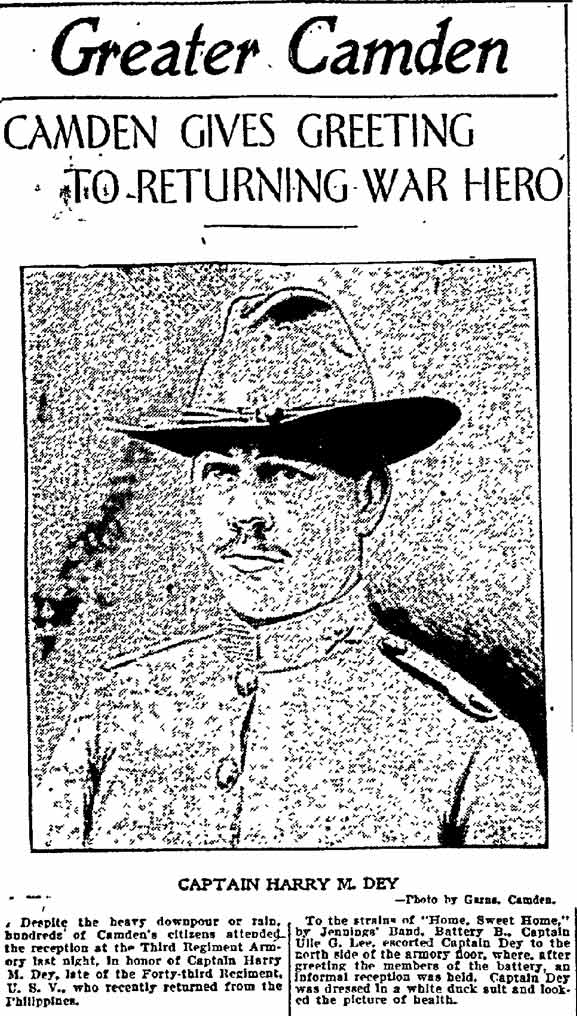
CAPTAIN HARRY M. DEY
—Photo by Garns, Camden.
Despite the heavy downpour of rain, hundreds of Camden’s citizens attended the reception at the Third Regiment Armory last night, in honor of Captain Harry M. Dey, late of the Forty-third Regiment, U. S. V., who recently returned from the Philippines. To the strains of “Home, Sweet Home,” by Jennings’ Band, Battery B., Captain Ulie G. Lee, escorted Captain Dey to the north side of the armory floor, where, after greeting the members of the battery, an informal reception was held. Captain Dey was dressed in a white duck suit and looked the picture of health.
Camden Notes
Philadelphia Inquirer —
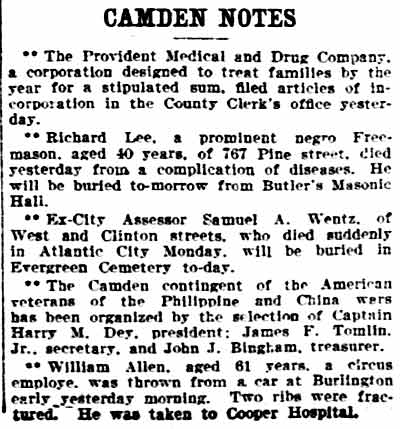
CAMDEN NOTES
The Provident Medical and Drug Company, a corporation designed to treat families by the year for a stipulated sum, filed articles of incorporation in the County Clerk’s office yesterday.
Richard Lee, a prominent negro Freemason, aged 40 years, of 767 Pine street, died yesterday from a complication of diseases. He will be buried to-morrow from Butler’s Masonic Hall.
Ex-City Assessor Samuel A. Wentz, of West and Clinton streets, who died suddenly in Atlantic City Monday, will be buried in Evergreen Cemetery to-day.
The Camden contingent of the American veterans of the Philippine and China wars has been organized by the selection of Captain Harry M. Dey, president; James F. Tomlin, Jr., secretary, and John J. Bingham, treasurer.
William Allen, aged 61 years, a circus employe, was thrown from a car at Burlington early yesterday morning. Two ribs were fractured. He was taken to Cooper Hospital.